Introduction
Social health insurance (SHI) has expanded rapidly as a leading health financing tool and has increased health population coverage to many health systems around the world, including an increasingly large number of developing countries (Hsiao and Shaw, Reference Hsiao and Shaw2007). For instance, the beneficiaries of Popular Health Insurance in Mexico, one of the leading performers in SHI expansion among developing countries, increased from 5.2 million in 2004 at its launch to 52.5 million in 2012 (Rivera-Hernandez and Galarraga, Reference Rivera-Hernandez and Galarraga2015). Likewise, in China, individuals with SHI made up less than 15% of the population in 1998 when SHI schemes were first introduced in the formal employment sector, and by 2011 coverage had extended to 95% (Yu, Reference Yu2015). More importantly, such expansion has occurred not only in terms of the breadth of coverage in the population but also in the comprehensiveness of benefit packages and increased reimbursement rates (Wang et al., Reference Wang, Zheng, He and Jiang2014).
One of the unintended consequences of this phenomenal expansion is the segmentation of the SHI system across different populations covered. In the case of China, for instance, there are three separate schemes for different groups: the Urban Employee Medical Insurance (UEI) scheme covers urban residents with formal employment, the Urban Resident Medical Insurance (URI) scheme covers the urban unemployed and the New Cooperative Rural Medical Insurance Scheme (NCMS) covers rural residents. Based primarily on an individuals’s place of residence (i.e., rural or urban) and occupation, these three schemes differ considerably in terms of levels of premium, coverage of health services and reimbursement rates. Studies have found that health care utilisation is significantly lower among the rural population enrolled in NCMS, as compared to the urban population enrolled in other types of SHIs (Meng et al., Reference Meng, Fang, Liu, Yuan and Xu2015). Significantly, the reimbursement rate was found to be 10% lower and service coverage was less comprehensive for NCMS as compared to UEI and URI (Meng et al., Reference Meng, Fang, Liu, Yuan and Xu2015).
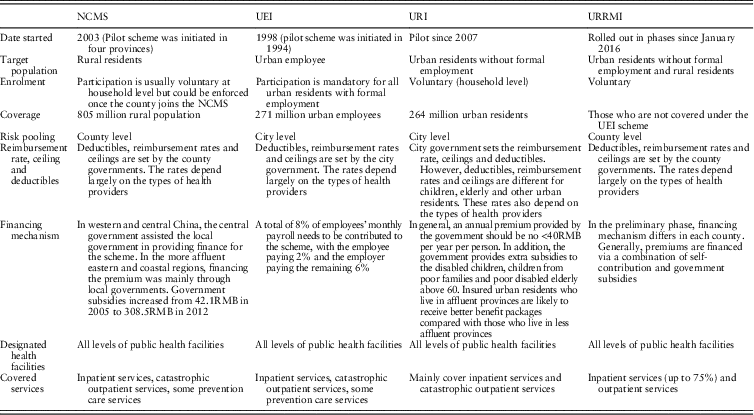
Critically, the segmentation of SHI has led to considerable disparities in access to health care and financial protection across different sections of population. Studies have found that the NCMS had little impact on reducing out-of-pocket (OOP) payments among low-income enrollees (You and Kobayashi, Reference You and Kobayashi2009; Yang and Wu, Reference Yang and Wu2015); the URI scheme was also demonstrated to have driven up health costs without necessarily reducing OOP expenditures (Liu and Zhao, Reference Liu and Zhao2012) (Table 1 and Box 1).
Key features of New Cooperative Rural Medical Insurance Scheme (NCMS), Urban Employee Medical Insurance (UEI), Urban Resident Medical Insurance (URI) and Urban and Rural Resident Medical Insurance (URRMI)

Source: Barber and Yao, (Reference Barber and Yao2010), Shen (Reference Shen2014), Meng et al. (Reference Meng, Fang, Liu, Yuan and Xu2015).
Types of social health insurance schemes in China

Since January 2016, the Chinese Government has begun to phase in the Urban and Rural Resident Medical Insurance (URRMI) scheme across different localities with the aim of merging both URI and NCMS and as a first step towards eventual integration of all existing SHI schemes under a single-payer scheme in the near future. Establishing a unified SHI by 2020, with the aim to close the gap of rural/urban health disparity by improving the benefit packages for the rural subscribers, is one of the key priorities of China’s health care reform (The State Council of People’s Republic of China, Reference Tang, Tao and Bekedam2016).
While it is typically assumed that unifying all SHI schemes to a single insurer system would help to reduce disparities in access and health costs across populations (Hussey and Anderson, Reference Hussey and Anderson2003), the actual impacts of such unification, however, are far from certain based on the experiences of a number of countries (Cheng, Reference Cheng2003; Atun et al., Reference Atun, Aydin, Chakraborty, Sumer, Aran, Guerol, Nazlioglu, Ozgulcu, Aydogan, Ayar, Dilmen and Akdag2013; Economics Intelligence Unit, 2014). While it is found that the unification of five SHI schemes in Turkey in 2008 led to improved access to care, greater fairness in financing and increased user satisfaction (Atun et al., Reference Atun, Aydin, Chakraborty, Sumer, Aran, Guerol, Nazlioglu, Ozgulcu, Aydogan, Ayar, Dilmen and Akdag2013), experiences in some other Asian countries indicated that the initial stages of SHI integration could be embroiled with fiscal challenges. Indonesia’s National health Insurance Scheme –‘Jaminan Kesehatan Nasional’ – launched in January 2014 aims to integrate various state-owned health insurance schemes into a single-payer SHI, met with problems related to financial insolvency due to a surge in health care demand (Economics Intelligence Unit, 2014). Similarly, the expenditures of Taiwan’s National Health Insurance (NHI), a government-run, single-payer health insurance scheme, outstripped its revenues during the first few years. Although the NHI has made health care more publicly accessible, a study has shown that some doctors in Taiwan tend to over-prescribe treatments covered by the NHI scheme to generate more revenue for the hospitals to then multiply their revenue streams (Cheng, Reference Cheng2003).
The recent policy development in China towards a unified SHI system offers a unique opportunity to study how the expansion and improvement of the benefit packages of SHI may influence health expenditures. Moving from the current system of the co-existence of multiple SHI schemes varying greatly in benefits to a unified system may entail enormous cost implications that have so far received little attention. Drawing data from the China Health and Retirement Longitudinal Study (CHARLS), this study aims to examine the impacts of the degree of generosity of different types of SHI on utilisation of health services, total health costs and OOP health costs. Insights derived from this study may not only contribute directly to the policy discourse on current policy reform in China towards a single insurer scheme, but also improve our understanding on the cost and benefit calculations of various policy options in reforming SHI systems as policymakers in many developing countries are grappling with the challenges in expanding SHI systems towards a more financially sustainable future (Hsiao and Shaw, Reference Hsiao and Shaw2007; Reich et al., Reference Reich, Harris, Ikegami, Maeda, Cashin, Araujo, Takemi and Evans2016).
Methods
Data source
We drew data from the national survey of CHARLS for the years 2011 and 2013. Commissioned by the U.S. National Institute on Aging, the World Bank and the National Natural Science Foundation of China, CHARLS is an ongoing, publicly available, internationally collaborative project that collects data from a nationally representative sample of Chinese residents aged 45 and above. This data set is well suited for our analysis considering that older adults and elderly populations have a higher propensity for health services, and the subsequent impacts on health costs may have more pronounced effects on them as compared to the younger population. In total, 28 provinces and autonomous regions varying substantially in terms of geography, economic development, public resources and health indicators were included in the survey. The first round of CHARLS data collection was conducted in 2011, and a follow-up survey was conducted in 2013.
Variable specifications
Dependent variables
The dependent variables chosen for our analysis are as follows: (1) binary variables of the participation in inpatient and outpatient care conditioned upon the occurrence of inpatient (in the past 12 months) and outpatient (in the past four weeks) visits, and (2) continuous variables of the total health costs and OOP costs of the most recent inpatient (in the past 12 months) and outpatient (in the past four weeks) visits. Total costs were defined as total inpatient costs before insurance claims were made; OOP costs were those paid by respondents after insurance claims were reimbursed. All costs were adjusted for inflation according to the Consumer Price Index for health services in different provinces using 2011 as the base year (National Bureau of Statistics of China, 2013, 2014).
Independent variables
The independent variables of interest for the present study are the SHI variables – UEI, URI, NCMS, URRMI and no insurance (individuals not enrolled in any health insurance schemes). Specifically, respondents were asked to report the type of insurance they had utilised for the most recent inpatient and outpatient visit.
Our analysis also controlled for a set of factors that may have influenced access/costs of inpatient care. These included variables for health needs and for non-health needs among the sample population (Jones, Reference Jones2007; O’Donnell et al., Reference O’Donnell, Van Doorslaer, Wagstaff and Lindelow2008). For health needs variables, our analysis controlled for individual variances that could affect health conditions such as age, gender, marital status, number of chronic diseases that an individual reported to have and number of limitations in activities of daily living (ADL) and instrumental activities of daily living (IADL). ADL refers to routine activities that an individual tends to do every day without needing assistance. There are six basic ADLs: eating, bathing, dressing, toileting, transferring (walking) and continence. IADL refers to the activities that allow individuals to live independently in the community. The IADLs reported in the survey are doing household chores, preparing hot meals, buying groceries, managing finances and making phone calls. The number of self-reported ADLs and IADLs is the aggregate measure of the severity of daily activity limitations.
For non-health-need factors, we controlled for a set of socio-economic variables. Per capita household expenditure was adjusted by household size and the demographic composition of the household (i.e., number of adults and children) using the Equivalence Scale in the past one month (Citro and Michael, Reference Citro and Michael1995) (continuous variable in logarithm function). Education (dummy variable), average per capita disposable income at the provincial level for year 2011 and 2013 (continuous variable) and region of residence (five geographical region dummies – North, Northeast, East, South Central, Southwest and Northwest – with Northwest as the reference category) were included in the analysis.
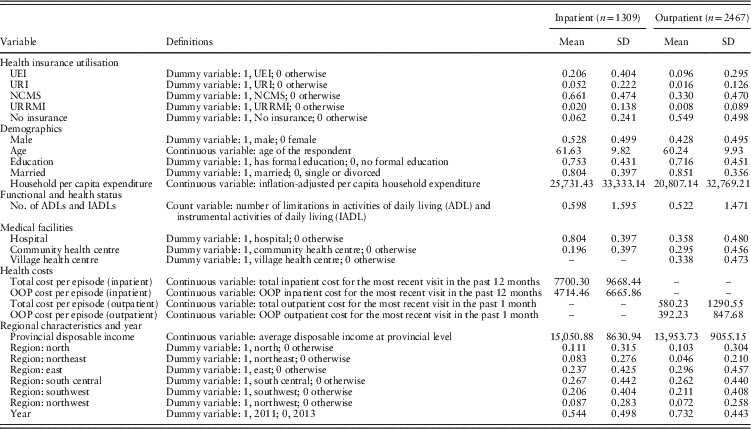
We also controlled for health facilities, which is a crucial supply-side factor that affects health utilisation and costs (Yang and Wu, Reference Yang and Wu2015). Health facility variables were categorised into three groups (village clinics, community health centre and city hospitals) for outpatient analysis and two groups (village clinics and city hospitals) for inpatient analysis. Village clinics is the reference category. Table 2 provides summary statistics of the study sample.
Summary statistics

Note: UEI=Urban Employee Medical Insurance; URI=Urban Resident Medical Insurance; NCMS=New Cooperative Rural Medical Insurance Scheme; URRMI=Urban and Rural Resident Medical Insurance; ADL=activities of daily living; IADL=instrumental activities of daily living; OOP=out-of-pocket.
Empirical strategy
This study incorporated both descriptive and inferential analysis. Descriptive analysis entailed calculating the means and standard errors of the mean costs of inpatient and outpatient total costs, as well as OOP costs across different health insurance utilisations.
Our inferential analysis involved modelling insurance variables to estimate the utilisation and costs of health care for individual participants who reported a history of inpatient visits within the last 12 months and outpatient visits within the last four weeks. In particular, we estimated the determinants of inpatient care utilisation, total costs and OOP costs for both inpatient and outpatient care using a two-part model (2PM) (Jones, Reference Jones2000, Reference Jones2007; O’Donnell et al., Reference O’Donnell, Van Doorslaer, Wagstaff and Lindelow2008). The 2PM comprises firstly of a Probit Model to examine the probability of individual health insurance utilisation on whether the same individual had incurred any costs on a recent inpatient and/or outpatient visit as a proxy for health service utilisation and, second, an ordinary least squares (OLS) model applied to determine the relationship between health insurance utilisation and health costs only to the population that incurred nonzero costs. We also included community fixed effects with standard errors clustered at the community level to account for heterogeneity across various urban and rural communities. This decision was guided by our assumption that there were unobserved factors at the community level that were correlated with other regressors in our model (Cameron and Trivedi, Reference Cameron and Trivedi2005).
In modelling health care costs, both the 2PM and Heckman Selection Model (HSM) are frequently used to analyse limited dependent variables (Dow and Norton, Reference Dow and Norton2003; Norton et al., Reference Norton, Dow and Do2008). In our study, we chose to model both inpatient and outpatient utilisations and costs using 2PM. We had considered HSM but did not apply this model due to the following reasons. Theoretically, 2PM assumes that both seeking treatment and actual health costs incurred are independent and discrete decisions (Madden, Reference Madden2008). On the contrary, HSM allows both decisions – seeking treatment and health costs – to be influenced by distinct but correlated observable and unobservable factors (Jones, Reference Jones2000, Reference Jones2007). The potential health costs would have an impact on an individual’s decision to seek treatment in the first place. Intuitively, both treatment-seeking and health cost decisions for outpatient treatment are unlikely to be correlated as outpatient costs, relative to inpatient costs, and are less crucial in influencing an individual’s treatment decision. This is especially the case in China whereby inpatient treatment decision is highly correlated with socio-economic status, and its high cost could potentially deter populations, especially those from low socio-economic background, to seek treatment (Gong et al., Reference Gong, Kendig and He2016; Jiang et al., Reference Jiang, Wang, Li, Zhang, Zhao, Wang, Ma and Ma2017). Considering this theoretical reasoning, 2PM is more suitable to model outpatient care utilisation and costs as opposed to HSM. We also performed statistical tests to determine whether 2PM is a better model than HSM by generating the inverse mills ratio (IMR) for HSM. The performance of HSM depends on the collinearity between the IMR, which was estimated from the Probit Model for the probability of seeking outpatient care, and the costs of outpatient care in the OLS regression model. The t-ratio test indicated that there was no collinearity between outpatient care decisions and costs, and the Spearman’s rank-order correlation, which is not statistically significant, suggested that there is no effect of selection. Our statistical tests substantiated our theoretical reasoning that 2PM is more suitable than HSM in modelling outpatient utilisations and costs in our analysis. For inpatient treatment, there is, however, a likelihood of the presence of unobserved factors that correlate both the decisions to seek treatment and health costs. This is due to a common belief that inpatient costs are much higher than outpatient costs and may therefore hinder an individual’s decision to seek treatment. Considering these latent factors, we could not conclude whether the zero inpatient costs were actual outcomes or missing potential outcomes due to an individual’s reluctance to seek treatment (Dow and Norton, Reference Dow and Norton2003). To make a statistical decision on which (2PM or HSM) is a better performing model for inpatient care utilisation and costs, we generated an IMR for HSM. The t-ratio test of this relationship indicated that there was no collinearity between an inpatient care decision and costs, and the Spearman’s rank-order correlation indicated no effect on selection, and hence established that HSM was not the appropriate model for this analysis (Jones, Reference Jones2007). Here, we reported only the results of the 2PM for inpatient analysis. Our model specifications are also guided by the fact that all parametric assumptions are reasonably fulfilled with histograms showing fairly normal distributions of all the cost data. For all analyses, the computation of a variance inflation factor (VIF) was performed, and results indicated that multi-collinearity was not a problem. Ramsey tests for linear regression models and Hosmer–Lemeshow tests for probit models were also performed, and results showed that our models did not have specification problems.
Results
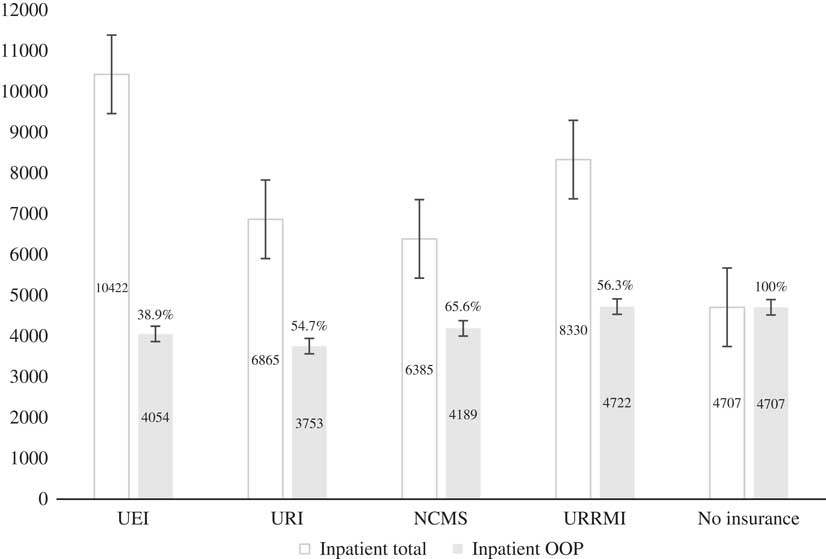
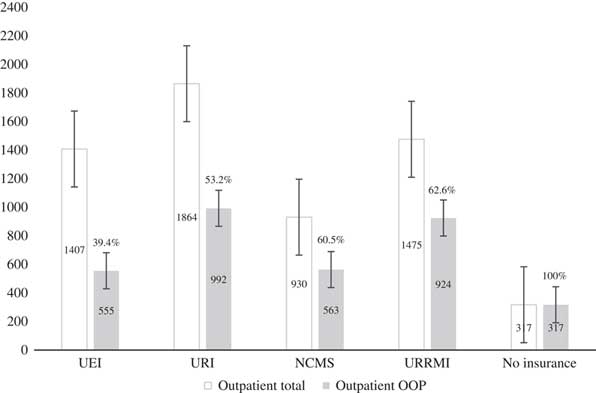
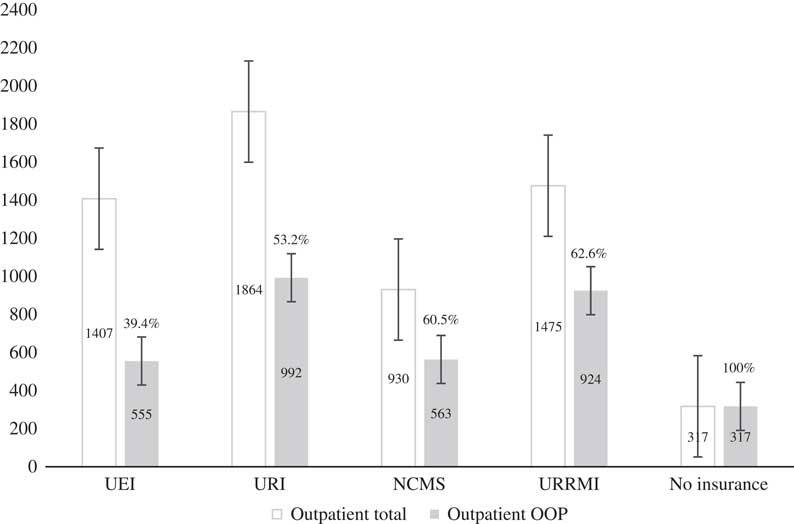
We first compared the mean total costs and OOP costs among different SHI participants for both inpatient and outpatient care. Figure 1 shows the mean of total and OOP costs for individuals who utilised different health insurance schemes at the most recent inpatient visit over the last 12 months. Individuals who utilised UEI, which is the most generous health insurance scheme, reported mean total cost of RMB10,421.60 (USD1562.45), as opposed to RMB4707.00 (USD685.06) from individuals who had no health insurance. Individuals who utilised UEI, URI, URRMI and NCMS for their most recent inpatient visit reported a lower share of OOP costs as a percentage of total cost (38.9, 54.7, 65.6 and 56.3%, respectively, on average) as compared to their counterparts with no health insurance who paid 100% of the total cost OOP. Comparison of the mean total health costs for different SHI schemes also indicated that people who utilised UEI incurred significantly higher cost per inpatient episode as compared to people who utilised other SHI schemes and people with no insurance. Comparing the most recent outpatient visit cost for individuals who utilised different health insurance schemes, Figure 2 shows that individuals who utilised URI incurred the highest mean cost (RMB1863.60 or USD279.39), followed by URRMI (RMB1475.40 or USD221.19) and UEI (RMB14,071.10 or USD2109.66). This is in contrast to relatively lower mean scores reported by individuals who utilised NCMS (RMB929.70 or USD139.40), and an even lower mean reported by individuals who had no health insurance (RMB317.00 or USD46.14). As for OOP costs for most recent outpatient visit, people who reported health insurance utilisation in their most recent outpatient visit also incurred lower share of OOP as a percentage of total cost as compared to individuals with no health insurance (39.4% for UEI utilisation; 53.2% for URI utilisation; 60.5% for NCMS utilisation and 62.6% for URRMI utilisation on average). Nevertheless, the relatively higher absolute OOP expenditures for health insurance enrolees as compared with individuals with no health insurance begets a follow-up question as to whether health insurance enrolees have tendencies to seek more treatment in outpatient settings, hence incurring higher absolute costs, as compared to people with no health insurance. If this holds true, the higher absolute costs could be perceived as desirable costs that are preventive in nature, potentially lowering the chance of seeking inpatient care in higher-level facilities that are more exorbitant. If this does not hold true, it suggests that the financial protection effects of health insurance towards outpatient care could be limited. Previous studies also reported that health insurance schemes in China had not been able to reduce OOP payment among the enrolees (Wagstaff and Lindelow, Reference Wagstaff and Lindelow2008; Liu and Zhao, Reference Liu and Zhao2012; Yang and Wu, Reference Yang and Wu2015). Our data do not allow us to decipher the underlying reason behind this trend. However, understanding the reasons behind the broad trends of higher absolute outpatient OOP expenditures among health insurance enrolees would be an interesting and important question to undertake in the future.
Comparison of the mean of most recent inpatient total and out-of-pocket (OOP) costs across different health insurance schemes (mean/SE). Note: UEI=Urban Employee Medical Insurance; URI=Urban Resident Medical Insurance; NCMS=New Cooperative Rural Medical Insurance Scheme; URRMI=Urban and Rural Resident Medical Insurance. % indicates percentage of inpatient OOP mean cost out of inpatient total mean cost. All costs are measured in Chinese RMB.

Comparison of the mean of most recent outpatient total and out-of-pocket (OOP) costs across different health insurance schemes (mean/SE). Note: UEI=Urban Employee Medical Insurance; URI=Urban Resident Medical Insurance; NCMS=New Cooperative Rural Medical Insurance Scheme; URRMI=Urban and Rural Resident Medical Insurance. % indicates percentage of outpatient OOP mean cost out of outpatient total mean cost. All costs are measured in Chinese RMB.
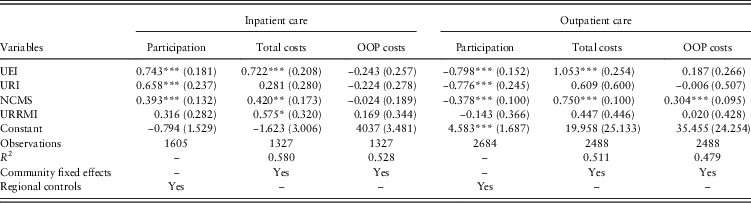
We subsequently attempted to disentangle the effects of different health insurance schemes of various generosity levels to both inpatient and outpatient care utilisations and health costs. We employed health insurance utilisation as the independent variable of interest. We reported the results of the 2PM estimating the effects of different health insurance schemes to an individual’s decision to utilise both inpatient and outpatient treatment, as well as the incurrence of inpatient and outpatient costs by comparing total costs before insurance reimbursement with OOP costs after insurance reimbursement in Table 3.
Two-part model for treatment utilisation and costs (inpatient and outpatient)

Note: UEI=Urban Employee Medical Insurance; URI=Urban Resident Medical Insurance; NCMS=New Cooperative Rural Medical Insurance Scheme; URRMI=Urban and Rural Resident Medical Insurance; ADL=activities of daily living; IADL=instrumental activities of daily living.
The probit model for health service utilisation controls for individual characteristics (gender, age, age-square, education, marital status), individual economic status (per capita household consumption expenditure), individual health and functional status (total number of ADL and IADL that one has difficulty with), level of health facilities and regional characteristics (average provincial disposable income and regional dummies), with survey year 2011 as the reference.
The ordinary least squares model for total costs and OOP costs controls for individual characteristics (gender, age, age-square, education, marital status), individual economic status (per capita household consumption expenditure), individual health and functional status (total number of ADL and IADL that one has difficulty with), level of health facilities and regional characteristics (average provincial disposable income), with survey year 2011 as the reference. Community fixed effects with standard errors clustered at the community level were included in the model.
Sensitivity analyses replaced a control ‘number of limitations in ADLs and IADLs’ with ‘number of chronic diseases one reported to have’ as alternative to control for individual health and functional status.
The full main results and sensitivity analyses are available in the Online Appendix.
*Significance at the 10% level; **significance at the 5% level; ***significance at the 1% level.
Results showed that, ceteris paribus, all health insurance participants were associated with a higher likelihood to use inpatient care as compared to the uninsured. The results for UEI, URI and NCMS are statistically significant (p<0.01). The magnitude of increase in using inpatient care for UEI, URI and NCMS participants was 18.4%, 16.3% and 9.7%, respectively, as compared to the uninsured. Turning to the health costs, ceteris paribus, utilisations of UEI, NCMS and URRMI schemes were significantly associated with higher total inpatient costs prior to insurance reimbursement as compared to the uninsured. In particular, per episode total inpatient costs ran approximately 72.2% higher for UEI participants, 42.0% higher for NCMS participants and 57.5% higher for URRMI participants as compared to the uninsured, suggesting that more generous insurance is associated with higher health consumption for the users. Health insurance utilisations have no significant effects on OOP expenditures among all health insurance enrolees as compared to the uninsured.
In terms of outpatient care, the broad trend shows that across China health insurance schemes appeared to have negative associations with the decisions to utilise outpatient care. UEI, URI and NCMS, for instance, indicated statistically significant reductions in probability of seeking outpatient care as compared to the uninsured. This finding may appear bizarre, but further analysis of the data shows that on average only about half of the health insurance enrolees ended up using health insurance in their most recent outpatient visit.Footnote 1 This suggests that health insurance has less influence on making individual outpatient care decisions as compared to inpatient care decisions. Findings for the costs incurred for outpatient care consequent to SHI utilisations corresponded with those of inpatient care, with UEI and NCMS participants shown to be associated with significantly higher total outpatient costs as compared to the uninsured. There are no significant associations between all health insurance utilisations with outpatient OOP expenditures, except for NCMS utilisation, which was found to associate with significantly higher OOP outpatient costs (~30.4%) as compared to the uninsured.
We performed sensitivity analyses, replacing the control ‘number of limitations in ADLs and IADLs’ with ‘number of chronic diseases an individual reported to have’, a highly correlated variable, to check for robustness of our regression models. Our sensitivity analyses correspond with our main results.
Discussion and conclusion
This study sheds light on the relationships between health insurance generosities and health-seeking behaviours, and the subsequent health costs incurred among the adult population aged 45 and above in China. UEI, the health insurance scheme that endows its enrolees with the most generous benefits, tends to incur the highest total pre-reimbursement inpatient health costs than the other health insurance enrolees. The same situation in which the most generous SHI tends to incur the highest charges among patients with the same types of medical conditions has been reported in other countries such as Germany (Krobot et al., Reference Krobot, Miller, Kaufman, Christensen, Preisser and Ibrahim2004) and Thailand (Ngorsuraches and Ungsopanit, Reference Ngorsuraches and Ungsupanit2004). In addition, studies conducted in the United States (Huttin, Reference Huttin2007), Korea (Suh et al., Reference Suh, Kang, Kim and Shin2014) and Mexico (Rivera-Hernandez and Galarraga, Reference Rivera-Hernandez and Galarraga2015) also demonstrated that a patient’s health insurance status did have some influence in determining their access to certain treatment regimens. Our findings suggest that more generous health insurance schemes such as UEI and URI tend to induce higher health consumption as compared to less generous health insurance schemes such as NCMS. The uninsured, likewise, incurred the lowest total mean health costs, which can be explained by their propensity to underutilise treatment due to lack of protection. Our findings point to a more marked effect of supplier-induced demand – a phenomenon that has been widely documented in China due to the profit-driven nature of providers in the public health care landscape (Yip and Hsiao, Reference Yip and Hsiao2009; Zhang et al., Reference Zhang, Hu, Wu, Yu and Dong2015) – for individuals with more generous health insurance schemes.
In terms of OOP payments, the participation in SHI schemes did not result in statistically significant differences in OOP payments for its participants in outpatient care as compared to participants with no insurance. The reductions of OOP payments in inpatient care were all insignificant. Moreover, NCMS utilisations were associated with a significant increase in OOP payments for outpatient care. Consistent with previous studies examining the effects of China’s SHI on financial protection to its enrolees, our findings provide limited support to the claim that participation in SHI would lead to a reduction in OOP payment (You and Kobayashi, 2009; Yang and Wu, Reference Yang and Wu2015). More important, while it is politically popular to make SHI more generous, it should not be taken for granted that more generous SHI schemes will reduce the financial burden of those insured. The NCMS participants, notably, have shown to receive hardly any financial protection in terms of OOP payment reductions.
The higher probability of inpatient care participation as opposed to outpatient care participation observed from the findings in this study is not entirely surprising. The higher tendency to favour inpatient care over outpatient care among the Chinese citizens is most likely a result of how health resources are historically allocated in China. Disproportionately higher medical investments have always been allocated to the second-tiered and third-tiered health care institutions such as big hospitals in the urban areas as compared to first-tiered health care institutions such as village health centres since the 1980s. This situation started at a time when free market economy became the central tenet in driving many areas of public policy reforms in China (Blumenthal and Hsiao, Reference Blumenthal and Hsiao2015; Cheng et al., Reference Cheng, Yuan, Lu and Yang2017). Besides, there exists a sense of distrust towards the primary health system among the citizens (Cheng et al., Reference Cheng, Yuan, Lu and Yang2017), and also a stronger preference to choose higher-tiered health care institutions when deciding on treatment due to a general perception that these institutions are able to provide a higher quality of care (Hu et al., Reference Hu, Liao, Du, Hao, Liang and Shi2016). Even though social health insurance expansion has been launched more than a decade ago and has been fairly effective in improving health access (Blumenthal and Hsiao, Reference Blumenthal and Hsiao2015), findings from our study suggest that there is a need for more policy attention to be placed on strengthening outpatient care provision at the primary health system level.
Since the launch of URRMI by the Chinese government in early 2016, there has been a strong push to merge this with the UEI scheme at the prefecture (county) level in China as the first step towards unification (He and Wu, Reference He and Wu2017). Our findings have important policy implications for policymakers in China and other developing countries that are contemplating a transition from a multiple-payer SHI system to a single-payer SHI system that unifies all existing schemes. Contrary to conventional wisdom that a single-payer SHI system that unifies all existing SHI schemes is more efficient (Hussey and Anderson, Reference Hussey and Anderson2003), our findings suggest that a move towards a unified SHI scheme that is more generous than some of the existing SHI schemes may give rise to health expenditure escalation, which would result in cost burden to the government and individual participants, in part due to the perverse incentives inherent in the current fee-for-service provider payment system in China that reimburses health providers based on the quantity of services delivered. The over-supplying of services and over prescribing of treatment have become norms in medical practices as means to generate additional revenues for the providers.
In recent years, various cost control measures, such as the separation of revenue generation responsibilities and expenditure systems in the health facilities, introducing more transparent pharmaceutical procurement systems and implementing national standard clinical guidelines, were proposed as tangible measures that could be taken at the institutional level to contain health costs in China (Tang et al., 2012). The effectiveness of these measures in overcoming perverse incentives is of critical importance to the success of the unification of SHI.
Besides the above policy options, governance mechanisms ought to be strengthened alongside institutional design reforms in the SHI system. In most countries, strengthening the accountability structures to detect fraud and abuse is a pivotal step in cost control. Experience in Taiwan demonstrated that building a monitoring system to detect malpractice, and ensuring that cost sharing is enforced on the population who did not have to pay for health care previously, stood as an effective check and balance in controlling cost (Lu and Hsiao, Reference Lu and Hsiao2003). In addition, with the dramatic rise in public health expenditure as a percentage of total health expenditure in China from 33.6% in 2001 to 55.8% in 2014 (The World Bank, 2016), reconfiguring the incentive structures within the provider payment systems is another cost control measure that ought to be considered. Literature on provider payment system has generated a general consensus that controlling all other factors, prospective payment systems tend to contain cost better than retrospective payment systems (Jegers et al., Reference Jegers, Kesteloot, Graeve and Gilles2002; Roberts et al., Reference Roberts, Hsiao, Berman and Reich2008). The Korean experience indicates that with increased health access and rising health demand under a unified SHI system, a shift towards a prospective provider payment system is inevitable (Kwon, Reference Kwon2009). A recent study that assessed three cities in China piloting mixed provider payment methods indicated that both a prospective (capitation and global budget) and retrospective (fee-for-service, case-based payment and unit flat rate) financing mix showed positive impacts on the cost control of health care (Tang et al., 2012). These positive outcomes indicate that a gradual shift in provider payment system from the current fee-for-service provider payment method to prospective system such as capitation and global budget in China is the way forward.
As China moves towards the eventual policy goal of integrating SHI schemes into a unified system, many institutional design aspects of unification, which include resetting acceptable premium rates to different segments of the population, optimising cost-sharing levels in the form of deductibles and co-payments and standardising service provisions across the country, warrant careful deliberations (Meng et al., Reference Meng, Fang, Liu, Yuan and Xu2015; Yu, Reference Yu2015). Likewise, an SHI system that ensures social solidarity necessitates the rich to subsidise the poor. Doing this without causing political backlash requires savvy political acumen. Over time, the government needs to find ways to effectively enhance premium revenue collection – especially from the self-employed and informal sector employees – to ensure political and fiscal sustainability of the system (Hsiao and Shaw, Reference Hsiao and Shaw2007). A unified SHI system that strictly observes cost containment also requires the government to effectively command its monopsony power and strategic purchasing. Solutions towards the challenges above, however, are beyond the scopes of this study.
This study possesses two limitations. While demonstrating that more generous health insurance schemes lead to higher total health costs, such a relation is at most associative. We acknowledge that there might be both observed and unobserved heterogeneities in terms of the design of different SHI schemes across different Chinese localities, and we have attempted to address this by incorporating regional controls and community fixed effects to account for geographical heterogeneities in our analysis. Besides, we acknowledge the limitation of using self-reported household survey data for our analyses, which could be subject to reporting bias. Our study provides an initial insight into the implication of a unified SHI system in China. Moving forwards, the examination of the mechanisms that drive-up health costs for different SHI schemes would be a meaningful research endeavour. Understanding this could provide more profound policy insights to the policymakers in the face of ongoing SHI reform and expansion in China.
Acknowledgement
The authors have no conflicts of interest that are relevant to the content of this paper. This research was partially funded by the Future Research Leadership grant of the Economic and Social Research Council, U.K, and the National University of Singapore Lee Kuan Yew School of Public Policy Graduate Research Scholarship.
Supplementary material
To view supplementary material for this article, please visit https://doi.org/10.1017/S174413311800018X