INTRODUCTION
The tropical rain forests of South-East Asia are renowned as areas of exceptional biodiversity and ecological complexity (Whitmore Reference WHITMORE1991), yet remain highly threatened (Mittermeier et al. Reference MITTERMEIER, GIL, HOFFMANN, PILGRIM, BROOKS, MITTERMEIER, LAMOREUX and DA FONSECA2004). Much of the interest in tropical ecology has concentrated on the variation in diversity across environmental gradients, particularly topographical and landscape features (Hamer et al. Reference HAMER, HILL, BENEDICK, MUSTAFFA, SHERRATT, MARYATI and CHEY2003, Rosenzweig Reference ROSENZWEIG1995). Gaps in the canopy, forming sunny patches on the forest floor, are a major environmental component within tropical rain forests (Hamer et al. Reference HAMER, HILL, BENEDICK, MUSTAFFA, SHERRATT, MARYATI and CHEY2003, Hill et al. Reference HILL, HAMER, TANGAH and DAWOOD2001). Gaps are created by natural tree fall, with mature forest canopies naturally existing as a dynamic mosaic of gaps in between closed canopy (Whitmore Reference WHITMORE1991). The ecology of gap dynamics is well documented in plants (Brokaw & Busing Reference BROKAW and BUSING2000, Denslow Reference DENSLOW1987), yet less so for other taxa (Davis et al. Reference DAVIS, HUIJBREGTS and KRIKKEN2000, Feener & Schupp Reference FEENER and SCHUPP1998). Of the arthropods, responses of butterflies to gaps are the best known (Hamer et al. Reference HAMER, HILL, BENEDICK, MUSTAFFA, SHERRATT, MARYATI and CHEY2003, Hill et al. Reference HILL, HAMER, TANGAH and DAWOOD2001, Spitzer et al. Reference SPITZER, JAROS, HAVELKA and LEPS1997).
Comparisons of butterfly diversity between gaps and closed-canopy areas within tropical forests have shown compositional difference between butterfly assemblages in gaps to those in closed-canopy areas (Hill et al. Reference HILL, HAMER, TANGAH and DAWOOD2001). Butterfly diversity and abundance tends to be higher in gaps than in the surrounding shady matrix (Hill et al. Reference HILL, HAMER, TANGAH and DAWOOD2001). The assemblage of butterflies in the canopy is also different to those on the forest floor (Schulze et al. Reference SCHULZE, LINSENMAIR and FIEDLER2001). These tropical rain-forest canopies have few range-restricted butterfly species and their assemblages vary little in response to gaps, and so they do not add much to our understanding of butterfly gap ecology (Dumbrell & Hill Reference DUMBRELL and HILL2005).
Studying natural behaviour in relation to biodiversity enables us to understand how this ecological mechanism influences the specific requirements of species. Dispersal, for instance, is strongly linked to resource-searching behaviours (foraging, mate or lek location, etc.) (Baguette & Van Dyck Reference BAGUETTE and VAN DYCK2007). So, for a species to move through any area, appropriate resources need to be available. Some butterfly species use gaps as territories, and males protect the patch from other males, while waiting for females that are attracted to these gaps (Bergman & Wiklund Reference BERGMAN and WIKLUND2009, Bergman et al. Reference BERGMAN, GOTTHARD, BERGER, OLOFSSON, KEMP and WIKLUND2007, Lederhouse Reference LEDERHOUSE1982). This means that an understanding of the importance of gaps and closed-canopy areas of tropical forests for maintaining butterfly diversity requires knowledge of their behavioural responses.
How butterflies use both natural gaps and closed-canopy areas in tropical forest is important for understanding their resource requirements. In this specific behavioural study, we hypothesize that these northern Bornean species would be more frequent in natural forest openings compared with those in closed-canopy areas, due to behavioural responses to these gaps. We further hypothesize that the closed-canopy nevertheless would be important to particular butterflies, or at least for the behaviours of certain butterflies.
METHODS
Study site and sampling methods
Sampling was carried out at Kuala Belalong Field Study Centre (KBFSC), Universiti Brunei Darussalam in northern Borneo. The KBFSC (4°33′N, 115°09′E) is situated on the north-western boundary of the Ulu Temburong National Park, and is surrounded by steep hills covered in virgin mixed dipterocarp lowland forest (Cranbrook Reference CRANBROOK1993). Ulu Temburong National Park is protected from logging, although occasionally illegal bark stripping for resin does occur (Hedl et al. Reference HEDL, SVATEK, DANCAK, RODZAY, SALLEH and KAMARIAH2009). The climate is typically equatorial with daily maximum temperatures ranging between 30–35 °C with little variation between months (Dykes Reference DYKES2000). There is no distinct dry season, although precipitation peaks around April and November (Dykes Reference DYKES2000), with an annual precipitation of more that 4000 mm (Cranbrook Reference CRANBROOK1993). This is an area of exceptional butterfly diversity, with 324 species recorded within a 1-km radius of the KBFSC (Orr & Hauser Reference ORR, HAUSER, Edwards, Booth and Choy1996).
Four sites were chosen, each at least 500 m from the KBFSC and from each other. Each site consisted of a gap of 20–40 m2 (created by natural disturbance within the forest) and a closed-canopy patch (a demarcated closed-canopy area of equivalent size). Sites were chosen to have similar elevation and typical gaps and closed-canopy patches for the area. Only one site was sampled per day, with the site used for observations rotated every sampling day. Observations began every hour on the hour with the first observation at 10h00 and the last beginning at 15h00. Sampling was suspended if it rained or when cloud cover exceeded 40%. Observations were paired so the gaps and closed-canopy patches of each site were sampled simultaneously. Three observers were used in this study (J.S.P., S.M.V. and P.B.C.G.) and observers alternated between gaps and closed-canopy patches before every observation event to prevent observation bias (Martin & Bateson Reference MARTIN and BATESON1993).
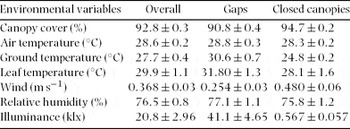
An observation event consisted of a 40-min observation period. Every butterfly which entered a patch was identified, and patch occupancy time was recorded. Behaviour was also recorded, using one of seven ostensive behavioural definitions. If the individuals changed their behaviour within the patch, then the time of each separate behaviour was recorded (Martin & Bateson Reference MARTIN and BATESON1993). The seven behavioural definitions were: feeding, agonistic, courtship or mating, basking, resting, patrolling, or whether the individual was touring through the patch. Basking here is the specific behaviour of the butterfly holding its wings horizontal so the sun can warm its wings, while patrolling differed from touring butterflies when the butterflies showed some searching behaviour. Local environmental variables (EVs) were measured before each sampling observation and these were: air temperature, relative humidity and wind speed using a single hand-held device (Testo 410–2), leaf temperature, ground temperature using an infrared surface thermometer (Testo 810), illuminance using a hand-held light-meter (Testo 540) and percentage canopy cover using a spherical densitometer (Table 1).
Means (± SE) of environmental variables for all observation events with both forest gap and closed-canopy plots combined and separate in Bornean tropical rain forest.

As it is difficult to distinguish tropical butterfly genera on the wing (Walpole & Sheldon Reference WALPOLE and SHELDON1999), at least two specimens of each butterfly species recorded in this study were collected. After each observation period recorded butterflies were captured, where this was not possible, identical butterflies from the same space and time were captured, and if this was not possible then butterflies were identified from observer's notes and previous knowledge. Only the 20 most frequently recorded species where observed. These specimens were positively identified using Otsuka (Reference OTSUKA2001) and the butterfly collection at the Universiti Brunei Darussalam. Voucher specimens were deposited at the invertebrate collection at the Universiti Brunei Darussalam.
Sampling occurred during the whole of August (a relatively dry month with monthly precipitation c. 200 mm; Dykes Reference DYKES2000) and early September 2008. A 14-d time span was used to gather all the observations. During this time, we had a total of 61 paired observation events (i.e. 40-min observation periods) for both the gap and closed-canopy patches. This resulted in 122 observation events, giving a total of 81 h and 20 min of observation time. These repeated behavioural observations are not considered replicates per se, but as sequential observation events (at four localities) of behavioural activities. The subsequent statistics chosen had to take this sequential recording into account and not to view them as true replicates.
Statistical analyses
Generalized Linear Mixed Models (GLMMs) with Poisson distributions and log link functions were used to compare patch occupancy time and abundance between gaps and closed-canopy patches per observation event for each species. GLMMs were chosen as our data had non-normal distributions and the variances were heterogeneous (O'Hara Reference O'HARA2009, Zuur et al. Reference ZUUR, ELENA and ELPHICK2010). GLMMs combine the properties of two statistical frameworks: namely linear mixed models (which incorporate random effects) and generalized linear models (which handle non-normal data by using link functions distributions; Bolker et al. Reference BOLKER, BROOKS, CLARK, GEANGE, POULSEN, STEVENS and WHITE2009). GLMMs treat random effects as covariant to the other fixed effects, and thus their variation is treated similarly to the error variance in the linear model (McCulloch et al. Reference MCCULLOCH, SEARLE and NEUHAUS2008). This effectively removes the influence of site and observer bias in these results, without having to assume the data are normally distributed like the more traditional repeated-measures ANOVA. As these models allow both random and fixed effects to be analysed together, it enabled us to overcome statistical biases from random effects (such as sites and observers in this study) while testing the fixed effects (Bolker et al. Reference BOLKER, BROOKS, CLARK, GEANGE, POULSEN, STEVENS and WHITE2009).
The fixed effects tested were: whether the patch was a gap or closed-canopy gap and the EVs listed in Table 1, while the random effects were: the sites and the observers. Further GLMM analyses were used to specifically test the overall response and for butterflies with higher densities and for those that spend longer time in gaps (gap assemblage), in closed canopies (closed-canopy assemblage) and those with no significant difference (intermediate assemblage). For all these GLMM analyses, there was no overdispersion of the variances compared with the models, thus Wald χ2 (Z) statistics were calculated using the penalized quasilikelihood technique (Bolker et al. Reference BOLKER, BROOKS, CLARK, GEANGE, POULSEN, STEVENS and WHITE2009) in SAS 9.2. Behavioural variation was determined by calculating the variation in patch occupancy time between gaps and closed-canopy patches for each butterfly assemblage and species per behavioural definition. Mann–Whitney U-test was applied to these data, which were non-normal in distribution with variances that were heterogeneous (Zuur et al. Reference ZUUR, ELENA and ELPHICK2010).
Relating butterfly compositional diversity and numbers of individuals to EVs was undertaken using Canonical Correspondence Analysis (CCA), using CANOCO version 4.5 software (ter Braak & Šmilauer Reference TER BRAAK and ŠMILAUER2002), for all patches combined, and separately for gaps and closed-canopy patches. These two patch types needed to be analysed separately as they grouped strongly in the overall analysis. Variance inflation factors for all environmental variables in each of the CCAs were all >3 so it can be assumed that there was no collinearity between these variables (ter Braak & Šmilauer Reference TER BRAAK and ŠMILAUER2002). CCA is a robust statistical method, which accommodates skewed species distributions, interrelated EVs and incomplete environmental measurements (Palmer Reference PALMER1993). Forward selection was used to rank EVs. Monte Carlo permutation tests, using 999 unrestricted random permutations, which CANOCO uses to calculate the F-ratio for each EV, were used to generate an F- and P-value (ter Braak & Šmilauer Reference TER BRAAK and ŠMILAUER2002). These permutation tests were performed to test the significance of each of the EVs in Table 1 to the species distribution patterns.
RESULTS
Overall butterfly responses
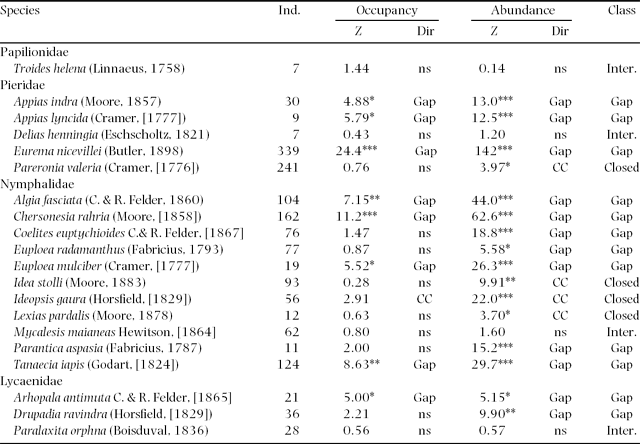
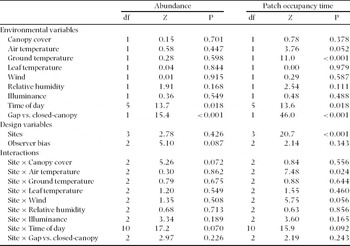
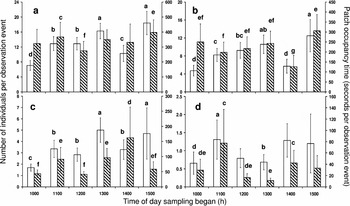
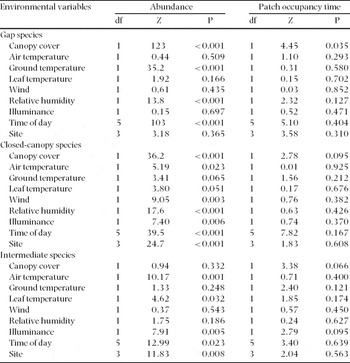
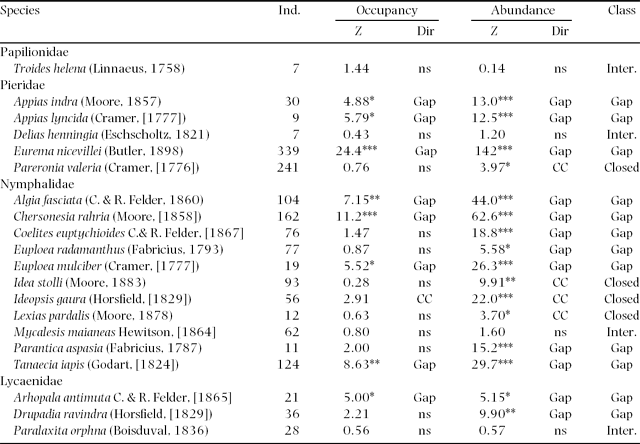
After the first five days of sampling, the 20 most frequently observed species were selected, and only these species were included in this study. From these 20 species, 12 had a positive phototactic response or higher residency time in gaps, four a negative phototactic response or higher residency time in closed-canopy patches and four showed no significant responses (Table 2). The two strongest EVs for the abundance of the overall assemblage were time of day and whether the sites were in canopy gaps or closed-canopy areas, with the gaps having significantly higher abundances than the closed-canopy patches (Table 3). Time of day was a significant EV for all assemblages, and this can be attributed to low numbers and activity prior to 11h00 (Figure 1). Patch occupancy time for the overall assemblage showed a positive correlation to gaps, which were occupied significantly longer than closed-canopy patches (Table 3). There were significant changes in patch occupancy time between sites (Table 3). The only EV with which site patch occupancy times significantly interacted was air temperature (Table 3). There was no significant difference in the abundance or patch occupancy time between the three different observers (Table 3).
Linear Mixed Models with Poisson distribution for time of patch occupancy and abundance for differences between gaps and closed-canopy areas per observation event. Ind = number of individuals, Z = Wald χ2 (Z) statistics, Occupancy = patch occupancy time, Dir represents the direction of the result (Gap = significantly higher patch occupancy time abundance in the gaps, CC = significantly higher patch occupancy time or abundance in the closed-canopy areas, ns = non-significant differences), Class represents the classification that species were assigned for further analyses (Gap = gap species, Closed = closed-canopy species, Inter. = intermediate species).
Generalized Linear Mixed Model (with Poisson distribution and log link function) result for the effect of various environmental and design variables on the overall butterfly assemblage surveyed in Bornean tropical rain forest. Site to environmental variable interactions are shown as this was the only significant random effect. Z = Wald χ2 (Z) statistics.

Mean abundance (open bar) and mean patch occupancy time (hatched bar) per time of day in Bornean tropical rain forest. These means were for all butterflies (a), gap species (b), closed-canopy species (c) and intermediate species (d). Mean (± 1 SE), different letters above bars represent significantly different means (5% level).

The abundance of gap species was negatively correlated to canopy cover, and positively correlated to ground temperature and relative humidity (Table 4). The abundance of closed-canopy species showed a positive correlation to canopy cover and air temperature, and a negative correlation to relative humidity, wind speed and illuminance (Table 4). The abundance of intermediate species was positively correlated to air and leaf temperature as well as illuminance (Table 4). The gap-inhabiting species showed significantly higher time of occupancy only in patches with lower canopy cover, while closed-canopy species, by contrast, significantly interacted with the time of day sampled (Table 4). The patch occupancy time of intermediate species no significant correlations with any of the EVs tested (Table 4).
Generalized Linear Mixed Models (with Poisson distribution and log link functions) results for the effect of various environmental variables on butterfly assemblages surveyed in Bornean tropical rain forest. Z = Wald χ2 (Z) statistics.

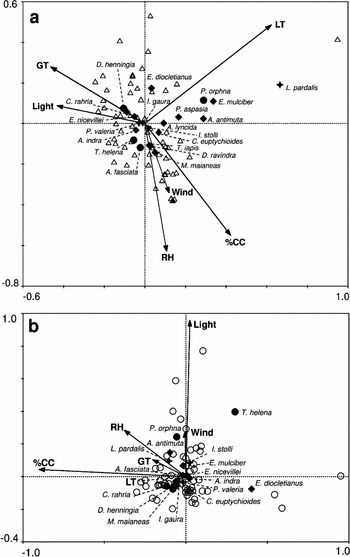
The most important EV in determining overall assemblage composition in the CCA was whether the patch was in a gap or it under the closed canopy (F = 6.29, P < 0.001). Other significant variables were canopy cover (F = 2.95, P = 0.002), ground temperature (F = 2.97, P = 0.037), relative humidity (F = 2.59, P = 0.002) and leaf temperature (F = 1.90, P = 0.041). When only gaps were analysed in the CCA, the significant variables were leaf temperature (F = 2.57, P = 0.008), canopy cover (F = 2.12, P = 0.008), relative humidity (F = 2.10, P = 0.013) and ground temperature (F = 1.82, P = 0.040) (Figure 2). There were only two significant EVs when closed-canopy sites where analysed in a CCA alone, and these were canopy cover (F = 4.10, P = 0.003) and illuminance (F = 2.58, P = 0.021) (Figure 2).
Canonical Correspondence Analysis (CCA) diagram of environmental variables affecting butterfly assemblages in Bornean tropical rain forest. Observations were made in gaps (open triangles; a) and equivalently sized closed-canopy areas (open circles; b). Closed-canopy species are represented by black stars, gap species by black diamonds and intermediate species by black circles (refer to Table 2 for full species names). Environmental variables are represented by black arrows. LT = leaf temperature, GT = ground temperature, RH = relative humidity, %CC = percentage canopy cover.

Behavioural responses
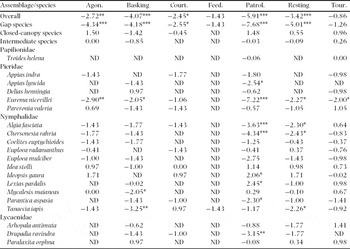
Patrolling behaviour was recorded most frequently and for the longest duration in this study (percentage of observations = 57.1%; percentage of time = 41.3%). Six species were significantly more often patrolling in gaps and two in closed-canopy areas (Table 5). Butterfly touring was the second most common behaviour observed (observations = 17.2%; time = 4.7%), yet only one species, Eurema nicevillei, showed a significant response for this behaviour in gaps (along with most of the other behaviours recorded) (Table 5). Resting (observations = 11.6%; time = 31.9%), basking (observations = 5.3%; time = 17.5%), agonistic behaviour (observations = 6.7%; time = 3.2%) and courtship (observations = 2.1%; time = 1.4%) were observed significantly more in gaps for the overall and gap-inhabiting assemblages (Table 5). Four species significantly used the gaps to rest, while three significantly used the gaps to bask. All of the butterflies that significantly positively responded to gaps to rest or bask were gap-inhabiting species, except Mycalesis maianeas, which was classified as an intermediate species. Only one species, E. nicevillei, showed increased agonistic behaviour in the gaps, and no individual species responded either type of patch for courtship (Table 5). Feeding was very rarely observed (observations = 0.13%; time = 0.27%), with no significant response for gaps or closed-canopy.
Results of Mann–Whitney U-tests for patch occupancy time of the butterfly assemblage and individual species per behaviour monitored during surveys of butterfly behaviour in Bornean tropical rain forest. Z - adjusted values are presented. Positive values show a shift towards the closed-canopy patches and negative results show a shift towards the gaps. * = P < 0.05, ** = P < 0.01, *** = P < 0.001, Agon. = agonistic behaviour, Court. = courtship, Feed. = feeding, Patrol. = patrolling, Tour. = touring, ND = no data (no observations for that species or group of species performing that particular behaviour).

DISCUSSION
Overall butterfly responses to gaps and closed-canopy patches
Overall butterfly numbers and patch occupancy time were higher in gaps compared with closed-canopy patches. However, four species were negatively phototactic or had a higher residency time in closed-canopy patches to gaps, so these areas were also important for certain tropical forest butterfly species. As found by Hill et al. (Reference HILL, HAMER, TANGAH and DAWOOD2001) in Sabah these assemblages in the gaps were distinct from those in closed-canopy patches. Even when closed-canopy patches are analysed separately, canopy cover and illuminance (variables linked to the amount of sun or shade) remained the most important variables in determining the composition of butterfly assemblages in these patches.
Time of day had a significant influence on the butterfly diversity for all assemblages. The reduced abundance and activity of butterflies early in the day is most likely due to temperature and illuminance being too low at this time for many of the butterflies to become active (Pollard & Yates Reference POLLARD and YATES1995). Canopy cover affected abundance and time of occupancy of butterflies, while it also had a strong effect on the composition of butterfly assemblages. This suggests that butterfly assemblage composition changes according to varying degrees of openness of the canopy. Along with strong assemblage difference between gaps and closed-canopy patches, this emphasizes the importance of both open gaps and closed-canopy areas for maintaining butterfly diversity in tropical forest.
Behavioural responses of butterflies to gaps
Most species here responded positively to either gaps or closed-canopy areas, and this was reflected in the great deal of variation in observed behaviours between gaps and closed-canopy areas. Some species were greatly dependent on gaps, for instance E. nicevillei was significantly more often found in gaps over closed-canopy areas for most behaviours. Other species used both gaps and closed-canopy for various behaviours, with M. maianeas showing no overall significant responses for either gaps or closed-canopy areas, although it did use gaps for basking. Even Lexias pardalis, a closed-canopy-inhabiting species, was recorded basking in a gap. Tanaecia iapis, classed as a gap-inhabiting species, was only recorded courting in closed-canopy areas. While butterflies can be classed as spending more time either in gaps or closed canopies, this does not restrict them to solely using either gaps or closed-canopy areas.
Thermoregulation is an important component of the selection of sites for some butterfly behaviours, particularly perching and basking (Dennis & Sparks Reference DENNIS and SPARKS2006). During cooler times of day, closed-canopy species may use gaps for basking, while conversely gap-inhabiting species may rest in closed-canopy areas when it is hot. Although some species use mostly gap or closed-canopy patches, the variability inherent in many behaviours means that both areas are needed to allow the full range of natural behaviour for most butterfly species.
Touring was one of the most common behaviours recorded, yet only E. nicevillei showed a significance response to gap or closed-canopy with regard to this behaviour. This species is a distinctly gap-inhabiting species and rarely penetrates the deep forest unless gaps are present. In this way, gaps may aid dispersal of some butterfly species through forests. In turn, too many gaps will restrict and isolate the movements of closed-canopy butterfly species. Our results show low levels of significance for the touring behaviour to either gaps or closed canopies, suggesting that neither open nor closed canopies are movement barriers to individual species.
Although we rarely recorded courtship, among any of the species, it occurred more often in gaps than in closed canopies. Other behaviours associated with mating, such as patrolling and agonistic behaviour was frequently recorded in gaps. Patrolling is often used by non-territorial males to locate mates (Scott Reference SCOTT1974). Agonistic behaviour in butterflies, particularly in the defence of gaps (Bergman & Wiklund Reference BERGMAN and WIKLUND2009), is often part of lek behaviour, to secure mating rights of visiting females (Lederhouse Reference LEDERHOUSE1982). Males that defend territories are more successful at obtaining mates than those that do not maintain a territory (Bergman et al. Reference BERGMAN, GOTTHARD, BERGER, OLOFSSON, KEMP and WIKLUND2007, Bonte & Van Dyck Reference BONTE and VAN DYCK2009).
We very rarely observed feeding behaviour, probably due to the higher canopy not being included in the observations. Tropical forests are three-dimensional landscapes, with many of the butterflies feeding high in the canopy where the flowers and fruits are situated. Butterflies also feed on fallen fruit and carrion, both of which are present on the forest floor (Hamer et al. Reference HAMER, HILL, BENEDICK, MUSTAFFA, CHEY and MARYATI2006), although this is a scarce commodity as many other animals also compete for it.
Conclusions
We found that both gaps and closed canopies were important in determining butterfly diversity, numbers and behaviour. This is due to their provision of suitable sites and conditions for various activities (Dennis et al. Reference DENNIS, SHREEVE and VAN DYCK2003). Gaps and closed canopies have distinct butterfly assemblages, yet many species use both areas. This emphasizes that butterflies have species-specific habitat requirements determined by both ecological and behavioural needs. It also emphasizes the need to maintain as much of the natural forest structural heterogeneity as possible, as many of the species-specific behaviours may depend on a variety of features across the landscape.
Since butterflies have been proposed as biodiversity indicators in tropical forests (Cleary Reference CLEARY2004, Sparrow et al. Reference SPARROW, SISK, EHRLICH and MURPHY1994), careful monitoring of these systems will need to be implemented. These would be particularly important for monitoring the effects of selective logging and even forest restoration programmes. Our results suggest two ways in which monitoring tropical forest butterflies can easily be enhanced. Firstly, it is imperative to sample both gaps and closed canopies, as these both have distinct butterfly assemblages. Secondly, collecting behavioural data in tandem with diversity and abundance data will greatly enhance the utility of such monitoring schemes. Information on behaviour is relatively simple to collect, but when incorporated into monitoring can provide valuable insights into not only which habitat components are important for butterflies but also why they are important. This extra layer of information greatly enhances our ability to both monitor and manage human activities affecting tropical forests.
ACKNOWLEDGEMENTS
We would like to thank D. J. Marshall, A. S. Kamariah, H. M. Masnah and A. K. Rafhiah from Universiti Brunei Darussalam for making the stay at KBFSC possible. We would also like to thank all the staff of KBFSC, particularly B. A. W. Rodzay and M. A. B. Salleh for their invaluable assistance and advice.