Beyond the machine breaking of the Luddites in 1811–13, arguably no act of protest in modern Britain, whatever the context, is so well known and notorious as the arrest, trial, and subsequent transportation in early 1834 of six agricultural labourers from the Dorset parish of Tolpuddle on the charge of having issued illegal oaths.Footnote 1 ‘For many years’, as John Archer put it, ‘it was believed that, with the exception of Swing and Tolpuddle, there were few rural events worth investigating’.Footnote 2 But, as is the received understanding, it was not the act of oath taking per se that was so objectionable to the Dorset authorities, and to the arresting magistrate James Frampton in particular. Rather, it was the attempt by agricultural workers to organize themselves into a trade union (aka the ‘Friendly Society of Agricultural Labourers’) that was so objectionable, the prosecution for oath-taking a device to facilitate passing a more draconian sentence by way of deterrent to others.Footnote 3
This was, so the narrative goes, an exceptional event. Indeed, everything about the arrest and trial of the Tolpuddle men and the subsequent mythologization has constructed the creation of the union and the judicial response as without parallel. First, through squire Frampton's framing of the ‘offence’ leading to the seemingly severe sentence of transportation (this being the sentence stipulated in the act deployed in their prosecution).Footnote 4 Second, Robert Owen's nascent Grand National Consolidated Trades Union instantly and opportunistically placed its campaigning weight behind an attempt to get the Dorchester sentence revoked, organizing both mass petitioning and the attendant vast gathering and procession to Whitehall from London's Copenhagen Fields on 21 April 1834. Third, after the Tolpuddle men's eventual return from transportation (James Hammett being the last to return in August 1839) their case fell out of popular consciousness. A brief revival by Joseph Arch's National Agricultural Labourers' Union in the 1870s was as nothing compared to the extraordinary efforts of the Trades Union Congress (TUC) to mark the centenary of the trial in 1934. The various rallies, publications, speeches, and the symbolic construction of six cottages in Tolpuddle to accommodate retired agricultural trades unionists again commemorated the events of 1834 as exceptional.Footnote 5 These mythologizing events, combined with the neatly self-contained and easily retold narrative, allowed the story to be told (and retold) in countless ‘new’ social histories in the mid-twentieth century. This process has continued into the early twenty-first century through the speechmaking and commemorative practices of the TUC, leftist politicians, and even the bishop of London at Baroness Thatcher's funeral.Footnote 6 Such was, and is, the making of this totemic moment of British social, rural, and labour history.
The intellectual, and thus historiographical, ramifications of this mythologization are several. It follows that in both labour histories and histories of rural England, acts of trade unionism in the countryside were exceptional. Tolpuddle was supposedly an isolated moment of collective action in a protest landscape in which ‘overt’, collective acts were also exceptional. So the orthodoxy goes, food rioting, that archetypal collective protest of the eighteenth century, essentially ceased in the 1790s. Beyond that point, rural workers instead turned to the tools of terror (incendiarism, the maiming of animals, trees, and plants, and the sending of anonymous threatening letters) rather than risking being seen openly protesting.Footnote 7 In this thesis, the ‘Bread or Blood’ riots of 1816, the East Anglian protests of 1822, Swing in 1830–1, and the anti-New Poor Law protests of 1834–6 together with Tolpuddle represented blips – as Andrew Charlesworth noted, this is quite a list of ‘exceptions’ – in an otherwise established trend.Footnote 8 If the condition of work and worklessness were accepted as the major driver of discontent in the countryside, then, as Roger Wells put it, ‘(we) must not allow major outbreaks of protest to cloud the view that day-to-day employment was the major ‘issue’ on which ‘levels of wages and public assistance turned’.Footnote 9
If such a reading came from a broader attempt to move the study of rural protest beyond the hegemonic status of the ‘riot’/disorder, it necessarily rests on a set of hitherto untested assumptions. First, that rural workers had forgotten the arts of organization and collective action. Second, that Tolpuddle was exceptional, an isolated case, rural workers sealed from the influence and knowledge of the protest practices of urban and industrial workers. The purpose of this article is to challenge these assumptions. It examines the ways in which rural workers acted collectively in the period between the end of the Napoleonic Wars and Tolpuddle, the post-war agrarian depression providing the economic and social context for the events of 1834. It pays particular attention to the period between Swing and Tolpuddle, a period of critical importance given that received accounts of Swing suggest that, to paraphrase Hobsbawm and Rudé, the brutal suppression of the protests destroyed what will there was amongst rural workers to resist.Footnote 10
In so doing, it builds upon Wells's earlier attempt to place Tolpuddle into a wider, agrarian context. Rural workers in other places had, Wells showed, adopted the principles and techniques of trade unionism before 1834. But such acts of ‘agrarian unionism’ were principally during earlier grain crises when more-than-parochial attempts at agrarian unionism occurred in Berkshire and Essex. Beyond 1834, Wells has also shown that agricultural workers again turned to unionism in 1835 and 1836 as part of broader anti-New Poor Law resistance. But these pre- and post-Tolpuddle attempts were located in the principal cornlands of eastern England, not the heaths of south Dorset.Footnote 11 By way of contrast, this article places the acts of unionism at Tolpuddle in their precise regional context: the English west, specifically Dorset, Somerset, west Wiltshire, and south Gloucestershire. As a distinctive region, it combined both areas with high levels of poverty and those with relatively lower levels of poverty, a variety of agricultural systems, and (unevenly) decaying industries. Indeed, while the cloth trades of north Wiltshire, north Somerset, and south Gloucestershire were in long-term decline, being unable to compete with those of Lancashire and Yorkshire, the lace trades of Somerset, the gloving trades of the Somerset–north Dorset borders, and the flax-based trades of West Dorset were more directly impacted upon by pan-European and wider global trading conditions.Footnote 12 This is not to claim that the region was in any way unique; rather, it is to argue that we can only truly understand the events at Tolpuddle when placed into both the broader regional and local context. The rest of the article is structured as follows. It starts by analysing, and conceptualizing, the resort to collective action in the region, before then examining the adoption of trade unionist tactics. Before concluding, the article ends by placing Tolpuddle into the immediate contexts of the aftermath of Swing and the reform crisis.
I
Notwithstanding Steve Poole's recent plea for historians to move beyond arguments about the relative importance of ‘overt’ and ‘covert’ protest, considerations of this very dynamic cast a long shadow on the field.Footnote 13 But the roots of this are relatively recent. Systematic studies of ‘covert’ protest – the tools of rural terror embracing incendiarism, the maiming of plants and animals, and the sending of anonymous threatening letters – were non-existent until David Jones's 1976 study of incendiarism in mid-1840s East Anglia.Footnote 14 In Captain Swing, Hobsbawm and Rudé asserted that neither before nor during 1830 was incendiarism the ‘characteristic form of unrest’, a status it only assumed after Swing.Footnote 15 But while our understanding of the tools of rural terror has advanced significantly since then,Footnote 16 arguably the ways in which we conceptualize collective action in the countryside has not.
The issue can be traced back to the so-called Wells–Charlesworth debate as to the relative importance of covert versus overt protest forms, and in particular to the paper by Wells that prompted the debate. In short, Wells's paper, in part reprising something first alluded to in E. P. Thompson's ‘moral economy’ paper, asserted that beyond the bitter suppression of the national wave of food rioting in 1795, the protests of the poor would in future be expressed through a resort to ‘covert’ protest rather than ‘overt’ protest. This dynamic was first expressed through a much-reduced resort to collective action during the arguably far worse subsistence crisis of 1800–1, and a corresponding spike in levels of incendiarism and the receipt of threatening letters.Footnote 17 In response, Charlesworth asserted that the 1816 ‘Bread or Blood’ riots, the 1822 labourers’ protests in East Anglia, and Swing – the largest and most extensive episode of rural protest in British history – were evidence that collective action remained the critical weapon of rural workers. Wells subsequently retorted that Charlesworth's paper betrayed a ‘myopic devotion’ to those ‘exceptional moments’ of rural protest. What was needed was a closer attention to those forms of ‘everyday’ resistance, not least as framed by the poor law and the experience of employment.Footnote 18
Notwithstanding a flurry of further papers on the subject, the debate was never satisfactorily resolved.Footnote 19 Indeed, while the discussion did much to reveal the importance of a range of protest techniques both before and after Swing, as well as their variable geography, the impasse was a function of a failure to offer satisfactory definitions of ‘overt’ and ‘covert’. It was also, in part, caused by a devotion to the two concepts as mutually exclusive phenomena rather than appreciating, as John Archer had alluded to, the ways in which there was often much that was ‘covert’ about collective protest and that ‘covert’ protest could act as a focus for ‘overt’ displays of labouring solidarity and strength. Incendiary fires, as Archer showed, often attracted large crowds of working men and women who refused to help extinguish the flames and instead basked together in a brief moment when the balance of power shifted from capital to labour.Footnote 20
Limiting assessments of collective action to acts of ‘riot’, even union, therefore fails to embrace its complexities. As E. P. Thompson noted, the word riot ‘can conceal what may be described as a spasmodic view of popular history’ where the ‘common people…intrude occasionally and spasmodically upon the historical canvas, in periods of sudden social disturbance’.Footnote 21 Beyond cultural complexities in defining riot (something Adrian Randall's Riotous assemblies neatly sidesteps by delimiting riot to those acts so defined in law) to restrict conceptualizations of collective protest is to deny the voices of resistance in a variety of other acts.Footnote 22 In times of stress, industrial communities embraced many forms of social conflict, not only food rioting but also unionism and the strike, sabotage and incendiarism, customary ritual and symbolism, threats, and bodily violence.Footnote 23
Rural workers too could also draw upon an extensive range of techniques and experiences in asserting their opposition. We cannot, 200 years after the event, state with conviction that a group of labourers descending on a rural vestry represented an act of overt protest while the actions of a violent poaching gang did not. Such groupings were important ways through which organization and working together was learnt. They also created networks that transcended the parish, the district, and even, in the case of smuggling gangs, the bounds of the nation-state.Footnote 24 As Wells has shown, criminal, poaching, and smuggling gangs not only offered many rural workers a critical supplement, even an alternative, to immiseration in agricultural employment, but also equipped their members with skills central to ‘overt’ protest: working together, leadership, decision-making, loyalty and secrecy, and, critically, how to mobilize. The Alfriston Gang combined theft (utilizing extensive networks of customers and ‘fences’), smuggling, anti-tithe sentiment, radical religion, and politics, and practised the ‘terrorist tradition’ against farmers, employers, and witnesses in the Cuckmere Valley of Sussex. It was also implicated in Swing risings in the area, open opposition to the New Poor Law, and agrarian trade union mobilization in the form of the short-lived ‘United Brothers’ in 1835.Footnote 25 Even the formation of harvest gangs equipped labourers with skills of organization and leadership and taught them how to bargain with farmers.Footnote 26 By way of example, the first Swing gang emerged from the ashes of the so-called ‘Blues’, aka the Aldington Gang of smugglers, which had also turned to burglary and poaching. Without these skills and pre-history, Swing would not have been possible.Footnote 27
It is also questionable whether the distinction between industrial and agricultural workers, and between agrarian and industrial communities is helpful. Beyond simply living together in the same neighbourhoods, the barriers between occupational groups were more fluid than is often acknowledged. By the time of Tolpuddle, large numbers of women were engaged in the serge district between Exeter and Taunton working on looms, ‘those who do the work being the wives or daughters of agricultural labourers, of mechanics or others’.Footnote 28 Not only were rural households often comprised of family members working in different occupations, but we also know that many weavers and others combined their trades with tending to smallholdings.Footnote 29 This is not to say that precise experiences – and responses – of industrial workers, rural craft workers and farmworkers were always the same. They were not, having different traditions, working practices and market conditions. Rather, it is to assert that the fluid occupational make-up of many western working families and communities meant that, as Randall notes, these were ‘communi[ties] of shared values and expectations’.Footnote 30 The experience of living and working together might not have absolutely transcended difference,Footnote 31 but it did lead to the sharing of experience, knowledge, and the cultural transmission of practices.
It is also important to note that this shared experience transcended the confines of the parish and locality. Many workers were highly mobile, tramping from one place of work and lodge to another, thus linking districts and disseminating news and ideas. Work on pauper letters reminds us that many working families were connected to wider pan-district, even pan-regional, networks by virtue of members of their family and kin living and working elsewhere. The idea of rural workers being isolated from wider social and political currents is overplayed. The rural world (and thus rural workers) was not hermetically sealed from the influence and knowledge of the urban and industrial.Footnote 32
It is precisely in this framework of diverse but shared working cultures, economic fortunes, mobilities, and traditions of plebeian self-assertion that we can understand the emergence of the trade union at Tolpuddle. It was, the analysis will go on to show, an expression of a deeply entrenched regional working culture. It was far from being either a bolt from the blue or ‘exceptional’. Nor, as it will be shown, was the judicial response to Tolpuddle without exception. It was not: Squire Frampton not only having ‘cut his teeth’ during Swing but having been especially active in adjudicating in labour disputes, invariably in favour of the employer.
II
The food riots that started in the late autumn of 1799 and continued through to the anti-Brown Bread riots of early 1801 were the last national wave of subsistence riots. Outside of some isolated market town protests during the 1811–12 and 1816 subsistence crises, and Cornish food riots in 1830 and 1848, the ‘tradition’ of food rioting, so the received understanding suggests, had passed.Footnote 33 Yet, amongst the established, stable industrial communities of the English west, the tradition continued beyond the Napoleonic Wars and into the late 1820s.Footnote 34 In the late spring and early summer of 1816, food riots over rapid advances in the price of potatoes occurred at Bideford (Devon) and Frome (Somerset), with a further riot at Bridport and a ‘disposition to riot’ at Yeovil that was only ‘suppressed’ by ‘the temperate conduct of the principal inhabitants’. So much might be read as simply the actions of industrial workers. At Bridport, we know that of the individuals arrested three were women, all twine spinners in the rope works, yet of the men one was a shoemaker, another was a blacksmith's apprentice, and only two involved in the preparation of flax and hemp.Footnote 35 In Somerset, we also know that the protests extended out into the surrounding countryside due to ‘the want of employment for the poor and the general distress of the farming classes’. If collective protest did not play out in the villages, it was certainly threatened, one threatening letter sent to a ‘Gentleman’ near Somerton warning of ‘ascertain [sic] Congregation that shall call upon you or expect Death for the burthen that is now laid on us we are determined to bear no longer’.Footnote 36
Nor was this the end of food rioting in the rural west. On 6 May 1826, a report that a market gardener had through forestalling effected a rise in the price of potatoes in Trowbridge market from 5d to 6d a peck occasioned ‘a number of the lower orders’ to assemble. After ‘wreak[ing] their vengeance by kicking about the streets all the vegetables he had bought’ and by destroying his barrow, they then turned their attentions to the other market gardeners present, before attacking the butchers and destroying the windows in the High Street. These were, so the magistrates thought, mostly cloth workers, the demand for the cassimere produced in the area being so depressed that the workers were engaged at only one third their normal level. The ‘success’ of the Trowbridge riot acted to give encouragement to the ‘manufactory workers’ of both Bradford-upon-Avon and Melksham to rise the next Saturday, though both were swiftly put down by the dragoons.Footnote 37
Food riots were not the only form of collective action feared by the rulers of the rural west. Indeed, the archive demonstrates that a physically assertive culture of riot was alive and well in many western communities. Fears that new enclosures at Harmington near Exeter were likely to be attacked in 1816 led to the creation of an arrangement to call upon the military to suppress any disturbance.Footnote 38 Electoral riots also maintained a particular potency in the south-west, in small market towns like Shaftesbury as much as the major urban centres, and were often expressions of organized, muscular popular loathing for the authorities. For instance at Taunton in June 1826, an election riot ended with a ‘mob of daring and insolent young men’ attacking the East Somerset Yeomanry.Footnote 39 The vestry of Westbury All Saints, the sole parish of the Wiltshire cloth town, in July 1819 even resolved to refuse relief to any person ‘who by himself or Family may be Guilty of any riotous or Tumultous proceedings during the present…Or personally insult any of the paymasters of the said parish.’Footnote 40 This assertive working culture was not something peculiar to industrial centres but also permeated the surrounding countryside. For instance, at agricultural Pewsham in the spring of 1829 it was reported that riots had become ‘so frequent’ that the inhabitants had been forced to apply to the magistrates ‘for protection’. Arrests duly followed. On the other side of north Wiltshire at Highworth, the arrest of labourer Edward Gibbs similarly followed a riot that December.Footnote 41 This ‘disposition to riot’ was also manifested at Painswick, a small decayed cloth town in south Gloucestershire, in the early spring of 1830. The ‘spirit of insubordination’ in the area checked only by the stationing of a detachment Dragoons in the parish and the arrest of nine individuals on the charge of riot.Footnote 42 Perhaps the most emphatic expression of this culture of open opposition came in the summer of 1829 when a steam carriage en route from London to Bath was attacked at Melksham by a ‘concourse of persons, many of whom believed a steam carriage was calculated to reduce manual labour’. If throwing stones was unlikely to do much damage to the machinery, the cries of the assailants were clear enough: ‘We are starving already, let's have no more machinery’, ‘Down with the machinery’, and ‘Knock it to pieces.’Footnote 43
Riot was, as noted above, an expression which represented only those moments and places where social relations had broken down. While even alcohol-fuelled acts of collective aggression were manifestations of deeper resentments and thus reflective of pre-existing social cleavages, the level of organization involved in most riots was limited to loose arrangements to come together and act. In this sense, the use of the term ‘riot’ in the reports from Pewsham, Highworth, and Painswick is instructive. While it is clear that what was being reported were not inter-class conflict or intra-trade disputes, the actions might have embraced expressions of customary cultural forms and spontaneous acts of violent opposition as opposed to acts of co-ordinated protest. Either way, what all such practices attest is the persistence of an assertive, combative collective action, that a pan-occupational solidarity often united working peoples in the face of common threats. Both the occupational make-up of crowds and the language deployed in threats and parleys with the authorities were public performances of solidarity, declarations that all workers (or ‘the poor’) were as one in opposition.Footnote 44
The evidence for the importance in the English west of criminal, poaching, and smuggling gangs is equally suggestive. The frequent recovery of casks of Geneva and other spirits along the Dorset and Somerset coasts and the occasional bloody affrays between large gangs of smugglers and the Coast Guard and preventative officers all attest to the continued importance of smuggling in the region.Footnote 45 Moreover, the gaol books for Dorset relate a steady stream of (mostly) farmworkers and artisans being so incarcerated.Footnote 46 Poaching gangs were arguably more important throughout the region, the combination of large areas of forest and woodland and several large estates offering extensive opportunities, and the large urban centres of Bath, Bristol, and Salisbury the market. Indeed, the provincial press was rarely free of reports of ‘daring raids’ and ‘desperate affrays’ between armed poachers and keepers, such cases markedly rising in the late 1820s and early 1830s. Similarly, press reports and judicial records relate the activities of other (supposed) criminal gangs of varying audacity and ambition. The sheep stealing, burglary, and cattle maiming of a ‘desperate gang’ operating in and around Corscomb in Dorset in the late 1820s being qualitatively more severe than a gang of housebreakers who ‘infested’ the neighbourhood of Taunton in 1821 and who came to prominence for stripping the gardens of North Curry of their crops of broccoli.Footnote 47 It is, of course, possible that reports overplay the degree of gang organization; indeed, it is possible that much of the activity reported was pilfering rather than organized crime. Either way, reports of ‘gang’ activity reflected a real sense of fear, even terror, amongst some rural residents of an organized, assertive working class.
III
Beyond the nascent acts of unionism during the subsistence crises of the 1790s and early 1800s, including what was reported as a two-day ‘strike’ of labourers demanding 9s a week on pain of ‘destruction’ at Wilcot in Wiltshire in April 1790,Footnote 48 the archive records few examples of farmworkers turning to combination in the period before Swing. Even during the food crisis of 1810–12 and before the onset of the post-Napoleonic agrarian depression, labourers, Wells claims, turned not to unionism but instead it was ‘likely’ that other ‘less dramatic thrusts’ succeeded in ‘gently prising out’ higher wages. Post-1815, Wells goes on to argue, ‘[t]he scale of unemployment, and continued magisterial hostility to any form of rural combination…ensured that farmworkers were prevented from adopting a unionist response’, magistrates and rural vestries colluding in stopping relief to those who attempted collective bargaining to increase their wages.Footnote 49
High levels of unemployment and underemployment effectively eroded what little bargaining power labourers had. This is not to say that farmworkers did not attempt, at least occasionally, to organize in attempt to secure higher wages and poor relief payments and to protect their rights to harvest labour. In June 1830, at Oaksey in Wiltshire, sixty to seventy female haymakers struck their work in attempt to secure higher wages, the farmers the day before having reduced their wages from 10d to 9d a day. Outside of unionist tactics, groups of labourers mobbed vestries, and, especially so from the mid-1820s, attacked Irish migrant labourers. Arguably the most frequent way in which fieldworkers challenged the terms of their engagement was through reneging on harvest labour agreements and leaving service during the periods of peak labour demands, presumably because they believed they could secure higher wages elsewhere. Indeed, by far the most common way in which work-related disputes were mediated by magistrates was in relation to cases of failing to perform agreed labour and/or leaving service. Agricultural labour markets for much of the post-war period might have been slack, but the harvest labour always attracted a premium and the need to get the harvest in as quickly as possible a competition between employers and between parishes.Footnote 50
If such attempts to secure higher wages by leaving their contracted agreements occasionally made the columns of the provincial press, extant gaol books of western counties are replete with (young) men breaching their labour contracts. In Dorset, for example, of the 503 admissions to gaol in the year starting 25 June 1827, twenty-five (or 5 per cent) of all cases were for breach of service.Footnote 51 As noted, for Dorset no magistrate was so active in bringing prosecutions in labour disputes as James Frampton. His first judicial intervention occurred in March 1803 when he committed six labourers of Milton Abbas (‘Abbey Milton’) to between one and two months’ imprisonment for ‘leaving off work before an agreement had expired and combining with others to increase wages’.Footnote 52 Between then and the arrest of the Tolpuddle men, Frampton intervened more frequently than any other Dorset magistrates in labour disputes, including in cases where those in service had supposedly failed properly to fulfil their duties. It is possible to overstate the case, for outside of prosecutions for unionism under the Combination Acts, the 1823 Master and Servant Act (which allowed for the summary conviction of three months’ hard labour for the failure to complete any contracted work satisfactorily and as such was a bête noir of trade unionists)Footnote 53 was never deployed by Frampton and relatively little used by his fellow Dorset magistrates.Footnote 54 Instead, beyond the 1824 repeal of the Combination Acts, workers in Dorset continued to be prosecuted in cases of labour disputes through revisions of Tudor labour law.Footnote 55
If the post-war depression acted to reduce skilled workers in the countryside to a ‘rough par’ with the fieldworkers,Footnote 56 organized trades were still well placed to combine and strike from work. In the English west, this ability to form combinations was particularly deeply rooted. According to Dobson's list of labour disputes, in the first half of the eighteenth century, outside of London, the counties of Devon, Somerset, and Wiltshire were far and away the most unionized region in England. Even when the rapidly expanding and developing northern industrial towns assumed a far greater degree of prominence in the second half of the century, industrial disputes continued to be an important marker of labour relations in the west. Indeed, even early eighteenth-century labour disputes post-dated earlier proto-unionist practices by western trade guilds, journeymen's associations, and other less formal arrangements.Footnote 57
Beyond 1815, the woollen industry remained that most prone to disputes. In 1816, the weavers of Bradford-upon-Avon and Chippenham, many of whom lived not in the towns but on the urban fringe and in the surrounding hamlets and villages, all struck work. The motivations were simple. The post-war depression in the western cloth market, exacerbated by the lack of demand in foreign markets, had led to a slump in employment. Against this backdrop, attempts to introduce the spring loom – long since in general use in the Yorkshire woollen industry – provoked resistance. Rather than resort to machine breaking or sabotaging cloth produced on the new looms, a combination of weavers focused on the two towns in early June attempted to prevent individuals from working for those clothiers using spring looms. The local magistrates swiftly put the strike down: six of the ‘principal ringleaders’ at Bradford and five weavers at Chippenham being sentenced by the local Bench to two and one months’ imprisonment respectively.Footnote 58
Industrial disputes in the early 1820s followed the same pattern: assertive attempts to regulate wages by co-ordinated strike action and humiliating workers who laboured ‘under price’. At Staplegrove on the fringe of Taunton, thirteen silk weavers were brought before the town magistrates in May 1821 for threatening and assaulting two fellow weavers for working for silk manufacturer Blinkhorn for ‘certain wages’.Footnote 59 More systematic, and widespread, were a series of ‘riots’ that occurred in the Wiltshire cloth district in January and February 1822 and again in July 1823. These ‘riots’ combined the techniques followed locally in 1816 and those deployed at Staplegrove the previous year. The clothiers, much to the chagrin of the weavers, had reduced the prices paid for cloth, prices, according to a letter sent to the Salisbury Journal ‘in the name of the weavers’ ‘paid for hundreds of years past’. Those who accepted the new terms were assaulted and their cloths destroyed. These protests, initially focused on Chippenham in mid-January before spreading to Frome (18 January) and Dilton Marsh (19 January), turned to machine breaking, the contentious spring looms again the focus of popular anger. Between 3 and 4am on 22 January, reports reached Bradford-upon-Avon that ‘several hundred’ weavers had assembled ‘within a mile of the town’ and had started breaking the looms. The reading of the Riot Act and the subsequent arrest of thirty weavers acted to disperse the group, while the raising of the Wiltshire Yeomanry, the stationing of ‘regular troops’ in Bradford and Trowbridge, and the committing to trial of eight of the loom breakers at the Wiltshire Assizes acted to check further protests.Footnote 60 Or at least they did for that year, for in the summer of 1823 weavers in and around Frome again refused to finish cloths taken out when the master clothiers again reduced their prices. The protests this time did not match the force of those in 1822 but there was a ‘great deal of disturbance’ and a mass gathering of weavers on 8 July. While this was quickly put down by the Somerset Yeoman Cavalry, and twenty of the weavers subsequently sent to gaol, the ‘examples’, so the Bristol press reported, ‘have not yet had the effect of restoring complete tranquility’. Soon the weavers returned to work at the old, ‘or even lower’, prices, so that by the end of the month they issued an address to the ‘gentlemen and tradesmen of the town and vicinity’ setting out their distresses and ‘soliciting aid towards the establishment of a society for the purpose of removing their grievances’.Footnote 61
Before the repeal of the Combination Acts in 1824, other places (and trades) in the west witnessed occasional industrial disputes. Papermakers at Cheddar in early 1816 struck work against an attempt to lower their wages as part of a co-ordinated national campaign organized through the ‘Combination Club of Associated Journeymen’. This was truly a mobile action that permeated the countryside. By April, the strike having already held for four months thanks to the support of the association, the authorities intervened on the occasion of three papermakers throwing the foreman of the Cheddar mills into a paper vat. But while the Somerset Sessions sentenced the men to six months’ solitary confinement and the strike broke, some of the leading activists stayed away from work and publicly issued revenge against those who had returned to their former employments.Footnote 62 A reduction in wages also occasioned a strike amongst the miners at the various pits on the Mendips the following year. The miners at Paulton initially struck work on Friday 28 February and notwithstanding warnings from a local magistrate again gathered on the Saturday morning with the intention of a delegation visiting the pits at Clandown, Smallcombe, and Radstock where the miners had also struck work. This did not work though: two of those ‘most conspicuous’ on the Friday were arrested at Paulton, while those at Clandown were dispersed by a force of the 23rd Lancers and the North Somerset Yeomanry.Footnote 63
While the Combination Laws were already a dead letter, their repeal, so the received understanding goes, occasioned an almost instant upturn in union activity.Footnote 64 In the English west, this was not altogether true. Indeed, it was not until early 1825, royal assent for their repeal given on 21 June 1824, that there was a discernible wave of activity.Footnote 65 Strike action was first manifest in the major centres: the sawyers followed the shipwrights at Bristol, then at Exeter the journeymen carpenters, masons, helliers, and papermakers all struck work in early April. The journeymen papermakers in mills throughout ‘the western districts’ struck work by the end of April, while the weavers in south Gloucestershire also turned out that May after the manufacturers failed to increase their wages sufficiently to meet their demands. All these actions, in contrast to other strikes in the post-Napoleonic period, were offensive rather than defensive, an attempt by western workers to improve rather than defend their terms. The strike was also vigorously enforced. The arrest of some weavers who had seized cloths from the houses of strike-breakers at Stroud leading to a reported crowd of 10,000 gathering and threatening to pull down the gaol unless their comrades were freed. Other customary and ritual forms of protest were also deployed by the Gloucestershire weavers, including the ‘ducking’ of weavers who refused to strike and the burning of effigies, presumably of the master clothiers.Footnote 66 Hereafter, both offensive and defensive strikes became seemingly endemic in the west. Carpet weavers at Wilton struck work in October 1825 to prevent a reduction in their wages, supported to the amount of £7 a week by their ‘brethren’ at Kidderminster; cloth workers in south Gloucestershire struck work at Wootton-under-Edge in December 1825 and at Uley in June 1828. Elsewhere, the flax combers and shoemakers (including female shoebinders) of Bridport attempted to advance their wages in January and November 1826 respectively, while lace operatives at Chard also struck work in June 1828.Footnote 67
This list, however, underestimates the resort to unionist practices in the period, for it does not represent the extent to which the practices of unionism were entrenched outside of strike action nor how the wider principle of combination now pervaded the region. By January 1826, according to a letter to the Home Office from Gloucestershire magistrate P. B. Purnell, a union embraced the weavers in all parishes in the ‘neighbourhood of Stroud, Dursley, Wotton, & Kingswood’, while its ‘delegates keep up an immediate communication with the clothing districts of Wiltshire’ and ‘regularly correspond’ with those in Yorkshire and boasted of being able to communicate with ‘every other Combination of whatever Trade existing in Great Britain’. This local but well-connected union, according to Purnell, met regularly and in large numbers. Twelve delegates had been ‘chosen’ from each parish, the delegates being led by the ‘King of the Weavers’ and ‘three or four’ other ‘leaders’, these being men of ‘superior abilities, indeed enviable Talents for the Management of an immense assemblage’. The weavers, so Purnell had been informed, were ‘bound by [a written] Oath…an oath of union and secrecy’, making obtaining information about their plans impossible. The only solution that ‘would completely meet this evil’, so he believed, was the ‘reenactment’ of the notorious Seditious Meetings Act of 1819 (60 Geo. III c. 6) passed in the aftermath of the Peterloo Massacre but repealed in 1824.Footnote 68
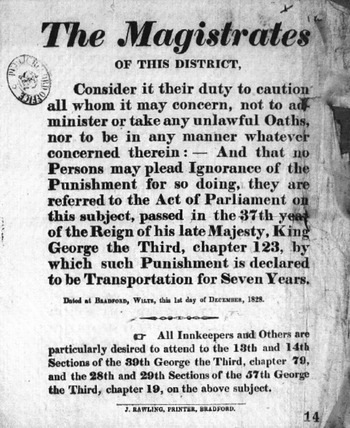
This did not occur. On 1 December 1828, the magistrates of the Bradford-upon-Avon district issued a handbill warning ‘all whom it may concern’ not to ‘administer or take any illegal Oaths’ (Figure 1). So that no person could ‘plead ignorance of the punishment’, the handbill directed individuals to 37 Geo. III c. 123, the ‘Unlawful Oaths Act’ (1797) that allowed for a maximum sentence of seven years’ transportation. Publicans were also warned to be mindful of the details of 39 Geo. III c. 79 (‘Unlawful Societies Act’, 1799) and 57 Geo. III c. 19 (‘Seditious Meetings Act’, 1817). A week later, the magistrates in the neighbouring Trowbridge district also produced a handbill. This was more explicit in its denouncement. Although the Combination Acts had been repealed, the same act as detailed on the Bradford handbill could be used to prosecute the ‘certain Illegal societies…forming in this Town and Neighbourhood’. The notices appear to have had no effect, and by the beginning of January the Trowbridge magistrates wrote to inform Wiltshire lord lieutenant the marquis of Lansdowne that ‘secret societies’ had been forming ‘for some weeks past’ in the woollen trade in Trowbridge and the neighbouring towns. The ‘union’ had already extended to Gloucestershire, Lancashire, and Yorkshire with the shared purpose of campaigning against the payment of wages in truck, the use of power looms, and the use of ‘shop’ looms, those looms, as the Hammonds put it, ‘belonging to the master clothiers and worked on premises owned by them’. Yet, notwithstanding that ‘constant’ meetings were held at which thousands of members were present, their being bound by oaths meant that it was impossible to procure the evidence sufficient to bring a prosecution to ‘serve as an example’.Footnote 69 The only members not bound by oath were women who, despite ‘having enrolled themselves quite as freely as men’, were not allowed to attend the ‘initiation’ meetings.Footnote 70
Handbill issued by the Bradford-upon-Avon magistrates, 1 Dec. 1828. Source: TNA, HO 40/23, fo. 15.

The inspiration, according to Stroud clothier Petty, were the lodges ‘of Saddleworth’ in the Lancashire cloth district. By early February, Somerset workers were also reported to be involved, the western weavers now united as one and with their fellow clothing operatives in the north. It was also reported that the ‘Union lodges’ had attracted support from other occupations. At a meeting of the Gloucestershire magistrates on 25 March, three leaders of the Gloucestershire lodges attended to detail their grievances, their spokesperson being a wealthy Stroud grocer, someone who would obviously stand to benefit from the end of paying in truck. ‘Agricultural servants’ and ‘general labourers’ were also members, presumably finding common cause with the weavers through kinship networks and shared experiences of work. In total, so reckoned the Bath press, some 20,000 individuals were members. Such was the magistrates’ fear at the strength of the union, their alleged links to ‘the radical reformers of the manufactories’, and their sense of secrecy (the lodges while held in pubs were guarded at the door by swordsmen while new members were initiated in blindfold in an arcane ceremony combining prayers and hymns, scripture, axemen, and the wearing of masks and white and black robes and turbans) that existing laws were thought inadequate and legislative support was requested from the government.
The Home Office's response was to send Bow Street officer Francis Fagan to Gloucestershire to investigate. His presence and deposition taking did undermine the unions, but arguably other factors were more telling, especially the need for the union to prove that it was not an illegal oath-bound society.Footnote 71 On the guidance of legal counsel, the ‘Union clubs’ did away with issuing the ‘obligation’ to secrecy, publicly issued a detailed set of rules, and invited further suggestions from the magistrates. In an act of appeasement, the ‘principal’ manufacturers also again publicly deplored the practice of paying in truck (this sentiment first having been expressed at a public meeting at Stroud on 20 January) and requested that the government might bring a bill before parliament to prohibit the practice ‘in a stronger manner’ than was presently the case.Footnote 72 Ultimately, it was the ‘dreadful state of privation’ amongst the weavers that was the union's undoing, those with work to go to returning to their employs.Footnote 73
IV
As E. P. Thompson put it, ‘the consciousness of the identity of interests between working men of the most diverse occupations and levels of attainment…was expressed on an unprecedented scale in the general unionism of 1830–34′.Footnote 74 The immediate context of ‘general unionism’, at least in the English west, was not just the recent experience of attempts at unionism but also the aftermath of the Swing rising and the agitation, and bloodletting, of the reform crisis of 1831 and 1832. Indeed, in relation to acts of combination and union, 1830 is notable for the fact that beyond the ‘spirit of insubordination’ at Painswick, there appears to have been no explicit acts of unionism or strike in the months before the outbreak of Swing. Perhaps this was in part a function of the collapse of the ‘Union clubs’. Perhaps it was also a reflection on the fact that the National Association for the Protection of Labour, developed out of experience of the failure of the cotton spinners’ union in Manchester in the autumn of 1829, did not extend its operations to the west.Footnote 75 It was almost certainly related to the devastatingly cold winter and spring, it hardly being a propitious time to strike from work. The severe weather was also met by both an upturn in poor relief and subscriptions to support the poor. At Frome, for instance, in February 1830, some 5,000 paupers were in receipt of weekly support from the parish, while at Bradford-upon-Avon a subscription funded free coals and blankets as well as weekly door-to-door sales to all families of half bread, bacon, peas, potatoes, and rice.Footnote 76 Against this backdrop of paternalism and poor relief and their partners’ scrutiny and surveillance, it was difficult, if not impossible, to resist openly the masters of the parish and the other paymasters.Footnote 77 One possibility was to turn to crime. At Taunton, ‘plunder, robbery & debauchery’ allegedly supported those amongst the 4,000 individuals out of work who were not supported by the poor rates, this latter group estimated in turn at a third of the population of 10,000.Footnote 78 Whatever the response, the first half of 1830 was notable for the apparent lack of mobilization compared to the late 1820s. The summer, though, was enlivened by several bitterly contested election campaigns that turned to violence and damage to property, most notably at Bristol and at agrarian Shaftesbury.Footnote 79
As Wells notes, ‘unionist mentalities’ were fundamental to Swing.Footnote 80 Threshing machine breaking was a simple enough attempt to increase employment opportunities, especially in the slack winter months, and aped the now classic tactic in the western cloth industry of machine breaking and unionism. More directly, calls for higher wages and poor relief payments to support their families – rural workers being realistic that wage rates adequate to the support of large households were improbable – were also unionist tactics. Moreover, given that work was thrown off to make such demands, Swing risings should also be read as de facto strikes. For instance, in the area between Malmesbury and Tetbury on the Wiltshire–Gloucestershire border, it was reported that the labourers had ‘formed themselves into associations’ and had ‘met to consider the best way to apply for an advance [in their wages]’. Not only was there the perception that recent attempts at unionism amongst the industrial workers in the area were now being imitated by the farmworkers, but ‘several of the lowest and most abandoned characters in Tetbury and not connected to agricultural employment have tried to associate with them’. ‘The rustics’, however, said they ‘could manage their own affairs’. The practice the ‘rustics’ deployed was successful. At Sherston, they visited the home of squire Cresswell and stated their determination to have a rise in their wages: Cresswell agreed and dictated a petition to the paymasters of the parish stating the new terms. The men asserted that they had ‘no thought of committing violence’ nor of joining a ‘foreign mob’, but would stay within the limits of the parish.Footnote 81 Whatever the claims to custom, deference, and attachment to the parish, the practice was still both influenced by Swing risings elsewhere and by the deeper culture of combination that pervaded the region.
What makes Swing remarkable in this context is not that it provided further evidence that the fieldworkers knew how to try and force increases in their wages and working conditions, but that it provided emphatic proof that this capacity and mentality extended throughout the region. If Swing was not manifest in its overt forms in all districts of the west (most of Somerset was notably free from machine breaking and wages ‘riots’, as were the cloth districts of Wiltshire) then this was as much a function of a combination of preventative deterrents, the pre-emptive taking down of threshing machines and wage increases rather than evidence of quiescence.Footnote 82 For instance, in the vicinity of Bradford-upon-Avon, the receipt of a threatening letter at Cooper's Staverton Superfine Woollen Manufactory prompted the formation on Friday 26 November of a ‘well-armed’ guard of men to watch the premises, local tradesmen also helping with the watch. The following day, a party of cavalry soldiers were also stationed at the factory at neighbouring Holt. This state of alarm continued through the weekend and into the following week, something exacerbated by the fear that the ‘clothing poor’ would ‘join the peasantry’. That ‘many of the lower classes’ had been ‘missing’ from the town the previous week was taken as evidence that they had ‘gone to join the rioters up country’. Unionist responses and the making of common cause between industrial and agricultural workers were expected, but, at least in the immediate locale, deterred.Footnote 83
The worst excesses of the bitter judicial repression meted out to Swing activists at the Hampshire Special Commission were avoided in the west. For notwithstanding that Special Commissions were held in Dorset and Wiltshire, the tone was less severe and the sentencing less draconian. For the latter county, the vast majority of the cases related to the chalklands of the east and south-east of the county, the ‘old traditional riotous centres of woollen manufacture’, as Hobsbawm and Rudé put it, left ‘largely untouched’.Footnote 84 For Dorset, of the ninety-one individuals placed into custody for their involvement in the risings, twenty-three were discharged on commitment, five were discharged on providing recognizances before the Special Commission. Of the five men sentenced to death – two for machine breaking, three for extorting money with menaces – none were hanged. Indeed, ‘only’ eleven men were transported for their involvement, and these from only three parishes: two from Shaftesbury for machine breaking; eight from Buckland Newton for machine breaking and extorting money; and one man for taking money at Edmundsham.Footnote 85 The popular response in the region was not then the swift and unprecedented turn to the tools of rural terror stimulated by the repression in the south and east.Footnote 86 This is not to say that there was no immediate spike in incendiarism levels – there was – but rather that this was neither sustained nor even the characteristic form of protest in the early 1830s.Footnote 87 In short, the weapons of rural terror were never as important in the English west as they were in the southern and eastern cornlands. Instead, the period beyond Swing in the west witnessed a defiant resort to forms of collective action that tied together industrial and agricultural workers throughout the region and bound the region to influences from elsewhere, both in the form of popular politics and unionism.
As is now well established, radical politics was writ through southern Swing, both in terms of the influence of radical discourses and in terms of the involvement of radical activists. While the systematic study of radicalism in western Swing awaits its historian, it is possible to draw out some critical trends. First, the western landed classes read Swing as both evidence of revolutionary sentiment and as being directly informed by radical politics. Dorset MP E. B. Portman had seen ‘several symptoms of an anxiety for a Revolution that will wipe off all Debts’, something he had heard several yeoman ‘exciting the notion that such had begun + only needed the aid of their class + of those below them to perfect its completion’. At Shaftesbury, a place wracked with political feeling and where the influence of Henry ‘Orator’ Hunt was suspected, it was also reported that there was ‘a prevailing disposition amongst the people’ not to enrol as special constables.Footnote 88 Handbills detailing state sinecures and rates of taxation were industriously dispatched from radical printers in Bristol, one ‘freely circulated’ at Clayhidon on the Devon–Somerset border excited ‘a good deal of unpleasant feeling’. Here, the ‘refractory reformers’ refused to enrol as special constables and lobbied clerical magistrate Clarke to lower his tithes. The clergy were not only the targets of ‘radical’ sentiment, but in the case of Rev. Henry Cresswell of Creech St Michael the author of a pro-reform ‘effusion’ and ‘thing of Blackguardism’. Cresswell had form. He was a staunch supporter of Henry Hunt and a member of the organizing committee that had welcomed him to Glastonbury on his release from Ilchester Gaol in October 1822.Footnote 89
While the exact purpose of Henry Hunt's journey through the west in late 1830 is open to conjecture, the Somerset authorities were convinced that the timing of his journey and speechifying was no coincidence, his presence was in itself generative of protest. Farmer Bull of Kingston, a small parish four miles north of Taunton, having ‘loudly exclaimed against Mr. Hunt Saturday last [4 December] in the bar of the Castle Inn [Taunton] at which Mr. Hunt was’, the following week received a threatening letter. Postmarked London, ‘Mr. Slave Driver’ Bull was warned that unless he ‘raise[d his] workmen's wages’ he would ‘hear further from Poor Man's Friend/Swing’.Footnote 90 Whatever the depth of the influence of radical politics in the west, the perception was clear. In reporting the trial of Swing activists in Kent and Hampshire, the Bridgwater and Somersetshire Herald juxtaposed the claim of Justice Baron Vaughan that none of the ‘crimes were committed by someone driven by the pressure of poverty’ with the fact that ‘the old fox’ Cobbett was ‘not yet caught’ and that Hunt remained free.Footnote 91
Such evidence, and perceptions, matter for two reasons. First, as Wells has noted, Swing and the subsequent trials of Carlisle and Cobbett for sedition stimulated a new interest in countryside matters amongst radicals in places like London and Birmingham. Rural speakers were even given a platform at the Rotunda, the infamous radical debating house in Woolwich.Footnote 92 Second, radicalism in the west was not something confined to the towns; rather by 1830 it had already infiltrated the countryside. The precise penetration of radical thought into the political cosmos of labourers is necessarily harder to delineate, though certain features of the reform campaign in the west are worth drawing out. Reform meetings and petitioning for parliament in support of reform were not confined to the major urban centres in the region, though the influence of Bath, Bristol, and Taunton was significant, but also occurred in the countryside. So deep was the clamour for reform that the defeat of Bankes, the Tory candidate for Dorset at the spring 1831 general election, was marked not only ‘with every possible demonstration of joy’ in the towns of the county but was also received with the ‘greatest joy’ and a peal of bells at rural Hazelbury Plucknett in neighbouring Somerset.Footnote 93 The further election in the county that year caused by the suicide of reforming Whig MP John Calcraft was even more bitterly contested in both town and country. The farmers, so reported the Sherborne Journal, ‘openly declare that they would not be influenced to vote against their consciences by their [Tory] landlords’. A subscription raised to prevent Tory candidate Lord Ashley from being elected, and thus ‘liberate a Tory and priest-ridden county from the bondage under which it has suffered so long’, drew monies not only from ‘every town’ in Dorset, Somerset, and Wiltshire but also contributions from as far away as Newcastle and Edinburgh.Footnote 94 Further evidence of the networked nature of western radicalism came in the form of £20 forwarded in January 1831 by the ‘friends of radical reform’ in Middlezoy, an agricultural parish between Taunton and Glastonbury, to the ‘independent electors’ of Preston to assist in covering the expenses of Henry Hunt's election as their MP the previous year.Footnote 95
The news of the defeat of the Second Reform Bill in the House of Lords on 8 October 1831, as conventionally told, was electric. However, while the immediate effect of the news of the rejection reaching the west was ‘sensation’, it was also marked by solemnity, a doleful peal played out on bells of the Bath suburb parish church of Walcot. A ‘demonstration’ in the same city on 13 October was marked as if it was a day of general mourning. The town effectively shut down for a vast gathering of the ‘respectable and political classes’, the trade unions of the city and the surrounding countryside being highly visible in the 22,000 strong crowd assembled on Great Pulteney Street. We should be careful not to read too much into this occasion, or indeed others in the west, as evidence of political unanimity. It was not. The hustings were reserved for the ‘gentlemen of the first respectability’, the journeymen hatters of Oldland Common being the only workers given the platform, and then just in supporting ‘our loyal and patriotic King and his Ministers, in their endeavours to obtain for us a just and equal representation [emphasis added]’.Footnote 96
Such was the fragile and uneven nature of this publicly staged pact that it soon dramatically broke down in the form of the infamous riots of 1831.Footnote 97 The impetus was not the rejection of the Reform Bill per se but rather the success of the anti-reform Lord Ashley at the Dorset election. Indeed, these market town riots predated the better known, and bloodier, riots at Bristol and Bath. Riots started, independently, at Blandford and Poole on 17 October. At the former place, the houses of Ashley's agents were ‘subject…to great violence and injury by a mob of many hundreds of persons’, while at the latter place the windows of anti-reformers were destroyed in the town with other damage inflicted upon houses and property at nearby Longfleet and Parkstone. Even the intervention of the yeomanry at Blandford failed to prevent a further riot the following day. Ashley's supporters’ property was also destroyed at Wareham during the same week, while a riot also occurred at Sturminster Newton on the 18th. Arguably the most dramatic events though occurred at Sherborne between the 19th and 21st and at Yeovil on the 21st and 22nd. The agitation at Sherborne and Yeovil was especially notable for the fact that it appeared to be jointly co-ordinated. The ‘Summerset Refarmers’ of Yeovil, having promised their support to the men of Sherborne, duly took a lead in the protests there on the night of the 20th, ‘conspicuous’ by their being armed with swords. A number of ‘countrymen’ were also observed to have joined the Sherborne ‘mob’, while on the night of the 21st the rioters decamped from Sherborne to nearby Oborne where they compelled a farmer to give them some cider. A further plan was also afoot to attack the houses of the magistrates in the neighbourhood of Bishops Caundle. We also know from the Dorset gaol records that labourers were arrested for their role in the riots at Blandford. Politics was clearly something not beyond the rural workers of the west.Footnote 98
V
The effect of the Bristol, Dorset, and Somerset riots rocked the western establishment. The high profile trial of the rioters, especially those of Bristol where four men were hanged and a further eighty-eight transported or imprisoned for their involvement, were a marker of judicial and governmental resolve. It is also important to note that the putting down of the riot at Sherborne by the Dorset Yeomanry, re-embodied the previous winter in response to Swing, was critical in shaping colonel of the yeomanry James Frampton's self-perception as the upholder of the hegemony of the landed elites and the suppressor of dissent. Indeed, not only is Frampton's account of the riots markedly paranoid, but in his unilateral dismissing of those members of the yeomanry who failed to muster, he demonstrated a ruthless single-mindedness.Footnote 99
It is telling, though, that neither the stoking of loyalism and patriotism in the aftermath of the riots, nor the alleged involvement of the Bristol Political Union (founded concurrently with a union at Bridgwater in May 1831) in the Bristol conflagration, did little to dampen the enthusiasm to establish further Political Unions.Footnote 100 Indeed, as Nancy Lopatin has suggested, the immediate aftermath of the Bristol riot marked the greatest growth in political union formation. Political unions were founded at Bath, Chard, Frome, Holt, Shepton Mallet, Taunton, Trowbridge, and Yeovil, those at Bath, Chard, and Frome having been in the planning in the period immediately before the events of late October.Footnote 101 These new unions, and that at Bridgwater, went out of their way to position themselves explicitly as loyal and patriotic. That at Taunton took the name ‘Loyal Political Union’, while the ‘Political Council’ of the Bridgwater Political Union issued a handbill attesting their attachment to ‘the Peace of the Country, the Authority of the Laws, and the Dignity of our beloved Sovereign’. The chair of the Frome Political Union even wrote to Home Secretary Melbourne to assure him that the organization would ‘co-operate’ with the authorities in maintaining the peace.Footnote 102
This stance seems, at least in the short term, to have succeeded, for while some political unions, such as that at Holt, appeared to fade quickly most remained active until the early months of 1833 when the London-based ‘National Political Union’ folded. A further impetus to action came in the form of the campaign for the passing of the Third Reform Bill and its successful passage through parliament in June 1832. On 28 May 1832, for instance, the several political unions in the vicinity of Bath met at High Common on the edge of the city, the reports suggesting that 12,000 members attended out of a total crowd estimated at 60,000. The creation of further political unions in 1832 (Bradford-upon-Avon, May; Wootton-under-Edge, June; Somerton, October; and Warminster, December) further attested the continued vitality of western political unions.Footnote 103 Both the location of the High Common meeting and the large crowd is suggestive of the involvement of agricultural workers in western political unions, though unlike in the south-east the evidence is more suggestive than certain.Footnote 104 In the spring of 1832, London ‘emissaries’ were active in giving lectures (including against the payment of tithes, something suggestive of a significant agricultural constituency) and otherwise proselytizing in Somerset. The Taunton Political Union was also active in campaigning in the surrounding countryside, including ‘haranguing’ those attending Somerton fair in July 1832. The political union at the small Somerset lacemaking town of Chard was equally active, regularly meeting and publishing remarkably assertive and self-assured pamphlets and posters. In the words of one handbill, provocatively entitled ‘Treason!!’, the political union boldly stated its position: ‘Peace or War, Reform or Revolution, Liberty or Death’, a statement more akin to the discourses of early 1790s Jacobinism than the post-Bristol riot discourse of loyalism, peace, and patriotism. After an attempt in August on an anti-reformers’ life and the issue of further threats of ‘the extremist violence’, the town authorities requested that a military force be stationed in the town. That their wish was granted suggests the Home Office shared their fears of further ‘disturbances’.Footnote 105 Tellingly, Dorset remained unique amongst southern counties in not hosting a political union, the ‘project’ of forming a political union at Lyme being abandoned as, reportedly, the ‘reformers will have nothing to do with it’. Given the co-operation between the middle classes and working people in other western political unions, the experience at Lyme is suggestive of a deeper belief amongst middle-class (and farming) reformers in Dorset that it was currently impossible to challenge publicly the Tory control of political life in the county.Footnote 106
The strength of western political unions was a direct factor of the vitality of trade organization, and especially trade unionism. In rural north and west Wiltshire, wage cuts in early 1831 stimulated further wage demonstrations, while mass complaints were also made to the Devizes bench over the stinginess of parish allowances that winter, a practice renewed in the spring of 1834.Footnote 107 More visible, if less so than in the late 1820s, were the strikes and other trade disputes amongst industrial and craft workers in the region. Outside of the major urban centres, there were strikes amongst seamen at Bridport in August 1831, amongst lacemakers at Tiverton over several weeks in October and again in late November 1831, and at Bridport amongst the shipwrights in February 1833.Footnote 108 Such cases, though, only give an indication as to the depth of union organization in the period, something driven by attempts at ‘general unionism’ by the Manchester-focused National Association for the Protection of Labour, and the London-based National Union of the Working-Classes.Footnote 109 If the political atmosphere in the immediate aftermath of the 1831 riots was not conducive to applying pressure openly on employers, by late 1832 the Bristol Tory press reported that the ‘Trade Unions [were] again thundering forth their placards’, though they claimed their strength resided only ‘in their abusive language’. At Yeovil, the distressed glovers were not unionized per se, but a public meeting of the operatives in the glove trade on 14 March 1832 bemoaning the government's refusal to grant an enquiry into their distresses demonstrated strong organization in support of attempting to effect an improvement in their collective lot.Footnote 110 Either way, the strong links between trade unions with the emergent political unions attests to their continued strength, at least in the major towns.
It was the making and the formal foundation of the Grand National Consolidated Trade Union (GNCTU), in late 1833 and the early weeks of 1834 respectively, that marked a renewal in attempts at unionism in the west. Moreover, this was something that was a product of both indigenous endeavour and external agitation. As Keith Laybourn notes, 1833 was a period of some organizational success amongst several trades in London, while a call for support from the several trades engaged in an extended lock-out at Derby from November 1833 being met by the London tailors led directly to the formation of the Robert Owen-led GNCTU.Footnote 111 Such a narrative, though, fails to appreciate the efforts of Owen and others in actively campaigning for general union and extending the reach of trade unions before the formal creation of the GNCTU in mid-February 1834. Owen formed the ‘National Regeneration Society’, a de facto universal trades union, in November 1833 and had been active amongst several trades in Yorkshire in making recommendations as how to handle anti-union pressure from employers. The London shoemakers had also shown more-than-metropolitan ambitions in founding the National Trade Association in October 1833.Footnote 112 This coming together of multiple ambitions across many trades and driven by agendas in many different places comprised, as Wells put it, a ‘general thrust’ by what could meaningfully be described as an emergent labour movement.Footnote 113
In practice, in the west this played out in the renewal and extension of local activism as supported by external trade union organization. Thus, in Barnstaple in mid-November 1833, the silk weavers who struck work were members of a trade union to which, according to silk manufacturer Miller, most other silk weavers belonged and was connected and in correspondence with other unions in different parts of England. Mirroring the practice deployed in the clothing trades in the late 1820s, the trade unionists were reported to ‘bind themselves by some secret oath to stand by each other’ and protected their meetings from spies by stationing ‘sentinels’ at the door. The issue of oath-taking unionists was again the critical concern to the local authorities. Acting lord lieutenant of Devon, Viscount Ebrington, in writing to Lord Melbourne to inform him of the news and Miller's offering of a £100 reward in relation to he and his clerk having received several threatening letters, stated he was unsure as to whether their method of combining was illegal. Beyond requesting ‘an official answer as to the reward’, Ebrington also desired that Melbourne ‘could give me privately any information as to what or whether anything can be done supposing they go on in their present state’.Footnote 114
Delegates from ‘London’ were also active in encouraging the formation of oath-bound trade unions elsewhere in Devon. The mayor of Plymouth informed Melbourne in late February that delegates from London unions had visited the town from ‘time to time’ to meet with the different trades and form associations ‘bound under the sanction of an oath’. The stonemasons, plasterers, and helliers had already been so associated, with further meetings apparently planned to enroll the masons and bricklayers, but despite the magistrates being ‘fully aware of the general progress of this confederacy’, the town police were finding it impossible to procure evidence to secure a prosecution for oath-making and conspiracy. Not only had the oaths helped to ensure that it was ‘improbable’ that the magistrates would ‘receive assistance from any members of a Union’, but also the meetings were held in the ‘strictest secrecy’.Footnote 115
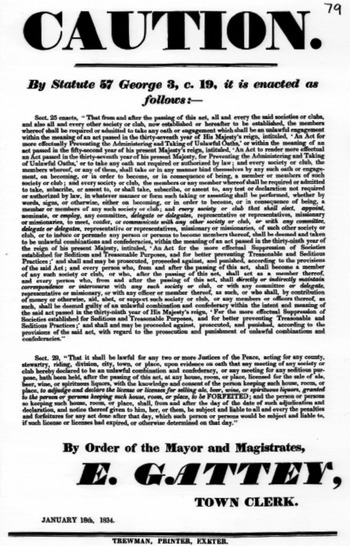
London unionists were also active in Exeter, Tiverton, and at Horsebridge near Tavistock from at least 13 January assisting in the formation of oath-bound trade unions amongst the different building trades, extending at Tiverton also to include the lacemakers. In Exeter, however, a member of the city police managed to gain admission as a spy to one of the meetings, evidence from which was sufficient for a group of constables to storm a meeting of some sixty bricklayers held at the Sun Inn. Fifteen attendees, including two London bricklaying delegates, were arrested and the names of twenty-five others also recorded. The paraphernalia of the initiation ceremony was also seized: two large sabres; two wooden axes; two masks; two white gowns; a large figure of death with a dart and an hour glass; a bible; a minute book; and a copy of the oath to be administered. Notwithstanding the arrests (most of the men immediately finding the £50 bail required) and the publicly advertised desire to secure prosecutions for the using of oaths (Figure 2), the magistrates found it impossible to secure ‘legal proof’ of the administration of the oath. As such, the fifteen men were committed to trial at the Exeter Sessions on the lesser charge of unlawful combination and confederacy. Moreover, the arrests did nothing to stop further meetings in January of the joiners, smiths, and painters and their subsequently joining the union.Footnote 116
Handbill issued by the Exeter magistrates, 18 Jan. 1834. Source: TNA, HO 52/24, fo. 79.

Similarly at Yeovil, ‘persons from Worcester and Derby’ had visited the glovemakers of the town in January and ‘instigated’ some 400 men to join a trade union. Again, they were bound by oath, agreeing to ‘act’ as the committee of the union dictated. ‘Nine tenths’ of the master glovers responded by dismissing the unionists who were duly supported to the amount of 10s a week from a central fund. The fear that the fund ‘must soon be exhausted’ and that ‘serious disturbances’ would arise was the prompt for magistrate Phillips to communicate the news from Yeovil is suggestive that other attempts at encouraging trade unionism in the west are probably not recorded in the archive.Footnote 117 Indeed, we know that at nearby West Chinook letters were received in July 1833 by flax dressers at Hayward & Sons mill from a flax worker at Barnsley calling on them to join the Leeds-based union. The recipients were encouraged to share the invitation with ‘all the Shops Round about you’ and a promise that the Yorkshire men would visit.Footnote 118 It was in this context of national (and general) unionism permeating through the west that the Tolpuddle union was formed.
VI
To claim that trade unionism penetrated the fields and farmyards as emphatically as it did the factories and workshops would be counter to the known evidence. But the consciousness of unionism and the culture of combination undoubtedly did run deep in the rural communities of the west. Indeed, that there was a stated desire on the foundation of the GNCTU to ‘get up a Union among the agricultural labourers’ is in itself suggestive of a belief that farmworkers would readily turn to trade unionism.Footnote 119 In short, as the foregoing analysis suggests, it was a coming together of the shared experiences of living with seemingly perpetual low wages and unemployment with the strong regional culture of combination that created these conditions. As such, it is important to understand the local experience in and around Tolpuddle.
The first truly indigenous Swing mobilization in Dorset started in the Bere Valley on 25 November.Footnote 120 The events that day appear to have been the result of some form of pan-parish organization, for concurrent assemblages formed in the parishes of Bere Regis (then proceeding to Charborough), Winterbourne Kingston, and at Tolpuddle where the labourers ‘had refused to work’. A combination of magisterial intervention, the threat that troops were on their way, and the suggestion by landlord Drax that his Bere tenants should increase the wages paid to their labourers (notwithstanding Frampton's resistance to the move) prevented further assemblages. Frampton's intervention, though, enraged the Bere labourers who planned the next day to join with the men of Briantspuddle and Tonerspuddle and ‘come in the night’ and attack Frampton's house at nearby Moreton. While nothing came of it, so fearful was Frampton that he requested and received military support in the form of twelve armed militia to guard his house. Tellingly, before hearing of the intended attack on his house, Frampton, in writing to the earl of Ilchester on night of the 25th, stated his belief that the Bere Valley was now ‘sound unless Tolpuddle being promised [higher wages] should make others discontented’. There also appeared to be a radical and trade unionist element to Swing in the Bere Valley in which the men of Tolpuddle were implicated, though the precise links are unclear. A ‘letter’ addressed to ‘the Labouring Inhabitants of Tolpuddle’ ‘found’ by squire Frampton in the village proclaimed:
Whereas the Deputy for the National Civil Liberty have learnt that letters of an inflammatory and Destructive nature have been picked up in your streets in consequence of extortion, oppression and deprecating men's labour. Do here advise that no hasty attempts be made. First let one and all apply to their Masters or Employers to advance their wages and in consequence of a refusal Help shall be obtained from the loyal and obedient subjects of W.B. R. on this rock.Footnote 121
We also know that a member of the Loveless family was arrested, and subsequently escaped, for being involved in a Swing mobilization. Moreover, despite George Loveless's later protestation that he was not ‘a rioter’ but had instead been part of a parish watch against incendiarists, a Tolpuddle farmer later testified to Frampton that both brothers were involved in the wages rising: George vocal in the crowd; James attempting to convince the men to go and support a parallel rising at nearby Piddletown.Footnote 122
The wage increases secured at Tolpuddle in 1830 were, as in many villages throughout southern England, short-lived. But, presumably encouraged by their recent success, the Tolpuddle men again pressed for increased wages in the winter of 1831–2. Indeed, George Loveless, in his own words, became a spokesman for local labourers during wage negotiations that winter when ‘there was a general movement of the working classes for an increase in wages’. Their demand was to have the same as the labourers were paid in the neighbouring parishes, 10s a week instead of the 9s they currently received. Unsuccessful, when wages were further reduced to 8s a week, ‘all the labouring men in the village’ applied to magistrate William Morden Pitt to ‘ask…his advice’. Told to send two or three of their body to come to County Hall the following Saturday to meet with their employers and ‘the chief magistrate’ Frampton, Loveless being appointed duly went to Dorchester. Here, despite an earlier promise made by the minister of Tolpuddle, Mr Warren, that if the men returned to their work he would ‘undertake to see you righted’, Loveless was told the men must ‘work for what our masters thought fit to give us’. Thereafter, wages were later reduced to 7s a week and then in the autumn of 1833 to 6s.Footnote 123
The response, after consulting ‘what had to be done’, was to form a ‘friendly society among the labourers’ in imitation of the ‘Trade Societies’ of which George Loveless was familiar from ‘different…accounts’. One source of these accounts was George and James's brother John, a flaxdresser at Burton Bradstock near Bridport. Not only was Bridport arguably the hotspot for trade disputes in Dorset, but the flaxworkers had a particularly deep history of local organization. Moreover, from the early 1830s the Bridport flaxdressers had also been involved in national trade unionism.Footnote 124 On George later being placed into custody in Dorchester gaol, the turnkey found in his pockets a printed address ‘To the Flax and Hemp Trade of Great Britain’, dated Leeds 30 November 1832, passed on by brother John. We also know that George had communicated with a further brother, Robert, living in London on the subject of forming a society, and through whom contact was made with London unionists. In late October 1833, ‘two delegates from a Trade Society’ paid ‘a visit’ to George and James Loveless and some thirty-eight others, including at least one man from Bere Regis, and helped them form the famous ‘Friendly Society’.Footnote 125
Their object, as counsel Derbishire, acting on behalf of the Lovelesses and Thomas Stanfield at the subsequent trial, somewhat disingenuously claimed was ‘to provide a fund, a kind of agricultural savings-bank for mutual succour and maintenance in the hours of need’. Or, as George Loveless later put it, their object was to ‘seek redress’ given that pleas to ‘employers, magistrates, or parsons’ had failed. The ‘Society’ was to be governed by a small ‘grand committee’ based at a ‘Grand Lodge’ in Tolpuddle, with satellite lodges in ‘every parish’, each with their own local committee. True to the model adopted by the unions formed in Devon and Somerset, and, as Wells puts it, the ‘several unions powering the GNCTU’, members were initiated in arcane ceremonies. Blindfolded, they took an oath of secrecy (what Loveless called ‘a form of prayer’), and kissed the bible from which a passage was also read. During the ceremonies, both Lovelesses wore capes, while a large painting of death stood in the corner of the room.Footnote 126
We also know that the union was not confined to Tolpuddle. The initiation ceremony performed on the night of 9 December was an attempt to enrol men from Affpuddle, the infamous prosecution being based on the evidence of Affpuddle initiates John Lock and Edward Legg. As Frampton informed Melbourne on 30 January – the first communication to the Home Office – ‘societies are forming…in parts of the Dorchester and Wareham divisions, with known activities centred upon Tolpuddle in the former and Bere Regis in the latter’. The existence of a lodge at Bere was confirmed by a letter, also found on George Loveless's person on his confinement in Dorchester gaol, from the ‘secretary’ of the Bere Lodge, George Romaine. We also know that in early February a carter from Hazelbury Bryan on passing through Bere was given a copy of the ‘general laws and bye-laws’ adopted at Tolpuddle and a letter which read:
Brethren, This will inform you that there is a possibility of getting a just remuneration for your labour without any violation of the law, or bringing your persons into any trouble, if men are willing to accept of what is offered then labouring men only get 2 shillings or half a crown a day as easy as they now get one shilling only. Let men be united and the victory is gained, after men are united and strike for a rise of wages they will be supported all the time they are staying at home from a certain fund provided for the purpose, nor will there be a danger of others undermining you, for you may take the most cowardly man in this kingdom and let him be united and he will stand firm as a rock. N. B. Men are adopting this almost through the Kingdom.
The carter was encouraged to ‘show it to the working people’ in his parish and send it on to neighbouring Mappowder. Systematic attempts were therefore being made to extend the area in which the union was active, Hazelbury and Mappowder being over ten miles north of Tolpuddle and on the fringe of the Blackmore Vale.Footnote 127 Even after the arrest of the six men on 24 February, the union not only remained in operation but extended its area of operation. A lodge was formed at Winfrith, its initial meeting also drawing in labourers from neighbouring Wool, while on the day following the arrests a meeting ‘by the Sound of a Horn’ was also held on Bere Heath, a calculated, and public, act of defiance.Footnote 128
The outcome and aftermath of the trial on 17 March at the Dorchester Assizes needs no further explanation, suffice to say that Loveless, as well as GNCTU and other trade union activists in the west and elsewhere, believed that the outcome was predetermined, Judge Baron Williams an establishment dupe. But to claim that the charge of issuing illegal oaths or the use of the 1797 Unlawful Oaths Act was novel does not stand scrutiny given the recent history of labour disputes in the west. Melbourne knew of the recent attempts to invoke the act. It would also seem improbable that Frampton's knowledge of this possible application of the act did not stem from the recent regional experience. Even Melbourne's issuing caution to Frampton in his pushing of the statute in framing the labourers’ indictment was mere ministerial protocol, for in 1832 he had recommended Hampshire lord lieutenant the duke of Wellington use the act to prosecute Hampshire political unionists.Footnote 129 Nor did the public shock at the severity of the sentence of transportation (efficiently fanned by the publicity machine of the GNCTU and other unions quick to exploit the potential of the case) lead to an immediate cessation in union activity in the countryside. For, as Wells has stated, in the spring of 1834 farmworkers ‘flocked’ to join the GNCTU at Brighton and also enrolled as members in other urban branches.Footnote 130
VII
Neither the adoption of trade unionism at rural Tolpuddle nor the judicial response was without precedent. So much we know, not least thanks to pioneering studies by Chase on the early history of trade unionism and by Wells on rural unionism. But neither study were attempts to place the events at Tolpuddle into the actual regional and lived contexts of Tolpuddle. Indeed, contra Wells's study, Tolpuddle happened not in a wider agrarian context but in a wider regional (and increasingly inter-regional) and pan-industrial, craft and agrarian context.Footnote 131 While trade unionism by the late 1820s had already become something that transcended local, and even regional, bounds, this was evidently not true of the experience of farmworkers. Before Tolpuddle, farmworkers were not isolated from wider currents of trade unionism. They often deployed the principles and many techniques of unionism, the mentalities even, without formally constituting themselves in unions. In all probability, the archive underestimates unionist activity amongst farmworkers, though it is important to remember that in the context of the post-Napoleonic agrarian depression conditions were far from conducive for farmworkers to engage in collective wages bargaining. If the economic conditions of the early 1830s were no better, other contexts were different. But in making a distinction between the varying practices (and trajectories) of different occupational groups, we need to be careful that we do not assume that knowledge did not transcend occupational division. Besides, such ‘divisions’ tended in lived practice to be more fluid. Industrial and craft workers often had to turn to agricultural labour to supplement their incomes, and not only during the harvest, while many western households were comprised of multiple occupational groups. This fluidity and occupational mixing was a constant throughout the region, something more closely akin to the north-west than the very different communities that dominated the southern cornlands. In this context, ideas were shared and practices learnt without bounds.
What united all western workers by 1834 was the discourse, underpinned by an emergent ideology, that the ‘labourer is worthy of his hire’. This was not just expressed in the trade conflicts of the weavers, silk throwers, lacemakers, flaxworkers, builders, amongst other trades, but was something that also underpinned wages disputes during and after Swing. The claim ‘this is what our labour is worth’ had by 1834, in the west at least, become universal. This was a direct function of shared, if differently contoured, experience: unemployment and underemployment; the readiness of employers to cut wages; and the oft grinding attitude of magistrates and poor law officials. But these attitudes, dispositions, and ideologies mean little outside of their (public) expression and performance. In the west, as the foregoing analyses attest, they found voice and form in a variety of different if overlapping registers, from criminal and work gangs, to trades disputes and formal unionism, something in the west that was inextricably tied up with forms of assertive popular (and anti-Tory) politics. The ability to organize and mobilize was thus far from dead post-1801 and far from novel amongst workers in the countryside. Western workers were thus united by a shared, vibrant critical culture of combination in pursuit of living better.
In part, this robust culture of plebeian combination that permeated the region and united town and country was also underpinned by the fact that western communities were networked into complex webs of work and organization that not only spanned the region but also, from at least the mid-1820s, fellow craft and industrial workers in the Midlands, Lancashire, Yorkshire, and London. This relational politics was not in itself novel – David Featherstone has neatly delineated the Atlantic geographies of both the London Corresponding Society and eighteenth-century coal heaversFootnote 132 – nor unique to the region, but was now being articulated and practised in ways that penetrated all communities in the west. The example of the Loveless family therefore is both instructive and illustrative of how this culture played out in practice. John lived in rural Burton Bradstock but worked in the unionized flax industry in Bridport with links to unionists in Leeds. Robert lived in London and was connected to metropolitan unionists. Labourer and Methodist preacher George through brother Robert was networked with London trade unionists. He also based the rules of the ‘Friendly Society’ on that of the Leeds-based flaxworkers union, and modelled the form and symbolism of the initiation ceremony on that used in many trades throughout the west since the late 1820s. Perhaps this set of connections was unusual, but given the occupational mixing of western communities it seems highly unlikely. The particular experiences of George and James in relation to multiple wages disputes are also unlikely to be unique. We know about these ‘complexities’ by virtue of their later notoriety, that itself a direct function not of Tolpuddle's exceptionalism but Frampton's bitter tenacity and the coincident timing which played perfectly into the GNCTU's need for such potent publicity. Arguably, then, what marks George Loveless out, and that which has allowed the TUC to fashion the now reflexively told Tolpuddle legend, was the fact he was so extraordinarily literate and committed his experiences of repression to paper.