1. Introduction
Sediments on the sea floor are not merely accumulations of mineral grains. In close up, the grains are densely populated by a world of benthic microorganisms known as microbial mats and biofilms (Noffke, Reference Noffke2010). They have a significant influence in subaqueous substrates on how sediments respond to the hydraulic dynamics of waves and currents, and are typically known for the sedimentary structures that they produce in mineral-precipitating environments (Zhang, Reference Zhang2012). For a long time, the best examples of such microbial structures have been the stromatolites. However, microbes do not always form stromatolites. In sand-rich depositional environments, where chemical precipitation of minerals does not take place, microbes and microbial mats also mediate the production of sedimentary structures and specific textures termed microbially induced sedimentary structures (MISS) (Noffke et al. Reference Noffke, Gerdes, Kleke and Krumbein1996; Noffke, Reference Noffke2009).
The formation of MISS has been studied and quantified in modern tidal flats, where benthic cyanobacteria are most abundant (Noffke et al. Reference Noffke, Gerdes, Kleke and Krumbein1997; Noffke, Reference Noffke1998). With the available information from modern sediments, siliciclastic rocks are also being searched for microbial mats and their signatures in ancient sediments with considerable success (Banerjee & Jeevankumar, Reference Banerjee and Jeevankumar2005; Aifa, Sarkar & Banerjee, Reference Aifa, Sarkar and Banerjee2005; Schieber et al. Reference Schieber, Bose, Eriksson, Banerjee, Sarkar, Altermann and Catuneanu2007; Banerjee et al. Reference Banerjee, Sarkar, Eriksson, Samanta, Seckbach and Oren2010; Lan & Chen, Reference Lan and Chen2012, Reference Lan and Chen2013; Lan et al. Reference Lan, Chen, Li and Kaiho2013; Lan, Reference Lan2015; Noffke et al. Reference Noffke, Christian, Wacay and Hazen2013; Kumar & Ahmad, Reference Kumar and Ahmad2014). During the past decade, systematic investigations into siliciclastic rock successions from the early Archaean to the modern period (Gehling, Reference Gehling1999; Eriksson et al. Reference Eriksson, Simpson, Eriksson, Bumby, George, Steyn and Sarkar2000; Noffke, Knoll & Grotzinger, Reference Noffke, Knoll and Grotzinger2002; Aifa, Sarkar & Banerjee, Reference Aifa, Sarkar and Banerjee2005; Sarkar et al. Reference Sarkar, Banerjee, Samanta and Jeevankumar2006; Schieber et al. Reference Schieber, Bose, Eriksson, Banerjee, Sarkar, Altermann and Catuneanu2007; Noffke, Reference Noffke2010; Lan & Chen, Reference Lan and Chen2012, Reference Lan and Chen2013; Lan et al. Reference Lan, Chen, Li and Kaiho2013; Noffke et al. Reference Noffke, Christian, Wacay and Hazen2013; Kumar & Ahmad, Reference Kumar and Ahmad2014 and references therein) have revealed that MISS have been formed by the pervasive overgrowth of microbial mats in peritidal–shallow-marine environments since early Archaean time (Noffke, Reference Noffke2000; Noffke, Knoll & Grotzinger, Reference Noffke, Knoll and Grotzinger2002; Noffke, Hazen & Nhleko, Reference Noffke, Hazen and Nhleko2003; Noffke, Beukes & Hazen, Reference Noffke, Beukes and Hazen2006; Noffke et al. Reference Noffke, Hazen, Eriksson and Simpson2006, Reference Noffke, Beukes, Bower, Hazen and Swift2008). Thus, it has been suggested as the fifth group of sedimentary structures in the classification of primary sedimentary structures (Noffke et al. Reference Noffke, Gerdes, Klenke and Krumbein2001).
Although MISS have been widely described and studied by their different morphological types and their relationships with depositional settings worldwide (Schieber et al. Reference Schieber, Bose, Eriksson, Banerjee, Sarkar, Altermann and Catuneanu2007; Noffke, Reference Noffke2010), little research has been conducted on the Early Cambrian MISS. Accordingly, this paper aims to present a specific type of MISS termed microbial laminated levelling structures and other possible biogenic structures from the Lower Cambrian strata in the eastern Yunnan Province of China in detail.
2. Materials and methods
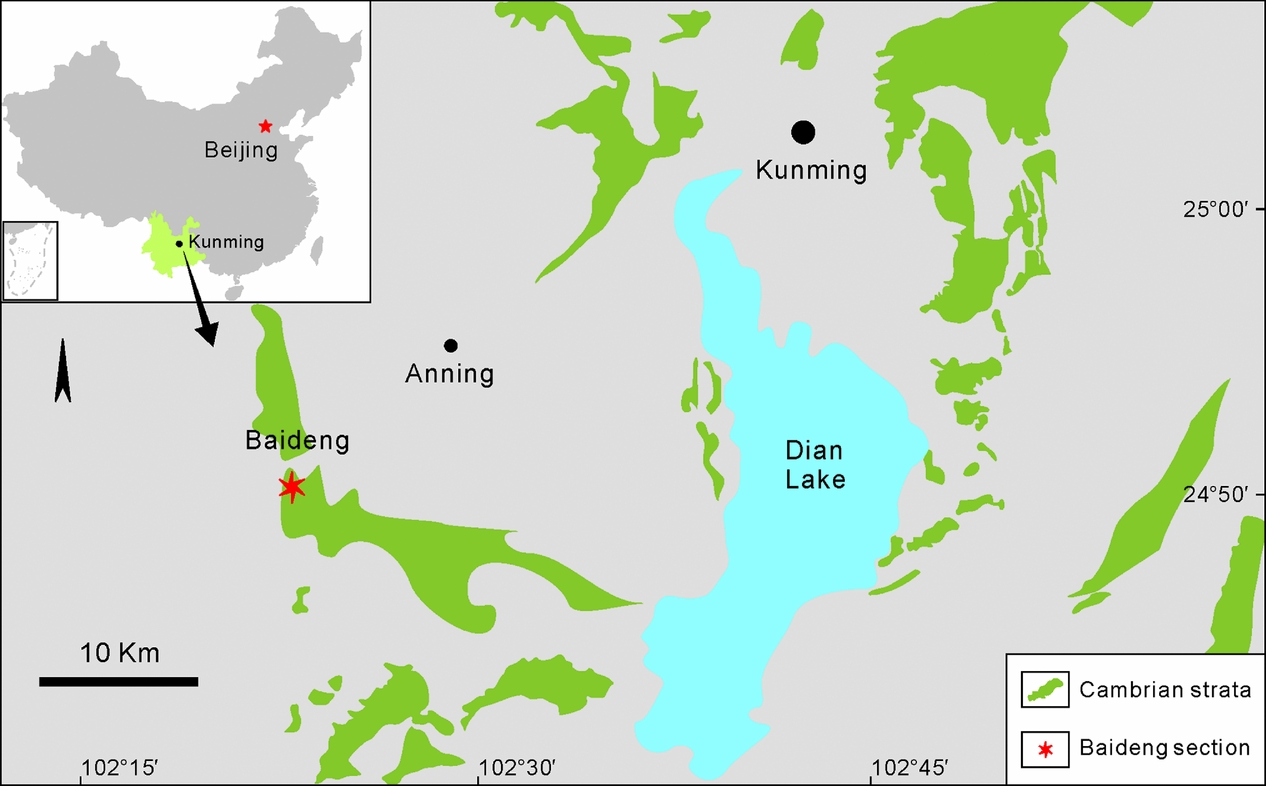
Materials for this ongoing investigation were collected from the Zhongyicun Member of the Meishucun Formation exposed in the Baideng section, which is located c. 40 km southwest of Kunming, the capital city of Yunnan Province (Fig. 1).
The locality of the Baideng section and the distribution of Cambrian strata in the Kunming area, capital city of Yunnan Province, China.

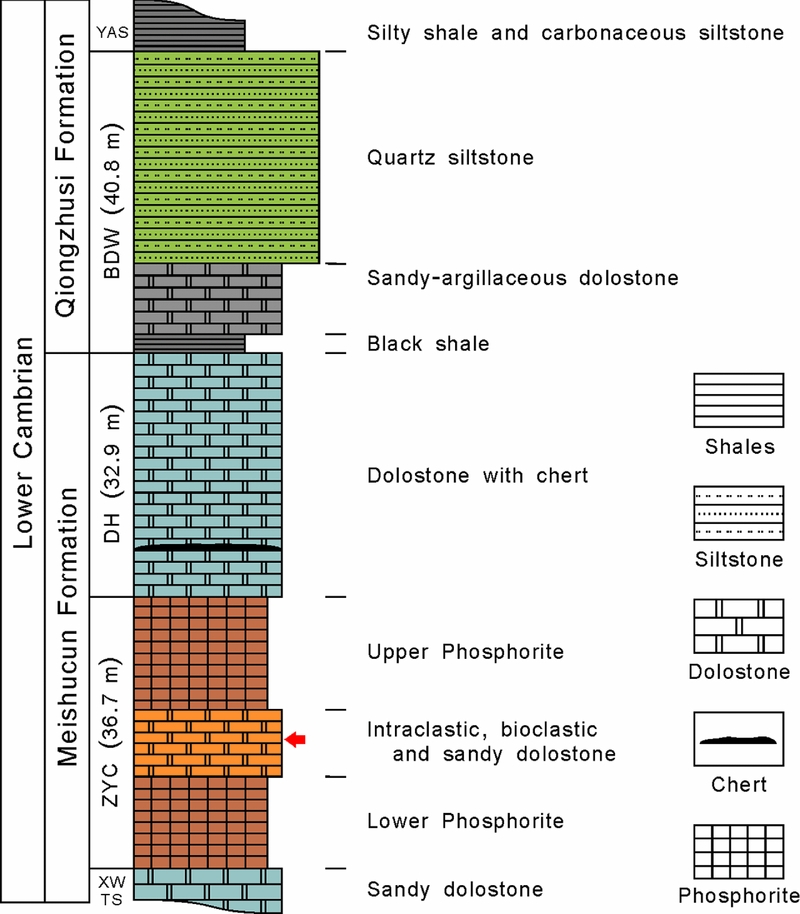
At the Baideng section, the Lower Cambrian Meishucun Formation consists of the Xiaowaitoushan Member (sandy dolomite), the Zhongyicun Member (phosphorite and dolomite) and the Dahai Member (dolomite with chert) in ascending order. The overlying Qiongzhusi Formation consists of the Badaowan Member (quartz siltstone with sandy-argillaceous dolomite and black shale at the base) and the Yu'anshan Member (silty shale with carbonaceous siltstone) (Luo et al. Reference Luo, Jiang, Wu, Song and Ouyang1982, Reference Luo, Jiang, Wu, Song, Ouyang, Xing, Liu, Zhang and Tao1984).
The total thickness of the Zhongyicun Member is c. 36.7 m at the Baideng section (Fig. 2). On the basis of its lithologic characteristics, the Zhongyicun Member can be further subdivided into three units from the bottom to the top, i.e. the lower phosphorite beds (c. 12.4 m, dark grey phosphorite), the middle clastic dolostone beds (c. 9 m, light grey intraclastic, bioclastic and sandy dolostone) and the upper phosphorite beds (c. 15.3 m, dark grey phosphorite). Our samples were collected from the middle clastic dolostone beds, which were once described as ‘the discontinuous lamina’ by Luo et al. (Reference Luo, Jiang, Wu, Song and Ouyang1982) and could be correlated with the fifth beds of the Cambrian strata in the Meishucun section by the biostratigraphic distribution of small shelly fossils (SSFs) (Yang et al. Reference Yang, Steiner, Li and Keupp2014). It was suggested that the age of the Zhongyicun Member is constrained to the Fortunian within the Terreneuvian of the Early Cambrian period (541–529 Ma) in view of the SFF zonation (Sato et al. Reference Sato, Isozaki, Hitachi and Shu2014).
Stratigraphic succession of Lower Cambrian strata in the Baideng section. Horizon of samples from the Zhongyicun Member is indicated with an arrow.

The samples were collected from outcrops in the studied section. The materials under consideration were studied and photographed in polished slabs and thin-sections using optical microscopy. The surface morphology and chemical composition of the microbial laminated levelling structures were studied by scanning electron microscopy (SEM) and energy-dispersive X-ray spectroscopy (EDX) after gold coating.
3. Lithostratigraphy
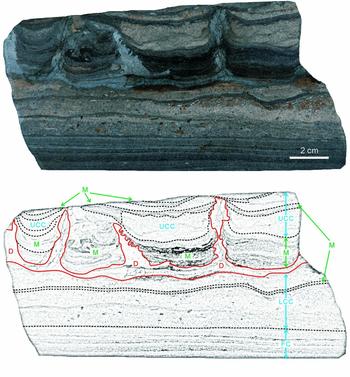
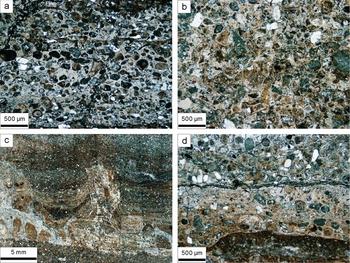
Lithologic characteristics enable the identification of two different clastic sedimentary units (i.e. the lower clastic unit and the upper clastic unit) separated by a dolomite-dominated sedimentary unit on the basis of the polished slab and thin-sections (Figs 3, 4).
Vertical section (polished slab) through the centimetre-scale valleys. From bottom to top, five layer units can be distinguished: fine clastic layers (FC), lower coarse clastic layers (LCC), dolomite layers (D), microbial laminae (M) and upper coarse clastic layers (UCC).

(a) Thin-section view of the fine clastic layers shows well-rounded phosphorite grains and the planar and parallel surfaces. (b) The phosphorite grains and the detrital grains are of varying sizes and shapes in the coarse clastic layers. (c) Thin-section view of the dolomite layers shows the centimetre-scale valleys and the microbial laminae. (d) Thin-section view shows that the upper coarse clastic layers are similar to the lower coarse clastic layers both in composition and structure.

The lower clastic unit is composed of fine and coarse clastic layers in ascending order. The fine clastic layers are mainly composed of well-rounded phosphorite grains 200 μm in diameter with minor quartz grains. The layer surfaces are planar and parallel (Figs 3, 4a). The coarse clastic layers with uneven boundary surfaces are also mainly composed of phosphorite grains (Figs 3, 4b). There are more detrital quartz grains and dolomite in the coarse clastic layers than in the fine clastic layers. In addition, the phosphorite grains and the detrital grains are of varying sizes and shapes in the coarse clastic layers. The vast majority of the phosphorite grains are well rounded and well sorted with a diameter of c. 200 μm, whereas the quartz and dolomite grains are poorly sorted and poorly rounded with an angular or subangular shape.
The dolomite-dominated sedimentary unit, in the lower part of which phosphatic dolomite and quartz grains are present, appears between the two different clastic sedimentary units. The upper part of the dolomite layers is characterized by centimetre-scale valleys which are c. 1–5 cm in width and 1–3 cm in depth (Figs 3, 4c).
The upper clastic unit comprises an alternation of microbial laminated layers and coarse clastic layers. The microbial laminated layers are c. 1 cm in thickness and deposited in the centimetre-scale valleys. The coarse clastic layers here are similar to the coarse clastic layers in the lower clastic unit both in composition and structure, indicating the same environmental conditions (Figs 3, 4d).
4. Fossils and possible biogenic structures
4.a. Small shelly fossils
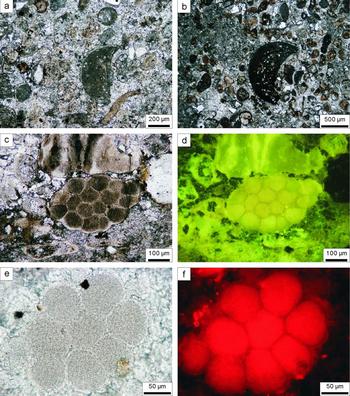
The SSF assemblages from the Zhongyicun Member of the Baideng section are exactly the same as in the other sections of the East Yunnan area (Steiner et al. Reference Steiner, Li, Qian, Zhu and Erdtmann2007; Sato et al. Reference Sato, Isozaki, Hitachi and Shu2014; Yang et al. Reference Yang, Steiner, Li and Keupp2014). Two SSF assemblage zones were recognized as the Anabarites trisulcatus–Protohertzina anabarica Assemblage Zone (Beds 2–8) and the Paragloborilus subglobosus–Purella squamulosa Assemblage Zone (Beds 9–12) (Luo et al. Reference Luo, Jiang, Wu, Song and Ouyang1982). The SSFs here occur as bioclastic grains. The internal cores of the SSFs are mainly filled with phosphate mud containing a small amount of detrital quartz and dolomite grains; the shells of the SSFs are still visible, but the original calcite has been secondarily replaced by dolomite (Fig. 5a, b). The fossils are five to six times the size of the surrounding clastic sediments. Thus, it is suggested that the filling up of the cavity by phosphatic mud occurred before transportation into the final depositional setting where the shells were dolomitized during diagenesis.
Small shelly fossils (a, b) and phosphatic multicellular structures (c–f). The chemical composition of the cell is different from the cell wall. It shows a strong fluorescence reaction in the inner parts of the cell.

4.b. Phosphatic multicellular structures
Besides the SSFs, phosphatic multicellular structures were also found in thin-sections (Fig. 5c–f), which are composed of closely packed cells. The cells are equally sized and spherically shaped with a diameter of c. 60 μm. Microscope examination of the individual cells reveals that the inner part of the cell and the completely preserved cell wall are different in chemical composition. The inner parts of the cell are filled with micritic phosphates and show a strong fluorescence reaction. The cell wall is c. 6 μm in thickness and is made up of dolomite crystals with no reaction under a fluorescence microscope. There is no doubt that these multicellular structures are biogenic in origin. However, it is difficult to determine their biological properties in view of the lack of more details.
4.c. Phosphatic ooids and oncoids
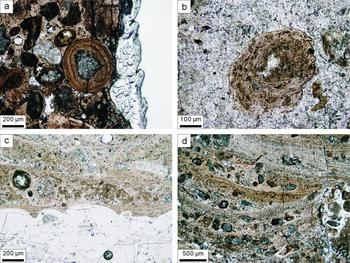
The phosphatic ooids are c. 500 μm in diameter with a regular spherical shape. Most of the nuclei are clastic grains, which are mainly composed of detrital quartz or dolomite grains. The cortex is formed by concentric phosphatic laminae (Fig. 6a). In contrast to the ooids, the oncoids exhibit a cortex consisting of more or less concentric and partially overlapping phosphatic laminae around a lithoclastic nucleus (Fig. 6b).
Phosphatic grains and biogenic laminae in thin-sections. (a) Phosphatic ooids, (b) phosphatic oncoids, (c) domal type stromatolites at the bottom of the centimetre-scale valleys, and (d) phosphatic microbial laminae in the centimetre-scale valleys.

4.d. Biogenic laminae
It is worth noting that there are two types of biogenic laminae: the dolomitic stromatolites and the phosphatic microbial laminae, in ascending order, which only occur at the bottom of the centimetre-scale valleys mentioned above. All of the stromatolites are domal type stromatolites (Fig. 6c). Microscope examination reveals that they are mainly composed of dolomitic laminae and deposited as stromatolitic crust. The thickness of the crust varies from 50–200 μm owing to differential growth of the stromatolites.
Growth of the phosphatic microbial laminae post-dated the stromatolitic crust in the deepest topographical parts of the valleys firstly and underpinned sustainability until the whole valleys were levelled and the prior structures became invisible (Figs 3, 6d). In vertical cross-sections, the phosphatic microbial laminae are composed of alternating dark grey microbial layers and light grey sandy layers, with the older layers overgrown by younger ones. The microbial layers vary in thickness and shape in different areas of the centimetre-scale valleys. At the margin of the valleys, where the microbial layers are in disconformable contact with the dolomite layers, the microbial layers are curved upwards and are much thinner than those in the central part of the valleys (Fig. 6d).
5. Interpretation and discussion
MISS are formed by various modes of microbial behaviour in response to the prevailing physical dynamics. Recently, a diamond-shaped scheme was introduced to summarize the biological processes in MISS formation, based on five categories of biological activities including growth, biostabilization, baffling and trapping, binding and the interference of all microbial activities interacting with physical sediment dynamics (Noffke, Reference Noffke2009, Reference Noffke2010).
Microbial laminated levelling structures are classified into the structures arising from microbial growth (Schieber, Reference Schieber, Erikson, Altermann, Nelson, Mueller and Catuneanu2004; Gerdes, Reference Gerdes, Schieber, Bose, Eriksson, Banerjee, Sarkar, Altermann and Catuneau2007; Noffke, Reference Noffke2010). Microbial laminated levelling structures, termed ‘levelled depositional surfaces’ (Noffke et al. Reference Noffke, Gerdes, Klenke and Krumbein2001), are the result of the development of microbial mats. These mats prefer to accumulate in the deepest topographical parts of the sediment surface relief at first during their growth, and to level the original morphology of the sedimentary surface. Microbial laminated levelling structures are typical for epibenthic microbial mats in modern supratidal zones (Noffke, Reference Noffke2000; Noffke et al. Reference Noffke, Gerdes, Klenke and Krumbein2001). The type of laminated levelling structure depends on the climate. In cold-water environments, the laminae occur as individual layers that alternate with fine sand layers. In hot, arid climates, biovarvites are common (Gerdes, Krumbein & Reineck, Reference Gerdes, Krumbein, Reineck, Einsele, Ricken and Seilacher1991).
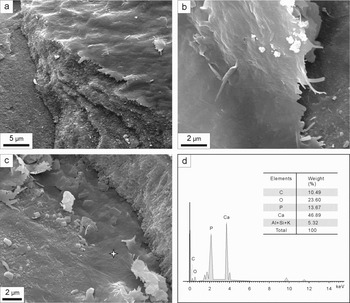
An examination of the SEM pictures of the microbial laminated levelling structures revealed the details of the microfabrics (Fig. 7a–c). The developing biomass of microbial mats overgrows the layer surface. The mats are composed of filamentous structures, which resemble filamentous cyanobacteria and unidentified algae with their extracellular polymeric substances (EPS) in shape and size documented from other modern MISS (Taher, Reference Taher2014). Furthermore, the EDX spectrum (Fig. 7d) shows that the original chemical composition of the mats has been replaced with phosphate, but the carbon peak from the EDX spectrum suggests the existence of carbonaceous materials. Thus, we consider the filamentous structures as phosphatic filamentous cyanobacteria with EPS.
SEM–EDX images of the microbial mats in the microbial laminated levelling structures. (a–c) The mats are composed of filamentous structures, which resemble filamentous cyanobacteria with EPS from other modern MISS (Taher, Reference Taher2014). (d) EDX spectrum shows dominant Ca, P and O for phosphate and the existence of carbonaceous materials.

Based on the analyses, the authors suggest that the laminated levelling structures were formed by microbial mat growth (Fig. 3). First, dolomite deposits formed. During a short hiatus in deposition, weathering created centimetre-scale, U-shaped valleys. Second, stromatolites formed at the bottom of the centimetre-scale U-shaped valleys. Finally, microbial laminae established and covered the proceeding structures until the whole valleys were levelled. Third, the upper clastic unit was deposited.
6. Conclusions
An association of fossils, phosphatic structures and grains, stromatolites and microbial laminated levelling structures is documented from the Zhongyicun Member of Lower Cambrian strata in the eastern Yunnan area, south China. SEM examination reveals that the microbial mats within microbial laminated levelling structures are composed of filamentous cyanobacteria with their EPS. Our study demonstrates that there may be a short hiatus in deposition. During the hiatus, the dolomite layer was weathered to form centimetre-scale valleys firstly, and then microbial mats accumulated in these valleys and formed the microbial laminated levelling structures.
Acknowledgements
The authors would like to thank Zhong-Wu Lan and the anonymous reviewer for their constructive comments which have greatly improved the quality of this manuscript. We thank the Major Basic Research Project of the Ministry of Science and Technology of China (Grant: 2013CB835002), the National Natural Science Foundation of China (Grants: 41621003) and the MOST Special Fund from the State Key Laboratory of Continental Dynamics, Northwest University (Grant: 201210127) for financial support.