



1 Introduction and statement of the results
Consider the following PDE:
 $$ \begin{align} w_{xx} - \delta^2 w_{yy} = Q(w) , \quad \delta = \{1,i\} \end{align} $$
where
 $Q(w)$
is a smooth function. For
 $\delta = 1$
, we have a hyperbolic PDE while for
 $\delta = i$
, an elliptic one.
We define the functional separation property of solutions as follows.
Definition 1 A solution
 $w(x,y)$
is functional separation if there exists an invertible, smooth function f such that
 $$\begin{align*}f\left(w(x,y)\right) = A(x) + B(y) \end{align*}$$
or equivalent the PDE is compatible with
 $$\begin{align*}w_{xy} = F(w)w_xw_y, \end{align*}$$
where
 $F(w) = -f"/f'$
.
It is natural to ask for which Q we obtain functional separation solutions. This question was answered in [Reference Grundland and Infeld16, Reference Qu, He and Dou30], for the case of the d’Alembert (or wave) operator. For the sake of completeness, we shall present the proof.
Moreover, in this article, we study a sinh-Gordon type equation of the form
 $$ \begin{align} \square_\delta w = \frac {2a}{\kappa} \sinh\left(2\kappa w\right)\!, \end{align} $$
where
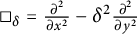 $\square _\delta = \frac {\partial ^2}{\partial x^2} - \delta ^2 \frac {\partial ^2}{\partial y^2}$
, with
 $\delta ,\kappa \in \{1,i\}$
and
 $a \in \mathbb {R}$
. The
 $\square _\delta $
operator is either the wave operator for
 $\delta = 1$
or the Laplace operator for
 $\delta = i$
.
Equation (2), for a suitable choice of
 $\delta $
and
 $\kappa $
, turns out to be the hyperbolic or elliptic version of the sinh-Gordon equation or sine-Gordon equation. More precisely, the following table presents the equations we have for every choice of
 $\delta $
and
 $\kappa $
:

By studying (2), one studies in a unified way all the equations of the table. In this work, we construct solutions of (2). There is no difference between the hyperbolic and elliptic versions and the sine-Gordon and sinh-Gordon, and we study them in a unified way.
These equations are important and appear in numerous applications, for example, [Reference Ao and Yan3, Reference Eleuch and Rostovtsev7, Reference Fokas and Pelloni12, Reference Hu and Sun19, Reference Hwang20, Reference Liu and Wei24, Reference McKean25, Reference Rubinstein32, Reference Wazwaz34, Reference Yang and Zhong38]. Research interest in this type of equation increased scientifically since the introduction of the soliton theory. For more details, we refer to [Reference Ablowitz and Segur1, Reference Hirota17, Reference Hirota18, Reference Miura27, Reference Rogers and Schief31, Reference Wazwaz35] and the references therein. The elliptic sinh-Gordon equation plays a vital role in the theory of constant mean curvature surfaces [Reference Abresch2, Reference Bour5, Reference Joaquín21, Reference Kenmotsu23, Reference Sterling and Wente33, Reference Wente36] and in the theory of harmonic maps [Reference Fordy and Wood13–Reference Fotiadis and Daskaloyannis15, Reference Minsky26, Reference Polychrou28, Reference Polychrou, Papageorgiou, Fotiadis and Daskaloyannis29, Reference Wolf37]. In the recent work of Fotiadis and Daskaloyannis, [Reference Fotiadis and Daskaloyannis15], (2) plays a vital role in the construction of harmonic diffeomorphisms between pseudo-Riemannian surfaces.
Moreover, sine-Gordon equations have several applications in Physics and Engineering. For instance, in [Reference Hirota17, Reference Yang and Zhong38] and the references therein, the motion of the magnetic flux on a one-dimensional Josephson junction transmission line is described by the hyperbolic sine-Gordon. Other applications of the sine-Gordon include the distributed mechanical analogue transmission line, the motion of a slide dislocation in a crystalline structure, models of elementary particles, the transmission of ferromagnetic waves, the epitaxial growth of thin films, and the DNA-soliton dynamics. Finally, the flux of fluid across a closed curve is quantized in the case of the elliptic sine-Gordon equation [Reference Kaptsov22].
In Section 2, we prove the following proposition.
Proposition 2 Equation (1) admits functionally separation solution if
 $Q(w)$
has the following form:
-
(1)
 $Q(w) = c_1 w + c_2,$
-
(2)
$Q(w) = c_1e^{2w} + c_2e^{-w},$
-
(3)
$Q(w) = c_1 e^{2wu} + c_2 e^{-cw},$
-
(4)
$Q(w) = c_1 w + c_2 w\log (w),$
-
(5)
$Q(w) = c_1\sinh (2w) + c_2 \left ( 2\cosh (w) + \arctan (\sinh (w)) \right )\!,$
-
(6)
$Q(w) = c_1\sin (2w) + \frac {c_2}{4} \left ( \sin (2w)\operatorname {\mathrm {arctanh}}(\sin (w)) - 2\cos (w) \right )\!,$
-
(7)
$Q(w) = c_1\sin (2w) + c_2 \left ( 2\sin (w) + \sin (2w)\log \left (\tan (\frac {w}{2})\right ) \right )\!,$
-
(8)
$Q(w) = c_1\sinh (2w) + c_2 \left ( 2\sinh (w) + \sinh (2w)\log \left (\tanh (\frac {w}{2})\right ) \right )\!.$








Next, we study (2). In Section 3, we prove the following main results. Recall that
 $\kappa = \{1,i\}$
.
Proposition 3 Let
 $w(x,y)$
be a solution to (2) and w is compatible with
 $$ \begin{align} w_{xy} = F(w)w_xw_y. \end{align} $$
Then,
 $F(w)$
is of the form
 $$ \begin{align} F(w) = \kappa \tanh\left(\kappa w\right)\!, \end{align} $$
or of the form
 $$ \begin{align} F(w) = \kappa \coth\left(\kappa w\right)\!. \end{align} $$
Theorem 4 Equation (2) admits functional separation solutions
 $$\begin{align*}\sinh\left(\kappa w(x,y)\right) = \tan\left(\kappa ( A(x) + B(y) )\right)\!, \end{align*}$$
and
 $$\begin{align*}\tanh\left(\kappa \frac{w(x,y)}{2}\right) = \kappa e^{-2(A(x) + B(y))}. \end{align*}$$
The theorem above demonstrates the classification of solutions of functional separation for (2). Since we have not selected the values of
 $\delta $
and
 $\kappa $
, there is no distinction between the elliptic and hyperbolic forms.
Note that our results extend the results in [Reference Polychrou28, Reference Polychrou, Papageorgiou, Fotiadis and Daskaloyannis29], since in these papers, the authors construct solutions for the elliptic sine-Gordon and elliptic sinh-Gordon equation. In this work, we study it in a unified way.
In Section 4, we consider the solutions constructed in Theorem 4, to obtain the form of the functions
 $A(x)$
and
 $B(y)$
. It turns out that these functions are Jacobi elliptic.
At first, we study the solutions of the form
 $$ \begin{align} \tanh \left( \kappa \frac{w(x,y)}{2} \right) = \kappa e^{-2\left(A(x) + B(y)\right)} = \kappa F(x)G(y), \end{align} $$
and we state the following result.
Theorem 5 If w is a solution of the sinh-Gordon type equation (2) of the form
 $$\begin{align*}\tanh \left( \kappa\frac{w(x,y)}{2} \right) = \kappa F(x)G(y), \end{align*}$$
then the functions
 $F(x)$
and
 $G(y)$
satisfy the differential equations
 $$ \begin{align} F'(x)^{2} = A\kappa^2\delta^2F(x)^{4} + B F(x)^{2} + C, \end{align} $$
 $$ \begin{align} G'(y)^{2} = \kappa\delta^2 CG(y)^{4} + \delta^2 \left( B - 4a \right) G(y)^{2} + A, \end{align} $$
where
 $A,B$
and
 $C \in \mathbb {R}$
.
Functions F and G are in general Jacobi elliptic functions, but there are constants for which the solutions are elementary functions.
The second family of solutions w of the generalized sinh-Gordon equation is of the form
 $$ \begin{align} \sinh\left( \kappa w(x,y) \right) = \tan \left( \kappa (A(x) + B(y)) \right)\!, \end{align} $$
and we obtain the following result.
Theorem 6 If w is a solution of the sinh-Gordon type equation (2) of the form
 $$\begin{align*}\sinh\left( \kappa w(x,y) \right) = \tan \left( \kappa (A(x) + B(y)) \right)\!, \end{align*}$$
then the functions
 $A(x)$
and
 $B(y)$
satisfy the differential equations
 $$ \begin{align} A"(x)^2 = - \kappa^2A'(x)^4 + c_1 A'(x)^2 + c_2 \end{align} $$
 $$ \begin{align} B"(y)^{2} = - \kappa^2 B'(y)^{4} + \delta^2\left(c_1 - 8a\right)B'(y)^{2} + c_3, \end{align} $$
where
 $16a^2 + \kappa ^2\left (c_3 - c_2\right ) = 4ac_1$
and
 $c_1,c_2, c_3 \in \mathbb {R}$
.
Remark By letting
 $\alpha (x) = A'(x)$
and
 $\beta (y) = B'(y)$
, (10) and (11) turn into
 $$\begin{align*}\alpha'(x)^2 = -\kappa^2 \alpha^4(x) + c_1\alpha^2(x) + c_2, \end{align*}$$
 $$\begin{align*}\beta'(y)^2 = - \kappa^2 \beta(y)^{4} + \delta^2\left(c_1 - 8a\right)\beta(y)^{2} + c_3, \end{align*}$$
where
 $16a^2 + \kappa ^2\left (c_3 - c_2\right ) = 4ac_1$
and
 $c_1,c_2, c_3 \in \mathbb {R}$
.
Generally, the solutions of these equations are Jacobi elliptic functions, but there are constants
 $c_1,c_2,$
and
 $c_3$
, for which we obtain elementary functions.
2 Proof of Proposition 2
Proof The proof follows [Reference Arrigo4, Reference Grundland and Infeld16, Reference Qu, He and Dou30]. The equations
 $w_{xx} - \delta ^2 w_{yy} = Q(w)$
and
 $w_{xy} = F(w)w_xw_y$
have to be compatible, to admit functional separation solutions. Differentiating both equations, once with respect to x and once with respect to y, we obtain the following:
 $$ \begin{align*} w_{xxx} &= \delta^2 \left(F'(w) + F^2(w)\right)w_xw_y^2 + \delta^2F(w)w_{x}w_{yy} + Q'(w)w_x \\ w_{yyy} & = \delta^2 \left(F'(w) + F^2(w)\right)w_x^2w_y + \delta^2 F(w)w_yw_{xx} - \delta^2Q'(w)w_y \\ w_{xyx} &= F'(w)w_x^2w_y + F(w)w_{xx}w_y + F^2(w)w_x^2w_y, \\ w_{xyy} &= F'(w)w_xw_y^2 + F^2(w)w_xw_y^2 + F(w)w_xw_{yy}. \end{align*} $$
Differentiating and using (1) to eliminate the second derivatives, we obtain
 $$ \begin{align*} \frac{w_{xxyx}}{w_xw_y} &= \left(3F'(w) + 3F^2(w)\right)Q(w) + F(w)Q'(w) \\ &+ \left(F"(w) + 3F(w)F'(w) + F^3(w)\right)w_x^2 \\ &+ \delta^2 \left(F'(w)F(w) + F^3(w)\right)w_y^2 \\ &+ \delta^2\left(3F'(w) + 4F^2(w)\right)w_{yy}, \end{align*} $$
 $$ \begin{align*} \frac{w_{xxxy}}{w_xw_y} & = Q"(w) + F^2(w)Q(w) \\ &+ \left(F'(w)F(w) + F^3(w)\right)w_x^2 \\ &+ \delta^2 \left(F"(w) + 3F(w)F'(w) + F^3(w)\right)w_y^2 \\ &+ \delta^2\left(3F'(w) + 4F^2(w)\right)w_{yy}. \end{align*} $$
Using the compatibility of
 $w_{xxyx}$
and
 $w_{xxxy}$
and equating the terms, we obtain:
 $$ \begin{align} 3Q(w)F'(w) + 2 Q(w)F^2(w) + Q'(w)F(w) = Q"(w) \end{align} $$
 $$ \begin{align} F"(w) + 2F'(w)F(w) = 0. \end{align} $$
Using (13), we obtain that F is one of the following:
-
(1)
$F(w) = c$
, where c is a real constant. -
(2)
$F(w) = 1/w$
-
(3)
$F(w) = - \tan (w)$
-
(4)
$F(w) = \tanh (w)$
-
(5)
$F(w) = \cot (w)$
-
(6)
$F(w) = \coth (w).$






We now find Q. From now on,
 $c_1$
and
 $c_2$
are real constants.
Case 1.
 $F(w) = 0, Q"(w) = 0$
so
 $$\begin{align*}Q(w) = c_1w + c_2. \end{align*}$$
Case 2.
 $F(w) = 1, Q"(w) - Q'(w) - 2Q(w) = 0$
so
 $$\begin{align*}Q(w) = c_1 e^{-w} + c_2 e^{2w}. \end{align*}$$
Case 3.
 $F(w) = c, Q"(w) - cQ'(w) - 2c^2Q(w) = 0$
so
 $$\begin{align*}Q(w) = c_1e^{2cw} + c_2e^{-cw}. \end{align*}$$
(For
 $c = -1$
Bullough–Dodd–Mikhailov equation)
(For
 $c = - 1$
and
 $c_1 = 0$
Liouville)
Case 4.
 $F(w) = \frac {1}{w}, w^2Q"(w) - wQ'(w) + Q(w) = 0$
so
 $$\begin{align*}Q(w) = c_1w + c_2w\log(w). \end{align*}$$
Case 5.
 $F(w) = \tanh (w)$
,
 $Q"(w) - \tanh (w)Q'(w) - \left (\mathrm {sech} ^2(w) + 2\right )Q(w) = 0.$
An obvious solution is
 $\sinh (2w)$
. So, letting
 $Q(w) = \sinh (2w)R(w),$
the equation turns into
 $$\begin{align*}\frac{d}{dw}\left(\cosh(w)\sinh^2(w)R'(w)\right) = 0 , \end{align*}$$
 $$\begin{align*}R(w) = c_2\left(\frac{1}{\sinh(w)} + \arctan(\sinh(w))\right) + c_1, \end{align*}$$
 $$\begin{align*}\Rightarrow Q(w) = c_1\sinh(2w) + c_2 \left( 2\cosh(w) + \arctan(\sinh(w)) \right) \end{align*}$$
Case 6.
 $F(w) = -\tan (w)$
,
 $Q"(w) + \tan (w)Q'(w) + \left (\sec ^2(w) + 2\right )Q(w) = 0,$
An obvious solution is
 $\sin (2w)$
. So, letting
 $Q(w) = \sin (2w)R(w),$
the equation turns into
 $$\begin{align*}\frac{d}{dw} \left( 4\cos(w)\sin^2(w)R'(w) = 0,\! \right) \end{align*}$$
 $$\begin{align*}R(w) = c_1 + \frac{c_2}{4} \left(\operatorname{\mathrm{arctanh}}(\sin(w)) - \csc(w)\right)\!, \end{align*}$$
 $$\begin{align*}\Rightarrow Q(w) = c_1\sin(2w) + \frac{c_2}{4} \left( \sin(2w)\operatorname{\mathrm{arctanh}}(\sin(w)) - 2\cos(w) \right) \end{align*}$$
Case 7.
 $F(w) = \cot (w)$
,
 $Q"(w) - \cot (w)Q'(w) + \left (\csc ^2(w) + 2\right )Q(w) = 0,$
An obvious solution is
 $\sin (2w)$
. So, letting
 $Q(w) = \sin (2w)R(w),$
the equation turns into
 $$\begin{align*}\frac{d}{dw} \left( \cos^2(w)\sin(w)R'(w) \right) = 0, \end{align*}$$
 $$\begin{align*}R(w) = c_1 + c_2 \left( \sec(w) + \log\left(\tan(\frac{w}{2})\right) \right)\!, \end{align*}$$
 $$\begin{align*}\Rightarrow Q(w) = c_1\sin(2w) + c_2 \left( 2\sin(w) + \sin(2w)\log\left(\tan(\frac{w}{2})\right) \right) \end{align*}$$
Case 8.
 $F(w) = \coth (w)$
,
 $Q"(w) - \coth (w)Q'(w) + \left (\csc h^2(w) - 2\right )Q(w) = 0$
.
An obvious solution is
 $\sinh (2w)$
. So, letting
 $Q(w) = \sin (2w)R(w),$
the equation turns into
 $$\begin{align*}\frac{d}{dw}\left(\cosh^2(w)\sinh(w)R'(w)\right) = 0 , \end{align*}$$
 $$\begin{align*}R(w) = c_1 + c_2\left(\frac{1}{\cosh(w)} + \log\left(\tanh(\frac{w}{2})\right)\right)\!, \end{align*}$$
 $$\begin{align*}\Rightarrow Q(w) = c_1\sinh(2w) + c_2 \left( 2\sinh(w) + \sinh(2w)\log\left(\tanh(\frac{w}{2})\right) \right)\!.\\[-39pt] \end{align*}$$
3 Solutions via functional separation
In this section, we demonstrate the proofs of Proposition 3 and of Theorem 4. Through this theorem, we classify the solutions with the property of functional separation of (2). There is no distinction between the elliptic and hyperbolic versions of both the sine-Gordon and sinh-Gordon equations.
Such solutions are important and many researchers have studied them. A remarkable example is due to Abresch. In [Reference Abresch2], the author describes the Wente Torus, introduced by Wente in [Reference Wente36]. The author constructs families of solutions of the elliptic sinh-Gordon equation which satisfy a geometric condition. This condition turns out to be a nonlinear PDE of the form
 $$\begin{align*}w_{xy} = \tanh(w)w_xw_y, \end{align*}$$
or
 $$\begin{align*}w_{xy} = \coth(w) w_xw_y. \end{align*}$$
In this work, we prove that these conditions are related with the functional separation families of solutions. We remind that by Definition 1, a solution has the property of functional separation, if there exists an f such that
 $$\begin{align*}f\left(w(x,y)\right) = A(x) + B(y) \end{align*}$$
or equivalent the equation (2) is compatible with
 $$\begin{align*}w_{xy} = F(w) w_xw_y , \end{align*}$$
where
 $F(w) : \mathbb {R} \rightarrow \mathbb {R}$
,
 $F = -f"/f'$
. Our first goal is to prove Proposition 3, to find explicitly the function F.
Proof of Proposition 3
The equations (2) and
 $w_{xy} = F(w)w_xw_y$
have to be compatible. Taking the derivatives with respect to x and y of both equations, we obtain
 $$ \begin{align} w_{xxx} - \delta^2 w_{yyx} &= 4a w_x\cosh\left(2\kappa w\right)\!, \end{align} $$
 $$ \begin{align} w_{xxy} - \delta^2 w_{yyy} &= 4a w_y\cosh\left(2\kappa w\right), \end{align} $$
 $$ \begin{align} (w_{xy})_x &= F'(w)w_x^2w_y + F(w)w_{xx}w_y + F^2(w)w_x^2w_y, \end{align} $$
 $$ \begin{align} (w_{xy})_y &= F'(w)w_xw_y^2 + F^2(w)w_xw_y^2 + F(w)w_xw_{yy}. \end{align} $$
Solving these equations for the third derivatives
 $w_{xxx},w_{xxy},w_{xyy,}$
and
 $w_{yyy,}$
we obtain
 $$ \begin{align*} w_{xxx} &= \delta^2 w_xw_y^2 \left(F'(w) + F^2(w)\right) + \delta^2 F(w)w_xw_{yy} + 4a w_x \cosh\left(2\kappa w\right)\!, \\w_{xxy} &= F'(w)w_x^2w_y + F(w)w_{xx}w_y + F^2(w)w_x^2w_y, \\w_{xyy} &= F'(w)w_xw_y^2 + F^2(w)w_xw_y^2 + F(w)w_xw_{yy}, \\w_{yyy} &= \delta^2w_x^2w_y \left(F'(w) + F^2(w)\right) + \delta^2 F(w)w_{xx}w_y - 4a\delta^2 w_y \cosh\left(2\kappa w\right)\!. \end{align*} $$
By compatibility and using (2) to eliminate the second derivatives, we obtain
 $$ \begin{align*} \frac{w_{xxxy}}{w_xw_y} &= 4aF(w) \cosh\left(2\kappa w\right) + \frac{6a}{\kappa} \left(F'(w) + F^2(w)\right) \sinh\left(2\kappa w\right) \\ &+ \left( F"(w) + 3F'(w)F(w) + F^3(w) \right)w_x^2\\ &+ \left(\delta^2F(w)F'(w) + \delta^2F^3(w)\right)w_y^2\\ &+ \left( 3\delta^2F'(w) + 4\delta^2F^2(w) \right)w_{yy} \end{align*} $$
and
 $$ \begin{align*} \frac{w_{xxyx}}{w_xw_y} &= 8a \kappa \sinh\left(2\kappa w\right) + \frac{2a}{\kappa}F^2(w)\sinh\left(2\kappa w\right)\\ &+ \left(F(w)F'(w) + F^3(w)\right)w_x^2\\ &+ \left(\delta^2F"(w) + 3\delta^2F'(w)F(w) + \delta^2F^3(w)\right)w_y^2\\ &+ \left(3\delta^2F'(w) + 4\delta^2F^2(w) \right)w_{yy}. \end{align*} $$
Thus,
 $$ \begin{align*} &4 F(w)\cosh\left(2\kappa w\right) + \frac{4}{\kappa}F^2(w) \sinh\left(2\kappa w\right) + \frac{6}{\kappa}F'(w) \sinh\left(2\kappa w\right) - 8\kappa\sinh\left(2\kappa w\right) \\ & + \left(F"(w) + 2F'(w)F(w)\right) \left(w_x^2 - \delta^2w_y^2\right) = 0, \end{align*} $$
from which we obtain the equations for
 $F(w)$
 $$ \begin{align} 2\kappa F(w) \coth(2\kappa w)+ 3F'(w) + 2F^2(w) = 4\kappa^2, \end{align} $$
and
 $$ \begin{align} F"(w) + 2F'(w)F(w) = 0. \end{align} $$
We begin with (19) and so by integrating, we obtain
 $F'(w) + F^2(w) = c$
. We have to consider three cases for c. Namely,
 $c = 0$
,
 $c> 0,$
and
 $c < 0$
. By scaling, we consider
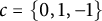 $c = \{0,1,-1\}$
. The only solutions of (19) compatible with (18) are
 $F(w) = \kappa \tanh (\kappa w)$
and
 $F(w) = \kappa \coth (\kappa w)$
.
Since we obtained the function F, we can construct the families of solutions via functional separation as in Theorem 4.
Proof of Theorem 4
By Proposition 3, we have that
 $F(w) = \kappa \tanh (\kappa w)$
or
 $F(w) = \kappa \coth (\kappa w)$
. To construct the families of solutions, we have to obtain the function f. Taking into account that
 $F = - f"/f'$
and considering the first case, we obtain
 $$\begin{align*}-\frac{f"}{f'} = \kappa\tanh(\kappa w), \end{align*}$$
and by integration, we obtain
 $$\begin{align*}f'(w) = 1/\cosh w , \end{align*}$$
which corresponds to (4), while taking into account the second case
 $$\begin{align*}-\frac{f"}{f'} = \kappa\coth(\kappa w), \end{align*}$$
by integrations, we obtain (5).
4 Solutions of the generalized sinh-Gordon equation
In this section, we prove Theorems 5 and 6. These theorems describe the families of solutions of (2), which are classified by Theorem 4.
The first family of solutions for (2) is of the form
 $$ \begin{align} \tanh \left( \kappa\frac{w(x,y)}{2} \right) = \kappa F(x)G(y). \end{align} $$
Proof of Theorem 5
Let
 $H(y) = 1/G(y)$
. By substituting (20) into (2), we obtain
 $$\begin{align*}\left( H^2(y) - \kappa^2 F^2(x) \right) \left( F"(x)H(y) + \delta^2 F(x)H"(y) \right) + 2\kappa^2 F(x)F'(x)^2H(y) \end{align*}$$
 $$\begin{align*}- 2\delta^2 F(x)H(y)H'(y)^2 = 4a \left( \kappa^2 F^3(x)H(y) + F(x)H^3(y) \right)\!. \end{align*}$$
By dividing with
 $F(x)H(y),$
we have
 $$ \begin{align} \left(\frac{F"(x)}{F(x)} + \delta^2 \frac{H"(y)}{H(y)} \right) \left( H^2(y) - \kappa^2 F^2(x) \right) + 2\kappa^2F'(x)^2 - 2\delta^2H'(y)^2 \end{align} $$
 $$\begin{align*}= 4a (\kappa^2F^2(x) + H^2(y)). \end{align*}$$
By differentiating with respect to x and y, we obtain
 $$ \begin{align} \left(\frac{F"(x)}{F(x)}\right)_{x} \frac{1}{\kappa^2\delta^2F(x)F'(x)} = \left(\frac{H"(y)}{H(y)}\right)_{y} \frac{1}{H(y)H'(y)} = 4A. \end{align} $$
Thus, we obtain
 $$\begin{align*}\left(\frac{F"(x)}{F(x)}\right)_{x} = 4\kappa^2\delta^2AF(x)F'(x) \end{align*}$$
 $$\begin{align*}\Rightarrow (F'(x))^{2} = A\kappa^2\delta^2 (F(x))^{4} + B(F(x))^{2} + C, \end{align*}$$
and for
 $H(y),$
we obtain
 $$\begin{align*}\left(\frac{H"(y)}{H(y)}\right)_{y} = 4AH(y)H'(y) \end{align*}$$
 $$\begin{align*}\Rightarrow (H'(y))^2 = A(H(y))^4 + B'(H(y))^2 + C'. \end{align*}$$
Using (21), we obtain that
 $B - \delta ^2 B' = 4a$
and
 $C = \kappa ^2\delta ^2C'$
and (7) and (8) follow.
By this theorem, we obtain the exact form of solutions of the family (20). In general, F and G are Jacobi elliptic functions. Through this theorem, we construct new families of solutions for both the elliptic and hyperbolic versions, since there is no selection of
 $\delta $
and
 $\kappa $
. Let us demonstrate an example of this family.
Example 7 Let
 $a = 1$
,
 $A = 0$
,
 $B = 4 - \kappa ^2,$
and
 $C = 1$
then we obtain the equations
 $$\begin{align*}F'(x)^2 = \left(4 - \kappa^2\right)F^2(x) + 1, \quad H'(y)^2 = \kappa^2\delta^2 \left(1 - H^2(y)\right)\!. \end{align*}$$
Then
 $$\begin{align*}F(x) = \frac{\sinh\left(\sqrt{4 - \kappa^2} x\right)} {\sqrt{4 - \kappa^2}}, \quad H(y) = \cos\left(\kappa\delta y\right)\!. \end{align*}$$
So, for (2), we have constructed the solution
 $$\begin{align*}\tanh\left(\frac{\kappa w(x,y)}{2}\right) = \kappa \frac{\sinh\left(\sqrt{4 - \kappa^2} x\right) \sec(\kappa\delta y)} {\sqrt{4 - \kappa^2}}. \end{align*}$$
By selecting the constants
 $\delta $
and
 $\epsilon $
, one obtains solutions for the hyperbolic or elliptic versions, depending on the choice made. For instance, let
 $\delta = 1$
and
 $\kappa = i$
then we obtain a solution of the hyperbolic sine-Gordon equation
 $$\begin{align*}w(x,y) = 2\arctan \left( \frac{\sinh(\sqrt{5}x)}{\sqrt{5}\cosh(y)} \right)\!. \end{align*}$$
In Figure 1, we demonstrate its graph.
Another example is to select
 $\delta = i$
and
 $\kappa = 1$
to obtain a solution of the elliptic sinh-Gordon equation. To this end, we obtain the solution
 $$\begin{align*}\tanh \left( \frac{w(x,y)}{2} \right) = \frac{\sinh(\sqrt{3}x)}{\sqrt{3}\cosh(y)}, \end{align*}$$
which is well-defined in
 $\Omega := \{ (x,y) \in \mathbb {R}^2: |\frac {\sinh (\sqrt {3}x)}{\sqrt {3}\cosh (y)} | < 1\}$
. In Figure 2, we demonstrate its graph.
The graph of
 $\tan(w(x, y)/2) = \sinh( \sqrt{5}x)/( \sqrt{5} \cosh(y) )$
.

The graph of
 $ \tanh(w(x,y)/2) = \sinh(\sqrt{3}x)/(\sqrt{3} \cosh(y) )$
.

One can verify the results either by hand or using computing software, such as Mathematica.
The second family of solutions for (2) is of the form
 $$ \begin{align} \sinh \left( \kappa w(x,y) \right) = \tan \left( \kappa(A(x) + B(y)) \right)\!. \end{align} $$
Proof of Theorem 6
By substituting (23) in (2), and dividing by
 $\sec \big(\kappa (A(x) + B(y))\big )$
then we obtain
 $$\begin{align*}\tan \left( \kappa(A(x) + B(y)) \right) = \frac { \kappa \left(A"(x) - \delta^2 B"(y)\right) } { 4a - \kappa^2A'(x)^2 + \delta^2\kappa^2 B'(y)^2 }. \end{align*}$$
By differentiating with respect to x and using the trigonometric identity
 $\sec ^2u = 1 + \tan ^2u$
and dividing with
 $A'(x)$
, we obtain
 $$ \begin{align} \left(4a - \kappa^2A'(x)^2 + \delta^2\kappa^2 B'(y)^2\right)^2 + \kappa^2 B"(y)^2 \end{align} $$
 $$\begin{align*}= \frac{A^{(3)}(x)}{A'(x)} \left(4a - \kappa^2A'(x)^2 + \delta^2\kappa^2 B'(y)^2\right) + \kappa^2 A"(x)^2. \end{align*}$$
By differentiating with respect to
 $y,$
we obtain
 $$\begin{align*}4\delta^2\kappa^2A'(x)B'(y)B"(y) \left(4a - \kappa^2A'(x)^2 + \delta^2\kappa^2 B'(y)^2\right) \end{align*}$$
 $$\begin{align*}= 2\delta^2\kappa^2A^{(3)}(x)B'(y)B"(y) - 2\kappa^2A'(x)B"(y)B^{(3)}(y). \end{align*}$$
After calculations, we obtain
 $$\begin{align*}\frac{A^{(3)}(x)}{A'(x)} + 2\kappa^2A'(x)^2 = \delta^2\frac{B^{(3)}(y)}{B'(y)} + 2\delta^2\kappa^2B'(y)^2 + 8a = c_1. \end{align*}$$
So we have for
 $A(x)$
 $$\begin{align*}\frac{A"'(x)}{A'(x)} + 2\kappa^2 A'(x)^2 = c_1 \end{align*}$$
 $$\begin{align*}\Rightarrow A"(x)^{2} = -\kappa^2A'(x)^{4} + c_1A'(x)^{2} + c_2 \end{align*}$$
and we have for
 $B(y)$
 $$\begin{align*}\frac{B"'(y)}{B'(y)} + 2\kappa^2B'(y)^2 = \delta^2 \left( c_1 - 8a \right) \end{align*}$$
 $$\begin{align*}\Rightarrow B"(y)^{2} = - \kappa^2B'(y)^{4} + \delta^2 \left( c_1 - 8a \right) B'(y)^{2} + c_3. \end{align*}$$
Using (24), we obtain the relationship
 $ 16a^2 + \kappa ^2(c_3 - c_2) = 4ac_1$
.
Let us illustrate an example of this family.
Example 8 Let
 $a = -\delta ^2\kappa ^2$
and choose
 $c_1 = 2\kappa ^2$
,
 $c_2 = - \kappa ^2,$
and
 $c_3 = - 8\kappa ^2\delta ^2 - 17\kappa ^2$
. To have solutions for every choice of
 $\delta $
and
 $\kappa $
, let
 $A'(x)$
and
 $B'(y)$
be constant functions. To this end,
 $$\begin{align*}A'(x) = 1 \quad B'(y) = \sqrt{4 + \kappa^2\delta^2}. \end{align*}$$
Then, the solution turns into
 $$\begin{align*}\sinh\left(\kappa w(x,y) \right) = \tan\left(\kappa \left(x + \sqrt{4 + \delta^2}y \right) \right)\!. \end{align*}$$
Now, let us demonstrate some examples by selecting
 $\delta $
and
 $\kappa $
. For
 $\kappa = \delta = 1,$
we obtain a solution of the hyperbolic sinh-Gordon equation
 $$\begin{align*}\sinh(w(x,y)) = \tan \left( x + \sqrt{5}y \right)\!. \end{align*}$$
We demonstrate its graph in Figure 3.
The graph of
 $ \sinh(w(x, y)) = \tan (x + \sqrt{5}y)$
.

For
 $\kappa = i$
and
 $\delta = 1$
, we obtain a solution for the sine-Gordon equation
 $$\begin{align*}w(x,y) = \arcsin\left(\tanh\left( x + \sqrt{5}y \right)\right)\!. \end{align*}$$
We demonstrate its graph in Figure 4.
The graph of
 $ \sin(w(x, y)) = \tanh (x + \sqrt{5}y)$
.

5 Discussion
In this work, we classify all the hyperbolic/elliptic PDEs that admit functional separation solutions. Moreover, we study the hyperbolic/elliptic sine-Gordon and sinh-Gordon equations without any distinction between them. We have used the method of functional separation to obtain new families of solutions for (2) and we prove that these are the solutions with such a property, so we obtain a classification. A future work to consider is to study this equation with a variable coefficient [Reference Yang and Zhong38, Reference Yang, Zhong, Zhong and Belić39], the inverse scattering method [Reference Ablowitz and Segur1], and Fokas’ method [Reference Chatziafratis, Fokas and Kalimeris6, Reference Fokas8–Reference Fokas and Pelloni12, Reference Hwang20] for boundary problems of both the hyperbolic and elliptic sine-Gordon and sinh-Gordon in a unified way.
Acknowledgements
The author would like to thank Prof. C. Daskaloyannis and Prof. A. Fotiadis for their help and support and Dr. G. Papamikos for his useful comments. Finally, the author would like to thank the referees for their useful comments.



