I. INTRODUCTION
Lubricants are widely used in applications such as machining industries, automotive and others. The main characteristics of lubricants are its lubricity, the ability of lubricant to reduce friction that exists between surfaces when they are in relative motion.Reference Abdalla and Patel1 Due to continuous environmental legislations and increasing customer awareness, lubricant industry is striving for lubrication solutions which should be biodegradable and environmentally friendly.
Conventional lubricants are mixtures of hydrocarbons blended with additives for specific lubrication requirements. These mixtures consist of paraffins, isoparaffines, nephthalenes, aromates, and compounds of sulfur, phosphors, nitrogen, and oxygen.Reference Basu, Sengupta and Ahuja2 Additives present in conventional engine oils contain sulfur and phosphorous based compounds, which are harmful to the environment.Reference Li, Li, Zhang, Ren and Zhao3,Reference Zhang, Xu, Yang, Zhang, Zhang and Zhang4 The amount of unburned lubricant has been proved to be a predominant contributor to undesirable paraffins and hydrocarbon emissions.Reference Brandenberger, Mohr, Grob and Neukom5 The use of conventional engine lubricants results in toxic exhaust emissions and harmful particulate matters. In addition to environmental hazards, the health risks include eye irritation, allergic contact dermatitis and mutagenicity.Reference Isaksson, Frick, Gruvberger, Pontén and Bruze6,Reference Jaiswal, Rastogi, Kumar, Singh and Mandal7
At present, several regulations are implemented globally which limit the Sulfated Ash, Phosphorous and Sulfur (SAPS) contents of additives.Reference Jaiswal, Rastogi, Kumar, Singh and Mandal7 Therefore, an environmentally friendly solution is required without compromising the lubrication performance of conventional lubricants. In this regard, a number of studies have presented biolubricants as an alternative solution but their wear protection and lubrication performance have remained questionable. Due to their low wear protection and low thermal and oxidation stability, such biobased oils have been used in blends with conventional oils.Reference Shahabuddin, Masjuki and Kalam8 Masjuki et al. discovered the usage of Palm Oil Methyl Esters as lubricating engine oil additives in a two-stroke engine. Thus, to introduce the environmentally friendly lubrication solution, such biobased oils can be in blends with synthetic oils to create comparatively environmentally friendly products with low toxicity labels.Reference Abdalla and Patel1
It has been observed that all the previous studies mentioned above have used fully formulated conventional lubricants in which biodegradable oil was blended for reducing environmental hazards. But the hazardous additives containing SAPS were still part of used lubricants in such studies and their compatibility and interaction with biobased oils were not described. Therefore, the role of biodegradable oil to be blended is required to be investigated in synthetic base oil rather than fully formulated lubricant.
This study addresses this problem by investigating the tribological characteristics of biobased oil in synthetic base oil (PAO 10). Additionally, the research is further extended to understand the role of graphene nanoplatelets (GNPs) as additives. The usage of nanoparticles as additives is adopted in lubricating oil blend due to recent advances in nanotribology. The dispersion of such nanosized particles (<100 nm) in lubricants results in formulation of nanolubricants for various applications. Such nanosized solid additives have unique properties such as the effects of quantum-size, effects of small-size, effects of surface and interface and others.Reference Xue, Liu and Zhang9 Thus the effects of GNP as an additive are also investigated on the physical and tribological properties of lubricating blend. The most suitable concentration of GNP added to blended lubricants is also determined for better wear protection and friction reduction.
II. METHODOLOGY
A. Samples formulation
Polyalphaolefins (PAO 10) was used as base oil which was blended with palm-oil trimethylolpropane (TMP) ester. Mixture of 95 vol% PAO and 5 vol% palm-oil TMP ester was selected based on study conducted by Fernández Rico et al.Reference Fernández Rico, Hernández Battez and Garcı́a Cuervo10 where addition of 5% TMP ester into PAO resulted in the lowest wear and the mixture was performed best under load, compared to 10 and 15% of TMP ester in PAO. This was also proved by Liew et al.,Reference Liew, Dayou, Dayou, Siambun and Ismail11 Maleque et al.,Reference Maleque, Masjuki and Haseeb12 and Zulkifli et al.Reference Zulkifli, Kalam, Masjuki, Shahabuddin and Yunus13 that the presence of 5% of TMP ester in mineral oils showed reduction of friction and wear compared to the other percentages and also improved the viscosity of lubricants.
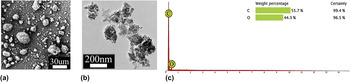
Seven concentrations between 0.01 and 3 wt% were used in this study to illustrate three different concentration regimes, which are dilute, intermediate, and concentrated solutions as were done by Kheireddin et al.Reference Kheireddin, Lu, Chen and Akbulut14 The additive used is GNP with ≈5 nm thickness and 120 m2/g surface area. Figure 1 shows GNP characterization in terms of size and morphology. Magnetic stirrer was used for blending 95 vol% PAO + 5 vol% palm-oil TMP ester. GNPs were added to the blended lubricant at 0.01, 0.03, 0.05, 0.1, 0.2, 0.5, 1, and 3 wt%, then mixed ultrasonically for 1 h using ultrasonic homogenizer (50% amplitude; 2 s pulse; 50 Hz frequency) to make sure that the GNP is well dispersed. The lubricant without addition of GNP was used as the baseline in this study.
(a) SEM and (b) TEM image of GNP and (c) EDX analysis on GNP.

B. Stability test
Two methods were used to evaluate the dispersion stability of nanosuspensions. The first method was observation stability test, where each nanofluid was collected with the same volume and placed at room temperature without any disturbance or movement. The samples were observed daily until the nanoparticles sedimented at the base of the container and obvious separation of nanoparticles and oil could be seen. Other method was metallographic micrograph stability test, where a drop of each nanofluid was dropped on glass slides and left at room temperature. After few days, the samples were viewed using optical microscope (OM) to observe the agglomeration of nanoparticles in each sample.
C. Physicochemical properties
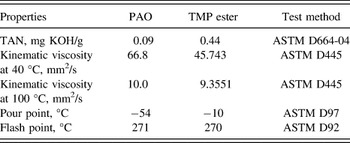
Kinematic viscosity, dynamic viscosity, density, and viscosity index (VI) of all samples were measured according to ASTM D445 and ASTM D2270. While total acid number (TAN) and total base number (TBN) of the samples were referred to ASTM D664-04 and D2896-06, respectively. The resulting specifications for the lubricants are listed in Table I.
Properties of PAO and palm-oil TMP esters.

D. Tribological test
Tribological tests were conducted using DUCOM Instruments (Bangalore, India) four-ball machine under the conditions listed in Table II. The balls used were chrome steel balls, AISI 52-100, with 12.7 mm diameter and 64-66 HRC. The coefficient of friction (COF) values were measured based on friction torque data collected and wear scar diameters (WSD) of all balls were measured using OM where the mean values were recorded. Further surface analysis was conducted on the steel balls using scanning electron microscope (SEM) and energy-dispersive x-ray spectroscope (EDX) to study the effects of GNP added in lubricant on the sliding surfaces.
Tribological test experimental parameters.

III. RESULTS AND DISCUSSIONS
A. Dispersion stability
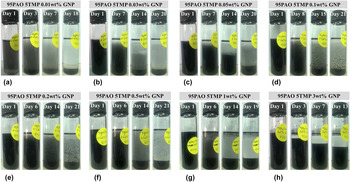
Observation stability test on the nanolubricants presented in Fig. 2 was conducted to examine the period for which GNP can withstand in the blended lubricants after sonication process. Addition of 3 wt% GNP showed the fastest sedimentation to occur, where in 2 days after sonication, obvious separation layer of GNP and blended lubricants can be clearly seen. It was sedimented completely 13 days after undergoing the sonication process while other samples can stand more than 20 days after sonication.
Images captured to observe the suspensions of GNP in blended lubricants at different concentrations of GNP: (a) 0.01 wt%, (b) 0.03 wt%, (c) 0.05 wt%, (d) 0.1 wt%, (e) 0.2 wt%, (f) 0.5 wt%, (g) 1 wt%, and (h) 3 wt%.

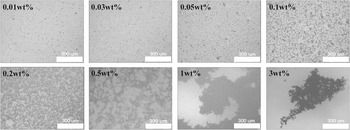
The metallographic micrographs stability test was done according to Singh and SureshReference Singh and Suresh15 where the agglomeration state of GNP particles was observed. The nanolubricants were examined using OM 10x lens and the images were taken and displayed in Fig. 3. Even though the microscope was unable to view up to nanometer scale, agglomeration behavior of the nanolubricants at micrometer scale could be examined clearly. 0.01 and 0.03 wt% of GNP in blended lubricants showed the least agglomeration size which are around 13–18 μm and the sizes increase up to 1050 μm as the GNP concentration was increased. This is due to interaction potentials and corresponding forces between particles,Reference Lynch and Dawson16 which make the nanoparticles attract each other. These attractions are highly dependent to densityReference DeLoid, Cohen, Darrah, Derk, Wang, Pyrgiotakis, Wohlleben and Demokritou17 of the nanofluids. Obvious agglomeration can be clearly seen as the GNP concentration increased.
Metallographic micrographs of GNP in blended lubricants at different GNP percentages.

B. Physicochemical properties
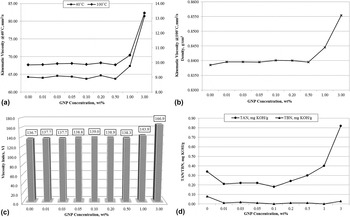
Figures 4(a) and 4(b) show that the viscosity and density of nanolubricants increase with increasing GNP concentration and this behavior is in accordance to previous studies.Reference Kheireddin, Lu, Chen and Akbulut14,Reference Ueno, Imaizumi, Hata and Watanabe18–Reference Wang, Wang, Lou and Hao20 These results were expected and this phenomenon occurred due to rise of probability of GNP nanoparticles to agglomerate as the amount of GNP added to the blended lubricants increased.
(a) Kinematic viscosity of GNP nanolubricants at 40 and 100 °C, (b) density of GNP nanolubricants at 15 °C, (c) viscosity index and (d) TAN and TBN of GNP nanolubricants.

Besides increase in viscosities, the viscosity index also showed the increasing trends as the GNP concentration increased as illustrated in Fig. 4(c). VI seems nearly constant for GNP concentrations of 0–0.5 wt% and sudden increase in VI occurred as the concentration increased. This proved that by adding more GNP into the nanolubricants, effects of temperature on viscosity were reduced and the nanolubricants were able to maintain its viscosity against temperature variation.
The effects of GNP in blended lubricants on TAN and TBN were also identified and presented in Fig. 4(d). The presence of GNP in the blended lubricant caused TAN to reduce slightly and remain constant as the amount of GNP increased up to 0.1 wt%. TAN started to increase as the GNP concentration increased from 0.2 to 3 wt%. The findings showed that at diluted concentration, GNP managed to reduce TAN but at intermediate and high GNP concentration, GNP caused the acidity of the lubricants to increase. Thus in addition to low dispersion stability, nanolubricants with high GNP concentration tend to give high acidity levels. High acidity in lubricant is highly undesirable as it can cause problems such as corrosion and chemical wear.
The trends of TBN values for oil samples are shown in Fig. 4(d). Addition of GNP caused the blended lubricant to reduce the TBN value slightly at the beginning, but the values remained constant and low, which are approximate to zero, as the amount of GNP increased. This showed that GNP managed to reduce the basicity of the blended lubricants regardless of amount of GNP added.
C. Tribological results
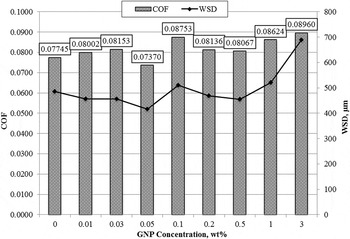
Figure 5 shows the COF and WSD of GNP added into 95PAO 5TMP at different concentrations. At diluted and intermediate concentrations, ranging from 0.01 to 0.5 wt%, COF values were 3–13% higher than that of blank blended lubricant, except for 0.05 wt% GNP, where COF reduction can be seen by 5%. This was caused by low coverage of GNP at low concentration which explained the reasons of lacking of GNP to form protective layer to avoid asperities contact, resulting the COF to be comparatively high.Reference Rapoport, Fleischer and Tenne21,Reference Moshkovith, Perfiliev, Lapsker, Fleischer, Tenne and Rapoport22 However, WSD values showed lower values than that of blank blended lubricant for both concentration levels and related values of 16–70 μm were observed, while a value of 24 μm was observed for 0.1 wt% GNP.
COF and WSD of nanolubricants at different GNP concentrations (condition: load = 392 N; temperature = room temperature (RT); speed = 1200 rpm; test duration = 3600 s).

At concentrated GNP concentration regime that consists of 1–3 wt% GNP, rises in COF and WSD values by 11–16% and 35–205 μm, respectively, can be seen than that of blank blended lubricant. This was due to agglomerations due to high concentration of GNP that creates large aggregates and cannot fit into the valleys between asperities, thus act identically as debris particlesReference Rapoport, Fleischer and Tenne21,Reference Moshkovith, Perfiliev, Lapsker, Fleischer, Tenne and Rapoport22 which resulted in abrasive-like wear to happen.Reference Kheireddin, Lu, Chen and Akbulut14
The results proved that addition of nanoparticles, either too little or too much, might causes deleterious effects in some cases either by increasing COF or WSD.Reference Hernández Battez, González, Viesca, Fernández, Díaz Fernández, Machado, Chou and Riba23 This phenomenon explained that finding the right GNP concentration is very important to maximize the nanolubricant performance. Addition of 0.05 wt% GNP showed the minimum COF and higher WSD reduction compared to other concentrations and this finding is consistent with the previous studies conducted by Kheireddin et al.Reference Kheireddin, Lu, Chen and Akbulut14 and Zen and Rashmi.Reference Zen and Rashmi24
D. Surface analysis
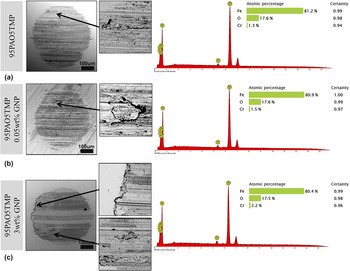
Figure 6 presented the SEM images and EDX analysis of the wear scar on the steel balls after tribological tests. Figure 6(a) shows the wear scar as a result of tribo-testing when blank blended lubricant was used. The WSD was 486 μm and the magnified image was used to analyze the surface defect that occurred on the scar, where small delamination can be seen. Figure 6(b) is the scar on the steel ball tested using blended lubricant with addition of 0.05 wt% GNP. The WSD is smaller compared to Fig. 6(a), which is 416 μm, but the delamination surface defect as showed by the magnified image, was a little bit bigger than surface defect on Fig. 6(a).
SEM images and EDX analysis on fourball steel balls for (a) 95PAO 5TMP, (b) 95PAO 5TMP + 0.05 wt% GNP, and (c) 95PAO 5TMP + 3 wt% GNP.

However, Fig. 6(c) shows the biggest scar than that of previous cases as WSD as high as 690 μm was observed. The surface wear was greater than Figs. 6(a) and 6(b), where adhesive wear can be seen at the scar's edges, while delamination wear happened badly at the scar's bottom left part. Although high WSD was observed for the case presented in Fig. 6(c), the high concentration of GNP enhances the worn surface by polishing effect where smoother surface can be observed with less grooves. This is due to GNP collided rapidly with each other at high concentration, thus creating large clumps of nanoparticles that behave as abrasive bodies which cause detrimental effects on the wear surfaces.Reference Hernandez Battez, Fernandez Rico, Navas Arias, Viesca Rodriguez, Chou Rodriguez and Diaz Fernandez25
The EDX analysis done on the steel balls showed similar elements found on all wear surfaces, which were iron (Fe), oxygen (O), and chromium (Cr). The detected elements like Fe and Cr were contributed by chrome steel balls, while the presence of O was due to oxide layer formed during the lubrication process. There was no carbon (C) detected on the surfaces and atomic percentage of O was not increasing as GNP concentration increased, which showed that the GNP did not adhere to the surfaces during the fourball testing as C and O are the major elements in GNP.
GNPs in lubricants protect rubbing surfaces by rolling or ball bearing effects where at first, GNP filled the microasperities present on the friction surfaces. This increased the surface contact area and also decreased contact pressure, which changed sliding friction into rolling effect at the contact area.Reference Wu, Tsui and Liu26 Furthermore, the spherical shape of GNP was more likely to cause effective rolling friction mechanism to occur.Reference Rapoport, Nepomnyashchy, Lapsker, Verdyan, Moshkovich, Feldman and Tenne27,Reference Zulkifli, Kalam, Masjuki and Yunus28 As an addition, nanoparticles will interact with friction surfaces due to their small size and form a protective layer and thus increase the lubricant's antiwear ability.Reference Zulkifli, Kalam, Masjuki and Yunus28
IV. CONCLUSION
Addition of GNP into 95 vol% PAO 5 vol% palm-oil TMP ester resulted in increasing values of viscosity, density, VI, and TAN while TBN values were decreased as the concentration of GNP was increased. The presence of GNP in the blended lubricant samples caused the COF to increase proportionally to the GNP concentration. At diluted and intermediate GNP concentration levels, WSD of the steel balls is reduced slightly as compared to the blank blended lubricant. However, at high GNP concentration level, WSD is increased up to 40% than that of blank lubricant. 0.05 wt% GNP in 95 vol% PAO 5 vol% palm-oil TMP ester showed the best performance in the tribological test by improving the COF and WSD as much as 5 and 15%, respectively. Further research is needed to be done to investigate the wear protection and friction reduction mechanisms of considered nanolubricants. The nanolubricant dispersion stability was very low and the GNP started to suspend as early as 2 days after mixing. Usage of dispersants can improve the stability of nanolubricants and various types of dispersants will be tested to find the most suitable dispersant to be used with GNP for future research.
ACKNOWLEDGMENTS
The financial support provided by FP032-2013A, high impact research grants UM.C/HIR/MOHE/ENG/60 and BK062-2014 is gratefully acknowledged. Acceptance of and presentation opportunities in Malaysian International Tribology Conference (MITC) 2015 is much appreciated.