Eating disorders represent serious public mental health problems that are attracting increasing attention (Varsou, Reference Varsou2010). The prevalence of eating disorders can be underestimated when only individuals who seek treatment and meet the diagnostic criteria for anorexia nervosa (AN) and bulimia nervosa (BN) are considered (Faravelli et al, Reference Faravelli, Ravaldi, Truglia, Zucchi, Cosci and Ricca2006; Stice, Marti, Shaw, & Jaconis, Reference Stice, Marti, Shaw and Jaconis2009). Therefore, models that explain partial symptoms, rather than models for complete AN or BN, as described in the Diagnostic and Statistical Manual of Mental Disorders (DSM-IV-TR), should be developed (American Psychiatric Association, 2000). A few models have been proposed to identify risk factors for and explain the development of eating disorders (Collier & Treasure, Reference Collier and Treasure2004; Gleaves, Brown, & Warren, Reference Gleaves, Brown and Warren2004; Kim, Reference Kim2012). The two-pathway Stice model (Stice, Reference Stice1994; Stice, Reference Stice2001) is most likely one of the most comprehensive measures to explain the development of bulimic symptoms and integrates the following factors: (1) sociocultural pressure to be thin; (2) ideal-thin body internalization; (3) body dissatisfaction; (4) negative emotions; and (5) restrained eating (Figure 1). The dual pathway model refers to the negative emotions and restrained eating that represent the final predictors of bulimic symptoms (Stice, Reference Stice2001; Stice, Bohon, Marti, & Fisher, Reference Stice, Bohon, Marti and Fischer2008). According to this model, social pressure and thin body internalization promotes body dissatisfaction, which increases negative emotions and dieting behaviors that trigger bulimic pathology (Ouwens, van Strien, van Leeuwe, & van der Staak, Reference Ouwens, van Strien, van Leeuwe and van der Staak2009; Stice, Reference Stice2001). The model predicts that bulimic symptoms are associated with the social pressure to have a thin body leads to the internalization of the ideal of the thin body and therefore body dissatisfaction associated with negative emotions and restrained eating as a mean to reduce such discrepancy. Restrained eating and dieting behaviors, in particular, have drawn increased attention in the literature with respect to the development of clinical symptoms (for example, Ouwens et al., Reference Ouwens, van Strien, van Leeuwe and van der Staak2009; Stice, Pressnell, & Spangler, Reference Stice, Pressnell and Spangler2002). Numerous studies have noted the core importance of eating restraint itself as a risk factor for the development and maintenance of eating disorders (Andrés & Saldaña, Reference Andrés and Saldaña2014; Cogan & Ernsberger, Reference Cogan and Ernsberger1999; Stice, Davis, Miller, & Marti, Reference Stice, Bohon, Marti and Fischer2008; Stice, Martinez, Presnell, & Groesz, Reference Stice, Martinez, Presnell and Groesz2006). Indeed, many symptoms of eating disorders are directly associated with dieting status as described in the “starvation study” by Keys (Reference Keys1950).
The two pathways in Stice’s model.

The influence of the media and peers on the social pressure to be thin has been intensively studied. An extensive review of 25 studies analyzing the influence of the thin ideal model presented in mass media reveled a significant increase in body dissatisfaction after viewing thin media images rather than average or super-size models or non-human objects (Groesz, Levine, & Murnen, Reference Groesz, Levine and Murnen2002). Verbal peer pressure to be thin has also been reported in an experimental study in which 120 females exposed to so-called “fat talk” reported increased body dissatisfaction compared with a control group in which a neutral topic was discussed (Stice, Maxfield, & Wells, Reference Stice, Maxfield and Wells2003; Stice & Whitenton, Reference Stice and Whitenton2002). Similarly, exposure to negative information or feedback about body weight or appearance has been found to positively correlate with body dissatisfaction compared with exposure to control (non-appearance related) information (Lavin & Cash, Reference Lavin and Cash2000).
In sum, body dissatisfaction, which has been defined in various ways, is a key variable in Stice’s model. Keeton, Cash, and Brown (Reference Keeton, Cash and Brown1990) defined body dissatisfaction as the discrepancy between the self body image and the ideal body image. Body dissatisfaction differs from body image distortion, which can be understood as the discrepancy between the self body image and the real body image. Cash, Edwin, and Deagle (Reference Cash, Edwin and Deagle1997) defined body dissatisfaction as a cognitive judgment bias rather than a perceptual distortion based on the overestimation of body size. Body dissatisfaction refers to the attitudinal dimension of the body image and body distortion to the perceptual dimension (Skrzypek, Wehmeier, & Remschmidt, Reference Skrzypek, Wehmeier and Remschmidt2001).
The high prevalence of body dissatisfaction was first reported almost three decades ago and was referred to as “normative discontent” (Rodin, Silberstein, & Striegel-Moore, Reference Rodin, Silberstein, Striegel-Moore and Sonderegger1985). A decade later, Brumberg (Reference Brumberg1997) reported that 13.53% of American girls were dissatisfied with their body at 13 years old; by age 17, the percentage had risen to 78%. In the United States, the ideal body is thin, as suggested by the trend in Playboy centerfolds models from 1959 to 1978, which exhibited significant decreases in bust and hip size (Garner, Garfinkel, Schwartz, & Thompson, Reference Garner, Garfinkel, Schwartz and Thompson1980). Consequently, expenses related to the goals of weight loss and meeting the cultural standards of thinness and beauty in western society have increased. For example, the number of cosmetic procedures has tripled in the past decade according to the American Academy of Cosmetic Surgery (Shroff & Thompson, Reference Shroff and Thompson2006). The drive for thinness is less pronounced in males according to the trend reflected by male Hollywood stars, who are more muscular now than actors in the 1940s and 1950s (Goldfield, Blouin, & Woodside, Reference Goldfield, Blouin and Woodside2006).
With respect to gender differences, literature has traditionally focused on females more than males (Shepherd & Ricciardelli, Reference Shepherd and Ricciardelli1998; Stice, Reference Stice1998; Stice, Reference Stice2001; van Strien, Reference van Strien1996) because females exhibit higher body dissatisfaction than do males (Brennan, Lalonde, & Bain, Reference Brennan, Lalonde and Bain2010; Cohane & Pope, Reference Cohane and Pope2001; Zaccagni, Masotti, Donati, Mazzoni, & Gualdi-Russo, Reference Zaccagni, Masotti, Donati, Mazzoni and Gualdi-Russo2014). However, men are not free from body dissatisfaction. Three decades ago, Cash, Winstead and Jada (Reference Cash, Winstead and Janda1986) found that the level of body dissatisfaction among men had increased since 1972; therefore, data must be continuously updated, and the male level of body dissatisfaction also should be analyzed in Stice’s Model, which has been suggested to also be useful for males (Halliwell & Harvey, Reference Halliwell and Harvey2006).
Gender differences have also been observed with respect to eating restraint or dieting behaviors, which are the best predictors of developing eating disorders, although negative emotion pathways also contribute (van Strien, Engles, van Leeuwe, & Snoek, Reference van Strien, Engels, van Leeuwe and Snoek2005). Drewnowski and Yee (Reference Drewnowski and Yee1987) reported that the percentage of women who followed a low-calorie diet in the previous month was more than double the number of males. Although women tend to diet to lose weight, men exercise to control weight and gain muscle.
Stice’s model focuses on the development of bulimic symptoms, and such behaviors are also observed among the non-clinical population. However, the application of this model in the non-clinical population would benefit our current knowledge of the risk factors associated with eating disorders and would therefore benefit future programs for the prevention of eating disorders both in males and females.
The aim of this study was to explore and analyze gender differences in the selection of variables involved in Stice’s Model of eating disorders in a non-clinical population.
The following hypotheses were addressed. Females will report higher body dissatisfaction (BSQ score) and dieting behaviors (DIS score). Females will perceive more social pressure to be thin (PSPS score) and will report higher thin-body internalization (IBSS score). Furthermore, differences in body dissatisfaction, dieting behavior and the perception of the pressure to be thin will be analyzed with respect to BMI levels. First, participants with higher BMIs will score higher with respect to body dissatisfaction regardless of their gender and will report more weight loss behaviors, such as dieting (DIS score), and to perceive more pressure to be thin than those subjects with lower BMIs.
Method
Participants
The sample included 162 college students, 41.4% males (n = 67) and 58.6% females (n = 95), recruited in a North American university. The study was conducted according to the guidelines established in the Declaration of Helsinki and approved by the local bioethics committee. All participants attended undergraduate psychology courses and had a mean age of 19.72 years (SD = 2.53). The mean age for males was 19.98 (SD = 2.72), and the mean age for females was 19.54 (SD = 2.39). No statistically significant differences were found between males and females. Participants were excluded from the study if any of the following criteria were met: (1) participants with a history of neurological or psychopathological disorders or current diagnoses of such; or (2) participants under current psychopharmacological treatment or with a history of psychopharmacological treatment.
Instruments
All participants filled out a 121-item questionnaire covering the following scales including age, gender, height and weight aimed to evaluate key variables of Stice’s Model of eating disorders:
Body Mass Index (BMI): BMI was calculated from the self-reported weight and height using the following formula: weight (kg) / height (m)2.
Body Shape Questionnaire (BSQ; Cooper, Taylor, Cooper, & Fairburn, Reference Cooper, Taylor, Cooper and Fairburn1987): The 34-item BSQ is a self-reported measure for body shape preoccupations typical of eating disorders. Participants answered questions like “Has feeling bored made you brood about your shape?” using a 6-point scale ranging from never to always. In items 12 and 25, the word “women” was replaced by “person of your gender”.
Dietary Intent Scale (DIS; Stice, Reference Stice1998): This nine-item scale assessed weight control behaviors during the previous 6 months. For example, one sample item was “I skip meals in an effort to control my weight”. Participants responded on a 6-item scale with responses ranging from never to always.
Perceived Sociocultural Pressure Scale (PSPS; Stice & Bearman, Reference Stice and Bearman2001): Ten items assessed how much pressure participants felt to be thin from different sources. A sample item was “I don’t like looking at myself in mirrors.” Participants answered on a 5-point scale ranging from strongly disagree to strongly agree.
Ideal-Body Stereotype Scale- Revised (IBSS-R; Stice & Agras, Reference Stice and Agras1998): This six-item scale assessed how participants have internalized a thin ideal body image through their degree of agreement with statements regarding what defines physical attractiveness in women. A sample item was “slender women are more attractive.” Participants answered on a 5-point scale ranging from strongly disagree to strongly agree.
Procedure
The participants were tested in gender-mixed groups ranging in size from 12 to 17 in a standard classroom over three weeks in October. Before the beginning of each session, complete instructions were written on a whiteboard at the front of the class. The surveys and the required consent forms were placed on each seat, and an empty desk was left between any two participants. On the consent form, the students were informed about the confidentiality and anonymity of all information gathered in the study.
Each survey consisted of eight pages. The first page contained the departmental instructions to participants for the survey studies. Students were asked not to discuss the project with anyone else until the end of the semester and to raise their hands if they had a question. The remaining pages contained the survey questions.
Data from one participant was discarded because the questionnaire was completed too quickly for adequate consideration of all of the items. Another participant was discarded because the participant responded “1” to all questions.
Data analysis
All statistics were calculated using SPSS v 21 AMOS for Windows (SPSS Inc., USA) with the level of significance set at p < .05.
First, a multivariable 2 x 2 ANOVA was conducted to study the gender differences among Stice’s risk factor variables. The first factor was gender (males and females), and the second factor was the BMI level (low-BMI if BMI < 25 and high-BMI if BMI > 24.9), consistent with the classification used by the World Health Organization to differentiate normal BMI from overweight (WHO, n.d.). We used the total scale scores of BSQ, DIS, PSPS and IBSS-R as the dependent variables.
Second, in order to assess the overall fit of the Stice’s model to our data, a path analysis was performed for the variables taken into account for our study, using maximum likelihood estimation. In order to test for differences between men and women, the gender variable was used as the grouping variable for the analysis, thus allowing for the comparison between the coefficients assigned to each group.
RESULTS
Gender effect
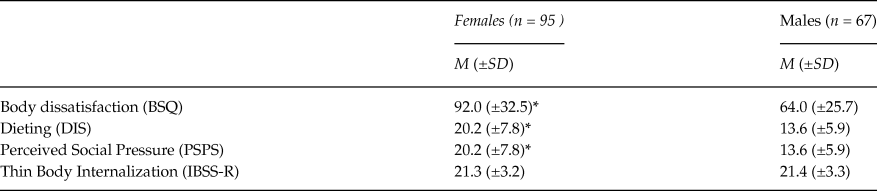
Table 1 presents gender differences in the mean and standard deviation of each measurement.
Gender differences in the means and standard deviations for every scale

Note: * = p < 0.5.
Females scored significantly higher than males with respect to body dissatisfaction, as measured in BSQ scores (F 1,151 = 57.09, p < .05). Females also scored higher in dieting as a weight loss measure compared with males. This difference in DIS scores was significant (F 1,151 = 26.35, p < .05). Similarly, females scored higher than males with respect to perceived social pressure (PSPS scores). The ANOVA revealed significant gender differences (F 1,151 = 44.91, p < .05). However, no significant gender differences were observed with respect to body thin internalization (IBSS-R score) when an ANOVA was conducted (F 1,151 = 0.0, p > .05).
BMI effect
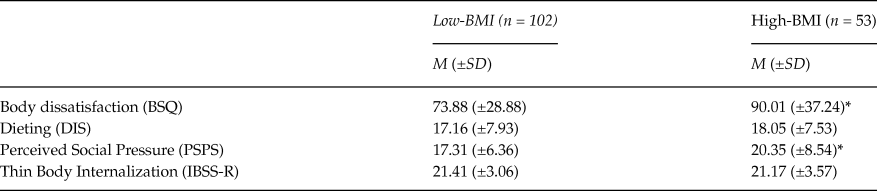
Table 2 presents gender differences in variables for high or low BMI.
BMI differences in the means and standard deviations for every scale

Note: * = p < .5.
High BMI males and females reported higher body dissatisfaction (BSQ scores) than did low BMI males and females. An ANOVA revealed that there was a significant BMI effect F 1,151 = 21.65, p < .05. In general, subjects with greater BMI perceived more social pressure to be thin compared with low BMI subjects. An ANOVA revealed that this difference was significant: F 1,151 = 15.08, p < .05. No significant differences were reported with respect to thin-body ideal internalization for subjects with low or high BMI: F 1,151 = 1.45, p > .05.
Interaction between gender and BMI
The mean BMI of the males was 25.65 (SD = 5.96), whereas the mean BMI of the females was 22.85 (SD = 4.95), representing a medium effect size with Cohen’s d = 0.51.
An interaction was observed among gender, BMI and dietary restraint. Only a few males reported dieting, and those with higher BMI values (M = 15.4, SD = 6.4) reported more weight loss-oriented behaviors (higher score on DIS) than did males with low BMI values (M = 12.2, SD = 5.2). However, females engaged in dieting behaviors independent of their BMI values. Both females with high (M = 20.7, SD = 7.0) and low BMI (M = 20.1, SD = 8.0) values reported weight loss behaviors (higher score on DIS): F 1,151 = 2.24, p > .05. With respect to the social pressure to be thin, perceived social pressure from the media was significantly higher among females with high BMI values (M = 26.0, SD = 9.2) than among those with lower BMI values (M = 19.6, SD = 6.8) and higher than either high BMI (M = 16.3, SD = 5.7) or low BMI (M = 13.7, SD = 3.8) values (F 1,151 = 4.44, p < .05).
Gender differences and Model fit by SEM
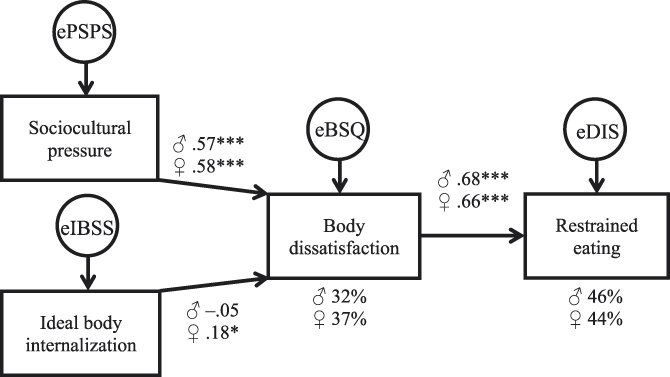
Model fit was satisfactory. Chi-square statistic was non-significant (CMIN = 11.023; df = 6; n.s.; CMIN/DF = 1.837), and values for other fit indexes were acceptable (GFI = .969; AGFI = .895; AIC = 39.023; RMSEA = .074). With respect to gender differences, all coefficients were similarly moderate and statistically significant for both men and women, with the exception of the regression weight of IBSS score on BSQ score, which was positive, and statistically significant for women (r = .18; p < .05), but close to zero and non-significant for men (r = –.05; n. s.), thus indicating a weak but significant effect of Ideal thin body internalization on Body dissatisfaction for women, but no effect at all for men. This makes squared multiple correlation for BSQ a bit larger for women (R 2 = .37) than for men (R 2 = .32), given that both PSPS and IBSS scores are significant predictors of BSQ for women, whereas PSPS is the only predictor of BSQ scores for men. Anyway, this difference disappears when examining the squared multiple correlation for DIS, which is slightly larger for men (R 2 = .46) than for women (R 2 = .44) (Figure 2).
Path diagram for the variables of the Stice’s model included in the study, with coefficients obtained for each gender.
* = p < .05; *** = p < .001.

In summary, the path analysis results support the notion that the Stice’s Dual Pathway model looks appropriate for women, but not for men, given that Ideal body internalization is not a significant factor in the development of body dissatisfaction for men. These results are consistent with the correlations obtained in Table 3, which show positive and significant correlations between IBSS and both BSQ (r = .334; p < .01) and DIS (r = .320; p < .01) scores for women, but not for men.
Discussion
The present study offers a detailed set of current data in a male and female sample of American college students that helps reveal the gender differences in the relationship between the main variables included in Stice’s dual pathway model for overeating, which was developed more than a decade ago in a female high school population and did not include body mass index. Our results revealed that high body mass, internalized body thin ideal, and peer pressure are positively associated with body dissatisfaction, consistent with previous studies (Lawler & Nixon, Reference Lawler and Nixon2011).
Our results support a higher level of body dissatisfaction in females than males. Specifically, our data resulted in a mean BSQ score of M = 91.95 and a standard deviation SD = 32.66 for a sample of 95 females. This level of body dissatisfaction is even higher than the level reported in the validation of BSQ in a British college female sample, with a mean BSQ score equal to 81.5 and a standard deviation of 28.4 (Cooper et al., Reference Cooper, Taylor, Cooper and Fairburn1987), and is higher than the body dissatisfaction reported in the Spanish adaptation of BSQ with adolescents 12 to 16 years old, with a mean BSQ score of 84.75 and a standard deviation of 30.42 (Raech et al., Reference Raech, Mora, Soler, Ávila, Clos and Zapater1996). These results support the assumption than body dissatisfaction is higher among females than males as well as a difference in direction of the dissatisfaction, with males reporting a desire to gain muscle whereas females wish to lose weight (Shaw, Stice, & Becker, Reference Shaw, Stice and Becker2009; Slevec & Tiggemann, Reference Slevec and Tiggemann2011; Stice, Becker, & Yokum, Reference Stice, Becker and Yokum2013). As a consequence, prevention and treatment programs should address body dissatisfaction as a key element (Burton & Stice, Reference Burton and Stice2006; Fairburn, Agras, Walsh, Wilson, & Stice, Reference Fairburn, Agras, Walsh, Wilson and Stice2004; Stice & Presnell, Reference Stice and Presnell2007; Stice, Shaw, & Marti, Reference Stice, Shaw and Marti2007).
The relationship between BMI and body dissatisfaction has been controversial. BMI has been positively correlated with body dissatisfaction, and body dissatisfaction was been positively correlated with eating restraint in a Swedish sample of 260 eighth grade females and an Australian sample of 210 eighth grade females using questionnaires (Lunner et al., Reference Lunner, Wertherm, Thompson, Paxton, McDonald and Halvaarson2000). However, no association was found between BMI and body dissatisfaction in a sample of 516 participants ranging in age from 12 to 18 using questionnaires (Kostanski & Gullone, Reference Kostanski and Gullone1998). Our results suggest that BMI influences body dissatisfaction in females as well as in males (Mendes, Araújo, Lopes, & Ramos, Reference Mendes, Araújo, Lopes and Ramos2014; Shroff & Thompson, Reference Shroff and Thompson2006), consistent with recent findings in neuroimaging studies supporting the key role of high body mass as a risk factor for the development of eating disorders (Batterink, Yokum, & Stice, Reference Batterink, Yokim and Stice2010; Burger & Stice, Reference Burger and Stice2011; Burger & Stice, Reference Burger and Stice2013; Ng, Stice, Yokum, & Bohon, Reference Ng, Stice, Yokum and Bohon2011; Stice, Spoor, Bohon, Veldhuizen, & Small, Reference Stice, Bohon, Marti and Fischer2008; Stice, Spoor, Ng, & Zald, Reference Stice, Marti, Shaw and Jaconis2009; Stice, Yokum, Blum, & Bohon, Reference Stice, Yokum, Blum and Bohon2010; Stice, Yokum, Burger, Spstein, & Small, Reference Stice, Durant, Burger and Schoeller2011; Yokum, Ng, & Stice, Reference Yokum, Ng and Stice2011). We detected a relationship between BMI and dietary restraint in men but failed to detect such a relationship between BMI and dietary restraint in women. This result is consistent with the larger pressure to be thin in women, prompting them to engage more easily in risk behaviors for eating disorders, such as dietary restraint.
Our results demonstrate that dieting is more prevalent among females than males. Indeed, the males’ mean DIS score was close to the minimum possible score, which supports previously cited studies that concluded that men, even if dissatisfied, are more interested in gaining muscle and that college males generally do not use dieting as a means of weight control. For females, the results suggest a tendency to engage in weight loss behaviors when dissatisfied with their bodies, which may indicate vulnerability to the future development of eating disorders according to the literature (Presnell & Stice, Reference Presnell and Stice2003; Presnell, Stice, & Tristan, Reference Presnell, Stice and Tristan2008; Stice, Miller et al., Reference Stice, Bohon, Marti and Fischer2008; Stice, Durant et al., Reference Stice, Durant, Burger and Schoeller2011; Stice & Fairburn, Reference Stice and Fairburn2003). Consistently, the role of dieting restraint as a risk factor for the development of eating disorders has also receiving support from neuroimaging studies (Bohon, Stice, & Spoor, Reference Bohon, Stice and Spoor2009; Burger & Stice, Reference Burger and Stice2011; Stice, Burger, & Yokum, Reference Stice, Becker and Yokum2013; Stice, Yokum, Bohon, Marti, & Smolen, Reference Stice, Yokum, Blum and Bohon2010).
For males, results fail to follow the same pattern, questioning the utility of Stice’s Model for studying risk factors of eating disorders in males.
In the present study, females reported perceiving greater pressure to be thin than did males, consistent with previous studies (Paxton, Reference Paxton1996; Stice et al. Reference Stice, Maxfield and Wells2003; Urquhart & Mihalynuk, Reference Urquhart and Mihalynuk2011). The present study demonstrated that females and males exhibit the same degree of thinness internalization. In fact, both sexes reported a neutral attitude with respect to attractiveness and thinness; therefore, our results question the utility of this variable within the model.
Understanding eating disorder behavior is an important element to healthy behavior changes. Through building our understanding of the key variables that influence eating disorders, this study improves our ability to help the non-clinical population make healthier choices in preventing eating disorders using Stice’s risk factors (Stice, Bohon, Marti, & Fisher, Reference Stice, Bohon, Marti and Fischer2008; Stice et al., Reference Stice, Presnell, Groesz and Shaw2005).
To summarize, the present study partially support Stice’s Dual Pathway Model for females but not for males. The data also indicated that the perceived social pressure to be thin came largely from the media, especially in high-BMI females. In addition, dietary restraint is independent of BMI in women. In women, body dissatisfaction is the best predictor of eating disorder risk behaviors such as dietary restraint, even if their current BMI falls within the normal range.
Further studies should compare this sample with samples from other groups, such as European college students, using the same questionnaires.
One of the possible limitations of the present study is that the subjects’ attitudes toward their bodies were assumed to be stable across situations (i.e., testing room versus non-testing situations). However, Tiggemann (Reference Tiggemann2000) found that body dissatisfaction can vary depending on the situation. Body-focused situations, such as the beach and other similar situations, resulted in higher dissatisfaction than did non–body-focused situations.
Despite the fact that the results of the present and other studies offer a global overview, a complete understanding of body dissatisfaction is still lacking, as indicated by Fernández-Aranda, Dahme, and Meerman (Reference Fernández-Aranda, Dahme and Meerman1999). Future studies should continue to contribute to the body of research on body dissatisfaction to improve our understanding of the relationships among dieting, body dissatisfaction, and associated variables. In addition, personality traits should be included in future studies.
This study aimed to identify risk factors and to contribute to the development of more efficient programs for the prevention of eating disorders (Bauer et al., Reference Bauer, Papezova, Chereches, Caselli, McLoughlin, Szumska and Moessner2013; Stice, Bytryn, Rohde, Shaw, & Marti, Reference Stice, Becker and Yokum2013) because eating disorders have been increasingly recognized as public heath priorities (Sánchez-Carracedo et al, Reference Sánchez-Carracedo, López-Guimerá, Fauquet, Barrada, Pámias, Puntí and Trepat2013). However, unexpectedly, the results of this study fail to support the role of BMI as a predictor of dietary restraint in females, the main risk factor of eating disorders, which has been reported previously (Brunson, Overup, Nguyen, Novak, & Smith, Reference Brunson, Overup, Nguyen, Novak and Smith2014). Males may abstain from dietary restraint to gain muscular volume and in turn increase their BMI.