Introduction
Thyroid cancer is the commonest endocrine malignancy, despite being responsible for less than 1 per cent of all cancers.Reference Weetman, Warell, Cox, Firth and Benz1 Between 1 and 5 per cent of these cancers are found to be non-Hodgkin's lymphomas.Reference Widder and Pasieka2 The disease is usually of B-cell origin, but Hodgkin's lymphoma and T-cell lymphomas have also been described.Reference Pasieka3 There is a strong correlation with Hashimoto's thyroiditis, which is found concomitantly in 454 to 85 per centReference Pasieka3 of cases. Consequently, thyroid lymphoma exhibits a female preponderance.Reference Scholefield, Quayle, Harris and Talbot4
Thyroid lymphoma classically presents as a rapidly enlarging thyroid mass in a patient aged over 50 years. The main differential diagnosis is anaplastic thyroid cancer. Fine needle aspiration cytology (FNAC) is often non-diagnostic (although it may raise suspicion). Definitive diagnosis is made after either open biopsy (when lymphoma or anaplastic carcinoma is suspected) or, less commonly, after more definitive surgery in the form of lobectomy or total thyroidectomy. The latter may be the case when the disease presents as a more indolent swelling.
The optimum treatment is with a combination of chemotherapy and radiotherapy. During the 1990s, it became rapidly apparent that dual modality treatment provided a far better outcome than treatment with either chemotherapy or radiotherapy alone.Reference DiBase, Grigsby, Guo, Lin and Wasserman5, Reference Ansell, Grant and Habermann6 Surgery does not provide any additional benefit.Reference Ansell, Grant and Habermann6
The literature supplies only sparse evidence of factors related to eventual thyroid lymphoma outcome. Published results are often based on small groups of cases collected over lengthy periods of time. The overall five-year survival for thyroid lymphoma is generally 50–60 per cent.Reference Ansell, Grant and Habermann6 The five-year survival for stage IE disease has been reported as 100 per cent.Reference Belal, Allam, Kandil, El Husseiny, Khafaga and Al Rajhi7 Some factors have been identified as being related to adverse outcome, including old ageReference DiBase, Grigsby, Guo, Lin and Wasserman5 and the presence of high-grade pathology and extra-thyroidal disease.Reference DiBase, Grigsby, Guo, Lin and Wasserman5, Reference Logue, Hale, Stewart, Duthie and Banerjee8 In the UK, thyroid cancer guidance published in 2007 by the British Thyroid Association stated that ‘the prognosis is generally excellent’ for thyroid lymphomas.Reference Perros9
This study aimed to review our experience of thyroid lymphoma and to clarify whether adverse symptoms and signs at presentation could be related to outcome. We also sought to highlight the diagnostic dilemma posed by the patient with a rapidly enlarging thyroid mass, airway compromise and an unknown histological diagnosis.
Materials and methods
Seventy-one patients were identified with a primary diagnosis of thyroid lymphoma made between 1992 and 2004, using the hospital coding system. All cases were subject to histopathological review, as per the hospital service operational policy on lymphoma. Hospital records were scrutinised, and demographic, clinico-pathological and outcome data were recorded.
Survival curves were produced, using the Kaplan–Meier method, and compared using the log rank test. Significant effects of symptom presentation on survival were then identified.
Results
Demographic data
Out of the 71 patients identified, it was possible to trace 63 sets of case notes with adequate available data.
The median patient follow-up time was 60 months (range, two to 135 months). There was a strong female preponderance (47 women (75 per cent) versus 16 men (25 per cent)). Age at presentation ranged from 38 to 91 years (median, 68 years). Diagnosis and initial surgical treatment (e.g. thyroidectomy or tracheostomy) were carried out at a number of referring hospitals.
Presenting symptoms
Two-thirds of patients (66 per cent) had symptoms for less than two months prior to presentation. The mean time to presentation was 2.8 months.
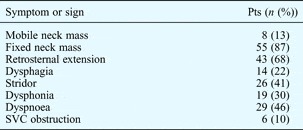
All patients presented with some form of neck mass, either fixed (87 per cent) or mobile (13 per cent). Sixty-eight per cent of patients were believed to have a retrosternal component to their thyroid mass, based on clinical or radiological findings. Other symptoms were frequently associated with the neck mass, e.g. stridor or dysphagia. Table I summarises the presenting symptoms and signs, and their frequency.
Presenting symptoms and signs

Pts = patients; SVC = superior vena cava
Diagnostic procedures
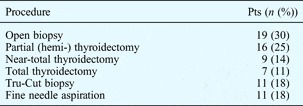
Table II summarises the diagnostic procedures carried out. Thirty patients (48 per cent) underwent biopsy (Tru-Cut or open), while 32 patients (51 per cent) underwent more formal surgery.
Diagnostic procedures

Pts = patients
Thirteen patients (21 per cent) required a tracheostomy. Four tracheostomies were permanent and nine were temporary.
Staging
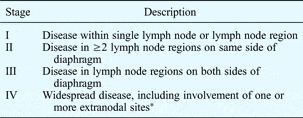
All patients were staged according to the Ann Arbor classification (Table III). Just over half the patients (n = 35) had localised disease within the thyroid gland (stage IE). A further 23 patients had disease within the thyroid as well as demonstrable local lymphadenopathy (stage IIE). The remaining five patients had disseminated disease. A total of 28 patients had systemic lymphoma, compared with 35 with disease solely within the thyroid.
Ann arbour thyroid lymphoma classification

Suffixes: A = no systemic symptoms; B = symptoms including drenching night sweats, unexplained weight loss and fevers; E = extranodal disease. *E.g. bone marrow, liver, lungs.
Pathology
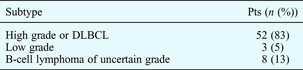
All patients were classified as having B-cell non-Hodgkin's lymphoma. Forty-seven patients had their histology reviewed by the Christie Hospital histopathology department. The remaining 16 all had documented evidence (in the case notes) of a specimen showing B-cell non-Hodgkin's lymphoma from the referring hospital, which had been reviewed by a specialist pathologist in that hospital's pathology department. The majority of patients (n = 52) were classified as having a high-grade B-cell lymphoma or a diffuse large B-cell lymphoma. There were four definite and five possible diagnoses of mucosa-associated lymphoid tissue lymphoma. The remaining two patients had low-grade disease. Table IV illustrates these results.
Pathological subtypes
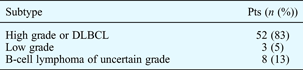
Pts = patients; DLBCL = diffuse large B-cell lymphoma
Ten patients had evidence of Hashimoto's thyroiditis, and a further six had evidence of a lymphocytic thyroiditis. In 34 patients, there was no identifiable thyroid tissue, as the gland had been very heavily infiltrated by tumour and therefore the presence or absence of thyroiditis could not be commented upon.
Treatment
Thirty-five per cent (n = 22) of patients received radiotherapy alone, 13 per cent (eight) received chemotherapy alone, and the remaining 49 per cent (31) received dual modality treatment. Three patients did not receive any treatment.
Radiotherapy was given to 52 patients in total, either as an anterior single field or as an anterior–posterior parallel pair.
Chemotherapy consisted of either vincristine, adriamycin, prednisolone, etoposide, cyclophosphamide and bleomycin (‘VAPEC-B’), or cyclophosphamide, doxorubicin, vincristine and prednisolone (‘CHOP’). A total of 39 patients received chemotherapy; for eight, this was their only treatment. Patients in the later years of the study were more likely to receive radiotherapy and chemotherapy. However, no patient in this series received the cluster of differentiation 20 glycoprotein antibody rituximab.
Outcome
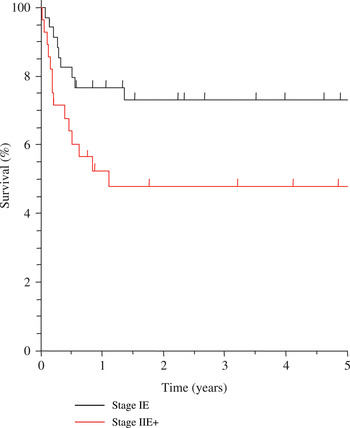
The estimated five-year survival was 62 per cent. Median survival has not been reached by the end of the study period. Of the patients who died (n = 28), 23 died of their lymphoma (36.5 per cent of the series); there were also five (7.9 per cent) intercurrent deaths. The overall survival by stage was 73 per cent for stage IE and 48 per cent for stage IIE+ disease.
Of the 23 patients who died of their lymphoma, 17 did so within six months of diagnosis (73 per cent). Of those patients who died of their disease, 18 died following their initial presentation, without achieving a remission (78 per cent). The remaining five achieved a brief remission (median, 98 days) and then relapsed, eventually succumbing to their disease. There were no relapses after 18 months.
Four out of five of the intercurrent deaths were due to second malignancies.
Relapse pattern
In total of nine patients relapsed (14 per cent). The mean time to relapse was 260 days (range, 77–514 days). Of these nine patients, five died of their lymphoma (55 per cent), one died of lung cancer, and the other three were alive and well at the time of writing. Six of the nine patients (66 per cent) who relapsed had been initially treated with radiotherapy alone, while the other three had received dual modality treatment.
Further treatment of the relapsed cases varied. Three patients were offered no treatment, three underwent chemotherapy, and three received a combination of chemotherapy and radiotherapy.
The site of relapse was also variable. One patient relapsed locally within the neck, and one in the axilla. Five patients had relapse within the abdomen: two developed nodal disease and three had intestinal involvement. One patient was found to have central nervous system infiltration, and the last patient developed disease in the humerus and femur (extra-nodal relapses).
Prognostic factors
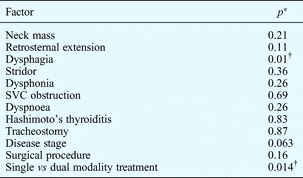
The patients' presenting symptoms were correlated with their overall survival, in an attempt to predict which patients would fare worst in the long term. We also considered the effect on overall survival of thyroid lymphoma stage (i.e. stage IE versus stages IIE to IV), presence of Hashimoto's thyroiditis, tracheostomy requirement, surgical intervention (i.e. none, open biopsy or hemi-thyroidectomy (or more extensive procedure)) and single versus dual modality treatment (Table V).
Overall survival estimation for possible prognostic factors

*Kaplan–Meier analysis. †p < 0.05. SVC = superior vena cava
It should be noted that only one death out of the 23 attributable to lymphoma occurred in a patient considered to have low-grade histology.
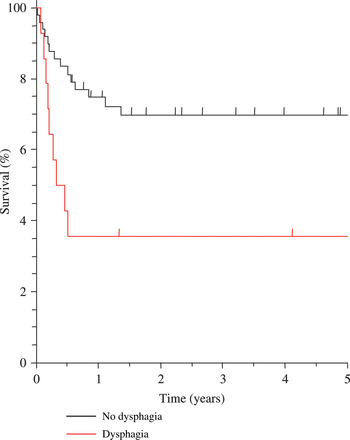
The only factor found to adversely affect the overall survival of these patients was the presence of dysphagia (Figure 1).
Patient five-year survival by dysphagia. p = 0.01, dysphagic vs non-dysphagic patients.

Disease stage was of borderline significance, those patients with more extensive disease having a worse prognosis (Figure 2). Those patients with stage IE disease were considered to have localised disease, as opposed to those with involvement of more than one organ or group of nodes.
Patient five-year survival by stage. P = 0.06, stage IE vs stage IIE+.

The presence of airway symptoms and the need for tracheostomy had no bearing on the patients' overall prognosis.
The type of surgery appeared to be unrelated to survival. Whether patients underwent a total or partial thyroidectomy had no relationship to their overall disease outcome.
Likewise, the presence of Hashimoto's thyroiditis appeared to have no influence on patient survival.
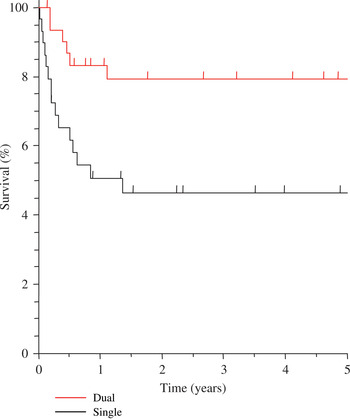
However, treatment with dual modality therapy significantly improved patient survival, compared with treatment with a single modality alone (Figure 3).
Patient five-year survival by treatment modality. p = 0.014, dual vs single modality treatment.

Discussion
We report a large series of patients with thyroid lymphoma. The majority of published series consist of smaller numbers of patients, or have been carried out over much longer time periods, making the identification of prognostic factors at presentation difficult.
Most patients in our series had a short history of presenting symptoms, usually related to the presence of the mass, which was fixed in 87 per cent of cases. Interestingly, our study findings suggest that only dysphagia is an adverse prognostic factor (p = 0.01). This may be related to the thyroid mass size that is necessary to cause swallowing difficulties. However, we did not find that stridor or airway compromise represented a significant adverse event.
A previous, 1992 analysis of 70 Christie Hospital patients managed over 20 years found that stridor, retrosternal extension and fixation were all adverse prognostic signs.Reference Logue, Hale, Stewart, Duthie and Banerjee8 It should be noted that, at that time, treatment was almost exclusively single modality rather than the combination of radiotherapy and chemotherapy currently recommended for the majority of patients. Thus, treatment improvements may be responsible for the fact that fixation, stridor and retrosternal extension are no longer prognostic factors for poor outcome.
Patients who present with respiratory compromise due to airway obstruction from thyroid lymphoma provide otolaryngologists with a considerable management dilemma. In our series, 13 (12 per cent) patients required an emergency tracheostomy. Reassuringly, the majority of these (n = 9) were temporary. Of the four that were permanent, one patient was lost to follow up, and three patients died with their tracheostomy tube in situ within two months of diagnosis.
Thyroid lymphoma patients who present in extremis pose an extremely difficult clinical problem. We know that thyroid lymphoma responds readily to steroids, but these can only be given after enough tissue has been taken for diagnosis and typing. However, it should be emphasised that a tracheostomy can be a life-saving procedure, and if deemed necessary it does not adversely affect the eventual treatment outcome for that individual patient.
The diagnosis of thyroid lymphoma can be problematic when FNAC is unreliable or difficult to interpret.Reference Pasieka3 Fine needle aspiration cytology is the first-line diagnostic investigation in any patient with a thyroid mass and, with optimal technical and cytological expertise (e.g. using ultrasound when necessary), lymphoma should be at least suspectedReference Widder and Pasieka2 in most such cases (e.g. as a differential diagnosis to anaplastic carcinoma). However, treatment regimens are linked to the subtype of lymphoma, and FNAC will not usually give enough information for typing purposes. It is therefore usually necessary to proceed to either Tru-Cut or open biopsy.Reference Matsuzuka, Miyauchi, Katayama, Narabayashi, Ikeda and Kuma10
In our series, only 17 patients were diagnosed using either Tru-Cut biopsy or FNAC, and this reflects the diversity of the referring hospitals. More radical surgery should not be considered.
Thirty-two (51 per cent) of our patients had either a partial or total thyroidectomy, possibly unnecessarily. As progress is made in the establishment of specialist thyroid services in all geographic areas of the UK, it is hoped that the use of thyroid surgery for diagnostic purposes will decrease (for all diseases). However, the role of specialist cyto-pathologists is crucial to this.
All our cases had pathologically confirmed B-cell non-Hodgkin's lymphoma. As diagnosis of the underlying lymphoma subtype can be difficult, and indeed may change in up to 30 per cent of cases reviewed at specialist centres, it is recommended that all cases should undergo specialist histopathology review and be discussed in a specialist multidisciplinary team setting. In this series, the patients who were treated without histopathological review all presented with very aggressive disease requiring emergency treatment. Subsequent review after initial treatment confirmed the original diagnosis.
The commonest subtype of thyroid lymphoma is diffuse large B-cell type.Reference Logue, Hale, Stewart, Duthie and Banerjee8 Low-grade mucosa-associated lymphoid tissue lymphoma is also common, comprising 6–27 per cent of cases.Reference Widder and Pasieka2 In our series, there were four definite diagnoses of mucosa-associated lymphoid tissue lymphoma (6 per cent), with a further five possible cases, which if confirmed would have brought the total to nine (14 per cent). It is postulated that this particular subtype has a much better long-term prognosis, approaching 90 per cent survival at five years.Reference Laing, Hoskin, Vaughan Hudson, Vaughan Hudson, Harmer and Bennett11 In our series, only one of the deaths was in a patient with mucosa-associated lymphoid tissue lymphoma, and this patient was so frail at presentation that she was offered only palliative treatment. Despite this, she died over three years from the date of diagnosis, illustrating the indolent course of this particular thyroid lymphoma subtype. The remaining deaths were all in patients with high-grade diffuse large B-cell disease.
Thyroid lymphoma can arise within a previously abnormal gland. Hashimoto's thyroiditis has been reported to occur in as many as 85 per cent of thyroid lymphoma cases.Reference Pasieka3 In the present series, 10 (34 per cent) of the 29 patients with thyroid tissue present in the histopathological specimen had evidence of Hashimoto's thyroiditis. In these patients, no significant survival benefit was conferred by concurrent Hashimoto's thyroiditis. However, since Hashimoto's thyroiditis has a strong association with low-grade lymphoma, such cases may have a better outcome.Reference Belal, Allam, Kandil, El Husseiny, Khafaga and Al Rajhi7 It should be noted that this entity can later transform into high-grade disease.Reference Scholefield, Quayle, Harris and Talbot4
A further six patients had evidence of lymphocytic thyroiditis. This condition has also been reported as having an increased probability of malignant transformation to thyroid lymphoma.Reference Holm, Blomgren and Lowhagen12
In cases of thyroid lymphoma, surgery is used as a diagnostic tool and has no favourable effect on prognosis.Reference Sippel, Gauger, Angelos, Thompson, Mack and Chen13
The main treatment modalities for thyroid lymphoma are chemotherapy and radiotherapy (as for other forms of non-Hodgkin's lymphoma). The precise treatment varies depending on the underlying histological subtype. Treatment for high-grade or diffuse large B-cell lymphoma consists of chemotherapy combined with radiotherapy for better loco-regional control.Reference Ansell, Grant and Habermann6 Chemotherapy is anthracycline-based, the most popular regimen being a combination of cyclophosphamide, doxorubicin, vincristine and prednisolone. In more recent years, the addition of rituximab, a monoclonal antibody against cluster of differentiation 20 glycoprotein, which promotes lysis and apoptosis of normal and malignant B-cells as well as sensitising them to chemotherapy, has significantly increased these patients' overall survival.Reference Cvetkovic and Perry14 Treatment is then consolidated with radiotherapy to the neck. Dual modality treatment has been shown on numerous occasions to confer greater survival benefits than single modality treatment.Reference Sippel, Gauger, Angelos, Thompson, Mack and Chen13 Our study results support these findings.
Low-grade disease is often treated with radiotherapy alone. If surgery has resulted in removal of the entire disease, radiotherapy may be considered unnecessary, and the patient may just be followed up regularly. Radiotherapy for thyroid lymphoma (either high or low grade) uses lower doses than that applied for squamous cell carcinoma of the head and neck. This means that it is associated with much less morbidity during and after treatment.
Thyroid lymphoma treatment can be complicated by the advanced age and consequential co-morbidity of some patients. One study found that age itself was a significant prognostic factor for outcome, and that patients under the age of 65 years fared much better than older patients.Reference DiBase, Grigsby, Guo, Lin and Wasserman5 Radical anti-cancer treatment produces problems of its own in the elderly, and this must be considered when calculating survival.
In thyroid lymphoma relapse rates of approximately 30% are reported.Reference Pasieka3, Reference DiBase, Grigsby, Guo, Lin and Wasserman5, Reference Doria, Jekel and Cooper15 In our series, nine patients (14 per cent) relapsed; the relapse was in the neck in only one patient. Low patient numbers make it difficult to analyse factors possibly associated with relapse. Relapse itself did not necessarily imply an adverse long-term outcome, as one-third of relapsed patients went on to become disease-free. Treatment for relapse varied.
• Thyroid lymphoma is relatively uncommon, resulting in a lack of outcome data
• It classically presents as a rapidly enlarging thyroid mass; the main differential diagnosis is anaplastic thyroid cancer
• Treatment is with combination chemoradiotherapy; surgery gives no extra treatment benefit
• The reported, large series had an overall five-year survival of 62 per cent
• Most patients dying of lymphoma did not achieve remission or relapse within six months
In our patients, the estimated five-year survival rate was 62 per cent. Of those patients who died of lymphoma, 73 per cent did so within six months of diagnosis, and 78 per cent did not achieve remission. This suggests that it is possible to identify those patients with a poor prognosis in the early stages of treatment. Conversely, it also suggests that patients who achieve and maintain complete remission in the first six months after treatment tend to survive long term.
Based on our study findings, we believe that the British Thyroid Association 2007 guidelines for the treatment of thyroid lymphoma should probably be revised, as regards their advice on the prognosis of thyroid lymphoma patients, as patients' overall survival certainly does not seem to be ‘generally excellent’. Our study findings allow diagnosing thyroid surgeons to give their patients some indication of the likely prognosis. Patients who achieve remission and maintain it for six months do indeed appear to have an ‘excellent’ prognosis.
Conclusion
The rapidly enlarging thyroid mass presents a diagnostic dilemma for otolaryngologists. Thyroid lymphoma, although rare, has a much more favourable prognosis than the other main differential diagnosis, anaplastic thyroid cancer. The overall estimated survival of thyroid lymphoma patients is in the region of 62 per cent at five years; in contrast, few patients with anaplastic thyroid cancer live beyond six months.
It is of paramount importance that thyroid lymphoma is diagnosed rapidly, and that treatment is initiated at the earliest opportunity. Surgery has no definitive role; however, many patients are still operated upon, which may reflect inadequacies in current diagnostic pathways. Symptomatology should not be a barrier to treatment, as only dysphagia appears to be an adverse prognostic factor, and many patients who present in extremis can still be cured.
Acknowledgments
We thank Professor John Radford and Dr Richard Cowan, Consultant Medical Oncologists, Christie Hospital, and Mr Ric Swindell, Medical Statistician, Christie Hospital, Manchester.