Introduction
Being a main cash crop of global importance and playing a vital role in human and animal nutrition, peanut (Arachis hypogaea L.) is widely cultivated in six continents, with Asia, Africa and Americas contributing to more than 99% of the world total peanut production (Wang et al., Reference Wang, Hu, Wang, Chen, Pan, Chi and Yu2014b). Peanut contains 45–55% oil and 26–31% protein in its seeds, and fatty acid composition is an indicator of its quality. Oleate and linoleate together constitute about 80% of the total fatty acids (Xu and Zhang, Reference Xu and Zhang2011). Peanut with at least 70% oleate is deemed as high-oleic (HO) (Moore and Knauft, Reference Moore and Knauft1989). Peanut oil and food products manufactured with HO raw materials proved to have extended shelf life and were resistant to flavour fade (Nawade et al., Reference Nawade, Mishra and Radhakrishnan2018; Davis et al., Reference Davis, Agraz, Kline, Gottschall, Nolt, Whitaker, Osborne, Tengstrand, Ostrowski, Teixeira and Davis2021; O'Connor et al., Reference O'Connor, Meder, Furtado, Henry, Wright and Rachaputi2021). Eating HO peanut may improve serum lipoprotein profile and reduce cardiovascular disease risk. Meanwhile, it is beneficial for control of body weight and blood glucose level, amelioration in cerebrovascular and cognitive functions and improvement in parameters leading to fatty liver development (Barbour et al., Reference Barbour, Howe, Buckley, Bryan and Coates2017; Wang and Zhu, Reference Wang and Zhu2017; Zhao et al., Reference Zhao, Shi, Wang and Zhou2019; Bimro et al., Reference Bimro, Hovav, Nyska, Glazer and Madar2020).
Δ12 fatty acid desaturase, also termed as omega-6 fatty acid desaturase (FAD2), catalyses the dehydrogenation of oleate at carbon 12 to produce linoleate, thus regulating the ratio of oleate to linoleate (Ray et al., Reference Ray, Holly, Knauft, Abbott and Powell1993). From an evolutionary point of view, the genome of cultivated peanut (A. hypogaea L.) is composed of two sub-genomes (A and B). Therefore, it has two pairs of non-allelic FAD2 homologues, FAD2A and FAD2B, and expression of the HO phenotype in the tetraploid cultivated peanut requires the inactivation of both genes (Moore and Knauft, Reference Moore and Knauft1989; Knauft et al., Reference Knauft, Moore and Gorbet1993; Jung et al., Reference Jung, Powell, Moore and Abbott2000a).
The world first high-oleic peanut natural mutant F435 was discovered by Norden et al. (Reference Norden, Borget, Knauft and Young1987). Thus far, over 200 HO peanut varieties have been bred in the world. However, most of the HO varietal releases only have F435 type FAD2 mutations, viz., a substitution of G448A in FAD2A and an insertion 442A in FAD2B (Nawade et al., Reference Nawade, Mishra and Radhakrishnan2018). Though other types of FAD2 mutations have also been reported recently (Wang et al., Reference Wang, Tonnis, An, Pinnow, Tishchenko and Pederson2015; Nada et al., Reference Nada, Biradar, Murthy, Krishnaraj, Bhat, Pasha and Yerimani2017; Chen et al., Reference Chen, Cheng, Wang, Song, Liu, Zhang and Li2018), the HO donor parental materials are still in severe shortage. There is an urgent need to create and identify additional HO peanut mutants.
The aim of the present study was to screen a mutagenized peanut population for HO mutants, genotype their FAD2A/FAD2B and if necessary, conduct functional analysis of mutated type FAD2 in yeast expression system.
Materials and methods
Peanut parental line, chemical mutagen treatment, planting and selection of the mutagenized population
Bred from the cross Huayu 40 × CTWE, wild type peanut line MNCK (15L46) was a normal-oleic (NO) (42.4% oleate, 35.7% linoleate) line with wild type FAD2A and FAD2B and elliptical oblong large seeds desirable for food processing. Both the parents were of sequential branching pattern. Huayu 40 was a NO (42.2% oleate, 37.0% linoleate) Virginia market type cultivar with wild type FAD2A and FAD2B, and CTWE was a HO (79.9% oleate, 2.2% linoleate) Spanish market type cultivar with F435 type FAD2A and FAD2B mutations. An increase in kernel yield of MNCK over local controls Huayu 25 and Huayu 33 by 13.16–30.67% in 2014 and 2015 was registered. In the spring of 2016, the seeds of MNCK were firstly pre-soaked in water for 10 h and were then treated with 15 mmol/l sodium azide (NaN3) in 0.1 mol/l phosphate-buffered saline (pH 3.0) for 4 h. Afterwards, the seeds were rinsed in running water for 4 h and were sown in the field. M1 single plants were harvested in the autumn of the same year. Plants with poor productivity were discarded, and the rest plants were sown in plant rows in the following year. In the autumn of 2018, M3 single plants were harvested. From each single M3 plant, one well-developed seed was randomly kept and utilized in screening for HO mutants with an MPA near infrared spectrometer (Bruker Optics, Germany) using the near infrared spectroscopy (NIRS) models for individual single seeds (Wang et al., Reference Wang, Wang, Tang, Wu, Xu, Hu and Qu2014a). As the planting season in 2019 was missed, the HO single seeds (M4) harvested in 2018 were planted in the spring of 2020, and the M4 plants were harvested in the autumn. Seeds from these plants were sent to Zhonghetiancheng Inspection Co. Ltd (Qingdao, China) and their oleate and linoleate content was determined by gas chromatography (GC) (CHP and FDSAC, 2017). Plant rows derived from the mutants along with MNCK were sown in 2021, and observations were made on main agronomic characteristics.
Cloning and sequencing of FAD2A/FAD2B and comparison of DNA and deduced amino acid sequences
The FAD2A and FAD2B genes of wild type peanut MNCK and mutant peanut MNHO were amplified using PCR primers aF19/R1 and bF19/R1 (Table 1). PCR mixture (50 μ1) was made up of 25 μ1 of 2 × Taq PCR Mix (Tiangen Biochemical Technology, Beijing, China), 5 μ1 of DNA template, 2 μ1of primers (10 μM) each and 16 μ1 of double distilled water. PCR program was 94 °C for 6 min, followed by 35 cycles of 94 °C for 30 s, 53 °C for 1 min and 72 °C for 2 min, and a final extension step of 74 °C for 4 min. After amplification was complete, the PCR products were detected using 1% agarose gel electrophoresis. The PCR products of FAD2A and FAD2B were sent to Tsingke Biotechnology (Beijing, China) for direct sequencing using aF19/R1 and bF19/R1 as sequencing primers, respectively. Meanwhile, bands of expected size were recovered, and cloned using pClone007 Versatile Simple Vector Kit, Trelief™ 5α Chemically Competent Cells and heat-shock transformation. To screen for positive colonies, PCR reaction mixture (25 μ1) consisting of 12.5 μ1 of 2 × T5 Super PCR Mix Colony (Tsingke Biotechnology), 1 μ1 of primers each and 1 μ1 of DNA template (a single colony in 10 μ1 sterile water) were prepared, and the following thermal cycling program was used: 98 °C for 2 min; 98 °C for 10 s, 53 °C for 10 s, 72 °C for 12 s, 30 cycles. DNA sequencing of PCR-positive clones was conducted by Tsingke Biotechnology using M13F/M13R primers (Table 1). FAD2A/FAD2B DNA and deduced amino acid sequences from wild and mutated type peanut were compared and analysed using DNAStar software (DNASTAR, Inc., Madison, USA) and novopro online tools (https://www.novopro.cn/tools/).
Primers used in this study

a Sequences of aF9, bF19 and R1 were from Patel et al. (Reference Patel, Jung, Moore, Powell, Ainsworth and Abbott2004).
b Restriction endonuclease recognition sequences for BamH I and Xho I were underlined.
Yeast expression for functional analysis of mutated FAD2B
Construction of yeast expression vector
Based on FAD2B sequence, the PYES2 vector sequence and the restriction enzyme cleavage sites of BamH I and Xho I, a pair of gene-specific primers with both homologous arms (lowercase letters) and enzyme cleavage sites were designed (Table 1). PCR reaction mixture for FAD2B sequence amplification (50 μl) consisted of 25 μl of 2 × Taq PCR Mix (Tiangen Biochemical Technology), 5 μl of template DNA, 2 μl of CEbf19, 2 μl of CER1 (Table 1) and 16 μl of sterile double distilled water. PCR program run on a Dongshenglong thermal cycling machine (model EDC-810) included an initial denaturation at 95 °C for 6 min, 35 cycles of 94 °C for 30 s, 53 °C for 1 min and 72 °C for 2 min, and a final extension step at 74 °C for 4 min. The amplification products were separated in 1.5% agarose gel, recovered and purified. PYES2 vector was double-enzyme digested with BamH I and Xho I (NEB, Beijing, Chine) in a 37 °C water bath for 15 min. In total, 50 μl of reaction mixture contained 1 μl of BamH I, 1 μl of Xho I, 1 μg of PYES2 vector and 5 μl of digestion buffer. The digestion products were gel recovered and purified. The target fragments were then ligated into the linearized PYES2 vector at 37 °C for 30 min (Vazyme Biotech, Nanjing, China).
The ligation products were transformed into E. coli. An aliquot of overnight liquid cultures was taken for the identification of PCR-positive clones. The PCR reaction mixture (50 μl) included 25 μl of 2 × Taq PCR Master Mix (Tiangen Biochemical Technology), 2 μl of each primer (pYES2-F/pYES2-R) (Table 1) and 1 μl of template (bacterial culture). PCR program was 95 °C for 6 min; 94 °C for 30 s, 53 °C for 1 min and 72 °C for 2 min for 30 cycles; and 74 °C for 4 min. The PCR products were sequenced using M13F and pYES2-R primers (Table 1).
Yeast transformation, identification of positive yeast clones, RT-PCR and GC-MS analysis of main fatty acids in yeast
Yeast transformation was done following the manufacturer's instructions for INVSc1 (MATa his3D1 leu2 trp1-289 ura3-52 MAT his3D1 leu2 trp1-289 ura3-52) competent cells (Zomanbio, Beijing). The yeast strain could produce oleic acid as a substrate for functional FAD2 to convert it into linoleic acid. Plasmids were extracted from yeast clones using yeast plasmid extraction kit (Tiangen Biochemical Technology). Positive yeast clones were identified using PCR reaction mixture (50 μl) consisting of 25 μl of 2 × Taq PCR Master Mix (Tiangen Biochemical Technology), 2 μl of primer pYES2-F/pYES2-R each (Table 1) and 5 μl of template and PCR program essentially the same as that used in positive E. coli clone identification except that a final extension step (at 74 °C for 4 min) was added.
RNA was extracted from PCR-positive yeast clones according to the instructions of the plant total RNA extraction kit (Tiangen Biochemical Technology). To remove genomic DNA, 4 μl of 4 × g DNA Wiper Mix, 1 μl of RNA template, 11 μl of RNase-free double distilled water were incubated in a water bath at 42 °C for 2 min. Then 4 μl of 5 × Hiscript III RT Mix (Vazyme Biotech) was added to the reaction, incubated in a water bath at 37 °C for 15 min and transferred to 85 °C for 5 s to obtain cDNA products and terminate the reverse transcription reaction.
PCR reaction mixture (50 μl) using cDNA as template was composed of 25 μl of 2 × Taq PCR Mix (Tiangen Biochemical Technology), 2 μl of primers each (bF19/R1) (Table 1) and 5 μl of cDNA. PCR thermal cycling program was as follows: 94 °C for 5 min; 94 °C for 30 s, 53 °C for 30 s, 72 °C for 40 s, 35 cycles; and 72 °C for 7 min.
Induced expression using engineered yeast and product collection
Yeast cultures with empty vector PYES2, insert of wild type FAD2B from MNCK and mutated type FAD2B from MNHO (the last two were FAD2B RT-PCR positive) in SC-U medium, respectively, were centrifuged at 1500 g at 4 °C for 5 min. Supernatant was discarded, and cell pellets were collected and resuspended in 100 ml of induction medium and incubated overnight in an oscillating incubator at 200 rpm at 30 °C. Cell cultures in the induction medium were collected by a centrifuge at 2500 rpm at 4 °C for 8 min, washed with deionized water, and finally lyophilized for 12 h under vacuum and stored at −70 °C.
GC-MS analysis of main fatty acids in yeast
The content of main fatty acids in engineered yeast, viz., C16:0, C16:1, C16:2, C18:0, C18:1 and C18:2, was determined using a gas chromatography-mass spectrometry (GC-MS) analyser (Model 7980A-5975C, Agilent, USA).
Methyl derivatization was done using HCl/MeOH method. In total, 1.8–4.2 mg of yeast cultures were weighed and fully ground in liquid nitrogen. In total, 0.2 ml of chloroform/methanol (2:1, v/v), 0.5 ml of HCl/MeOH (5%, v/v) and 100 μ1of undecanoic acid internal standard (3.05 mg/ml) were sequentially added. After heating at 85 °C for 1 h, 1 ml of n-hexane was then added, and the supernatant fatty acid methyl ester was collected.
For GC analysis, a capillary column HP-INNOWax with column size of 30 m × 250 μm × 0.25 μm was utilized. Polyethylene glycol was used as the stationary liquid. The maximum temperature of the gasification chamber was 260 °C, and the temperature was programmed to 80 °C for 2 min at the initial phase, then increased to 250 °C at 10 °C/min, and kept for 10 min. The carrier gas was helium with a split ratio of 5:1. The injection volume was 1 μl.
For MS analysis, full scan mode was selected, with a mass range of 40–400 amu at 70 eV electron ionization. A 3.25 min solvent delay was used, and temperature of ionization source and quadrupole was 230 and 150 °C, respectively (Fang et al., Reference Fang, Wang, Wang, Tang, Wang, Feng and Yu2012).
Results
Screening for high-oleic peanut mutants
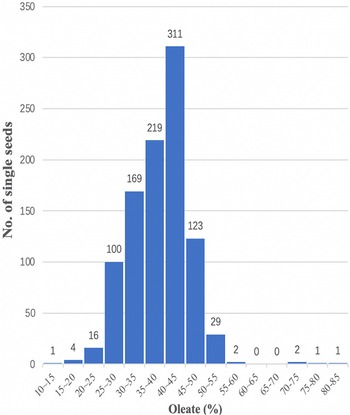
A NIRS model for bulk seed samples (Wang and Zhu, Reference Wang and Zhu2017) was used to predict the oleate content of seeds from individual M2 single plants harvested in the autumn of 2017, but no high-oleic single plant was found. Individual single seeds collected in the autumn of 2018 (one M4 seed from each M3 plant) were scanned with the NIR machine, and oleate and linoleate were predicted using NIR models for single seeds. From a total of 826 seeds, 4 seeds with 70.80–80.10% oleate, viz., 18M1N1-3-84, 18M1N1-3-238, 18M1N1-3-370 and 18M1N1-3-584, were identified (Fig. 1, online Supplementary Fig. S1, Table 2). The single plants grown from the four high-oleic seeds were harvested in the autumn of 2020, and were renamed as 20A 18 M1N1-1, 20A 18 M1N1-2, 20A 18 M1N1-3 and 20A 18 M1N1-4. Seeds from the single plants were harvested. Their oleate content, as determined by GC, ranged from 80.01 to 81.97%, confirming their HO phenotype. Seed weight per plant of the four HO plants was 27.94–61.50 g, much higher than the wild type control MNCK (19.98 g) (Table 2). All the mutants had seed and pod type and size like their parent. Some morphological differences were noted in 2020. In fact, in 2021, differences in plant height, length of cotyledonary branches and productivity among the plant rows at harvest were more evident. MNCK was 43.5 cm tall, with 50.0 cm cotyledonary branches and 16.8 pods per plant. The mutant-derived plant rows had plant height of 36.5–41.0 cm, length of cotyledonary branches of 45.3–47.5 cm and number of pods per plant of 18.3–32.5.
Prediction of oleic acid content of 826 single seeds collected in the autumn of 2018.

Oleate and linoleate content of 4 high-oleic mutants measured by NIRS/GC and productivity

a NIRS results.
b GC results. For GC analysis, only 1/3 of the seeds were used, and the rest was used for seed increase and selection.
FAD2A/FAD2B gene sequencing and DNA/deduced amino acid sequence alignment
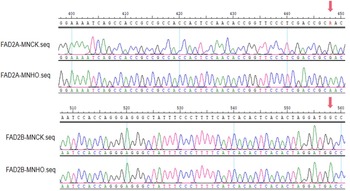
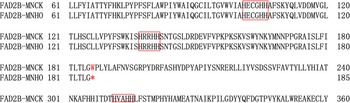
The complete coding sequences of FAD2A and FAD2B were 1140 bp in length, encoding 379 amino acids. Partial nucleotide sequence alignment results of FAD2A/FAD2B from the wild type MNCK and the mutant type MNHO were shown in Fig. 2. MNHO had a G448A mutation in FAD2A, resulting in a change of aspartic acid (D) into asparagine (N) in FAD2A (online Supplementary Fig. S2). A G558A mutation in FAD2B led to a premature stop codon, and the resultant FAD2B lost the third histidine box (Fig. 3). Direct sequencing of FAD2A/FAD2B PCR products and sequencing of PCR-positive clones gave the same results as to the above-mentioned mutations in FAD2A/FAD2B.
Partial FAD2A/FAD2B sequence comparison between wild type MNCK and mutated type MNHO.

Comparison of deduced FAD2B amino acid sequences between wild type MNCK and mutated type MNHO, showing three histidine boxes and a W to *mutation.

GC/MS analysis of main fatty acids in yeast
To make it clear if the G558A mutation in FAD2B causes dysfunctional FAD2B, functional analysis of the mutated FAD2B was performed in yeast expression system. The empty vector PYES2, the recombinant plasmid MNCK containing the wild type FAD2B along with the recombinant plasmid MNHO carrying the mutant type FAD2B were transferred into INVSCI competent cells. Transformants were identified by PCR, and PCR-positive yeast clones capable of producing FAD2B transcripts were used in subsequent induction culture and fatty acid analysis (data not shown).
The fatty acid composition of the yeast was determined by GC-MS. Both C18:2 and C16:2 were detected in the strain containing wild type FAD2B, but they were not found in the strain containing mutated type FAD2B or empty PYES2 vector (online Supplementary Table S1). C18:1 in the strain containing the mutated type FAD2B was higher than that in the strain containing the wild type FAD2B and the empty vector (Fig. 4). According to peak area, in the strain containing wild type FAD2B, C18:2 and C16:2 accounted for 7.51 and 7.95% of the total fatty acids, respectively. C18:1 content in the strain containing the mutated FAD2B gene was 3.50 and 5.40% points higher than that in the strain containing the wild type FAD2B and the empty vector, respectively (online Supplementary Table S1).
Fatty acid profiles in three yeast strains harbouring different expression vectors as determined by GC-MS. PYES2: yeast strain PYES2 containing empty vector PYES2, MNCK: yeast strain MNCK containing recombinant plasmid with wild type FAD2B, MNHO: yeast strain MNHO containing recombinant plasmid with mutated type FAD2B.

Discussion
In this study, NIRS models for individual single peanut seeds were utilized to predict oleate and linoleate content in a sodium azide mutagenized population. Four HO mutants with F435 type FAD2A mutation (G448A) (López et al., Reference López, Nadaf, Smith, Connell, Reddy and Fritz2000) and non-F435 type FAD2B mutation (G558A) (Nkuna et al., Reference Nkuna, Wang, Wang, Tang and Zhang2021) were identified from 826 single seeds (M4 seed generation) representing 826 M3 single plants. The mutants obtained in the present study derived from the same mutagenized population as in an earlier report from our research team (Nkuna et al., Reference Nkuna, Wang, Wang, Tang and Zhang2021), but the G558A mutation in FAD2B was identical and no additional novel mutation in FAD2 was found. Three HO peanut mutant plants were selected from 515 M3 single plants in our previous study (Nkuna et al., Reference Nkuna, Wang, Wang, Tang and Zhang2021) (Fig. 2). In the present study, to keep more genetic diversity and avoid losing mutants if any, single seed descent (SSD) method was followed, and four HO mutant seeds representing four HO mutant plants were obtained, but we cannot trace back to their single plant origin, as the single seeds were not numbered based on plant number. However, according to our earlier report (Nkuna et al., Reference Nkuna, Wang, Wang, Tang and Zhang2021), it was likely that the HO mutants from the present study originated from a single M2 seed not homologous for FAD2A/FAD2B mutant alleles. Sodium azide treatment not only affected oleate and linoleate content, but also had some influence on plant height, length of cotyledonary branches and productivity, providing possibilities for breeding peanut cultivars with both high oleate and high yield through chemical mutagenesis.
NIRS for single seeds appeared to overestimate the amount of linoleic acid (Table 2). There were three possible reasons. Firstly, as compared with bulk seed samples, individual single peanut seeds have fatty acid profiles more susceptible to influence by environmental factors and maturity degrees. Secondly, the single seed NIRS models may have some bias, partially originating from the narrow scope of variation in linoleate relative to oleate. Thirdly, the NIRS models used were developed based on cotyledonary slices instead of the whole seeds, bringing about addition source of errors. Nevertheless, our work showed that it was still possible to use SSD method coupled with NIRS models for individual single peanut seeds to identify HO mutants as early as in M3/M4 seed generations (Nkuna et al., Reference Nkuna, Wang, Wang, Tang and Zhang2021).
It is noteworthy that in a related study, where MNCK (15L46) was treated with a different concentration of sodium azide (25 mmol/l), only one HO mutant seed (M4) with F435 type FAD2 mutations was identified. Interestingly, difference in chemical mutagen concentrations resulted in distinct mutations in HO peanut.
Previously, using peanut cultivars with wild type FAD2A and wild type FAD2B, we obtained some mutants with elevated oleate not high enough to be considered as high-oleic. When a second round of treatment was applied, we were able to induce high-oleic mutants (Yu et al., Reference Yu, Wang, Wang, Yu, Shi, Ren, Yu and Du2019). The seemingly impossible double mutation in the present study may be ascribed to the high sequence similarity between peanut FAD2A and FAD2B genes (only 11 bp difference between FAD2A and FAD2B in the coding region) (Patel et al., Reference Patel, Jung, Moore, Powell, Ainsworth and Abbott2004). Obviously, the mutations did not occur at corresponding sites of the genes in the HO induced mutants and in HO peanut natural mutants previously reported. Peanut FAD2A and FAD2B showed different mutation hot spots, indicating that factors other than coding sequences of genes of interest may have some influence on mutation site. Mid-oleate mutants may still have some value in genetics and breeding studies, and they should not be discarded.
Commercial automatic seed sorters for HO peanut seeds are now readily available. For example, SEEDMEISTER Mark IIIx (Brimrose, USA) may process 100 kernels in 4 min (Anonymous, 2021). Utilization of these NIRS machines will greatly enhance HO peanut mutant discovery and quality breeding.
Reportedly, the three conserved histidine boxes of FAD2 are vital to its activity, and any mutations in these regions may cause reduction or loss of activity and specificity (Yu et al., Reference Yu, Pan, Yang, Min, Ren and Zhang2000; Jung et al., Reference Jung, Swift, Sengoku, Patel, Teulé, Powell, Moore and Abbott2000b; López et al., Reference López, Nadaf, Smith, Simpson and Fritz2002; Fang et al., Reference Fang, Wang, Wang, Tang, Wang, Feng and Yu2012). Bioinformatics studies inferred that the G558A mutation in FAD2B led to the lack of the third histidine box in FAD2B, thereby impairing the desaturase. However, functional analysis of the mutated type FAD2B in a model expression system is still necessary, as it may provide strong evidence for the relationship between this point mutation and elevated oleate content in peanut (Nkuna et al., Reference Nkuna, Wang, Wang, Tang and Zhang2021).
The pYES2 vector is a shuttle plasmid having both a eukaryotic and a prokaryotic replicon. Saccharomyces cerevisiae INVSc1 is a unicellular diploid fungus, and its genomic information and genetic expression pattern have been well elucidated, so it is often used as a eukaryotic expression host for foreign genes (Cao et al., Reference Cao, Cao, Wu, Zhan, Ding, Li and Xie2020). The pYES2 vector may be transferred into S. cerevisiae INVSc1 for functional analysis of eukaryotic genes. In this study, eukaryotic expression vectors with wild and mutated type FAD2B inserts were constructed. Special care was taken to choose the right clone based on sequencing information during the construction of the expression vector not to introduce additional artificial mutation(s) in FAD2B. The recombinant vectors along with empty pYES2 were transferred into yeast cells. GC-MS analysis of fatty acids in yeast revealed that yeast strain with wild type FAD2B gene had 7.51% linoleate, while no linoleate was detected in yeast strain with mutated type FAD2B gene and empty vector, demonstrating for the first time that the G558A in FAD2B is a functional mutation responsible for the dysfunctional FAD2B in the peanut mutants.
To facilitate the utilization of the HO mutation in peanut breeding, the HO mutants were crossed with NO adapted peanut cultivars to analyse their combining ability. Genome editing targeting the 558 bp site in FAD2B was conducted, and the resultant seeds will be evaluated in due course.
Supplementary material
The supplementary material for this article can be found at https://doi.org/10.1017/S1479262122000053
Acknowledgements
Our sincere thanks are due to the financial support from Taishan Industry Leading Talents Special Fund (LJNY201808), Yantai Science and Technology Plan Project (2018ZDCX), Corps Science and Technology Development Special Promotion Achievement Transformation Guidance Plan (2018BC012), Guangdong Program for Science & Technology Plan (2020B020219003), and China Agricultural Research System (CARS-13), Agricultural Science & Technology Innovation Project of Shandong Academy of Agricultural Sciences (CXGC2021A46, CXGC2021A09, CXGC2022A03).