Introduction
The topic of ‘global constitutionalisation’ or ‘constitutionalisation beyond the state’Footnote 1 is moving to the forefront in international law and international politics. In the coming of age of the ‘world society’,Footnote 2 constitutionalisationFootnote 3 is a project which is concerned with the strengthening of international law and supranational institutions, and the fostering of a global ‘rule of law’ based on the principles of equality and human rights.Footnote 4 It is associated with a shift from the ‘Westphalian’ sovereignty paradigm in international relations towards a cosmopolitan legal order.Footnote 5
Initially, the concept of ‘constitutionalisation beyond the state’ was addressed in the context of European integration. However, processes of constitutionalisation are not unique to the European Union. Recently, the concept has gained considerable attention on the international plane, for instance within the framework of the World Trade Organization.Footnote 6
Despite widely varying perceptions, we identify two stylised views of constitutionalisation: constitutionalisation as a unitary and all-embracing process on the one hand, and constitutionalisation assembling several differentiated processes on the other hand. In other words, while global constitutional unity aims at the creation of a global unitary constitution, differentiated constitutionalisation in contrast seeks to realise a multiplicity of autonomous subsystems in international politics – it suggests global constitutional plurality.
So far, processes of global constitutionalisation have been mainly studied from a normative angle. This is not surprising since the concept has a strong anchor in international law. Notwithstanding the importance of normative reasoning, we think that it is crucial to investigate empirically which ‘constitutional model’ – the unitary or the differentiated one – is the most suitable to describe real developments in international law.
In concrete terms, we ask whether international law is moving towards a more unified constitutional order or whether differentiated types of constitutional processes are emerging. We do so in a comparative and quantitative fashion. First, we study the sequencing (that is, the time of treaty inauguration) and the ratification pace of 32 so-called ‘quasi-constitutional’ international agreements that entered into force between 1945 and 2007 containing (1) institutional and organisational guidelines for inter-state relations and (2) fundamental human rights provisions for individuals. Second, we also make a first attempt to study antecedents to global constitutionalisation. Thereby, we focus on democratisation levels, state duration, and regional variation.
But why should scholars of international relations be interested in the different shapes of global constitutionalisation? We see two reasons. First, systematic empirical research on global constitutionalisation is scant. It is far from clear how far the international order has moved towards a unitary or a pluralist conception. In this regard, our goal is not so much to establish whether the global legal order is unitary or plural; rather, we seek to explore the degree of unitarism or pluralism. The dearth of empirical research on global constitutionalisation also combines with inappropriate methodology. Even though studies concerned with patterns of commitment to international agreements are numerous, they merely focus on one particular agreement or a selection of a few agreements rather than on the broader process of global constitutionalisation.Footnote 7 In addition, these empirical analyses do not take into account the possibility of multiple ratification events across agreements. Using event history techniques combining the marginal risk set approach of Wei, Lin and WeissfeldFootnote 8 (WLW) with a counting process style of data input, we provide a more comprehensive empirical picture of global constitutionalisation. Second, the debate on unitary and pluralist conceptions of the ‘global constitutional order’ also taps into an efficiency and effectiveness debate. Building on economic ‘complementarity’ approaches, Hall and Soskice argue that ‘two institutions can be said to be complementary if the presence (or efficiency) of one increases the returns from (or efficiency of) the other.’Footnote 9 This line of reasoning – being prominent in the context of the political economy of national states – can be extended to the process of global constitutionalisation. In this regard, we think that coherence – as in line with the unitary conception – is an important condition for the efficiency and effectiveness of global regimes. If both the sequencing and the ratification pace of ‘quasi-constitutional’ international agreements occur with a substantial gap in time, then the emerging global legal order may have efficiency or effectiveness gaps. For instance, if there is a substantial time gap between general provisions and related legal instruments with a high degree of precision, or between political and related social rights, then effective and efficient governance at the international plane tends to be undermined. Such reasoning is also in line with functional theories in international relations.Footnote 10 From a functional perspective, incomplete integration undermines the effectiveness of existing policies, thereby creating pressures for additional policy co-ordination. Thus, from an efficiency vantage point, it is crucial to better capture which type of global constitutionalisation is emerging.
Certainly, by focusing on the ratification of ‘quasi-constitutional’ international agreements, we only capture part of the constitutionalisation process. We do not claim to capture global constitutionalisation with its all-embracing characteristics including societal forces and judicial review. Nonetheless, ratification of ‘quasi-constitutional’ agreements represents a conditio sine qua non – or a necessary condition – for the emergence of a ‘global constitutional order’. While societal actors might be pivotal in advocating global constitutionalisation, it is the states which produce international law.
The article proceeds as follows: first, we focus on some definitional and conceptual questions of global constitutionalisation. Second, we outline how we can study constitutionalisation empirically. Third, we discuss our methodological approach. Fourth, we present the results of our empirical investigation. This is followed by the conclusion where we discuss some normative and empirical implications of our study.
Global constitutionalisation: some conceptual notes
To better understand what global constitutionalisation is and how it differs from other related approaches, let us first turn to the conceptual distinction of three related terms: constitution, constitutionalism, and constitutionalisation.
A constitution Footnote 11 is first and foremost associated with the national context. Following Western templates it is a framework which refers to the bulk of basic legal norms organising and institutionalising a polity.Footnote 12 The link between the constitution and political institutions is captured by the concept of the ‘rule of law’Footnote 13 (as legally employed in the Anglo-American context).Footnote 14 It reflects a common idea of a constitution ‘that the state's bodies act according to the prescriptions of law, and law is structured according to principles restricting arbitrariness’.Footnote 15 Put simply, the term constitution is closely linked to the ‘rule of law’ which provides for a formal requirement guaranteeing the special relationship between the branches of power.Footnote 16 Translated to the international sphere, it implies that political entities must act within established legal frameworks and according to established procedures.Footnote 17
Constitutionalism, by contrast, implies more than the term constitution. Constitutionalism goes beyond the simple articulation of formal rules and procedures of a constitution. It is a ‘mindset’ providing also for a tradition and a sensibility about how to act in a political world.Footnote 18 Constitutionalism defines rights of and obligations to individuals. Weiler and Wind concur that
there is a difference between constitution and constitutionalism. Constitutionalism […] embodies the values, often non-stated, which underlie the material and institutional provisions in a specific constitution. At this level, separating constitution from constitutionalism would allow us to claim, rightly or wrongly, for example, that the Italian and German constitutions, whilst very different in their material and institutional provisions, share a similar constitutionalism vindicating certain neo-Kantian humanistic values, combined with the notion of the Rechtsstaat.Footnote 19
Constitutionalism explicitly refers to the safeguard of fundamental human rights. Proceeding from the value premise of ‘normative individualism’, several scholars define global constitutionalism in the context of a citizen's perspective.Footnote 20 Such a value-laden constitutional reading is strongly linked to the recognition of individuals as the new subject of international law via the promotion of fundamental rights.Footnote 21 This implies that modern international law is no longer exclusively concerned with the regulation of state-to-state relations but also with individual-state relations.Footnote 22 In sum, constitutionalism can be captured as a ‘mindset’ or what Weiler calls an ‘academic artefact’.Footnote 23
Constitutionalisation, in turn, indicates a process towards the emergence, creation and identification of constitution-like elements. It embeds a time dimension, which implies that a constitution or constitutional elements can come into being as part of a process extending through time. In short, it denotes a constitution-in-the-making.Footnote 24 Constitutionalisation as a process of creating constitution-like elements also contrasts with the moment of constitutional creation. The ‘constitutional moment’ refers to the act of constitution-making in a revolutionary event.Footnote 25
Two further conceptual notes on constitutionalisation are in order. First, while constitutionalism describes a ‘mindset’ denoting what (international) law ‘ought to be’, constitutionalisation describes the concrete process towards the ‘global constitutional order’.Footnote 26 Second, constitutionalisation should not be put on a par with legalisation.Footnote 27 Although both concepts refer to the process of creating legal arrangements, they differ with regard to the type of legal process they induce and the scope of legal arrangements they cover. Legalisation refers to the formal practices creating legal arrangements which gain in binding force through bureaucratic details, such as precision, the degree of obligation and the possibility of delegation.Footnote 28 Constitutionalisation, to the contrary, covers a much broader process. It not only refers to the formal process,Footnote 29 but also involves political and social practices that establish law-like rules and institutions in the international community.Footnote 30 Thus, it raises considerably more substantial questions about the systemic and substantive quality of international law.
Having provided a conceptual understanding of global constitutionalisation, we now turn to the pivotal distinction between global constitutionalisation as a unitary and all-embracing process on the one hand, and constitutionalisation assembling several differentiated processes on the other. Although in practice the positions we present fall more or less onto a continuum, for illustrative purposes we simplify the task by distinguishing between the two extreme types.
Some theorists – especially European law scholars – understand constitutionalisation as a process that has a tendency towards international legal unity.Footnote 31 In this respect, constitutionalisation is about the legal integration of states. Several scholars have postulated a universal world constitution beyond the nation-state, which legitimises the exercise of global political power. In this regard, the UN Charter in particular is referred to as the constitutional document of the international community. Accordingly, the UN is viewed as the primary institution which furnishes the international community with organs.Footnote 32
The alternative to constitutionalisation in terms of global constitutional unity is global constitutional pluralism.Footnote 33 Walker – being a staunch critic of the global constitutional unity – argues that there exist a range of different constitutional sites and processes. In his view, constitutionalism and constitutionalisation are a ‘set of loosely and variously coupled factors’ which allow one to distinguish between different forms of constitutionalism and to identify modes and degrees of constitutionalisation. This contrasts with a constitutional reading in terms of black-and-white and all-or-nothing.Footnote 34 Krisch for instance understands pluralism in the context of global administrative law as an alternative to the attempts at constitutionalising the global political order into a coherent unified framework. He argues that a unified understanding of constitutionalisation tends to downplay ‘the extent of legitimate diversity in the global polity’. This diversity is triggered, on the one hand, by the variety of global constituencies which cannot claim full regulatory legitimacy and on the other hand, by the diverging ways of exercising participatory rights in the determination of the scope of the polity.Footnote 35
Another strand of the pluralist conception is inspired by the sociological approach of Niklas Luhmann. Teubner, the most influential proponent of Luhmann's systems theory within legal studies, describes the difference between constitutional unity and constitutional plurality as follows:
The constitution of world society does not come about exclusively in the representative institutions of international politics, nor can it take place in a unitary global constitution which overlies all areas of society, but, instead, emerges incrementally in the constitutionalisation of a multiplicity of autonomous sub-systems of world society.Footnote 36
Global constitutional pluralism is thus associated with the emergence of different constitutional sites and processes which are configured in a horizontal rather than a hierarchical, vertical pattern.Footnote 37 It is concerned with the fragmentation of international law – ‘the rise of specialized rules and rule-systems that have no clear relationship to each other’Footnote 38 – emerging from the horizontal nature of the international legal system. Constitutionalisation, in this regard, does not seek to overcome fragmentation by creating legal unity in the international sphere, but rather attempts to adapt to it by acknowledging the fragmented nature of the international system.
In this context it is crucial to distinguish between two debates: one focusing on the idealised distinction of unity versus plurality of international law and the other focusing on societal versus state-based constitutionalisation. In this article, we only deal with the first debate and do not reflect on the role of societal forces (such as non-governmental actors) in the constitutionalisation process. There are two reasons for this concentration on the state. First, current research is not able to quantify current societal developments in international relations. This forestalls any empirical research on this topic. Second, even though societal actors might be pivotal in advocating global constitutionalisation (for example, by stimulating the content of international law, setting the international legal agenda, promoting human rights, humanitarian and environmental law, or mobilising states and leveraging public opinion),Footnote 39 it is the states which produce international law. In this regard, Cohen also argues that the importance of the emerging societal forces is overestimated by systems theorists. According to Cohen, the ‘international society of states’ – in contrast to the cosmopolitan order of societal forces – remains the core of the world political system. Thus, by studying the commitment of states to constitution-like international norms, we capture one crucial aspect of the constitutionalisation process.Footnote 40
So far, the distinction between global international legal unity and global constitutional pluralism is mostly a theoretical one. Almost no attempts have been made to assess the process of global constitutionalisation empirically. The exceptions are studies conducted in the European context.Footnote 41 They not only demonstrate that constitutionalisation as an ongoing project is empirically quantifiable when compared to the theoretical concept of constitutionalism. They also demonstrate that constitutional mechanisms such as judicialisation and politicisation of policy making,Footnote 42 as well as parliamentalisation and institutionalisation of human rightsFootnote 43 have an impact on European Union and Member-State politics. In this study, we shall provide a systematic empirical analysis of the shape of constitutionalisation. In concrete terms, we explore whether international law in the post-1945 era is moving towards a more unified constitutional order or whether it takes the shape of differentiated types of constitutional processes. Our analysis focuses on the development of core international law documents containing (1) organisational and institutional guidelines for inter-state relations and (2) fundamental human rights provisions for individuals.
Empirical analysis: generations of rights and state commitment
Our aim is to examine whether international law is moving towards a more unified constitutional order or whether it takes the shape of differentiated types of constitutional processes. If the international order does indeed reveal constitutional pluralism, we might capture it in terms of issue-area-based sub-systems.
One way to think of different issue-areas in the field of international relations is in terms of generations of human rights.Footnote 44 A generation-based distinction of rights was originally proposed by Vasak.Footnote 45 He distinguishes between three generations of international human rights – liberté (civil and political rights – first generation), égalité (economic, social, and cultural rights – second generation) and fraternité (solidarity rights – third generation).
Human rights of the first generation refer to civil and political liberties,Footnote 46 such as freedom of speech, movement and religion, right to property, security of person and the right to political participation.Footnote 47 With regard to the international context, human rights of the first generation do not imply that a global political citizenship is feasible. Rather they indicate the opportunity of individuals to claim their personal freedoms, including the right to seek redress if injured by another, the right of peaceful protest and the right to a fair investigation and trial if suspected of a crime. This concept also refers to equal treatment of all individuals irrespective of race, sex or class. In other words, civil and political rights mean that individuals are protected from the coercive power of governing authorities and are granted the liberty to participate in (international) politics.
In addition, procedural guidelines organising inter-state relations also fall under this category of rights. These are formal provisions,Footnote 48 which structure the international legal system and provide an institutional setting in which international political and legal action takes place. They refer to the international ‘rule of law’ that ensures a set of guiding rules and procedures according to which political entities must act.Footnote 49 Even though these provisions do not address the relationship between individuals or individuals and states, they are a necessary requirement for the guarantee of individual rights in the international community.
Second-generation rights are social and economic in nature. Social rights include the right to work, education, health care, social security and a minimum standard of living. Economic rights, on the other hand, comprise market-enabling measures aimed at the abolition of protectionist rules and the redress of inequality of opportunities for economic activity between citizens of different nations.Footnote 50 The recent literature has also pointed to economic rights as elements of an enlarged concept of civil rights, including the right to trade and the right to market access, as well as the protection of civil liberties and properties.Footnote 51 Social and economic rights pursue the creation of a level playing field for all individuals by setting common standards with regard to economic liberalisation as well as social development.
Third-generation rights comprise rights such as the right to development, peace, environmental protection and self-determination. In contrast to rights of the first and second generation, these collective rights are less frequently embodied in international law documents but rather take the form of political proposals. In this article, we focus only on the first two generations of rights, since they are uncontroversial in the egalitarian liberal literature. Unlike human rights of the third generation, they are not subject to continuing disagreement regarding the holders, duty-bearers and their substance.Footnote 52
Notice further that the ‘generations’ account of rights is often associated with the conception of ‘negative’ and ‘positive’ rights.Footnote 53 Negative rights closely resemble the first generation of human rights. They require prohibition of certain actions, as in the right not to be subjected to violent actions by governments. Positive rights, in turn, correspond to the second (and third) generation(s) of human rights. They impose a moral obligation on governments to provide public goods and services.Footnote 54
Although the ‘generations’ concept is far from being a popular analytical tool in the scholarly literature,Footnote 55 we find it a useful framework for the purpose of our empirical analysis on emerging patterns of constitutionalisation. Our expectation is as follows: if international law is moving towards a more unified constitutional order, then we should see no difference in the sequencing and ratification pace according to the different issue-areas (as embodied in the ‘generations’ account of rights). Conversely, if international law takes the shape of differentiated types of constitutional processes, then we should see a difference in sequencing and ratification pace according to the different issue-areas.
In concrete terms, we study the sequencing (that is, the time of treaty inauguration) and the pace of state commitment to these agreements incorporating basic formal rules (the international ‘rule of law’ providing for an institutional setting of inter-state action) and human rights (comprising civil and political liberties as well as social and economic rights for individuals). We use the term ‘international agreement’ to refer to all international norms included in the sample. International agreements comprise the widest range of international instruments. Following art.2(1)(a) of the Vienna Convention on the Law of Treaties of 1969, an international agreement is ‘concluded between States in written form and governed by international law, whether embodied in a single instrument or in two or more related instruments and whatever its particular designations’.Footnote 56 For the purpose of our analysis, we have compiled a data set containing ratification entries of international agreements. By ratification we mean several possible treaty actions – acceptance, approval, accession and succession – which all have the same legal effect as ratification and consequently lead to an internationally binding arrangement.Footnote 57
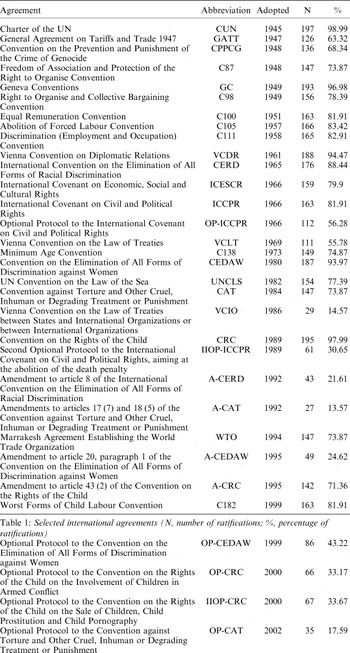
The data set encompasses ratification entries for 32 international agreementsFootnote 58 made since the Second World War over 199 nation states (1945–2007). The entries include ratifications of charters, conventions and covenants as well as documents of lower hierarchical order such as amendments and optional protocols.Footnote 59 A detailed inventory is given in Table 1.Footnote 60 The selected agreements have in common that they are written and binding instruments that establish legal rights and duties and require ratification by the states. All provisions covered by these legal documents primarily address the protection of human rights of the first (civil and political rights) and the second generation (economic and social rights) and the international ‘rule of law’ principle. After careful consideration of all legal instruments related to the process of global constitutionalisation, we have decided to drop several international agreements. These concern the collective rights of the third generation (for example, legal instruments dealing with refugees, migrant workers and stateless persons). In so doing, we limit ourselves to the most important and fundamental constitutional documents.
Selected international agreements (N, number of ratifications; %, percentage of ratifications).

Sources of ratification data: UN, United Nations Treaty Collection, available at: {http://treaties.un.org/Pages/UNTSOnline.aspx?id=2}; for GATT and WTO see WTO, The 128 countries that had signed GATT by 1994, available at: {http://www.wto.org/english/thewto_e/gattmem_e.htm} and WTO, Members and observers, available at: {http://www.wto.org/english/thewto_e/whatis_e/tif_e/org6_e.htm}.
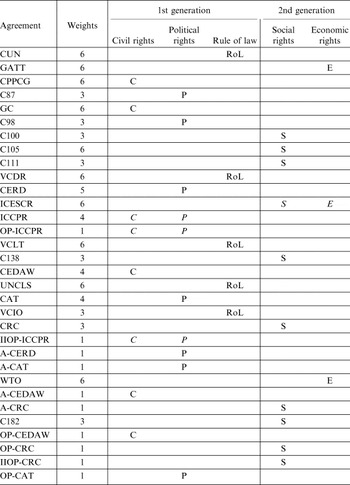
Formally, these international law instruments are not ranked in any general order of priority. However, legal vocabulary indicates some informal hierarchy of international law.Footnote 61 The selected agreements differ with regard to the degree of universality (precision) and the level of formality. In order to obtain a realistic and relatively unbiased reflection of state commitment to these agreements, we need to distinguish between conventions, charters, and covenants on the one hand, and protocols and amendments on the other hand. To do so, we assigned weights to each international agreement. In assigning weights to the international agreements, we draw from the definition of international agreements as laid down in art.2(1)(a) of the Vienna Convention on the Law of Treaties of 1969. Consequently, an international agreement can be embodied in one instrument or in two or more related instruments. The coding rules are as follows: we assign a weight of 6 to an international agreement (such as treaty, charter, convention or covenant) of higher hierarchical order comprising only one particular legal instrument. International agreements of higher hierarchical order which embody several legal instruments concerning the same subject-matter are assigned proportional weightings. The theoretical range of these proportional weightings goes from 2 to 5; in practice, however, the range goes only from 3 to 5. We weight the instruments in such a way that their sum representing one particular international agreement does not exceed the value of 6. Thereby, instruments of lower hierarchical order such as protocols and amendments are assigned a value of 1. Instruments of higher hierarchical order (treaty, charter, convention or covenant) are assigned a value ranging between 3 and 5, depending on the number of additional issue-related instruments of lower hierarchical order. Since no international agreement is composed of more than three instruments of lower hierarchical order (each assigned a weight of 1) and one instrument of a higher hierarchical order, the minimum value for an instrument of a higher hierarchical order is 3. The concrete weights are displayed in table 2.Footnote 62
Classification of agreements and corresponding weights

Note: C: civil rights; P: political rights; RoL: formal provisions; S: social rights; E: economic rights. Due to their overarching characters, four agreements are allocated twice: ICCPR, OP-ICCPR, IIOP-ICCPR are each assigned to the subgroup of political and of civil rights, and ICESCR is assigned to the subgroup of social and economic rights (double assignments indicated by italics). The key to treaty abbreviations is provided in Table 1.
For this analysis we classified the selected 32 international agreements into issue-areas as presented in table 2. Our classification is based on the main aim of a particular treaty. We consider the designated function of a treaty to be the decisive factor for its classification into an issue-area-based subgroup. We acknowledge that classifying international agreements into specific issue-areas can entail ambiguity. It is not always easy to distinguish between different rights, or to decide whether a treaty providing both for a strong dispute settlement mechanism and regulating economic affairs should be classified as a ‘rule of law’ provision or as an ‘economic right’. To deal with such classification ambiguities we strongly relied on legal expertise. In concrete, we studied the (available) travaux préparatoires as well as the literature outlining the history and purposes of each international agreement. In addition, we consulted scholars specialised in public international law.
Let us take the UN Charter to illustrate the classification process. The UN Charter is the most important international agreement and it is designed to introduce a comprehensive public order system. As mentioned before, a number of international law scholars call the Charter the constitutional document of the international community. However, the fact that the purposes of the Charter are relatively wide-ranging makes it difficult to provide a clear-cut classification of its main aim. The Charter established the UN, lays down its functions and prescribes its limitations, deals with the issues of peace, security and the use of force, and provides the base line for human rights. Nevertheless, its major objective is to promote international co-operation and to establish peaceful relations between nation states. Consequently, it is an instrument providing institutional and organisational guidelines for inter-state relations, and was therefore classified as a ‘rule of law’ (RoL) provision.
With regard to the operationalisation of the process of global constitutionalisation by way of the sequencing of international agreements and the pace of state commitment to these agreements, there are three alternatives to consider. First, we might focus on the creation and initiation of international agreements. This would allow exploring the negotiation and bargaining capabilities of states during the drafting process of an agreement. Empirically, this would require us to take an in-depth look at documentary sources from the years of preparatory discussions and negotiations (the travaux préparatoires). However, travaux préparatoires are not publicly accessible for all the international agreements under consideration. Thus, focusing on the drafting process might lead to a biased empirical investigation of the process of global constitutionalisation. Second, we could operationalise global constitutionalisation via the overall rates of compliance with international provisions. This approach, however, also has drawbacks. On the one hand, this would require extensive data gathering. On the other hand, it would also imply a standardised translation of qualitative materials into quantifiable levels of compliance rates. At this stage of research on global constitutionalisation, however, the paucity of relevant data forestalls such an analysis in a broad quantitative design. Third, we might simply focus on the overall ratification rate of international agreements. But this approach also has severe limitations. It would involve omitting the time dimension, thus confronting us with the problem of relatively low variance both among states and the generations of international rights. As such, this way of operationalising global constitutionalisation leads to a fairly simplistic empirical analysis. Consider the following example: Namibia and Egypt both ratified 75 per cent of the 32 selected ‘quasi-constitutional’ international agreements, but did so over a different period of time. While Namibia ratified these agreements within a time frame of 19 years (between 1983 and 2002), it took Egypt 57 years (from 1945 to 2002) to achieve the same rate of ratification. Thus, limiting our analysis to the simple rate of ratification, we would lose important information with regard to the sequencing and ratification pace of international agreements.
Hence, compared to the alternatives, a method that takes into account the sequencing and ratification pace of international agreements provides a feasible way of operationalising global constitutionalisation. Furthermore, as argued above, such an approach represents a conditio sine qua non for global constitutionalisation. Nonetheless, we acknowledge that by measuring the sequence and ratification pace of international agreements, we capture only parts of the larger constitutional picture. Our analysis focuses only on the institutionalisation of some international ‘rule of law’ provisions and the legal protection of human rights. As such, we do not address structural issues of global authority, for example, principles and structures for the establishment of global ‘legislation’, the exercise of global ‘executive power’, or the operation of global adjudicatory capacity. Therefore, it would be misleading to call these international agreements ‘constitutional’. Rather, we shall call them ‘quasi-constitutional’ norms: while they have some important constitutional characteristics, they do not refer to the entirety of a constitutional document.
Statistical techniques
In order to analyse the sequencing and ratification pace of international ‘quasi-constitutional’ norms, we use event history techniques. An event history model offers an appropriate method for analysing the timing of political change, which is the change in status from non-ratification to ratification. It not only considers which countries ratify international agreements, but also takes into account that some countries do so with different time lags. Furthermore, event history analysis can take into account that countries may resign from a particular treaty and re-ratify it later.Footnote 63 In addition, it can accommodate censored and truncated data.Footnote 64 In this study, we are confronted with fixed and random right-censoring as well as left-truncation.Footnote 65
Finally, event history techniques can be applied to data with ‘multiple events per subject’.Footnote 66 In this study, we do not examine ratification behaviour for each treaty separately, but are interested in finding a superordinate institutionalisation pattern of international ‘quasi-constitutional’ norms; thus we need to take into account that each country can ratify up to 32 international agreements.Footnote 67 Our data is formulated as a counting process according to Andersen and GillFootnote 68 and combined with the marginal risk set approach of Wei, Lin and Weissfeld (WLW).Footnote 69 The WLW counting process data consists of multiple records and is set up as annual intervals.Footnote 70 By clustering on countries, the WLW counting process formulation accounts for the fact that ratifications of international agreements by a specific country are not independent, but are not bound to experience a prior event.Footnote 71 The defining characteristic of the WLW approach is that all subjects are ‘at risk’ for all events at all times prior to experiencing that event.Footnote 72
In order to obtain a realistic account of the sequencing of the international agreements and the pace of ratification, we do not standardise the time of treaty inauguration, (that is, the time when the agreement becomes open for signature and ratification). Rather, we focus on the inauguration of each international agreement. At first glance, one might think that such an approach leads to a biased view of the process of global constitutionalisation. However, we believe that it is a more appropriate method to study both the sequencing of international agreements and the pace of ratification, since it takes into account additional information about the timing and emergence of international agreements. For an illustration, consider the provisions regarding rights granted to children as laid down in several issue-related legal international instruments. The International Covenant on Civil and Political Rights (ICCPR), adopted in 1966, recognises children as possessors of human rights at the international level without laying down the specific rights of children. More elaborate provisions – such as the protection of children from economic exploitation – were incorporated into the Convention on the Rights of the Child (CRC), which was only adopted by the UN in 1989. A state which ratified the ICCPR 7 years after its adoption (in 1973) and the CRC 1 year after its adoption (in 1990) would have ratified these two agreements on the rights of children with a time gap of 17 years. Standardising the adoption of agreements to zero, we would imply that both agreements were adopted in the same year. This would reduce the time gap to 6 years (ratification of the ICCPR 7 years after adoption minus ratification of the CRC 1 year after adoption) and would bias the actual time that has elapsed between the first and the second ratification. In statistical terms, standardisation does not enable us to depict the temporal relation between distinct ‘outsets’ of each international agreement (the time of opening an international agreement for signature and/or ratification). The ICCPR, for instance, was opened for signature and ratification in 1966, while the CRC was opened for signature and ratification in 1989. Standardising the time of outset of each international agreement to zero, we would omit information accounting for the difference in years between the launching of international agreements. In our analysis, we take into account both the sequencing of international agreements and the pace of ratifications.
Results of the analysis are reported on the basis of descriptive event history quantities.Footnote 73 Adjusting for the presence of left-truncated and right-censored data by Greenwood's formula,Footnote 74 we compute the modified Kaplan-Meier (hereafter K-M) estimate for the survival function together with the restricted mean survival time (time to ratification) and its variance, as well as the median and confidence intervals of the survivor function.Footnote 75
Empirical findings – unitary or plural constitutionalisation?
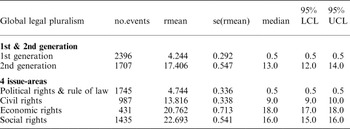
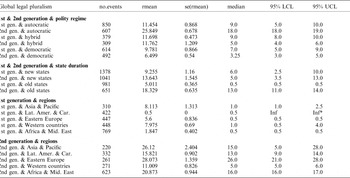
Concerning the empirical analysis, we speak of constitutional pluralism when the difference in sequencing and ratification pace of distinct international‘quasi-constitutional’ agreements is statistically significant. Conversely, a statistically insignificant difference in sequencing and ratification pace according to the issue-areas is an indicator for the emergence of a unified international constitutional order. We distinguish between statistically significant and statistically insignificant differences by means of confidence limits. Overlapping confidence limits suggest that distinct ‘quasi-constitutional’ subsystems are not evident. Non-overlapping confidence limits indicate that issue-area-based perception of global constitutionalisation is of considerable importance. An overview of descriptive summary statistics is provided in Table 3Footnote 76 (see above).
Descriptive statistics of treaty ratification (weighted values)

Note: Total number of subjects ‘at risk’ (country years) to ratify an international agreement is 128205; no.events: number of ratifications that occurred; rmean: restricted truncated mean time to ratification; se(rmean): standard deviation of the restricted truncated mean survival time; median: median time to ratification; 95% LCL and UCL: upper and lower confidence intervals (95%) for the median.
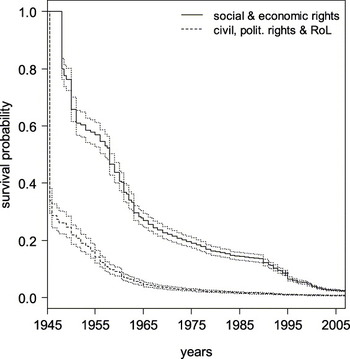
A first picture emerges when we classifyFootnote 77 the full sample of 32 ‘quasi-constitutional’ international agreements into two issue-areas, representing the first and the second generation of rights – the formal-civil-political stratum and the socio-economic stratum. The sequencing and ratification pace differ significantly between these two subgroups with regard to the average year of ratification (see table 3) as well as the median time to ratification. Fifty per cent of international agreements within the formal-civil-political subgroup had been concluded in the first year after the drawing up of agreements. On the other hand, it took thirteen years to reach the median number of ratifications of socio-economic treaties. As indicated by the non-overlapping confidence limits, the two-step functions differ significantly (see figure 1). The ratification of socio-economic rights proceeds more slowly than the ratification of civil-political rights.
Kaplan-Meier survivor curve for 1st and 2nd generation of rights (weighted values) covering 32 international agreements.
Note: Survival probability refers to the probability that a state does not ratify a group of international agreements to a particular time.

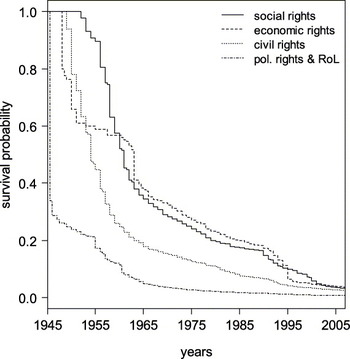
Our second categorisation is a more thorough refinement of ‘quasi-constitutional’ agreements into four issue-areas distinguishing between (a) civil rights, (b) political rights and the ‘rule of law’, (c) social rights, and (d) economic rights. K-M survival curves for the first three strata progress almost proportionally from the outset of the study, supplemented by the economic strata from the mid 1960s onwards (see figure 2). Significantly distinct confidence levels confirm the appropriateness of this four-fold stratification. Again, ratification of political rights with ‘rule of law’ provisions and civil liberties is faster than ratifications of agreements containing social or economic rights.Footnote 78
Kaplan-Meier survivor curve for 4 issue-areas (weighted values) covering 32 international agreements.
Note: For the sake of clarity, no confidence limits are displayed. Survival probability refers to the probability that a state does not ratify a group of international agreements to a particular time.

In sum, our results show that global constitutionalisation can be captured to some extent as the multiplicity of its functions, rather than as a fully-fledged integrative constitutional process. The emergence of ‘quasi-constitutional’ subsystems according to a two-tier generation-based conception of rights and a four-tier specification of those rights seem to provide a more accurate account of the present nature of international law than a constitutional reading of the ongoing developments as a unitary process leading towards global harmonisation.
Antecedents of global constitutionalisation
In this section, we make a first attempt to study antecedents of global constitutionalisation. Our goal here is not to identify the exact causal mechanisms underlying global constitutionalisation. Given the infant stage of this type of research, we merely seek to establish associations between specific factors and quasi-constitutional agreements. Since global constitutionalisation is of a plural nature, our analysis distinguishes between the two subgroups of international agreements, namely between the first generation and the second generation of rights.
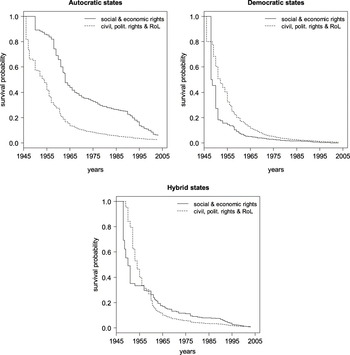
First, we consider the effects of democratisation on the sequencing and pace of ratification of ‘quasi-constitutional’ agreements. There is widespread evidence that democratic states are more willing to ratify international agreements than autocratic states,Footnote 79 since international agreements are generally in accordance with their domestic practices. However, to properly explore the link between the regime type and ratification behaviour, we need to distinguish between autocracy, hybrid regimes, and full democracies.Footnote 80 To do so, we employ the Polity2 scale. The scale ranges from +10 (strongly democratic) to −10 (strongly autocratic), and provides data for 7294 country years between 1946 and 2003.Footnote 81 Following Epstein et al.,Footnote 82 we re-classify the Polity scale into three categories: values greater than 7 indicate a full democratic regime; values ranging from 1 to 7 indicate a hybrid political system; and values less than 1 indicate an autocratic regime. Our findings show that the sequencing and ratification pace of both treaty generations differ significantly within each polity regime (see figure 3 and table 4). On average, democratic states ratify international ‘quasi-constitutional’ agreements at a higher pace than autocratic states.Footnote 83 This confirms that democratic states are more willing to ratify international agreements than autocratic states. However, the ratification pace with regard to the two generations of international agreements differs across the regime types. In the case of authoritarian regimes it took nine years to reach the median number of ratifications of civil-political rights and ‘rule of law’ provisions, and eighteen for socio-economic treaties. This is in stark contrast to democratic regimes, where the median time to ratification is lower and the sequencing and ratification pace of the two treaty generations is reversed compared to the autocratic regime (3.25 years for second generation rights and seven years for provisions of the first generation). In the context of hybrid regimes, the ratification pattern is similar to fully democratic regimes (the median time to ratification was nine years for agreements of the first generation and five years for rights of the second generation). While second generation rights are ratified at a higher pace at the outset of the study, the ratification pace decelerates from the late 1950s and reverses the overall ratification pace of the two subgroups of agreements. The variance across regime types and treaty generations documents that the ratification pattern of ‘quasi-constitutional’ agreements is more complex than is captured by simple theoretical assumptions. Future research might need to adopt a sovereignty-centred view which emphasises national ‘sovereignty costs’ of policy change imposed by treaty ratification as well as by national interests and power.Footnote 84
Kaplan-Meier survivor curves for 1st and 2nd generation of rights according to polity regime (weighted values) covering 32 international agreements.
Note: For the sake of clarity, no confidence limits are displayed. Survival probability refers to the probability that a state does not ratify a group of international agreements to a particular time.

Descriptive statistics of treaty ratification with antecedents (weighted values)

Note: Total number of subjects ‘at risk’ (country years) to ratify an international agreement is 128205; no. events: number of ratifications that occurred; rmean: restricted truncated mean time to ratification; se(rmean): standard deviation of the restricted truncated mean survival time; median: median time to ratification; 95% LCL and UCL: upper and lower confidence intervals (95%) for the median.
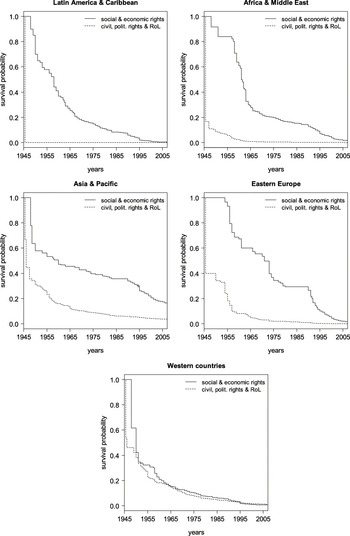
Notice that no reliable estimates can be reported in the case of Latin America & Caribbean for agreements of the first generation. In this case, all international agreements which were open for ratification in the first year of the study were ratified in the very same year. This leads to a zero survival rate after the first year (see figure 5) which is due to the nature of the K-M estimator modified for the presence of left-truncated observations on the country level. This measure takes into account that countries can enter the study with a delayed entry time and that times of treaty inauguration are not standardised. In general, the K-M estimator considers the temporal process of the ratification behaviour. However, due to the construction of the non-parametric K-M as product-limit estimator, the curve cannot decrease below the initial value of zero, which was already reached after the first year. For this specific case the survival curve obtained by the non-parametric K-M estimator provides no useful information about the process of ratifications.
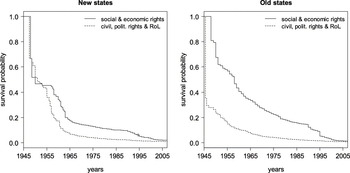
Second, we focus on state duration. State duration distinguishes between the ratification pace of countries which gained independence after 1945 (in the process of decolonisation or the collapse of the Soviet Union) and states which have a longer duration. We expect state duration to be negatively correlated with the commitment to ‘quasi-constitutional’ agreements. New states generally have no standing in the international community and must convince other states that they are willing to become good members of the international community. Thus, by openly and publicly committing to international norms, new states can establish a reputation at the international level. In addition, new states may also feel a specific need to break with past practices of their country. They may want to distance themselves from prior abuses within the country in order to obtain collateral benefits such as investment, trade, and political support. By joining an international agreement, they may signal an intention to become a good member of the international community.Footnote 85 We therefore expect that new states are more likely to join an international agreement than older states. We capture state duration via state independence or via the introduction of the first national constitution.Footnote 86 For the purpose of graphical clarity, we transformed the variable ‘state duration’ into a binary measure distinguishing between ‘old states’ which existed before 1945 and ‘new states’ which came into existence after 1945. Focusing on the data presented in table 4 and figure 4, there are pace differences between the two subgroups of agreements. Both, new and old states ratify civil and political rights as well as ‘rule of law’ provisions on average at a higher pace than socio-economic treaties. However, the difference in ratification pace between old and new states is not statistically significant. Comparing the pace differences of each generation of treaties between new and old states, we do not find support for our assumption that new states have an overall higher likelihood of treaty ratification than old states.
Kaplan-Meier survivor curves for 1st and 2nd generation of rights according to state duration (weighted values) covering 32 international agreements.
Note: For the sake of clarity, no confidence limits are displayed. Survival probability refers to the probability that a state does not ratify a group of international agreements to a particular time.

Kaplan-Meier survivor curves for 1st and 2nd generation of rights according to geopolitical regions (weighted values) covering 32 international agreements.
Note: For the sake of clarity, no confidence limits are displayed. Survival probability refers to the probability that a state does not ratify a group of international agreements to a particular time.

Third, we focus on regional variation in the ratification of ‘quasi-constitutional’ agreements. We propose that there are similarities in ratification behaviour among states from the same geographical region. This argument draws from constructivist approaches in international relations. Finnemore, for instance, argues that dense networks of transnational and international social relations shape states' perceptions of the world and their role in that world.Footnote 87 As more states commit to international ‘quasi-constitutional’ norms, other states feel pressured to commit as well. Simmons introduced a global and regional measure to control for states among which the influence of norms is likely to exist.Footnote 88 Since our goal is to detect regional variation in ratification behaviour, we classify world regions into five categories: 1) Western countries (including Western Europe, Australia, New Zealand, US of America and Canada), 2) Asia and the Pacific, 3) Eastern Europe and post Soviet Union (including central Asia), 4) Africa and the Middle East, and 5) Latin America and the Caribbean.Footnote 89 Our results show that the ratification pace of agreements of the first and second generation differs significantly within each region. In all regions, agreements of the first generation are ratified more rapidly than second generation rights (see table 4). However, the difference in the ratification pace between the two generations is smaller in Western countries than in the other world regions (see figure 5). This finding is in line with Kagan's claim that Western democracies are the vanguards of international cooperation.Footnote 90
Conclusion
In this study, we investigated the shape of global constitutionalisation. Defining global constitutionalisation in terms of state commitment to international ‘quasi-constitutional’ agreements, we explored the degree to which international law is moving towards a more unified constitutional order or whether it takes the shape of differentiated types of constitutional processes. To this end, we analysed the sequencing and ratification pace of 32 selected ‘quasi-constitutional’ agreements drawn up in the period between 1945 and 2007. The results of our study are sobering news for those devoted to the ambitious project of a unified ‘global constitutional order’, as they indicate that the development in international law displays a tendency towards differentiation. Following a generation-based distinction of rights, we find that the ratification of ‘quasi-constitutional’ agreements embodying political rights with ‘rule of law’ provisions and civil liberties is faster than the ratification of agreements containing social or economic rights. Certainly, these findings may not come as a big surprise for many scholars; but our analysis is the first to examine the shape of ‘global’ constitutionalisation in a systematic and sophisticated manner.
Four implications follow from our study. First, the fact that global constitutionalisation has a distinct pluralist shape reflects challenges of effectiveness and efficiency. Substantial gaps in the sequencing and ratification pace mean a lack of coherence of the international legal order, and as such tend to imply a gap in effective and efficient governance.
Second, our analysis provides a starting point for further elaboration on the future legal and ‘constitutional’ shape of the international polity. Based on their experiences with the European Union, European lawyers enthusiastically started to employ the constitutional vocabulary on a global scale. Our findings, however, may dampen this enthusiasm. They do not lend support to a unified and quick process of global constitutionalisation, but rather lend support to the idea of a ‘multi-speed globe’ of differentiated constitutionalisation. Such a ‘variable geometry’ on theglobal scale could also acknowledge irreconcilable differences among nation states. Thus, proponents of global constitutionalism may be well advised to focus primarily on groups of states able and willing to pursue common objectives, while acknowledging that others may follow but with a considerable time lag.Footnote 91
Third, we have also focused on three antecedents of global constitutionalisation, namely regime type, state duration, and regional effects. We could demonstrate that processes of global constitutionalisation vary across regime types and world regions (while there is no effect for new and old states). These findings provide an important starting point for more detailed, case-based analyses of the exact mechanisms underlying processes of global constitutionalisation.
Fourth, to study ratification patterns we employed sophisticated statistical tools, namely the analysis of multiple ratification events using the WLW formulation combined with a counting process style of data input. Most studies concerned with the issue of commitment to international agreements focus on one agreement or a selection of a few agreements.Footnote 92 This approach, however, is deficient since it raises the problem of generalisability. Our statistical tools (combining the WLW approach with the counting-process data imputation style) provide a more appropriate framework for studying cross-treaty ratification effects in an encompassing manner and for analysing multiple ratification events. By examining all ‘quasi-constitutional’ agreements since 1945, we have been able to draw more generalisable conclusions than is possible when analysing evidence from individual agreements. By studying ratification patterns of 32 international ‘quasi-constitutional’ agreements, we have been able to provide a more comprehensive evaluation of these agreements and to investigate research questions which cannot be tackled in a one-agreement analysis or a series of one-agreement analyses.
Finally, we acknowledge that our analysis is mainly descriptive. While we made a first attempt to explore antecedents of global constitutionalisation, future research must take a more extensive look at the forces impeding or facilitating constitutionalisation processes, while at the same time specifying the exact mechanisms. These crucial issues should be tested and assessed in our comprehensive multi-treaty framework.
Appendix: applied event history quantities
The basic quantity employed to describe time-to-event processes is the survival function. It is the probability that a subject survives to time t.Footnote 93 With T denoting a nonnegative random variable representing the lifetime of subjects, the survival function is defined as

Expressing this with regard to the analysis of ratification events, let us first consider a risk set with only one potential international agreement to be ratified. Then, the survivor function denotes the probability that a state does not ratify the international agreement under investigation to a particular time. Within the framework of multiple ratification events, the survivor function can be thought of as the proportion of not-ratified multilateral agreements over all states to a particular time. Over the course of time, the proportion of states that has not ratified the agreements must decrease; hence the survivor function is a monotonous decreasing function. It is the complement of the cumulative distribution functionFootnote 94F(t) defined as

Therefore, it is also described by the integral of the probability density functionFootnote 95f(t) as

However, given that the ratification data is left-truncated and/or right-censored, the upper limit of the integral of S(t) is generally not ∞, and the lower limit not t. C denotes a mixed censor timeFootnote 96 with the cumulative distribution function G(y), the probability density function g(y) and the survival function S g(y). Each subject i has a lifetime T i, and a censored time C i. On each of n subjects the pair (Y i, δi) can be observedFootnote 97 where

Reflecting the presence of left truncation, each subject must be considered to have a left-truncation time (delayed entry time) X i, a lifetime Y i, and a censoring time C i. Then each of n subjects observed is described by the triple (X i, Y i, δi) where

Thereby, k(x) denotes a probability density function of X, f(t) and S(t) the probability density function and the survival function of T, and g(y) and S g(y) a probability density function and a survival function of C. The times X i, T i, C i are assumed to be independent.Footnote 98
In order to estimate the survival function, the nonparametric modified Kaplan-Meier (hereafter K-M) estimator is applied.Footnote 99 In contrast to the empirical survivor function which treats data as if there were no censored observations, the K-M estimator reflects the presence of right-censored observations, formulated by means of the survivor function. The K-M estimator is defined as

and where y (i) denotes the ith distinct ordered censored or uncensored observation and the right endpoint of the interval Ii, i = 1, 2, …, n′ ≤ n, and k the number of the interval endpoints. The K-M estimator is based on  (t) indicating the risk set just before time t (the number of subjects at risk at the beginning of the interval I i equals the number of subjects which survived the previous interval I i−1) and comprising
n i = number of subjects in the risk set
 (y (i))
= number of subjects which did not experience the event (and which are not censored) just before y (i)
d i = number of subjects which experienced the event at time y (i)
p i = surviving probability P (not experiencing the event through I i | not having experienced the event at beginning I i)
= P(T > y (i) | T > y (i−1)).
The modified K-M estimator adjusts, in addition, the empirical survivor function for the presence of left-truncation, by redefining the K-M estimate to be zero beyond the largest observation. Extended to left-truncated data the modified K-M estimator is

It is based on a modified risk set
(t (i)) and t (i) defined by

with t (1), …, t (r) indicating the r ≤ n distinct ordered (uncensored) death times, so that t (j) is the jth ordered death time, where
n i = number of subjects in the risk set
(t (i))= number of subjects which are left-truncated before time t (i) and which did not experience the event (but which are not censored) just before time t (i)
d i = number of subjects which are left-truncated before time t (i) and which experienced the event at t (i)
p i = surviving probability P (not experiencing the event through time t (i) | left-truncated before time t (i) and not having experienced the event just before time t (i)).
The K-M estimator yields a right continuous decreasing step function, which steps down at each t (i). The size of the steps depends not only on the number of events observed at each time t (i), but also on the pattern of the censored and truncated observations prior to time t (i).Footnote 100
Another summary measure of the event experience is the mean or median time to the event. The mean time to the event (mean survival time) E(T) is the total area under the survival curve S(t). For a given time t the mean survival time E(T) becomes shorter, the greater the risk, the smaller S(t).Footnote 101 The mean survival time is given by

Note that the modified K-M estimator is not defined beyond the largest time value. Therefore, the mean lifetime cannot be estimated, and comparison of the ‘survival time’ for the different constitutional categories becomes complicated by the differences in the largest time values between the constitutional groups. To make a comparison which adjusts for these differences, the estimated mean, restricted to the specified interval (the observation period) is constructed for each constitutional group. This estimation is based on the assumption that the survivor function is 0 after the largest time.Footnote 102 The estimated restricted truncated mean survival time is then taken to be

If the largest time value y (n) is uncensored, then a truncated interval is the same as the integral over [0, ∞) since over [y (n), ∞),  . But if the maximum time value is censored, the function will have a non-zero value at that point and be undefined afterwards, the
 . Thus, the integral over [0, ∞) is undefined, and
 . In order to avoid this, the integral is truncated. By taking the upper limit of integration to be the y (n), the K-M estimate is redefined to be zero beyond the largest time value.Footnote 103 As
 is a step function,
 is computed as

where n′ = number of distinct observed y i's, n′ ≤ n, y (0) = 0,  , and
 is the height of the function at y (i−1).
The estimated variance of the estimated restricted truncated mean survival time is

It is reported in the findings section as the standard error, which is the square root of the Greenwood's formula for the estimated variance.Footnote 104 Greenwood's formula modified for truncated observationsFootnote 105 is described by

The K-M estimator is also used to provide estimates of quantiles of the time-to-event distribution. In this manner the median survival time can also be determined. This is a descriptive measure preferred even over the mean survival time, as time-to-event data are right skewed. The pth quantile t p follows from F(t p) = p or S(t) = 1 − p and is defined as t p ≤ S −1(1 − p). t p is the smallest time at which the survivor function is less than or equal to 1 − p. When p = 0.5, t p is the median survival time. The estimated quantile is then

Likewise, upper and lower confidence intervals for the median are defined in terms of the confidence intervals for the S(t): the upper and lower confidence limit is the smallest time at which the upper or lower confidence limit for S(t) is ≤ 0.5.Footnote 106 Confidence intervals are obtained by the Greenwood's standard error on an approximate (1 − α) × 100% confidence levelFootnote 107 and are computed as