INTRODUCTION
For nearly three-quarters of a century, scholars have remarked on resemblances between Izapa and sites of the Gulf Coast, particularly Tres Zapotes, beginning with Stirling's (Reference Stirling1943:72) statement that “[i]n general Izapa appears to be much more closely related to the earth-mound sites of southern Veracruz and the Isthmus of Tehuantepec, than it does with sites in the Maya area.” Others (e.g., Coe Reference Coe and Wauchope1965a:695) have identified similarities in pottery, especially Lowe (e.g., Reference Lowe and Adams1977, Reference Lowe, Sharer and Grove1989), who included them in his broader ceramic-based argument for the deep history of a Mixe-Zoque/Maya ethnic boundary with Izapa at its southeastern-most frontier (cf. Clark and Lowe Reference Clark, Lowe, Lowe, Ekholm, Clark and Lee2013:85–87).
Most frequently, though, authors point to sculpture for specific ties between Izapa and the southern Gulf lowlands (Coe Reference Coe and Wauchope1965b:773–774; Guernsey Reference Guernsey2006; Norman Reference Norman1976; Quirarte Reference Quirarte1973, Reference Quirarte and Nicholson1976, Reference Quirarte, Lowe and Pye2007; Scott Reference Quirarte and Adams1977; cf. Smith Reference Smith1978, Reference Smith1984). Stelae A and D and Monument C from Tres Zapotes, as well as stelae from El Mesón and Alvarado, figure prominently in these discussions, and were central to Coe's (Reference Coe and Wauchope1965b:773–774, Figure 57) argument for Izapan art as the medium through which Olmec art influenced Maya art. Coe went so far as to posit the origin of Izapan art in the southern Gulf lowlands before spreading southeast toward Izapa and the Guatemalan highlands and piedmont, another branch evolving into the Classic sculptural traditions of Cerro de las Mesas and El Tajín. Alternatively, Bernal (Reference Bernal, Heyden and Horcasitas1969:172) saw the Izapan style as developing in the Pacific piedmont with significant Olmec input, then later influencing sculpture at Tres Zapotes, “comparable to Rome influencing Greece.”
Because of their differences in portability, permanence, and contexts of use and display, pottery and stone monuments index different forms and mechanisms of social interaction. In this paper we reexamine transisthmian ties in these two media, with particular focus on the major Middle to Late Formative centers of Izapa and Tres Zapotes and their surrounding regions. The framework within which we interpret technical, iconographic, and aesthetic similarities and differences in pottery and stone monuments derives from situated learning theory (Lave and Wenger Reference Lave and Wenger1991; see also Pool Reference Pool and Faulseit2017). In this perspective, the network through which knowledge about the creation and use of objects is disseminated constitutes a “community of practice,” that is, “a network of relations among people and objects mediated by actions they conduct, taking place in relation to other communities of practice and continuing over time” (Joyce Reference Joyce, Cordell and Habicht-Mauche2012:150), or, more succinctly, a network “formed by people who engage in a process of collective learning in a shared domain of human behavior” (Wenger-Trayner and Wenger-Trayner Reference Wenger-Trayner and Wenger-Trayner2015). Importantly, communities of practice differ from other kinds of social networks in having a shared domain of interest (or “joint enterprise”; Wenger Reference Wenger1998:73–77), a community whose members interact with one another and share information (“mutual engagement”; Wenger Reference Wenger1998:77–82), and a “shared repertoire” (Wenger Reference Wenger1998:82–84) of resources for practice, including experiences, tools, stories, and ways of addressing recurring problems. Because communities of practice are focused on a particular domain of interest, individuals may participate in multiple communities of practice corresponding to distinct but intersecting pursuits, roles, statuses, or identities. Thus, the situated learning perspective does not assume that all participating individuals will share a common identity beyond that linked to the particular pursuit that constitutes the domain of interest. While shared language and regular interaction surely facilitate the transmission of knowledge, communities of practice can crosscut ethnic, linguistic and other dimensions of social identity. Such is particularly the case for the composite communities termed “constellations of practice” (Wenger Reference Wenger1998:126–133), which are formed by attenuated or indirect interaction among loosely linked communities that share some technical practices in the same domain, or a portion of the same repertoire of resources across different domains. In other words, our perspective does not assume that similarities in pottery or other aspects of material culture coincide with ethnolinguistic identities, but neither does it preclude that possibility.
Chronology
As described by Clark and Lowe (Reference Clark, Lowe, Lowe, Ekholm, Clark and Lee2013), the place that was to become Izapa was initially occupied in the Barra phase, around 1800 b.c. (Figure 1). The early village occupations grew through the Initial Formative period, reaching a peak during the Early Formative period Cuadros phase (1300–1200 b.c.). After a decline and possible hiatus in occupation during the Jocotal and Conchas phases, the site grew to become a Middle Formative regional center and reached its apogee in the Late Formative Guillén phase (300–100 b.c.), before declining precipitously in extent and influence in the Hato phase (100 b.c.–a.d. 100; cf. Mendelsohn Reference Mendelsohn2016).
Izapa and Tres Zapotes chronologies. Image by Pool.

Inomata et al. (Reference Inomata, Ortiz, Arroyo and Robinson2014:398–399) have cautiously suggested a revision of the Izapa chronology that would date the Guillén phase to 100–1 b.c., citing the occurrence of spiked censers and inner-handle censers, which they note spread through the Maya lowlands and some parts of the Maya highlands in the early Protoclassic. They also note, however, the general absence of other Maya Protoclassic markers in the Guillén phase, such as nubbin feet, gancho rims, and Usulutan vessels. Inomata et al. advance their revision in the context of a Bayesian reanalysis of radiocarbon dates from Kaminaljuyu and other sites in the highlands and Pacific slope of Chiapas and Guatemala. In the case of Izapa, they report “[t]he Bayesian model leaves substantial uncertainty, with the start date of the Guillén phase ranging between 300–100 b.c.” (Inomata et al. Reference Inomata, Ortiz, Arroyo and Robinson2014:399). In the current article, we treat the Guillén phase as broadly contemporaneous with the Hueyapan B phase (ca. 200–1 b.c.) at Tres Zapotes. As described below, the Guillén phase shares fewer similarities with the Tres Zapotes sequence than the preceding Frontera phase, but it is even more dissimilar to the Protoclassic Nextepetl phase at Tres Zapotes. In short, Inomata et al.’s revision of the Izapa sequence would change some of the details of our comparisons, but the broad picture of increasing divergence in ceramic traditions would remain substantially the same.
Across the Isthmus, we divide the Formative chronology of Tres Zapotes into four phases, the last three of which can be subdivided into “A” and “B” subphases, as follows: Arroyo (1250–1000 b.c.); Tres Zapotes A (1000–700 b.c.); Tres Zapotes B (700–400 b.c.); Hueyapan A (400–200 b.c.); Hueyapan B (200–1 b.c.); Nextepetl A (1 b.c.–a.d. 150); and Nextepetl B (a.d. 150–300; Figure 1). In broad terms, the growth and decline of Tres Zapotes parallels that of Izapa, though its trajectory was simpler and its decline more protracted. A handful of eroded sherds identified by Ortiz Ceballos (Reference Ortiz Ceballos1975) as “Ocos” attest to an Initial Formative occupation in the general area. The first substantial occupation we have documented so far occurred around 1250 b.c. during the Early Formative. From that point on, Tres Zapotes grew steadily, becoming a regional Olmec center early in the Middle Formative Tres Zapotes phase (Pool and Ortiz Ceballos Reference Pool, Ceballos, Uriarte and Lauck2008) and reaching its apogee in the Late Formative Hueyapan phase. Although it began to shrink in extent in the Protoclassic period (Pool Reference Pool, Arnold and Pool2008; Pool and Ohnersorgen Reference Pool, Ohnersorgen and Pool2003), it retained some regional prominence into the Early Classic period, only being abandoned sometime in the Late Classic (a.d. 600–900). In this paper, we focus on interaction in the last seven centuries b.c., when both sites flourished as preeminent centers in their respective regions.
CERAMIC TIES
The following notes on ceramic resemblances between Tres Zapotes and Izapa are based primarily on our familiarity with the Tres Zapotes typology (Loughlin Reference Loughlin2012; Ortiz Ceballos Reference Ortiz Ceballos1975; Pool and Ortiz Ceballos Reference Pool and Ceballos2016), published descriptions of the New World Archaeological Foundation's (NWAF) typology for Izapa and Chiapas more broadly (Clark and Cheetham Reference Clark, Cheetham, Carrión and Cook2005; Lowe et al. Reference Lowe, Ekholm, Clark and Lee2013), and our observations on ceramics of the corresponding types at Chiapa de Corzo in the NWAF type collection (Christopher A. Pool, unpublished notes). There are few surprises here—our observations generally match those of Lowe (Reference Lowe and Adams1977, Reference Lowe, Sharer and Grove1989), as well as those of Ortiz Ceballos (Reference Ortiz Ceballos1975) and Clark and Cheetham (Reference Clark, Cheetham, Carrión and Cook2005). Due to differences in raw materials on the Pacific Piedmont and the Gulf Coast, tempers and, to a lesser degree, paste colors and textures do not always coincide as closely as forms, decoration, and surface treatments (when preserved).
Late Middle Formative (700–500 b.c.)
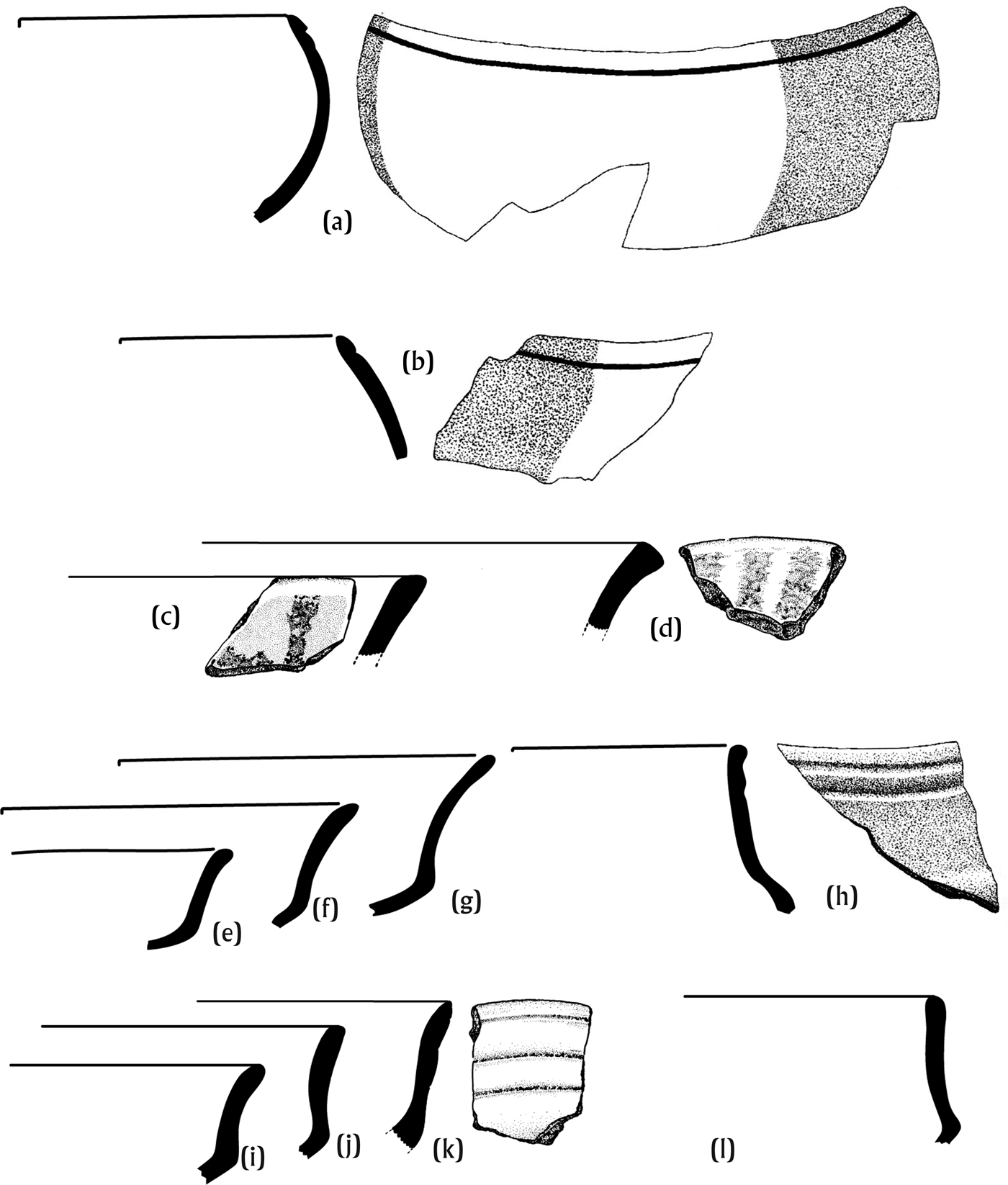
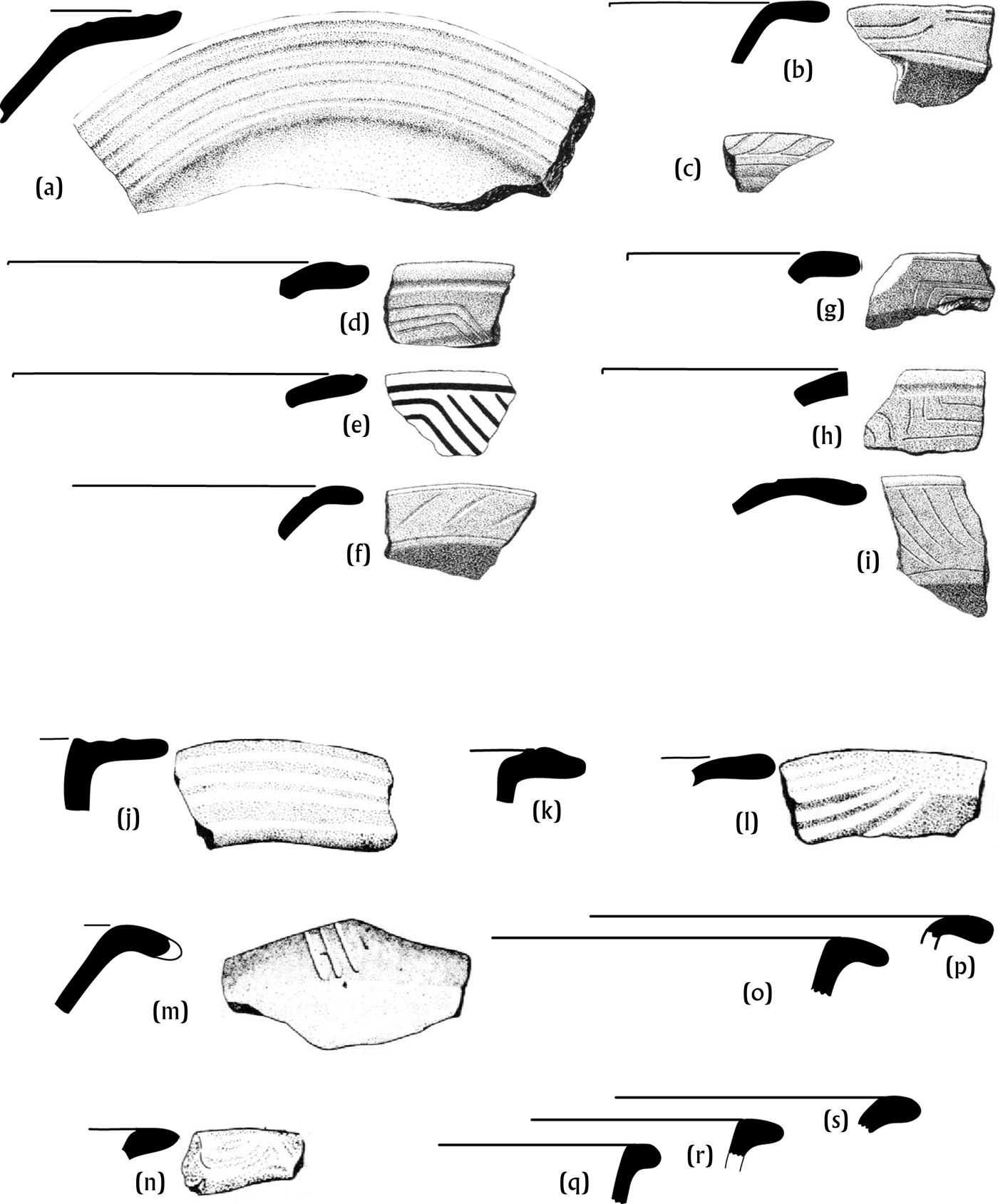
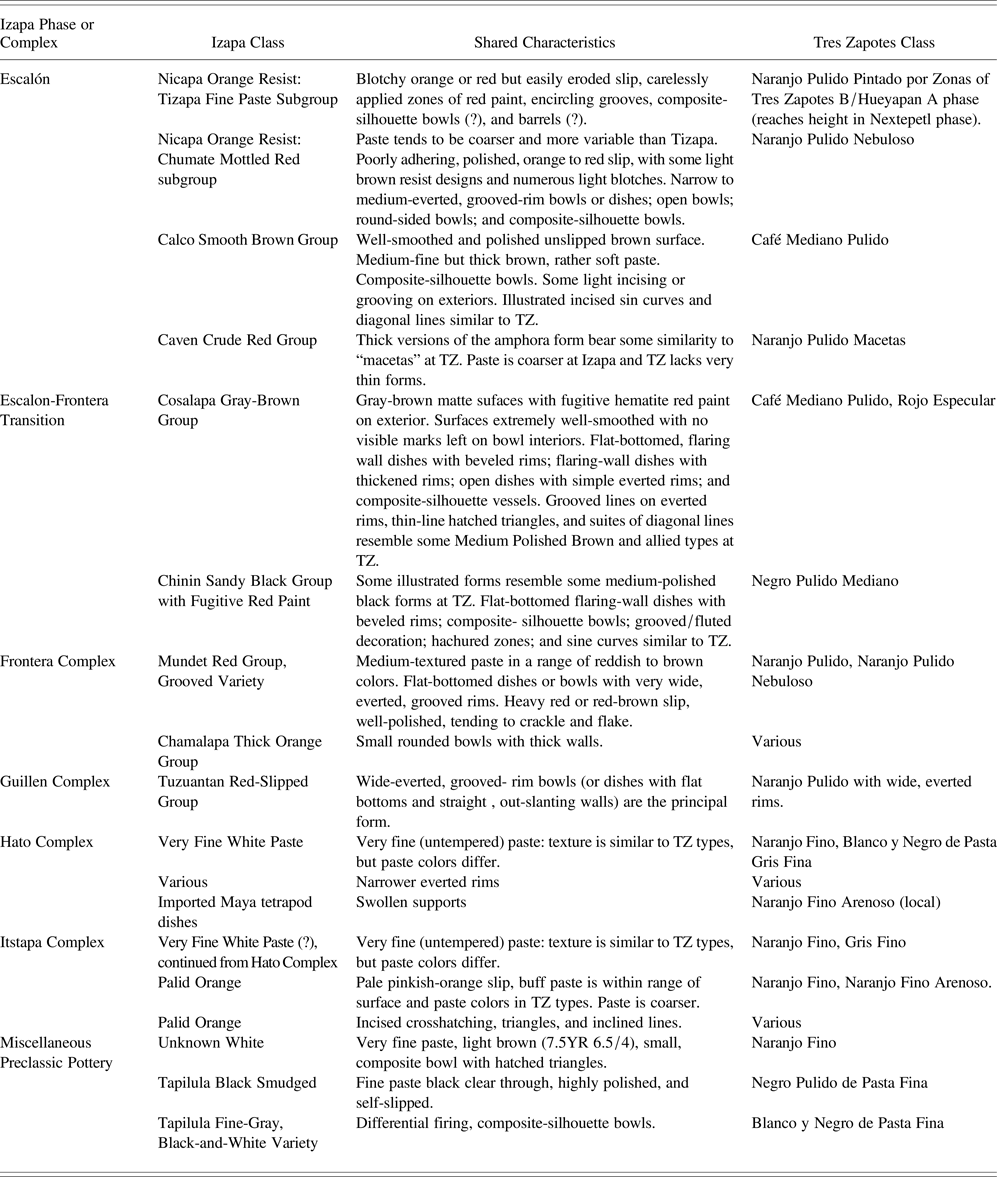
The Escalón phase at Izapa and the Tres Zapotes B phase both see the development of local versions of a widespread and long-lived tradition of polished red-orange wares with waxy (or soapy) slips that Lowe (Reference Lowe and Adams1977:222–223) identified as a key component of his Modified (or Terminal; Lowe Reference Lowe, Sharer and Grove1989:56–61) Olmec Horizon (see also Grove Reference Grove and Rice1993), and which he considered indicative of Mixe-Zoque ethnolinguistic identity. Labeled Nicapa Orange Resist at Izapa, the group corresponds with Naranjo Pulido of the Tres Zapotes B phase (Figure 2). Within the Nicapa group, the Tizapa Fine Paste subgroup corresponds to Naranjo Pulido Pintado por Zonas at Tres Zapotes and the Chumate Mottled Red subgroup corresponds to Naranjo Pulido Nebuloso. (To facilitate differentiation between Izapa/Soconusco pottery types and those of Tres Zapotes, we refer to the former by their English names and the latter by their Spanish names, many of which Ortiz (Reference Ortiz Ceballos1975) first described in Spanish.) Although Ortiz Ceballos (Reference Ortiz Ceballos1975:107) associated Naranjo Pulido and the Pintado por Zonas and Nebuloso subtypes most strongly with the Hueyapan A phase (400–200 b.c.), his stratigraphic charts show them to be distributed throughout the Middle and Late Formative sequence, an observation borne out by our own excavations (see below).
(a, b, e–h) Late Middle Formative pottery from Izapa and (c, d, i–l) Tres Zapotes. (a, b, e–h) Escalón-phase Nicapa Orange Resist, Tizapa Fine Paste subgroup. (c, d) Tres Zapotes B-phase Naranjo Pulido Pintado por Zonas. (i–j, l) Naranjo Pulido, variety unspecified. (k) Tres Zapotes B-phase Naranjo Pulido Nebuloso. (a, b, e–h) Redrawn from Lowe et al. Reference Lowe, Ekholm, Clark and Lee2013:Figure 8.

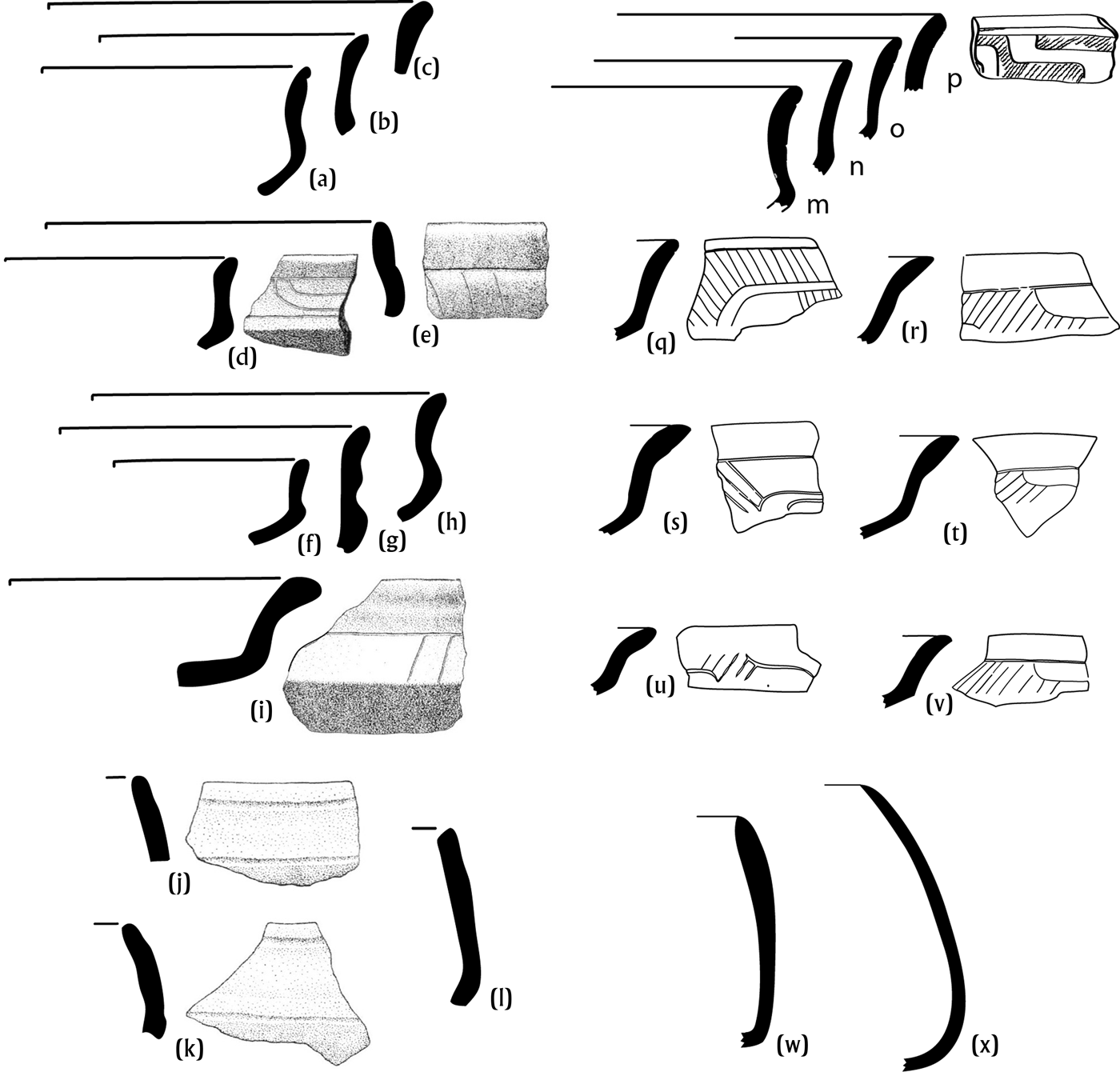
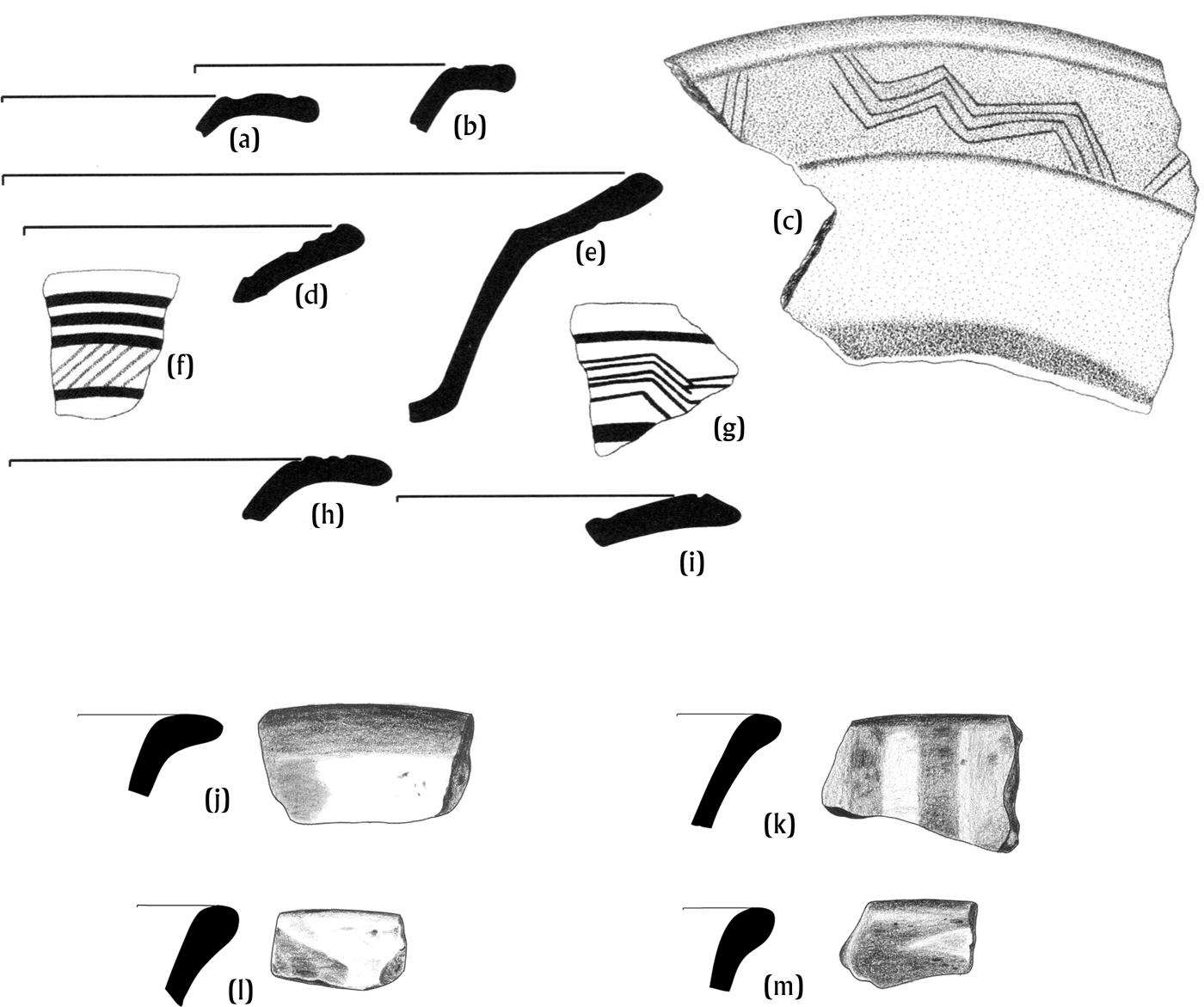
Another Escalón-phase ceramic group with close parallels at Tres Zapotes is Calco Smooth Brown, which corresponds very closely to Café Mediano Pulido, including its characteristic composite silhouette bowl form with diagonally hatched sine curves on the exterior (Figure 3; Lowe Reference Lowe, Sharer and Grove1989:57–59, Figure 4.9). The hatched sine-curve motif occurs on composite silhouette bowls across the southern Gulf lowlands, from Cerro de las Mesas in the Western Lower Papaloapan Basin (Drucker Reference Drucker1943b) through the Chontalpa in central Tabasco (Sisson Reference Sisson1976; von Nagy Reference von Nagy2003). The thicker examples of amphorae in the Craven Red Group at Izapa resemble the “macetas” form in an unpolished orange paste at Tres Zapotes, but the latter appears to be confined to the Hueyapan A and early Hueyapan B phases (ca. 400–100 b.c.).
Late Middle Formative pottery from (a–l) Izapa and (m–x) Tres Zapotes. (a–l) Escalón-phase Calco Smooth Brown. (m–x) Tres Zapotes B-phase Café Mediano Pulido. (q–x) Redrawn from Drucker Reference Drucker1943a:Figures 31 and 32.

In the Central Depression and western Chiapas, Tapilula Black and White shares forms and motifs, including the hachured sine curve, with differentially fired Blanco y Negro and Bayo y Negro at Tres Zapotes.
Stark (Reference Stark, Stark and Arnold1997:288–289) observes a reduction in the extent of ceramic style zones toward the end of the Middle Formative period and beginning of the Late Formative period as used here (Stark's “Late Preclassic” begins ca. 600 b.c.). One manifestation is a differentially fired black-and-red type seen in central Veracruz and Tehuantepec. Another is characterized by elaborated line-break designs, usually executed on the exterior of white pottery or the light (and sometimes white-slipped) areas of differentially fired pottery. Stark's review of published reports suggests the style zone extends in Veracruz from just north of the Sierra de Chiconquiaco at Santa Luisa to the Mixtequilla, but not as far as Tres Zapotes or the Tuxtla Mountains. She also identifies rare occurrences of similar motifs on orange- or black-slipped pottery along the Pacific lowlands of Guatemala and in the Guatemalan and Salvadoran highlands (Stark Reference Stark, Stark and Arnold1997:303, Table 10.1). Lowe et al. (Reference Lowe, Ekholm, Clark and Lee2013:Figure 15) illustrate two Etzunú White-on-Gray-Brown sherds with motifs that may qualify. Examples also occur on Chinín Sandy Black with Fugitive Red Paint (Lowe et al. Reference Lowe, Ekholm, Clark and Lee2013:Figure 19, Form 1, Figure 20, Form 4) of the Escalon-Frontera transition and Frontera-phase Mundet Red (Lowe et al. Reference Lowe, Ekholm, Clark and Lee2013:Figure 24a), though in the last case they are on the upper surface of widely everted rims.
Middle–Late Formative Transition (Escalón-Frontera and Late Tres Zapotes B, ca. 500 b.c.)
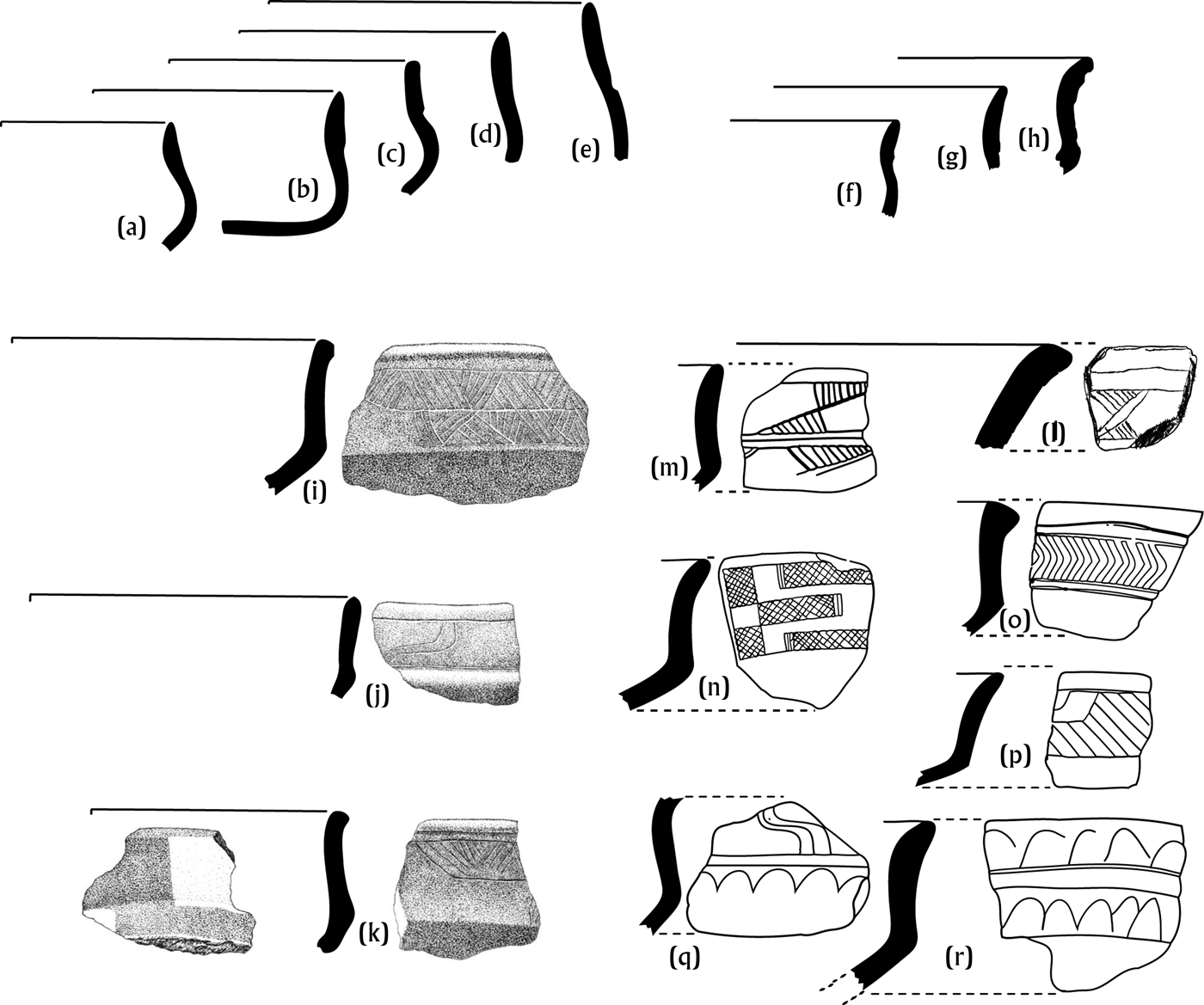
Of those ceramic groups identified by Lowe et al. (Reference Lowe, Ekholm, Clark and Lee2013) as transitional between the Escalón and Frontera phases, Cosalapa Gray-Brown with Fugitive Red Paint and Chinín Sandy Black with Fugitive Red Paint are most similar to types at Tres Zapotes. The Cosalapa Gray-Brown group finds its closest parallels in Café Mediano Pulido shallow bowls (plates) with composite silhouettes and rare enclosed tecomate-like forms (Figure 4). Shared decorative motifs include hatched triangles, sine curves and alternating hatched zones on the exterior of rims and upper bodies. A few Café Mediano Pulido sherds retain red pigment in their incisions.
Pottery of the Middle to Late Formative transition from (a–e, i–k) Izapa and (f–h, m–r) Tres Zapotes. (a–e) Escalón/Frontera-phase Chinín Sandy Black. (f–h) Late Tres Zapotes B-phase Negro y Bayo de Pasta Fina. (i–k) Escalón/Frontera-phase Cosalapa Gray-Brown. (m–r) Late Tres Zapotes B-phase Café Mediano Pulido Esgrafiado. (a–e) Redrawn from Lowe et al. Reference Lowe, Ekholm, Clark and Lee2013:Figure 20, (f–g) drawings by Pool, (i–k) from Lowe et al. Reference Lowe, Ekholm, Clark and Lee2013:Figure 18, and (m–r) from Drucker Reference Drucker1943a:Figure 22.

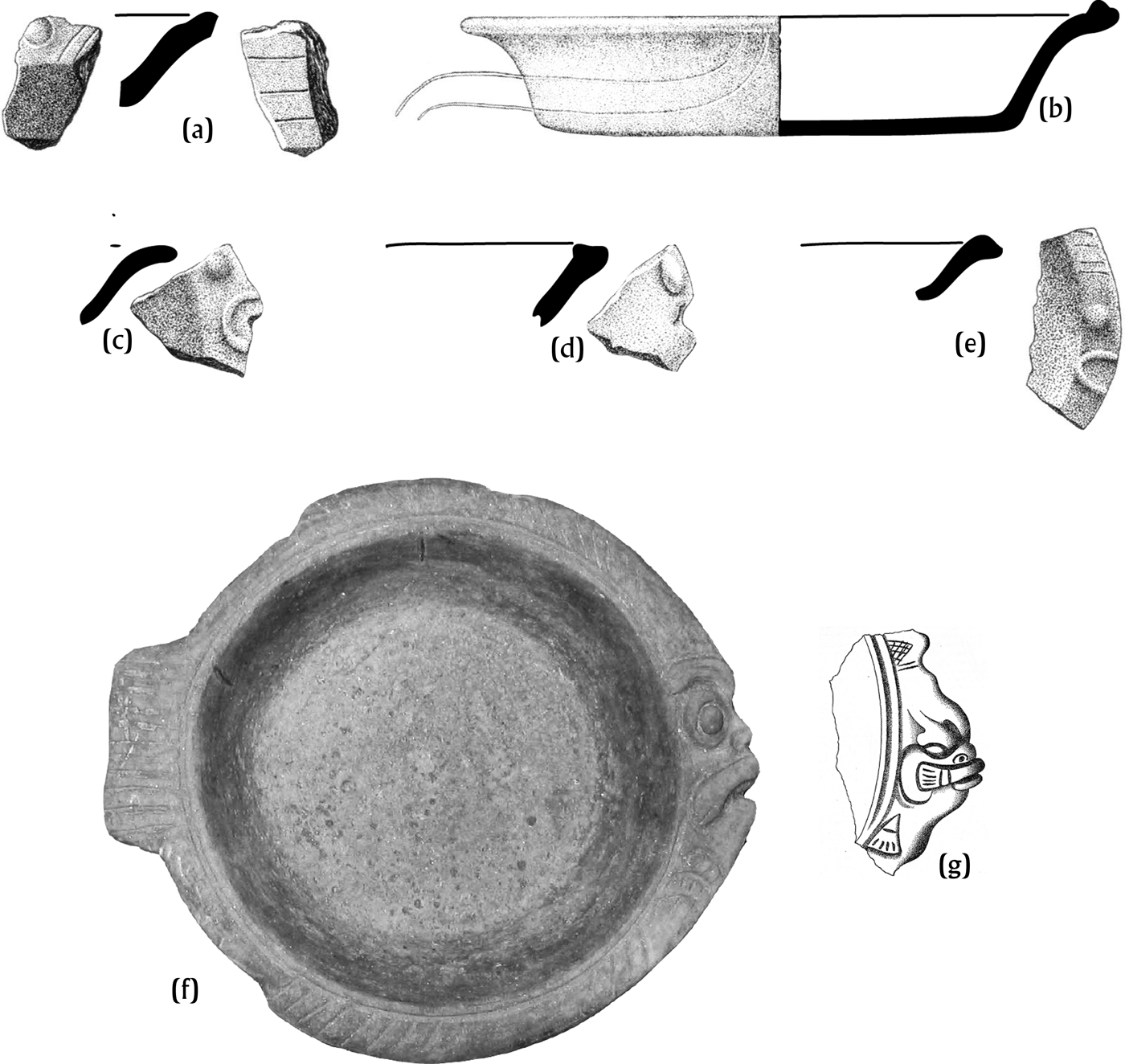
Chinín Sandy Black is most similar to Negro Pulido Mediano at Tres Zapotes, sharing composite silhouette bowls, flaring-walled dishes with beveled rims (although bases are slightly concave at Tres Zapotes), grooved or fluted decoration, hachured zones, and sine curves, similar forms also occur in differentially fired Bayo y Negro at Tres Zapotes (Figure 4). A Negro Pulido Mediano plate of the Tres Zapotes B phase has a modeled fish head and rim that recalls Chinín Sandy Black examples (Lowe et al. Reference Lowe, Ekholm, Clark and Lee2013:Figure 21a), but is less abstractly modeled and somewhat anthropomorphic (Figure 5). Negro Pulido Mediano at Tres Zapotes is distinguished by medium-grained quartz temper, rather than the pumice of the Chinín Sandy Black. At Tres Zapotes, red pigment appears within the incisions of Negro Pulido de Pasta Fina but has not been identified in the medium-paste version. The paste that defines Negro Pulido Mediano has a long history at Tres Zapotes, beginning in the Arroyo phase, but the composite silhouette form, the hatched zones and triangles, and the sine curves appear confined to the late Middle Formative and early Late Formative in this type.
Pottery of the Middle to Late Formative transition with modeled fish heads and fins from (a–e) Izapa and (f–g) Tres Zapotes. (a–e) Escalón/Frontera-phase Chinín Sandy Black. (f–g) Late Tres Zapotes B-phase Negro Pulido Mediano. (a--e) Redrawn from Lowe et al. Reference Lowe, Ekholm, Clark and Lee2013:Figure 21, (g) from Drucker Reference Drucker1943a:Figure 33.

Beginning later in Stark's Pozas phase (700–400 b.c.) than the elaborated line breaks, and ending by about 100 b.c., very thin-lined “minute incision” characterizes a style zone that extends through central Veracruz from Las Higueras to Tres Zapotes. Motif elements executed with minute incision include hachured-and-fringed triangles, fringed lines, clumped herringbones and chevrons, “abacus” ticks (offset groups of ticked lines in registers), slanted bands or lines with hachured triangles on either side, and entwined boxes (both plain and hachured). Other motifs executed in minute incision within this region also occur (typically in thin, but not minute, incision) at sites in Central Mexico and extending southeastward across the Isthmus and Chiapas highlands through the Pacific lowlands and Guatemalan highlands through to western El Salvador. This broader set of motifs includes abacus-like sets of vertical lines in a band, herringbones or chevrons, hachured or cross-hachured triangles arranged point-to-point (often sharing a diagonal line), and hachured step or step-on-hachured background. Stark's step category appears to include curvilinear sine curves as well as more rectilinear steps, the latter being more common in the Mixtequilla. In the Mixtequilla, the minute-incision motifs occur on a variety of pastes and surface finishes, including differentially fired, black, mottled streaky-brown, orange-slipped, and unslipped vessels (Stark Reference Stark2001:112).
Early Late Formative (Frontera and Hueyapan A)
The Frontera phase at Izapa and equivalent phases throughout Chiapas are marked by the appearance and ubiquity of Mundet Red, which evidently developed out of Nicapa Orange Resist of the preceding Late Middle Formative phases (Clark and Cheetham Reference Clark, Cheetham, Carrión and Cook2005:389–391, 395, 397). The typological and chronological equivalents at Tres Zapotes are Narjanjo Pulido Sencillo and Naranjo Pulido Nebuloso in their late Tres Zapotes B and Hueyapan A occurrences (Figure 6). The strongest resemblances are in the grooved variety of Mundet Red, which consists of flat-bottomed dishes or bowls with very wide everted rims, usually sporting parallel grooves on the upper surface of the rim. Rarely, incised designs, including “fish fin” diagonal lines and frets occur in both sets (see Lowe et al. Reference Lowe, Ekholm, Clark and Lee2013:Figure 24a; Ortiz Ceballos Reference Ortiz Ceballos1975:Figures 38–49). The Naranjo Pulido Nebuloso type at Tres Zapotes has a thick slip that exhibits the crackling and blotchy, light-brown zones described for some Mundet Red examples (Lowe et al. Reference Lowe, Ekholm, Clark and Lee2013:45).
Early Late Formative pottery from (a–i) Izapa and (j–s) Tres Zapotes. (a–i) Frontera-phase Nicapa Orange Resist. (j–s) Tres Zapotes B/Hueyapan A-phase Naranjo Pulido. (a–i) Redrawn from Lowe et al. Reference Lowe, Ekholm, Clark and Lee2013:Figure 24a, (j–n) redrawn from Lowe Reference Lowe, Sharer and Grove1989:Figure 4.7.

In our excavations at Tres Zapotes, unpolished “maceta” forms appear in the same paste as Naranjo Pulido at the beginning of the Hueyapan A phase and continue into the Hueyapan B phase (cf. Ortiz Ceballos Reference Ortiz Ceballos1975:106). As noted above, some amphora forms of the earlier Craven Red Group are similar, but generally with thinner walls. These low-necked or neckless jars are both larger and of narrower proportions than the small jars of the Frontera-phase Chamalapa Thick Orange group or the Guillén-phase Copachi Crude Thick-Walled group.
“Miscellaneous Formative Pottery”
Lowe et al. (Reference Lowe, Ekholm, Clark and Lee2013:61–67) describe a small number of unusual sherds from Izapa that they identify as possible imports from the Gulf Coast and which are thought to date to the Escalón and Frontera phases. The Tapilula Black Smudged type is clearly related to Negro Pulido de Pasta Fina, which has a long history in southern Veracruz, becoming increasingly frequent in the Protoclassic period at Tres Zapotes (Ortiz Ceballos Reference Ortiz Ceballos1975). Tapilula Fine-Gray, Black-and-White variety is similar to Blanco y Negro de Pasta Fina at Tres Zapotes, which occurs in the composite silhouette bowl form illustrated by Lowe et al. (Reference Lowe, Ekholm, Clark and Lee2013:Figure 31i) during the Tres Zapotes B phase, coeval with the Late Escalón and early Frontera phases.
Late Late Formative (Guillén and Hueyapan B)
The Guillén phase (300–100 b.c.) marks the apogee of mound construction and monument carving at Izapa (Clark and Lowe Reference Clark, Lowe, Lowe, Ekholm, Clark and Lee2013:78), and the presence of a handful of monuments with Izapan-style elements at Tres Zapotes points to contacts between the sites at that time (see below). In most respects, though, ceramics of the Guillén phase are notably dissimilar to the Hueyapan B phase (200–1 b.c.) at Tres Zapotes, with which it overlaps (or is coeval under Inomata et al.’s [Reference Inomata, Ortiz, Arroyo and Robinson2014] proposed chronology; Figure 1). As Lowe et al. (Reference Lowe, Lee and Espinosa1982:135) noted, the strongest similarities are in the wide-everted, grooved-rim bowls that occur in the Tuzuantan Red-slipped group at Izapa and in Naranjo Pulido at Tres Zapotes (Figure 7). Fish effigy modeling, which becomes quite elaborated at Izapa, disappears by the Hueyapan phase at Tres Zapotes.
Late Late Formative pottery from (a–i) Izapa and (j–m) Tres Zapotes. (a–i) Guillén-phase Tuzuantun Red-Slipped. (j–m) Hueyapan B-phase Naranjo Pulido Pintado por Zonas. (a–i) Redrawn from Lowe et al. Reference Lowe, Ekholm, Clark and Lee2013:Figure 27-18, (j) from Ortiz Reference Ortiz Ceballos1975:Figure 58, and (k–m) from Ortiz Reference Ortiz Ceballos1975:Figure 59.

Terminal Formative or Protoclassic (Hato/Itstapa and Nextepetl/Bezuapan Phases, ca. 100 b.c.–a.d. 300)
Period designations for the span of 100 b.c. to a.d. 300 are particularly inconsistent in the Gulf lowlands, with different scholars beginning the Classic period anywhere from a.d. 100 to 300 and using the terms Terminal Formative (e.g., Pool Reference Pool2006; Pool and Britt Reference Pool and Mudd Britt2000; Santley Reference Santley2007), Protoclassic (e.g., Coe Reference Coe and Wauchope1965a; Ortiz Ceballos Reference Ortiz Ceballos1975), and early Early Classic (e.g., Santley and Arnold Reference Santley and Arnold1996). Here, we follow the older precedent in referring to the time span of the Nextepetl phase at Tres Zapotes (Ortiz Ceballos Reference Ortiz Ceballos1975) and the Late Bezuapan phase in the Sierra de los Tuxtlas (Pool and Britt Reference Pool and Mudd Britt2000), both recently re-dated to a.d. 1–300 (Pool Reference Pool, Arnold and Pool2008:127; Pool et al. Reference Pool and Ceballos2016), as the Protoclassic period in southern Veracruz.
The Terminal Formative Hato (100 b.c.–a.d. 100) and Itstapa (a.d. 100–250) phases of Soconusco and Izapa overlap substantially with the Protoclassic Nextepetl and Late Bezuapan phases. The Nextepetl phase can be further subdivided into Nextepetl A (ca. a.d. 1–150) and Nextepetl B (ca. a.d. 150–300) facets (Ortiz Ceballos Reference Ortiz Ceballos1975; Pool et al. Reference Pool and Ceballos2016). Inomata et al.'s (Reference Inomata, Ortiz, Arroyo and Robinson2014) proposed chronological revision would align the Hato phase more precisely with the Nextepetl and Late Bezuapan phases, but would do little to change our evaluation of ceramic interactions across the isthmus in this time frame.
The Terminal Formative or Protoclassic saw significant innovations, both in Soconusco and in southern Veracruz. The most striking technological parallel between the two regions was the development of untempered or very finely tempered wares (Mendelsohn Reference Mendelsohn2016; Pool and Britt Reference Pool and Mudd Britt2000), but specific paste characteristics and surface treatments are strikingly different. In other respects, too, ceramic traditions in the two regions continue to diverge.
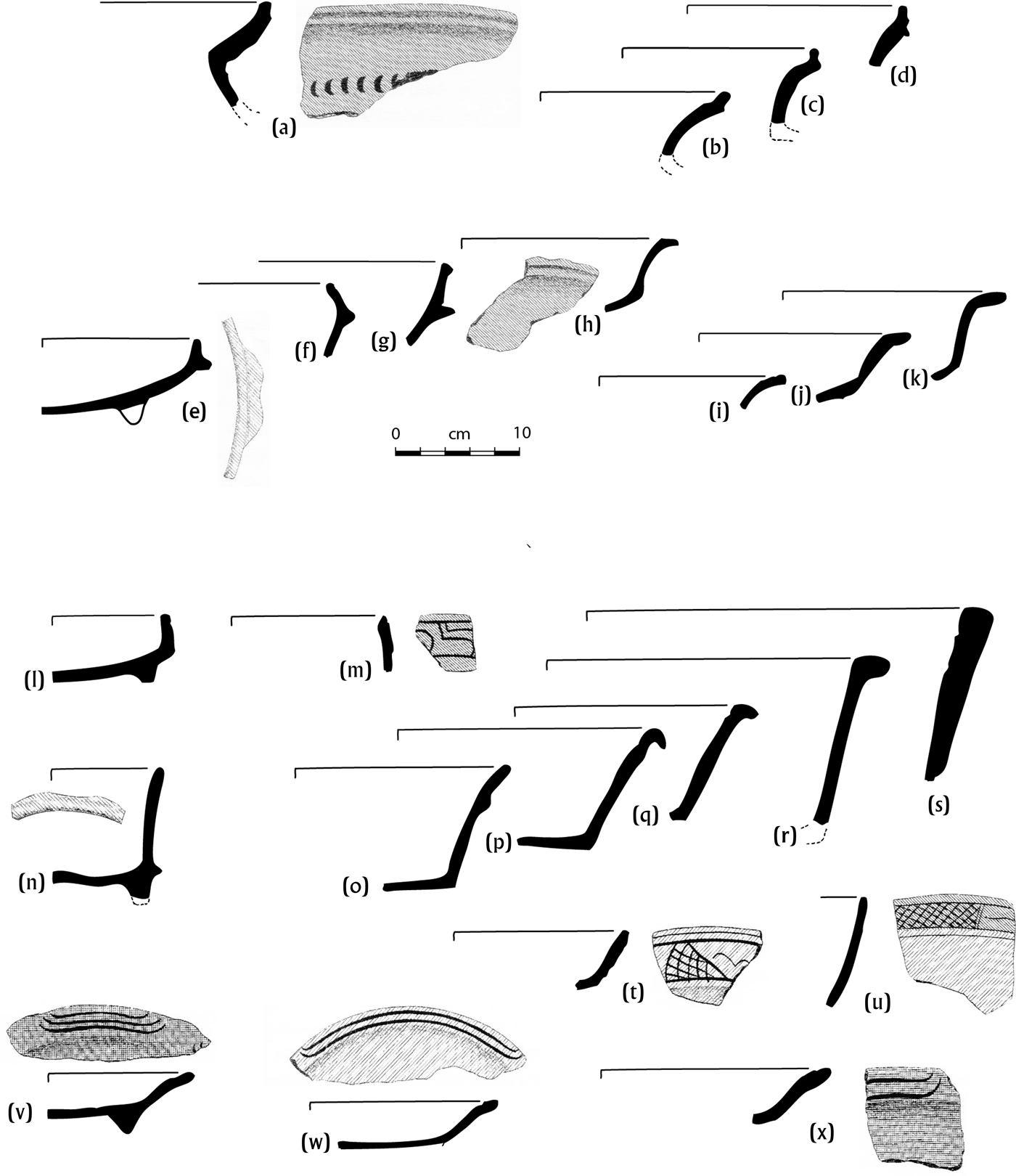
The initial definition of the Hato phase was based on the specialized ceremonial associations with urn burials in Izapa Mound 30d (Lowe et al. Reference Lowe, Lee and Espinosa1982: 135). Clark and Cheetham (Reference Clark, Cheetham, Carrión and Cook2005:411–414) augmented Lowe's description with survey materials from the Mazatán area, but acknowledged that ceramics from the phase remained poorly defined, particularly with respect to utilitarian wares (Clark and Cheetham Reference Clark, Cheetham, Carrión and Cook2005:411, fn. 9). Mendelsohn's (Reference Mendelsohn2016) description of Hato pottery from recent excavations at Izapa adds substantively to knowledge of the phase. Hato-phase additions to the ceramic repertoire include lustrous orange-red and red-on-orange pottery (typically with a red-painted band on the rim). Pale Orange pottery (Naranjo Pálido) with a medium-textured gray paste fired to a light brown near the surface and covered with a thin pinkish-orange or light-red (2.5YR 5/8) slip also makes its appearance (Figure 8; Clark and Cheetham Reference Clark, Cheetham, Carrión and Cook2005:412–413). Usulutan pottery with negative resist designs on the same paste as Red-on-Orange is present, but scarce. New ceramic modes include small “button” and solid conical (nubbin) tripod supports and small, bilobed “fins” (aletas) on everted rims. The wide everted rims of the Guillén phase are replaced by narrower everted lips and bolstered rims.
Selected Postclassic pottery of the (a–k) Hato and (l–x) Itstapa phases of Izapa and Soconusco. Hato-phase (a–d, f–h) Red-Orange, (e) Pale Orange, and (i–k) Orange on Red. Itstapa-phase (l) Unslipped Buff, (m, s) Red-Orange, (n, u) Red-Orange on Buff, (o, p, r, t) Palid Orange, and (q, v–x) Pale Orange “Tiznado.” (a–k) After Clark and Cheetham Reference Clark, Cheetham, Carrión and Cook2005:Figure 68, (l–x) after Clark and Cheetham Reference Clark, Cheetham, Carrión and Cook2005:Figure 72.

Clark and Cheetham (Reference Clark, Cheetham, Carrión and Cook2005:421) describe the subsequent Itstapa phase as having “very small” changes from the Hato phase, with continuation of the Pale Orange ware, small conical supports, reddish orange slips, Usulutan resist decoration, and red-on-orange and red-on-buff bichromes. Mendelsohn (Reference Mendelsohn2016) observes a characteristic groove or dip along the interior lip of Itstapa-phase Pale Orange vessels. Additions to the ceramic repertoire include smudged (tiznado) versions of Pale Orange vessels and post-firing incised designs, including the by-then archaistic double- and triple-line break (Clark and Cheetham Reference Clark, Cheetham, Carrión and Cook2005:421–424). Mendelsohn (Reference Mendelsohn2016) also notes thick incised or excised geometric designs on Pale Orange vessels.
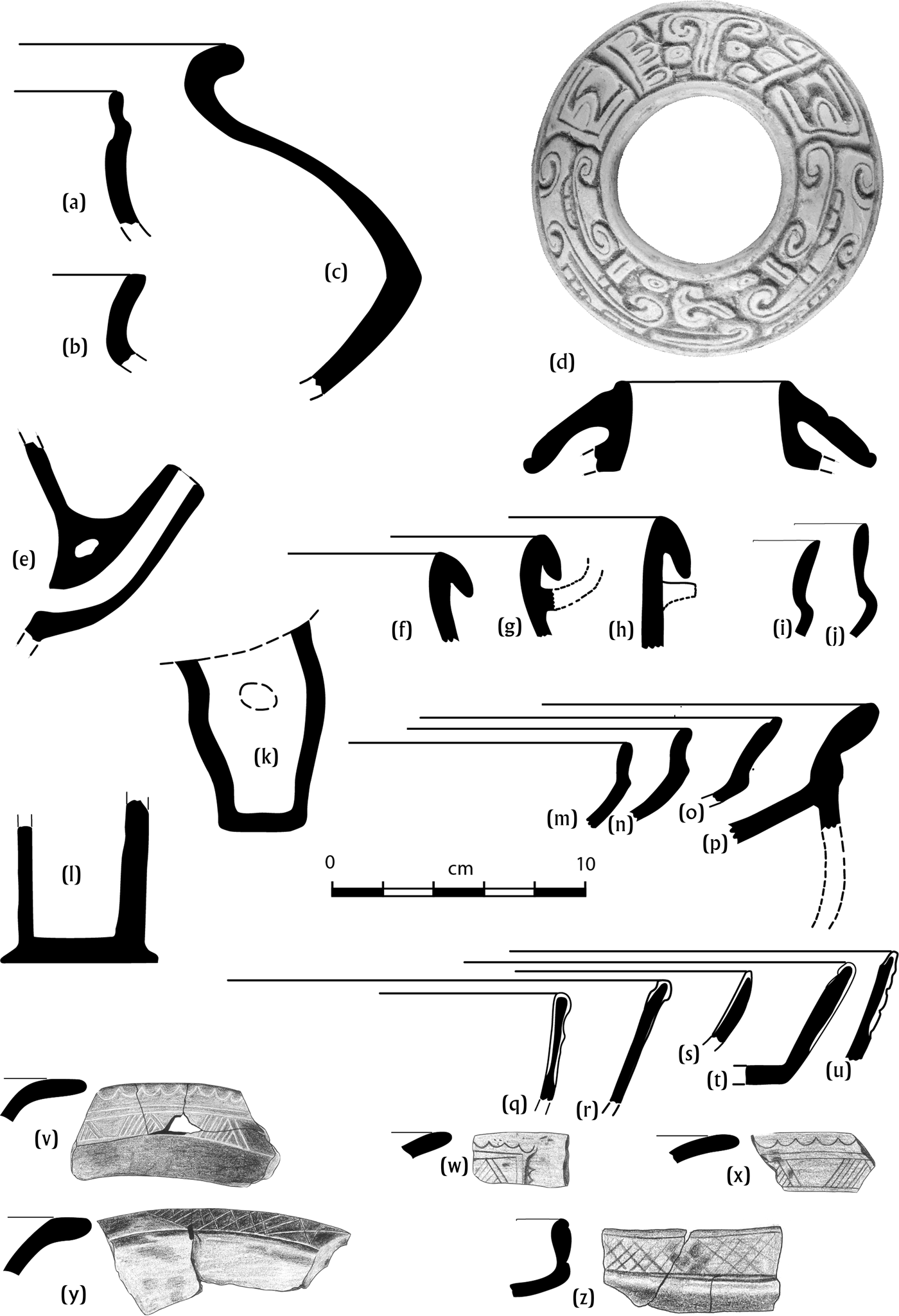
In southern Veracruz, the coeval Nextepetl, Chininita, and Bezuapan phases (a.d. 1–300) were characterized by a trend toward service wares with finer pastes and increasing popularity of orange and buff pastes. (Figure 9; Ortiz Ceballos Reference Ortiz Ceballos1975:118–135, Gráficas 1 and 5; Pool and Britt Reference Pool and Mudd Britt2000:146–150, Figures 9 and 11). Black and differentially fired types persist, but fine-paste variants are increasingly popular. At Tres Zapotes, Ortiz Ceballos (Reference Ortiz Ceballos1975:118–128) described the Nextepetl A phase (which we now date to a.d. 1–150) as characterized by his types Café Rojizo Pulido (with fine quartz temper), Negro Pulido de Pasta Fina, a gray-paste variety of Blanco y Negro de Pasta Fina, and white-rimmed bowls of Imitación Blanco y Negro de Pasta Fina. Typical serving forms in these types include cylindrical vessels, composite silhouette vessels, plates with straight divergent or concave walls and flat bottoms, and small jars. Nubbin or small solid conical supports occur, but rarely. Geometric incised designs were incised both pre- and post-firing, but post-fired incision is not a new trait, as it seems to be in the Itstapa phase (Clark and Cheetham Reference Clark, Cheetham, Carrión and Cook2005:421). The Rastreado type of utilitarian jars with brushed shoulders continued to be the dominant utilitarian type, as it was throughout the Formative sequence, but increased in popularity as the maceta form of Naranjo Pulido declined (Ortiz Ceballos Reference Ortiz Ceballos1975:125, Gráfica 1).
Postclassic Nextepetl-phase pottery from Tres Zapotes. (a–c) Café Burdo Rastreado, (d–h, k–l) Naranjo Fino Arenoso, (i–j) Naranjo Fino, (j, m–o, z) Negro Pulido de Pasta Fina, (q) Blanco y Negro de Pasta Fina, (r–u) Bayo y Negro de pasta fina, and (v–y) Café Rojizo Pulido. (v–y) After Ortiz Reference Ortiz Ceballos1975:Figure 62, (z) after Ortiz Reference Ortiz Ceballos1975:Figure 64.

As described by Ortiz Ceballos (Reference Ortiz Ceballos1975:128–132) the Nextepetl B phase (now dated a.d. 150–300) is characterized by the appearance of scarce Gris Fino flat-bottomed plates, cylindrical vessels, and ollas and elevated frequencies of Naranjo Fino flat-bottomed sub-globular bowls, flat-bottomed dishes with divergent straight or curved walls thickening toward the rim, composite-silhouette vessels, and small globular jars. Small globular jars of red-painted Naranjo Rojizo con Desgrasante de Cuarzo, and bichrome curved-wall plates in Café Rojizo with red-slipped exterior lapping over to an interior rim band and a white-painted interior round out the Nextepetl B assemblage described by Ortiz.
Untempered Fine Orange pottery made its initial appearance at Tres Zapotes as early as the Hueyapan B phase, but became increasingly common through the Nextepetl sequence (Ortiz Ceballos Reference Ortiz Ceballos1975:175, Gráfica 5), as it and the closely related Fine Buff (Bayo Fino) did in the Chininita and Late Bezuapan phases of the southwestern and central Tuxtlas, respectively (Pool and Britt Reference Pool and Mudd Britt2000:146–150, Figures 9–11). Whereas the Terminal Formative, very fine pastes of Izapa are white with a dark core and orange slip (Mendelshon Reference Mendelsohn2016), those of the Gulf Coast occur principally in orange and buff colors, with some gray examples, and rarely have a dark core. Slips, when they occur on untempered Protoclassic vessels are white, rather than orange. There is some intraregional and temporal variation in the texture of untempered vessels in southern Veracruz due to selection of clays from differentially exposed members in the upwardly coarsening Concecpción source formation (Pool and Santley Reference Pool, Santley, Bey and Pool1992; Stoner et al. Reference Stoner, Pool, Neff and Glascock2008). Specifically, untempered pastes tend to have more naturally occurring, very fine quartz sand inclusions in the Tres Zapotes region through the Protoclassic and Classic periods, but appear to be confined to the Protoclassic in the central Tuxtlas. Although texture was the key defining characteristic for the Sandy Fine Orange (Naranjo Fino Arenoso) type first defined for the Late Bezuapan phase at Bezuapan (Pool and Britt Reference Pool and Mudd Britt2000), the light paste color and typical Protoclassic forms are more diagnostic of the type in the Tres Zapotes region. Particularly characteristic are hollow swollen “mammiform” supports, hollow cylindrical supports, strongly everted rims on small-necked jars, and specific composite silhouettes in plates. Aside from broad similarities in the composite silhouettes, though, the characteristic traits do not closely match locally made examples from Izapa and Soconusco. Pool and Britt (Reference Pool and Mudd Britt2000) attribute the increasing popularity of very fine pastes in the central Tuxtlas to the development of true updraft kilns for better control over firing schedules, but excavation of Sandy Fine Orange vessels in association with firing pits suggests their more open texture did not require the same degree of control.
The Hato and Itstapa phases of Soconusco share with the Nextepetl A and B phases of Tres Zapotes and their equivalents in the Tuxtla Mountains the adoption of very fine pastes for some serving vessels, some aspects of vessel form, and some incised decorative motifs. In general, however, the Protoclassic assemblages on either side of the Isthmus continue the divergence seen in the late Late Formative period. Nubbin and conical supports, common in Soconusco, are rare in southern Veracruz at this time. Swollen supports occur on locally made vessels at Tres Zapotes and imported vessels in ritual offerings at Izapa, but the link seems to be one of common origin in the Maya lowlands. Fine paste wares in the two regions are strikingly different in paste color and surface treatment. The tradition of differential firing continues with application to increasingly fine pastes in southern Veracruz, as does the manufacture of Rastreado jars with brushed shoulders. None of these have strong parallels in the Izapan sequence during the Hato and Itstapa phases, so far as we can tell from published descriptions.
Summary
Overall, the ceramics of Tres Zapotes and Izapa (and more generally of the hinterlands of both polities), reflect the participation of their potters and their consumers of pottery in broad, overlapping constellations of practice of southeastern Mesoamerica during the late Middle through Terminal Formative periods. During the late Middle Formative period, those commonalities encompass at least two modes of surface treatment and several forms and decorative modes, combined in closely related ceramic categories. By the Guillén and Hueyapan B phases, which represent the apogees of both sites, shared analogues were few but with a strong parallel in wide-everted grooved rim bowls with a waxy red-to-orange slip. Both regions exhibit the adoption of fine-paste wares in the Terminal Formative/Protoclassic period, but in general shared attributes of paste, form, and surface treatment do not cohere at a typological level between the two regions.
SCULPTURAL TIES
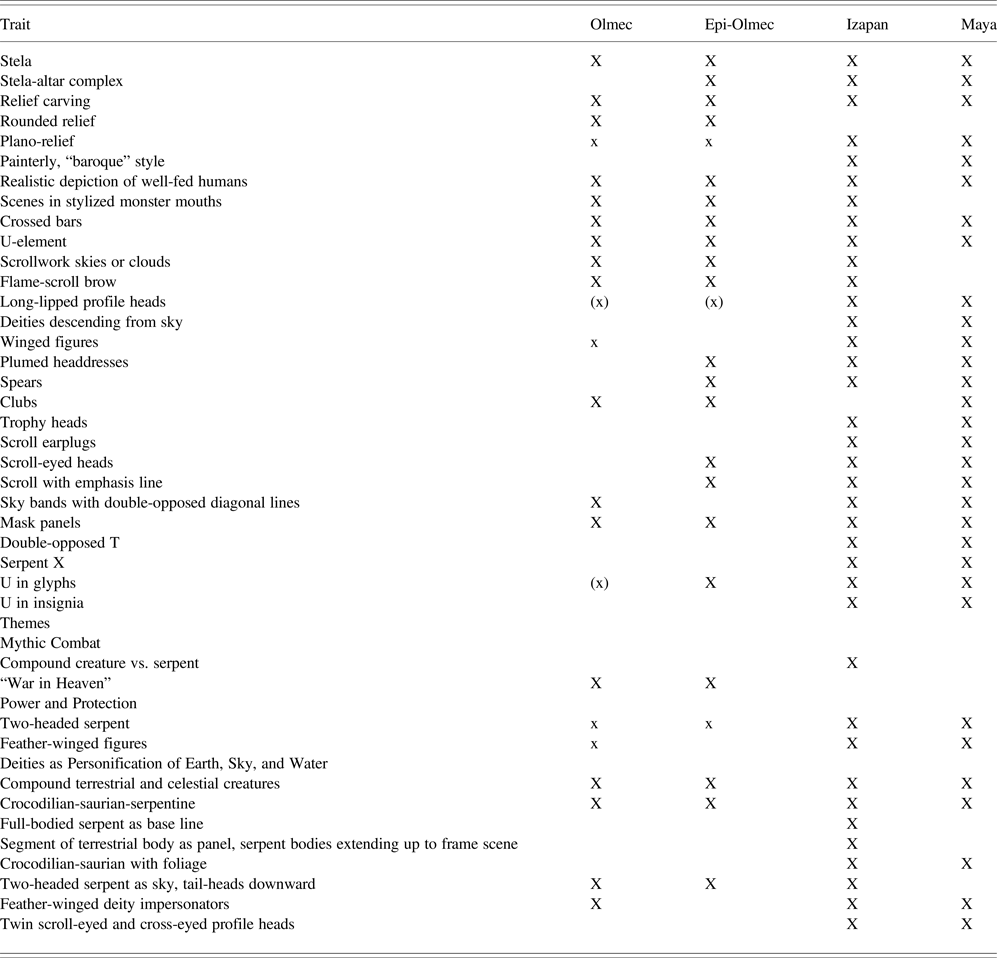
Sculptural styles of the Lower Papaloapan Basin (LPB) tell a rather different story from ceramics regarding ties with the Pacific piedmont. During the Late Formative Hueyapan phase and the Protoclassic Nextepetl phase, several monuments in the LPB show a clear incorporation of Izapa elements into local Olmec-derived styles. An overlapping set of stylistic traits is shared between Izapa and contemporaneous highland Maya sculptures (Table 2; Quirarte Reference Quirarte1973).
Correspondences between Izapa and Tres Zapotes (TZ) ceramic types (data compiled from Clark and Cheetham Reference Clark, Cheetham, Carrión and Cook2005; Lowe Reference Lowe, Sharer and Grove1989; Lowe et al. Reference Lowe, Ekholm, Clark and Lee2013; Mendelsohn Reference Mendelsohn2016; Ortiz Ceballos Reference Ortiz Ceballos1975; Pool and Ortiz Ceballos Reference Pool and Ceballos2016).

Representation of stylistic traits in southeastern Mesoamerican sculptural traditions (Coe Reference Coe and Wauchope1965b; Norman Reference Norman1976; Quirarte Reference Quirarte1973, Reference Quirarte and Adams1977; see also Smith Reference Smith1984). Modified after Pool Reference Pool2007:Table 7.1. X, present; x, rare; (x) ambiguous.

With one exception, however, all the sculptures with specifically Izapa traits come from outside Tres Zapotes proper. Distinctively Izapa elements may have been incorporated in LPB sculpture as early as the Francesa phase, and likely intensified during the Guillén phase. They also demonstrably persisted into the Protoclassic, long after Izapa's population and sculptural traditions were in decline (see Quirarte Reference Quirarte, Lowe and Pye2007 and discussion below. Note that we use “Izapa” as an adjective for stylistic traits represented at Izapa and “Izapan” when necessary to refer to the broader set of Late Preclassic sculpture to which that term has been applied).
Izapa Sculptural Ties at Tres Zapotes
Discussion of Late Formative sculpture at Tres Zapotes has tended to focus either on Stela C and its 32 b.c. Long Count date (e.g., Morley Reference Morley1946; Stirling Reference Stirling1939, Reference Stirling1940; Thompson Reference Thompson1941) or on the presence or absence of Izapan traits on a handful of monuments (e.g., Coe Reference Coe and Wauchope1965b; Norman Reference Norman1976:293–296), leading to misperceptions such as Rice's (Reference Rice2007:103) comment that “most of its monuments are carved in the Late Preclassic style of Izapa.” To the contrary, Tres Zapotes's Late Preclassic and Protoclassic corpus of some 40 monuments is an eclectic set of full-round sculputres, tenoned busts, carved stelae, plain stelae, boxes, and basins, only three or four of which enter into discussions of Izapan style (Pool Reference Pool, Clark, Guernsey and Arroyo2010).
Let us first dispense with Tres Zapotes Stela A (Figure 10). Working from Edwin Cassady's truly awful drawing in Stirling's (Reference Stirling1943:Figure 3) report, Coe (Reference Coe and Wauchope1965b:773) wrote: “The monument [Stela A] is badly weathered, but the scene is not Olmec. The two flanking figures carry a knife and a severed head, respectively; head-taking is an Izapan trait.” As Moreno's recent drawing more accurately depicts, however, the scene falls well within Olmec canons, the flanking figures carry something, but it's not clear if they carry a knife or a baton, and neither carries a severed head.
Tres Zapotes Stela A. Drawing by Ayax Moreno, courtesy of the New World Archaeological Foundation.

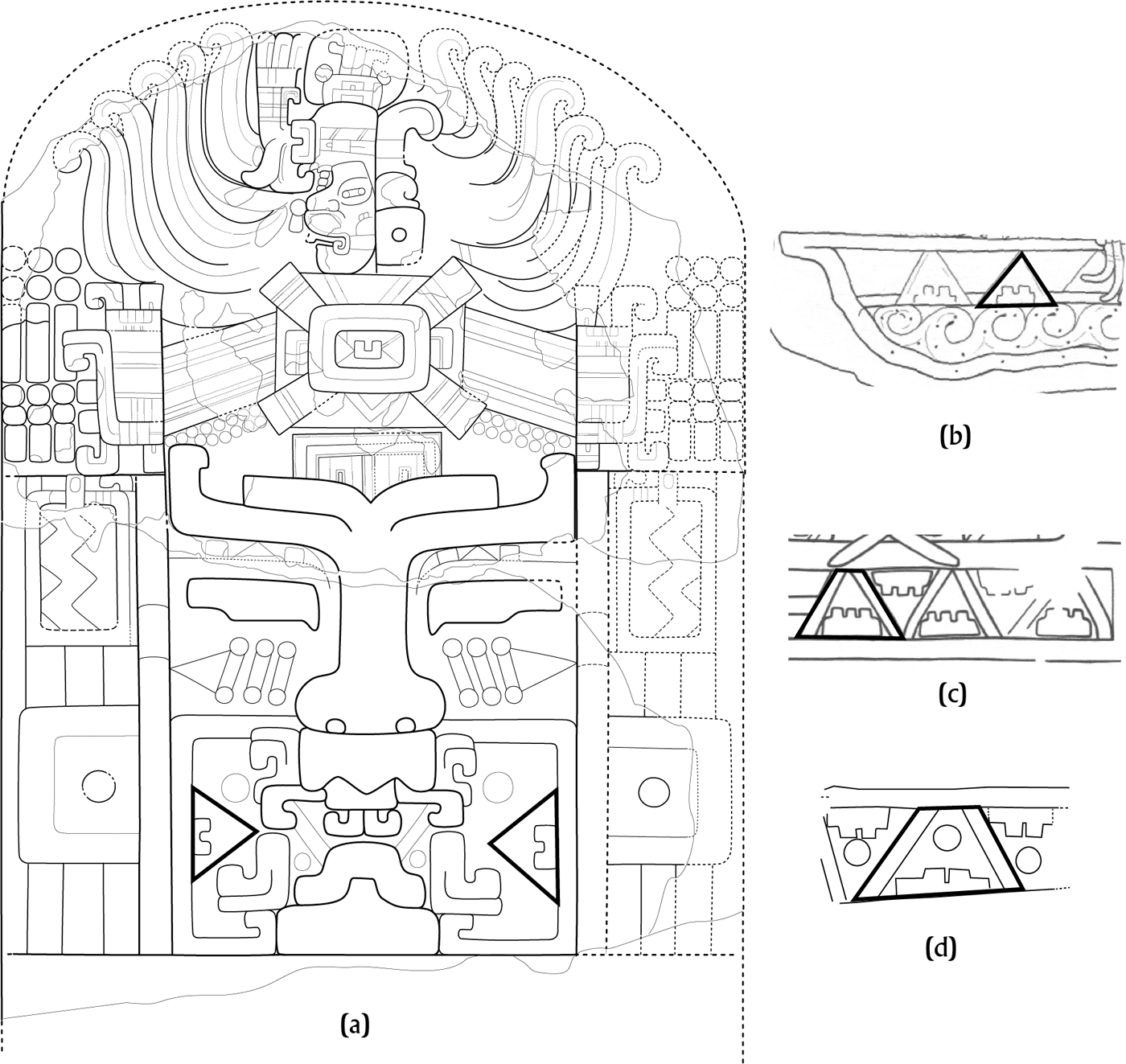
Due to its 32 b.c. inscribed date, Stela C is sometimes noted in passing in discussions of Izapan art. With their offset dots and infixed double merlons, Quirarte (Reference Quirarte, Lowe and Pye2007:265) relates the triangular shapes in the cheeks of the earth monster mask with basal motifs on Izapa Stelae 5 and 12 and the Alvarado stela (Figure 11). The origin of the double merlon lies well back in Middle Formative art, however, including some Gulf Olmec examples, and earth bands with triangular shapes flanked by dots appear at least as early as the Late Middle Formative period in the sunken patio at Chalcatzingo.
Triangles with infixed double merlons: (a) Tres Zapotes Stela C (obverse); (b) Izapa Stela 5 basal band; (c) Izapa Stela 12 basal band; and (d) Alvarado stela basal band. (a) Base drawing by Ayax Moreno, courtesy New World Archaeology Foundation; (b) modified from Clark and Moreno Reference Clark, Moreno, Lowe, Pye and Lowe2007:Figure 13.7; (c) modified from Clark and Moreno Reference Clark, Moreno, Lowe, Pye and Lowe2007:Figure 13.8; and (d) drawing by Pool after a photograph by Perez de Lara and Justeson Reference Perez de Lara and Justeson2006:4.

More interestingly, Stela C has a complex biography, based on differential weathering of the obverse and reverse, its orientation and associations at the time of its discovery, stylistic considerations, and radiocarbon dating of the preparation of the plaza in which it was found (Pool Reference Pool, Clark, Guernsey and Arroyo2010). In our reconstruction of events, the obverse of Stela C, with its image of a profile head emerging against a branched plant from the cleft head of the earth monster was carved early in the Late Formative period, drawing on Olmec iconographic themes. Some centuries later, in 32 b.c. the reverse was prepared and carved, resulting in a less-weathered appearance. Subsequently the stela was broken into at least three pieces. One of those fragments was reset on its side behind a round altar in Plaza B of Group 3 in the Protoclassic period (based on a sealed radiocarbon date of 1870 ± 50 BP (cal. a.d. 55–250, 2σ) in an offering associated with the nearby plain stela (Monument 44). Thus, the stela-altar association at Tres Zapotes substantially post-dates the apogee of the Izapan style, even taking into account Inomata et al.’s (Reference Inomata, Ortiz, Arroyo and Robinson2014) suggested chronological revision.
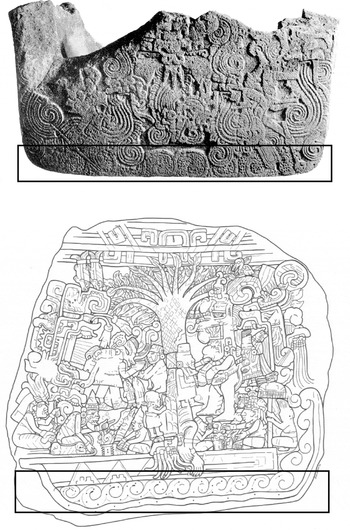
As all commentators acknowledge, the composition and iconography of the elaborately carved stone box, Monument C, appears strongly influenced by Izapa art (e.g., Coe Reference Coe and Wauchope1965b; Guernsey Reference Guernsey2006; Miles Reference Miles and Willey1965; Norman Reference Norman1976; Quirarte Reference Quirarte and Adams1977; Smith Reference Smith1984). Iconographically, the pitted water scrolls at the base of the scene on sides A and B are particularly close to Izapa Stela 5 (Figure 12). The incised plano-relief technical style also strongly resembles stelae at Izapa (Pool Reference Pool, Clark, Guernsey and Arroyo2010). In short, we agree that Monument C constitutes strong evidence for close interaction between Izapa and Tres Zapotes.
Pitted water scrolls: (top) Tres Zapotes Monument C (Stirling Reference Stirling1943:Plate 5); (bottom) Izapa Stela 5 (drawing by Ayax Moreno, courtesy of the New World Archaeological Foundation).

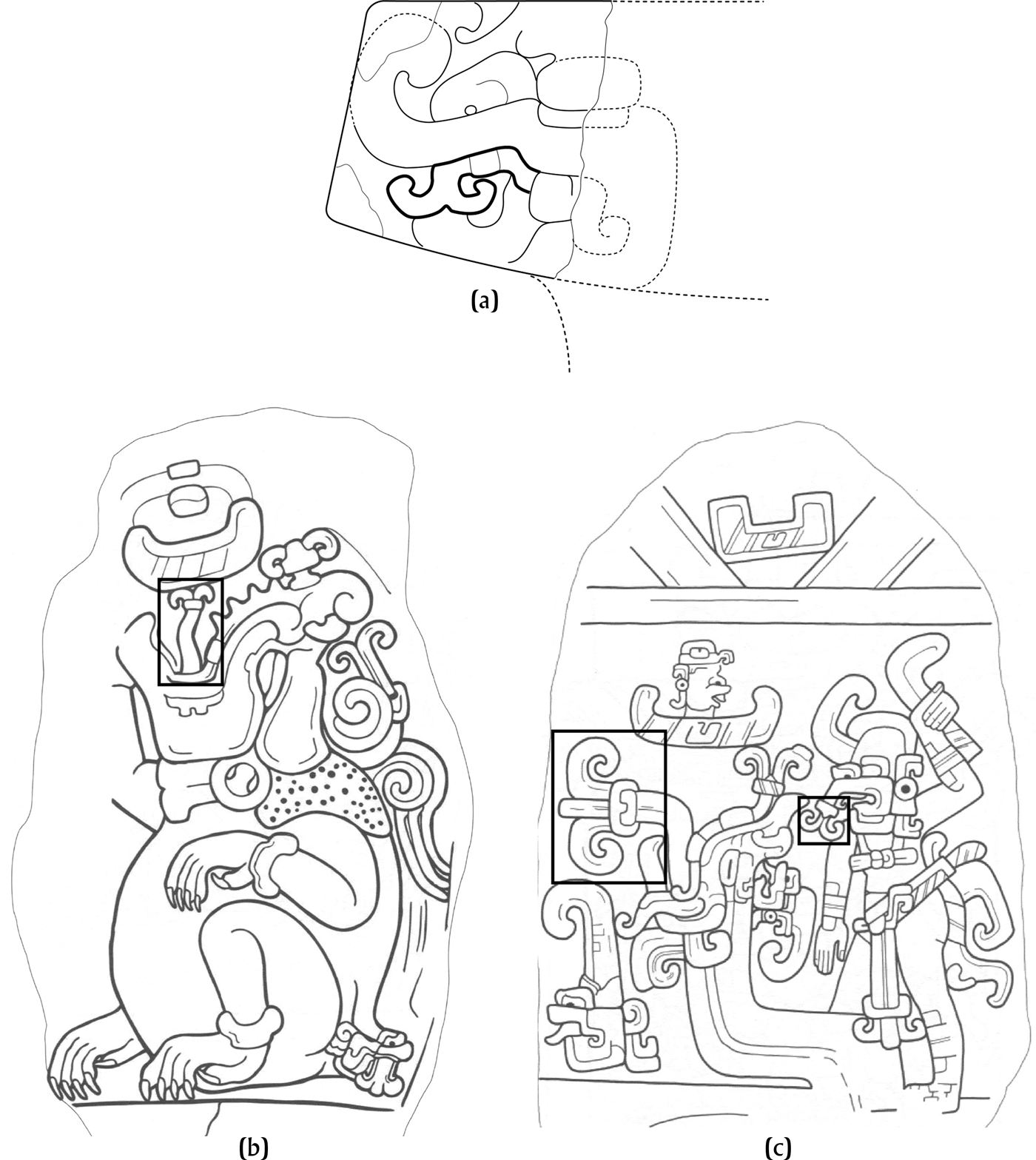
Rarely discussed, but nevertheless important, is Monument 28, a corner fragment of a rectangular throne first reported by Porter (Reference Porter1989:141–142). As Moreno's recent drawing shows, the fragment bears the plano-relief carving of a long-lipped head (Figure 13a). The placement of the head resembles those on Izapa Throne 1, though it differs in its iconographic details. A bifurcated tongue curves down from under the upper jaw. Crossing the tongue above the bifurcation is a band like that gracing the toad's tongue on Izapa Stela 6 (Figure 13b) or the serpent's tongue on Izapa Stela 3, although its placement suggests an upper tooth (Figure 13c). A double scroll in similar orientation may also be seen in the bifurcated lip of the standing figure on Izapa Stela 3 (Figure 13c).
Relief images with bifurcated tongues: (a) Tres Zapotes Monument 28; (b) Izapa Stela 6; and (c) Izapa Stela 3. All figures adapted from drawings by Ayax Moreno. (a) Courtesy of the New World Archaeological Foundation. (b–c) Adapted from Clark and Moreno Reference Clark, Moreno, Lowe, Pye and Lowe2006:Figures 13.8 and 13.3, respectively.

A heavily battered potbelly figure from Tres Zapotes (Monument L) offers less site-specific evidence of ties to the Southern Maya highlands and Pacific slope (Guernsey Reference Guernsey, Guernsey, Clark and Arroyo2010:221; Pool Reference Pool, Clark, Guernsey and Arroyo2010:109).
Izapan Sculptural Ties Beyond Tres Zapotes
Several authors (Coe Reference Coe and Wauchope1965b; Guernsey Reference Guernsey2006; Norman Reference Norman1976:293; Smith Reference Smith1984; Quirarte Reference Quirarte and Adams1977, Reference Quirarte, Lowe and Pye2007), have commented on Izapan elements in “Tres Zapotes” Stela D. The monument is not from Tres Zapotes proper, but was discovered in a small outlying mound complex that Stirling (Reference Stirling1943) labeled Group 4. Stela D depicts three figures in a niche or proscenium that seems to form the maw of a monster whose upper face is depicted above. Long-lipped serpents dangle head-down to either side of the niche (Figure 14a) and scrolls emanate from the nostrils of deity masks on the sides of the monument (Figure 14b). The figures in the central narrative scene are arrayed in elaborate costume with tall-feathered effigy headdresses and “insect wing” capes (Figure 14c). A bird deity faces downward, although its posture is aberrant with respect to the corpus at Izapa (Figure 14d). The basal element likewise does not seem to be represented in stelae at Izapa and the technical style of carving, with a predominance of rounded rather than planar relief, seems to owe more to earlier Olmec technical style than to the planar relief of most stelae at Izapa. Also unlike Izapa, but common to Late Preclassic highland Maya sculpture, is what appears to be a block of fifteen or so glyphs occupying negative space between the central protagonist and the kneeling figure he or she faces (Figure 14e). Guernsey (Reference Guernsey2006:33–34, 37) discusses Stela D along with La Venta Stela 2, Pijijiapan Stone 1, and Izapa Miscellaneous Monment 2 (“El León) as an intermediate stage in the Middle to Late Formative development of stelae from boulder monuments that adhere more closely to the natural contours of the rock than do their successors. Our stylistic seriation (Pool Reference Pool, Clark, Guernsey and Arroyo2010) places Stela D early in the Late Formative period (early Hueyapan A phase), which matches well with the Francesa-phase date proposed for Miscellaneous Monument 2 by Guernsey (Reference Guernsey2006:39).
Tres Zapotes Stela D with elements indicated; see text for discussion. Base drawing by Ayax Moreno, courtesy of the New World Archaeological Foundation.”

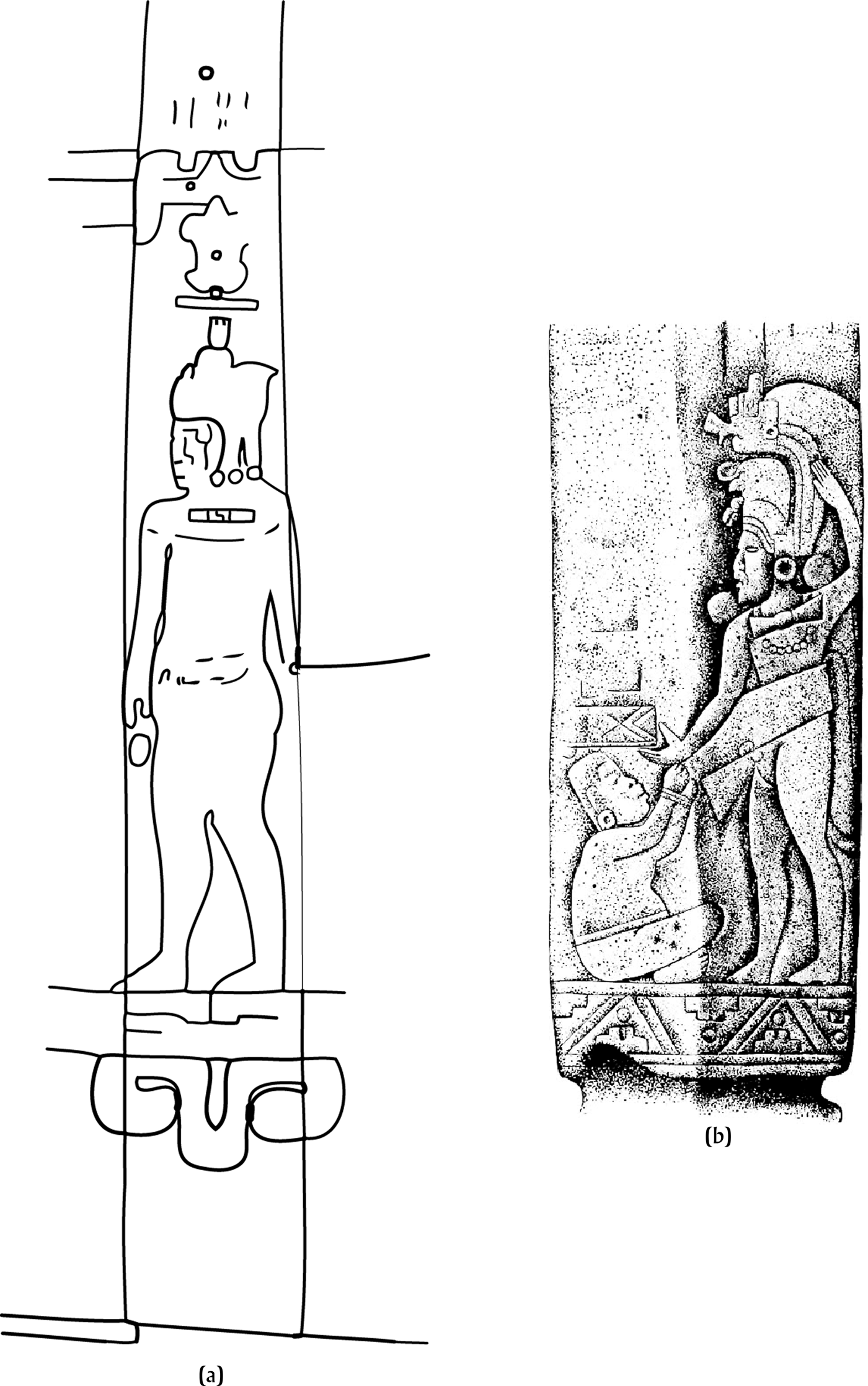
Some 10 kilometers north of Tres Zapotes, El Mesón has yielded two carved stelae. Monument 1 is a 3.6-m-long natural basalt prismatic column on which is carved a figure standing on a band which in turn rests upon a curved motif that dips low in the middle and curls under on the ends (Figure 15). The incurving extremes of the basal element call to mind basal motifs at Izapa and elsewhere in the Pacific piedmont, but otherwise it is both simpler and different in form. Above the headdress of the standing figure is a horizontal bar with a surmounted dot, evidently the numeral six. Above it is a trefoil element with an infixed dot, which Scott (Reference Scott1977:99) relates it to earlier Olmec trefoil motifs as well as Glyph D in Zapotec inscriptions. Quirarte (Reference Quirarte, Lowe and Pye2007) observes these as well as resemblances to geographically and temporally widespread trefoil motifs stretching from Central Veracruz to the Maya lowlands and the Pacific coast.
Late Formative basalt column monuments: (a) El Mesón Monument 1 (redrawn from Scott Reference Scott1977:102); (b) Alvarado Stela (Bernal Reference Bernal, Heyden and Horcasitas1969:Figure 8).

Similar in composition to El Mesón Monument 1 is the Alvarado Stela (Figure 15), found about 40 kilometers to the east. Also rendered on a prismatic basalt column, the monument shows a small, sparsely clothed figure seated before a tall, caped figure wearing a wide belt or yoke and a tall effigy headdress. The seated figure, whose garb and close-fitted helmet recall Olmec images, gestures toward the standing figure, who holds out a box or bundle on which are stacked a series of glyphs, at the top of which is a serpentine knot in a cartouche. The two figures sit and stand, respectively, upon a basal band adorned with triangles with infixed dots and double merlons, closely resembling the basal band on Izapa stela 12 (Scott Reference Scott1977:102; Quirarte Reference Quirarte1973:Figures 7c and 7d).
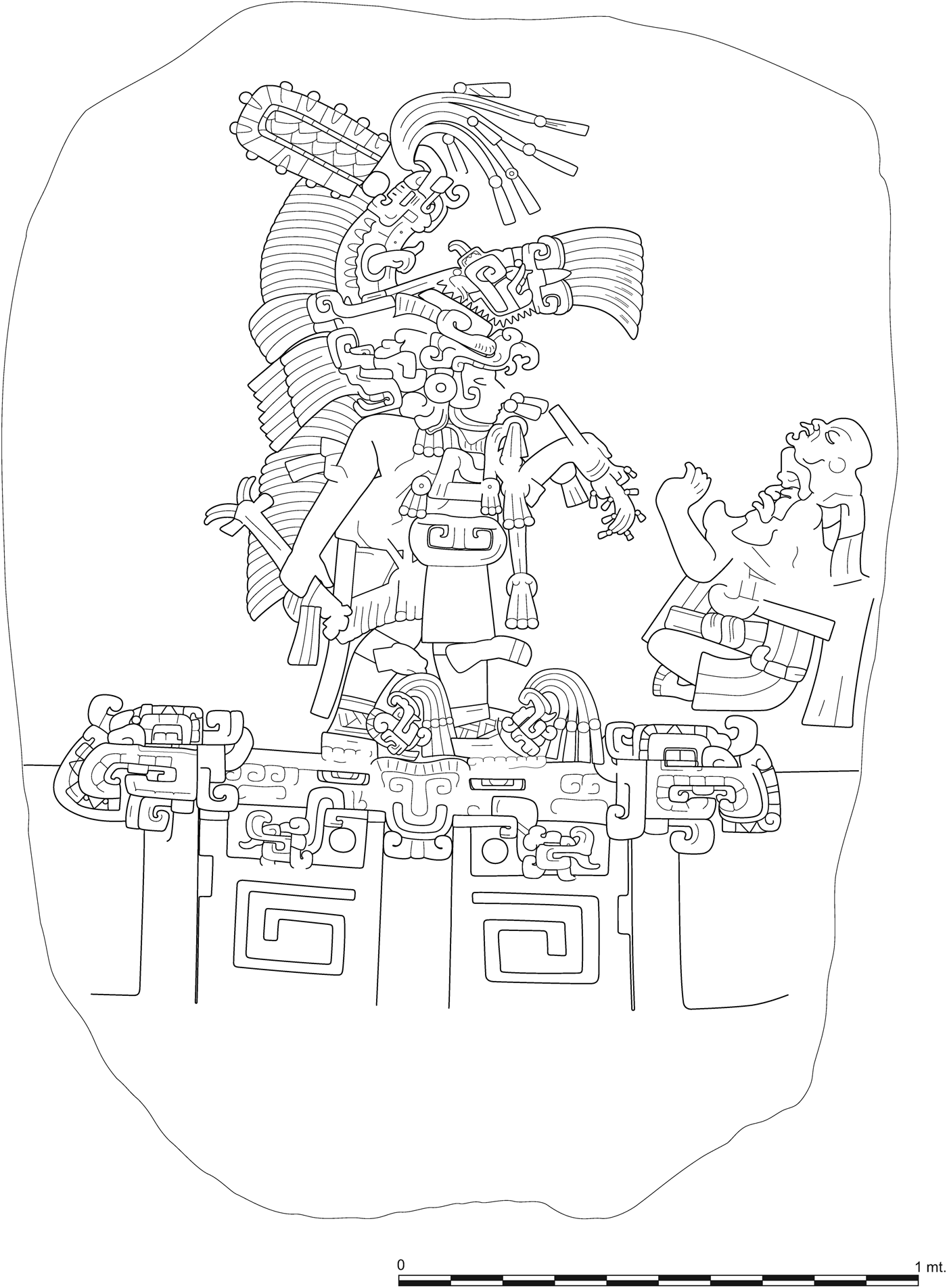
Stylistically, El Mesón Monument 1 and the Alvarado Stela fall squarely in the Late Formative period. Probably later (Protoclassic) is El Mesón Monument 2 (Figure 16). This large slab, dressed on one face, shows a very elaborately dressed figure with feathered headdress and cape or backrack, and tasseled high-backed sandals. A seated corpulent figure with an anthropomorphic Olmec-like head in his or her headdress seems to ward off the standing figure. Most striking with respect to Izapan ties is the bicephalic altar on which the figure stands, with long-nosed serpent or bird heads on each end and incurving scrolls on its front side. These elements would seem to be derived from, and possibly contemporaneous with, Late Formative monuments at Izapa and in the Guatemalan highlands.
El Mesón Monument 2. Drawing by Ayax Moreno, courtesy of the New World Archaeological Foundation.

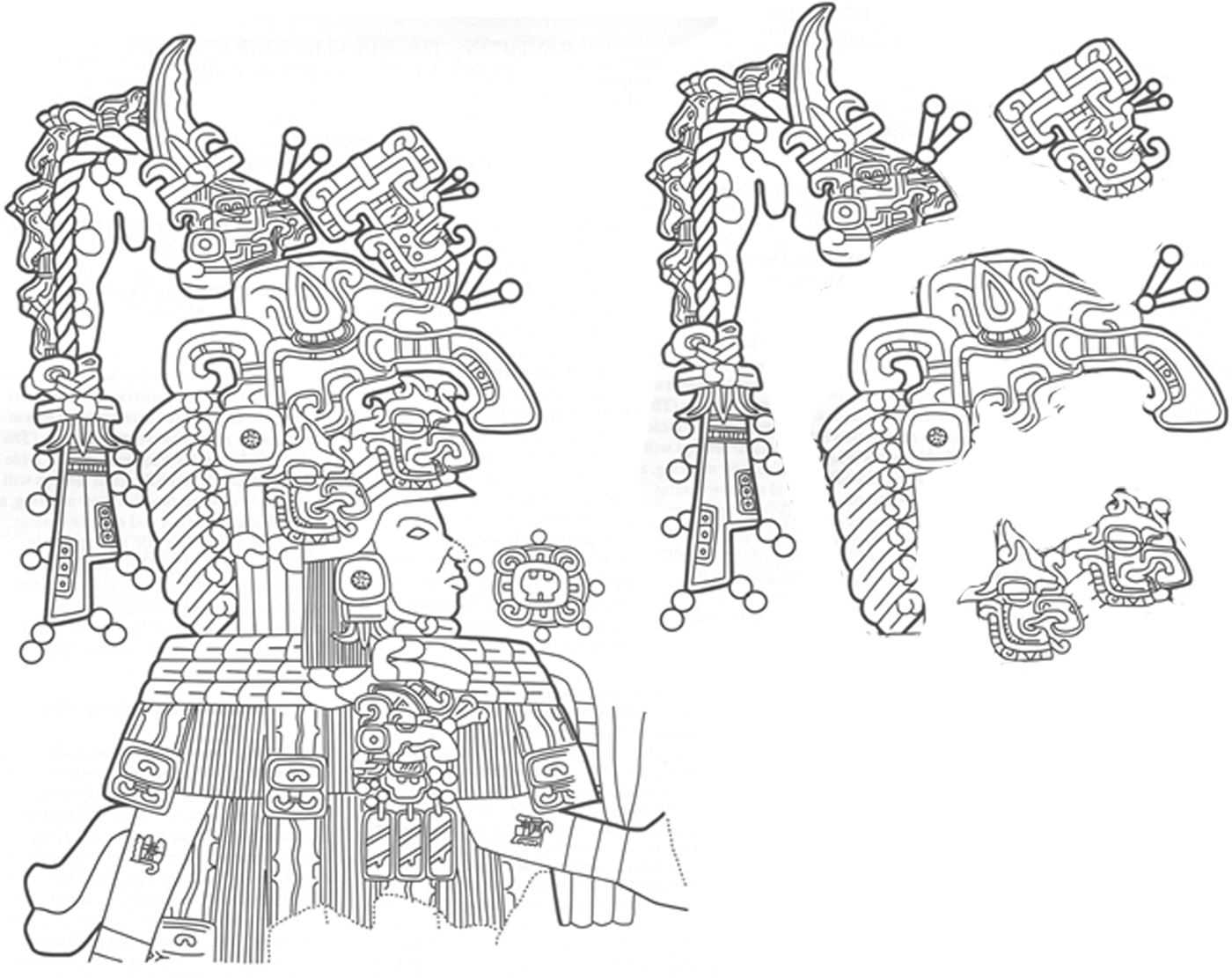
In dress and posture, the standing figure on El Mesón Monument 2 bears a strong resemblance to the figure on the La Mojarra stela, dated by its Long Count calendrical inscriptions to a.d. 157 (Justeson and Kaufman Reference Justeson and Kaufman1993; Winfield Capitaine Reference Winfield Capitaine1988). The La Mojarra stela bears the longest hieroglyphic text in the epi-Olmec or Isthmian writing system. As glyphs are confined to a handful of possibly calendrical or naming examples at Izapa, my focus here is on the style and iconography of the human figure (Figure 17). Apparently a ruler, the person is elaborately dressed in a partially feathered cloak and effigy headdress. Facial features are carefully modeled in rounded low relief, and the details of the costume are presented on multiple planes – i.e., the carving is more three-dimensional than the incised plano-relief of most Izapan monuments, resembling more the technical style of Kaminaljuyu Stelae 10 and 11 and other Protoclassic highland Maya stelae. The figure stands on an ornamented basal band containing a panel with four dots flanked by double merlons, which seems unique among Protoclassic sculptures in southern Mesoamerica (Winfield Capitaine Reference Winfield Capitaine1988:Figure 7; Quirarte Reference Quirarte1973:Figure 5). He wears a pectoral in the form of a long-lipped head with three pendant subrectangular carved jewels. The shoulders of his cloak appear feathered. Vertical stripes on the rest of the cloak may represent pleats or fringe. Interestingly, wide bands on the cloak contain “music brackets,” a common motif on Early Formative pottery on the Gulf Coast and the Mexican highlands.
La Mojarra Stela 1, detail and exploded image of headdress elements. Adapted from a drawing courtesy of George Stuart.

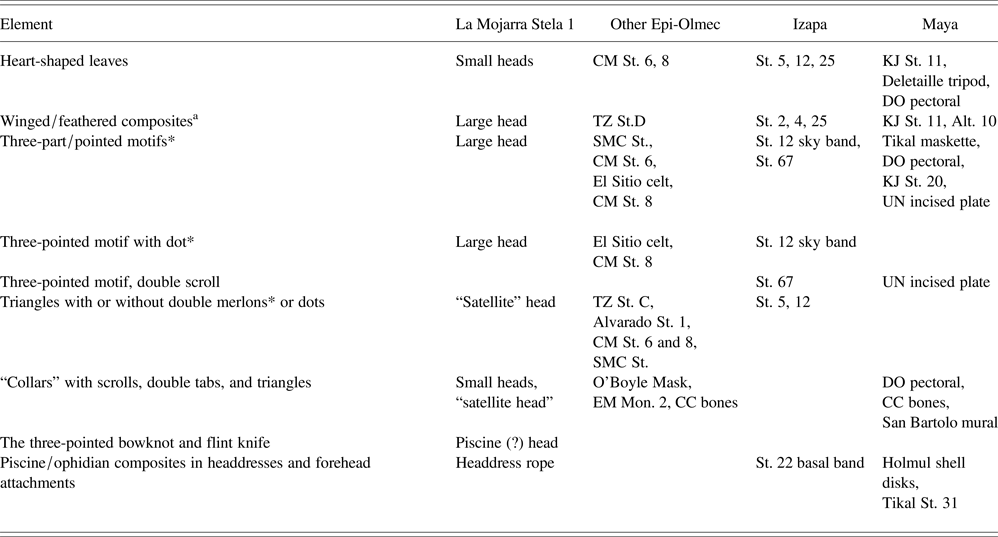
Quirarte (Reference Quirarte, Lowe and Pye2007) highlights several iconographic elements in the ruler's costume and headdress shared with Late Preclassic Izapa and highland Maya carvings (Figure 17). Among them are: (1) heart-shaped leaves in headdresses and belt assemblages; (2) winged (or feathered) composites in headdresses and narrative scenes; (3) three-part/pointed motifs in headdresses or headbands, (4) composite heads with inscribed triangles and dots; (5) composites with collars in headdresses and other contexts; (6) the three-pointed bowknot and flint knife in the headdress; and (7) piscine/ophidian composites in headdresses and forehead attachments (Table 3). Given its relatively late date, the iconography of the La Mojarra stela suggests an eclectic borrowing of motifs. Three motif sets (winged or feathered composites, three-pointed headdress motifs [including dotted examples], and double merlons) have antecedents in Olmec-style examples. The La Mojarra stela shares with earlier Epi-Olmec carvings winged or feathered composites (here I include the downward-looking figure on Tres Zapotes Stela D, but not the figures with insect-wing capes), three-pointed motifs, triangles with dots and double merlons, and scrolled-and-adorned collars. All of these except the collars and winged figures appear on fifth-century stelae from Cerro de las Mesas. Most of the motifs highlighted by Quirarte are also present in Izapa examples, including “piscine composites” (or just fish), which appear in the basal band of Stela 22, though not in headdresses at Izapa. Missing from the Izapan corpus are the scrolled-and-adorned collars and the three-pointed bowknot with flint knife. The latter combination is unique to La Mojarra. It is worth noting, though, that the representation of flaking on the knife is more similar to Maya examples than to Izapa art, although less detailed (see Guernsey Reference Guernsey2006:65).
Iconographic elements shared between La Mojarra Stela 1 and carvings in other traditions. CC, Chiapa de Corzo; CM, Cerro de las Mesas; DO, Dumbarton Oaks Research Library and Collection; EM, El Mesón; KJ, Kaminaljuyu; SMC, San Miguel Chapultepec; TZ, Tres Zapotes; UN, unproveninced; Alt., Altar; Mon., Monument; St., Stela(e).

Summary
Monument carving in the Eastern Lower Papaloapan Basin saw a proliferation of forms, styles, and themes in the Late Formative period (Pool Reference Pool2007). Relief carving drew partly upon established Olmec tradition but also incorporated to varying degrees the iconography and styles of Izapa and other sites in the Chiapas-Guatemala highlands, piedmont, and Pacific coasts. Chronological development of relief styles can be seen in the environs of Tres Zapotes from the late Olmec Stela A to the epi-Olmec Stela D in the persistence of proscenium monuments depicting scenes with rulers and attendants executed in rounded relief with the addition of Izapa-style long-lipped gods and glyph blocks. The carving and re-carving of Stela C also exhibits the late addition of text on the reverse to abstracted Olmec-derived symbols on the obverse. Within the corpus of monuments at Tres Zapotes, Monument C stands out for its faithful execution of Izapa plano-relief technical style as well as incorporation of strongly Izapa motifs in the basal scroll band and long-lipped deity masks.
In the hinterland of Tres Zapotes, chronological change is also evident in the progression from basalt column monuments depicting a ruler (El Mesón Monument 1), sometimes engaging with a smaller Olmec-like figure (Alvarado Stela, continued on El Mesón Monument 2), to slab stelae with more elaborately cloaked and head-dressed rulers on El Mesón Monument 2 and the La Mojarra stela. Strongly Izapa elements include basal band designs and thrones with long-lipped deity masks, while costuming of rulers on the later monuments combines Izapa and Maya-derived elements.
CONCLUSION
In a recent challenge to Lowe's (Reference Lowe and Adams1977:224) argument that waxy orange-slipped pottery at Izapa and other transisthmian sites expressly communicated a Mixe-Zoque identity, Clark (Clark and Lowe Reference Clark, Lowe, Lowe, Ekholm, Clark and Lee2013:86) reminds us “that ceramic styles do not equal people, and that people can change their dinnerware without changing their language or cultural identity,” adding, “[a] more secure assumption is that people who closely share cultural practices will likely have similar kinds of tools and objects, such as ceramic vessels.” Clark argues that the “Mixe-Zoque” orange pottery of the late Middle Formative period was of Maya inspiration and that Izapa was a multicultural, cosmopolitan center. He further attributes scarcity of text and the emphasis on narrative scenes and mythic images in the art of Izapa to the need to transcend linguistic boundaries.
Clark's observations are important, but we wonder if they go far enough. While arguing for multiple influences, Clark still grounded his explanation for patterned variation in late Middle to Late Classic ceramic assemblages in ethnolinguistic terms, replacing Lowe's monolithic Mixe-Zoque identity with peoples of multiple origins (but see Clark Reference Clark, Traxler and Sharer2017:222–223, which emphasizes manipulation of identity and ethnicity through various media to political ends). We do not mean to imply that ceramic practices cannot express ethnolinguistic identity, but that it may be more (or at least equally) useful to focus on the construction of social networks reflected in the transmission of technical knowledge and aesthetic “taste” (Bourdieu Reference Bourdieu1984). Following Lave and Wenger (Reference Lave and Wenger1991), the networks through which actors acquire and share such techniques and aesthetics constitute “communities of practice.”
At this point, the scope and resolution of our data are not adequate to conduct a quantitative social network analysis like that Mills and colleagues (Reference Mills, Peeples, Haas, Borck, Clark and Roberts2015) have recently described for Arizona and eastern New Mexico or the less-detailed qualitative analysis one of us advanced regarding strengths of ties between regions based on Olmec motifs (Pool Reference Pool2007:Figure 6.10). We would like to conclude with some observations, however, that may prove useful in such an analysis grounded in a situated learning framework.
First, as we hinted above, ceramic vessels and monumental art index different mechanisms of learning and transmission of knowledge. The portability of ceramics, their ubiquity and visibility in household and ritual settings, and the rapidity of their manufacture obviate the need for apprentices to travel long distances or transcend social hierarchies to learn how to execute decoration and mimic form. Apprenticeship that is more intimate may be necessary to acquire the technical knowledge to create some effects, such as waxy slips, but that knowledge is readily passed down the line and errors corrected by observation of ubiquitous local examples. The social networks that transmit such information may therefore exhibit a plethora of nodes at multiple levels of centrality and extended chains of linkages, creating broadly clinal distributions in space. In effect, every household and neighborhood may become a node in the transmission of technical knowledge. While this often results in the recombination of motifs and modes of execution (e.g., in Stark's [Reference Stark2001:112] incised motifs replicated outside the minute incision technical style), they can also create widespread coherence in form, decoration, and surface treatment, as exhibited in Munet Red grooved everted-rim dishes and allied Gulf Coast types and in mottled brown composite silhouette dishes with hachured sine curves.
Because monumental stone sculptures are not easily transported long distances and tend to cluster in specific places and contexts, the faithful transmission of technical and aesthetic knowledge for carving them requires that novice sculptors travel to, or that they receive instruction from masters who have traveled from, the places where the monuments are carved or exhibited. Some motifs may be conveyed by drawings, to be sure, but there are few original examples with which to compare one's attempts, and drawings or verbal descriptions from others not familiar with chaine opératoire of a particular style rarely convey the process of carving, resulting, for example, in only isolated examples on the Gulf Coast of Izapa-style motifs rendered in Izapa-style plano-relief.
Consequently, the Trans-Isthmian ties expressed in pottery and stone sculpture likely represent the formation of Late Middle to Late Formative social networks which, while they may overlap with one another and with recognized social identities, would have been distinctive in their own right and in ways that may not map simply onto ethnolinguistic boundaries or simple elite/commoner distinctions.
RESUMEN
En 1943 Matthew Stirling (Reference Stirling1943:72) opinó, “Izapa parece estar relacionado mucho más cerca con los sitios de montículos de tierra en el sur de Veracruz … que con sitios en el área Maya” (traducción por el autor). Desde entonces académicos han propuesto ligas de intensidades variables entre unidades políticas por ambos lados del istmo de Tehuantepec. Se ha notado semejanzas en la alfarería entre el sur de Chiapas y la costa del Golfo, pero la discusión de interacción transistmo se ha enfocado principalmente en similitudes escultóricas entre Izapa y sitios en la cuenca baja del Río Papaloapan, e inclusive Tres Zapotes, El Mesón, y Alvarado. De hecho, Michael Coe sugirió que el estilo Izapeño se pudo haber originado en la costa del Golfo y no en las laderas del Pacífico. En este artículo re-examinamos la interacción entre Izapa y unidades políticas epi-olmecas con una base de datos ampliada con estudios recientes iconográficos e investigaciones arqueológicas dentro y alrededor de Tres Zapotes.
La cerámica de Tres Zapotes y de Izapa (así como la de sus regiones en general) reflejan la participación de sus productores y consumidores de la alfarería en amplias constelaciones de práctica en el sureste de mesoamérica, en particular durante los periodos formativo medio y formativo tardío. Durante el periodo formativo medio las semejanzas embarcan por lo menos dos modos de tratamiento de superficie y varios modos decorativos. Para las fases Guillén y Hueyapan B, que representan el apogeo de ambos sitios, las semejanzas fueron escasas y más evidente en platos rectos divergentes con labios volados acanalados y engobe ceroso de color rojo a naranja.
En el periodo formativo tardío la talla de monumentos en la cuenca baja del Río Papaloapan experimentó una diversificación de formas, estilos y temas. La talla en relieve aprovechó la tradición olmeca ya establecida en la región, pero también incorporó en varias medidas elementos iconográficos y estilísticos de Izapa y otros sitios de la costa, el pie de monte y los altos de Chiapas y Guatemala. Se puede observar el desarrollo de estilos de relieve en los alrededores de Tres Zapotes con la persistencia de monumentos “proscenios” desde la estela olmeca A hasta la estela epi-olmeca D que presentan escenas de gobernantes y sus auxiliares en relieve redondeado con la adición de una deidad de labio largo estilo Izapa y textos jeroglíficos. La talla y la retalla de la estela C también exhibe la adición de un texto en el reverso a símbolos abstractos de derivación olmeca en el anverso. Dentro del corpus de monumentos en Tres Zapotes, el Monumento C se destaca por su ejecución fiel del estilo técnico Izapeño de relieve- plano así como la incorporación de motivos fuertemente Izapeños en la banda basal de volutas y las máscaras de deidades de labio largo mientras que la indumentaria de gobernantes en monumentos más tardíos incorporan y combinan elementos de derivación izapa y maya.
Los vínculos transistmeños expresados en la alfarería y la escultura de piedra tratan de la formación de redes sociales durante el formativo medio tardío y el formativo tardío. Estas redes sociales aunque pudieron traslapar uno con otro y con identidades sociales reconocidas, debían de ser distintivas así mismos y en maneras que no colindan precisamente con fronteras etnolingüistas o con distinciones sencillas entre las elites y la gente común.
Acknowledgements
We thank Robert Rosenswig and Julia Guernsey for inviting us to present an earlier version of this paper in their symposium at the 2015 Society for American Anthropology meetings and to contribute to this special issue. Our work at Tres Zapotes and El Mesón was conducted with the permission of the Instituto Nacional de Antropología e Historia and was supported financially by the National Science Foundation (grant numbers BCS-0242555 and BCS-1261514), the Foundation for the Advancement of Mesoamerican Studies, Inc., and the University of Kentucky. John Clark graciously granted access to the New World Archaeological Foundation ceramic type collections. We also thank him and Rex Koontz for their helpful comments on a draft of this article. Finally, Pool and Loughlin express our profound gratitude to our coauthor, Ponciano Ortiz Ceballos, for his seminal early work defined the Tres Zapotes Formative period ceramic chronology, his insights, and decades of support and friendship. All three of us take responsibility for any errors of fact or interpretation.