1. INTRODUCTION
Spoken Continental French exhibits a number of properties which were classically argued to characterize null subject languages (Rizzi, Reference Rizzi, Jaeggli and Silva- Corvalan1986b; Jaeggli & Safir, Reference Jaeggli and Safir1989). While it has been shown (e.g. see Gilligan, Reference Gilligan1987; Newmeyer, Reference Newmeyer2005: 45) that this so-called cluster of properties does not characterise all such languages, Spoken French for example appears to allow non-referential (expletive) null subjects and ‘free’ inversion, and lacks that-trace effects; (1) and (1)b show non-referential null subjects in main and embedded clauses, (1)cshows inversion (or right-dislocation) of the subject DP, and (1)d shows the lack of that-trace effects.Footnote 1
- (1)
a. ∅ Faut pas sortir par le four, hein?
b. J(e) crois que ∅ y a Mamie qui arrive.
c. Elle va dessus (,) la vache.
d. [CP Quii c'estj [IP tj [CP ti qu(i) [CP ti est arrivé ?]]]]
In this paper we focus on constructions like that shown in (1) above, in which the subject clitic il (3rd, sg. masc.) has been dropped preceding an impersonal verb – here we use this term to refer to any verb occurring with a less than fully referential subject. The availability of missing subject cliticsFootnote 2 in constructions like the impersonal in the Spoken register (where in Standard French, the written or formal register, an overt expletive would be required) has been noted for some time, but has not been investigated in detail (e.g. Lambrecht, Reference Lambrecht1981: 27–28; Auger, Reference Auger, Ashby, Mithun and Perissinotto1993: 179; Coveney, Reference Coveney2002: 30; Fonseca-Greber, 2004). We focus here on providing (i) a clearer picture of what factors affect when a dropped subject clitic in these constructions is accepted by speakers, and (ii) how this phenomenon might be best analysed within a view of Spoken French subject clitics as agreement affixes rather than syntactic subjects (e.g. Roberge, Reference Roberge1990; Auger, Reference Auger1994; Culbertson & Legendre, Reference Culbertson and Legendre2008; Culbertson, Reference Culbertson2010). This view entails that Spoken French is indeed a null subject language, but casts examples like (1a) in a different light – namely as missing an overt agreement morpheme rather than an overt subject. We discuss how Spoken French might fit into a theory of null subject language types cross-linguistically, and show that both usage-based (Bybee & Hopper, Reference Bybee and Hopper2001) and potentially formally derived (Rizzi, Reference Rizzi1986a) factors appear to play a role in explaining when the clitic can be dropped.
It must be noted at the outset that our investigation of this phenomenon, which we refer to as il-drop, represents a first pass rather than an exhaustive search of the contexts and factors we believe may affect its availability for speakers of Spoken French. The particular constructions we focus on, however, are motivated by the goals stated above; first, we test constructions that vary in their frequency in the language, second, we test constructions that vary in the type of expletive subject licensed – quasi-argumental vs. fully non-argumental – as classified by Rizzi (Reference Rizzi1986a). Thus we include impersonal verbs as in (1d), but also weather predicates and a number of other distinguishable types (described in detail below).
We proceed as follows. In section 2 we provide a summary of the evidence that subject clitics behave as agreement affixes in Spoken French (in contrast to Standard French). In section 3 we discuss the relevant constructions in which il-drop may be found, and how this phenomenon can be seen in relation to the analysis of subject clitics in Spoken French put forward in section 2. In section 4 we report the results of a controlled acceptability judgement task investigating the factors that influence the availability of il-drop. In section 5 we suggest an analysis of il-drop which follows from featural matching requirements of subject clitic agreement (Suñer, Reference Suñer1992; Culbertson, Reference Culbertson2010), and spell out future directions for research on this topic.
2. SPOKEN FRENCH SUBJECT CLITICS AS AGREEMENT AFFIXES
Traditional analyses of subject clitics in (Standard) French treat them as phonological clitics, attached to the verb in the phonology but functioning as true subject arguments in the syntax (e.g. Kayne, Reference Kayne1975; Rizzi, Reference Rizzi, Jaeggli and Silva- Corvalan1986b; De Cat, Reference De Cat2007). This view is largely based on differences between French and Northern Italian dialects (NIDs), various features of subject clitics in the latter having been argued to follow from their status as agreement affixes rather than true subjects (Rizzi, Reference Rizzi, Jaeggli and Silva- Corvalan1986b; Brandi & Cordin, Reference Brandi, Cordin, Jaeggli and Safir1989). In particular, the properties shown in 1–4 below have been presented as evidence for the agreement status of subject clitics in the relevant dialects (see e.g. Rizzi, Reference Rizzi, Jaeggli and Silva- Corvalan1986b; Brandi & Cordin, Reference Brandi, Cordin, Jaeggli and Safir1989; De Cat, Reference De Cat2007, and others).
1. No non-affixal material intervening between subject clitic and verb.
2. No (syntactic) movement of the clitic independent of verb host.
3. Obligatory repetition (narrow scope) of subject clitic in conjoined verb phrases.
4. Co-occurrence of subject clitic and DP subject without dislocation/topicalisation of the DP.
Note that properties 1–3 pertain to whether a given subject clitic should be analysed as a phonological clitic or affix, while property 4 pertains to whether that clitic functions as an agreement marker. (A clitic with properties 1–3 but not 4 could be treated as a morphologically bound or incorporated argument, as has been claimed for French object clitics – Miller, Reference Miller1991). Culbertson (Reference Culbertson2010) shows that all the above properties in fact hold of Spoken Continental French, just as they do for the NIDs studied by Brandi and Cordin (Reference Brandi, Cordin, Jaeggli and Safir1989) and others.
Evidence concerning property 1 above typically focuses on the position of negation in Standard French (2) compared to the NIDs (2)b. In the Standard French example, ne intervenes between the subject clitic and the verbal complex, while in Trentino and Fiorentino the negative element does not intervene (abstracting away from some variation in ordering in Fiorentino, Brandi and Cordin, Reference Brandi, Cordin, Jaeggli and Safir1989: 120). These data have been used to argue that the structural position of the subject clitic in French must be relatively high compared to the NIDs, i.e. in the same position as other subjects (Rizzi, 1996b; Zanuttini, Reference Zanuttini1997: 30–35; Poletto, Reference Poletto2000: 18–19), or alternatively that the subject clitic must not attach to the verb pre-lexically (as affixes do, De Cat, Reference De Cat2007: 15–18). However, in Spoken French, the negative marker ne is in fact dropped preferentially just when it would intervene between the subject clitic and verb. In the corpus surveyed in Culbertson (Reference Culbertson2010),Footnote 3 the retention rate in this context is a mere 6.3%, compared to 83.3% when only a subject DP is present.Footnote 4
(2)

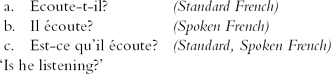
Similar conclusions have been drawn based on the existence of subject clitic inversion in question formation in French, where the subject clitic could be analysed as moving independently of the verb in the syntax (property 2). The examples in (3) illustrate three strategies for question formation, only one of which, (3), involves inversion. The latter strategy is not in fact available for subject clitics in in the Spoken register (only a residue of 0.9% of inversions was found in the corpus surveyed in Culbertson, Reference Culbertson2010; see also Coveney, Reference Coveney2002 for additional discussion of question formation in Spoken French).
(3)
As for property 3 above, Rizzi (Reference Rizzi, Jaeggli and Silva- Corvalan1986b) and others point out that in conjoined VPs, the subject clitic in the NIDs must be repeated, as expected of an agreement marker (4)c. By contrast, in Standard French the subject clitic may take wide scope over the conjoined phrases, appearing only once (4), suggesting again that they are structurally high and/or must not be attached pre-lexically as an affix. However, in Spoken French, the repetition of the subject clitic is obligatory as shown in (4)b (repeated in 98.4% of cases in the corpus surveyed in Culbertson, Reference Culbertson2010) as in the NIDs.
(4)

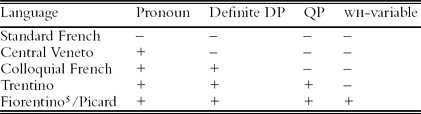
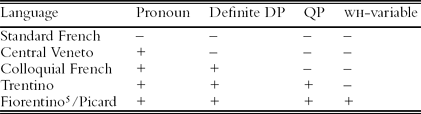
Finally, the NIDs show regular and in some cases obligatory subject doubling, where the subject clitic appears even when a DP subject is also present. Subject doubling occurs in both Trentino and Fiorentino even when the DP subject is quantificational in nature, as in (5)d, therefore the doubling construction cannot be analysed as a dislocation (Rizzi, Reference Rizzi, Jaeggli and Silva- Corvalan1986b). In Standard French, a similar construction is possible (5), however quantificational subjects cannot be doubled by a subject clitic (5)c, suggesting a dislocation analysis. In Spoken French, while still impossible with quantificational subjects, doubling as in (5)b is strikingly frequent – obligatory with all tonic pronoun subjects, and present in 81% of sentences with non-pronominal DP subjects in the corpus surveyed in Culbertson (Reference Culbertson2010) (see Nadasdi, 1995; Coveney, Reference Coveney2005, among others for quantification of subject doubling rates with particular noun phrase types in other corpora). Further, acoustic analysis of sentences with doubling provides no evidence for the prosodic break that accompanies clear cases of (e.g. object) dislocation, and doubling is possible in broad focus constructions independently analysed as simple IPs (Culbertson, Reference Culbertson2010: 113; contra De Cat, Reference De Cat, Bok-Bennema, Hollebrandse, Kampers-Manhe and Sleeman2004). This places Spoken French squarely within the typology of doubling shown in Table 1.
Partial typology of subject doubling (Culbertson, Reference Culbertson2010)
(5)
3. SPOKEN FRENCH AS A NULL SUBJECT LANGUAGE AND IL-DROP
The evidence summarised above does not support a clear distinction between subject clitics in NIDs like Trentino and Fiorentino and those in Spoken French. Subject clitics have progressed along a grammaticalisation cline (from independent pronouns) to the point where they function as agreement markers, attached to the verb in the morphology. A natural consequence of this analysis is the null subject status of these languages – clearly sentences which have a subject clitic agreement alone must now be treated as licensing an empty (null) subject argument.
As mentioned in section 1, Spoken French exhibits a number of other features commonly found in Romance null subject languages, including constructions (6) which on the surface parallel the non-referential null subjects required for example in Italian. Indeed, dropping expletive il in Standard French (where subject clitics are arguably still argumental), would be equivalent to dropping an argumental subject. However, if the clitic il has become an agreement marker in Spoken French, then what is missing in these sentences is not an expletive subject but (prefixal) agreement. This observation is crucial to understanding how Spoken French might fit into a typology of null subject languages, since under this view both referential and non-referential null subjects are allowed, however certain constructions which take a non-referential null subject do not trigger subject clitic agreement, resulting in il-drop. This lack of subject clitic where it would agree with a non-referential null subject has also taken place in the NIDs – in Trentino no subject clitic agreement is present (6)b, in Fiorentino the neuter form appears (6)c.
(6)
How this agreement pattern might be best understood in Spoken French (and the NIDs) will be taken up in section 5. First however, we will discuss variation in the availability of il-drop in Spoken French and report the results of an investigatory acceptability judgement task. As noted by a number of researchers, some impersonal predicates allow widespread il-drop, while others do so to a lesser extent or not at all (Auger, Reference Auger, Ashby, Mithun and Perissinotto1993: 179; Fonseca-Greber, 2004). These contrasts are illustrated in (7) below (examples taken from the Lyons and York CHILDES corpora; Plunkett, 2002), which impressionistically proceed from more to less frequent il-drop. (Note that reduction of il to i is typical in the Spoken register, and possible in all these contexts).
(7)
Based on corpus examples from Spoken French like those above, one possibility is that frequency is the driving factor behind the availability of il-drop. This is consistent with frequent impersonal constructions such as (il) faut. . . ‘it is necessary. . .’ and (il) y a ‘there is. . .’ which allow il-drop pervasively (see e.g. Fonseca-Greber, 2004) while others do only occasionally or not at all. However, it is also possible that even after controlling for frequency, particular predicates may exhibit differences in the availability of il-drop. For example, weather verbs are often analysed as subcategorising for a quasi-argumental subject rather than a true expletive, as discussed below (Rizzi, Reference Rizzi1986a: 528–9; Travis, Reference Travis1984: 219; Bennis, Reference Bennis1986: 95–7; Vikner, Reference Vikner1995: Ch. 7). This may explain the apparent unavailability of il-drop with weather predicates like pleuvoir ‘to rain’ and faire beau ‘to be nice (outside)’ (precisely why this prediction would hold is discussed in section 5). Further, in her discussion of the typology of impersonal constructions, Travis (Reference Travis1984) differentiates among a more diverse set of verb classes, suggesting that additional finer-grained categories may also be relevant. These factors are difficult to test based on corpora as (aside from a few frequent ones) impersonal constructions on the whole are quite rare. By contrast, statistical analysis of experimentally gathered native speaker judgements makes it possible to vary factors of interest in a controlled manner, and directly contrast particular impersonal sentences with and without il.
Below we investigate the effect of frequency, non-argumental vs. quasi-argumental status, and also verb class (explained in detail below) on native speakers’ ratings of impersonal sentences with and without il.
4. ACCEPTABILITY RATINGS OF IL-DROP BY NATIVE SPEAKERS
4.1 Participants
Participants were 24 native speakers of Continental French recruited through Amazon Mechanical Turk, an online crowdsourcing marketplace which pairs companies or individuals posting tasks with individuals willing to complete them (see Sprouse, Reference Sprouse2011 for validation of this service as a methodology for syntactic experiments). Participants ranged in age from 18–79, and were from various regions in France (including Paris, Lyon, Bordeaux, Bretagne). To ensure that participants were indeed native speakers of French, IP addresses were constrained to within France, and a test of fluency was given (described below).
4.2 Stimuli
Impersonal predicates in French are best separated into four classes combining semantic properties and syntactic considerations: weather predicates, modals, non-modals and ‘existential’ predicates. As described below the variety of syntactic properties associated with impersonal predicates argues against a purely syntactic classification (cf. Travis, Reference Travis1984). The first class contains weather verbs as in il neige ‘it is snowing’ and il pleut ‘it is raining’, and also adjectival predicates like il fait beau ‘it is nice’ and il fait du vent ‘it is windy’. Expletive il in weather verb constructions is held to be a quasi-expletive, since it can serve as a controller of (non-arbitrary) PRO in a non-finite complement clause, as shown in (8a,b) (Chomsky, Reference Chomsky, Belletti, Brandi and Rizzi1981: 323–25; Rizzi, Reference Rizzi1986a: 529). By contrast, expletive il in all other target constructions involving a non-finite complement clause may not control PRO, and examples such as (8d) necessarily involve arbitrary reference rather than co-reference.
- (8)
a. Iti rained before PROi snowing.
b. Ili a plu avant de PROi neiger.
c. It is enough PROarb to talk.
d. Il suffit de PROarb parler.
The second class contains epistemic and non-epistemic modals as in il faut. . . ‘it is necessary. . .’, il vaut mieux. . . ‘it is better. . .’, il est possible. . . ‘it is possible. . .’, which take a sentence complement introduced by que or in some cases an infinitival verb (e.g. il vaut mieux qu'on parte ‘it is better that we leave’; il vaut mieux partir, ‘it is better to leave’). Epistemic modals may undergo extraposition optionally ([TPil est possible/probable [CPque. . .]] vs. [TP [CPque. . .] est possible/probable] ‘it is possible/likely that. . .’ vs. ‘that. . .is possible/likely’) or obligatorily ([TPil se peut [CPque. . .]] vs. *[TP [CPque. . .] se peut], ‘it may be that. . .’ vs. ‘*that. . .may be.’). The predicates in the third class typically take sentential complements, but are not modal, e.g. il semble/parait que. . . ‘it seems that. . .’, il s'agit de. . . ‘it's about. . .’, il m'arrive de. . . ‘it happens to me. . .’. Some are passive (il est prévu que. . . ‘it is expected that. . .’, il est convenu que. . . ‘it is agreed that. . .’). The fourth class contains intransitive predicates which may appear in an impersonal existential (or presentational) construction subject to a definiteness restriction (see e.g. Labelle, 1992: 381–2; Cummins, Reference Cummins1996: Ch. 2.5): il y a DP -def ‘there is DP-def’, il reste DP -def lit. ‘there remain DP-def’, il sort DP -def lit. ‘there leave DP-def’, etc. Following Lambrecht (Reference Lambrecht1994), Legendre and Sorace (Reference Legendre, Sorace and Godard2010) divide these predicates into presentational and event-reporting on the basis of their discourse properties: presentational predicates serve to introduce a new, not yet activated, entity in the world of discourse while event-reporting predicates merely introduce a new event. Both varieties are grammatical with all lexico-aspectual classes in French, including those traditionally associated with unergativity (9).
(9)

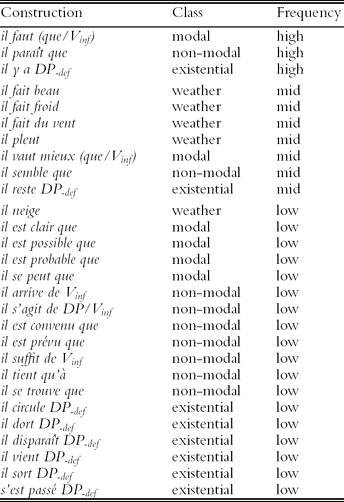
Test sentences (42 total) were constructed using a sample set of predicates from each class (listed in Table 2 below). The frequency of each predicate was estimated based on use in impersonal constructions in the PFC corpus (Phonologie du français contemporain; Durand, Laks & Lyche, Reference Durand, Laks, Lyche, Pusch and Raible2002), an adult-directed corpus of Spoken French. Predicates were separated into three frequency bins – high, mid, low.Footnote 6
Frequency bin for each of the predicates tested, sub-organised by class.7 Verbs are given in present tense, however in the context of the experiment verbs could appear in alternate tenses

Frequency information for each verb is shown in Table 2. A number of these verbs can also appear with ça in the same constructions, for example ça suffit, and c'est clair are possible, but not *ça faut or *ça y a.Footnote 8 Thus ça functions as an alternative marker in impersonal constructions in Spoken French, perhaps unsurprisingly as it also alternates with il in referential contexts particularly when the subject is generic (ça can be treated as an agreement marker with a potentially distinct featural makeup; Auger, Reference Auger1994: Ch. 4; Culbertson, Reference Culbertson2010: 123). For this reason then, the absence of il in at least some of our sentences could also be interpreted as absence of ça. We return to this issue below, however note that what we are interested in here is whether an agreement marking clitic can be dropped.
Using the stimuli described above, four lists were created, comprised of 22 test sentences and 25 fillers each. In half of the test sentences il was dropped, and in the other il was retained. Approximately half of the filler sentences were expected to be rated as ungrammatical and the other half as grammatical. Each participant judged sentences from only one of the four lists.
Sentences were recorded by two young native French speakers (one female, one male) who knew one another and were instructed to use the informal register (this was encouraged in the orthography of the script the speakers read from as well, e.g. ne was omitted, t’ (2nd, sg. acc.) was used instead of te before a consonant, etc.). For each test sentence, versions with and without il were recorded. The two speakers were allowed to practice beforehand to ensure fluency for each sentence. Context was provided in the form of a set-up question, as in the example in (10) below. Note that each rated sentence (both test and filler) was preceded by either oui, non or another conjunction so that the verb (accompanied by i(l) or not) would not be sentence-initial.
(10)

4.3 Procedure
Participants were recruited through Amazon Mechanical Turk, and were first required to answer a number of demographic questions concerning their age, sex, birthplace, current residence and other language experience. They were asked to verify that (i) they had lived in France from birth until at least age 15, and (ii) their parents had spoken French to them during that time. They also completed a test of their fluency which required them to listen to a clip of a French song and briefly describe it.
Participants were then instructed that they would hear auditorily presented sentence pairs, and their task was to rate the second sentence (the answer to the preceding question). They were explicitly told that experimenters were interested in their judgements of the informal register.Footnote 9 Sentences were rated on a scale from 1 (totalement inacceptable ‘totally unacceptable’) to 7 (tout à fait acceptable ‘perfectly acceptable’), intermediate points were not labelled (following Schütze, Reference Schütze1996: 189, note 12). Participants pressed play to hear each question-answer pair, and then entered their rating.
4.4 Results
As a sanity check, we first verified that participants rated filler sentences expected to be grammatical as higher than those expected to be ungrammatical. Data for this and all other analyses presented here were subjected to mixed effects logistic regression, which allows for the combination of fixed and random effects in a single model.Footnote 10 Here we treat participant as a random effect. As expected, participants reliably rated grammatical fillers higher than ungrammatical fillers (mean rating 5.45 (sd = 1.87) vs. 3.92 (sd = 2.36), β = 1.53 ± 0.13, p < 0.001).
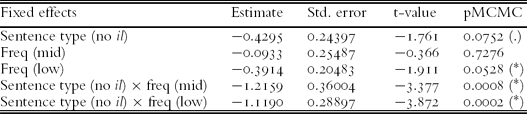
Setting aside filler items, we predicted that increased frequency would lead to higher ratings for test sentences in which il was dropped. To test this, we ran a 2 × 3 model with sentence type (il, no il) and frequency (high, mid, low) as predictors. The results are summarised in Table 3 below.
Parameter estimates for mixed effects model testing the effect of frequency and sentence type on rating (p-values estimated by MCMC sampling, (.) indicates marginal significance)
First, there was a marginally significant effect of sentence type, with participants rating sentences with il retained somewhat higher than those with il dropped. This is as expected if French speakers have access to both the Standard and Spoken register, and retaining il is clearly (in general) an acceptable possibility in both (Massot, 2008; Culbertson, Reference Culbertson2010: 97; Palais, Reference Palais2013). Participants were also found to generally rate sentences containing low frequency verbs lower than those with high frequency verbs.Footnote 11 Most interestingly, a significant interaction between sentence type and frequency was found – participants rated sentences with il dropped significantly higher when those sentences contained a high frequency verb compared to a mid and low frequency verb. To investigate this effect further, sentences with il dropped were analysed alone. When il was dropped, participants were found to rate sentences with high frequency verbs higher than those with mid frequency (β = −1.50 ± 0.26, p < 0.001), and higher than those with low frequency (β = −1.58 ± 0.20, p < 0.001). No difference was found between ratings for sentences with mid and low frequency verbs (β = 0.008 ± 0.10, p = 0.67). In summary, when the verb in the sentence was high frequency, participants in this experiment accepted sentence with il-drop almost as readily as they accepted their il-retained counterparts (mean 5.58 compared to 6.01). By contrast, for sentences with only mid or low frequency verbs, ratings of il-drop were relatively low. This result confirms our prediction that frequency of the verb indeed has a strong effect on the availability of il-drop in Spoken French. Example sentences (with their average ratings out of 7) are given in (11).
(11)
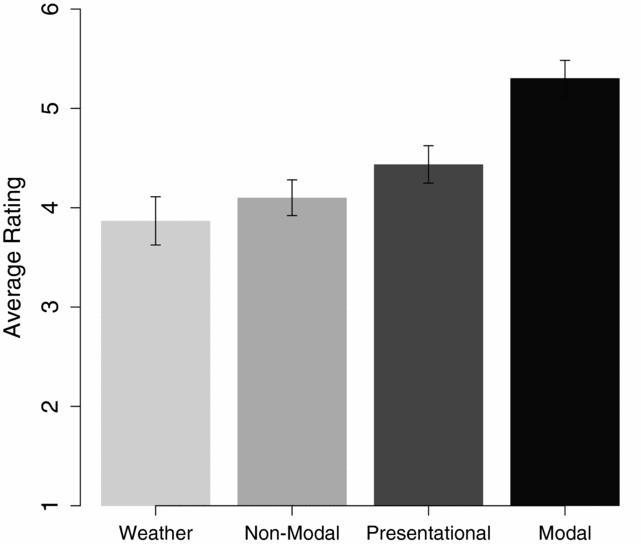
Verb type – as defined by the verb classes described in section 4.2 – was also investigated in more detail for test sentences with il dropped. Figure 1 illustrates the average rating given for sentences with verbs in each class. First, to confirm that verb class in fact contributed significantly to explaining the data, we added this as a predictor to our previous model which contained verb frequency as a predictor. A Likelihood Ratio test (Lehmann, 1986) confirmed that the added complexity of the model with verb class as a predictor was warranted by the improved fit to the data (χ↑2(3) = 11.81, p = 0.008).
Average ratings given to sentences where il is absent with verbs in each class (error bars are standard error of the mean).
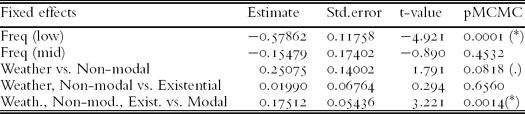
The results of the regression model are summarised in Table 4 below. This model used Helmert contrast coding, which allows us to evaluate several key contrasts in a single model by testing each level of the verb class factor against the mean of all previous levels. (The frequency factor is coded such that comparisons are made to the mean rather than a single level, since we are focusing here on the effect of verb type.) With il dropped, participants rated sentences with non-modal verbs (taking sentential complements), as marginally higher than those with weather verbs. Sentences with weather or non-modal verbs were not rated differently from ‘existential’ verbs. However, comparing the latter verb types with the class of modal impersonals reveals that sentences with modal verbs were rated significantly higher. Representative sentences from each class, along with their average ratings (out of 7), are given in (12).
(12)
Parameter estimates for mixed effects model testing the effect of verb class on rating of sentences with il-drop (p-values estimated by MCMC sampling, (.) indicates marginal significance)
Interestingly, additional post-hoc comparisons (Bonferroni corrected) revealed that among sentences with weather predicates, il drop was rated significantly higher with adjectival predicates like ‘fait beau’ compared to verbs like ‘pleut’ (β = −1.75 ± 0.58, p = 0.002). The highest and lowest rated examples in the weather class shown in (13) are representative of this difference (note example (13) is in the range of acceptability of il-drop with predicates like s'agit ‘is about’ and semble ‘seems’).
(13)

Finally, as suggested by an anonymous reviewer, we investigated two additional effects. First, the effect of phonological context on il-drop ratings. In particular, we looked to see whether il-drop was more likely to be accepted when il would be followed by a vowel-initial auxiliary verb or verbal complex (e.g. a auxiliary verb like être ‘to be’, or a clitic+verb complex as in y a ‘(there) is’). This factor was not found to be significant (β = −0.20 ± 0.20, p = 0.32), however as it was not systematically manipulated in our stimuli, additional investigation may be warranted. Second, we conducted several analyses aimed at assessing whether particular verbs behaved differently than others within a given verb type (weather, modal, non-modal, existential). Among the weather verbs, sentences using faire froid ‘to be cold’ were found to be more acceptable without il than other weather predicates, while sentences using pleuvoir ‘to rain’ were found to be less acceptable. Among the modal verbs, sentences with vaux mieux ‘to be better’, and être probable ‘to be possible’ were found to be more acceptable without il, while être clair ‘to be clear’ was less acceptable. Among the non-modal verbs, sentences with suffir ‘to be enough’ where found to be more acceptable without il, while sentences with prevoir and convenir, e.g. est prévu que. . . ‘is predicted that. . .’, est convenu que. . . ‘is agreed that. . .’ were less acceptable. Finally among existential predicates, sentences with venir, e.g. il vient DP -def ‘there comes DP-def’ were found to be more acceptable without il, while those with dormir, e.g. il dort DP -def ‘there sleeps DP-def’ was found to be less acceptable. (In all cases, p<0.05, and models are fit on residual ratings after frequency is taken into account). This suggests that there may be some amount of construction-specific variation in addition to variation between classes of verbs, however further investigation would be needed to confirm these differences.Footnote 12
5. DISCUSSION AND CONCLUSIONS
5.1 Summary
Based on impressionistic analysis of corpus data, we hypothesised that frequency and quasi-argument vs. true expletive status of the impersonal subject are factors that affect the availability of il-drop in Spoken French. We predicted that higher frequency verbs would result in higher ratings of sentences with il-drop, and that verbs taking a quasi-argument (e.g. weather predicates) would result in lower ratings of il-drop. These predictions were borne out by the results of the acceptability judgement task reported here. In particular, sentences with il-drop which used verbs in the highest frequency bin (e.g. (il) faut (que). . . ‘(it) is necessary (that). . .’, (il) y a. . . ‘(there) is. . .’, (il) paraît que. . . ‘(it) seems that. . .’) were rated higher compared to sentences using mid or low frequency verbs, in line with frequency-based models of change (e.g. Bybee & Hopper, Reference Bybee and Hopper2001). Crucially however, frequency alone did not fully explain participants’ ratings. First, il-drop in sentences with weather predicates was generally rated lower than for other verb types. Highest rated with il-drop were sentences using verbs we have classified here as modals (which often take a sentential complement), e.g. faut (que), est possible/clair/probable (que), vaut mieux (que). The other verb classes tested – non-modals (with sentential complements) and presentational/event-reporting verbs – had ratings which fell somewhere in the middle. Again, these asymmetries held even after controlling for the effects of frequency. The picture painted by these results is a complex one, and likely represents a snap-shot of a change in progress; there is without a doubt variation in il-drop even for those predicates with which it was judged most acceptable here, and surprisingly, even predicates typically thought to categorically disallow il-drop were not necessarily rejected by speakers (e.g. adjectival weather predicates).
5.2 Discussion
We have established, using controlled native speaker judgements, that Spoken Continental French does indeed systematically allow the subject clitic agreement il to be dropped in certain impersonal constructions. We now return to the issue of what this means for the grammar of the language, and why it might be available in some contexts and not others. First, as mentioned in section 3, this loss of subject clitic agreement in the context of impersonal constructions has also taken place in the NIDs (examples repeated in (16)). This process therefore seems likely to be a reflection of the kind of grammaticalisation which has occurred in these languages. While these constructions on the surface are parallel to the non-referential null subjects found in Italian and other null subject languages, there is an important distinction; in Italian for example, just as in referential null subject contexts, there is no overt subject argument in impersonal constructions, however in both cases suffixal verbal agreement marking is present. In Spoken French and the NIDs, an overt subject argument can be dropped in referential and non-referential contexts, however, the prefixal agreement marking can also be dropped in (some) non-referential impersonal constructions. Thus, because the subject clitics in these languages are not true argumental subjects, dropping il (or the equivalent clitic in the NIDs) is parallel to dropping an agreement marker, not a subject. When the il is retained in impersonal constructions, there is still a non-referential null subject. What needs to be understood for these language then, is why prefixal agreement is not triggered (regularly) in impersonals. We focus first on the difference between the availability of il drop in weather predicates compared to the other construction types investigated.
In the literature on null subject languages, the following typology of null pronominals has been suggested (Rizzi, Reference Rizzi1986a): pro+ref (fully referential/argumental null pronoun), proexpl+A (quasi-argumental null pronoun), proexpl–A (non-argumental null pronoun). These distinctions are motivated by asymmetries in the availability of null subjects of these types cross-linguistically, and in the form of the expletive used (Travis, Reference Travis1984). Setting aside for the moment the apparent variability in the Spoken French system, we can characterise the language within this typology as licensing all three null pronominals, but exhibiting (obligatory) clitic agreement with only pro+ref and proexpl+A. The suggestion we would like to put forward here is that the featural content of these three null pronominals differs, resulting in the difference in agreement triggering. In particular, subject clitic agreement is not triggered by true expletive proexpl–A precisely because this argument lacks any featural content – it cannot provide an identifiable set of subject phi-features, required for subject clitic agreement. This is similar to what was implied by Lambrecht (Reference Lambrecht1981: 28), who characterised Spoken French subject clitics as fulfilling an agreement function which is crucially not available in impersonal constructions. By contrast, pro+ref clearly has a full set of phi-features, and thus is expected to trigger clitic agreement. The quasi-argumental proexpl+A, we suggest, while not having a fully articulated set of features nevertheless has some featural content, in fact enough to trigger agreement. Evidence for this view comes from several sources which we survey briefly here (for the most part based on overt quasi-arguments and expletives, but by assumption the properties which hold of these also hold of the null pro alternatives).
First, as mentioned above, quasi-argumental expletives differ from true expletives in serving as controller of (non-arbitrary) PRO (8), have been argued to carry a bleached (rather than no) theta-role (Chomsky, Reference Chomsky, Belletti, Brandi and Rizzi1981: 323–5; Rizzi, Reference Rizzi1986a: 528–9), and have some (rather than no) referential value (Bolinger, Reference Bolinger1977: 77–87; Rizzi, Reference Rizzi1986a: 528–9). Along similar lines, Svenonius (Reference Svenonius2002: 6) points out that because weather predicates can assign case to an internal object (‘it's raining mackerel/cats and dogs/men, il pleut des cordes/grenouilles), by Burzio's Generalisation, they must actually assign an external theta-role to ‘it’ in English (although see Crousaz & Benincà, Reference Crousaz and Shlonsky2003 on how this may vary cross-linguistically). Acquisition evidence also supports a referentiality distinction between proexpl+A and proexpl–A. In particular, Kirby and Becker (Reference Kirby and Becker2007) show that English children acquire referential and quasi-argumental ‘it’ earlier than true expletive ‘it’, and interpret this finding as support for the view that children acquire more referential arguments earlier. Cross-linguistically, special ‘dummy’ subjects e.g. ‘world’, ‘nature’, ‘surroundings’, or cognate arguments ‘rain (N)’, ‘snow (N)’ can be used in weather constructions but not in true expletive constructions (Eriksen, Kittilä & Kolehmainen, Reference Eriksen, Kittila and Kolehmainen2010). In French (like English), most weather predicates exhibit the alternations in (14) not found in other impersonal constructions (although for more details see the thorough discussion in Ruwet, Reference Ruwet1991: Ch. 3). It is possible then that the referential accessibility of quasi-argumental expletives comes in part by analogy to such constructions, or to something like incorporation of the subject/theme la pluie into the verb (as suggested by Jackendoff, Reference Jackendoff1983: 185).
- (14)
a. Il pleut aujourd'hui.
‘It's raining today.’
b. Il tombe de la pluie.
Lit. ‘It is falling (of the) rain.’
c. La pluie tombe aujourd'hui.
‘The rain is falling today.’
d. Le temps est pluvieux aujourd'hui.
‘The weather is rainy today.’
A more precise characterisation of the feature difference between proexpl+A and proexpl+A was suggested by Rizzi (Reference Rizzi1986a: 543), who argued that quasi-arguments are in fact specified for number features while true expletives have neither number nor person features (see also Ouhalla, Reference Ouhalla1993: 490).
That the presence of subject clitic agreement would be sensitive to the features of the subject – either null or overt – is perhaps not surprising given other facts about Spoken French and the NIDs. Suñer's (Reference Suñer1992) Matching Hypothesis aims to explain the pattern of subject clitic agreement in Trentino and Fiorentino as due to feature-matching requirements which must hold between the subject argument and an agreeing clitic. In particular, she argues that subject clitics in the NIDs are triggered only when the subject argument is given or identifiable (and null or neuter otherwise). This explains, for example, the pattern of missing/default agreement with wh-subjects (as in (15)b) also discussed by Brandi and Cordin (Reference Brandi, Cordin, Jaeggli and Safir1989). Similarly, because the proexpl –A is not identifiable, in Trentino no subject clitic agreement should appear, and this is confirmed by (16)b. In Fiorentino, there is in fact a ‘default’ neuter clitic, and it is the one used with impersonal verbs (16)c.
Following Suñer (Reference Suñer1992), Culbertson (Reference Culbertson2010) analysed Spoken French subject clitics as agreement markers triggered only when the subject argument is definite and accessible (see also Nadasdi, 1995; Coveney, Reference Coveney2005). Thus no clitic agreement is present with indefinite DPs (e.g. personne ‘nobody’) or wh-subjects, as in (15). If our discussion of the features of quasi-argumental expletives is on the right track, the marker il would be triggered in such cases because the featural set of proexpl+A does not clash with the matching requirements of subject clitic agreement. On the other hand no subject clitic agreement is predicted to appear with proexpl–A either because – as Suñer (Reference Suñer1992) argued – such subjects are essentially accessible, or alternatively because no features are present to be matched.Footnote 13 As mentioned above, the clitic ça, is used as an alternative to il in some impersonal constructions, including with weather predicates (e.g., ça pleut). This clitic is argued by Auger (Reference Auger1994: Ch. 4) to be an agreement marker with features distinct from il based on its use with generic (referential) subject DPs. In at least some of the constructions tested here, it may be that ça rather than il is dropped, however in either case clitic agreement is missing. It remains to be seen whether the pattern of omission of ça differs from that of il.
(15)
(16)


The remaining factors we have uncovered here – that modal impersonal predicates are rated as the most acceptable with il-drop, and that there is a clear relationship between frequency and il-drop – may be related to more general principles of language change. For example, one of the most frequent impersonal constructions, faut (que), is a modal predicate, and the availability of il-drop more generally in that class may be the result of analogical processes (Hopper & Traugott, Reference Hopper and Traugott2003). Further, the general phonological reduction of il to i in Spoken French seems like to be similarly related to frequency, and thus may serve to accelerate il -drop in just those cases.
While we have couched our explanation here in terms of abstract features, it is possible to formulate an alternative view of this process of grammaticalisation which is similar in spirit, but more in line with usage-based approaches (e.g. Bybee & Hopper, Reference Bybee and Hopper2001; Hopper, Reference Hopper1987). Under this view, subject clitic agreement can in some sense be expected to drop in constructions like the ones investigated here; impersonals, weather predicates, and the like present no ambiguity in terms of the semantic identity of the subject, and thus agreement is not functionally needed there. A usage-based approach would of course also lead to the expectation of frequency as a driving factor, and the most frequent constructions – among them those we have classified as modal, non-modal and existential – indeed are most permissive of il-drop. If these constructions can be distinguished from weather verbs semantically, then il-drop might extend analogically to the former faster than the latter. Of course, it remains to be worked out precisely how the classes might in fact be distinguished (without recourse to notions like the type of null subject licensed).
Several additional questions remain of course, most obviously the variation in availability of il-drop within a given impersonal construction in Spoken French. We leave this issue for the most part to future work, however a few comments are in order. The appearance of subject clitic agreement in fact exhibits variation in other contexts in Spoken French as well. In particular, even when the features of an overt argumental subject match those of the subject clitic, agreement is triggered apparently optionally in some cases (e.g. in the case of non-pronominal definite DP subjects, see (16), and (5)b). Thus any analysis of subject clitic agreement in Spoken French will necessarily be faced with this issue. It seems likely that this variation is due to the fact that the clitic system is still in the process of change in French, and most adult speakers by assumption have access to the Standard French grammar – a non-null subject grammar in which subject clitics are true argumental subjects.Footnote 14 This is supported by the fact that frequency is clearly playing a role in Spoken French il-drop (see Krug, Reference Krug1998; Diessel, Reference Diessel2007, among others for discussion of the role of frequency in grammaticalisation).
5.3 Conclusion
Spoken French subject clitics have been argued to function as agreement affixes (Roberge, Reference Roberge1990; Auger, Reference Auger1994; Culbertson, Reference Culbertson2010; among others) similar to the agreement subject clitics of several Northern Italian dialects. These languages have thus become null subject licensing, and have two sources of agreement morphology – an older suffixal system (phonologically retained for verbs of certain conjugation classes only), and a newer prefixal system. We have focused here on constructions licensing non-referential null subjects in Spoken French – impersonal constructions – in which the agreement subject clitic il is optionally absent. Using controlled native speaker judgements, we have confirmed that the availability of il-drop is affected by the frequency of the predicate, the type of null subject licensed (quasi-argument vs. true expletive), and relatedly, the class of the predicate (modal verbs were given the highest ratings). These findings are a preliminary but significant step forward given the difficulty of investigating these features in-depth using corpus evidence alone. We have argued that the (optional) lack of subject clitic agreement in these constructions, also a feature of the Northern Italian dialects with agreement clitics, is the result of feature matching requirements of these agreement systems (Suñer, Reference Suñer1992; Culbertson, Reference Culbertson2010). For Spoken French, we have suggested that a featural (referential) distinction between the quasi-argumental proexpl+A of weather predicates and the true expletive proexpl–A of other impersonal constructions leads to (near-)obligatory clitic agreement in the former but not the latter.
APPENDIX: Task Instructions
Instructions: Evaluation des phrases
Vous allez entendre des phrases en français et déterminer si elles vous paraissent acceptables. Par phrase acceptable, on veut dire qu'un locuteur natif du français pourrait l'utiliser dans une conversation naturelle entre personnes qui se connaissent bien. Par inacceptable on veut dire que la phrase vous paraîtrait bizarre si un ami l'utilisait dans une conversation avec vous, ce qui vous mènerait à penser que le français n'est pas sa langue maternelle.
On ne s'intéresse ni aux points de style ou de clarté, ni aux règles de grammaire que vous avez pu apprendre à l'école. Ce sont vos premières intuitions en tant que locuteur français qui nous intéressent, donc concentrez-vous seulement sur ce qui vous paraît plus ou moins naturel en conversation. De plus, on s’ intéresse particulièrement à ce qui est naturel dans le style ‘informel’ du français – la langue que vous utilisez en conversation avec vos amis proches ou votre famille, pas le style formel ou professionnel qu'on utilise quand on parle à son patron ou à ses profs.
Chaque phrase que vous allez juger sera précédée d'une question qui la situe dans un contexte particulier. Par exemple, vous pourriez entendre la question «Quel est votre film préféré ?», puis la réponse «Le film que j'aime le mieux est 8 Femmes». C'est la réponse, la deuxième phrase, que vous devez juger.
Utilisez une échelle de 1 (totalement inacceptable) à 7 (tout à fait acceptable) pour juger les phrases.
Essayez de ne pas vous attarder sur aucune phrase et de réfléchir à votre évaluation; indiquez votre toute première réaction pour chaque phrase.
Ce sondage n'est pas un test de mémoire ou un piège quelconque. N'essayez pas de mémoriser les jugements que vous donnez, ce sondage n'est pas un test secret d'intelligence! On est des linguistes, et on étudie la langue. On veut simplement savoir si vous trouvez acceptable ou non les phrases présentées pour que nous, on puisse mieux comprendre la langue française d'aujourd'hui.
[Translation: You will hear some sentences in French and decide whether they seem acceptable to you. By an acceptable sentence, we mean that a native speaker of French could use it in the natural conversation between people who know each other well. By unacceptable, we mean that the phrase would be strange to you if a friend used it in conversation with you, and it might lead you to think that French was not their native language.
We are not interested in points of style or clarity, nor in the rules of grammar that you may have learned in school. It's your immediate intuitions as a French speaker that interest us, so concentrate only on what would seem more or less natural to you in conversation. In addition, we are particularly interested in what is natural in ‘informal’ French – the language that you use in conversation with your close friends, not the formal or professional style that you might use when talking to your boss or professors.
Each phrase that you judge will be preceded by a question that situates it in a particular context. For example, you might hear the question “What's your favourite movie?”, then the response “My favourite movie is ‘Huit Femmes'”. It's the response, the second sentence that you must judge.
Use a scale from 1 (totally unacceptable) to 7 (perfectly acceptable) to judge the sentences.
Try not to take too long on any one sentence or reflect on your judgement; give your immediate reaction for each sentence.
This task is not a test of your memory or any other trick. Don't try to memorise the judgements that you've given, this task isn't a secret intelligence test! We are linguists, and we study language. We simply want to know whether you find the sentences we present to you acceptable or not, so that we can better understand the French language today.]