




1. Introduction
Exploring subjects that have received limited scholarly attention is both intellectually valuable and historiographically necessary. While the history of symbolic capital has been widely studied, most research focuses on the industrial era and modern developments. In contrast, the medieval period remains underexplored in this regard. In what follows, the term “brand” is employed only in a metaphorical sense, as an interpretative bridge to discuss the formation of merchant identity and reputational signaling in pre-industrial contexts. Applying modern concepts such as branding or corporate image-making to the Middle Ages may seem anachronistic; yet, this study challenges that assumption. It argues that fundamental principles of reputational signaling were not only imaginable but actively employed by late medieval merchants.
Within the fields of economic and business history, reputational signaling is typically analyzed through two principal dimensions. The first concerns the distinction between the brand as a marker of commercial identity and the trademark as a legally defined category—both often treated as developments of the modern era (Bently et al., Reference Bently, Davis and Ginsburg2008; Da Silva Lopes and Casson, Reference Da Silva Lopes and Casson2012; Higgins, Reference Higgins2012). The second focuses on the relationship between symbolic capital and market competition, particularly during the 19th and 20th centuries, when the interaction between trademarks, consumer perception, and market strategies became especially pronounced (Mercer, Reference Mercer2009; Lopes, Reference Lopes2013). Despite this modernist framing, recent scholarship increasingly challenges the industrial exclusivity of merchant identity, tracing its conceptual roots back to the Late Middle Ages (Hamilton and Lai, Reference Hamilton and Lai1988; Epstein, Reference Epstein2008; Bastos and Levy, Reference Bastos and Levy2012). During this period, individual craftsmen and guilds employed distinctive marks to differentiate goods, uphold quality standards, and build consumer trust (Koehn, Reference Koehn2001; Epstein, Reference Epstein2008; De Munck, Reference De Munck2012). Counterfeiting, market regulation, and consumer signaling through marks also emerged earlier than commonly assumed, as shown by premodern responses to fraud and imitation (Duguid and Lopes, Reference Duguid and Lopes2010; Greenhalgh and Rogers, Reference Greenhalgh and Rogers2012; Higgins, Reference Higgins2012; McKendrick et al., Reference McKendrick, Brewer and Plumb2018).
From an economic perspective, these dynamics can be approached through the framework of information asymmetry, understood as situations in which one party to a transaction possesses more or better information than another (Akerlof, Reference Akerlof1970; Spence, Reference Spence1973; Stiglitz, Reference Stiglitz2002). In late medieval long-distance trade, such asymmetries were particularly acute: merchants operated across geographically dispersed markets, relied on intermediaries, and frequently dealt with agents whose reputation could not be verified through direct personal knowledge. Under these conditions, visual and documentary devices capable of linking a transaction, a letter, or a financial instrument to a recognizable merchant or company acquired practical economic value. Merchant marks may therefore be interpreted as visual signals embedded in commercial practice: they did not eliminate uncertainty, but they helped stabilize attribution, continuity, and recognition across distance. In this sense, they functioned not simply as identifiers but as part of the broader repertoire through which premodern merchants managed informational frictions within imperfect market environments.
Before proceeding further, it is necessary to clarify the conceptual object of this investigation. Merchant marks, unlike seals, trademarks, collective marks, or signa, were personal or corporate emblems functioning within documentary, rather than purely material, contexts. SealsFootnote 1 were legally validating devices attached to charters; trademarks later evolved as product identifiers in regulated markets; collective marks were corporate symbols of guilds; and signa referred to the visual representations used in shop signage or urban identification. Merchant marks, by contrast, operated primarily within notarial and financial documentation, where they served to authenticate signatures and express merchant identity. Importantly, marks impressed on goods and those recorded in documents represented two distinct though sometimes overlapping practices: the former related to ownership and control of merchandise, the latter to documentary validation and the public articulation of mercantile standing. This distinction is crucial to understanding their dual economic and symbolic function.
While this body of literature is valuable, it warrants further refinement. Many studies conflate artisanal or guild marks with broader questions of commercial visibility, applying frameworks better suited to product labeling than to the construction of mercantile identity. This study contends that while craftsmanship-related marks primarily served a functional role, c’est à dire, ensuring quality and reliability, it is in the domain of merchant activity that symbolic capital, in the sense of crafting economic identity and projecting trust, was more consciously developed. In particular, merchant marks in the Western Mediterranean operated as visual instruments of reputation and prestige. Unlike simple seals or producer marks, they allowed merchants to project a stable presence across wide commercial networks. This distinction is critical, as mercantile identity practices have often been overlooked or subsumed under broader discussions of seals, despite their unique symbolic and economic functions.
One notable exception to the limited attention paid to merchant-specific forms of visual self-representation is the research of Thomas Kittel (Reference Kittel2020), which offers valuable insights into the symbolic function of merchant marks. His study is among the few to explicitly highlight their role as nonverbal signatures within trade networks and to interpret these marks as heraldic-based emblems employed by prominent mercantile families. Although Kittel approaches the topic primarily from a cultural–historical perspective and focuses on the 16th and 17th centuries, his findings resonate with the economic implications explored in this study. In particular, the dual function he identifies—as both a marker of professional identity and an instrument of self-fashioning—is highly relevant to the 14th- and 15th-century cases examined here. His work reinforces the notion that merchant marks were not merely functional signs, but socially charged devices through which mercantile families fashioned public presence within expanding commercial networks.
The late 14th and 15th centuries represented a transformative period in the development of European economic structures. Often described as an era of incipient long-distance commercial integration, this period witnessed the expansion of long-distance trade networks, the formalization of risk management practices such as maritime insurance, and the refinement of financial instruments that would become foundational to modern capitalism (Tracy, Reference Tracy1990; López Pérez, Reference López Pérez1999; Goldthwaite, Reference Goldthwaite2011; Engel, Reference Engel2016; Ceccarelli, Reference Ceccarelli2021; Orlandi, Reference Orlandi2021; Goddard, Reference Goddard2022; Botticini et al., Reference Botticini, Buri and Marinacci2023). These shifts were underpinned by the consolidation of institutional frameworks that structured market interaction and contract enforcement (Milgrom et al., Reference Milgrom, North and Weingast*1990; North, Reference North1990; Greif, Reference Greif2006; Greif and Kingston, Reference Greif, Kingston, Schofield and Caballero2011; Ogilvie, Reference Ogilvie2011, Reference Ogilvie2019; Jedwab et al., Reference Jedwab, Johnson and Koyama2022). In this context, the Western Mediterranean emerged as a highly integrated commercial zone, linking the economies of southern and northern Europe and connecting Christian Europe to the Islamic world, North Africa, and Asia through the intensification of global trade routes (De Roover, Reference De Roover1999; Cruselles Gómez, Reference Cruselles Gómez2001; Coulon, Reference Coulon2004; Jacoby, Reference Jacoby2005; Bolton and Guidi‐Bruscoli, Reference Bolton and Guidi‐Bruscoli2021; Casado Alonso et al., Reference Casado Alonso, Igual-Luis, Miranda, Sequeira, Lains, Costa, Grafe, Herranz-Loncán, Igual-Luis, Pinilla and Vilar2024).
However, the selection of Italy and the Crown of Aragon as the geographical focus of this study responds to both empirical and analytical considerations. These regions offer an exceptionally rich and continuous documentary record, particularly through dense notarial traditions that preserve a wide range of commercial and financial instruments. This archival abundance makes them especially suitable for the systematic analysis of merchant marks within their operative context. At the same time, a substantial body of historiography has identified the Western Mediterranean as a leading zone of commercial and institutional development during the Late Middle Ages, characterized by the widespread use of bills of exchange, the refinement of credit mechanisms, the emergence of marine insurance, and the consolidation of notarial and consular frameworks governing trade (Cipolla, Reference Cipolla1956; Bryer, Reference Bryer1993; Munro, Reference Munro2001; Igual Luis, Reference Igual Luis2007, Reference Igual Luis2008; Goldthwaite, Reference Goldthwaite2011; Laliena Corbera and Lafuente Gómez, Reference Laliena Corbera and Lafuente Gómez2012a, Reference Laliena Corbera and Lafuente Gómez2012b; Malanima, Reference Malanima2018; Antinori, Reference Antinori2023; Lains et al., Reference Lains, Freire Costa, Grafe, Herranz-Loncán, Igual-Luis, Pinilla and Vilar2024). Rather than asserting absolute primacy, this study therefore treats Italy and the Crown of Aragon as analytically representative environments in which the interaction between commercial practice, institutional enforcement, and reputational mechanisms can be most clearly observed. Within these transregional networks, commercial hubs such as the Italian city-states and the Crown of Aragon played a central role in facilitating exchange and fostering trust-based relationships (Abulafia, Reference Abulafia1985; Feliu I Montfort, Reference Feliu I Montfort1988, Reference Feliu I Montfort2016a, Reference Feliu I Montfort2016b; López Pérez, Reference López Pérez1995; Laliena Corbera and Lafuente Gómez, Reference Laliena Corbera and Lafuente Gómez2012a, Reference Laliena Corbera and Lafuente Gómez2012b; Igual Luis, Reference Igual Luis, Feller and Rodríguez2016). In such competitive environments, merchant marks emerged as strategic tools of identification, recognition, and projecting credibility across contexts where direct personal familiarity could not be relied upon.
Equally important to this commercial ecosystem was the institutional figure of the notary, who operated at the intersection of law and commerce. Notaries validated financial instruments, drafted contracts, and preserved legal records in the form of notarial books—thus becoming critical mediators of trust and continuity in commercial practice (De Roover, Reference De Roover1940; García, Reference Bordes García2015; Puttevils, Reference Puttevils and Classen2015; Piñol Alabart, Reference Piñol Alabart, Mantegna and Poncet2018, Reference Piñol Alabart2021; López Pérez, Reference López Pérez2019). This symbiosis between legal documentation and commercial reliability was particularly evident in the Western Mediterranean, where notarial institutions played a key role in sustaining transactional certainty (Munro, Reference Munro2000; Abulafia and López Pérez, Reference Abulafia and López Pérez2020). By situating merchant marks within this dual framework of expanding trade networks and institutional enforcement, this study underscores their dual function: as devices for identity and as mechanisms of trust-building. Thanks to the preservation of notarial sources, it is now possible to trace how these visual signs contributed to the articulation of economic identity and the broader advancement of commercial practice in late medieval Europe.
2. Documentary sources and data collection
This paper centers on an in-depth analysis of the notarial books authored by Giuliano Scarsi,Footnote 2 a Pisan notary whose work is preserved in the Archivio di Stato di Firenze within the series Notarile Antecosimiano. Scarsi’s records span a total of 64 volumes, covering the years 1387–1435, albeit with notable gaps in the chronology. Specifically, books for the years 1388–1392, 1394–1396, 1424–1425, and 1433–1434 are absent. Scarsi’s notarial books fall into two distinct categories: the liber protocollorum et scedarum and the liber actorum. The first category corresponds to the manual book, in which the notary recorded every legal or business transaction in an abbreviated and schematic form. The second, the liber actorum, reproduces the same documents in a fuller and more developed version, almost complete but still preliminary, since neither book contains the final public instrument with the notarial subscription and sign. Consequently, the documentation is effectively duplicated: ideally, both books were produced for each year, yet in practice, some years preserve both, others only one, and sometimes neither—causing the total loss of information for the entire period concerned.Footnote 3
The exceptional preservation of Scarsi’s books renders them a corpus of inestimable historical value. Throughout the late-medieval and early-modern centuries, many manuals and act books suffered neglect or destruction; continuous sequences of both categories for the same notary are extremely rare. The existence of Scarsi’s 64 volumes, representing nearly half a century of activity, therefore constitutes an almost unique documentary series. It is not common to find, within a single archival fund, a consistent double set of books covering successive years. This continuity makes the Pisan notary’s collection an invaluable source for understanding the evolution of commercial documentation and the visual practices associated with merchant identity in the 15th century.
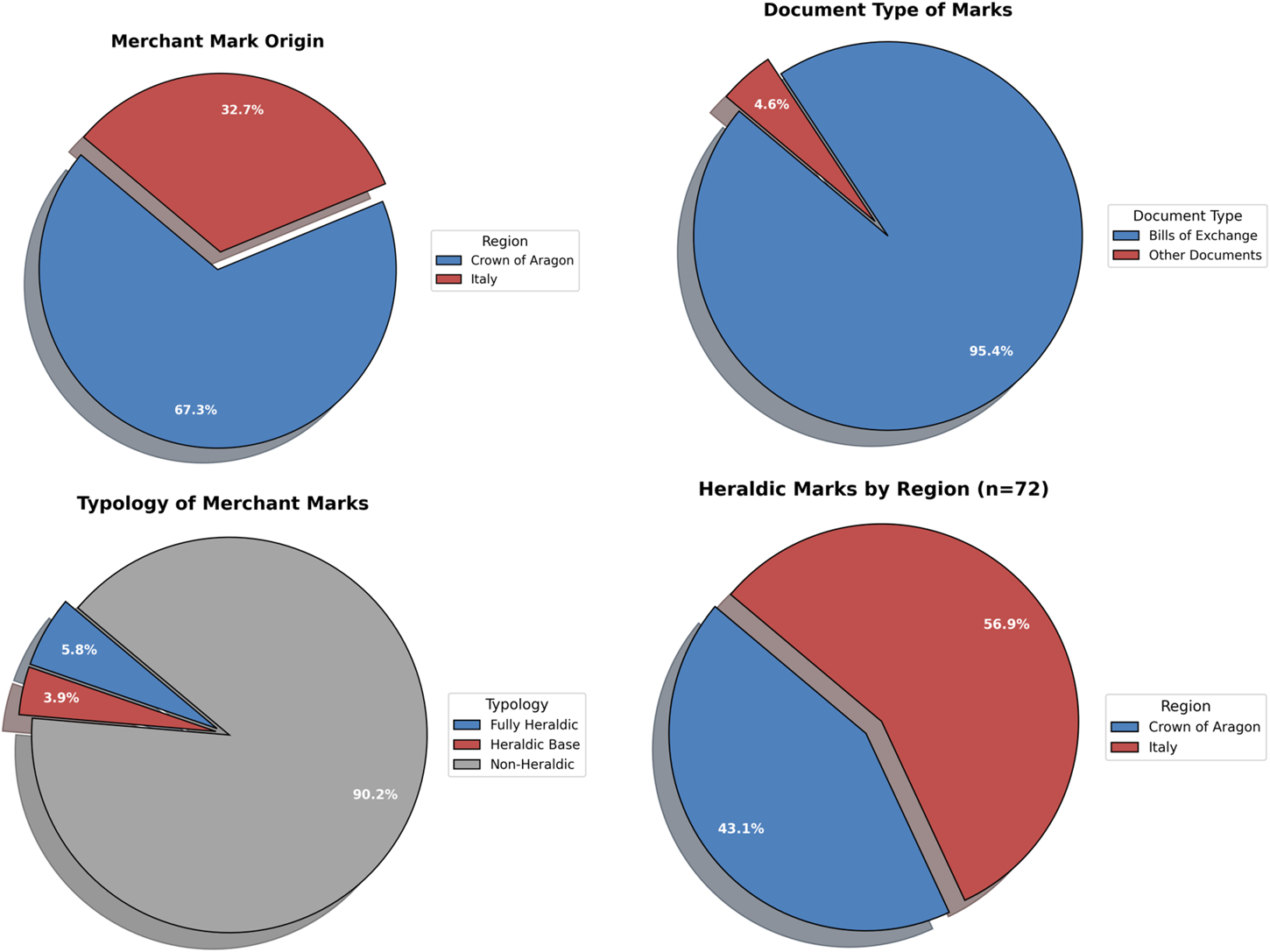
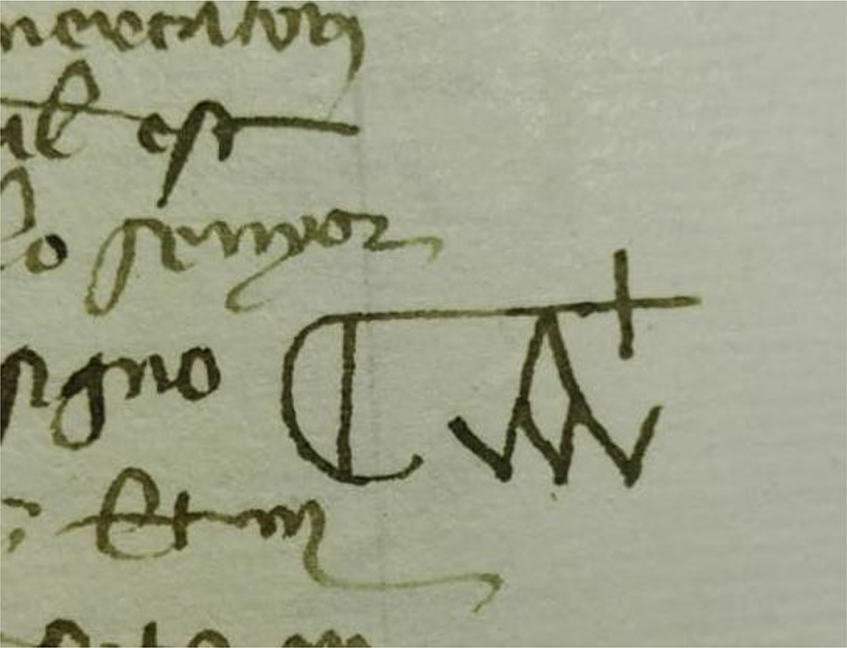
The dataset analyzed in this study comprises 738 documents containing merchant marks, extracted from the notarial records of Giuliano Scarsi (Figure 1). For the purposes of this study, merchant marks are classified into three distinct categories based on their visual structure and symbolic reference. Fully heraldic marks are those that conform to established heraldic conventions, incorporating shields, charges, and compositional principles associated with armorial systems. Heraldic-based marks, by contrast, adopt selected elements of heraldic design—such as shields or emblematic motifs—without adhering strictly to formal heraldic rules. Non-heraldic marks (= mercantile type) consist of purely geometric, alphanumeric, or abstract configurations that do not display any explicit connection to heraldic tradition. This classification provides a consistent framework for analyzing the visual variability of merchant marks within the dataset.
Visual breakdown of the dataset (own elaboration).

1 Long description
The first pie chart titled ′Merchant Mark Origin′ shows the distribution of marks by region: Crown of Aragon at 59.3 percent and Italy at 40.7 percent. The second chart, ′Document Type of Marks,′ displays document types: Bills of Exchange at 6.6 percent and Other Documents at 93.4 percent. The third chart, ′Typology of Merchant Marks,′ categorizes marks as Fully Heraldic at 5.9 percent, Heraldic-Based at 3.5 percent and Non-Heraldic at 90.7 percent. The fourth chart, ′Heraldic Marks by Region (n=72),′ shows regions: Crown of Aragon at 56.9 percent and Italy at 43.1 percent. Each chart includes a legend indicating the categories represented.
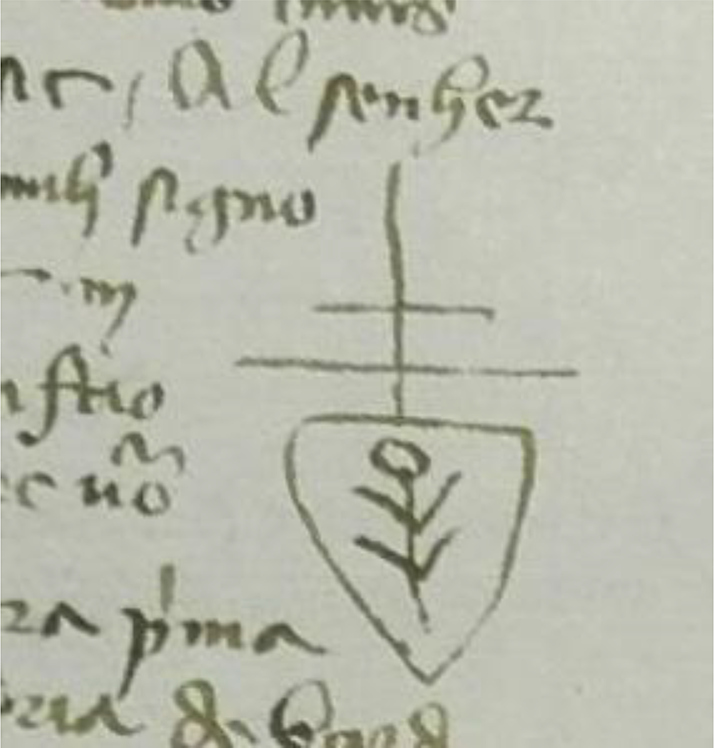
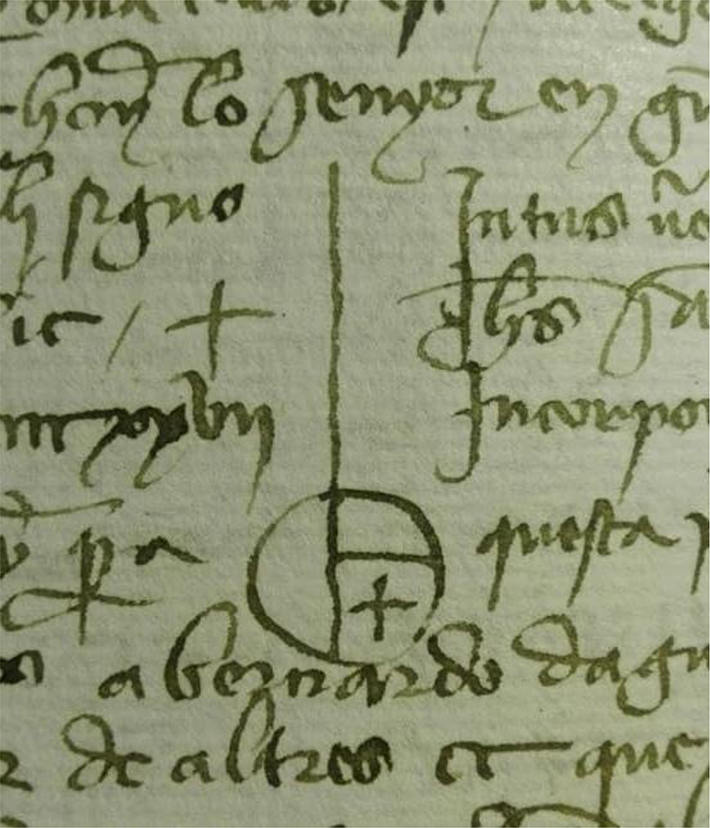
Therefore, of the 738 marks in the dataset, 483 originate from merchants associated with the Crown of Aragon, while 221 are attributable to Italian merchants. The vast majority—704 documentsFootnote 4—are bills of exchange, underscoring the financial and commercial context in which these marks were used. A smaller subset consists of 14 documents from the Crown of Aragon and 20 from Italy, where the merchant mark appears in non-exchange instruments, such as letters or account notes. Within this corpus, 72 marks can be classified as heraldic or heraldic-based. Of these, 31 are linked to merchants from the Crown of Aragon (Figure 2) and 41 to Italian merchants (Figure 3). A more nuanced typological breakdown reveals that 43 of these marks follow a fully heraldic structure, while 29 incorporate heraldic elements (Figures 4 and 5) without strictly conforming to the rules of heraldic design. The remaining marks in the dataset employ non-heraldic (mercantile) forms (Figures 6 and 7)—combinations of geometric shapes, letters (Figure 8 and 9), vertical shafts, and canting motifs—suggesting a broader range of visual strategies through which merchants fashioned their public commercial presence in late-medieval networks. It should be noted that heraldic and heraldic-based marks are more numerous in the Italian material than in that from the Crown of Aragon. This distinction is relevant insofar as it reveals regional variation in visual self-representation, but it does not alter the central argument advanced here: namely, that merchant marks of different formal types participated in the same broader economy of mercantile visibility. Heraldic marks are thus treated not as the normative or superior form of merchant representation, but as one particularly visible variant within a broader repertoire of mercantile signs.
Heraldic mark of Joan Embrí (Catalonia), ASF.18841, f. 234r–v.

Heraldic mark of Niccolò dell’Amannato (Italy), ASF.18795, f. 165v–166r.

Heraldic-based type mark of Arnaldo Puyaçuelo (Catalonia), ASF.18843, f. 113v–114r.

Heraldic-based type mark of Tomaso Cerchini (Italy), ASF.18841, f. 162r–v.

Mercantile type mark of Jordi Català (Catalonia), ASF.18845, f. 10 of April.

Mercantile type mark of Michele Lomellino (Italy), ASF.18808, f. 113v–114r.

Mercantile type mark—letter subtype: M—merchant Antonio Melzo (Italy), ASF.18841, f 51r–v.

Mercantile type mark—letter subtype: CA—merchant Macià Català (Catalonia), ASF.18845, non-foliated.

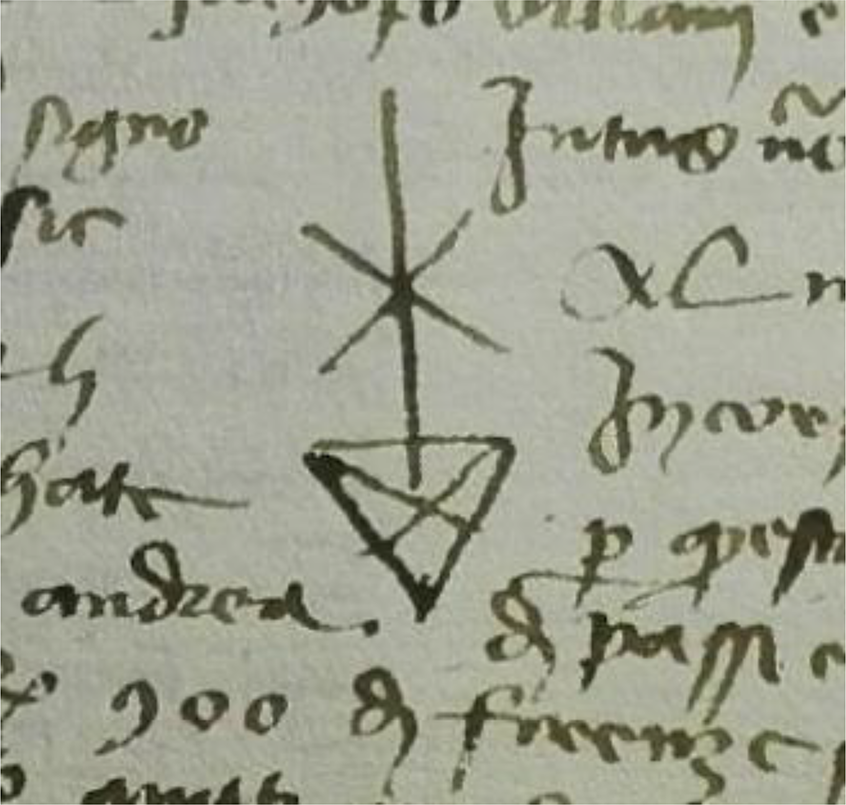
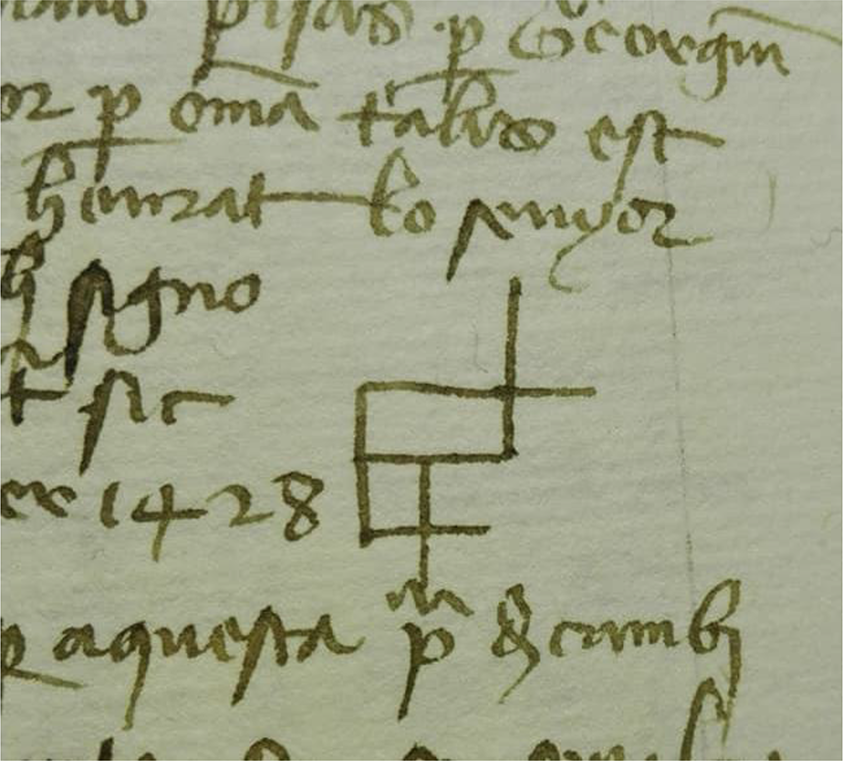
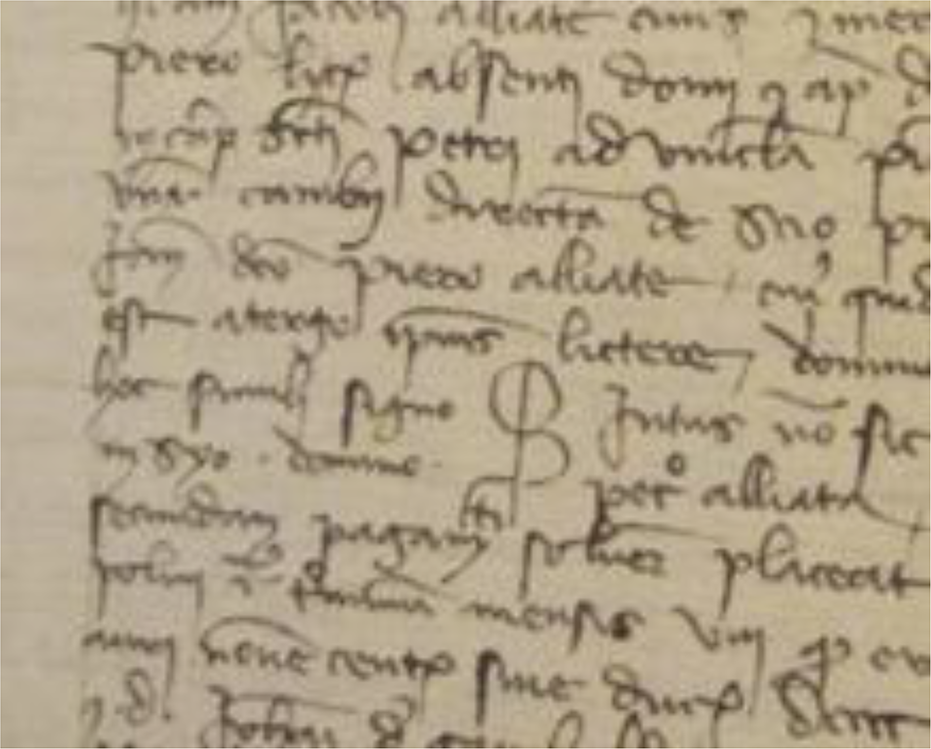
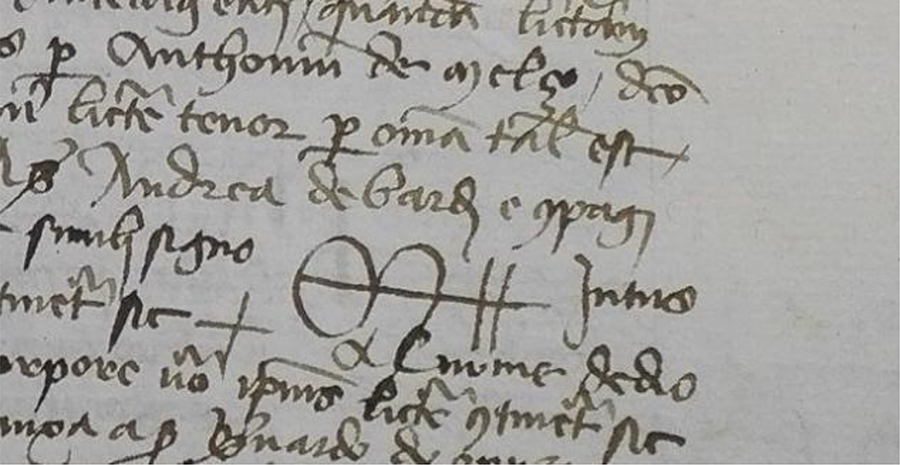
The merchant marks are typically composed of a geometric figure—such as a circle, triangle, or a shape resembling a letter—along with more distinctive designs like a heart or, in some cases, figures that defy precise description. These geometric elements are often complemented by a vertical shaft, which may or may not be topped with a cross. The cross itself can vary in form, appearing as either a single or double line, or sometimes as a diagonal cross (saltire). This structural composition imparts a sense of verticality to the marks, with horizontal designs being notably rare. An examination of Giuliano Scarsi’s notarial books reveals the evolving presentation and significance of merchant marks within the written record. These signs are consistently embedded within the body of the text, serving as integral components of notarial transcription (see Appendix). In the earlier volumes, merchant marks typically occupy two to three lines, but in the later books—reflecting a chronological progression—they often expand to four or five lines. Despite variations in size, the integration of the marks into the textual fabric remains remarkably consistent. Their placement is most commonly associated with bills of exchange or the corresponding protests, underscoring the centrality of these instruments in commercial practice.
While bills of exchange constitute the primary source in which merchant marks appear, they are not the only context. Other notarial documents also feature these signs, including acts of company formation, letters of re-exchange, general commercial correspondence, freight contracts, and even administrative records. While merchant marks were not exclusively confined to documentary use, their primary and most consistent function is observed within notarial and financial records. Bills of exchange and their related protests constitute the most frequent and institutionally standardized contexts in which these marks appear. This recurring association is not incidental: bills of exchange were routinely and meticulously transcribed into the notarial books, and within these transcriptions, merchant marks were carefully reproduced—underscoring their role as formal identifiers and as integral components of the legal and financial record. Regarding format, merchant marks appear almost exclusively as direct graphical representations. These depictions are remarkably consistent, with virtually no deviation from visual rendering. Exceptions are extremely rare. In only a handful of cases, the mark is described textually rather than drawn—a practice more typical of workshop seals or production marks than of merchant signs. Similarly uncommon are instances in which the mark is referenced solely by the name of its owner, a convention likewise more associated with artisanal or institutional sealing practices than with personal mercantile symbols. This consistency of visual representation further supports the interpretation of merchant marks as intentional, recognizable tools of identity and legitimacy within the broader ecosystem of late-medieval commerce.
Before advancing in general with the empirical study of this research, it is important to clarify the rationale behind the selection of the specific cases discussed. Out of more than 700 documented examples, only a limited number have been chosen as focal points for detailed analysis. The examples of the grands cas Footnote 5 (including the Peruzzi, Bardi, Datini, Borromei, and Buonconti companies) were selected not because they represent the entirety of mercantile experience, but because they belong to prominent families of merchant bankers whose activities have been extensively studied. For each of these cases, a well-established research tradition exists, providing solid contextualization and interpretative frameworks that enable a more coherent understanding of their operations and significance within late-medieval commerce. Above all, the case of Joan de TorralbaFootnote 6 (Abulafia and López Pérez, Reference Abulafia and López Pérez2020; Viu Fandos, Reference Viu Fandos2022) constitutes the only Iberian example of comparable magnitude: his corpus of 13 preserved accounting books offers rare chronological continuity and enables the identification of a merchant’s visual and financial identity across multiple decades (López Pérez and Nassar, Reference López Pérez and Nassar2024). This combination of Italian and Aragonese material allows for a comparative reading that bridges two of the most advanced commercial environments of the 15th century.
3. Emblems, marks, and signs: a diplomatic and heraldic perspective
The dataset analyzed in this study contains a broad spectrum of merchant marks, including geometric, letter-based, canting, and heraldic or heraldic-based forms. The examples presented in this study do not follow a typological or statistical selection, but rather serve to showcase evolving concerns with visual representation, symbolic projection, and socio-economic identity. In this context, particular attention is paid to marks that exhibit formal or functional similarities to heraldic shields, as these most clearly engage with the representational logic that underpins what we refer to here—“early merchant identity.” While merchants such as Joan de Torralba employed non-heraldic marks (that is, marks without explicit heraldic elements), others such as Berenguer Sirvent adopted heraldic-based forms. This diversity reflects the flexibility with which merchant marks could be adapted to different social and commercial contexts. However, the aim of this section is not to isolate heraldic forms as a superior or dominant category, but, au contraire, to examine how different visual registers, including those borrowed from heraldic tradition, contributed to the symbolic economy of late-medieval commerce.
At the same time, these formal differences should not obscure their shared mercantile function. What distinguishes heraldic-based marks is not their basic mercantile function, which they shared with non-heraldic forms, but the additional symbolic associations they could mobilize, particularly those linked to lineage, prestige, wealth, and social visibility. In this sense, heraldic-based marks may well have carried a stronger representational charge, especially in environments where armorial language was readily legible and socially meaningful. Yet, on the basis of the present evidence, it cannot be demonstrated in any conclusive way that they were systematically more effective than non-heraldic marks in strictly economic or commercial terms. Indeed, the evidence also points in the opposite direction: merchants such as Francesco di Marco Datini, despite belonging to a family with its own heraldic identity, relied primarily on a non-heraldic merchant mark. This suggests that the practical efficacy of a sign did not depend exclusively on its heraldic quality, but rather on the broader commercial setting within which it circulated.
This broader visual repertoire becomes clearer when heraldic-based marks are situated alongside other forms of graphic communication, particularly monograms, since both encode names or identities to be recognized visually rather than read alphabetically. These symbols depend on cognitive processes of graphic recognition, condensing authority, reputation, or power into compact and visually striking designs (Garipzanov, Reference Garipzanov2018). Viewed through this semiotic lens, merchant marks may be meaningfully compared to heraldic shields—emblems that perform analogous representational and functional roles (Le Buhan, Reference Le Buhan2024). Yet, while heraldic shields have long benefited from extensive scholarly study, merchant marks have received comparatively limited attention. The historiography of heraldry has evolved from speculative antiquarian theories invoking Greek, Roman, Germanic, Byzantine, and Islamic precedents to a well-established consensus that situates the crystallization of heraldic practice in the 12th century (Jéquier, Reference Jéquier1978; Pastoureau, Reference Pastoureau1982; Cignoni, Reference Cignoni1998), further reinforced through congresses, manuals, and institutional research. By contrast, the systematic study of merchant marks emerged only in the mid-20th century, when Federigo Melis—a pioneer of economic history, accounting, and insurance—assembled a foundational corpus of examples that informed later scholarship (Melis, Reference Melis1950, Reference Melis1962). His work was subsequently expanded by Cecchi Aste (Reference Cecchi Aste2010), Burghart (Reference Burghart2014), and Redondo Parés (Reference Redondo Parés2020), who proposed formal classification systems, yet merchant marks remain underrepresented in both general and specialist historiography, seldom the focus of dedicated colloquia, congresses, or thematic publications.
The origins and precedents of merchant marks remain somewhat obscure. Scholars have variously traced their genealogy to Roman producer marks and, more symbolically, to imperial and religious emblems such as the Chrismon of Late Antiquity. Initially signifying Christ and divine protection, the Chrismon became, under Constantine, a symbol of imperial legitimacy and was later adopted by the Roman aristocracy as a marker of Christian identity, with its diffusion in material and public culture attesting to its enduring symbolic potency in late Roman and early medieval contexts (Le Buhan, Reference Le Buhan2024). Parallel to this, monograms—graphic combinations of initials and letters—emerged as elite symbols of identity on seals, coinage, and ecclesiastical artifacts throughout the post-Roman and Byzantine worlds, later spreading across Western Europe. The Visigothic, Merovingian, and Lombard kingdoms adopted such signs, while under the Carolingians, they evolved into dynastic insignia: Charlemagne’s monogram, for instance, embodied both personal and royal authority, a model emulated by his successors and by ecclesiastical figures, including the papacy (Garipzanov, Reference Garipzanov2018). These visual traditions (of the Chrismon and the monogram) provided the conceptual framework from which merchant marks later drew. By the Late Middle Ages, within an increasingly symbolic commercial culture, such signs became essential tools of professional identification, social representation, and the mitigation of commercial risk (Von Stromer, Reference Von Stromer1992). Rooted in these earlier forms, merchant marks developed as flexible visual devices shaped by economic function and competitive need. Their earliest attestations appear in 14th-century Italian commercial documents, from which they disseminated across the Mediterranean, Flanders, and Northern Europe, evolving within the merchant-dominated city-states of the Western Mediterranean alongside innovations in accounting, banking, and maritime distribution. They thus fulfilled dual roles: facilitating fiscal control and logistical tracking, particularly in customs and port operations, while also marking the commercial actor responsible for the goods or document (Burghart, Reference Burghart2014; Gentile, Reference Gentile2017; Le Buhan, Reference Le Buhan2024).
As these marks acquired a stable presence within documentary and mercantile practice, their functions diversified beyond mere visual identification. They established ownership, facilitated the recovery of lost or stolen goods, legitimized merchandise receipts, guaranteed product quality, and distinguished artisanal goods, particularly through packaging. They also featured prominently in written records such as trade ledgers and merchants’ letters, serving as identifiers of the sender—akin to a subscription—or as postal signs enabling efficient correspondence delivery (Engel, Reference Engel1992; Cecchi Aste, Reference Cecchi Aste2010). This functional dimension is clearly visible in the correspondence of the merchant Joan de Torralba: one letter from Joan Massanet in Palermo (1434), another from Ramon Pujades in Zaragoza (1446), and a third from Pere de Soldevila in Mallorca (1454) each include Torralba’s mark in the address to ensure recognition and delivery (Arxiu Nacional de Catalunya, Llibre de Comptes, 1-960-T-3187, nos. 44, 2, and 79).
Geographically speaking, most marks preserved in correspondence from the Datini Archive originate from Central and Northern Italy, Catalonia, Southern France (Avignon and Marseille), and Northwestern Europe. These marks are typically monochrome, featuring a cross within a circle, triangle, or other simple geometric shapes, letters, and occasionally a shield format containing a symbol or partitioned lines. They predominantly adopt a vertical design, with few examples showing horizontal orientation. In the case of letters (abbreviations), their meaning often derives from the merchant’s or company’s name, such as the “F” for Francesco Datini or “M” for the Marçal, Massip, or Miafre families. Some marks include canting elements, such as a pear branch for the Peruzzi, three “XXX” for the Trenta, or a circle within another circle for Miquel de Roda (Roda = wheel) (Hayez, Reference Hayez2010, Reference Hayez, Bartholeyns, Bourin and Dittmar2018; Kittel, Reference Kittel2020; Marí Brull, Reference Marí Brull2021).
Although it may appear that each merchant or company employed a single mark, the reality was considerably more complex. Variations of a mark, whether minor or substantial, could distinguish specific products within the same shipment. A merchant might simultaneously use a personal mark distinct from that of the company, and a company’s mark could evolve even if its principal merchant remained unchanged. In partnerships, the arrangement varied: each associate could employ their own mark, or a single symbol, typically that of the senior partner, could represent the firm as a whole. In 1397, for instance, Benedetto Lomellini of Genoa claimed wool bales from Anglia sive Inghilterra bearing the marks “Q” and “T,” while his correspondence displays a similar emblem replacing the “T” with a “B” (ASF, Notarile Antecosimiano, 18795, ff. 10r–11r). This case demonstrates the adaptability of mercantile identity across partnerships and cities, showing how the same merchant could modulate his visual representation to accommodate differing commercial or jurisdictional contexts. Likewise, in 1406, Ranerio de Santo Savino of Pisa used distinct marks for his enterprises in Florence, Genoa, and Pisa (ASF, Notarile Antecosimiano, 18810, ff. 64v–67r), and many merchants engaged in multiple businesses simultaneously employed several marks (Engel, Reference Engel1992).
The use of multiple marks could also facilitate fraudulent or semi-legal practices.Footnote 7 Some merchants deliberately altered or borrowed marks to disguise ownership or exploit fiscal privileges. This, however, should not be taken as the standard pattern of mercantile practice. In the Western Mediterranean, and especially in the Catalan and Italian material, the normal tendency was toward continuity: a mark remained associated with a given merchant or mercantile house across different markets, transactions, and alliances. Multiple marks appear above all in specific situations: changes in partnership structure, the coexistence of individual and company activity, representation through factors, or, in some cases, attempts to exploit legal and fiscal asymmetries. A notable instance occurred in 1405, when the Datini company loaded silk in Valencia under the name and mark of Joan Beyona, a native exempt from taxation; upon arrival in Piombino, they sought to substitute Beyona’s name and mark with those of Datini to avoid duties imposed on foreigners (Michienzi, Reference Michienzi2021). Such maneuvers, operating within a gray zone between fraud and pragmatic flexibility, enabled merchants to safeguard their goods against confiscation, retaliation, or piracy, or to protect associated companies established in other cities (Hayez, Reference Hayez2010).Footnote 8 At the same time, other cases suggest that the coexistence of more than one mark did not necessarily imply instability or opportunism but could reflect the overlapping of distinct economic roles. Joan de Torralba offers a particularly clear example: while engaged in company activity, the partnership could employ a composite mark incorporating the signs of its principal associates, whereas Torralba himself retained his own individual merchant mark. Yet, throughout his commercial career, his personal mark remained stable. This pattern indicates that the use of multiple marks was generally linked to different juridical or organizational settings rather than to ordinary mercantile practice as such. On the basis of the present evidence, therefore, multiple marks should be understood as situational variants rather than as the ordinary pattern of mercantile practice.
4. Merchant marks as early “brand” identity
The power of logos or marks in branding today is undeniable (Wheeler and Meyerson, Reference Wheeler and Meyerson2024). When we see the bitten apple, we instantly think of Apple, and the colored “G” unmistakably signals Google. Similarly, the three-pointed star of Mercedes evokes the image of luxury automobiles. This immediate recognition, fuelled by modern advertising, e-commerce, and the prominence of logos, feels distinctly 21st century. Yet, it would be misleading to assume that this phenomenon is exclusive to our time. While we won’t find billboards or digital advertisements in the 15th century, the essence of symbolic capital recognition existed long before the modern era.
However, before applying this analogy to the late-medieval evidence, a necessary clarification must be made. A legitimate question arises when studying medieval marks: whether merchant marks should be treated together with the signs used by artisans, townspeople, or livestock farmers to identify ceramics, glass, cattle, or other material goods. As already indicated in the introduction, this study does not follow that path. Those practices, often rooted in older traditions of product authentication, were primarily connected to ownership, quality control, and protection against imitation. They remain important, but they belong to a different documentary and economic context. The focus here is instead on merchant marks as visual devices embedded in commercial, notarial, and financial practice.
Two crucial distinctions must therefore be underlined. First, the signum mercatoris—the merchant’s mark—belongs to the sphere of symbolic and institutional representation, forming part of what we may metaphorically call a system of symbolic capital rather than a literal “brand.” Its function was to make the merchant or company recognizable within commercial and banking networks in the absence of modern legal protection. By contrast, the seals used to distinguish or guarantee the quality of goods produced in a workshop or on a farm were tangible identifiers affixed directly to merchandise. Second, these two categories differed morphologically and operationally: the artisanal or workshop seal followed a concrete, product-oriented logic, whereas the merchant mark operated within documentary and financial records. Thus, merchant marks formed part of a broader system of reputational identity construction, while workshop seals remained mechanisms of material authentication and quality assurance.
As seen in Figure 10, a clear contrast emerges when comparing the stylistic typologies of marks—whether heraldic, heraldic-based, or distinctly mercantile. Taking, for instance, three randomly selected examples—those of Andrea de Bardi, Berenguer Sirvent, and Joan de Torralba—it becomes evident that such merchant marks differ qualitatively from the more rudimentary seal marks. While the latter served a purely functional purpose, used simply to mark or identify ownership, the former reveals a more elaborate visual language adapted to the needs of mercantile communication.
Contrasting seals and merchant marks: heraldic, heraldic-based, and mercantile types.

Figure 10 Long description
A four-part comparative layout arranged left to right, separated by vertical dividers. Each part contains a rectangular manuscript excerpt with dense handwritten lines and a single simple line mark drawn over the writing. Beneath each rectangle is printed English text. Left section: The mark is a cross shape with a longer vertical stroke and a shorter horizontal stroke. Printed text below reads: Seal Mark left parenthesis ASF dot 18827, f dot 88r right parenthesis. Second section: The mark is a diamond outline with internal diagonal lines. Printed text below reads: Merchant Mark: Andrea de Bardi left parenthesis heraldic type right parenthesis left parenthesis ASF dot 18841, f dot 186r-187r right parenthesis. Third section: The mark is a circle with a cross inside and additional straight lines forming a grid-like pattern within the circle. Printed text below reads: Merchant Mark: Berenguer Sirvent left parenthesis heraldic-based type right parenthesis left parenthesis ASF dot 18843, f dot 222r-v right parenthesis. Right section: The mark is made of intersecting straight strokes, including a vertical line and angled lines forming an X-like shape. Printed text below reads: Merchant Mark: Joan de Torralba left parenthesis mercantile type right parenthesis left parenthesis ASF dot 18832, f dot 30r-31r right parenthesis.
In the Late Middle Ages, following the commercial revolution,Footnote 9 systems of recognition for merchants, merchant bankers, and trading companies were already well established. Marks and symbols, though distinct from modern logos, formed part of the practical apparatus through which commercial actors made themselves identifiable across vast trade networks. They functioned as instruments of reputational signaling, reducing information asymmetry and facilitating exchange in markets that lacked formal auditing or credit-rating mechanisms.Footnote 10 Yet, this function was not abstract. In the notarial and financial documentation examined here, the merchant mark often appeared in contexts where the name of the merchant, agent, or company was already written. Its inclusion was therefore not simply a matter of identification in the narrow sense. Rather, the mark added a visual and reputational layer to the written act, helping to connect a bill of exchange, protest, copy, contract, or commercial instruction to a recognizable economic actor and to the symbolic capital associated with him.
The notarial treatment of these marks makes this function especially visible. In the absence of formal trademark legislation, notarial writing did not create a proprietary right over the sign in the modern sense, but it could operate as a mechanism of documentary validation. When notaries reproduced a merchant mark in a copy, protest, memorandum, or related commercial instrument, they were not adding a decorative element, but preserving a sign that had practical evidentiary value. Once entered into notarial documentation, the mark acquired procedural visibility and could form part of the evidentiary material available before mercantile jurisdictions such as the Consolat de Mar in Barcelona, the Consoli del Mare in Pisa and Florence, or the consular courts of Genoa and Marseille.Footnote 11 The mark therefore supplemented the written name by providing a visual form of attribution, capable of linking persons, goods, and obligations across documentary sequences and commercial operations.
A concrete example of this practical function is provided by a loose 15th-century cargo memorandum preserved among commercial and insurance-related notarial materials in BarcelonaFootnote 12 (Figure 11). The document is brief, comprising only four pages, with the final page left blank. The document lists packages of merchandise—including nutmeg, pepper, gum arabic, borax, brazilwood, cotton, copper, and textiles—by associating each group with a graphic sign placed in the left margin. The recurrent formula de tal senyal indicates that the mark was not ornamental but served as an operative identifier linking the written entry to the physical package. Its importance becomes clearer in relation to information asymmetry. In maritime trade, the person who owned, financed, insured, or claimed the goods was often not the same person who loaded, transported, received, stored, or verified them. The mark therefore helped bridge the informational gap between absent principals, commercial agents, carriers, notaries, and potential claimants by making merchandise recognizable across different documentary and material contexts. The repeated notation that certain goods were no consignats is especially revealing: where ordinary consignment procedures were incomplete, absent, or disputed, the sign preserved a minimum mechanism of attribution and evidentiary control. The memorandum thus shows that marks could operate as low-cost instruments for reducing uncertainty: they connected persons, goods, and documents in a commercial environment characterized by delegated agency, fragmented knowledge, and imperfect monitoring.
Mark-based cargo memorandum listing merchandise by commercial signs, 15th-century Barcelona.

In this respect, merchant marks were not isolated signs but integral components of the institutional and communicative architecture of commerce, linking personal honor, professional credibility, and economic functionality. The same transformations that strengthened civic institutions, financial practices, and contractual enforcement also fostered new modes of mercantile self-representation. Within this framework, the merchant mark emerged as both a social and economic device, translating moral values such as honor and fidelity into recognizable indicators within documentary and financial circulation. The spread of financial instruments and the institutionalization of notarial and consular procedures reinforced the evidentiary and symbolic authority of such marks, sustaining a system in which visual recognition and contractual credibility converged to support expanding commercial networks.
Taking into account these structural transformations—both macroeconomic and microeconomic—it becomes evident that the extensive use of merchant marks (signa mercatorum or signa negotiatorum, often referred to in Latin notarial sources simply as signum) was closely connected to the intensification of trade and the rapid development of financial techniques. In this evolving commercial environment, the signum mercatoris functioned simultaneously as a practical identifier and as a form of symbolic capital, allowing merchants to differentiate themselves and maintain credibility within increasingly impersonal and competitive markets. These systems (created by and for merchants) required visible and stable mechanisms of identification and legitimacy within the broader institutional framework of exchange.
As competition intensified, the need to establish a distinct and recognizable identity became imperative. Marks and symbols thus operated as instruments of differentiation within a dynamic commercial environment in which visibility and credibility determined access to exchange. However, the establishment of such identities was not supported by formal legal protection during the late medieval and early modern periods. The formalization of trademark regimes would only emerge in the 19th century (Belfanti, Reference Belfanti2018). Nevertheless, merchants occasionally sought institutional recognition for their signs through privileges or patents in specific regional contexts, although such practices remained limited in scope (Mercer, Reference Mercer2009; Belfanti, Reference Belfanti2018).
Having addressed these institutional and legal dimensions, the discussion turns to the central question of how mercantile identity was constructed and communicated within the late medieval economy. Commercial correspondence constituted one of the principal channels through which economic, informational, and social relations were maintained. The surviving corpus of personal and commercial letters provides exceptional insight into how trust, reputation, and identity were articulated through written and visual signs (Greif, Reference Greif, Ménard and Shirley2008). Such correspondences conveyed not only information on prices, merchandise, and exchange rates but also the credibility and reliability of the sender.Footnote 13 In this communicative context, merchant marks—appearing in letters, bills of exchange, and other contractual instruments—functioned as semiotic devices that signaled legitimacy and enabled recognition across distance. The mark was therefore not merely a personal or corporate identifier, but a reputational mechanism embedded in the functioning of exchange within increasingly impersonal markets.
It is important to note that before mercantilism took hold in Europe, economic thought—and consequently the organization of commerce—remained predominantly scholastic. The well-known tension between ecclesiastical doctrine and commercial activity, particularly regarding the concept of usury, has been extensively studied (De Roover, Reference De Roover1967; Koyama, Reference Koyama2010; Denjean, Reference Denjean2011; Januard, (Reference Januard2021). Yet, the Church itself functioned as a financial institution (Ekelund et al., (Reference Ekelund, Hébert and Tollison1989)), and its moral framework shaped commercial representation. Many signa mercatorum, particularly of the mercantile type, incorporated a cross or cross-like element, symbolizing faith, integrity, and reputational probity. In societies such as the Crown of Aragon and the Italian city-states, personal honor and trustworthiness were thus conveyed both through conduct and through visual forms.
The progressive impersonalization of commercial relations further reinforced the role of merchant marks as instruments of recognition and credibility. As trade networks expanded across space and institutional contexts, mechanisms capable of substituting for direct personal reputation became increasingly necessary. In this context, the merchant mark operated as a functional response to distance, anonymity, and delegation. Merchants frequently relied on factors—agents acting on their behalf in other markets—whose authority was communicated through the use of the principal’s mark in correspondence and contractual documentation. This practice ensured continuity of identity and reinforced credibility across markets. An illustrative example is the case of Bernat Vidal and Buonaccorso de Buonconti, where Vidal, acting as a representative, employed Buonconti’s merchant mark in letters and bills of exchange, thereby signaling the authority and reliability of the principal merchant (Figure 12).
Merchant—factor mark: Buonconti—Vidal.

Figure 12 Long description
Three manuscript snippets are displayed in a horizontal row, each featuring a merchant mark and printed label. The snippets are archival in nature, showing handwritten cursive text and simple line-drawn marks. Left snippet: A manuscript fragment with a vertical line and cross-like mark. The printed label reads: ′Merchant Mark: Andrea de Bardi (heraldic type). [ASF. 18841, f. 186r–187r]′. Middle snippet: A fragment with a curved line mark and looped shape. The printed label states: ′Merchant Mark: Bartolomeo de Peruzzi (heraldic type). [ASF. 18828, f. 21r–22r]′. Right snippet: A fragment with a mark inside an oval outline. The printed label reads: ′Merchant Mark: Bartolomeo de Peruzzi and Co. (heraldic type). [ASF. 18827, f. sciolti]′. The presentation is documentary, with a focus on the historical and archival nature of the merchant marks. The printed labels are in serif type, arranged in narrow stacked lines, distinguishing them from the handwritten manuscript background.
Concerning Bernard Vidal, more information is available thanks to the extensive fund of Joan de Torralba, which preserves the entirety of his accounting books. Through these volumes, it is possible to reconstruct with considerable precision who Bernard Vidal was. He emerges as a prominent banker in 15th-century Barcelona, active during the first half of the century. Most references to him derive from his banking and financial relationships with other merchants, yet he is also identified as a mercader (merchant). For instance, Bernard Vidal is explicitly described as mercader (Benavides Helbig and Casado Novas, Reference Benavides Helbig and Casado Novas2021: 317, 328, 419). Furthermore, he frequently appears as an intermediary in bills of exchange—particularly in those involving Joan de Torralba and various Italian merchants (Benavides Helbig and Casado Novas, Reference Benavides Helbig and Casado Novas2021: 85). On certain occasions, he is also mentioned as a traginer (carrier or muleteer) (Benavides Helbig and Casado Novas, Reference Benavides Helbig and Casado Novas2021: 143). Overall, Vidal figures primarily as an intermediary or participant in four-party bills of exchange, a typical form of financial operation in the Late Middle Ages, especially between Barcelona and Florence.
Let us now consider some even more tangible examples. When working with Scarsi’s notary books, we initially created a vast dataset, as the primary data were analyzed from an economic perspective, specifically focusing on bills of exchange and exchange rate fluctuations. This allowed us to build a comprehensive network of the individuals (economic agents) involved in these bills of exchange and protested bills of exchange. Among the numerous cases recorded, the Bardi and Peruzzi families were selected for their exceptional representativeness: as the most powerful Florentine banking houses of the 14th century, they provide the clearest illustration of how merchant identity operated simultaneously at economic, social, and symbolic levels. For the present analysis, we focus on specific examples in which the mark played a key role. The mark evolved into a mercantile emblem while simultaneously retaining its heraldic origins, thereby serving a dual purpose. It acted as a powerful visual representation of the family’s identity and as a sign that symbolized their commercial credibility. In this context, we have provided two examples: the Bardi family and the Peruzzi family.
The Bardi and Peruzzi are well known to medieval historians as the two largest Florentine merchant banking companies of the 14th century (Hunt, Reference Hunt1990). They were manufacturers, traders, and bankers, with extensive operations throughout the Mediterranean and Western Europe. In many ways, they represent an early form of the modern “multinational corporation,” as often noted by scholars (Goldthwaite, Reference Goldthwaite2011; Padgett and Powell, Reference Padgett and Powell2012). They were so influential that they operated from London and had representations in Flanders, the Crown of Aragon, and southern France. They were deeply involved in the papal banking activities, which were crucial during this period. With their headquarters in Florence, they maintained key commercial activities across all major centers of Western Europe during the 14th century. The activity of these houses continued throughout the 14th century and into the first half of the 15th century, with a long history dating back to the 13th century (Guidi-Bruscoli, Reference Guidi-Bruscoli, Allen and Davies2016). They initially engaged in the wool trade, and, for example, by the end of the 13th century, the Bardi & Co. was already established in England.
However, our focus here is not to study the history of the first “multinational corporations” or the collapse of the Bardi and Peruzzi companies. Instead, the focus is on their mark (Figure 13), their identity, and how this image was projected across Europe. An important phenomenon to highlight is that many merchant marks were transformed into fully heraldic marks.Footnote 14 In both the Bardi and Peruzzi cases, these families were wealthy before rising as prominent bankers and merchants in the 14th century. They already possessed heraldic coats of arms, which later became their merchant marks, symbolizing the family’s identity and trustworthiness. For instance, Andrea de Bardi represented the Bardi family, while Bartolomeo Peruzzi did so for the Peruzzi family.
Heraldic merchant marks of the Bardi and Peruzzi families.

The Peruzzi’s merchant mark is remarkably elaborate compared to typical merchant marks, reflecting the family’s conscious investment in visual self-representation. The Peruzzi placed significant importance on being immediately identifiable through their name and lineage. To achieve this, they employed a common heraldic device known as canting arms, a visual pun in which the depicted object directly represents or echoes the family name—a pear branch (it. piro) for the Peruzzi, hence the repeated use of pears on their mark. The mark of Bartolomeo de Peruzzi embodies both complexity and balance, qualities essential for visual reproduction and recognition. Its central structure—a stylized pear that also resembles a balanced scale—may be read as conveying a deliberate dual symbolism: on the one hand, it evokes the family name through canting arms; on the other, it appears to allude to fairness and equity in trade, values central to mercantile honor. This second layer of interpretation must, of course, be treated with caution, since the surviving evidence does not allow us to prove the precise intention behind the design. Nevertheless, within the broader visual and moral economy of late-medieval commerce, the association between balance, equity, and mercantile integrity remains a plausible reading of the mark’s symbolic force. The Peruzzi family, among the wealthiest and most influential in 14th-century Florence, required a recognizable emblem to signal authenticity, reliability, and continuity between their heraldic identity and mercantile prestige.
From this perspective, the Peruzzi mark stands as one of the most accomplished expressions of symbolic capital and mercantile identity in the Late Middle Ages. Given the family’s well-known cultural patronage—exemplified by their chapel in Santa Croce, Florence—the mark may also be read within a broader effort to align commercial authority with artistic and civic distinction.Footnote 15 This convergence of economic, social, and esthetic representation underscores the mark’s role as both a practical identifier and a visual medium for projecting status across Europe. The commercial success of families such as the Bardi and Peruzzi depended not only on their capacity to trade in high-value commodities, formulate long-term strategies, and navigate the institutional environment of 14th- and 15th-century Florence, but also on their ability to sustain recognizability across multiple branches and distant markets. The question, therefore, is not whether the mark alone created trust, but how it contributed to the broader communicative mechanisms through which such trust could be maintained. In this sense, their marks functioned as visual signs of continuity, helping to link commercial operations to an already established familial and corporate reputation.
In both the Bardi and Peruzzi cases, the transformation of heraldic arms into mercantile marks reveals the conscious construction of continuity between social distinction and commercial authority. What had once belonged primarily to the visual language of lineage was adapted to the market as an emblem of mercantile presence. The mark thus became a material expression of crafted prestige: a means of translating inherited honor into a recognizable commercial form. These families, already established among Florence’s political and financial elite, used their signs to support the visibility of their transregional operations and to connect dispersed transactions with a stable familial identity. In doing so, they blurred the boundaries between heraldic symbolism and mercantile semiotics, creating a hybrid visual code through which social hierarchy and economic performance could reinforce one another. Such marks were therefore not passive indicators of origin, but active instruments of reputational communication, integrating aristocratic representation with commercial practice across distant markets.
Moving beyond Florence, we turn our attention to another geographical focus—the BorromeiFootnote 16 of Milan, a prominent merchant and banking family of the 15th century. Their case reflects a similar dynamic to that of the Bardi and Peruzzi, where the mark was not simply a sign of trade but a means of projecting reputation and consolidating credibility. In their case, as in others, the merchant mark transcended commercial circles, becoming part of a broader language of prestige and recognition that extended well beyond immediate business networks (Figure 14).
The Borromei merchant marks.

The Borromei familyFootnote 17 were among the most prominent Italian merchant bankers of the 15th century. Headquartered in Milan, with additional bases in Venice and Florence, their banking empire extended far beyond Italy, reaching into northern Europe. By the 1420s, the Borromei conducted their northern operations through agents. However, in 1435, Vitaliano Borromei took a decisive step by establishing a bank in Bruges, followed by a branch in London in 1436, operated under the name of his young son, Filippo. These expansions cemented the Borromei’s status as one of the most stable and influential banking networks in northwest Europe. In Catalonia, the Borromei maintained a robust presence, operating their own company in Barcelona while forging strategic partnerships with leading Catalan merchants such as Gabriel Carmau, Joan Font, Berenguer Fortuny, and Joan Riba. Their banking network seamlessly facilitated money transfers across key commercial hubs, such as Barcelona, Venice, London, and Bruges, often leveraging the accounts of family partners or clients to execute transactions on behalf of others. This operational model exemplified the interconnected nature of their enterprise.
By the late 14th century, the family turned its attention back to Florence. In 1392, Francesco (Figure 14), Piero, and Lodovico Borromei, the sons of Bartolomeo, secured permission to return to Florence. Their return coincided with their entry into the Arte del Cambio (Guild of Bankers and Money-Changers) in 1409, marking their reintegration into Florence’s financial elite. By then, the family had already established banking operations in Pisa and Florence, with Piero and Lodovico running a new bank in Florence from 1406 onward. Following Francesco’s death in 1409 and Lodovico’s in 1415, the Borromei banking ventures faced challenges but adapted. In Genoa, Francesco di Bartolomeo opened a bank under his name around 1404. Meanwhile, operations in Pisa persisted under Antonio Borromei and partners, including Gabriello di Lodovico, Antonio Corbinelli, and Benedetto di Bartolomeo. Despite these shifts, the Borromei family’s banking network remained a key player in the 15th-century European financial landscape.
Against this background of geographic expansion, branching partnerships, and organizational complexity, the divergence between the Borromei marks shown in Figure 14 may be interpreted in at least two non-exclusive ways. First, it may reflect differentiation within the family itself, whether between distinct branches of the Borromei lineage or between individual merchants who, while belonging to the same wider kinship network, adopted their own heraldic or heraldic-based variants (as Francesco Borromei) in order to express a more specific corporate or personal identity. Second, the variation may respond to strategic commercial considerations, with different marks being employed in different business contexts, partnerships, or markets. In this sense, the coexistence of related but non-identical marks need not imply the absence of connection, but rather the flexible adaptation of visual identity within a broader mercantile network.Footnote 18
Although heraldic and heraldic-based types together account for less than 10% of the corpus, their relevance far exceeds their statistical weight. These marks provide a privileged vantage point from which to understand how prestige and capital symbolique could be visually constructed and transmitted within late-medieval commercial society. The examples selected, those of the Bardi, Peruzzi, Buonconti, and Borromei, belong to families whose activities are exceptionally well documented, allowing their emblematic practices to be situated within broader trajectories of mercantile expansion, social ambition, and public recognition. They thus serve as paradigmatic cases for analyzing how merchants and merchant bankers mobilized visual forms to project crédibilité, légitimité, and intégrité. By contrast, the vast majority of mercantile-type marks, though numerically dominant, often remain decontextualized within surviving documentation. Within this analytical contrast, the exceptional case of Joan de Torralba, the only merchant from the Iberian Peninsula whose full corpus contable survives, gains its interpretative weight, since it allows a non-Italian example to be placed within the same Mediterranean field of visual-commercial practice.
One of the most important insights we can draw from these examples is that, for merchants and companies operating across extended networks, the possession of a clearly defined and recognizable merchant mark could become a significant advantage. This principle transcended scale and status: whether a merchant operated independently, acted as a banker, or belonged to a powerful lineage such as the Peruzzi, the underlying logic remained comparable. The mark condensed a merchant’s public commercial presence into a portable and repeatable sign, particularly useful in a market environment structured by distance, delegation, and imperfect information. The statistical evidence confirms that the use of marks was not the privilege of the elite, but a wider practice of economic communication, adopted across different levels of mercantile activity.
What we argue in this paper is that the merchant mark was not just a tool of identification, nor simply a substitute for a signature, but a strategic asset within the architecture of long-distance trade. It functioned as a symbolic and operational component of a broader commercial ecosystem that encompassed bills of exchange, banking partnerships, contractual arrangements, correspondence, and notarial records—mechanisms that together sustained an increasingly complex and interconnected transregional economy. The mark did not guarantee this system by itself, but it helped make the commercial actor legible within it, giving visual form to réputation marchande. While smaller, regional merchants may have operated without such signs, their use becomes notably consistent among medium-large firms and banking houses engaged in extensive cross-Mediterranean commerce. Although notarial records do not provide direct access to how these marks were perceived by third parties, their recurrent presence within bills of exchange, company contracts, and commercial correspondence reveals a deliberate effort to establish continuity and recognizability across different documentary contexts. In this sense, the merchant mark can be understood as part of an early logic of identité marchande: a visual strategy through which commercial actors maintained presence, distinction, and reputational coherence across geographically dispersed networks.
5. Conclusions
The present study demonstrates the richness and analytical potential of the corpus of merchant marks, a field that is steadily attracting increasing scholarly attention. This material occupies a prominent and distinctive position within the broader economic and business history of late-medieval commerce, since it offers a privileged entry point into the study of symbolic capital, commercial identity, and reputational strategies before the emergence of modern brands. Understanding how such visual forms were constructed, transmitted, and consolidated is essential for grasping the mechanisms through which medieval merchants articulated prestige and commercial authority. Moreover, this phenomenon reveals a long process of historical continuity, linking the formation of reputational strategies in the 15th century with later forms of commercial image-making. The accumulation of symbolic capital through these marks, whether visible in documents, goods, or architecture, anticipated the enduring relationship between image, trust, and economic performance that continues to structure commercial behavior today.
Although the terminology of branding cannot be applied literally to the 15th century, the metaphorical and analytical use of the concept provides a valuable interpretive framework. Much of the recent scholarship on reputation and symbolic systems has developed within the legal and social dimensions of trademark law (Schwarzkopf, Reference Schwarzkopf2010; Bastos and Levy, Reference Bastos and Levy2012; Duguid & Silva Lopes, Reference Da Silva Lopes and Casson2012; Petty, Reference Petty2013; Higgins, Reference Higgins2012). These studies have yielded insights of great value, yet they often overlook the informal mechanisms through which commercial confidence was generated and circulated during the Late Middle Ages. The merchant mark thus remains an exceptionally fertile field of inquiry: an informal yet powerful device through which commercial identity acquired visible and durable form.
The principal historiographical contribution of this article is therefore to reposition merchant marks within the economic and business history of commercial identity. Rather than treating them primarily as objects of visual culture, heraldic ornament, or semiotic curiosity, the study interprets them as instruments through which merchants and companies projected a stable presence within dispersed markets. In this sense, the article contributes to debates on the prehistory of branding, not by projecting modern corporate categories anachronistically onto the Late Middle Ages, but by showing that certain underlying functions of commercial image-making—differentiation, recognition, and continuity of commercial presence—were already present in medieval mercantile practice. Semiotic analysis is therefore used here as a methodological instrument, while the central argument remains anchored in economic history: merchant marks formed part of the practical repertoire through which economic agents managed presence, status, and recognizability.
Since the central argument of this study has already foregrounded the role of merchant marks as instruments of reputational communication in late-medieval commercial practice, it is now necessary to move beyond this functional interpretation and delimit more precisely the historical object under consideration. The marks examined here should not be assimilated either to seals or to trademarks, despite certain functional affinities with both. Their role was not primarily juridical, as in the case of seals, nor artisanal or product-centered, as in many forms of production marking. They belonged instead to the mercantile and financial sphere, where names, signs, correspondence, bills of exchange, and other written instruments formed part of the communicative infrastructure of trade. For this reason, the study deliberately refrains from engaging in an exhaustive comparison with seals or trademarks, choosing instead to analyze the merchant mark as a specific historical phenomenon situated at the intersection of commercial practice, visual identification, and reputational economy. All conclusions presented are therefore derived exclusively from the corpus of marks identified in the notarial books of Giuliano Scarsi, and they pertain strictly to their commercial use within the economic architecture of the 14th and 15th centuries—above all within the Western Mediterranean, the principal geographical focus of this research.
Once merchant marks have been distinguished from these neighboring forms of identification, a further analytical refinement must be made within the corpus itself. The categories of heraldic, heraldic-based, and non-heraldic marks help clarify the internal diversity of this material. These categories did not correspond to a fixed or fully formalized regulatory system, and the surviving evidence does not allow us to reconstruct a precise set of rules determining when a merchant was permitted, or expected, to adopt one form rather than another. Their use seems instead to have depended on a combination of family tradition, social aspiration, commercial strategy, local custom, and the need for visual distinctiveness. Heraldic marks drew most directly on the language of lineage, honor, and elite self-representation, allowing merchants or companies to situate themselves within recognizable codes of prestige. Heraldic-based marks occupied an intermediate space, adapting heraldic motifs to the practical needs of mercantile communication without necessarily implying full noble status or formal armorial identity. Non-heraldic marks, by contrast, appear to have emphasized recognizability, graphic economy, and functional differentiation. The importance of the distinction therefore lies not in establishing rigid typological boundaries, but in showing the plurality of visual strategies available to late-medieval merchants.
The function of merchant marks can also be examined through the broader problem of information asymmetry—a structural feature not only of late-medieval commerce, but of economic exchange more generally. The commercial world of the 14th and 15th centuries was, however, characterized by particularly fragmented markets, limited transparency, slow information transmission, and the frequent separation between principals, agents, carriers, notaries, and receivers. These conditions indeed imposed severe constraints on decision-making under uncertainty (Li, Reference Li2015). Each merchant, as an individual economic agent, had to navigate these risks through personal reputation, commercial networks, correspondence, institutional mediation, and the documentary instruments available to him. In this context, the merchant mark emerged as a symbolic yet practical device that helped attach documents, goods, and financial instruments to recognizable commercial actors. Its value lay precisely in the fact that it could travel where the merchant himself could not: on letters, bills of exchange, memoranda, packages, and notarial copies, preserving a visual link between an operation and the reputation behind it. In economic terms, such mechanisms anticipated problems later formalized in the theories of Akerlof and Stiglitz, whereby asymmetric information constitutes a major source of market failure. The medieval response, however, was not primarily regulatory or contractual, but reputational, documentary, and visual: it depended on recognizable marks that helped stabilize attribution across dispersed networks.
In this way, merchant marks fulfilled a shared and essential function within the communicative architecture of late-medieval trade. Whether representing an individual merchant such as Joan de Torralba or the collective identity of a mercantile company or lineage such as the Peruzzi, they connected persons, documents, goods, and obligations across commercial networks marked by distance and imperfect enforcement. Their efficacy lay precisely in this dual nature: at once practical and semiotic, institutional and personal. As instruments of symbolic capital and image-construction, they transformed commercial presence into a visible and repeatable form, allowing merchants and companies to project continuity beyond the immediate transaction. As such, the merchant mark may be regarded as a crucial component of the infrastructure that made medieval markets intelligible and operable—an early and remarkably effective device through which information, reputation, and legitimacy circulated within the Mediterranean economy.
Acknowledgements
This research was supported by the projects GENESIS: Economic Globalisation and New International Frameworks: European Markets and Late Medieval Trade Networks in the Western Mediterranean (PID2019-104157GB-I00/AEI/10.13039/501100011033) and M&N: Merchants and Networks: Datification and Automatic Transcription of Mediterranean Trade (Torralba Company, Fifteenth Century) (PID2023-150176NB-I00). Additional support was provided by the Medieval and Postmedieval Archaeology Research Group (GRAMP-Med) at the University of Barcelona, funded by the Generalitat de Catalunya (2021SGR236), and by the Institute of Archaeology of the University of Barcelona (IAUB).
Appendix. Sample page from a notarial register showing merchant marks—ASF.18843 f. 113v–114r




 Open access

