Introduction
Memory and executive impairment are common complaints among the elderly people. Cognitive decline in certain domains has been observed in the normal aging process (Park et al., Reference Park, O'Connell and Thomson2003). A psychological model proposes that age-related cognitive decline may be caused by the degeneration of neuronal networks in working memory, inhibitory processes, and sensory function (Park et al., Reference Park, O'Connell and Thomson2003), or a general delay in processing speed (Troyer et al., Reference Troyer, Moscovitch and Winocur1997; Tombaugh, Reference Tombaugh2004). Distinguishing between normal aging and mild cognitive impairment (MCI) is not easy, but is clinically relevant and important as it represents a risk of dementia.
The diagnostic criteria for amnestic MCI (aMCI; Petersen, Reference Petersen2004) are divided into single-domain and multiple-domain. Single-domain aMCI is diagnosed if the impairment involves only memory, whereas multiple-domain aMCI pertains to an impaired memory domain plus at least one other cognitive domain, such as language, executive, or visuo-spatial function (Petersen, Reference Petersen2004). Single- and multiple-domain aMCI sub-types can both represent early Alzheimer's disease (AD; Petersen, Reference Petersen2004).
Previous studies have demonstrated that isolated memory impairment may be fairly uncommon in clinically diagnosed aMCI patients (Kramer et al., Reference Kramer2006), while executive function impairment usually coexists in both single- and multiple-domain aMCI (Petersen, Reference Petersen2004; Fischer et al., Reference Fischer2007). In a two-year follow-up study (Rasquin et al., Reference Rasquin, Lodder, Visser, Lousberg and Verhey2005), the decline in executive function is faster than those in visuo-spatial, attention, orientation, language, and praxis domains in MCI patients. It can therefore be hypothesized that impaired executive function may be an early cognitive marker for predicting the progress of aMCI.
Executive function encompasses a number of cognitive abilities that generally control or guide behavior in a top-down fashion, such as decision-making, planning, self-monitoring, behavior initiation, organization, and inhibition (Anderson and Tranel, Reference Anderson, Tranel and Grafman2002). Currently, no single executive function system can explain the complexity of control–automatic processes (Stuss and Alexander, Reference Stuss and Alexander2000). Because extensive screening can be time-consuming in clinical practice, this study investigated whether executive dysfunction could be detected using simple and practical executive function tests.
Five tests that help detect executive function, thus termed executive function tests (EFTs), are selected and used in this study not only because they are commonly used in aMCI (Kramer et al., Reference Kramer2006; Traykov et al., Reference Traykov2007; Brandt et al., Reference Brandt2009; Saunders and Summers, Reference Saunders and Summers2011) but also because a pilot study by Kramer et al. (Reference Kramer2006) has shown that they have a significantly higher discriminative ability between controls and participants with aMCI. These include the Stroop test, modified trail making test (TMT), digit backward span, design fluency test, and category fluency test (CFT). The digit backward performance requires attention and working memory (Hester et al., Reference Hester, Kinsella and Ong2004), whereas the Stroop test requires selective attention, response inhibition, and working memory. Design fluency needs ability such as generation, design, and working memory (Baldo et al., Reference Baldo, Shimamura, Delis, Kramer and Kaplan2001). The TMT requires visual scanning, visuo-motor tracking, divided attention, and cognitive flexibility, while the CFT requires organized thinking, semantic knowledge, list-generation ability, and speech fluency (Kramer et al., Reference Kramer2006; Traykov et al., Reference Traykov2007; Saunders and Summers, Reference Saunders and Summers2011).
Among the five EFTs, CFT is a disputed one. Nonetheless, it is used in this study because, in aMCI, semantic knowledge is less disrupted such that loss of stored representations or attributes may be considered a minor effect in slow word production. Moreover, in the literature, CFT is also considered as a non-linguistic or executive control deficit (Henry et al., Reference Henry, Crawford and Phillips2004).
The purpose of this study was to verify the practical value of applicable EFTs in detecting executive dysfunction in participants with aMCI. Executive dysfunction patterns were examined in a more generalized population of aMCI, who were not divided into single-domain or multiple-domain aMCI. The aim was to determine the definition of executive dysfunction in aMCI patients and how to accurately sub-group them as amnestic plus dysexecutive multiple-domain aMCI.
Methods
Participants
Three hundred and forty-six participants, including 120 aMCI and 126 AD patients, and 100 normal controls (NC), were recruited from the memory clinics of Taipei Veterans General Hospital and Kaohsiung Chang Gung Memorial Hospital. Neurologists interviewed all of the participants and the diagnoses of aMCI and AD were based on results of clinical interviews, neurologic examinations, neuropsychological tests, laboratory findings, and neuroimaging evaluation. The hospitals’ human ethics committees approved the study protocol and all participants and/or their primary caregivers provided informed written consent.
Diagnosis of aMCI
The diagnosis of aMCI was based on the criteria proposed by Petersen et al. (Reference Petersen, Smith, Waring, Ivnik, Tangalos and Kokmen1999) including (1) presence of memory complaints preferably corroborated by an informant; (2) impaired memory function as documented by the Chinese Version Verbal Learning Test (CVVLT) with a 10-min recall score below the cut-off value of 5 (Chang et al., Reference Chang2009); (3) maintained activities of daily living and the patient able to maintain social and familial activities by clinical judgment; and (4) preserved general cognitive function, according to both clinical impression and Mini-Mental State Examination (MMSE) score above a cut-off value 24, which was the reference limit in Taiwan (Liu et al., Reference Liu1994). Only patients with a clinical dementia rating (CDR) score of 0.5 and a score of 0.5 on the memory domain were recruited.
Diagnosis of Alzheimer's disease
All of the AD patients met the criteria of the National Institute of Neurological and Communicative Disorders and Stroke–Alzheimer's Disease and Related Disorders Association (McKhann et al., Reference McKhann, Drachman, Folstein, Katzman, Price and Stadlan1984). All of them had mild AD with a CDR of 1.
Normal control participants
The NC elderly people were volunteers or the patients’ spouses. All of them received the same standard clinical evaluations. None had a history of neurologic or psychiatric disorders, or showed any evidence of impaired neurologic performance or abnormal laboratory data for biochemistry, complete blood count, and electrolytes. None had subjectively significant memory decline and all had a CDR score of 0.
Neuropsychological assessment
Trained neuropsychologists conducted the MMSE Folstein et al., Reference Folstein, Folstein and McHugh1975), CVVLT (Chang et al., Reference Chang2009), and all of the EFTs listed below.
Procedures and scoring of the CVVLT followed a previous protocol (Chang et al., Reference Chang2009). The CVVLT was divided into four learning trials with short-term recall after 30 sec (CVVLT-30 sec) and 10 min (CVVLT-10 min). The CVVLT-total score was the summation of the scores from trial 1 to trial 4. The validity and norm data of the CVVLT were published elsewhere (Chang et al., Reference Chang2009).
Executive function tests
1. Design fluency test (Baldo et al., Reference Baldo, Shimamura, Delis, Kramer and Kaplan2001). The test was performed on a page with 40 contiguous squares in a 5 × 8 array. Each square contained five symmetrically and identically arranged dots. The examiner asked the participant to draw as many different figures as possible within 1 min by connecting the dots using four straight lines without repeating.
2. Modified trail Making test part B (TMT-B) (Lu and Bigler, Reference Lu and Bigler2000; Tombaugh, Reference Tombaugh2004). The lines should alternate between numbers and weekday circles. The score was calculated by the number of lines completed in 120 sec. Both the scores and time to complete the test were recorded.
3. Digit backward span (Hester et al., Reference Hester, Kinsella and Ong2004). Maximum of seven digits.
4. Stroop test (Amieva et al., Reference Amieva2004). The test was designed to assess inhibitory ability by measuring classical interference effects to shift between task instructions. The examiners reminded the participants if the rules were violated and recorded the scores of modified lines. The total Stroop test score was the score without reminders during the testing period of 120 sec.
5. CFT (Troyer et al., Reference Troyer, Moscovitch and Winocur1997). CFT in the animal category was performed. The participants had to say as many animals as possible within 60 sec.
Statistical analysis
Analysis of covariance (ANCOVA), with age and education as covariates, was used to compare continuous demographic variables between groups. Post hoc analysis with the Tukey method was used to avoid type 1 errors after multiple comparisons. Two-tailed Student t-tests were used to explore differences in the continuous variables between two categorical groups. Correlation analysis with partial correlation was used to check correlations between variables after controlling for possible confounding effects of age and education. Executive impairment was defined as a score of <1.5 SD of the age- and education-matched NC group (Chen et al., Reference Chen2011).
Both sex and comparison of percentages below the cut-off values were analyzed using the χ2 test. Receiver operating characteristic (ROC) curves for each of the EFTs were as follows: (a) aMCI versus normal controls and (b) AD versus normal controls. Logistic regression analysis was also performed to detect the best predictor among the five EFTs for discriminating aMCI versus NC or AD versus NC. A p < 0.05 was considered statistically significant.
All statistical analyses were done using the Statistical Package for Social Sciences software package (version 13 for Windows®, SPSS Inc, Chicago, IL).
Results
Demographic data of the study group
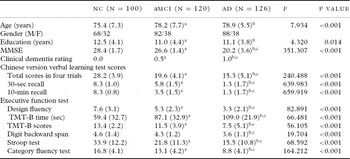
The demographic data and cognitive performances of the participants are shown in Table 1. Of the 346 participants included, 238 were men and 108 were women, with a mean age of 77.6 ± 7.0 years and a mean education level of 11.5 ± 4.1 years. There were 100 NC elderly people, 120 aMCI, and 126 AD patients. All of the AD patients had a CDR score of 1, and all aMCI patients had a CDR score of 0.5. aMCI and AD patients were older than the NC, and the NC had the highest education level. aMCI patients had an intermediate memory performance between the NC and AD groups in all CVVLT scores.
Demographic and cognitive test results of the study groups

NC = normal control; aMCI = amnestic mild cognitive impairment; AD = Alzheimer's disease; MMSE = Mini-Mental State Examination; TMT-B = trail making test part B.
ap < 0.05, MCI vs. controls; bp < 0.05, AD vs. controls; cp < 0.05, aMCI vs. AD. Data are presented as mean (standard deviation).
Age effect on EFTs
Age inversely correlated with the performance of executive functions, including the TMT-B time (r = 0.349, p < 0.001), TMT-B score (r = −0.220, p = 0.029), Stroop test (r = −0.424, p < 0.001), and design fluency (r = −0.240, p = 0.016) in the NC group. All NC participants were first categorized into three age groups: <60 years, 60–69 years, and ≥70 years. The main difference in executive function among the three age groups was present in participants aged ≥70 years old. Accordingly, 70 years was used as the cut-off age to establish the norm.
Education effect on the EFTs
There was a positive correlation between education level and EFTs, including TMT-B score (r = 0.284, p = 0.004), digit backward span (r = 0.364, p < 0.001), Stroop test (r = 0.216, p = 0.035), and CFT (r = 0.324, p = 0.001). All of the NC participants were categorized into three education groups: ≤5 years, 6–8 years, and ≥9 years. Using ANOVA with post hoc analysis of EFT scores, participants with education ≥9 years had significantly higher scores in five EFTs than the other two groups. Thus, nine years of education was used as the cut-off level for the norms.
Sex
There were no statistically significant differences between sexes in any of the EFTs.
Executive function tests among the NC, aMCI, and AD participants in different education and age groups
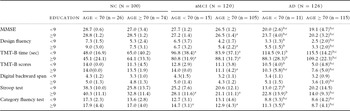
The performance of EFTs among the NC, aMCI, and AD participants by different age (<70 and ≥70 years) and education level (<9 and ≥9 years) groups (Table 2) showed that most of the results followed the pattern NC > MCI > AD. Compared with NC participants, aMCI patients had significantly impaired TMT-B time, while AD patients had significantly impaired TMT-B time, score, design fluency, and CFT performance. Compared with AD participants, age- and education-matched aMCI participants had significantly higher scores in CFT. Data for F values, degree of freedom, and effect size for participants <70 old and ≥70 years old were listed in the Supplementary Tables 1 and 2, available as supplementary material attached to the electronic version of this paper at www.journals.cambridge.org/jid_IPG).
Results of EFT of participants in two educational levels and two age groups

NC = normal control; aMCI = amnestic mild cognitive impairment; AD = Alzheimer's disease; MMSE = Mini-Mental State Examination; TMT-B = trail making test part B.
ap < 0.05, NC vs. aMCI; bp < 0.05, NC vs. AD; cp < 0.05, MCI vs. AD matched for age and educational levels. Data are presented as mean (standard deviation).
Correlations between different executive function tests in all and aMCI participants
Partial correlation was used to check correlations between variables after controlling for the possible confounding effects of age and education.
In all of the study participants, there were mild-to-moderate correlations in all EFTs (Supplementary Table 3). The correlation coefficients were 0.3–0.6 and all had p < 0.001. The correlations between the EFTs in aMCI were as follows: TMT-B time correlated with the Stroop test (r = 0.312, p = 0.001) and design fluency (r = 0.459, p = 0.018); Stroop test correlated with design fluency (r = 0.336, p < 0.001); and the CFT correlated with TMT-B time (r = 0.334, p < 0.001) and design fluency (r = 0.321, p < 0.001).
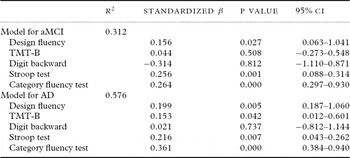
Logistic regression analysis using the five tests as predictors of aMCI or AD

aMCI = amnestic mild cognitive impairment; AD = Alzheimer disease; CI = confidence interval; TMT-B = trail making test part B.
Correlations between memory and executive function tests in all and aMCI participants
To investigate if memory decline also paralleled executive function in all and in aMCI participants, correlation analysis was performed. In all of the study participants (Supplementary Table 3), CVVLT-total showed a moderate correlation with TMT-B time (r = −0.412, p < 0.001). CVVLT-10 min correlated with MMSE (r = 0.686, p < 0.001), and TMT-B time (r = −0.437, p < 0.001).
In aMCI participants, the CVVLT-total score had a mild correlation with MMSE (r = 0.218, p = 0.023) and the CVVLT-10 min recall score had a positive correlation with design fluency (r = 0.205, p = 0.033) and CFT (r = 0.289, p = 0.002) in the aMCI group.
Characteristics of executive function test impairment in aMCI and AD participants
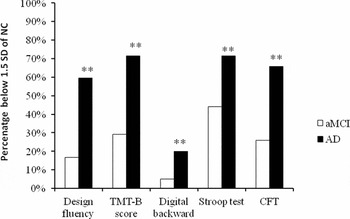
The percentage below the mean −1.5 SD of the cut-off value based on the NC population in the AD and aMCI patients (Figure 1) showed that AD patients had significantly higher frequencies of EFT scores below the cut-off value compared with the aMCI group. Among the aMCI participants, the Stroop test results had the most impairment (44%), followed by TMT-B score (29%), CFT (26%), and design fluency (17%).
Percentage of patients below 1.5 SD from age- and education-matched normal control (NC) in AD and aMCI. **p < 0.01; MMSE = Mini-Mental State Examination; CFT = category fluency test; TMT-B = trail making test part B.

The ROC curves were applied to evaluate the five EFTs in discriminating aMCI versus NC and AD versus NC (Supplementary Table 4). The Stroop test and CFT had comparable areas under the curve (AUC) to discriminate aMCI and AD from NC (Table 4). Using logistic regression analysis, to compare the discrimination ability of the five EFTs for aMCI or AD with NC (Table 3), the regression models for aMCI showed that CFT, Stroop test, and design fluency were all significant while the model for AD showed that CFT, Stroop test, design fluency and TMT-B all helped discriminate between AD and NC. The optimal cut-off value, sensitivity, and specificity were calculated for aMCI and AD (Supplementary Table 5).
Memory and EFTs in AD and aMCI sub-groups by post hoc analysis

Data are presented as mean (standard deviation).
NC = normal control elderly people (n = 100); AD = Alzheimer disease (n = 126); aMCI = amnestic mild cognitive impairment (n = 120); EFT = executive function test; MMSE = Mini-Mental State Examination; CVVLT = Chinese version verbal learning test scores; CFT = category fluency test; TMT-B = trail making test part B.
ap < 0.05 vs. AD; bp < 0.05 vs. NC; cp < 0.05 vs. aMCI without EFT impairment; dp < 0.05 vs. aMCI with one EFT impairment.
Sub-group analysis of the different degrees of executive dysfunction in aMCI participants
According to the severity of executive dysfunction (Brandt et al., Reference Brandt2009; Chen et al., Reference Chen2011), aMCI patients were further divided into six sub-groups according to the number of impaired EFTs (Table 4). The aMCI without EFT impairment group (n = 41% and 34%) had significantly lower CVVLT-10 min and CVLT-total scores than the NC group, but had no significant differences in all of the other EFTs. The aMCI with only one EFT impairment group (n = 39% and 32.5%) had significantly lower MMSE, CVVLT, Stroop test, and design fluency than the NC group. Comparison between aMCI without EFT impairment and those with one EFT impairment showed no difference in MMSE and CVVLT but significant differences in the Stroop test and design fluency. aMCI participants with at least two EFTs impairments demonstrated significantly lower scores in all of the five EFTs than in the NC and aMCI without EFT impairment groups.
Discussion
Although patients with multi-domain aMCI have been suggested to have a higher risk of progressing to dementia (Rasquin et al., Reference Rasquin, Lodder, Visser, Lousberg and Verhey2005; Brandt et al., Reference Brandt2009), there is still no full consensus on which neuropsychological test is essential for establishing the diagnosis of multiple-domain MCI. In the current study, 66% of aMCI patients had impairment in at least one EFT. Moreover, aMCI sub-groups with two or more EFT impairments had significant differences in all five EFTs compared with the NC, aMCI without EFT impairments, and aMCI with only one EFT impairment groups. Based on the study results, the most sensitive tests among the five EFTs were CFT and Stroop test. aMCI patients with two or more EFTs impairments had better memory performances than AD patients. Nevertheless, the EFT performance of these patients suggested that they were more likely to progress to AD than those with single-domain aMCI, and should therefore be closely followed-up.
Numerous reports have investigated the possible progression of different types of MCI to different types of dementias (Petersen, Reference Petersen2004; Winblad et al., Reference Winblad2004; Fischer et al., Reference Fischer2007). The MCI workshop (Brandt et al., Reference Brandt2009) suggests that clinicians should evaluate additional cognitive domains like language, attention/execution, or visuo-spatial function in patients with aMCI in order to determine whether they are single domain or multiple domain. Although language and visuo-spatial problems have frequently been discussed in early AD, a decline in executive function has also been frequently reported in aMCI (Crowell et al., Reference Crowell, Luis, Vanderploeg, Schinka and Mullan2002). From the results of the present study, only 34% of aMCI patients had no EFT impairments, while 66% still showed at least one EFT impairment. One recent study (Oosterman et al., Reference Oosterman, Oosterveld, Rikkert, Claassen and Kessels2012) suggested that in AD, medial temporal atrophy was associated with lower scores in executive tests, general cognitive test, and episodic memory performance, which were similarly observed in the patients and aMCI group here.
As in the literature, CFT is used as an executive function evaluation test among aMCI (Nutter-Upham et al., Reference Nutter-Upham2008) and AD (Baudic et al., Reference Baudic, Barba, Thibaudet, Smaggh, Remy and Traykov2006) patients, and is the best predictor in this study. The other sensitive test in aMCI or AD is the Stroop test. An interesting phenomenon is that patients with aMCI have higher failure rates in the Stroop test than in CFT. There are several possible reasons. The Stroop test involves multiple cognitive processes. Its performance has been correlated with task-switching, selection attention, response inhibition, disruption of semantic knowledge, and speeded verbal processing in either MCI or AD patients (Bondi et al., Reference Bondi2002; Sinai et al., Reference Sinai, Phillips, Chertkow and Kabani2010). A functional imaging study suggests three “parallel” networks related to the tasks of the Stroop test (Harrison et al., Reference Harrison2005): (i) a cingulo-frontal system that is initially engaged in selecting and mapping a task-relevant response (color naming) when the attention demands of the task are greatest; (ii) a ventral visual processing stream whose concurrent decrease in activity represents the task-irrelevant inhibition of word reading; and (iii) co-activations in the dorsal and ventral pre-frontal regions, as well as the fronto-polar cortex. Thus, performance on the Stroop test must be accomplished by the cooperation of extended cortical networks.
This study has some limitations. First, the number of aMCI patients younger than 70 years is small. The study results therefore are more representative of those aged >70 years. Second, the results mainly focus on the executive dysfunction in aMCI. It is worth pointing out that not only memory and executive function but also language and visuo-spatial functions can be impaired in multiple domain aMCI. Hence, the abnormalities that can be yielded by the pre-defined EFTs like CFT can represent cognitive deficit not solely in execution. Lastly, although aMCI participants with impairment in at least two EFTs signify a more definite executive dysfunction, whether or not they have significantly worse prognosis than aMCI with impairment in only one EFT warrants further longitudinal studies.
In summary, aMCI with two or more EFTs may represent multi-domain aMCI that is different from NC. Although memory scores in these aMCI patients are still higher than in those with AD, the EFTs scores are not significantly different. In a clinical setting, a close follow-up is recommended for these patients. Among the five EFTs, CFT, and Stroop test may be the most discriminative test for aMCI and AD.
Conflict of interest
None.
Description of authors’ roles
P.-N. Wang designed the study and supervised the data collection. N.-C. Chen and C.-C. Chang wrote the paper and conducted the statistical analysis. C.-W. Huang, W.-N. Chang, Y.-T. Chang, and Y.-C. Yeh collected the data and assisted with manuscript writing. K.-N. Lin and C Chen performed the neuropsychological tests.
Acknowledgments
This study was supported in part by grants from Chang Gung Memorial Hospital (CMRPG880951), the National Science Council (NSC97-2314-B-010-011), and Taipei Veterans General Hospital (V98C1-134 and V99C1-037).