I. INTRODUCTION
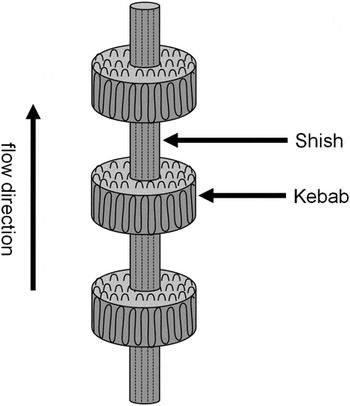
Semicrystalline polymers are widely used in polymer industry due to their bi-properties of crystalline and amorphous components. The crystalline component contributes the strength for materials, while the flexibility can be attributed to the amorphous component. Generally, molten polymers have experienced some processes like extrusion or injection and then become plastic products, fibers, and so on. The final morphology and properties of polymer products strongly depend on the processing history. It is well known that when semicrystalline polymers are crystallized under shear or elongational flow, crystallization rate is enhanced and the so-called “shish-kebab” structure might be formed.Reference Odell, Grubb and Keller1–Reference Keller and Odell4 As shown in Fig. 1, it is considered that shish-kebabs consist of extended-chain crystals (shish) and fold-chain lamellar crystals (kebab) grow periodically around shish in the simplest case.Reference Odell, Grubb and Keller1–Reference Pennings7 It is believed that shish structure is the molecular origin of ultrahigh strength and ultrahigh modulus fibers.Reference Odell, Grubb and Keller1–Reference Keller and Odell4 Numerous studies have focused on the formation mechanism of shish-kebabs. Recently, one of the major topics is formation mechanism of shish and shish precursor (“row-nucleated” or “shish-like” precursor) formed during the shearing process, which affects final morphology drastically. For example, Alfonso’s and Kanaya’s groups revealed the existence of precursors of shish-kebabs with a scale of micron size.Reference Azzurri and Alfonso8–Reference Zhao, Matsuba, Nishida, Fujiwara, Inoue, Polec, Deng and Kanaya11 Precursors of shish-kebabs in micron size were found to be formed above nominal melting temperatures (T m) of isotactic polystyrene even close to equilibrium melting temperatures ( ). Rastogi et al. found the existence of precursors of shish-kebabs formed in nanometer scale and elucidated the critical size of precursors.Reference Balzano, Kukalyekar, Rastogi, Peters and Chadwick12, Reference Balzano, Kukalyekar and Rastogi13 Van Meerveld et al.Reference Van Meerveld, Peters and Hutter14 used the Wi-number by introducing the reptation time and Rouse time to predict the chain orientation/stretch, nucleation, and the final morphology. A comprehensive model given by Custodio et al.Reference Custodio, Steenbakkers, Anderson, Peters and Meijer15 suggested mechanism for shish and shish precursor as a function of viscoelastic flow history, which is affected by shear rate, temperature, relaxation times, viscosity, and so on. The model fitted the results in both simulations and experiments very well.
Schematic model of a simple shish-kebab crystallite.

To understand shear-induced crystallization mechanism and to control polymer properties, rheological considerations are thought to be necessary since the structure formation during shearing is strongly related to the competition between shear flow and relaxation of chain segments. Although the idea of combining rheological results and shear-induced crystallization is not novel any more,Reference Van Meerveld, Peters and Hutter14–Reference Patil, Balzano, Portale and Rastogi16 the relaxation times which always estimated from calculation instead of viscoelastic measurements are not carefully treated. In this study, we have focused on the relationship between shear-induced crystallization and viscoelastic behavior of syndiotactic polystyrene to enlighten the understanding of formation mechanism of shish-kebabs. We also used amorphous polystyrene to probe the discrepancy of structure formation during shearing and structure relaxation after shearing between crystalline and noncrystalline polystyrene.
II. EXPERIMENTS
A. Materials
The polymer used in this study is syndiotactic polystyrene (sPS) purchased from Scientific Polymer Products (Ontario, NY) with molecular weight Mw = 300,000 and polydispersity of Mw/Mn = 3.9, where Mw and Mn are the weight-average and number-average molecular weights, respectively. The sPS is 98% syndiotactic. The nominal melting temperature (T m) of sPS is 270 °C in differential scanning calorimetry measurements with a heating rate of 10 °C/min. Atactic polystyrene (aPS) with molecular weight Mw = 350,000 and polydispersity of Mw/Mn = 2.0 was used as a noncrystalline specimen.
B. Characterization techniques
1. Rheo-small-angle x-ray scattering and rheo-optical measurements
Time-resolved small-angle x-ray scattering (SAXS) measurements were carried out by using an apparatus installed at a beam-line BL15A,Reference Amemiya, Wakabayashi, Hamanaka, Wakabayashi and Hashizume17 Photon Factory, KEK, in Tsukuba, Japan. A two-dimensional (2D) charge coupled device (CCD) camera (C7300; Hamamatsu Photonics K.K., Hamamatsu, Japan) with an image intensifier was used as the x-ray detector. The wave length λ of the x-ray beam was 1.5 Å, and the camera length was 2.3 m for SAXS measurements. The q range in the SAXS measurements was 8 × 10⁻³–1.5 × 10⁻¹ Å−1 where q is the scattering vector, q = 4π sin θ/λ (2θ being scattering angle). Expose time to x-ray is 2 s and storage time was about 4 s.
Polarized optical microscope (POM) measurements were performed by using Olympus BX50 (Tokyo, Japan) with a CCD camera attachment. A Linkam CSS-450 high temperature shear cell was used to control the temperature of the sample and the shear conditions. Samples with 50-μm thickness were placed between two quartz plates in POM measurements while between two stainless plates with windows of Kapton in SAXS measurements after temperature calibration.
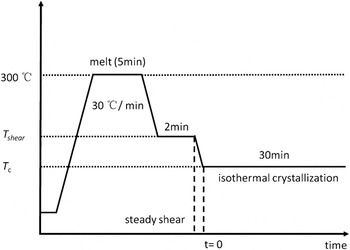
The temperature protocol for the shear experiments is shown in Fig. 2: sample was (a) heated up to 300 °C, which was around the equilibrium melting temperatures ( )Reference Wang, Cheng, Hsu and Lin18, Reference Lin and Woo19 from room temperature at a rate of 30 °C/min; (b) held at 300 °C for 5 min to erase thermal history; (c) cooled down to a shear temperature (T shear) at a rate of 30 °C/min, the shear temperature had a wide range which could be above or below the nominal melting temperature (T m); (d) held at T shear for 2 min to reach the temperature equilibrium and then subjected a steady shear flow; (e) after cessation of shear flow, quenched to a desired temperature (T c) and held for 30 min for rheo-SAXS and rheo-optical measurements during isothermal crystallization. The ranges of shear rate and shear strain were 0–1,200 s−1 and 0–400,000%, respectively.
Temperature protocol of shear experiments for Rheo-small-angle x-ray scattering (SAXS) and rheo-optical measurements.

2. Rheological measurements
Viscoelastic behavior of sPS was measured using a Physcia MCR 301 torsional parallel disk type rheometer (Anton Paar, Tokyo, Japan). Raw materials were pressed to disks with 25 mm in diameter and 0.9 mm in thickness at molten state. Samples were measured at an oscillation mode with a constant strain ε = 4% to study the linear viscoelastic behavior of the melt such as storage modulus and loss modulus as a function of frequency. The angular frequency range was 0.01–500 rad/s. A nitrogen atmosphere was applied to samples to prevent the degradation. The sPS sample was kept at 300 °C for 5 min to erase the thermal history and then quenched to a desired temperature before onset of measurements.
III. RESULTS AND DISCUSSIONS
A. Shear-induced crystallization of sPS
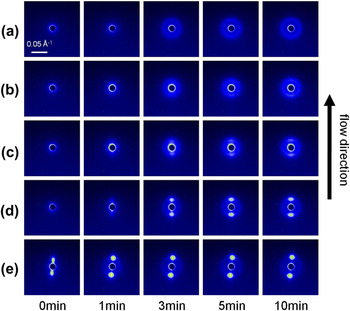
At first, we observed isothermal crystallization process of sPS after applying a steady shear flow with a constant shear strain and various shear rates around the nominal melting temperature T m (= 270 °C) by using time-resolved SAXS. The shear temperature T shear was 270 °C, and the isothermal crystallization temperature T c was 245 °C. The shear strain was 400,000% and the shear rate was 0–1,200 s−1. Figure 3 shows crystallization time evolution of SAXS profiles in various shear rates. It was found that after cessation of flow, spot-like meridian scatterings with respect to the flow direction were emerged. On increasing shear rate, the meridian scattering features became stronger. Meanwhile, only homogeneous 2D SAXS patterns were observed in the quiescent state which indicated the spherulitic morphology. The anisotropic scattering features can be attributed to the scattering features of oriented (stacked) lamellar crystals in size dimension in the case of flow-induced crystallization. Equatorial streaks normal to flow direction are thought to be the scattering features of shishs while the meridian spots parallel to flow direction are thought to be the scattering features of kebabs.Reference Somani, Yang, Zhu and Hsiao20 In this study, the meridian scattering features (kebabs) were found during isothermal crystallization, but the equatorial streaks (shishs) were not observed. Our rheological results showed that almost no shish entity formed in our experiments which will be discussed later.
Crystallization time evolutions of two-dimensional SAXS patterns of syndiotactic polystyrene (sPS) at 245 °C. (a) At quiescent state; (b–e) after applying a steady shear flow with a constant shear strain = 400,000% and various shear rates  at 270 °C. (b)
 = 25 s−1; (c)
 = 100 s−1; (d)
 = 800 s−1; (e)
 = 1,200 s−1.

To get more quantitative information, intensity collected from 2D SAXS patterns was used to calculate invariant Q. The invariant Q was given by
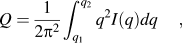
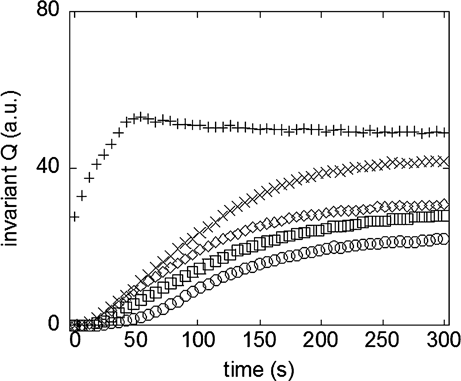
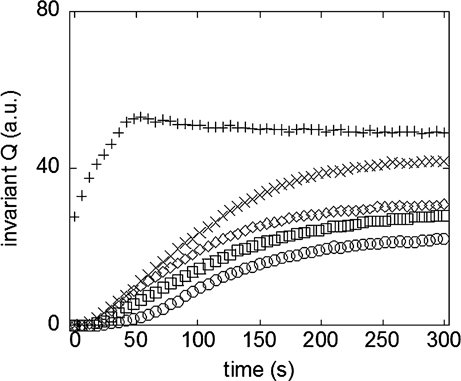
where I(q) was the intensity collected from 2D SAXS patterns, the integration range was from q 1 = 8 × 10⁻³ Å−1 to q 2 = 1.5 × 10⁻¹ Å−1. For an incompressible two-phase system, invariant is a function of product of volume fractions of two phases and the square of their density difference. In the case of crystallization, invariant has no change during nucleation as the volume fractions of crystalline and amorphous components keep constant. Then, invariant becomes to increase with growth of crystals until the crystallinity reaches 50%.Reference Strobl21 Integrated time evolution of invariant Q at various shear rates is shown in Fig. 4. It is evident that the invariant was accelerated after applying a steady shear flow compared with the quiescent state. The invariant was also accelerated by shear rates at a constant shear strain. The induction time defined as the onset of secondary nucleation was drastically curtailed, which means the increase of nucleation density induced by shear flow (Table I).
Time evolutions of invariant during isothermal crystallization at 245 °C with various shear rates. (○): quiescent state; (□): = 25 s−1; (◇):
 = 100 s−1; (×):
 = 800 s−1; (+):
 = 1,200 s−1.
Induction time for quiescent and flow-induced crystallization.

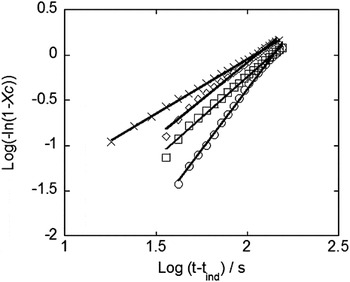
One can easily associate the Avrami equation by normalizing the invariant to survey the nucleation type and growth geometry of crystals.Reference Cavallo, Azzurri, Balzano, Funari and Alfonso22 The Avrami exponent n given by the slope of Avrami plot (Fig. 5, where t ind is the induction time) for various shear conditions is shown in Table II. Our experimental Avrami exponent for the quiescent state was 2.6 and did not fit the well-accepted exponents,Reference Schulz5 which could be attributed to diverse crystalline types formed during isothermal crystallization. It is well known that sPS exhibits a complex polymorphism through its crystallization.Reference De Rosa, de Ballesteros, Di Gennaro and Auriemma24–Reference Gowd, Tashiro and Ramesh27 In the case of melt crystallization, a dual morphology, α and β crystalline forms, was observed in many studies. Sorrentino et al.Reference Sorrentino, Pantani and Titomanlio23 estimated Avrami exponents for neat α and β forms. Avrami exponent was 1.5 for neat α form and 3.5 for neat β form. Generally, without any preprocessing, a combination of α and β forms is emerged during isothermal crystallization at 245 °C. The estimated Avrami exponent at quiescent state is between 1.5 and 3.5, which seems to be reasonable. On the other hand, Avrami exponent decreased with increasing shear rate, indicating the different nucleation type or lower growth geometry in flow-induced crystallization. It is important to elucidate here that the Avrami equation only provides information for mono-morphology system. It is difficult to precisely predict mixed morphology system such as a morphology including spherulitic form and shish-kebabs (at least kebabs were existent in our case) in flow-induced crystallization. Similar discussions about the limitation of Avrami exponents have been reported by many groups on flow-induced crystallization.Reference Balzano, Kukalyekar and Rastogi13, Reference Keum, Zuo and Hsiao28, Reference Li and de Jeu29
Avrami plots after normalizing the invariant Q for various shear rates. (○): quiescent state; (□): = 25 s−1; (◇):
 = 100 s−1; (×):
 = 800 s−1. t ind is the induction time defined as the onset of secondary nucleation.

Avrami exponents for quiescent and flow-induced crystallization.

a Data from Sorrentino et al.23
Lamellar orientation was estimated by the degree of orientation which was Herman’s orientation function in this study. Herman’s orientation function was given byReference Ran, Fang, Zong, Hsiao, Chu and Cunniff30
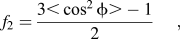
where φ was the azimuthal angle and <cos2φ> was the average squared cosine of azimuthal angle expressed as

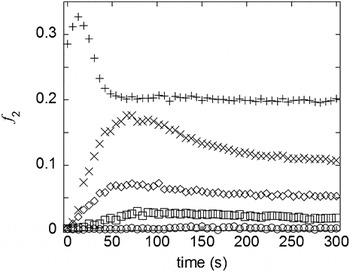
where I(φ) was scattered intensity along the azimuthal angle φ. Time evolution of Herman’s orientation function during isothermal crystallization with various shear rates is shown in Fig. 6. An apparent dependence of Herman’s orientation function was found when increasing shear rate. On increasing shear rate, the nucleation density was enhanced and the concentration of kebabs was advanced. As a result, Herman’s orientation function increased with the formation of oriented lamellae (kebabs). Two interesting phenomena have to be interpreted here. One is that Herman’s orientation function rose steeply at the early stage of isothermal crystallization for each flow-induced sample. This can be directly explained by the formation of kebabs. As reported in literatures,Reference Azzurri and Alfonso8–Reference Zhao, Matsuba, Nishida, Fujiwara, Inoue, Polec, Deng and Kanaya11, Reference Li and de Jeu29, Reference Housmans, Steenbakkers, Roozemond, Peters and Meijer31 “row-nucleated” or “shish-like” precursors were formed after cessation of flow, which worked as a nucleation agent for kebabs. In consequence, kebabs can grow without nucleation process and follow a diffusion-controlled growth process.Reference Dukovski and Muthukumar32 The other is that Herman’s orientation function was found to reach its maximum after expeditious growth at the early stage and then decrease to be almost no change at the late stage of isothermal crystallization for all the flow-induced samples. In flow-induced crystallization where a mixed morphology is always observed, Herman’s orientation function depends on the proportion of concentration between anisotropic kebabs (oriented lamellae) and isotropic spherulites. At the early stage of isothermal crystallization, kebabs grew first and Herman’s orientation function increased, no spherulites emerged until the maximum was reached. After that, spherulites grew and lowered the anisotropy for the whole system. Finally, Herman’s orientation function was equilibrated at the late stage of isothermal crystallization.
Time evolutions of Herman’s orientation function during isothermal crystallization at 245 °C with variant shear rates. (○): quiescent state; (□): = 25 s−1; (◇):
 = 100 s−1; (×):
 = 800 s−1; (+):
 = 1,200 s−1.

B. Correlation between shear-induced crystallization and relaxation time in polymer melts
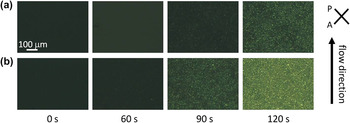
On the other hand, only spherulitic morphology was observed after applying a shear flow with a shear rate  = 10 s−1 [Fig. 7(b)] around nominal melting temperature despite the induction time was shortened compared with the quiescent state [Fig. 7(a)]. Similar result was also shown in Figs. 3(a) and 3(b). The discrepancy of shear-induced crystallization on shear rate can be attributed to the variant nucleation process during shearing affected by a lot of factors such as quenching depth. Generally, in the case of flow-induced crystallization, the nucleation process under shear flow is significantly affected by relaxation time of chain segments.Reference Van Meerveld, Peters and Hutter14 In particular, there are several characteristic relaxation times that dominate the states of chain segments in entangled polymer melts. The states of chain segments under shear flow can be considered as follows. (i) When the imposed shear rate
 is extremely low,
 << τd−1, where τd−1 represents the reciprocal of reptation time. (ii) When the imposed shear rate
 is close to τd−1 but smaller than the reciprocal of Rouse time τR−1 (τd−1 ∼
 < τR−1). (iii) When the imposed shear rate is high enough to satisfy
 > τR−1. To interpret the mode of chain segments in entangled polymer melts objectively, pure reptation theory introduced by de GennesReference de Gennes33, Reference de Gennes34 and developed by Doi and EdwardsReference Doi and Edwards35 seems to be inadequate. Some supplementary models such as contour length fluctuation (CLF)Reference Doi36 and convective constraint release (CCR)Reference Marrucci37 are necessary for a polydisperse system. In regime (i),
 ≪ τd−1, reptation, and CLF are the dominant relaxation mode and chain segments relax with the slowest time scale τd. Undoubtedly, there should be no orientation or stretch of chain segments even during shearing. In regime (ii), τd−1 ∼
 < τR−1, CCR becomes the dominant mode. Chain segments are easier to be oriented by CCR increasing the average distance between adjacent entanglements but cannot be stretched. In regime (iii),
 > τR−1, chain segments between entanglements are thought to be both oriented and stretched in this regime; thus, the shish entity can be produced between adjacent entanglement points.
Polarized optical microscope (POM) measurements of isothermal crystallization at 250 °C. (a) the quiescent state; (b) sheared at 270 °C with a shear rate  = 10 s−1 and shear strain = 400,000%.

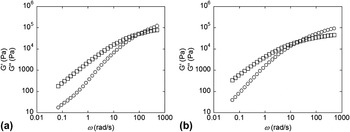
Figure 8 gives the storage modulus G′ and loss modulus G′′ as a function of frequency for sPS at 270 °C and aPS at 220 °C. The standard deviation of storage and loss modulus is about 2–3%. The reciprocal of frequency at crossover of storage modulus and loss modulus was used to estimate the average relaxation time which was τd in this study. The average τd−1 and τR−1 of sPS at 270 °C were estimated to be 62 ± 5 and 1860 ± 149 s−1, respectively. When the imposed shear rate approaches τd−1,  ∼ τd−1 < τR−1, chain segments between entanglements are oriented by flow and “row-nucleated” or “shish-like” precursors are introduced from oriented melts, sequentially induce kebab morphology during isothermal crystallization. Such a relative low shear rate will not lead up to the formation of shish entity since chain segments remain unstretched. Even the imposed shear rate is quite higher than τd−1 (
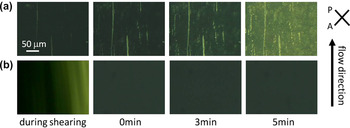
 = 1,200 s−1), it is still below the τR−1. Note here that it is well known that the high molecular weight tail (HMW-tail) controls the flow-induced nucleation and then the final morphology.Reference Balzano, Kukalyekar and Rastogi13, Reference Zuidema, Peters and Meijer38 Unfortunately, the gel permeation chromatography (GPC) data of sPS is impossible for us at present (it has to be measured in 1,2,4-trichlorobenzene solvent at 150 °CReference Huang, Chen, Lin, Wu, Zhu, Shiyan, Fu and Yang39). Thus, we cannot quantitatively discuss the relationship between the imposed shear rate and the Rouse time of HMW-tail without GPC data. In this study, we only used the average Rouse time with combining SAXS results to predict roughly that no or few shish entity exists in our experimental conditions. The nature of “row-nucleated” or “shish-like” precursors still needs to be studied which is not the main topic in this study. Meanwhile, the average τd−1 of aPS at 220 °C was estimated to 24 ± 3 s−1. To confirm the orientation of polymer melts induced by flow and to compare structure formation and relaxation after cessation of flow, POM measurements were performed to both sPS and aPS samples. (Fig. 9) Shear temperatures for sPS sample and for aPS sample were 270 and 220 °C, respectively. Shear rates for sPS sample and aPS sample were 60 and 30 s−1, respectively, which approximates to τd−1 of each sample. After cessation of flow, sPS sample was quenched to 250 °C for isothermal crystallization and aPS was held at 220 °C. Orientation of polymer melts induced by flow was observed during shearing in both samples. “Row-nucleated” or “shish-like” precursors were found in sPS sample immediately after cessation of flow (a, 0 min). A mixed morphology including spherulitic form and kebab was observed during isothermal crystallization (a, 3, 5 min). In contrast, oriented melts in aPS relaxed directly with no residual orientation after cessation of flow (b, 0 min). The relaxation time only controls the orientation and stretch of chain segments and may not be the only factor for inducing “row-nucleated” or “shish-like” precursors.
Storage modulus G′ (□) and loss modulus G′′ (○) as a function of frequency. (a) sPS at 270 °C. (b) Atactic polystyrene (aPS) at 220 °C.

POM observations of sPS and aPS during and after applying a shear flow. (a) sPS sample was sheared at 270 °C with a shear rate  = 60 s−1 and quenched to 250 °C for isothermal crystallization. (b) aPS sample was sheared at 220 °C with a shear rate
 = 30 s−1 and held at 220 °C.

We know that such a prediction for shear-induced crystallization cannot be considered quantitatively owing to the following reasons. First, we used a polydisperse polymer so that the average relaxation time cannot represent all the chain segments relaxation. Instead, distribution of relaxation time for different chain segments length, especially for the HMW-tail, should be introduced. Second, there are several methods to determine the average relaxation time from viscoelastic measurements.Reference Van Meerveld, Peters and Hutter14, Reference Acierno, Palomba, Winter and Grizzuti40 There should be more arguments for determining the average relaxation time. Third, the applied rheological measurements give the viscoelastic information of polymers bulkily whereas crystallization always occurs locally. Thus, it is hard to predict the flow-induced crystallization behaviors precisely by present rheological approach.
IV. CONCLUSIONS
We studied the shear-induced crystallization and viscoelastic behavior of sPS. By increasing shear rate, crystal growth rate was accelerated during isothermal crystallization compared with quiescent state. Avrami exponent decreased with increasing shear rate suggested a lower growth geometry or different nucleation type in flow-induced crystallization. Kebabs were found to grow expeditiously first after cessation of flow and then spherulites arose to decrease Herman’s orientation function. We discussed a possibility for the discrepancy of shear-induced crystallization on shear rate and shear temperature from a rheological point of view. When the imposed shear rate  is close to inverse of reptation time τd−1 but smaller than the inverse of Rouse time τR−1 (τd−1 ∼
 < τR−1), chain segments between adjacent entanglements are oriented but still unstretched to introduce “row-nucleated” or “shish-like” precursors. No or few shish entity was thought to be formed with chain segments keeping unstretched at our experimental shear rate. The relaxation time only controls the orientation and stretch of chain segments and may not be the only factor for inducing “row-nucleated” or “shish-like” precursors. Our prediction for shear-induced crystallization cannot be considered quantitatively due to its limitations. Thus nova measurement such as microrheology for flow-induced crystallization is prospective to understand formation mechanism of shish-kebabs.