Objects, libraries and art students: The Slade Small Press Project
Art students are makers, that much we know, and no strangers to objects. They are also writers and readers but, certainly at the UCL Slade School of Fine Art, the majority of students do not have a substantial, assessed, written component such as a dissertation or thesis to their course and largely follow the traditional model of tutorial-led studio work supported by an element of Art History and Theory teaching. In academic terms books, and certainly library books, may have been considered as containers of secondary information or critical texts rather than sculptural objects or concrete vessels for conceptual works. How, then, to best engage students with Library collections when their perception is perhaps that the Library is for reading, visual reference, and contextualisation but rarely a direct catalyst for the immediate priority of creating artwork? Yet UCL Special Collections has a wealth of material that is used to engage and inspire those students who work predominantly visually, for whom the Library may seem a daunting environment or who may never have had the opportunity to work with primary sources as research material.
Art students have wide-reaching interests and are typified by the interdisciplinarity of their research sources. Being members of such a diverse institution as UCL offers them opportunities to immerse themselves in resources from a vast array of subject areas and they are encouraged to explore all Library collections. As well as 18 libraries with lending collections covering all taught subjects, UCL Library Services holds inspirational Special Collections in diverse subject areas that can be consulted on an individual basis or used in support of group teaching and public engagement activities.
The Small Press Collections are a conglomeration of smaller collections relating to independent publishing. Established at UCL in 1964 with a remit to collect the printed material being produced as part of a rapidly emerging scene, we are still acquiring items today. The collections have three component parts: the Little Magazines (periodicals produced by independent presses focussing on experimental / new literature and visual work which would not have had an outlet via mainstream publishers), the Poetry Store (small edition pamphlets, generally produced by the same independent presses, containing experimental / new writing), and the Alternative Presses (independent newspapers with a political / countercultural emphasis). With well over 4000 magazine titles alone, the collection is one of the most comprehensive in the world and could claim to be one of the best University collections, certainly in the UK/Europe and possibly further afield. The collections focus on text and image: experimental poetry and other textworks, visual poetry, the documentation of performance and sound poetry, and text works by artists. Collaborations between all those forms is a key theme. As such, the collections are rich in visual material and offer an insight into the ways artists, throughout art history, have disseminated ideas through printed material.
Some of the most frequently consulted items in our Little Magazines collection are the two original copies of Blast magazine, edited and self-published by Slade alumnus Percy Wyndham Lewis in 1914 and 1915 (typically for a Little Magazine, despite best intentions, Blast only survived two issues before being engulfed by the trauma of the First World War). A mouthpiece for Lewis’ avant-garde Vorticist movement, Blast remains a visually innovative item today and represents a key moment in English Modernist art and literature. It represents an artist (not very long out of art school) using the print medium as the cornerstone of their visual output.
Continuing this tradition, Slade students and academic staff regularly produce printed material as part of their practice: an artists’ book, a collaborative magazine, or a group catalogue, for example. Many artists are working with text as a medium, which obviously lends itself to the print format, and prose writing is an art form in its own right. The possibilities for distribution offered by pamphlets and magazines for all kinds of visual work do not appear to have been detrimentally affected by the growth of digital and social media; you only need look at the current proliferation of artists’ books fairs, the number of independent magazines in circulation or the rise of the pop-up artists’ bookshop to conclude that interest in print media is not waning. Additionally, the Slade has recently purchased a Risograph printer, the 21st century equivalent of the mimeograph so beloved of the independent underground of the 1960s and 70s as a method of cheaply producing lo-fi printed publications, of which we have many examples in the Small Press Collections. Our Risograph offers Slade students instant access to a form of print with the accessibility and affordability of the photocopier combined with the sophistication of digital technology.
More widely, in terms of the institutional strategy for 2034 one of UCL's key aims is to enhance teaching and learning via the Connected Curriculum and to ‘ensure that all UCL students are able to learn through participating in research and enquiry at all levels of their programme of study’.Footnote 1 In practice, this encourages undergraduate teaching in conjunction with research projects and collections, and facilitates non-linear collaborations across the institution. This method of working has traditionally been more prevalent in Science disciplines but can pose more of a challenge in the Arts, Humanities and Social Sciences. Opportunities to encourage dialogue between academic staff and students are, therefore, positively encouraged. Of course, collaborative working practices are not unusual in Fine Art and the boundaries between student and academic are not as rigid as in many disciplines; opportunities to work together are generally enthusiastically received.
Having identified the production of print media as an existing research concern in the department, given the recent Risograph purchase and active print workshops, using our collection of modern and contemporary avant-garde publications as a point of inspiration seemed like a marriage made in heaven and the Slade Small Press Project was born.
The project, open to all students regardless of programme and to academic staff across the School, begins with an introduction to the materials – an illustrated talk through some of the key items in the collections and their historical significance followed by a hands-on session where participants are able to engage first hand with the publications. The importance of handling cannot be overstated: although the material value of some of the items is high, this is also a working collection in an academic institution – students are encouraged to experience the materiality of the publications as objects, under supervision. Significantly, and to further break down the barriers, we take the materials to them and into their environment with the sessions taking place in the art school rather than in the Library, or more specifically, a Special Collections reading room. This results in a subtle change of perception.
In this handling session it is important to include examples with a range of production values; glossy zines sat alongside 1960s photocopied and stapled DIY classics. To illustrate the importance of print media in the context of Modern western art, also included are examples that represent key moments in the historical avant-garde: The yellow book, a decadent Victorian quarterly that lent its name to the ‘Yellow Nineties’; The blind man that records the furore surrounding Duchamp's Fountain; 0–9, Vito Acconci and Bernadette Mayer's mimeographed conceptual classic of the 1960s. Revealing to students how Sol Lewitt, Robert Smithson or Carl Andre translated their three dimensional pieces into two dimensional work intended for mass distribution yet with no dilution of the artistic message is illuminating.
The relevance of the collection in today's terms is also stressed – a YouTube clip of post-punk genius Mark E Smith of Mancunian mavericks The Fall extolling the virtues of Vorticist graphic design, or a still of typically Futurist typography in an issue of iD magazine from the currently fashionable 1980s brings the collections bang up to date. These are not stuffy rare books in a hushed library environment and it is important to banish these preconceptions from the students’ minds; using the Library's non-standard materials to change perceptions of what a Library is and what it can offer in terms of creative inspiration is one of the key aims of this project.
The introductory talk that focusses primarily on an historical frame of reference is supplemented by a series of activities intended to further contextualise the collections in a creative framework. Following the initial handling session, students are encouraged to attend further tutorial style gatherings where more items from the collections can be selected in response to the work of an individual, to illustrate production values or themes revealed by their own work.
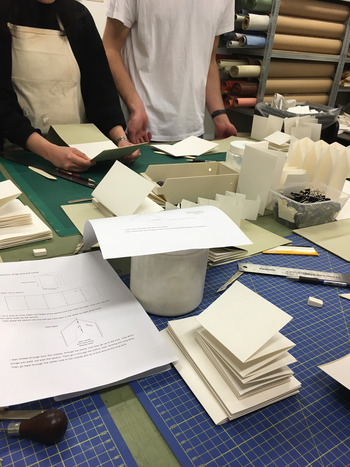
Fully utilising the workshop facilities offered by the art school, participants additionally have the option of attending a practical introduction to simple book binding in the Slade's own bindery. Fig. 1. We learn how to follow simple folding patterns and hand stitching techniques to produce a basic pamphlet, easy to reproduce in small editions. Visits to external organisations are also arranged to add further context by outlining how independent publishers operate and how small scale booksellers curate their wares according to the best in current artists’ publishing. In 2016, excursions were made to Tenderbooks, a ‘space for independent artist publications and unique contemporary art books’Footnote 2 in Central London and Finishing Touch, a ‘pop-up’ bookshop, gallery and project space based in an old barbershop in South London. Tenderbooks frequently commission artists’ publications and thus demonstrate a further stage in the breadcrumb trail that starts with an item in our Library collections as inspiration, ending with a physical publication in a retail environment. Both they and Finishing Touch also source and sell historical examples of artists’ publications amongst new commissions, again giving students a further perspective on the items they can access via UCL collections.
Basic book binding workshop in the Slade Bindery.

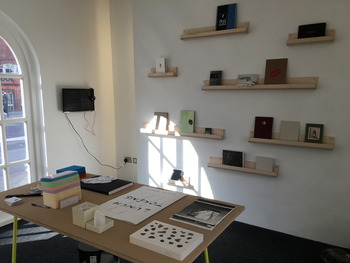
The project culminates in a two-part event; firstly, a symposium consisting of a series of talks and panel sessions open to all members of the University and the public. To widen the dialogue further, Book Arts students from other institutions are invited to display their work alongside stalls from independent booksellers in the form of a mini bookfair. The 2016 event also featured a ‘live publishing’ event using the Slade's Risograph printer and co-ordinated by artists’ collective, Catalog. The second element of the project event is an exhibition of work by Slade staff and students in the UCL North Lodge, a high profile space directly on Gower Street, showing publications that have been made in direct response to items from the Small Press Collections. Fig. 2.
The Small Press Project exhibition in the UCL North Lodge.

Our 2016 event was a great success and a clear pathway can be traced from the initial handling session of items from the collection to the exhibition of artwork created by the project participants. We were extremely fortunate to have the project funded by the UCL Institute of Advanced Study, UCL Slade School of Fine Art and UCL Library Services. Primarily, this funding enabled us to cater for the one day symposium, cover speakers’ expenses, and purchase materials to mount the exhibition of work in the North Lodge.
Ultimately, though, the key aim of the project was to use UCL Library's Special Collections collaboratively with the Slade, with the objectives of raising the profile of the Library's primary source materials and changing perceptions of what we can offer in a creative environment. It reminds us of the objecthood of books and other printed matter and their potential for artistic inspiration beyond their role as receptacles of knowledge.
Object literacy, object-based learning and current practice in libraries
In the second part of this article, we would like to widen the focus from the use of special collections within the creative environment – in the case study above, by fine-art staff and students in a leading fine-art college – to creative outputs arising from the use of special collections by public audiences, and by university staff and students in a wide range of subjects, outside the art-college environment. Two brief case studies will explore the impact of hands-on contact with rare print material on the creativity of audiences when activities aren't, as they were for the Slade project, focused on the immediate priority of creating artwork.
It is worth first setting these activities in the context of current terminology and trends in university teaching outside the creative arts, in particular the development of object-based learning programmes. As we have seen above, the perennial importance of learning from physical objects is likely to be self-evident to artists and many staff and users of art libraries. Outside this context, as a teaching tool the method seems to have been explicitly identified in English since at least the C19th, when many universities and even some schools were amassing teaching collections of, for example, natural-history, geology or pathology specimens. The phrase ‘object lesson’ in the sense ‘a lesson in which a pupil's examination of a material object forms the basis for instruction’ is first illustrated in the Oxford English dictionary by a quotation from 1831,Footnote 3 and later used by Mark Twain in 1881.Footnote 4 ‘Object teaching’, said to be derived from the work of the C18th Swiss educationalist Johann Heinrich Pestalozzi, was introduced into schools in the US in the C19th,Footnote 5 is used in translating De Tocqueville in 1851,Footnote 6 and was considered worthy of a definition in Carter Victor Good's Dictionary of education of 1945.
Recognition of the pedagogic value of object-based learning is therefore nothing new, as much in the context of primary and secondary education as of universities. But, following the decline in the use of universities’ subject-focused teaching collections in the second half of the C20th and the transition of many of these collections to non-teaching museum status, it is museologists who, in the last decade, have taken up the term to describe ways of energising teaching and learning in Higher Education by focusing on physical museum exhibits, in an age of increasingly digital learning resources in universities. This, combined with the recent increase in humanities and social sciences research exploring material culture, and the longstanding interest in experiential learning since Kolb, has led to publications in the fields of archaeology, anthropology, and museum studies.Footnote 7 New perspectives have emerged on the impact of the tactile in health and education and of haptics (grasping hold of things, physically as well as figuratively, rather than merely touching them),Footnote 8 somatic learning and the role of all the senses, the creative power of self-guided exploration or rummaging,Footnote 9 and analogies between how we construct meaning from objects and how we read text and analyse thought, alongside explorations, for example, of the role of objects as metaphor, symbol, or coded reference.Footnote 10 In the world of museums and galleries, the introduction of object-based learning to universities is a new and exciting field.
This puts those of us who are librarians and archivists working with physical special collections in a dilemma, since ‘object-based learning’ appears to mean just what we have always been about, and it is more likely to be called ‘working with primary sources’ or ‘using original materials’. If we work in special-collections libraries, part of our core business involves our daily supporting those learning about, and teaching, history, literature, languages, biography, law, politics, philosophy, material sciences, physics, as well as writers, artists and musicians, and specialist practitioners such as conservators and film-makers. As often as these library users are interested in words alone, they are more likely to be asking questions that would be at home in an object-based learning handbook - how can the physical aspects of an item (size, format, ink, colour and pigments, type and texture of paper or parchment, evidence of the plants and animals used to make the document, binding materials and design, container, book furniture, handwriting, annotations, use of the page and blank space, general mise-en-page, doodles, owners’ and readers’ marks, booksellers’ price, evidence of the use and biography of the document, illustrations, the relationship between word and image, printers’ decorations, typography, evidence of collector, classification, storage or arrangement on the shelves) enhance the meaning of the text and vice versa? The relationship between form and content for text-bearing objects is one of the primary sources for answering research questions in most university humanities departments, and many science and social-science departments too.
This holistic understanding of the books, manuscripts and other textual objects in libraries and archives is longstanding. The German art historian Aby Warburg, and his librarian and institute successors, spent many years experimenting with rummaging, or browsing and serendipity, by repeatedly rearranging Warburg's expanding library of rare books and prints to a principle best translated as ‘the good neighbour’, by which he felt the book you needed was usually next to the book you thought you needed. He even took his library classification on tour for lectures and presentations, in the form of boards pasted with illustrations he felt were iconographically connected.Footnote 11 UCL's outstanding Special Collections are full of examples that have been the source of recent holistic study, such as tortoiseshell bindings and tulip gauffering that illuminate the impact of Dutch trade on Early Modern Spanish Jewish books printed in Amsterdam, or the use of donkey fur as binding, or the landscape format typical of Early Modern household reference books telling us something about the intended use of emblem books (Early Modern books of visual and verse proverbs, a common knowledge of which would have been required for Shakespeare's audiences to grasp many of his puns and manipulated meanings). With the concrete poetry that forms part of the collections discussed in the case study above, it is very clear that the physical is a central part of understanding, for example, Thomas A. Clark's 2011 poem in bottle form: A small subtraction from the River Add.Footnote 12
If the physical aspects of our items already are, and always have been, important for the use of our collections, why should special-collections librarians be concerned about or get involved in the same activities re-termed ‘object-based learning’ and taking place in museums or other departments at universities? Aside from straight-forward reasons of recognising and sharing the expertise and best practice we already have, promoting awareness of our collections, learning from our colleagues, and working across disciplines, there is another urgent reason to do with a change in the language used for the physical material we look after, and touched on in the account above of art students’ perceptions of libraries. As library collections of modern text have moved from physical to digital over the last 50 years, print material has increasingly been described as ‘delivering information’ or ‘knowledge’ rather than presenting concepts, ideas, images, poems, interpretations, arguments. Online text is often called ‘content’, and so, increasingly, is the text of physical books. The understanding of how words operate is growing increasingly further away from their physical carrier, from the medium, and from the physical object.
As those involved in art and design will be all too aware, there is no innate reason for the exciting and versatile advent of digital text to cause this apparent blindness to its physical aspects. The medium through which we perceive words electronically, whether we focus on website design or on the social context of the device on which we're reading, has as much impact on how we understand those words and how we perceive the digital device as the physical aspects of a rare book. Yet current language, social perceptions, and unfortunately policy and allocation of resources remain for the most part blind to the verbal medium, whether electronic or physical, making it increasingly important that library staff in special collections, who work daily with the relation between word and medium, become involved in teaching its importance.
There are some more selfish reasons why those working in libraries with physical special collections should raise awareness of the relation between text and its physical presentation. The words in our collections, the ‘content’, are increasingly viewed by our library users through photographs of physical items, with students and researchers often unaware of, or incurious about, how to understand the text physically, how to ‘read’ the text once the individual words have been read. Library staff need to do more than we have in the past to provide education in what we propose, in this article, be called ‘object literacy’ for books: the skills of understanding the significance and physical symbolism of size, format, margins, paper thickness, printers’ marks and all the physical aspects of text-bearing objects discussed above, for material outside the context of fine art just as much as within it.
We also need more education for the digital officers and photographers who are increasingly responsible for deciding which physical qualities need somehow to be conveyed in digital photographs of rare books, and of course we need to increase training for our library users so that they have the visual and physical literacy to ‘read’ books as physical objects when users finally do encounter them in three dimensions. It is also increasingly important that we teach, and support teaching of, the physical aspects of texts, including text accessed online, so that the next generation of readers is aware of the social and cultural contexts of words and meanings, contexts that will otherwise become lost.
Using rare books and UCL's Dante Collection to teach object literacy
So how can librarians become involved in teaching these skills? Like many library departments, Special Collections at UCL runs classes with many of its 600,000-odd rare books, manuscripts and archives for many hundreds of students across the humanities, sciences and social sciences each year, as well as a wide range of exhibitions, public events and media projects, but collaborating with object-based learning programmes run by museums within and outside UCL has certainly also helped.
The University's innovative Bachelor of Arts and Sciences (BASc) degree programme has, since 2013, included a module called ‘Object lessons’, developed by Leonie Hannan and Helen Chatterjee. Each student is allocated an object from among the University's library, archive and museum collections, with the guidance of an allocated curator, and explores a wide range of questions related to the object literacy defined above; the course culminates in groups of students being asked to put together an online exhibition of the group's allocated objects and presenting the digital exhibition to assessors, staff and students.
Managing and benefitting from difference is an important part of the group collaborations: 42% of UCL's students come from outside the UK, and the students on the BASc also bring a very wide range of subject specialisms to the exhibition projects, some having arts and others science backgrounds. The cross-disciplinary exploration of the value of asking different sorts of questions about their objects has been one of the high points of the course. Students also gain experiences, following the guidelines of UCL's Connected Curriculum mentioned at the start of this article, that prepare them for the current climate of research and other employment, including presentation and web skills, dealing with credit, copyright, and accountability, and, we hope, a taste for the excitement of research questions and their elusive or ambivalent answers.
Library staff have benefitted not only by promoting our collections but also in having a pool of students ready to be involved in the public engagement activities that are increasingly part of our and their academic tutors’ activities, and in introducing students to working alongside professionals they would not normally encounter or appreciate, from librarians, archivists and cataloguers to conservators, exhibition officers and specialist photographers. The students, in turn, aside from gaining module credits and in some cases altering their career choices as a result of these encounters, have produced artwork, music and performances arising from their collaborations.
Another example beyond the framework of credit-bearing university modules arose from a public-engagement collaboration intended to promote our little-known but outstanding collection of rare and illustrated editions of Dante's works, dating from C15th incunables to contemporary artists’ interpretations. Following a similar model to the Slade Project, with a breadcrumb trail from initial encounter with physical books to creative output, we began by taking selected items from the collection out of the library to academics’ weekly lunchtime readings from Dante's Divine Comedy. These were initially compulsory for Italian students at UCL and the Warburg Institute, and included displays of rare books and prints from UCL Special Collections and brief talks from the Rare-Books Librarians on topics such as the social and political context of choosing engraving over woodcut for Botticelli's C15th illustrations, or the impact of the octavo format for Aldine's first edition. The bibliographic talks followed readings of passages in English and Italian, and inspiring talks on the passages by UCL's Professor of Dante Studies.
After initial success, the events were opened to all members of the University of London, then to the general public, then included subsidised places for school children and adult education learners, involved children's writing workshops, and were finally re-run as workshops at the Italian Cultural Institute and as weekend workshops. We were very grateful for funding from the Italian Cultural Institute and the Warburg Institute, which enabled professional couriering and supervision of the rare books.
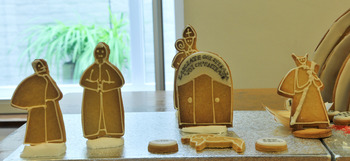
At one of the weekend workshops, after a tiring day, we were frustrated by a delay in being given access to the tea room. Eventually the door opened to reveal the entire Divine Comedy in biscuit form. Fig. 3. One of the most loyal participants at the weekly readings was also a gifted cook, and had spent the preceding month experimenting with how to recreate the poem in food. Without the object-literacy teaching being in any way focused on the creative process, he had seen and touched the huge variety of physical editions of the poem before creating his own work.
Leon Conrad's Divine Comedy in biscuit form after Dante workshop with UCL Special Collections (Image © David Ward).

The result of this sort of work, besides promoting use of library collections and, of course, providing us with edible biscuit sins, is to improve students’ grasp and understanding of meaning - in the projects described here, by helping students interpret physical text-bearing objects – and to facilitate their own creative process. The projects have also helped train students for the new landscape of employment, from the small-press businesses involved in the Slade project to academic and academic-related careers, where communication and public interaction are vital and an understanding of research processes often required as early as MA level. Most of all, we hope to improve understanding of the items in our collections, both by improving object literacy and by making our often unknown or under-valued professions and expertise more visible, which has to be in our interests for the survival not only of the material we curate but also of the social and cultural contexts that give its words meaning.