One of Heidegger's more notorious slogans, first uttered in a 1950 lecture and echoed in a series of subsequent works, is “Die Sprache spricht, nicht der Mensch”—“Language speaks, not man.” One of his most eminent students, Hans-Georg Gadamer, reports being unimpressed with it: “for a long time I resisted the forced paradox in this formulation of Heidegger. It certainly did not please me very much, and I learned that even the most loyal followers of Heidegger were furious that he had come out with it.” Every disciple found a new interpretation of the master's Heraclitean maxim. Gadamer himself explained it: “Of course there is a person who speaks, but not without being restricted by language.”Footnote 1 And again later: “the use and development of language is a process which has no single knowing and choosing consciousness standing over it.”Footnote 2 Herman Philipse's reading, to take another example at random, is rather: “Being speaks to us through language … language speaks to us, and if we listen in the right manner, we ‘inhabit’ language as our home.”Footnote 3 Others have connected it to famous tags and aphorisms of later philosophers: “There is nothing outside the text,” “the death of the author,” and so on.Footnote 4
It is not my intention in this essay to add to this exegetical plenum. Instead I would point out that Heidegger was not the first to arrive at his peculiar formula. In 1908, one Albert William Alderson (1880–1963) wrote,
who holds a telephone ear-piece responsible for its sayings? One minute it may support one thing, and the next speak in diametrical opposition. Yet who suggests that the telephone ear-piece has anything to do with the views it enunciates? Everyone knows that it simply repeats mechanically what is spoken into the mouth-piece at the other end of the wire. All human beings are like that mouth-piece: they simply repeat what their language tells them to say, the real power is the language.Footnote 5
Questions arise, then: who was Alderson, what was his own social and intellectual context, and what prompted this extraordinary judgment? The answers will take us far from the rarefied air of Continental philosophy, and into the histories of empire, capitalism, warfare—and diamond mining. His is the story, never before told, of what happens when a self-taught office clerk sets foot on terrain thoroughly explored by academics, and reaches, on his own lights, explosive conclusions. In this respect it may remind some of Carlo Ginzburg's tale of the miller Menocchio, interrogated by the Inquisition and burnt at the stake in 1599 for his heretical views, including his analogy of the Creation to the formation of cheese from milk. Ginzburg's aim was to reconstruct the thoughts of a working-class outsider, the sort of person not usually represented qualitatively in archives and other historical documents; Menocchio offered the rare possibility of studying such ideas directly, rather than through the prism of a “popular” literature “imposed” from above. Moreover, although his beliefs were decidedly not typical, they were within the bounds of his culture, or, as Ginzburg puts it, the “horizon of latent possibilities,” and so his case helps us to understand the limits of that horizon in a way not permitted by mainstream discourse.Footnote 6 So with Alderson: though not working-class, he did belong to a bureaucratic middle class of significant numbers but only rarely represented in histories of ideas. As with Menocchio, Alderson's ideas were peculiar extrapolations of common elements, and show us the limits of a horizon. This is of interest in its own right, but there is one additional reason to study him: although his conclusions have since been forgotten, they left a legacy, remarkable if troubling, among the intellectual projects of the early twentieth century.
Albert Alderson and the quest for peace
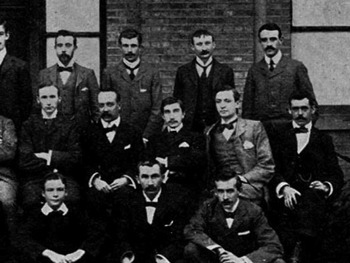
Alderson's life was wildly different from those of the scholars and philosophers usually studied by intellectual historians, and only a few traces survive in the archives of his native Kimberley, South Africa, and elsewhere. In 1859 his English father, William, arrived in the Cape to seek his fortune, after a luckless stint looking for gold in Australia; throughout the 1870s William worked with some success as a diamond miner, alongside the young Cecil Rhodes, and in April 1880, when the De Beers mining company was floated on the stock market for £200,000, he became one of its directors and the majority shareholder. Rhodes later bought him out for £750,000—about £50 million in today's money. Albert was born, three months before the company, on 18 January 1880, and the family went to live in London.Footnote 7 But three years later William was declared bankrupt and, after much legal wrangling, served a spell in Holloway Gaol for financial misdealings. In the 1890s the Aldersons returned to Kimberley, where they lived in the family home of William's wife Elizabeth; at the start of the Boer War, Albert joined the town guard and helped fight off the siege of 1899, for which he received the Queen's South Africa Medal.Footnote 8 The next year he found work in the De Beers office translating its correspondence; he had achieved white-collar, bourgeois respectability, though not domestic independence. Alderson was evidently a character: one contemporary remembered him arriving at her home in a large black cape, looking “like the devil” and speaking like him too, smooth and persuasive.Footnote 9 In one archival relic, a 1901 Christmas photo of the company office (Fig. 1), at the age of almost twenty-two, he sticks out a mile (middle row, second from right) from his peers—tall, clean-shaven, handsome, arrogant, otherworldly, Proustian.
De Beers company office, from Diamond Fields Advertiser, Christmas issue, 1901. Reproduced courtesy of the Kimberley Africana Library.

The year 1914 brought personal disaster: Alderson was accused of murdering Mary Grace Healey, a local teacher and family friend who rejected his proposal of marriage.Footnote 10 The evidence seems cumulatively impressive in retrospect, but it was nonetheless judged to be circumstantial, and the case was not brought to trial; Alderson fled Kimberley and disappeared. He died in 1963 at the Hertford British Hospital in Paris, leaving a modest will to his niece in England. His final book, first printed in 1955 when he was living in London, reveals dim glimpses of a peripatetic life, recalling on one page an encounter with the descendants of slave-owning Confederates during a visit to Brazil.Footnote 11
Alderson's milieu, at least during the known period of his life, was bureaucratic rather than academic. But in his spare time he wrote two books (1908, 1955–60) and six pamphlets (1909–15), almost all of which offered similar arguments on the same theme, namely, to quote the title of his first book, The Extinction in Perpetuity of Armaments and War.Footnote 12 He had a plan for permanent world peace, for what others would later call the end of history. It involved eliminating all the languages on earth except English.
Few of Alderson's writings, and none of the archival records, give any explicit indication of intellectual context; his principal book contains not a single footnote, citation or quotation. (There are quotations only of imaginary objections to his ideas, and his own responses.) He evidently had not the slightest interest in academic work pertaining to his themes, and referred only to current affairs and to major events in global political history, betraying the education of an autodidact.Footnote 13 His prose belongs to the world, not to the study: plain and hardheaded, with the vigor and repetitiveness of a pamphleteer, and a taste for large numbers—sums of money, demographic figures—the aesthetic of a company clerk. There are journalistic touches: appeals to the imagination and similes from commercial life, two of which we shall examine towards the end of this article. He scorns political elites in favor of the supposed perspective of the man in the street, and his arguments, as we shall see, are naive, extremist, impossible to align with school or party.
Alderson's ideas, then, for the most part lack the explicit discursive and institutional contexts that intellectual historians usually zero in on. Aspects of his argument can be contextualized in longer currents of European thought, but other aspects are harder to situate and explain; moreover, due to the way he constellated premises in ways unforeseen by earlier scholarly traditions, even his proposal that seems most typical of the period—his advocacy of a single global language—has a startlingly atypical rationale. However, as I hope to demonstrate here, his assumptions did reflect, however waywardly, the febrile, industrial, globalized, polyglot setting of Edwardian South Africa, and may be read specifically as an interpretation of the event that epitomized so many of the Cape's tensions, namely the Anglo-Boer War.
The central distinction in all of Alderson's writings is between those who speak the same language as each other, and those who do not; for the sake of convenience in this article, I will refer to these groups as homoglots and heteroglots respectively, though Alderson does not use those terms. All wars, he argues, have one of three causes—first, the mistaken belief of homoglots that they can profit from conflict; second, the private interests of hereditary elites; and third, the actual and irreconcilable differences of interests between heteroglots.Footnote 14 The first cause he hopes to reason his readers out of, while the second is already disappearing, and the third will be solved by eliminating heteroglossia; that is, differences in language.
Throughout history, Alderson writes, wars have been caused by kings, princes and dukes vying for power among themselves: a favorite example is the Wars of the Roses, but Alderson also mentions the French Wars of Religion, the American War of Independence, and a range of more recent local conflicts. These wars did not benefit the people of the countries involved, but they had no choice but to participate; such wars were, in other words, fundamentally undemocratic, reflecting only the will of autocrats. Whether he knew it or not, Alderson was writing in a long tradition of liberal political thought, going back to Kant, Cobden and others, associating peace with democracy. This in itself is less interesting than his solution, namely “commercialization,” or as he would later put it, more whimsically, “besteaming”: that is, industrialization, railways, telephony, and capital finance.Footnote 15 These processes had been occurring of their own accord in Europe for the past century: “In the last one hundred years an immense change in the material conditions of the world, due to the application of steam and electricity to industrial purposes, has taken place. This has resulted in a transference of power, which in its turn has profoundly modified the attitude of governments in the settling of various questions.”Footnote 16 In that time, power had been handed from “an aristocratic landed oligarchy” to “an industrial town democracy,” allowing for the creation and articulation of “public opinion” via cheap, mechanical print.Footnote 17 In other words, the “commercial classes” (by which Alderson seems to have meant both middle and working classesFootnote 18) were now in control of political decisions, and these classes did not want war, because it was unprofitable to the nation. The same developments would inevitably spread to the rest of the globe: “at no distant date the whole world will be commercialised.”Footnote 19
Alderson's optimism about global commercialization and its pacific effects—not to mention his journalistic and sometimes polemical prose style—will remind us of the famous, and famously wrong, predictions of Francis Fukuyama in 1992. In fact, Fukuyama couched his own position as a return to the optimism of Alderson's era, embodied by two items above all: the Encyclopaedia Britannica of 1911, and the 1910 pamphlet The Great Illusion, a work of liberal peace theory by the English journalist (and later Labour MP) Norman Angell.Footnote 20 The latter book was initially self-published as Europe's Optical Illusion after editors refused to touch it; even Angell's friends had warned that he would be “classed with cranks and faddists” who philosophized about peace when Europe was gearing up for war.Footnote 21 Nonetheless, it became a huge success and went through several editions down to 1938, occasioning printed synopses and critiques. Its thesis was that warfare, colonialism and empire had been rendered pointless by the “internationalisation” of labor and capital; that is, by the interconnectedness of nations via free-trade networks; as he summarized the argument in 1914, “For a modern nation to add to its territory no more adds to the wealth of the people of such nation than it would add to the wealth of Londoners if the City of London were to annex the county of Hertford.”Footnote 22 And just as Fukuyama would look back to Angell, so Angell looked back to the early theories of the “interdependence of nations” by David Hume and Adam Smith. But their ideas, he said, could hardly have been developed in great detail, since there was as yet little national interdependence in their time:
Consequently, until well into the nineteenth century, despite the intellectual labours of the physiocrats, the old idea that it was a nation's interest to kill the industry of other nations was still predominant. But by the third or fourth decade of the nineteenth century a real division of labour had set in. Steam was now playing a large role in our industry …Footnote 23
For Angell, then, the liberal ideals of the eighteenth century were realized only with the technological and commercial realities of the nineteenth. War would be eliminated when people understood the interconnected capitalism of the world. This was a view Alderson would have recognized, for he was likewise against colonization and empire, although the policy he advocated was complicated by his linguistic views, to be discussed shortly. He even used a image like Angell's, comparing annexation to a man cutting off the top of his blanket and attaching it to the bottom so as to cover his feet.Footnote 24 Although his 1908 book includes no references, it is easy to see it as a kindred response to a similar set of liberal premises and world circumstances as The Great Illusion.
Between the arguments of Alderson and Angell, however, lay an important difference. The Swiss political theorist Gerald Schneider has distinguished two types of modern liberal peace theory, the one founded on the commercial interdependence between nations, the other on the domestic conditions within a single nation; the father of the first theory, he writes, was Angell, and that of the second, the Austrian American economist Joseph Alois Schumpeter, who advanced his case in the 1919 essay Zur Soziologie der Imperialismen.Footnote 25 Alderson's position was closer to the latter, but much simpler. Industrialization, infrastructure and capitalism were for him not primarily bridges between nations—the latter was a collateral effect that in fact made war more likely, in that it brought differences of interest into closer contact—but the handmaidens of democracy within nations. They were also quintessential features of the new South Africa that the English, and the mining magnates, had sought to impose on the Boer farmers since the late nineteenth century; one need only think of the railways championed by his father's friend Cecil Rhodes, or of the innovations in mining technology that underpinned the Boer War. Alderson's emphasis on commerce, industry and technology is perhaps the aspect of his thought that most overtly situates him within the genealogy of Cape culture and politics.
The phonostate
In May 1914, on the eve of the war, Alderson penned a riposte to Angell's The Great Illusion. Angell had argued that there was no reason for one developed nation to engage another in war, since it would bring neither any material benefit; this, wrote Alderson, was very similar to what he himself had already asserted in his book of 1908, except for the key proviso—that it only held between two nations speaking the same language.Footnote 26 Alderson's chief concern, by contrast, was with heteroglots. To understand his position on this subject, it will be necessary to step back a little and examine the philosophical and political context of heteroglossia—the plurality of languages—in South Africa over the decades preceding his work.
By the late nineteenth century it had become received wisdom in Europe that language was an essential sign of national and racial identity.Footnote 27 Language, nation and race formed organic wholes, both on the world map and in individual persons, and so linguistic records could be taken as reliable indices of the mental character, indeed the identity, of a social group; Ferdinand de Saussure was compelled to combat this “popular notion” explicitly in his course on general linguistics at Geneva in 1906–11.Footnote 28 The tension, and actual conflict, between nations could thus be understood as an expression of a fundamental irreconcilability between the characters of their inhabitants. Moreover, it could be held that an individual's thought was shaped, or even determined, by his or her language—this argument, in the tradition of Kant and Wilhelm von Humboldt, was frequently propounded in Germany in particular.Footnote 29 To take one example of many, the influential theologian and philosopher Friedrich Schleiermacher, in a lecture in Berlin from 1820, argued,
Thinking … is performed only by means of language; every thought has its natural place only in the language in which it is thought, and can be productive only to the same degree as that language. For every language is a specific way of thinking, and what is thought in one language cannot be reproduced in another in the same way.Footnote 30
Languages, then, are not fungible: the way a person thinks is governed by his or her language, and in the same passage Schleiermacher insists that the determining factor is in fact a person's mother tongue. The idea of national and ethnic difference thus goes hand in hand with an insistence on the intimate bond between language and thought. The German philologist Wilhelm Bleek, who spent most of his life in the Cape studying local African languages, held the same views, acknowledging his debt to Humboldt. In a treatise of 1867 he wrote that language “is the spring of self-consciousness … it is only by means of it that true development of thought can take place”; it was, he concluded, “the basis of our existence as human beings.”Footnote 31
The idea that the contours of a language shape, or even determine, its speakers’ thoughts would continue to be controversial in the twentieth century, now associated above all with the names of Benjamin Lee Whorf and Edward Sapir. Inevitably it intersected, especially in Germany, with racist and nationalist arguments, but conversely it could be used to critique imperialism and support vernaculars against the domination of European languages. For instance, the prominent Kenyan intellectual Ngũgĩ wa Thiong'o, in his plea for African authors to write in their native tongues, relied on an understanding of language as identifiable with culture, and inextricable from thought and selfhood: “Language as culture is thus mediating between me and my own self; between my own self and other selves; between me and nature. Language is mediating in my very being.”Footnote 32 To write in English was to think in English, and therefore to be cognitively “colonized.”
Whether or not we accept Ngũgĩ's theory of language, it can hardly be denied that the dominance of European languages in Africa was no accident, but the result of deliberate colonial policies since the early nineteenth century—policies predicated, however implicitly, on a notion, cognate with his own, of language as constitutive. The early Cape colonist and geographer John Barrow thus insisted in an 1819 article for the Quarterly Review, “let but all official documents, all registers, title-deeds, instruments for conveying and securing property, be made in the English language, and the next generation will become Englishmen.”Footnote 33 An enforced change of tongue would shape thought and allegiance. As James Sturgis and others have documented, from the 1820s on there would be official efforts in South Africa, of varying degrees of success, to mandate the English language in government documents, legal proceedings, church services and schoolteaching. The local press helped the effort: in 1857 one English newspaper implored the Afrikaners, “Let your language [i.e. Afrikaans] and your nationality go, and you need not fear for your religion.”Footnote 34 Later in the century, the discussion of these questions was everywhere, on both English and Afrikaner sides. Anthony Trollope, touring the Cape in 1877, remarked on how English was elbowing out Dutch in the schools at Bloemfontein—going so far as to note the selection of books in the children's private bedrooms—and prophesying a “unity of language” without the need for “political Confederation.”Footnote 35 Only a year earlier, Chief Justice J. H. de Villiers, lecturing in Afrikaans at the public library of Cape Town, had proclaimed, “So long … as different classes speak different languages, no community of interests can permanently exist between them. With so many elements of discord existing in our comparatively small and scattered community, it would be a real advantage to this country if the antagonism arising from a difference of language could be entirely done away with.”Footnote 36
For Villiers, as for Trollope, future unity would lie in English, not Dutch or Afrikaans, but it is worth noting the idea of “interests” (belange) invoked in support of linguistic unity. The argument is strictly pragmatic. Pragmatic, too, is the imperialist version of the idea by the British journalist Richard William Murray, who identifies the presence of English with “sympathy” to English institutions, government and people; as Rhodes had seen, the teaching of English, along with railways and intermarriage, would help bring about “the union of interests” in the Cape.Footnote 37 By this Murray meant the assimilation of Boer interests to the English. Underlying all such arguments was a desire for unity not only of language but of selfhood and nationhood, for language could not be separated from cultural and religious identity. This subtext is brought out in the most ardently imperialist writings on the subject, such as James Stanley Little's 1884 Sketch Book of South Africa, which identified the British Empire and the English language with “the abolition of war, of priestcraft, of despotism, all over the world” and the “unity of all races of the earth into one people.”Footnote 38 It is why other Afrikaner writers and politicians opposed linguistic union. Thus Jan Hendrik Hofmeyr, the leader of the anti-imperialist Afrikaner Bond, thundered in 1890, “The language question is a matter of life and death. Despise the language and you despise your nationality.”Footnote 39
The struggle over languages continued during the period of reconstruction after the Boer War. Lord Milner sought a policy of anglicization, not only supporting British political and economic interests at the Boers’ expense, but depriving Dutch of its official status and insisting on the sole use of English at the level of government; in this he was backed by many, although Joseph Chamberlain and the Colonial Office dissented at first. But Milner underestimated Boer resistance to the policy, and his efforts are now widely judged a failure.Footnote 40 Eventually, the South Africa Act of 1909 (8.137) would enshrine English and Dutch “on a footing of equality” in government. But this very period also witnessed the rapid growth of a Boer nationalism that championed Afrikaans, emblematized by the former general Barry Hertzog, who helped found the Suid-Afrikaanse Akademie vir Wetenskap en Kuns (South African Academy of Science and Art) in the same year. In 1925, it would be formally clarified that “Dutch” included Afrikaans.
Language, race and nation were thus intimately joined as markers of identity in the minds of white South Africans of the nineteenth and early twentieth centuries; this was the ideological and rhetorical context in which Alderson found himself upon the family's return to Kimberley in the late 1890s, and one that must have seemed central to the armed struggle in which he participated, aged nineteen, in 1899. His worldview was, as we would expect, defined by a sensitivity to the conflicts inherent in a state of heteroglossia; like his South African forebears, he placed a critical importance on a person's language. But unlike them, he firmly denied any bond between language, race and nation. Still more strikingly, he evacuated selfhood altogether, leaving only the “interests” to which writers like Villiers and Murray had alluded.
As the world became commercialized, Alderson asserted, the only legitimate ground for violent struggle was a difference in language, and when this was present in a country, or between two neighbors, war was inevitable. This was his pathology, his monomania. To take only the most obvious example, one that recurs throughout his 1908 book, the Boer War had been “entirely due to the presence of two languages” in South Africa.Footnote 41 (Alderson did not distinguish Dutch and Afrikaans, and entirely ignored the African languages.Footnote 42) Anybody who spoke Dutch would be on the Boer side, just as anybody who spoke English would be on the English side; loyalties aligned strictly on linguistic grounds, unless a special incentive should be offered, as with the Boer turncoats known as the National Scouts.Footnote 43 It was practically a law of physics: his favorite analogy was the fact that water runs downwards unless mechanically, and with great effort, pumped upwards. Alderson also claimed that individuals, or even entire groups, could be mistaken about their loyalty; this was the situation, for instance, of the Irish, who had been loudly pro-Boer during the war, despite the language they shared with the British. He pointed out that the Irish in South Africa all lived among the English because they knew that they had no livelihood with the Boer, given the linguistic discrepancy;Footnote 44 in other words, their hostility to the English was a false consciousness. The way to prevent any future war was therefore to establish a single tongue throughout the Cape. The linguistic provision of the 1909 Act, then, was a disaster, and in a pamphlet of that year, the only one he published in South Africa, Alderson railed against it.Footnote 45 He concluded another of the same year, printed in London, by inviting communication (or cheques) from sympathizers to his cause, and giving his mother's address.Footnote 46
However, the Boer War was far from being Alderson's only example. The fall of the Roman Empire had the same cause: it was, he said, like a beautifully bound volume whose pages were all written in different languages.Footnote 47 He gave the same explanation in every possible case. In 1915 he added the First World War to the list, noting that, though he presumed a future Allied victory, it could be only temporarily decisive, since the variety of languages throughout Europe would remain.Footnote 48
What was certain in all instances was that contention was caused by language, and not, he was adamant, by differences of politics, religion, nationality or race, each of which he debunked repeatedly. Andrew Thompson has shown the variety of British loyalisms in South Africa of the period: to the Crown, to a “way of life,” to race, to values.Footnote 49 Alderson rejected them all. Race was particularly irrelevant: “Where unity of language prevails,” he maintained, “nobody can tell one ‘race’ from another. They are all the same. Everybody is of the same race.” Distrust was founded on superstition: “The idea that there is some mysterious difference in the Oriental make-up that Westerners can never fathom, is sheer myth and humbug.”Footnote 50 The average person had no interest in the race of his political masters, only in their language.
Alderson spent a great deal of time anticipating counterexamples—wars between commercialized homoglots, and peace among heteroglots. One of his strategies for dealing with the former was to reduce them to commercial disputes; for instance, the Irish Home Rule struggle became a merely “economic question” about landlords.Footnote 51 Another was to revert to the assertion of false consciousness, the mistaken belief that wars between homoglots can be profitable, or even meaningful. Take the American War of Independence: Alderson doggedly regarded this as “an occurrence of virtually no importance whatsoever,” since “to the vast bulk of the population it made no difference.”Footnote 52 A few soldiers died, a few politicans went up or down, but otherwise much was the same after as before, and above all, English continued to be spoken on American soil. When you looked at the world from the perspective not of nation-states, as most maps showed it, but of languages, the American war changed nothing. In other words Alderson was proposing a division of the globe into regions defined not by race, culture or political territory, but by language—not the ethnostates advocated by modern racists, but phonostates.Footnote 53
This concept is still more vivid in his second and final book, The Only Way to Everlasting Peace, composed over a period of some years, self-published in 1955—it is dated 7 March at the end—and reprinted by P. R. Macmillan in 1960, with a new preface of 28 January.Footnote 54 “[T]he true unit,” he now wrote, “is the language, not the country. In reality there are no such places as the United States, England, Australia, New Zealand, and so forth, except as geographical expressions.”Footnote 55 Again, “It is only by seeing a language map of a country or continent that you can appraise the real interests of its inhabitants.”Footnote 56 Such a map of medieval Europe would show that Germany lost the two world wars hundreds of years ago when it failed to establish its language throughout the continent.
The phonostate structure also applied to peaceful countries with more than one national language, of which the signal example was Switzerland. In Alderson's eyes this posed no problem: “There is really no such thing as Switzerland,” only the French part, the German part and the Italian part, held together in an uneasy peace because, in any conflict, each would be defended by the parent country.Footnote 57
The telephone and the signal light
Why should heteroglossia lead to war? We might expect that Alderson's reason was the mutual incomprehension of heteroglots. This had been the lesson of Babel, and one of the primary justifications given for the global auxiliary languages devised in the late nineteenth century, of which Esperanto and Volapük remain the most famous.Footnote 58 But it was not Alderson's reason. The problem, he maintained in his 1908 book, was not incomprehension, but the irreconcilability of interests. Paul Kruger and the other Boer leaders could understand English perfectly well, but that did not stop war breaking out, since they still owed their allegiance to Dutch. Therefore, if one wanted to eradicate warfare, it was not good enough to promulgate an auxiliary language; what was needed was the removal of all languages but one—a single global phonostate. This demand was formulated in violent terms:
what I insist on in this book is total extinction of existing tongues, that only will be effective from the no-war standpoint … Facility of inter-communication is set up (but even this only to a certain extent) by a universal auxiliary language, but identity of interest is only achieved by a single universal language that has killed all others and reigns in their stead.Footnote 59
Languages had to be “killed,” a figure of speech Alderson uses repeatedly. The English “could kill the French tongue in Quebec”; they “could also extinguish Dutch in South Africa, and likewise could kill all the innumerable tongues of India.”Footnote 60 It is a rhetoric of cruelty, but Alderson protests that his plan is not literally cruel at all. Rather, “It is the most brutal, the most inhuman cruelty to allow children to be brought up to different tongues. They are born friendly, i.e., without language, and hostility is inoculated into them by different-tongueness.”Footnote 61 Moreover, nothing but language needed to be eliminated, because it alone determined one's political interests; nations, religions and cultures could remain just the same, and no loss of life need be incurred. It is this modular notion of language, separable from all the other aspects of cultural life, that really marks Alderson out from the German traditions of the period. And it was why he saw imperialism and colonialism as a waste of time and effort, unless they propagated a language. The British Empire, Alderson commented in 1955, had been a colossal failure for precisely this reason, and he lamented the loss of English teaching in India following independence, and in South Africa since 1948.Footnote 62 The only worthwhile sort of empire, by contrast, was an empire of language.Footnote 63 But by this point he had lowered his expectations a little: it was enough now that the dominant global language should be able to “overawe the next three strongest languages,” for instance if it could command 25 or 30 percent of the world's population.Footnote 64
Like many liberal peace theorists, Alderson rejected any claims of cultural or racial superiority—but only among white Western nations.Footnote 65 His view of nonwhite peoples, and especially black Africans, was openly racist and paternalist; it did not feature explicitly in his political arguments, and he did not advocate any difference in general policy towards them, but his assumptions implicitly subtended his vision of a globalized economy grounded in anglophone commercial power. What is most curious is that, given his linguistic focus, he extended his pluralism to languages, insisting that no tongue was intrinsically better than another. He supported the supremacy of English, he said, only because he judged it the most feasible.
This made his argument quite different from that of the Victorians, who had predicted the universal hegemony of English as its manifest capitalist destiny. Thus the social reformer Francis Place in a letter of 1839: with the expansion of the North Americans, English “will become the language of Commerce as it is now of unparalleled enterprise wherever they who speak it fix their abode, and it will gradually supersede all other languages.”Footnote 66 Thus Thomas de Quincey's 1853 autobiography: “The English language is travelling fast towards the fulfilment of its destiny … running forward towards its ultimate mission of eating up, like Aaron's rod, all other languages.”Footnote 67 We will have no trouble recognizing in such sentiments the old assumption of an innate superiority in the English language, and behind it English values, culture, race and religion. Alderson strenuously denies any such link: the triumph of English is in principle no better than that of French or Chinese, though much more likely, given the existing numbers of anglophones and their increasing political and commercial clout around the world. As with Place, the strength of the language lay not in England at all, but in the vastness of America, whose only serious rival phonostates were Russia, China and Spanish South America. Europe, by contrast, was an irrelevance. Alderson's chief hope lay in converting China:
English is a sort of general means of communication already in China, being used in the ports, in trade, &c. In fact, I believe that Chinamen from different parts of China can only understand each other by means of the broken English current in the ports, as the various languages of China are mutually unintelligible …Footnote 68 If China refused, the English-speakers are strong enough to enforce its adoption.Footnote 69
In that last sentence, that threat of literal violence, is an aspect of Alderson's argument he rarely emphasized, but which was there all along. There was no hope of profit in war between homoglots, no purpose in colonialism or empire—but, contra Angell, conflict between heteroglots could be extremely profitable because it could serve to further the cause of one's language. This, indeed, was the only benefit of war and imperialism in the modern world. In 1914 Alderson recommended that the correct strategy in victory was to force the defeated nation to teach its children the victor's language; this was, crucially, in the interests of both parties.Footnote 70
There is one piece of this peculiar system we have not yet addressed—we have not asked why Alderson held a person's interests to be determined by her language. This question will take us to the core of his thought. Despite his reliance on the word “interests,” which appears almost two hundred times in The Extinction, he nowhere defines it, and it seems to run together political and economic considerations. Right at the start of his book he offers a hypothetical scenario:
You go to Canada, landing at Quebec … On all sides the language you hear spoken is French. You buy a newspaper: French. You accost a cabman: French … We will suppose you wish to find journalistic employment. You enter a newspaper office; if you speak no French your services are not required … In short, if you cannot speak French you will probably starve. And this in an English—an English colony.Footnote 71
The foreigner looking for work abroad seems to be Alderson's canonical “state-of-nature” thought experiment, appropriately for a man whose father had made his fortune in just that setting, and who himself continued to benefit from his capacity to work internationally. “Political economists,” Alderson later declared, “write much on the subject of free trade in merchandise, but what is a thousand times more important is free trade in men, and that is impossible under polyglottism.”Footnote 72 Yes, there were immigrants who did not speak the language, but they were doomed to a miserable existence. Alderson would have been familiar with their lot, since De Beers had become increasingly dependent on imported Chinese labor; the gulf between them and him, the affluent white Englishman, must have seemed immense.Footnote 73
Alderson's homo economicus was a creature of the globalizing nineteenth century, seeking fortune abroad, aligned less with nations than with corporate structures like the mining industries of South Africa; race, flag and culture seemed like outmoded totems, impinging on pure economic rationality. And in this respect South African mining was an obvious context. It was the very globalism of De Beers, with its head office and operations in the Cape but its board of directors in London, that prompted the United Kingdom to tighten its international tax laws in 1906.Footnote 74
At first glance this purely economic understanding of interests would seem at odds with Alderson's claim that the Boer War was caused by the irreconcilability of political interests—as if he was suggesting that the Boer and British leaders were really fighting for the free movement of labor within an enlarged phonostate. But it was a common diagnosis of the Boer War to view its apparently nationalistic contention of English against Dutch as a cover for financial and industrial interests. The economist John A. Hobson seminally advanced this position in his 1900 book on the conflict; not only had the British stolen the diamond fields from their rightful Dutch owners, but the mines were now ultimately controlled by a “small ring of financial foreigners”—that is, inevitably, Jewish bankers—in whose interests the British were now fighting, whether they realized it or not.Footnote 75 Even Hans Morgenthau, who criticized economic theories of imperialism such as Hobson's on the very ground that capitalists tended to be hostile to empire—as Alderson was—conceded that the Boer War was, uniquely among conflicts in the period of “mature capitalism,” provoked by economic rather than political concerns.Footnote 76 Since then, historians have offered a subtler reading of the national and corporate interrelations at the local level, demonstrating a complex symbiosis between the imperial state and the mining magnates.Footnote 77
The war was a shock to the system, even among the victorious British. Much South African thought of the following decade was directed towards preventing a repeat of violence, and towards rethinking the nature of the British Empire itself—a trajectory that led through Milner's administration, its debating society the Fortnightly Club, and its successor the Round Table movement, to the promotion of a “closer union” between Britain and its colonies, and, ultimately, the Commonwealth.Footnote 78 Vineet Thakur and Peter Vale have recently argued that the club and its members, who recommended policies of racial segregation for the purpose of white solidarity between the English and Dutch, should be viewed as the progenitors of what would later become the academic discipline of international relations.Footnote 79
Against this backdrop, Alderson's fantasy, as bizarre and isolated as it was, seems more legible. Like Milner's men, he wanted not only to prevent future war, but also to rethink the very notion of international allegiance; as with them, his thought began with the Boer War and concluded with the whole world, which is why this fragment of intellectual history has a global and not just a local context. His argument was founded on linguistic, not racial, segregation, with language apparently a proxy for economic opportunity in a new global marketplace. But this was surely not enough; a lingua franca like English, or an auxiliary language like Esperanto, if sufficiently diffuse, would also permit the free movement of international labor that he sought. When Alderson wrote in The Extinction that speakers of one language would perish in a foreign country among heteroglots, the anonymous annotator of one copy scrawled, reasonably enough, “Well learn the language!”Footnote 80 His own later life in Paris, reading the French press that he quotes in his second book, seems to underscore the absurdity of suggesting that all interlingual migration is undesirable.
But there is in his work one last threshold at which economics, and economic rationality, come to a halt. Beyond this line is a much more radical notion, the one we dangled as bait at the start of this article: “All human beings … simply repeat what their language tells them to say, the real power is the language.” A human has no free will, no inner being; he is only a machine, a telephone for language to speak through, or, as Alderson later had it, “merely a gramophone, a telephone receiver, a radio set.”Footnote 81 The metaphor is straight from his globalizing vision—that is, from the busy company office where he translated correspondence. Again, “a man as regards his attitude towards his fellow-men—his international relations, so to speak,—is really merely a machine, a puppet, an automaton, the tool of his language.” A national government, too, is “only a puppet and the strings are pulled by the language.”Footnote 82 Another image captures a different part of the new commercial world. Alderson liked to tell an anecdote from his childhood: when he first saw the signal lights on the London railway, he thought that the green and red lamps had different filaments. Only later did he realize that both lights were white, the only difference being their glass filters.Footnote 83 So it was with human beings, who were all the same, all white lights, but with various filters—that is, languages—and therefore various purposes. This image might be misconstrued as implying that one's language is a superficial and irrelevant aspect of one's identity. In fact, Alderson has in mind quite the reverse: “A man speaking Dutch would strongly favour a Dutch-speaking State; change his language to English, and he at once favours an English-speaking State. He is like an ordinary white light which can show any colour according to how it is manipulated … It is simply the tool of its operator.”Footnote 84 What is so striking about these two images, the telephone and the railway lights, is that they inadvertently burlesque central metaphors of personal identity in Western thought: the inner voice (logos endiathetos), which is the discourse of thought constitutive of individual agency, but also the immanent divine Word (John 1:1); and the inner light, which is also the light of the Word (John 1:9, Augustine's Confessions VII.x.16) and of reason (the Cartesian lumen naturale). These are metaphors by which human beings were given interiority and consciousness, but also a relation to God—to eternal, immutable reality. They would be subverted in Heidegger's pseudo-theological wordplay: “Language speaks. Man speaks insofar as he responds to language. The response is hearing. It hears [hört] insofar as it belongs [gehört] to the behest of silence.” “Language speaks. Man speaks only when he responds skilfully to language. But this response is the proper way in which man belongs in the clearing [Lichtung] of Being.”Footnote 85 Language replaces God as the guarantor of Being.
For Alderson, by contrast, the light seems to be nothing so much as standing reserve, purely fungible in the service of a desired outcome; everything has become merely technological and mechanically reproductive. He has no use at all for the notion of interiority or inner being, still less for racial or national attachments, only for that of a person's interests. And so he repeatedly imagines, as above, a situation in which someone's language is suddenly changed and her interests are at once transformed: “you can manufacture German, English, French, &c., just as you can manufacture boots, or hats, or socks. It is all artificial.”Footnote 86 The rest of a human being is left intact in the transformation: there is no self to change along with the language. In fact there is no “inside” at all: the light of a signal box has no nature, no essence, being only the energy needed to transmit the meanings (stop and go) embodied in its filters.
This is what makes his intuition so different from that of the German tradition discussed earlier in the article, despite superficial similarities—language is here fundamental and constitutive, but it is not, as Bleek had it, the means by which the “true development of thought can take place,” nor, as Ngũgĩ would later put it, a “culture” that mediates an individual self. It is not an integral part of an organic totality, in either an individual or a nation, but simply that which determines interests. Alderson's figure of language speaking is thus the mirror image of Heidegger's, and its proper milieu is precisely what the German philosopher would bewail in his 1941 notebooks: the Planetarismus or globalism that homogenized cultures, and the corresponding Idiotismus or idiosyncratism by which we surrender what is ours to everyone else—including, trenchantly, to “the binding force of the entirely ‘they’-like claim of the radio, where ‘no one’ speaks”—not even, perhaps, language.Footnote 87 With what horror would he have read Alderson's demand for global “commercialisation”—with what disgust of the “artificial,” telephonic man, manufactured by language? Alderson, no doubt, would have been horrified right back. And yet more than one commentator on Heidegger—one thinks most notably of Emmanuel Levinas and Herbert Marcuse—has seen in the results of his philosophy something of the same bleakness and antihumanism as is evident in The Extinction.Footnote 88
Alderson, then, was far from being any sort of proto-Heidegger—I must emphasize here that I am not advancing a decontextualized argument that the one “anticipated” the other. Nonetheless, juxtaposing the two figures reveals just how easily the subordination of agency to language, such a salient feature of twentieth-century Continental philosophy, could arise from entirely different experiences. Beyond this it is difficult to know just what would count as “context” for Alderson's telephonic idea at all—to seek that would be to run the risk of reducing the idea to another already known, when we gain more as historians by discovering something new. Context only takes us so far. After all, Heidegger's followers, who understood his thought and its context well, were reportedly baffled by his dictum that language speaks. Perhaps that would be a legitimate scholarly response to Alderson's pronouncement too.
Some readers may balk at the effort to recover an author so obscure and so misguided as Alderson. But it is important for intellectual historians to consider outsiders alongside their more usual fare of elite scholars and academics, and not just the ordinary mainstream whose historiographical value Saul Dubow, in a South African context, has so eloquently defended.Footnote 89 Alderson's isolation from that mainstream, far from being a reason to ignore his work, is a better reason to study it, for it gives us a sense of how a man of the time might have reasoned without the constraints of the standard academic premises. In other words, he reminds us that big ideas can occur to the average person reading a newspaper, even if that person in this case happened to be the son of the cofounder of De Beers. His were the assumptions of a typical Edwardian bourgeois—liberalist political ideals, casual racism, the embrace of technology, globalism, the conception of behavior in terms of economic rationality—taken to their logical limits, and anchored in something utterly antiliberal, namely the annihilation of personal agency. These assumptions, typical and atypical alike, no less than those of the Fortnightly Club or the Boer nationalists, lay within the horizon of thought on the threshold of technological modernity, and a full picture of that place and time must include the one as well as the others.
Alderson's legacy?
It might be supposed that Alderson's arguments represent a historical dead end. Few seem to have read his work, and as far as I know, no author-published book or article, save the odd early review, has ever referred to it.Footnote 90 As with Alderson himself, it disappeared like a wraith into the forests of the twentieth century. Other men had a similar idea, but for more conventional reasons, and probably independently. For instance, at the First Universal Races Congress, held at the Imperial Institute, London, in late July 1911—the proceedings would be published by P. S. King, who also printed Alderson's work—the renowned Oxford orientalist D. S. Margoliouth proposed a global reduction of languages to one, using the very Aldersonian image of the gauges of railway tracks:
Languages, then, are not worth artificially preserving either for patriotic or literary purposes; like railways, they are instruments for communication; and the question whether it is desirable to have many languages or one is not very different from the question whether it is best for each country to have its own gauge or that all should have a common gauge.Footnote 91
Margoliouth was sure that the language adopted by all would have to be one of the three great European languages, i.e. English, French or German. At the same conference, Ludwik Lejzer Zamenhof, the venerable founder of Esperanto, agreed with Margoliouth but proffered his own invention as the solution: “The diversity of peoples and the hatred of each other which they betray will not wholly disappear from the face of the earth until humanity has but one language and one religion.”Footnote 92 These two, however, were worried about incomprehension, not irreconcilability. The same is presumably true of the American car magnate Henry Ford, who in the 1920s declared that the only sure road to world peace was to “Make everybody speak English!’Footnote 93
Margoliouth's talk played into a burgeoning scholarly conversation about the nature of nationalism—that is, about precisely what was responsible for the feeling of like-mindedness among peoples.Footnote 94 The great Chicago philologist Carl Darling Buck, whose synonym dictionary of the Indo-European tongues is still consulted today, made a case in 1916 for the primary significance of language in forming national identity; his essay reads like a much more reasonable and nuanced exploration of the axioms underpinning Alderson's work, and it even includes a section on the imperial policy of destroying local languages.Footnote 95 Buck would be cited, alongside Margoliouth, in James Mickel Williams's 1920 textbook The Foundations of Social Science to underscore the claim that language, not race, was the key to national identity.Footnote 96 In South Africa itself, such questions had direct and pressing practical dimensions, particularly in regard to the language of education. Charles Templeman Loram argued in 1917 that the Bantu languages should not be allowed to survive on account of their lack of intellectual sophistication; rather, indigenous South Africans should be taught in English and Dutch after two years.Footnote 97 Bilingualism would remain the important cause, even as the racial question fell away, as can be seen in the efforts towards cultural unity of later scholars such as E. G. Malherbe and T. J. Haarhoff.Footnote 98
Alderson's concerns, then, became mainstream, in a weaker form, over the decade after his first book. But had that book itself been entirely forgotten? In fact, we can identify one contemporary reader, and a rather significant one at that, with whom we may conclude this article. On 16 February 1911, five months before the Universal Races Congress, C. K. Ogden, then an undergraduate at Cambridge, delivered a lecture, entitled “The Progress of Significs,” to his intellectual salon, the Heretics Society. The lecture, which remained in manuscript until it was printed in 1994, was an introduction to the ideas of his mentor and correspondent, Lady Victoria Welby, an impeccably well-connected biblical scholar and pioneer of what she called the “science of meaning,” similar in some respects to the theories of her friend Charles Sanders Peirce.Footnote 99 In a list of recent works on language, Ogden mentioned a proposal for French as a universal tongue, and then remarked, “Similar claims are put forward on behalf of English in a book by A[lbert] W[illiam] Alderson, with the unpromising title The Extinction in Perpetuity of Armaments in War (1908), which really deals entirely with questions of language.”Footnote 100 No more is said, but the context, in which Ogden recommends books to his audience, implies approval.
Two decades later, Ogden made his name on the international stage by announcing his project for “Basic English”—a version of English with a reduced lexicon and simplified grammar designed to be adopted worldwide as a universal auxiliary language. It rapidly became a cause célèbre. New books were written in Basic and old ones translated into it, including, remarkably, a few pages from Finnegans Wake, courtesy of Ogden himself; it found supporters all over the world, and in the early 1940s even Winston Churchill expressed an interest, although attention would fizzle out by the middle of the next decade.Footnote 101 Basic looks like a far cry from Alderson's plan, closer instead to Esperanto. In the preface to his 1931 book Debabelization, Ogden wrote, “The absence of a common medium of communication is the chief obstacle to international understanding, and therefore the chief underlying cause of War.” This was certainly the more usual justification for a universal language, and we might wonder whether Ogden had forgotten all about Alderson in twenty years. But immediately before this statement he declared, “‘What Europe needs most is about fifty more dead languages’, said a sagacious observer at the outbreak of the World War. What the World needs most is about 1,000 more dead languages—and one more alive.”Footnote 102 I have been unable to trace the quotation, but it reads an awful lot like a memory, dim with age, of Alderson's guiding idea. In these words Ogden's plan did not seem quite so cheerful after all—English no longer as a mere auxiliary language, but as the sole survivor of linguistic armageddon.Footnote 103 Was Alderson an “influence” on Ogden? That category is a notoriously troublesome one. All we know is that Ogden read The Extinction at a formative moment in his intellectual career, and twenty years later put forward a plan with a similar subtext. For the two sentences quoted here are only the direct expression of an idea latent in Basic English. Some contemporary critics of the project, such as the Canadian linguist Michael West, focused on its technical details.Footnote 104 But other voices accused it of cultural imperialism, and these intensified when I. A. Richards, Ogden's old collaborator, visited China to disseminate the scheme—as if accepting Alderson's challenge unawares—even as Richards pooh-poohed the complaints in his book Learning Basic English, to the dissatisfaction of reviewers.Footnote 105 In a 1943 speech at Harvard, Churchill glorified Ogden's neo-imperial vision, imagining “British and Americans moving about freely over each other's wide estates with hardly a sense of being foreigners to one another,” a scenario to be accomplished by the diffusion of “our common language … throughout the globe.” That diffusion, he added, would aid many other races on earth, and help to preserve peace better than “taking away other people's provinces.”Footnote 106 If Alderson knew of this speech, he surely approved, for his views had now been given the most prominent expression; indeed, insofar as historians have disapproved of these and similar sentiments, they have been objecting to the lingering spirit of Alderson within them.Footnote 107
Alderson's work, put in its full historical context, looks like the missing link between the politics of globalization in the late nineteenth century and the universal-language theories of the early twentieth. The crudeness and absolutism of his thinking, its refusal of circumspection, not to mention its antihumanism and the ugly cultural politics that lie beneath it, will make it unattractive to those hunting diamonds in the deep mines of history; it cannot be rehabilitated by charitable rereading. But these very qualities ought to recommend it to another class of historian: the coroner. For it represents a varicosity, a making visible, of veins under the skin of modern Western thought, loaded with toxins. As so often, it took an outsider speaking what he thought was plain common sense to show where things were headed. But he was, we are told, a theatrical man, and his cleverest ruse, in an age vaunting its own profundity and enlightenment, was to persuade it that he had never existed.
Acknowledgment
For their comments on earlier drafts, I would like to thank Derek Attridge, Andrew Gibson and Andrew McKenzie-McHarg. I am also greatly indebted to Anne Clarkson, a descendant of Alderson's aunt and a professional genealogist, who helped with the biographical points mentioned in this article, including the discovery of Alderson's date of death.