


In the wake of conflict, victors face difficult choices allocating scarce resources. The broad provision of public goods can consolidate control by enhancing security, legitimating the new regime, and co-opting potential sources of opposition.Footnote 1 At the same time, weakened fiscal capacity, the endurance of opposition groups, and the threat of violent backlash often constrain this more expansive approach.Footnote 2 Recent scholarship evaluating related trade-offs examines how territorial control shapes distributive politics during and after conflict,Footnote 3 while an influential body of work emphasizes the long-run effects of institutions following colonial conquest for welfare outcomes.Footnote 4
The centrality of ethnoreligious cleavages in both contemporary and past conflicts suggests that conquest and rebellion not only shape institutions but also radically disrupt the distribution of economic resources across societal groups.Footnote 5 In this article, we consider how shifts in local inequality condition the long-run supply of public goods. This is particularly challenging from an empirical standpoint in places where local inequalities are themselves a legacy of conflict because civil war, revolution, or colonization simultaneously change the group identity of economic elites and the concentration of resources between individuals.Footnote 6 The vast literature connecting ethnic diversity with public goods provision implies thorny inferential challenges in trying to isolate the impact of either shift.Footnote 7
We develop a theoretical framework to consider how local variation in the postconflict group identity of economic elites shapes the supply of public goods. We focus on settler colonies: agrarian economies where conquest led to rule by an ethnoreligious minority, and extreme horizontal inequality between groups amplified the risk of conflict.Footnote 8 Connecting the literature on between-group inequality with work on postconflict public goods provision, we argue that local variation in the share of land controlled by the dominant minority conditions the supply of public goods through a variety of channels, including group-level variation in preferences, connections between local elites and supralocal institutions, and local social cohesion. While we highlight heterogeneity across types of public goods according to the incidence of their resulting benefits across groups and their modes of supply, we suggest that, in most settler colonies, minority elites’ exclusionary preferences inhibited aggregate investments in public goods.
We apply this framework to colonial Ireland and test it by combining a rich set of original data sources with a natural experiment.Footnote 9 We focus on the two centuries following the Cromwellian Settlement, an archetypal case of rule by a dominant ethnic minority.Footnote 10 Characterized as “the most epic and monumental transformation of Irish life, property and landscape that the island has ever known,” the Settlement followed a brutal war of conquest (1649–1653).Footnote 11 The terms of surrender for this conflict are succinctly captured in an apocryphal ultimatum attributed to the leader of the invading New Model Army, Oliver Cromwell, that Ireland’s Catholic gentry could go “to Hell or to Connacht,” Ireland’s poorest province. The Act for the Settlement of Ireland (1652) formalized the expulsion of much of Ireland’s Catholic gentry to westernmost Connacht, expropriating and redistributing their estates to English Protestants, but leaving their surviving tenants in place.Footnote 12
Features of this redistribution process allow us to isolate local variation in the sectarian identity of landowners following the Settlement. Facing uncertainty over the land available to compensate the wealthy “Adventurers” who had funded the war and the New Model Army soldiers who fought it, a lottery in 1654 randomly allocated baronies—comprising a quarter of Ireland’s total land mass—between these two groups.Footnote 13 Owing to their varied propensities to settle, we find that land in baronies assigned to soldiers had higher rates of English Protestant ownership by 1670, while land in Adventurer-assigned baronies was more likely to be sold back to its prior Irish Catholic owners. We find no equivalent differences in land concentration, such as the number of distinct landowners in a given area, for reasons we discuss later. While clearly a compound treatment, the comparison of outcomes across lottery-assigned baronies provides unusual leverage on an often intractable problem in postconflict settings: how to untangle the effects of inequality between identity-based groups from the effects of economic concentration between individuals.
To explore the consequences of elite identity for public goods provision, we examine the effects of the baronial lottery in the long run. Consistent with the claims of historians who have long argued the Cromwellian Settlement had persistent effects on landownership, we document that our “short-run” variation persists through subsequent episodes of land expropriation, is not attenuated by religious conversion, and that areas assigned to the Army were more likely to retain Protestant landlords nearly two centuries later.Footnote 14 A detailed examination of facility-level historical sources relating to a range of local public goods—schools, health facilities, workhouses, and carceral facilities—on the eve of the Great Famine (1845–1849) indicates that public goods were scarcer in areas assigned to the Army. Further, we find the most striking reductions in public goods that were either directly elite-funded or were disproportionately likely to benefit the Catholic majority. These results are consistent with discrimination by an English Protestant elite against poorer Irish Catholics in areas quasi-randomly exposed to more intensive land expropriation during colonization.
Beyond Ireland, our theory suggests that similar dynamics are most likely to hold across a range of colonial and imperial settings. Extreme group-level inequality in landownership characterized former settler colonies in Africa, such as Algeria, Angola, Kenya, Mozambique, South Africa, and Zimbabwe, where local elites also played significant roles in public goods provision for decades prior to independence.Footnote 15 In the Americas, there are parallels with colonial Ireland prior to the expansion of the welfare state, and in Eurasia, we note potential similarities with the expansion of the Russian Empire. Beyond these historical cases, we note that minority rule resulting from insurgency, such as more recent examples in Burundi, Ethiopia, Rwanda, or Uganda, generates a set of analogous, if distinct, tensions.Footnote 16
We make two distinct contributions. First, existing work on the long-run consequences of colonization for public goods delivery often focuses on the crucial role of institutions, such as property rights regimes.Footnote 17 By emphasizing the distributional legacies of conflict, and building on generations of Irish historical scholarship pointing to the local social dimensions of settler colonization,Footnote 18 we join a recent set of contributions highlighting the importance of identity traits of the colonial elite for a range of economic and political outcomes.Footnote 19 Building on work examining the difficult trade-offs in postconflict governance, we highlight the nuanced expenditure preferences of minority group elites.Footnote 20 The impact of these preferences underscores how conquest reshapes not just institutions but also the local political economy over an extended period.
Second, a large literature connects ethnic diversity, state building, and public goods.Footnote 21 While some scholars emphasize the importance of the concentration of resources between individuals,Footnote 22 others instead prioritize distribution between groups.Footnote 23 However, whether following conflict or in general, both types of inequality typically covary, making it extremely difficult to disentangle these two distinct channels.Footnote 24 Empirically, our research design enables us to tease apart inequality in landholding between groups from inequality in landholding between individuals, allowing us to estimate the effects of the Cromwellian Settlement’s radical reconfiguration of Protestant and Catholic landowners on public goods nearly two centuries later.
Inequality, Identity, and Local Public Goods
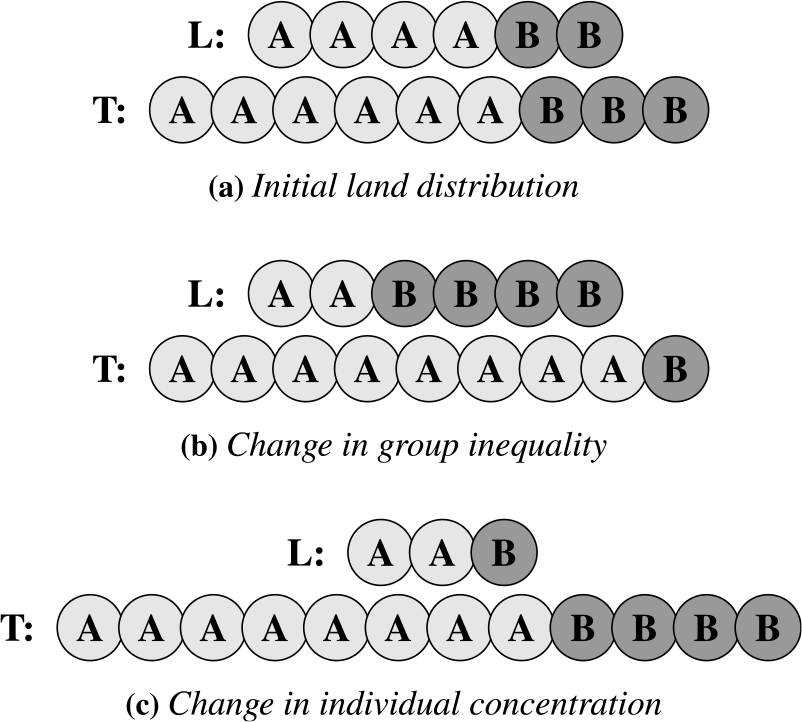
The consequences of conquest for local inequality bundle changes in the distribution of resources across groups and between individuals. In Figure 1 we consider a stylized administrative unit where citizens are either of economic status L (for Landlord) or T (for Tenant). This general arrangement—the division of society into a (wealthier) landowning class and a poorer tenant class (such as peasants)—broadly characterizes many agricultural societies.Footnote 25 We assume the presence of a cross-cutting group cleavage dividing A (the majority group) and B (the minority), which may reflect nationality, religion, caste, or ethnicity. In our empirical setting, A corresponds to Irish Catholics and B to English Protestants. Figure 1a depicts an initial distribution in which members of the two groups are equally likely to own land (that is,
 $P(L|A) = P(L|B)$
). We consider two possible reallocations. In Figure 1b, group-level inequality shifts such that
 $P(L|A) \neq P(L|B)$
while individual-level inequality, P(L), stays fixed. Here, the ratio of non-landowners to landowners remains the same, but the ratio within groups changes.Footnote 26 In Figure 1c reallocation shifts individual-level inequality such that P(L) falls while still
 $P(L|A) = P(L|B)$
. Here, landholding becomes more concentrated at the individual level (fewer people own land), but group inequality stays the same (the proportions of A and B among landowners and non-landowners is unchanged).
Shifts in land inequality between groups and individuals

Shifts in local inequality resulting from conflict are likely to reflect a combination of Figures 1b and 1c.Footnote 27 Colonization, for example, might concentrate land among fewer owners than there were before, as in much of the Spanish EmpireFootnote 28 and British colonies across Asia and sub-Saharan Africa.Footnote 29 But colonization also reshapes group inequality by changing the identity of the elite. In Zimbabwe, half of all land was expropriated by settlers comprising 5 percent of the population;Footnote 30 in Algeria, the most productive land was taken from the local Muslim population by French colonists.Footnote 31
Despite the fact that these twin shifts are typically codetermined when cross-cutting cleavages exist, previous scholarship on the legacies of colonization focuses primarily on land concentration and its interaction with political institutions.Footnote 32 Greater land concentration enables a smaller elite (regardless of identity considerations) to coordinate and mobilize resourcesFootnote 33 and for landed elites trying to forestall industrializationFootnote 34 to limit labor mobility and human capital development.Footnote 35
Theoretical Channels
Shifts in the group-level distribution of land are likely to have independent and persistent effects on public goods provision. We highlight three potentially countervailing channels through which these effects occur. As discussed in the next section, these channels are likely to heterogeneously affect the supply of different types of local public goods in postconflict settings.
First, changes in the identity of the local economic elite (in Figure 1b, B rather than A) imply that variation in their preferences will shape the levels and distribution of local public goods.Footnote 36 On the one hand, groups might have different intrinsic preferences due to their varied evaluations of different public goods.Footnote 37 On the other, group status (majority or minority) potentially generates instrumental differences in preferences. The ethnic diversity literature, for example, explores strategic reasons to prioritize expenditures that benefit one’s in-groupFootnote 38 or to be differentially responsive to local tenants.Footnote 39
Second, the group identity of local elites shapes their connections to supralocal political institutions. Significant land transfers following conquest typically increase the alignment between the identity of the local elite with elites in regional or central institutions which hold significant influence over resource distribution. While these linkages might enable local elites to more effectively request resources for their communities,Footnote 40 the distributive incentives facing state institutions are potentially mixed.Footnote 41
Third, shifts in the group-level distribution of land affect social cohesion by shaping the extent to which group affiliation (A or B) becomes predictive of economic status (L or T). Marginal increases in horizontal differentiation inhibit local cooperation, which might be needed to coproduce local public goods.Footnote 42 Larger changes, such as those resulting from conflict, can lead to the politicization of group identity, prompt social unrest or rebellion,Footnote 43 and induce repression.Footnote 44
Aggregate and Conditional Implications
While the net effect of these channels is ex ante ambiguous, in the settings we focus on—agrarian economies under minority rule in the wake of conflict—increases in group-level inequality are likely to reduce aggregate levels of local public goods. We argue that effects across specific public goods are likely to be conditioned by the incidence of the resulting benefits across groups and the modes of their supply.
In the aggregate, following conflict and large-scale land transfers, the cohesion channel should unambiguously inhibit public goods production. Reductions in social trust, particularly toward out-groups,Footnote 45 reduce local coordination, amplify the future risk of conflict, and undermine cross-group cooperation in the provision of public goods.Footnote 46 The preferences channel implies similar reductions. In principle, a minority elite could hold intrinsic preferences for broader public goods. However, these are often likely to be dominated by instrumental preferences for exclusionary expendituresFootnote 47 and even more so following conflict when enmity between groups is high.Footnote 48 Finally, while the connections channel increases linkages of minority elites to their in-group peers with influence over supralocal political institutions, these are unlikely to be consequential for distributive outcomes in settings defined by a relatively low-capacity central state.
While implying reductions on average, increased group-level inequality is likely to have heterogeneous effects across different types of public good. Most importantly, this depends on the incidence of benefits arising from investments, which affects the extent to which public goods change the economic or social status gaps between groups. This variation shapes local elites’ instrumental preferences and incentives regarding their supply. Broad investments in health infrastructure, for example, have prospective payoffs to a minority elite to the extent that these help them to maintain an agricultural labor forceFootnote 49 and support economic production.Footnote 50 Additionally, limiting the local burden of disease is in the interest of even exclusionary local elites given the indifference of contagion to economic status.Footnote 51 Similarly, minority elites face potential incentives to invest in local security institutions to the extent that they help to maintain agricultural output and consolidate their local control.Footnote 52
Minority local elites, in contrast, face only weak incentives to invest in the human capital of the broader local population through education,Footnote 53 particularly when it is hard to target education access specifically to their in-group.Footnote 54 Welfare institutions—such as, in our case, workhouses—present an intermediate case in historical settings. While purely redistributive incentives are likely to decrease as the minority group’s economic influence increases, welfare institutions also helped discipline labor and prevent social disorder, providing some benefits to local elites.Footnote 55
Alongside the incidence of benefits, the mode of supply varies across public goods as a function of the institutions and individuals involved in their provision. This conditions whether local elites’ varied incentives translate into material changes in distribution. For public goods that are provided supralocally, whether centrally or regionally, the connections of local elites to their peers might influence their distribution of resources.Footnote 56 For those supplied locally, local elites enjoy more discretion in the granular targeting of resources, increasing the likelihood that the benefits of nominally “public” goods accrue primarily to the minority in-group.Footnote 57 Simultaneously, weakened cohesion limits the ability of communities to coordinate and independently increase supply. While smaller institutions depend on the beneficence (or self-interest) of individual landholders (such as dispensaries or elementary education facilities), these investments often also rely on local coordination for informal labor and materials.Footnote 58
While heightened group-level inequality should inhibit the aggregate supply of local public goods, these conditions highlight where these reductions should be largest. These occur where the stratified incidence of benefits favors the majority, such as basic education or purely redistributive social welfare spending. Within these broad categories, reductions are likely to be greatest where the mode of supply is most local, such as for small-scale schools funded by local elites or locally funded facilities supporting the poorest. For public goods where the incidence of benefits is less stratified, such as health or security institutions, we might expect reductions to be conditioned by whether local elites have significant discretion over the funding and targeting of local investments.
Applicability, Persistence, and Scope
The conditions supporting these reductions in public goods provision are likely satisfied in extreme cases of rule by a dominant minority, like settler colonialism, where the composition of the local elites changes suddenly and dramatically in the wake of conquest, but also in a broader set of cases where a minority group owns a disproportionate share of land, where the central state is relatively weak, and where local elites play important roles in supplying public goods. While the specific institutional forms of public goods vary across time and space, the underlying theoretical categories we identify are broadly portable. In many settler colonies across Africa, for example, European-only schools, racially segregated healthcare, and centrally administered prisons each corresponded to distinct institutional logics that parallel those we describe earlier.Footnote 59
Our framework rests on several scope conditions. First, it requires an imperfect correlation between group identity (A or B) and economic status (L or T).Footnote 60 Where these are perfectly correlated, as in purely extractive colonial governance systems, local elites instead invest in highly exploitative systems of labor coercion like chattel slavery without supplying any public goods at all.Footnote 61 Our framework, by contrast, requires that local elites face incentives to at least selectively supply public goods. Second, our theory is bounded to cases where the central state is relatively weak. Temporally, this implies the period prior to the arrival of industrialization and the welfare state, which dramatically decreased the discretion of local notables over public goods provision.Footnote 62
These conditions potentially apply to several of the largest former settler colonies in Africa, such as Algeria, Angola, Kenya, Mozambique, South Africa, and Zimbabwe, prior to independence. These cases are characterized by huge disparities in land ownership, relatively weak central states, and local elites who enjoyed significant discretion over public goods and had limited interest in their uniform provision.Footnote 63 Indeed, prior work has already noted structural similarities between colonial Algeria and Ireland.Footnote 64 In Eurasia, relevant cases include Poland under PartitionFootnote 65 or the expansion of the late Russian Empire,Footnote 66 where imperial conquest replaced a local landed elite with an ethnoreligious minority with little interest in supplying public goods to Muslim Azeris, Chechens, Tatars, or Circassians.Footnote 67 In the Americas, due to the prevalence of slavery, our framework likely helps to explain variation in the local provision of public goods following Abolition but prior to the expansion of the welfare state (dating to the early 1900s in the United States and considerably later elsewhere).
For the theorized effects of group-level inequality to persist, two conditions must be met. First, allocations of land between groups must be “sticky.” While this condition is potentially consistent with the efforts of local elites to resist reform, in other cases, the freer transfer and consolidation of land might erode inequalities over time. Second, it requires that group divisions remain relatively calcified. On the one hand, group-level geographical sorting would erode between-group inequalities at the local level. On the other, assimilation between A and B over time would attenuate the impact of these divisions. While not a formal scope condition for our theory, we note that these conditions are most likely to be met following conquest that changes the identity of the political elite with intergenerational consequences for assimilation.
The Cromwellian Settlement
In principle, we could test the implications of our theoretical framework in a wide range of settings. Ireland is particularly informative for understanding the persistent impacts of local inequality in settler colonies for at least three reasons. First, Ireland was among the earliest and most significant colonies in the British Empire.Footnote 68 Second, prior work emphasizes Ireland’s role as a “laboratory” of empire.Footnote 69 Many colonial institutions and practices were first tested in Ireland before being extended and applied elsewhere.Footnote 70 Finally, while attempts to impose England’s sovereignty over Ireland lasted more than four centuries, the Cromwellian Settlement was perhaps the critical juncture that consolidated its control over Irish land for more than two-and-a-half centuries.Footnote 71 This long span of time, in turn, allows us to parse the long-run consequences of group-based inequality induced by conflict.
Pre-Cromwellian Ireland
The century leading up to the Irish Rebellion of 1641 was characterized by growing English influence over the island.Footnote 72 De facto English control was expanded beyond the Pale—a coastal administrative bastion surrounding Dublin—with the establishment of several “plantations” (see supplementary Figure A2a in the appendix), most successfully in Ulster province.Footnote 73 During this century, local government, largely focused on military control and the administration of the courts,Footnote 74 became more formalized.Footnote 75 Most local public goods, however, remained scarce. Limited attempted state intervention in education produced parallel (extensive, informal) Catholic and (limited, formal) Protestant educational systems.Footnote 76 Hereditary and ecclesiastical medical institutions were largely destroyed in the sixteenth and seventeenth centuries.Footnote 77 This near total absence of public goods left local elites with significant scope to shape the welfare of local populations in the decades and centuries after the Settlement.
Rebellion and Conquest
In 1641, the growing influence of Protestants triggered a series of Irish rebellions.Footnote 78 In response, Charles I and the Parliaments of England and Scotland agreed to reinvade Ireland. Funds were raised under the Adventurers’ Act (1642), so called because 1,500 wealthy merchants and politicians “ventured” their capital to fund the invading army.Footnote 79 In exchange for fiscal support, the Adventurers were promised land to be expropriated from the Irish gentry after the conclusion of the campaign.Footnote 80 The invasion was delayed by the outbreak of the English Civil War but, in 1649, an army led by Oliver Cromwell began to quell the rebellion. Midway through the conflict, it became clear that Parliament lacked the funds to pay the invading army and more than 30,000 soldiers were promised arrears in the form of smaller landholdings, also to be apportioned after the conflict.
Expropriation and Redistribution of Land
After a protracted and bloody conflict that saw as much as 30 percent of Ireland’s population lost in just over a decade, the last of the Irish gentry surrendered in 1653.Footnote 81 The Act for the Settlement of Ireland (1652) and the Act of Satisfaction (1653) reallocated the nominal ownership of nearly all Ireland’s land across four claimant categories: the Army, the Adventurers, the English state, and dispossessed Catholic elites. Figure 2 depicts these assignments, which followed a contested deliberative process.Footnote 82 Nearly all Catholic landowners were liable to have their lands confiscated and forced to resettle in the impoverished western province of Connacht, where land quality was considered lowest.Footnote 83 Expropriated land was then to be redistributed to the Adventurers and Army soldiers owed arrears.Footnote 84 The Adventurers mostly sought lands in the provinces of Leinster and Munster, where land quality was highest.Footnote 85 The sheer number of Army claimants led additional counties to be set aside to meet their claims.Footnote 86 In the aftermath of the conflict significant debates among British politicians and officers of the New Model Army focused on the severity of punishment to impose on Irish Catholics, whether landowners or peasants. At the extreme, these proposals included ethnic genocide or contained reservations.Footnote 87 In the end, the recognition that conquered lands required an agricultural labor force defeated the most radical proposals of full-scale ethnic expulsions. The result of this debate was that tenants were ultimately left relatively untouched by the expropriation of the Catholic gentry.Footnote 88
Assignment of land to different claimant categories under the Cromwellian Settlement
Notes: See supplementary Table A1 for sources. Thick borders indicate province; thin borders indicate county. For a detailed discussion of the redistribution process, see Smyth (Reference Smyth2006), chap. 5.

The magnitude of the debts owed to the Army and Adventurers, combined with uncertainty about ownership, dramatically slowed the reallocation of land. A series of land surveys sought to fill this informational void, culminating in the Down Survey of 1655–1657, which mapped all townlands (median area two square kilometers) eligible for expropriation. By 1659, essentially all the land within the areas allocated to the Army and the Adventurers had been assigned to individual claimants.
The settlement of expropriated land was implemented in concert with the restoration of Charles II in 1660. Despite the hopes of Irish Catholics that Charles would nullify the expropriation, the second Act of Settlement (1662) defined landownership as existing in 1659 to be the basis of any future claims. However, recognizing that not all Catholic elites were complicit in the 1641 rebellion, Catholic landowners found to be “innocent” by a court of claims could buy their old land from its new owner. Later, as a further concession under the Act of Explanation (1665), a broader set of Catholic landowners was permitted to regain portions of their estates. The lengthy resolution of the land redistribution process meant many Protestant claimants resold the rights to their new land on the private market. As a result, some Catholic landowners were able to recover significant portions of their preconflict landholdings, even in territories where all land had been nominally confiscated in 1652.Footnote 89
Post-Cromwellian Public Goods Production
The Cromwellian Settlement established the basic pattern of Protestant landownership that would endure for more than two centuries. Throughout this period, the supply of local public goods heavily depended on the involvement of landowners, whether directly or through their influence over supralocal institutions. While discussed in more detail in the results section, we provide a brief overview here.
Local administration during this period was primarily carried out through county-level “grand juries.”Footnote 90 These biannual meetings, from which Catholics were de jure excluded,Footnote 91 saw local landowners lobby their peers to prioritize specific outlays in exchange for their cess taxation. The grand juries had primary responsibility for carceral facilities, including county jails, from the early eighteenth centuryFootnote 92 and several types of healthcare, including county infirmaries, from 1765.Footnote 93 Garnham notes their importance:
In an age when central government impinged little upon the lives of the majority of the population, the administrative powers of assize juries were comparatively extensive and wide ranging … Through their control of public works and associated funding, and their involvement in the administration of civil and criminal justice, grand juries could intrude upon the lives of almost every inhabitant within their jurisdictions.Footnote 94
Other institutions—both more and less formal than the grand jury system—encoded a similar link between the preferences of local elites and the distribution of public goods. The Boards of Poor Law Guardians, which allocated workhouses under the Poor Law system, for example, relied on a landowning franchise qualification for membership.Footnote 95 The Poor Law system, however, is also suggestive of centralizing pressures: the Poor Relief Act of 1838 saw Dublin-based Commissioners divide the island into more than 130 poor law unions, each of which was to have a primary workhouse. Implementation and funding discretion (including the establishment of auxiliary workhouses) was then left to local actors.
Educational institutions, from “free” schools funded by large landowners to informal “hedge” schools, depended almost entirely on local initiative and funding. The life of Erasmus Smith (1611–1691) is illustrative of the discretionary role of local elites following the Cromwellian Settlement. Smith’s father had received land as one of the Adventurers, and Erasmus expanded the family holdings by purchasing more land debentures. In 1657, Smith formed a trust, intended to support free (Protestant) education for those living on his land as tenants.Footnote 96 This largely ad hoc and informal reliance of schools on the support of local elites endured for almost two hundred years, gradually starting to decline only with the advent of state-funded “national” schools in 1831.
Combining these institutional details with our theoretical framework, increased group-level inequality should have significant implications for local public goods provision. On the one hand, Protestant landowners plausibly had more sway over the decision making of supralocal institutions like the grand jury, which were responsible for county-level infrastructure like infirmaries. However, local elites (irrespective of denomination) were likely most decisive in the supply of more discretionary small-scale investments such as dispensaries or schools. Our theoretical expectations are shaped by the intersection between the incidence of benefits across groups and the mechanisms through which different public goods are supplied. We expect the strongest effects of shifts to the identity of the local elite for public goods that are provided locally rather than centrally, and which accrue few benefits to elites themselves. Elite composition should have fewer consequences for local public goods that were provided in a more centralized, less discretionary way, or which privileged elite interests.
Short-Run Effects on Landownership
The Cromwellian Settlement saw Catholic landownership fall from 50 to 20 percent, constituting “the single largest shift in land ownership anywhere in Europe (and possibly beyond) during the early modern period.”Footnote 97 The incomplete Pender’s Census of 1659, on the other hand, reported 87 percent of households as being Irish rather than English, suggesting the extreme degree of landholding inequality across groups.Footnote 98
Importantly, there was also substantial local-level variation in the extent of this change. We draw on a contemporary digitization of the Books of Survey and Distribution, spatially linked to the Down Survey by Ó Siochrú, Brown, and Bailey, which includes the names, religion, and holdings of all landowners in 1641 and 1670.Footnote 99
In Figure 3, we plot the distribution of land owned by Protestants before and after the Cromwellian Settlement across parishes, with province names highlighted (see supplementary Figure A4 for county labels). While English landholdings were widespread throughout Ireland by 1641, a significant amount of land was still owned by Catholics. The largest changes in landownership after the Cromwellian Settlement occurred in Munster and Leinster. Less change occurred in Connacht, where dispossessed Catholics were relocated, and Ulster, which was already dominated by Protestant plantations.
Share of land owned by Protestants, 1641–1670

Barony-Level Land Lottery
Features of the land allocation process following the conflict generate a plausibly exogenous source of variation in the intensity of this redistribution. Ten of Ireland’s thirty-two counties were to be split between the Army and Adventurers (see the divided counties in Figure 2).Footnote 100 The decision to split counties reflected two considerations: first, “the planting of the soldiers in the same counties with the Adventurers was thought to offer some encouragement to the latter [to settle], who would know that able-bodied soldiers lay close at hand” in the likely event of future rebellions;Footnote 101 second, “the planners refused to allow Adventurers from individual English regions to cluster together in Ireland.”Footnote 102 Ultimately, the English state considered that dividing these counties would help form a more stable Protestant plantation than had previously been achieved outside of Ulster.Footnote 103
Within the ten split counties, a lottery was used to evenly allocate baronies (the third-lowest administrative unit) to either the Army or Adventurers: “In the interest of impartiality … a lottery was held on 24 January 1654 to determine which baronies of each county would constitute the soldiers’ half and which baronies the Adventurers’ half.”Footnote 104 The division of land at this level was necessitated by a lack of granular information. By then, only the crude barony-level Gross Survey of 1653 was available to provide estimates of the distribution of profitable land.Footnote 105 Having assigned baronies to either claimant type, the Adventurers and Army were to decide how to apportion land parcels within their assigned baronies to specific individuals.
Crucially, the Adventurers and Army claimants were unlikely to actually take up their land at similar rates (see Appendix C.2 for a longer discussion). The absence of a cadastral survey meant that there was little information regarding the ownership and quality of land essential for its expropriation. These informational gaps were ultimately overcome by the Down Survey, completed in only 1658—sixteen years after land was promised to the Adventurers and fifteen years after the same promise was made to soldiers as compensation for unpaid wages. These long delays led many to sell their land claims. Ohlmeyer, for example, highlights that “in the months following the lottery the speculators [Adventurers] either sold or exchanged their adventures” while “the majority of Cromwell’s troops were eager for cash and merely sold their debentures and went home.”Footnote 106 As a result, under a quarter of the original Army and Adventurer claimants had actually taken up their land by 1670.Footnote 107
Prospective variation in the extent of land redistribution induced by the baronial lottery depends both on claimants’ decisions to settle and, if not, the recipients of their entitlements. Existing work highlights that “most [soldiers] sold out at a discount to their officers or to existing New English settlers,” who then “eagerly bought up [land] from hardpressed soldiers, and at knock-down discounts.”Footnote 108 Many army officers gradually became major landowners after the Settlement.Footnote 109 At the same time, the eventual forgiveness of some Irish Catholic (former) landholders allowed them to purchase back portions of their land.Footnote 110 While unresolved by prior work, these purchases were potentially more likely in areas assigned to Adventurers, because Army debentures were considerably smaller on average, recovering significant land there would have required bargaining with many more individuals.Footnote 111 Further, the Adventurers may have also been more willing to negotiate with Catholic elites given their primarily financial motivations and general lack of direct engagement in the prior conflict.Footnote 112
Research Design
Leveraging this lottery-based assignment of baronies, we draw on the disaggregated land data introduced earlier to test for variation in the subsequent identity of landowners in the “short run” following the Cromwellian Settlement (see Appendix B for more detail on our data sources). Aggregating from the townland to the parish (as defined during this period, with an average area of twenty-five square kilometers) to match the resolution of our subsequent outcomes, we consider the proportion of land owned by Protestants in 1641 and 1670; the change in this proportion between 1641 and 1670; and the proportion of land not owned by the same family in both years (see supplementary Figure A3 for outcome distributions). We also consider analogous measures of land concentration, which we introduce in what follows.
To define our “analysis sample” within the ten split counties, we record information on the assignment of baronies to the Army or Adventurers using a set of historical sources (see supplementary Table A1). Within these baronies and counties, however, not all land was eligible to be redistributed—most importantly, high pre-existing levels of Protestant settlement in Ulster rendered much of its land exempt from expropriation.Footnote 113 Within the set of lottery-assigned baronies, we therefore exclude all forty-nine parishes where no townlands were eligible for redistribution (see Appendix C.1 for further discussion). This restriction leaves us with an analysis sample of 794 parishes nested within ninety baronies in ten counties.
Our empirical strategy requires that the assignment of baronies within the ten split counties to different claimant categories was indeed as if random in 1654, as the historical record suggests.Footnote 114 To assess the “success” of this randomization, we conduct balance tests on predetermined outcomes defined at the parish level. We assess balance on: (1) pre-Settlement patterns of land ownership; (2) the frequency of particular Irish-language stems in townland names, which indicate the historical presence of various geographical features and natural resources;Footnote 115 (3) climatic suitability for relevant agricultural production;Footnote 116 and (4) predetermined geographical characteristics.
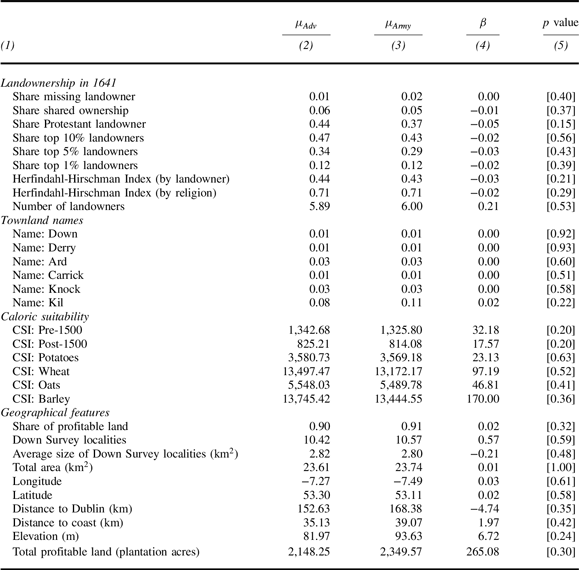
Table 1 presents results of these balance tests. Columns 2 and 3 present the mean of each variable in parishes in the areas assigned to Adventurers and the Army, respectively. Column 4 tests these differences by regressing the outcome on the treatment indicator for assignment to the Army with county fixed effects (given the county-stratified nature of the baronial lottery), with p values provided in column 5. No differences are statistically significantly different, consistent with an essentially random allocation of baronies between claimant types.Footnote 117
Balance on predetermined covariates

Table 1 Long description
The table presents results of balance tests for variables in parishes assigned to Adventurers and the Army. It includes five columns: mean for Adventurers, mean for the Army, beta values, and p-values. The table has 30 rows, each representing different variables such as landownership, townland names, caloric suitability, and geographical features. Each row provides specific values for the mean in Adventurers and Army columns, beta values, and p-values. Notable variables include share missing landowner, share shared ownership, share Protestant landowner, and various caloric suitability indices. The table aims to test differences by regressing outcomes on the treatment indicator for assignment to the Army with county fixed effects.
Notes: See Appendix B.2 for variable descriptions. All predetermined covariates observed at the parish level. Column (2) presents mean of parishes in Adventurer-assigned baronies; (3) presents mean of parishes in Army-assigned baronies; (4) presents coefficient from regressing outcome onto an indicator for a barony being assigned to the Army and county fixed effects; (5) presents p values from that regression with standard errors clustered by barony. *p < .10; **p < .05; ***p < .01.
We then estimate our main results using the following specification:
 $$\begin{align}y_{pbt} & = \beta\text{Army}_{\it b} + \eta_{\it c} + \epsilon_{\it pbt},\end{align}$$
where outcome y in parish p in barony b in year t is regressed onto an indicator
 $\text{Army}_{\it b}$
, for whether that parish was in a barony assigned to Army claimants in 1654, and county fixed effects (
 $\eta_c$
). In auxiliary specifications, to improve precision we also add a vector of LASSO-selected predetermined covariates (
 ${\rm X}_{pb}$
) following Belloni, Chernozhukov, and Hansen.Footnote 118 Standard errors are clustered by barony. Given the plausibility of its exogenous assignment,
 $\beta$
identifies the causal effect of assigning areas to Army versus Adventurer claimants.
Effects of Barony-Level Assignment on Landownership
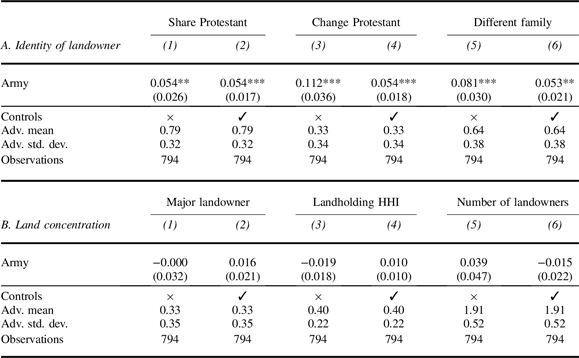
Panel A of Table 2 estimates treatment effects on the subsequent identity of landowners. In columns 1 and 2, we find that the exogenous assignment of a barony to Army claimants in the 1650s increased the proportion of land in that barony owned by Protestants in 1670 by around five percentage points (pp) (
 $p \lt .05$
), from 79 to 84 percent. This estimate is stable, but more precise, with the inclusion of predetermined covariates (column 2). This effect implies a roughly 30 percent greater rate of Catholic landholding in Adventurer-assigned baronies. In columns 3 and 4, we find that assignment to the Army induced an increase in Protestant landownership between 1641 and 1670, equivalent to between five and eleven percentage points (
 $p \lt .01$
). Finally, in columns 5 and 6, we find that parishes in baronies assigned to Army claimants are between five and eight percentage points more likely to have a different landowner family recorded in 1670 compared to 1641 (
 $p \lt .05$
), indicating a greater overall rate of land turnover. The standardized effect sizes for each of these outcomes range between 0.14 and 0.33 standard deviations relative to levels observed in baronies assigned to the Adventurers.
Effects on landownership in 1670

Table 2 Long description
The table is divided into two main sections: A. Identity of landowner and B. Land concentration. Section A has three columns: Share Protestant, Change Protestant, and Different family, each with two sub-columns. Section B has three columns: Major landowner, Landholding HHI, and Number of landowners, each with two sub-columns. Each section contains data on the impact of the Army on landownership. Section A shows the effects on the identity of landowners, with data indicating the proportion of land owned by Protestants and the likelihood of different landowner families. Section B shows the effects on land concentration, with data on the presence of major landowners, landholding concentration, and the number of landowners. The table includes controls, Adventurer barony means, Adventurer barony standard deviations, and the number of observations for each column.
Notes: Dependent variables: panel A: share of land in parish owned by Protestants; change in share of land in parish owned by Protestants 1641–1670; share of land in parish owned by a different family (based on surname) in 1670 relative to 1641. Panel B: share of land in parish owned by a landowner in the top 5 percent of landowners nationwide; Herfindahl-Hirschman index of individual landownership in parish; Log+1 Number of landowners in parish. All specifications are estimated using OLS with county-level fixed effects using Equation (1). Even-indexed columns add LASSO-selected predetermined covariates. Standard errors clustered by barony in parentheses. *p < .10; **p < .05; ***p < .01.
Panel B indicates that the baronial lottery did not meaningfully affect measures of land concentration. In columns 1 and 2, we find no treatment effects on the share of land owned by “major landowners” in parishes within Army-assigned baronies, which we define as those landowners with holdings in the top 5 percent of the distribution across the whole country in 1670 (see Panel B of supplementary Table A4 for alternative operationalizations). In columns 3 and 4, we find no effects on a Herfindahl-Hirschman index of land concentration defined at the parish level. In columns 5 and 6, we similarly find no effects on the number of distinct landowners in each parish. These null effects are reinforced by high correlations between land concentration within a given county before and after the Cromwellian Settlement.
Two additional analyses shed light on these results (see Appendix C.2 for more detail). First, we linked the names of landowners in 1670 with lists of all 1,500 AdventurersFootnote 119 and 2,200 officers from Cromwell’s New Model Army involved in the Irish conflict (see supplementary Table A3).Footnote 120 Depending on our linkage method, assignment to the Army is associated with a ten to nineteen (4 to 6) percentage point (lower) likelihood of a landowner’s name matching an Army officer (Adventurer). As a result, land in Army-assigned areas is five to fourteen percentage points more likely to be settled by an individual from either list by 1670. Second, we find that major landowners as defined in 1641 were more likely to retain their land in Adventurer-assigned areas by 1670 (see Panel A of supplementary Table A4). These results underlie the limited propensity of either group to ultimately take up their land.Footnote 121 Many Army claimants sold their land to their officers and a higher share of prior Catholic landowners were able to recover their holdings in Adventurer areas. Explaining our null results on concentration, most landowners by 1670 either comprised major new Protestant settlers who had bought up land rights (disproportionately in Army-assigned areas) or pre-existing Catholic landowners (disproportionately in Adventurer-assigned areas).
Long-Run Effects of Landowner Identity
While the overall intensity of expropriation was high even in Adventurer-assigned areas, the baronial lottery generates significant variation in the ethnoreligious identity of subsequent landowners. Motivated by previous scholarship tracing Ireland’s poverty to the Cromwellian Settlement, we next examine the long-run consequences of this intensive margin variation.Footnote 122 We first assess the persistence of these effects on landownership over time before evaluating effects on the supply of public goods on the eve of the Great Famine (1845–1849). While a substantial gap separates our “treatment” from our public goods outcomes, sufficiently granular data from the seventeenth or eighteenth centuries do not appear to have survived.Footnote 123 Further, we do not consider post-Famine outcomes because the Great Hunger transformed rural Irish society, rendering any effects hard to interpret.Footnote 124 We introduce our data sources in what follows and estimate reduced form effects using Equation (1), comparing outcomes in Army-assigned baronies (and hence more likely to become owned by English Protestants) to those in Adventurer-assigned baronies.Footnote 125
Persistence of Short-Run Variation
We begin by assessing whether the short-run variation in landowner identity induced by the baronial lottery persisted over time. Such persistence is not a given: attenuation could be driven by intermarriage, migration, and religious conversion over time or by subsequent land transfers.Footnote 126 However, these moderating forces would have to contend with a series of punitive laws—known collectively as the Penal Laws—that further marginalized Catholics and rendered their acquisition of new land extremely difficult.Footnote 127 Exclusionary political and economic institutions consolidated the Protestant Ascendancy in Ireland, effectively freezing group-level landholdings as they existed at the end of the seventeenth century.Footnote 128 As a result, we expect that the patterns of local landowning that we identify in the immediate aftermath of the Cromwellian Settlement will persist and shape the provision of public goods even long afterwards.
To evaluate this persistence, we use three sets of analyses (see Appendix D for full details). First, we consider effects on exposure to subsequent land confiscations following the Williamite War (1689–1691), when more land was expropriated from a group of Catholic landowners and sold mostly to Protestants.Footnote 129 Given there was more Catholic land in Adventurer-assigned baronies prospectively eligible for redistribution, this could imply an attenuation of the short-run effects. After digitizing archival records of the universe of resulting transfers, in supplementary Table A5 we assess treatment effects on the incidence of these subsequent transfers and resulting landownership in 1703. While we find marginally less land was redistributed during this period in Army-assigned baronies, we continue to find significant differences in Protestant landownership by 1703 with coefficient magnitudes similar to Table 2. This underscores the relatively more limited impact of the Williamite confiscations, certainly compared to those under the Cromwellian Settlement, in our sample.
Second, prior work highlights the potential relevance of religious conversion in reducing Catholic landownership throughout the eighteenth century.Footnote 130 Until the Papists Act of 1778, converting to Protestantism would afford Catholic elites more economic and political rights. Leveraging a transcription of the Catholic Qualification and Convert Rolls, we geolocate the 30,000 recorded conversions and assess whether we observe a higher incidence in Adventurer-assigned areas over time, which would again imply the attenuation of our short-run effects.Footnote 131 We find no such evidence (see supplementary Figure A5), which is consistent with previous evidence highlighting the relative lack of success of these policies.Footnote 132
Third, we assess effects on local religious composition observed much closer to the time of our public goods outcomes. Griffith’s Valuation (1847–1864), which recorded the names of all “lessors” of land, represents one of the few micro-level data sources surviving from this period.Footnote 133 Using a complete digitization, we record the names and geographical locations of all lessors in our analysis sample (
 $n=149,000$
) and impute their religion by linking their surname to the distribution of religion by name, as recorded in the full 1901 census.Footnote 134 Consistent with substantial persistence through time, our results suggest that lessors were around three percentage points more likely to have Protestant-associated names in Army-assigned areas (see supplementary Table A6).Footnote 135 We also consider evidence for whether the overall population similarly varied in its religious composition but find only limited evidence of this.
Our evidence suggests that the baronial lottery had persistent effects through time on the group identity of local elites, with more muted effects among the broader population. This striking persistence is consistent with previous descriptive evidence. As Campbell notes, “more than two-thirds of great landowners in 1881 were the descendants of the men and women who had colonized Ireland in the early modern period.”Footnote 136 Qualitative evidence of the persistence of local elites is consistent with the claim that sectarian inequality in landowning exacerbated by the Cromwellian Settlement endured up to and through the Great Famine. We expect these patterns, filtered through local political and administrative institutions that privileged or depended upon local landowners, to generate systematic variation in local public goods provision.
Effects on the Supply of Local Public Goods
Our theoretical framework highlights aggregate and heterogeneous implications of changes in the identity of local elites for the supply of public goods. We therefore consider evidence from a wide set of local public goods: schools, health facilities, workhouses, and carceral institutions, which together account for many of the most salient categories of local public good during this period. Their diversity—both across and within these broader categories—provides theoretically relevant variation in the extent of their group-level incidence and elites’ role in their supply.
Our data are primarily drawn from a variety of public reports describing conditions in Ireland from the mid-1830s to the mid-1840s (see Appendix B). We introduce the data and provide high-level results here, before providing additional context on the operation and funding of each local public goods category. As discussed earlier, health facilities and carceral facilities designed for local security had a relatively flat incidence of group-level benefits compared to education and welfare institutions. Within these categories, specific types of facilities were often supplied using a mixture of supralocal political institutions and local funding by economic elites.Footnote 137
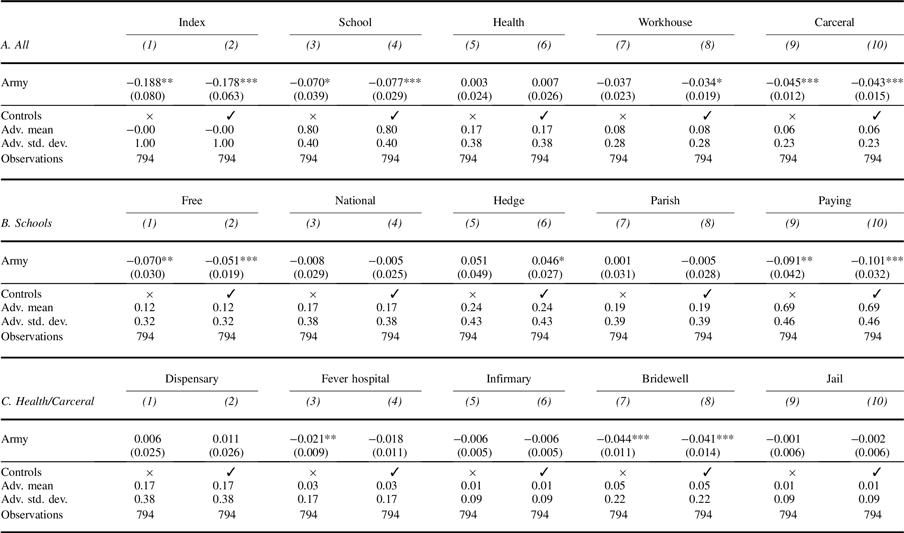
In panel A of Table 3, we first consider effects on the extensive margin: whether any of these four kinds of local public goods are observed in a parish, as well as a standardized z-score, aggregating the four categories of public goods.Footnote 138 We find that, on average, local public goods are scarcer in parishes that had been assigned to Army claimants nearly two centuries prior. An overall index finds a reduction in their presence equivalent to 0.19 standard deviations in the specification without controls (
 $p \lt .05$
) and 0.18 standard deviations with controls (
 $p \lt .01$
). Army-assigned parishes are around seven percentage points less likely to have any school in 1835 (
 $p \lt .10$
without controls and
 $p \lt .01$
with controls). Across the other public goods categories, we find no differences in the local presence of health facilities, substantively large (though noisy) reductions in the presence of workhouses, and negative effects on the aggregate presence of carceral facilities (
 $p \lt .01$
).Footnote 139 Areas historically exposed to greater changes in the identity of local elites then fared significantly worse in the aggregate provision of local public goods over time.
Long-run effects on presence of local public goods

Table 3 Long description
The table is divided into three main sections: A, B, and C, each focusing on different types of local public goods. Panel A examines the overall index and specific categories such as School, Health, Workhouse, and Carceral. It includes columns for different conditions and their respective values, with controls, Adventurer barony means, Adventurer barony standard deviations, and observations. Panel B delves into various types of schools, including Free, National, Hedge, Parish, and Paying, presenting similar columns and values. Panel C focuses on health and carceral facilities, such as Dispensary, Fever Hospital, Infirmary, Bridewell, and Jail, again with corresponding columns and values. Each panel provides a detailed comparison of the presence of these public goods under different conditions, highlighting statistical significance and variations.
Notes: Dependent variables: panel A: columns 1 and 2: standardized z-score index of other columns; 3 and 4: any school in parish (1835); 5 and 6: any health facility in parish (1837); 7 and 8: any workhouse in parish (1845); 9 and 10: Any prison in parish (1840). Panels B and C: any of a given local public good category in parish. All specifications are estimated using OLS with county-level fixed effects using Equation (1). Even-indexed columns add LASSO-selected predetermined covariates. Standard errors clustered by barony in parentheses. *p < .10; **p < .05; ***p < .01.
Evidence from each public good category. The diversity of funding mechanisms for local schools in Ireland in the early-to-mid 1800s provides an opportunity to evaluate whether our results reflect the exclusionary expenditure preferences of local elites. According to Catholic reformer and MP Thomas Wyse, “All education soon got infected with a political and sectarian spirit … a battle fought in every school, under every hedge, for the minds and feelings of the country.”Footnote 140 Attempts by the Protestant elite to use the education system to convert Catholic children failed in large part due to the popularity of so-called “hedge” schools.Footnote 141 While these schools were initially relatively informal outdoor gatherings, by the early 1800s they were more formal and constituted a majority of Irish schools.Footnote 142 They were, however, still of overall low quality, and by 1835 the term “hedge school” specifically referred to the lowest-quality schools.Footnote 143
The resilience of the hedge school is particularly remarkable given the wide variety of alternative types of schooling. These included parish schools, so called because they were associated with the parishes of the Church of Ireland; free schools, generally higher-quality schools able to forgo fees because they were endowed by wealthy Protestants, often directly with revenues from landed estates; or charter schools, vocational boarding schools explicitly designed to facilitate religious conversion. As the result of long-standing efforts by a range of different reformers, both Catholic and Protestant, national schools were introduced in 1831.Footnote 144 Because these nondenominational schools were relatively new in 1835, there are far fewer of them recorded in the census.
In panel B of Table 3, we find evidence that free schools, which tended to be specifically funded by local economic elites, are five to seven percentage points rarer in Army-assigned baronies (
 $p \lt .05$
).Footnote 145 In columns 5 and 6, on the other hand, we find that the aforementioned low-quality, hedge schools were modestly more common in Army-assigned areas. In columns 9 and 10, we find that fee-paying schools, a rump category of fee-based schools for which we have no religious affiliation information, were significantly scarcer in Army-assigned areas. For the remaining categories, we find no significant differences. These results suggest that the presence and composition of educational facilities differed between Army and Adventurer assigned baronies, with overall fewer schools and a higher proportion of low-quality schools in Army-assigned areas.Footnote 146 Given prior work on the connection between Protestantism and education, these negative results suggest Protestants’ intrinsic preferences are unlikely to have mattered much for the supply of public goods.Footnote 147 Consistent with the relatively group-stratified returns to educational investments, that we find reductions for school types where local elites played the greatest role in provision highlights the importance of exclusionary instrumental preferences.
In panel C of Table 3, we explore health facilities for which, as highlighted in our theoretical framework, the incidence of benefits is less sharply stratified by group. Across different types of facility—infirmaries, dispensaries, and fever hospitals—funding relied on local taxation, distributed by grand juries, as well as private subscriptions and donations.Footnote 148 Unlike the other public goods we consider, historians suggest local elites directly benefited from these institutions. Fever hospitals sought to contain epidemics that disproportionately afflicted the middle and upper classes; dispensaries were small outlying clinics intended to care for the poor but “many subscribers made their contributions conditional upon the willingness of the dispensary medical officer to provide free medical care for them and their families.”Footnote 149 Larger infirmaries were funded primarily by a property tax paid by tenant farmers,Footnote 150 and were to be one per county with locations specified in the 1765 enabling act.Footnote 151 We find no reductions in the presence of health facilities in the aggregate and broadly null results for the specific types of facility (Table 3, panel C).Footnote 152 The absence of treatment effects, in spite of large increases in local inequality, highlights that minority elites faced stronger instrumental incentives to ensure the supply of health facilities—to maintain an agricultural labor force, reduce the externalities of disease, and directly access care.
Finally, we consider workhouses and different carceral institutions, which offer somewhat intermediate cases. Workhouses, established under the Poor Relief Act of 1838 and constructed in the early 1840s, were the government’s response to the worsening economic condition of the poorest in society and were entirely funded by local taxes on landowners. Landlords with the largest estates, and hence paying the most taxes, were given more votes during deliberations held by local Boards of Guardians, which decided how to target support for the poor.Footnote 153 Initially comprised of one workhouse per Poor Law Union, auxiliary workhouses were subsequently often built—at the discretion of Guardians—due to high demand. Workhouses were a key redistributive channel in pre-Famine Ireland,Footnote 154 though the fact that they served broader functions of labor coercion implied that their provision was not purely altruistic.Footnote 155 Our negative (but noisy) result on their presence in Panel A is then consistent with the relatively stratified nature of resulting benefits and local elites’ reduced willingness to redistribute towards the poor.
In spite of efforts to centralize control of the carceral system through both statutory requirementsFootnote 156 and loan conditions,Footnote 157 grand juries remained the key funding agent.Footnote 158 In columns 7 and 8 of panel C of Table 3, we show that the overall reduction in the incidence of prisons owes entirely to reductions in bridewells rather than jails.Footnote 159 Jails, the largest carceral institutions, were generally limited to one per county. The null result on their provision is therefore consistent with both their centralized provision and direct relevance to elite security. Bridewells, on the other hand, were “small town prisons” that had, in the eighteenth century, aspired to “put the poor to work and teach them the habits of industry.”Footnote 160 Ultimately, bridewells straddled poor relief and criminal punishment and focused mostly on local nuisances rather than serious security threats.Footnote 161 As a result, the reduction in bridewells is consistent with the idea that the incidence of resulting benefits was relatively more stratified compared to jails, along with local elites having somewhat greater discretion in their allocation.
Mechanisms and Alternative Explanations
Our results provide evidence consistent with areas subject to greater expropriation by an ethnoreligious minority elite receiving lower levels of public goods in the long run. We also find some evidence that the group incidence of public goods benefits and the role of local elites in the supply of public goods condition this provision, with our effects typically strongest for those public goods with a significant role for local elites and which would disproportionately benefit the Catholic tenant class. We view these conditional effects as most consistent with variation in the instrumental preferences of local elites as filtered through local or regional institutions.
However, our theoretical framework outlines alternative channels through which heightened group-level inequality induced by the baronial lottery might have impacted the provision of public goods. In this section, we explore whether the effects of group inequality might also be operating through elites’ linkages to the central colonial state or reduced social cohesion between groups in the wake of conflict. Finally, to rule out the mechanism typically associated with studies of individual-level land concentration, we explore long-run consequences for the composition of the local economy.
Central linkages and social cohesion. First, we assess evidence relating to variation in central state linkages. We consider this pathway unlikely to explain reductions in the supply of local public goods for three reasons. First, local elites in Army-assigned areas became more similar to those running the government. Similarly, these elites also should have enjoyed more influence over county-level institutions like the grand jury (relative to Catholics), but we find no evidence that this facilitated the local supply of public goods. Second, central state funding for local public goods was scarce until later in the nineteenth century. Last, digitizing and geolocating data on the residences of all MPs across Irish parliaments between 1550 and 1800, we find no systematic differences in whether politicians came from Army or Adventurer baronies (see supplementary Figure A7), suggesting that this channel is unlikely to be substantively important.
An alternative channel highlights the role of social cohesion that, through increased horizontal differentiation between groups, might have inhibited communities’ ability to coordinate in the provision of public goods. While our data is limited, in supplementary Table A12 we find some evidence of this by drawing on a number of sources. First, we measure exposure to a major series of rebellions in 1798, which sought to overthrow the Protestant colonial government. Following this rebellion, civilians were allowed to make claims to the government for the damages they had suffered. Drawing on an archive of all such claims, we find Army-assigned areas were more likely to be exposed to the rebellion. We measure proto-nationalist sentiment using the incidence of signatories to one of the first large-scale political petitions in Ireland, the William Smith O’Brien petition of 1848. Linking the signatories to household heads in the contemporaneous Griffith’s Valuation, we find a modestly higher share of households supporting this nationalist cause in Army-assigned areas. We also evaluate participation in the Tithe Wars, between 1830 and 1836, in which civilians protested the imposition of tithes paid to the Protestant Church of Ireland by defaulting on their payments. Drawing on individual-level data, we find no effects of assignment to the Army on the incidence of recorded defaulters.
Local economic structures. In line with theories premised on the effects of individual-level land concentration, the reduced supply of local public goods (especially schools), could be consistent with increased land inequality inducing local elites to limit citizens’ human capital to hinder their mobility from agriculture to industry.Footnote 162 Intuitively, if this were the case, Army-assigned areas should have become relatively more rural and agricultural over time. We test this observable implication in two ways. First, we draw on spatial data relating to a wide array of private agricultural and industrial infrastructure investments, as recorded in the first Ordnance Survey of 1846. These include both infrastructure primarily associated with industry, such as foundries, gas works, and quarries, as well as that associated with agriculture, such as windmills and lime kilns (used mainly to produce fertilizer). Assessing the presence of these different types of private infrastructure as a function of the baronial lottery, we find no systematic differences, either overall or by type of infrastructure (see supplementary Table A13). This result also suggests that it is unlikely that differences in local development were driven by differential access to capital between landlords in Army or Adventurer assigned baronies.
Second, we assess effects on exposure to the Great Famine of 1845–1849. Beginning with Connell, historians have argued it is impossible to account for the devastation of the Famine without considering the long-run consequences of mass redistribution of land from Catholic to Protestant elites in the seventeenth century.Footnote 163 Mokyr, for example, concludes his seminal work on the causes of the Famine by arguing that “When we ask the question what, in the final analysis, was the real cause, the true ‘external factor’ in the dismal history of prefamine agriculture … Ultimately, there is history to blame: the creation of the landlord class from British and Scottish adventurers and mercenaries.”Footnote 164
Recognizing important measurement challenges,Footnote 165 we follow prior work in using parish-level data from the 1841 and 1851 censuses to examine economic conditions on the eve of the Famine and the intensity of local exposure.Footnote 166 Prior to the Famine, we find few systematic differences in population levels, density, or sectoral employment, with similar shares of households employed in agriculture and manufacturing (73 and 18 percent, respectively). We find some evidence of increased poverty in Army-assigned baronies, with a marginally higher share of households living in the very lowest quality housing. Using population change between 1841 and 1851 as a measure of Famine intensity, we find little evidence of differences as a function of the lottery.Footnote 167 After the Famine, we continue to find a slightly higher share of extreme poverty but, contrasting with the implications of concentration-based accounts, slightly less agricultural employment in Army-assigned baronies.
Overall, these results are consistent with neither the strategic economic incentives of local elites attempting to prevent industrial transitions, nor with variation in linkages to the central state shaping outcomes. Our evidence of greater social unrest is consistent with heightened horizontal differentiation between groups, while our broadly null results on Famine exposure potentially owe both to measurement challenges and the regional rather than local drivers of the Famine.Footnote 168
Conclusion
The Cromwellian Settlement was a massive and violent upheaval of Irish society. The expropriation of land from Catholic landowners transformed Ireland into a colony dominated economically and politically by an English Protestant minority until 1922. In Ireland, as in most colonies, the extent of expropriation and settlement varied dramatically across localities. We show that the lottery-based assignment of land across ten counties provided an exogenous shock to the share of land ultimately transferred to English Protestants in the wake of the Settlement and led to a persistent increase in group-level inequality but not individual-level concentration.
Our analysis of an unusually rich set of granular data sources demonstrates that, on the eve of the Great Famine, local public goods were scarcer and more exclusionary in areas across these ten “treated” counties, which, due to greater historical exposure to colonial expropriation, had a higher share of Protestant landlords. Our results, both across and within local public goods categories, are consistent with the greater unwillingness of landed elites to provide public goods likely to benefit tenants who were both poorer and largely belonged to a different societal group (such as elite-funded schools or redistributive institutions). Among public goods with a broader incidence of benefits, such as health institutions, we find fewer differences. Further, distinctions within types of public good highlight how variation in the mode of supply of different investments acted as a key moderator of elite preferences.
These findings have significant implications for studies of postconflict public goods provision beyond Ireland. In many settler colonies, the relative weakness of the colonial state meant major landowners enjoyed enormous discretion over the provision of public goods, and the close association between landownership and group identity likely exhibited comparable dynamics in shaping public goods provision as those we illustrate in Ireland. By connecting the literatures on postconflict resource allocation and colonial institutional legacies, our results underscore the consequential impact of settler colonialism for local social inequalities—even above and beyond its direct institutional legacies. By parsing the effects of group rather than individual inequality, we identify an important channel often overlooked in prior studies of land inequality more broadly.
As discussed earlier, historical imperial expansions across Eurasia and Africa provide natural cases for future work to probe and extend the implications of our framework and findings. More speculatively, beyond colonial cases, similar logics might also apply where insurgencies result in rule by a minority group, as in many sub-Saharan African cases.Footnote 169 While the legacies of internal conflict are distinct from those of conquest, and these cases generally feature stronger central states than in settler colonies, relevant examples include Ethiopia under the Tigray People’s Liberation Front (1991–2018), where a 6 percent minority came to power;Footnote 170 regimes in Burundi (pre-2005) and Rwanda (1994 to present), where Tutsi minorities consolidated control over economic resources;Footnote 171 and Uganda since 1986.Footnote 172 Further, an implication of our framework “in reverse” is that the replacement of a minority landed elite by members of the ethnic majority should lead to the provision of more generous and inclusive public goods over time. Growing evidence on the politics of public goods provision under rebel governance offers promising settings to test this prediction.Footnote 173 More broadly, our emphasis on conditional effects across different types of public goods, rather than aggregate provision alone, provides a template for evaluating the distributional consequences of elite turnover in any postconflict setting.
Our results also have implications for debates about the association between diversity and public goods. While our findings affirm arguments highlighting the first-order importance of group-level preferences in divided societies for welfare and development outcomes, our evidence underscores how contemporary associations between public goods outcomes and group affiliation likely reflect longer historical processes.Footnote 174 Understanding when and where these processes, which jointly determine both the distribution of key economic resources and the identity of the economic elite, persist through time represents a promising area for future research.
Acknowledgments
With thanks to Bob Allen, Lisa Blaydes, Kate Casey, Verena Fetscher, Adriane Fresh, Tyler Goodspeed, Anna Grzymala-Busse, Jacob Hariri, Alex Hartman, Torben Iversen, Saumitra Jha, Dmitrii Kofanov, Melissa Lee, Johannes Lindvall, Shelley Liu, Ellen Lust, Kevin O’Rourke, Christopher Paik, Giuliana Pardelli, Leonid Peisakhin, Thomas Piketty, Matthew Reichert, Henry Thomson, and Nina Weber for useful discussions, audiences at APSA 2022, APSA 2023, ASREC 2023, GLD Work in Progress Workshop, the Historical Political Economy Working Group 2022, LSE-UCL Land Politics Seminar, MPSA 2023, Social Science History Workshop at NYU Abu Dhabi, Irish Quantitative History Workshop 2023 at Trinity College Dublin, Economic History Seminar at the Paris School of Economics, and the Virtual Historical Political Economy Workshop, and to Cormac O’Grada, Alan Fernihough, Soeren Henn, Paul Manzor, and Michael Murphy for data access. Mubadir Zaman and Sejin Park provided research assistance. A previous version of this article appeared as the Governance and Local Development Institute Working Paper 69 under the title “Elite Identity, Land Inequality, and Local Development: Evidence from Colonial Ireland.”
Data Availability Statement
Replication files for this article may be found at <https://doi.org/10.7910/DVN/6JTSAF>.
Supplementary Material
Supplementary material for this article is available at <https://doi.org/10.1017/S0020818326101465>.






 Open access

