INTRODUCTION
Much contemporary philosophical debate over the just distribution of resources focuses on a particular kind of dilemma. In it, two sides, each containing a (different) number of individuals, fall into conflict over a scarce resource that can go to only one of them; the possibility of splitting the resource does not exist, nor (in the particular dilemmas I have in mind) does the possibility of not giving the resource to either side. The dilemma arises because each side exerts a superior claim based on at least one or another of three broad criteria.
The first is Worse-offedness: particular individuals on one side are so much worse off compared with those on the other side that it justifies their getting the resource. The second is Benefit: particular individuals on one side stand to benefit from the resource so much more than those on the other side that it justifies their getting the resource. And the third is Numbers, which – here I follow John Taurek's usage – is essentially a way of viewing the other two criteria. Instead of treating Worse-offedness and Benefit as ‘claims of individuals considered one by one’, Numbers views them as ‘aggregation[s] of the claims of individuals’.Footnote 1 In other words, instead of accepting that no Worse-offedness or Benefit claim can be greater than that which any individual by himself exerts, Numbers says they can be added up over the individuals on a given side to support its claim to the resource.
Consider, for example, the following case. On Side 1 are 2 people, each of whom, if their side gets the resource, would benefit by 20 units. On Side 2 are 10 people, each of whom, if their side gets the resource, would benefit by 8. Benefit, understood as a claim asserted by individuals, would point toward giving the resource to Side 1. But Benefit, when viewed through the lens of ‘Numbers’ – that is, when aggregated over individuals – would incline us to give the resource to Side 2.Footnote 2
‘We may’, as Dennis McKerlie says in framing a typical dilemma to which the three criteria give rise,
feel that the interests of the very worst off should be given some priority over the interests of others, but why should they be given absolute priority? . . . We might think that at least sometimes the greater size of the benefits for the people who are better off, combined with a larger number of people who would be benefited, give us a stronger reason to help them.Footnote 3
Frances Kamm frames the same distributive question in the specific context of health care when she asks, ‘[o]n what basis can we compare the saving of an infant's life with, say, the restoration of mobility to ten elderly people who have been immobilized by arthritic hips?’Footnote 4 In such dilemmas, Worse-offedness (an admittedly inelegant but apt term), Benefit, and the aggregative imperatives brought to bear by Numbers, together give us no clear answer as to which side should get the resource.Footnote 5
Here is one way to describe the current state of philosophical play as to how to approach such dilemmas. Some philosophers offer arguments that dismiss, at the outset, the relevance of at least one of the three criteria, as Peter Singer does with Worse-offedness, or John Taurek does with Numbers. For many philosophers, however, there is something intuitively unsatisfying about such resolutions, and so I will set them aside here.Footnote 6 Instead, the following is written within the frame of those philosophers who take all three criteria seriously – and who by and large offer intuitively acceptable modes of reconciling them – but who lack a theoretically informed way of using cardinal, or even ordinal, measures to help us resolve hard cases.
As an example, consider McKerlie's observation, noted above, that ‘sometimes’ one side's greater potential to Benefit, whether in aggregate or individual terms, should outweigh the greater Worse-offedness claims of those on the other. Intuitively that is right, but how do we know when that ‘sometimes’ is? As Norman Daniels says, ‘we have no satisfactory theoretical characterization’ as to how to proceed: no single cardinal scale on which to evaluate each of the three imperatives – Worse-offedness, Benefit and Numbers – against the others.Footnote 7 ‘[P]hilosophers’, as Eric Rakowski concludes about the current state of play, find it ‘difficult to state more precise or comprehensive conclusions. Our moral convictions are simply too blunt to frame useful general principles.’Footnote 8 We do not, as David Brink points out, yet have a ‘metric for integrating the three measures of the seriousness of a complaint’.Footnote 9
In what follows, I offer a ‘theoretically characterized’ way of coming to cardinally definitive or ‘precise’ conclusions in hard cases where the three conflict. I offer, in other words, a set of ‘principles’ or a ‘metric’ for defining precisely how any given magnitude of difference in each of the three criteria should be weighed against the others, a mode of ‘intregrating the three measures’. I do not want to go so far as to say that the approach I am advancing is the sole ‘right’ way of resolving hard cases. I suggest only that the approach I am offering generates conclusions that reliably conform to our intuitions when those intuitions are clear – i.e. heavily favor a particular resolution – while providing a theoretically justified cardinal ‘metric’ for reaching a just conclusion when our intuitions conflict, when ‘our moral convictions’ alone, as Rakowski says, are ‘too blunt’ to give us a definitive answer. There may well be other modes of doing the same, but none so far have appeared.
With Kamm, McKerlie and othersFootnote 10 – and here I part company with some utilitarians, prioritarians and Taurek – I will assume that all three criteria press on us, and that the most philosophically interesting cases arise where the three fall into conflict and must be reconciled. I will refer collectively to the approaches set forth by those who accept the legitimacy of all three criteria as ‘the prevalent approach’, since despite their differences they all share certain assumptions: assumptions that I too will adopt, though I will use them in a different way.
Section 1 sets forth those assumptions. In doing so it looks only at the first two of the three criteria, Worse-offedness and Benefit, understood as claims of individuals, and then explicates the way that the approach I am advocating would generate theoretically justified, intuitively acceptable, cardinally definitive resolutions to cases in which each side exerts a superior claim based on non-aggregative versions of one of the two, i.e. either Worse-offedness or Benefit. Section 2 offers a defense of the approach I am advancing, and then explains how it can be adapted to take account of the aggregative imperative represented by Numbers. Although the Worse-offedness/Benefit/Numbers conflict lies at the heart of fair-distribution theory generally, I will use the specific example of health-care distribution, since so much of the philosophical work on the topic takes place within that context. But the approach I advance can be made to apply to Worse-offedness/Benefit/Numbers conflicts over the distribution of any other kind of resource.
1. COMMON ASSUMPTIONS CONCERNING WORSE-OFFEDNESS AND BENEFIT
Here, I will set forth assumptions that the prevalent approach shares with the method I am advancing when it comes to Worse-offedness and Benefit, both understood as ‘claims of individuals’.Footnote 11 Only then, in the next section, will I bring in Numbers, with its aggregative concerns.
To begin with, the prevalent-approach philosophers assume, and so does the approach I will advance, that in the kinds of conflicts under discussion, it is possible to cardinally measure the magnitude of each individual's capacity to Benefit and, separately and independently, to cardinally measure the level of each individual's Worse-offedness. If we were speaking of distribution matters generally, such measures would be made in ‘utils’ or some other notional unit; here, where I am taking the distribution of health care as our specific example, I will use QALYs.
A single QALY (Quality-Adjusted Life Year) unit is the value that people would assign to a year of life in good health, with a year of life in fair-to-poor health coming in at a number less than one depending on its morbidity factors, and death being represented by zero.Footnote 12 We can measure a person's capacity to Benefit in terms of the QALYs that the contested medical resource would give him. And we can measure his ‘complete-life’ Worse-offedness, how well or badly off he has been health-wise in his life, by adding up the QALYs he has already experienced at the point at which the resource is to be allocated.
What this means – and I share this assumption with the prevalent approach – is that within each of the two criteria separately, whether Worse-offedness or Benefit, cardinal comparisons can be made across people. Suppose that we could distribute a resource to A, who has enjoyed 15 QALYs in his life thus far, or to B, who has enjoyed 30, and that the resource would give A a Benefit of 5 QALYs and B a Benefit of 30. We can then say that, intra-criterially – that is, within the criterion of Benefit – B stands to Benefit more than A by 25 QALYs. And, again intra-criterially but this time within the criterion of Worse-offedness, we can say that A is Worse off than B by 15 QALYs.
I will, as an aside, take this opportunity to note that I am going to use the terms ‘Worse off’ or ‘Worse-offedness’ not only comparatively, as in ‘A is Worse off than B by 15 QALYs’ – and this is the meaning that counts for distributive purposes; it is the meaning of Worse-offedness as a ‘criterion’ – but also non-comparatively. I will also use ‘Worse off’ or ‘Worse-offedness’, in other words, to refer to the amount of well-being that any given individual such as A or B has experienced thus far in his life prior to the resource-distribution decision (so A's Worse-offedness is 15, and B's is 30). In any event, even though we can make these cardinal intra-criterion comparisons inter-personally – B's claim is stronger than A's by 25 QALYs within the criterion of Benefit; A's claim is stronger than B's by 15 QALYs within the criterion of Worse-offedness – we still will not be able to make cardinal inter-criterion comparisons of these comparisons. We still do not know whether A's greater Worse-offedness of 15 should outweigh B's greater capacity to Benefit of 25, such that A should get the resource. Assuming cardinal measurements for Worse-offedness and Benefit, as the prevalent approach philosophers do, would seem to bring us no closer to resolving dilemmas than they manage to come.
In saying that QALYs, or whatever welfare units we use, allow for intra-criterion measures to be made inter-personally, I share a further assumption with the prevalent approach. QALYs, the units that give us intra-criterion measures of both Worse-offedness and Benefit, can – as is the case for all welfarist measures – be allotted to take account of the fact that the same condition or treatment can assume different QALY magnitudes depending on how it is distributed across people, i.e., inter-personally. To take just one example, we might want to say, in measuring Worse-offedness, that two broken arms represent a collective loss of .1 QALY for the person who suffers them, while one broken arm apiece for two people amounts to a loss of only .04 QALYs per person. We might want to say this for any number of reasons having to do with our sense that an added threshold of disability emerges when the same burdens are borne by one instead of shared by two. All welfarist measures face issues as to whether and how to make allowances for these possibilities, and they are important ones. But they are intra-criterion matters, having to do with what QALY amount should be assigned to the Worse-offedness of one person's two broken arms versus another person's one broken arm. The prevalent approach and my own assume these matters of intra-criterion inter-personal measurement settled because, even once settled, the problem of making a cardinally precise inter-criterion inter-personal decision remains.
I will also make a converse assumption, one equally implied if not particularly relied upon by the prevalent approach: that, as an intra-personal inter-criterion matter, cardinal comparisons can be made. For any given person, his Worse-offedness and capacity to Benefit can also be placed on the same cardinal scale.
To explain: many prevalent-approach philosophers take a ‘complete-lives’ approach to Worse-offedness, which assumes that what counts for determining how Worse-off any person is at the time the resource is to be distributed is the sum of all the QALYs he has experienced in his life up to that time. At the beginning of any given time period, in other words, a person will have enjoyed a certain number of QALYs in his life up until that moment; that will be his Worse-offedness ex ante. So then if, by virtue of his side's being given the resource, he will Benefit a certain amount during that time period, then at the end of the time period the QALYs embodied in his Worse-offedness at the beginning of the period can be added to the QALYs that measure the amount of the Benefit he enjoyed during it, to give us a new level of Worse-offedness, call it ‘Worse-offedness ex post’, that becomes his level of Worse-offedness going forward into the next time period. For example, if A has a complete-lives Worse-offedness ex ante of 15 QALYs, and gets the resource, thereby benefiting by 5 QALYs, he will have a new complete-lives Worse-offedness level ex post of 20 QALYs.Footnote 13
As does the prevalent approach, then, the one I will advance assumes that intra-personally, that is, within any given individual's life, the QALYs representing his Worse-offedness and those representing his capacity to Benefit at any given point can be added inter-criterially in this way. I say that the prevalent approach exhibits this assumption because the complete-lives view is assumed by many prevalent-approach philosophers and, even assuming it, the prevalent approach still runs into the difficulties I hope to resolve. Just because, intra-personally, the inter-criterion sum of A's Worse-offedness (15 QALYs) and his capacity to Benefit (5) is 20, and B's (30 + 30) is 60, that does not tell us, as an inter-personal inter-criterion evaluative matter – i.e. when we have to allocate – whether the resource should go to A or B. It does not tell us whether the difference between them in Worse-offedness (A's claim being greater by 15) should outweigh the difference between them in capacity to Benefit (B's claim being greater by 25). And that is the question that the prevalent approach tackles in a way that provokes the criticisms I cite from Rakowski, Daniels, Brink and others, and that the approach I am advancing seeks to resolve in a different way.
In saying that QALYs, or whatever welfare units we use, allow for intra-personal measures to be made inter-criterially – that is, for Worse-offedness QALYs and Benefit QALYs to be placed on the same scale intra-personally – I share a further assumption with the prevalent approach. QALYs, like all welfarist measures, can be allotted to take account of the fact that the same condition or treatment can assume different magnitudes depending on how it is distributed within an individual's life. The condition of being arthritis-free during an earlier time in one's life, to take one example, may not afford the same QALYs as does a treatment that cures one's arthritis for an equivalent period later on. In other words, freedom from arthritis may not be represented by the same number of QALYs as part of one's complete-life level of Worse-offedness at the point of resource distribution, as it would as part of one's capacity to Benefit from the resource going forward, depending on a host of factors. Even within the category of Worse-offedness, we might want to allot a greater loss of QALYs to a condition that an individual experienced in the most recent period – the period just before the resource is to be allocated – than to the same condition experienced in the more distant past. This would allow us to account for the situation in which a person may have been in good health for forty years, but has fallen ill immediately before the resource is to be distributed, thus enabling his current condition to count relatively heavily in determining the QALYs that constitute his complete-lives Worse-offedness claim on the medical resource.Footnote 14
Again, both the prevalent approach and the one I shall advance sit on top of these kinds of debates over how, in taking intra-personal inter-criterial sums of Worse-offedness plus Benefit, QALYs assigned to the same conditions or treatments should differ according to the time periods in which they occur – just as it sits on top of various debates over how, in taking intra-criterial inter-personal differences of Worse-offedness or of Benefit, QALYs assigned to the same conditions or treatments can vary depending on the persons to whom they occur. For the purposes of what follows, any reader can simply imagine those debates to be resolved in whatever way she prefers.
That is because, even assuming we know how to take into account the possibility that the same resource deprivation or allocation can have different QALY effects depending on to whom and when it occurs, that would not mean that we would then know how to distribute the resource. Even assuming that we can measure cardinal differences in Worse-offedness or in Benefit intra-criterially across persons, and cardinally sum Worse-offedness and Benefit inter-criterially within each person, that doesn't mean, on the prevalent approach, that we then have the cardinal inter-criterial, inter-personal measurements necessary to decide which side should get the resource. My aim throughout is not to address all problems of measurement, only the matter of inter-criterial inter-personal measures. As does the prevalent approach, I assume intra-criterion inter-personal measurement, and intra-personal inter-criterion measurement, doable, and the mode of doing them settled.
Let me set out a couple of final assumptions having to do with Worse-offedness and Benefit, the first of which concerns the border between them. Specifically, I will follow Kamm and deem complete-lives Worse-offedness to capture everything we know about a person's life at the point at which the resource is to be allocated – knowledge that could extend into the future – and not merely (as I have suggested up till now) everything that has happened to him up until that moment.Footnote 15 Consider a conflict between M and N. M, let us imagine, has lived twenty years, and will live six months more if he doesn't get the resource. He is thus Worse off than N, who is eighteen and will live five more years if he doesn't get the resource (assuming their quality of life is otherwise equal). Accordingly, Benefit represents the measure by which an individual's life will improve beyond whatever we know of what that person's complete life already will include. If the resource will allow M to live another two years beyond now, then the Benefit, as Kamm says, is actually two years minus the six months he already would have lived. The same applies to non-life-threatening conditions and non-life-saving treatments.
Finally, as noted above, the complete-lives view takes a person's Worse-offedness – or, more exactly, his Worse-offedness ex ante, before the resource is allocated – and adds to it whatever amount of Benefit he might enjoy as a result of his side's getting the resource, to give him a new Worse-offedness ex post. And this introduces an important wrinkle into the kinds of dilemmas at issue here. Specifically, Worse-offedness actually breaks into two criteria, what I shall call Worse-offedness ex ante (or WA for short) and Worse-offedness ex post (WP). We shall want to consider each, along with the individual's capacity to Benefit (which I shall abbreviate as B) and, later, Numbers in determining which side should get the resource.
To see this, consider the following observation by Norman Daniels: suppose that of two patients X and Y, patient X – as measured, Daniels says, in ‘QALYs or some other unit’ – is ‘wors[e] off to start with’, that is, Worse off ex ante (WA). ‘How much priority we give to X . . . rather than Y’, Daniels observes, ‘may also depend on whether X . . . end[s] up much better than Y . . . after treatment.’Footnote 16 In other words, although X is Worse off ex ante (WA), nevertheless, if we help X, then Y might end up Worse off ex post (WP); and we would want to take that into account as well.
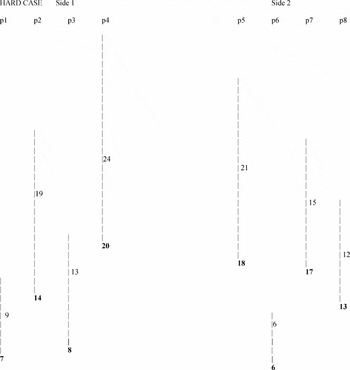
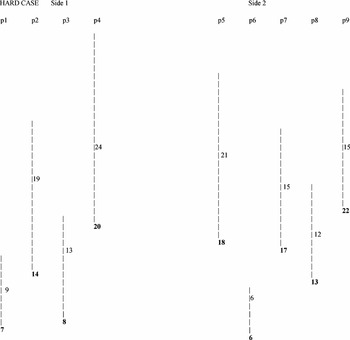
Let me pursue this a bit further. Imagine a case of the sort shown in
Figure A, in which Worse-offedness ex ante (WA), Worse-offedness ex post (WP), and Benefit (B), understood as complaints of individuals, differ between two four-person sides: Side 1 with persons p1 to p4, and Side 2 with persons p5 to p8.Footnote 17 The complete-lives Worse-offedness ex ante (WA) of each person, prior to the decision to allocate the resource, is signified by the positioning of the bottom end of the line that represents him, along with the accompanying bold number (in QALYs). So for example p3's WA is 8 and p5's is 18; and hence, as an intra-criterion inter-personal matter, p3 has a stronger WA claim than p5 by 10 QALYs. As for the capacity to Benefit (B) of each person, should his side get the resource, it is indicated by the length of the line that refers to him, as well as by the non-bold number (in QALYs) at its side; p3, e.g. stands to Benefit from the resource in the amount of 13 QALYs, and p5 by 21: p5 thus has the stronger B claim by 8 QALYs.
Figure A

As for WP, it is a counter-factual notion. If Side 2 gets the resource, meaning (among other things) that p5 will now enjoy 39 QALYs in his complete life (18 + 21) as a result, then p3, remaining at 8, will be WP with respect to p5 in the amount of 31 QALYs (39-8). Conversely, if Side 1 gets the resource, then p5, remaining at 18 QALYs, will be WP than p3 at 21 (8 + 13) QALYs, in the amount of 3 QALYs (21-18). This is why WA, B and WP are each independent criteria. WP isn't simply WA and B summed, thereby replicating WA and B and becoming redundant. WP is counter-factual. In any given case, WP will equal WA plus B only for the winning side, not the losing one, for whom the WP's will remain at their WA's. Hence the differences between either side in WP will not recapitulate the differences between them in WA and B, but rather bring a new criterion to bear.
Hard and Easy Cases
I shall now explain how the approach I am advancing would resolve cases such as Figure A's, which I shall call ‘Hard Cases’, in which at least some individuals on each side have greater WA, WP and/or B claims than some on the other side. I had, of course, said at the outset that we are concerned with cases in which three criteria, which I identified as Worse-offedness, Benefit and Numbers, come into conflict in various ways. But in effect, as Daniels shows – and Kamm and others proceed with their analyses on this basis – Worse-offedness itself splits into two criteria, WA and WP. Each of them, viewed as the claims of individuals, exerts independent imperatives, as does Benefit (B), and all three in turn can then also be viewed as aggregated over each side, i.e. viewed through the lenses of what I shall now refer to as a fourth criterion, Numbers. Again, I will bring Numbers in later. But first, even when focusing on WA, B and WP understood in a non-aggregative way – even when assuming that no recognizable WA, B or WP claim can be greater than that which any individual by himself exerts – the case in Figure A is a Hard Case, since the three, and hence our intuitions, do not give an unambiguous indication of which side should get the resource. My claim is that we should decide a Hard Case of the Figure A sort by determining which kind of Easy Case it is closest to, and this kind of determination can be made cardinally.
What is an Easy Case? Well, if a Hard Case is one in which WA, B and WP, taken together, offer no clear resolution, then an Easy Case will be one in which, taken together, they unambiguously suggest that a particular side get the resource. More specifically, there are three kinds of Easy Cases: ones in which (a) all three criteria, WA, B and WP, point to one and the same side; (b) two criteria point to one side while the third registers a tie; or (c) all three register a tie.
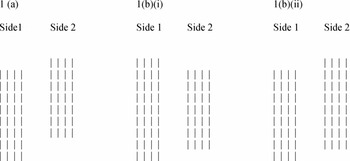
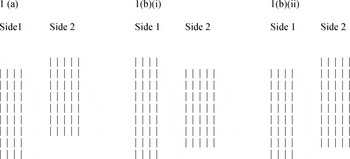
To make this more concrete, consider Figure B, which shows three Easy Cases in which, again, there are four people on each side. In Easy Case 1(a), Side 1 has the better claim in all three criteria understood as claims of individuals, WA (as determined by comparing the locations of the bottom point of each side's lines), B (as determined by comparing the length of each side's lines) and WP (as ascertained by comparing the distance from the top of each side's lines to the bottom of the other's); in such cases, Side 1 should get the resource.Footnote 18 In Easy Cases 1(b)(i) and 1(b)(ii), two of the three criteria point to Side 1 while the third registers a tie. Specifically, in 1(b)(i), WA and B each favor Side 1, while WP (ascertained, again, by comparing the distance from the top of each Side's lines to the bottom of the other's) is a tie. In Easy Case 1(b)(ii), Side 1 dominates in WA and WP claims, with B a tie. In both 1(b)(i) and 1(b)(ii), then, Side 1 dominates on a majority of criteria while Side 2 dominates in none, which makes them both Easy Cases on which Side 1 should get the resource.
EASY CASES in which Side 1 should win.

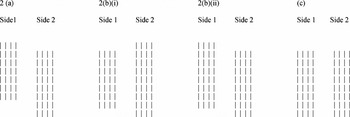
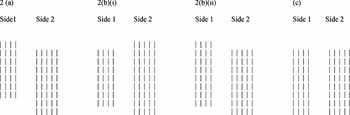
Now consider Figure C. The first three Easy Cases simply reverse each of those in Figure B. That is, Figure C's are identical Easy Cases to those in Figure B, except that here, Side 2 easily – i.e. uncontroversially – should win, because it either dominates in all three criteria, WA, B and WP, as in Easy Case 2(a), or else dominates in a majority two out of three while the third is tied, as in 2(b)(i) and 2(b)(ii). Finally, in Figure C, I have also placed Easy Case (c), in which WA, B and WP are all tied. This case is Easy because it suggests, unambiguously, that we flip a coin.Footnote 19
EASY CASES in which Side 2 should win (or which register a tie).

I have, as noted, yet to deal with the matter of Numbers, so my references to WA, B and WP are all meant to be taken on an individual-by-individual basis; for example, each individual on Side 1 in Easy Case 1(b)(i) dominates each individual on Side 2 in WA and B while being tied in WP, and that is why it is an Easy Case in a non-aggregative way; i.e. even when the Numbers aren't taken into account. Nevertheless, because the Numbers on each Side are tied, Side 1 necessarily, in each of Figure B's cases, either dominates or is tied, as the case may be, in WA, WP and B in an aggregate sense as well – and the same for Side 2 in Figure C's cases.
Let me now outline the approach I am advancing. On it, we should resolve any given Hard Case of the Figure A sort by determining which kind of Easy Case it most closely resembles. If it most resembles 1(a), 1(b)(i) or 1(b)(ii), the resource should go to Side 1. If it most resembles 2(a), 2(b)(i) or 2(b)(ii), the resource should go to Side 2. And if Easy Case (c) is closest, we should flip a coin. For the purposes of exposition, it's better for me to first explain how we would determine which Easy Case is closest to the Hard Case in Figure A – a determination we can make cardinally – and then, after that, I shall explain why we should allocate the resource to the side that wins in the closest Easy Case, while responding to objections that may occur to the reader as he or she considers the following methodology.
To determine which of the seven Easy Cases is closest to the Hard Case, we must first, for each of the seven, come up with the version of it that is closest to the Hard Case. Only then can we determine which, of these closest versions of each of the seven, is the closest to the Hard Case. The closest version of each Easy Case will be the one which is the minimal number of QALYs ‘away’, that is, which requires changes of the smallest number of QALYs possible to transform the Hard Case into it. Let me show this by way of example, by demonstrating how we could calculate the closest version of Easy Case 1(b)(ii) to the Hard Case; the basic approach can be applied, with appropriate changes, to determine the closest versions of each of the other Easy Cases.
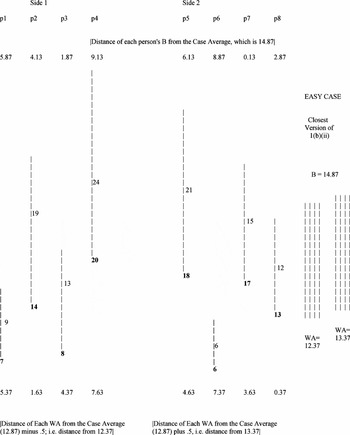
To ascertain the closest version of Easy Case 1(b)(ii) to the Hard Case in Figure A, we would have to make two calculations, one involving Benefit (B) and the other WA.Footnote 20 Take Benefit (B) first. As can be seen in Figure B, in an Easy Case 1(b)(ii), each Side's members would Benefit (B) from the resource to the same magnitude. The task here is to determine what that magnitude would be, in cardinal terms, in the closest version of Easy Case 1(b)(ii) to the Hard Case in Figure A. And that magnitude would simply be the one in which every person on both sides, Side 1 and Side 2, displays a capacity to Benefit equal to the average capacity to Benefit for the Hard Case as a whole. The average of any group of figures is always that number from which the summed distances of group members is lowest. For the Hard Case, that average Benefit (B) is: 9 +19 + 13 + 24 + 21 + 6 + 15 + 12 divided by 8 = 14.87.Footnote 21 In Figure D, which shows again the Hard Case from Figure A, I have placed above each person's line the number of QALYs that his capacity to Benefit – whether it is larger or smaller – is away from the case-average Benefit (B) of 14.87, which would be the B for each individual in the closest version of Easy Case 1(b)(ii).
HARD CASE: Amount of change needed to get to Easy Case 1(b)(ii).

As for WA, the average level of Worse-offedness ex ante (WA) taken across all nine persons in the Hard Case is 7 + 14 + 8 + 20 + 18 + 6 + 17 + 13 divided by 8 = 12.87. If, however, we are looking for that version of Easy Case 1(b)(ii) that is closest to the Hard Case, we would, as the third panel in Figure B suggests, want the WA's on Side 1 to come as close as they can to that case average of 12.87 while remaining just a little worse-off than it. And we would want those on Side 2 to come as close as they can to 12.87 while remaining just a little better off. That's because, for Side 1 to have the better claim – in the way it does in Easy Case 1(b)(ii) – its WA must be lower than Side 2's, but just a little lower, if we are looking for the closest version of Easy Case 1(b)(ii).
‘Just a little’ does not introduce a fudge factor here, since whatever magnitude we choose, we will have to use it in constructing the closest versions of each of the other Easy Cases. And so, for our purpose – which is to determine which among the closest versions of each of the Easy Cases is closest to the Hard Case – the amount of this ‘differential,’ whatever we choose, will not affect the outcome. In any event, ‘just a little’ should asymptotically approach zero, if, as we are, we are looking for the absolutely closest version of Easy Case 1(b)(ii), where the WAs on Side 1 come as close as they can to the Hard-Case average WA while still remaining below it, and those on Side 2 come as close as they can to the Hard-Case average WA while still remaining above it. For the sake of being able to illustrate this differential diagramatically in Figure D, though, I'll assume that we are looking for that version of Easy Case 1(b)(ii) in which the WA of each person on Side 1 is .5 QALYs lower than the Hard Case average WA of 12.87 – so 12.37 – and the WA of each person on Side 2 is .5 QALYs higher than the Hard Case average WA of 12.87 – so 13.37. In Figure D, I have placed beneath each person on Side 1 the number of QALYs his level of WA is away from 12.37, and on Side 2, the number of QALYs his level of WA is from 13.37.Footnote 22
Summing these numbers along with those on top of the Figure which indicate how far each person's B is from 14.87, we get the total amount of QALYs by which the Hard Case differs from the nearest version of 1(b)(ii), which itself is graphically depicted on the right side of Figure D. Specifically,

plus

So the closest version of Easy Case 1(b)(ii) is 35 + 39 = 74 QALYs away from the Hard Case.
We can perform similar exercises, and get analogous numbers, representing the QALY differences between the Hard Case and the closest versions of each of the other Easy Cases, those that award the resource to Side 1 (Figure B), those that award it to Side 2 (Figure C), and the one that advises us to flip a coin (Figure C as well). With them, we can determine which Easy Case is the absolute closest to the Hard Case. I won't perform all the calculations here; they can be done in a fashion analogous to the one I used for 1(b)(ii). Suffice it to say that, from those cardinal calculations, we would see that the closest Easy Case to the original Hard Case is the closest version of 1(b)(i), an Easy Case in which the resource would go to Side 1.Footnote 23
2. JUSTIFYING THE ALTERNATIVE APPROACH
On the approach I would like to advance, then, we should resolve any given Hard Case of the Figure A sort by determining which kind of Easy Case in Figure B or Figure C it most closely resembles. And this kind of determination can be made with the type of definitiveness afforded by cardinal rankings.
But what of it? Before bringing Numbers in, let me first explain the moral intuition behind the approach I am suggesting and the justification for it. Let me explain, in other words, why it is possible to place WA QALYs and B QALYs on the same inter-criterion, inter-personal scale – as the approach I am advancing requires we do in summing them to calculate the closest Easy Case – when the prevalent approach seems not to be able to. Following that, I will set forth the argument as to why we should allocate the resource according to the disposition recommended by the closest Easy Case so measured.
First, note that the difference between (say) p1's B in the Hard Case and in the Easy Case can be added to the difference between p5's B in the Hard Case and in the Easy Case. Likewise, the difference between p1's WA's in the two Cases can be added to the difference between p5's WA's in the two Cases. In other words, the inter-personal addition of QALYs can be done intra-criterially, as the prevalent approach's own assumptions allow. We can, as an intra-criterion matter for Benefit (B), take the inter-personal sum ∑p1-p9 |(Bp − Bavg)|. And for WA, we can take ∑p1-p4 |WAp − WAavg-.5| + ∑p5-p9 |WAp − WAavg+.5|.
Second, note that the difference between any given person's WA's in the two cases, Hard and Easy, can be added to the difference between his B's in the two cases; in other words, the intra-personal addition of QALYs inter-criterially can be done, as the complete-lives understanding assumes. This allows us to take |WAp – WAavg-.5| plus |(Bp – Bavg)| for p1, say, or |WAp − WAavg+.5| plus |(Bp – Bavg)| for p5. It follows, then, from these two observations, that we can add – we can place on the same scale – the difference between (say) p1's B's in the Hard Case and the pertinent Easy one, and the difference between p5's WA's in the Hard Case and in the Easy one. More generally, we can take the inter-criterion inter-personal sum ∑p1-p4 |WAp – WAavg-.5| + ∑p5-p9 |WAp − WAavg+.5| + ∑p1-p9 |(Bp – Bavg)|. There is no incomparability problem; a QALY is a QALY; all fall on the same scale. And after conducting similar operations for the closest version of each of the Easy cases, we can see which is closest to the Hard Case.Footnote 24
I will shortly explain the moral intuition as to why we should use the approach I am advancing. But first, I have just argued that this approach legitimately assumes that the QALYs that represent (for example) the difference between p1's B in the Hard and in the Easy Case, and those that represent the difference between p5's WA in the Hard and in the Easy Case, can be placed on the same inter-criterion, inter-personal cardinal scale to calculate the distance between the Hard Case and the Easy one. So then why can't the prevalent approach place the difference between p1's B and p5's B in the Hard Case, and the difference between p1's WA and p5's WA in the Hard Case, on the same inter-criterion, inter-personal cardinal scale, cardinally weighing them against each other to decide the Hard Case? Why has the prevalent approach been unable to decide Hard Cases with a philosophically justified level of precision?
The reason is this: in the approach I am proposing, we are not choosing between the Hard Case and the Easy Case as if they were alternatives. Instead, the alternatives, depicted as they are entirely within the Hard Case, are either that Side 2 will wind up with all the Benefits indicated and Side 1 with none, or vice versa. But imagine that the Hard Case in Figure D and the Easy Case, say again 1(b)(ii) as shown on the right side of Figure D, were our two alternatives. Suppose, in other words, that we could distribute a resource so that this particular version of Easy Case 1(b)(ii) with its WA's and all the B's indicated for both sides would come about – i.e. imagine that the B's for each side aren't counter-factual to one another – or so that the Hard Case with all its WA's and B's would come about, for these eight people. Then we would run into the prevalent approach's problem: how could I say that p1's improved WA of 5.37 QALYs if we choose Easy Case 1(b)(ii) instead of the Hard Case outweighs the smaller Benefit of 6.13 which p5 would then receive (5.37 being the number below p1, and 6.13 the number above p5)? But as part of the measurement of the distance between the Hard and the Easy Case, which is what is required on the approach I am advancing, the two amounts can be placed on the same scale and added together. Intra-personally, p1's WA QALY is the same as p1's B QALY; inter-personally, p1's B QALY is the same as p5's B QALY.
I hope I have shown that the approach I am advancing ‘transforms’ a Hard Case ‘into’ an Easy one by legitimately placing the QALYs measuring different individuals' WAs and Bs on the same scale. But what moral arguments lie behind this project? Why should we distribute the resource as the closest Easy Case suggests? The governing argument in my approach is that the persons in the Hard Case, given their levels of WA, B and WP, are closest to being in a situation – i.e. whatever the closest Easy Case happens to be – where we can clearly justify that Easy Case's particular disposition of the resource than they are to any other. Yes, the side that does not get the resource loses out. The approach that I am advancing, no less than the prevalent approach, will leave the feelings of regret that can arise in any situation of moral conflict. But the losing side in the closest Easy Case has a claim that is less exigent, because the overall configuration of the Hard Case is further from the closest one in which it could legitimately claim the resource.
Put another way, if 1(b)(i) is the closest Easy Case, as it is, then it is the closest case in which we feel a distribution can unproblematically be made. If Side 2 wants to claim the resource, it would at the very least have to explain why it should get it even though the closest Easy Case awards the resource to the other side, even though the Hard Case is further away – resembles less – a situation in which Side 2 could legitimately, i.e. should unambiguously, get the resource. At the very least, this poses a question to Side 2 that it must answer, and hence constitutes an argument for giving the resource to Side 1. What, then, could Side 2ers say?
Some might point out that Side 2's p6, in the Hard Case in Figures A and D, is simply Worse off ex ante (WA) than anyone on Side 1. But my alternative, as does the prevalent approach, certainly allows the WA of one individual on a given side in a Hard Case to tip the balance in that Side's favor, if that WA is low enough in the context of all the other WA's, WP's and B's in the case. It just so happens, however, that all things considered, the Hard Case in Figures A and D is not such a case. As it is, Side 2's Bs are not quite large enough with respect to Side 1's, nor are its WAs or WPs low enough to justify, with the clarity of an Easy Case, giving the resource to Side 2. But there would come a point at which, if there were greater WA, WP or B claims on Side 2 or smaller ones on Side 1 in the original Hard Case, then Side 2 would claim the resource because 2(a), 2(b)(i) or 2 (b)(ii) would be the closest Easy Case. Even prevalent-approach philosophers agree that no matter how WA a person is, his claim on a resource cannot outweigh the claims of others, if their WAs, WPs and Bs are significant enough.Footnote 25
The governing justification for my approach, then, is that there is a clear sense in which an injustice would be done to Side 1 if Side 2 got the resource. The configurations of individual WAs, Bs and WPs on either side are closest to arranging themselves in such a way that Side 1 could legitimately claim the resource, ‘legitimately’ in the sense that it would be an easy call. True, the Hard Case is not literally that Easy Case. Nor is it literally being made into it. But the fact remains that the Hard Case's WAs, Bs and WPs are farther from justifying a similar claim for Side 2. That is the argument for giving the resource to Side 1, and there is nothing that wouldn't trouble the prevalent approach that troubles it. Again, I am saying only that the approach I am advancing has a philosophical justification, offers solutions that are as reliably intuitively acceptable as any other's, including the prevalent approach, and does so with cardinal precision. Whether that amounts to saying it is the ‘right’ approach in some further sense is not a question I will broach. In other words, I am not ruling out the possibility of other cardinal schemes with philosophical rationales that also reliably yield intuitively acceptable results, though none has yet emerged.
Bringing in the Numbers
Can this approach be adapted to take account of situations in which we are concerned with WA, B and WP not only as claims of individuals but as aggregate claims of entire sides? The easiest way to explore this is to take our previous Hard Case and add an extra person, say p9 with a WA of 22 and a B of 15, to Side 2 (see
Figure EFigure E

The pertinent Easy Cases would be configured like those in Figures F and G (they are identical to those in Figures B and C except for the extra person on Side 2). Consider Figure G's Easy Case 2(b)(ii). If we look at each individual on Side 2 and compare him with each individual on Side 1 – that is, even without aggregating, as ‘Numbers’ advises we do – we will see that the Side 2ers have greater WA and WP claims while remaining tied in B. It follows, however (and again, Figure F's 2(b)(ii) illustrates this), that when we do bring Numbers in – that is, as an aggregate matter – the Bs on Side 2 also dominate Side 1 as, of course, would the aggregate WAs and WPs. If the original Hard Case is closest to it, or for similar reasons to 2(a) or 2(b)(i), then Side 2 should win, whether we view matters through the aggregative lenses of Numbers or not. And if it is closest to (c), then we should roll a nine-sided die with five sides marked ‘Side 2’ and four marked ‘Side 1’.
EASY CASES in which Side 1 should win.

EASY CASES in which Side 2 should win (or which require, as with (c), rolling a die).

Now consider the closest Easy Cases in which (see Figure F) Side 1 wins. They are not mirror images of those in Figure G on which Side 2 wins, because Side 1 has fewer individuals. And so the approach I am advancing would seem to run into a problem. While as an ‘individual’ matter, Side 1 would win in all three of Figure F's cases – in all three, as before, the WAs, Bs and WPs on Side 1 either dominate or are tied with those on Side 2 when individuals are compared with individuals – as an aggregate matter for at least some of the criteria, these cases would seem to give the resource to Side 2.
This is most obviously so with Benefit (B). For example, in Figure F's Easy Case 1(b)(ii), Numbers would bid us remember that while as an individual matter, those on Side 1 are WA and WP than those on Side 2, and while individuals on both sides would each Benefit (B) from the resource by the same amount, nevertheless, as an aggregate matter – because there are five such amounts on Side 2 and only four on Side 1 – Side 2 would Benefit more from the resource in aggregate than Side 1. This case no longer, i.e. once the aggregating imperative of Numbers comes into it, seems an Easy one. Similarly, in Easy Case 1(a) in Figure F, there are four people on Side 1 who each, individually, stand to Benefit (B) more than each individual on Side 2, and who also dominate in WA and WP claims. But again, in an aggregate sense, those on Side 2 would Benefit (B) more than those on Side 1. The case is no longer an easy one, or so it would seem. And, of course, in versions of Figure F's cases in which the numbers on either side were even more unequal – say there were 10 on Side 2 instead of 5 because there were 10 on Side 2 in whatever Hard Case is in question – then the superior strength of Side 2's aggregate Benefit claim would be that much larger, even though these are supposed to be Cases in which Side 1 easily wins: easily in the sense that at least some (if not all) criteria point to it, while none point to Side 2.
Not only B, of course, but WA and WP too lend themselves to both individual and aggregate approaches. But an aggregate approach to WA in Figure F's cases – as can be seen by glancing at them – will still favor Side 1 every bit as much as would an individualistic approach. As for WP, individual and aggregate approaches can lead to different results.Footnote 27 But (although I can't show this here), what I am about to say concerning the tension between B understood individually and B understood aggregatively can be made to apply to WP. So I will say no more about WA or WP at this point, and focus on B.
The problem that introducing Numbers poses for the approach I am advancing, then, is that if the nearest Easy Case is one that would award the resource to a particular side on a given criterion (B, for purposes of illustration) understood individually, but to the other side on that same criterion understood aggregatively, then we have no clear way of proceeding. And, so it would seem, 1(a), 1(b)(i) and 1(b)(ii) are no ‘easier’, once we have to take the aggregating imperative of Numbers into account, than is the original Hard Case.
There is, however, a way out of this dilemma, one that would allow us to deem Figure F's cases to be easy ones that uncontroversially would award the contested resource to Side 1. And that would be if, whenever one of them is the closest Easy Case, it is legitimate to understand B only individually, not aggregatively. Then and only then would 1(a), 1(b)(i), and 1(b)(ii) truly be Easy Cases. But why should B be so understood? Wouldn't that essentially banish the claims of Numbers, of aggregation, at the outset, much as Taurek does?
No. Think of it this way: intuitively, we believe – and this is the nub of one of the prevalent approach's main concerns – that there have to be original Hard Cases where, no matter how much one Side (Side 2, say) dominates in aggregate Benefit, Side 1 should win. These would be cases – and again I'm talking now of original Hard Cases, not the nearest Easy Case – in which persons on Side 1 are, taken individually, by and large considerably Worse off ex ante (WA) than those on Side 2 (say most if not all of those on Side 1 are blind or something equally serious, while most if not all on Side 2 have minor headaches), and/or where persons on Side 1, as individuals, stand to Benefit (B) considerably more than those on Side 2 (say most if not all of those on Side 1 will be saved from a stroke, while most if not all on Side 2 will get relief from a hangnail). Of course, if there are a sufficiently large number who would be relieved of a hangnail on Side 2 and only one whose stroke would be cured on Side 1, then the aggregate Benefit on Side 2 will outweigh the aggregate Benefit on Side 1. Even so, our intuitions would want us to give the resource to Side 1; would want us to view the Hard Case in non-aggregative terms.
We get suspicious of the idea that the greater individual-based WA and B claims of a Side 1 should outweigh a larger-aggregate B claim on a Side 2 only as those on Side 2, individually and not just aggregatively in the Hard Case, command a greater and greater capacity to Benefit (B), even if, on the whole, never quite as great as those individuals on Side 1, or are individually and not just aggregatively more and more WA, even if, on the whole, never quite as WA as those individuals on Side 1. But, on the approach I am advancing, what this means is that at one point – well before the point at which the individuals on Side 2 in the Hard Case have only slightly smaller WA claims than the individuals on Side 1, or are capable of Benefiting (B) only just a little less – the closest Easy Case will flip from 1(a), 1(b)(i) or 1(b)(ii) to 2(a), 2(b)(i) or 2(b)(ii) (perhaps via an interim period where (c) is the closest Easy Case), where Side 2 does win. As it should.
Consider our Hard Case in Figure E. Here, the average individual Benefit on Side 1 (which happens to be 16.25 QALYs) is higher than on Side 2 (13.8 QALYs), but the aggregate Benefit is higher on Side 2 than on Side 1 (69 versus 65). Nevertheless, this Hard Case turns out to be closest, on the approach I am advancing, to Easy Case 1(a) – 79.98 QALYs away – which gives the resource to Side 1.Footnote 28 And giving the resource to Side 1 does not conflict with our intuitions, principally since both p1 and p3 on Side 1 are each almost as WA as p6 on Side 2, and p4 on Side 1 has a B that dominates everyone's on Side 2.
But now, suppose that we added five more individuals to Side 2 in the Hard Case in Figure E, each with a WA of 8 and a B of 16. The average individual Benefit on Side 1 would continue to be higher than on Side 2, 16.25 versus 14.9, while the aggregate Benefit on Side 2 would now be much higher than on Side 1 (149 versus 65). But this time, the Hard Case would be closest to Easy Case 2(a), giving the resource to Side 2.Footnote 29 Such an outcome, too, accords with our intuitions.
In effect, this means that 1(a), 1(b)(i) and 1(b)(ii) in Figure F are Easy Cases after all. For if they turn out to be closest, it means that we should view matters in individual not aggregate terms. And, so viewed, Side 1 in 1(a) dominates in B, WA and WP. In 1(b)(i), Side 1 dominates in B and WA while being tied in WP. And in 1(b)(ii), Side 1 dominates in WA and WP while being tied in B. Hence, we have a cardinally definitive way of allowing Benefit, understood individual by individual, to outweigh Benefit, understood in aggregate, in Hard Cases in which, intuitively, we are more likely to believe that this is what should happen, and, conversely, of allowing aggregate measures to dominate individual measures where, intuitively, we are more likely to think they should. To borrow from McKerlie, if ‘sometimes’ one side's greater potential to Benefit in aggregate should outweigh the other's greater individual claims to Benefit, then the approach I am advancing tells us when that ‘sometimes’ is.Footnote 30
CONCLUSION
My suggested alternative relies on the same assumptions as does the prevalent approach. Yet while it reliably leads to intuitively acceptable conclusions, it also does so with a cardinal resolution, a ‘precision’ that the prevalent approach doesn't offer. The approach I am advancing gives us answers that conform to our intuitions where they are fairly clear. In addition, to borrow from Daniels, it gives us ‘theoretical[ly] characteriz[ed]’ – theoretically-justified – cardinally precise answers when our intuitions do begin to come into serious conflict, answers more precise than our ‘blunt convictions’ are able to justify or perhaps even reach. In those cases, it offers resolutions that are no less intuitively acceptable than any other, although of course any single resolution, mine or anyone else's, would not be able to capture all our intuitions in such cases, precisely because they do conflict.
I would go so far as to say that any approach, such as the one I am suggesting, would be useful – assuming it reliably gave rise to cardinally determinable, intuitively acceptable ways of deciding Hard Cases – even if there were no philosophical argument underlying it. It would, though, be surprising for such an approach to work if there were no such argument governing it, no moral rationale or ‘theoretical characterization’ for the answers it gives. And for the approach I am recommending, there is: the rationale that explains why the resource should go to the side that would get it in the closest Easy Case, which I set out above. Whether this is the only principle which could or should be used to decide Hard Cases remains an open question. But it is one that allows us to generate conclusions that are no less intuitively satisfactory than any other, while doing so with cardinal clarity. In all cases, it leads to answers that are definitive, intuitive and justified.Footnote 31