Introduction
‘Power and institutions’ – in mainstream International Relations (IR) theory, these two terms were long framed as conceptual opposites. The long-standing controversy between realists and their institutionalist and constructivist critics revolved largely around the question of whether or not international law, institutions, and norms can constrain the balancing dynamics among the unequal powers in the international system and protect the weak against the strong.Footnote 1 In the course of the past decade, however, a growing body of cross-disciplinary scholarship has come to challenge the false dichotomy underlying this debate. International institutions, the critics argue, should not be viewed as opposed to power but as structures that are deeply shaped by global power inequalities and contribute to their perpetuation.
One line of argument within this new literature has focused on the deficits of the extensive ‘global governance’ literature of the 1990s, which was so optimistic about the demise of old superpower rivalries that it underestimated the continued impact of unequal state power on the shape of post-Cold War institutional frameworks.Footnote 2 Another strand of discussion has highlighted historical and current manifestations of hierarchical institutional order among states, overlooked by both realists and their principal institutionalist critics due to their shared assumption of international anarchy.Footnote 3 Finally, scholars in the neighbouring discipline of international law have attacked the traditional view of international law-making as an ‘apolitical’ exercise,Footnote 4 pointing to Western and Northern dominance in the historical evolution of international law and to the ways in which ‘hegemonic’ states such as today's United States shape and use legal rules to their own advantage.Footnote 5
Where does this new interdisciplinary interest in unequal institutional order come from?Footnote 6 Are we witnessing just another academic fad, or does the research trend mirror real political developments, that is, has there been a recent move toward greater inequality in the global political order? The latter intuition seems to underlie many recent contributions on the topic. Many authors, while emphasising that unequal orders have existed since the birth of the modern state system, place particular emphasis on early twenty-first-century developments, specifically on the influence of US power on the current institutional orders. Timothy Dunne, for instance, asks ‘whether the period between 9/11 2001 and March/April 2003 marks the emergence of a new era in international relations’ that is characterised by a US-centred ‘hierarchical system’.Footnote 7 Similarly, David Lake argues that ‘hierarchy and the question of who has authority are the key issues in today's unipolar world’.Footnote 8 Legal scholars also see evidence of a move toward ‘hegemonic international law’ in the recent foreign policy practice of the United States, a trend they attribute to ‘the turn from a bipolar to a unipolar international system’.Footnote 9
The feeling that the global institutional order has recently become more unequal is thus shared by observers from diverse theoretical backgrounds. But how can we put this rather implicit and vague diagnosis to an empirical test? And if we can confirm a trend toward greater inequality, how can we explain it? The existing literature does not offer persuasive answers to these questions, due to a number of limitations. First, it is rich in anecdotal evidence but poor in comprehensive longitudinal analysis systematically tracking change over time. Second, it lacks a common conceptual framework. Thus far, IR scholars have focused mainly on extreme cases of unequal institutional orders, such as practices of ‘semi-sovereignty’ that involve states relinquishing sovereign control over their security or economic policies.Footnote 10 Legal scholars, in contrast, have been interested in the more subtle ways in which international laws and law-making processes reflect power inequalities, yet their analyses have remained largely descriptive and unconnected to the explanatory approaches proposed by IR theorists. Finally, there is still a shortage of empirical work that would permit us to assess the validity of different theoretical claims.
In the present article, I address these shortcomings by studying the historical evolution of institutional inequality in one important policy domain: the global governance of arms control. The analysis proceeds in two steps. I first tackle the descriptive question of whether or not we have actually seen an increase in institutional inequality in the global arms control regime. I introduce a new typology of different forms of institutional inequality and apply it to map formal variation and change in global arms control institutions since 1945. I find that in this issue-area, we cannot observe a trend toward more inequality, but rather a constant change in the institutional forms that inequality has taken.
In part two of the article, I seek to understand what drives this ‘mutation’ of institutional inequality over time. I argue that it is insufficiently explained by either of three major theories of unequal institutional order: neither the realist concept of coercive order, nor the theory of hierarchy as a rational agreement between strong and weak states, nor the constructivist notion of an unequal order supported by hegemonic ideologies can fully explain the observable pattern of institutional change. I therefore propose an integrated approach that combines rationalist and constructivist arguments with insights from historical institutionalism. I argue that both material and normative environmental pressures shape the evolution of unequal institutions, but that the interaction of these factors is conditioned by past institutional legacies. Veto points embodied in pre-existing institutions inhibit reforms that increase or decrease institutional inequality and lead to the addition of new (un)equal institutions in a process of ‘layering’. At the same time, pre-existing forms of institutional inequality facilitate the reproduction of similar forms in adjacent issue areas. In the final step, I apply this model to the case of the postwar multilateral arms control regime to demonstrate its analytical utility.
Institutional inequalities in global governance: a typology
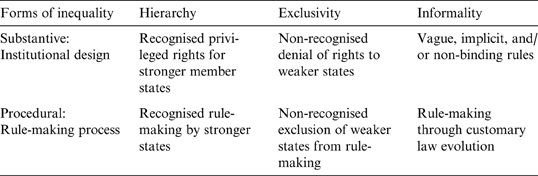
To confirm or reject the diagnosis of a recent trend toward greater institutional inequality, we first need to define what institutions should be classified as ‘unequal’. In this article, I understand institutional inequality as referring to formal characteristics of international institutions that systematically privilege powerful over weak states. This definition is broad enough to encompass both extreme encroachments on state sovereignty and the more subtle practices discussed under the heading of ‘hegemonic international law’. To allow for nuanced cross-case and cross-temporal comparisons, I distinguish three formal characteristics that render international institutions unequal in the above-cited sense and that capture most empirical variants of unequal institutional order described and discussed in the existing literature: hierarchy, exclusivity, and informality. All three characteristics, I argue, can apply either to the design of an inter-state institution or to the process through which international institutional rules are made. These analytical distinctions leave us with six types of institutional inequality, as shown in Table 1.
Forms of inequality in international institutional orders

The form of institutional inequality that has captured most attention from International Relations theorists is hierarchy. I understand hierarchy as an order marked by graduated rights and privileges, which accords ‘special rights to the powerful’.Footnote 11 In line with other theorists, I assume that hierarchy rests on the recognition of these privileges by the less powerful members of the hierarchical institution.Footnote 12 The hierarchical gradation of recognised rights can refer to an institution's design, that is, to the substantive rights that its rules accord to its members, or to the process through which new institutional rules are made. If a few ‘top dogs’ create new rules for a wider group of states and if their authority to do so is recognised by weaker states, we can speak of hierarchial rule-making.
Another type of institutional inequality is exclusivity. In some institutions, certain states are either altogether barred from membership or denied rights that other members enjoy.Footnote 13 Other than in a hierarchical order, this denial of substantive rights is not recognised by the underprivileged states. Exclusivity can also characterise the process of rule-making. Exclusive rule-making occurs when a group of powerful states creates rules for itself and then externalises them, through some combination of sticks and carrots, to other states which have not participated in the rule-making process and which have not recognised the authority of the rule-makers to legislate for them.Footnote 14
A third institutional reflection of power inequalities is informality. Informality can emerge separately from, but also in conjunction with one of the other forms of inequality.Footnote 15 Compared to hierarchy and exclusivity, it is a more ambiguous institutional feature that can, but does not always, structurally favour powerful over weaker states.
At the level of institutional design, an institution can be characterised as informal if its rules are vague or non-binding. These features, also summarised under the label ‘soft law’, have been discussed in the literature as serving a number of efficiency-enhancing functions, such as lowering contracting costs.Footnote 16 At the same time, informality is often reflective of large power differences among institutional designers. In some cases, it merely facilitates compromise between strong and weak states without privileging either side.Footnote 17 In other instances, informality effectively benefits the powerful, because it enables them to circumvent existing equal institutions and to exploit the flexibility of informal rules to their own advantage.Footnote 18 Those disposing of superior legal resources and coercive power are best positioned to apply informal rules selectively, effectively exempting themselves from inconvenient rules, while forcing those they favour upon weaker states. In this way, ‘[i]nformality allows the strictures of sovereign equality to be circumvented’.Footnote 19
In a similar vein, powerful states are privileged by – albeit not in complete control of – the informal process of rule-making that underlies the evolution of customary international law. Because customary law reflects changes in state practice, rather than the outcomes of formal treaty negotiations, ‘the process of customary international law[-making] is based in large part on applications of state power, that is, the ability of one state to compel or significantly influence the behaviour of another’.Footnote 20
Institutional inequality in the multilateral arms control regime, 1945–present day
The beginning of a new era?
The global regime governing the production, possession, and distribution of weapons and weapons-related technologies appears to be a likely case for confirming the alleged trend toward greater institutional inequality. The arms control literature written in the past ten years echoes many themes of the general literature on hegemonic international law and hierarchy in world politics. For instance, observers have identified a ‘paradigm change’ from formal arms control institutions to more informal cooperative arrangements and ‘soft law’, promoted most forcefully by the United States.Footnote 21 Others have noted a US-driven move from universally agreed non-proliferation treaties to a form of ‘non-integrative arms control’ that is ‘dominated by a few states’ and undermines ‘traditional concepts underlying multilateral arms control’, namely universality, equality of member states, and voluntary adherence.Footnote 22 In contrast, arms control negotiations following this traditional, equal approach are seen as having entered a period of ‘stagnation’ in the early twenty-first century.Footnote 23 Viewed together, these analyses appear to indicate a recent shift toward a more unequal global arms control regime. But does the diagnosis withstand closer empirical scrutiny?
Some are more equal than others: hierarchy in the global arms control regime
The first type of institutional inequality discussed in the preceding section, hierarchy, has a long history in the arms control field. From its inception, the post war global arms control regime was marked by a strong procedural hierarchy that eroded only slowly in the course of the following decades.
Throughout the 1950s, arms control negotiations at the United Nations were conducted in various UN commissions that included only the permanent UN Security Council members plus Canada. The admission of six smaller allies from NATO and the Warsaw Pact did not fundamentally alter this hierarchical structure.
A first important step toward procedural equality was taken with the creation of the Eighteen Nation Disarmament Committee (ENDC) in 1962. This new forum added only eight states to the existing negotiating structure, but the enlargement was politically significant: the ‘newcomers’ were members of the Non-Aligned Movement (NAM) and thus represented a large part of the global South which had hitherto remained excluded from global arms control talks. While the superpowers still informally dominated the ENDC,Footnote 24 the new body was widely regarded as the first genuinely multilateral forum for arms control negotiations.Footnote 25
The procedural hierarchy was flattened further in the course of the following decades. More and more states gained access to global arms control negotiations, as the ENDC was replaced by the Conference of the Committee on Disarmament (CCD) in 1969 and eventually by today's Conference on Disarmament (CD) in 1979, increasing its membership to forty states in the process. The informal superpower dominance also began to soften in the 1980s, as China and other Southern states began to play more assertive roles in global arms control talks. The equalisation of negotiating procedures went farthest in the field of conventional weapons. The 1980 Convention on Certain Conventional Weapons (CCW) was negotiated outside the CD and finalised at a conference open to all UN members.Footnote 26 The most recent example of this highly egalitarian mode of rule-making on conventional arms control issues was the process leading up to the adoption of the Arms Trade Treaty in 2013.Footnote 27
And yet, hierarchical rule-making re-emerged in the arms control regime after the turn of the millennium. In 2004, the UN Security Council passed resolution 1540, which obliged UN member states to adopt a range of measures to prevent the spread of weapons of mass destruction (WMD) to non-state actors. What was novel about this resolution was that it did not target a specific threat to peace, but created general legal obligations with regard to an abstract class of threats. Thus, the Council effectively acted as a ‘global legislator’, imposing rules that were partly derived from existing conventions upon all UN members, regardless of whether or not they had signed up to those treaties.Footnote 28 This law-making by council decree, also observable in other policy areas, was interpreted by analysts as signalling a ‘push for greater hierarchy’ in the international systemFootnote 29 which ‘transfers the inequality [embodied in the Council's structure] into a much larger domain’.Footnote 30 Consequently, many state representatives criticised the Council's assertion of legislative powers in the debate preceding the adoption of Resolution 1540. While most of them eventually accepted it as an exceptional measure addressing an urgent political need, India threatened to disregard it, arguing ‘India cannot accept any obligations arising from treaties that India has not signed or ratified’.Footnote 31
In addition to procedural hierarchies, the global arms control regime has also been marked by a long-standing hierarchy of substantive rights with regard to nuclear weapons. The cornerstone of the nuclear hierarchy is the 1968 Non-Proliferation Treaty (NPT), which divides the world into two classes of states: the ‘Nuclear Weapons States’ (NWS), which had exploded atomic bombs before January 1967, and the remainder of ‘Non-Nuclear Weapons States’ (NNWS), which are prohibited from acquiring nuclear weapons. From its inception, the NPT's negative implications for state equality were subject to intensive debate.Footnote 32 Several nuclear threshold states – Argentina, Brazil, India, Israel, Pakistan, and South Africa – refused to sign it, as they considered it ‘unacceptably discriminatory and hypocritical for the superpowers to maintain weapons denied to other states’.Footnote 33 China was also among the NPT's chief critics, although it was accorded privileged treatment as NWS.Footnote 34 Nevertheless, the treaty gained a considerable measure of acceptance as time progressed. Three of the initial NPT hold-outs developed a full nuclear capability, but other ‘threshold states’ relinquished their programmes and joined the treaty. The Chinese and French accessions in 1992 and the indefinite extension of the NPT in 1995 further reinforced the hierarchical order created in 1968.Footnote 35
Welcome to the club: exclusive practices of arms control
The 2003 Proliferation Security Initiative (PSI), a US-led grouping of like-minded countries which aims to intercept shipments of weapons and dual-use technology to countries suspected of running illegal WMD programmes, is often cited as a paradigmatic example of a new form of ‘non-integrative’ and ‘non-consensual’ arms control.Footnote 36 Yet, a closer look reveals that similar exclusive practices of arms control have existed since the 1970s in the form of export control clubs.
The first of these supplier cartels was the Zangger Committee, an informal grouping formed in 1971 by 15 nuclear suppliers to reach a common interpretation of the NPT's restrictions on exports to NNWS.Footnote 37 While this committee still exists, it was soon overtaken in importance by the 1975 Nuclear Suppliers Group (NSG), formed to bring (then) NPT non-members France and Japan on board.Footnote 38 In the following decades, similar export control clubs were established on materials relevant to the production of chemical and biological weapons (1984 Australia Group), missile technology (1987 Missile Technology Control Regime), and major conventional weapons systems and dual-use goods (1996 Wassenaar Arrangement).
Export control clubs are examples of both exclusive rule-making and exclusive institutional design. An exclusive process of rule-making lies in the clubs' attempts to forcefully externalise internally agreed rules to non-members. Their principal aim is to deny weapons to potential recipients – including to countries that have not accepted any restrictions of their right to these weapons by signing up to relevant non-proliferation regimes. In addition, club members have also repeatedly exerted pressure on other technology suppliers to comply with the clubs' rules. For instance, the US forced China through unilateral sanctions to adhere to the rules of the Missile Technology Control Regime (MTCR), although China was not an MTCR member and ‘repeatedly objected to Washington's pressure to adhere to standards that China had no role in formulating’.Footnote 39
In addition to the exclusive rule-making process, export control arrangements are also exclusive at the level in that they effectively deny substantive rights to club outsiders, which club insiders claim for themselves. This inequality of substantive rights results from the attempts of supplier cartels to limit not only the spread of prohibited weapons (renounced also by club members themselves) but also the export of ‘dual use’ technologies that can – but need not – be used to build prohibited weapons. While the possession of these dual use technologies is not illegal and is considered unproblematic for club insiders, they are seen as a security problem in the hands of club outsiders.
Politically, this denial of substantive rights to certain states was even more explosive than the exclusive rule-making process the clubs embodied. While the formal criterion for restricting technology transfers to certain states was their non-compliance with non-proliferation rules, the fact that most targets were developing countries made the clubs vulnerable to charges of ‘racism’.Footnote 40 For instance, the denial of technology for commercial satellite launches to India under the MTCR – logical from a Western viewpoint, given India's earlier diversion of ‘civilian’ nuclear technology toward the construction of its first nuclear bomb – gave India an opportunity to protest that the regime ‘remains a surreptitious club of white countries, many former colonial powers that … seeks to prevent the former colonial world from acquiring even commercial technologies critical to economic development’.Footnote 41
Against the background of this long-standing controversy about export controls, the 2003 PSI appears as merely the most recent reinforcement of a well-established form of institutional inequality. The attention that the PSI has attracted as a novel form of security cooperation is partly due to its extremely informal nature, which is discussed in the next section.Footnote 42 In terms of its exclusivity, the PSI does not differ from earlier export control clubs. In fact, it seeks to strengthen the enforcement of existing export restrictions through ship interdictions – a practice already used, if less frequently, in the 1980s and 1990s.Footnote 43
Constructive vagueness: informal rules and customary law-making
A third institutional characteristic that can reflect power inequalities among states is informality. As was argued above, not all instances of informalisation can be classified as manifestations of institutional inequality. The multilateral arms control regime comprises several arrangements that are less precise or less binding than ‘hard law’,Footnote 44 but not all of these arrangements work to the advantage of powerful states. The 2001 UN Programme of Action on Small Arms and Light Weapons, for instance, was adopted as a non-legally binding agreement after both powerful states such as the US and China and smaller countries, particularly from the Arab world, opposed binding obligations.Footnote 45 In this instance, informality helped to forge a consensus between large and small states.
In other instances, informality had evident unequal effects. Export control arrangements, as discussed above, are exclusive arrangements that establish an inequality between members and non-members. To this, the informality of the clubs added an inequality within the club membership, because more powerful member states are better able to interpret and use the club rules to their own advantage. This dynamic is well illustrated, again, by the MTCR. The United States not only used sanctions on non-members such as China to enforce their adherence to MTCR standards, but pressured France, a fellow MTCR member, not to sell technology for civilian space-launch missiles to India.Footnote 46 The regime's informality thus enabled the US to apply its rules selectively by imposing a strict interpretation upon another MTCR member in the Indian case, while preserving its freedom to pursue a lenient export policy in other cases, most notably with regard to Israel.
The informality of export control clubs was taken one step further by the 2003 PSI, characterised by the former US Undersecretary of State for Arms Control, John Bolton, as ‘an activity, not an organization’.Footnote 47 The initiative's multilaterally agreed rules comprise no more than a three-page statement of vague ‘interdiction principles’. Underneath this thin, informal multilateral layer, the PSI consists of multiple bilateral shipboarding agreements between the US and important flag state nations. As US advocates of the initiative argue, this ‘flexible network format’ allows the US to respond quickly to proliferation incidents, with vague multilateral rules providing ‘a valuable multilateral cloak for what it essentially a set of hub-and-spoke arrangements’.Footnote 48 It is therefore not surprising that the PSI's extreme informality met with widespread scepticism among other states – and that US President Obama, in his celebrated 2009 Prague Speech, sought to improve the initiative's international legitimacy by promising to transform it into a ‘durable international institution’.Footnote 49 Given the advantages that the informal system provides to the US, however, it is perhaps equally unsurprising that this formulation was later toned down, in the 2010 US National Security Strategy, into ‘durable international effort’.Footnote 50
Apart from its informal institutional design, the PSI was also interpreted by legal experts as an attempt at informal rule-making by pushing the boundaries of customary international law. At first glance, the initiative's aim of facilitating state cooperation on ship interdictions appears to be in full accordance with existing international law, which allows for ships to be stopped and searched on the high seas with the consent of the flag state. The fact that China, India, and other critics nevertheless voiced concerns about the legality of the initiative was due to a widespread apprehension that the US would use it to establish, by way of practice, a customary right of stopping and searching ships suspected of carrying proliferation-related cargo on the high seas, regardless of flag state consent. These concerns were based on early statements by US officials, which suggested that the US viewed interdictions on the high seas as legal under an extended right of pre-emptive self-defence. Due to other states' strong reactions, US representatives did not repeat these claims in later statements.Footnote 51 As there is no known case in which a PSI interdiction proceeded without territorial or flag state consent, the informal law-making attempt appears to have been, for now, rebutted by global opinion iuris.
Understanding the pattern of institutional change
Three perspectives on unequal institutional order
The picture that emerges from the empirical stocktaking is one of high institutional diversity and complexity. Multiple forms of institutional inequality coexist with one another, and with more equal institutional arrangements and rule-making procedures, in the global governance of arms control – and have done so for many decades. The analysis thus casts doubt on the notion that the regime has recently undergone a fundamental transformation. Neither is inequality a new feature of global arms control institutions, nor is there evidence of a steep rise in inequality in the post-Cold War period. While some new forms of institutional inequality have emerged in recent years, they merely complement other, much older unequal institutions and can thus hardly be interpreted as signalling radical change.
Nevertheless, it would be equally misleading to paint a picture of institutional stability or stagnation. In fact, the evolution of global arms control has been marked by a multiplicity of institutional reforms and innovations, some of which have deepened inequality, while others have softened up unequal structures. What has changed as a result of these dynamics is not so much the overall extent of inequality in the regime but the institutional forms that inequality has taken in different historical periods. While some of its earlier manifestations have weakened, other forms have emerged in more recent stages of regime development. How can we make sense of these ‘mutations’ of institutional inequality?
International Relations theorists have developed a number of broad explanatory approaches to account for the existence of unequal institutional order. As I argue in the following, each of these perspectives can shed light on some aspects of institutional inequality in the arms control regime, but neither fully captures the observable pattern of institutional change.
One perspective that is most prominently associated with realist ‘hegemonic stability theory’, but also informs some more recent contributions, emphasises coercion as the key mechanism for the establishment and maintenance of unequal order. Strong states, the argument holds, can impose institutional rules that benefit them upon weaker states through military or economic threats and pressure, or form clubs that generate negative externalities and thus indirectly sanction outsiders.Footnote 52 With regard to institutional change, the focus on coercion implies an expectation that institutional inequality should deepen as dominant states gain coercive capabilities, that is, material power.
This explanation captures some of the dynamics we can observe in the arms control regime, particularly the US resort to sanctions to externalise the rules of exclusive export control clubs. The realist perspective is less useful, however, in explaining the broad support that some unequal institutions, such as the NPT, have achieved among weaker states in the absence of coercion. Furthermore, the explanation of institutional change in terms of a changing distribution of material power is too simple, no matter how one operationalises the latter concept. If overall economic and military power is decisive, the ‘unipolar moment’ after the end of the Cold War should have been accompanied by a sharp rise in institutional inequality, favouring above all the policy preferences of the United States. If what matters in the field of arms control is the distribution of specific technologies, continued proliferation should have led to a flattening of inequalities. Neither of these expectations matches the more complex evolution of the regime.
In contrast to the first approach, other perspectives view unequal order as being based on a consensus between strong and weak states. According to one line of argument, unequal order is the product of a rational bargain between superordinate and subordinate states that benefits both sides.Footnote 53 Focusing specifically on international hierarchy, Lake argues that this form of unequal order results from an ‘exchange between ruler and ruled in which A provides a political order of value to B sufficient to offset the loss of freedom incurred in his subordination to A, and B confers the right on A to exert the restraints on his behaviour necessary to provide that order’.Footnote 54 The unequal order thus represents a rational equilibrium that neither strong nor weak states have any incentives to disturb.
Since hierarchy thus depends not only on the power of dominant states but also on their willingness and ability to fulfil order-provision functions that are valuable in the eyes of subordinates, shifts in the global distribution of power need not immediately undermine unequal institutions, as realism would suggest. With clever policy choices, dominant powers may dissuade rising challengers from unsettling the existing hierarchy for a considerable amount of time, thus compensating a loss of coercive power with authority. Conversely, policies that run against the interests of subordinate states may accelerate the decline of hierarchy.Footnote 55
A different account of the consensus underlying institutional inequality is given by critical theorists and constructivists. This group of authors, summarised in the remainder of the article under the label of ‘constructivism’, attribute the consensual nature and stability of unequal orders not to pragmatic cost-benefit calculations but to legitimising discourses about ‘good’ and ‘bad’, ‘insiders’ and ‘outsiders’ that shape the identities of states and societies.Footnote 56 This approach suggests that institutional change will be driven by change in such constitutive discourses. For instance, a racist division of the world into ‘civilised’ and ‘non-civilised’ peoples legitimised and enabled colonial hierarchies, the decline of this ideology contributed to their fall.Footnote 57
Both conceptualisations of unequal order as a consensus between strong and weak can account better than realism for the institutionalisation of inequality in the absence of coercion and for disjunctures between regime evolution and power shifts, and both can illuminate key episodes in the history of global arms control. For instance, a rational cost-benefit calculus was evidently at play when many states, despite initial principled objections, acquiesced to the hierarchical UN Security Council Resolution 1540 out of a perceived need to act against a pressing security threat. In contrast, a constructivist perspective seems better able to explain the fierce arguments over ‘racism’ and ‘double standards’ in the arms control regime that are hard to square with the notion of a mutually beneficial equilibrium. It can also shed light on why states that would benefit from unequal institutions object to them out of principle, as in the case of China's long-standing opposition to the NPT.
Both rationalism and constructivism can thus account for certain aspects of the evolution of inequality in the arms control regime. Yet, neither is alone sufficient to capture the whole trajectory of institutional change, and neither provides much analytical leverage when it comes to understanding the striking proliferation of different forms of institutional inequality in the arms control field. If shifting interest calculations or ideologies explain why unequal arms control institutions were repeatedly criticised and challenged, why were such moves often paralleled or followed by the creation of new unequal institutions?
Understanding the path-dependent evolution of institutional inequality
The analytical perspective I propose seeks to illuminate this puzzle, but without completely rejecting existing approaches. I argue that rationalist and constructivist arguments about institutional inequality need not be construed as mutually exclusive and that both material and ideational factors matter in the creation, reproduction and transformation of unequal order. I further contend that in order to understand the interaction of these factors and the historical ‘mutations’ of institutional inequality, we must take into account the constraining impact of past institutional legacies on the process of institutional change.
My argument starts from some of the same assumptions that the ‘rational exchange’ theory of hierarchy also builds upon. In line with rationalist reasoning, I assume that institutional arrangements are created purposefully by states to fulfil certain functions, and that in some policy areas, a certain degree of inequality can be necessary to achieve the desired effects. This is quite obvious in the field of arms control: because some states are more technologically advanced than others at any given point in time, controlling the spread of armaments and weapons-related technologies means limiting their possession to those who already dispose of them, disfavouring those who do not. This means that while inequality is in the interest of dominant powers, in the contemporary international system most notably the United States, it is also considered necessary by a critical number of weaker states in the system for ensuring regime effectiveness.Footnote 58
Contrary to the rationalist perspective, however, I do not assume that the institutionalisation of inequality can be explained solely in terms of cost-benefit calculations. Even if an unequal institution's ability to produce valuable effects (in our case: to effectively control the spread of weapons) can make it attractive to subordinate states, there is no reason to think that this should make non-purposive considerations of moral legitimacy unimportant. Barring any conclusive evidence to the contrary, it seems more plausible to assume that an institution's legitimacy and stability rest both on its ability to fulfil valuable functions and on its being in tune with prevalent conceptions of ‘just’ political order, as emphasised by constructivists.
And yet, the simple recognition that both effectiveness and moral legitimacy matter does not generate simple predictions about how institutional inequality will evolve over time. If both shifts in the distribution of material capabilities and changes in an institution's normative environment can affect its legitimacy, these different environmental pressures should generate conflicting demands for institutional change.
In the case of the arms control regime, two conflicting dynamics can be expected to play an important role. The proliferation of weapons – a change in material conditions – indicates that existing institutional arrangements are ineffective in controlling the spread of; it can therefore be expected to prompt demands for greater institutional inequality. In contrast, a discursive move that challenges perceived injustices of the international political order will likely give rise to calls for greater institutional equality. If changes in both material and normative conditions can trigger demands for institutional change, this will almost inevitably produce tensions between institutional effectiveness and justice. Proposals for increasing institutional inequality that respond to proliferation events will clash with prevalent conceptions of justice, and norm-driven demands for greater equality will be opposed out of concerns for regime effectiveness.
How, then, should we expect effectiveness and justice concerns to interact, and how can this interaction explain the recurrent ‘mutations’ of institutional inequality? The most straightforward way in which conflicts between different environmental pressures could be resolved is through the negotiation of institutional rules that balance instrumental and moral concerns against one another. A move toward deeper inequality within the arms control regime should be made more acceptable by compensatory moves toward greater equality in other parts of the regime, which soften concerns about injustice. Conversely, successful equalising reforms should be conditional upon compensatory changes that increase inequality elsewhere to mitigate perceived effectiveness costs.
Such a balanced, negotiated solution appears to be an obvious response to countervailing environmental pressures. And yet, I argue, we can expect it to be rare in practice because constraints and opportunities embedded in pre-existing institutional structures can block or reinforce certain pathways of institutional change and inhibit comprehensive institutional reforms. This argument draws on historical institutionalist insights about the path-dependent nature of institutional change.Footnote 59
According to historical institutionalists, choices about institutional rules are almost always made within an already institutionalised context that limits available options of change.Footnote 60 Existing institutions are resilient to reform pressures, due to past investments that political actors have made in them, due to ‘veto points’ embedded in institutional structures, and due to the intrinsic legitimacy associated with historic arrangements.Footnote 61 ‘Boundedly rational’ political actors weigh new institutional design proposals against pre-existing arrangements and generally prefer small ‘fixes’ of the latter over radical reform.Footnote 62 As a result, institutional change in a pre-institutionalised environment tends to be incremental – or to occur through the addition of entirely new institutions (‘layering’), which is often less cumbersome than reforms of existing institutions.Footnote 63
What do these general arguments about institutional change suggest, more specifically, regarding the evolution of institutional inequality over time? First, veto points in existing institutions can be expected to block their adaptation to changing environmental pressures. The more institutional veto points exist, the more likely the deepening or softening of institutional inequality will proceed through the addition of new (un)equal institutions (‘layering’), rather than through reforms (H1).
Furthermore, equalising reforms of unequal structures should be more likely than reforms that render equal institutions more unequal (H2). This is so because an institution's members are more likely to cast vetoes against a reduction of their own privileges than against reforms that expand privileges to new members, and because equal and inclusive institutions offer more veto points to opponents of reform than unequal institutions.
Lastly, institutional veto points can also be expected to influence the form that institutional inequality it is likely to take in those cases where it emerges. As discussed above, the three forms of inequality distinguished in this article differ in the degree of recognition from weak states that they require. Whereas hierarchy rests on the explicit acceptance of unequal rights and privileges by subordinate states, informal institutions merely require weak states' acceptance of institutional flexibility, and exclusive institutions can work without any explicit consent from weak states.Footnote 64 The more consent is required to establish a certain form of inequality, the more it will be inhibited by institutional veto points. Strong veto points will thus favour exclusivity over informality over hierarchy (H3).
However, the likely impact of institutional legacies on the evolution of institutional inequality is not limited to blockades against change. To the contrary, existing institutions can also provide opportunities that facilitate the institutionalisation of deeper (or lesser) inequality in a particular form. Because boundedly rational actors eschew radical change, they can be expected to agree more voluntarily to reforms and innovations that follow some pre-established path. Thus, the emergence of a particular form of institutional inequality should be more likely if a similar unequal structure already exists in an adjacent issue-area (H4). Likewise, an institutional change toward deeper (or lesser) inequality should be more likely if this reform follows a procedural precedent within existing institutions (H5).
Taken together, the above conjectures suggest that a comprehensive, negotiated rebalancing of effectiveness and justice concerns will be difficult to achieve in a pre-institutionalised setting. Institutional constraints and opportunities make some proposals easier to realise than others and lower the prospects for radical departures. A negotiated compromise between conflicting demands for effectiveness and justice is therefore more likely in a still relatively unregulated issue-area (H6).
The following section puts the theoretical approach advanced here to an empirical test by analysing three major turning points in the history of post-war global arms control. Some modesty is warranted, however, regarding the aim of this test. The argument of this article points to the complex interaction of material, ideational, and institutional conditions, which can either reinforce or dampen each others' effects and which are hard to measure objectively. It is therefore all but impossible to predict what combination of absolute values of all relevant factors will lead to a specific institutional outcome. More modestly, the above hypotheses should be read as probabilistic predictions on the effect that a given change in environmental conditions can be expected to have, all other things equal. Furthermore, the complex explanatory model contains too many interacting variables to be amenable to a controlled comparative case study. The following plausibility probe therefore seeks to demonstrate the relevance of the causal factors discussed above – particularly the impact of pre-existing institutional structures on the evolution of institutional inequality – by process-tracing multiple individual cases of change in the arms control regime.
Explaining the institutionalisation of inequality in the arms control regime
To support the claim that the theoretical approach developed above can capture major transformations of the multilateral arms control regime since 1945 more accurately than simple realist, rationalist, or constructivist accounts of unequal institutional order, the following section analyses three turning points in the history of the regime. Each of these episodes was marked both by equalising reforms and by the establishment of new forms of institutional inequality.
The creation of the nuclear hierarchy
The first key moment of institutional change that warrants explanation was the institutionalisation of a hierarchy in the 1968 NPT. The external trigger for this early institutionalisation of inequality of nuclear rights in the global arms control regime was a shift in the global distribution of material capabilities, namely, the end of US nuclear superiority. With the Soviet Union, the UK, France, and China successively acquiring nuclear weapons and others having embarked on their own programmes, it became increasingly ‘clear that the “non-proliferation line” could not be held just through the exercise of American power and persuasion’.Footnote 65 Its loss of coercive capabilities thus led the US to press for an institutionalisation of inequality – a move of substituting coercion with authority that is well captured by a ‘rational exchange’ model of hierarchy.Footnote 66
Equally in line with rationalist expectations, many non-nuclear states shared the analysis of nuclear powers that the spread of nuclear weapons constituted a grave threat to international peace and therefore supported the introduction of institutional constraints on their acquisition by further states. Some non-nuclear countries even spearheaded the NPT initiative, as is illustrated by the ‘Irish Resolution’. Yet, accounts of the NPT negotiations suggest that many non-nuclear states also had major normative reservations with regard to the explicit institutionalisation of unequal rights and privileges in the new regime.Footnote 67
As predicted by the article's theoretical approach, changing material conditions prompted a demand for the institutionalisation of an unequal nuclear regime, which clashed with prevalent justice conceptions on the part of weaker states. How was this conflict between effectiveness and justice resolved in the case of the NPT? How was it possible to institutionalise a hierarchical order over the normative objections of many states?
A realist perspective that explains institutional inequality as the product of coercion fails to illuminate this puzzle. First, the NPT initiative was a response to the perceived loss of US coercive power in the nuclear realm. Second, while both superpowers were key drivers of the negotiating process, they had to make major concessions to non-nuclear states to win their agreement to the draft, as is detailed below.
Alternatively, the successful adoption of the treaty might be interpreted as indicating that effectiveness concerns eventually won out over moral objections on the part of weaker states, and that the constructivist argument about the moral basis of institutional legitimacy is after all irrelevant to the NPT case. Yet, such an explanation is betrayed by the centrality of justice and equality concerns throughout the negotiations.
The comprehensive compromise package that settled the conflict between nuclear and non-nuclear states and enabled the adoption of the hierarchical treaty contained important concessions in the direction of institutional equality. A hierarchical distribution of rights was institutionalised, but so were important compensatory measures. Apart from prohibiting non-nuclear states from acquiring nuclear weapons, the NPT offered them the side-payment of guaranteed access to civilian uses of nuclear energy (Art. IV) and obliged nuclear states to engage in ‘good faith’ disarmament negotiation in the long run (Art. VI), thus introducing a – still vague – time limit on substantive inequality.
In addition, the adoption of the NPT's hierarchy of substantive rights was conditional upon an equalisation of procedural rules at various levels. The NPT was negotiated in the ENDC, a body that was perceived by contemporaries as enhancing the representativeness of global arms control negotiations due to its inclusion of NAM states. The consent of this large grouping of states to the institutionalisation of the nuclear hierarchy would have been impossible to obtain without giving some of its representatives a say in the negotiations, so the introduction of substantive inequality in the NPT was conditional on the equalisation of negotiating procedures. Their inclusion in the negotiations, in turn, empowered the NAM to articulate their interests more forcefully and to negotiate not only the above-cited compromises but also a strengthening of procedural equality in the NPT's internal decision-making structures. It was due to their insistence that a system of Review Conferences, based on equal voting rights of all NPT member states, was created to oversee the treaty's implementation and evolution.Footnote 68
Thus, the key to the successful institutionalisation of hierarchy in the NPT lay in a negotiated compromise that balanced effectiveness and justice by increasing equality in other parts of the treaty and in the global negotiating machinery on arms control matters. The NPT case thus illustrates well the simultaneous influence of material and normative environmental pressures on the evolution of institutional inequality. Rationalist and constructivist arguments about the legitimacy of unequal institutions are both partly confirmed by the case, but neither perspective can alone explain the outcome.
At the same time, the case also supports the historical institutionalist propositions that a negotiated compromise between effectiveness and justice concerns is facilitated by a scarcity of pre-existing institutional constraints (H6), and that the emergence of hierarchy as a form of institutional inequality is favoured by the existence of few institutional veto points (H3). Prior to the NPT, the possession of nuclear weapons had not yet been subject to any multilateral regulation. Furthermore, the existing structure for arms control negotiations still offered relatively few veto points to countries opposing the institutionalisation of a nuclear hierarchy. Although the creation of the ENDC empowered the NAM to articulate their preferences more forcefully, the number of veto players in this forum was still relatively small, enabling the nuclear powers to seek individual compensatory deals – on economic as well as security terms – with particularly obstinate treaty sceptics, such as Germany.Footnote 69
In summary, material and normative environmental pressures interacted to produce both the hierarchical structure of the NPT and a simultaneous equalisation of global arms control negotiations, as well as concessions to equality and justice within the unequal treaty. While this negotiated compromise is in line with the article's theoretical explanations, the limits of the nuclear consensus are also evident. Neither threats and pressure nor compensatory equalising moves were strong enough to convince the remaining NPT hold-outs to buy into the institutional compromise. Unpersuaded that the NPT offered them sufficient security benefits or went far enough to allay their misgivings about the treaty's perceived injustice, they continued to pursue their own nuclear programmes. Furthermore, while the NPT was invented to compensate for the United States' declining ability to unilaterally halt the spread of nuclear weapons, it did not spell the end of coercive counter-proliferation. Both the US and Israel, a key NPT holdout, continued to resort to the threat and use of force to thwart the nuclear ambitions of regional and global opponents.
The expansion of arms control negotiations and the rise of export control clubs
Following the institutionalisation of a nuclear hierarchy in the NPT, the evolution of the global arms control regime in the 1970s and 1980s was marked by two apparently contradictory moves. The procedural equalisation of arms control negotiations continued to progress, but at the same time, a new form of institutional inequality emerged with the foundation of exclusive, informal export control clubs.
The first of these developments occurred through successive reforms of the existing negotiating machinery: the ENDC underwent several enlargement rounds to create more and more inclusive negotiating forums. What propelled this reform process was a major normative shift in the international system. The progress of decolonisation had increasingly turned the UN into a stage for denouncing global inequalities, including in arms control matters. Mounting discontent with the hierarchical manner of rule-making in this field culminated in a 1978 special session on arms control of the UN General Assembly. The Conference's Final Document affirmed that ‘[a]ll States have the right to participate in disarmament negotiations … on an equal footing’ and demanded that ‘the existing disarmament machinery be revitalized and forums appropriately constituted for disarmament deliberations and negotiations with a better representative character’.Footnote 70
At the same time as the old negotiating hierarchy was thus flattened, the formation of exclusive, informal export control clubs introduced a new form of institutional inequality. As with the creation of the NPT, the environmental shocks which these new arrangements reacted to were proliferation events. The establishment of the NSG in 1975 was a response to India's successful nuclear test in 1974.Footnote 71 Similarly, the 1984 Australia Group was prompted by the use of Western-supplied chemical weapons in the Iran-Iraq war,Footnote 72 and the 1987 MTCR by India's launch of a civilian space satellite, its start of a ballistic missile programme, as well as Chinese missile transfers to other states.Footnote 73 In each of these instances, proliferation signalled the insufficiency of existing arms control measures and the need for more unequal structures to reinforce existing constraints on the spread of weapons technologies.
The evolution of the global arms control regime in the 1970s and 1980s thus responded to countervailing environmental pressures that were similar to those underlying the creation of the NPT: a proliferation-induced quest for greater institutional inequality, and a norm-driven demand for greater equality. As in the NPT case, rationalist and constructivist arguments can both partly account for these dynamics. And yet, they again fail to explain the specific institutional outcome observed. This time, conflicting environmental pressures were not balanced through comprehensive negotiations, as in the NPT case, but triggered two distinct and conflicting developments: an equalising reform of hierarchical negotiating structures and the addition of a new unequal layer to the regime. Furthermore, the new unequal institutions were not hierarchical but exclusive and informal.
As with respect to the previous phase of regime evolution, a realist focus on coercion is of little use in explaining this outcome. True, the United States used sanctions threats to impose its interpretation of club rules to insiders as well as outsiders. Yet, as will be argued below, the very creation of the clubs also indicates that the US found itself incapable of imposing greater inequality within existing institutions. While the clubs certainly mirror US policy preferences, the governance costs they entail for the hegemon are much higher than those of a recognised hierarchical arrangement.
A historical institutionalist perspective that highlights the constraints and opportunities embedded in pre-existing institutional structures is more helpful in elucidating the specific way in which the arms control regime was adapted to environmental changes in the 1970s and 1980s. First, the successful flattening of the negotiating hierarchy through gradual reforms is in line with the historical institutionalist expectation that equalising reforms should be easier to achieve than adaptations deepening the inequality of the regime (H2). The ENDC's original members had little reason to veto the expansion of the forum, as this move did not threaten their own substantive or participatory rights. In addition, the norm-driven equalisation of the negotiating machinery was aided by the fact that each enlargement round elicited new demands for entry from countries that were angry to have been skipped; Japan's strong reaction to the creation of the ENDC is a case in point.Footnote 74 Such calls were hard to oppose on normative grounds, given that the need for greater inclusivity had already been recognised once. This self-reinforcing dynamic of equalising reforms exemplifies the historical institutionalist proposition that reforms following procedural precedents should be easier to accomplish (H5).
In contrast, a reform of the arms control regime in the direction of greater inequality was blocked by multiple institutional veto points created by earlier institutional choices. As expected by the historical institutionalist perspective, these veto points necessitated an institutional innovation to sidestep the blockade (H1). The first of the export control clubs, the NSG, was established within the existing non-proliferation regime founded on the NPT. As discussed in the preceding section, the creation of this hierarchical institution had been predicated on the strengthening of procedural equality both within and outside the NPT. The accession of more and more states to the treaty meant that the agenda of NPT Review Conferences was increasingly dominated by non-nuclear states, particularly by the NAM.Footnote 75 Given this group's sensitivity toward the ‘discriminatory’ aspects of the treaty and its preoccupation with the NPT's disarmament dimension, the nuclear exporters could not expect to gain sufficient support for additional, stringent export restrictions at NPT Review Conferences. At the same time, the self-reinforcing equalisation of the official UN forum for arms control negotiations that had started with the creation of the ENDC made it increasingly difficult for nuclear powers and nuclear exporters to find support for their positions within this forum. Support for stringent export controls was as elusive in the CCD or CD as at NPT Review Conferences. The Biological Weapons Convention and the Chemical Weapons Convention (CWC), the major non-nuclear arms control conventions negotiated after the NPT, did not comprise any differentiation of substantive rights, and the NAM even demanded the abolition of the Australia Group in the CWC negotiations.
The institutional blockades within and outside the NPT explain not only why institutional change proceeded through innovation rather than reform in this phase of regime evolution, but also why a new formal variant of institutional inequality developed. As historical institutionalism suggests, exclusivity and informality demand less recognition from weak states than hierarchy and are therefore more likely to emerge if existing institutions contain strong veto points (H3). Moreover, the remarkable proliferation of export control clubs in diverse policy areas testifies to the importance of the NSG, the first of the clubs, as an institutional model legitimising and facilitating the reproduction of similar forms of inequality in adjacent issue-areas (H4).
In summary, the constraining and conditioning impact of earlier institutional choices explains the specific pathway along which the evolution of institutional inequality progressed in the arms control regime of the 1970s and 1980s. As expected by historical institutionalism, the combined impact of institutional constraints and opportunities prevented a comprehensive balancing of effectiveness and justice concerns, as it had still been achievable in the less pre-institutionalised setting of the 1960s (H6).
Adapting the regime to post-Cold War security realities
A new wave of reforms and innovations hit the arms control regime in the post-Cold War period, reaching its crest in the early years of the new millennium. The external challenges that triggered these changes were again both material and normative. Continued proliferation, illustrated most dramatically by the Iraqi case, demonstrated that existing arms control arrangements still had clear deficits in controlling the spread of weapons and weapons-related technologies, and the ‘9/11’ terrorist attacks drew attention to additional threats beyond the world of states. At the same time, both the rise of key Southern powers to a more self-confident position and the breakdown of Cold War ideological divisions called for a reform of existing hierarchical and exclusive structures. These countervailing pressures prompted a number of different, parallel adaptation moves.
First, normative pressure for equalising reforms produced institutional adaptations and innovations which, while not eliminating existing unequal arrangements, softened up their boundaries in some respects, and complemented them with more equal structures.
A redrawing of boundaries became most visible in the 2005 bilateral US-India agreement on cooperation on civil nuclear technology, which was followed by the lifting of NSG sanctions against India in 2008. Together, these moves ‘upgraded’ India from one of the key targets of nuclear export controls to welcome recipient of nuclear technology.Footnote 76 Underlying this policy shift was an increasing Western and Northern preoccupation with illiberal ‘rogue states’, which entailed new normative differentiations within the Global South and allowed former ‘outsiders’ to improve their standing.Footnote 77 As a liberal democracy and US ally, India fell squarely on the ‘good’ side of the new discursive divide between ‘rogues’ and legitimate members of the international community.Footnote 78 India itself underlined this perception by stressing its democratic credentials in demanding entry into the nuclear club:
Nuclear proliferation in itself is not a North-South issue, nor are export controls … There are Saddam Husseins in the South as there were Hitlers and Mussolinis in the North … These problems are converted into North-South issues when countries in the North from cartels, clubs, and groups and do not bring democracies from the South into such arrangements.Footnote 79
The US-India deal and the NSG decision reacted to the shifting discursive boundaries by informally elevating India, a non-signatory of the NPT, to the status of legitimate nuclear power.Footnote 80
Other changes added new, more equal institutional layers to existing unequal arrangements. As discussed above, export control clubs had been widely criticised as ‘discriminatory’ ever since their inception. Southern states, in particular, had time and again demanded their abolition and replacement with universally agreed rules,Footnote 81 and the UN General Assembly had issued ‘repeated reminders that multilateralism represents a core principle in negotiations on disarmament and non-proliferation, which in turn implies inclusiveness, non-discrimination, and transparency’.Footnote 82 While the clubs themselves proved resilient to this mounting criticism, several additional, highly inclusive agreements were concluded after the turn of the millennium in the same policy areas in which the clubs were active. Thus, the universally open (non-legally binding) 2002 Hague Code of Conduct on Missiles (HCOC) was a deliberate attempt to take the issue of missile control from the much-contested MTCR to a genuinely global forum.Footnote 83 Likewise, the 2013 Arms Trade Treaty was created inter alia as an inclusive complement to the Wassenaar Arrangement, viewed by many states as a ‘Cold War device’ and ‘excluding instrument’.Footnote 84
At the same time as the global arms control regime was thus partially equalised to reflect post-Cold War normative shifts, a second, countervailing move led to the formation of new unequal structures, most notably the exclusive and informal Proliferation Security Initiative and the UN Security Council's Resolution 1540 that introduced a new form of hierarchical rule-making on non-proliferation issues. Both these institutional innovations followed the shock ‘9/11’ and were designed to address perceived gaps in the existing arms control architecture in preventing the possible spread of WMD to non-state actors and their state sponsors.
In summary, the conflicting pressures emanating from transformations in the material and normative environment of the arms control regime again did not lead to a negotiated rebalancing of effectiveness and justice concerns. Rather, the result was a plethora of institutional innovations that partly softened and partly reinforced existing inequalities in the arms control regime. What accounts for this outcome?
As in the preceding phase of regime development, the post-Cold War institutional innovations highlight the power of institutional veto points in blocking the adaptation of institutional structures to environmental changes (H1). In the case of the US-India deal, a formal amendment of the NPT to make India an official Nuclear Weapon State was out of the question, given the veto power that other NPT members had within the treaty's equal decision-making structures – and it would have weakened the Western position within the NPT vis-à-vis potential nuclear renegades perceived as hostile to Western interests, particularly Iran.Footnote 85 It was much easier for the US to informally soften up the boundaries of the nuclear club by concluding a bilateral cooperation agreement and by winning others' support for this move in the Nuclear Suppliers Group, an exclusive forum with fewer veto points.
When it came to the widespread critique of the clubs themselves, however, the latter proved resilient to external reform demands, necessitating the addition of new, more equal institutions in the same issue-areas to respond to normative pressures for change.
In both instances, the equalisation of the arms control regime in response to normative change thus proceeded through institutional innovations that sidestepped institutional veto points. This pattern differs from the 1970s and 1980s, when equalising reforms of the regime were still possible. It suggests that the second historical institutionalist hypothesis holds only within certain limits: while reforms that increase equality may be comparatively easier to realise than reforms deepening institutional inequality (H2), moves in either direction may be blocked by veto points in a densely pre-institutionalised setting.
The deepening of inequality through institutional innovations, in contrast, mirrors the evolution of the regime in the 1970s and 1980s. The first of these innovations, the PSI, sought to stop percieved gaps in the system of exclusive export control clubs. As proliferation progressed, the members of existing clubs found it increasingly difficult to limit the spread of arms merely by coordinating their national export control policies. A potential solution lay in a stronger coercive enforcement of clubs' rules vis-à-vis outsiders through the interception of ships with proliferation-related cargo. Such ship interdictions were impeded, however, by the principle of exclusive flag state jurisdiction on the high seas, inscribed in the United Nations Law of the Sea Convention (UNCLOS). Amending this treaty was a hopeless endeavour, as both its near-universal membership and its consensus-based review procedure posed high institutional obstacles to reform.Footnote 86
The PSI sought to circumvent these veto points with a dual strategy. The creation of a hub-and-spoke system of shipboarding agreements, combined with a highly informal multilateral coordination mechanism, allowed club members to pool and enhance their coercive capabilities within the boundaries of existing international law – and the United States to control these coercion activities under a multilateral cover. At the same time, the implicit attempt to push the boundaries of customary international law sought to circumvent the hurdle of a formal treaty amendment. While the first of these strategies has arguably succeeded, the second met with too much resistance on the part of global opinio iuris.
It was in response to international criticism of the PSI's lacking legality and legitimacy that the United States sought to strengthen the global non-proliferation regime through yet a new form of institutional inequality. The US-sponsored UN Security Council Resolution 1540, which amounted to a new form of hierarchical law-making on non-proliferation manners, was proposed and designed to ground the PSI in a firmer and more consensual legal basis.Footnote 87 By shifting the issue to the hierarchical forum of the UN Security Council, the sponsors could sidestep the veto points that blocked either a formal treaty amendment or a reform of customary international law. Resolution 1540 thus confirms the familiar pattern of institutional innovation to circumnavigate institutional veto points (H1). At the same time it also illustrates how the existence of unequal institutional models facilitates the reproduction of similar forms of inequality in adjacent issue-areas (H4). The acceptance of a new mode of hierarchical rule-making on arms control matters was aided by the fact that Resolution 1540 followed the model of Resolution 1373, adopted after ‘9-11’ in September 2001 to reinforce UN member states' counterterrorism policies.Footnote 88
Still, the forum shift to the UN Security Council ultimately paid off only in part from a US point of view. Resolution 1540 called on states to ‘take cooperative action’ to prevent the proliferation of weapons of mass destruction, and could thus be read as adding legitimacy to the PSI.Footnote 89 And yet, its text – adopted after extensive consultations with both members and non-members of the Council – fell short of challenging the principle of flag state consent.Footnote 90 As in the case of the PSI, remaining institutional veto points were strong enough to water down the American initiative.
The analysis suggests that the evolution of the arms control regime in the post-Cold War era can best be understood by a theoretical perspective that takes into account not only the conflicting reform pressures emanating from material and normative changes in the international system, but also the impact of existing institutional structures in channelling these pressures. Institutional veto points and models led to diverse, partly contradictory institutional innovations, rather than to a rebalancing of effectiveness and justice in a comprehensive negotiation (H6). In comparison with earlier stages of regime evolution, the failure rate of new institutional initiatives was higher in the post-Cold War era: not even equalising reforms could be realised, and institutional innovations designed to circumvent structural veto points achieved this aim only partly. This observation is in line with the historical institutionalist expectation that road blocks to institutional change grow more numerous as the density of regulation in an issue-area increased.
The form as well as the only partial success of various US-led initiatives also illustrates, once more, the limits of a realist perspective explaining unequal order as the product of coercion. While many post-Cold War innovations were initiated by the US and reflected US policy preferences, the dominant power repeatedly had to resort to informal arrangements and forum shifts to sidestep institutional constraints – and ultimately had to scale down its ambitions for change.
Conclusion
Unequal institutional orders in world politics have attracted the attention of a growing number of International Relations and International Law scholars. Underlying this interest is an implicit notion that the international system has been undergoing a transformation toward a more unequal global order. This intuition could not be confirmed by this article's in-depth analysis of the historical evolution of institutional inequality in one important issue area, the global governance of arms control. Although recent writings by arms control experts suggest that the field constitutes a likely case for confirming the ‘inequalisation’ hypothesis, a close empirical analysis does not reveal a clear trend toward greater inequality in the post-Cold War era. Instead, what emerges is a complex picture of constant change in the institutional forms that inequality has taken in different historical periods.
This ‘mutation’ of institutional inequality is not adequately explained by any of the broad theoretical approaches that IR theorists have developed to account for the existence of unequal institutional order. I have therefore proposed a perspective that combines rationalist and constructivist arguments about unequal institutions with historical institutionalist insights about the path-dependency of institutional choices. According to this argument, changes in the distribution of material capabilities and in prevailing moral discourses create conflicting pressures for deepening and lessening institutional inequality. How these countervailing pressures are resolved depends on the constraining and conditioning impact of past institutional choices. Strong veto points embedded in pre-existing institutions inhibit reforms, particularly reforms that deepen institutional inequality, and favour the addition of new layers to the regime. They also facilitate the emergence of exclusivity and informality over hierarchical forms of institutional inequality. At the same time, institutional models and procedural precedents increase the likelihood that similar forms of (un)equal institutions are reproduced and similar reforms repeated in the evolution of the regime. Due to the influence of these constraints and opportunities, a comprehensive, negotiated balancing of effectiveness and justice concerns can be expected only in a setting with few pre-existing institutional constraints.
In this article, the plausibility of these propositions was illustrated by analysing multiple instances of change in post-war multilateral arms control institutions. Due to the long history of the regime and the extraordinary density and diversity of institutional arrangements in this issue-area, the arms control case provides a particularly fertile ground for demonstrating the impact of past institutional choices on the evolution of institutional inequality over time. Some caution is therefore warranted in applying the hypotheses developed here to other issue-areas.
That said, there are good reasons to expect that the article's argument should be able to shed light on the evolution of institutional inequality in some other fields. While the tension between effectiveness and equality is particularly pronounced in the field of arms control, it is by no means unique to it. We can therefore expect that material and normative environmental changes will generate conflicting demands for increasing and decreasing institutional inequality also in other areas. The higher the density of regulation in these policy fields, the more we can expect veto points and opportunities embedded in existing institutions to constrain and channel the adaptation of the regime to conflicting environmental pressures.
One promising case for testing the argument is the field of anti-terrorism policy. Like arms control, international efforts to coordinate and regulate the fight against terrorism have a long history that goes back to the early twentieth century. Like the arms control field, the landscape of global anti-terrorism measures is populated by a plethora of equal as well as unequal institutional arrangements. Examples of the latter include the UN Security Council's resolution 1373, which introduced a new mode of hierarchical rule-making that was later copied in Resolution 1540, the G8's efforts to reinforce the global fight against terrorism by coordinating policies within this exclusive great power club, and the Financial Action Taskforce on Money Laundering, which has compiled ‘blacklists’ of non-cooperative countries to press for the universal acceptance of the group's internally agreed standards. A cursory look at these forms of institutional inequality already indicates that their creation may have a lot to do with circumnavigating institutional veto points. For instance, Resolution 1373 lifted several contested issues out of the deadlocked negotiations on a Comprehensive Convention on International Terrorism in the UN General Assembly.Footnote 91
In conclusion, the article's arguments about the evolution of inequality in the global arms control regime not only illuminates a development of intrinsic political importance, but also invites follow-up studies of international anti-terrorism policy and of other policy areas in which scholars have diagnosed manifestations of ‘hegemonic international law’.Footnote 92 The present contribution should thus be regarded as the possible starting point of a broader discussion on the interaction of material, normative, and institutional conditions in the evolution of institutional inequality in different issue-areas, rather than as a final word on these questions in the field of arms control.