The different contributions to this issue exhibit a great variety in the dynamics of the constitution of authority over territory, property and persons. The general literature into which these contributions feed confirms this variation, and this should make us quite cautious about simple explanations of dynamics, causalities and outcomes. I recognize that some highly informed analysts have argued that African land regimes differ so much and so intricately that each can be thought of as sui generis – land rules ‘only apply in the groups where they have developed’ (Reyna and Downs Reference Reyna, Downs, Downs and Reyna1988: 10–11). Nonetheless, there is much to be said for attempting to move toward broader theoretical generalizations about how land conflicts vary in form and political expression in Africa. Analysing property regimes, how they vary, and how they are changing may contribute to a better understanding of the structures and processes by which rural Africa is governed and incorporated into the modern state.
In this short essay I develop five preliminary – deliberately simple and schematic – hypotheses about how variation in grassroots-level property relations may shape patterns of land-related conflict and broader political dynamics.Footnote 1 These are sketched out as five land conflict scenarios, differentiated from one another by variations in underlying land tenure regimes. I focus on situations with high levels of competition for land, asking what forms of land-related conflict are likely to emerge under different land tenure configurations. This kind of analysis, if its descriptive claims are plausible, can help to reveal patterns in the power configurations that are embedded in land tenure relations, how these link to what Mahmood Mamdani (Reference Mamdani1996) called ‘the local state’, and how they work to connect local- and national-level political systems.
The analysis hinges on contrasting situations with high and low levels of in-migration, and situations characterized by varying degrees of local and central authority over land issues (especially over land allocation and land dispute adjudication). The hypotheses that emerge may offer leverage in analysing the different kinds of social and political tensions that arise in conditions of rising competition over land. They suggest ways of distinguishing different trajectories of politicization or political instrumentalization of land-related conflict, and of seeing the different possibilities open to (local and national) politicians as they try to suppress, amplify, and/or direct the momentum and tensions that arise from competition for land.
The reasoning is offered as a partial antidote to the view, prevalent especially in much of the Political Science discussion of rural politics and rural conflict in Africa, that local political and natural-resource disputes stem from the weakness (or absence) of state intervention in the rural areas in general, and rural property relations in particular. Jeffrey Herbst's States and Power in Africa (2000), for example, argued that central state authority barely penetrates rural Africa. From this vantage point, land conflict seems to lie outside the sphere of formal politics and ‘beyond the reach of the state’. Yet in many cases, this is clearly not so. Some of the most extensive episodes of violent conflict over property rights have happened in the commercial farming areas of states like Côte d'Ivoire, Kenya and Zimbabwe, which all have long histories of deep state involvement in the ordering and reordering of rural property relations. Highly politicized land conflict has been central in recent political histories of some of the richest and most intensively governed regions of Africa's strongest states. Close analysis shows that land institutions have structured these patterns of conflict, and that they are as much a result of state building in these regions as a reflection of the absence thereof (Boone Reference Boone2007, Reference Boone2009, Reference Boone2011a). The same is also often true of the low-grade, more everyday forms of land competition and conflict that go far in shaping the character of politics in rural localities, revealing the character of local–national linkages, and defining the dynamics surrounding the commodification of land-related relations. Land institutions are integral to power relations and state structure at the local level.
This attempt to think schematically about patterns of land-related conflict is also offered as a complement to more nuanced, fine-grained and ethnographic studies of land politics. Single-case studies predominate in the literature, although more broadly comparative efforts have been important in informing empirical analysis and theory over time (Pélissier Reference Pélissier1966; Chanock Reference Chanock1998; Amin Reference Amin, Amin and Forde1974; Shack and Skinner Reference Shack and Skinner1979; Lavigne-Delville et al. Reference Lavigne-Delville, Toulmin, Colin and Chauveau2002; Berry Reference Berry1993, Reference Berry2001, Reference Berry2002; Bruce and Migot-Adholla Reference Bruce and Migot-Adholla1994), and have become more numerous in the last decade (Bierschenk and Olivier de Sardan Reference Bierschenk and Olivier de Sardan2003; Kuba et al. Reference Kuba, Lentz and Somda2003; Juul and Lund Reference Juul and Lund2002; Ribot Reference Ribot2004; Chauveau and Colin Reference Chauveau and Colin2010; Kouamé Reference Kouamé2010; Onoma Reference Onoma2010; Jacob and Le Meur Reference Jacob and Le Meur2010). Bakary Camara's article in this collection is an example of a structured comparison of two different land tenure systems in Mali. Comparative frameworks that are broader still, such as the one proposed here, may expand possibilities for seeing patterns in land politics (both across time and space), and leveraging what we observe across many land-politics arenas to better understand the role and place of land politics in national trajectories.
At first cut, the analysis presented here is structuralist (institutionalist) and ‘economic’, but it is not and cannot remain completely so. Structure per se does not produce change or social outcomes. Structure describes some of the salient features of variation in the contexts in which people struggle over political arrangements and outcomes; structure refers to aspects of these that are (mostly) not of the actors' own making at the moment at which our dramas unfold. And ‘economic’ surely has to do with livelihoods, resources, and relations of production, but where markets are incomplete and deeply socially embedded, as in much or most of rural Africa, the political and social relations that govern resource access are direct and explicit. The analysis here of variations in local political arenas is highly simplified, and intended as a heuristic device for exploring variation in local social structure, local political structure, local–centre linkage and patterns of land-related conflict. It abstracts from diversity in hope of achieving greater analytical purchase on the problem of comparison across space and time. These simplifications may even suggest new ways of comparing and contrasting the very forms of multiplicity and ambiguous transformation that are at the centre of many existing analyses of land politics in Africa.
LAND TENURE REGIMES: DIMENSIONS OF COMPARISON
Building on large bodies of existing work on land regimes and land politics in sub-Saharan Africa, as well as on contributions presented in the present and past issues of Africa,Footnote 2 this essay proposes a schematic conceptualization of African land tenure regimes. The aim is to identify politically salient institutional features and variations across sub-national units, enabling us to compare and contrast land regimes both across and within countries.Footnote 3 To this end, land regimes are understood as ‘practised’ institutions or institutional orders (as in Ostrom Reference Ostrom1990; Greif Reference Greif2006; Olivier de Sardan Reference Olivier de Sardan2008) that encode the four critical aspects of local socio-political structure that were flagged in the introduction to this issue: property relations or rights, authority rules, citizenship rules, and a jurisdictional domain. Land tenure regimes are differentiated from one another (and may change over time) along these dimensions. A particular land regime defines a locus of political authority over land rights at the local level, as well as linkages between local political arenas and higher instances of the state apparatus; a territorial and political-administrative arena for the playing out of land-related politics; and a distribution of political and economic rights across social groups that are constituted through the norms and rules of land allocation and land use. These arrangements go far in framing the political arenas in which land rights are contested, and in defining some of the most important social groups that are likely to be parties to land-related struggles and conflict at the local level. With this repertoire of concepts, we can begin to describe variation in the local structures and settings of land politics.
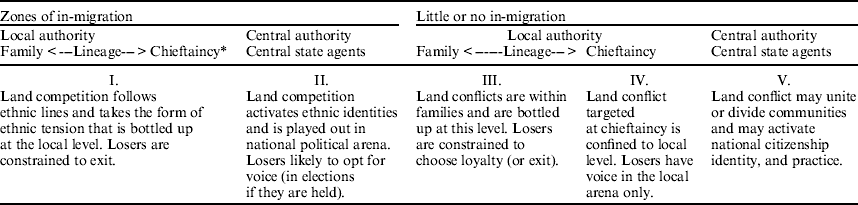
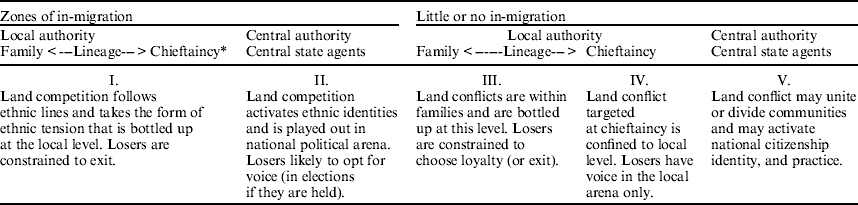
Table 1 typologizes land regimes in terms of these politically salient dimensions. At the first level, the table divides into two columns that draw a distinction between zones with or without high levels of in-migration. This allows us to tap into variation in the extent to which in-migration has been a major factor in the local expansion of agricultural production. At the next level, each of these categories is subdivided according to the locus/nature of authority over land. The locus of authority is conceptualized as ranging from the local (that is, in what are known as the customary forms, running from the most local family groups, to more encompassing lineages and clans, to community-level chieftaincy) to national (that is, where the state allocates land and adjudicates land conflicts directly).Footnote 4 Authority over land allocation is tied to territorial jurisdictions that also vary from the purely local to the national.Footnote 5 By considering these factors together, we tap into variation in land tenure regimes in which citizenship/entitlement principles influence the ways in which land-allocating authorities (be they local/customary or national/statist, each operating within a given territorial jurisdiction) distribute, mediate and revoke access to land.
Smallholder land tenure regimes: expected forms of land-related conflict (where there are high levels of competition for land)
* Or other forms of the (neo)customary.
Source: Adapted from Boone, Reference Booneforthcoming.
From this point, the table generates five hypothetical scenarios about the kinds of land-related conflict that are likely to arise under different land tenure regimes, under conditions of rising land-related competition among smallholders.Footnote 6 Many such conflicts have a redistributive character. This is because rising competition for land – associated with growing scarcity, increases in the commercial value of land, and/or growing commodification of transactions – often leads rights holders to seek more exclusive land rights. That is, they seek to exclude some claimants from land access, or seek to curtail the access rights of rival claimants, as Peters (Reference Peters2002, Reference Peters2004) and others have argued. Potential losers in these processes can be expected to try to avoid or minimize their losses – these dynamics are conceptualized here as redistributive tensions or struggles over land and land rights.Footnote 7 Social tensions and conflicts that arise in these processes are likely to be multi-stranded and complex. Even so, analysts may be able to discern some of the main elements of structure and variation in local settings by asking which social groups are likely to be the front-line losers of land rights under conditions of rising competition for land. Whose land access and land rights are most vulnerable under the different land tenure institutions?
The table proposes that the character of the land regime is often a good predictor of which social groups are most vulnerable to loss or curtailment of their land rights – be they indigenes, strangers, or neither of these – in which case there is likely to be systematic pressure on the land rights of vulnerable family members (especially youth and women). It also suggests that rough outlines of the defensive strategies that these groups are likely to adopt can often be anticipated by looking at the jurisdictional scale of the land-politics arena in which they are fighting, their citizenship status within that jurisdiction (political and economic rights, entitlements and responsibilities), and the nature of the political authority they must look to for protection, or in the case of appeal (customary or statist). Following the lead of Bierschenk and Olivier de Sardan (Reference Bierschenk and Olivier de Sardan2003), we can employ Albert O. Hirschman's (1971) exit–voice–loyalty typology as a starting point for specifying these options in a way that helps to capture variation across a wide variety of settings. Land-rights losers, or those threatened with loss, can respond with exit (out-migration), loyalty (take losses but remain in prevailing relationships), or voice (pursuit of redress or restitution via collective action in a political arena, including threats, protest, resistance or voting). Weapons-of-the-weak strategies such as witchcraft or subversion can be considered as hybrid strategies that combine elements of exit, loyalty and voice.
Exit, voice and loyalty responses are not randomly distributed, or determined only by actors' preferences. Thinking in terms of the role of institutions in structuring social action and dynamics, the present analysis emphasizes the extent to which local responses to (the spectre of) redistributive conflict are shaped by the land tenure regimes that channel and aggregate social tensions around land.
Land regimes generate incentives and possibilities for, and constraints on, exit, voice and loyalty that vary not only across space, but also across different groups of actors in a given setting. These aspects of socio-economic structure help to produce the varied patterns of land-related conflict that can be observed in Africa today.
HOW LAND REGIMES CAN STRUCTURE REDISTRIBUTIVE CONFLICT OVER LAND
Bierschenk and Olivier de Sardan have suggested that the outlines of local institutional orders are likely to reveal themselves in conflict situations (1997, 2003). The present analysis leverages this same insight about causality.Footnote 8 Because of structure and patterned variation in the political orders that govern land access and allocation, we should expect patterns in the conflicts that emerge around rising competition for land. Each dimension of the land regime constitutes a structuring element of the local political arena. They combine to shape different forms of land-related conflict.
The authority dimension points to the institutional position of the land-rights allocator. This actor (or group of persons) is expected to respond to the emergence of land-related conflicts in ways that help defend or increase already-achieved political authority and status. This feature of the land tenure regime is intrinsically linked to the jurisdictional scale at which land-related conflict plays out: jurisdictional scale refers to the institutional source or site, within a national system of territorial administration, of the land allocator's authority. Together, the authority and jurisdiction variables serve as indicators of the likely degree of implication of central state agents in a land-related conflict. Under local authority, the customary land regimes are built on segmented and ranked citizenship orders in which low-ranking in-migrants (outsiders) have the weakest land claims. By contrast, where in-migration has been sponsored by the central government, in-migrants' land claims are based on national citizenship. The government that granted the land rights to the settlers is expected to defend these rights. Under this land tenure regime, the land-rights losers are those who claim land rights on the basis of indigeneity. In-migration is also a feature of local settings that varies significantly across settings, going far in determining salience of the indigene–stranger distinction under local land authority and under central authority. The intensity of competition for land also varies over time and space, affecting the pace and weight of social processes that can trend toward growing exclusivity of rights (and thus, intensity of pressures that may be expected to fuel land-related conflict).
Using the authority, jurisdiction and citizenship concepts (or dimensions of comparison), it is possible to generate hypotheses (or sketches of scenarios) about the likely structure of land-related conflict under different land regimes. On this basis, we can generate expectations about who is likely to be a front-line loser of land rights under different land tenure regimes, and an argument about which political strategies (exit, voice, or loyalty, and in what jurisdictions) these likely losers are likely (or unlikely) to pursue in their efforts to defend their land-access rights.
Under conditions of high competition for land, divergent institutional configurations at the local level are expected to produce different kinds of politics. Under the following land tenure regimes, land-related conflict is likely to assume these forms:
-
1 In areas of high in-migration where land allocation and adjudication is under the local (the customary) control of lineage heads or chiefs, migrants are likely to be the main land-rights losers. This can be expected to generate indigene–stranger tensions and conflicts, and local authorities such as family heads or chiefs are likely to be the target or focal point of strangers' land claims and land grievances.Footnote 9 Where central authority recognizes and backs the customary land regime, strangers are unlikely to have access to a formal political arena in which to voice grievances, and state agents are likely to be unresponsive to their appeals. Upon the loss of land access, strangers have few options other than to exit, especially if they have actually been expelled. Conflict is likely to appear as localized ‘ethnic conflict’.
-
2 Where high in-migration has taken place under state sponsorship (statist land regime), rising competition for land will find political expression in tension between state-sponsored settlers and indigenes. Indigenes are likely to be land-rights losers; their grievances will be focused on the central state and central state agents. Central authorities can be expected to back those they have settled on the land – in other words, settlers with whom they have patron–client relations. Land-related conflict will find expression in the national political arena, and is likely to find ‘voice’ as ethnic grievances targeted at central rulers, and, ultimately, as ethnic claims for more control over the levers of state power. It is unlikely that this form of land-related conflict will materialize under any of the other land tenure regimes we have described. (See Naseem Badiey's study of land competition in Juba, the new capital of South Sudan, in this volume, and the Office du Niger case as described by Bakary.)Footnote 10
-
3 In areas of low in-migration where the locus of land authority is local (lineage heads and chiefs) and competition for land is high, families and lineages are likely to have direct control over most land. Here, competition for land is likely to play out within families and lineages, and subordinate members will tend to be the main land-rights losers. Within the family or lineage, there is not a public arena in which to protest injury or voice grievances; losers in this situation will therefore not have a ‘voice’ option. They will usually be constrained to opt for ‘loyalty’ (by accepting a hardening of terms of land access), or exit. They may employ weapons of the weak (subversion or witchcraft). Land-related conflict is most likely to take the form of ‘domestic conflict’ and appear non-political. It is unlikely that land-related conflict will find expression in any of the other forms specified here.Footnote 11
-
4 In areas of low in-migration and high demand for land, chiefly authority may be exerted over land-rights allocation in some particular places and situations, such as in peri-urban or irrigable areas where chiefs are ‘taking back’ land from families. In these settings, family/lineage members are vulnerable to the loss of acquired land rights, and a local political forum for ‘voice’ may be found in the arena of chiefly accountability. The stage is set for land-related conflict that takes the form of a debate on chiefly authority. Land-related conflict can be expected to play out as political debates within the chiefly jurisdiction over the accountability of a chief. Such a pattern of conflict is unlikely under other land tenure regimes (see, for example, Berry in this issue; Ubink and Amanor Reference Ubink and Amanor2008).
-
5 In localities where central states are land allocators, it is unlikely that one would find high competition for land (among smallholders) in the presence of low in-migration. This combination of factors is improbable for two reasons. First, central states have usually become directly involved in land allocation precisely to foster in-migration, or to displace smallholders completely, and second, in places where indigenes are densely settled and in-migration is low, customary regimes usually prevail. However, precisely this unusual configuration may exist in some parts of central Tanzania where the state has gone far in displacing customary or ancestral rights, but where local populations are considered indigenous to the area. Here, central state authority is directly implicated in mediating land-rights conflicts within families and lineages, who can assert land claims using voice in national institutions and the national arena (if these are not closed by political repression exerted by the central state).Footnote 12
COMPARISONS AND RESEARCH DIRECTIONS
These schematic comparisons are drawn in terms of the political aspects of land tenure regimes – authority, citizenship, jurisdiction – that are invoked in the introduction to this collection of articles. The patterns are discernible in the case analyses presented by authors who have contributed to this issue of Africa.
The customary hierarchies of land rights often structure processes of commodification, much in the way Berry documents in her article on chiefly land dealings in the areas surrounding Kumasi. Customary (‘lineage’ or ‘chief’) authorities may exercise their control over land to exclude those lower in the customary hierarchy. Scenario 4 (above) anticipates that this would provoke tensions around chiefly accountability, and that these would be voiced by ‘stool’ citizens in the public arena that is constituted by chieftaincy. Empirical work, not only by Berry herself (2001) but also by Ubink and Amanor (Reference Ubink and Amanor2008) and others, confirms that this is very much the case. Land politics in adjacent areas of western Ghana where smallholder in-migrants (‘strangers’) farm stool lands conform to a different pattern, the pattern invoked in Scenario 1. There, non-citizens of the local stools do not have access to a local public arena in which to voice objections to pressures that are circumscribing and eroding the land rights they acquired in earlier periods, when unfarmed land was more abundant. Under growing pressure on the land, stranger farmers are largely constrained to respond in terms of loyalty and exit; tensions are bottled up and indigenes retain the upper hand (with backing from the central state) (Boni Reference Boni2005; Boone and Duku Reference Boone and Duku2012). Much harsher and more repressive instances of the type of politics invoked in Scenario 1 can be found in other parts of West Africa: in parts of northern Cameroon, some politically powerful chiefs (lamibé) have violently threatened and expropriated stranger farmers with impunity (Article 19 1995; Taguem-Fah Reference Taguem-Fah, Perrot and Fauvelle-Aymar2003; Boone, Reference Booneforthcoming). In Cameroon, national politicians benefit from the bottling up of these conflicts within circumscribed jurisdictions that are dominated by pro-government chiefs.
Pauline Peters's (Reference Peters2002) account of land struggles within families in southern Malawi is evocative of what may well be a more general pattern of land competition in settings where land control is lodged in families (without much of a role for chiefs or other communal authorities), and where few ‘strangers’ are present. This general pattern, where land-related conflicts are expressed mostly as intensely intergenerational and gendered struggles, is captured in Scenario 3. It is visible in other settings where the authority, citizenship and jurisdiction aspects of the land regimes are similar, as they are in parts of southern Ghana (Amanor Reference Amanor1994) and densely populated Kisii in western Kenya (Orvis Reference Orvis1997; Ontita Reference Ontita2007; Silberschmidt Reference Silberschmidt1992). It is true that intergenerational and gendered struggles over land are ubiquitous features of land politics in Africa (and beyond). The point of the present analysis is to suggest that under land regimes such as those described in Scenario 3, these intimate struggles are likely to be the main sites of land-related conflict. These are not settings in which one would expect to see indigene–stranger conflict, chieftaincy-centred conflict, or conflict around how state power is used to distribute land among local smallholders. It will be hard for politicians seeking local electoral constituencies to play on redistributive struggles over land in these jurisdictions, precisely because the main axis of land competition cleaves (rather than unites and mobilizes) the target constituency.
Although real-world situations of land-related conflict are characterized by complexities that a simple typology cannot capture, the scenarios proposed here may be helpful in sorting out different elements of a complex situation, and in suggesting comparisons and contrasts with other cases. The Lund article in this collection, for example, details a case of back-and-forth movement over time between land tenure rules that we have conceptualized as alternatives in the typology sketched out above. In an analysis of the Upper East Region of Ghana, Lund tracks change over time in the locus of authority over land, starting with the imposition of a new, statist system of land administration under colonial rule, and then moving to the period after Ghana's 1979 decentralization. Decentralization opened the door to a cast of neo-customary authorities who are competing amongst themselves for the upper hand in allocating land, and in controlling the rents to be gained from playing this role. Lund shows that these local struggles involve, inter alia, attempts to influence the redrawing of jurisdictional boundaries that delineate their scope, scale and institutional locus of control over land. These are attempts to shape and reshape the local political arena. The salience of the jurisdictional variable is anticipated in the framework outlined above.
Work on southern Côte d'Ivoire – by Chauveau and Colin in Africa 2010, for example, and by Alfred Babo in this collection – allows us to track shifting patterns of conflict between indigenes and in-migrants in the centre-west and south-west. In these regions, land-related conflict in the Houphouët era (1960–90) resembled the patterns sketched out in Scenario 2 (Boone Reference Boone2009). Under a statist land tenure regime, where the central state exercised heavy-handed control over land use and land allocation, settlers gained ground at the expense of indigenous communities. Government did not hesitate to ride roughshod over ‘customary claims’ to the land, and agents of the prefectural administration actively settled strangers within jurisdictions targeted for in-migration (Chauveau Reference Chauveau2000; Dozon Reference Dozon1985). In the conflicts described by Alfred Babo in this issue, indigenes in the deep south-west are using the political openings of the post-Houphouët period (and the economic shifts imposed by neo-liberal reforms) in attempts to establish (re-establish, they would say) local institutions and power relations that resemble those sketched out in Scenario 3.
Bakary Camara's article identifies two different land tenure situations in the cotton-producing region of Mali: a statist land tenure regime in the Office du Niger territory; and a CMDT zone in which largely (neo-)customary rules and relations prevail. His analysis introduces additional dimensions of complexity to the schema proposed above. In the Office du Niger, the authority of the state is entrenched and not actively contested by groups claiming antecedent historical or customary rights. Everyone is a settler, much as is the case in some zones of Tanzania that were not inhabited by settled agriculturalists before the state-sponsored resettlement and villagization programme in the 1970s. In the Office du Niger, we see patterns of land politics that are partly similar to those invoked in Scenario 2. Land allocation and dispute adjudication processes are statist in nature, as suggested in Scenario 2, but in the case of the Office du Niger there is no salient indigene–settler cleavage, and the politics of possession and exclusion plays out along other lines (with access to capital often being a main axis of social cleavage when it comes to access to land). In the CMDT zone, by contrast, much of the land-related conflict described by Camara follows the lines sketched out in Scenario 3, where land disputes play out within the landholding community, and within landholding families. Movement toward individualization of land rights is evident in efforts on the part of some family members to claim more exclusive land rights at the expense of others, provoking many conflicts around customary norms and legitimacy of commodification.
Other kinds, perhaps many other kinds, of land-related conflict fall outside of the scope of the hypothetical scenarios outlined above. Lund (Reference Lund2008, and in this volume) describes conflicts structured by the division of neo-customary authority between competing agents. In north-eastern Ghana, chiefs and earth priests argue over the authority to allocate and adjudicate land. Within a given territorial jurisdiction, which neo-customary authority wields legitimate authority over land? In this same region, competition among neo-customary authorities over the demarcation of the boundaries of territorial jurisdictions is also common (Lentz Reference Lentz2001, Reference Lentz2010). In these cases, rival parties representing different communities (different local citizenries) ask, ‘Where are the jurisdictional boundaries to be drawn?’ These examples reinforce our arguments about the political salience of authority, jurisdiction and citizenship, but in particular forms not specified in the five scenarios featured above. The interest of the Ghanaian state seems to be best served by keeping these conflicts bottled up at the local level, in the spheres of chiefly and neo-customary politics where the hand of the state is often not very visible.
The Askew, Maganga and Odgaard article in this collection is part of a rapidly growing body of scholarship on the role of ‘outsiders’ (that is, investors who are not residents of the localities, foreigners, parastatal arms of national governments, et cetera) – in heightening land competition in many rural localities since the late 1990s. The discussion above has concentrated on land conflicts among smallholders in a given locality, and thus does not deal directly with the politics of ‘land grabs’. However, the hypothetical scenarios presented here do provide a point of departure in comparing local responses to these challenges. The land tenure rules and institutions that shape forms of land conflict among smallholders (as simplified in the scenarios above) also shape local responses to the challenges of outside investors. It is precisely because of the deeply statist character of land tenure regimes in most of Tanzania that the government and outside investors have such wide possibilities of accessing land in that country (Boone Reference Boone2011b). Built into this same statist land tenure regime is a vertically integrated system of land courts. This institutional arrangement gives land losers and potential losers the option of accessing national-level institutions and the national public sphere in voicing grievances and seeking redress (albeit at considerable cost and with the strong possibility that money and power will bias the process and outcomes, as these authors point out).
Across much of Africa, farming areas are under great pressure: economic, demographic and environmental changes are straining political and social rules governing land access and land use. Returns to multi-party politics and economic liberalization also create new demands and openings. These pressures have had uneven and often unanticipated effects in rural Africa. This concluding article spotlights the local institutions that shape the incentives and political options of the ordinary people who are engaged in these processes. The argument is that a structuralist take on local institutional order reveals similarities and variations in the land tenure regimes that mediate access to land, and that this institutional diversity produces identifiable patterns in land politics, both across space and time. Land tenure institutions vary in how they create connections (or disconnections) between local and national political arenas. These arrangements are key in explaining how, why and where land-related conflicts play out on the national stage (as in Kenya, Zimbabwe, Côte d'Ivoire), and how, why, and where they tend to remain bottled up at the local level, and containerized within particular local jurisdictions.
In much of rural Africa, these local institutions and local political arenas are, to varying degrees, non-liberal, both in the way they define property and in the way they define political authority and citizenship. This is key to understanding the political effects of the forces that are accelerating changes in state–society relations across much of Africa. These forces include political liberalization, commodification of land transactions, and mounting competition for control over productive resources. The most enthusiastic proponents of neo-liberalism predicted that these processes would combine to drive a smooth, rapid and uncontested expansion of the economic marketplace. Proponents of democratization hoped that these same forces would result in expansion of the electoral marketplace, and the channelling of social competition into voting for political parties and candidates for elected office. While such changes are visible in many places, this is only part of the picture. Commodification of land rights and rising competition over both land and political office (both national and local) can also result in heightened contestation, sometimes violent and exclusionary, over the legitimacy of local authority, citizenship rights and entitlements, and sub-national jurisdictional boundaries. The five scenarios above underscore the fact that, in land politics, the political playing field is often highly structured, but that this structuration is neither random nor everywhere the same. Rather, the structure of the local political arenas in which land-related conflict plays out often conforms to patterns that reflect central features of land tenure regimes that vary markedly in how they define citizenship, authority over land, and political jurisdictions.