





1. Introduction
Writing is a pivotal component of educational instruction and assessment, recognized for its role as an essential linguistic skill that encompasses complex cognitive functions such as critical reasoning, logical thinking, and problem-solving (Sari, Utomo and Astina Reference Sari, Utomo and Astina2021; Uto Reference Uto2021). The integration of writing tests into large-scale assessment programs has spurred the advancement of automated essay scoring (AES) systems, offering a practical alternative to the laborious and time-consuming process of manual grading.
Over the past decades, AES has garnered interdisciplinary interest due to its substantial commercial and educational applications (Latifi and Gierl Reference Latifi and Gierl2021; Shermis Reference Shermis2014). From the perspective of rating traits, numerous studies have focused on constructing AES models based on single holistic scores provided by human raters (Goh, Sun and Yang Reference Goh, Sun and Yang2020; Vajjala Reference Vajjala2018). However, studies that delve into AES models incorporating analytic rating traits remain relatively scarce (Kumar, Fraser and Boulanger Reference Kumar, Fraser and Boulanger2017; Taghipour Reference Taghipour2017).
Regarding approaches to AES, two types can be categorized: traditional approaches with manually crafted linguistic features and neural network approaches without feature engineering. Traditional feature-based approaches employ multiple regression models to predict essay scores (Lee, Ge and Chung Reference Lee, Ge and Chung2021; MacArthur, Jennings and Philippakos Reference MacArthur, Jennings and Philippakos2019). Despite significant advancements, traditional approaches require considerable effort in model construction and feature selection when applied to different genres or rating traits. This necessitates starting anew to select the appropriate linguistic features to fit the specific model.
By eliminating the need for manual feature selection, neural network approaches streamline the modeling process and enhance the scalability and adaptability of AES systems across various genres and rating scales (Beseiso, Alzubi and Rashaideh Reference Beseiso, Alzubi and Rashaideh2021; Kumar and Boulanger Reference Kumar and Boulanger2021). However, most neural network approaches primarily focus on holistic scoring, often overlooking the benefits of multi-task learning (MTL) and the application of pre-trained language models in multi-dimensional AES tasks (Blanchard et al. Reference Blanchard, Tetreault, Higgins, Cahill and Chodorow2013; Vajjala and Lučić Reference Vajjala and Lučić2018). This gap underscores the need for a deeper understanding of different constructs of writing quality, potentially leading to more nuanced and effective AES implementations. Besides, despite the broad applicability of neural networks, their vulnerability to adversarial examples of input perturbations causing errors poses a significant challenge, particularly in sensitive applications like AES.
To bridge the identified gaps, rather than proposing novel individual components in isolation, this study builds a unified framework whose methodological originality lies in the targeted integration of MTL, adversarial robustness training, and word-level explainability on top of the pre-trained language model, Bidirectional Encoder Representations from Transformers (BERT). While designed for multi-dimensional AES, this integrated framework also serves as a methodological reference for broader natural language processing (NLP) tasks that require multifaceted evaluation coupled with robustness and post-hoc interpretability. The main contributions of this study can be summarized as follows:
-
• Unified multi-trait modeling. We propose an integrated MTL approach to fine-tune BERT across both holistic and analytic rating scales. While joint modeling of holistic and analytic scores has been explored previously, our formulation explicitly derives the holistic score as the arithmetic sum of the four analytic scores, leveraging shared representations to improve generalizability across diverse writing constructs without manual feature engineering.
-
• Adversarial robustness for evaluative stability. We address the vulnerability of AES models to subtle input manipulations by embedding Fast Gradient Sign Method (FGSM) adversarial training within the multi-task framework, which remains underexplored in AES, thereby maintaining the integrity and robustness of the scoring process.
-
• Granular attribution for pedagogical utility. We augment the framework with explainable artificial intelligence (XAI) via Integrated Gradients (IG), attributing multi-dimensional scoring decisions to individual input tokens and providing potentially diagnostic and tailored feedback for multi-dimensional writing assessment and instruction.
We emphasize that the individual building blocks employed here—MTL, FGSM-based adversarial training, IG-based attribution, and BERT fine-tuning—are each well established in the broader NLP literature. The originality of this study, therefore, lies not in any single component, but in their targeted integration: to the best of our knowledge, this is the first AES framework that simultaneously couples joint holistic–analytic scoring with adversarial robustness training and word-level attribution. In particular, while adversarial training is mature in general NLP, its application to multi-dimensional essay scoring has remained largely unexplored. Section 3.5 further provides a conceptual account of why these components reinforce one another when built upon a shared differentiable encoder. This integration yields empirical and diagnostic insights across analytic rating scales that none of the components affords in isolation.
2. Related work
2.1 Rating scales for writing evaluation
A well-defined set of rating scales is essential for the validity of essay evaluation. Scholars have emphasized its role in assisting raters and educators in generating consistent scores and minimizing biases stemming from subjective judgments (Wind Reference Wind2020). Holistic scoring, which assigns a single score to reflect overall writing quality, is valued for its efficiency and cost-effectiveness, especially in large-scale educational assessments. This method simplifies the scoring process by allowing raters to assign a single score quickly without needing multiple readings to analyze diverse analytical scales and descriptors. However, it faces substantial criticism for its lack of granularity. Specifically, holistic scoring often fails to provide detailed feedback for students, especially those struggling with writing, regarding specific areas for improvement (Weigle Reference Weigle2002). Moreover, it does not allow evaluators to recognize and value the unique characteristics that differentiate essays.
Scholars today recognize the significant value of analytic rating scales in writing assessments, particularly for their capacity to deliver detailed and diagnostic feedback across various dimensions of writing quality (Zou, Yan and Fan Reference Zou, Yan and Fan2024). Analytic scoring excels in providing a nuanced and comprehensive portrayal of student performance by considering multiple aspects of writing quality. It not only facilitates pinpointing specific developmental needs but also bolsters formative assessment practices by addressing individual performance aspects distinctly and enabling personalized feedback (Wind Reference Wind2020). Therefore, the present study combines the advantages of holistic and analytic scoring methods to enhance reliability and validity.
2.2 Approaches to automated essay scoring
Traditional feature-based models emphasized the correlation between linguistic features and the overall quality of writing. (Crossley Reference Crossley2020; Latifi and Gierl Reference Latifi and Gierl2021), they have yet to be explored in predicting specific writing quality constructs. Besides, their generalizability is often constrained by the variability of linguistic features across different genres and rating scales, requiring significant efforts to adapt and refine these systems for broader applications.
Recent advancements in AES have markedly enhanced model generalizability across diverse genres and topics, primarily through neural network approaches. Unlike traditional AES methods that rely heavily on handcrafted linguistic features, neural networks leverage deep learning to automatically extract and learn from raw text data, thus bypassing the need for predefined feature sets. Scholars have adopted the convolutional neural network approach (Dong and Zhang Reference Dong and Zhang2016), the recurrent neural network approach (Park, Lee and Shin Reference Park, Lee and Shin2021), and the deep convolution recurrent neural network approach (Dasgupta et al. Reference Dasgupta, Naskar, Dey and Saha2018) to explore AES tasks.
While the shift toward increasingly sophisticated neural models promises more reliable and insightful assessments of student writing, it concurrently introduces inherent interpretability challenges—often characterized as the black box problem. This opacity motivates the explainability methods reviewed in Section 2.6. Furthermore, although hybrid approaches have garnered significant interest for their broader potential in NLP tasks (Dasgupta et al. Reference Dasgupta, Naskar, Dey and Saha2018; Uto, Xie and Ueno Reference Uto, Xie and Ueno2020), there remains a pressing need to investigate their efficacy in multi-dimensional essay scoring across diverse genres and rating traits.
2.3 Pre-trained language models in AES tasks
Although neural network architectures have achieved remarkable success in AES tasks (Li, Chen and Nie Reference Li, Chen and Nie2020; Uto Reference Uto2021), their heavy reliance on extensively annotated datasets remains a significant bottleneck. To address this limitation, scholars have demonstrated that pre-trained language models can be fine-tuned for different NLP tasks (Devlin et al. Reference Devlin, Chang, Lee and Toutanova2018; Sung et al. Reference Sung, Dhamecha, Saha, Ma, Reddy and Arora2019). BERT, introduced by Google AI Language, has set new performance benchmarks across multiple tasks and has proven helpful in AES (Mayfield and Black Reference Mayfield and Black2020; Nadeem et al. Reference Nadeem, Nguyen, Liu and Ostendorf2019) and automated short-answer grading (Lun et al. Reference Lun, Zhu, Tang and Yang2020; Sung et al. Reference Sung, Dhamecha, Saha, Ma, Reddy and Arora2019).
MTL offers a promising avenue to exploit such pre-trained models further, as shared representations across related tasks improve both generalization and training efficiency (Bernardini et al. Reference Bernardini, Romeo, Frontoni and Amini2021; Gao et al. Reference Gao, Hong, Li, Zhang, Wu, Wang, Zhang, Gong, Zheng, Meng and Li2023). Building upon these advancements, recent literature has explored BERT-based architectures for the joint modeling of holistic and analytic essay scores via multi-task or multi-loss learning paradigms. For instance, Wang et al. (Reference Wang, Wang, Li and Lin2022) optimized multi-scale essay representations using diverse loss objectives; Kumar et al. (Reference Kumar, Mathias, Saha and Bhattacharyya2022) framed trait-specific scoring as auxiliary tasks to enhance holistic prediction; and Cho et al. (Reference Cho, Huang and Kwon2024) introduced a dual-scale BERT incorporating multi-trait representations for concurrent holistic and dimension-specific grading.
While these foundational studies establish the viability of joint holistic–analytic modeling using pre-trained encoders, they leave notable structural and interpretability gaps unexplored. Specifically, they neither enforce a constraint in which the holistic score is compositionally derived from analytic dimensions, nor do they couple joint scoring with adversarial robustness training and gradient-based attribution.
2.4 Large language models and ensemble approaches in AES
Large language models (LLMs) and ensemble methodologies are rapidly reshaping automated assessment. Contemporary studies have explored large-scale generative models, such as GPT-3.5 and GPT-4, in zero-shot and prompt-based essay evaluation (Xia, Mao and Zheng Reference Xia, Mao and Zheng2024), with comparative evidence suggesting that generative models can surpass traditional neural baselines in specific settings (Kim and Jo Reference Kim and Jo2024; Li and Liu Reference Li and Liu2024). Systematic assessments have further investigated their accuracy, validity, and fairness across diverse scoring rubrics (García-Varela et al. Reference García-Varela, Nussbaum, Mendoza, Martínez-Troncoso and Bekerman2025; Huang and Wilson Reference Huang and Wilson2025; Pack, Barrett and Escalante Reference Pack, Barrett and Escalante2024), while highlighting the critical role of prompt design for open-source LLMs (Abujadallah, Saad and Abudalfa Reference Abujadallah, Saad and Abudalfa2025). Beyond the immediate context of educational assessment, LLMs and advanced representation learning architectures have demonstrated substantial predictive utility across adjacent domains. For instance, transfer learning from pre-trained models has proven effective for financial sentiment analysis (Ergun and Sefer Reference Ergun and Sefer2025), while tailored data representations have markedly enhanced financial statement fraud detection (Alaygut and Sefer Reference Alaygut and Sefer2025). These interdisciplinary successes underscore the cross-domain versatility of the representation-learning paradigm upon which our proposed framework is built. Concurrently, ensemble approaches combining BERT, XGBoost, and neural networks with ridge regression have been shown to substantially reduce root mean squared error (RMSE) in holistic scoring (Poonpon and Chansanam Reference Poonpon and Chansanam2025).
Although these generative and ensemble methods define the current frontier, they often incur substantial computational overhead, depend heavily on prompt engineering, and offer limited access to gradient-based token-level attribution. In contrast, the present study positions a compact, fully differentiable BERT-based framework as an efficient, controllable, and interpretable alternative, prioritizing word-level attribution and computational economy for robust real-world deployment.
2.5 Adversarial training
Despite their advanced capabilities, deep neural networks are particularly vulnerable to adversarial examples—inputs that have been subtly and deliberately manipulated to deceive models during testing (Shrivastava et al. Reference Shrivastava, Pfister, Tuzel, Susskind, Wang and Webb2017; Wong, Rice and Kolter Reference Wong, Rice and Kolter2020). These adversarial examples are engineered by introducing minute perturbations to the input data of models, specifically designed to maximize the loss and induce misclassification (Goodfellow, Shlens and Szegedy Reference Goodfellow, Shlens and Szegedy2014). Even the most advanced algorithms frequently struggle to accurately identify these modified inputs, which typically remain undetectable to the human eye.
Adversarial training contributes to the robustness of multi-dimensional AES models by equipping them to handle various types of manipulative inputs. To mitigate these vulnerabilities, the present study integrates adversarial training into the multi-dimensional AES pipeline, aiming to develop robust models capable of withstanding input perturbations without compromising scoring accuracy or stability.
2.6 Interpretability of AES models
The inherently opaque nature of deep neural networks has spurred the development of various explanation methods, highlighting a growing need to demystify the decision processes of these complex models (Kolek et al. Reference Kolek, Nguyen, Levie, Bruna and Kutyniok2022). XAI has become a crucial field within AI-driven educational scenarios, pioneering innovative methodologies to clarify and interpret the predictions of complex models. Advances in XAI enhance transparency and deepen understanding of the decision-making mechanisms, contributing to more accountable and comprehensible technological solutions (Holzinger et al. Reference Holzinger, Saranti, Molnar, Biecek and Samek2022).
Building trust remains a significant challenge, as the AES black box often remains opaque to educators and students. It underscores the need for continued research in XAI to make AES models more interpretable and aligned with educational goals, thereby enhancing their utility and acceptance in educational settings. A further challenge lies in elucidating the complete decision-making process within AES pipelines, spanning from holistic to analytic scoring. By integrating XAI into these frameworks, stakeholders—including educators and students—can gain insights into the underlying rationale driving specific scoring decisions.
Taken together, these intersecting research strands motivate the integrated computational framework developed in the subsequent sections.
3. Method
3.1 Dataset
The Automated Student Assessment Prize (ASAP) dataset, which includes a diverse array of essay topics and genres, has played a pivotal role in both benchmarking and advancing AES models. It stands as a cornerstone for developing and validating machine learning algorithms. It comprises essays across eight essay prompts authored by students in grades seven through ten. Specifically, four of these prompts are source-based, requiring students to refer to a document provided within the question. In contrast, the remaining four prompts encompass traditional genres such as persuasive, expository, and narrative essays. These collections exhibit a broad spectrum of subjects and writing modalities. The essay lengths in this dataset exhibit significant variability, with averages ranging from 150 to 550 words per response.
Dataset 7 was specifically chosen for its comprehensive scoring rubric. This scoring was executed across four essential dimensions: Ideas, Organization, Style, and Conventions, with scores for each trait ranging from 0 to 3. It comprises 1,569 narrative essays written by seventh-grade students on the topic of Patience (Shin and Gierl Reference Shin and Gierl2021). These essays are characterized by both brevity and depth, averaging approximately 250 words in length. The scoring distribution across each rating scale is illustrated in Figure 1. Results reveal that a substantial number of students fall within the intermediate category in terms of writing quality.
Score distribution for different rating scales of ASAP dataset 7.

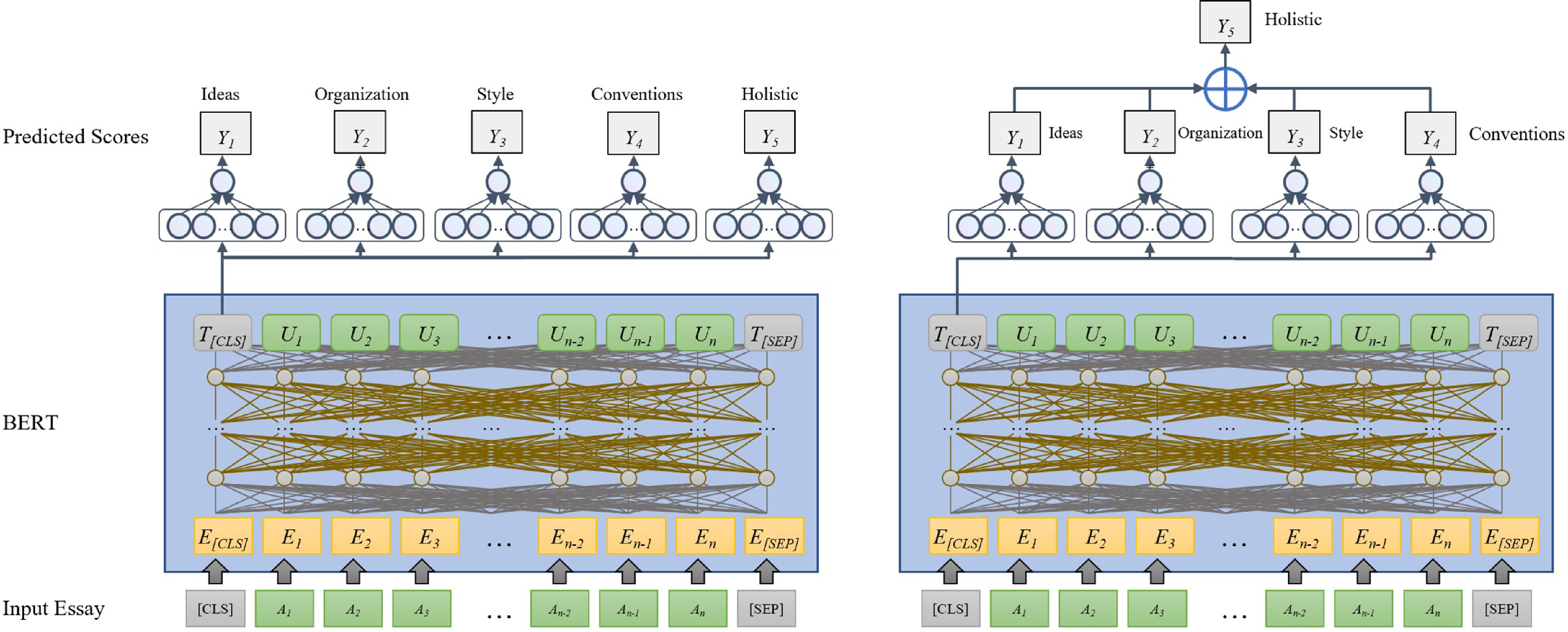
Integrated MTL with fine-tuning BERT for multi-dimensional AES (Left: BERT-Simple-MTL; Right: BERT-Integrated-MTL).

3.2 Integrated multi-task learning with fine-tuning BERT
The present study employed an integrated MTL framework (Figure 2), supported by fine-tuning the BERT model, to simultaneously predict scores across different constructs of writing quality. We propose the BERT-Simple-MTL approach, which treats each rating scale (including Ideas, Organization, Style, Conventions, and Holistic) as an independent yet simultaneous task. We further propose BERT-Integrated-MTL, which explores the interrelationships between holistic and analytic rating scales. Within this model, the holistic score is computed as the cumulative sum of the analytic scores for Ideas, Organization, Style, and Conventions.
By incorporating MTL with fine-tuning BERT, the present study benefits multi-scale AES tasks through the shared representation of each scale compared with single-scale scoring tasks. To model the intricate relationship between the input essay, denoted as
 $A$
, and its evaluation metrics, we employ the BERT algorithm to systematically extract salient attributes from
 $A$
. These attributes are subsequently employed to predict ratings across multiple dimensions. The mathematical framework governing this process is encapsulated as follows:
 \begin{equation*}\begin{pmatrix}Y_1 \\ Y_2 \\ Y_3 \\ Y_4 \\ Y_5\end{pmatrix} = f_{\text{BERT-Integrated-MTL}}(A),\quad \text{where}\quad Y_5 = Y_1 + Y_2 + Y_3 + Y_4,\end{equation*}
and
 $f_{\text{BERT-Integrated-MTL}}(A)$
represents the integration of the BERT framework with the input essay
 $A$
, yielding a set of attributes. These attributes are then exploited to calculate scores
 $Y_1, Y_2, Y_3, Y_4$
corresponding to the different constructs of writing quality regarding Ideas, Organization, Style, and Conventions. The aggregate score
 $Y_5$
is derived by summing these individual scores, amalgamating the discrete evaluations into an overarching assessment criterion.
Given the categorical nature of the proposed AES model, we employ categorical cross-entropy as the loss function for each dimension, a standard method widely employed in multi-class categorization tasks. The aggregate loss
 $L$
for the entire framework is computed by summing the losses for each rating scale and the holistic score:
 \begin{equation*}L = \sum _{i=1}^4 L_i(Y_i, \hat {\kern-1pt Y}_i) + L_5(Y_5, \hat {\kern-1pt Y}_5),\end{equation*}
capturing the cumulative impact of discrepancies across all rating scales, including Ideas, Organization, Style, and Conventions, as well as the holistic score
 $Y_5$
.
Each
 $L_i$
denotes the loss for dimension
 $i$
, where
 $Y_i$
represents the true score assigned by human raters and
 $\hat {\kern-1pt Y}_i$
denotes the predicted scores by the proposed AES model. The loss functions
 $L_i$
are delineated as:
 \begin{equation*} L_i = -\sum _{c=1}^C p_{ic} \log q_{ic}, \end{equation*}
here,
 $p_{ic}$
represents the actual probability of class
 $c$
within dimension
 $i$
, and
 $q_{ic}$
signifies the predicted probability of class
 $c$
.
3.3 Adversarial training: the Fast Gradient Sign Method
Adversarial training emerges as a pivotal approach in enhancing the robustness of machine learning models against input perturbations. FGSM is an advanced technique for generating adversarial examples—inputs deliberately designed to disrupt machine learning model outputs (Goodfellow et al. Reference Goodfellow, Shlens and Szegedy2014). During the training phase, gradients of the loss function in relation to the input essay text are carefully calculated to discern how minor textual changes can substantially affect scoring outcomes across all rating scales. Utilizing these gradients, adversarial examples are generated by introducing perturbations scaled by
 $\epsilon$
. By incorporating these adversarial examples, the model is exposed to both original and strategically modified versions of the essays.
The fundamental principle of FGSM is to generate adversarial examples by applying minimal yet strategically optimized perturbations to the input data. The mathematical formulation of FGSM is expressed as follows:
 \begin{equation*} \mathbf{x}^{adv} = \mathbf{x} + \epsilon \cdot \text{sign}(\nabla _{\mathbf{x}} J(\mathbf{\theta }, \mathbf{x}, y)), \end{equation*}
where
 $\mathbf{x}^{adv}$
signifies the adversarial example derived from the original input
 $\mathbf{x}$
,
 $\epsilon$
a small scalar that determines the perturbation’s magnitude,
 $\nabla _{\mathbf{x}} J(\mathbf{\theta }, \mathbf{x}, y)$
denotes the gradient of the loss function
 $J$
with respect to the input
 $\mathbf{x}$
,
 $\mathbf{\theta }$
represents the model’s parameters, and
 $y$
is the true label for
 $\mathbf{x}$
. The
 $\text{sign}( )$
function directs the perturbation towards increasing the loss, thus testing the model’s robustness in adversarial settings.
It is worth clarifying our rationale for adopting FGSM. We deploy FGSM not as the most potent adversarial attack available, but rather as a computationally lightweight, single-step perturbation scheme. First, FGSM injects adversarial noise utilizing a single gradient computation, which preserves the computational tractability of the multi-task training configuration (see Table 7). Second, its algorithmic simplicity facilitates the isolation and reproducibility of robustness gains, thereby establishing a controlled baseline for embedding-space perturbations in AES. Third, while the core attack mechanism is standard, the perturbations are computed against the joint multi-task loss; consequently, each adversarial example simultaneously challenges all five scoring dimensions through the shared encoder (see Section 3.5). Multi-step alternatives, such as Projected Gradient Descent (PGD) and FreeLB, explore a more comprehensive adversarial neighborhood at substantially higher computational cost; we evaluate both empirically in Section 4.5. Thus, we position FGSM as an efficient, foundational entry point for adversarial training in AES, rather than as an upper bound on defensive capability.
3.4 Interpretability via integrated gradients
In educational assessment, the transparency and interpretability of AES models are essential for establishing trust and ensuring accountability. Interpretability enables stakeholders to verify the model’s underlying logic, confirm its alignment with pedagogical objectives, and identify potential biases or spurious correlations in its reasoning. In this study, we leverage IG (Ross and Doshi-Velez Reference Ross and Doshi-Velez2018; Sundararajan, Taly and Yan Reference Sundararajan, Taly and Yan2017) to generate word-level attributions, aiming to support students’ writing development through data-driven feedback while providing educators with insight into the model’s scoring behavior. We adopt IG as an applied, post-hoc interpretability technique rather than proposing a methodologically novel XAI algorithm. Furthermore, it is important to note that IG provides local, instance-specific feature attributions rather than global decision transparency; the resulting attributions highlight how individual tokens contribute to the prediction for a specific essay, rather than extracting universal causal rules across the entire corpus. Nevertheless, this local interpretability helps bridge the gap between highly performant but opaque neural architectures and the pedagogical need for granular, potentially diagnostic feedback. This dual advantage of automated scoring and token-level attribution enhances the educational utility of the proposed framework, positioning it as a promising tool for both large-scale assessment and personalized instruction.
3.5 Theoretical rationale for the integrated framework
While the constituent techniques of our framework are individually well established, their integration is not an ad hoc combination. Instead, all three components converge upon and mutually reinforce a single computational quantity: the gradient of a shared differentiable encoder. First, the integrated MTL architecture constrains the holistic score to be the cumulative sum of the four analytic scores. This structural constraint serves as an explicit inductive bias. It compels the shared encoder to learn representations where analytic dimensions compose linearly to reflect overall writing quality, thereby regularizing all five scoring tasks toward a unified construct and mitigating task-specific overfitting (Zhang and Yang Reference Zhang and Yang2021).
Second, FGSM adversarial training augments the optimization objective with perturbations derived from the sign of the input gradient. To a first-order approximation, minimizing this adversarial loss implicitly penalizes the gradient norm, promoting local smoothness of the scoring function within the embedding space (Goodfellow et al. Reference Goodfellow, Shlens and Szegedy2014; Miyato, Dai and Goodfellow Reference Miyato, Dai and Goodfellow2016). Crucially, this smoothness constraint operates on the shared representation underlying all five tasks, which facilitates the transfer of robustness gains across rating dimensions rather than isolating them within a single task.
Finally, IG leverages this exact gradient pathway for post-hoc attribution (Sundararajan et al. Reference Sundararajan, Taly and Yan2017). The smoother loss surface cultivated by adversarial training yields more stable input gradients, which in turn produce more reliable word-level attributions for instructional feedback. In summary, MTL supplies the cross-dimensional inductive bias, adversarial training enforces the local stability of the shared representation, and IG extracts these stabilized gradients for interpretable evaluation. Consequently, the three components form a mutually supportive architecture in which each element fortifies the theoretical preconditions of the others, rather than a mere concatenation of disparate methods.
3.6 Evaluation metrics
To gauge the alignment between the scores predicted by the computational model and those graded by human evaluators, we employed four distinct metrics to provide a robust framework for evaluating the precision and reliability of the model’s performance in mirroring human judgment.
R
 $^2$
was a goodness-of-fit measure to evaluate the proportion of variance in human raters’ scores that the model can explain. Its formula is given by:
 \begin{equation*} R^2 = 1 - \frac {\sum _{i=1}^{n}(y_i - \hat {\kern-1pt Y}_i)^2}{\sum _{i=1}^{n}(y_i - \bar {y})^2}, \end{equation*}
where
 $y_i$
represents the actual scores assigned by human raters, serving as the benchmark for evaluating the AES model’s accuracy. The model aims to closely align its predicted scores
 $\hat {\kern-1pt Y}_i$
with these actual scores to effectively mimic human scoring behavior.
 $\bar {y}$
denotes the average of all actual scores, offering a reference point for assessing variations in both actual and predicted scores.
Quadratic Weighted Kappa (QWK) was employed to measure the degree of agreement between the evaluations of the two raters.
 \begin{equation*} QWK = 1 - \frac {2 \times \sum _{i,j} w_{ij} o_{ij}}{\sum _{i,j} w_{ij} e_{ij}}, \end{equation*}
where
 $w_{ij}$
denotes the weight assigned to the disagreement between raters for terms categorized
 $i$
and
 $j$
,
 $o_{ij}$
represents the observed frequency of agreement, and
 $e_{ij}$
signifies the expected frequency of agreement under the assumption of chance.
Exact Agreement is a metric designed to quantify the proportion of essays where the scores assigned by human raters perfectly align with those predicted by the model.
Exact-Plus-Adjacent Agreement broadens the criteria by measuring the percentage of essays that either receive the same score or within one point by both the human raters and the model.
3.7 Hyperparameter selection and experimental setup
All experiments were implemented with the BERT-base-uncased encoder (12 layers, 768 hidden dimensions, 110 M parameters). Models were trained with the AdamW optimizer for 5 epochs with a batch size of 32 and a maximum sequence length of 128 tokens, on a single NVIDIA RTX 3090 GPU (24 GB). The learning rate schedule used a linear warmup over the first 10% of training steps followed by linear decay, a weight decay of 0.01, and a dropout rate of 0.1.
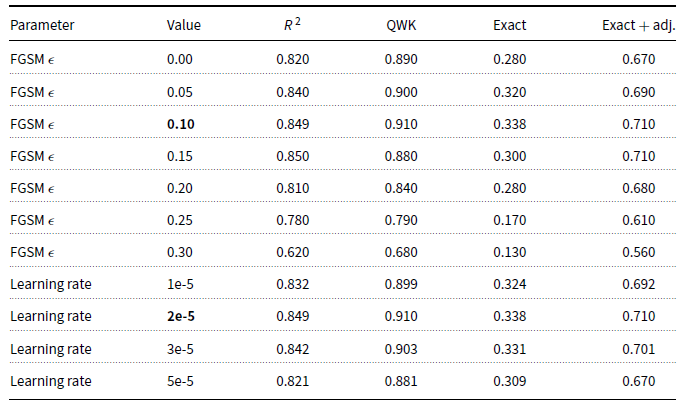
Two hyperparameters proved most consequential and were selected via grid search under the same clean-test evaluation condition as the main results: the FGSM training perturbation radius
 $\epsilon$
and the learning rate.
 $\epsilon$
here denotes the perturbation radius applied during adversarial training, as distinct from the test-time perturbation analysis reported in Section 4. As shown in Table 1,
 $\epsilon$
was examined over
 $\{0.00, 0.05, 0.10, 0.15, 0.20, 0.25, 0.30\}$
: holistic performance peaks at
 $\epsilon = 0.10$
(QWK
 $= 0.910$
) and degrades sharply beyond
 $\epsilon = 0.15$
, falling to a QWK of 0.680 at
 $\epsilon = 0.30$
, indicating that excessive perturbations distort the semantic content of the embedding space rather than regularizing it (Goodfellow et al. Reference Goodfellow, Shlens and Szegedy2014). The learning rate was examined over
 $\{1\mathrm{e}{-5}, 2\mathrm{e}{-5}, 3\mathrm{e}{-5}, 5\mathrm{e}{-5}\}$
, with
 $2\mathrm{e}{-5}$
producing the strongest holistic QWK—consistent with the fine-tuning ranges recommended for BERT (Devlin et al. Reference Devlin, Chang, Lee and Toutanova2018). Accordingly, the final BERT-Integrated-MTL-FGSM configuration adopts
 $\epsilon = 0.10$
and a learning rate of
 $2\mathrm{e}{-5}$
.
Hyperparameter sensitivity of BERT-Integrated-MTL-FGSM on the holistic dimension. Selected values are shown in bold

Table 1. Long description
The table presents the sensitivity of BERT-Integrated-MTL-FGSM hyperparameters on the holistic dimension. It has 12 rows and 5 columns. The columns are labeled Parameter, Value, R squared, QWK, Exact, and Exact + adj. The rows are grouped into two sections: FGSM epsilon and Learning rate. Each row lists the parameter value and corresponding metrics. Notable trends include the peak performance at FGSM epsilon of 0.10 with a QWK of 0.910 and a learning rate of 2e-5 with a QWK of 0.910. Performance degrades sharply beyond these values.
4. Results and discussion
4.1 Analysis of integrated multi-task learning and adversarial training with fine-tuning BERT for AES tasks
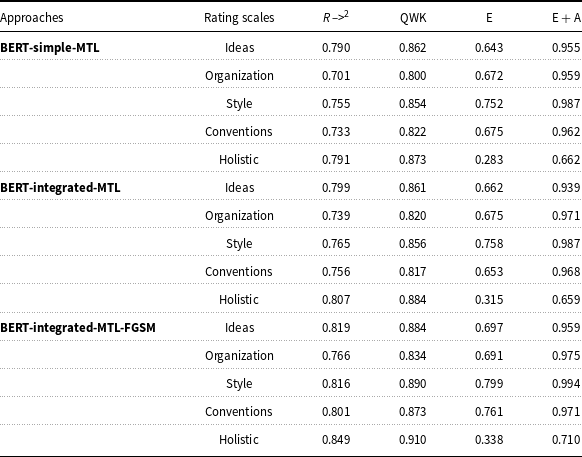
To validate the effectiveness of our proposed AES model for multi-dimensional writing assessment, we conducted a thorough comparative study to evaluate the effectiveness of MTL with fine-tuning BERT for multi-scale tasks. The present study involved three distinct configurations as follows: BERT-Simple-MTL, BERT-Integrated-MTL and BERT-Integrated-MTL-FGSM. Table 2 indicates the effectiveness of different approaches to multi-dimensional writing assessment.
Comparison of different approaches to multi-scale scoring tasks (E: Exact Agreement; E + A: Exact-Plus-Adjacent Agreement)

Table 2. Long description
A table comparing different approaches to multi-scale scoring tasks. The table has three rows and five columns. The columns are labeled Approaches, Rating scales, R squared, QWK, E, and E + A. The rows are labeled with different approaches: BERT-simple-MTL, BERT-integrated-MTL, and BERT-integrated-MTL-FGSM. Each approach is evaluated across five rating scales: Ideas, Organization, Style, Conventions, and Holistic. The values for each rating scale and approach are provided for R squared, QWK, E, and E + A. For example, BERT-simple-MTL for Ideas has R squared of 0.790, QWK of 0.862, E of 0.643, and E + A of 0.955. The table shows variations in performance across different approaches and rating scales.
Results demonstrate that BERT-Simple-MTL demonstrates moderate to high performance across different rating scales. It excels at the Holistic scale with an
 $R^2$
of 0.791 and a QWK score of 0.873. The higher scores in Exact-Plus-Adjacent Agreement across all rating scales indicate a general alignment with human raters, although not always precise. Potential reasons for the observed limitations in achieving high Exact Agreement for holistic scoring may stem from the independent scoring mechanism utilized by the model. Additionally, the broad scoring range, which extends from 0 to 24 points, likely complicates the precise evaluation of essays, as it demands a nuanced understanding and integration of multiple assessment dimensions into a single aggregate score.
BERT-Integrated-MTL-FGSM, which incorporates adversarial training, exhibits superior performance across nearly all rating scales according to various evaluation metrics. Notably, it achieves the highest
 $R^2$
and QWK in the Holistic dimension (0.849 & 0.910 respectively). The improvements in both Exact Agreement and Exact-Plus-Adjacent Agreement across different rating scales underscore the substantial benefits of adversarial training. It substantially enhances the model’s resilience against perturbations, thereby increasing the precision and consistency of multi-dimensional scoring. Moreover, it promotes scoring stability across broad response groups (see Section 4.6), an essential characteristic for navigating the complex and varied nature of multi-dimensional writing assessment.
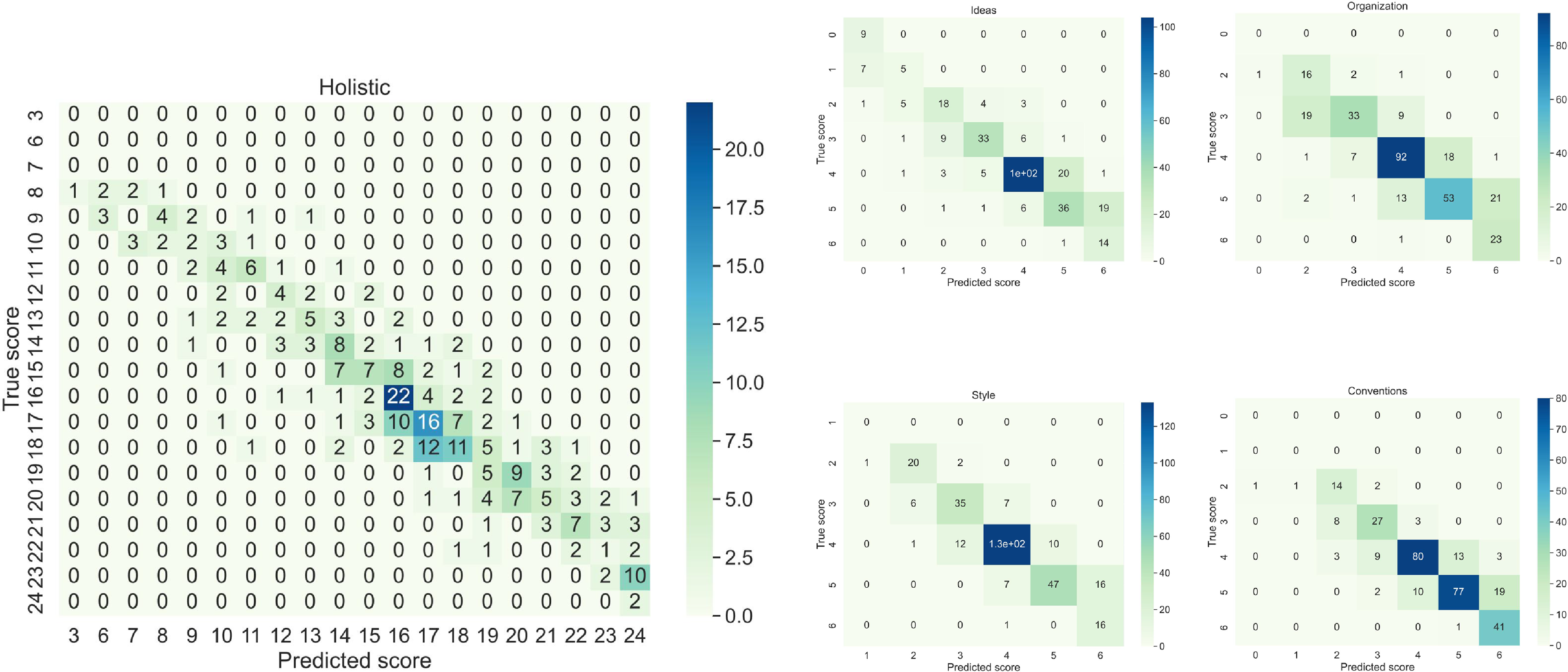
We have visualized the confusion matrices comparing true and predicted scores for BERT-Integrated-MTL-FGSM, as depicted in Figure 3. These matrices demonstrate that the predictions from BERT-Integrated-MTL-FGSM align more closely with the actual scores, supporting our earlier observations. This evidence underscores the superior performance of BERT-Integrated-MTL-FGSM, affirming the value of integrated MTL with fine-tuning BERT and adversarial training in multi-dimensional scoring tasks.
To gain deeper insights into the model’s scoring behavior, we analyzed instances of inaccurate predictions. This analysis reveals two systematic divergences from human evaluative behavior. First, the model exhibits systematic stringency, adopting a stricter scoring regimen than human evaluators: it tends to assign the lowest possible scores to essays that do not meet specified word count requirements, reflecting a rigid adherence to predefined criteria, and it penalizes spelling and word formation errors more heavily than human raters typically would. Second, the model is prone to score compression, an inclination toward middle-level scores. From a machine learning optimization perspective, predicting middle-level scores minimizes the overall expected deviation from true scores across the dataset. While this trade-off optimizes aggregate performance metrics (e.g., reducing the mean absolute error (MAE)), it may sacrifice absolute precision at the extreme ends of the scoring spectrum for individual outlier essays. These qualitative observations are quantitatively corroborated by the stratified error analysis in Section 4.6, where middle-band essays exhibit the lowest absolute errors.
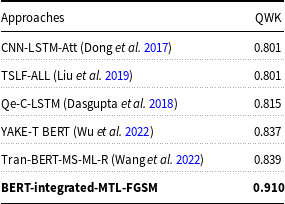
We also compared the results with other well-established baseline models. Scholars have employed neural network approaches to develop AES models, contributing to a rich landscape of approaches in this field. Table 3 demonstrates the QWK scores for the holistic rating scale with BERT-Integrated-MTL-FGSM and other well-established baselines. CNN-LSTM-Att (Dong, Zhang and Yang Reference Dong, Zhang and Yang2017) integrates CNN and LSTM layers with an attention mechanism to specifically address AES tasks, demonstrating the utility of hierarchical network structures. TSLF-ALL (Liu, Xu and Zhu Reference Liu, Xu and Zhu2019) explores a dual-phase learning architecture that capitalizes on the benefits of feature-engineered methods to enhance interpretability and performance. Qe-C-LSTM (Dasgupta et al. Reference Dasgupta, Naskar, Dey and Saha2018) employs a sophisticated deep convolutional recurrent neural network to achieve greater accuracy in essay scoring. YAKE-T BERT (Wu et al. Reference Wu, Henriksson, Nouri, Duneld and Li2022) is fine-tuned exclusively on student essays, eschewing any contextual information from essay prompts to concentrate solely on the evaluation of text. Tran-BERT-MS-ML-R (Wang et al. Reference Wang, Wang, Li and Lin2022) employs two BERT models to derive features at the token, document, and segment levels, utilizing multiple loss functions to score essays effectively.
Comparison of QWK scores at the holistic rating scale with BERT-Integrated-MTL-FGSM and other well-established baselines

Table 3. Long description
The table presents a comparison of Quadratic Weighted Kappa (QWK) scores for different approaches used in automated essay scoring (AES) at the holistic rating scale. It includes six rows and two columns. The columns are labeled ‘Approaches’ and ‘QWK’. The row labels and their corresponding QWK scores are as follows: Row 1: CNN-LSTM-Att (Dong et al. 2017), 0.801. Row 2: TSLF-ALL (Liu et al. 2019), 0.801. Row 3: Qe-C-LSTM (Dasgupta et al. 2018), 0.815. Row 4: YAKE-T BERT (Wu et al. 2022), 0.837. Row 5: Tran-BERT-MS-ML-R (Wang et al. 2022), 0.839. Row 6: BERT-integrated-MTL-FGSM, 0.910. The table highlights the QWK scores achieved by each approach, with BERT-integrated-MTL-FGSM achieving the highest score of 0.910.
Confusion matrices for BERT-Integrated-MTL-FGSM across multi-dimensional writing assessment.

Results revealed that BERT-Integrated-MTL-FGSM achieved a QWK score of 0.910, surpassing the benchmark established by Wang et al. (Reference Wang, Wang, Li and Lin2022) with a QWK score of 0.839. A paired t-test analysis confirmed that BERT-Integrated-MTL-FGSM significantly improved performance compared with the most robust baseline (
 $\textit {p} \lt 0.0010$
). This achievement signifies a noteworthy improvement in holistically predicting essay quality, marking a 7.1% enhancement over the most proficient baseline model. Results also underscore the efficacy of integrating MTL and adversarial training techniques in enhancing the precision and reliability of AES models.
Radar charts for different approaches across multi-scale scoring tasks.

Figure 4. Long description
Four radar charts compare different approaches across multi-scale scoring tasks. Each radar chart has five axes labeled Organization, Ideas, Holistic, Conventions, and Style, with values ranging from 0.0 to 1.0. The charts compare three approaches: BERT, BERT-Simple-MTL, and BERT-Integrated-MTL, each represented by different colored lines. Panel A: The radar chart titled R squared shows the performance of the three approaches across the five axes. Panel B: The radar chart titled QWK shows the performance of the three approaches across the five axes. Panel C: The radar chart titled E shows the performance of the three approaches across the five axes. Panel D: The radar chart titled E+A shows the performance of the three approaches across the five axes. Each panel indicates that BERT-Integrated-MTL generally performs better or similarly compared to the other two approaches across most axes.
4.2 Comparison of effectiveness of multi-task learning in multi-dimensional writing assessment
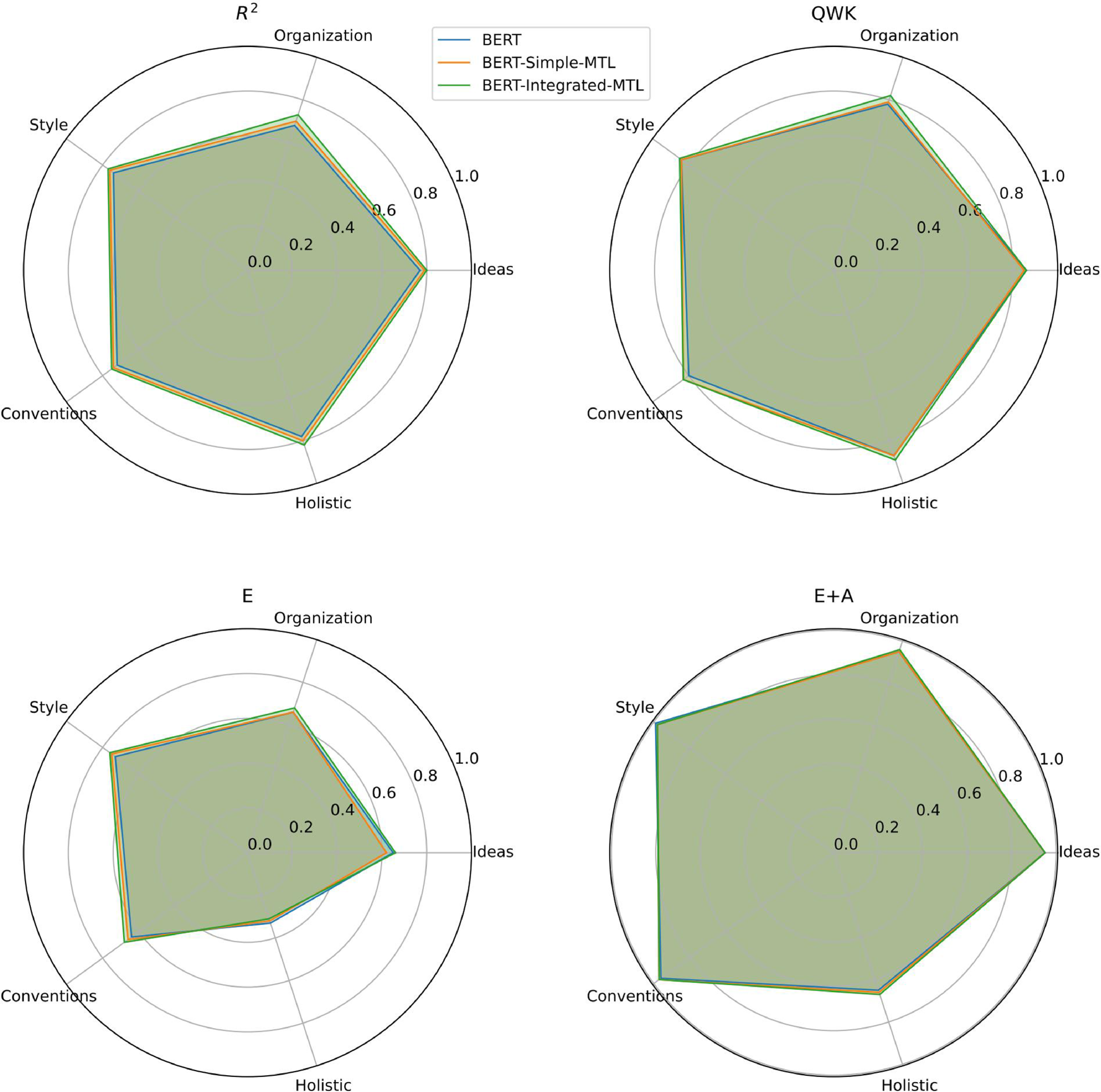
To explore the effectiveness of MTL in multi-dimensional writing assessments, we compare the performance of three different approaches regarding BERT, BERT-Simple-MTL, and BERT-Integrated-MTL. BERT here refers to the specific adaptation of the BERT model for AES tasks, where it is fine-tuned independently for each individual rating scale. To uncover data patterns and correlations, we utilized radar charts to visualize multivariate data, facilitating a comparative analysis of three different BERT model adaptations: BERT, BERT-Simple-MTL, and BERT-Integrated-MTL across various analytic rating scales (see Figure 4).
BERT-Integrated-MTL consistently outperforms BERT and BERT-Simple-MTL across diverse evaluation metrics and rating scales in AES tasks. Specifically, BERT generally displays the smallest area coverage, particularly in the Holistic and Conventions dimensions, which implies reduced reliability and lower concordance with human assessments. The superior performance of BERT-Integrated-MTL can be attributed to its integration of MTL capabilities, which adeptly incorporates various constructs of writing quality into the model’s framework. The enhanced performance is likely due to its capacity to capture complex interdependencies among scoring criteria, thereby improving its generalizability. Moreover, the increased accuracy observed in BERT-Integrated-MTL may stem from its ability to leverage shared representations across multi-scale scoring tasks. These insights highlight the significance of integrating advanced computational techniques in AES systems to more accurately replicate the nuanced judgment of human evaluators, which is crucial for developing more precise and dependable AES models.
4.3 Comparison of effectiveness of adversarial training in AES tasks
The robustness and generalizability of neural network approaches can be markedly improved via adversarial training techniques. In the present study, we utilized FGSM with adversarial examples to introduce perturbations during the training phase of our proposed approach. Experiments were conducted to determine the optimal balance between disturbance and model stability, enhancing the understanding of how adversarial training can fortify AES models against potential vulnerabilities.
Performance of BERT-Integrated-MTL-FGSM across various perturbation sizes at the holistic scale.

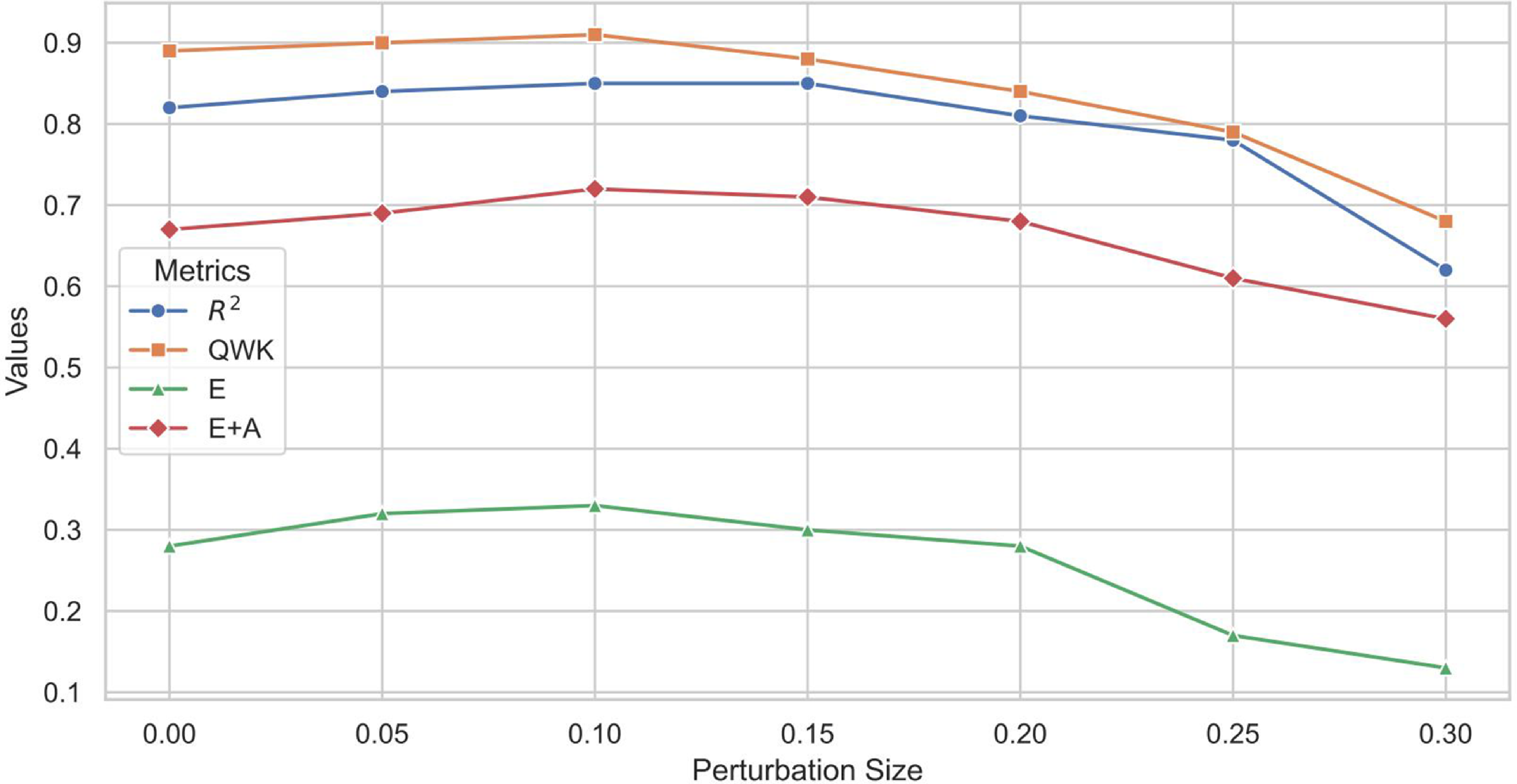
BERT-Integrated-MTL-FGSM underwent adversarial training with the integration of perturbations at varying magnitudes: [0.00, 0.05, 0.10, 0.15, 0.20, 0.25, 0.30]. These magnitudes correspond to the epsilon values
 $\epsilon$
in FGSM, which dictate the step size for generating adversarial examples. Figure 5 indicates the performance of BERT-Integrated-MTL-FGSM across various perturbation sizes at the holistic scale. We can observe the resilience of the model against adversarial examples and its ability to maintain consistency in scoring. This comparative analysis is crucial for identifying the optimal epsilon value that enhances generalization and robustness without compromising the integrity of the model’s predictive accuracy.
As the perturbation size increases from 0.00 to 0.30, a distinct trend is observable in the performance of different evaluation metrics. The marked decline in performance metrics at higher perturbation levels (0.25 and 0.30) underscores the adverse effects of excessive adversarial noise, which can obscure critical features and lead to sub-optimal model predictions. This analysis accentuates the essential equilibrium required in adversarial training, underscoring the necessity to fine-tune perturbation magnitudes to bolster model robustness without undermining performance integrity.
The findings highlight the efficacy of employing a controlled level of adversarial training to augment the robustness of neural networks in AES tasks. A perturbation size of 0.10 is identified as the optimal threshold for enhancing model accuracy and generalization without compromising the integrity of the input data. Our findings, supported by seminal works in the field (Goodfellow et al. Reference Goodfellow, Shlens and Szegedy2014; Tsipras et al. Reference Tsipras, Santurkar, Engstrom, Turner and Madry2018), underscore the dual benefits of adversarial training in enhancing both the robustness and generalization of AES systems and models. However, they also highlight the necessity of precisely calibrating perturbation magnitudes to avoid impairing model performance, a critical factor in developing practical and reliable systems. Adversarial training mitigates overfitting, reduces sensitivity to spurious correlations in the training data, and promotes consistent scoring across varied essay submissions. By equipping models to effectively process adversarial examples, this regularization method helps AES systems maintain reliability and deliver stable performance, even when evaluating atypical responses. Such advancements are vital for upholding the integrity and relevance of AES in diverse educational contexts where the imperatives of fairness and accuracy prevail.
4.4 Ablation study on model components
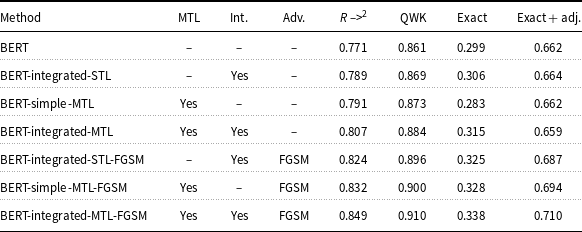
To isolate the individual contribution of each architectural component, we conducted an ablation study comparing BERT-based variants configured with and without MTL, the integrated analytic–holistic constraint, and FGSM adversarial training. Table 4 details the predictive performance on the holistic scoring dimension. The complete BERT-Integrated-MTL-FGSM architecture achieves the strongest overall performance (R
 $^2 = 0.849$
, QWK
 $= 0.910$
, Exact Agreement
 $= 0.338$
, and Exact-Plus-Adjacent Agreement
 $= 0.710$
). Relative to the non-adversarial BERT-Integrated-MTL baseline, the incorporation of FGSM adversarial training yields the most substantial single-component improvement (
 $+0.026$
in QWK and
 $+0.051$
in Exact-Plus-Adjacent Agreement).
Ablation study evaluating model components on the holistic scoring dimension. MTL: multi-task learning; STL: single-task learning; Int.: integrated analytic–holistic constraint; Adv.: FGSM adversarial training

Table 4. Long description
The table presents an ablation study evaluating model components on the holistic scoring dimension. It has 8 rows and 7 columns. The columns are labeled as Method, MTL, Int., Adv., R, QWK, Exact, and Exact + adj. The rows list different BERT-based model variants and their respective performance metrics. Row 1: BERT, 0.771, 0.861, 0.299, 0.662. Row 2: BERT-integrated-STL, Yes, 0.789, 0.869, 0.306, 0.664. Row 3: BERT-simple-MTL, Yes, 0.791, 0.873, 0.283, 0.662. Row 4: BERT-integrated-MTL, Yes, Yes, 0.807, 0.884, 0.315, 0.659. Row 5: BERT-integrated-STL-FGSM, Yes, FGSM, 0.824, 0.896, 0.325, 0.687. Row 6: BERT-simple-MTL-FGSM, Yes, FGSM, 0.832, 0.900, 0.328, 0.694. Row 7: BERT-integrated-MTL-FGSM, Yes, Yes, FGSM, 0.849, 0.910, 0.338, 0.710.
Within the FGSM-augmented configurations, the integrated constraint and the MTL framework further contribute absolute QWK gains of
 $+0.010$
and
 $+0.014$
, respectively. Cumulatively, the full model improves the holistic QWK by
 $0.049$
over the BERT baseline. Note that IG is excluded from this predictive ablation analysis, as it functions strictly as a post-hoc attribution mechanism applied after scoring and therefore does not alter the predictive metrics.
Three key observations from these results warrant discussion. First, unlike the robustness–accuracy trade-off frequently observed in computer vision domains (Tsipras et al. Reference Tsipras, Santurkar, Engstrom, Turner and Madry2018), adversarial training in our context yields concurrent accuracy gains. This aligns with prior evidence suggesting that embedding-space adversarial perturbations function as effective regularizers for continuous text representations (Miyato et al. Reference Miyato, Dai and Goodfellow2016). Second, the empirical gains exhibit a consistently cumulative pattern—wherein each component enhances performance both in isolation and in tandem—thereby substantiating the mutually reinforcing theoretical design articulated in Section 3.5. Third, the consistent advantage of the MTL configurations over single-task variants corroborates existing literature demonstrating that trait-level auxiliary signals strengthen holistic prediction (Cho et al. Reference Cho, Huang and Kwon2024; Kumar et al. Reference Kumar, Mathias, Saha and Bhattacharyya2022).
4.5 Comparison with multi-step adversarial training methods
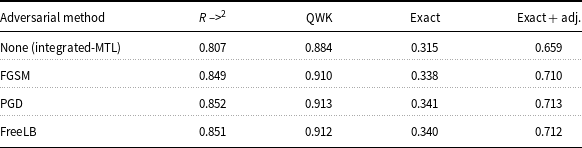
To further justify the adoption of FGSM, we benchmarked it against two more computationally intensive, multi-step adversarial training methods under identical data partitions and experimental configurations: PGD, which iteratively refines the perturbation over three gradient steps (Madry et al. Reference Madry, Makelov, Schmidt, Tsipras and Vladu2017), and FreeLB, which accumulates multi-step latent perturbations while efficiently reusing gradient computations (Zhu et al. Reference Zhu, Cheng, Gan, Sun, Goldstein and Liu2020). As Table 5 reports for the holistic dimension, all three adversarial strategies clearly outperform the non-adversarial BERT-Integrated-MTL baseline (QWK
 $= 0.884$
), corroborating the utility of adversarial regularization. Among them, PGD and FreeLB achieve marginally superior predictive metrics compared to FGSM (QWK of 0.913 and 0.912, respectively, vs. 0.910). However, these fractional gains of at most
 $+0.003$
QWK incur disproportionately high training costs—178.6 minutes for PGD and 151.3 minutes for FreeLB, compared with the 92.8 minutes required by FGSM (see Table 7).
Comparison of adversarial training methods on the holistic scoring dimension. All variants share the same BERT-Integrated-MTL backbone and training configuration

Table 5. Long description
A table comparing adversarial training methods on holistic scoring dimensions. The table has four rows and five columns. The columns are labeled Adversarial method, R squared, QWK, Exact, and Exact plus adj. The rows are labeled None (integrated-MTL), FGSM, PGD, and FreeLB. Row 1: None (integrated-MTL), R squared 0.807, QWK 0.884, Exact 0.315, Exact plus adj. 0.659. Row 2: FGSM, R squared 0.849, QWK 0.910, Exact 0.338, Exact plus adj. 0.710. Row 3: PGD, R squared 0.852, QWK 0.913, Exact 0.341, Exact plus adj. 0.713. Row 4: FreeLB, R squared 0.851, QWK 0.912, Exact 0.340, Exact plus adj. 0.712.
The diminishing returns of multi-step methods observed in this setting align with empirical evidence that single-step adversarial training can approximate the robustness and performance benefits of its multi-step counterparts at a fraction of the computational overhead (Wong et al. Reference Wong, Rice and Kolter2020). While FreeLB has demonstrated notable gains on broad natural language understanding benchmarks (Zhu et al. Reference Zhu, Cheng, Gan, Sun, Goldstein and Liu2020), the inherently bounded and ordinal nature of essay scoring rubrics appears to constrain the available headroom that a more exhaustive exploration of the local adversarial neighborhood could otherwise exploit. Consequently, we position FGSM not as the theoretical upper bound for adversarial defense, but rather as a pragmatic operational compromise, affording a favorable trade-off among scoring accuracy, robustness, and computational tractability—a conclusion consistent with the deployment analysis presented in Section 4.8.
4.6 Formal error and bias analysis
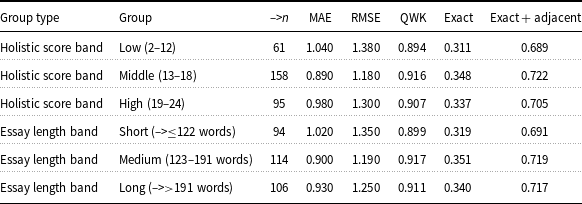
To formalize our robustness evaluation without introducing auxiliary perturbation settings, we retained the original FGSM epsilon analysis and conducted a stratified error analysis on the held-out test set, investigating whether prediction errors disproportionately cluster within specific response groups. Table 6 details the MAE, RMSE, QWK, Exact Agreement, and Exact-Plus-Adjacent Agreement across holistic score bands and essay-length groups. The performance variation across these strata remains marginal. Across score bands, QWK ranges from 0.894 (low-scoring essays) to 0.916 (middle-scoring essays); across length groups, it spans from 0.899 (short essays) to 0.917 (medium-length essays). Furthermore, the absolute-error distribution shows that on the fine-grained 23-point holistic scale, 33.8% of test-set predictions yield exact matches and 71.0% fall within the exact-plus-adjacent range, with only 9.9% deviating by three or more points.
Stratified error analysis of BERT-Integrated-MTL-FGSM on the held-out test set, by holistic score band and essay-length group

Table 6. Long description
The table presents a stratified error analysis of BERT-Integrated-MTL-FGSM on a held-out test set, categorized by holistic score bands and essay length bands. It includes five columns: Group type, Group, n, MAE, RMSE, QWK, Exact, and Exact + adjacent. The Group type column lists the categories, which are Holistic score band and Essay length band. The Group column specifies the range or length. The n column shows the number of essays in each group. The MAE, RMSE, QWK, Exact, and Exact + adjacent columns provide performance metrics for each group. For Holistic score band, the groups are Low (2-12), Middle (13-18), and High (19-24), with n values of 61, 158, and 95 respectively. For Essay length band, the groups are Short (<122 words), Medium (123-191 words), and Long (>191 words), with n values of 94, 114, and 106 respectively. The table details the performance variation across these strata, with QWK ranging from 0.894 to 0.917 and Exact + adjacent agreement ranging from 0.689 to 0.722.
These stratified outcomes contextualize our system within established psychometric findings on human and automated rating behaviors. The concentration of lower error margins within middle-band essays quantitatively corroborates the score-compression phenomenon identified during our qualitative analysis. This effect partially stems from the scarcity of extreme-scoring essays in the training distribution (
 $n=61$
for the low band vs.
 $n=158$
for the middle band). Furthermore, the modest performance differences across length groups speak to the long-standing critique that AES systems inherently reward sheer verbosity. While essay length covaries with human quality judgments themselves (Crossley and McNamara Reference Crossley and McNamara2011), the marginal error disparities among short, medium, and long essays indicate that our model’s predictions are not length-dominated. The slightly elevated error rates for shorter essays align instead with the model’s strict adherence to length-related rubric criteria, echoing prior evidence that machines and humans weight surface lexical features differently (Vögelin et al. Reference Vögelin, Jansen, Keller, Machts and Möller2019).
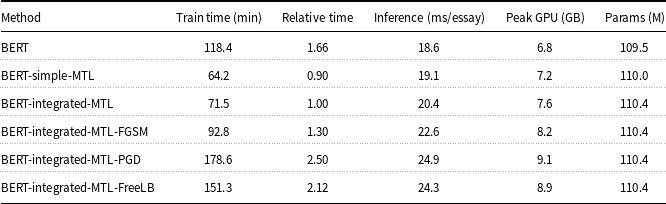
Computational cost of different training strategies. Relative training time is normalized to BERT-Integrated-MTL. Training time is measured on the same hardware and data partition as the main experiments

Table 7. Long description
A table comparing computational costs of different training strategies. The table has six rows and six columns. The columns are labeled Method, Train time (min), Relative time, Inference (ms/essay), Peak GPU (GB), and Params (M). The rows are labeled with different methods: BERT, BERT-simple-MTL, BERT-integrated-MTL, BERT-integrated-MTL-FGSM, BERT-integrated-MTL-PGD, and BERT-integrated-MTL-FreeLB. Each row provides specific values for each method across the different columns. For example, BERT has a train time of 118.4 minutes, a relative time of 1.66, an inference of 18.6 ms/essay, a peak GPU of 6.8 GB, and 109.5 M parameters. The table provides a detailed comparison of the computational costs associated with each training strategy.
Reporting exact and adjacent agreement adheres to standard operational AES evaluation protocols (Attali and Burstein Reference Attali and Burstein2006). Finally, because the ASAP dataset lacks demographic metadata, we deliberately refrain from claims regarding demographic fairness—an evaluation dimension that recent LLM-based AES studies have begun to formalize with dedicated designs (Huang and Wilson Reference Huang and Wilson2025; García-Varela et al. Reference García-Varela, Nussbaum, Mendoza, Martínez-Troncoso and Bekerman2025). Confined to the empirical bounds of our data, these results support the cautious claim that the proposed framework promotes scoring stability across broad response groups.
4.7 Visualization of model predictions via XAI
Recent strides in NLP have been propelled by the robust capabilities of pre-trained language models, enhancing the precision of tasks, including writing assessments. However, a persistent challenge is the opaque nature of these models, which can lead to mistrust among users such as educators and students who depend on transparent and justifiable evaluations in educational contexts. The interpretability of models in AES is essential as it connects highly effective yet opaque models with the necessity for transparent, accountable decision-making processes.
The visualizations depicted in Figure 6 offer a detailed examination of word significance across four key scoring dimensions: Ideas, Organization, Style, and Conventions, each assessed on a scale from 0 to 6. These visual representations provide a valuable window into the model’s operational logic and can inform pedagogical strategies to improve student writing. By highlighting how specific lexical choices influence scores across distinct rating scales, these visualizations can assist educators in tailoring their instructional approaches, directing focus toward areas where students require the most guidance.
Visualizations of word importance across four rating scales (Ideas, Organization, Style, Conventions).

For Ideas, Figure 6a demonstrates that the model predicts with 100% certainty (Prediction Score 1) that the essay deserves a score of 0 (Attribution Score 0), indicating a significant deficiency in thematic development and content richness. Words contributing positively to this metric, such as patience, align closely with the essay’s central argument, enhancing its coherence and depth. Conversely, words receiving negative attribution scores, like theme and all ways, indicate phrases or terms that are peripheral to the main topic. The essay fails to clearly articulate the importance of patience or the contexts in which it is crucial. This lack of clarity is further exacerbated by the absence of concrete examples or detailed discussions, weakening the argument about the necessity and role of patience. The statement not all of us have it exemplifies this vagueness, lacking the specificity needed to engage readers effectively and support the thematic structure.
For Organization, Figure 6b indicates that the model predicts with 98% certainty that the essay should receive a score of 1. The sentences in the sample essay lack coherence and smooth transitions, resulting in a disjointed progression of ideas. For instance, the abrupt shift between the first and second sentences disrupts the logical flow, making it difficult for readers to seamlessly connect the points. Additionally, the essay lacks a distinct central theme or guiding topic sentence, which is crucial for leading the reader through the core argument of the paragraph. The repetitive sentence structure, such as it is hard to … but even harder to …, also contributes to the text’s redundancy, detracting from its overall impact and readability. Moreover, the absence of specific examples or detailed support for the discussion on patience further weakens the essay’s organization. Despite these issues, the text does utilize some transitional phrases like but and even harder, providing a basic organizational framework.
In terms of Style, Figure 6c indicates the model predicts with 94% certainty that the essay should receive a score of 1. The sample essay displays basic word choice and sentence structure but lacks sophistication and variety. The presence of spelling errors and incorrect word usage detracts from the overall effectiveness. The word choice is often incorrect or simplistic, such as using theme instead of it, which detracts from the clarity and precision of the writing. Furthermore, the sentence structure is monotonous and repetitive, with multiple sentences starting with it is, which makes the text feel redundant and lacks variation. Additionally, the text does not utilize rhetorical devices, such as metaphors or contrasts, which could enhance the expression and make the writing more compelling.
In terms of Conventions, Figure 6d indicates that the model predicts with 99% certainty that the essay should receive a score of 2. The visualization suggests that the model is sensitive to the correctness of language usage, with positive attributions corresponding to well-constructed sentences free of errors. The negative scores associated with certain words or phrases may indicate grammatical inconsistencies or typos that students need to address to improve their scores in this dimension. Examining specific instances within the text, sentences like patience not all … and it is hard to … exhibit fundamental errors, such as improper capitalization at the beginning of sentences, which undermines the formal quality of the writing. Additionally, there are notable punctuation mistakes, including the omission of crucial punctuation marks like dashes or commas after patience to properly separate clauses. Furthermore, the misuse of the word theme instead of the more appropriate pronoun it and the incorrect spelling of all ways instead of always are indicative of a lack of precision in word choice. These errors collectively degrade the text’s adherence to the conventions of standard English, impacting its overall readability and professionalism.
By employing AI models that analyze various constructs of writing quality, educators and students can gain precise insights into the strengths and weaknesses of their writing across different dimensions. Research has shown that students may develop at varying rates concerning different constructs of writing quality (Weigle Reference Weigle2002). The visualization of model predictions through XAI provides empirical support to previous findings and facilitates targeted instructions, promoting focused improvements in specific areas such as coherence, word choice, structural complexity, and grammatical accuracy. Moreover, XAI demystifies the evaluation process, providing clear, actionable feedback that students can understand and apply. While previous studies have integrated XAI within AES tasks (Conijn, Kahr and Snijders Reference Conijn, Kahr and Snijders2023; Mizumoto and Eguchi Reference Mizumoto and Eguchi2023), focusing primarily on macro-level writing instruction, the current research extends this application to multi-dimensional writing assessment by addressing the difficulty in discerning the internal mechanisms that explain the decision-making processes of these models (Von Eschenbach Reference Von Eschenbach2021).
We emphasize that these attribution maps constitute local explanations: each map accounts for a single prediction on a specific essay, and recurring patterns across essays—however suggestive—do not equate to global decision rules. Accordingly, the visualizations should be interpreted as instance-level diagnostic evidence rather than a comprehensive account of the model’s overall scoring policy. Quantitatively assessing the faithfulness and stability of such attributions at the corpus level remains an important direction for future research.
4.8 Computational cost and deployment efficiency
To assess the practical viability of the proposed framework, we evaluated the computational overhead of each training strategy, measuring parameter count, training duration, inference latency, and peak GPU memory consumption. As detailed in Table 7, the BERT-Integrated-MTL-FGSM configuration comprises 110.4M parameters, requires 92.8 minutes for training, allocates 8.2 GB of peak GPU memory, and achieves an inference latency of 22.6 ms per essay. While the introduction of FGSM adversarial training increases the offline training duration from 71.5 to 92.8 minutes compared to the base BERT-Integrated-MTL, the inference latency remains highly conducive to batch deployment in AES pipelines. Although PGD and FreeLB yield marginally superior QWK scores, they incur substantially higher training costs (178.6 and 151.3 minutes, respectively). Consequently, FGSM strikes a more favorable balance among scoring accuracy, model robustness, and computational efficiency.
These results directly address the prevailing concern that the performance improvements associated with fine-tuning BERT models incur prohibitive computational costs (Mayfield and Black Reference Mayfield and Black2020). Within our multi-dimensional scoring paradigm, the integrated MTL architecture effectively reduces the total training overhead compared to independently fine-tuning five dimension-specific BERT models (71.5 vs. 118.4 minutes), as the tasks leverage a shared encoder representation. Furthermore, the relative computational demands of the evaluated adversarial strategies align with prior findings indicating that single-step methods can approximate the robustness gains of multi-step adversarial training while requiring only a fraction of the computational budget (Wong et al. Reference Wong, Rice and Kolter2020). Finally, given its compact parameter footprint (approximately 110M) and millisecond-level inference latency, our framework proves substantially more economical than the prompt-based LLM approaches discussed in Section 2.4, supporting its suitability for large-scale, real-time AES applications.
4.9 Conceptual implications for writing assessment
Beyond system architecture and empirical performance gains, our findings carry broader theoretical implications for the domain of writing assessment. First, the effectiveness of the summative constraint—which derives the holistic score as the cumulative sum of the four analytic dimensions—provides empirical backing for a compositional view of writing quality. As detailed in Table 4, imposing this constraint elevates the holistic QWK from 0.861 (dimension-specific fine-tuning) and 0.873 (simple MTL) to 0.884, peaking at 0.910 when further combined with adversarial training, with consistent advantages across all five evaluated scales (Table 2). Although prior joint-modeling studies established that trait-level signals benefit holistic prediction (Cho et al. Reference Cho, Huang and Kwon2024; Kumar et al. Reference Kumar, Mathias, Saha and Bhattacharyya2022; Wang et al. Reference Wang, Wang, Li and Lin2022), our results indicate that the relation can be strengthened into an explicit additive structure, echoing structural analyses of writing scores in the psychometric literature (Schoonen Reference Schoonen2005). The long-debated relationship between holistic and analytic scoring (Weigle Reference Weigle2002; Wind Reference Wind2020) can thus be effectively approximated by an additive model, at least within this specific genre and rubric, suggesting that overall quality judgments can be largely reconstructed from trait-level evaluations.
Second, the observed robustness improvements can be interpreted through the lens of psychometric validity theory. If a scoring function fluctuates appreciably under construct-irrelevant surface perturbations, the resulting score variance constitutes psychometric noise rather than valid measurement—a concern central to the validation of automated text evaluation tools (Keller-Margulis, Mercer and Matta Reference Keller-Margulis, Mercer and Matta2021). Adversarial robustness training, therefore, operationalizes a key facet of construct validity—namely, insensitivity to construct-irrelevant variance—by formally embedding it as an explicit optimization objective. Empirically, this alignment is corroborated both by the system’s resilience in the perturbation analysis (Figure 5) and by its stratified scoring stability: as reported in Section 4.6 (Table 6), the trained model’s QWK varies only between 0.894 and 0.917 across holistic score bands and essay-length groups.
Third, the interpretability analysis illustrates that IG attributions align with rubric-consistent lexical evidence (Figure 6). This suggests that the model’s internal decision criteria partially recover the evaluative constructs formally defined within the human rubric, offering a data-driven window into how specific textual features accrue evaluative weight across distinct scoring dimensions. Such instance-level transparency is pedagogically consequential: recent evidence shows that the presence and quality of explanations in AES systems shape student trust and motivation (Conijn et al. Reference Conijn, Kahr and Snijders2023), underscoring the practical value of attribution-based feedback beyond its technical role.
Taken together, these findings suggest that integrated neural scoring architectures are not merely predictive instruments; they can also serve as empirical probes for investigating the underlying structure, validity, and interpretability of writing assessment itself.
5. Conclusion
Advancements in corpus linguistics, NLP, and deep learning technologies have yielded profound insights into AES tasks. Neural network approaches, in particular, have demonstrated exceptional potential by obviating the necessity for extensive handcrafted feature engineering. Despite these technological strides, the potential of pre-trained language models and multi-task transfer learning for constructing multi-dimensional AES models remains largely untapped. Additionally, enhancing the robustness of AES models against subtle input perturbations that result in prediction errors continues to be a formidable challenge. The intricate mechanisms within deep learning frameworks remain insufficiently understood, a gap that is critically important for the advancement of multi-dimensional writing assessment and instructional strategies.
The advent of MTL has enabled neural network approaches to significantly boost performance by leveraging the pre-trained language model BERT and transferring the acquired knowledge to analogous or related tasks. Moreover, the integration of adversarial training via FGSM not only sustains high accuracy and scoring stability in multi-dimensional AES tasks but also enhances the robustness and reliability of AES applications across diverse adversarial scenarios. Furthermore, by integrating gradient-based attribution via IG, the present study advances the generalizability, robustness, and interpretability of multi-dimensional AES models. This integration partially illuminates the evaluative mechanisms within the deep learning black box, offering potentially diagnostic and tailored feedback that students can readily comprehend and utilize.
Acknowledgements
This article is sponsored by Ministry of Education in China Project of Humanities and Social Sciences (No. 23YJCZH197).
Competing interests
The authors declare no competing interests.



 Open access

