Introduction
Infertility, defined as a failure to conceive after a year of regular unprotected intercourse, affects 8–16% of reproductive-aged couples (Stephen & Chandra, Reference Stephen and Chandra2006). Depending on the cause of infertility and patient characteristics, management options range from pharmacologic treatment to more advanced techniques, referred to as assisted reproductive technologies (ART). Over the past 2 decades, the use of ART has increased dramatically worldwide and has made pregnancy possible for many infertile couples.
An initial step in ART is controlled ovarian stimulation (COS), which allows the traditional practice of replacing more than one embryo at a time within the uterus to maximise pregnancy rates. In fact, ART has been associated with a 30-fold increase in multiple pregnancies, compared with the rate of spontaneous twin pregnancies (ACOG, 2005).
Multiple pregnancies are associated with a broad range of negative consequences for both the mother and the fetuses. Maternal complications include increased risks of pregnancy-induced hypertension, pre-eclampsia, polyhydramnios, gestational diabetes, fetal malpresentation requiring Caesarean section, postpartum haemorrhage, and postpartum depression. Babies from multiple pregnancies are at significantly higher risks of early death, prematurity, and low birth weight, as well as mental and physical disabilities related to prematurity (Ontario Reference Ontario2006).
Increased pregnancy rates, which have been associated with recent advances in ART, coupled with concerns about maternal and perinatal morbidity related to multiple pregnancies have led to attempts to restrict the number of embryos transferred (Maheshwari et al., Reference Maheshwari, Griffiths and Bhattacharya2011). Indeed, the necessity to decrease assisted-reproduction-induced iatrogenic multiple pregnancies has become a health, economic, and legal issue in several countries (Adashi et al., Reference Adashi, Barri, Berkowitz, Braude, Bryan and Carr2003).
The most effective approach to minimise the risk of multiple pregnancies is single-embryo transfer (SET) of either the cleavage or blastocyst-stage embryos. There are concerns, however, that replacing only one embryo can reduce success rates, especially when cleavage-stage embryos are transferred.
A recently published systematic review concluded that in a single fresh in vitro fertilization (IVF) cycle, SET is associated with a lower live birth rate than double embryo transfer. However, no evidence was found of a difference in the cumulative live birth rate when a single cycle of double embryo transfer is compared with repeated SET (Pandian et al., Reference Pandian, Marjoribanks, Ozturk, Serour and Bhattacharya2013).
The acceptance of SET depends on access to financial support for multiple cycles of ART. Increased availability of insurance coverage is associated with fewer embryos per transfer and a lower multiple pregnancy rate (Reynolds et al., Reference Reynolds, Schieve, Jeng and Peterson2003; Stillman et al., Reference Stillman, Richter, Banks and Graham2009). However, the availability of funding for ART is variable, with some countries enjoying public sector support whereas others relying on patients to pay for treatment, either directly or indirectly through expensive private insurance schemes.
Aside from the financial support the embryo developmental competence is an important factor impacting the SET program implementation. Despite considerable improvements, IVF therapy remains highly inefficient. Many retrieved oocytes do not fertilize properly and many embryos resulting from normally fertilized oocytes fail to develop to the blastocyst stage and most embryos that are transferred do not implant (Ola & Li, Reference Ola and Li2006). However, once the blastocyst stage is achieved, the blastocyst-stage SET apparently lead to a similar pregnancy rate when compared with double-embryo transfer (Criniti et al., Reference Criniti, Thyer, Chow, Lin, Klein and Soules2005; Styer et al., Reference Styer, Wright, Wolkovich, Veiga and Toth2008).
Together with the embryo quality, the maternal age and number of previous attempts play a role in the decision of the number of embryos to be transferred. Therefore, the goal of the present study was to determine the chance of pregnancy and the risk of multiple pregnancies by taking into account the number and quality of transferred embryos in patients >36 years old or ≤36 years old.
Materials and methods
Study design
This retrospective observational study enrolled 1497 patients who were undergoing intra-cytoplasmic sperm injection (ICSI) cycles between January 2011 and December 2012. The cycles were split into groups according to the number and quality of the transferred embryos on the third day or fifth day of development: (1) the high-quality group, in which one or two high-quality embryos were transferred; and (2) the high-and low-quality group, in which one high-quality and one low-quality or two high-quality and one low-quality embryos were transferred. The cycles were also divided according to age (<36 years old or ≥36 years old), and the pregnancy rate and multiple pregnancy rate were compared between the embryo quality groups in the two patient age sets. All cases of severe spermatogenic alteration, including frozen and surgically retrieved sperm, were excluded from the study.
A written informed consent was obtained in which patients agreed to share the outcomes of their own cycles for research purposes, and the study was approved by the local institutional review board.
Controlled ovarian stimulation and laboratory procedures
Controlled ovarian stimulation was achieved by pituitary blockage using a gonadotropin-releasing hormone (GnRH) antagonist (Cetrotide, Serono, Geneva, Switzerland), and ovarian stimulation was performed using recombinant follicle stimulating hormone (FSH) (Gonal-F; Serono, Geneva, Switzerland).
Follicular growth was followed by a transvaginal ultrasound examination that started on day 4 of the gonadotropin administration. When adequate follicular growth and serum estradiol (E2) levels were observed, recombinant human chorionic gonadotrophin (hCG; Ovidrel; Serono, Geneva, Switzerland) was administered to trigger the final follicular maturation. Oocytes were collected 35 h after hCG administration by transvaginal ultrasound ovum pick-up.
Oocyte preparation
Retrieved oocytes were maintained in culture medium (Global® for fertilization, LifeGlobal, Connecticut, USA) supplemented with 10% protein supplement (LGPS, LifeGlobal, Connecticut, USA) and covered with paraffin oil (Paraffin oil P.G., LifeGlobal, Connecticut, USA) for 2–3 h before cumulus cell removal. Surrounding cumulus cells were removed after exposure to a HEPES-buffered medium containing hyaluronidase (80 IU/ml, LifeGlobal, Connecticut, USA). The remaining cumulus cells were then removed mechanically by gently pipetting with a hand-drawn Pasteur pipette (Humagen Fertility Diagnostics, Charlottesville, USA).
Oocyte morphology was assessed using an inverted Nikon Diaphot microscope (Eclipse TE 300; Nikon®, Tokyo, Japan) with a Hoffmann modulation contrast system under ×400 magnification, just before sperm injection (3–4 h after retrieval). Oocytes that were observed to have released the first polar body were considered to be mature and were used for ICSI.
Semen sample collection and preparation
All semen samples were collected by masturbation after ejaculatory abstinence. After liquefaction for 30 min at room temperature, the semen samples were evaluated regarding ejaculate volume, colour, pH, sperm count, sperm motility and sperm morphology (WHO, 2010).
A two-layered density gradient centrifugation technique, performed according to the manufacturer's instructions, was used for the sperm preparation (90% isolate and 50% isolate, Irvine Scientific, Santa Ana, CA, USA). Sperm count and motility were analysed in the recovered fractions.
Intra-cytoplasmic sperm injection
Intra-cytoplasmic sperm injection was performed according to Palermo et al. (Reference Palermo, Joris, Devroey and Van Steirteghem1992), in micro-injection dish, prepared with 4 μl droplets of buffered medium (Global® w/HEPES, LifeGlobal, Connecticut, USA), and covered with paraffin oil on a heated stage at 37.0 ± 0.5°C of an inverted microscope. The spermatozoa were selected for ICSI under ×400 magnification.
Embryo morphology evaluation
Embryo morphology was assessed at 16–18 h post-ICSI and on the mornings of days 2, 3 and 5 of embryo development using an inverted Nikon Diaphot microscope (Eclipse TE 300; Nikon, Tokyo, Japan) with a Hoffmann modulation contrast system under ×400 magnification.
For the cleavage-stage morphology, the following parameters were recorded: the number of blastomeres, the percentage of fragmentation, the variation in blastomere symmetry, and the presence of multinucleation and defects in the zona pellucida and cytoplasm. High-quality cleavage-stage embryos were defined as those having all of the following characteristics: 4 cells on day 2 or 8−10 cells on day 3; <15% fragmentation; symmetric blastomeres; absence of multinucleation; colourless cytoplasm with moderate granulation and no inclusions; absence of perivitelline space granularity; and absence of zona pellucida dysmorphism. Embryos lacking any of the above characteristics were considered to be of low quality.
The blastocysts are graded according to Gardner and Schoolcraft (Reference Gardner, Schoolcraft, Jansen and Carnforth1999) (a modified system). The following characteristics were recorded: the size and compactness of the inner cell mass (ICM) and the cohesiveness and number of trophectoderm (TE) cells. Briefly, embryos were given a numerical score from one to six on the basis of their degree of expansion and hatching status, as follows: 1, an early blastocyst with blastocoels that occupy less than half the volume of the embryos; 2, a blastocyst with a blastocoel that is greater than half the volume of the embryo; 3, a full blastocyst with a blastocoels completely filling the embryo; 4, an expanded blastocyst; 5, hatching blastocyst; or 6, a hatched blastocyst. For full blastocysts onward, the ICM was classified as follows: high-quality, tightly packed with many cells; or low-quality, loosely grouped with several cells or with few cells. The TE was classified as follows: high-quality, many cells forming a cohesive epithelium; or low-quality, few cells forming a loose epithelium or very few cells.
Statistical analyses
The pregnancy and multiple pregnancy rates were compared between the groups of patients in which exclusively high-quality or high-and-low-quality embryos were transferred for patients >36 years old or ≤36 years old. Data expressed as percentages were compared using the chi-squared or Fisher's exact test only when the expected frequency was five or fewer.
When a significant difference was found between the groups, binary regression models were also performed to evaluate the influence of transferring an additional low-quality embryo on the chance of pregnancy or multiple pregnancy risk. The results of the logistic regression were presented as the odds ratio (OR), P-value, and 95% confidence interval (CI).
Results were considered to be significant at the 5% critical level (P < 0.05). Data analysis was carried out using the Minitab (version 14) Statistical Program.
Results
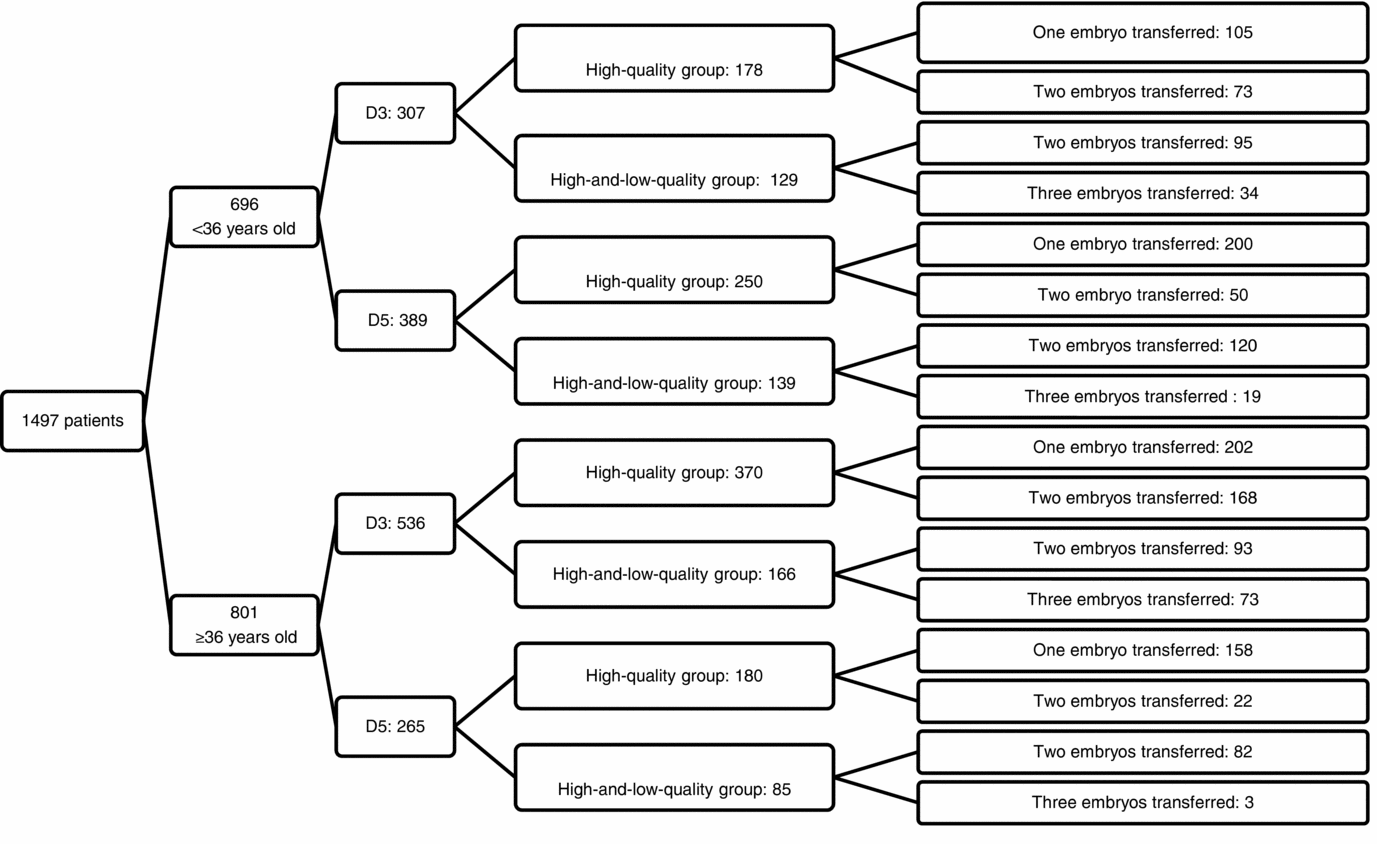
Of 1497 patients, 696 were <36 years old, out of which 428 had exclusively high-quality embryos transferred (the high-quality group) and 268 had an extra low-quality embryo transferred (the high-and-low-quality group). Overall, 801 patients were ≥36 years old, out of which 550 had exclusively high-quality embryos transferred and 251 had an extra low-quality embryo transferred.
The distributions of patients into experimental groups and the number of transferred embryos in each group are described in Fig. 1.
Distributions of patients into experimental groups and the number of transferred embryos.

Patients <36 years old
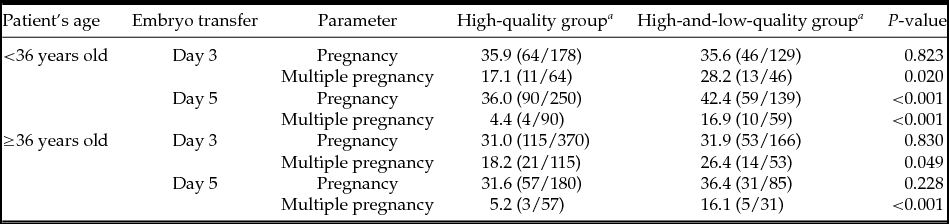
In patients who were <36 years old, when embryo transfer was performed on the third day of development, no significant difference was noted in the pregnancy rate when the groups were compared (35.9 versus 35.6% for the high-quality groups and the high-and-low-quality groups, respectively, P = 0.823, Table 1). However, the multiple pregnancy rate was increased by the transfer of an extra low-quality embryo (17.1 versus 28.2% for the high-quality and high-and-low-quality groups, respectively, P = 0.020, Table 1). This finding was confirmed using a binary logistic regression, which showed that the transfer of an extra low-quality embryo was a determinant of the multiple pregnancy chance (OR = 1.53; CI 95% = 1.31–2.03; P = 0.020).
Comparison of pregnancy and multiple pregnancy rates when only high-quality embryos or a high-quality and an extra low-quality embryo were transferred on days 3 or 5 of development for patients <36 years old or ≥36 years old
aValues are percentage (number/total).
When embryo transfer was performed on the fifth day of development, the transfer of an extra blastocyst significantly increased the pregnancy rate (36.0 versus 42.4% for the high-quality and high-and-low-quality groups, respectively, P < 0.001, Table 1). The logistic regression confirmed this finding, demonstrating that an extra blastocyst transfer is determinant of the pregnancy chance (OR = 1.50; CI 95% = 1.12–2.01; P < 0.001).
The multiple pregnancy rates also differed among the groups (4.4 versus 16.9% for the high-quality and high-and-low-quality groups, respectively, P < 0.001, Table 1). This result was also confirmed by the logistic regression model, which demonstrated a more than two-fold increase in the multiple pregnancy risk when an extra low-quality blastocyst was transferred (OR = 2.37; CI 95% = 1.40–4.02; P < 0.001).
Patients ≥36 years old
In older patients, when the embryo transfer was performed on the third day of development, no significant difference was noted in the pregnancy rates when the groups were compared (31.0 versus 31.9% for the high-quality and high-and-low-quality groups, respectively, P = 0.830, Table 1), However, when an extra low-quality embryo was transferred, a significantly increased rate of multiple pregnancies was observed (18.2 versus 26.4% for the high-quality and high-and-low-quality groups, respectively, P = 0.049, Table 1). This finding was confirmed using a binary logistic regression, showing that the transfer of an extra low-quality embryo was a determinant of the multiple pregnancy risk (OR = 1.58; CI 95% = 1.34–2.01; P = 0.044).
When embryo transfer was performed on the fifth day of development, no significant difference in the pregnancy rate was found based on whether exclusively high-quality blastocysts were transferred or one extra low-quality blastocyst was transferred (31.6 versus 36.4% for the high-quality and high-and-low-quality groups, respectively, P = 0.228). However, the multiple pregnancy rate was significantly increased by an extra low-quality blastocyst transfer (5.2 versus 16.1% for the high-quality and high-and-low-quality groups, respectively, P < 0.001). This result was also confirmed by the logistic regression model, which demonstrated a three-fold increase in the multiple pregnancy risk when an extra low-quality blastocyst was transferred (OR = 3.12; CI 95% = 1.63–5.99; P < 0.001).
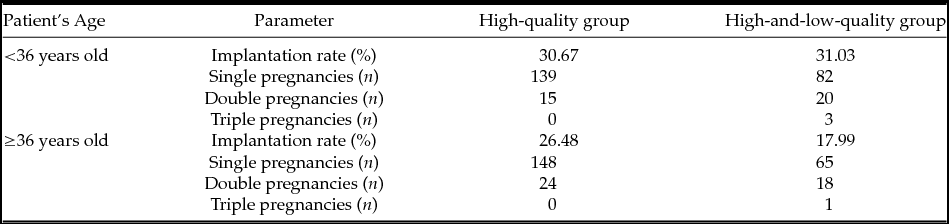
The description of implantation rates and numbers of single, double or triple pregnancies when only high-quality embryos or a high-quality and an extra low-quality embryo were transferred for patients <36 years old or ≥36 years old are described in Table 2.
Description of implantation rates and numbers of single, double or triple pregnancies when only high-quality embryos or a high-quality and an extra low-quality embryo were transferred for patients <36 years old or ≥36 years old
Discussion
Although most professional societies have issued guidelines to decrease the number of embryos to be transferred during assisted reproduction techniques, the incidence of multiple pregnancies remains unacceptably high (Pennings, Reference Pennings2000).Therefore, there is a clear trend towards reducing the proportion of multiple pregnancies when possible. Currently, the best available strategy for preventing multiple births is to limit the number of transferred embryos.
In fact, as suggested by Olivennes & Frydman (Reference Olivennes and Frydman1998), reducing the number of transferred embryos will also promote less intense stimulation protocols: a more ‘friendly IVF’. However, the poor implantation rate of IVF-produced embryos encourages multiple embryo transfer to increase pregnancy rates.
Elective SET with the promise of the subsequent transfer of frozen–thawed embryos would achieve the goal of a single healthy child as a result of IVF treatment (Olivennes Reference Olivennes2000). However, the success of the elective SET depends on the patient's age and the quality of the transferred embryo.
The present study evaluated the chance of pregnancy and the risk of multiple pregnancies, taking into account the number and quality of transferred embryos in two patient age sets (>36 years old or ≤36 years old). Our results demonstrated that for cleavage-stage embryo transfers, the pregnancy rate is the same if an extra low-quality embryo is transferred, compared with cycles in which exclusively one or two high-quality embryos are transferred for both patient age groups. The risk of multiple pregnancies, however, is significantly higher with an extra low-quality embryo transfer.
For blastocyst embryo transfer, the risk of multiple pregnancies is more than two-fold higher when an extra low-quality blastocyst is transferred for both patient age groups. However, in younger patients, the chance of pregnancy is also increased by an extra low-quality blastocyst transfer. In contrast, in older patients, the pregnancy rate is not increased by the transfer of an extra low-quality blastocyst.
Our findings demonstrated that the transfer of an extra low-quality embryo may not favour older patients either when cleavage-stage or blastocyst-stage embryos are transferred. In these patients, not only is the chance of pregnancy not increased but the rate of multiple pregnancies is also higher. This result suggests that the implantation potential may not considerably vary among embryos of the same cohort; in other words, when a high-quality embryo does not implant, the implantation chance of a low-quality embryo from the same cohort is low. However, when a high-quality embryo is able to implant, the implantation chance of another embryo of the same cohort may be higher.
It has been demonstrated that there is a decline not only in the oocyte quantity but also in the oocyte quality in older women (te Velde & Pearson, Reference te Velde and Pearson2002). In fact, older women present a reduction in follicular diameter compared with younger women, suggesting that larger follicles are generally recruited in the beginning of reproductive life; as women get older, the remaining follicles show a decrease not only in diameter but also in quality (Westergaard et al., Reference Westergaard, Byskov and Andersen2007).
In younger patients, the transfer of an extra blastocyst, even if it is a low-quality blastocyst, is able to increase the pregnancy rate. Extended embryo culture and the subsequent transfer of blastocyst-stage embryos are associated with increased implantation rates (Blake et al., Reference Blake, Farquhar, Johnson and Proctor2007; Papanikolaou et al., Reference Papanikolaou, Kolibianakis, Tournaye, Venetis, Fatemi, Tarlatzis and Devroey2008). Prolonging the culture period allows for a better selection of embryos with a higher implantation potential and a better synchronisation between the endometrium and the embryo. However, although the pregnancy rate is increased, the risk of multiple pregnancies is also significantly higher when an extra embryo is transferred.
The decision about the number of embryos to be transferred lies with the physician and the patient. Although there currently appears to be sufficient evidence in the literature to suggest that elective SET may eliminate multiple pregnancies without compromising the cumulative live birth rate per couple, many clinicians are reluctant to adopt SET. Reports of low pregnancy rates when only one embryo is transferred (Ludwig et al., Reference Ludwig, Schopper, Katalinic, Sturm, Al-Hasani and Diedrich2000) are responsible for the feeling of negativity regarding SETs. However, systematic reviews have concluded that while SET is associated with lower live birth rate than double-embryo transfer in fresh cycles, the cumulative live birth rates from fresh and frozen SET cycles are similar to those in patients who are undergoing fresh double-embryo transfer (Pandian et al., Reference Pandian, Bhattacharya, Ozturk, Serour and Templeton2009; Gelbaya et al., Reference Gelbaya, Tsoumpou and Nardo2010; McLernon et al., Reference McLernon, Harrild, Bergh, Davies, de Neubourg and Dumoulin2010).
Embryo quality is considered a major predictor of implantation and pregnancy. The ability to make the best choice has become pivotal with the growing implementation of SETs. Van den Abbeel et al. (Reference Van den Abbeel, Balaban, Ziebe, Lundin, Cuesta, Klein, Helmgaard and Arce2013) described that degree of expansion and hatching status should be considered first among the three morphology parameters (degree of expansion and hatching status, ICM grade, and TE grade) when selecting a blastocyst for transfer, as this parameter has the highest predictive value of live birth. For Hill et al. (Reference Hill, Richter, Heitmann, Graham, Tucker, DeCherney, Browne and Levens2013) the TE grading, but not ICM grading, predicts implantation and live birth for single-blastocyst transfers.
Many potential parents may actually desire multiple pregnancies. In a previously published survey, only half the total number of couples had any objection to triplets and 20% deemed quadruplets acceptable (Gleicher et al., Reference Gleicher, Campbell, Chan, Karande, Rao, Balin and Pratt1995). However, whether these couples are aware of the complications of multiple gestations is a matter of debate.
In a previous report by our group that investigated ART professionals’ attitudes towards their own IVF cycles, we showed that the transfer of a higher number of embryos and the associated multiple pregnancy risks were seen as acceptable, illustrating that when faced with infertility and ART, ART professionals have similar attitudes and perceptions to those of the infertile community. This finding suggests that the emotional aspects of the desire for a child and of the decision-making process related to ART have more influence over individuals than the intellectual knowledge about the risks and benefits of ART techniques (Bonetti et al., Reference Bonetti, Melamed, Braga, Madaschi, Iaconelli, Pasqualotto and Borges2008).
In conclusion, our results demonstrated that the transfer of an extra low-quality embryo may significantly increase the risk of a multiple pregnancy. In younger patients, the transfer of an extra low-quality blastocyst may also increase the chance of pregnancy; however, our findings raise the question of whether is it worth trying to increase the pregnancy rate to the detriment of a single pregnancy.
Declaration of interest
There are no conflicts of interest.