


1. Introduction
This article has two sides. On one hand side there is the sad duty to provide a final and conclusive overview over Sverre Aarseth’s “Nbody industry”, on the other hand side there is the good news that his legacy continues to grow, the industry is alive. Here I want to present a personal and selective view about Sverre’s work and life, some scientific achievements, and how I think the legacy continues at the current time and will continue into the future. The article concludes with a scientific summary of the current features of Nbody6++GPU (and to a lesser extent Nbody7, but see Banerjee, this volume), its performance and some exemplary science results. Also competing codes for direct and accurate Nbody simulations, which have been rare in the past decades, will be briefly quoted.
2. Nbody – the beginning
Sebastian von Hoerner found in his early published N-body simulations that the relaxation time (Chandrasekhar Reference Chandrasekhar1942) is relevant for star cluster evolution and that the formation of close and eccentric binaries occurs. It is particularly difficult to accurately integrate them, the simulation would practically stop, since close binaries demand too tiny time-steps (von Hoerner Reference von Hoerner1960; von Hoerner Reference von Hoerner1963).
About at the same time a young postdoc – Sverre Aarseth – in Cambridge developed a direct N-body integrator to simulate clusters of galaxies using a gravitational softening, thereby avoiding von Hoerner’s problems with tight binaries and singularities (Aarseth Reference Aarseth1963). Regularization methods (Kustaanheimo and Stiefel Reference Kustaanheimo and Stiefel1965) were later implemented in Aarseth’s direct N-body code (Aarseth Reference Aarseth1971). This allowed to proceed past the binary deadlock detected in von Hoerner’s models (see Sect. 3.4 below). Remarkably von Hoerner and Aarseth never met until their only meeting during the star2000 conference in Heidelberg (Deiters et al. Reference Deiters, Fuchs, Just, Spurzem and Wielen2001). During that meeting they could for the first time compare their codes, and von Hoerner published a remarkable account on “how it all started” (von Hoerner Reference von Hoerner2001).
Nbody5 (Aarseth Reference Aarseth, Brackbill and Cohen1985) had already become an “industry standard”. It used Taylor series using up to the third derivative of the gravitational force, in a divided difference scheme based on four time points, with individual particle time-steps (different from the current Hermite scheme, see below Sect. 3.1). Regularizations for more than two bodies used the classical chain regularization (Mikkola and Aarseth Reference Mikkola and Aarseth1990).
Stellar evolution is a very successful ingredient to all Nbody code versions, pushed forward from early on by Jarrod Hurley, Chris Tout, and collaborators (cf. e.g. Hurley et al. Reference Hurley, Pols and Tout2000, Reference Hurley, Tout, Aarseth and Pols2001, Reference Hurley, Tout and Pols2002, Reference Hurley, Pols, Aarseth and Tout2005, see also Hurley, this volume, and Fig. 1). While a historical account and the current state of the art is summarized here by Hurley (this volume), further details and new developments on massive stars, winds, and relativistic binaries can be found inside articles in Aarseth et al. (Reference Aarseth, Tout and Mardling2008); Aarseth (Reference Aarseth2003) and in the recent review of Spurzem and Kamlah (Reference Spurzem and Kamlah2023).
Sverre Aarseth (right) and Chris Tout (left), with visitor Emmanuil Vilkoviski of Fesenkov observatory in Almaty, Kazakhstan; in mid 90’s.

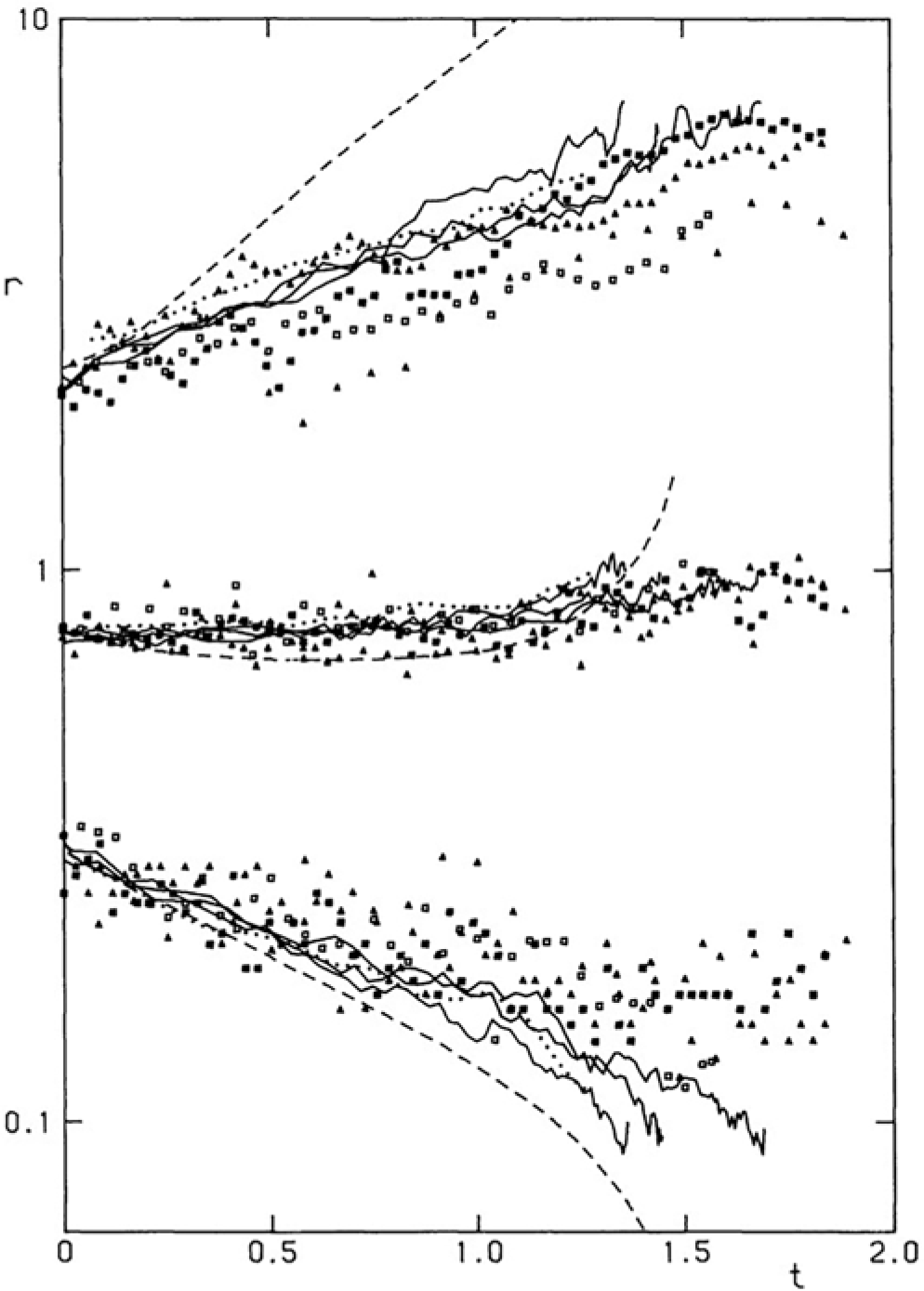
Another line of research, through which the author of this article got the initial opportunity to collaborate with Sverre, started with a fluid dynamical model of star clusters, which was developed with my then supervisor Erich Bettwieser (Bettwieser and Spurzem Reference Bettwieser and Spurzem1986; Louis and Spurzem Reference Louis and Spurzem1991). The model was based on earlier ideas by Larson (Reference Larson1970a, b), and it led to the detection of gravothermal oscillations (Sugimoto and Bettwieser Reference Sugimoto and Bettwieser1983; Bettwieser and Sugimoto Reference Bettwieser and Sugimoto1984). There was doubt about the validity of such models for star cluster evolution, a collaboration with Sverre started to verify the models against direct Nbody simulations. Sverre had already published a pioneering paper about comparison between Nbody, Monte Carlo, and fluid dynamical models (Aarseth et al. Reference Aarseth, Henon and Wielen1974); in that comparison though the fluid dynamical models did not give a very good agreement with Nbody (cf. Fig. 2). Further work by Spurzem and Aarseth (Reference Spurzem and Aarseth1996); Giersz and Heggie (Reference Giersz and Heggie1994a, b); Giersz and Spurzem (Reference Giersz and Spurzem1994); Giersz and Heggie (Reference Giersz and Heggie1996) established a very good agreement between predictions of statistical physics and direct Nbody simulations. Makino (Reference Makino1996) could find gravothermal oscillations in Nbody using GRAPE.
Radii containing 10%, 50%, 90% of the mass, plotted versus time for a cluster with stars of equal masses. Open triangles and squares: Nbody integration with
 $N=100$
and
 $N=250$
(Wielen). Filled triangles and squares: Nbody Integration with
 $N=250$
(Aarseth). Full lines: Monte Carlo models (Hénon1971). Dotted lines: Monte Carlo model (Shull and Spitzer). Dashed lines: fluid-dynamical model (Larson). From: Aarseth et al. (Reference Aarseth, Henon and Wielen1974); for citations and further discussion see that paper.

3. Nbody – the growth
3.1. Hermite Scheme
The Hermite scheme and hierarchically blocked time-steps (Hut and McMillan Reference Hut and McMillan1986; Makino and Aarseth Reference Makino and Aarseth1992) improved the performance on vector and parallel computers and turned out to be efficient for all of recent parallel and innovative hardware (general and special purpose parallel computers, GRAPE and GPU, see Sect. 3.5 below). The Hermite scheme uses the analytic Nbody expression for the Newtonian gravitational acceleration
 $\vec{a}_0$
and its time derivative
 $\vec{{\dot a}}_0$
at some time
 $t_0$
, to extrapolate low-order predicted positions
 $\vec{x}_p$
and velocities
 $\vec{v}_p$
at the next time step
 $t\gt t_0$
. Then again gravitational acceleration
 $\vec{a}_1$
and its time derivative
 $\vec{{\dot a}}_1$
at t are computed, using only predicted data. These four values of
 $\vec{a}$
and
 $\vec{{\dot a}}$
on two time points
 $t_0,t$
allow the the Hermite extrapolation to compute the
 $2^{\mathrm{nd}}$
and
 $3^{\mathrm{rd}}$
derivatives of acceleration. These are used finally to obtain the high order corrected new positions and velocities from
 \begin{align} \vec{x}(t) &= \vec{x}_p(t) + \frac{1}{24}(t-t_0)^4 \vec{a}_0^{(2)} +\frac{1}{120}(t-t_0)^5 \vec{a}^{(3)} + \mathcal{O}(\Delta t^6).\end{align}
 \begin{align}\vec{v}(t) &= \vec{v}_p(t) + \frac{1}{6}(t-t_0)^3 \vec{a}_0^{(2)} +\frac{1}{24}(t-t_0)^4 \vec{a}_0^{(3)} + \mathcal{O}(\Delta t^5).\end{align}
The effective error in the methods is of order
 $\mathcal{O} (\Delta t^5)$
, as was shown in test simulations (Makino Reference Makino1991), which is not obvious due to the intrinsic low order predicted values used in the Hermite step.
3.2. Time-step choice
Aarseth (Reference Aarseth, Brackbill and Cohen1985) provides an empirical time-step criterion
 \begin{equation}\Delta t = \sqrt{\eta \frac{ \vert\vec{a}\vert \vert\vec{a}^{(2)}\vert + \vert\vec{{\dot a}}\vert^2 }{ \vert\vec{{\dot a}}\vert \vert\vec{a}^{(3)}\vert + \vert\vec{a}^{(2)}\vert^2 }} \ .\end{equation}
The error is governed by the choice of
 $\eta$
, which in most practical applications is taken to be
 $\eta = 0.01 - 0.04$
. In Makino (Reference Makino1991) a different time step criterion has been suggested, which appears simpler and more straightforwardly defined, and couples the time-step to the difference between predicted and corrected coordinates. The standard Aarseth time-step criterion from Eq. (3) has been used in most N-body simulations so far, because it seems to achieve an optimal step better than (on average) the mathematically more sound Makino step (see the time-step related discussion in Sweatman Reference Sweatman1994). For the purpose of vectorization and parallelization the time steps of particles are quantized, only a variation by a factor of 2 is permitted, and the time t should be an integer multiple of all time steps (Hut and McMillan Reference Hut and McMillan1986).
3.3. Ahmad-Cohen neighbour scheme
For every particle a neighbour radius is defined, accelerations and their time derivatives according to the Hermite scheme are separately computed for particles inside and outside the neighbour radius. Consequently two different time steps are defined, the smaller irregular one related to the more fluctuating neighbour particle’s forces, and another more steady, regular one related to the distant particles. The Ahmad-Cohen (AC) neighbour scheme goes back to Aarseth and Zare (Reference Aarseth and Zare1974) and typically yields regular timesteps, which are 5–10 times larger than the irregular steps. During irregular steps the regular forces are extrapolated using low order Taylor series. This reduces the amount of full force calculations significantly (see Huang et al. Reference Huang, Spurzem and Berczik2016, and also an earlier analysis by Makino and Hut Reference Makino and Hut1988). The AC scheme is currently rarely used elsewhere, with the exception of a recent simulation of star clusters in a cosmological context using Enzo-N (Jo et al. Reference Jo, Kim, Kim and Bryan2024). Note that the AC scheme is algorithmically similar to smoothed particle hydrodynamics (see for a more historical quote Spurzem et al. Reference Spurzem, Berczik, Berentzen, Merritt, Nakasato, Adorf, Brüsemeister, Schwekendiek, Steinacker, Wambsganß, Martinez, Lienhart, Kugel, Männer, Burkert, Naab, Vasquez and Wetzstein2007). Note also that the concept of a neighbour radius is not strictly implemented, there are precautions to search for fast incoming particles in a larger environment already in Nbody5, and nowadays a mass ratio far away from unity (in both directions) triggers larger search radii for neighbours in the current AC scheme (Wang et al. Reference Wang, Spurzem, Aarseth, Nitadori and Berczik2015; Kamlah et al. 2022a; Spurzem and Kamlah Reference Spurzem and Kamlah2023).
3.4. Regularizations
As the relative distance r of the two bodies becomes small, their time-steps are reduced to prohibitively small values, and truncation errors grow due to the singularity in the gravitational potential (von Hoerner Reference von Hoerner1960, Reference von Hoerner1963, Reference von Hoerner2001, see Sect. 2). The idea is to take both stars out of the main integration cycle, replace them by their centre of mass and advance the usual integration with this composite particle instead of resolving the two components. The internal motion of the two members of the regularized pair (KS pair, for Kustaanheimo and Stiefel Reference Kustaanheimo and Stiefel1965) is done in a new 4D coordinate system, which is similar to a quaternion space, including perturbing forces of other nearby stars. The theoretical base of this can be found e.g. in Neutsch and Scherer (Reference Neutsch and Scherer1992); the algorithm including the time transformation is in Mikkola (Reference Mikkola1997).
Close encounters between single particles and binary stars are a central feature of cluster dynamics. The chain regularization (Mikkola and Aarseth Reference Mikkola and Aarseth1998) is invoked if a KS pair has a close encounter with another single star or another pair (see Fig. 3). The chain regularization is effectively a chain of two body KS regularization, with the other particles perturbing the two body forces. Especially, if systems start with a large number of primordial (initial) binaries, such encounters may lead to stable (or quasi-stable) hierarchical triples, quadruples, and higher multiples. They are treated by using special stability criteria (Mardling and Aarseth Reference Mardling and Aarseth2001). Algorithmic regularization is a relatively recent different method based on a time transformed leap-frog method (Mikkola and Merritt Reference Mikkola and Merritt2008); it does not employ the KS transformation. See for its use and application the next subsection and Banerjee (this volume, on Nbody7).
Sverre Aarseth and Seppo Mikkola, discussing chain regularization, in 2007.

3.5. Nbody with Parallel and GPU computing
The importance of vector and parallel computing was discussed in a pioneering conference (Hut and McMillan Reference Hut and McMillan1986). The GRAPE chip (Sugimoto et al. Reference Sugimoto, Chikada, Makino, Ito, Ebisuzaki and Umemura1990; Makino et al. Reference Makino, Kokubo and Taiji1993) is an application specific integrated circuit (ASIC), which computes in parallel gravitational forces between particles. It also computed the time derivative of the force, to be directly applicable to the Hermite scheme of Nbody6 (Makino et al. Reference Makino, Fukushige, Koga and Namura2003). A first implementation of the Nbody-code on GPU rather than GRAPE was reported by Nitadori and Aarseth (Reference Nitadori and Aarseth2012) using CUDA kernels. Many of these kernels written by Keigo Nitadori are still in current use, even for the massively parallel programs such as Nbody6++GPU.
At the same time another development started, parallelization of Nbody6 with the (at that time) new standard MPI (message passing interface), yielding Nbody6++ (Spurzem Reference Spurzem1999). Nbody6++ parallelizes both force loops with MPI, for the regular and the neighbour force in the Ahmad–Cohen scheme.
With the advent of clusters, where nodes would be running MPI, and each node having a GPU accelerator, Nbody6++GPU was created – on the top level MPI parallelization is done for the force loops (coarse grained parallelization) and at the bottom level each MPI process calls its own GPU to accelerate the regular force calculation (Berczik et al. Reference Berczik, Spurzem, Zhong, Wang, Nitadori, Hamada and Veles2013), and an AVX/SSE implementation on the CPUs accelerates prediction and neighbour (irregular) forces (Wang et al. Reference Wang, Spurzem, Aarseth, Nitadori and Berczik2015). With this code the Dragon-I simulation was done (Wang et al. Reference Wang, Spurzem, Aarseth, Nitadori and Berczik2015, Reference Wang, Spurzem, Aarseth, Giersz and Askar2016), at time of publication the award winning largest direct N-body simulation of a globular cluster with all required astrophysics (single and binary stellar evolution, stellar collisions, tidal field), simulated over 12 Gyrs.
In recent years, inspired also by LIGO/Virgo/KAGRA gravitational-wave detections (Abbott et al. Reference Abbott, Abbott, Abbott, Abernathy and Acernese2016, Reference Abbott, Abe, Acernese, Ackley, Adhikari, Adhikari, Adkins, Adya, Affeldt and Agarwal2024), numerous current updates have been made with regard to stellar evolution of massive stars in singles and binaries (summarized in Kamlah et al. Reference Kamlah, Spurzem, Berczik, Arca Sedda, Flammini Dotti, Neumayer, Pang, Shu, Tanikawa and Giersz2022b; Spurzem and Kamlah Reference Spurzem and Kamlah2023), and with regard to collisional build up of stars (mass loss at stellar collisions allowed) and intermediate-mass black holes (Rizzuto et al. Reference Rizzuto, Naab, Spurzem, Giersz and Ostriker2021; Rizzuto et al. Reference Rizzuto, Naab, Spurzem, Arca-Sedda and Giersz2022; Arca-Sedda et al. Reference Arca-Sedda, Rizzuto, Naab, Ostriker, Giersz and Spurzem2021). The Dragon-II simulations using Nbody6++GPU show nicely that the ensemble of binary black hole mergers observed by LIGO/Virgo/KAGRA (including the most massive ones) can be well reproduced from star cluster simulations (Arca Sedda et al. Reference Arca Sedda, Kamlah, Spurzem, Rizzuto, Naab, Giersz and Berczik2023, 2024a,b). Dragon-III simulations are in progress for globular and nuclear star clusters (Wu et al. Reference Wu, Cho, Spurzem, Wang, Flammini Dotti and Amiri2025, Cho et al., this volume). Recent work has brought the largest published number of particles to
 $1.8\cdot 10^6$
(Barber and Antonini Reference Barber and Antonini2025; Rantala et al. Reference Rantala, Lahén, Naab, Escobar and Iorio2025), using PeTar and BiFrost codes, respectively (see below Sect. 4). Current construction sites regarding Nbody6++GPU are a better model for neutron stars (Song et al. this volume), and for tidal disruption events near massive black holes (Cho et al. this volume, and Lee et al. Reference Lee, Lee, Kim, Spurzem, Hong and Chung2025). Finally a variant called Nbody6++GPU-massless has been developed which gives the possibility to integrate large numbers of very small mass particles (free floating planets, asteroids, or comets) inside a star cluster (Flammini Dotti et al. Reference Flammini Dotti, Kouwenhoven, Berczik, Shu and Spurzem2025a, b). The current standard code Nbody6++GPU is available via GitHubFootnote ‡.
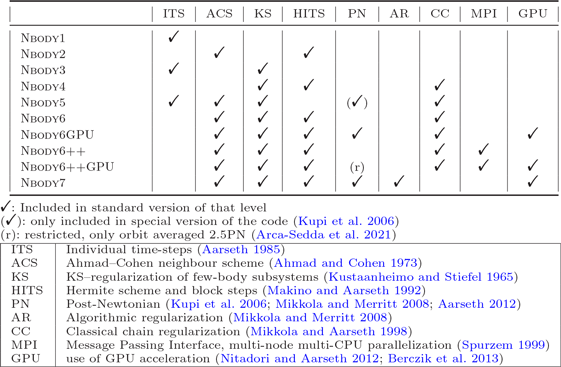
Features of Nbody1-7, adopted with some updates from Spurzem and Kamlah (Reference Spurzem and Kamlah2023).

Table 1 Long description
A table comparing features of Nbody1-7. The table has 8 rows and 10 columns. The columns are labeled ITS, ACS, KS, HITS, PN, AR, CC, MPI, and GPU. The rows are labeled Nbody1 to Nbody7. Each cell contains a checkmark, a special symbol, or is empty, indicating the presence or absence of specific features. Notable features include the use of Individual time-steps (ITS), Ahmad-Cohen neighbour scheme (ACS), KS-regularization of few-body subsystems (KS), Hermite scheme and block steps (HITS), Post-Newtonian (PN), Algorithmic regularization (AR), Classical chain regularization (CC), Message Passing Interface (MPI), and GPU acceleration. Special symbols indicate inclusion in special versions of the code or restrictions on certain features.
4. New approaches
There are two major new developments, one being PeTar, the other BiFrost. PeTar (Wang et al. Reference Wang, Iwasawa, Nitadori and Makino2020a) is a hybrid N-body code, which combines the P
 ${}^3$
T (particle-particle particle-tree) method and a slow-down time transformed symplectic integrator (SDAR Wang et al. Reference Wang, Nitadori and Makino2020b). The code is conceptually ahead of Nbody6++GPU in several respects; parallelization of a large number of hard binaries is included and a domain decomposition makes it easier to go to particle numbers much larger than
 $10^6$
, as well as the use of the Tree scheme for distant groups of particles, rather than the Ahmad–Cohen neighbour scheme in Nbody6++GPU. But a detailed mutual verification and performance comparison of PeTar and Nbody6++GPU for a large scale and long simulation including all astrophysical effects (such as e.g. the Dragon-I simulations) is still missing. Another novel approach is based on forward symplectic integrators (FSI, cf. e.g. Dehnen and Hernandez Reference Dehnen and Hernandez2017). It is called BiFrost (Rantala et al. Reference Rantala, Naab and Springel2021, Reference Rantala, Naab, Rizzuto, Mannerkoski, Partmann and Lautenschütz2023), uses MPI parallelization and GPU acceleration and shows as well competitive benchmarks for very large N (million and more). Both codes have been successfully used for large direct Nbody simulations (Liu et al. Reference Liu, Wang, Hu, Tanikawa and Trani2024; Barber and Antonini Reference Barber and Antonini2025; Rantala et al. Reference Rantala, Naab and Lahén2024, Reference Rantala, Lahén, Naab, Escobar and Iorio2025).
Acknowledgements
Most importantly, the author wants to express thanks and gratitude to Sverre Aarseth for teaching, collaboration, and friendship over many years. Be assured Sverre, that our community will follow your friendly and open-minded spirit and keep your legacy alive. Furthermore I want to thank Kai Wu, Francesco Flammini Dotti, Manuel Arca Sedda, Jarrod Hurley, Abbas Askar, Sambaran Banerjee, Peter Berczik, Roberto Capuzzo-Dolcetta, Mirek Giersz, Shuo Li, Shiyan Zhong, Xiaoying Pang, Thorsten Naab, and several more of co-authors not mentioned here for collaboration and helpful comments. Support by German Science Foundation (DFG, Sp 345/24-1), National Science Foundation of China (NSFC, grant No. 12473017), and Chinese Academy of Sciences (CAS) NAOC International Cooperation Office for its support in 2023, 2024, and 2025 is acknowledged. This research was supported in part by grant NSF PHY-2309135 to the Kavli Institute for Theoretical Physics (KITP).), and the Gauss Centre for Supercomputing e.V. (https://www.gauss-centre.eu/) for providing computing time through the John von Neumann Institute for Computing (NIC) on the GCS Supercomputer JUWELS and JUWELS-Booster at the Jülich Supercomputing Centre in Germany (JSC). The GRAPE team at Tokyo University, represented first by Daiichiro Sugimoto and later by Junichiro Makino deserves sincere acknowledgment for making GRAPE hardware available early for international collaborators.

 N=100
 N=250
 N=250