There is always something potent about handling historic documents. You can't help but feel the shock of reality in encountering these dispatches from the past. It's there in the nut-like reek that hovers about the paper…. Paper is almost a blotting paper soaking up the stink of the past. Then there is the language of handwriting itself: each individual shaping of a word is a pen-portrait of the person who wrote it …
Introduction
Peter Wells’Footnote 1 quote from his recent book Dear Oliver serves as an example of the thoughts and feelings that can be aroused by sustained interaction with just one typical component of an archive, the letter. We are told that the book is being replaced by digital texts. What is it about our special collections, by contrast to our published book collections, that seems to be bucking this trend and what can we do to encourage it?
New Zealand's Sunday Star Times reported the downward trend in book issuing at both of the major public libraries in Wellington and Auckland over the last few yearsFootnote 2 and the University of Auckland's recent review of its creative arts and industries libraries includes the ‘declining rates of usage’Footnote 3 as a reason to recommend the closing of these specialist subject libraries with their collections being moved to the general library.
At the same time as we have observed the decrease in book issuing and the rise in the use of digital surrogates and online resources, there is a concomitant turning to the authentic, the real. There is a noticeable attraction to the rare and the one-off in the zeitgeist: take, for example, the growing attraction for LPs, Polaroids and the hand-written captions on slides.
Art archive collections speak to this desire for authenticity and provide an opportunity for us to broaden the profile of our users and encourage the contents of our repositories to be accessed and engaged with in different ways.
E H McCormick Research Library
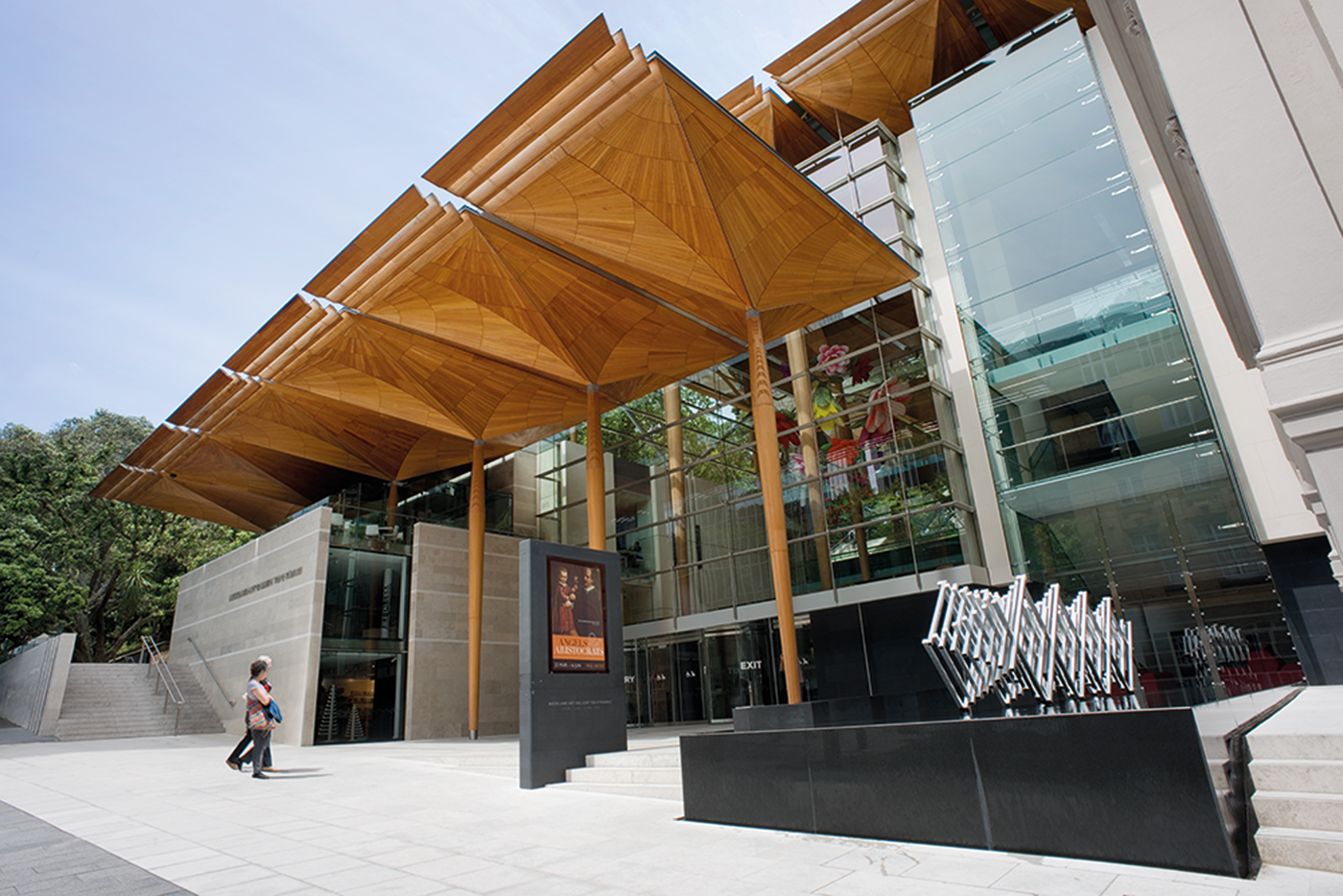
At the E H McCormick Research Library, Auckland Art Gallery (Fig. 1) we hold the archives of the gallery as well as the personal papers of artists and the records of other galleries. We have close to 160 archival collections, double the number we had in 2009. As well as a rapid growth in donations, we have seen a steep rise in interest and engagement with our specialist materials.
Exterior of Auckland Art Gallery Toi o Tāmaki Image credit: Auckland Art Gallery Toi o Tāmaki

Until recently we essentially served the staff of the gallery, members of the public, serious researchers and students. Now, we are as likely to be visited by artists as we are by traditional art historians. Books were the usual end-product of time spent with the archives and, naturally, this still occurs but now other text formats may be published, as well as other creative outputs.
Currently, who are our users, how do they engage with our archives and what results from this interaction? Firstly, there is still strong use of the archive collections by Auckland Art Gallery staff, with the collections appearing to be gaining in status and acceptance. As well as conducting content-based research, curators regularly include examples of this material within exhibitions. Archives may provide context on artists featured or have value as sometimes the only remaining evidence of conceptual thinking and visual documentation associated with some earlier art-making such as performance practices.
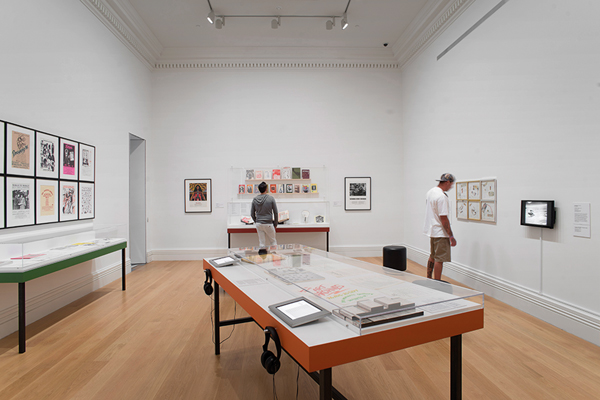
For the first time in our 130-year history, archives have taken over an entire exhibition space in the gallery. Catherine Hammond, Research Library Manager and I are the curators of Collective Women: Feminist Art Archives from the 1970s to the 1990s (Fig. 2). The exhibition opened in November 2017 and is on until mid-2019. Though we regularly put on displays of material in a dedicated cabinet outside the library, it was a valuable and educative experience to be able to work with the full exhibitions team to realise the exhibition. Working intently with our archives gave us a chance to take the role of the ‘user’ ourselves and gave us an appreciation of the great satisfaction that can arise from such deep engagement with the material that leads to a meaningful outcome. The exhibition has generated greater public awareness of the archives and the visitor programme means significant engagement with attendees and we've received exposure to new audiences via social media.
Installation view of Collective Women: Feminist Art Archives from the 1970s to the 1990s Image credit: Auckland Art Gallery Toi o Tāmaki

Among the feminist archives featured in the exhibition is a series of interviews with around 50 New Zealand women artists conducted in the mid-1980s.Footnote 4 We were intrigued when a young student wrote a play based on and inspired by the women's experiences as practising artists at that time for a major project in English at honours level. She then wrote about it for the latest issue of Reading Room, the Research Library's journal of contemporary art and culture. We intend to encourage further multi-disciplinary students and will be working with gallery educators to ensure it happens.
Curators from other institutions regularly borrow items from our archives for exhibitions, following gallery loan procedures and protocols. We have become collaborators in new initiatives, such as the curatorial workshop offered by Victoria University of Wellington's Adam Art Gallery which utilised our archives and the exhibition in the library's display cabinet, Notes on Rest, a curatorial opportunity requested by a PhD graduate who approached us directly.
As well as curators, we find that conservators, both our own and external professionals, are consulting particular archives. One of the gallery's paintings conservators has been engaged in an in-depth study of New Zealand artist Tony Fomison's (1939–1990) work. Close consultation of the painting log books he compiled from 1966–1979Footnote 5 has enabled her to create lists of materials and techniques associated with each of the works he catalogued. Once the research is published, the wider conservation community will also benefit.
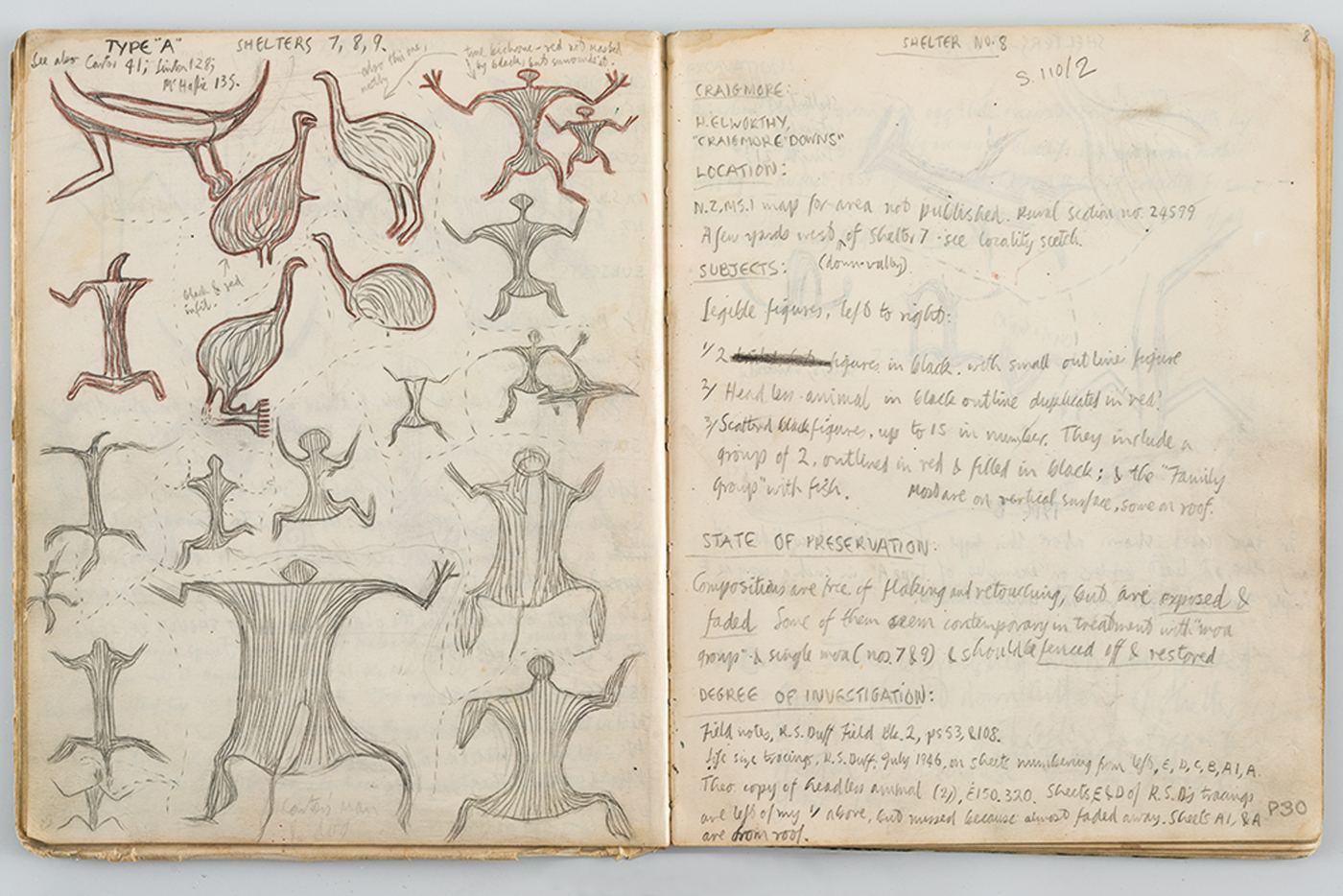
Using the same archive, we recently welcomed archaeologists into the Research Library. Fomison's life-long interest in Māori rock art began when he worked for the Canterbury Museum as a young man documenting sites around New Zealand. Having first consulted Fomison's field books for his own PhD research,Footnote 6 the leading academic recently brought in a small team to use them for continuing research, as it appears that Fomison's archaeological work in the 1950s is still of value today (Fig. 3). A tribal Māori rock art trust also sought copies of the books and the artist's estate were happy to grant permission for this.
Field books from the Tony Fomison Studio Papers, E H McCormick Research Library, Auckland Art Gallery Toi o Tāmaki, gift of Mary Fomison, 2009 Image credit: Auckland Art Gallery Toi o Tāmaki, reproduction permission courtesy of Tony Fomison Estate

Dealer gallerists are also finding reasons to access, and sometimes borrow items from artists' personal papers for exhibitions. Fomison, for example, allocated a running number to his paintings and recorded these in his log books. We have noticed that these numbers and the background information he wrote in them are being included in sale catalogues to support provenance, for example.
After checking that we weren't breaking any rules by collaborating with a commercial enterprise, we lent short films and sketch books from the archives of New Zealand-born, Los Angeles-based artist/gallerist Giovanni Intra (1968–2002), to appear in the Michael Lett Gallery's exhibition on him.Footnote 7 Coverage of this exhibition appeared in Artforum and made mention of the archival component.Footnote 8
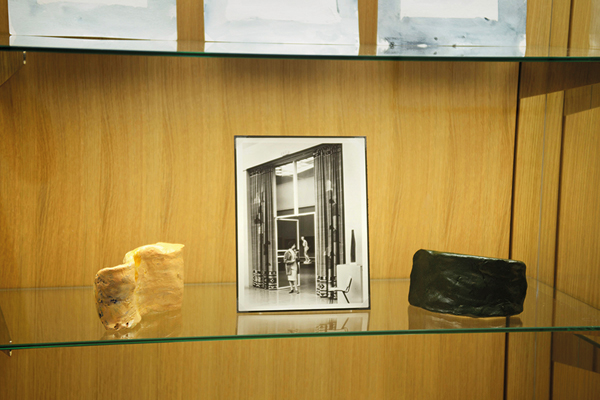
Finally, we find that artists are using our archives for a variety of reasons and with a variety of outputs. Artworks have resulted from some interactions with our special collections, such as some delicate watercolours and ceramic ‘curves and wavy lines’ by Berlin-based New Zealander and 2018 Walters Prize winner Ruth Buchanan, in response to an archive we have that centres on a dramatic, very large, hand-woven curtain work that hung in Auckland Art Gallery in the 1950s (Fig. 4).Footnote 9 Her Walters Prize entry includes our Collective Women exhibition as a site to visit, as part of the experience of her exhibited work, Bad Visual Systems.Footnote 10
Installation view of Ruth Buchanan Artist Project: The Curtain Image credit: Auckland Art Gallery Toi o Tāmaki, reproduction permission courtesy of Ruth Buchanan

As well as artworks, our artist collaborations have included exhibitions and internships. We facilitated an exhibition curated by Los Angeles-based New Zealand contemporary artist Fiona Connor about an abiding interest of hers, the Californian abstract artist John McLaughlin; and selected a fine arts graduate as the 2016 summer art archive intern, valuing the different perspective an artist brings to traditional archive tasks, such as arrangement and description.
Survey of archival repositories
In order to see whether our observations of a change in users of our repository was typical, and to be able to share a wider perspective on visitors and their use of archives, I contacted a small number of archivists and librarians from elsewhere in New Zealand, Australia and the United Kingdom.Footnote 11
I asked respondents, half of whom were from the tertiary sector and half from art museums to identify the key user groups in their institutions; comment on whether this had changed over time; and say what resulted from users' engagement with the archives.
As well as the same user profiles that we experience at Auckland Art Gallery, respondents reported some interesting additions: volunteer guides; film makers; school students introduced to the archives through gallery educators; donors of archives revisiting their own or their organisations’ papers; and genealogical researchers.
Respondents did not universally report a change in the types of users as we have experienced. Those who did observe changes reported an increase in artists and designers, as well as in private and international researchers. Respondents were more likely to comment on the rise in sheer numbers using their facilities in the last few years and a change in the way people engaged with the archival collections. A broadening in approach was most often reported such that artists and designers, for example, ‘are using the archive as a source for further creative work, rather than as just a research tool’.Footnote 12
There was also the observation I began with, i.e. a decrease in the use of published collections at the same time as an increase in the use of archives, where those two collections were held in the one location.
As for outputs, in addition to those experienced in Auckland, the respondents mentioned general social histories, plus more specific unpublished genealogical histories; conference papers and writings on museology; educational material; and design/brand development by internal users; and more unusual results such as ‘house plans for building renovations’.Footnote 13
Making our collections visible
Having summarised who our audiences are and how they use our collective facilities, what is it about our methods or processes that might contribute to the rise in popularity and broadening of approaches that we have all witnessed? At Auckland Art Gallery we use a variety of mechanisms to make our collections visible, and many of these are similarly used by the archivists in the above-mentioned survey.
A few years ago, we were one of the first institutions in New Zealand to work with our collection management system suppliers, Vernon, to create an archive cataloguing module within the gallery's internal collection database. Both here and on the gallery's websiteFootnote 14 one can search on an artist's name and see both the artworks by that individual and any archives we might have relating to them. We can attach finding aids to Vernon though not yet to our website. As well as through these mechanisms, we add archives to our national register of archives and manuscripts, the Community Archive.Footnote 15
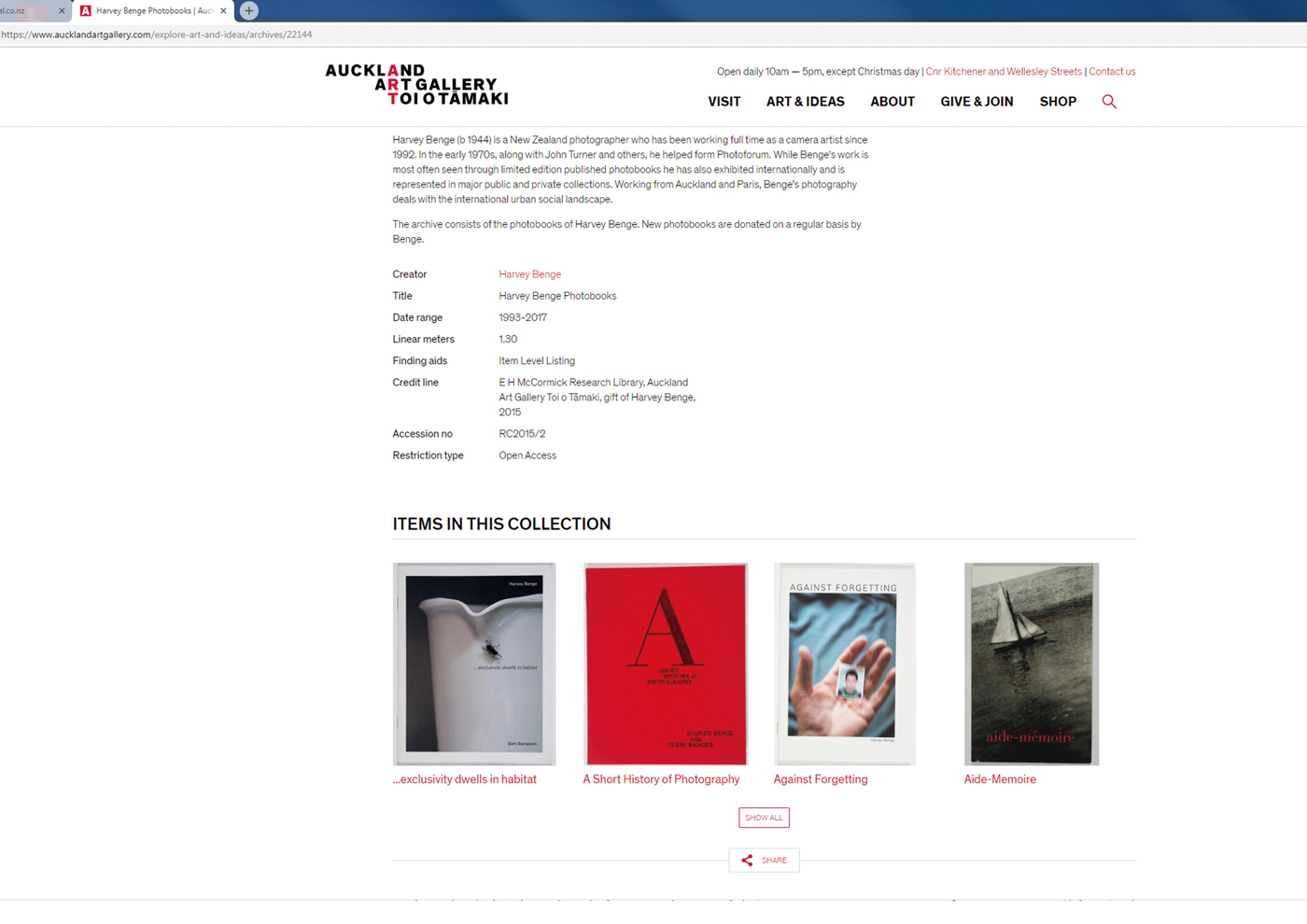
Digitised archival items can be accessedFootnote 16 for some collections and this has led to a couple of contemporary artist donors ensuring, for example, that copies of all of their recent works are deposited with us on a regular basis (Fig. 5).Footnote 17 As well as highlighting our collection, we are able to promote our archival exhibitions via the Gallery's general exhibition page, give in-depth information about the history of the Auckland Art Gallery, publish blog posts and make digitised Gallery catalogues and publications available.
Archive item records for Harvey Benge Photobooks on Auckland Art Gallery website Image credit: Auckland Art Gallery Toi o Tāmaki

Engagement is also encouraged through providing tours of the Research Library, publishing our journal Reading Room that has a section dedicated to archives, publishing in other academic journals and on specialised websites,Footnote 18 making conference and symposium presentations, offering an annual internship, and providing mentoring and training to other publicly-funded art organisations and students.
In reviewing the responses of my archival colleagues elsewhere, the single most important factor in revealing archives and thus ensuring use, was the professional and timely cataloguing and provision of online collection-level records with, in some instances, accompanying finding aids. The Hocken Library, one of New Zealand's premier research libraries, reported a 50 percent increase in the number of archives issued in one year following the addition or improvement in several thousand catalogued records as the result of a grant.Footnote 19
Other helpful mechanisms to raise visibility are the use of social media to highlight collections; mentions in institutional e-newsletters and involvement in key organisation-wide events; the circulation of lists of outcomes by researchers; and the requirement of some universities for their staff to carry out research and subsequently publish on their own collections.
Of particular interest was the approach of the University of Brighton. Design Archive Archivist and Senior Research Fellow Sue Breakell describes it as ‘research-informed stewardship’: as many of the staff have a research mandate themselves, the collections are managed in a ‘spirit of critical reflection and enquiry’. Working collaboratively and being open to new approaches, Design Archive staff sometimes initiate the use of the collection with artists and academics rather than the other way around and in their work with curators may contribute to the intellectual content as well as providing items for projects. Their aim is to ‘open up new avenues of research’ and develop new events and other outputs that promote their collection.Footnote 20
My last question asked fellow archivists for general comments that summed up what was currently happening with their collections. There were common themes: colleagues reported digitisation projects and improvements in processes and modes of delivery, with efficiency being a key motivation. Most art museum librarians and archivists commented on the change in the way their archives were being used, particularly creatively. Andrea Bell, of the Hocken, wrote, ‘it is inspiring to witness and actively engage with the diversity of approaches towards research … as users, and in particular, artists ‘breathe new life into the collection, and its ever-evolving interpretation’.Footnote 21 A senior Australian colleague noted about the archives, ‘you can never guess how they will be used … [they] are now being treated more like works of art in their own right’.Footnote 22
Despite mainly positive round-ups on the state of their archives, some pressure points were expressed. Archivists from the United Kingdom reflected on the impact of financial constraints in the arts sector, commenting on the need, therefore, to ‘keep relevant and be able to demonstrate our value to the institution’.Footnote 23 Length of time spent on surfacing the relevant record for our users is still an issue. And the increase in collection size and the rise in the demand for archives can have a negative flow-on effect. There is the practical issue of running out of physical space and a rise in expectations that cannot always be met, such as a push for item level cataloguing. For myself, I would add that despite unprecedented growth in our collections some groups are still underrepresented, such as Pasifika (i.e. from the Pacific Islands) artists. The ‘silence of the archive’ indeed.
Conclusion
Despite challenges, and all professions have them, it feels like archival collections are in a good place. We need to remember and emphasise the reasons why they are chosen by our users over other resources. They have the power to ‘provoke debate, discussion or an alternative point of view’;Footnote 24 on a practical level they provide information and therefore sometimes crucial evidence, and, because of their potency, they can inspire new creations, as we have seen. To encourage the broadening range of users and uses that we are currently experiencing, in my opinion, we need to emphasise the personal. The personal within the archive, such as the artist's voice through interviews and letters; and the personal in our processes: let's communicate regularly with our donors, demystify the jargon and make records simple and efficient for our users to access. And let's treasure the fact that, in a sometimes-detached anonymous world, we can spend time with meaningful objects that are authentic and unique.
This is an edited text of a paper originally presented at the 2018 ARLIS/ANZ Conference: Expanding Our Reach, National Portrait Gallery and National Gallery of Australia, Canberra, October 2018.