1 Introduction
1.1 Background and motivation
Language resources (dictionaries, terminologies, corpora, etc.) developed in the fields of corpus linguistics, computational linguistics and natural language processing (NLP) are often encoded in heterogeneous formats and developed in isolation from one another. This makes their discovery, reuse and integration for both the development of NLP tools and daily linguistic research a difficult and cumbersome task. In order to alleviate such an issue and to enhance interoperability of language resources on the Web, a community of language technologies experts and practitioners has started adopting techniques coming from the area of study of linked data (LD). The LD paradigm emerges as a series of best practices and principles for ‘exposing, sharing and connecting data on the Web’ (Bizer, Heath and Berners-Lee Reference Bizer, Heath and Berners-Lee2011), independently of the domain. These principles state that unique resource identifiers should be used to name things in a way that allows people to look them up, find useful information represented with standard formalisms and discover more things that are linked to those resources. LD emerged in the context of the Semantic Web, an extension of the Web ‘in which information is given well-defined meaning, better enabling computers and people to work in cooperation’ (Berners-Lee et al. Reference Berners-Lee, Hendler and Lassila2001). General and domain-specific on-line ontologies (such as the ones we revisit in this survey) provide this well-defined meaning on the Semantic Web and are used to represent the data that will be linked to other data. Following this line, an ontology is properly defined as a ‘formal, explicit specification of a shared conceptualisation’ (Studer, Benjamins and Fensel Reference Studer, Benjamins and Fensel1998). This definition refers to an ontology formalised as a machine-readable, explicit description of a domain common to a group of domain experts. Thanks to the semantics encoded in ontologies, LD is transforming the Web into a vast cloud of interlinked information (commonly referred to as the ‘Web of Data’) in which resources are linked across datasets and sites, and where facts and related knowledge are available for consumption by advanced, knowledge-based software agents as well as by humans through suitable interfaces.
The Semantic Web (and hence, LD too) has as formal backbone the Resource Description Framework (RDF),Footnote 1 which describes the data through statements in the form of triples subject – predicate – object. This simple model allows structured and semi-structured data to be mixed, exposed and shared across different applications. These triples can be serialised in different formats such as TurtleFootnote 2 or JSON-LD.Footnote 3 The semantic layer that ontologies provide is defined using the Ontology Web Language (OWL)Footnote 4 and other formalisms and schemes such as RDF Schema.Footnote 5
The following example (in Turtle syntax), taken from DBpedia,Footnote 6 is an RDF statement about Francisco de Goya (a famous Spanish painter) representing that ‘Francisco de Goya was born in Fuendetodos’:Footnote 7

Notice that since another triple in DBpedia states that

a semantic reasoner might infer that Goya was born in Spain even though this information is not explicitly declared in the data.
In the previous example, knowledge of some ‘real live’ entities (Goya, country, birth place, . . .) has been described in RDF. However, the resources that RDF can describe and link can be literally anything, which means also linguistic information. For instance, the grammatical properties of the word ‘country’ can be represented in RDF as well. In the following example, we state that a certain resource (apertiumEN:country-n-en) is a lexical entry and has ‘country’ as written form and noun as part of speech:Footnote 8

This example (encoded in compact Turtle syntax) illustrates also how information coming from different datasets (i.e., Apertium RDFFootnote 9 and LexInfoFootnote 10), available in different Web spaces and built by different people for different purposes, have been interlinked in a rather straightforward way.
Linking linguistic information from heterogeneous sources that contain complementary information allows to create a graph of language resources that can be consumed by applications to perform NLP tasks or assist linguists in their research. Indeed, LD is increasingly being adopted by the computational linguistics and the digital humanities communities (Declerck et al. Reference Declerck, Lendvai, Mörth, Budin, Váradi, Chiarcos, Nordhoff and Hellmann2012; Chiarcos, Nordhoff, and Hellmann Reference Chiarcos, Nordhoff and Hellmann2012c; Chiarcos et al. Reference Chiarcos, McCrae, Cimiano and Fellbaum2013; Hellmann et al. Reference Hellmann, Lehmann, Auer and Brümmer2013; Flati and Navigli Reference Flati and Navigli2014; McCrae, Fellbaum and Cimiano Reference McCrae, Fellbaum and Cimiano2014; El Maarouf et al. Reference El Maarouf, Alferov, Cooper, Fang, Mousselly-Sergieh and Wang2015; González-Blanco, del Rio and Martínez Cantón Reference González-Blanco, del Rio and Martínez~Cantón2016; Villegas et al. Reference Villegas, Melero, Bel and Gracia2016) and an extensive number of efforts are now devoted towards the conversion of language resources to RDF. These works apply LLD for language documentation efforts (Nordhoff Reference Nordhoff, Chiarcos, Nordhoff and Hellmann2012) and to facilitate dialectal and etymological studies (Chiarcos and Sukhareva Reference Chiarcos and Sukhareva2014; Abromeit et al. Reference Abromeit and Fäth2016), lexical analysis (Khan, Boschetti and Frontini Reference Khan, Boschetti and Frontini2014), morphological studies (Klimek et al. Reference Klimek, Arndt, Krause and Arndt2016) as well as querying and reuse of lexicographical data (Declerck, Wandl-Vogt and Mörth Reference Declerck, Wandl-Vogt and Mörth2015; Bosque-Gil et al. Reference Bosque-Gil, Gracia, Montiel-Ponsoda and Aguado-de-Cea2016a), among numerous examples. Specifically in relation to NLP tasks, the possibility of querying graphs of distributed sources, integrating and exchanging annotations between different NLP tools within a pipeline, as well as automatically enriching resources with complementary information are especially highlighted advantages that LD offers (Chiarcos, Hellman and Nordhoff 2012a, Chiarcos, Hellman and Nordhoff 2012b; Chiarcos et al. Reference Chiarcos, McCrae, Cimiano and Fellbaum2013; Hellmann et al. Reference Hellmann, Lehmann, Auer and Brümmer2013; Chiarcos and Sukhareva Reference Chiarcos and Sukhareva2015, just to name a few). These applications are possible thanks to the use of shared conceptualisations and terminologies, such as the ones we revisit throughout this paper, and common formats.
Given these advantages and the potential of LD and, in particular, LLD, these last years have seen a wide range of contributions to the literature in LLD which aim at the publication of linguistic information on the Web following LD best practices. This has led to the emergence of the so-called Linguistic Linked Open Data (LLOD) cloud,Footnote 11 which constitutes a growing ecosystem of semantically connected linguistic data on the Web. The LLOD cloud is a community effort launched by The Open Knowledge Foundation’s Working Group on Open Data in Linguistics (OWLG)Footnote 12 (Chiarcos et al. Reference Chiarcos, Hellmann, Nordhoff, Chiarcos, Nordhoff and Hellmann2012a; McCrae et al. Reference McCrae, Chiarcos, Bond, Cimiano, Declerck, de Melo and Osenova2016) as a first step to bridge the gap between the advances in language technologies, and linguistics in general, and those taking place in the Semantic Web and artificial intelligence communities. Its main goal is to promote and track the use of LD in linguistics and facilitate the access to available language resources.
In addition, some recent advancements in LLD have also been driven by the activities developed within the framework of international projects such as LIDERFootnote 13 or FREMEFootnote 14, among others. Workshops, datathons and conferences such as the Multilingual Semantic Web Workshop,Footnote 15 the Linked Data in Linguistics Workshop,Footnote 16 the Workshop on Knowledge Extraction and Knowledge Integration,Footnote 17 the Summer Datathon on Linguistic Linked Open Data,Footnote 18 the Conference on Language, Data and Knowledge,Footnote 19 the NLP&DBpedia Workshop Series,Footnote 20 among other initiatives, have encouraged interdisciplinary contributions and community gathering, and provide a perfect scenario to establish new collaborations along these lines of work.
In order to support the representation of the range of linguistic information contained in language resources, experts in the field have been developing numerous models, extensions and category registries to account for general and fine-grained linguistic description. A linguistic model provides the ontology entities (classes, properties and individuals) needed to represent the linguistic information of a language resource and to account for its structure and internal/external connections (e.g., lexical entry, syntactic frame, morph, root and antonym). Such models will be used to represent the linguistic facts contained in language resources. For example, defining what a synonym relation is belongs to the model, while stating that car and auto are synonyms belongs to the lexicon and is the result of a particular instantiation of such a model.
In general, the models presented in the literature are complementary to one another, but sometimes they show some overlap among them. Indeed, authors have developed their own ad-hoc extensions due to the actual lack of existing models that account for the specific features of the resource they aim to convert, due to the lack of awareness of a partially similar resource, or even due to the difficulty of finding the appropriate documentation. Such a proliferation of models for representing LLD, along with their potential redundancies and their differences in scope, makes it difficult to a newcomer to LLD to decide to which model to adhere when converting resources to LLD. The review we are sketching would help, together with other initiatives such as the Linked Open Vocabularies website,Footnote 21 in preventing them from missing previous work that could be applicable to their resource.
The process of generating LLD consists of several steps. For a detailed walk-through, we refer the reader to guidelines for multilingual data generation and publication (Gómez-Pérez et al. Reference Gómez-Pérez, Vila-Suero, Montiel-Ponsoda, Gracia and Aguado-de-Cea2013; Vila-Suero et al. Reference Vila-Suero, Gómez-Pérez, Montiel-Ponsoda, Gracia, Aguado-de-Cea, Buitelaar and Cimiano2014), as well as to the best practices suggested in W3C Best Practices for Multilingual Linked Open Data community group,Footnote 22 and the LIDER project guidelines and reference cards,Footnote 23 which cover a range of language resources. These steps for LLD generation can be broadly summarised as follows: (1) source data and source data model analysis, (2) unique resource identifier naming strategy definition, (3) modelling, (4) RDF generation (or conversion to RDF), (5) linking, and (6) publication. The first step, source data and data model analysis, gives already some valuable information on the kind of linguistic description provided in the resource and also guides in the selection of an appropriate LLD model to be reused. Indeed, in the third step, modelling, reusing existent ontologies and vocabularies is recommended (Gómez-Pérez et al. Reference Gómez-Pérez, Vila-Suero, Montiel-Ponsoda, Gracia and Aguado-de-Cea2013). This involves a careful analysis of the models available out there, and it is at this point where this survey aims to offer support.
Even though summaries and overviews of the work towards the transformation of language resources to LLD are available (Hellmann Reference Hellmann2013; McCrae et al. Reference McCrae, Chiarcos, Bond, Cimiano, Declerck, de Melo and Osenova2016), to the best of our knowledge, there still lacks a comprehensive review of the state of the art on the models or ontologies that support the representation of linguistic data as LD in terms of the nature of the linguistic content they encode, the ways in which they do so, and what representation challenges still remain ahead.
Our classification of contributions seeks to go over the current literature in LLD with an emphasis on how various efforts approach linguistic knowledge, how they capture it in their proposals and how they relate to one another. Each effort has its own background and tries to satisfy different representation needs, varying from one to another in terms of representation content and granularity. Many of them are complementary to each other and can be used simultaneously to represent different linguistic features. Owing to that, a critical comparative analysis of the considered models would need a preliminary descriptive analysis and classification of the whole landscape of LLD models, which is precisely the main target of this work. Therefore, this review is descriptive rather than criticalFootnote 24 and focuses on the observed resource-specific problems and general tendencies that we explain and discuss throughout the article as answers to the research questions defined in Section 2. For instance, given two models sharing (1) a common representation goal, (2) an equivalent level of granularity of linguistic description, (3) the type of resources to which they are applied and (4) linking capabilities to other resources, the decision to which to adhere still remains on the LD expert’s side. In practice, this may be done on the basis the widespread use of each model, design preferences, linguistic standpoint, etc.
The classification that we provide thus aims to serve as a broad framework for thinking about these models allowing experts to make informed decisions about the models that best cover their needs.
1.2 Classification scheme
The LLOD cloud offers a classification of language resources in LD format in terms of resource type and license. The resource type classification organises resources according to the following categories: corpora, terminologies, thesauri and knowledge bases; lexica and dictionaries; linguistic resource metadata; linguistic data categories, and, last, typological databases. These classes can be roughly grouped into corpora, lexico-conceptual resources and metadata resources (McCrae et al. Reference McCrae, Chiarcos, Bond, Cimiano, Declerck, de Melo and Osenova2016), a grouping which comes close to the classification provided in Meta-Share.Footnote 25
In contrast to the LLOD cloud classification, which focuses on datasets, ours is a classification of the models that are used to represent such datasets semantically. Our proposed classification hinges on three gradually emerging groups into which contributions to the LLD field can be organised, namely (1) general models that aim at capturing the main elements of lexical resources, (2) vocabularies developed as extensions to models in Group 1 along with ontologies that can be used with them to provide more granularity on specific layers and dimensions and (3) catalogues of linguistic data categories. A fourth group is included consisting of other models, namely, those geared towards the representation of corpora and service-oriented models. These last models are not dealt with in detail here, since these contributions include many structural (e.g., properties to anchor annotations to a given text span) or NLP-based entities and therefore do not strictly focus on the representation of content from the different levels of linguistic description.
Group 1 (general models) encompasses ontology lexica models, such as lemon (McCrae et al. Reference McCrae, Aguado-de-Cea, Buitelaar, Cimiano, Declerck, Gómez-Pérez, Gracia, Hollink, Montiel-Ponsoda, Spohr and Wunner2012) and OntoLex,Footnote 26 and initiatives such as TELIX (Rubiera et al. Reference Rubiera, Polo, Berrueta, El Ghali, Simperl, Cimiano, Polleres, Corcho and Presutti2012) or the recent Oxford Global Languages Ontology (OGL) (Parvizi et al. Reference Parvizi, Kohl, González and Saur2016).
Group 2 (model extensions) encompasses two subgroups: Group 2a revisits models that address a particular level of linguistic description: phonology, morphology, syntax, semantics, discourse, etc. Some of the models that are covered in our study are the PHOIBLE model for phonological typology (Moran and Wright Reference Moran and Wright2009; Moran Reference Moran, Chiarcos, Nordhoff and Hellmann2012), the Multilingual Morpheme Ontology (MMoOn) ontology for morphology (Klimek Reference Klimek2017) and the Predicate Model for Ontologies (PreMOn) model for verbal predicates and each of its extensions, among many others. This group also includes the small extensions developed to account for specificities of a resource due to its grounding on a specific linguistic theory, for instance, lemonGL (Khan et al. Reference Khan, Frontini, Gratta, Monachini and Quochi2013) in the Generative Lexicon Theory (GL) (Pustejovsky et al. Reference Pustejovsky1991). Group 2b focuses on specific branches of linguistics or related areas, and presents models such as lemonDIA (Khan et al. Reference Khan, Boschetti and Frontini2014) for diachronic linguistics and lemonet (Chiarcos and Sukhareva Reference Chiarcos and Sukhareva2014; Abromeit et al. Reference Abromeit and Fäth2016) for etymological data, along with models used in contrastive linguistics and lexicography.
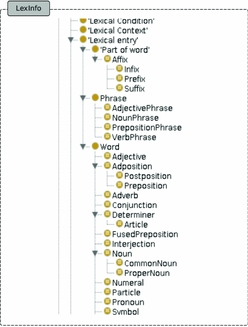
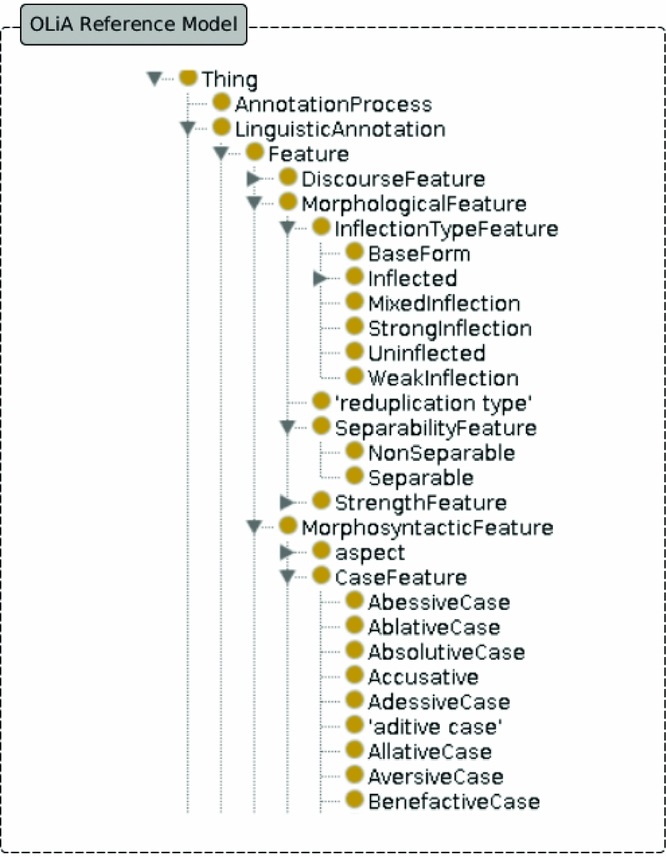
Group 3 (catalogues) contains catalogues of linguistic data categories that cover the whole linguistic domain and are widely used in conjunction with models of Group 1 and Group 2a and 2b (concrete examples provided in Section 3.3). In this group, we go over ontologies of linguistic description, category and language identifier registries (General Ontology for Linguistic Description (GOLD) (Farrar and Langendoen Reference Farrar and Langendoen2003), LexInfo (Cimiano et al. Reference Cimiano, Buitelaar, McCrae and Sintek2011), ISOcatFootnote 27 (Kemps-Snijders et al. Reference Kemps-Snijders, Windhouwer, Wittenburg and Wright2008; Windhouwer and Wright Reference Windhouwer, Wright, Chiarcos, Nordhoff and Hellmann2012) and Lexvo (de Melo Reference de Melo2015)) and the Ontologies of Linguistic Annotation (OLiA)Footnote 28 (Chiarcos and Sukhareva Reference Chiarcos and Sukhareva2015)), among other resources.
The remainder of this paper is organised as follows. Section 2 is devoted to explain the methodology we have followed in order to conduct this review, including the research questions we aim to answer and the literature selection criteria. Section 3 focuses on each group in detail, followed by a discussion in Section 4. The conclusions and the main challenges that we have identified as a result of this study are outlined in Section 5.
2 Methodology
2.1 Research questions and goals
The reviewing method used in this paper (described in detail in the following subsections) is inspired from Dyba, Dingsoyr and Hanssen (Reference Dyba, Dingsoyr and Hanssen2007) and aims to answer the following research questions:
(1) What are the available models that allow to represent linguistic information as LD in its different description levels?
(2) What are the main modelling difficulties that arise when representing linguistic information as LD and how do different models tackle them?
(3) How have such LD-based linguistic models been (re)used, adapted and extended?
(4) What are the major remaining challenges to describe linguistic content in the current LD-based models?
The goal of this review therefore is to provide answers to questions (1)–(4). This review focuses on the current literature in LLD. Other models that do not provide linguistic descriptions as LD are outside of the scope of this paper. Further, techniques, tools and best practices for building ontologies, as the ones used in LLD, are not examined in this survey. On this topic, we refer the interested reader to the literature in ontology engineering (e.g., reviews of methodologies for building ontologies by Corcho, Fernández-López and Gómez-Pérez (Reference Corcho, Fernández-López and Gómez-Pérez2003) and Iqbal et al. (2013).
In the remainder of this section, we describe the different steps that we have followed in this process.
2.2 Selection of bibliographic sources
As a starting point, the datasets available through the LLOD cloud page at the time of writing were listed, and their associated papers searched on the Web. Further, the whole proceedings of the following related conferences and workshops were examined: all Multilingual Semantic Web Workshop proceedings available to the date of writing; all Linked Data in Linguistics Workshop issues to the date of writing; OntoLex Workshop 2008, LREC 2014, 2016; ISWC 2014, 2015, 2016; ESWC 2014, 2015; ASIALEX 2013, 2015, 2016; EURALEX 2014, 2016; GLOBALEX 2016, eLex 2013, 2015, and the ISA-LSA Chicago 2015 Conference. In addition, a series of Google Scholar searches involving the combination of the following terms, plus the specific level of linguistic analysis, linguistic theory or branch, were carried out: {linked data, lemon, RDF, linguistic linked data, RDF conversion, migration, (level of analysis), (linguistic theory), (branch of linguistics)}, e.g., ‘linguistic linked data GL lemon RDF’.
2.3 Selection of papers
From the numerous references obtained in the previous step, a first title-based filtering was conducted guided by the following questions, with one positive answer being enough to pass the filter:
(1) Does the title of the paper suggest that it deals with the RDF conversion of a linguistic resource or a modelling of a linguistic resource for the Web of Data?Footnote 29
(2) Does the title of the paper mention lexical resources and refers to their linking, integration or merge?
(3) Does the title of the paper suggest the authors propose a new ontology or model, or an extension to an existing one to encode linguistic information?
(4) Does the title of the paper suggest the authors are introducing a new project or initiative related to LLD?
A second filtering process was performed on the remaining papers, abstract-based, to make sure the answers to the previous four questions were indeed correct and the title had not been misleading. An additional crucial question was added to this filter: Is the paper related to LLD in any way? This ruled out works which integrate or link resources but do not rely on the LD paradigm. The third filter consisted in detecting which of the remaining papers reported on the same work or project, but were presented from different perspectives in multiple publications.
Furthermore, if an abstract included references to previous work on which that paper was building upon, those references were searched in Google Scholar and underwent the same filtering process. Likewise, if the abstract included a potential useful keyword that had not been used in the Google Scholar searches (e.g., searches including ‘discourse’ but not ‘information structure’), another round of searches was performed and the results were subject to the filtering processes. This step was repeated throughout the whole review as the papers were read and more references and relevant keywords included in them were taken into consideration. Exceptions were only made in those cases in which (1) a paper served as basis for a model or inspired its creation, but it itself was not directly related to LD and (2) a paper was a (classic) reference paper in linguistics, philosophy or cognitive science.
This review seeks to have a broad scope in order to provide an overview of available models, their coverage and their use by the community, without carrying out a detailed evaluation of the quality of such models. Although the report tries to be exhaustive, we are aware that some contributions may not have been included in the initial selection due to different reasons. For instance, recent publications take some time to appear in Web indexes like Google Scholar. Also the visibility of journal papers may be delayed by the publication process.
2.4 Methodology of analysis
Language can be studied with different units of analysis in focus. The levels of linguistic description are defined in terms of these units of analysis, which, if arranged from smallest to largest, lead to a structure similar to the one shown in Figure 1. This arrangement of the linguistic description levels is widely found in reference books in linguistics and introductory courses and literature in the field (Hayes et al. Reference Hayes, Curtiss, Szabolcsi, Stowell, Stabler, Sportiche, Koopman, Keating, Munro, Hyams and Steriade2013) (traditionally, morphology and syntax would constitute the grammatical level).
Levels of linguistic description and their units of analysis.

Inspired by the thematic analysis description provided by Dixon-Woods et al. (Reference Dixon-Woods, Agarwal, Jones, Young and Sutton2005) and referred to by Dyba et al. (Reference Dyba, Dingsoyr and Hanssen2007), this review identifies the set of themes into which current work in LLD may be systematically classified. Specifically, we follow a thematic approach based on the main levels of linguistic description showed in the figure above and commonly addressed in theoretical linguistics, and some of the sub-fields in applied linguistics and areas related to it. By relying on these levels as backbone for our thematic approach, we help the reader to better locate each studied model in a broader context and thus facilitate the decision which one to reuse in a particular project. The main categories we propose follow the same aim.
The papers remaining from the selection and filtering processes outlined above were classified and sub-classified into the groups in which this review is structured. Group 1 models mainly represent information pertaining to the 2nd–4th levels in Figure 1 (counted bottom-up), whereas Group 3 models include elements to capture information from all levels and their interfaces, specially morphosyntax. Models belonging to Group 2a are rather focused on one level (e.g. morphology, (lexical) semantics), as opposed to models in Group 2b, which address aspects that either touch upon different levels or are not easily covered by them. We analyse and compare the contributions in each of these groups in the following sections.
Notice that this survey devotes more space to some models with respect to others, in particular, those concerned with the representation of (lexico-)semantic information. The main reason is that such a kind of models gather more interest in the LLD community, therefore needing a more thorough description. Furthermore, these efforts (aimed at the representation of the lexicon-ontology interface, the lexico-grammar interface and word meaning in general) are more numerous than those addressing phonology, morphology or, in applied linguistics, terminology or typology. This makes the semantics section of the survey longer than other sections. On the other hand, each work either addresses different, concrete aspects in the representation of lexico-semantic information (e.g., from a specific theory) not covered by the others, proposes new ontologies for this kind of information, or highlights gaps in other models. Since we do not find this scenario in other levels or areas of Group 2 or Group 3 yet (e.g., discourse and diachronic linguistics), consisting of works with different goals in mind (exceptions to this would be lexicography and etymology), one of our aims was to highlight this heterogeneity. This allows us to detect potential shared aspects, even though some of these models have not been reused in later contributions and others are still on-going work.
3 Models for the representation of language resources as LD
This section provides an overview of the main current models to represent linguistic content as LD. Four main groups are distinguished: models to represent the main elements of lexical resources (Section 3.1), ontologies and extensions to such models and ad-hoc vocabularies to encode content from different levels of linguistic analysis, linguistic theories, or other disciplines related to linguistics (Section 3.2), linguistic terminology registries and OLiA and description (Section 3.3); and other models, particularly those concerned with the representation of corpora and service-oriented data. Section 3.1 is not intended to go through schemes and frameworks to represent linguistic annotations in XML that fall outside the scope of LD (e.g., the Linguistic Annotation Framework (Ide and Romary Reference Ide and Romary2004)). We limit ourselves to mention those initiatives that were the most influential in the development of current models for LLD and the most used formats in resources that are nowadays being converted to RDF.
3.1 Group 1: Models to represent the main elements of lexical resources
3.1.1 Previous work
The idea of structuring a lexical resource as a graph is not exclusive to LD-based representations, but goes back to initiatives such as WordNet (Fellbaum Reference Fellbaum1998, Reference Fellbaum and Brown2005) and Polguère’s lexical systems (Polguère Reference Polguère2006, Reference Polguère2014) among others (e.g., ConceptNet (Liu and Singh Reference Liu and Singh2004)). The Lexicon Graph Model (Trippel Reference Trippel2006), for instance, addresses the combination of diverse lexica from different sources with disparate structures (micro, macro and mesostructures), which, however, contain information that makes them complementary to one another. The author proposes a graph of lexical items as nodes and typed edges, where the original lexica are sub-graphs, and the information can be accessed through various entry points corresponding to the elements of the entry such as the orthography or the spelling. Spohr (Spohr Reference Spohr2012), inspired also by the Lexicon Graph Model, turns to OWL and RDF to represent a multifunctional lexical resource. Here, multifunctional is understood as both serving a range of NLP applications and, from the perspective of functional lexicography, modelling lexical entries as dynamic entries generated and presented to the user depending on their profile and situation needs.
In the development of resources for NLP and outside the context of LD, the Lexical Markup Framework (LMF) (Francopoulo et al. Reference Francopoulo, George, Calzolari, Monachini, Bel, Pet and Soria2006) was defined to serve as standard for the creation of lexical resources, such as machine readable dictionaries, to allow for their exchange. LMF comprises a core package and several extensions to represent morphological, syntactic and multilingual information. Its core describes the basic structure of a lexical entry, and, together with its extensions, it inspired part of the core of the Lexicon Model for Ontologies (lemon) (McCrae et al. Reference McCrae, Aguado-de-Cea, Buitelaar, Cimiano, Declerck, Gómez-Pérez, Gracia, Hollink, Montiel-Ponsoda, Spohr and Wunner2012), designed in RDF and nowadays a de facto standard for converting language resources to LLD. lemon inherits some classes and properties from LMF, adapts others to the concept of semantics by reference (Cimiano et al. Reference Cimiano, Buitelaar, McCrae and Sintek2011) and to the use of external ontologies for linguistic description, and proposes new classes as well (McCrae et al. Reference McCrae, Aguado-de-Cea, Buitelaar, Cimiano, Declerck, Gómez Pérez, Gracia, Hollink, Montiel-Ponsoda, Spohr and Wunner2010). We will describe lemon in detail in Section 3.1. In the context of the ISO’s Technical Committee TC37 SC4,Footnote 30 we briefly refer also to the Linguistic Annotation Framework (Ide and Romary Reference Ide and Romary2004) and its XML serialisation, the Graph Annotation Format (Ide and Suderman Reference Ide and Suderman2007), the Morpho-syntactic Annotation Framework (de la Clergerie and Clément Reference de la Clergerie, Clément and Vetulani2005) and the Syntactic Annotation Framework (Declerck Reference Declerck2006).
In addition to LMF, other formats suggested to deal with the syntactic heterogeneity in linguistic resources for NLP are TEI (Sperberg-McQueen and Burnard Reference Sperberg-McQueen and Burnard1994) and Term Base eXchange (ISO DIS 30042, 2007) for terminologies.
3.1.2 Linked Data-based models
The following models, in contrast to the ones mentioned in the previous section, were developed in the context of the Semantic Web and the LD initiative.
Simple Knowledge Organisation System
The Simple Knowledge Organisation System or SKOS (Miles and Bechhofer Reference Miles and Bechhofer2009) is a W3C RecommendationFootnote 31 that is widely used to represent thesauri and taxonomies (Food and Agriculture Thesaurus AGROVOC,Footnote 32 the GEMET thesaurus of the European Environment Agency,Footnote 33 the Multilingual Thesaurus of the EU (EUROVOC),Footnote 34 to name a few). SKOS comprises a series of specifications that provide guidelines to model concepts, concept schemes, hierarchical (e.g., skos:broader) and associative (e.g., skos:related) semantic relations between concepts, as well as preferred and alternative (lexical) labels for concepts (e.g., skos:prefLabel), represented as strings. SKOS-XL is the extension of this model for labels (SKOS eXtension for Labels).Footnote 35 This extension allows to reify lexical labels of resources and provides properties to relate them (e.g., an acronym relation can be a subproperty of a label relation) or to indicate what type of label it is (preferred, alternative, etc.). However, and in contrast to the models below, SKOS-XL does not support the linguistic description of such labels: their phonetic, grammatical and semantic features, or how the different labels relate to one another. Importantly also, SKOS-XL labels are not described as ‘linguistic objects’, in contrast to some of the models presented below.Footnote 36
lemon and OntoLex
lemon emerges from a combination, review and extension of prior models such as LingInfo (Buitelaar et al. Reference Buitelaar2006), LexOnto (Cimiano et al. Reference Cimiano, Haase, Herold, Mantel and Buitelaar2007), LIR (Montiel-Ponsoda et al. Reference Montiel-Ponsoda, Aguado de Cea, Gómez-Pérez and Peters2011) and SKOS. Its successor, OntoLex, is the result of opening lemon to the community under the umbrella of the W3C Ontology-Lexica community group, in order to extend and formally modularise it. Both lemon and OntoLex belong to the group of ontology lexica models, i.e., models for the lexicalisation of an ontology. The criteria guiding the development of lemon and OntoLex are conciseness, descriptiveness (not prescriptiveness), modularity and RDF-native design. These models were actually not devised, in their origin, to represent lexica as LLD but to ground a given ontology linguistically (McCrae et al. Reference McCrae, Aguado-de-Cea, Buitelaar, Cimiano, Declerck, Gómez Pérez, Gracia, Hollink, Montiel-Ponsoda, Spohr and Wunner2010). Despite this, they are increasingly being used to convert lexica and other linguistic resources to LD and have become a de facto standard to represent and interchange lexical data in the Semantic Web.
Since these models aim to lexicalise an ontology, the conceptual layer (the ontology) is kept separate from the lexical (and linguistic information-bearing, in general) layer, being the class LexicalSense the bridge between a lexical entry (LexicalEntry) and its meaning (the concept in the ontology). This separation between the lexical and ontological layer is also implemented in previous models such as Senso Comune (Oltramari et al. Reference Oltramari and Vetere2008), which follows the Descriptive Ontology for Linguistic and Cognitive Engineering Upper Ontology (Gangemi et al. Reference Gangemi, Guarino, Masolo, Oltramari and Schneider2002) for its reference ontology. lemon comprises five modules: (1) the core, for the representation of grammatical, (basic) morphological and semantic information, and the (2) lexical and terminological variation, (3) phrase structure, (4) syntactic frames and (5) morphological variation modules. OntoLex also consists of a core, which describes lexical entries, their forms and their mapping to the denoted meaning in an ontology, and a series of modules to represent the syntax-semantics interface (synsem), variations and translation (vartrans), the internal structure of an entry (decomp) and linguistic metadata (lime). Section 3.2 presents the extensions to lemon and OntoLex that have been proposed in the literature.
The Oxford Global Languages Ontology (OGL)
With the conversion of lexicographically rich resources to RDF new modelling problems arise, and the lack of mechanisms to represent certain lexicographic annotations moves authors to design extensions to OntoLex (Section 3.1) or, recently, to the creation of a new ontology, partially from scratch, targeted at the conversion of lexicographic resources. The OGL (Parvizi et al. Reference Parvizi, Kohl, González and Saur2016) has been developed to model and integrate multilingual linguistic data from Oxford Dictionaries. It includes elements to account for a range of information found in dictionaries, from inflected forms to semantic relations, pragmatic features and etymological data.
The approach followed in OGL is nonetheless not focused on the reuse of existing vocabularies through their extension (in contrast to models presented in the next subsection), but on the creation of a new vocabulary designed with this concrete aim to ensure that the dictionary representation requisites are met. The ontology allows linkage with lemon content and ontologies of linguistic description. The emphasis of the approach is set on representing grammatical information with cross-linguistic validity and on maintaining grammar traditions in different languages as key points. Although some of the modelling decisions differ from those followed in lemon-based approaches and the proposed classes are differently defined (e.g., Lexical Entry in lemon vs. Lexical Entry in OGL, the use of forms in OGL to represent dictionary headwords, etc.), other aspects are common with lemon and are also modelling practices that are spreading throughout the community. Examples of these are the treatment of the given translations of a dictionary entry as lexical entries (or headwords) of a dictionary in the target language (cf. Bosque-Gil et al. Reference Bosque-Gil, Gracia, Montiel-Ponsoda and Aguado-de-Cea2016a; Gracia et al. Reference Gracia, Villegas, Gómez-Pérez and Bel2018) or the exploitation of translation relations among senses to obtain indirect translations through a pivot language (Villegas et al. Reference Villegas, Melero, Bel and Gracia2016; Gracia et al. Reference Gracia, Villegas, Gómez-Pérez and Bel2018).
TELIX
Last, the TELIX model for the representation of linguistic annotations (Rubiera et al. Reference Rubiera, Polo, Berrueta, El Ghali, Simperl, Cimiano, Polleres, Corcho and Presutti2012) takes a slightly different approach from the one followed in lemon, OntoLex and the OGL ontology. Just as corpus oriented models (Section 3.4), it focuses on representing linguistic annotations in corpora, but it also proposes means to cover the lexical information about word tokens, for which some corpus-oriented models rely on lemon, used along with linguistic data category registries (see Section 3.3). TELIX is presented as an annotation-oriented lightweight ontology that refines SKOS-XL, and, in fact, models lexical entries as skosxl:Labels that stand in opposition to their occurrences, telix:LabelOccurrence (word forms in a text). In contrast to OntoLex and the OGL ontology, the lexical sense is not one of the core elements of the model, i.e., skosxl:Labels and occurrences directly point to ontology entities, and word forms can be linked to a range of linguistic information through custom properties, classes and values that cover morphosyntax, syntax and discourse concepts, among other aspects.
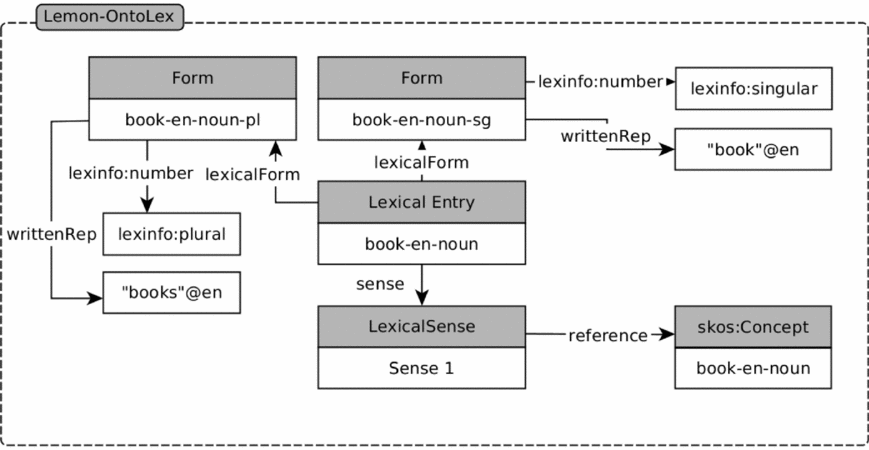
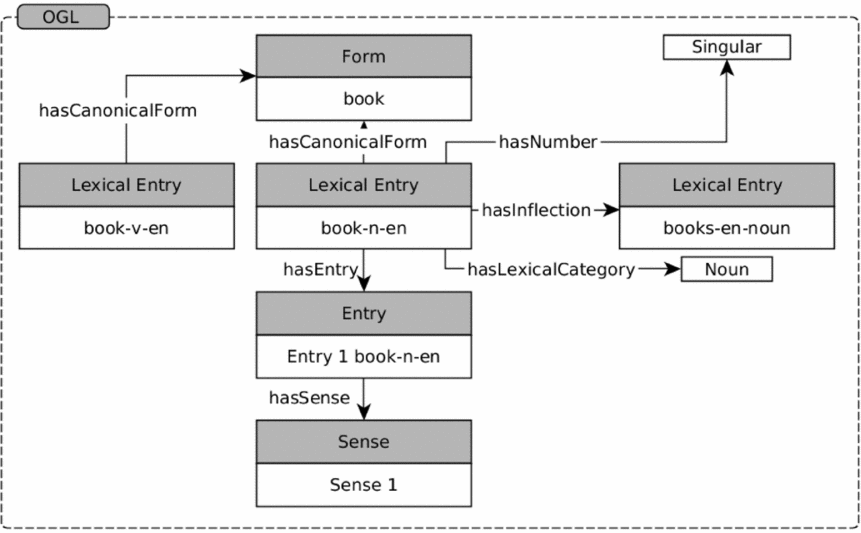
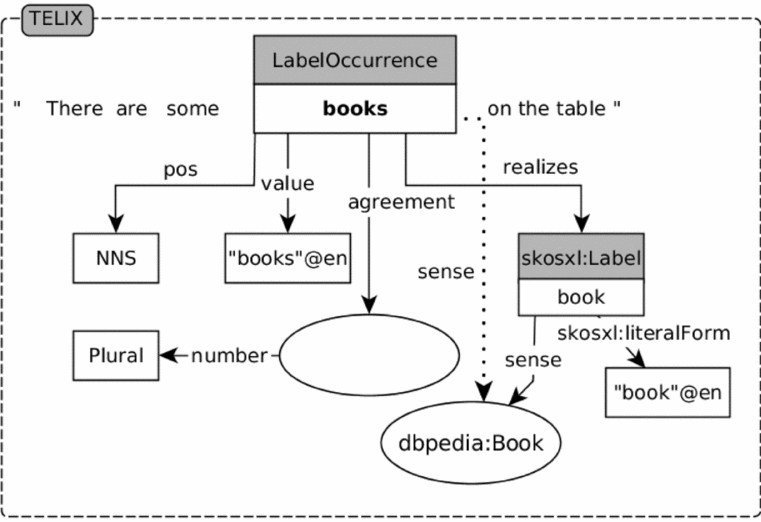
Figures 2–4 show the different representations of the lexical entry book according to OntoLex, the OGL ontology and TELIX, respectively.Footnote 37 Example 1 provides the RDF Turtle serialisation of the entry shown in Figure 2 and also illustrates the subject–predicate–object model that was introduced earlier. The book example is inspired by examples provided in the literature (Rubiera et al. Reference Rubiera, Polo, Berrueta, El Ghali, Simperl, Cimiano, Polleres, Corcho and Presutti2012; Parvizi et al. Reference Parvizi, Kohl, González and Saur2016) and the OntoLex Specification, which in turn have been adapted for comparative purposes. As shown in Figure 3, in OGL Ontology, the word book is treated as a form of both the verb book and the noun book, i.e., forms can be shared by different lexical entries, which are part-of-speech dependent. The inflection of book in plural form, books, is therefore modelled as a lexical entry as well. Interestingly, the element Entry refers to the dictionary entry from which the information concerning the lexical entry is extracted, acting then as provenance. In OntoLex (Figure 2), in contrast, forms are not shared by lexical entries, and inflectional word forms are viewed as forms of the lexical entry. In OntoLex, there is no entry element to track the provenance, but it relies on properties available in other vocabularies, such as dc:source, to that aim. Last, since TELIX is oriented towards the representation of annotations, Figure 4 shows the modelling of an occurrence of the word books in a sentence (see Rubiera et al. (Reference Rubiera, Polo, Berrueta, El Ghali, Simperl, Cimiano, Polleres, Corcho and Presutti2012) for more details). The LabelOccurrence class is used to model tokens and their morphosyntactic properties, whereas SKOS labels act as the types of those tokens and link to their meaning as defined in an ontology.
Example 1. Turtle RDF serialisation of the example in Figure 2

The lexical entry book modelled with OntoLex.

The lexical entry book modelled with the OGL ontology.

The lexical entry book modelled with TELIX.

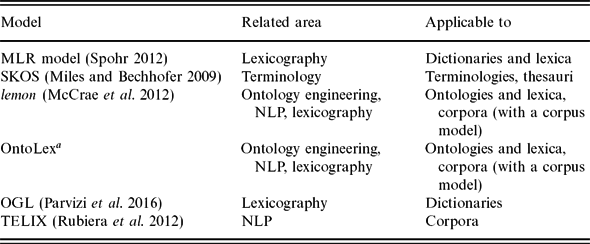
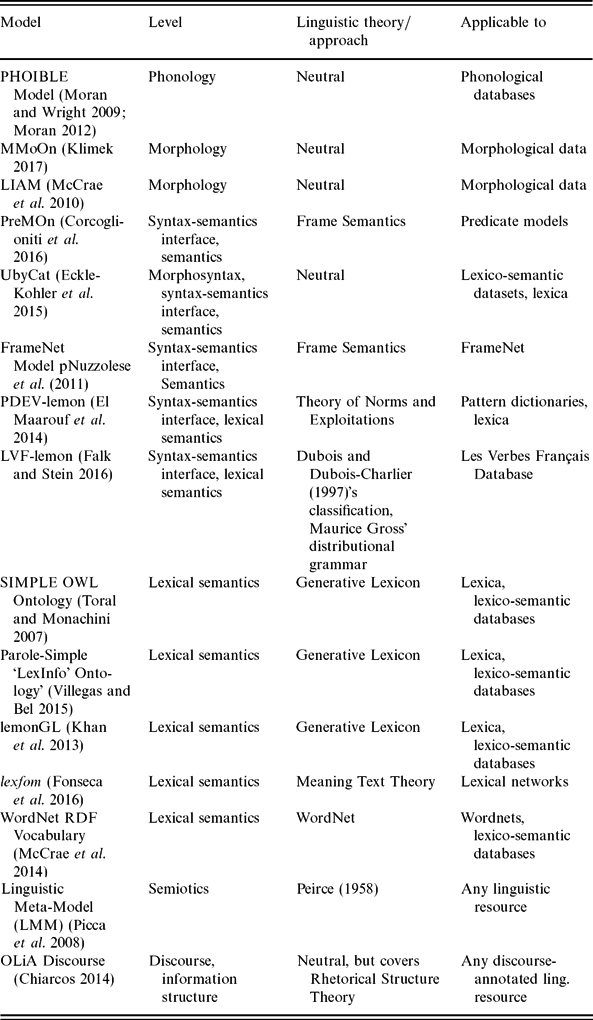
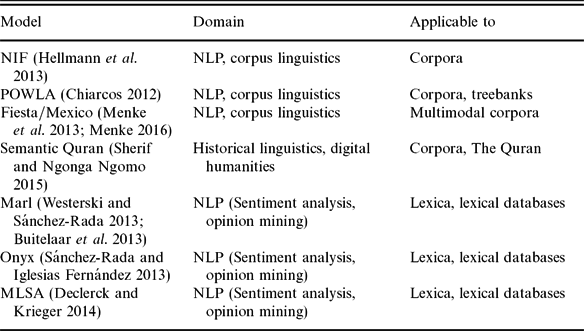
Table 1 summarises the models mentioned in this group, along with the domain in which they have been developed or are commonly used, and the type of resources to which they can be applied.
Group 1: Models to represent the main elements of lexical resources

3.2 Group 2: Level and theory-specific models and extensions
In addition to the models that describe the structure of a lexical entry, its relations to other elements in the lexicon or to concepts in an ontology, we find a series of contributions which present extensions to the models mentioned above and new ontologies to capture, with a high level of granularity, content from a specific level of linguistic analysis and notions coming from branches or sub-branches related to linguistics (lexicography, comparative linguistics, historical linguistics, terminology, etc.) and linguistic theories.
3.2.1 Models for different levels of linguistic analysis
In the following, we go over the ontologies and extensions to the models presented in Section 3.1 developed to address linguistic content from each of these levels and their interfaces following the order presented in Figure 1.
Phonetics and phonology
Phonetics and phonology remain two areas with relatively low coverage in the LLOD cloud. PHOIBLE (Moran and Wright Reference Moran and Wright2009; Moran Reference Moran, Chiarcos, Nordhoff and Hellmann2012) was proposed for the creation of a knowledge base for phonological typology that integrates content from several segment inventory databases into one interoperable dataset. A model is developed to associate segments to the languages in which they occur (e.g., hasSegment), features to segments (hasFeature) and metadata and bibliographic information (sources) to each segment inventory. The GOLD (Farrar and Langendoen Reference Farrar and Langendoen2003), on the other hand, contains classes to encode phonetic, specifically, articulatory features (e.g., SupraLaryngealProperty), and phonological information, but to the best of the authors’ knowledge, there is no instantiation of these concepts in phonetic datasets yet.
Morphology
In addition to the classes, properties and individuals available in linguistic data category registries (Section 3.3), MMoOnFootnote 38 (Klimek et al. Reference Klimek, Arndt, Krause and Arndt2016; Klimek Reference Klimek2017) was recently made available with the specific aim of representing lexemes, word forms, morphological patterns and any other morphological information at the sub-word level relevant in morphology. The ontology, with classes such as mmoon:Morph, mmoon:Morpheme and mmoon:Meaning and links to ontologies of linguistic description and annotation, allows for the creation of morpheme inventories for any inflectional language through language specific schema levels that extend the core of the ontology. Previously, the lemon model included a morphology module (McCrae et al. Reference McCrae, Aguado-de-Cea, Buitelaar, Cimiano, Declerck, Gómez Pérez, Gracia, Hollink, Montiel-Ponsoda, Spohr and Wunner2010) intended to capture morphological patterns and rules that would prevent the explosion of instantiated lemon:Forms in case of languages of rich synthetic and polysynthetic morphology. Classes such as lemon:MorphPattern, lemon:MorphTransform and properties as lemon:rule and lemon:generates allow to encode the morphological pattern the lexical entry shows and the set of transformations that would systematically generate a series of inflected forms of that lexical entry. This module is now available as the Lemon Inflectional Agglutinative Morphology ontology.Footnote 39
Syntax
The syntax domain is mainly addressed by the annotations schemes present in linguistic data category registries, which are covered in detail in Section 3.3. At the time of writing, LLD resources that instantiate models covering this layer are still scarce except from annotated corpora such as the NEGRA Corpus (Skut et al. Reference Skut, Brants, Krenn and Uszkoreit1998; Chiarcos et al. Reference Chiarcos, Hellmann, Nordhoff, Chiarcos, Nordhoff and Hellmann2012b).
Syntax-Semantics interface
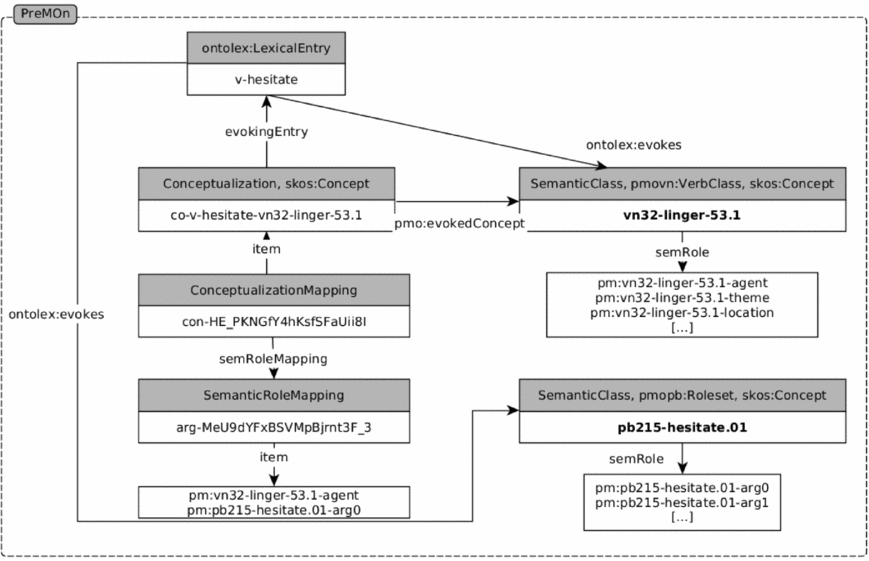
The representation of the interface between syntax and semantics is receiving much attention by the community. The newly developed PreMOn (Corcoglioniti et al. Reference Corcoglioniti, Rospocher, Aprosio and Tonelli2016) and its extension to model NomBank,Footnote 40 PropBank,Footnote 41 VerbNet,Footnote 42 and FrameNetFootnote 43 are put forward as complements to lemon to represent predicate models and their mappings (SemLinkFootnote 44) as LD. The model, just as MMoOn for morphology, responds in an OntoLex-compliant fashion to the lack of a single ontological model in RDF/OWL to represent these resources in an homogeneous way. The proposed extensions for each of the resources are intended to encode the particular features of a predicate model, whereas the PreMOn core ontology, with classes such as pmo:SemanticClass and pmo:SemanticRole and properties that relate classes and roles, serves both as foundation to achieve semantic interoperability between the extensions and as link to OntoLex and SKOS. An extract of the entry hesitate modelled with PreMOn is illustrated in Figure 5. The entry hesitate evokes several concepts, represented in this figure as instantiations of semantic classes from VerbNet (linger-53.1) and PropBank (hesitate.01). Each of these instantiations is linked to the series of thematic roles that the verb selects (in the case of VerbNet) or its numbered arguments (PropBank), lumped together in the same box in this figure for space reasons. There is a conceptualisation mapping (which in the actual data takes two conceptualisations, co-v-hesitate-vn32-linger-53 and co-v-hesitate-vn32-linger-53.1). This mapping allows to establish a semantic role mapping between VerbNet’s hesitate agent role and PropBank’s arg0 for hesitate.
The lexical entry hesitate modelled with PreMOn.

FrameNet, along with other lexico-syntactic and lexico-semantic resources (WordNet,Footnote 45 VerbNet, OmegaWikiFootnote 46 in German and English and WiktionaryFootnote 47 in English and German) had previously been converted to lemon in lemonUby (Eckle-Kohler, McCrae and Chiarcos Reference Eckle-Kohler, McCrae and Chiarcos2015). The vocabulary ubyCat was proposed to extend lemon with data structures found in UBY resources (in LMF) and to link the data categories in UBY resources to those already defined in current linguistic data category registries. However, the challenge in this contribution was the mapping of LMF elements in UBY resources to lemon, rather than the development of a new ontology to cover a specific type of information (Eckle-Kohler et al. Reference Eckle-Kohler, McCrae and Chiarcos2015). Nonetheless, the ubyCat extension is reused in the conversions of other works to RDF (e.g., Swedish FrameNet RDF (Borin et al. Reference Borin, Dannells, Forsberg and McCrae2014)) and, since it includes equivalences from concepts present in the resources to their lemon counterpart, the ontology serves as guide to map concepts to lemon as well.
Prior to lemonUby and PreMOn, and independently from lemon, FrameNet 1.5Footnote 48 was converted to RDF through the use of the SemionFootnote 49 tool, and a method was proposed to extract knowledge patterns from FrameNet frames (Nuzzolese, Gangemi and Presutti Reference Nuzzolese, Gangemi and Presutti2011). The OWL metamodel developed in that work sticks strongly to the structure of FrameNet, as opposed to the extension suggested in PreMOn (see Corcoglioniti et al. (Reference Corcoglioniti, Rospocher, Aprosio and Tonelli2016) for more details). An integration of FrameNet in LOD with the NLP Interchange Format (a model for the representation of corpora described in Section 3.4) building upon that previous work has also been put forward (Alexiev and Casamayor Reference Alexiev and Casamayor2016).
A renown lexical resource for English is the Pattern Dictionary of English Verbs (PDEV),Footnote 50 a database of English verbs that gathers the common syntagmatic patterns of use of each verb, expresses them in terms of an ontology of semantic and syntactic categories, and associates them with a meaning, implicature or entailment in order to illustrate verbal behaviour (Hanks Reference Hanks2007). These patterns are extracted through Corpus Patterns Analysis (Hanks Reference Hanks2004), which is based on the Theory of Norms and Exploitations (Hanks and Pustejovsky Reference Hanks and Pustejovsky2005; Hanks Reference Hanks2013). One of the challenges of converting PDEV to lemon rests on the fact that the model lacks a way of connecting a syntactic frame to a lexical sense directly: This connection depends on the syntactic arguments, so that the meaning of the syntactic frame will then be inferred from the meaning of the concepts and properties corresponding to the arguments (El Maarouf, Bradbury and Hanks Reference Maarouf, Bradbury and Hanks2014). Cases in which the meaning is not compositionally built from the meaning of the arguments (such as idioms, one of the focus of the Theory of Norms and Exploitations) give rise to modelling problems.
The lack of direct connection from a syntactic frame to a lexical sense in lemon and OntoLex (link only through the class OntoMap) is also encountered in recent work in the conversion of other verbal inventories, as LVF (Falk and Stein Reference Falk and Stein2016). In PDEV-lemon, the authors tackle the problem with the ad-hoc classes :frameSense and its inverse, included in the ontology suggested as extension to lemon, together with other four new ontologies covering pattern domains, pattern registries, semantic types and contextual roles, respectively. Figure 6 shows the modelling of the entry we mentioned earlier, hesitate, in PDEV-lemon. Note that, whereas PreMOn captures the semantics of hesitate in terms of verb classes and verbal propositions in VerbNet and PropBank, by representing semantic roles, their mappings, and selectional restrictions on the arguments, PDEV-lemon introduces semantic types and prototypicality of arguments in syntactic frames and gives the implicature of the verb in the specific patterns in which it occurs.
The lexical entry hesitate modelled with PDEV-lemon.

The ontologies put forward as part of the PDEV-lemon effort and the ubyCat vocabulary introduced above, in conjunction with lemon, are also suggested for the modelling of the ‘Les Verbes Français’ (LVF) (Falk and Stein Reference Falk and Stein2016). LVF is a lexico-syntactic resource in French where each verb sense comprises a semi-formal semantic description (an operator, which is a combination of primitive predicates and a semantic class), and a series of syntactic constructions which in turn contain information about the syntactic arguments, adjuncts and some features of their realisations. LVF-lemon turns to the lemon core to encode morphology, to the UBY ontology for syntactic constructions, to VerbNet for thematic roles, to PDEV-lemon ontologies for the conceptual layer, and provides some ad-hoc extensions for syntactic types and operators. The authors argue, however, that verb senses in LVF do not seem to fit into the LexicalSense class available in lemon: in LVF, they are induced from the semantic descriptions provided (through semantic class and semantic primitives information). The authors of LVF-lemon show that the mapping to lemon of the semantic primitives that form up the complex meaning of senses is not a trivial task in itself.
(Lexical) Semantics
In addition to those ontologies developed as part of PDEV-lemon in the context of the Theory of Norms and Exploitations and the efforts towards the migration of FrameNet to RDF (FrameNet as resource conceived from the Frame Semantics approach), we found a series of contributions grounded in other linguistic theories.
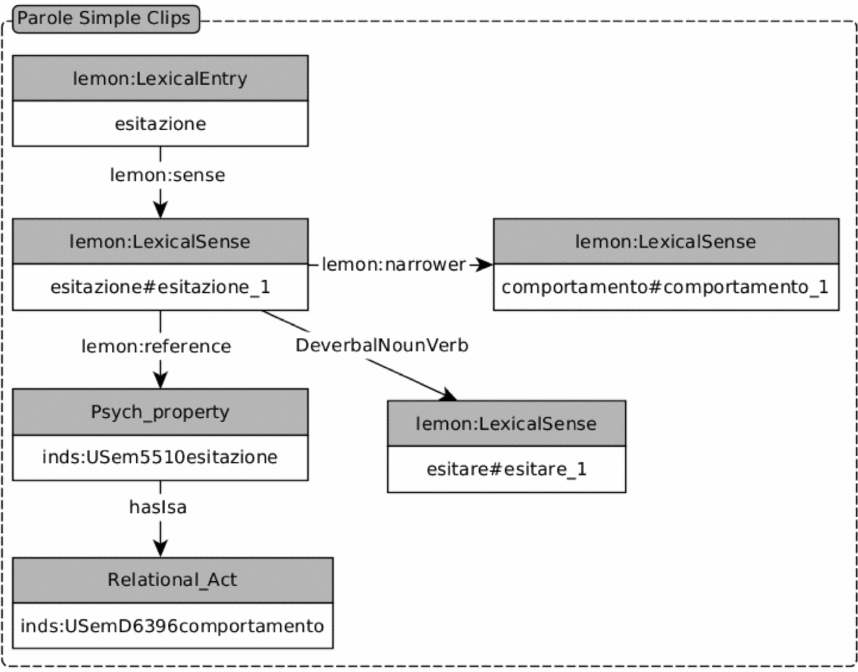
The SIMPLE-OWL ontology (Toral and Monachini Reference Toral and Monachini2007), for instance, is the OWL version of the SIMPLE ontology (Lenci et al. Reference Lenci, Bel, Busa, Calzolari, Gola, Monachini, Ogonowski, Peters, Ruimy, Villegas and Zampolli2000), a language-independent ontology of semantic types, semantic units, and semantic and lexical relations grounded in the extended qualia structure of the GL (Pustejovsky et al. Reference Pustejovsky1991). As a result of the PAROLE (Ruimy et al. Reference Ruimy, Corazzari, Gola, Spanu, Calzolari and Zampolli1998) and SIMPLE projects, which, respectively, aimed at creating a series of lexica and corpora with morphological and syntactic information in numerous European languages and at adding a semantic layer to them, the Parole-Simple datasets were developed. The Parole-Simple DTD has been mapped to lemon and to the linguistic data category catalogue LexInfo (Section 3.3) (Villegas and Bel Reference Villegas and Bel2015) in the Parole-Simple LexInfo Ontology for the conversion of the Spanish and Catalan portions of the data (Parole-Simple Spanish and Catalan lexica). Such conversions called for the definition of new classes such as parole:TemplateTop to encode semantic template following the SIMPLE ontology, e.g., parole:SymbolicCreation, parole:Human; and new syntactic and morphosyntactic properties subsumed by linguistic data category catalogues and lemon properties in order to represent, for instance, syntactic functions; and new semantic relations (e.g., causativity), among other aspects. Many elements in the DTD were in fact not longer needed once the model was mapped to RDF (Villegas and Bel Reference Villegas and Bel2015). The conversion of the Italian Parole-Simple lexica to lemon and the extensions to them developed in the context of the CLIPS Italian project (Ruimy et al. Reference Ruimy, Monachini, Distante, Guazzini, Molino, Ulivieri, Calzolari and Zampolli2002) (hence, the Parole-Simple-Clips dataset) have also been addressed through the use of the SIMPLE-OWL ontology (Del Gratta et al. Reference Del Gratta, Frontini, Khan and Monachini2015). An example of this dataset for the entry esitazione ‘hesitation’, is provided in Figure 7. Note that one of the lexical senses of esitazione takes as conceptual reference an instantiation of the class Psych_property from the Simple Ontology (USem5510esitazione), and this instantiation is in turn a type of comportamento ‘behaviour’, an instantiation of the class Relational_Act in the model.
The lexical entry hesitate modelled in Parole-Simple Clips.

Furthermore, lemonGL (Khan et al. Reference Khan, Frontini, Gratta, Monachini and Quochi2013) was presented as an extension to lemon to better capture the structure of a lexical sense in terms of the GL qualia roles (formal, constitutive, agentive, and telic). The authors address the limitations of lemon to account for logical polysemy Pustejovsky and Bouillon (Reference Pustejovsky and Bouillon1995) by suggesting a lexical sense element in lemon that is linked to qualia and argument structures (lemonGL:QualiaStructure, lemonGL:hasQualia), which in turn are associated with roles (e.g., lemonGL:hasTelic) in order to represent, following the GL theory, the different aspects of a single meaning.
Models grounded on the Meaning Text Theory (Mel’cuk Reference Mel’cuk1995, Reference Mel’cuk and Cowie1998) have also been proposed. The recent Lexical Functions Ontology Model (lexfom) (Fonseca, Sadat and Lareau Reference Fonseca, Sadat and Lareau2016) addresses the representation of lexical functions in a lemon-compliant way and arises as a mechanism to migrate lexical networks (lexical units and their relations) to LLD. The model provides modules for the representation of lexical function families (e.g., paradigmatic versus syntagmatic), semantic classes of lexical functions; features, constituents and government patterns of lexical functions, and means to link lemon lexical senses as the keywords and values of these functions. The model is grounded on the idea that the nodes in a lexical network are already disambiguated, therefore, the connection of lexical items through lexical functions take place at the level of the lexical sense via vartrans:SenseRelations.
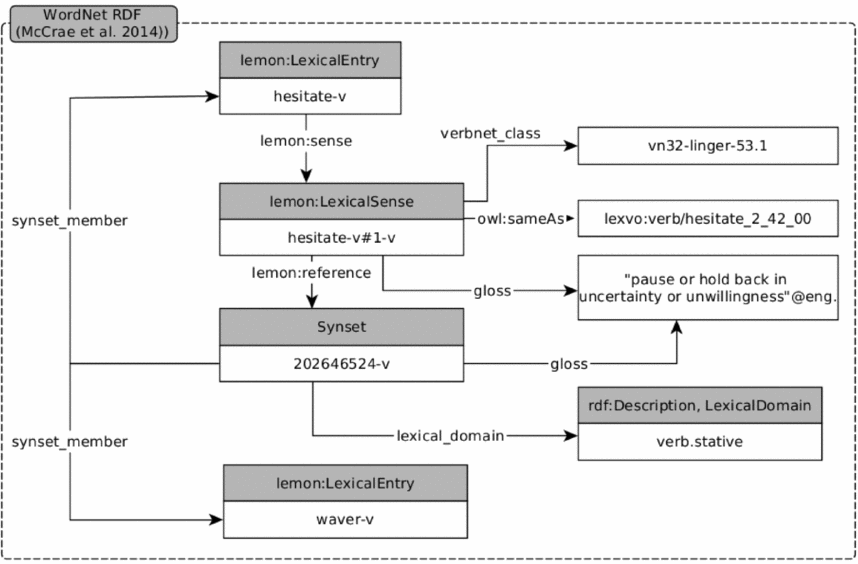
We also highlight at this point the work towards the migration of WordNet 3.0 to RDF using lemon. Prior to lemon and OntoLex, WordNet 2.0 had been previously converted to RDF, relying in a custom data model.Footnote 51 In the conversion from Princeton WordNet to LLD (McCrae et al. Reference McCrae, Fellbaum and Cimiano2014), WordNet synsets are viewed as the ontological references of lemon lexical senses, and new classes (e.g., Synset as subclass of skos:Concept, Lexical Domain, etc.) properties to encode hyponymy, meronymy, entailment, etc., and individuals of lexical domains (e.g., noun.process) were defined to account for the lexical information present in WordNet. This is illustrated in Figure 8 with a sense of the entry hesitate linked to a synset as reference. Through this concept, we can access other members of that synset as well as information on its lexical domain, among other aspects. This modelling in lemon has been recently adapted to OntoLex.Footnote 52 Some of the main differences include the use of the class ontolex:LexicalConcept for synsets and the mapping of lexical concepts to the Collaborative Interlingual Index (Bond et al. Reference Bond, Vossen, McCrae and Fellbaum2016).
The lexical entry hesitate modelled in WordNet RDF (2014).

The Global WordNet Formats to publish WordNetsFootnote 53 reuse the entities from the WordNet ontology as RDF and JSON-LD, along with the OntoLex vocabulary. Another ontology developed in order to convert a lexico-semantic resource is in fact the EuroWordNet Multilingual Central Repository Ontology,Footnote 54 generated from the LMF versions of WordNet Lexica included in the Multilingual Central RepositoryFootnote 55 (Gonzalez-Agirre, Laparra and Rigau Reference Gonzalez-Agirre, Laparra and Rigau2012), which builds upon the EuroWordNet Top Ontology (Vossen et al. Reference Vossen, Bloksma, Rodriguez, Climent, Calzolari, Roventini, Bertagna, Alonge and Peters1998). The EuroWordNet MCR Ontology serves as foundational backbone to generate the EuroWordNet lemon lexica available in the MCR.
Semiotics
Before moving into models for the representation of discourse, and still closely related to semantics, we turn to the realm of semiotics, concerned with the study of the meaning of signs in communication systems. The Linguistic Meta-Model (Picca, Gliozzo and Gangemi Reference Picca, Gliozzo and Gangemi2008) enables the representation of knowledge according to different semiotic theories in terms of the semiotic triangle (symbol – reference – thought of reference) (Ogden et al. Reference Ogden, Richards, Ranulf and Cassirer1923; Peirce et al. Reference Peirce, Hartshorne, Weiss and Burks1958). Its core consists of the classes Reference, Meaning and Expression, each of them with a series of subclasses inspired or derived from Descriptive Ontology for Linguistic and Cognitive Engineering (Gangemi et al. Reference Gangemi, Guarino, Masolo, Oltramari and Schneider2002), and it is extended by a second module that accounts for specific linguistic references, e.g., lmm2:ExtensionalReference. This model serves as basis for the Semiotics Ontology,Footnote 56 imported by OntoLex, and includes also pragmatics-inspired elements such as the class LinguisticAct.
Discourse and information structure
The OLiA, explained in more detail in Section 3.3, aim to achieve conceptual interoperability among different annotation schemes and external terminology repositories through an intermediate conceptual layer, the OLiA Reference model. The OLiA Discourse extension (Chiarcos Reference Chiarcos2014) for the Reference Model addresses the information encoded in major discourse annotated corpora available nowadays and incorporates notions from other efforts that revolve around the representation of discourse (such as NERDFootnote 57 or the Grounded Annotation FrameworkFootnote 58). The annotations this extension addresses pertain to discourse structure, coherence relations, coreference and bridging, information structure (topic-focus) and information status (given-new) with classes such as DiscourseCategory, DiscourseRelation and DiscourseFeature and a long list of subclasses and properties that capture the different phenomena. The extension focuses on the annotation schemes of the Rhetorical Structure Tree Bank,Footnote 59 grounded on the Rhetorical Structure Theory (Mann and Thompson Reference Mann and Thompson1988), OntoNotes (Pradhan et al. Reference Pradhan, Hovy, Marcus, Palmer, Ramshaw and Weischedel2007) and the Penn Discourse Tree BankFootnote 60 and Graph Bank (Wolf and Gibson Reference Wolf and Gibson2005) (PDTB and PDGB, respectively). One of the author’s main points, along with the NLP interoperability advantage and the potential use of the reference model in corpus query systems, is that this extended reference model of OLiA allows to generalise over the Rhetorical Structure Tree Bank and PDTB, which are conceived from different theoretical backgrounds, by providing a shared terminology that separates discourse relations (the central aspect of the PDTB approach) from discourse structural ones (the latter playing an important role in RST). This idea, in turn, is based on the benefits of a common conceptual layer among different schemes to compare, integrate, or revisit them (see Section 3.3).
Table 2 lists the models mentioned in this section, including the level of linguistic description they address, the theory on which they are grounded (if any) and the type of resources to which they are applied. The structure of this table differs from Table 1 to reflect the fact that the systems described in this section deal with specific levels of linguistic analysis.
Group 2a: Models for different levels of linguistic analysis

3.2.2 Group 2b: Models for specific branches of applied linguistics and related areas
There exist other kinds of extensions and efforts in the development of models for the representation of language resources as LD presented from the perspective of a sub-discipline of linguistics (not theoretical) or a related research area. These are targeted at addressing gaps in the representation of information common to a specific field of study (e.g., historical linguistics, contrastive linguistics/typology, terminology and lexicography), rather than to a particular level of linguistic analysis. We go through the ontologies and extensions designed for this purpose in the following paragraphs, focusing on historical linguistics, lexicography and cross-linguistic studies.
Historical linguistics
In historical linguistics, and, in particular, diachronic semantics, for instance, the semantic shift in word meanings is an object of study. lemonDIA (Khan et al. Reference Khan, Boschetti and Frontini2014) is developed as an extension to lemon to capture the meaning change in a lemon lexical entry throughout time as a perdurant entity in order to dodge the unfeasability of adding an extra time argument to RDF triples (Khan, Diaz-Vera and Monachini Reference Khan, Diaz-Vera and Monachini2016a). The authors suggest the inclusion of a class DiachronicShiftObject with an associated TimeInterval, and one or more lexical senses can be linked to it. This approach is further updated with classes such as a perdurant LexicalSense (LexicalpSense) to which a Semantic Shift element can be linked, LexicalDomain, NegatedShift and links to the Time Ontology in OWLFootnote 61 for the conversion of historico-philological data (Khan et al. Reference Khan, Diaz-Vera and Monachini2016a). An interface to create datasets based on lemonDIA is also provided (Khan, Bellandi and Monachini Reference Khan, Bellandi and Monachini2016b).
In relation to historical linguistics and moving into lexicography, the European Network of e-Lexicography is fostering work towards the conversion of a range of dictionaries, some of which contain historical data, to LLD based on the OntoLex model. To this aim, new classes and properties are defined to capture information which the lemon and OntoLex models fall short of covering. This is the case, for instance, of the class Etymology and the properties encoding different types of temporal information, in the recent conversion of thirteen dictionaries (dialectal, bilingual, monolingual, historical, etc.) carried out as part of European Network of e-Lexicography (Declerck et al. Reference Declerck, Wandl-Vogt and Mörth2015). An extension to lemon to represent etymological information of lexical entries has also been proposed (lemonet) (Chiarcos and Sukhareva Reference Chiarcos and Sukhareva2014). Recently, a new revisited version of lemonet builds upon the properties proposed in the modelling of the etymological WordNetFootnote 62 in order to undertake the conversion of the Tower of Babel (Starling)Footnote 63 with properties such as lemonet:cognate and lemonet:derivedFrom as subproperties of vartrans:lexRel from the vartrans module of OntoLex (Abromeit et al. Reference Abromeit and Fäth2016). This last work has been launched in the context of the Linked Open Dictionaries project,Footnote 64 which, among other aspects, aims to apply the LD paradigm to develop new methodologies for the research in (historical) linguistics, cross-lingual lexicography and historical sciences.
Lexicography
Structures typically found in dictionaries, be they historical or not, such as the sense and sub-sense hierarchy in an entry, raise problems as well. lemonLSJ (Khan et al. Reference Khan, Frontini, Boschetti and Monachini2016c) and polyLemon (Khan et al. Reference Khan, Diaz-Vera and Monachini2016a) both emerge as extensions to lemon to capture this sense and sub-sense structure in a dictionary entry, the former specifically developed during the migration of the Liddell–Scott Greek–English LexiconFootnote 65 to lemon. Both extensions suggest the inclusion of the properties senseChild and senseSibling to relate senses and their parent senses in the dictionary entry. Ad-hoc vocabularies for the conversion of monolingual and bilingual lexica to lemon and OntoLex have also been proposed, for instance, for the conversion of K Dictionaries data (Klimek and Brümmer Reference Klimek and Brümmer2015; Bosque-Gil et al. Reference Bosque-Gil, Gracia, Montiel-Ponsoda and Aguado-de-Cea2016a). Such works aim to account for the proprietary XML tags and values whose labels were not present or had an incompatible definition in external linguistic terminology repositories. The conversion from TEI to RDF of dialectal dictionaries of Arabic for their subsequent integration using OntoLex has been addressed as well (Declerck and Mörth Reference Declerck and Mörth2016). The focus here has been on how the several lexical senses of an entry across different dialectal dictionaries, if gathered in a sense repository and mapped when equivalent, enable the navigation through the different entries and the enrichment of one another.
With regards to the representation of the multilingual aspect in dictionaries, and lexical resources in general, a translation module for lemon was proposed (Gracia et al. Reference Gracia, Montiel-Ponsoda, Vila-Suero and Aguado-de Cea2014), the lemon translation module. This module, reused in resources such as the Apertium RDF series (Gracia et al. Reference Gracia, Villegas, Gómez-Pérez and Bel2018), inspired later the vartrans module of OntoLex. With classes such as vartrans:Translation and the properties vartrans:source and vartrans:target, for example, the vartrans module provides mechanisms to describe translation relations between senses of different lexical entries and their directionality.
Prior to the lemon translation module, WiktionaryFootnote 66 was converted to lemon in the DBnary resource (Sérasset Reference Sérasset2015; Tchechmedjiev et al. Reference Tchechmedjiev, Sérasset, Goulian and Schwab2015) which, at that time, needed the definition of a db:Translation class with a series of properties to refer to the target language and the information concerning the source sense and the target sense, etc. Other classes and properties included in DBnary do not attempt to fill a gap in lemon but rather to deal with the fact that Wiktionary has its own legacy structure: different lexical entries may occur in the same Wiktionary page, relations might be underspecified or link two senses, others may link a sense to a Wiktionary page, etc. Figure 9 illustrates the kind of information that DBnary provides for the entry hesitate: translations are represented at the lexical entry level with their own class and a target language. In contrast to WordNet RDF, lexical definitions or glosses are represented at the lexical sense level. Note that DBnary introduces classes such as db:Page reflecting the legacy structure of Wiktionary.
The lexical entry hesitate modelled in DBnary.

Also, in relation to translations, we mention the Panlex Vocabulary (Westphal, Stadler and Pool Reference Westphal, Stadler and Pool2015), developed in the context of the PanLex project to gather translations among lexemes in different languages. PanLex includes both very general purpose classes such as plx:Definition or plx:Expression (the latter being used for lexemes as lexical entries), and classes to represent languages, their varieties and ISO language codes (plxo: Language, plx:LanguageVariety).
The problems encountered in the conversion of dictionaries, the majority of which have been highlighted in the definition of the requirements for the OGL (Section 3.1), prove that the mapping of proprietary formats to a standard framework like lemon is not always straightforward due to the type of information included in dictionary entries: lexicographic annotations, the structure of the dictionary entry itself and numerous elements that do not have an homologous one in other models and/or external ontologies for linguistic description. lemon and OntoLex, in fact, though devised from a lexicographic perspective, were originally intended to lexicalise ontologies, not to model lexicographically rich linguistic resources to RDF, which however is the use to which the vast majority of the community is currently turning. Even so, by using extensions and ad-hoc vocabularies, dictionary data are increasingly being converted to LLD, and the benefits of LD for lexicography are currently being explored (Declerck et al. Reference Declerck, Wandl-Vogt and Mörth2015; Klimek and Brümmer Reference Klimek and Brümmer2015; Bosque-Gil et al. Reference Bosque-Gil, Gracia, Montiel-Ponsoda and Aguado-de-Cea2016a; Declerck and Mörth Reference Declerck and Mörth2016; Parvizi et al. Reference Parvizi, Kohl, González and Saur2016) etc. At the time of writing, the OntoLex community is discussing a series of best practices for the representation of rich lexicographic resources as LLD as part of a new module.Footnote 67
Typology and cross-linguistic studies
In the line of linguistic typology, language documentation and cross-linguistic studies in general, and in addition to some catalogues of linguistic categories (Lexvo.org and Glottolog/Langdoc, discussed later in Section 3.3) and PHOIBLE (introduced above), we point out the Typological Database System ontologies (Saulwick et al. Reference Saulwick, Windhouwer, Dimitriadis and Goedemans2005), which, through an architecture similar to OLiA’s Reference Model mentioned above, aim to integrate the different theory-specific models of typological databases to allow for cross-database searches. To this aim, an ontology of linguistic typology is developed to serve as a shared vocabulary across the various local models. It encompasses the notions present in all of them (e.g., word order) through concepts that unify the different theory-dependent views, while keeping the theory-specific definitions at the local level. In addition, the Cross-Linguistic Linked Data Project (Forkel Reference Forkel2014) promotes the creation of a LD infrastructure to integrate and publish typological data sets (PHOIBLE, WALS,Footnote 68 WOLD,Footnote 69 Glottolog,Footnote 70 afbo,Footnote 71 among others) and suggests to that aim a typological data model that accommodates to the diverse resources.
Terminology
The conversion of resources to LLD has also been addressed in the domain of terminology. In addition to SKOS, the model to represent taxonomies and thesauri introduced at the beginning of Section 3, and its extension SKOS-XL, best practices have been defined for the generation of LLD from terminological resources in the TBX format.Footnote 72 This has been the case in the context of the conversion of IATEFootnote 73 and the European Migration NetworkFootnote 74 datasets to RDF using OntoLex and a specific vocabulary put forward for that purpose (Lider Term Base eXchange Ontology) (Cimiano et al. Reference Cimiano, McCrae, Rodríguez-Doncel, Gornostay, Siemoneit and Lagzdins2015). This vocabulary encodes header information, reliability codes or information related to transactions, for example. OntoLex alone (together with its modules), has also proved to be rich enough to cover basic terminological multilingual information (e.g., definitions and translations) as the one given in some resources such as the Terminoteca RDF (Bosque-Gil et al. Reference Bosque-Gil, Montiel-Ponsoda, Gracia and Aguado-de-Cea2016b).
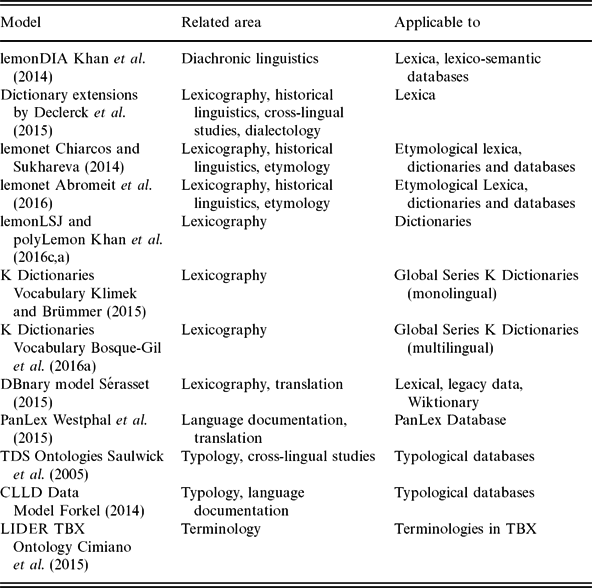
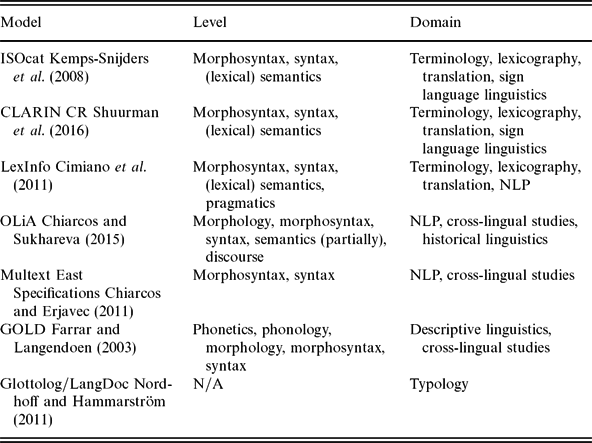
Table 3 groups the models explained above, providing the area of linguistics to which they are related and the type of language resource to which they are being applied.
Group 2b: Models for specific branches of applied linguistics and related areas

3.3 Group 3: Linguistic data category registries
This subsection dwells on ontologies of linguistic description and linguistic data category registries in general. Most of the models presented above often turn to these categories as a basis to create their custom vocabularies for three main reasons: To comply with the community’s view of the domain or the linguistic tradition (Parvizi et al. Reference Parvizi, Kohl, González and Saur2016), to establish mappings between their defined elements and the ones in the linguistic terminology ontology (Klimek Reference Klimek2017), or to point to them as external resources (Hellmann et al. Reference Hellmann, Lehmann, Auer and Brümmer2013) that can be used together with the developed model.
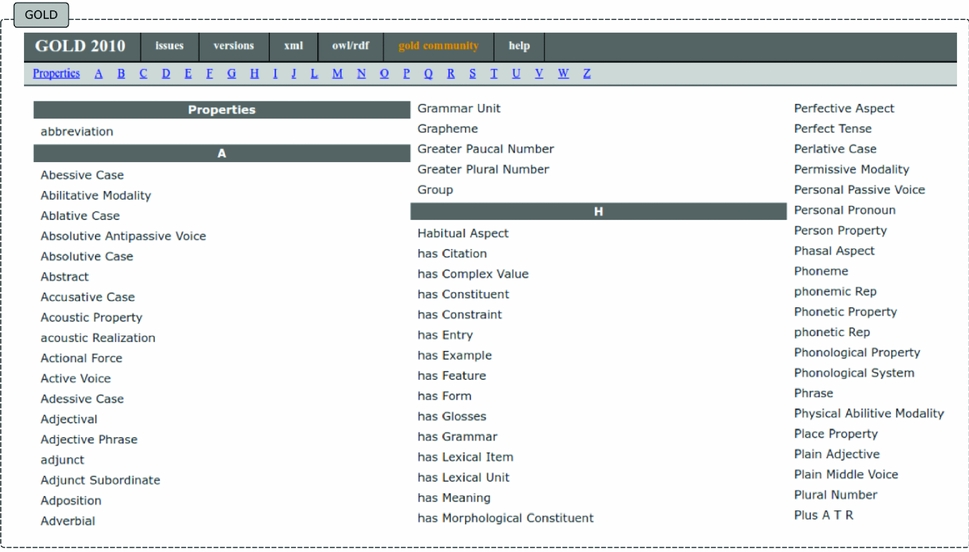
Developed from a typological viewpoint, the GOLD (Farrar and Langendoen Reference Farrar and Langendoen2003) constituted the first effort towards a repository of linguistic terminology in the Semantic Web and was developed as a comprehensive ontology that refines the Suggested Upper Merged OntologyFootnote 75 with linguistic constructs, basic concepts used in linguistic analysis, grammatical categories and types of linguistic expressions with the aim of serving as a central terminological resource to enable data comparison across languages. In its 2010 version, it addressed the morphosyntax, morphosemantic (e.g., mood, aspect, and tense) and phonetic layers (Figure 10). In contrast to ontologies such as Descriptive Ontology for Linguistic and Cognitive Engineering (Gangemi et al. Reference Gangemi, Guarino, Masolo, Oltramari and Schneider2002), which were devised for NLP purposes, GOLD is developed for cross-lingual studies and is inspired by typological initiatives such as WALS (Farrar and Langendoen Reference Farrar and Langendoen2003).
A small section of the GOLD ontology in its Web interface.

We also highlight the ISOcat ISO TC37 Data Category Registry in its adaptation from the XML data model to an RDF model (Windhouwer and Wright Reference Windhouwer, Wright, Chiarcos, Nordhoff and Hellmann2012) and the Relation Registry RELcat to relate the data categories (Windhouwer Reference Windhouwer2012). ISOcat is in turn based on ISO 12620:2009,Footnote 76 which establishes the specifications of data categories (the data model) and the management of such a registry (Kemps-Snijders et al. Reference Kemps-Snijders, Windhouwer, Wittenburg and Wright2008). Importantly, it is not a formal ontology but a structured collection of terms (Eckle-Kohler et al. Reference Eckle-Kohler, McCrae and Chiarcos2015), and ontological relationships are not contained in the registry, so that RELCat was developed to complement ISOcat in that respect. ISOcat was created initially to address data categories found in terminological databases, which in turn are common throughout annotation frameworks (Eckle-Kohler et al. Reference Eckle-Kohler, McCrae and Chiarcos2015), and it was used along with LMF in the CLARIN infrastructure to encode terminological, morphosyntactic and metadata information. ISOcat was, however, designed in a data-oriented way and the needs of the ISO TC 37 and the CLARIN community turned out to differ after time. The latter advocated a simpler model, easily reusable, focused rather on concepts and without constraints on data types and data categories. This led to the creation of the CLARIN Concept Registry by building upon ISOcat (Eckle-Kohler et al. Reference Eckle-Kohler, McCrae and Chiarcos2015; Shuurman et al. Reference Schuurman, Windhouwer, Ohren and Zeman2016).
Another linguistic data category registry is LexInfo (Cimiano et al. Reference Cimiano, Buitelaar, McCrae and Sintek2011), specifically developed to address the lexicon-ontology interface and widely used together with lemon and OntoLex (see El Maarouf et al. (Reference Maarouf, Bradbury and Hanks2014), Ehrmann et al. (Reference Ehrmann, Cecconi, Vannella, McCrae, Cimiano and Navigli2014), Sérasset (Reference Sérasset2015), Gracia et al. (Reference Gracia, Villegas, Gómez-Pérez and Bel2018), among others). LexInfo, building on LingInfo (Buitelaar et al. Reference Buitelaar2006) and LexOnto (Cimiano et al. Reference Cimiano, Haase, Herold, Mantel and Buitelaar2007), is a lexicon model that tackles the limitations of SKOS, RDF and RDFS in encoding linguistic information associated to the elements of an ontology, and it is grounded on the separation of the conceptual and linguistic layers. This separation lies behind the notion of ‘semantics by reference’ introduced above. The second version of LexInfo is an extensive ontology of types, values and properties derived partially from ISOcat,Footnote 77 and currently its elements capture information from the morphosyntactic (see Figure 11), syntactic, syntactic–semantic, semantic and pragmatic levels of linguistic description.
A small section of the LexInfo ontology in the ontology editor Protégé.

With an architecture different from LexInfo and ISOcat, the OLiA (Chiarcos and Sukhareva Reference Chiarcos and Sukhareva2015) seek to achieve semantic and syntactic interoperability between current linguistic annotation schemes and external terminologies through the use of a reference model, annotation models (or external reference models) and linking models as mediators of reference and annotation or external ones, e.g., PennTreeBank annotation model and linking model. The idea behind this architecture is to abstract from the specific annotation schemes and to provide a common ontological ground among the different models to allow for the generalisation, comparison and potential revision of the models that capture a range of linguistic phenomena. As of today, they are being reused in multiple conversions of corpora and lexico-syntactic resources (e.g., lemonUby) to LLD, and the linguistic content they cover ranges from morphology, morphosyntax, syntax, semantics (partially) and, with the OLiA Discourse extension, to discourse phenomena, including discourse structure, coherence relations, coreference and information structure and status (Chiarcos Reference Chiarcos2014; Chiarcos, Fäth and Sukhareva Reference Chiarcos, Fäth and Sukhareva2016b) (Figure 12).
A small section of the OLiA Refence Model in the ontology editor Protégé.

There has also been an effort to develop an ontology in OWL/DL from the Multext East Specifications for corpus morphosyntactic annotation (Chiarcos and Erjavec Reference Chiarcos and Erjavec2011). This effort provides numerous attributes and values for syntactic and morphosyntactic features of multiple languages along with notes and bibliography, etc. Through a rich feature set, the specifications account for a range of properties of languages with rich inflection and different typology.
In addition to the above-mentioned resources and also in relation with typology, there are typological databases such as Glottolog/Langdoc (Nordhoff and Hammarström Reference Nordhoff and Hammarström2011). This database provides a language family tree in terms of the notion of languoid, i.e., a language, dialect or language variety (Good and Hendryx-Parker (Reference Good and Hendryx-Parker2006) as cited in Nordhoff (Reference Nordhoff, Chiarcos, Nordhoff and Hellmann2012)) and links the information to the bibliographic records attesting it.
Table 4 summarises the information regarding the groups introduced in this subsection. For the sake of comparison of aim and scope, we include the level of linguistic description each catalogue covers and the branches of linguistics which may turn to it when representing their resources as LLD.
Group 3 models

3.4 Other models
This section mentions some of the models that do not fit into the groups presented above and which do not address the representation of purely linguistic content, as opposed to the works mentioned so far, but are rather focused on describing structural aspects of corpora or characteristics of NLP services. Although the analysis of these models falls outside the scope of this paper, it is worth mentioning them in order to enrich the context of this work. In fact, the models that we have reviewed in this survey are quite frequently used in conjunction with the ones that we report in the following paragraphs.
Corpora models
Models for corpora representation and their annotations as LLD focus on the structure of corpora, the documents themselves, the (multi-layer) annotations and the relation between the different annotations, and the text to which they are anchored. These models can often be combined with models to represent lexical resources (e.g., OntoLex) and linguistic data category catalogues (e.g., LexInfo, OLiA). Examples of efforts here are the NLP Interchange FormatFootnote 78 (Hellmann et al. Reference Hellmann, Lehmann, Auer and Brümmer2013), which can be used with the Open Annotation Data Model,Footnote 79 now superseded by the Web Annotation Data Model,Footnote 80 to represent corpora and annotations as LD to allow for the exchange of content between different NLP tools, and POWLA (Chiarcos Reference Chiarcos and Presutti2012) as a formalism based on RDF and OWL to represent (multi-layer) corpora annotations. The Open Annotation Data Model and other models developed in the context of Biomedical NLP have been applied to share and compare annotations from different corpora (Kim and Wang Reference Kim and Wang2012) on top of which to develop multi-layer corpora search tools (Kim, Cohen and Kim Reference Kim, Cohen and Kim2015). Additional corpora models are the annotation layer of TELIX (Rubiera et al. Reference Rubiera, Polo, Berrueta, El Ghali, Simperl, Cimiano, Polleres, Corcho and Presutti2012), the Fiesta/Mexico data model (Menke, McCrae and Cimiano Reference Menke, McCrae and Cimiano2013; Menke Reference Menke2016) to account for annotations in multimodal corpora taking into account different timelines and the Semantic Quran vocabulary (Sherif and Ngonga Ngomo Reference Sherif and Ngonga Ngomo2015), which was developed to model a multilingual dataset of translations of the Quranic Arabic Corpus and contains general purpose classes to represent chapters, verses, etc., and datasets with a hierarchical structure in general. As examples of corpora that reuse these models we mention The Universal Dependencies Treebank series in RDF, which use the NLP Interchange Format Format along with OLiA; the Manually Annotated Sub-Corpus (MASC) of the Open American National Corpus, which relies on POWLA and also reuses OLiA, and the Semantic Quran corpus, which uses its own vocabulary and links to GOLD to represent linguistic data categories.
Service-oriented models
There have also been advances in the development of models oriented towards NLP services that leverage lexical resources in the LLOD cloud. Marl (Buitelaar et al. Reference Buitelaar, Arcan, Iglesias~Fernández, Sánchez~Rada and Strapparava2013; Westerski and Sánchez-Rada Reference Westerski and Sánchez-Rada2013), for instance, is an ontology that aims at capturing the properties of opinions as expressed online for opinion mining services, while its Onyx extension (Sánchez-Rada and Iglesias Fernández Reference Rada and Iglesias Fernandez2013) is aligned with the WordNet-Affect taxonomyFootnote 81 and the Emotion Markup Language (EmotionML)Footnote 82 in order to encode emotions and their relations to the lexical items lexicalising them in a lemon-compliant fashion. In addition, the multi-layered reference corpus for German Sentiment Analysis (MLSA) in its LLD version (Declerck and Krieger Reference Declerck and Krieger2014) relies on a custom-vocabulary to encode polarity and factuality values.
Table 5 lists these models, the main areas of research in which they are or may be used, and the kind of resources that can instantiate them.
Other models

4 Discussion
The analysis of the different models described in the previous section reveals that representing linguistic content from language resources as LD is not a trivial task. Reusing already available representation mechanisms (e.g., lemon, SKOS) is a challenge when, at the same time, the modellers try to be respectful to the original resource annotations, be they inspired by tradition, linguistic theory or their use in applied and/or theoretical linguistics.
One of the main issues that our study illustrates is the proliferation of independently developed vocabularies that have a certain degree of overlap. In fact, vocabularies might have entities in common that may differ to smaller or greater extent from one another. Several resources may use the same type of annotations but define them differently in each case, and this leads in turn to different vocabularies created to transform them. Sometimes these differences between entities with the same label are motivated by practical or theoretical reasons. For example, the OGL Lexical Entry class used in the modelling of Oxford Dictionaries differs from ontolex:LexicalEntry because it was specifically devised for the conversion of those dictionaries, just as other ad-hoc elements defined in the K Dictionaries vocabularies which have a counterpart with the same name in data category registries not fully compatible with the original resource data model. Similarly, two ontologies with theoretical differences may include elements with the same label which may or may not refer to the exact same notion. This is the case of the class Vehicle in the PDEV-lemon ontology (derived from the Corpus Pattern Analysis Ontology), and another Vehicle as semantic class in the Parole Ontology (GL-based). Likewise, there is a Time Period in PDEV-lemon but no relation of this class to the time Intervals defined in the OWL Time Ontology, which, again, may be completely different or may share some basic definitions. A further example is the PanLex class plx:Expression and the homonym Semiotics Ontology class, and the list goes on. By pointing this out, we are not claiming that these classes should be related, that those models are lacking those relations or that one should reuse the other, but merely highlighting that there does not seem to be a reference model ‘glueing’ all these models to allow for their comparison. This proliferation of vocabulary entities with some overlap is also due to models being developed simultaneously, or to a model addressing gaps in the literature at that time (e.g., DBnary translation elements) that were further analysed and extensively covered by other models later on (e.g., lemon translation module, OntoLex vartrans module).
It is worth noting here that the syntax-semantics interface and lexical semantics, in general, seems to be one of the most challenging levels to represent as LD, and creating new classes in ad-hoc vocabularies does not always seem to achieve the required results. We have extensions for translations, discourse categories, etymology, morphology, etc., at other levels, but semantic classes, for instance, seem to be problematic still, specially if the resource includes content touching also upon semantic primitives and meaning decomposition, as is the case with LVF. A similar problem is addressed in PDEV-lemon when capturing the meaning of idioms and their relation (or lack of) to the meaning of their units, and the lexfom model showcases the difficulty in addressing collocations, pointing to future lines of work in that respect. Other levels of analysis, including pragmatics (e.g., speech acts), dialogue structure and phonetics and phonology remain as areas with still a very low coverage in the LLOD cloud.
Catalogues of linguistic data categories include numerous elements that thoroughly address the morphosyntax level. However, the number of corpora annotated with syntax is still low and the resources annotated (not as LD) with syntactic information beyond phrase or dependency structures, mainly for linguistic research, are hard to discover: resources with syntactic phenomena, (e.g., syntactic ellipsis, control-constructions) or with the syntactic constructions those linguistic units give rise to (e.g., seem as a raising to-subject verb) are still difficult to find. Therefore, since the amount of resources that contain such information is still limited, their LLD versions are even more scarce.
There are areas related to linguistics studies in which the LD paradigm is being successfully adopted, such as historical linguistics, lexicography, terminology and cross-linguistic studies. However, its application in other areas remains largely unexplored. That is, the case of speech processing, patholinguistics, sociolinguistics, forensic linguistics, psycholinguistics and neurolinguistics, along with second-language acquisition. This might be caused by a less obvious relation between some of the latter areas and NLP-based applications, as the resources used in many of these disciplines, e.g., sociolinguistics, are not commonly involved in NLP tools for machine translation, named entity recognition and linking, text summarisation, and the like. Interestingly, speech resources and spoken language data are building blocks of NLP systems for speech recognition, but the representation of multimedia data as LLD has not been much addressed in the literature apart from the Fiesta/Mexico model (Menke et al. Reference Menke, McCrae and Cimiano2013). Other emerging disciplines at the interface between those mentioned above and computer science, e.g., computational neurolinguistics, computational forensic linguistics, computational sociolinguistics, etc. are likely to face the same problems of other branches in linguistics, namely, syntactic and semantic heterogeneity, which the LD paradigm and the Semantic Web would potentially help solve.
Multilingualism and the added value of linking multilingual resources in the context of NLP systems and cross-linguistic studies has emerged as one trending topic in the work with LLD, and the properties available in the OntoLex vartrans module (coming in turn from the lemon translation module), LexInfo, DBnary and SKOS account for that aspect in different ways, so that these mechanisms provide a solid basis to represent multilingual data in the LLD context. Several challenges arise when trying to automatically establish links among resources in different languages (Gracia et al. Reference Gracia, Montiel-Ponsoda, Cimiano, Gómez-Pérez, Buitelaar and McCrae2012a; Gracia, Montiel-Ponsoda and Gómez-Pérez Reference Gracia, Montiel-Ponsoda and Gómez-Pérez2012b), or when determining if two entities serve as cross-linguistic equivalents in any context or only in certain contexts (as some commonly cited examples reveal: river versus Fr. rivière or flueve; president or prime minister versus Sp. presidente, etc.), or even when addressing specific features of a multilingual resource (for instance, multilingual examples in a dictionary).
As for the reuse of available mechanisms, and in addition to lemon and OntoLex established already as de facto standards, LexInfo and OLiA also seem to be the most reused external linguistic registries that are used with lemon and OntoLex, over ISOcat and GOLD. lemonUby categories and the PDEV-lemon ontologies are also, to a smaller extent, reused by other works presenting their own extension. At the instantiation level, although not the focus of this review, we mention linkage to WordNet as one of the pivotal steps in the linking of multilingual information carried out in several of the efforts mentioned above, and BabelNet as an encyclopedic hub linking linguistic resources in the LLOD cloud.
Even though this scenario offers a promising perspective of the LLD landscape and points to directions for future developments, there are still some aspects to be addressed on the way to a wider community adoption of LLD:
• First, in comparison to the number of resources available and growing, there are still few tools and services that consume LLD and that leverage the links across datasets. The benefits of LLD are partially outshined by this lack, which makes them not fully evident to experts outside the Semantic Web. The LLD community, however, has started to tackle it (McCrae et al. Reference McCrae and Cimiano2015; Chiarcos et al. Reference Chiarcos, Fäth, Renner-Westermann, Abromeit and Dimitrova2016a).
• Second, and related to what is described as the lack of expressivity in the LOD cloud (Jain et al. Reference Jain, Hitzler, Yeh, Verma and Sheth2010), the datasets in the LLD cloud are usually not annotated using the full potential that semantic formalisms allow. This, together with the lack of schema level links (Jain et al. Reference Jain, Hitzler, Yeh, Verma and Sheth2010; Millard et al. Reference Millard, Glaser, Salvadores and Shadbolt2010; Anjomshoaa et al. Reference Anjomshoaa, Kiesling, Tuan, Lam, Wetz and Tjoa2014), highlighted in this survey in the case of lexical semantic models, prevents reasoners from inferring more knowledge, which in turn would help in showing the full potential of LLD. A way to mitigate this issue will come from the application of ontology matching techniques to establish links among the different linguistic models and from the development of specific reasoners ready to deal with linguistic knowledge.
• A third reason here would be that the gap between linguistic knowledge in the sub-disciplines of linguistics and the linguistic knowledge available in linguistic models in the Semantic Web is still very wide. The intended use of this knowledge varies, as mentioned before: the knowledge needed for an application to perform named entity linking is different from the one needed for conducting theoretical linguistic research. Thus, domain experts working on, for instance, the properties of verbs of movement in English and Spanish, may find the information about verbs in current ontologies of little use for their research. However, as the models in this work reveal, gradually more and more granularity is being added onto the different levels through extensions, new ontologies and new use cases.
5 Conclusions
In this survey, we have provided an overview of the current and available mechanisms to model linguistic content as LLD in order to give a sense of the main lines of work, trends and remaining challenges in the field. Throughout the paper, we have tried to provide answers to the research questions raised in Section 2, namely the following:
(1) What are the available models that allow to represent linguistic information as LD in its different description levels?
(2) What are the main modelling difficulties that arise when representing linguistic information as LD and how do different models tackle them?
(3) How have such LD-based linguistic models been (re)used, adapted and extended?
(4) What are the major remaining challenges to describe linguistic content in the current LD-based models?
Research question 1 has been addressed in Section 3, specifically in Section 3.2. Tables 1–5 provide summaries to the main points highlighted in each subsection of Section 3.
The modelling difficulties in the representation of linguistic content as LLD we identified in our analysis (question 2) and some remaining challenges that are still to be faced (question 4) were considered and discussed in Section 4. In addition, the reuse, adaptation and extensions of general models to represent the structure of lexica (question 3) were described throughout Section 3.2, and also referred to as part of the discussion.
In terms of future work, there are several directions to pursue. First, this survey will serve as a general framework for a critical, comparative analysis of the models presented here. This comparison could be performed in terms of the practices built for ontology development followed in each case, the structural and logical consistency of the ontologies (supported by ontology evaluation tools and reasoners), their coverage of the domain, their reuse in the community, their maintenance and documentation, etc. The results of such a comparison would provide some guidance on which model better suits a specific use case. Second, although this work mentioned some gaps in the presented models, it was not focused on specific modelling solutions for linguistic phenomena. For each group and sub-group introduced in this survey, it would be interesting to further investigate modelling gaps through the analysis of a set of representative examples extracted from various language resources of different kinds. In addition, and in order to complement our descriptive approach in this article, we plan to analyse the patterns of use of some of the models discussed in the previous pages so as to detect, compare and discuss common and emerging modelling practices and instantiation choices per resource type in the representation of language resources as LLD. This analysis will be accompanied by both an overview of the resources that instantiate these models as well as statistics of their term coverage. The obtained results are expected to reflect the current modelling heterogeneity in the conversion of language resources to LLD and will serve as input for the revision of these models and ontologies. Last, more research is needed regarding the issues on the way for a wider community adoption of LLD, some of them mentioned above.