Introduction
What constitutes local history in strictly ideologically controlled Communist regimes? How do such regimes deal with their contentious, repressive, and dehumanizing pasts that are no longer consistent with current ideologies? How do official historical writers, especially those emerging from government ranks within authoritarian settings, navigate the tensions between their own historical integrity and the overarching mandates of state ideology?
Compared with emerging democracies, which necessarily confront such transitional justice issues, authoritarian states undergoing post-totalitarian shifts (Linz and Stepan Reference Linz and Stepan1996), such as post-Mao China, Khrushchev’s de-Stalinization reform (Markwick Reference Markwick and Jones2006), and East European states in the 1980s, do not need to completely overhaul or reveal their past histories. However, they still have to selectively and carefully manage their historical baggage, especially the recording and judgments of state-sponsored repression and civilian violence that are no longer congruous with current ideologies stressing stability and development. Contentious historical episodes can potentially exacerbate existing or create new political cleavages within society, especially among political elites who experienced disparate treatment and consequently hold divergent perspectives over the past. As such, post-totalitarian regimes need to craft a relatively cohesive narrative that grapples and defuses past injustices in order to bolster their ideological legitimacy and justify the succession of the current leadership.
Despite authoritarian states’ tendency to treat history as a key legitimization device and stifle alternative historical narratives, we argue that this predicament of handling contested historical legacies provides certain opportunities for historical justice, where the representation of history and the production of historiography are decentralized from the centralized authoritarian rule.
We theorize this process of decentralized historiographical negotiation. In this process, official history is selected, written, and presented in a manner that involves multiple actors across various levels of organizational hierarchy and different geographic regions. Instead of one centralized narrative strictly dictated and monopolized by the state, this negotiation acknowledges the presence of diverse inputs and the nuances that revisionist and local perspectives bring to the historical narrative. Local historians, editors, and officials have a higher degree of freedom to discuss, interpret, and record historical events even within official government histories compared with the totalitarian past. The dispersion of history production therefore allows for negotiation of what history is and how it should be presented. This negotiation involves actors across different administrative ranks and regions, covering key historiographical subjects such as the thematic essence, the scientific formality, the objectivity of local history writing, and the handling of politically sensitive topics.
In this article, we empirically examine the mechanisms of decentralized historiographical negotiation in authoritarian states by investigating the production process of Chinese local gazetteers (difangzhi 地方志). These gazetteers, which are part of an imperial historical and cultural tradition that chronicles local geographies and histories, have been revitalized in post-Mao China. Our study challenges the traditional view that the central government has persistently enforced its ideological and content-based authority over local subjects through the production. During the 1980s and 1990s, there existed vibrant and dynamic discussions regarding local gazetteer compilation that shifted common practices during that period and thereafter. Opinions from the bottom were able to sway and alter the original views held by the heads of the national office, allowing local editors to preserve their own stance in the final publication. Evidence of such cross-hierarchy negotiations indicates that despite being part of the bureaucratic system, some local gazetteer editors acted with a degree of independence and selectively followed orders from higher-level officials.
Documenting local history in Communist China
The origin, interruption, and relaunch of local gazetteers
The compilation of local gazetteers is an established and venerable tradition in China. During the imperial era, the central court mandated the compilation of local gazetteers, positioning them as critical tools for documenting local information, preserving historical records, and maintaining state unity. These initiatives were often directed from the provincial level to sub-provincial subordinates, or by local officials or eminent local gentry who voluntarily undertook gazetteer projects to gain prestige (Dennis Reference Dennis2015: 4–29). The compilation of imperial gazetteers was primarily an elite-centered activity, in which officials independently recruited authors and collected materials.
Similar to its imperial predecessor, the county gazetteers of Communist China were foremostly considered “state archives” (Zhongguo Difangzhi Xiehui 1991b: 52). The production of local gazetteers is essentially a governmental activity, so administrative authorities have facilitated the systemic access to historical archives and original materials that are relatively richer and more accurate than unofficial sources (Wang Reference Wang2009; Xue Reference Xue2010). However, the central government is also found to consistently intervene into the composition of local gazetteers through ideological guidance as well as publication and review protocols. These gazetteers were required to incorporate socialist elements to intentionally distinguish them from their imperial predecessors.
The origin of local gazetteers in Communist China can be traced to 1956, when the People’s Daily published an initiative to restart local gazetteer compilation (Wang Reference Wang1956). In 1958, Local Gazetteer Group (difangzhi xiaozu 地方志小组) was established under central government as a working group to lead the national production of local gazetteers (Zeng Reference Zeng1981). Within the same year, the group issued the document “Several Opinions on the Compilation of New Local Gazetteers,” which officially advocated for the innovation of the imperial gazetteer format and introduced the concept of “new gazetteers” (xinzhi 新志). It proposed several new principles, such as “serving socialism” and “ prioritizing contemporary over ancient history” (houjin bogu 厚今薄古) (Zhongguo Difangzhi Xiaozu 1991: 71–72). These principles were later adopted in the official guidelines in the early 1980s.
During the Cultural Revolution, the compilation of local gazetteers was suspended due to significant political turbulence. Following Mao’s death, the handling of Mao’s legacy became a focal point of debate for the reconstruction of party ideology and propaganda. In June 1981, the Central Committee of the Chinese Communist Party issued Resolution on Certain Historical Issues of the Party since the Founding of the People’s Republic of China, acknowledging the “political errors” of Mao and identifying the Gang of Four and their associates as legally responsible. This reassessment of the party history aimed to reconcile a then deeply divided party and society, paving the way for subsequent political and economic reforms.
In 1981, the Chinese Local Gazetteers Association (Zhongguo Difangzhi Xiehui 中国地方志协会) was established. Two years later, the Chinese Local Gazetteer Guidance Group (zhongguo difangzhi zhidaoxiaozu 中国地方志指导小组) was formed to oversee the gazetteer composition process. This group comprised several key members of the previously disbanded Local Gazetteer Group as well as newly appointed officials and scholars (Chinese Academy of Social Sciences 1991: 99–101). Subsequently, the compilation committees were established at the national, provincial, city, and county levels. These committees were led by the main local government leaders and were integrated into the government hierarchy as working bodies with administrative functions.
The paramount leader of the time Deng Xiaoping specifically instructed that gazetteer editing and writing should adhere to the principle of “be rough, not detailed” (yicu buyixi 宜粗不宜细), as recording history in local gazetteers was now considered risky, potentially disclosing state secrets or documenting content conflicting with the central political stance (Deng Reference Deng2011: 385–403). The official guidelines from the Chinese Local Gazetteer Guidance Group also explicitly mandated that “(the new local gazetteers) have to maintain alignment with the central committee of the party in political matters” (Zhongguo Difangzhi Zhidao Xiaozu 1985: 9). As a result, local gazetteers were expected to avoid detailed descriptions of historical events, especially those with politically sensitive content, and instead adopt vague narratives and general remarks.
The power dynamics behind gazetteer compilation
Such a state interventionist approach has led many scholars to explore the structural control imposed by the central government. These studies often adopt textualist and/or ideological approaches, emphasizing the dichotomy between historical professionalism and top-down ideological control. Local gazetteer compilation is typically depicted as a form of unilateral governance, where the central government enforces strict ideological control, regulates content through administrative pressure and political scrutiny, and imposes standardized production methods without considering regional variations (Clausen Reference Clausen2004; Vermeer Reference Vermeer1992; Xue Reference Xue2010). This depiction indicates a clear distinction and defined administrative boundaries between the state authorities and editors.
Local editorial groups are generally seen as a cohesive entity with high homogeneity. Gazetteer editors as a whole are responsible for not documenting information that could damage the reputation of their local government, so they rigorously and repeatedly engage in self-censorship practices. For instance, sensitive details such as the number of deaths during the Great Leap Forward have been systematically excluded from local records (Cao Reference Cao2005).
The strict review edicts of the compilation process imply that the content in local gazetteers can be strictly (self-)censored, prompting scholars to use empirical knowledge to verify the authenticity and reliability of the recorded information. Walder and Su’s analysis (Reference Walder and Su2003) of county gazetteers across provinces shows positive correlation between the detailness of the reports of the Cultural Revolution and the number of victims reported. Even the most detailed local gazetteers are shown to have deliberately underreported death and casualty figures. More recently, scholars have begun to open the black box of the local gazetteer review process by examining the processes and causes of data manipulation, rather than merely verifying data authenticity of the text itself. Yan and Xiao (Reference Yan and Xiao2024) identify the presence of internal review draft manuscripts (neibu pingyigao 内部评议稿) throughout the production process of county gazetteers. Their study assesses the censorship process in recording political events in local gazetteers in Guangxi Province, noticing a significant decline in data quality in the final published versions in comparison to the more flexible draft manuscripts circulated internally for review and commentary by local cadres.
The analytic lens of top-down governance is rather limited, as it overlooks the autonomy and subjectivity of local editors who strive to preserve their own historical narratives and editing practices. In fact, many officials in the field of local gazetteers had received professional historical training before the founding of Communist China, while retired intellectual cadres were also appointed at their political level from provincial to county. Given their dual identity as victim witnesses and government officials within the bureaucratic structure, local gazetteer editors may have opposed a monolithic historical viewpoint, instead expressing perspectives different from official mandates and negotiating within the political system for their own historical truths.
We observe that during this period, the production of local gazetteers marked a departure from the traditional model of unilateral governance. The authoritarian intervention of the central government had declined, allowing local entities to exert greater influence over the writing and interpretation of the local history. As Thogersen and Clausen (Reference Thogersen and Clausen1992: 167) note, “the real power over the [gazetteer] project seems to rest in the hands of the local bureaucracy rather than at the central level.” Consistent with this approach, scholars have already noted the presence of localized historical agency and narratives in Wenshi Ziliao (文史资料), a fragmented local collection of historical materials that includes personal testimonies, informal sources, lesser-known local events, and non-official historical perspectives. Using Wenshi Ziliao, scholars have documented multi-layered local historical perspectives on key contentious topics such as ethnic minorities, colonial history, and socialist mobilization (Fromm Reference Fromm2019). However, while Wenshi Ziliao faced relatively less direct official control given its purpose, it received limited editorial resources and professional review compared to local gazetteers (Chang Reference Chang2000). For these reasons, we contend that Wenshi Ziliao plays a more peripheral role in state-sponsored historical production than local gazetteers, which provides more nuanced insights into official historiographical construction and power dynamics shaping historical narratives of the post-Mao era.
The production of historiography and social knowledge
By analyzing the production mechanisms of local gazetteers, we seek to expand the social theory of knowledge production into the production of historical knowledge in authoritarian contexts. Existing research has highlighted the processes of new knowledge generation in different areas of the humanities and social sciences, whether through library research infrastructure, peer reviews, or academic conferences (Camic et al. Reference Camic, Gross, Lamont, Camic, Gross and Lamont2011; Trouillot Reference Trouillot1995). But how knowledge producers navigate the review of their work from political authorities, especially under authoritarian governments, remains relatively unexamined.
In this article, we uncover the internal power dynamics of knowledge production by examining the negotiations and interactions among local state historians and guiding institutions across multiple government levels. We reveal the process through which the boundaries of knowledge production are dynamically and interactively negotiated and reshaped between power agents and producer subjects. Our study reaches beyond previous research examining how power determines the production and manifestation of certain knowledge through archival resources, cultural imperialism, and research evaluation (Friedrich Reference Friedrich2018; Stark Reference Stark, Camic, Gross and Lamont2011; Trouillot Reference Trouillot1995). Instead of simply being instructed on what is proper or sensitive, promising or unworkable, and memorable or unremarkable, the subjects of historical knowledge production can also leverage “weapons of the weak” to negotiate over the substance, meaning, and process of knowledge production. In this sense, the knowledge production is a contested terrain in which those working within have developed dyadic, iterative, and formalistic strategies of negotiation in the official recording of history under authoritarian governance.
Data and methods
In this article, we used a combination of historiographical, archival, and field methods to gather data. Firstly, we built a unique dataset consisting of local gazetteer bulletin journals at the provincial level. Since the 1980s, coinciding with the commencement of county gazetteer editing work, each province began publishing a gazetteer bulletin journal (difangzhi tongxun 地方志通讯 or fangzhi yanjiu 方志研究) to address gazetteer-related issues and share editing experiences. Typical topics included how to implement guidance from the central government while adapting to local features, decisions on whether to record certain historical events, and reflections on historical lessons learned from past political movements. Generally, these journals were restricted from public access, often labeled for “internal exchange use” or “internal publication.”
Starting from 2019, we began to collect gazetteer bulletin journals through “Kongfz.com” (Confucius old book website), the largest online marketplace for used books in China. Some internal publications, regarded as discarded items, are occasionally sold by government personnel, and others find their way to public libraries before being leaked to the market, where they become available to online buyers on this secondhand book trading platform. The publication of local gazetteer bulletin journals has been quite inconsistent across provinces, and some have been renamed multiple times, complicating our data collection process. To address this problem, we referenced an index of gazetteer bulletin journals issued by the Chinese National Library to identify the publication status and issue coverage of provincial local gazetteer bulletin journals.
Through these efforts, we managed to collect gazetteer bulletin journals from a range of provinces, including Heilongjiang, Liaoning, Shaanxi, Shandong, Beijing, Tianjin, Zhejiang, and Fujian. This sample represents the regional diversity of China and captures key discussion contents from gazetteer editors and officials across the hierarchy. Although it was not feasible to collect local gazetteer bulletin journals from every province, we compiled a relatively comprehensive dataset given accessibility constraints.
In addition to gazetteer bulletin journals, we collected addresses delivered by high-level officials at key conferences, along with governmental documents and regulations related to gazetteer writing. The majority of leaders’ speeches and government documents concerning local gazetteers are not publicly disclosed. We accessed these key sources primarily through commemorative collections (jinian wenji 纪念文集) of high-ranking central officials who oversaw the editing and publication of local gazetteers. These collections provide crucial insights into the formation of national-level regulations for local gazetteer composition, as national leaders can more directly articulate their perspectives and attitudes in their oral speeches.
In recent years, increased restrictions on archive openness in China have made the collection of government documents extremely challenging (Ransmeier Reference Ransmeier2017). Our field trips to local archives and interaction with secondhand book dealers help us acquire “work manuals” (gongzuo shouce 工作手册) that systematically contain cataloged government documents related to gazetteer compilations. These manuals are used to train new local gazetteer editors and have been shown to be invaluable in our research.
Thirdly, we find local gazetteers from multiple counties as another primary data source. Nearly all county gazetteers feature a section titled “Compilation Process” (bianzuan shimo 编纂始末) at the end, where local gazetteer editors explain the entire compilation process in detail. In some counties, editors meticulously document suggestions received after completing each draft, debates over the editorial comments, and the changes made. In other words, the section on the compilation process more or less reveals the negotiation mechanisms behind the compilation process.
For this case study, we selected Shaanxi and Shandong Provinces to comprehensively compare how political movements are recorded in each county. We systematically collected information pertaining to significant political events, such as the Great Leap Forward and the Cultural Revolution, from each county’s gazetteers in Shaanxi and Shandong. This comparison allows us to assess regional variations in the production of historical knowledge through local gazetteer offices.
Lastly, we incorporate qualitative data from in-depth interviews conducted during our fieldwork in the summers of 2022 and 2023. We interviewed former local gazetteer officials who were responsible for various steps of the compilation process, including providing materials, writing specific sections of the gazetteers, and revising manuscripts in the final stages to ensure stylistic consistency.
Three key negotiation fields
During the 1980s and 1990s, negotiations over local gazetteers were guided by semi-formal institutional arrangements and generally fell into two categories: in-person conference meetings across various local levels and discussions through articles published in gazetteer bulletin journals. These conference meetings were not arranged randomly but were meticulously planned and scheduled months in advance. This planning was made to ensure direct communication between the staff across different hierarchical levels and editorial teams, facilitating more structured exchange of ideas and guidelines (Dong Reference Dong and Yibo1989a: 80–91; Zhongguo Difangzhi Zhidao Xiaozu 1991).
We identified three key interrelated fields and discourses of negotiations made by local gazetteer editors in terms of historical writing. The first concerns the classification of local gazetteers – that is, whether they should be treated more as historical testimony or reference materials. This discussion was crucial for the autonomy of local editors, as it determined the fundamental purposes and roles of local gazetteers under the party state. The clear categorization of gazetteers as history or reference not only determined the required expertise and materials but also influenced the composition of the local gazetteer compilation team. The second field of negotiation revolves around the scientific rigor of gazetteers under the leadership of the party state. Here, the debate focuses on how strictly the gazetteers should adhere to Marxist logic or uphold professional historian ethics. The third field centers on the documentation of political movements, questioning whether local gazetteers should commit to the truthful reporting of historical facts. In this negotiation field, local scholars often insisted and dominated certain issues on historical justice, prompting high-level officials at the national office to compromise.
The nature of local gazetteers: Historical or reference books
Starting from the early 1980s, there was extensive discussion on the format of local gazetteers, focusing on their thematic focus, classification, selection, and arrangement of archival materials. Specifically, the debate was centered on the nature of local gazetteers: whether they should be more historical books or reference materials.
This debate was a continuation of academic debates between Qing Dynasty scholars Dai Zhen and Zhang Xuecheng over the extent to which local gazetteers are geographical, historical, or encyclopedic in their nature (Du Reference Du2023; Zhang Reference Zhang2019). Some editors saw gazetteers as an integral part of historical studies with an interdisciplinary approach (Sun Reference Sun1983), and others placed local gazetteers within the broader context of historical scholarship, considering them as “mature historical sciences” that should “maintain historical authenticity” against any form of censorship or external distortion (Wang Reference Wang1985).
The central leadership viewed the main purpose of gazetteers as collecting historical information for “patriotic education” and “researching historical and past realities” (Zhongguo Difangshizhi Xiehui 1991). Qiaomu Hu, a member of the CPC Politburo, attempted to settle the debate decisively by defining local gazetteers in the mid-1990s as “plain, rigorous, scientific reference books…. [that] eliminate any empty words and rid of any propaganda biases” (Hu Reference Hu and Qiaomu1994b: 234). Hu was a Communist Party propagandist and arguably the most prominent party historian, who also directed the Party History Research Office. These definitions from the top authorities and leaders were eventually adopted into the national standard document “Interim Regulations for the Compilation of New Local Gazetteers.”
However, this definition was not set in stone, as the term “interim” indicates that the center intended to leave room for local experimentation and adaptation. While a broad consensus was largely reached by the late 1980s, not all local leaders and compilers immediately embraced it – higher-level directors might not have fully influenced the actual authority in local compilation processes. For example, in his 1987 speech at the Shanghai Local Gazetteers Compilation Committee’s inaugural meeting, then-secretary of Shanghai, Jiang Zemin, still emphasized the importance of preserving historical materials for educational purposes:
Gazetteers, as the ‘complete history of a locality (yifang zhi quanshi 一方之全史),’ encompass a thorough and systematic record of a region, spanning from astronomy to geography, encompassing the realms of nature and society, politics and economics, history and contemporary reality, individuals, and the local landscape. It serves as a comprehensive, accurate, and systematically organized social compendium. (Jiang Reference Jiang1990: 3)
Liang Hanbing (梁寒冰), a distinguished gazetteer scholar who also served as the Deputy Director of the National Archives Administration, proposed to liberate local gazetteers from traditional binary classifications of history and geography by designating them as an entirely new discipline. This perspective had significant implications for so-called “new gazetteers” in Communist China (Liang Reference Liang1984, Reference Liang1985). Specifically, local gazetteers were now seen as distinct from Party and revolutionary histories, focusing less on manifesting “the laws of historical development” of the revolution but more on the practical utility of material compilation to “serve the future development and building of the country” (Liang Reference Liang1981: 4–5).
The debate regarding the fundamental nature of local gazetteers revolved around two core questions: whether they should function as an independent discipline, distinct from other official or scholarly historical subfields, and the degree of autonomy gazetteer editors could exercise in relation to interventions from other government departments, such as the Office of Party History. Framing local gazetteers as historical documents enables authors to anchor their narratives within historical traditions of the imperial era that were already associated with, and historically granted, a higher level of editorial autonomy. Conversely, categorizing local gazetteers more as reference books would require a more detached presentation of historical events that permits less room for subjective and ethical assessments of controversial historical periods.
The formality of ‘scientificity’: Marxism vs neutrality
The second field of negotiation concerned the scientific formality of gazetteers under the leadership of the party state. The word “scientificity” (kexuexing 科学性) was widely regarded by editors as an essential feature of local gazetteers. However, interpretations of what counted as “scientific” significantly varied across different negotiation participants.
For the top leadership, Marxism was argued to constitute the core of “scientificity,” thus fundamentally distinguishing the socialist gazetteer from its imperial predecessor. The latter was critiqued for its “limited representation of the real history of people” due to “its historical limitations and the control by the old ruling class” (Zhongguo Difangzhi Xiaozu 1991: 71). In his 1980 speech at the Chinese Historical Society, Hu Qiaomu advocated for compiling local gazetteers with “new perspectives, methods, and materials” (Hu Reference Hu and Qiaomu1994a: 110), which was later crystallized as part of the “basic tasks” for gazetteer compilation. In his 1981 speech at the founding of the Chinese Local History and Gazetteers Association, Hu further elaborated on the idea of “being innovative,” stating that “new local gazetteers should be more scientific and modern than old (imperial) ones” (Zhi Reference Zhi1985: 2).
Following Hu’s guidelines on “new perspectives, methods, and materials,” Dong Yibo (董一博), the vice president of the Chinese Local History and Gazetteers Association, emphasized that “new perspectives” are to conform to Marxist philosophy and Maoism. He argued that “only by adhering to them (Marxist philosophy) could gazetteers be infused with ideological, knowledge-based, contemporary, local, and informational qualities, thus becoming truly scientific reference books” (Dong Reference Dong1989b: 73). He further elaborated that new methods included Marxist dialectical materialism, the application of modern natural and social science research results, and the use of new technologies such as electronic storage. New materials, according to Dong, referred to categories often excluded or dismissed in imperial era gazetteers, such as social statistics, local chronicles, and charts (Dong Reference Dong1984). This implied a particular theoretical disposition to treat Marxism and new information technologies as intricately intertwined. That is to say, only those editors aligning with Marxist principles and seriously endorsing this ideology could aptly employ modern scientific technology to faithfully represent the authentic conditions of local society in their documentation.
The views of top-level officials were influential but did not impede local autonomy in interpreting the concept of “scientificity.” Contrary to the ideologically charged interpretation, scientificity was seen by editors as a move towards professionalization with the highest possible degree of “political neutrality.” Some local editors pointed out that “politicization” – the decision-making on what and how to record events from political consideration – obstructed the transformation of local gazetteers into truly scientific compilations of materials (Yang Reference Yang1989). These editors vividly recounted the experiences of averting potential political risks as cadres during past political movements, which, in turn, would certainly compromise the scientific integrity of local gazetteers (Chen Reference Chen1987). They argue that a “scientific attitude” was necessary to record history directly and restore its original appearance, including the mistakes and setbacks of political movements in the Mao era (Geng and Wang Reference Geng and Wang1989). Consequently, they advocated for a more depoliticized approach to report issues related to social class, economic activities, and historical development.
Depoliticization, however, did not mean avoiding political content entirely. Local bureaucracy sought to find a consensus on “scientificity” that aligned with the principles of socialism, historical professionalization, and modern scientific research methods. “Scientificity” sometimes served as the umbrella term under which editors justified their adoption of new methodological and technical approaches in gazetteer compilation to increase its credibility and research values over political instrumentality. In this view, political content could and should be included, but its scientific interpretation and assessment should not be predetermined – in a positive or negative direction. Editors argued that local gazetteers should not adopt a predetermined stance or serve as a tool to advocate for the legitimacy of a specific government policy in the past. However, if empirical data have proved the effectiveness of this policy, it should be truthfully recorded in the gazetteer (Zhong Reference Zhong1993).
Some editors attempted to reconcile the two conflicting interpretations of scientificity, believing that true scientific rigor and Marxist ideologies were not contradictory and could be reconciled. For instance, one editor explained that the scientific presentation and organization of economic data and figures effectively illustrated the basic principles of Marxist political economy. Other technical aspects, such as logical categorization and clearly organized writing, were also recognized as elements of scientificity by local editors (Wang Reference Wang1989).
However, concerns about the “over-scientification” of local gazetteers were raised by critics who argued that transforming these documents into textbooks diminished their neutral “informational and referential values” (Tang Reference Tang1985). One editor from Shanghai highlighted the problematic tendency to periodize gazetteer writing by political era, indicating this as a flawed approach:
The writing principle that depicts the period before the founding of the People’s Republic of China as dark, the post-1949 era as bright, and the post-1978 Reform and Opening-up era as smooth-sailing, clearly demonstrates biases. Also, scientificity is not solely about documenting both positive and negative aspects of an event at the time. Doing so would only lead to contradictory evidence. It is imperative to convey the original form of events while noting different perspectives concurrently. (Wu Reference Wu1990: 15)
In short, scientificity was a negotiable concept for editors of the time, as the tensions between interpretations of “Marxist logic” and “neutrality” highlighted. Local editors cautiously attempted to establish a specific mode of documentation within the framework of scientificity for local gazetteers. This involved distinguishing them from historiography of the imperial period, striving to maintain neutrality and objectivity, introducing and adopting new information technologies, and aligning with the most updated political guidance. Though individual editors tended to favor particular aspects under scientificity, as a group, they generally reached broadly acceptable consensus. Overall, their collective efforts in negotiating scientificity significantly improved the scientific validity of local gazetteers.
The principle to record political mistakes: ‘Not detailed’ vs ‘utter uprightness’
The documentation of political movements, especially those during the Mao era, remained a contentious issue among local gazetteer compilers. There were lengthy, intensive, and sometimes belligerent discussions, especially regarding the structure and sequence of chapters addressing such movements. The debate was framed as one between the principles of reporting historical facts as “be rough, not detailed” (yicu bu xiyi) versus “writing history with moral uprightness” (bingbi zhishu 秉笔直书). The former approach often required editors to passively report commonly accepted facts, avoiding controversial figures or events, and mandated that the presentation of “politically negative movements” and “political mistakes” of the party state be rigorously scrutinized before publication. The latter approach, by contrast, required that editors truthfully report historical facts and not obscure the responsibilities of powerful politicians involved in historical controversies and state-sponsored political violence.
At the central level, the party state strongly opposed documenting any facts “detrimental to the Party’s mission and unity, or facts that could incite grievances among the masses towards the Central Party Committee” (Zhongguo Difangzhi Zhidao Xiaozu 1985: 9–14). According to this principle, it was considered “inappropriate” to specifically report the political violence in movements such as the Great Leap Forward and Cultural Revolution in any chapter. Particularly under the “not detailed” guidelines, this included “no individual names, no trivial details, no individual cases, no comprehensive statistical data and no investigation of individual responsibility” (Zhongguo Difangzhi Zhidao Xiaozu 1986: 51).
At the local level, some local editors were committed to writing history with integrity and conscientiousness as a means of maintaining moral uprightness. They held that historical documentation should directly confront political mistakes with profound reflections and thus advocated for more candid and critical records of political movements during the Mao era. For instance, compilers from Heilongjiang Province openly expressed their disapproval of a deceased high-ranking provincial leader accused of misconduct during the Cultural Revolution, despite strong objections from his family.Footnote 1 They maintained that this approach adhered to the principle of “writing history with moral uprightness” (Heilongjiang Sheng Difangzhi Bianzuan Weiyuanhui 1999).
However, the central leadership disputed the very existence of the so-called ancient Chinese historical tradition of “writing history with moral uprightness.” As Liang Hanbing himself argued, “the study of history and gazetteers should serve specific classes and social groups” (Liang Reference Liang1988a: 19–20). Accordingly, he urged gazetteer compilers to adhere to Marxist historical interpretation and exercise caution when recording their local histories, ensuring they aligned with the Party’s policy line of class struggle:
Anything that contradicts the current policies of the Party must be resolutely discarded; anything that does not serve the goals of compiling and revising historical records should be judiciously omitted; and anything lacking practical significance should be substantially reduced. To borrow a phrase from Lenin, it’s better to have ‘less, but better.’ (Liang Reference Liang1988a: 28)
Despite such central directives, local editors managed to maintain a degree of autonomy. Chen Yuanfang (陈元方), a retired provincial Party secretary and director of the Shaanxi Provincial Gazetteer Committee, collaborated with other party intellectuals to push the boundaries in recording Mao’s political movements. In some parts, they successfully persuaded the central authorities to adopt their recommendations for more accurately recording these highly sensitive events.
Chen actively advocated for thoroughly uncovering the political movements of the Cultural Revolution and their devastation. He argued that since the accountable individuals and parties had already been criticized or sentenced, critiquing and learning from these events rather supported political stability. He emphatically titled one article “Failing to document the Cultural Revolution in local gazetteers is a distortion of modern Chinese history” in order to express his stance (Chen Reference Chen1992). In another piece, he argued that “local gazetteers are the ‘complete history of a locality’. If some events (during the Cultural Revolution) are not documented as if they never occurred, this is the act of historical nihilism.” (Chen Reference Chen1987: 7). According to Chen, this was the historical duty of those producing local gazetteers. Failing to fulfill this duty, he contended, contradicted the principles of historical materialism and reflected an irresponsible attitude towards both the people and the history. Such omissions, he asserted, “would lead to the condemnation from both the people and history itself” (Chen Reference Chen1989: 161).
Chen’s efforts garnered extensive support from liberal party intellectuals at various levels, both within and outside Shaanxi Province. An author affiliated with the Central Institute of Socialism mentioned that after reading Chen’s works, he felt a strong impulse to write articles supporting Chen (Ling Reference Ling1992). Articles with titles such as “Local gazetteers should have special volumes dedicated to recording the Cultural Revolution” (Li Reference Li1992), “Local gazetteers should record the Cultural Revolution” (Zhang Reference Zhang1992), and “Documenting the Cultural Revolution is an indispensable part of the county gazetteers” (Yue Reference Yue1992) appeared widely in various gazetteer bulletin journals. This sparked a significant surge in the advocacy for recording past political movements across the country since the mid-1980s.
This wave of support successfully shaped the decision of the central leadership, leading to a notable shift in its policy. In June 1988, at a national seminar, Liang acknowledged that Chen’s views had brought significant attention and prompted a reassessment of their earlier principles regarding the Cultural Revolution. He noted that it was “insufficient to solely address format-related issues,” asserting that the quality of political content must also be discussed by local gazetteer editors, particularly the recording of the Cultural Revolution (Wang Reference Wang1990: 23). This acknowledgment by the leadership in Beijing signified their recognition of the need to reevaluate how to document the series of political movements during the Mao era.
Despite this shift, all gazetteer compilers were still expected to assert that their ideological stance aligned with that of the party state, with variations emerging only from the way of interpretation. Even when openly documenting the detrimental consequences of political movements, they had to frame their stance as supporting the party’s leadership and intended solely to prevent similar future upheaval and destruction.
Dynamics of local negotiation
When Chen Yuanfang pushed for the boundaries of discussion with central authorities, how did other provinces react? Did they adopt the same principles to document the Cultural Revolution in their local gazetteers? As the head of the Shaanxi Provincial Gazetteer Committee, Chen advocated for each county to include a distinct section dedicated to the Cultural Revolution. How effectively was his authority being followed across Shaanxi Province?
To further explore the dynamics of negotiation at the local level, we analyzed the structural organization and arrangement of chapters related to the Cultural Revolution through two comparisons: (1) comparison within each county of Shaanxi; and (2) comparison across Shaanxi and Shandong Provinces. Our findings show that the richness of detail and geographical extent of negotiation varied significantly between provinces. According to Figure 1, Shandong’s local gazetteers typically lacked independent sections on Mao-era political movements, and documentation on the Cultural Revolution is largely absent. In contrast, most counties in Shaanxi included individual chapters dedicated to the Cultural Revolution. These provincial variations suggest that influential local figures, such as Chen Yuanfang, played a critical role in shaping the content of gazetteers within their jurisdictions.
Cultural Revolution coverage level in each county gazetteer of Shandong and Shaanxi Provinces.
Note: The color corresponds to the level of coverage of Cultural Revolution in each County. Dark gray refers to a full chapter, medium gray refers to a subchapter under another bigger theme chapter, and light gray refers to only small section coverage under a subchapter. White indicates no independent coverage of Cultural Revolution content at all. A diagonally striped area indicates a region not applied in the comparison, e.g., the county did not exist or it did not compile its own county gazetteer in the 1980s.

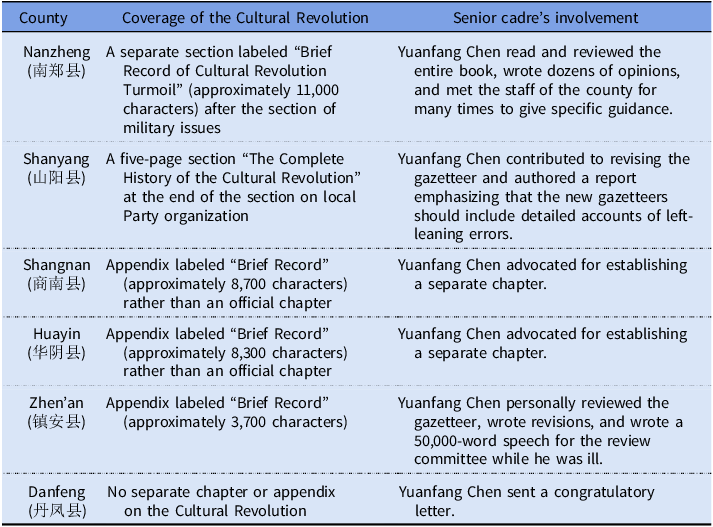
However, a closer examination of the negotiation dynamics within Shaanxi Province reveals that not all local compilers completely embraced Chen Yuanfang’s assertive approach. In fact, subsequent provincial committee meetings ended with “no agreement being reached” (Shangnan Xianzhi Bianzuan Weiyuanhui 1993: 949). This outcome left each county with its own discretion to decide the extent and format to document the Cultural Revolution. We present a brief description and statistics from six counties, illustrating how their decisions to document the Cultural Revolution might have been influenced by directives and opinions from Chen, as noted in their epilogs or technical notes (Table 1).
Overview and statistics of the Cultural Revolution in six Shaanxi Counties

Most counties actively endorsed Chen’s propositions. For example, in Nanzheng County (南郑县), gazetteer editors included an individual chapter of approximately 11,500 Chinese characters that provided a detailed account of various political campaigns in the Cultural Revolution. The chapter was strategically placed between the sections on military affairs and education (Nanzheng Xianzhi Bianzuan Weiyuanhui 1990). In Shanyang County (山阳县), after a review meeting with Chen, gazetteer editors added a five-page dedicated section titled “the complete history of the Cultural Revolution” at the end of the section on local party organization (Shanyang Xianzhi Bianzuan Weiyuanhui 1993).
Some counties adopted a more balanced approach, navigating through differing opinions. In Shangnan County (商南县), compilers held multiple rounds of internal discussions as they sought a middle ground between conflicting directives from provincial and central authorities. Over the years, the decision-making process in Shangnan regarding the creation of a distinct section for the Cultural Revolution underwent several rounds of revisions. Initially, after numerous local meetings, compilers decided against creating a separate chapter. However, after receiving feedback from the provincial committee, which recommended the opposite approach, they adjusted their initial decision and opted to create a separate section on the Cultural Revolution and Leftism Errors. Eventually, considering all relevant directives from central, provincial, and local authorities on the narratives of the Cultural Revolution, they chose to consolidate all pertinent information into an appendix labeled “Brief Record” (jilue 记略; approximately 8,700 characters) instead of creating a separate chapter (Shangnan Xianzhi Bianzuan Weiyuanhui 1993). Similarly, in Huayin County (华阴县), local compilers expressed hesitation upon recommendations from the provincial office to establish a separate chapter on the Cultural Revolution. Before making the final decision, they conducted “repeated evaluations” of the proposal, eventually deciding to create an appendix of approximately 8,300 characters on this topic (Huayin Xianzhi Bianzuan Weiyuanhui 1995).
Some other counties, such as Zhen’an County (镇安县), demonstrated a more cautious approach by opting to create only an independent appendix with limited details (approximately 3,700 characters) to cover the period (Zhen’an Xian Difangzhi Bianzuan Bangongshi 1995). Similarly, Danfeng County (丹凤县), around the same time, chose to disperse records related to the Cultural Revolution throughout the chronicle and other sections, rather than dedicating a separate section in the main body of the gazetteer (Danfeng County Gazetteers Compilation Committee 1994).
In summary, the patterns observed both within and across provinces highlight significant disparities in gazetteer compilation at the local level, showing that neither the central government nor provincial governments were able to enforce uniform ideological control. Instead, the negotiation of local gazetteer editors with their superiors was quite common, as evidenced by our findings in two archetypical provinces. The disparities in editing attitudes at the provincial level contributed to bifurcation in local gazetteers across provinces. County-level editors retained a certain degree of reservation and autonomy in response to guidance received from their superior directors at the provincial level. This autonomy allowed them to determine county-level editing approaches on their own.
Why historiographical negotiations were made possible
Despite central directives clearly mandating the adherence to Marxist philosophy and the class struggle line in gazetteer compilation, historiographical negotiations were still possible at the local level. In this section, we explore four major determinants facilitating such negotiations. While the regime’s pursuit of historical justice following the post-totalitarian transition provided the basic soil for political rehabilitation and restitution, the ambiguous political guidance and organizational flexibilities not only created opportunities to negotiate for local experimentation but also diminished the barriers to engaging in bottom-up negotiations. In addition to these structural factors, we also find that the social network of key opinion leadership as well as the subjective motivation of compliers themselves further enables like-minded local editors to openly publish their views and support each other.
Political factor: Historical justice following post-totalitarian transition
In the years following the tumultuous Cultural Revolution, there was an extensive and prolonged effort for political restitution and rehabilitation. The post-Mao era saw an authoritarian system attempting to address its violent past. Specifically, with the “Resolution on Certain Historical Issues of the Party since the Founding of the PRC” issued by the Central Committee in 1981, the party state launched a comprehensive rehabilitation campaign to address the grievances and injustices of the Cultural Revolution. Many individuals implicated in Mao-era injustices, chaos, and atrocities were investigated and punished.
During this rehabilitation movement, Yaobang Hu, the General Secretary of the CPC Central Committee in the 1980s and noted liberal reformer, effectively positioned the new leadership as guardians of a new political culture characterized by openness, democracy, and socialist legality. This shift promoted a relaxation of official control in propaganda under the slogan “liberating thought” (Leese and Shuman Reference Leese and Shuman2023). This post-totalitarian institutional context is not unique to China. Markwick (Reference Markwick and Jones2006) argues that in political systems where history serves as a centerpiece of legitimacy, political reforms and historical revisionism often go hand in hand. For instance, the “de-Stalinization” movement during the early Khrushchev era led to a push toward professionalizing the historical academic sphere, transforming it into a scientific discipline rather than merely an agency for propaganda. During this period, government-appointed historians like Eduard Burdzhalov, the deputy editor of the journal Questions of History, endeavored to move away from the paradigms of Stalinism and the Short Course, albeit within the doctrinal orthodoxy of “Marxism.”
The political culture of post-totalitarian transition during this period facilitated the inclusion of diverse viewpoints among local gazetteer editors. At a national academic conference on local gazetteers, editors across the nation engaged in vigorous debates on various topics such as the attributes, functions, and formats of local gazetteers, with all conflicting viewpoints being equally recorded. Contrary to the tradition, where the central government might typically prescribe conclusions or guidance before the conference, editors this time enjoyed substantial freedom to express their opinions. As a result, participants “unanimously agreed” that the conference was “lenient, harmonious, and democratic” (Zhongguo Difangzhi Xiehui 1991a: 173), illustrating a political atmosphere that maintained respect, tolerance, and courtesy towards intellectuals, thereby allowing for a certain degree of non-orthodox expressions. Even so, historical justice after the transition is not assured by the state nor realized without discursive tactics fitting in dominant political ideology, which were carefully crafted by local historical writers.
Organizational factor: Institutional flexibility encouraging local experimentation
The compilation of local gazetteers during the 1980s was not as institutionalized and regimented as the post-2010 era. This relative administrative flexibility afforded local officials more space and time for reflection and debate. The “new gazetteers” were designed to distinguish themselves from their imperial predecessors, thus fostering an environment conducive to local experimentation and innovation to fulfill this prominent mandate. According to working notes from the Chinese Local Gazetteers Association (1991a), there was recognized divergence in genre, guiding theories, viewpoints, and resources across different localities. Consequently, central directors did not impose strict constraints but instead encouraged “breakthroughs” and “innovation,” deciding to defer the standardization of formats and the establishment of common procedures.
To achieve “breakthroughs” and “innovation,” local gazetteers incorporated various modern social scientific elements, such as statistical forms, charts, demographic concepts, and methods, while avoiding excessive emotional expression. Indeed, many central leaders expressed concerns that over-emotional expression or an overemphasis on negative aspects of political movements during the Mao era was “unscientific” or “overly subjective.”
Additionally, the extended hiatus in local gazetteer compilation during the Mao era resulted in a lack of practical experience among the senior directors of the central leadership. Consequently, their proposed viewpoints to localities were generally broad and open to negotiation. Often, their stances and opinions were solidified and established through negotiations with lower-level practitioners. For instance, Liang Hanbing (Reference Liang1981: 4) initially recognized only the vague grounds of categorizing new gazetteers as “encyclopedic compendiums.” However, after discussions with local bureaucracies, he later provided more affirmative responses, recognizing “city gazetteers” as a city’s “encyclopedia” and a collection of historical materials (Liang Reference Liang1988b: 45).
Social network factor: Key opinion leadership of retired senior cadres
Many local gazetteer officials and directors, including Chen Yuanfang from Shaanxi Province, were retired senior cadres of local party branches who had been targeted and suffered during previous political campaigns, especially during the Cultural Revolution. As key witnesses to local political historical events and victims of Mao’s political movements, they felt a strong urge to accurately reflect the past political mistakes of the Mao era. These retired senior cadres, with their extensive connections to former comrades at the central level, possessed sufficient political authority and intellectual capital to debate or reinterpret specific compilation guidelines. This allowed them to ensure that the compilations aligned with their own perspectives, narratives, and practices.
Although these retired senior cadres tried to push boundaries, they remained aware of the “red line” and argued that the common interpretation of “seeking truth from facts” did not fully capture its true essence. Instead, only by “preserving truth and seeking reality” could one record history truly and faithfully. They demonstrated this commitment by arguing against the tendency to primarily attribute turmoil, chaos, and atrocities of the Cultural Revolution to certain policies implemented by the Gang of Four without implicating the top leadership.
It is important to note, however, that these so-called “red lines” or disputed principles were often not very clearly defined and articulated in documents in the course of actual practice. Even some senior editors did not perceive them as such. Their interviews revealed that emphasizing the rigor and depth of their writing process was often enough to secure support on their coverage of political issues from higher authorities. This approach has provided sufficient legitimacy to their negotiation and pursuit of autonomy, as one interviewee explained regarding the unwritten rules of their work, “Documents? There won’t be any public documents showing details on how to reflect the troubled political history … Everyone has their own understanding. You know what should be written and what should not be” (interview with CXTSG02-G).
Cultural-psychological factor: Imperial literal tradition as subjective motivation
Local gazetteers in China have been preserved as a valued historical tradition from the imperial era. Hu Qiaomu vehemently stressed that the newly established Communist government should continue the compilation of local gazetteers “to avoid future historians accusing contemporary ones of disrupting the continuity of the notable historical tradition” (Zhongguo Difangzhi Xiehui 1991b: 52). For editors, this advice underscored the importance of connecting with the legacy of imperial gazetteers and emulating the virtues of ancient Chinese historians like Confucius and Sima Qian in recording a fair and truthful history (Rogacz Reference Rogacz2019). This specific historiographical tradition of “writing history with moral uprightness” inspired rank-and-file local editors to engage in the work deemed as “unrewarding” and “sacrificial” (Thogersen and Clausen Reference Thogersen and Clausen1992).
These discourses that are connected with traditional historian virtues highlight an often-overlooked cultural-psychological factor: the sense of responsibility and sacred mission. The local gazetteer editors we interviewed all shared this similar sentiment, underscoring the sacredness of their work. In a sense, it was this ethical component of historiography that motivated them to perform documentative work:
In a broader sense, what we are doing is a meritorious deed that will have a lasting impact. As residents of our county, we want to contribute and leave a meaningful mark on our hometown. (interview with CXCJX02-L)
It’s quite strange; although many of them do a poor job, when they talk about their own jobs, each person feels that he has accomplished something truly remarkable. (interview with CXTSG02-L)
This sense of responsibility may have motivated editors to negotiate with their superiors and fight for their own space to preserve the historical memory of their localities. For editors who valued the importance of local gazetteers, the task was unlikely to be seen merely as a routine administrative procedure. Instead, they perceive their compilation work as active construction of historical meaning and the powerful expression of their identity as local intellectuals.
Discussion and conclusion
In this study, we argue that the challenges of addressing contentious and repressive histories in authoritarian regimes undergoing post-totalitarian transitions provide precious opportunities for historical justice, as the representation of history and the production of historiography become decentralized from the central state. We specifically examine the compilation of local gazetteers in post-Mao China and uncover vigorous negotiation within three discourses of historical production: the thematic nature of local gazetteers, the methods used to promote their scientificity, and the management of negative historical baggage associated with state repression and contentious politics. The thematic focus of local gazetteers plays a crucial role in shaping historical narratives and material selection at the local level. By selecting themes that reflect more complex and multifaceted views of local history, gazetteers can challenge the obscured and often propagandistic histories promoted by authoritarian states. Negotiation around scientificity helps to counteract the influence of ideological bias and political interference, thus enhancing the professionalization and credibility of the historical recording. Lastly, addressing negative state history, particularly state repression and contentious politics, is essential for the historiography that not only addresses injustice and repression but also embodies the moral convictions of history writers themselves.
We find that the convergence of seemingly contradictory ideological sources transformed the “new local gazetteers” of the 1980s and 1990s into a unique amalgamation – a “Frankenstein-esque” creation melding the ideological foundation of “socialist values,” the methodological rigor to create “scientific classification,” and the traces of imperial cultural heritage. Precisely because “new local gazetteers” combined these diverse intellectual resources, discourses of negotiation were able to emerge and flourish. Local editors leveraged these discursive strategies to enhance the legitimacy and efficacy of their negotiations with higher-level peers.
Our findings challenge the traditional view that local gazetteers in Communist China serve merely as window dresser or box-ticking exercises, reflecting persistent ideological control and content-based regulation by the central government. Our mixed-method analysis reveals that in the 1980s and early 1990s, there were vibrant and dynamic discussions that, to some extent, shaped norms and practices in the compilation of local gazetteers. In our case, the initiative to critically revisit history did not originate from the central leadership, which initially appeared highly cautious and hesitant, aiming to protect the party’s image. Instead, it was local advocates who used various negotiation techniques to defend their conscientious and strategic efforts to achieve historical justice at their local jurisdiction.
Our research also contributes to the literature on historical justice or “the politics of historical truths” under authoritarian regimes (Aboueldahab Reference Aboueldahab2017; Leese and Shuman Reference Leese and Shuman2023; Neuman and Thompson Reference Neumann and Thompson2015). Previous studies have extensively discussed transitional justice measures such as legal restitution, fame rehabilitation, political reconciliation, and monetary reparations in various authoritarian countries, including the late Soviet Union, China, and Egypt. However, few studies have explored how local history is produced and negotiated to address past injustices and document state-sponsored atrocities both within and outside China. Our study underscores the importance of examining the production of official history itself in the realization of historical justice, highlighting the interplay of political power, organizational structure, and theoretical heuristics employed by its participants.
This study has several limitations. Firstly, the materials we selected and relied upon in our analysis are more representative than comprehensive. We analyze and compare the textual evidence extracted from all county gazetteers from Shaanxi and Shandong Provinces. While we consider the comparison itself sufficient to show the critical impact of influential leaders on within-province political dynamics, we select these provinces based on data availability rather than random sampling of all Chinese provincial-level regions. The sample selection method might weaken the representation and external validity of our findings. And certainly, the intensity, variation, and contingency of negotiations could be better understood by examining more regions. Secondly, more fieldwork and oral histories from the editors involved in the compilation are crucial and would complement the existing data, particularly in revealing more subtle and informal negotiation processes between historical editors. Informal practices and negotiations within the bureaucratic system are likely underrepresented in correspondence journals and other forms of written words. Local editors may develop strategies to tactfully address sensitive historical topics, navigating political pressures while adapting to central directives. We suggest future researchers incorporate evidence from a wider range of sources, particularly oral interviews and the work memoirs of chief editors. Such new evidence would provide more insights into the deliberate reasoning and power dynamics of knowledge production at a more granular level.
Since the late 2000s, there has been a new wave of gazetteer compilation in China. In 2006, the central government issued the “Regulations on the Work of Local Gazetteers” (difangzhi gongzuo tiaoli 地方志工作条例), which detailed the compilation methods more explicitly (State Council of PRC 2006). The primary aim of this directive was to strengthen legal regulation and address issues of “excessive subjectivity, arbitrarity, and unbalancedness” observed in the past (Wu Reference Wu2006). This move toward institutionalization introduced a rigid framework with tightened political control and a highly structured workflow, which curtailed editors’ creative freedom, leaving them with less organizational flexibility and fewer chances to experiment. As a result, local gazetteer production, once characterized by vibrant debates and negotiations, has become a standardized and bureaucratic administrative process. This shift has led to a ritualistic decline of the compilation process, causing a loss of the creativity and dynamism in historical production and negotiation that was widely observed in earlier rounds.
Acknowledgements
The authors express their gratitude for the invaluable feedback provided by three anonymous referees. We also thank Andrew Walder, Elizabeth Perry, Guoqing Song, Madeleine Dong, Paul Pickowicz, Patricia Ebrey, Rana Mitter, and Susan Whiting for their feedback on the earlier version of this paper.