Introduction
In recent years a number of drugs initially developed as anticonvulsants have become established as mood stabilizers alongside lithium for recurrent affective disorder, and for certain other psychotropic indications (Ferrier, Reference Ferrier2001). A number of factors, including the continued development of specialized old age mental health services and associated expertise, and increasing unease about the use of antipsychotic drugs in older patients (Committee on Safety of Medicines, 2004) have contributed to growing interest in the use of mood stabilizer drugs for the treatment of mood disorders and for other indications amongst older patients. Lithium, carbamazepine and sodium valproate are now in widespread use by old age psychiatrists for a number of indications, including recurrent affective disorders, acute mania and behavioral problems in dementia. Although there is a growing evidence base to support their use, concerns exist about safety, the potential for drug interactions and use outside of licensed indications (Katona, Reference Katona2001).
In order to investigate further the patterns of use and attitudes towards mood stabilizer drug prescription in older patients, we undertook a postal questionnaire survey of a large sample of old age psychiatrists in the U.K. The aim of the survey was to assess the attitude of consultants, specialist registrars, associate specialist and staff grades in old age psychiatry towards the use of mood stabilizers in the elderly.
Methods
A postal questionnaire was sent to a random sample of the membership of the Old Age Faculty of the Royal College of Psychiatrists in England and Wales. Opinion was sought on the use of mood stabilizers in the treatment of behavioral symptoms in dementia, acute manic symptoms, treatment resistant schizophrenia, treatment-resistant depression and prophylaxis of affective disorder. Respondents were also invited to identify any other indications they had for mood stabilizer therapy. In the second part of the questionnaire views were sought regarding factors that might limit practitioners' use of mood stabilizers. These factors included concerns about efficacy, safety, drug interaction, prescribing outside license, lack of scientific evidence as well as limited experience with their use. For both sets of questions, a five-point Likert scale was used ranging from strongly agree to strongly disagree to record responses. In addition, respondents were asked to identify their preferred drug for each of the specified indications and also to indicate the drugs about which they had the greatest concerns.
Following a small local pilot, the questionnaire was then sent to a representative sample of members of the Royal College of Psychiatrists Faculty of Old Age Psychiatry (n = 508) along with a covering letter explaining the purpose of the study and a stamped addressed return envelope. Questionnaires were sent anonymously so that non-responders could not be identified and no reminders were sent. Data were entered and stored in an Excel spreadsheet and subsequent statistical procedures were performed using SPSS version 15.
Results
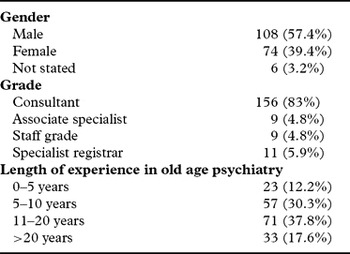
One-hundred-and-eighty-eight replies were received representing a response rate of 37%. The characteristics of the respondents are shown in Table 1. In addition, 17 questionnaires were returned uncompleted: in 7 cases this was because the recipient no longer worked at that location and in 10 cases no reason was given. The overwhelming majority of respondents (n = 181; 96.3%) stated that they initiated prescriptions for mood stabilizer drugs.
Characteristics of respondents (N = 188)

Indications for mood stabilizers
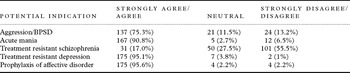
The majority of respondents either agreed or strongly agreed with the use of mood stabilizers for the treatment of aggression/behavioral and psychological symptoms of dementia (BPSD) (n = 137; 75%), for acute mania (n = 167; 90.8%), for treatment resistant depression (n = 175; 95%) and for the prophylaxis of affective disorder (n = 175; 95%). A more detailed breakdown of respondents' attitudes to a variety of potential treatment indications for mood stabilizer drugs is presented in Table 2.
Respondents' attitudes to potential indications for mood stabilizer drugs

Potential concerns about mood stabilizers
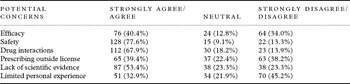
In response to questions addressing possible concerns regarding mood stabilizer drugs, the majority of respondents agreed or strongly agreed that they had concerns about safety (n = 128; 77%) or about drug interaction (n = 112; 68%). Eighty-seven respondents (53%) agreed or strongly agreed that lack of scientific evidence would restrict their use of mood stabilizers. A substantial minority of respondents agreed or strongly agreed that they had concerns about using the drugs outwith their licensed indications (n = 65; 39.4%) or as a result of limited personal experience (n = 51; 32.9%). A more detailed breakdown of respondents' attitudes to a variety of potential concerns about mood stabilizer drugs is presented in Table 3.
Respondents' attitudes to potential concerns about mood stabilizer drugs

Preferred drugs and specific concerns
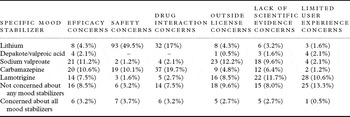
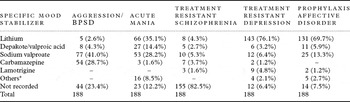
A majority of respondents listed lithium as the preferred mood stabilizer for treatment of resistant depression (n = 143; 76%) and for prophylaxis of affective disorder (131; 70%). Sixty-six respondents (35%) listed lithium as their preferred mood stabilizer for acute mania. Despite its enduring popularity, lithium was also the mood stabilizer attracting the greatest level of concern about safety (n = 93; 49.4%). For the management of aggression and behavioral symptoms in dementia, the majority of respondents cited valproate (n = 77; 40%) or carbamazepine (n = 54; 28%) as their preferred mood stabilizer. Concerns about drug interaction were most frequently associated with carbamazepine (n = 37; 20%) and lithium (n = 32; 17%). More detailed data in respect of preferences for, and concerns about, specific drugs are presented in Tables 4 and 5.
Respondents' concerns about specific mood stabilizer drugs

Respondents' preferences for specific mood stabilizer drugs against potential indications

*Others = olanzapine gabapentin, quetiapine vigabatrin.
BPSD = behavioral and psychological symptoms of dementia.
Fifty-three respondents made additional general comments from which three major themes were identified: anxiety about the risks associated with lithium, the lack of scientific evidence supporting the use of mood stabilizers for certain indications including behavioral symptoms of dementia, and an expectation that use of mood stabilizer drugs was likely to increase in the future.
Discussion
The majority of respondents were experienced prescribers of the drugs in question with over 10 years experience in the specialty (Table 1) and the survey was therefore appropriately targeted. However, the response rate of 37% inevitably imposes limitations on the interpretation of our findings. In particular, there is a possibility that response bias could have overestimated the rate of agreement that mood stabilizers should be used for certain indications. In other work (Sibbald, Reference Sibbald, Addington-Hall, Brenneman and Freeling1994) it has been shown that non-response to postal surveys is associated with lack of activity in the study area.
While the majority of practitioners strongly agreed or agreed with the use of mood stabilizers for various indications, there seemed to be concerns regarding safety, drug interaction and efficacy. With lithium in particular, concerns regarding safety may reflect a failure to adjust for pharmacokinetic and pharmacodynamic factors that occur in old age (Johnson, Reference Johnson1998). There seemed to be similar levels of concerns for both lithium and carbamazepine in terms of drug interaction. Lithium may interact with other drugs, particularly via changes in renal excretion; there are many cases of lithium toxicity occurring with angiotensin converting enzyme (ACE) inhibitors in the elderly (Bazire, Reference Bazire2007). Carbamazepine is a potent inducer of CYP3A4 and other oxidative enzyme systems in the liver (Bazire, Reference Bazire2007) and in high doses can therefore reduce levels of drugs such as quetiapine by 80%, which can be potentially clinically significant (Grimm, Reference Grimm, Richtand, Winter, Stams and Reele2006). There was less concern about sodium valproate and drug interaction although this too can interact with certain drugs commonly used in the elderly. Rapid elevation of INR (3.9) has been reported after a single dose of sodium valproate (Guthrie, Reference Guthrie, Stoysich, Bader and Hilleman1995). Recent data from North America (Shulman et al., Reference Shulman2003) suggests a shift away from the prescribing of lithium towards increased prescribing of valproate in older patients, but interestingly our findings do not indicate that this trend has occurred in the U.K.
Respondents' concerns about lamotrigine may be a reflection of the so far restricted evidence base to support the use of this drug in older patients. The limited literature suggests that it may be effective and relatively well tolerated in patients with dementia but further studies are needed (Sajatovic et al., 1999). At present, lamotrigine is not recommended for routine management of treatment resistant depression (National Institute for Health and Clinical Excellence, 2007).
With regard to the use of mood stabilizers in treatment resistant schizophrenia, a large proportion of respondents did not prescribe these drugs for this indication, which is unsurprising as it is not recommended in current evidence-based guidance (National Institute for Health and Clinical Excellence, 2002).
This survey highlights the intersecting themes of widespread use of, but persisting concerns about safety and efficacy for, mood stabilizer drugs in older patients. Given these therapeutic dilemmas, the relative lack of age-relevant published evidence is unsatisfactory and surprising. The need for further intervention studies relevant to older adults in this therapeutic area is clearly apparent.
Conflict of interest
Both authors have attended meetings sponsored by pharmaceutical companies that market mood stabilizer drugs.
Description of authors' roles
Dr. Ephraim collected the data and contributed to writing the paper; Dr. Prettyman designed the study and was the principal author of the paper.