INTRODUCTION
The New Zealand exclusive economic zone (EEZ) is bryozoologically rich in species and diverse in higher taxa. Gordon et al. (Reference Gordon, Taylor, Bigey and Gordon2009) cited 961 species, 953 of them marine, of which 331 were known to be undescribed (in the collection of the National Institute of Water & Atmospheric Research in Wellington (NIWA)). Geologically, the New Zealand regional landmass, a small continent known as Zealandia (Luyendyk, Reference Luyendyk1995) of which only 7% is emergent, extends well beyond the EEZ, especially north-west along the Lord Howe Rise and Norfolk Ridge to the Chesterfield Plateau and New Caledonia. It is connected to the north-east with the Colville and Kermadec Ridges that, respectively, trend towards Fiji and Tonga and to the south-west with the Macquarie Ridge and Maquarie Island, but these ridges are geologically not part of Zealandia. Parts of the north-western and south-western features belong to the Australian EEZ, but biogeographically the fauna of these ridges merges with that pertaining to New Zealand proper. New Zealand's marine biodiversity, which is notably high for several groups of marine organisms including Bryozoa, is likely to be related to the size of the EEZ (one of the seven largest in the world) and the high diversity of seafloor relief and marine habitats, which is partly associated with New Zealand's position across a major plate boundary (Gordon et al., Reference Gordon, Beaumont, MacDiarmid, Robertson and Ahyong2010).
Zealandia's area of shallow shelf is 300,000 km2 and the EEZ spans 30° of latitude. Gordon et al. (Reference Gordon, Taylor, Bigey and Gordon2009) estimated that the final diversity of bryozoan species, from the intertidal to more than 10,000 m in the Kermadec Trench and from subtropical Raoul Island to subantarctic Campbell Island and beyond, could exceed 1300 taxa. Gordon et al. (Reference Gordon, Taylor, Bigey and Gordon2009) noted that 61% of the bryozoan fauna in the EEZ was endemic—a figure that could increase when the poorly known cyclostome fauna is fully described—and cited 43 Recent endemic genera of which 17 were unnamed. One of these latter was subsequently described by Gordon & Taylor (Reference Gordon and Taylor2010) and ten more are described here. Five additional new genera, not confined to the EEZ but which fall within the broad New Zealand biogeographical region centred on Zealandia and its margins, are also described herein.
Gordon et al. (Reference Gordon, Taylor, Bigey and Gordon2009) noted the presence of inferred archaic elements in the fauna, based on either long stratigraphic durations or as rare living representatives of particular clades, but the rich Cenozoic bryozoan fauna of New Zealand has not been described adequately enough to fully assess the significance of these elements. Two of the new genera described herein—from deep water exceeding 1700 m—have plesiomorphic character states typical of some Cretaceous taxa. Even new bryozoan discoveries from shelf depths in poorly studied areas of the globe are yielding striking novelty, e.g. the discovery of reverse-polarity zooidal budding in a cheilostome, Fatkullina paradoxa, from the Sea of Okhotsk (Grischenko et al., Reference Grischenko, Gordon and Taylor1999); an unusual combination of fixed- and free-walled skeletal morphologies in a northern New Zealand cyclostome genus, Spiritopora (Taylor & Gordon, Reference Taylor and Gordon2003); and the intrageneric evolution of costae and an ascus in the otherwise anascan genus Cauloramphus in the North Pacific (Dick et al., Reference Dick, Lidgard, Gordon and Mawatari2009, Reference Dick, Mawatari, Sanner and Grischenko2011). Abundant recent sampling by NIWA on seamounts, in the deep sea, and on remote shelf areas in the New Zealand EEZ is yielding much new biodiversity in all major phyla, including Bryozoa, and the rate of discovery of new species and genera is currently exceeding the taxonomic capacity to deal with it. The challenge is to apprehend this new biodiversity in order to assess its significance at many levels.
MATERIALS AND METHODS
The taxa described here were collected during several cruises carried out by NIWA and its predecessor, the New Zealand Oceanographic Institute (NZOI). At sea, all collected biological material, including bryozoans, was preserved in seawater–formalin before later transfer to 70% isopropanol or ethanol. Dried bryozoan specimens with membranes intact, or NaClO-treated specimens with membranes removed, were studied by scanning electron microscopy, mostly using a LEO 440 SEM (at Industrial Research Ltd, Lower Hutt) or a Hitachi TM3000 Tabletop Microscope (at NIWA, Wellington). All type specimens are lodged in the NIWA Invertebrate Collection (NIC), Wellington. Using an optical eyepiece micrometer, measurements were made of morphological features taken mostly in the zone of astogenetic repetition and given in the text as the observed range and mean (the latter in parentheses). Measurements (in μm unless otherwise stated) are given in the text, accompanied by the following abbreviations:
- AnL, AnW
ancestrula length and width
- AntL
anter length
- AvL, AvW
avicularium length and width
- BrW
erect branch diameter or width
- FOL, FOW
female orifice or opesia length and width
- ML, MW
avicularian mandible length; mandible width at articulation
- OL, OW
orifice length and width
- OoL, OoW
ooecium length and width
- OpercW
operculum width
- OpL, OpW
opesia length and width
- OpsL, OpsW
opesiule length and width
- PeOL, PeOW
peristomial orifice length and width
- SpL
spine length
- ZD
autozooid depth (height)
- ZL, ZW
autozooid length and width.
Full station data for all examined specimens are given in the Appendix.
SYSTEMATICS
Class GYMNOLAEMATA Allman, Reference Allman1856
Order CHEILOSTOMATA Busk, Reference Busk and MacGillivray1852
Suborder NEOCHEILOSTOMINA d'Hondt, Reference Hondt1985
Superfamily CALLOPOROIDEA Norman, Reference Norman1903
Family CALLOPORIDAE Norman, Reference Norman1903
Genus Cavalliella gen. nov.
TYPE SPECIES
Cavalliella linearis sp. nov.
ETYMOLOGY
Eponymous for the Cavalli Seamount off north-eastern New Zealand, where the taxon was found.
DIAGNOSIS
Colony encrusting. Autozooids with proportionately large elongate-oval opesia surrounded by narrow granular cryptocyst of constant width and narrow smooth gymnocyst. Opercular flap differentiated at distal end of membranous frontal wall as a semicircular sclerite. No articulated oral or periopesial spines. No avicularia. Ooecium well developed, wider than long, its floor bulging into the coelom of the distal zooid; ectooecium smooth with no tabula or fenestra; ovicell opening cleithral. Basal pore-chambers present. Ancestrula unknown.
REMARKS
A new genus is established here for a Crassimarginatella-like species that has a wholly smooth-surfaced ovicellar ectooecium without any trace of a frontal fenestra or tabula. Within the large, heterogeneous family Calloporidae as currently circumscribed there are suites of related genera that have similar, overlapping characters. One consequence has been inconsistency in taxonomic attribution and general uncertainty in delimiting generic boundaries. Undoubtedly gene sequencing will be a useful tool in elucidating relationships but the majority of bryozoan taxa have yet to be sequenced. In the case of historic, and even current, shipboard practices anywhere in the world, bulk-collected biological–oceanographic samples, often taken opportunistically in the course of other sampling, are routinely preserved in seawater–formalin; smaller quantities of formalin are required than alcohol, which is also flammable and deemed more hazardous. Biological samples can be frozen at sea but, while perfect for gene sequencing, can be compromised in terms of tissue preservation. A large number of bryozoan taxa are known only as fossils and these also have to be accommodated in biosystematic schemata without recourse to sequencing.
In the present instance, the suite of genera under consideration comprises mainly Crassimarginatella Canu, Reference Canu1900, Alderina Norman, Reference Norman1903 and Corbulella Gordon, Reference Gordon1984, along with some other genera on the morphological periphery of these three. The type species of these genera were all originally included in Membranipora de Blainville, Reference Blainville and Cuvier1830 when first described. Eventually, as more and more related species became described and the concept of Membranipora became unwieldy, phenetic clusters were segregated as genera. Additional characters also came to be seen as having taxonomic relevance, leading to more-effective circumscription of genera (and even families, also segregated from phenetic clusters previously included in Membranipora). The process continues, aided, where feasible, by cladistic analysis of large numbers of similar taxa in monographic studies, and by sequence data.
In the case of Crassimarginatella, Alderina and Corbulella, morphology has generally been adequate for improved taxonomic resolution, thanks to studies of zooidal ontogeny and discoveries of missing morphological characters. Thus, Harmelin (Reference Harmelin1973) showed from his discovery of occasional vicarious avicularia in Crassimarginatella solidula (Hincks, Reference Hincks1860) that this species should be excluded from Alderina, in which it had frequently been included, a conclusion supported by the external morphology of the ooecium and the form of the ancestrula (the latter is non-tatiform and has a substantial cryptocyst in the type species of Alderina (Hayward & Ryland, Reference Hayward and Ryland1998, figure 47A)). Previously, Hastings (Reference Hastings1945) had questioned Harmer's (Reference Harmer1926) establishment of Pyrulella (type species Membranipora pyrula Hincks, Reference Hincks1881), characterized by conspicuous periopesial spines, on the grounds that the bifenestrate ectooecium typified Valdemunitella Canu, Reference Canu1900 whereas Membranipora corbula Hincks, Reference Hincks1880b, also included by Harmer in Pyrulella, had a unifenestrate ectooecium. Building on Hastings's (Reference Hastings1945) conclusions, Gordon (Reference Gordon1984) established Corbulella for M. corbula and related new and existing species on the basis of the conspicuous periopesial spines, broad ectooecial fenestra and a distinctive type of vicarious avicularium, newly discovered in M. corbula. In this work, Gordon (Reference Gordon1984) showed that Membranipora maderensis Waters, Reference Waters1898, included by Harmelin (Reference Harmelin1973) in Crassimarginatella, also belongs to Corbulella. (In passing, Crassimarginatella fossa Uttley, Reference Uttley1951, which has relatively few autozooidal periopesial spines (often missing), nevertheless has an avicularium with a serrated rostral rim (Gordon, Reference Gordon1986) and should be included in Corbulella (as Corbulella fossa comb. nov.) even though lacking avicularian opesial spines.)
Subsequently, additional new taxa have been ascribed to Crassimarginatella and Alderina that depart from the characters of their respective type species, raising again the question of generic circumscription. For example, Tilbrook et al. (Reference Tilbrook, Hayward and Gordon2001) and Dick et al. (Reference Dick, Tilbrook and Mawatari2006), respectively, described new species of Crassimarginatella and Corbulella with vestigial ooecia. These attributions may be correct but further study is needed. Dick et al. (Reference Dick, Tilbrook and Mawatari2006) also described a new species, attributed to Alderina, having a Crassimarginatella-like ectooecium with a transverse slit in many (but not all) of the ooecia and which lacked avicularia and ancestrulae, highlighting the problem of missing characters. López-Fé (Reference López-Fé2006) described a new species, Alderina canariensis, with an acleithral ovicell (it is cleithral in the type species of Alderina); A. canariensis can now be included in Kenoaplousina López Gappa & Liuzzi, Reference López Gappa and Liuzzi2013 (as Kenoaplousina canariensis comb. nov.).
Cavalliella gen. nov. is Crassimarginatella-like in most characters, having similar proportions of opesia, cryptocyst and gymnocyst to the type-species Crassimarginatella crassimarginata (Hincks, Reference Hincks1880a). There are differences in the pore-chambers (higher in the wall in C. crassimarginata) and colony form (bi- to pluriserial in Cavaliella linearis) but these are trivial, leaving the absence of avicularia (which conceivably may be merely undiscovered) and the form of the ooecium as the main distinguishing features. Whereas Crassimarginatella s.s. has a transverse ectooecial fenestra, this is lacking in C. linearis. The ooecium of C. linearis appears identical to that in the newly recognized Early Eocene genus Tumaiella Gordon & Taylor, Reference Gordon and Taylor2014 from Chatham Island, but the sole known species lacks an autozooidal gymnocyst. It could be argued that to establish the new genus Cavielliella is premature, but it is apparent that Crassimarginatella itself, as currently circumscribed, will be further split. Inter alia, whereas C. crassimarginata has an avicularium with a robust, complete crossbar (also seen in Tertiary Crassimarginatella sculpta (MacGillivray, Reference MacGillivray1895) from Australia), most other species have only marginal pivots, which occasionally may fuse to form a thin crossbar. It is certain that intrageneric clades will be recognized in Crassimarginatella s.l. and it remains to be seen how these are partitioned. The time is ripe for a detailed morphological and cladistic analysis of all known species of Crassimarginatella, Alderina and Corbulella (~85 species in all, some nominally Cretaceous) (Bock, Reference Bock2014), but that is beyond the scope of this paper.
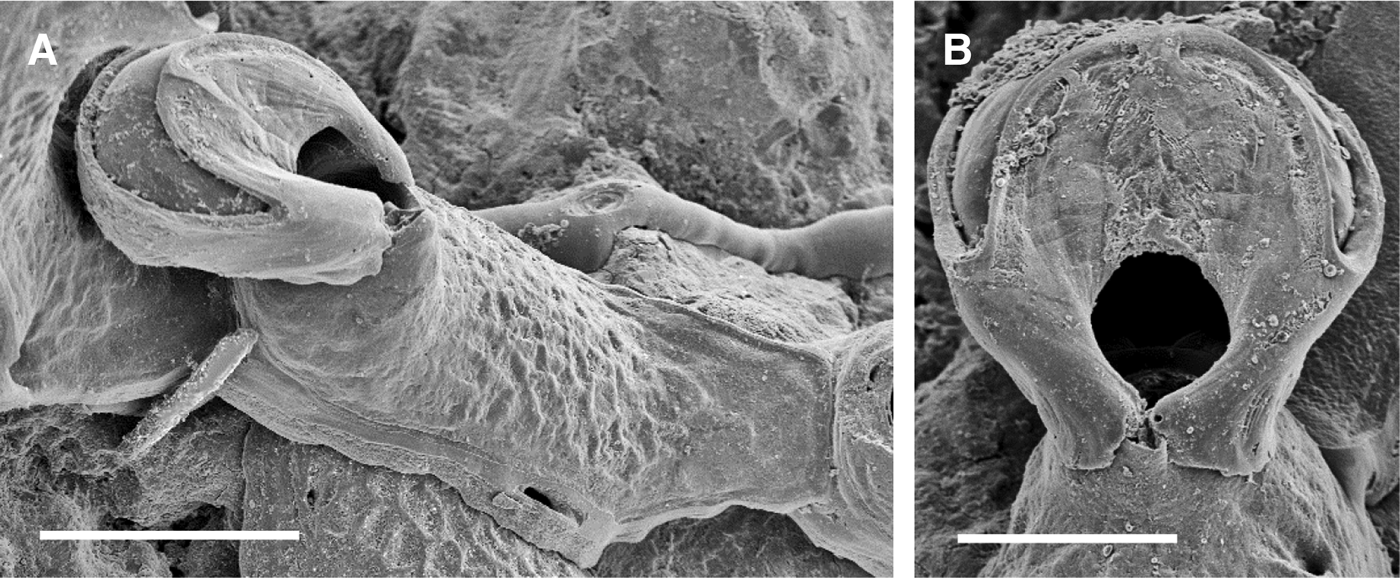
Cavalliella linearis sp. nov.
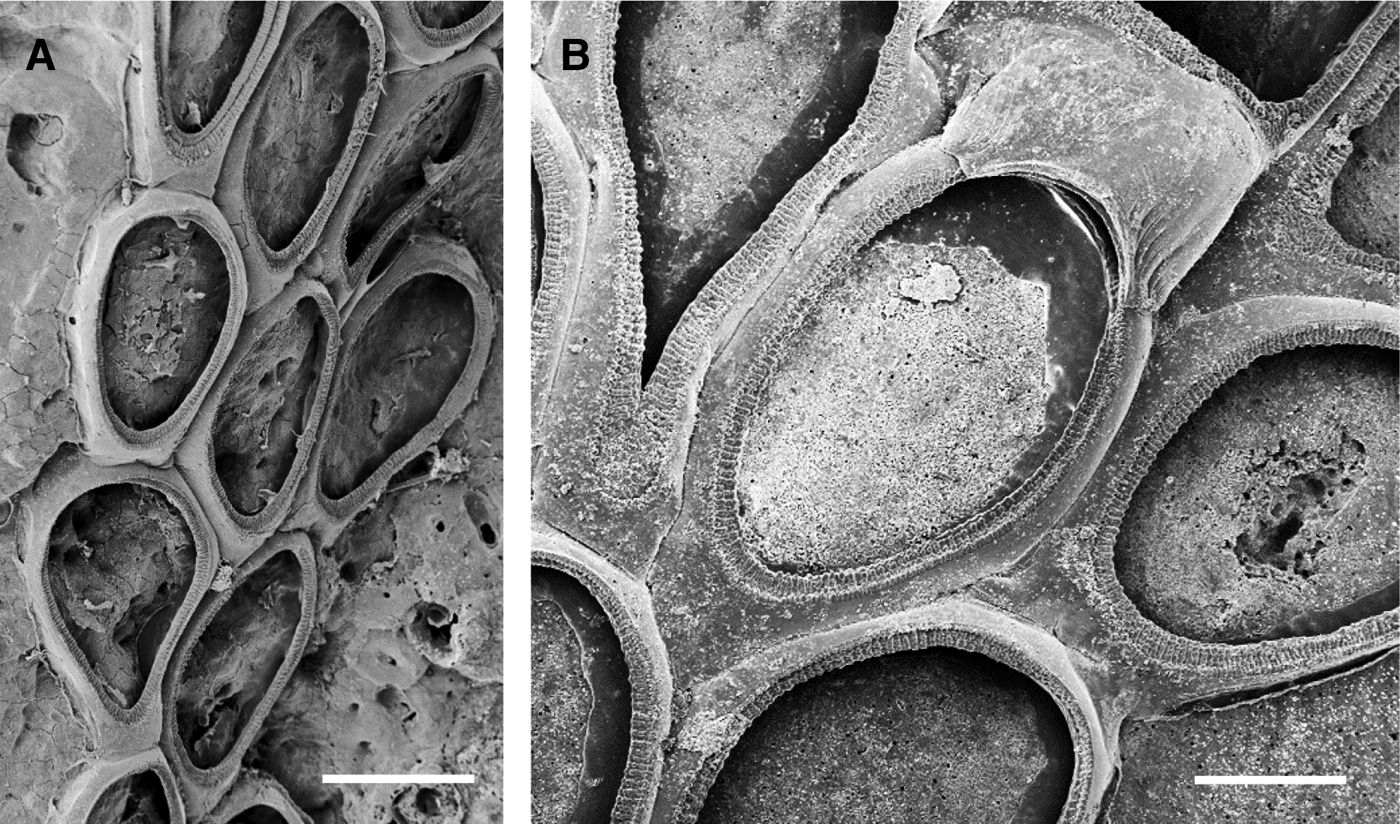
(Figure 1A, B)
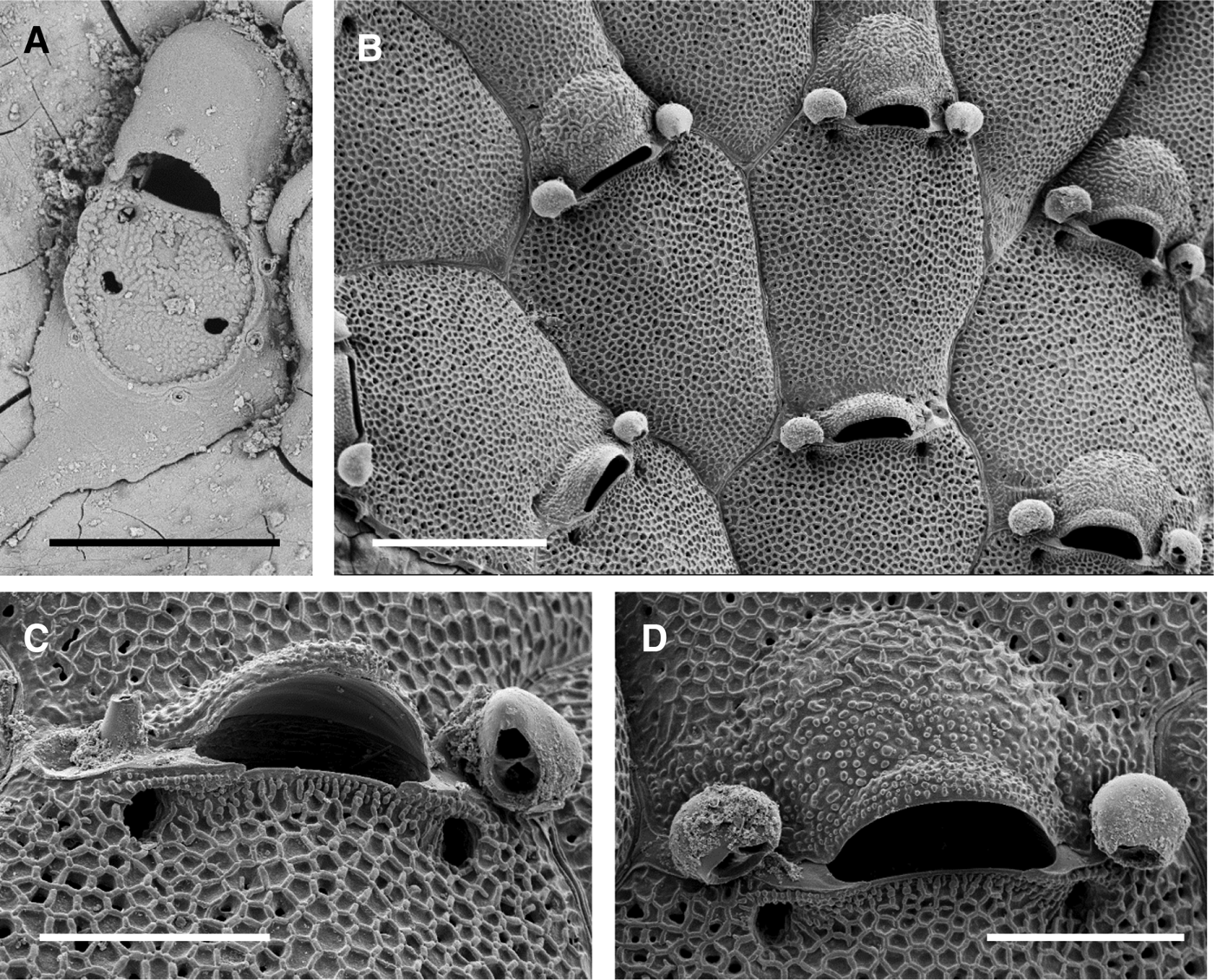
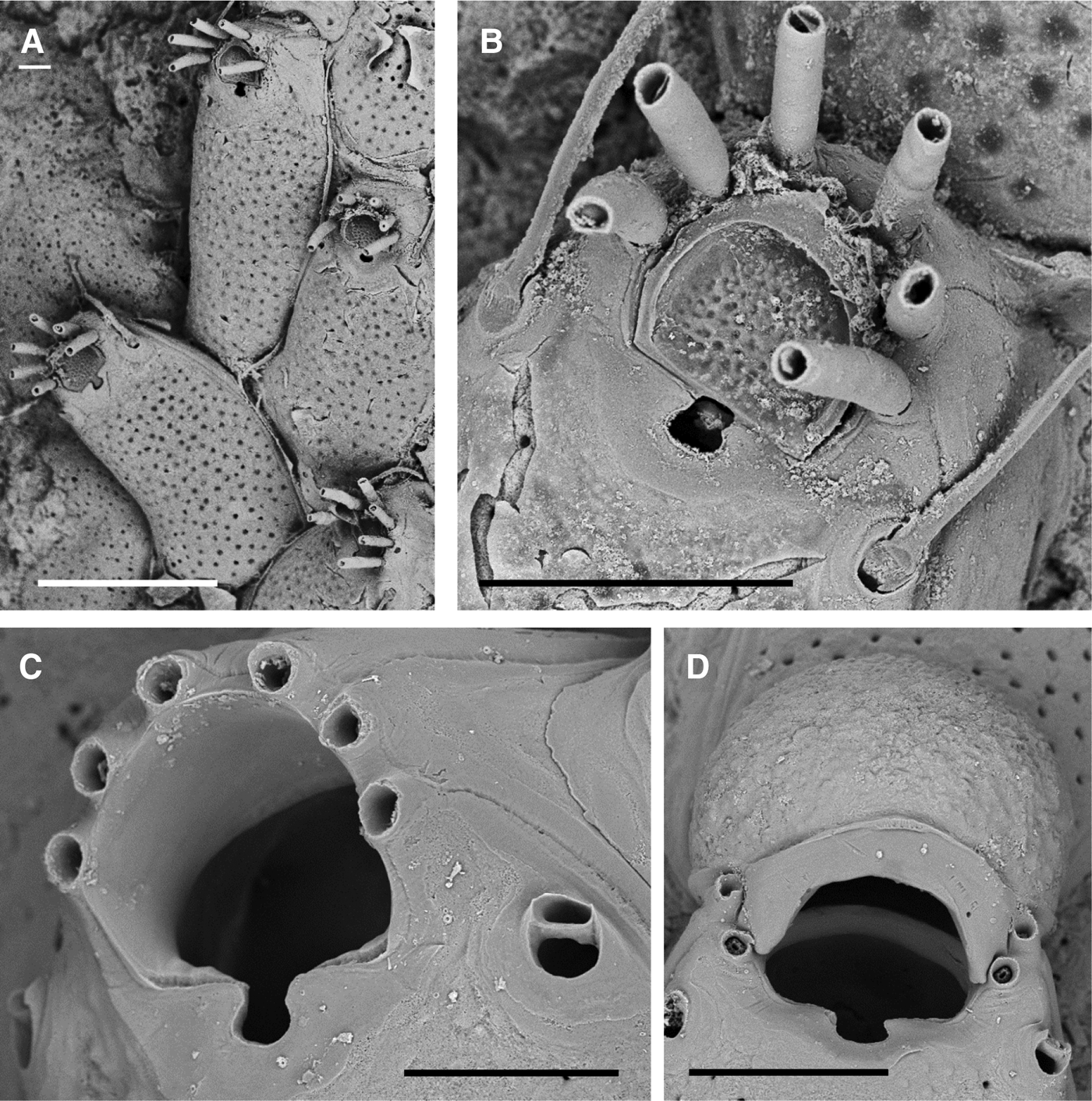
Cavalliella linearis gen. et sp. nov., NIWA 3716, holotype, from Station KAH0204/47, Cavalli Seamount: (A) part of pluriserial colony; (B) autozooid with ooecium. Scale bars: A, 500 µm; B, 200 µm.

MATERIAL EXAMINED
Holotype: NIWA 3716, Station KAH0204/047, Cavalli Seamount off north-eastern North Island, New Zealand, 792–880 m depth.
Paratype: NIWA 92085 from same locality.
ETYMOLOGY
Latin, linearis, pertaining to a line, alluding to the linear chains of zooids.
DESCRIPTION
Colony encrusting, unilaminar, with zooids in branching linear series that are mostly biserial, broadening to 3–4 zooids wide especially prior to branching of series; maximum colony length encountered 13 mm, with width varying from ~1.10–2.71 mm. Autozooids large [ZL 889–1132 (985), ZW 567–689 (653)], with proportionately large elongate-oval opesia surrounded by narrow granular cryptocyst of constant width and narrow smooth gymnocyst that is not or only slightly broader proximally; cryptocystal granulations arranged in series perpendicular to opesia [OpL 733–855 (791), OpW 489–556 (512)]. Operculum weakly differentiated at distal end of membranous frontal wall as a semicircular sclerite 217–233 (223) µm wide. No articulated oral or periopesial spines. No avicularia. Ooecium well developed, wider than long, its floor bulging into the coelom of the distal zooid; ectooecium smooth with no tabula or fenestra; ovicell opening cleithral [OoL356–400 (378), OoW 522–556 (539)]. Basal pore-chambers present; typically one mid-distally, two on each side distolaterally, and a much longer chamber on each side laterally. Ancestrula not seen.
REMARKS
Parts of approximately seven colonies were found on a single rock from Cavalli Seamount. The rock was cut on a rock saw into smaller blocks that could be examined by SEM. None of the colonies had an intact proximal portion containing an ancestrula or periancestrular zooids and some longer linear series had missing zooids—no doubt abraded or damaged during the process of trawling that collected the original rock and other substrata.
The genus and species are so far known only from 792–880 m depth on the Cavalli Seamount off north-eastern North Island, New Zealand, and so are nominally endemic.
Genus Recapitulator gen. nov.
TYPE SPECIES
Recapitulator mirus sp. nov.
ETYMOLOGY
Latin, one who recapitulates or repeats, alluding to the plesiomorphic spinose ooecium; gender masculine.
DIAGNOSIS
Colony encrusting, multiserial. Autozooids with large oval opesia entirely surrounded by a gymnocystal rim. No cryptocyst. Articulated oral spines present; no periopesial spines. Large interzooidal avicularia present, with thin complete crossbar. Ooecium composed of two opposing series of tightly apposed costae separated by a thin median suture. Pore-chambers present. Ancestrula not seen.
REMARKS
Recapitulator gen. nov., is the only known Recent calloporid with spinose ovicells, differing from lower Cenomanian (Mid-Cretaceous) Distelopora Lang, Reference Lang1915 and lower Campanian (Late Cretaceous) Unidistelopora Ostrovsky & Taylor, Reference Ostrovsky and Taylor2004a in the arrangement of costal spine bases and hence the mode of formation of the ooecium, in having avicularia, and in lacking a cryptocyst.
Recapitulator mirus sp. nov.
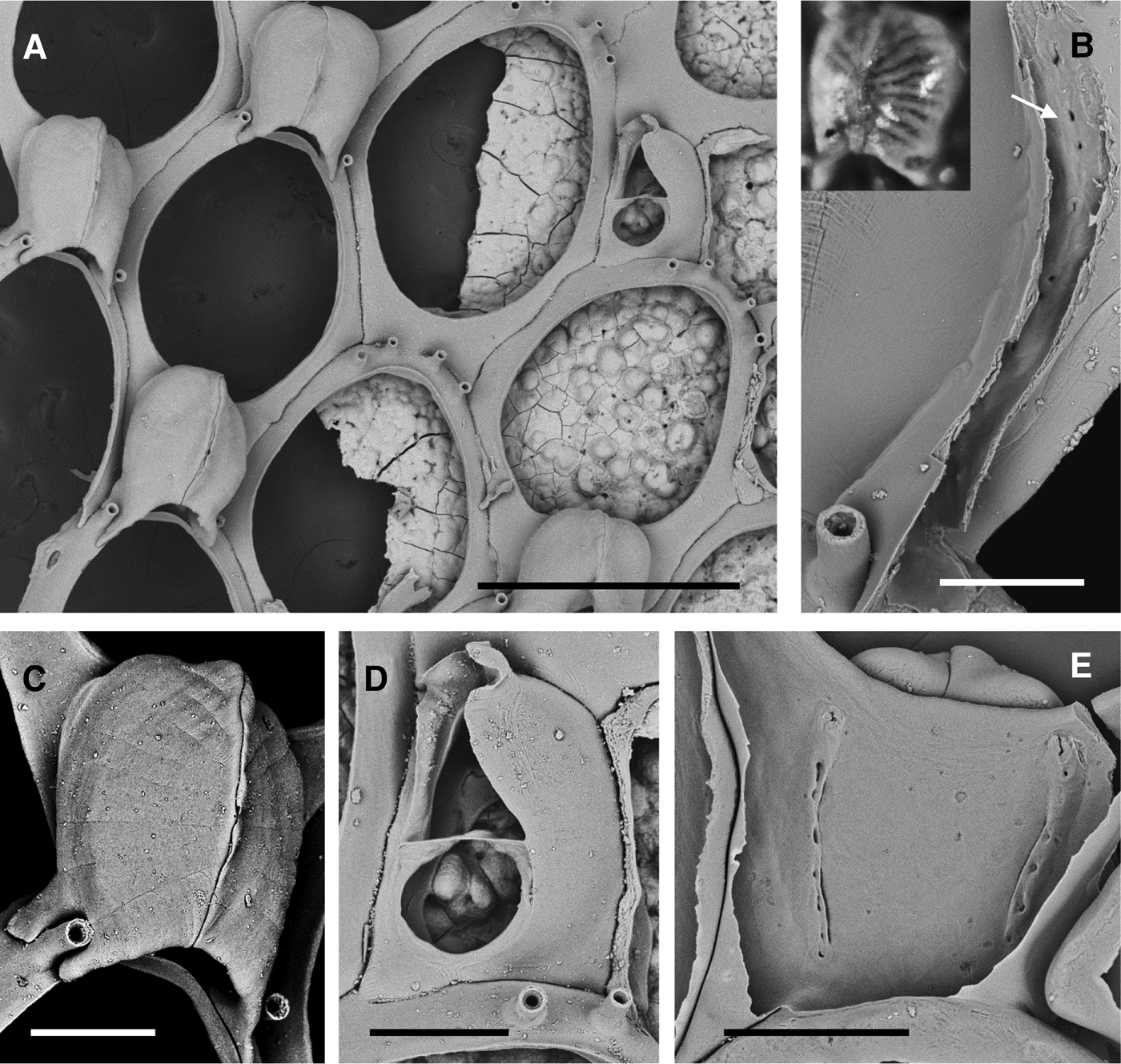
(Figure 2A–E)
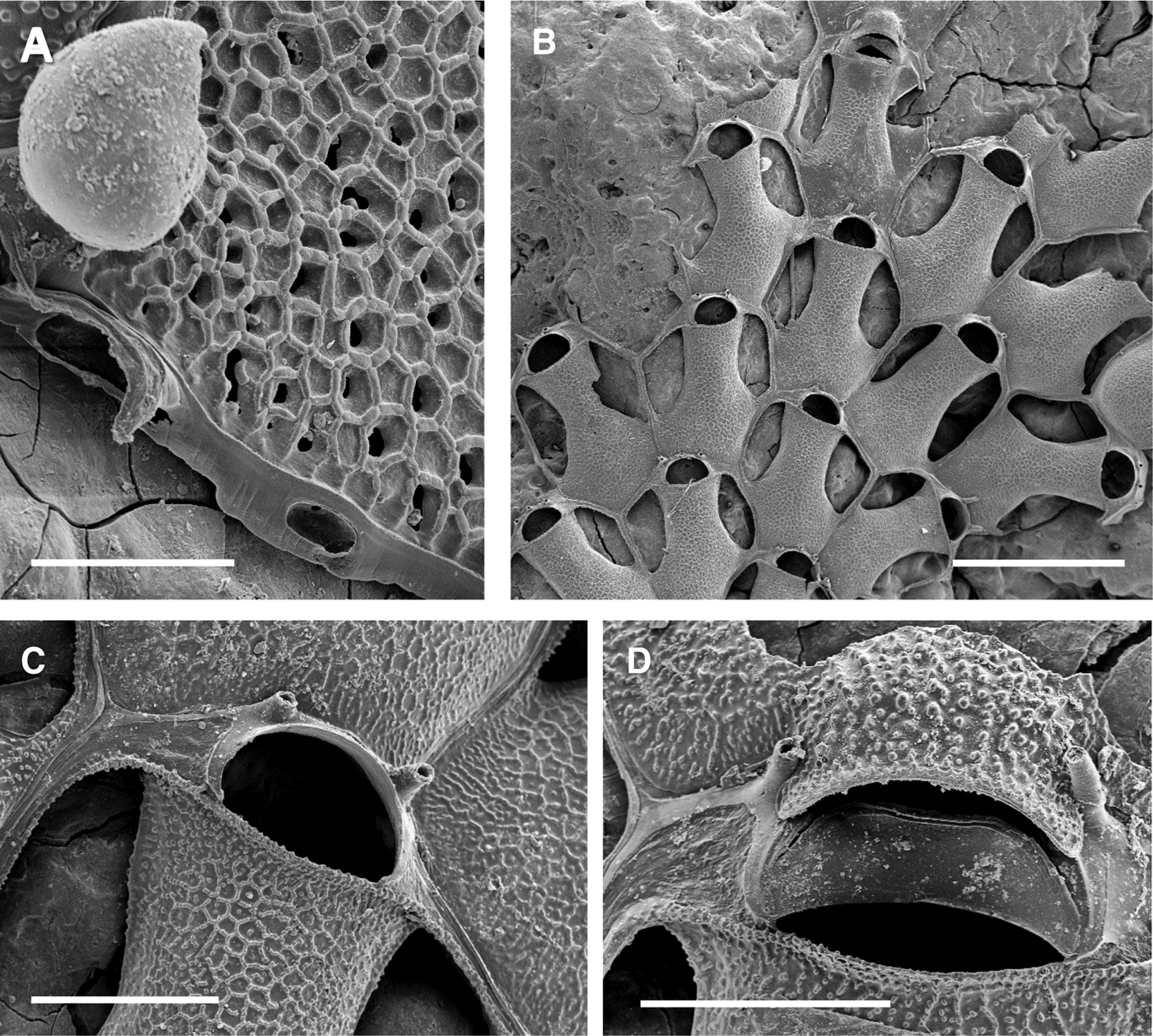
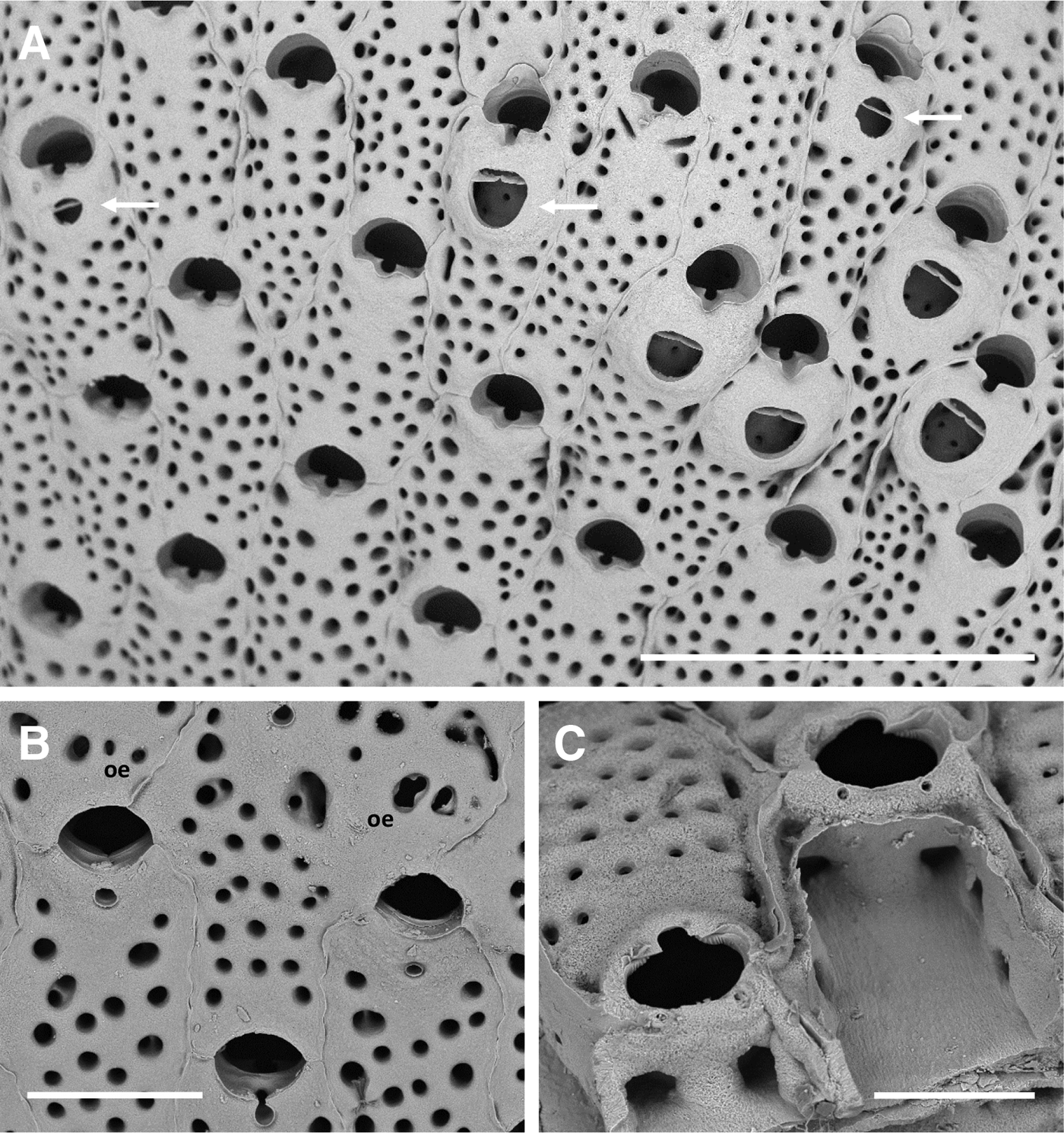
Recapitulator mirus gen. et sp. nov., NIWA 92104, holotype, from Station TAN0803/114, near Hjort Trench: (A) part of originally larger colony, showing autozooids, some with ooecia, and a large interzooidal avicularium; (B) interior view of part of endooecial floor (left) and ooecial cavity (right) showing tiny communication pores (arrow); inset light-micrograph of an ooecium clearly showing the costae; (C) ooecium, contrast-enhanced to show the thin intercostal sutures; (D) interzooidal avicularium; (E) underside of ooecium showing two near-parallel rows of communication pores. Scale bars: A, 1 mm; B, 100 µm; C–E, 200 µm.
MATERIAL EXAMINED
Holotype: NIWA 92104, Station TAN0803/114, on the northern ridge of an unnamed seamount at the southern end of the Hjort Trench south of Macquarie Island, 1775–1973 m depth.
ETYMOLOGY
Latin mirus, wonderful, alluding to the structure of the ooecium.
DESCRIPTION
Unique colony encrusting, unilaminar, multiserial, longest dimension 22 mm. Autozooids large [ZL 1128–1611 (1363), ZW 810–1243 (1071), ZD 100–221], with large oval opesia occupying most of the frontal area [OpL 889–1255 (1030), OpW 738–1000 (820)], entirely surrounded by a smooth, sloping gymnocystal rim that is a little flatter proximally. No cryptocyst. Four long, tapering, basally articulated oral spines on distal rim of gymnocyst [SpL 744–994]; no periopesial spines. Operculum a semicircular flap 289–331 (316) µm wide at base. Large interzooidal avicularia present, asymmetrical, with one side more pronounced, the rostral tip open as a furrow flanked by slightly curled and twisted rims; rostral foramen acutely triangular, separated from a subcircular opesia by a narrow crossbar that is thinnest medially [AvL 699–780 (740)]. Ooecium acleithral, composed of ~9–11 opposing pairs of costae, these laterally tightly apposed with faint lines between them; a longitudinal median crest and suture separates the opposing pairs; a pair of oral spines remaining, the proximal ends of a pair of costae straddling their bases on each side [OoL 558–683 (614), OoW 446–522 (473)]. Pore-chambers present, uni–triporous, one mid-distal, two distolateral, two lateral; mid-distal chamber basal, distolateral and lateral chambers higher in the wall; distolateral chambers smallest, intermediate between basal and mural in appearance. Ancestrula not seen.
REMARKS
Recapitulator mirus gen. et sp. nov., is notable for its costate ooecium, which is interpreted as a plesiomorphic feature inasmuch as the earliest cheilostome ooecia were almost certainly multispinose. Although the earliest actual ooecia known in the fossil record are bilobate (bispinose)—found in upper Albian (Mid-Cretaceous) Wilbertopora Cheetham, Reference Cheetham1954 (Cheetham et al., Reference Cheetham, Sanner, Taylor and Ostrovsky2006)—and predate the multispinose ooecia of Distelopora and Unidistelopora, it is hypothesized that bispinose ooecia evolved from multispinose antecedents via spine reduction (Ostrovsky & Taylor, Reference Ostrovsky and Taylor2004a).
The sole colony of R. mirus lacks ontogenetic stages showing ooecium development, which can be inferred, however, from studying the skeletal structure of fully formed ooecia. In this species the floor of the ooecium is formed by the proximal gymnocyst. A view of the underside of the gymnocyst shows a longitudinal arc of tiny pores (some occasionally merged to form a slit) on either side (Figure 2E); similarly, a view of a fractured ooecium from above shows the line of pores connecting with the ooecial cavity defined by the parallel walls of the endooecium and ectooecium (Figure 2B). According to Ostrovsky & Taylor (Reference Ostrovsky, Taylor, Moyano, Cancino and Wyse Jackson2004b), the formation of the ooecial floor by the proximal gymnocyst is a primitive feature that characterizes the ooecia of Cretaceous Distelopora, Wilbertopora and Gilbertopora Ostrovsky & Taylor, Reference Ostrovsky and Taylor2004a but is not otherwise found in Recent calloporids. The arrangement of spine bases in Recapitulator (paired longitudinal arcs) is reminiscent of the paired longitudinal lobes in Wilbertopora (Ostrovsky & Taylor, Reference Ostrovsky, Taylor, Moyano, Cancino and Wyse Jackson2004b), differing from those in Distelopora and Unidistelopora (spine bases distally arcuate or in the form of a horseshoe) (Ostrovsky & Taylor, Reference Ostrovsky and Taylor2004a, Reference Ostrovsky and Taylor2005).
Visually, the costate structure of the ooecium in R. mirus is more evident by light microscopy (Figure 2B, inset) than by low-magnification SEM because of the different optical densities of costal walls and lumina. In optical view, some costae and their lumina appear to merge, an impression reinforced by an interior view of costal outlines and the entrances to their lumina.
The genus and sole species are so far known only from the type locality, just outside the Australian EEZ of Macquarie Island, at 1775–1973 m depth.
Genus Mangana gen. nov.
TYPE SPECIES
Mangana magnesia sp. nov.
ETYMOLOGY
An intended double allusion, based on the Greek manganon, means of charming or bewitching (alluding to the novel characters of the taxon), and the manganese oxide substratum that the deep-sea type species grew on; gender feminine.
DIAGNOSIS
Colony encrusting, oligoserial. Autozooids with extensive opesia surrounded by narrow cryptocyst. Gymnocyst almost completely concealed proximally by an adventitious avicularian chamber and laterally by narrow kenozooids that are formed adventitiously in interzooidal furrows; avicularian chamber with areas of lateral cryptocyst. No oral or opesial spines. Ovicell hyperstomial, cleithral; ectooecium smooth, imperforate, but with lateral and occasionally frontal areas of cuticle-covered interior wall (cryptocyst). Interzooidal communications via mural septula. Ancestrula unknown.
REMARKS
Mangana gen. nov. would be distinctive enough based on the combination of a large oval opesia, absence of spines, narrow cryptocyst and proximally adventitious avicularium, but what is remarkable for a calloporid is the presence of elongate adventitious kenozooids in interzooidal furrows. Additionally, the lateral walls of the avicularian chamber and ooecium have areas of cryptocyst.
Mangana magnesia sp. nov.
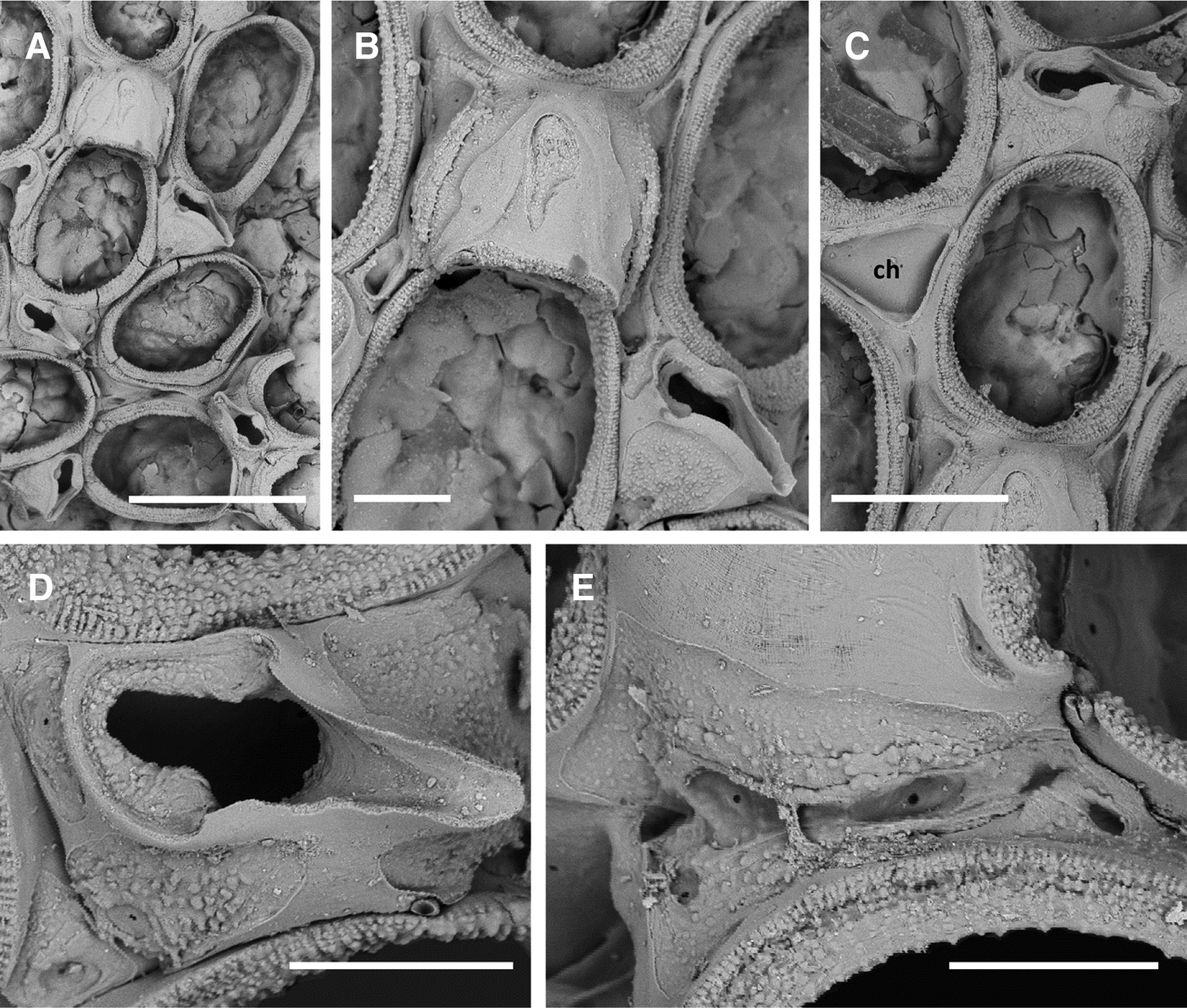
(Figure 3A–E)
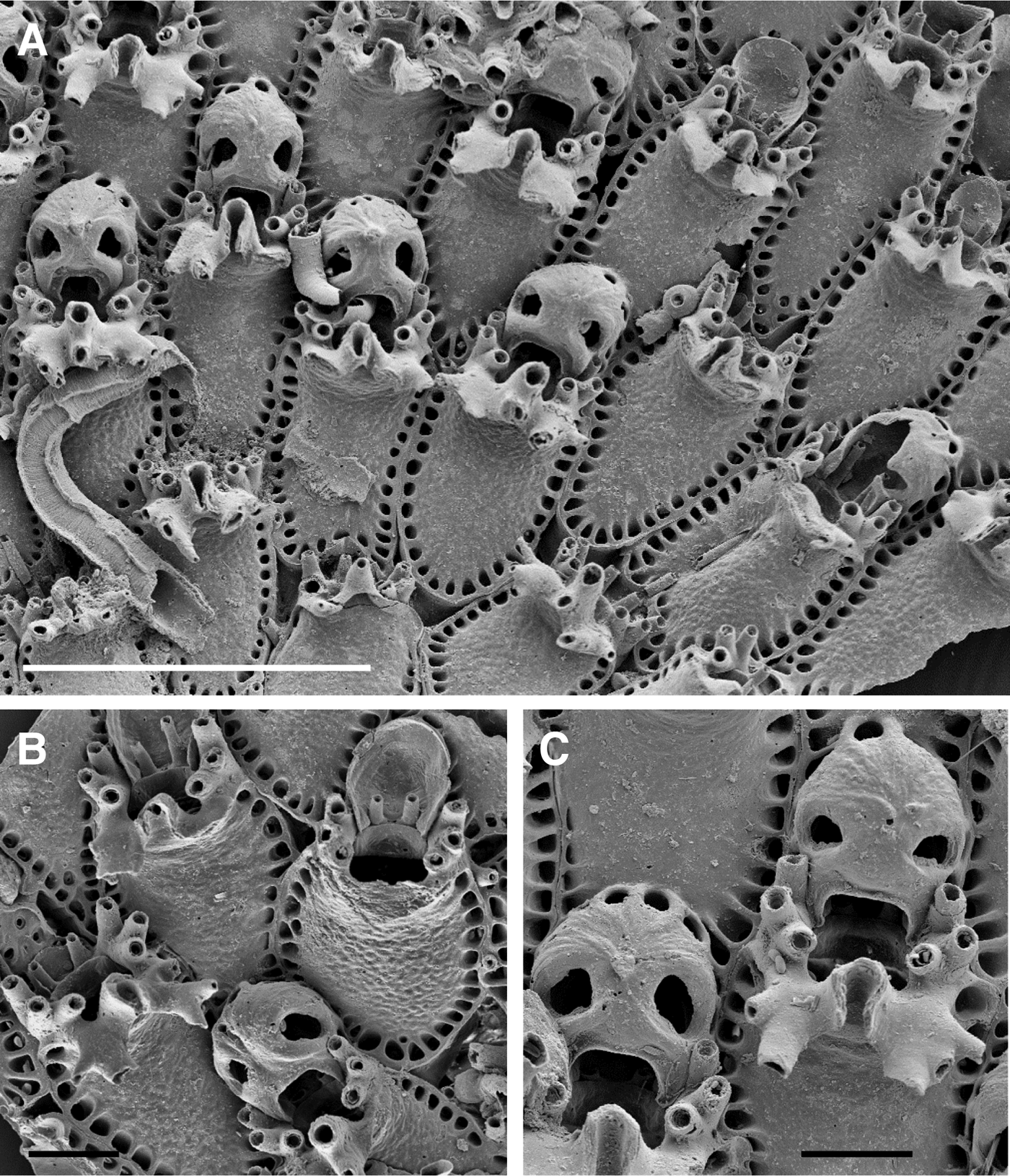
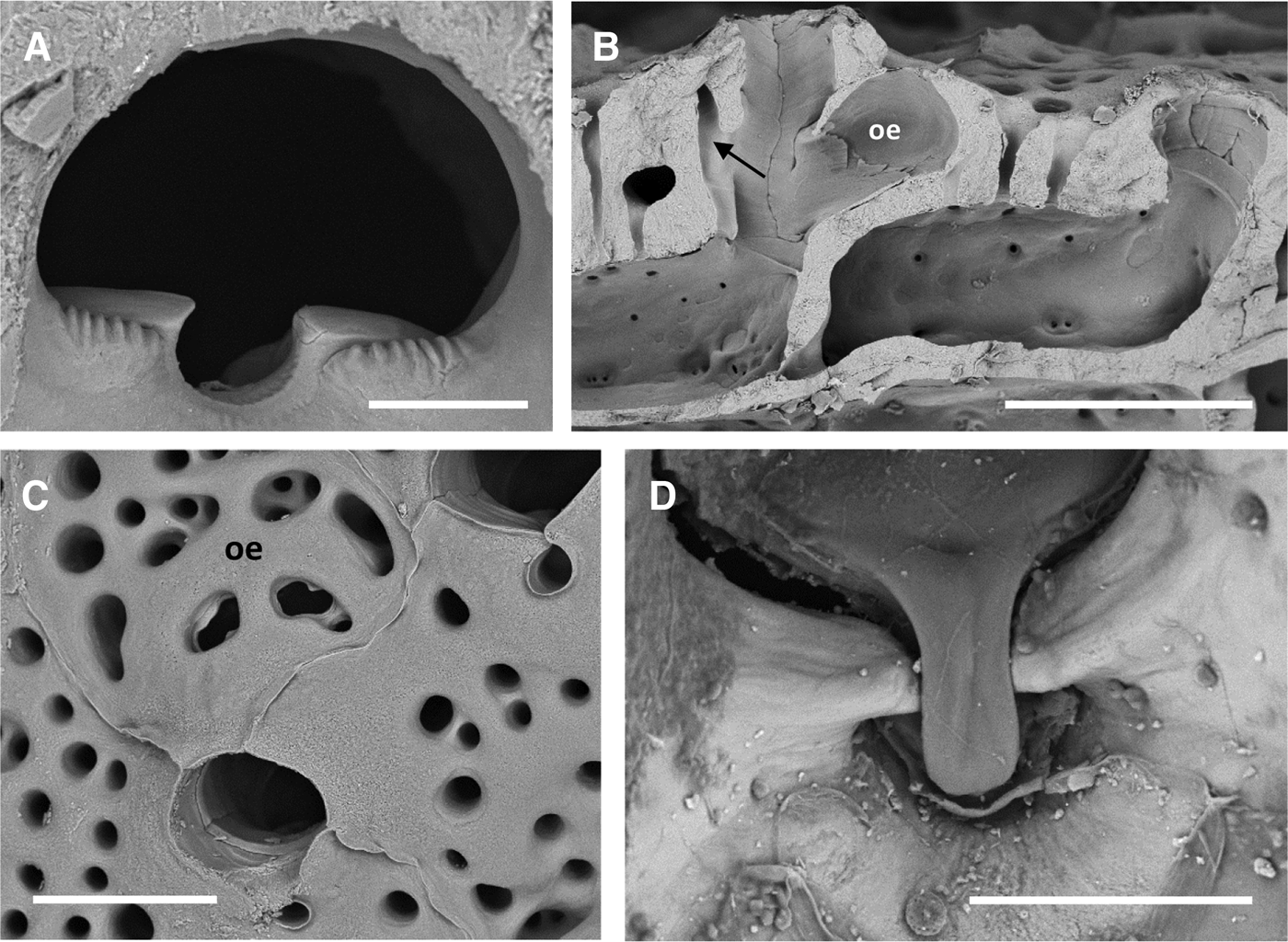
Mangana magnesia gen. et sp. nov., NIWA 92102, holotype, from Station TAN0803/112, Solander Trough: (A) autozooids (one with an ooecium) and adventitious avicularia; (B) close-up of ooecium in A, with surficial areas of interior wall and lateral kenozooids; (C) zooids distal to ooecium in B, showing an undeveloped avicularian chamber (ch) and a a fully developed avicularium; (D) en-face view of avicularium, showing surficial areas of interior wall; (E) lateral view of an ooecium showing areas of interior wall and a kenozooidal chamber with communication pores. Scale bars: A, 1 mm; B, D, E, 200 µm; C, 500 µm.
MATERIAL EXAMINED
Holotype: NIWA 92102, Station TAN0803/112, head of Solander Trough west of Stewart Island, 1260–1351 m depth.
ETYMOLOGY
Alluding to the manganese oxide substratum of the holotype specimen—the name of the element manganese is a corruption of the Latin place-name Magnesia.
DESCRIPTION
Colony encrusting, bi- to mostly triserial, with occasional branch bifurcations, 35 mm long. Autozooids contiguous but with deep interzooidal furrows; membranous frontal wall and opesia extensive, opesia completely surrounded by narrow granular cryptocyst of almost equal width throughout except distally where it is thinner [ZL 1000–1388 (1229), ZW 620–887 (716), ZD 154–245]. Gymnocyst almost completely concealed proximally by a transversely rectangular adventitious avicularian chamber and partly laterally by narrow interzooidal kenozooids that are formed adventitiously. Anterior end of frontal wall modified as an opercular flap that is strengthened mid-length by a dark-brown transversely crescentic sclerite [OpW 267–336 (309)]. No oral or opesial spines. Avicularium orientated laterally or slightly obliquely proximally, the rostrum more or less elongate-triangular with a rounded tip, the rostral foramen continuous with the avicularian opesia owing to the absence of a crossbar; opesia bordered by granular cryptocyst; lateral walls of avicularian chamber with large shallow areas of granular cryptocyst (Figure 3D); mandible hastate [ML 278–324 (304), 134–149 (143)]. Ooecium hyperstomial, cleithral; ectooecium imperforate, more or less smooth but with lateral and occasionally frontal areas of cuticle-covered interior wall (cryptocyst) (Figure 3E) like that on the avicularian chamber [OoL 458–473 (465), OoW 567–611 (586)]. Interzooidal communications via uni–triporous mural septula. Ancestrula unknown.
REMARKS
Kenozooids can occur interzooidally in many cheilostomes, often incidentally as space-fillers depending on the way autozooids grow over uneven substrata but also semi-regularly as a consistent feature. The kenozooids of Mangana magnesia gen. et sp. nov., are, however, budded adventitiously from the lateral gymnocyst and have a reasonably consistent position, at least in the vicinity of avicularia and ooecia. They are similar to those recorded in many fossil and at least one living species of Cribrilinidae (see discussion in Gordon & Voigt, Reference Gordon, Voigt, Gordon, Smith and Grant-Mackie1996) and a Cretaceous electrid (Dick et al., Reference Dick, Komatsu, Takashima and Ostrovsky2013) but they have not previously been recorded in the Calloporidae. Another remarkable feature of M. magnesia is the presence of areas of cryptocyst in the gymnocystal walls of the avicularia and ooecia. The very thin coeloms of these cryptocystal areas are each connected via a tiny pore to the larger coelom of the parent polymorph; this is certainly the case in the avicularia and a comparison with the equivalent areas of cryptocyst on the ooecial surface shows them to be formed in the same way. In other words, the ooecial cryptocystal surfaces do not represent endooecium; rather, these shallow cuticle-covered chambers are not part of the ooecial coelom but communicate with it. The question remains as to why they should form at all.
The species is known only from the holotype colony, which was split in order to prepare part of it for SEM. The species grew on a rock substratum covered by a 10–12 mm thick black manganous crust at 1260–1351 m depth.
Family PYRISINELLIDAE Di Martino & Taylor, Reference Di Martino and Taylor2012a
Genus Microblestrum gen. nov.
TYPE SPECIES
Microblestrum imitator sp. nov.
ETYMOLOGY
A hybrid name combined from the bryozoan genera Micropora and Amphiblestrum; gender neuter.
DIAGNOSIS
Colony encrusting, multiserial. Autozooids with extensive flat frontal cryptocyst bordered by a raised rim that is surrounded by a narrow sloping gymnocyst; cryptocyst with a pair of oval to slit-like opesiules. Opesia-orifice bordered by articulated oral spines. Proximal gymnocyst with 0–2 sessile avicularia. Ovicell hyperstomial, acleithral, with triangular frontal exposure of endooecium. Basal pore-chambers present. Ancestrula unknown.
REMARKS
Di Martino & Taylor (Reference Di Martino and Taylor2012a) established the family Pyrisinellidae to accommodate a small suite of taxa that appear to represent a monophyletic group. In the sum of its features this clade is somewhat intermediate between Calloporidae (Calloporoidea) and Microporidae (Microporoidea) but differs strictly from the former in having a salient mural rim that forms a ridge around the cryptocyst and opesia. Correlated characters include an arch of articulated oral spines and a prominent hyperstomial ovicell. Pyrisinellidae also differs strictly from the Microporidae in having a narrow gymnocyst around the entire circumference of the autozooid. Microblestrum gen. nov. differs from the pyrisinellid genera Pyrisinella Di Martino & Taylor, Reference Di Martino and Taylor2012a and Spinisinella Di Martino & Taylor, Reference Di Martino and Taylor2012a in having a non-trifoliate opesia and opesiules and from confamilial Setosinella Canu & Bassler, Reference Canu and Bassler1933 in having adventitious avicularia and a triangular exposure of endooecium. Megapora Hincks, Reference Hincks1877, only provisionally assigned to Pyrisinellidae by Di Martino & Taylor (Reference Di Martino and Taylor2012a), differs from Microblestrum in having, inter alia, a trifoliate opesia and no avicularia; its ovicell has a frontal triangular area. Another genus that may be confamilial is Antarctic Apiophragma Hayward & Ryland, Reference Hayward and Ryland1993. It has a salient mural cryptocystal rim and narrow perizooidal gymnocyst like the above pyrisinellid genera and is very similar to Microblestrum but lacks avicularia and differs in its opesia—it is longer than the orifice, somewhat parallel-sided (Waters, Reference Waters1904) to campanuliform (Hayward, Reference Hayward1995), with the operculum confined to the distal two-thirds and articulating with condyles where the opesia is slightly constricted. The ovicell was not seen by Hayward & Ryland (Reference Hayward and Ryland1993); Waters (Reference Waters1904) illustrated it (but did not describe it) as having a frontal structure that could be either a ridge or an excavation.
The hybrid name Microblestrum reflects the extensive flat cryptocyst, opesiules and combined opesia-orifice of Micropora Gray, Reference Gray1848 and other Microporidae; the sessile gymnocystal avicularia and triangular area of endooecial exposure are reminiscent of several genera of Calloporidae including Amphiblestrum Gray, Reference Gray1848.
Microblestrum imitator sp. nov.
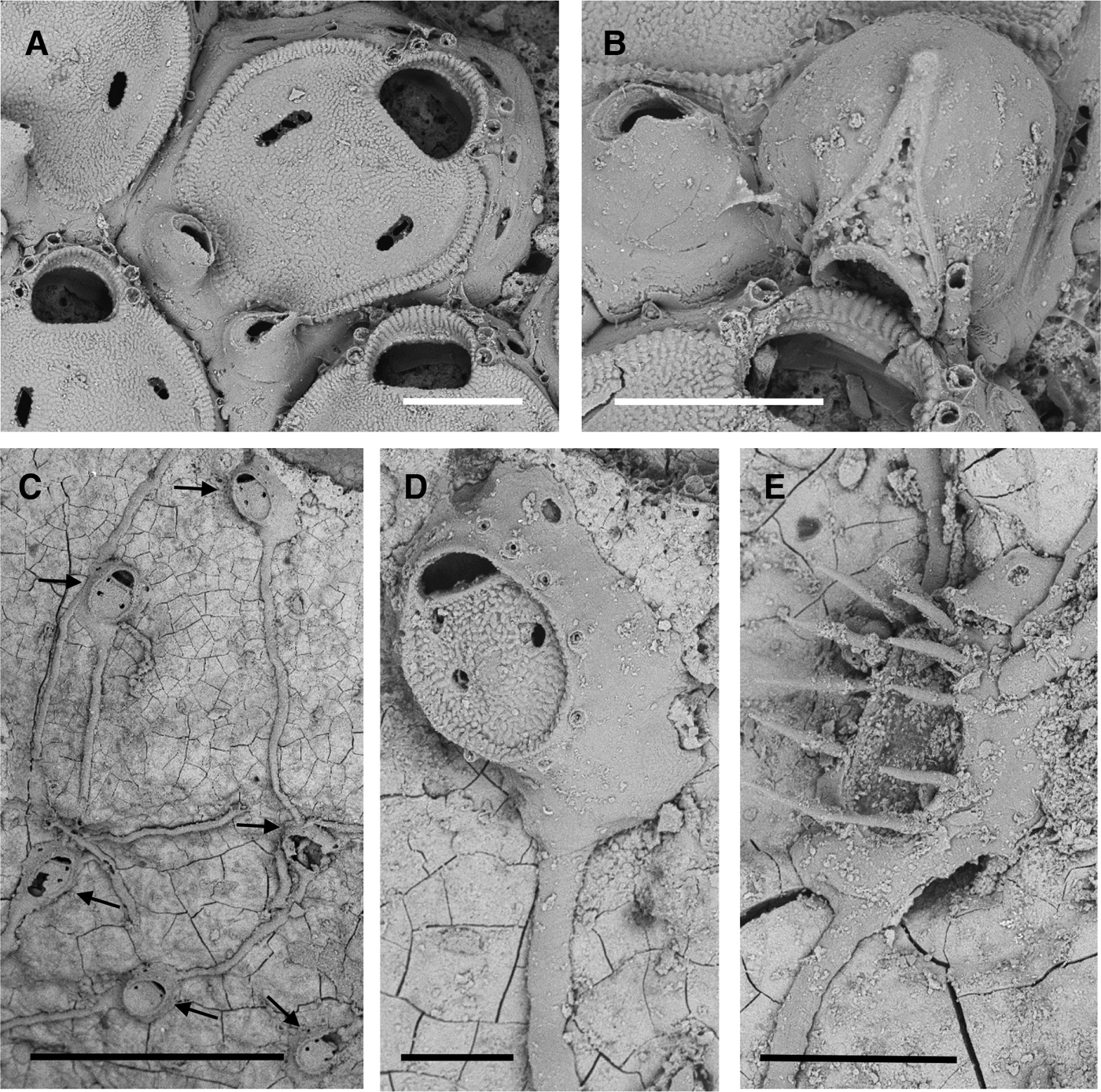
(Figure 4A, B)
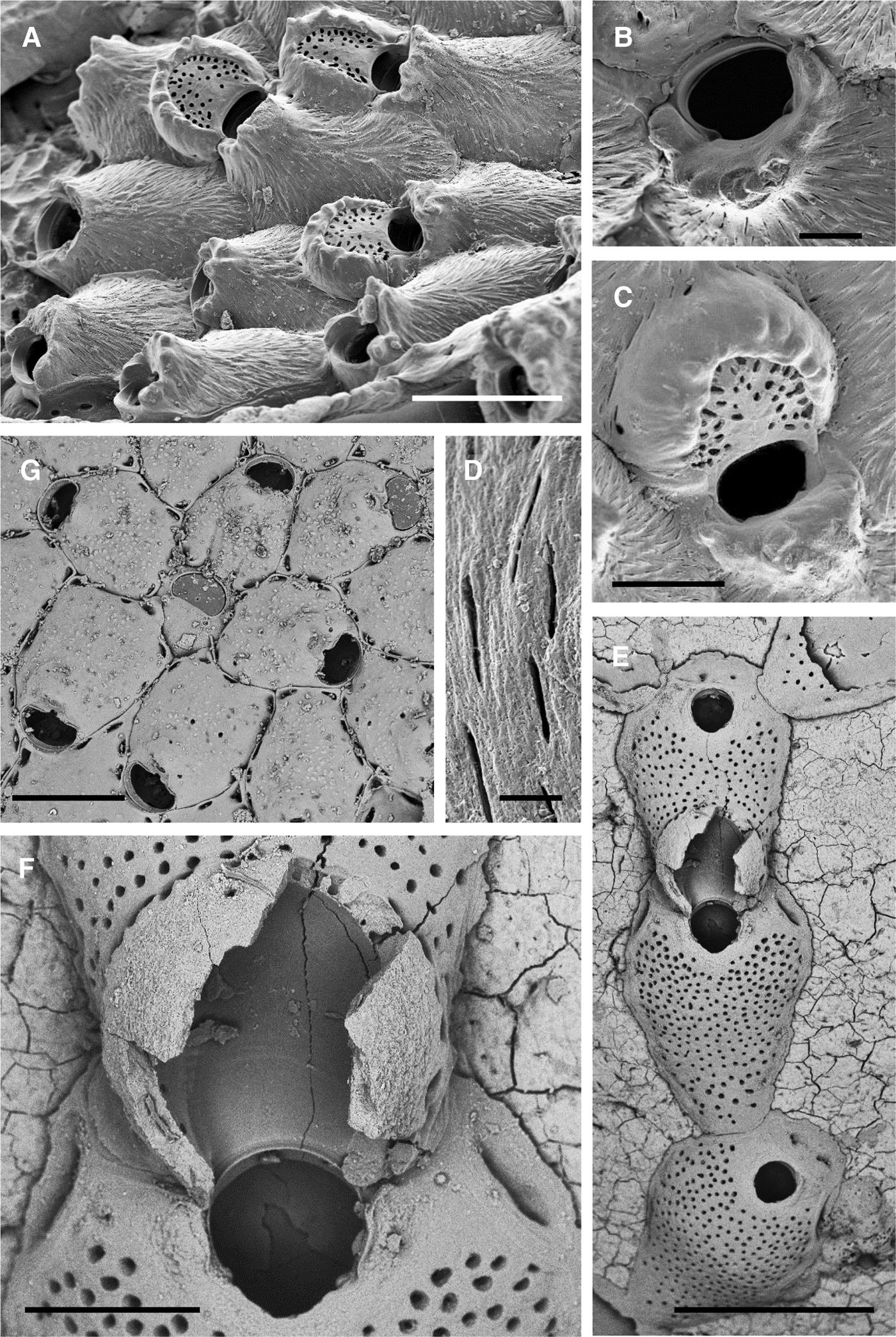
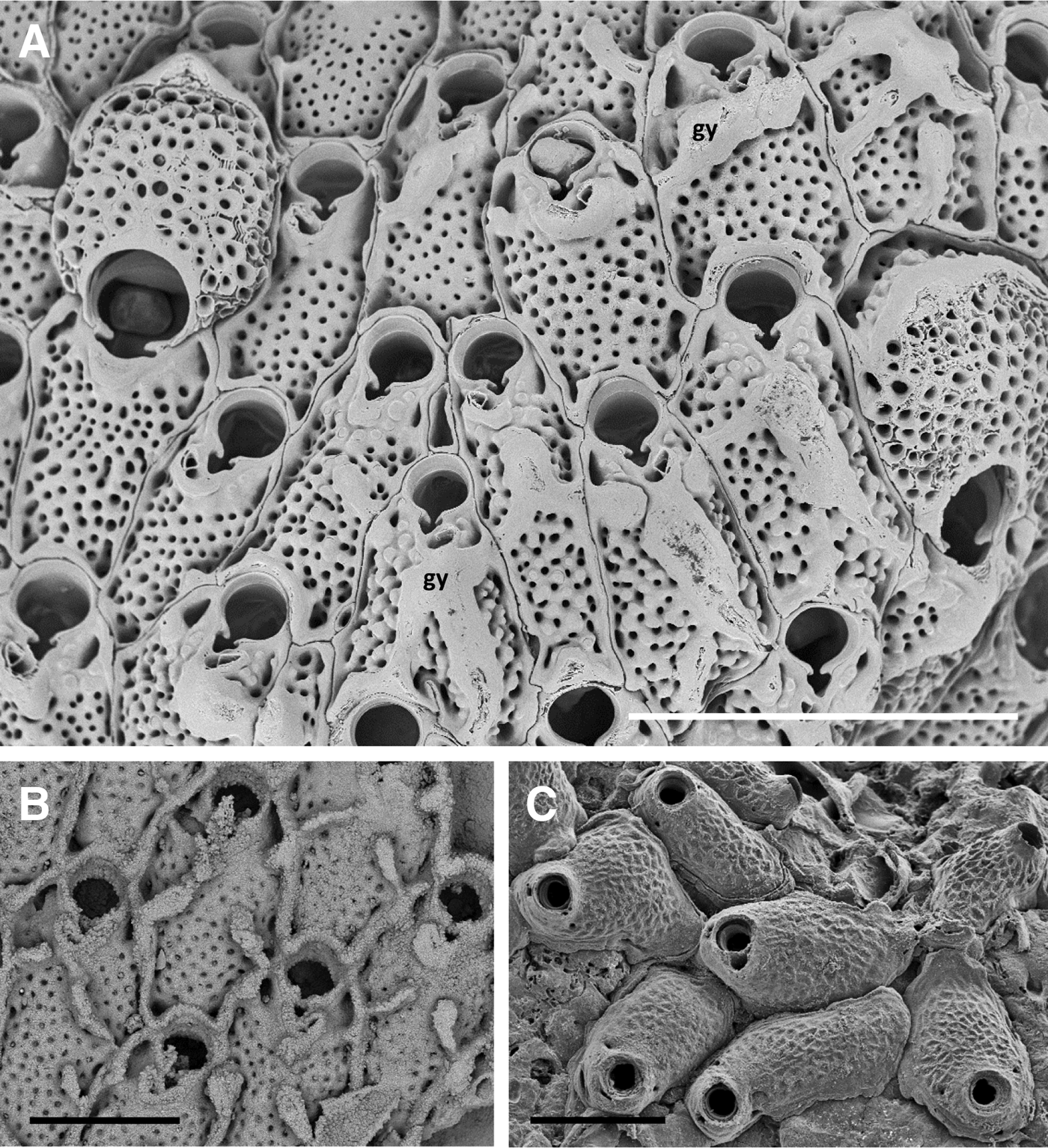
Microblestrum imitator gen. et sp. nov., NIWA 40907, holotype, Station TAN0803/98, Hjort Seamount: (A) autozooids showing paired elongate opesiules and adventitious avicularia; (B) ooecium with triangular exposure of endooecium. Stolomicropora iota gen. et sp. nov., NIWA 92105, holotype, from Station TAN0803/36, northern Macquarie Ridge; (C) part of colony showing six autozooids (arrows) with stolon-like caudae; (D) close-up of top right-hand autozooid in C, with four opesiules and periopesial spine bases; (E) autozooid with periopesial spines intact. Scale bars: A, B, E, 200 µm; C, 1 mm; D, 100 µm.
MATERIAL EXAMINED
Holotype: NIWA 92101, Station TAN0803/098, north-west slope of Hjort Seamount south of Macquarie Ridge, 676–750 m.
ETYMOLOGY
Latin imitator, imitator, one who copies, alluding to the replication of some microporid and calloporid features; used as a noun in apposition.
DESCRIPTION
Colony encrusting, multiserial, unilaminar. Autozooids almost as wide as long, clearly distinguished owing to interzooidal furrows [ZL 489–794 (627), ZW 431–722 (539), ZD 78–131]. Extensive flat frontal cryptocyst bordered by a narrow, raised crenulated rim that is surrounded by a narrow sloping gymnocyst; cryptocyst with a pair of oval to slit-like opesiules midlength [OpsL 28–79]. Opesia-orifice transversely D-shaped, bordered by three articulated oral spines on each lateral margin, no spines mid-distally [OpL 100–143 (122), OpW 144–178 (157)]; 1–2 smaller spine bases on the lateral gymnocystal margin of some zooids. Proximal gymnocyst with 0–2 sessile avicularia, these directed laterally or obliquely distolaterally; each with a small proximal area of granular cryptocyst and an acute triangular rostrum with no crossbar. Ovicell hyperstomial, acleithral, lying recumbently between a distal pair of avicularia or one of these lacking; smooth and imperforate with a narrowly triangular frontal exposure of irregular endooecium [OoL 278–331 (297), OoW 267–289 (273)]; all six oral spines retained in ovicelled zooids. Basal pore-chambers present; typically one mid-distal and two distolateral, of varying length. Ancestrula unknown.
REMARKS
Microblestrum imitator gen. et sp. nov. appears to be closest in morphology to Antarctic Apiophragma hyalina (Waters, Reference Waters1904), the sole known species of its genus (Hayward & Ryland, Reference Hayward and Ryland1993; Hayward, Reference Hayward1995). The two species have in common a more-or-less identical zooid shape, a flat cryptocyst surrounded by a raised crenellated cryptocyst rim, a pair of opesiules, and two sets of three oral spines separated by a distal gap. On the other hand, as noted above, M. imitator has a simple D-shaped opesia-orifice with no condyles and the gymnocyst bears 1–2 adventitious avicularia (lacking in some zooids). Information is needed on the frontal features of the ovicell in A. hyalina and the nature of the ancestrula in M. imitator in order to compare these taxa more precisely.
Microblestrum imitator is so far known from a single colony that was taken in an upslope trawl at 676–750 m depth on Hjort seamount south of Macquarie Ridge. The hippothoid cheilostome Hippothoa flagellum Manzoni, Reference Manzoni1870 grew alongside and partly upon M. imitator.
Genus Stolomicropora gen. nov.
TYPE SPECIES
Stolomicropora iota sp. nov.
ETYMOLOGY
Latin stolo, branch, shoot, runner, plus Micropora, a bryozoan genus, alluding to the stoloniform extensions of autozooids; gender feminine.
DIAGNOSIS
Colony encrusting, uniserial. Autozooids very small, comprising a long, stoloniform caudal portion and oval distal dilatation. Dilatation steep-sided with raised narrow rim surrounding an extensive cryptocyst with two pairs of opesiules; lateral walls and cauda gymnocystal. Articulated spines surround the cryptocyst. Opesia-orifice transversely D-shaped. Ooecium imperforate, cleithral. Basal pore-chambers present distally. Ancestrula unknown.
REMARKS
Stolomicropora gen. nov. raises the question of family attribution. Like Microblestrum gen. nov., in the past it would unhesitatingly have been included in the Microporidae because of the transversely D-shaped opesia-orifice and opesiulate cryptocyst, but the raised cryptocystal rim and perizooidal gymnocyst also argue for inclusion in the Pyrisinellidae. Stolomicropora differs from all pyrisinellid and microporid genera in the sum of its characters, in particular the combination of stoloniform autozooids and pericryptocystal spines. Individual autozooids in non-stoloniform Apiophragma hyalina are similar to the dilatation in Stolomicropora iota sp. nov. (see below) and have circular opesiules (not slit-like) but spines are oral only. Scriblitopora Hayward & Winston, Reference Hayward and Winston2011 has a complete series of pericryptocystal spines but the autozooids are non-stoloniform, there are multiple opesiules and the ooecium has a median longitudinal suture.
Stolomicropora iota sp. nov.
(Figures 4C–E, 5A)
Stolomicropora iota gen. et sp. nov., NIWA 92105, holotype, from Station TAN0803/36, northern Macquarie Ridge: (A) autozooid with ooecium. Otomicropora otus gen. et sp. nov., holotype NIWA 3828, Station KAH0204/20, Cavalli Seamount; (B) part of colony, several autozooidal with ooecia; (C) auotzooidal orifice, flanked by a short spine and a sessile adventitious avicularium, with a pair of suboral opesiules; (D) maternal orifice. Scale bars: A, C, D, 200 µm; B, 500 µm.
MATERIAL EXAMINED
Holotype: NIWA 92105, Station TAN0803/036, Seamount 3 Clementsville, northern Macquarie Ridge, 1144–1365 m.
ETYMOLOGY
Greek iota, anything very small.
DESCRIPTION
Colony encrusting, uniserial. Autozooids very small, comprising a stoloniform caudal portion (varying from 239 to >1155 µm in length) and a suboval distal dilatation [ZL (dilatation) 289–406 (352), ZW 194–278 (239)]. Dilatation steep-sided with raised very narrow granular rim surrounding an extensive flat granular cryptocyst with two pairs of circular to subcircular opesiules, one pair just proximal of the orificial rim, the other half-way along the cryptocyst; lateral walls and cauda gymnocystal. 10–11 relatively stout pointed articulated spines surround the cryptocyst. Opesia-orifice transversely D-shaped [OpL 33–51 (37), OpW 78–89 (83)]. Ooecium smooth, imperforate, cleithral, longer than wide [OoL 187, OoW 156]. Two small basal pore-chambers present distally with often a third budding locus between them that seems not to be from a pore-chamber. Ancestrula unknown.
REMARKS
Stolomicropora iota gen. et sp. nov. is striking for its small size. Its mode of growth, and the ability to accommodate varied caudal lengths, allows it to ramify over irregularities in the substratum. Many caudae have sections missing, thus the zooidal dilatations appear capable of surviving as unitary individuals which can produce new buds (up to three) distally. Caudae that happen to cross those from adjacent zooids do not appear to fuse.
The large number of pericryptocystal spines invites comparison with uniserial (but non-caudate) Micropora cervicornis d'Hondt & Mascarell, Reference Hondt and Mascarell2010 from 90–180 m deep at Ile Ua Pou in the Marquesas Islands. This striking species has up to 25 pericryptocystal spines, mostly variably cervicorn, but it differs significantly from S. iota in the large size of the zooids (up to 1200 µm long), the perforated cryptocyst with two long slit-like opesiules, and a highly porous gymnocyst. Micropora cervicornis clearly does not belong to Micropora and requires a new genus. Its family relationships are uncertain; the formal description does not specifically mention a raised cryptocystal rim (the line drawing is equivocal on this point) but Pyrisinellidae is a possibility. The gymnocystal perforations would be an unusual feature, however.
Stolomicropora iota is known only from the holotype colony, which grew on a rock substratum covered by a 3–5 mm thick black manganous crust at 1144–1365 m depth on a volcanic seamount.
Superfamily MICROPOROIDEA Gray, Reference Gray1848
Family MICROPORIDAE Gray, Reference Gray1848
Genus Otomicropora gen. nov.
TYPE SPECIES
Otomicropora otus sp. nov.
ETYMOLOGY
Greek otos, ear, and Micropora, a bryozoan genus, alluding to the ear-like avicularia; gender feminine.
DIAGNOSIS
Colony encrusting, multiserial. Autozooids large with relatively small opesia-orifice and extensive, flattened cryptocyst with reticulate surface; a tiny pseudopore occupies some of the reticular depressions. Opesiules paired, small relative to cryptocyst, located near each proximolateral corner of the orifice. Avicularia adventitious, lateral-oral, generally paired, small and subglobular with triangular mandibular pivots that fuse in midline; often with a tiny spine behind avicularium or in place of it. Ooecium recumbent, with granular to subreticulate endooecial surface, cleithral. Interzooidal communications via small uniporous pore-chambers. Ancestrula tatiform with periopesial spines.
REMARKS
Otomicropora is a distinctive new microporid genus, characterised by adventitious avicularia superficially resembling bird's-head avicularia, and reticulate sculpturing of the cryptocyst.
Otomicropora otus sp. nov.
(Figures 5B–D, 6A)
Otomicropora otus gen. et sp. nov., holotype NIWA 3828, Station KAH0204/20, Cavalli Seamount: (A) lateral view of an autozooid showing an avicularium in profile and two distolateral pore-chambers. Rosemariella thompsonae gen. et sp. nov., NIWA 92086, holotype, from Station Z8484, northern Louisville Ridge; (B) part of colony, the autozooid at top centre with an ooecium; (C) autozooidal orifice, with smooth, flat areas flanking the orifice; (D) maternal orifice, with damaged operculum bent inwards proximally. Scale bars: A, 100 µm; B, 1 mm; C, D, 200 µm.
MATERIAL EXAMINED
Holotype: NIWA 3828, Station KAH0204/020, Cavalli Seamount off north-eastern North Island, New Zealand, 610–637 m depth.
Paratypes: NIWA 3829, Station KAH0204/030, 800–825 m depth; NIWA 92084, Station TAN0307/056, 2376–2385 m.
Other material: two colonies, one small and ancestrulate, Station TAN0306/005, Christable Seamount west of Auckland Island, 973–990 m.
ETYMOLOGY
Latinised form of otos, ear, used as a noun in apposition, alluding to the small, ear-like lateral-oral avicularia.
DESCRIPTION
Colony encrusting, unilaminar, multiserial, observed maximum dimension 13 mm. Autozooids large [889–1234 (1014), ZW 578–1154 (810), ZD 139–210], basal wall wholly cuticular. Opesia-orifice small relative to autozooid size, transversely narrow [OpL 83–110 (92), OpW 211–243 (224)], sloping slightly distad and partly concealed by the cowl-like distal rim. Cryptocyst broad and extensive, weakly convex, sloping gently to interzooidal boundaries, paired boundaries indicated by a very thin line of calcification with median suture; surface regularly and finely sculptured reticulation forming pentagonal to heptagonal cells; a tiny pseudopore present in some reticulation cells but with no apparent pattern of distribution. Opesiules paired, small relative to cryptocyst, located near each proximolateral corner of orifice, a little longer than wide with internal diameter 22–44 µm. Avicularia adventitious, lateral-oral, generally paired, small and subglobular and superficially bird's-head-like but sessile, not pedunculate, sitting in a small concavity in which a single communication pore is evident in the absence of the avicularium; mandibular pivots triangular, stout relative to size of avicularium, their acute tips meeting and fusing in the midline, delimiting a tiny opesia proximad and rostral foramen distad [AvL 144–157 (146), AvW 100–111 (103)]. Often a non-articulated spine adjacent to the avicularium and partly concealed by it, or the spine replacing an avicularium on one or both sides of the orifice; spines rarely up to 334 µm long, tapering; mostly very short in available specimens. Ooecium recumbent, with granular to subreticulate endooecial surface, cleithral [OoL 256–312 (285), OoW 332–367 (344)]. Interzooidal communications via small uniporous pore-chambers; a line of uniporous septula in transverse (distal) walls. Ancestrula tatiform with no cryptocyst discernible by light microscopy; lateral wall narrow with distal pair of slender spines, one on either side in opercular region, and ca 7 additional periopesial spines [AnL 567, AnW 356].
REMARKS
The species is striking for its contrasting proportions, having large autozooids with relatively small orifices and adventitious avicularia. The avicularia form initially as cup-shaped receptacles, each budded from a uniporous septulum in a concavity adjacent to the orifice. The rounded shape of the avicularium, with its short beak-like rostrum, is remarkably like a buguloidean bird's-head avicularium but is sessile.
Otomicropora otus sp. nov. occurs within the New Zealand EEZ from the Cavalli Seamounts off north-eastern New Zealand to the western and eastern margins of the subantarctic Campbell Plateau at depths of 610–2385 m, hence the genus and species are nominally endemic.
Genus Rosemariella gen. nov.
TYPE SPECIES
Rosemariella thompsonae sp. nov.
ETYMOLOGY
Honorific for the late Rose-Marie Thompson, a friend and workmate at the NIWA whose inimitable word-processing skills rendered near-illegible collegial manuscripts (sometimes literally hand-written in part) into impressive scientific tomes; gender feminine.
DIAGNOSIS
Colony encrusting, multiserial. Autozooids large with combined opesia-orifice that is flanked by a shallow imperforate area on either side. Oral-spine bases present. Distal half or more of cryptocyst narrower than proximal part, having the form of a ‘polypide tube’ flanked by a pair of enormous opesiules; cryptocystal surface with weak, irregular reticulation; no pseudopores. Avicularia absent. Ooecium recumbent, with granular endooecial surface, cleithral. Interzooidal communications via small uniporous mural septula. Ancestrula unknown.
REMARKS
Rosemariella gen. nov. is a distinctive new microporid characterised by enormous paired opesiules that restrict the distal part of the cryptocyst into a ‘polypide tube.’ There are no avicularia.
Rosemariella thompsonae sp. nov.
(Figure 6B–D)
MATERIAL EXAMINED
Holotype: NIWA 92086, Station Z8484, from Rosemariella Seamount (newly named) in the Louisville Ridge chain, 1000 m.
ETYMOLOGY
Eponymous for Rose-Marie Thompson.
DESCRIPTION
Colony encrusting, unilaminar, multiserial, maximum diameter 5 mm. Autozooids large [ZL 655–1067 (910), ZW 617–767 (680), ZD 112–210], basal wall wholly cuticular. Opesia-orifice more or less transversely D-shaped with gently concave proximal rim [OL 132–167 (150), OW 210–256 (227)], flanked on either side by a smooth, imperforate, triangular area that merges into the lateral margin and is bounded proximally by an extension of the slightly elevated proximal orificial rim. Oral-spine bases present, 2–3 on the distal rim, sometimes with an additional spine base associated with the distal margin of the triangular area on each side. Distal half or more of cryptocyst narrower than proximal part, having the form of a ‘polypide tube,’ its sides curving basalwards almost to the substratum, flanked by a pair of enormous opesiules [OpsL 332–589 (461), OpsW 110–245 (181)]; cryptocystal surface with weak, irregular reticulation; no pseudopores. Avicularia absent. Ooecium recumbent, with granular endooecial surface, cleithral [OoL 156–167 (162), OoW 278–289 (284)]. Interzooidal communications via small uniporous mural septula. Ancestrula unknown.
REMARKS
Morphologically, the nearest genus to Rosemariella gen. nov. is Andreella Jullien, Reference Jullien1888—Andreella megapora Moyano & Melgarejo, Reference Moyano and Melgarejo1974, for example, has a pair of large opesiules, but in this instance the cryptocyst is narrowed to a shelf or ridge and is not tubular. Further, all described living species of Andreella have a well-developed sessile avicularium on the proximal cryptocyst, the peripheral margin of the ectooecium may be calcified in at least two of the species (Moyano, Reference Moyano1985), and there is no triangular area either side of the orifice.
Rosemariella thompsonae sp. nov. is so far known only from 1000 m depth on a seamount in the Louisville Ridge east of East Cape, New Zealand.
Superfamily LEPRALIELLOIDEA Vigneaux, Reference Vigneaux1949
Family ROMANCHEINIDAE Jullien, Reference Jullien1888
Genus Bioptica gen. nov.
TYPE SPECIES
Bioptica spinosa sp. nov.
ETYMOLOGY
Latin, bi-, two, double, plus opticus, optic, alluding to the paired ‘eye-like’ excavations in the ooecium; gender feminine.
DIAGNOSIS
Colony encrusting, multiserial. Autozooids with umbonuloid frontal shield, imperforate centrally but bordered by a marginal series of areolae. Proximal orificial rim with simple distal spines and a proximolateral complex of branching spines; all spines non-articulated; no lyrula. Avicularia absent. Ovicell hyperstomial with bifenestrate endooecium. Ancestrula unknown.
REMARKS
Bioptica gen. nov. is somewhat Escharoides-like but differs in having a peristomial spine complex, a bifenestrate ooecium and no avicularia.
Bioptica spinosa sp. nov.
(Figure 7A–C)
Bioptica spinosa gen. et sp. nov., NIWA 92087, holotype, from Station Z9687, Spirits Bay: (A) part of colony, most autozooids having ooecia; (B) same, autozooids tilted forward; (C) close-up of ooecia and spinose peristomial complex. Scale bars: A, 1 mm; B, C, 200 µm.
MATERIAL EXAMINED
Holotype: NIWA 92087, Station Z9687, Spirits Bay, northern New Zealand, 48 m.
ETYMOLOGY
Latin spinosus, thorny, alluding to the presence of orificial spines.
DESCRIPTION
Colony encrusting, unilaminar, multiserial, maximum length 18 mm. Autozooids more or less elongate-oval [ZL 533–722 (635), ZW 345–534 (405), ZD 121–167]. Frontal shield umbonuloid, rising evenly from the margin towards the abruptly raised peristomial spine complex, imperforate except for 18–36 conspicuous marginal areolae; proximal boundary frequently curved; autozooids overgrowing an irregular substratum may have small interzooidal gaps. Basal zooidal wall calcified, either adherent directly on the substratum or with short basal props if substratum irregular. Peristomial orifice in vertical plane [OL 78–121 (96), OW 112–143 (130)], with somewhat squared, alyrulate opening. Distal rim with a pair of non-articulated spines; lateral margins each with a pair of fused spine bases, the most proximal of which bifurcates, continuing proximally as a spinose process that fuses mid-proximally with the opposing process, typically forming a narrow median curl or scoop, though this is variable; the overall effect is a complex structure comprising five short spine tips on either side of the orifice. Avicularia absent. Ovicell hyperstomial with somewhat squared opening; endooecium with a pair of conspicuous frontal fenestrae, surface more or less smooth or faintly granular with weak ridges converging at apex; some marginal areolar pores present [OoL 239–256 (246), OoW 300–321 (315)]. Interzooidal communications via recessed multiporous septula that appear intermediate between intramural septula and pore-chambers. Ancestrula unknown.
REMARKS
At the type and sole known locality for the species, two moderately large colonies of Bioptica spinosa sp. nov. encrusted a shell of the dog cockle Tucetona laticostata (Quoy & Gaimard) (Glycymeridae), an important substratum for bryozoans in the Spirits Bay area (Cryer et al., Reference Cryer, O'Shea, Gordon, Kelly, Drury, Morrison, Hill, Saunders, Shankar, Wilkinson and Foster2000). One overgrew a smaller colony of Bitectipora rostrata (MacGillivray) and both were partly overgrown by a species of Microeciella (Cyclostomata), a serpulid tubeworm and a leucosoleniid sponge. The genus and species are apparently endemic to New Zealand.
Superfamily SMITTINOIDEA Levinsen, Reference Levinsen1909
Family BITECTIPORIDAE MacGillivray, Reference MacGillivray1895
Genus Caesiopora gen. nov.
TYPE SPECIES
Caesiopora secta sp. nov.
ETYMOLOGY
Latin caesio, a cut, and porus, pore, hole, alluding to the pseudopores that look like small cuts; gender feminine.
DIAGNOSIS
Colony encrusting, multiserial. Autozooids with pseudoporous lepralioid frontal shield, the pseudopores in the form of narrow slits that diverge proximolaterally from peristome. Primary orifice with broad shallow poster and small rounded condyles. Peristome comprising a thickened irregular collar. No oral spines or avicularia. Ovicell hyperstomial with a broad, flat perforated ectooecium bordered peripherally by a raised rim of secondary calcification. Intramural uniporous septula present. Ancestrula modified tatiform with circular opesia and well-developed cryptocystal shelf.
REMARKS
Caesiopora gen. nov. is distinguished primarily by the unusual slit-like pseudopores; other diagnostic features, when used in combination, include the lack of avicularia and the wider-than-long orifice with shallow poster and simple condyles. The ooecium resembles that in some species of Schizomavella Canu & Bassler, Reference Canu and Bassler1917 and Stephanotheca Reverter-Gil, Souto & Fernández-Pulpeiro, Reference Reverter-Gil, Souto and Fernández-Pulpeiro2012a, except that secondary calcification completely surrounds the perforated ectooecium in the latter.
Caesiopora secta sp. nov.
(Figure 8A–D)
Caesiopora secta gen. et sp. nov., NIWA 92088, holotype, from Station Z9697, Spirits Bay: (A) part of colony, showing three autozooids with ooecia; (B) autozooidal orifice; (C) ooecium and maternal orifice; (D) close-up of slit-like pseudopores. Cheilonellopsis inflata gen. et sp. nov., NIWA 3773, holotype, from Station KAH0204/52, Cavalli Seamounts; (E) part of uniserial colony, with a single broken ooecium; (F) close-up of oecium in E. Xenogma rhomboidale (Powell, Reference Powell1967), NIWA 92100, non-type, from Station K837, Macauley Island; (G) ancestrula and periancestrular autozooids. Scale bars: A, 500 µm; B, C, G, 200 µm; D, 20 µm; E, 1 mm; F, 250 µm.
MATERIAL EXAMINED
Holotype: NIWA 92088, Station Z9697, Spirits Bay, northern New Zealand, 57 m.
ETYMOLOGY
Latin secta, a cut, alluding to the cut-like pseudopores; used as a noun in apposition.
DESCRIPTION
Colony encrusting, unilaminar, multiserial, maximum dimension 5 mm. Autozooids longer than wide [ZL 610–789 (671), ZW 399–600 (464), ZD 110–153] with pseudoporous lepralioid frontal shield rising from margins to steeply elevated proximal peristomial crest. Pseudopores in the form of numerous exceedingly narrow slits that diverge proximolaterally from the peristome; calcareous fabric between slits finely lineated in the same direction. Additional distinguishing areolar-septular pores rare to absent. Primary orifice wider than longer [OL 110–143 (128), OW 137–167 (154)], with broad shallow poster and small, rounded condyles in the proximolateral corners. Peristome comprising a thickened irregular collar made up of a lateral pair of processes and a slighter thicker, broader proximal crest, the three projections confluent at their bases. No oral spines or avicularia. Ovicell hyperstomial with a broad, flat perforated ectooecium (~40 pores) bordered peripherally by a raised rim of secondary calcification [OoL 243–278 (263), OoW 356–389 (370); it is not known whether the operculum can close the primary orifice and, in a raised position, also close the ovicell. Intramural uniporous septula present. Ancestrula modified tatiform with seven peripheral spines, circular opesia and well-developed cryptocystal shelf [AnL 356, AnW 300].
REMARKS
Phil Bock (Melbourne) sent SEM micrographs of an unnamed species from Bass Strait that also has distinctive slit-like pseudopores. However, unlike Caesiopora secta gen. et sp. nov., zooids of the Australian species have normal pseudopores at the colony margin that later become narrow through secondary calcification; furthermore, the orientation of the pseudopores tends to be chaotic and not aligned with the calcareous fabric of the frontal shield, and there is a suboral avicularium. These characters and that of the ovicell allow the Australian species to be accommodated in Schizomavella Canu & Bassler, Reference Canu and Bassler1917. The genus Caesiopora and its nominotypical species are thus apparently endemic to New Zealand.
Superfamily SCHIZOPORELLOIDEA Jullien, Reference Jullien1882
Family LACERNIDAE Jullien, Reference Jullien1888
Genus Cheilonellopsis gen. nov.
TYPE SPECIES
Cheilonellopsis inflata sp. nov.
ETYMOLOGY
Cheilonella, a bryozoan genus, plus -opsis, likeness; gender feminine.
DIAGNOSIS
Colony encrusting, uniserial. Autozooids pyriform with evenly pseudoporous frontal shield. Orifice subcircular with broad poster and weak condyles. No articulated spines or avicularia. Ooecium hyperstomial with nearly smooth imperforate endooecium and membranous ectooecium; septular pores around basal periphery. Basal pore-chambers present. Ancestrula unknown.
REMARKS
Cheilonellopsis gen. nov. is named with reference to Cheilonella Koschinsky (Reference Koschinsky1885), a monotypic Lutetian (late Middle Eocene) genus from Bavaria with similar-looking uniserial zooids. Cheilonellopsis differs from Cheilonella most obviously in having a pseudoporous frontal shield and no orificial denticle. The poorly described and illustrated sole colony fragment of Cheilonella gigas comprised only four large, ventricose, infertile zooids (one broken). D'Hondt & Schopf (Reference Hondt and Schopf1984) attributed their Recent deep-sea species Cheilonella bathyalis, occurring off Recife, Brazil, to this genus but, as they noted, it has a pseudoporous frontal shield. Accordingly, it cannot belong to Cheilonella; their SEM figure shows only a single infertile zooid that has the characters of Smittina. Zágoršek (Reference Zágoršek, Piller and Rasser2001) transferred non-pseudoporous uniserial Priabonian (latest Eocene) Alysidota prominens (Reuss, Reference Reuss1869) to Cheilonella, but finding more material of C. gigas is necessary for proper characterization of the genus and for evaluating this transfer.
Harmelin (Reference Harmelin1977) noted similarities between Cheilonella and a new uniserial seamount species that he provisionally described as ‘?Cheilonella sp.’; it was later reinterpreted as a new genus and renamed Sertulipora guttata (Harmelin & d'Hondt, Reference Harmelin and Hondt1992). As in C. gigas, the autozooids are ventricose but the frontal shield has pseudopores and there is no orificial denticle. Sertulipora has a number of features in common with Cheilonellopsis, viz uniseriality, a pseudoporous frontal shield, imperforate ooecium, similar arrangement of basal pore-chambers and distolateral budding at 120°, but there are some significant differences. Apart from having a high peristomial rim and moderately well-developed angular orificial condyles, the ooecium in Sertulipora is proportionately smaller, is elevated above the substratum and opens into the peristome; importantly, it is not produced from a distal autozooid because none is budded distally. Presumably the ooecium is budded from the maternal zooid.
Cheilonellopsis gen. nov. is here included in the Lacernidae Jullien, Reference Jullien1888. Although the type species of the family has a non-pseudoporous frontal shield, the ooecium in the type genus and in Cheilonella are skeletally imperforate with a membranous ectooecium and peripheral basal pores.
Cheilonellopsis inflata sp. nov.
(Figure 8E, F)
MATERIAL EXAMINED
Holotype: NIWA 3773, Station KAH0204/052, Cavalli Seamounts, off north-east North Island, 820–910 m.
Paratype: NIWA 3771, Station KAH0204/051, Cavalli Seamounts, 800–900 m.
Other material: NIWA 22497, Station E857, south end of Norfolk Ridge, 951–954 m; unregistered, Station KAH0204/032, Cavalli Seamounts, 780–810 m depth.
ETYMOLOGY
Latin inflatus, puffed up, swollen, alluding to the convex frontal shield.
DESCRIPTION
Colony encrusting, uniserial, new zooid branches budded distolaterally at an angle of 120° from one another; maximum colony length encountered 11 mm. Autozooids pyriform to subclavate, widest at midlength to 2/3 length, tapering proximally to truncate connection with parent zooid [ZL1032–1678 (1343), ZW 667–1055 (893), ZD 44–211]. Frontal shield evenly and densely pseudoporous, the proximalmost pores a little sparser and larger than the rest; lateral margins of zooid comprising a narrow smooth zone; 1–3 pores along each lateral margin a little larger and more recessed, comprising areolar-septular pores. Orifice subcircular with broad shallow poster and weak condyles at the shoulders [OL 178–256 (207), OW 178–236 (201)]; no peristome as such; smooth marginal zone of zooid continuing around distolateral and distal pore-chambers and distal rim of orifice. No articulated spines or avicularia. Ovicell hyperstomial with nearly smooth imperforate endooecium and membranous ectooecium; ovicelled zooid budding daughter zooid mid-distally [ooL 490–589 (540), OoW 360–544 (452)]. Mid-distal pore chamber with two large septular pores. Ancestrula unknown.
REMARKS
The sole known ooecium is frontally broken but enough of the endooecium is present to show that it is imperforate apart from septular pores around the basal periphery, and has a faint surface texture. Although the maternal zooid has conspicuous distolateral pore-chambers, it is not known if these ever bud daughter zooids when the mid-distal ovicelled daughter zooid is present. It is highly likely that budding of distolateral daughters is suppressed as these would impinge on the daughters from the mid-distal zooid.
Colony morphology is like that in species of Nimba Jullien & Calvet, Reference Jullien and Calvet1903, which, in contrast, have a non-pseudoporous frontal shield.
The known distribution of Cheilonellopsis inflata gen. et sp. nov. ranges from the southern end of the Norfolk Ridge to the Cavalli Seamount complex off the north-eastern coast of North Island, New Zealand, at depths of 780–954 m, hence the genus and species are nominally endemic to New Zealand.
Family BUFFONELLODIDAE Gordon & d'Hondt, Reference Gordon, Hondt and Crosnier1997
Genus Xenogma gen. nov.
TYPE SPECIES
Schizoporella rhomboidalis Powell, Reference Powell1967.
ETYMOLOGY
The genus name was first proposed by the late Shane A. Parker (South Australian Museum), who recognized that the cleithral ovicell warranted separation of Powell's species from Buffonellodes. His suggested name is retained in deference to his perspicacity. It appears to be derived from the Greek xenos, stranger, and ogmos, furrow, perhaps alluding to the unrecognised nature of this taxon among buffonellodids and the interzooidal furrows; gender neuter.
DIAGNOSIS
Colony encrusting, unilamellar, multiserial. Zooids with smooth, non-pseudoporous frontal shield and moderately conspicuous areolar-septular pores along the margins. Orifice transversely D-shaped, with straight proximal rim, small sinus and flat articular condyles. Oral spines on periancestrular zooids only. Avicularium median, suboral, with complete crossbar. Ovicell moderately prominent, endooecium smooth and imperforate, ectooecium membranous; semicleithral, with the zooidal operculum also able to close the ovicell opening. Basal pore-chambers present. Ancestrula with non-sinusoid orifice nearly surrounded by a circlet of spines.
REMARKS
Xenogma gen. nov. differs from all other buffonellodid genera in having a (semi)cleithral ooecium. Apart from the type species, Xenogma also includes Schizoporella ridleyi MacGillivray, Reference MacGillivray1883 from south-eastern Australia and an unnamed Western Australian species.
Xenogma rhomboidale (Powell, Reference Powell1967)
(Figures 8G, 9A–C)
Schizoporella rhomboidalis: Powell, Reference Powell1967: 266, figure 37.
Xenogma rhomboidale (Powell, Reference Powell1967), NIWA 92100, non-type, from Station K837, Macauley Island: (A) autozooids and ooecia with semicleithral opercula; (B) ancestrula; (C) maternal orifices with opercula in lowered position; note the smooth area of calcification between each sinus and suboral avicularium. Scale bars: A, C, 200 µm; B, 100 µm.
Buffonellodes ridleyi: Uttley & Bullivant Reference Uttley and Bullivant1972: 42; Gordon Reference Gordon1984: 89, pl. 31F; Reference Gordon1985: 177, figure 28 (non Schizoporella ridleyi MacGillivray, Reference MacGillivray1883).
Buffonellodes rhomboidale: Gordon et al. Reference Dick, Lidgard, Gordon and Mawatari2009: 297.
MATERIAL EXAMINED
Figured specimen: NIWA 92100 from Station K837, Macauley Island, Kermadec Ridge, 110–125 m.
Other material (unregistered): NIWA Stations B455 (58 m), B457 (211 m), B477 (82 m), B479 (154 m), B493 (76–80 m), B498 (44 m) (all western South Island), C871 (66 m), D246 (29 m), D262 (33 m), D273 (75 m) (all northern South Island), E820 (220 m, Puysegur Ridge), K803 (140–190 m), K818 (95–116 m), K819 (100–140 m), K851 (104–106 m), K867 (190–240 m), K872 (235–280 m) (all Kermadec Ridge), M780 (40 m), M783 (60–100 m) (Fiordland) and Q686 (205 m, Stephens Hole, Cook Strait); Chatham Islands Expedition Station 24, 70 m.
REMARKS
This species has been thoroughly described by Powell (Reference Powell1967) and Gordon (Reference Gordon1984). Neither author, however, saw the ancestrula (Figures 8G, 9B), which is half the size or less of periancestrular zooids and has a calcified frontal wall, a non-sinusoid orifice the same size as periancestrular orifices, and a circlet of eight spines that nearly surrounds the orifice. The ancestrula buds a triplet of daughter zooids, of which the median one has four oral spines and another may have one spine. No other zooids in the colony produce spines, which is another feature distinguishing Xenogma from Buffonellodes Strand, Reference Strand1928.
Xenogma ridleyi (MacGillivray, Reference MacGillivray1883) comb. nov. differs from X. rhomboidale in producing very conspicuous areolar areas, separated by narrow ribs, as frontal calcification increases. Philip E. Bock (Melbourne) sent SEM photographs of an unnamed Western Austrailan species that is clearly congeneric. It lacks the areolae of X. ridleyi and differs from X. rhomboidale in having an orificial sinus that is proportionally twice as wide and more squared, a higher-arched anter, a more-pronounced proximal ooecial rim and no calcified platform connecting the sinus and suboral avicularium.
Gordon et al. (Reference Gordon, Taylor, Bigey and Gordon2009) used the combination Buffonellodes rhomboidale for Powell's (Reference Powell1967) species, unaware that Małecki (Reference Małecki1963) had used the combination Buffonellodes rhomboidalis for fossil Buffonella rhomboidalis Canu & Bassler, Reference Canu and Bassler1920. Zágoršek (Reference Zágoršek2003), however, synonymized this latter species with Lepralia sparsipora Reuss, Reference Reuss1869 as Arthropoma sparsipora. Hence, Powell's (Reference Powell1967) species name does not enter into secondary homonymy (ICZN 1999, Article 59).
Xenogma rhomboidale is endemic to the New Zealand EEZ, ranging from ~29°S at Raoul Island to 46°S on Puysegur Ridge at depths of 29–280 m.
Family ESCHARINIDAE Tilbrook, Reference Tilbrook2006
Genus Taylorius gen. nov.
TYPE SPECIES
Taylorius cylindratus sp. nov.
ETYMOLOGY
Honorific for Dr Paul D. Taylor, Natural History Museum, London, in recognition of his outstanding contributions to New Zealand and global bryozoology and palaeontology; gender masculine.
DIAGNOSIS
Colony encrusting or erect, bilamellar or cylindrical, from an encrusting base. Autozooids with uniformly pseudoporous frontal shield; sparse marginal areolar-septular pores a little larger and/or more elongate than pseudopores, or not distinguishable. Orifices dimorphic, wider in ovicelled zooids, sinus narrow, condyles horizontal, smooth or ridged, on orificial ‘shoulders’. Articulated oral spines ephemeral or persistent. Avicularia paired, lateral-oral, small, with complete crossbar and setiform mandible; or replaced by vestigial heterozooids. Ooecium recumbent to almost fully immersed, of low to moderate profile, cleithral, imperforate. Interzooidal communications via recessed multiporous mural septula. Ancestrula unlike later zooids; an opesia occupying the distal half of the frontal area, a smooth cryptocyst the remaining half, the raised rim bearing widely separated spine bases around the entire periphery.
REMARKS
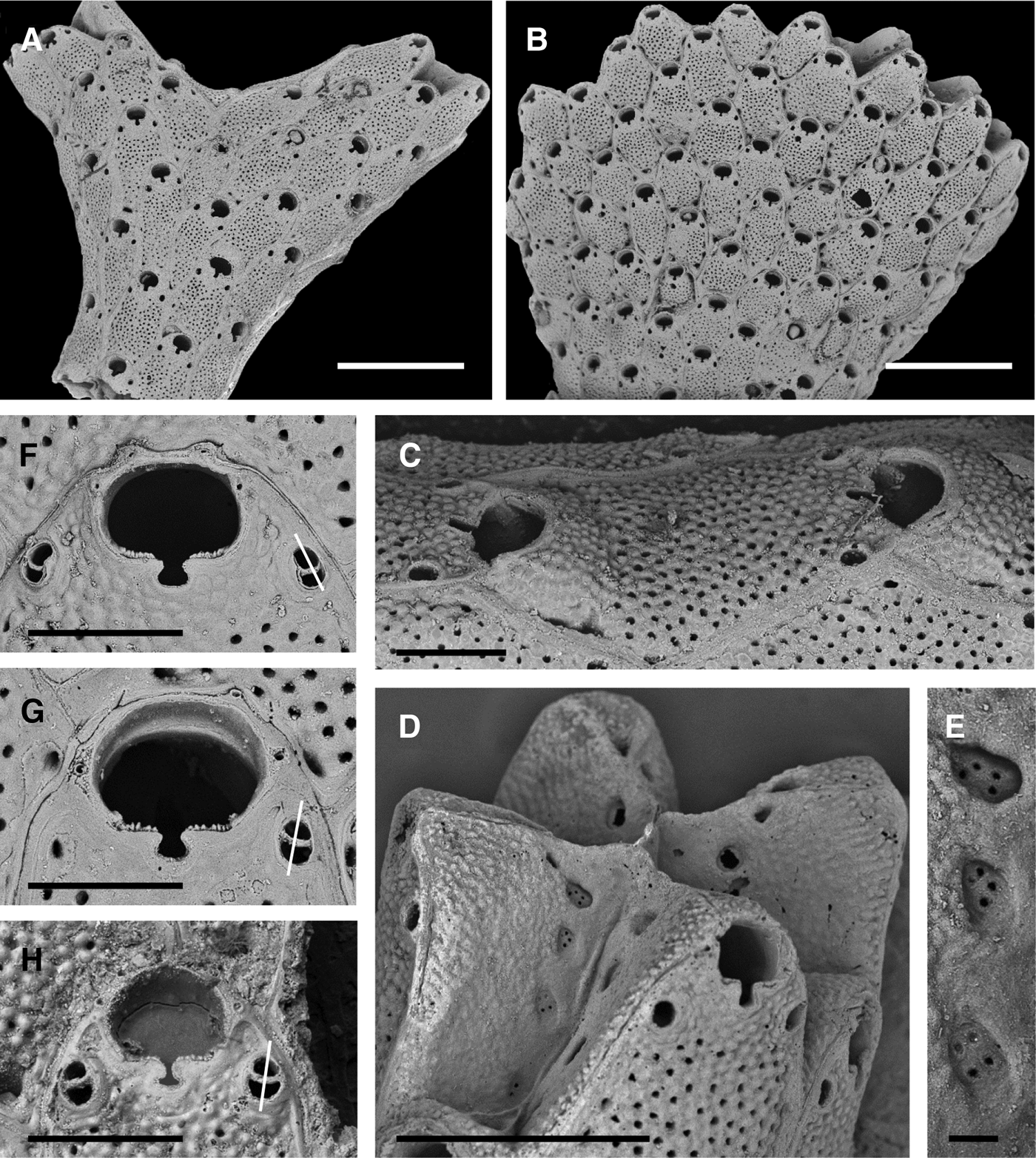
Escharina Milne Edwards, Reference Milne Edwards and Lamarck1836sensu lato has had a chequered taxonomic history, sequentially summarized and clarified by Brown (Reference Brown1952), Buge (Reference Buge1957), David & Pouyet (Reference David and Pouyet1978) and Berning et al. (Reference Berning, Tilbrook and Rosso2008). Several genera are now accepted that were previously included in Escharina, including Herentia Gray, Reference Gray1848, Therenia David & Pouyet, Reference David and Pouyet1978, Phaeostachys Hayward, Reference Hayward1979 and Bryopesanser Tilbrook, Reference Tilbrook2006; more are likely to be recognized from among the morphologically varied taxa that are known in both hemispheres. One new segregate genus is discriminated herein from New Zealand, viz. Taylorius gen. nov. It differs most obviously from Escharina and Herentia in having a pseudoporous frontal shield. It differs from the other three pseudoporous genera in several characters—from Therenia and Phaeostachys in having regularly paired small heterozooids and from Bryopesanser in having setiform avicularian mandibles, fully cleithral ovicells and no peristome. Like Herentia and Therenia, Taylorius has dimorphic orifices. The setiform mandible has so far been observed in three species ascribed here to Taylorius.
The genus is confined to the Southern Hemisphere. In New Zealand, it ranges from the Otaian (Early Miocene) to the present day. Six New Zealand species (three of them new) are included with certainty and an extant Australian species that shares a number of features may also be related (see below). Two fossil species are included in the genus – Escharina masoni Brown, Reference Brown1952 [=Taylorius masoni comb. nov.] from the Otaian (Early Miocene) of Tarakohe Quarry (Tasman District, northern South Island) and Escharina waiparaensis Brown, Reference Brown1952 [=Taylorius waiparaensis comb. nov.] from the Waiauan (Middle Miocene) of Weka Pass (Hurunui District, Canterbury) (Figures 10H, 11A–C). Recent Escharina incognita Powell, Reference Powell1967 [=Taylorius incognitus comb. nov.] from the Three Kings Islands, northern New Zealand, is clearly related to the new species described below, having similar orifices and cleithral ovicells but the paired avicularia are represented by vestigial heterozooids.
Taylorius cylindratus gen. et sp. nov., NIWA 92092, holotype, from Station K838, Macauley Island: (A) part of erect, cylindrical colony with bifurcation; (C) profile of two maternal orifices and ooecia; (D) branch tip showing staggered growth of autozoids; note rows of mural septula; (E) multiporous mural septula; (F) autozooidal orifice and avicularia. Taylorius arcuatus gen. et sp. nov., NIWA 92095, paratype, from Station A714, Bounty Islands; (B) part of erect, bilamellar colony; NIWA 92098, figured specimen, CIE Station 24, eastern Chatham Islands; (G) autozooidal orifice with, unusually, only a single avicularium. Taylorius waiparaensis (Brown, Reference Brown1952), NHM D36757, holotype, Mt Brown Limestone, Waipara, Miocene; (H) autozooidal orifice and avicularia. Note: A and B and F–H are, respectively, at exactly the same scales for comparison. Avicularia in F–H have longitudinal axes indicated. Scale bars: A, B, 1 mm; C, 250 µm; D, 500 µm: E, 50 µm; F–H, 200 µm.
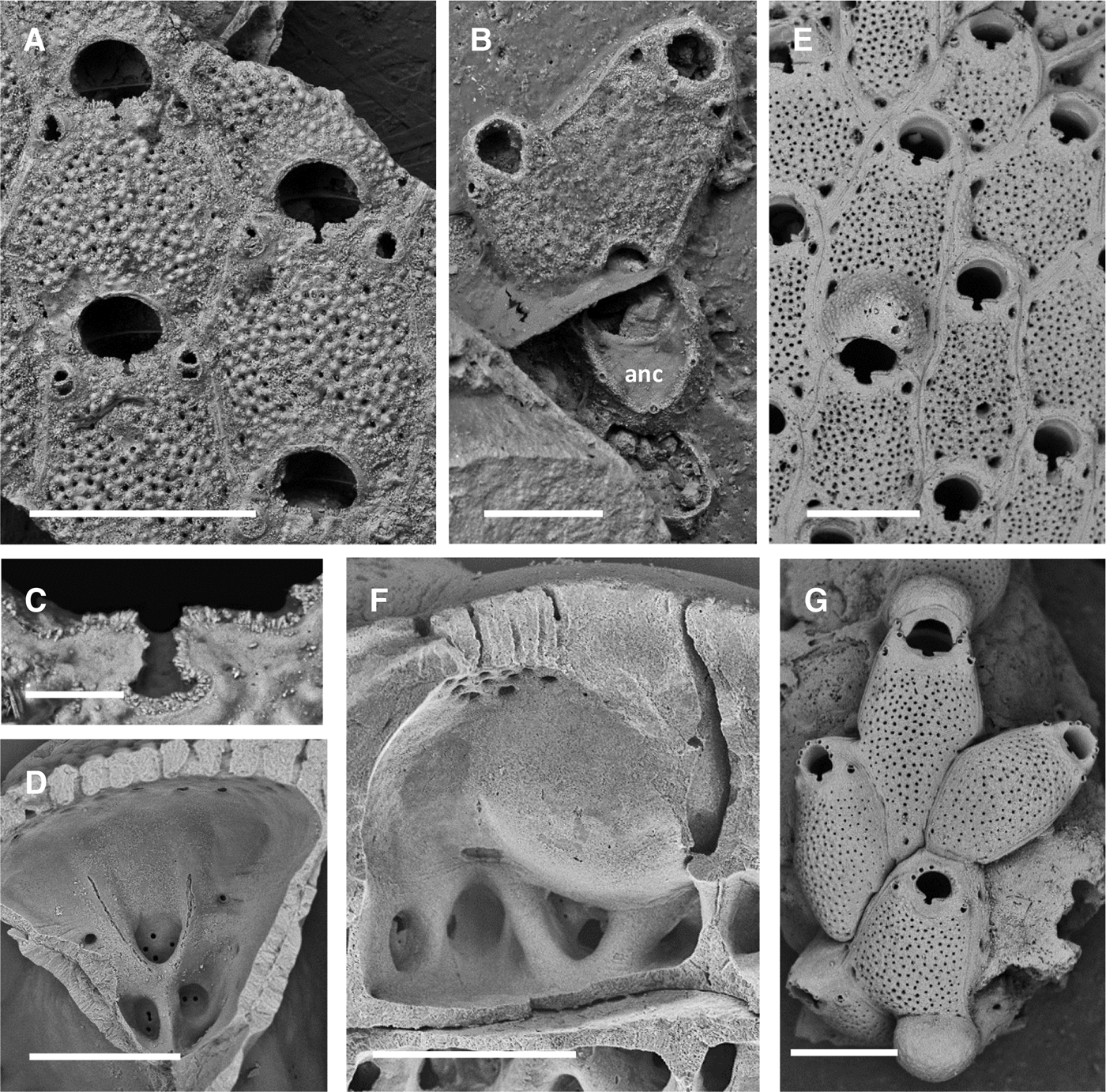
Taylorius waiparaensis (Brown, Reference Brown1952), NHM D36757, holotype, Mt Brown Limestone, Waipara, Miocene: (A) maternal orifices and cryptic ooecia; (B) ancestrular zooid, showing a large area of cryptocyst (anc), and two daughter autozooids; (C) sinus of autozooidal orifice. Taylorius cylindratus gen. et sp. nov., unregistered, from Station K838, Macauley Island; (D) transverse section of a zooid from a fractured cylindrical stem showing interior view of proximal end of autozooid with Y-shaped ridge separating multiporous septula. Taylorius arcuatus gen. et sp. nov., NIWA 92094, holotype, from Station A714, Bounty Islands: (E) part of holotype showing dimorphic orifices and an ooecium; (F) transverse section of a zooid from a fractured bilamellar stem showing interior view of proximal end of autozooid with the bulge of an ooecium, beneath which are buttressed recesses with multiporous septula. Taylorius spinosus gen. et sp. nov., NIWA 22486, holotype, from Station TAN0205/64, Macauley Island; (G) part of linear colony showing dimorphic zooidal orifices, with two ooecia (top and bottom). Scale bars: A, E, 500 µm; B, D, F, 200 µm; C, 50 µm; G, 250 µm.
Hayward & Cook (Reference Hayward and Cook1983) reported nominal Escharina waiparaensis from the continental shelf of eastern South Africa, noting that their material was ‘in all respects … identical with Powell's specimens from Three Kings Islands’. Powell's (Reference Powell1967) material is here included in Taylorius cylindratus sp. nov., described below, but examination of SEMs of the South African material (courtesy of Dr Wayne Florence, Albe Bosman and Jody-Caryn Oliver, Iziko Museums of South Africa) reveals that it is not conspecific and needs a new name (to be undertaken by South African colleagues).
Brown (Reference Brown1952) noted a similar ovicell in Recent Australian Schizoporella acuminata Hincks, Reference Hincks1881, which he also attributed to Escharina; it is cleithral and the orifice is dimorphic but the avicularium is single and relatively large with a triangular rostrum (see Wass & Yoo, Reference Wass and Yoo1983: figures 39 & 40) and therefore probably has a non-setiform mandible. This species needs further study to determine if it should be included in Taylorius or represents an additional genus-level segregate.
The ancestrula has not yet been found in any of the Recent species of Taylorius, including the new species described below, but Brown (Reference Brown1952: figure 164) discovered an ancestrula in T. waiparaensis and his specimen has been re-examined by SEM. His drawing depicts an additional zooid proximal to what is clearly the actual ancestrula; he interpreted the additional zooid as the ancestrula but it almost certainly pertains to another species. The actual ancestrula has a partial cryptocyst and relatively large distal opesia; it in turn buds two daughter zooids that have a typical frontal shield. Berning et al. (Reference Berning, Tilbrook and Rosso2008: figure 1A) illustrated a kenozooidal ancestrula in Herentia hyndmanni (Johnston, Reference Johnston1847) and surmised that it might also be present in Therenia species. The ancestrula in Escharina and Phaeostachys is fully tatiform with periopesial spines (Hayward & Ryland, Reference Hayward and Ryland1999); that in Bryopesanser is modified-tatiform, with a circlet of spines, but part of the frontal area is a cryptocyst (Tilbrook, Reference Tilbrook2006, Reference Tilbrook2012).
Brown (Reference Brown1952) described the interzooidal communications of T. waiparaensis as comprising ‘Pore-chambers: at least eight narrow chambers arranged along the distal margin of the zooecium, the median chamber communication with the distal zooecium by a pore passing between the arms of a V-shaped structure on its proximal wall’. These structures have been confirmed in congeneric living species (Figures 10D, E, 11D, F). In the literature, all of the other genera mentioned above are said to have basal pore-chambers (dietellae). Taylorius constitutes an exception. It has mural septula, set relatively low in the lateral walls, which are shallowly recessed but, with wall thickening, can come to be more deeply recessed though never actually chambered. The proximal recesses are strongly buttressed by oblique V- or Y-shaped ridges.
Taylorius cylindratus sp. nov.
(Figures 10A, C–F, 11D)
Escharina waiparaensis: ?Brown Reference Brown1954: 427; Powell Reference Powell1967: 275, text-figure 45, pl. 6a; Gordon Reference Gordon1984: 84, pl. 29C; Reference Gordon1985: 177, figure 28.
MATERIAL EXAMINED
Holotype: NIWA 92092 from Station K838, Macauley Island, Kermadec Ridge, 200 m.
Paratype: NIWA 92093, from Kermadec Ridge (station unknown).
Other records (unregistered or no longer in collection): NIWA Stations K795 (southern Kermadec Ridge, 350 m) and K872 (Esperance Rock, 235–280 m).
ETYMOLOGY
Latin cylindratus, in the form of a cylinder, alluding to the cylindrical erect stems of the species.
DESCRIPTION
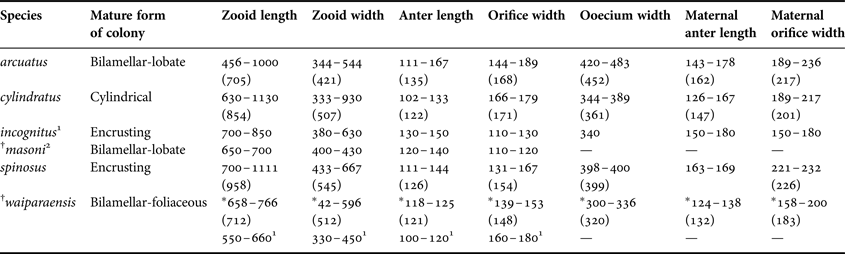
Colony initially encrusting, producing erect stems that may be cross-sectionally lensoidal near the base but tending to cylindrical, occasionally branching, these ~1.45 mm diameter; longest broken erect fragment 17.2 mm long. Autozooids tending to be elongate-rectangular in erect branches, wider mid-length when encrusting [ZL 630–1130 (854), ZW 333–930 (507)]; interzooidal boundaries indicated by thin lines bordered by the narrow margins of adjacent zooids, giving the overall effect of a smooth narrow non-porous strip around the zooids. Frontal shield weakly convex, granular with numerous evenly spaced pseudopores; areolar-septular pores sparse, a little longer than pseudopores. Orifice with distinct transversely D-shaped anter that is wider than long [OL 147–168 (163), OW 166–179 (171)]; sinus with distal corners curving inwards and proximal end rounded; denticled condyles set on nearly straight proximal margin of anter; 2–4 tiny spine bases on distal margin, the distal pair larger. Small lateral-oral avicularia present at level of sinus or slightly proximal of this, mostly paired, one rarely missing and replaced by a pore; longitudinally bean-shaped with complete crossbar. Ovicell fully immersed in distal zooid, ooecium frontally visible as a low bulge, cleithral, the exterior skeletal surface cryptocystal, granular, imperforate [OoL 222–411 (323), OoW 344–389 (361)]; orifice dimorphic, wider than in autozooids [FOL 167–212 (190), FOW 189–217 (201)]. Four multiporous mural septula along each lateral wall in distal half of zooid; proximal end of each zooid with oblique buttress arranged in a V or Y with a multiporous septulum within the V and another on either side. Ancestrula not seen in examined material.
REMARKS
Powell (Reference Powell1967) described and illustrated the setiform avicularian mandible as well as the dimorphic opercula with arch-like sclerites. He also photographed lateral convexities of the frontal shield, proximal to the avicularia, in some autozooids.
Taylorius cylindratus sp. nov. differs from Miocene T. waiparaensis (Figures 10H, 11A–C) in the form of the erect colony (cylindrical stems, not ‘bilamellar-foliaceous’) and in the metrics of zooids and orifices (see Table 1). In particular, the width ranges of non-fertile orifices are non-overlapping and the zooids of the latter species are proportionally shorter in relation to width.
Summary of the differences between the New Zealand species of Taylorius gen. nov. (measurements in micrometres, means in parentheses).
†fossil species; *measured from SEMs of Brown's (Reference Brown1952) holotype; 1Powell's (Reference Powell1967) measurements; 2Brown's (Reference Brown1952) measurements.
At the present day, T. cylindratus ranges from Macauley Island (Kermadec Ridge) (Gordon Reference Gordon1984, Reference Gordon1985) to the Three Kings Islands (Powell Reference Powell1967) at depths of 92–490 m. Brown (Reference Brown1954) reported T. waipararensis (as Escharina) from a piece of submerged limestone dredged by the ‘Terra Nova’ from the vicinity of the Three Kings Islands in 1911. On the basis of foraminifera in the sample, the limestone was dated as Early Pliocene in age. Brown (Reference Brown1954) noted some differences from T. waiparaensis sensu stricto, including the occurrence of vincularian (cylindrical) as well as bilamellar fragments in the Pliocene sample. Without re-examining this material, currently in the Waters Collection at the Manchester Museum, it is not possible to say whether it belongs to T. waiparaensis, T. arcuatus sp. nov. (see below) or T. cylindratus, but the latter appears most likely, given its northern distribution.
Taylorius arcuatus sp. nov.
(Figures 10B, G, 11E, F)
Escharina waiparaensis: Uttley & Bullivant Reference Uttley and Bullivant1972: 43; Gordon Reference Gordon1989b: 43.
MATERIAL EXAMINED
Holotype: NIWA 92094, Station A714, Bounty Islands, 165 m.
Paratype: NIWA 92095 from same locality.
Other material (non-type): NIWA 92096 (same locality as holotype); NIWA 92097, Station B484 (off Puysegur Point, 124 m); NIWA 92098, Chatham Islands Expedition Station 24 (south of The Sisters, eastern Chatham Rise, 69 m). Unregistered: Stations B480 (Doubtful Sound, 116 m), B483 (Puysegur Point, 187 m), B487 (Puysegur Bank, 196 m), B493 (Breaksea Sound, 84 m), B498 (Jag Rocks, 44 m) and B616 (Dagg Sound, 134 m).
ETYMOLOGY
Latin arcuatus, bent like a bow, alluding to the arcuate ridge inside the zooidal orifice upon which the distal margin of the operculum rests in the closed position.
DESCRIPTION
Colony initially encrusting; all erect fragments comprising unattached, broken bilamellar planar branches, the largest 13 mm long or 9 mm wide and 1.17 mm thick. Autozooids tending to be elongate-rectangular in erect branches, wider mid-length when encrusting [ZL 456–1000 (705), ZW 344–544 (421)]; interzooidal boundaries indicated by thin lines bordered by the narrow margins of adjacent zooids, giving the overall effect of a smooth narrow non-porous strip around the zooids. Frontal shield weakly convex, granular with numerous evenly spaced pseudopores; areolar-septular pores, sparse, tending to be more conspicuous in erect zooids, usually 2–3 obvious such pores along each lateral margin. Orifice with rounded, transversely D-shaped anter that is generally a little wider than long; sinus occasionally parallel-sided, more usually with distal corners curving inwards, proximal end rounded [OL 144–200 (168), OW 144–189 (168)]; denticled condyles set on the straight proximal margin of the anter; typically four tiny spine bases on distal margin (sometimes one missing) in which is set a narrow crescentic ridge upon which the distal margin of the operculum rests when closed. Small lateral-oral avicularia present, mostly paired, one occasionally missing and replaced by a pore; longitudinally oval with complete crossbar. Ovicell mostly fully immersed in distal zooid, ooecium typically appearing as a low bulge, but occasionally frontally protruding, cleithral, the exterior skeletal surface cryptocystal, granular, imperforate [OoL 376–433 (396), OoW 420–483 (452)]; orifice dimorphic, wider than in autozooids [FOL 216–234 (225), FOW 189–236 (217)]. Mural communication pores set low in lateral walls inset in buttressed recesses; distal transverse wall with large multiporous septulum. Ancestrula not seen in examined material.
REMARKS
Taylorius arcuatus sp. nov. differs from Miocene T. waiparaensis (Figures 10H, 11A–C) most obviously in the metrics of zooids and orifices (see Table 1). In particular, the length ranges of the fertile orifice and the width ranges of the ooecium are non-overlapping between the two species. Taylorius arcuatus differs most obviously from Taylorius cylindricus sp. nov. in the form of the erect colony. Encrusting zooids in these two species are very similar; the most obvious features then distinguishing them are the arcuate distal oral ridge (seen unequivocally with SEM), the greater spacing between oral spines and 2–4 moderately conspicuous areolar-septular pores in T. arcuatus. The orientation of the avicularia also differs (cf. Figures 10F and G). This latter character appears to have usefulness in species discrimination in Taylorius.
Taylorius arcuatus ranges from the Chatham Rise to Puysegur Bank and Fiordland at depths of 44–19 m.
Taylorius spinosus sp. nov.
(Figures 11G, 12A–D)
Taylorius spinosus gen. et sp. nov., NIWA 22486, holotype (part), from Station TAN0205/64, Macauley Island: (A, B) unbleached autozooids showing oral spines, opercula and avicularian mandibles; (C) close-up of autozooidal orifice flanked by avicularia; (D) ooecium and maternal orifice. Scale bars: A, 500 µm; B, D, 200 µm; C, 100 µm.
MATERIAL EXAMINED
Holotype: NIWA 22486, from Station TAN0205/64, 30.1623°S 178.5777°W to 30.1692°S 178.5728°W, 328–287 m, Havre Trough north-west of Macauley Island.
ETYMOLOGY
Latin spinosus, thorny, alluding to the conspicuous oral spines.
DESCRIPTION
Colony encrusting, pluriserial, up to ~9 mm long. Autozooids elongate with curving lateral margins, widest midlength or a little proximal of this [ZL 700–1111 (958), ZW 433–667 (545), ZD 300–411]. Frontal shield convex, resulting in interzooidal furrows between zooids, with thin lines of calcification along the margins; shield minutely granular with numerous evenly spaced pseudopores; areolar-septular pores not differentiated from pseudopores or 1–2 slightly larger pores proximally. Orifice with high-arched anter and rounded sinus with the distal corners incurving [OL 133–176 (159), OW 131–167 (154)], no inner oral ledge for operculum to rest on; operculum with raised distal margin and pitted frontal surface; condyles narrow, not denticled, set on the straight proximal margin of the anter, sloping (narrowing) towards sinus enttrance; six conspicuous, articulated oral spines up to 211 µm long. Small, paired lateral-oral avicularia present, oval with complete crossbar, mandible setiform, up to 567 µm long. Ooecium recumbent on distal zooid, conspicuous, cleithral, the exterior skeletal surface cryptocystal, granular, imperforate, with a proximofrontal crescent of smooth calcification [OoL 402–409 (406), OoW 398–400 (399)]; orifice dimorphic, wider than in autozooids [FOL 163–169, FOW 221–232 (226)]. Small mural septula in lateral walls. Ancestrula not seen in examined material.
REMARKS
Taylorius spinosus sp. nov. is clearly congeneric with the other species recognized here but is notable for its much more conspicuous ooecium with a proximofrontal crescent of smooth calcification, not otherwise seen in the genus, and its non-denticled articular ridges (condyles). As in congeners, the ovicell is subcleithral, with two positions of closure by the operculum, one for the primary zooidal orifice and one for the secondary maternal orifice (see Ostrovsky, Reference Ostrovsky2014: figure 2.8D). In the former position the operculum is flat; in the latter it is bent inwards. Accordingly, the outer maternal orifice is shorter (163–169 µm) than the inner primary orifice (ca 239 µm).
Taylorius spinosus is known only from the type locality in the Havre Trough, at 287–328 m depth.
KEY TO THE LIVING AND FOSSIL NEW ZEALAND SPECIES OF TAYLORIUS GEN. NOV.
1. Oral spines (or spine bases) obvious, six in number ……… spinosus
— Oral spines (or spine bases) inconspicuous (four or fewer) or absent ……… 2
2. Frontal heterozooids all vestigial, not developed as avicularia ……… incognitus
— One or both frontal heterozooids developed as avicularia ……… 3
3. Distal rim of autozooidal orifice with narrow inner ledge (best seen by SEM) ……… arcuatus
— Distal rim of autozooidal orifice lacking inner ledge ………4
4. Oral spine bases, if evident, mostly four in number; autozooidal orifice width >125 µm ……… 5
— Oral spine bases not apparent; autozooidal orifice width not >125 µm ……… masoni
5. Autozooidal orifice width not >160 µm; erect colony bilamellar-foliaceous ……… waiparaensis
— Autozooidal orifice width >160 µm; erect colony cylindrical (vincularian) ……… cylindratus
Family incertae sedis
Genus Bountyella gen. nov.
TYPE SPECIES
Bountyella morgani sp. nov.
ETYMOLOGY
Alluding to the geographical provenance of the type species from the vicinity of the Bounty Islands at the north-eastern corner of the Campbell Plateau, New Zealand; gender feminine.
DIAGNOSIS
Colony bilamellar-foliaceous, presumably from an encrusting base. Autozooids longer than wide with thin interzooidal boundary lines, becoming thickly calcified. Frontal shield coarsely perforated by relatively large pseudopores. Orifice with wide anter, small, rounded sinus and grooved articular ridges; sinus transformed into a spiraminal tube with secondary calcification. Paired oral spine bases ephemeral. Avicularia median, suboral, lacking from most zooids, of variable size. Ooecium recumbent on distal zooid, soon becoming immersed in secondary calcification, with 1–2 relatively large frontal pseudopores, opening above primary orifice. Interzooidal communications via small multiporous mural septula. Ancestrula and early colony stages unknown.
REMARKS
The familial relationships of Bountyella gen. nov. are morphologically not straightforward. The characters of the autozooid and primary orifice at the growing margin are strongly suggestive of the Escharinidae (cf. Taylorius gen. nov.) but secondary calcification transforms the frontal surface into a coarsely pseudoporous shield and the orificial sinus into a spiramen. The median suboral avicularium is reminiscent of that found in Buffonellodidae and some Eminooeciidae but the frontal shield in these families is non-pseudoporous. The ooecium is not typical of Escharinidae but, on the other hand, appears similar to that in some genera that have been ascribed to the wholly northern hemisphere family Stomachetosellidae, many of which have a coarsely pseudoporous frontal shield. Winston & Hayward (Reference Winston and Hayward2012) commented that the family is poorly circumscribed, chiefly because the type species of the family is a little-known fossil that has not been morphologically well characterized. They erected Stomacrustula to encompass three Recent species previously attributed to Stomachetosella Canu & Bassler, Reference Canu and Bassler1917, but declined to place their new genus in a family. Stomacrustula includes S. sinuosa (Busk, Reference Busk1860), which has a single large ooecial perforation but it is not clear if ooecial structure (best determined by histological sectioning of a developmental series) in this genus is the same as in Bountyella. For now, Bountyella must also be considered incertae sedis.
Bountyella morgani sp. nov.
(Figures 13A–C, 14A–C)
Bountyella morgani gen. et sp. nov., NIWA 92090 (part), from Station A747, Bounty Islands: (A) autozooids from distal part of colony with three sizes of suboral avicularia (arrows); (B) orifices from more proximal part of colony showing parts of two ooecia (oe) and sinuses transformed to spiramina; (C) autozooidal orifices near colony margin with paired oral-spine bases. Scale bars: A, 1 mm; B, C, 200 µm.
Bountyella morgani gen. et sp. nov., NIWA 92090 (part), from Station A747, Bounty Islands: (A) interior (underside) view of autozooidal orifice; (B) laterally sectioned autozooidal chambers, the one on the left showing an ooecium (oe) and spiraminal sinus (arrow) embedded in secondary calcification; (C) ooecium (oe). Fovoporella spectabilis (Hincks, Reference Hincks1891), NIWA 92099, non-type, from Station B226, Foveaux Strait; (D) interior view of opercular tab (vanna) showing its narrower underside profile. Scale bars: A, 50 µm; B, C, 200 µm; D, 100 µm.
MATERIAL EXAMINED
Holotype: NIWA 92090, Station A747, 47.6817°S 179.0517°E, 113 m, just north of the Bounty Islands, New Zealand.
ETYMOLOGY
Honorific for John Morgan, Chief Executive Officer of the NIWA, in recognition of his appreciation of the value of taxonomic research.
DESCRIPTION
Colony erect, bilamellar-foliaceous, presumably from an encrusting base, the largest fragment 35 mm high, 26 mm wide. Autozooids overall longer than wide, subrectangular with gently curving lateral margins and thin interzooidal boundary lines, soon becoming thickly calcified, with older, proximal parts of the colony having occluded orifices and less-obvious zooidal boundaries; frontal budding can result in secondary overgrowth of an additional zooid layer in some parts of the colony [ZL 554–898 (745), ZW 256–611 (391)]. Frontal shield coarsely perforated by relatively large pseudopores. Orifice with wide anter, small, rounded sinus and grooved articular ridges; sinus transformed into a spiraminal tube with secondary calcification in many zooids, rendering the peristomial orifice somewhat transversely elliptical, otherwise it more or less retains the shape of the primary orifice but tends to be a little larger [OL 100–189 (148), OW 144–211 (167)]. Paired oral-spine bases ephemeral. Avicularia median, suboral, lacking from most zooids, combined rostrum + opesia of more or less equal length and width, ranging in size from small to moderately large while retaining the same overall proportions; aviculiferous zooids tending to be grouped in clusters [AvL 67–200, AvW 67–189]. Ooecium wholly recumbent on distal zooid, initially wider than long, rapidly becoming immersed in secondary calcification, with 1–2 relatively large frontal pseudopores, opening above primary orifice; final size in frontal view indistinct owing to indistinct boundaries, ca 222–283 µm long and wide. Interzooidal communications via small multiporous mural septula laterally and larger paired multiporous septula in transverse walls; transverse wall frontally very thick, granular, as seen in differentiating zooids at growing margin. Ancestrula and early colony stages unknown.
REMARKS
The erect, somewhat curled colony morphology of Bountyella morgani is large enough to form a potential microhabitat but the colony surface is free of epibionts. The species is known only from the type locality near the Bounty Islands, at 113 m depth.
Family SCHIZOPORELLIDAE Jullien, Reference Jullien1882
Genus Fovoporella gen. nov.
TYPE SPECIES
Schizoporella spectabilis (Hincks, Reference Hincks1891).
ETYMOLOGY
The genus name is a hybrid coined from ‘fovo’, a phonetic rendering of Foveaux (for Foveaux Strait, New Zealand) and -porella, a common bryozoan suffix, as in Schizoporella, in which the type species was originally included.
DIAGNOSIS
Colony encrusting, multiserial. Autozooids with pseudoporous lepralioid frontal shield crossed by conspicuous raised gymnocystal ridges in older zooids that tend to have a central umbo. Orifice cleithridiate, with an inversely sagittate sinus narrowed at its entrance by inwardly directed condyles. No oral spines. Asymmetric suboral avicularian chamber embedded in gymnocystal umbo, acute with complete crossbar. Female zooids dimorphic with broader sinus and operculum; ooecium large, hyperstomial, cleithral, ectooecium with numerous funnelled pores larger than pseudopores of frontal shield. Ancestrula not seen.
REMARKS
Fovoporella gen. nov. differs from Schizoporella Hincks, Reference Hincks1877, in which it was originally included, in several characters, most notably the gymnocystal ridges, but also the cleithridiate autozooidal orifice and dimorphic cleithral female orifice. The fact that Brown (Reference Brown1952) put quotation marks around the genus name shows that he recognized the species could not belong to Schizoporella but he made no comment about this and did not suggest a new genus.
The combination of a pseudoporous frontal shield with a line (or lines) of gymnocystal calcification is rare in lepralioid ascophoran cheilostomes. It is elsewhere known only in the Indo-Pacific genus Retelepralia Gordon & Arnold, Reference Gordon and Arnold1998, which has a median strip of gymnocystal calcification separating the frontal hypostegal coelom into two halves (Di Martino & Taylor, Reference Di Martino and Taylor2012b), and in the Early Eocene genus Illusiopora Gordon & Taylor, Reference Gordon and Taylor2014, endemic to Chatham Island, in which the gymnocystal line is very thin and placed obliquely or medially.
Fovoporella spectabilis (Hincks, Reference Hincks1891)
(Figures 14D, 15A, B)
Fovoporella spectabilis (Hincks, Reference Hincks1891), NIWA 92099, non-type, from Station B226, Foveaux Strait: (A) autozooids and female zooids with dimorphic orifices; note the gymnocystal ridges (gy) in which suboral avicularia may occur; (B) part of Pliocene colony from Waipukurau Gorge, showing incipient gymnocystal ridges. Ramicellepora ramosa gen. et. sp. nov., NIWA 3844, paratype, from Station KAH0204/30, Cavalli Seamounts; (C) ramifying, loosely contiguous autozooids; orifices slightly occluded by apparent internal reparative growth. Scale bars: A, 1 mm; B, 500 µm; C, 300 µm.
Schizoporella obliqua?: Waters Reference Waters1887: 66, figure 2 [not Lepralia obliqua MacGillivray, Reference MacGillivray1869].
Schizoporella spectabilis Hincks, Reference Hincks1891: 292, pl. 7, figure 1, 1a.
Schizoporella obliqua?: Hamilton Reference Hamilton1898: 199.
“Schizoporella” spectabilis: Brown Reference Brown1952: 247, figures 181–183.
Schizoporella spectabilis: Fleming Reference Fleming1971: 28.
‘Schizoporella’ spectabilis: Gordon et al. Reference Gordon, Taylor, Bigey and Gordon2009: 292.
MATERIAL EXAMINED
Figured material: NIWA 92099, Station B226, Foveaux Strait, 49 m.
Other material (unregistered): Stations B221–226, 230, 235, 237, 253, 254, 258 and 264, all Foveaux Strait, 14–49 m; Kapiti Island Marine Reserve, off Paraparaumu, 17.5 m. G.H. Uttley Collection: Recent, Sumner (Christchurch) and Timaru, no depth data; Pliocene, from Waipukurau Gorge.
DESCRIPTION
Colony encrusting, multiserial, maximum diameter 24 mm. Autozooids with pseudoporous lepralioid frontal shield; slightly larger marginal pores or depressions mark areolar-septular pores; shield typically crossed by conspicuous raised gymnocystal ridges that tend form a central umbo in older zooids [ZL 700–987 (848), ZW 367–600 (478)]. Orifice cleithridiate, with an inversely sagittate sinus narrowed at its entrance by inwardly directed condyles [OL 210–256 (238), OW 161–194 (178)]; opercular tab (vanna) frontally broad, closing the sinus, but on its inner side having a narrowed ridge that fits between the condyles. No oral spines. Asymmetric suboral avicularian chamber embedded in gymnocystal umbo, rostrum acute with complete crossbar (AvL 100–123 (117), AvW 64–100 (76)]. Female zooids dimorphic with broader sinus and operculum and longer condyles that are not downturned [FOL 245–367 (286), FOW 212–289 (251)]; ooecium large, hyperstomial, cleithral, ectooecium with numerous funnelled pores larger than pseudopores of frontal shield [OoL 669–810 (729), OoW 434–723 (577)]. Ancestrula not seen.
REMARKS
The provenance of Hincks's type (Reference Hincks1891) specimen was ‘Stewart Island’. The species today is very common in Foveaux Strait between South and Stewart Islands. Fovoporella spectabilis encrusts molluscan shell and also small pebbles. On this latter substratum, which can be potentially rolled or tumbled in the benthic setting of Foveaux Strait (either naturally, owing to tidal currents and scour, or through dredging for oysters) the gymnocystal ridges can be robust owing to the extra calcification that is secreted for strengthening; such is also the case where a colony grows around the edge of a shell. Gordon (Reference Gordon1986, p. 69) noted similar robust calcification of zooidal frontal skeletal walls in species of Micropora, Macropora, Escharoides, Didymosella and Microporella from western Foveaux Strait.
Fovoporella spectabilis of Pliocene age has been found in Waipukurau Gorge (Waters, Reference Waters1887). Specimens in the G.H. Uttley Collection (unregistered ex GNS Science) are lacking ooecia but otherwise accord with Recent material in all important respects. Lateral zooidal walls are rather higher than in Recent specimens but this feature is not uncommon in many cheilostomes and certainly falls within the expected range of within-colony variation.
At the present day, the species ranges from Kapiti Island off the west coast of the southern North Island, along the east coast of South Island (recorded at Christchurch and Timaru) to the coast of Stewart Island, attaching to dead mollusc shells and pebbles at depths of 14–49 m. The genus and species are thus nominally endemic to New Zealand.
Superfamily CELLEPOROIDEA Johnston, Reference Johnston1838
Family CELLEPORIDAE Johnston, Reference Johnston1838
Genus Ramicellepora gen. nov.
TYPE SPECIES
Ramicellepora ramosa sp. nov.
ETYMOLOGY
Composite of Latin ramus, branch, and Cellepora, a bryozoan genus; gender feminine.
DIAGNOSIS
Colony encrusting, uniserial to loosely pluriserial. Autozooids elongate, the frontal shield imperforate, lepralioid-cryptocystal, edged by a very thin gymnocystal margin; areolar-septular pores sparse, tiny. Orifice subcircular with very small sinus, surrounded by low peristome. No oral spines. Avicularia rare, peristomial, oval with crossbar. Ovicell hyperstomial, ectooecium frontally depressed, with distal crescentic tabula exposing smooth endooecium; proximofrontal lobes of ooecium nearly or completely embracing orifice. Narrow basal pore-chambers present. Ancestrula not seen.
REMARKS
Ramicellepora gen. nov. is distinguished from all other celleporids by its uni- to pluriserial ramifying habit and its distinctive ovicell. The ooecial tabula suggests a relationship with Buffonellaria but that genus has multiserial species; the tabula is frontal, not distal, and 1–2 avicularia are always associated with the orifice.
Ramicellepora ramosa sp. nov.
(Figures 15C, 16A, B)
Ramicellepora ramosa gen. et. sp. nov., NIWA 3844, paratype, from Station KAH0204/30, Cavalli Seamounts: (A, B) lateral and frontal views of ooecium, showing large flat frontal area and crescentic tabula exposing endooecium. Scale bars: A, 200 µm; B, 100 µm.
MATERIAL EXAMINED
Holotype: NIWA 3846, Station KAH0204/52, Cavalli Seamounts, 820–910 m.
Paratype: NIWA 3844, Station KAH0204/30, Cavalli Seamounts, off north-east North Island, New Zealand, 800–825 m.
ETYMOLOGY
Latin ramosus, branching.
DESCRIPTION
Colony encrusting, uniserial to loosely pluriserial, maximum length encountered 12 mm. Autozooids elongate, variable in shape, parallel-sided or, more often, clavate and slightly narrowed proximally [ZL 333–667 (504), ZW 172–322 (256), ZD 78–132]. Frontal shield imperforate, lepralioid-cryptocystal with a faintly reticulate or dimpled texture, edged by a very thin gymnocystal margin in which are set very long, narrow openings to basal pore-chambers from which other zooids are budded; these typically arranged one mid-distally and one on each side. Areolar-septular pores sparse to absent along the margins but usually one on each side between proximal rim of peristome and zooid margin; an avicularium may be budded from one of these pores. Avicularia rare, in proximolateral rim of peristome, tiny, oval, with complete crossbar [AvL 34, AvW 33]. Orifice subcircular with small U-shaped sinus, surrounded by low peristome [OL 56–76 (66), OW 54–72 (63)]. No oral spines. Ovicell hyperstomial, acleithral, ectooecium smooth, frontally flattened or depressed, with a distal crescentic tabula exposing smooth endooecium; proximofrontal lobes of ooecium nearly or completely embracing orifice [OoL 243–279 (262), OoW 210–233 (220). Ancestrula not seen.
REMARKS
The uni- to pluriserial, runner-like mode of growth allows the species to accommodate to the highly irregular lithic surfaces on which colonies have been found. The genus and species are so far known only from the Cavalli Seamounts at 800–910 m depth and are nominally endemic to New Zealand.
DISCUSSION
Gordon & Bock in Appeltans et al. (Reference Appeltans, Ahyong, Anderson, Angel, Artois, Bailly, Bamber, Barber, Bartsch, Berta, Błażewicz-Paszkowycz, Bock, Boxshall, Boyko, Brandão, Bray, Bruce, Cairns, Chan, Chan, Collins, Cribb, Curini-Galletti, Dahdouh-Guebas, Davie, Dawson, De Clerck, Decock, De Grave, de Voogd, Domning, Emig, Erséus, Eschmeyer, Fauchald, Fautin, Feist, Fransen, Furuya, Garcia-Alvarez, Gerken, Gibson, Gittenberger, Gofas, Gómez-Daglio, Gordon, Guiry, Hernandez, Hoeksema, Hopcroft, Jaume, Kirk, Koedam, Koenemann, Kolb, Kristensen, Kroh, Lambert, Lazarus, Lemaitre, Longshaw, Lowry, Macpherson, Madin, Mah, Mapstone, McLaughlin, Mees, Meland, Messing, Mills, Molodtsova, Mooi, Neuhaus, Ng, Nielsen, Norenburg, Opresko, Osawa, Paulay, Perrin, Pilger, Poore, Pugh, Read, Reimer, Rius, Rocha, Rosenberg, Saiz-Salinas, Scarabino, Schierwater, Schmidt-Rhaesa, Schnabel, Schotte, Schuchert, Schwabe, Segers, Self-Sullivan, Shenkar, Siegel, Sterrer, Stöhr, Swalla, Tasker, Thuesen, Timm, Todaro, Turon, Tyler, Uetz, van der Land, Vanhoorne, van Ofwegen, van Soest, Vanaverbeke, Walker-Smith, Walter, Waren, Williams, Wilson and Costello2012, Supplementary Information) noted that the total number of described bryozoan species globally is about 5900 (a more precise figure was given by Bock & Gordon (Reference Bock, Gordon and Zhang2013) based on data in the World Register of Marine Species) and estimated that an additional 2800–5200 species may be undescribed and/or undiscovered. They noted that known museum collections contain upward of 1000 undescribed species (especially from Australia), that new revisions of genera and families have significantly increased numbers of species in those taxa, that 20–30% of of bryozoan species from newly sampled areas of the tropical Indo-Pacific are new, and that both this region and the deep sea remain bryozoologically undersampled (cf. Tilbrook, Reference Tilbrook2006).
As an indicator of hitherto unrecognized bryozoan diversity and ongoing discovery, hundreds of new species have been described since 1990 and the pace shows no signs of slowing, through comprehensive studies of the following:
(1) Genera—for example, Thalamoporella (Soule et al., Reference Soule, Soule and Chaney1992, Reference Soule, Soule and Chaney1999), Puellina (Reverter & Fernández, Reference Reverter and Fernández1996; Harmelin, Reference Harmelin2006), Antropora (Tilbrook, Reference Tilbrook1998; Tilbrook & Grischenko, Reference Tilbrook and Grischenko2004) Hippopodina (Tilbrook, Reference Tilbrook1999), Stylopoma (Tilbrook, Reference Tilbrook2001), Electra (Nikulina, Reference Nikulina2006, Reference Nikulina2008a, Reference Nikulinab; Nikulina et al., Reference Nikulina, Ostrovsky, Claereboudt, Ernst, Schäfer and Scholz2013), Antarctothoa (Wright et al., Reference Wright, Hayward and Hughes2007; Kukliński & Barnes, Reference Kukliński and Barnes2009), Schizoretepora (Harmelin et al., Reference Harmelin, Bitar and Zibrowius2007), Schizotheca (Reverter-Gil & Fernández-Pulpeiro, Reference Reverter-Gil and Fernández-Pulpeiro2007), Buffonellaria (Berning & Kukliński, Reference Berning and Kukliński2008), Monoporella (Dick, Reference Dick2008), Amathia (Souto et al., Reference Souto, Fernández-Pulpeiro and Reverter-Gil2010a; Gordon & Spencer Jones, Reference Gordon and Spencer Jones2013), Beania (Vieira et al., Reference Vieira, Migotto and Winston2010b), Cauloramphus (Dick et al., Reference Dick, Mawatari, Sanner and Grischenko2011), Crepis (Reverter-Gil et al., Reference Reverter-Gil, Souto and Fernández-Pulpeiro2011), Microporella (Soule et al., Reference Soule, Chaney and Morris2003, Reference Soule, Chaney and Morris2004; Harmelin et al., Reference Harmelin, Ostrovsky, Cáceres-Chamizo and Sanner2011), Bugula (Winston & Woollacott, Reference Winston and Woollacott2008; Vieira et al., Reference Vieira, Winston and Fehlauer-Ale2012), Schizomavella (Reverter-Gil & Fernández-Pulpeiro, Reference Reverter-Gil and Fernández-Pulpeiro1996, Reference Reverter-Gil and Fernández-Pulpeiro1997; Reverter-Gil et al., Reference Reverter-Gil, Souto and Fernández-Pulpeiro2012a), Bryopesanser (Tilbrook, Reference Tilbrook2012) and Scrupocellaria (Tilbrook & Vieira, Reference Tilbrook and Vieira2012; Vieira et al., Reference Vieira, Spencer and Winston2013a, Reference Vieira, Spencer and Winstonb).
(2) Families—for example, Lichenoporidae (Alvarez, Reference Alvarez1992, Reference Alvarez1993, Reference Alvarez1994, Reference Alvarez1995; Gordon & Taylor, Reference Gordon and Taylor2001), Macroporidae (López de la Cuadra & García Gómez, Reference López de la Cuadra and García-Gómez1997; Gordon & Taylor, 2008), Doryporellidae (Grischenko et al., Reference Grischenko and Taylor2000, Reference Grischenko, Taylor and Mawatari2004), Eurystomellidae (Gordon et al., Reference Gordon, Mawatari and Kajihara2002), Phidoloporidae (Hayward, Reference Hayward1999, Reference Hayward2000, Reference Hayward2004; Figuerola et al., Reference Figuerola, Ballesteros and Avila2013); Cupuladriidae (Herrera-Cubilla et al., Reference Herrera-Cubilla, Dick, Sanner and Jackson2006, Reference Herrera-Cubilla, Dick, Sanner and Jackson2008).
(3) Regional and local faunas—for example, New Caledonia (Gordon & d'Hondt, Reference Gordon, Hondt and Crosnier1991, Reference Gordon, Hondt and Crosnier1997; Gordon, Reference Gordon and Crosnier1993; Gordon & Braga, Reference Gordon, Braga and Crosnier1994; d'Hondt & Gordon, Reference Hondt, Gordon and Crosnier1996, Reference Grischenko, Gordon and Taylor1999), Great Barrier Reef (Ryland & Hayward, Reference Ryland and Hayward1992; Hayward & Ryland, Reference Hayward and Ryland1995), Antarctica (Hayward, Reference Hayward1995 and references therein; Porter & Hayward, Reference Porter and Hayward2004; Kukliński & Barnes, Reference Kukliński and Barnes2009; Hayward & Winston, Reference Hayward and Winston2011; De Blauwe & Gordon, in press); southern California (Soule et al., Reference Soule, Soule and Chaney1995), Vanuatu (Tilbrook et al., Reference Tilbrook, Hayward and Gordon2001), Indian Ocean subantarctic islands (Branch & Hayward, Reference Branch and Hayward2005), Korea (Seo, Reference Seo2005, Reference Seo2011 and references therein), Hawaii (Dick et al., Reference Dick, Tilbrook and Mawatari2006), Solomon Islands (Tilbrook, Reference Tilbrook2006), Hokkaido (Grischenko et al., Reference Grischenko, Dick and Mawatari2007), western South Africa (Florence et al., Reference Florence, Hayward and Gibbons2007), Barbados (Winston & Woollacott, Reference Winston and Woollacott2009), and south-eastern Brazil (e.g. Ramalho et al., Reference Ramalho, Muricy and Taylor2009, Reference Ramalho, Muricy and Taylor2011; Vieira et al., Reference Vieira, Gordon, Souza and Haddad2010a; Winston & Vieira, Reference Winston and Vieira2013).
Even well-studied parts of the world like the north-east Atlantic, Mediterranean and eastern United States are yielding new bryozoan species (e.g. López de la Cuadra & García Gómez, Reference López de la Cuadra and García-Gómez2001; Hayward & McKinney, Reference Hayward and McKinney2002; Chimenz Gusso & Soule, Reference Chimenz Gusso and Soule2003; De Blauwe, Reference De Blauwe2006; Harmelin et al., Reference Harmelin, Bitar and Zibrowius2009; Reverter-Gil et al., Reference Reverter-Gil, Souto and Fernández-Pulpeiro2009, Reference Reverter-Gil, Souto and Fernández-Pulpeiro2012a, Reference Reverter-Gil, Souto and Fernández-Pulpeirob; Souto et al., Reference Souto, Fernández-Pulpeiro and Reverter-Gil2010a, Reference Souto, Reverter-Gil and Fernández-Pulpeirob, Reference Souto, Reverter-Gil and Fernández-Pulpeiroc Vieira et al., Reference Vieira, Spencer and Winston2013), genera and even families (López-Fé, Reference López-Fé2006), partly through genetic studies (e.g. Ryland & Porter, Reference Ryland and Porter2000; Porter, Reference Porter2004; Porter & Hayward, Reference Porter and Hayward2004) but also through revisions of historic collections (e.g. Reverter-Gil & Fernández-Pulpeiro, Reference Reverter-Gil and Fernández-Pulpeiro1999; Winston, Reference Winston2005; Souto et al., Reference Souto, Fernández-Pulpeiro and Reverter-Gil2007; Winston & Hayward, Reference Winston and Hayward2012) and examination of little-studied biotopes (e.g. Winston & Vieira, Reference Winston and Vieira2013).
In an overview of bryozoan diversity in the New Zealand deep sea Gordon (Reference Gordon and Ross1987) noted exceptional levels of taxonomic and colonial diversity, comprising 240 species deeper than 700 m, on a wide variety of substrata (soft sediment, hard shell and rock, other organisms). Although the New Zealand region encompassed by oceanographic charts of the area covers only about 3% of the world seafloor, the species numbers at that time increased the described deep-sea bryofauna by 23% for anascan and 62% for ascophoran bryozoans. Since then, nearly 100 more deep-sea species (i.e. >500 m) have been added to NIWA's invertebrate collection. Most of them remain undescribed but monography is now underway and a goal of this paper is formal description of some of the novel deep-sea genera. As mentioned in the introduction, two of the new calloporid genera described herein—Recapitulator and Mangana—have plesiomorphies previously undetected among Recent Calloporidae (respectively, a costate ooecium and ‘pelmatoporine’ elongate adventitious interzooidal kenozooids) but which are found in some Cretaceous calloporids or cribrilinids. Globally, bryozoan samples from deeper water (i.e. greater than 500 m) have a history of yielding taxonomic and morphological novelty of significance to phylogeny, e.g. pelmatoporine interzooidal kenozooids in the cribrilinid Jolietina latimarginata (Busk, Reference Busk1884), single-colony phases of growth with taxonomically distinct zooid morphologies in Corbulella tubulifera (Bock & Cook, Reference Bock, Cook, Hayward, Ryland and Taylor1994, Reference Bock and Cook2001), mixed frontal-shield morphologies in Bifaxariidae and Mixtopelta indica (David & Pouyet, Reference David and Pouyet1986; Gordon, Reference Gordon1988, Reference Gordon, Hayward, Ryland and Taylor1994) and the discovery of living Plagiopora and Chelidozoum, genera previously known only from the Australian Miocene (Gordon, Reference Gordon1989a; Gordon & d'Hondt, Reference Gordon, Hondt and Crosnier1991). Among the other new genera recognized here, two (Microblestrum and Stolomicropora) are added to the recently recognized family Pyrisinellidae (Di Martino & Taylor, Reference Di Martino and Taylor2012a), which, apart from one questionably included Recent species, previously comprised only three extinct genera ranging from the Middle Cretaceous to the Middle Miocene.
Among the new genera herein recognized from shallow coastal waters or the continental shelf, two (Bioptica and Caesiopora) are from Spirits Bay, New Zealand's marine-biodiversity hotspot area (see Taylor & Gordon, Reference Taylor and Gordon2003) wherein are found about half of New Zealand's described bryozoan species and a third of the entire known bryofauna, described and undescribed. The bifenestrate ooecia of Bioptica (Romancheinidae) and the slit-like pseudopores of Caesiopora (Bitectiporidae) are exceptional in these families. A recent trend in cheilostome taxonomy has been the splitting of putatively cosmopolitan or widely distributed species that came to be recognized as species complexes, not only through molecular (e.g. Porter, Reference Porter2004; Nikulina, Reference Nikulina2008a), but also through more-detailed morphological studies (e.g. Herrera-Cubilla et al., Reference Herrera-Cubilla, Dick, Sanner and Jackson2006, Reference Herrera-Cubilla, Dick, Sanner and Jackson2008; Berning & Kukliński, Reference Berning and Kukliński2008; Tilbrook, Reference Tilbrook2012) and this is particularly important for living bryozoans that have been considered conspecific with fossil taxa. A case in point is Escharina waiparaensis, which was first described in the New Zealand Miocene (Brown, Reference Brown1952) and accorded a wide living distribution in New Zealand (Powell, Reference Powell1967; Gordon, Reference Gordon1984, Reference Gordon1989b) and even South Africa (Hayward & Cook, Reference Hayward and Cook1983). In this paper it is recognized as three species belonging to a new genus. As has been demonstrated by many of the authors cited above, examination of holotype specimens is critical to resolving outstanding taxonomic issues and properly apprehending novel biodiversity.
ACKNOWLEDGEMENTS
Rob Stewart and Dean Stotter (NIWA) collected Fovoporella spectabilis from Kapiti Island Marine Reserve under permit from the Department of Conservation (WE/83/FLO). Dr Anne-Nina Lörz (NIWA) translated some German text. Dr Jean-Georges Harmelin (Station Marine d'Endoume, Marseille) and Phil Bock (Melbourne) kindly supplied images and information concerning Eastern Atlantic and Australian bryozoans, respectively. Dr Paul Taylor (NHM, London) kindly provided images of type specimens of Escharina waiparaensis.
FINANCIAL SUPPORT
Deep-sea specimens were collected during NIWA's ‘Seamounts’ research program (KAH0204) and the interdisciplinary New Zealand–Australian ‘MacRidge 2’ research voyage (TAN0803), the biological component of which was part of NIWA's research project ‘Seamounts: their importance to fisheries and marine ecosystems’ funded by the New Zealand Foundation for Research, Science and Technology and CSIRO's Division of Marine and Atmospheric Research project ‘Biodiversity Voyages of Discovery’ funded by the CSIRO ‘Wealth from Oceans’ Flagship. D.P. Gordon's research was supported by NIWA through Coasts and Oceans Research Programme 2 (Marine Biological Resources) taxonomy project COBR1402.
APPENDIX
Station data