


1. Introduction
Since the early 1970s, U.S. Congress is polarizing (Baldassarri and Gelman, Reference Baldassarri and Gelman2008), that is, politicians take more extreme ideological positions (McCarty et al., Reference McCarty, Poole and Rosenthal2006). Dozens of studies have confirmed the initial results on polarization in Congress by Poole and Rosenthal (Reference Poole and Rosenthal1984), both with roll-call votes (Carroll et al., Reference Carroll, Lewis, Lo, Poole and Rosenthal2009) and text data (Gentzkow et al., Reference Gentzkow, Kelly and Taddy2019). An important and consistent finding in this regard is that ideological polarization appears to vary at the issue-level and that cultural issues seem more polarizing than economic issues (Abramowitz, Reference Abramowitz2018; Iyengar et al., Reference Iyengar, Lelkes, Levendusky, Malhotra and Westwood2019). For example, Diermeier et al. (Reference Diermeier, Godbout, Yu and Kaufmann2012, p. 44) write that “our analysis does not show a prevalence of economic (redistributive) factors in separating liberals from conservatives.”
This strikes as odd. Economic issues are a core area of politics at the national level (Evans et al., Reference Evans, Rueschemeyer and Skocpol1985), and in a polarized political system such as the U.S., economic issues should be polarized, too. McCarty et al. (Reference McCarty, Poole and Rosenthal1997) have argued that polarization plays out over a redistributive economic dimension. But economics includes more than just redistribution. It also includes trade policies or the federal budget. Dissent on economic issues has become common in Congress. In 2025, for example, the U.S. government shut down after Congress failed to reach a consensus on the new federal budget, and president Donald J. Trump has publicly threatened to use this shutdown for political gains (Romm, Reference Romm2025). Trump had already overseen the so-far longest government shutdown in U.S. history during his first presidency (History, Art and Archives, U.S. House of Representatives, 2025). This highlights that economic issues are a source of discontent. But how can we measure polarization at the issue-level?
Existing quantitative measures of polarization rarely focus on policy issues. This includes scaling methods such as DW-NOMINATE (McCarty et al., Reference McCarty, Poole and Rosenthal1997), the Lasso-estimator of phrase partisanship developed by Gentzkow et al. (Reference Gentzkow, Kelly and Taddy2019), and network measures of polarization (Waugh et al., Reference Waugh, Pei, Fowler, Mucha and Porter2011). While these measures capture Congressional polarization, they cannot say much about polarization on the issue-level. Some studies do focus on issue-level polarization, but are frequently limited in scope (Baldassarri and Bearman, Reference Baldassarri and Bearman2007; Diermeier et al., Reference Diermeier, Godbout, Yu and Kaufmann2012), or focus on polarization in the U.S. public (Converse, 1964/Reference Converse2006).
To track economic polarization, this study proposes a measurement for polarization that quantifies polarization at the issue-level. This paper defines issue-level polarization via issue-attention, that is, who talks about which issues. Polarization can not just occur when representatives disagree over the same issues, but also when they no longer talk about the same issues at all. This is a dimension of polarization that does not rely on disagreement over the same issues, but by a split of the relevant issues between antagonistic groups.
The literature on U.S. parties suggests that, counter to intuition, parties in the U.S. may have an incentive to distinguish themselves by focusing on specific issues (Aldrich, Reference Aldrich1995). Parties create “brands” (Nokken and Poole, Reference Nokken and Poole2004, p. 546) around policy issues, which differ from the policy preferences observable in vote outcomes. For example, after the 1980s, the Republican Party has established itself as the anti-tax party, running under a program of “Starve the Beast” (Prasad, Reference Prasad2018). The Democratic Party had no such identifying feature (Berman, Reference Berman2022).
The paper establishes and tests an analytical framework which allows measuring issue-level polarization in U.S. Congressional discourse using a combination of network analytical tools and computational text analysis. It conceptualizes U.S. Congress as a political network in which representatives are connected if they talk similarly about similar issues. It uses a single, dataset of floor speeches between 1873 and 2011 (Gentzkow et al., Reference Gentzkow, Kelly and Taddy2019), enriched with additional speech data between 2012 and 2025 (Judd et al., Reference Judd, Drinkard, Carbaugh and Young2019). To extract the content, that is, the issues representatives are talking about, the paper utilizes an LDA topic model (Blei et al., Reference Blei, Ng and Jordan2003). LDA has been selected due to its statistical properties and since it delivers comparable performance to approaches such as BERTopic (Egger and Yu, Reference Egger and Yu2022). To approximate the polarization in the resulting network, it uses the Leiden community detection algorithm (Traag et al., Reference Traag, Waltman and van Eck2019) and modularity scores (see Waugh et al., Reference Waugh, Pei, Fowler, Mucha and Porter2011).
Using this measurement framework, the paper contributes to polarization research in the U.S. with three relevant results. First, it delivers a measure of issue-level polarization that shows how representatives in U.S. Congress focus on different issues, and tracks trends over time. The results correlate with existing results on ideological polarization, suggesting a potential relationship between vote results and issue-level polarization. Second, focusing on economic issues, it can show that, while economic discourse shows different patterns than the overall discourse, economic issues have become increasingly partisan over time. This trend is especially visible in the House. Third, it provides a way to compare discursive polarization in U.S. Congress with polarization on the economic issue-level.
Understanding issue-level polarization in economic issues and how it connects to other types of polarization is important for understanding lawmaking in U.S. Congress. By developing a framework to measure issue-level polarization, this paper aids in understanding the structure of polarization in Congressional discourse. The framework is straight-forward to implement and can be adapted to different contexts.
In the next sections, existing research on polarization and economic discourse is reviewed (Section 2). Then, the framework for measuring issue-level polarization is described (Section 3) and the analytical results are presented (Section 4). The paper closes with some conclusions and directions for further research (Section 5). An appendix includes additional robustness checks and information.
2. Polarization in U.S. Congress
This study considers issue-level polarization. Polarization is a phenomenon by which political parties move apart from each other over time (Abramowitz and Saunders, Reference Abramowitz and Saunders2008). The more polarization increases, the less compatible the political positions of the parties are, reducing the ability to arrive at bipartisan decisions. Polarization is visible in vote behavior (Poole and Rosenthal, Reference Poole and Rosenthal1984), and research has shown that party affiliation is a strong predictor of this (McCarty et al., Reference McCarty, Poole and Rosenthal2006). The amount of partisan votes has been steadily increasing, and it has become more difficult to strike a bipartisan consensus across many issues (but see Craig, Reference Craig2023 for an overview of bipartisan efforts in Congress).
The initial advancements into studying polarization in U.S. Congress have been made by Poole and Rosenthal (Reference Poole and Rosenthal1984), who have developed a scaling method, DW-NOMINATE, that uses vote results to place representatives onto an ideological map (see for corresponding ideological plots the Voteview website, Lewis et al., Reference Lewis, Poole, Rosenthal, Boche, Rudkin and Sonnet2021). Their findings have started a lively debate on the structure, mechanisms, and dynamics of political polarization in the United States.
Some focus on changes in the ideological composition of the electorate, with the prominent theory diagnosing increased partisan sorting (Fiorina et al., Reference Fiorina, Abrams and Pope2008). Others focus on political distrust of the out-group, called affective polarization where “political elites—particularly members of Congress—increasingly disagree on policy issues” (Iyengar et al., Reference Iyengar, Lelkes, Levendusky, Malhotra and Westwood2019, p. 130). Others again have looked at how polarization spreads out over individual issues, and argued that, while some policy issues have become highly polarized, others remain bipartisan (Diermeier et al., Reference Diermeier, Godbout, Yu and Kaufmann2012). Despite the interest of the academic community, there is little scholarly agreement on the increasing disagreement in American politics beyond the initial diagnosis of an increase in polarization (Zimmer, Reference Zimmer2019).
There are two sides to polarization in U.S. Congress. Polarization is usually measured by how much representatives disagree on the same issues. In Congress, representatives can only vote in favor or against a bill, which makes voting a suitable domain to study polarization. But polarization can also occur as representatives start focusing on entirely different issues. Political scientists have outlined how parties are incentivized to distinguish themselves from each other (Aldrich, Reference Aldrich1995, pp. 169ff; Downs, Reference Downs1957). Representatives and parties can focus on different issues altogether (Cox and McCubbins, Reference Cox and McCubbins2005), which has, among other things, led to the emergence of the phenomenon of “issue ownership” (Petrocik, Reference Petrocik1996). When representatives do not just simply disagree on how to tackle certain issues, but talk about entirely different issues altogether, this can also be a sign of polarization.
Ample evidence in Congressional lawmaking points to multiple shifts in issues owned by the two parties (Ergen and Rademacher, Reference Ergen and Rademacher2021; Mudge, Reference Mudge2018). For example the Republicans started focusing on tax breaks and “starving the beast” under Reagan (Prasad, Reference Prasad2018). In effect, this can lead to polarization, since there is little agreement on the bills being discussed. It should also be possible to measure polarization on the issue-level and, more importantly, see if representatives focus on different issues in their limited time in an effort to distinguish themselves (Box-Steffensmeier et al., Reference Box-Steffensmeier, Christenson and Craig2019).
Thus, the paper studies a particular form of polarization, issue-level polarization. By tracking which representatives focus on which issues, and whether these differences are sufficient to form distinctive clusters in a polarized network, this analysis studies a variant of polarization. It measures polarization based on the issues representatives talk about, and switches focus to the content of representatives’ floor speeches. This allows measuring polarization specifically in the economic domain, and compare economic polarization trends with overall polarization trends.
The proposed framework measures discursive (dis)similarities between speakers, and lets issue-level polarization occur naturally from there. This approach is more natural to Congress, because polarization is not an inherent (albeit expected) property of the Congressional proceedings, while overlap in the issues that representatives talk about in floor speeches is. Therefore, measuring speech patterns returns to the initial aims of Poole and Rosenthal (Reference Poole and Rosenthal1984) in measuring something expected (issue similarity), and letting other phenomena (polarization) emerge from it.
2.1 Congress as a political network
Congress is often conceptualized as a network in which representatives form nodes connected by edges which quantify various measurements from vote to speech agreement. Congress consists of 435 (plus 6 non-voting) House representatives and 100 senators who constitute a relatively homogeneous group of individuals. They are educated similarly, elected comparably, and perform the same set of actions over an extended time span. Likewise, they frequently mention each other, refer to the same bills, utilize similar arguments, and are subject to the same institutional pressures (Evans, Reference Evans2018; Martin, Reference Martin2001). In short, Congress presents as a network with well-defined membership in which the interactions between members are of interest, comprising a network with an exogenous boundary (Butts, Reference Butts2008).
Indeed, many studies analyze various aspects of the interactions in U.S. Congress by viewing Congress as a network. Parigi and Bergemann (Reference Parigi and Bergemann2016), for example, study how co-residency affects voting behavior in the early Congress. Minozzi and Caldeira (Reference Minozzi and Caldeira2021) find that political leaning predicts how far representatives in the early House will live apart. Focusing on offices, Rogowski and Sinclair (Reference Rogowski and Sinclair2012) find no evidence of influence based on colocated offices in the contemporary House of Representatives. Finally, Box-Steffensmeier et al. (Reference Box-Steffensmeier, Christenson and Craig2019) explore lobbying in the House and use networks of groups in “Dear Colleague” letters to predict the probability of a bill passing.
These are all very tangible attributes to analyze Congressional behavior with. Researchers have also used political networks to study more abstract phenomena such as interpersonal influence over attitudes (Baldassarri and Bearman, Reference Baldassarri and Bearman2007), party polarization (Waugh et al., Reference Waugh, Pei, Fowler, Mucha and Porter2011), ideological polarization (Mepham et al., Reference Mepham, Vörös and Stadtfeld2025) in U.S. Congress and elsewhere (Lima et al., Reference Lima, Marques, Assis, Cardoso, Mikyška, De Mulatier, Paszynski, Krzhizhanovskaya, Dongarra and Sloot2023), or membership associations in the context of the U.S. Supreme Court (Box-Steffensmeier and Christenson, Reference Box-Steffensmeier and Christenson2015). The primary difference between all of these approaches is how they conceptualize connectedness in these networks, that is, how they operationalize the links within these networks. A natural choice is vote results (Waugh et al., Reference Waugh, Pei, Fowler, Mucha and Porter2011) or shared attributes (e.g., educational attainment or party affiliation, Mepham et al., Reference Mepham, Vörös and Stadtfeld2025). In these cases, edges between nodes indicate shared attributes or votes.
Indeed, the most crucial issue to solve when conceptualizing Congress as a political network is to choose an appropriate metric to define connectedness within this network. This paper is interested in measuring issue-level polarization, that is, polarization via issues discussed by the representatives. In order to properly construct Congress as a political network, the first step therefore consists of defining what an issue is, how representatives can be connected via issues, and what polarization based on issues might look like.
2.2 Discourse and economic policy talk in U.S. Congress
Most quantitative analyses of polarization in U.S. Congress rely on vote results. However, a central complicating factor when only considering vote data is that vote behavior is heavily influenced by the congressional parties (Cox and McCubbins, Reference Cox and McCubbins2005; Evans, Reference Evans2018). This means that vote-based polarization measures cannot disentangle the institutional influence of parties on the voting behavior of representatives (Krehbiel, Reference Krehbiel1993). Speeches, on the other hand, are protected by the first amendment and thus better suited to understand ideological polarization (Fernandes et al., Reference Fernandes, Debus and Bäck2021). More specifically, representatives use their floor speeches to utter dissent, even if they vote along party lines (Erz, Reference Erz2025a). For these reasons, this paper focuses on congressional floor speeches to measure issue-level polarization.
Congressional discourse is highly formalized (Amer, Reference Amer1993). This includes the procedures for allotting floor time to speakers, how representatives discuss, and the topics they talk about (see a comprehensive summary for the House of Representatives in Davis, Reference Davis2022). Unlike discourse on, e.g., social media, it exhibits a structured appearance, even on the Senate floor, despite the larger freedom that Senators have in their speech length. This means that one can place a certain set of assumptions on the model that Congressional discourse follows. First, speeches usually focus on a single issue (Rogowski and Sinclair, Reference Rogowski and Sinclair2012). Second, in each debate, several representatives will chime in and deliver speeches and comments, and argue for various standpoints. Third, speeches form natural sites for representatives to perform position-taking in front of their peers (Abercrombie and Batista-Navarro, Reference Abercrombie and Batista-Navarro2020; Fernandes et al., Reference Fernandes, Debus and Bäck2021).
Disagreement in legislative debate is legion, and discussions feature arguments in favor or against some bill under discussion, and sometimes broader debates on what the representatives believe needs to be done (Vedres, Reference Vedres2022). Thus, Congressional discourse is a fertile space to analyze what representatives talk about, and how that may contribute to the broader polarization trends in Congress. But what exactly are the issues under discussion?
Policy issues can be as specific as a certain set of tariffs or as broad as civil rights. Representatives likely have varying views on how to address such issues. Since this paper has access to data for a long period (1873–2025), many smaller policy issues will come and go over time, i.e., will not be measurable at every time point. Only fundamental policy issues can be expected to remain relevant over the entire time span of interest. These are traditionally large issues such as the economy, social redistribution, foreign policy or social conflict (Evans et al., Reference Evans, Rueschemeyer and Skocpol1985). Since the focal issue for this paper is the economy, the paper can make use of the entire dataset to track the dynamics of issue-level polarization across the entire period.
Economic issues are debated in Congress according to the same rules as any other issue. However, there are two peculiarities to economic discussions. According to the U.S. constitution Congress has the “power of the purse,” meaning that Congress decides over the federal budget. More specifically, budget bills must originate in the House of Representatives. This means, on the one hand, that economic discussions frequently occur in the context of budget and appropriation bills. On the other hand, if economic discourse has become more polarized, this trend should be more pronounced in the House than in the Senate. In terms of this analysis, we should expect the House to feature more pronounced issue-level polarization than the Senate.
A second peculiarity of economic discourse in Congress relates to events and societal changes since the 1970s. In the 1970s, the U.S. economy was subject to a series of economic shocks, which rendered economic discussions salient (Erz, Reference Erz2025a). This is seen by some as a precursor to a fundamental paradigm shift in U.S. economic policy under U.S. president Ronald Reagan (Centeno and Cohen, Reference Centeno and Cohen2012; Fourcade and Babb, Reference Fourcade and Babb2002; Krippner, Reference Krippner2005). At the same time, research also diagnoses a change in language (Berman, Reference Berman2022) and argues that both the Democrats and Republicans adopted very similar economic policy views (Mudge, Reference Mudge2018). Much of the research of this period implies that the language with which economic issues were discussed has become more homogeneous. This could partly be the reason a lot of research has focused more on cultural issues like civil rights when analyzing differences between the two parties (Bonomi et al., Reference Bonomi, Gennaioli and Tabellini2021; Diermeier et al., Reference Diermeier, Godbout, Yu and Kaufmann2012). In short, this analysis should find a drastic change in issue-level polarization around this time.
2.3 Discursive polarization at the issue-level
Having introduced Congressional discourse and economic discussions, the next step is to understand how polarization can be measured at the issue-level. Researchers have long used Congressional speech to measure polarization. Diermeier et al. (Reference Diermeier, Godbout, Yu and Kaufmann2012), for example, use speech data from the Senate; Jensen et al. (Reference Jensen, Kaplan, Naidu and Wilse-Samson2012) use the Google Books corpus to explore partisan speech patterns across both Senate and House of Representatives. The largest-scale polarization analysis of Congress that uses speech data to date is from Gentzkow et al. (Reference Gentzkow, Kelly and Taddy2019). They use historical speeches from the inception of the Congressional Record (CREC) in 1873 (Amer, Reference Amer1993) until the 111th Congress (2009–2011) to develop an estimator similar to NOMINATE to identify the partisanship of words and phrases. They, too, are able to reproduce the findings of Poole and Rosenthal (Reference Poole and Rosenthal1984) using speech data. This paper draws on the same data to measure issue-level polarization.
Text-based analyses of polarization in U.S. politics commonly use text data as an input to scaling methods (see Carroll et al., Reference Carroll, Lewis, Lo, Poole and Rosenthal2009). This measures the partisanship in the usage of words and phrases. Diermeier et al. (Reference Diermeier, Godbout, Yu and Kaufmann2012); Jensen et al. (Reference Jensen, Kaplan, Naidu and Wilse-Samson2012), and Gentzkow et al. (Reference Gentzkow, Kelly and Taddy2019) all train machine learning classifiers or use regression models to estimate how likely it is for a Democrat or a Republican to use a word or phrase. This means that they measure the partisanship of words (how representatives talk), but not topical associations (what representatives talk about). While Diermeier et al. (Reference Diermeier, Godbout, Yu and Kaufmann2012) do find some patterns in the partisanship of words that hint towards topical associations, these are emerging from their classifier’s results (see particularly Table 5, Diermeier et al., Reference Diermeier, Godbout, Yu and Kaufmann2012, pp. 45–46). This shows that an interpretation on the issue-level—while plausible and backed by the data—is a post-hoc interpretation.
However, polarization is not limited to the mere form of speech. Polarization should also be visible in the content of the speeches. There are accounts of Congressional representatives disagreeing over issues from civil rights or abortion (Abramowitz, Reference Abramowitz2018) to the economy (Rossinow, Reference Rossinow2015; Stein, Reference Stein1988) or healthcare (Parlapiano et al., Reference Parlapiano, Andrews, Lee and Shorey2017; Pierson, Reference Pierson2007). More importantly, there are indications that, while Republicans have started to focus on taxes and “starve the beast” rhetoric, Democrats did not follow suit (Prasad, Reference Prasad2018). This indicates that there might be a deeper schism between representatives in that they no longer talk about the same issues at all. If these disagreements result in stable patterns, this can be an indication of issue-level polarization.
On the network-level, we can leverage this information to measure whether issue-level polarization occurs in economic discourse. This means that we assume polarization to be a structural feature of the resulting networks. Following the definition of Waugh et al. (Reference Waugh, Pei, Fowler, Mucha and Porter2011), a political network is polarized when stable communities emerge, which are densely interconnected, but sparsely connected to other communities. If there is polarization on the issue-level, one should find a network with identifiable communities.
A central assumption behind this analysis is therefore that discursive polarization describes a state inside a political network in which representatives form clusters based on which topics they talk about, and that topic modelling is capable of identifying the specific language used by representatives from the two parties to talk about these issues.
2.4 Research questions and hypotheses
This paper is interested in the structural and temporal dynamics of issue-level polarization at both discursive level and specifically in the economy. This involves answering three related questions:
-
1. Is Congressional discourse polarized on the issue-level? And, if so, how does this polarization compare to polarization in voting behavior?
-
2. Is the trajectory of polarization at both discourse (all issues) and economic issue-level comparable? Or are there significant differences, and how can they be explained?
-
3. What contributes to Congressional issue-level polarization?
The first question validates the proposed framework against existing measures of polarization. To answer it, I measure speech similarity using what I call “speaker profiles.” A speaker profile is a vector that counts speeches by issue based on an LDA model. By calculating how similar these speaker profiles are between representatives, one can construct networks where the similarities comprise the edges connecting representatives in the resulting network. I then analyze how polarized these networks are over time using modularity scores, and compare the emerging trends with the findings of McCarty et al. (Reference McCarty, Poole and Rosenthal2006) to establish a baseline and compare the patterns of discursive polarization with the polarization visible in vote behavior. The null hypothesis for this research question is that, if Congress is polarized, there should be evidence of separate communities of speakers.
To answer the second question, I modify the speaker profiles to only include speeches on economic issues, and repeat the process. By utilizing the same model to classify speeches into topics in both instances, the results for discursive and issue-level polarization are comparable. This will show both if and how issue-level polarization happens in economic issues and allows comparing this to the discursive trend. The null hypothesis for this research question is the same as for the first in that we should see clear polarization if this is a cause for the observed discursive dynamics.
Lastly, I ask what might contribute to the patterns of discursive polarization in the networks. I test specifically for polarization along party lines to examine whether party affiliation might be a predictor of issue-level polarization. Essentially this measures whether members from the same party focus on similar issues, which is an indication of homophily (McPherson et al., Reference McPherson, Smith-Lovin and Cook2001). To assess whether homophilic trends are statistically significant, I validate these findings using Quadratic Assignment Procedure (QAP, see Krackhardt, Reference Krackhardt1987).
3. Measuring issue-level polarization
This section starts with an overview over the proposed measurement framework. It then explains the data used for the analysis and walks through the different steps required to measure issue-level polarization, including measuring topics, constructing “speaker profiles,” and using community detection as a proxy for issue-level polarization.
The framework consists of three basic steps. First, it requires a corpus of speech data. From this corpus, the topics on which the representatives speak need to be extracted. In this case, I chose LDA for various mathematical and theoretical properties that are outlined below. With these topics at hand, the second step consists of constructing “speaker profiles” that uniquely describe a speaker’s speech behavior across a defined time slice—in this case a single congress. Based on these “speaker profiles,” the framework uses cosine similarity to measure how similar they are. With this data, a network can be constructed that, in a third step, is passed through a community detection algorithm. The modularity scores produced by this clustering is what proxies issue-level polarization. While this paper validates this framework for congressional speech, it can be adapted to other parliamentary speech corpora to measure overall discursive and issue-level polarization.
As its primary data source, this analysis relies on the CREC (Amer, Reference Amer1993), speech transcripts from U.S. Congress since 1873. More specifically, this analysis utilizes a historical individual-level dataset provided by Gentzkow et al. (Reference Gentzkow, Kelly and Taddy2019). The dataset contains approximately 17 million speeches from around 7,000 individual speakers between 1873 and 2011. In addition, the dataset provides a few basic metadata, such as party affiliation, state, name, and the chamber. This metadata allows vetting the results and control for various mechanisms.
Since the dataset ends in 2011, it lacks a period of intense partisan politics, which includes the first presidency of Donald J. Trump. Therefore, additional speech data has been downloaded from the Congressional archives (Judd et al., Reference Judd, Drinkard, Carbaugh and Young2019) that covers the period 2012–2025. Thus, the analysis includes almost the entire history of the CREC. It should be noted that both parts of the dataset have one crucial distinction: while the data between 1873 and 2011 is based on scanned PDF files, the data between 2012 and 2025 is born-digital. As such, a part of the data contains OCR- and other data errors from which the latter part does not suffer. While the topic model (see below) proves remarkably resilient to these issues, this distinction between the two parts of the data should be kept in mind while interpreting the results.
3.1 Measuring discursive dynamics with LDA
The goal of this analysis is to measure issues that representatives talk about, and compare individual speech profiles over time. To do so, it first needs to identify the issues representatives talk about. To this end, it uses Latent Dirichlet Allocation (LDA, Blei et al., Reference Blei, Ng and Jordan2003). The choice of LDA over more recent methods requires some justification. Egger and Yu (Reference Egger and Yu2022) provide a comprehensive comparison of four topic modeling methods: LDA, non-negative matrix factorization (NMF), Top2Vec, and BERTopic. Their results highlight that no method has clear advantages over any other (Egger and Yu, Reference Egger and Yu2022, Table 5). Instead, each method excels in certain domains, and as such, the choice of method is important.
The choice of LDA is based on three reasons. First, LDA uses only domain-specific data to arrive at a topic solution that is tailored to that data. Especially the newer methods Top2Vec and BERTopic utilize pre-trained models which have been trained on different, out-domain data. This has been shown to induce biases that are difficult to quantify (Boelaert et al., Reference Boelaert, Coavoux, Ollion, Petev and Präg2024; Garg et al., Reference Garg, Schiebinger, Jurafsky and Zou2018). For this analysis, precision is crucial to keep the resulting speech profiles comparable. This leads to the second point: explainability (Bommasani et al., Reference Bommasani, Hudson, Adeli, Altman, Arora, von Arx and Liang2022). The computational process of transformer models is still not fully understood, while LDA uses a theoretically motivated generative process with well-defined assumptions (Blei et al., Reference Blei, Ng and Jordan2003). Third, and finally, LDA has been studied extensively (see e.g., George and Doss, Reference George and Doss2018; Maier et al., Reference Maier, Niekler, Wiedemann and Stoltenberg2020). We know much about the advantages and shortcomings of the model, and as such have a large literature to draw on when implementing robustness checks (see the appendix for an array of tests and below for all considerations when implementing this model).
Even though LDA has somewhat fallen out of favor due to the improvements in computational text analysis in recent years, it remains an important tool. LDA is a Bayesian method that treats text as a bag of words and assumes that each text is generated by the speaker choosing a topic to talk about, and then using appropriate words to convey their message. By reverse-engineering this process, LDA arrives at a model that assigns probabilities to each word of being associated with specific topics, which allows turning text data into topics. The analyst then only has to interpret the resulting topic distributions. It allows us to detect what representatives in Congress talk about with minimal input from the researcher (Mohr et al., Reference Mohr, Bail, Frye, Lena, Lizardo and McDonnell2020).
While the previous sections have implied that an issue (such as “the economy”) is synonymous with a “topic,” the topics that LDA produces are not the same as what the reader understands as a topic. Since LDA simply groups words together based on co-occurrence patterns, only few LDA-topics map onto what a human researcher would intuitively understand as a “topic.” There are three cases to consider. The first two are “topic splitting” and “topic clustering” (Carlsen and Ralund, Reference Carlsen and Ralund2022). Topic splitting occurs when a human-understandable topic is spread out over multiple LDA-topics. Topic clustering occurs when multiple human-understandable topics (e.g., taxation and tariffs) are grouped into a single LDA-topic. Third, LDA also tends to group function words into their own topics. For example, speeches in Congress contain many phrases such as “I yield the floor to representative X,” and LDA tends to group those into topics.
A related issue concerns the temporal stability of LDA. Language is subject to perennial change (Lazer et al., Reference Lazer, Hargittai, Freelon, Gonzalez-Bailon, Munger, Ognyanova and Radford2021). Tone, words, grammar—all of this changes over time (Chang and DeDeo, Reference Chang and DeDeo2020). This has profound implications for the study of discourse. It is difficult to quantify the impact this has on text analysis, as text analysis methods vary in their susceptibility to linguistic change. This has led some authors to use somewhat arbitrary binning techniques and run, e.g., one model per decade (Kozlowski et al., Reference Kozlowski, Taddy and Evans2019; Stoltz and Taylor, Reference Stoltz and Taylor2021).
This paper uses a single topic model for the entire period spanning one and a half centuries, as this ensures an unchanging baseline. How problematic is this? There are again three cases to consider. First, there are words that have been used in the beginning of the dataset which fell out of fashion (such as “greenbacks”). Second, there are words that came into existence only towards the end of the dataset (such as “Watergate”). And third, the usage context of some words has changed throughout the dataset. As LDA tries to group words together which frequently co-occur, it may choose to populate some topics with words from the first case, and some with words from the second case. A common technique for LDA is to remove rarely used words to mitigate this problem (see appendix). As to the third case, it depends on how drastic the word co-occurrence patterns change, but since LDA is an admixture model (Molina and Garip, Reference Molina and Garip2019), words can contribute to multiple topics at the same time, accounting for different usage contexts.
All of this means that this analysis has to respect two constraints. First, it needs to focus on entire policy areas instead of small particular issues, as this mitigates the impact of the concerns discussed above. This reduces the measure’s resolution but makes it more robust. Second, it must consider all topics, since all will encode some part of speech similarity, mitigating the issue of topic splitting and clustering. This analysis addresses this issue by giving the topic model ample space to create clusters of words. More specifically, it uses
 $K = 500$
, where
 $K$
is the number of topics, which I have to provide to the model in advance. Using such a high number ensures (a) that the amount of mismatched speeches remains small and (b) that the topic model has the space to account for temporally limited issues which are only relevant in certain parts of the corpus.
In total, LDA requires three hyperparameters that can be only experimentally determined (Lewis and Grossetti, Reference Lewis and Grossetti2022). The parameters were set to an
 $\alpha$
-value of
 $0.5$
, a
 $\beta$
-value of
 $0.1$
and a
 $K$
of
 $500$
(see the appendix for a full description of the process and a discussion of alternative parameters). I used the final, trained models to turn every speech into a distribution of topic loadings. I recognize that there is strong evidence that speech patterns in House and Senate might differ significantly (researchers commonly only focus on a single chamber, e.g., Diermeier et al., Reference Diermeier, Godbout, Yu and Kaufmann2012; Yu, Reference Yu2014). Therefore, I train two additional models separately on speeches from Senate and House to validate the findings from the main model.
3.2 Description and interpretation of the LDA results
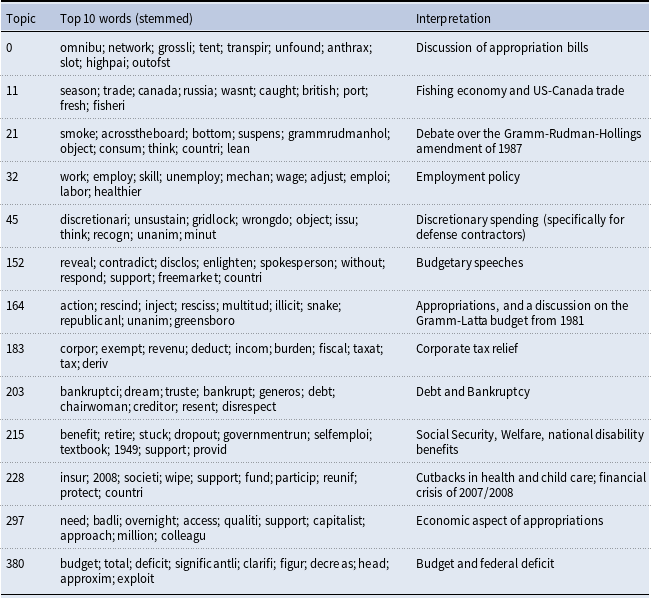
With the trained topic models at hand, I identified every topic which primarily captured economic speech by creating a list of all topics that contained economic terms in the top 10 words, separately for each of the three models. I then manually inspected top speeches for these topics to verify that the topic indeed contains economic policy talk. See Table 1 for a list of the economic topics from the main model (see the appendix for the lists for the two other models). Importantly, different layers of the economy—such as appropriations, debt, welfare benefits—are split up into different topics, as we would expect. This way, we can identify representatives who primarily focus on the budget, or taxation.
Economic topics contained in the main model. The topic number references its index in the topic-term matrix where the index starts at 0

Table 1 Long description
A table with 10 columns and 13 rows. The columns are labeled Topic, Top 10 words (stemmed), and Interpretation. The table lists economic topics identified in a main model, showing top 10 words and their interpretations. Row 1: Topic 0, Top 10 words (stemmed) omnibu; network; grossli; tent; transpir; unfound; anthrax; slot; highpai; outoft, Interpretation Discussion of appropriation bills. Row 2: Topic 11, Top 10 words (stemmed) season; trade; canada; russia; wasnt; caught; british; port; fresh; fisheri, Interpretation Fishing economy and US-Canada trade. Row 3: Topic 21, Top 10 words (stemmed) smoke; across the board; bottom; suspens; grammrudmanhol; object; consum; think; countr; lean, Interpretation Debate over the Gramm-Rudman-Hollings amendment of 1987. Row 4: Topic 32, Top 10 words (stemmed) work; employ; skill; unemploy; mechan; wage; adjust; emplo; labor; healthier, Interpretation Employment policy. Row 5: Topic 45, Top 10 words (stemmed) discretionary; unsustain; gridlock; wrongdo; object; issu; think; recog; unanim; minut, Interpretation Discretionary spending (specifically for defense contractors). Row 6: Topic 152, Top 10 words (stemmed) reveal; contradict; disclos; enlighten; spokesperson; without; respond; support; freemarket; countr, Interpretation Budgetary speeches. Row 7: Topic 164, Top 10 words (stemmed) action; rescind; inject; resciss; multitud; illicit; snake; republica; unanim; greensboro, Interpretation Appropriations, and a discussion on the Gramm-Latta budget from 1981. Row 8: Topic 183, Top 10 words (stemmed) corpor; exempt; revenu; deduct; incom; burden; fiscal; taxat; tax; deriv, Interpretation Corporate tax relief. Row 9: Topic 203, Top 10 words (stemmed) bankruptci; dream; trustee; bankrupt; generos; debt; chairwoman; creditor; resent; disrespect, Interpretation Debt and Bankruptcy. Row 10: Topic 215, Top 10 words (stemmed) benefit; retire; stuck; dropout; governmentrun; selfemplo; textbook; 1949; support; provid, Interpretation Social Security, Welfare, national disability benefits. Row 11: Topic 228, Top 10 words (stemmed) insur; 2008; societ; wipe; support; fund; particip; reunif; protect; countr, Interpretation Cutbacks in health and child care; financial crisis of 2007/2008. Row 12: Topic 297, Top 10 words (stemmed) need; badli; overnight; access; qualiti; support; capitalist; approach; million; colleague, Interpretation Economic aspect of appropriations. Row 13: Topic 380, Top 10 words (stemmed) budget; total; deficit; signific antil; clarifi; figur; decreas; head; approx; exploit, Interpretation Budget and federal deficit.
To provide qualitative insight into what the topic model has detected, Figure 1 shows a plot of the economic topics listed in Table 1 over time, highlighting the ratio of speeches per congress classified with this topic. The plot shows signs of all peculiarities of LDA discussed above. We can see some topics starting with very low salience reach high salience towards the end of the dataset, there are topics with high salience becoming less salient towards the end, and we have topics that remain stable.
A plot of the 13 economic topics identified in the main topic model. The y-axis denotes how many speeches per congress have been classified with the provided topic. The topic numbers correspond to the numbers in the table of top-words.

What becomes immediately obvious is that most economic topics remain stable over time, as expected. Several topics feature spikes that correspond with phases in which the issue were salient in discourse. Most topics experience a slight increase in saliency during the end of the “progressive era” in the United States between 1910 and 1920, marked by significant economic legislation. Later, topic number 164 clearly captures a new form of discussions about appropriation bills started during the economic crises of the 1960s and remained important for the remainder of the dataset. Other topics have peaks at different time points, such as topic 380 that peaks at the height of the economic crises of the 1970s, or topic 215 that peaks after World War II. Finally, we can see that economic topics become more salient in overall discourse starting in the 1970s, indicating a qualitative change in how representatives talk about the economy.
All in all, these descriptive results indicate that economic issues have remained relatively stable, but that different parts of economic discourse are relevant at different points in time. This is corroborated, for example, by research showing that taxation has only become highly salient and a central issue for the policymaking process after the 1960s (Erz, Reference Erz2025b).
3.3 Constructing speaker profiles
To construct speaker profiles, the models classify all speeches into topics, and assume the topic with the highest loading to be the main topic of that speech. Given that LDA is an admixture model that provides values for all topics for all documents (Grimmer et al., Reference Grimmer, Roberts and Stewart2022; Molina and Garip, Reference Molina and Garip2019), this choice requires justification.
By default, LDA provides scores (often called “loadings”) for how much each topic in the model “loads” on the given document, but I chose to retain only the highest-loading topic. Since speeches in Congress primarily focus on one topic, retaining all topic loadings would be at odds with how the speaker envisioned their speech. Speakers regularly touch upon multiple issues, but only to support their main argument. Furthermore, since LDA is a Bayesian method, it tends to assign probabilities for all topics in all documents roughly uniformly (see Carlsen and Ralund, Reference Carlsen and Ralund2022, especially Figure 2). This means that retaining all topic loadings will push the similarity metric (see below) to find almost perfect similarities between all topics and speakers, and even more so when aggregated.
After having classified all speeches into their single primary topic, I construct speaker profiles by aggregating all speeches by every individual speaker for one entire congressional cycle of two years. A congressional cycle is the period between congressional elections, which are held every two years, which is further subdivided into two one-year sessions. I choose to use this two-year cycle instead of individual sessions because over the course of these two years, the make-up of the congressional network does not change significantly.Footnote 1 A speaker profile is a 500-dimensional vector in which each number denotes the frequency of speeches classified into the corresponding topic of that individual speaker within one congressional cycle. I repeat this process for all 75 congressional cycles that are part of the dataset (from the 43rd Congress to the 118th Congress). This resulted in about 40,000 vectors (ca. 535 representatives by 75 Congresses).
3.4 Measuring speech similarity
This paper measures how similar speakers address issues in their speeches, given the constraints outlined above. Cosine similarity is a popular choice to calculate speech similarity that has the right properties for this analysis (see equation). First, unlike divergence measures like Kullback-Leibler (Chang and DeDeo, Reference Chang and DeDeo2020), it is symmetric and commutative. This means that a comparison of larger or smaller distances is straight forward. Also, if representative A talks similarly to representative B, then B talks similarly to A. Since cosine similarity measures the angle
 $\theta$
between two vectors, the measure also accounts for different amounts of speech. Thus, similarity between representatives who talk about the same topics in the same relative frequency will be maximal. It will be minimal for those who talk about widely diverging topics in different amounts.
 \begin{equation*} \cos (\theta ) = \frac {\sum _{i=1}^n \vec {A_i} \vec {B_i}}{\sqrt {\sum _{i=1}^n \vec {A_i}^2} \sqrt {\sum _{i=1}^n \vec {B_i}^2}} \end{equation*}
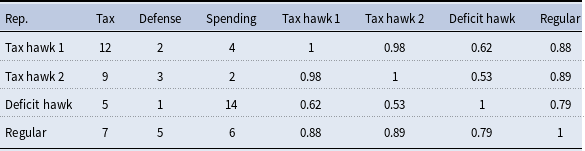
To demonstrate that cosine similarity accurately proxies the speech distance between various representatives in terms of what they talk about, consider the following, hypothetical example: Let us assume there are three topics, the first one denoting speeches about taxes, the second one denoting speeches about defense, and the third one denoting speeches about federal spending. Let us further assume we have four representatives; two of which are “tax hawks” one of which is a “deficit hawk” (“hawks” are representatives focusing on specific topics), and the final one is a representative who does not focus on specific topics. Table 2 demonstrates that those who focus on the same topics have the highest speech similarity, while those who focus on different topics have the lowest.
Hypothetical speaker profiles and corresponding cosine similarities for four exemplary ideal-typical representatives

Table 2 Long description
The table presents data on hypothetical speaker profiles and their corresponding cosine similarities for four ideal-typical representatives. It has four rows and eight columns. The columns are labeled as Rep., Tax, Defense, Spending, Tax hawk 1, Tax hawk 2, Deficit hawk, and Regular. The rows are labeled as Tax hawk 1, Tax hawk 2, Deficit hawk, and Regular. Row 1: Tax hawk 1, 12, 2, 4, 1, 0.98, 0.62, 0.88. Row 2: Tax hawk 2, 9, 3, 2, 0.98, 1, 0.53, 0.89. Row 3: Deficit hawk, 5, 1, 14, 0.62, 0.53, 1, 0.79. Row 4: Regular, 7, 5, 6, 0.88, 0.89, 0.79, 1.
The first half of Table 2 contains the absolute speech counts for each representative, while the second half denotes the cosine similarity to other representatives. The two “tax hawks” possess the highest similarity despite slightly different frequencies of speeches. The least similar speakers are those focusing on tax and the deficit, respectively. The speech similarities towards the “regular” representative are in between. What should be noted is that most similarities that should theoretically indicate a high similarity (e.g., between the two tax hawks) are above
 $0.9$
, while the similarities of each “specialized” representative to a regular one without a distinct speech profile are still well above
 $0.5$
. This is just a hypothetical example, and real data will behave differently, but this helps demonstrate how different cosine similarities can be interpreted. Cosine similarity captures the speech similarities in a way that corresponds with the research question.
Since this paper compares discursive polarization with issue-level polarization, this step needs to be repeated twice. First, I measure the speech similarity between the full speaker profiles which include all topics. In a second step, I construct a second set of matrices that measure speech similarity based only on economic topics. Since I measure similarity using the cosine between two vectors, setting any dimension in both vectors to zero effectively removes that dimension from the similarity calculation. This means that I could construct a simple mask vector, which contains ones for the economic topics, and zeros for all other topics. Multiplying a speaker profile with this mask thus yields a new speaker profile that only retains the frequency counts of economic topics. Calculating the cosine similarity between two “masked” speaker profiles therefore provides a measure of economic speech similarity. However, since both sets of matrices is constructed from the same underlying data, the results are comparable.
In total, this analysis uses about 80,000 speaker profiles (ca. 535 representatives by 75 Congresses by 2).
3.5 Community detection and modularity scores
With this measure of speech similarity, I am able to produce networks of representatives who are connected if they speak similarly. This produced 450 adjacency matrices (75 Congresses
 $\times$
3 models
 $\times$
2 topic subsets [economic and overall]). These matrices are weighted and symmetric, and contain between about 10,000 (Senate only) and 250,000 entries (full Congress).
To measure the amount of issue-level polarization this induces in each Congress-network, this analysis follows Waugh et al. (Reference Waugh, Pei, Fowler, Mucha and Porter2011) in their choice of using community detection algorithms. To understand what community detection algorithms measure, we need to understand the structure of the networks resulting from cosine similarity scores. By generating a Congressional network as such, one creates a weighted network in which edges connect representatives based on their speech similarity, with stronger weights being associated with higher topical similarity. Such networks will be fully connected, since even very dissimilar speakers will have a small amount of overlap. This is due to general noise that is introduced when dealing with textual data. It is unlikely for two speakers’ speech vectors to be exactly orthogonal. This raises an important question for constructing a network: dichotomization.
The Leiden community detection algorithm can work with weighted networks (Traag et al., Reference Traag, Waltman and van Eck2019). Dichotomization removes data and drastically reduces the resolution of the data. As such, the main results reported in the next section are based on the weighted, non-dichotomized networks. However, because there is a theoretical argument to be made for dichotomization, in which similarities below a certain threshold should not be considered, the appendix includes a section that reports the same results, but based on dichotomized, binary networks. Indeed, these results show the same trends as the non-dichotomized network, but more pronounced.
The aim of community detection algorithms is to find groups of nodes within a network such that the solution maximizes edges within groups while minimizing edges between groups. In our case, this means finding groups of nodes in Congress which speak similar among each other, but dissimilar to other groups. Community detection is an NP-hard problem, meaning that it requires algorithmic approximation (Bruggeman et al., Reference Bruggeman, Traag and Uitermark2012). Most algorithms choose to start with a random community assignment, measure how well the solution works, and update the assignments. This is done until no move would improve the solution. This paper relies on the Leiden algorithm (Traag et al., Reference Traag, Waltman and van Eck2019) for detecting communities (see the appendix for a comparison of Leiden with the Louvain and walktrap algorithms).
Fortunato (Reference Fortunato2010) has outlined a series of issues with community detection algorithms and their corresponding modularity score metric. Specifically, he argues that the assumption of the null-model for community detection algorithms is problematic. Community detection algorithms essentially compare the modularity of a network to one of the same amount of vertices and edges, but with randomly rewired edges (Bruggeman et al., Reference Bruggeman, Traag and Uitermark2012). If the modularity of the observed network is significantly higher than the one of the random baseline, the algorithm assumes that the network has a community structure. However, even random graphs may exhibit a community structure by chance. This means that community detection algorithms may lead to false positives or false negatives. In addition, even a community structure that we can easily observe by visual inspection of a network plot might not be properly detected by community detection algorithms. This is especially grave for sparse networks.
For dense, weighted networks, these issues may be less severe than for sparse unweighted networks (Fortunato, Reference Fortunato2010). Nevertheless, recognizing these issues with modularity scores, I handle the resulting modularity scores in the analysis with the due caution. First, I refrain from analyzing the absolute values of the modularity scores, since those can be over- or underestimates of the real community-structure of the networks. The scores will only be compared against each other to detect trends over time. Second, I compare the results with two more community detection algorithms, Louvain and walktrap. If the results from all three algorithms are comparable and stable, this indicates that the community structure is less likely a false positive by chance. But third, and most crucially, I do not expect the community structure to be neatly divided into two groups. This last point requires some elaboration.
Speech similarity does not exclusively depend on party affiliation. There are indications that political speech also depends on socio-economic variables (Canen et al., Reference Canen, Kendall and Trebbi2020), geographical origin (Ermakoff, Reference Ermakoff2008), or committee assignments (Fenno, Reference Fenno1973). For this study, which focuses on speech similarity, this means that the network community structure which the Leiden algorithm might recover will connect representatives not simply based on party affiliation, but also on various other shared attributes. This means that the analysis requires a second step to check for homophily of the resulting community structure.
3.6 Confirmatory analysis with quadratic assignment procedure
In order to verify the results from the community detection algorithm and answer the third research question, I employ QAP. QAP compares multiple networks with each other and tests whether the observed correlation between both is due to chance (Krackhardt, Reference Krackhardt1987). In this case, we can compare the observed network based on speech similarity with a synthetic network constructed based on homophily, that is, whether two nodes in the network share the same attribute (McPherson et al., Reference McPherson, Smith-Lovin and Cook2001). This method is preferable to a dyad-level OLS-regression that predicts edges based on shared attributes, because a network does not uphold the independence-assumption of OLS (Krackhardt, Reference Krackhardt1987).
By randomly permuting the synthetic network and calculating the correlations between all permutations and the observed network, QAP tests whether the observed homophily patterns are spurious. If random permutation does not produce the same amount of correlation between the attributes and the observed network significantly often (e.g.,
 $p \lt 0.05$
), this is an indication that the observed correlation might not be spurious. I perform one QAP analysis using
 $n = 1,000$
permutations.
The QAP analysis tests the third research question. It tests whether the observed networks could be caused by party homophily, that is, representatives from the same party are more frequently connected to similar peers. I do so by creating an attribute for the nodes in my network, and store the party affiliation for each node in it. Then, I create a synthetic network in which nodes are connected if they are part of the same party. By performing QAP, I check whether the speech similarity networks might be correlated to party homophily.
4. Results
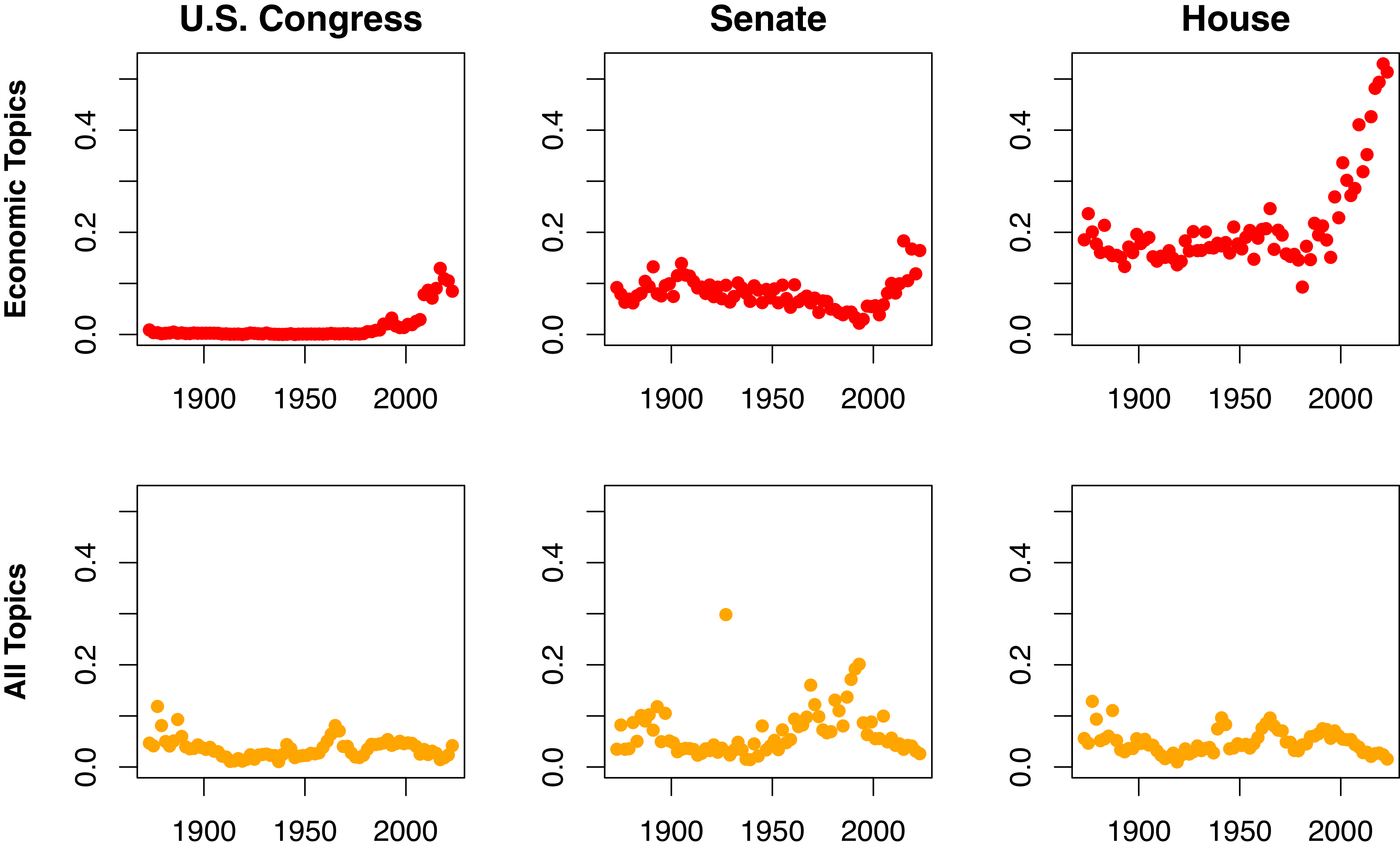
Constructing weighted adjacency matrices and calculating modularity scores allows us to plot the modularity scores for each Congress network over time. Figure 2 shows the modularity scores as calculated for the adjacency matrices for all 69 Congresses in the data, separated into six plots. The first column shows the results when using the data for the entire Congress, irrespective of chamber. To check whether these results change if accounting only for Senate or House, columns two and three report the same results for models that only include Senate or House, respectively. The first row reports modularity scores when using only the economic topics, and the second row reports modularity scores accounting for all 500 topics in the model.
Modularity scores according to the Leiden community detection algorithm across the three models and two sets of topics.

Focusing on the bottom row first, we can see the overall discursive polarization in Congress over time. The plots for all three models show similar patterns: A U-shaped trend, indicating more discursive polarization at the beginning of the data in 1873, followed by a phase of low polarization in the early to mid 20th century, followed by a period of rising polarization. With small differences, all three plots essentially tell the same story. The results for the Senate are more pronounced however, and we can see how the Senate becomes more polarized starting in the 1960s, while the House remains somewhat less polarized.
This positively answers the first research question. Congressional discourse is indeed polarized along issues. More importantly, it exhibits a similar pattern to the one observed with vote results by McCarty et al. (Reference McCarty, Poole and Rosenthal1997). Vote results also show a U-shaped trend with more polarization around 1950, less polarization in the 1960s and 1970s, and more polarization since the 1980s (see McCarty et al., Reference McCarty, Poole and Rosenthal1997, figure 3.1, p. 15). Additionally, we can see that the differences in speech are relatively small between both chambers of Congress, as all three models exhibit very similar patterns. This is corroborated by research on ideological polarization more generally (Baldassarri and Bearman, Reference Baldassarri and Bearman2007).
Next, we focus on the top row, which repeats these results, but only using the economic topics. We can clearly see differences to the overall discursive polarization observed. If we only include economic topics in the calculation of our speaker profiles, we can see that issue-level polarization across economic topics has remained stable throughout almost the entire period of analysis, with a strong upwards trend beginning in the 1980s. Notably, the issue-level polarization in economic discourse in the House outweighs both general polarization across all topics, and in the Senate. While the Senate, too, experiences an uptick beginning in the 1990s, issue-level polarization in the House remains high, more than doubling in the last twenty years of the dataset.
Comparing the two plots in the first column (economic topics and all topics, full U.S. Congress model only), it appears that economic issue-level polarization contributed little to discursive polarization in the first third of the data, and more in the last third of the data. This corroborates findings by McCarty et al. (Reference McCarty, Poole and Rosenthal1997) in that the overall polarization observed since the 1970s appears to be at least partly due to polarization on the economic issue-level. Indeed, it appears that the crises of the 1970s have not just led to economic issues becoming more salient in discourse (Erz, Reference Erz2025b), but that representatives began forming distinct clusters based on which topics they talked about.
Economic issue-level polarization in the Senate and House follow different trends. While the Senate is generally more polarized along issues than the House, the picture reverses across only the economic topics. Here, it is the House that exhibits very strong issue-level polarization, while the Senate exhibits only a small increase towards the end of the data, mirroring the full model results. This corroborates the hypothesis that economic issues have the potential to be very polarizing, but particularly in the House, where budget bills must originate.
This allows addressing the second research question. Economic discourse appears polarized on the issue-level, but to a different degree than the overall polarization. While the overall discursive polarization exhibits a U-shaped trend but remains overall low, economic issues remain level until the last third of the data, when issue-level polarization increases rapidly. This indicates that, while U.S. Congress always has formed some clusters, most representatives still talk about similar issues. On the other hand, in economic discourse, it appears that representatives have stopped talking about similar issues, and instead began focussing on particular issues, which leads to the strong community structure.
While Figure 2 shows issue-level polarization, it cannot say whether this polarization happens along party lines. The community detection algorithm might have found communities across party lines. Therefore, we now turn to another set of results, which answer the third research question.
Figure 3 shows the assortativity, or homophily (McPherson et al., Reference McPherson, Smith-Lovin and Cook2001), of the networks over time based on party affiliation. Each of these plots visualizes the fraction of edges between representatives in the networks that can be explained by representatives being members of the same party. The higher a point in the plots, the more edges connect not just similar speakers, but speakers from the same party.
Assortativity, or homphily, based on party affiliation over time for the three models and two sets of topics.

These plots are all highly similar, showing little difference in the structure of the full Congressional network and the two smaller subnetworks based on Senate and House. Party homophily remains low across the entire time period. For the full model, there are effectively no changes in party homophily, indicating that party affiliation does not explain the community structure. The senate model shows some jitter, likely caused by the small numbers of nodes in these networks (100 vs. 435 and 535 in the other two models). This indicates that issue-level polarization appears not to be explained by party affiliation. This hints to the possibility that issue-level polarization might be cross-cutting. What strikes is a sharp increase in party homophily in the economic discussions in the House starting in the 2000s. This corroborates the interpretation from Figure 2 in that the House serves as a fertile site for economic disagreements, likely due to the fact that budget bills must originate there. Only in economic discourse in the House, it appears, does party affiliation explain a part of the community structure, indicating that the parties focus on different issues.
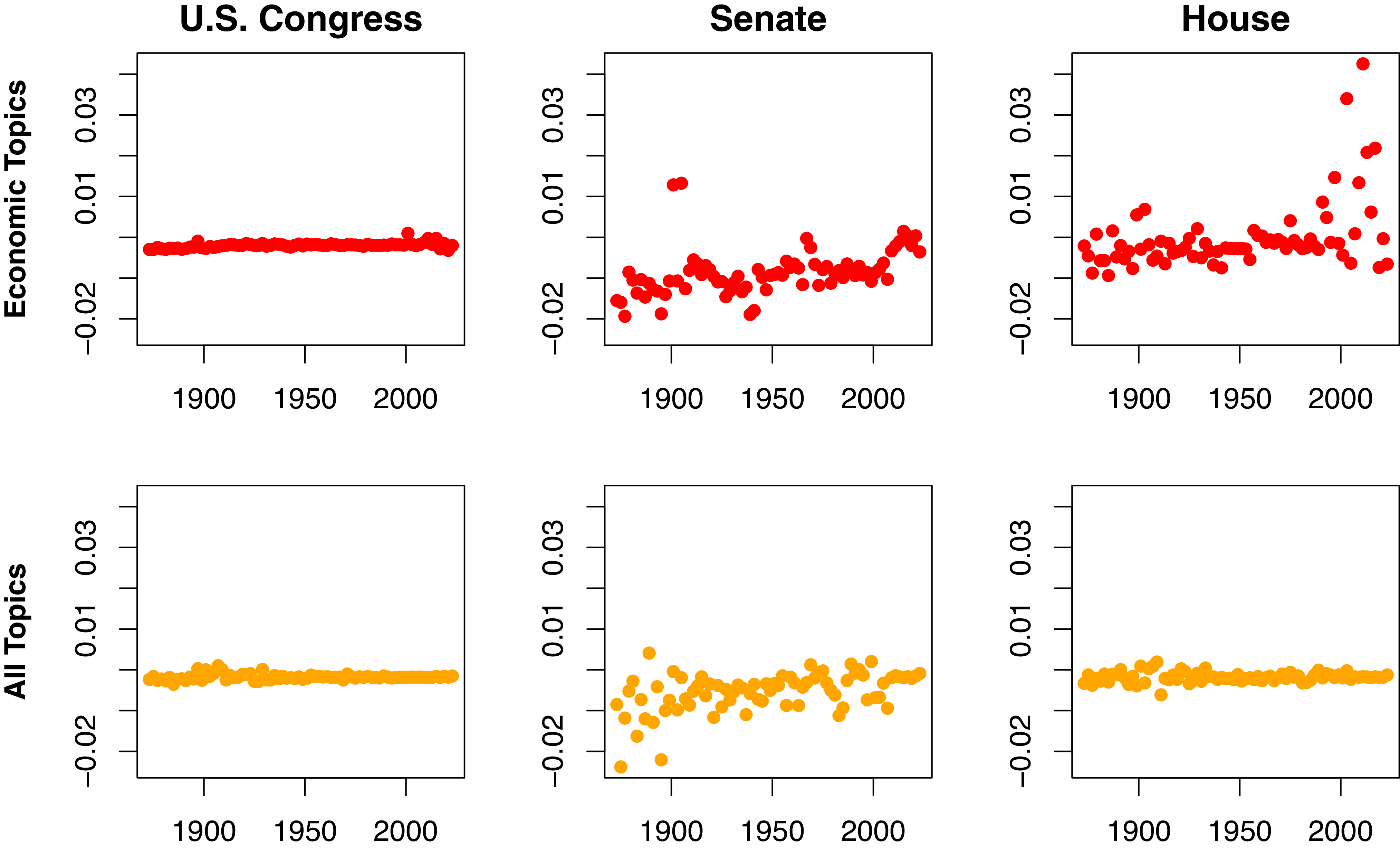
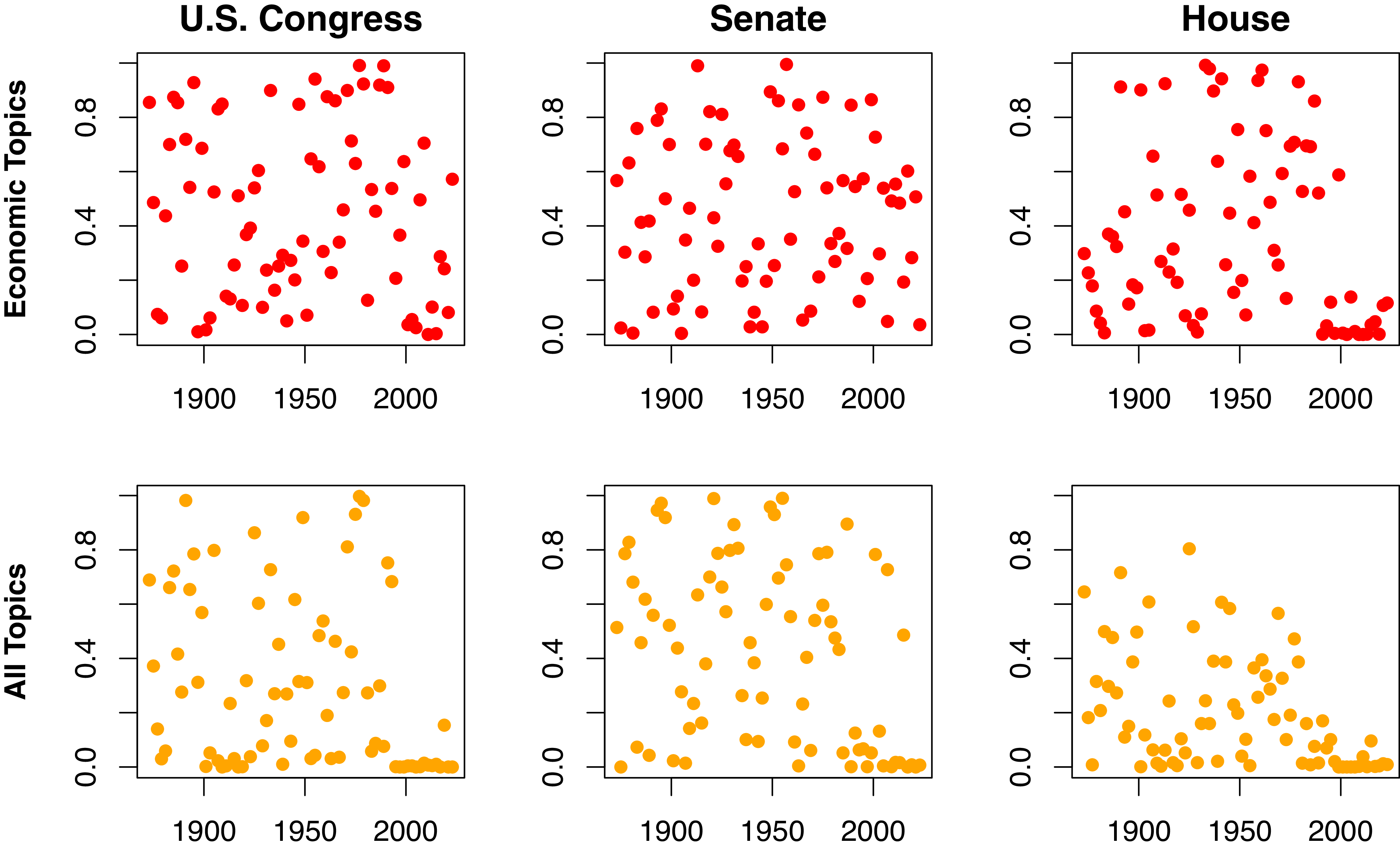
But how likely is it that issue-level polarization cuts across party lines? Using a QAP test, I check whether this finding holds up to a random permutation of the network. Figure 4 shows the results of a QAP test with regard to party affiliation. It becomes clear that, overall, party homophily appears not to be a significant predictor of discursive polarization, with probability scores varying widely. Regardless of whether we look at the first row (economic topics) or the second one (all topics), most networks fail the QAP test; showing that random permutations of the party affiliation network can yield similar or higher correlations with the observed speech similarity networks. This means that most homophily trends we can observe in Figure 3 are likely insignificant.
QAP test results obtained by comparing the correlation of the observed speech similarity network with
 $n = 1,000$
permutations of a synthetic network based on party homophily.

Figure 4 Long description
Panel A: A scatter plot shows the polarization of U.S. Congress over time, with the x-axis representing years from 1900 to 2000 and the y-axis representing the level of polarization for economic topics. Red dots indicate data points. Panel B: A scatter plot shows the polarization of the Senate over time, with the same axes and red dots as in Panel A. Panel C: A scatter plot shows the polarization of the House over time, with the same axes and red dots as in Panel A. Panel D: A scatter plot shows the polarization of U.S. Congress over time for all topics, with the x-axis representing years from 1900 to 2000 and the y-axis representing the level of polarization. Orange dots indicate data points. Panel E: A scatter plot shows the polarization of the Senate over time for all topics, with the same axes and orange dots as in Panel D. Panel F: A scatter plot shows the polarization of the House over time for all topics, with the same axes and orange dots as in Panel D.
There is one important observation, though. From the mid-1980s onward, we can see a sharp drop in the QAP results in the bottom row, and the House results for economic issue-level polarization. Only a few results go above a conservative
 $p \lt 0.05$
-threshold. This means that, from that time point, the results obtained in Figure 2 are likely significant. In other words, the discursive polarization along issue-lines observed in Figure 2 is cross-cutting. Additionally, the stark increase in issue-level polarization in the economic discourse in the House happens along party lines. This suggests that party affiliation becomes more relevant for economic issue-level polarization in the House.
Historical evidence corroborates this. When Ronald Reagan became President of the United States in 1981, he oversaw a large shift in the Republican Party, leading to the homogeneous party we observe today (Abramowitz, Reference Abramowitz2018; Rossinow, Reference Rossinow2015). The 1980s are generally described as a period in which homogenization set in to the two-party system, partly driven by the turn towards “neoliberalism” and a “technocratization” of language (Berman, Reference Berman2022; Mudge, Reference Mudge2018). This means that, while party affiliation does not significantly correlate with speech similarity across most of the dataset, this relationship becomes more salient in the 1980s. From thereon forward, party affiliation becomes correlated with speech similarity. More importantly, however, these results show how the House of Representatives has become a site of fierce economic disagreements, with representatives clustering significantly more along party lines. This suggests that the institutional structure of U.S. Congress seems to be an important driver of issue-level polarization.
5. Discussion
These results show that issue-level polarization is an essential angle to view polarization in U.S. Congress besides ideological and affective polarization. What representatives talk about matters just as much as how they vote. To contextualize these results and rejoin them with empirical accounts of events coinciding with the observed patterns of Congressional discourse in the 1970s and 1980s, when polarization in the economic networks starts to increase, two argumentative threads are particularly helpful.
A first insight can be gained from the literature on neoliberalism. Especially president Reagan is known for having initiated a drastic paradigm shift in economic policy (Babb and Kentikelenis, Reference Babb and Kentikelenis2021; Centeno and Cohen, Reference Centeno and Cohen2012; Harvey, Reference Harvey2005). From this perspective, the increase in polarization might be explained as a result of dispersion of economic discourse due to representatives having to find a new language to talk about the economy. Moreover, this literature might help explain why party affiliation does not yet significantly correlate with polarization on the economic issue-level during his presidency, and only increases from the 1990s. Research has shown that many democratic representatives have voted in favor of Reagan’s economic proposals (Erz, Reference Erz2025a; Stein, Reference Stein1988). This implies that the lagged increase in the correlation between economic polarization and party affiliation could be partly due to the economy becoming more partisan as the two parties have coalesced more around distinct poles of the ideological spectrum.
Second, many scholars have focused on a phenomenon often labeled “culture wars” (Abramowitz, Reference Abramowitz2018; DellaPosta et al., Reference DellaPosta, Shi and Macy2015). As the civil rights movement in the 1960s has taken off, representatives have started to polarize primarily along cultural issues. This then could have impacted economic discourse, too, meaning that the increase in polarization in economic policy talk could be partly due to this.
Regardless of angle, however, the results show that economic discourse has become more polarizing, particularly since the 1980s and even more so in the House, and it has started to correlate with party affiliation since the 1990s. While this study has focused merely on establishing a measure of issue-level polarization to understand the structure of economic discourse and the substantive results are thus limited, it provides a framework that can easily be extended and built upon. The steps to arrive at the measurement are computationally straight forward, meaning that this measurement can be applied without extensive computational resources and thus provides a simple way of analyzing parliamentary discourse and polarization without the need for resource-intensive Large Language Models (LLM, see Bender et al., Reference Bender, Gebru, McMillan-Major and Mitchell2021).
6. Conclusion
This paper has shed light upon issue-level polarization in economic discourse in U.S. Congress using speech data and a network approach. The results show that polarization in issue attention on the economic level has remained low in Congress until the 1980s, when an increase can be observed. In the House, economic issue-level polarization has always remained higher, showing how divisive discussions about the economy can be. Furthermore, the analysis also suggests that issue-level polarization was not significantly correlated with party affiliation until the 1990s, when this association started to become stronger. All in all, this project shows that economic issue-level polarization is an important aspect of understanding lawmaking processes in U.S. Congress. The results suggest that the difficulties in the passage of budget bills and government shutdowns might be explained by structural factors, where representatives not just disagree on particular issues, but about which issues are relevant to start with.
The analysis has demonstrated how to measure topical associations on the issue-level, and that these correlate with known polarization patterns. This shows that combining a topic model with a suitable measure of speech similarity can help us understand issue-level polarization in the U.S., and generally polarization at more depth than simply analyzing roll-call vote data would allow for.
Specifically, this approach offers a different angle compared to existing studies of polarization in Congressional discourse. First, by using speech transcripts, research gains access not just to the voting behavior of representatives, but also their motivations for doing so, opening up a larger pool of information for analysis. Second, by not focusing on partisanship in speeches, the method accesses directly what representatives are talking about, not just how that separates them. Third, by using a single, large model, it uses a stable baseline so that results are comparable across time and space. Incidentally, the comparison between multiple topic models also showed that LDA is remarkably resilient to the differences in speech patterns between the chambers.
Still, this analysis suffers from several limitations. First, a topic model always requires interpretation by the researcher, inserting biases in various ways into the analysis (Biernacki, Reference Biernacki2012; Lee and Martin, Reference Lee and Martin2015; Mohr, Reference Mohr1998). The economic topics were chosen based on an inspection of the top words and top speeches for each topic. While the list of economic topics should be exhaustive since the bar for inclusion of topics was set conservatively, there may be nuances that got lost in this process. In addition, annotating topics from topic models is a resource-intensive task, and mapping the entirety of 500 topics exhaustively has proven prohibitively difficult. An LLM might be able to aid in producing an initial topic interpretation, although research suggests that this approach bears its own risks (Ollion et al., Reference Ollion, Shen, Macanovic and Chatelain2023).
Topic models have also been subject to criticism over the years. With the arrival of more sophisticated text analytical methods, there is hope that other methods may provide theoretically sound measurements faster. Since this study merely requires a measure of linguistic similarity, future research can extract issue-level discourse using other methods. What is crucial is only that the method assigns topics deterministically and based on lexical similarity, while GPT-based models can introduce noise due to their probabilistic nature (Bender et al., Reference Bender, Gebru, McMillan-Major and Mitchell2021).
This leads to a third limitation. Since this study was only concerned that a topic was about economics, but not how economics have been discussed within that topic, deeper conclusions about the results cannot be drawn. What can be said is only that polarization occurred based on differences in which topics have been discussed, but not how or why. Since topic models treat text as a bag of words, the model could not pick up on ideological polarization caused by representatives talking about the same issues in the same frequency, but having opposing stances. Therefore, while this method can extract issue-level polarization, it is less-suited for extracting ideological polarization.
A fourth limitation concerns scope. Because clustering topics is difficult, and becomes even more difficult with cultural issues, such as the civil rights movement, this analysis has only focused on comparing general discourse within economic discourse. Future analyses can take a step further and use this measurement strategy to compare polarization dynamics across a broader and possibly more nuanced selection of issues.
Finally, this study stops short of offering a rigorous explanation for the emergent patterns. While the results and robustness checks allow drawing some careful conclusions, it cannot offer a description of the actual social mechanisms at work.
While these results do suggest that the speech patterns in U.S. Congress changed over time and uneven so between the macro and micro level, it is difficult to say just how these patterns changed, and why. But with the groundwork laid by this study, research has an additional means to explore just that.
Acknowledgements
The author thanks Károly Takacs for extensive feedback on a first version of this paper, as well as the two anonymous reviewers for their helpful and rigorous comments. Jacob Habinek and Étienne Ollion have provided feedback on later versions of this work. Emelie Karlsson and Alexandra Rottenkolber have provided helpful comments.
Supplementary material
The supplementary material for this article can be found at https://doi.org/10.1017/nws.2026.10049.
Competing interests
The author(s) declare none.
Funding statement
This work was supported by the Swedish Research Council (grant number Dnr 2013-07681).
Data availability statement
The data (1873–2011) for this work has been collected by Matthew Gentzkow, Jesse Shapiro, and Matt Taddy, and is available for download from the article’s website: https://doi.org/10.3982/ECTA16566.
The data between 2012 and 2025 has been downloaded by the author using the CREC Parser developed by Nicholas Judd, Dan Drnikard, Jeremy Carbaugh, and Lindsay Young.
The Python and R code for this paper is available upon request.
Statement on the use of AI tools
This work does not contain any text, images, or other data that has been generated by a LLM. Furthermore, generative AI has not been used to generate insights or help in structuring ideas in any way throughout the process of writing this paper.

 n=1,000


 Open access

