Introduction
Syntactic structures across languages may often diverge, even in languages that are typologically grouped together regarding their functional and grammatical features. The intuition that cross-linguistic similarities and/or differences may be a determinant of the ease with which a certain structure can be learnt in a foreign or second language (L2), and of native-like attainment of non-native speakers, has instigated a long line of research, especially in the domains of Second Language Acquisition (SLA) and applied linguistics (e.g., Ellis, Reference Ellis1994; Gass, Reference Gass, Flynn and O'Neil1988; Kormos, Reference Kormos2006; Lado, Reference Lado1957; Ringbom, Reference Ringbom2007; Schwartz, Reference Schwartz1998). SLA studies on word order have yielded contrasting findings (see Odlin, Reference Odlin, Patten and Lee1990 for a critical discussion). The core issue in the present study though was not whether speakers of one language can learn a different structure in another language (see DeKeyser, Reference DeKeyser2005 for a review), but what different structures entail for bilingual language representation, activation, and cross-talk in unbalanced proficient bilinguals.
Not so long ago, bilingual research established that users of more than one language are sensitive to properties of both language systems, regardless of whether a particular context requires use of both languages or not (e.g., Hartsuiker, Pickering & Veltkamp, Reference Hartsuiker, Pickering and Veltkamp2004; Kroll, Sumutka & Schwartz, Reference Kroll, Sumutka and Schwartz2005; see Kroll, Dussias, Bogulski & Valdes-Kroff, Reference Kroll, Dussias, Bogulski, Valdes-Kroff and Ross2012 for a review). Interestingly, the few psycholinguistic studies that have directly compared bilingual groups for production beyond the lexical level have shown that divergent syntactic properties across two languages may lead to syntactic errors when speaking one of the languages. This is true even for highly proficient bilinguals, and despite intensive corrective feedback on structures that differ cross-linguistically. For instance, Hatzidaki, Branigan and Pickering (Reference Hatzidaki, Branigan and Pickering2011) showed that subject-verb and pronoun-antecedent agreement computation is influenced by divergent number properties of a subject noun across the languages of a bilingual (Hatzidaki et al., Reference Hatzidaki, Branigan and Pickering2011; Hatzidaki, Pickering & Branigan, Reference Hatzidaki, Pickering and Branigan2006). Also, gender agreement in determiner-noun phrases is influenced by cross-linguistically incompatible gender systems (Lemhöfer, Spalek & Schriefers, Reference Lemhöfer, Spalek and Schriefers2008; Lemhöfer, Schriefers & Hanique, Reference Lemhöfer, Schriefers and Hanique2010). Furthermore, language interference effects are particularly evident in contexts where both languages of a speaker are actively used (i.e., in code-switching), with stronger influence usually from the native language (L1) to the second language (L2) than vice versa (see Butler & Hakuta, Reference Butler, Hakuta, Bhatia and Ritchie2004; Kroll, Bobb & Wodniecka, Reference Kroll, Bobb and Wodniekca2006 for reviews).
What these findings suggest is that grammar processing in proficient, unbalanced bilinguals is not handled by two functionally independent systems. If this were the case, speakers, based on their preverbal message, would build the intended structure and proceed unimpeded to articulation in the target language as monolingual speakers do (Levelt, Reference Levelt1989; Levelt, Roelofs & Meyer, Reference Levelt, Roelofs and Meyer1999). Instead, occurrence of syntactic errors that bear the mark of the non-target language provides evidence of a leakage of syntactic information from one language system into another, consistent with a model of bilingual sentence production that assumes shared syntactic (besides lexical) representations (Hartsuiker et al., Reference Hartsuiker, Pickering and Veltkamp2004; Hartsuiker, Beerts, Loncke, Desmet & Bernolet, Reference Hartsuiker, Beerts, Loncke, Desmet and Bernolet2016; Hartsuiker & Pickering, Reference Hartsuiker and Pickering2008). In this model, by activating words in their two languages, bilingual speakers also activate syntactic information encapsulated in their lemmas through the use of corresponding nodes (Levelt et al., Reference Levelt, Roelofs and Meyer1999). According to Hartsuiker and Pickering (Reference Hartsuiker and Pickering2008, p. 482), these nodes are shared between the languages of a bilingual if the constructions that are involved have “sufficiently similar rules”. Thus, an important consequence of this framework is that cross-linguistic influences may occur at the syntactic level as well. However, it is not clear in this model, whose assumptions originate predominantly from priming studies, what degree of cross-lingual similarity in syntactic representations is necessary for such cross-lingual interactions.
In a series of syntactic priming experiments with noun phrases, Bernolet, Hartsuiker and Pickering (Reference Bernolet, Hartsuiker and Pickering2007) showed that cross-linguistic syntactic priming only occurred when the word order was identical between the languages of the bilinguals (between Dutch and German but not between Dutch and English). Hence, the authors concluded that structures whose word order differs cross-linguistically are not shared in bilinguals. However, despite their clear findings, a comparison that would provide irrefutable evidence for the authors’ claim but was not considered in that study was a comparison between German and English. Because German and Dutch have the same word order in relative clause structures of noun phrases, as opposed to English, a lack of priming between German and English would provide strong evidence that it is the difference in word order and not other factors, such as task procedure (cf. Desmet & Declercq, Reference Desmet and Declercq2006) that blocks the priming of a particular structure from Dutch to English. For instance, Jacob, Katsika, Family, and Allen (Reference Jacob, Katsika, Family and Allen2016) formulate an account that posits that both word order similarity and level of embedding are prerequisites for cross-linguistic priming (see also Chen, Jia, Wang, Dunlap & Shin, Reference Chen, Jia, Wang, Dunlap and Shin2013 who argue that only similarity of hierarchical structure is crucial). Putting aside the conflicting results of these studies, an important question that follows from the conclusion of Bernolet et al. (Reference Bernolet, Hartsuiker and Pickering2007) is what non-shared syntactic representations entail for language interaction. If structures with different word order are not assumed to be shared in the bilinguals’ mind, would that suggest that they are immune to interference of the contrasting characteristics of the other language?
In a more recent study, using cross-linguistic priming of genitive structures from Dutch to English, Bernolet, Hartsuiker and Pickering (Reference Bernolet, Hartsuiker and Pickering2013) showed that cross-linguistic syntactic priming is stronger as L2 proficiency increases. This was interpreted to reveal a transitional stage L2 learners go through where they first establish language-specific structures that allow them to keep the syntactic representations of their two languages apart. And only later on, when they attain high proficiency in the L2 and if the syntactic structures of their two languages are similar, do bilinguals shift to shared syntactic representations. This suggests that language proficiency should be carefully controlled in studies that look at language interference effects to be able to attribute the effects to the right source of influence, such as competence, performance (Chomsky, Reference Chomsky1965) or their intersection (Culicover, Reference Culicover2013).
Returning to the question of how dissimilarity in functional and hierarchical relations across two languages may affect language interaction (e.g., Gass & Selinker, Reference Gass and Selinker1992; Schwartz & Sprouse, Reference Schwartz and Sprouse1996), let's take the case of reported speech production. To produce an utterance that reports, for example, what just happened as a response to a direct question, the speaker has to convert a direct question into an indirect one (e.g., Holly: What did Eric eat?, Reported Speech: Holly asked what Eric ate). Parenthetically we note that in prescriptive grammars, both simple past and past perfect are felicitous for use in English reported speech in utterances such as the above. In particular, in Modern English, action verbs in simple past in direct speech remain in simple past tense in reported speech. The same happens when it is not necessary to distinguish between two different times in the past (The Farlex Grammar Book, 2016). Considering the example mentioned previously, and extending the computations that need to take place to the bilingual case, if we assume parallel language activation (e.g., Hartsuiker et al., Reference Hartsuiker, Pickering and Veltkamp2004; Hartsuiker & Pickering, Reference Hartsuiker and Pickering2008), the system does not consider the syntactic representations of direct and indirect questions only in the target language, but also those in the non-target language. In cases where the structures across the two languages map onto each other, reported speech production should not be problematic. However, if cross-linguistic differences exist either in the formation of a direct question and/or the formation of an indirect one, the speech production system might sometimes accidentally derail and proceed to the production of non-target like structures (e.g., *Holly asked what did Eric eat, *Holly asked what ate Eric, etc.). Thus, the question of interest here is whether cross-linguistic syntactic differences by themselves suffice to yield instances of language interference or whether interference might be modulated or even blocked by the contrasting characteristics of the syntactic structures of the two languages. In other words, would speakers of an L1 that diverges from the L2 in how it structures both a direct question and an indirect one show a larger effect of language interference (demonstrated through the production of word order errors) than speakers of an L1 that diverges from the L2 only in how it structures a direct question?
To date, no study has examined whether the degree of cross-linguistic syntactic differences influences language interaction and whether it modulates the magnitude of language interference in L2 sentence production. The present study aimed to do so by specifically investigating the effects of word order differences during L2-reported speech production of object questions. Exploring such a question clearly has important implications for models of bilingual sentence production that assume separate or shared representation of syntactic information between languages (e.g., de Bot, Reference De Bot1992; Hartsuiker et al., Reference Hartsuiker, Pickering and Veltkamp2004), or for models of bilingual language learning that consider competing cues and transfer effects from the L1 to the L2 (e.g., Bates & MacWhinney, Reference Bates, MacWhinney, Wanner and Gleitman1982; see Li & MacWhinney, Reference Li, MacWhinney and Chapelle2013 for a review). Psycholinguistic research on this issue can also inform educational research interested in the effects of language interaction and performance differences between native speakers, children and adults, with the potential to apply its findings to instruction programmes for L2 learners (see for example Clahsen & Felser, Reference Clahsen and Felser2006 and the shallow-structure hypothesis in L2 sentence comprehension).
A rare study related to the current research question is that of Pozzan and Quirk (Reference Pozzan and Quirk2013), who examined the L2-English production of main and embedded yes/no and wh-questions in proficient Spanish–English and Chinese–English bilinguals. The errors that were produced in embedded object questions (the structure tested in the present study) were comparable for the two groups of bilinguals, and the authors accounted this finding to structurally constrained overgeneralization of inversion of L2 main questions onto L2 embedded questions. However, despite their contribution, Pozzan and Quirk (Reference Pozzan and Quirk2013) did not actually examine the effect of the degree of cross-linguistic syntactic differences on language interference: the tested structure was not only different between the speakers’ L1 (Spanish and Chinese), but also between each L1 and the target L2 (English). Moreover, as various syntactic structures were examined, only 4 items were used in the condition of embedded object questions. In the present study, we varied this structure in its degree of syntactic similarity between the L1 and the L2, using a sufficient number of experimental items. Note at this point that the scope of the present study was not to identify the precise source of surface structure differences in the examined languages. The critical point regarding the degree of cross-linguistic syntactic differences was rather used to investigate how these differences might impact the emerging interference.
Additionally, we explored whether the degree of L1 interference might be modulated by different contexts of bilingual language use. Thus, apart from production in bilinguals’ L2, we also examined code-switched production from L1 to L2. The introduction of such a manipulation was driven by previous bilingual findings from language interaction in subject-verb agreement (Hatzidaki et al., Reference Hatzidaki, Branigan and Pickering2011), which showed that cross-linguistic number divergence yielded an increased number of agreement errors in a context of L1-L2 code-switching relative to selective L2 use. Although that study did not look at the effects of the degree of cross-linguistic syntactic differences – one might assume that in the current study too – a code-switched setting could modulate the degree of activation of contrasting syntactic features, and hence their likelihood of interfering with reported speech production. That is, if a direct question is produced in L1 and the indirect question in L2, an L1 with syntactic structures that differ in word order from the L2 in both direct and reported speech (absolute degree of cross-linguistic difference) might increase the activation of the different word order and lead to more instances of language interference than a language with contrasting features only in the formation of direct speech (lower degree of competing features) or a context of same language use. At the same time, considering that highly proficient bilinguals are expected to produce few errors overall, the inclusion of a code-switched condition that would enhance cross-linguistic interference could also enhance the possibility of detecting any between-group differences at all.
Undoubtedly, there are many syntactic configurations that could be used to look at effects of language interference in word order from L1 to L2. In the present study, because the focus of interest was on the role of the degree of cross-linguistic syntactic differences in the emerging language interference, we considered suitable to look at syntactic structures that would allow meaningful comparisons not only between each L1 and the L2, but also between the two L1s, given L2. Thus, we chose to examine the case of object questions (What-questions from now on) in English reported speech of Dutch–English and Spanish–English proficient bilinguals, because the degree of differences in this syntactic construction is graded across the three languages, with Dutch being the least and Spanish the most different from the target English (Chomsky, Reference Chomsky1981; Rizzi, Reference Rizzi, Belletti and Rizzi1996; Torrego, Reference Torrego1984; Zwart, Reference Zwart1997). More specifically, the transformation of an English past tense What-question from direct speech (WH-DS) to reported speech (WH-RS) involves creating a subordinate clause with the word order of a declarative sentence, whereby the subject comes before the verb while the auxiliary verb is omitted, as in 1b. In contrast, declarative sentences do not undergo any transformation from direct speech (D-DS) to reported speech (D-RS1 and D-RS2) as in 2b and 3b, respectively. (Translations in Dutch and Spanish are provided in brackets.)
1a.

1b.
2a.
2b.
3a.
3b.


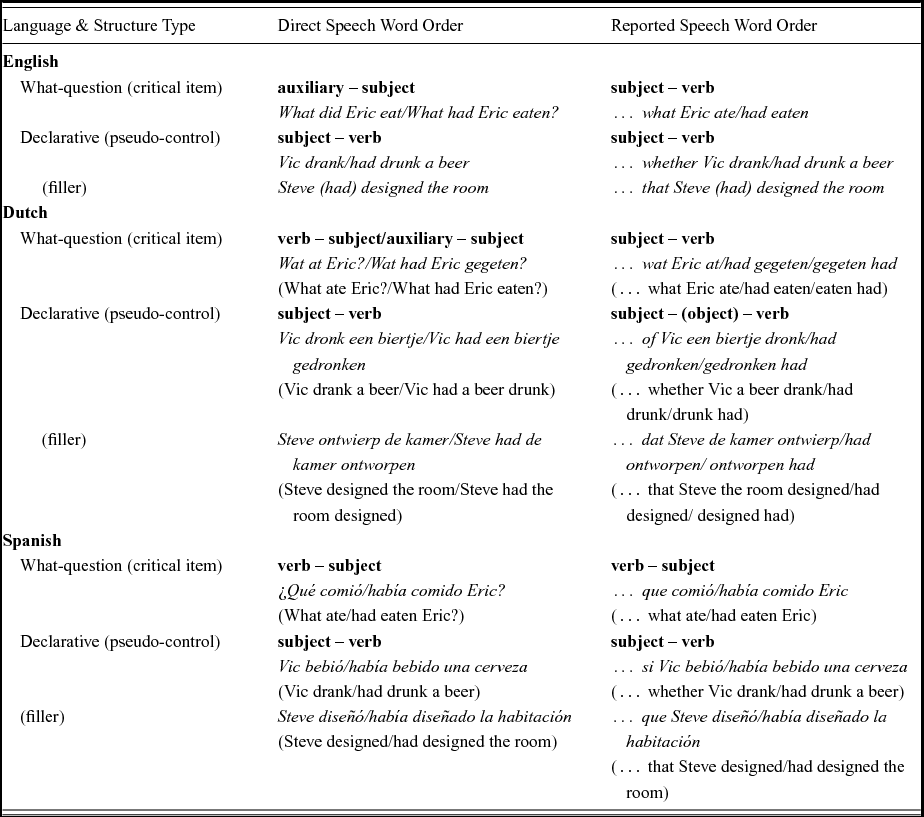
Cross-linguistically, the transformation of What-questions from direct to reported speech gives rise to different structural patterns: in direct speech, all three languages display inversion, but crucially, the kind of inversion involved does not consider the same constituent elements; in Dutch and Spanish there is inversion between the subject and the verb, whereas in English the inversion concerns the subject and the auxiliary verb. However, in reported speech, Dutch and English subordinate What-question structures maintain the subject-verb word order and do not require subject-verb inversion, while Spanish subordinate What-structures require subject-verb inversion (Torrego, Reference Torrego1984; Zagona, Reference Zagona2003; see Rizzi, Reference Rizzi, Cinque and Salvi2001, Reference Rizzi, Cheng and Corver2006, for a similar analysis of interrogative structures in Italian). In sum, while in Dutch and English there is a word-order asymmetry between direct and reported wh-question structures (verb-subject vs. subject-verb word order, respectively), in Spanish interrogatives there is no word-order asymmetry (verb-subject word order in both). Note that syntactic operations for the generation of declaratives with embedded clauses, such as those in 2b or 3b, are similar in English, Dutch and Spanish, with the exception of SOV word order for Dutch in which case nevertheless the subject still appears before the verb in both direct and reported speech as in English and Spanish. Table 1 summarizes the similarities and differences of direct and reported speech across the three languages examined in the present study.
Illustration of similarities and differences in word order between direct and reported speech across English, Dutch, and Spanish in simple past and past perfect. Note that in our experiment, all the direct speech prime sentences were presented in simple past. Back-translation from Dutch and Spanish is used for clarification in brackets.

The above cross-linguistic similarities and differences allow the formulation of two hypotheses in relation to our research question. According to the first one (the graded effect account), if language interference is sensitive to the extent of cross-linguistic syntactic differences, one would predict a larger effect of interference between two languages with more contrasting syntactic representations (Spanish vs. English, with different syntactic structures in both direct and reported speech, main vs. auxiliary verb inversion and VS vs. SV order, respectively) than between more similar languages (Dutch vs. English, with different syntactic structures in direct speech only, with main vs. auxiliary verb inversion). Thus, Spanish–English bilinguals should be more prone than Dutch–English bilinguals to produce utterances in their L2 that reflect interference from their L1.
The alternative hypothesis (the all-or-none effect account) assumes that the processor is vulnerable to language interference as long as there are deviating features between the L1 and the L2. In our case, that would be the co-activation of the differential characteristics of a What-question in Dutch or Spanish direct speech, before the verb moves to its base position in English reported speech. Under this account, the system could sometimes derail simply because the co-activated contrasting syntactic structure might interfere in the process of reported speech construction. Hence, this account would predict a comparable size of effect of interference for the two groups of bilinguals. With regard to the manipulation of language context, if code-switching indeed boosts effects of cross-linguistic interaction, as it has been found with number divergence in subject-verb agreement (Hatzidaki et al., Reference Hatzidaki, Branigan and Pickering2011), it would be reasonable to expect larger effects of L1 interference in L1-L2 code-switched production than in same language production in the L2. Moreover, if the degree of syntactic differences modulates the emerging interference, we might also expect to find larger language context effects for the Spanish–English than for the Dutch–English bilingual group.
Experiment
Method
Participants
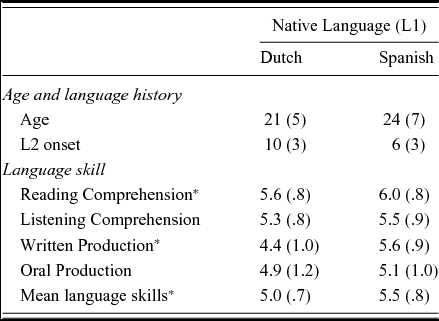
Fifty-eight Dutch–English (n=31) and Spanish–English (n=27) proficient bilinguals, students at Ghent University and at the University of the Basque Country in Vitoria-GasteizFootnote 1, respectively, participated in the experiment. Bilinguals from both countries were carefully selected such that they were proficient in English as a second language (L2; learnt at school) and had Dutch or Spanish as their native language (L1). They all reported that English was the only language in which they could hold a fluent conversation other than their native language. Moreover, besides similar L2 formal education, because the Spanish–English participants were less exposed to English through popular media than the Dutch–English participants, we assessed their proficiency in English by additionally collecting their scores on Oxford Quick Placement Test, which uses ALTE levels (Association of Language Testers in Europe). All the participants were classified as advanced (48/60 to 54/60) or very advanced (55/60 or higher), corresponding to C1 and C2 respectively in the European Framework of Reference. Also, Spanish–English bilinguals originated from regions of Spain where only Spanish was spoken, or they were born in Spanish monolingual families. A few of them had very limited knowledge of Basque (they were schooled in Spanish, but had few classes of Basque). (See Table 2 for participants’ language history and self-assessed L2-English proficiency.) Participants received course-credit or monetary compensation for their participation.
Dutch-English and Spanish-English bilinguals’ language history and self-rated proficiency level in L2-English. Mean age and L2 onset are given in years, with standard deviations in brackets. The proficiency scores are given on a 7-point scale, where 1 = skill lacking and 7 = as good as native language.

*Statistically significant difference between the two groups, as showed by independent-sample t-tests: Reading Comprehension: t(56) = 2.06; p = .044; Written Production: t (56) =4.71; p < .001; Mean language skills: t(56) = 2.59; p = .012.
Materials and procedure
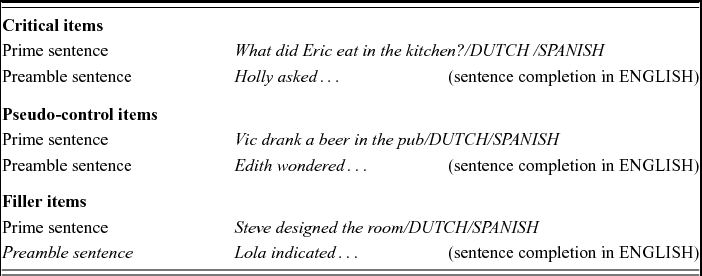
We created 50 experimental items, 25 of which were critical items that involved object argument questions in reported speech, and 25 were pseudo-control items that involved declarative sentences in reported speech. The verbs asked and wondered, which introduced reported speech in preamble sentences, were used for both critical and pseudo-control items, so that participants would not associate any of the two verbs with a particular condition (What-question or declarative sentence). Another 50 items, declaratives with an embedded clause that were not introduced in reported speech by verbs of the above two conditions, were used as fillers. All items consisted of a prime sentence and a sentence preamble for completion in reported speech (see Table 3). By using direct-question prime sentences in our design when what-question reported speech was required, we aimed to restrict the range of responses in order to have full control of the expected embedded clause production, both in terms of specific verb use and content. Importantly, this way we also avoided including in the preamble the wh-element, so that participants were required to compute the embedded indirect question naturally and in full (i.e., our preambles only included the subject and the verb, Edith asked. . ., Edith indicated. . . and so on). Each of these 100 items was presented once in the same language (L2) condition (both prime sentence and sentence completion in L2) and once in the code-switching (L1→L2) condition (prime sentence in L1 – sentence completion in L2). In sum, each participant was presented with a total of 200 items distributed across six blocks. Note that this point of inter-sentential code-switching is considered one of the most common ones in language use by proficient bilinguals (Myers-Scotton & Jake, Reference Myers-Scotton, Jake and Nicol2001; Woolford, Reference Woolford1983). Moreover, intra-sentential code-switching, which is more complex, was not considered in the present study because it is highly related to discourse contexts of bilingual language use (Toribio & Rubin, Reference Toribio, Rubin, Roca and Jensen1996; Muysken, Reference Muysken, Bhatia and Ritchie2004) and our participants did not have such a profile. Also, the reported utterance was restricted by the syntactic and lexical aspects typical of subordinate clauses which would make it impossible to switch at the required site as it would violate the Equivalence Constraint; that is, for intra-sentential code-switching to occur at that site, the surface structure of the two languages should map onto each other and that was not the case (Köder, Reference Köder2016; Poplack, Reference Poplack and Duran1978, Reference Poplack1990). A list of the English materials with their translations in Dutch and Spanish is provided in the Appendix.
Examples of materials used in the present study. DUTCH and SPANISH refers to the language of the prime sentence in the code-switched condition.

The experiment was run using E-Prime 1.0. Participants were tested one at a time and they all received written instructions in their L2-English. Below is an example of the instructions that participants received when the session involved code-switching (in this example, Spanish–English). (In sentence completion in the same language, the explanatory clause was not present.)
Some events happened just now, and you will read sentences about them.
On each trial the first sentence, which is in Spanish, says what happened:
A man did something. You have to read that sentence aloud and understand it.
Then press the spacebar to see the beginning of a related sentence
which is in English. You have to read it aloud and make a full sentence in English.
Try to understand every sentence you read, but also do the task fast.
Now press the spacebar to start practice trials.
In addition to the above written instructions and after each practice session before the actual experiment started, the researcher told the participants that in the narration of events it would always be a man who just did something and a woman who narrated the event. They should try to remember the name of the man (1-2-syllable long), but if they did not, they could use ‘he’ instead.
The experimental session started with two practice trials. A fixation cross was presented on a computer screen for 1000 ms followed by the prime sentence participants had to read aloud. After reading the prime sentence, participants would press the spacebar, at which point the prime sentence disappeared and the sentence-completion preamble appeared. After reading the preamble and making a full sentence, participants pressed the spacebar to proceed to the next trial. Sentence completion was always performed in participants’ L2 (English). Half of the participants performed the task first in the same language condition (3 blocks), with prime sentences presented in English, and finished the task in the code-switching condition (3 blocks), with prime sentences presented in the participants’ native language (Dutch or Spanish). The other half of the participants performed the task in the reverse order. The order of context language presentation was counterbalanced across participants. The stimuli were presented in a pseudo-randomized order, and no two critical items preceded or followed each other. The entire session lasted about 50 minutes. Upon completion of the experiment, and before debriefing, each participant was asked to explain to the experimenter the formation of reported speech in English. All participants’ responses confirmed that they had explicit knowledge of the syntactic structure under investigation.
Scoring and analysis
Transcribed responses were allocated to the following categories; correct word order for grammatically correct completions using the verb of the prime sentence; incorrect word order for completions using the verb of the prime sentence but with ungrammatical subject-verb word order (e.g., *Daisy asked what did Karl find on the bus /*Iva asked what had Brian planted in the park); miscellaneous responses when wrong tense or ungrammatical verb forms were used (e.g., *Janet asked what Adam writed at the conference), when a different verb than the one of the prime sentence was used (e.g., in code-switching), or when the verb was not marked for past tense (e.g., would sing); and omissions, when no response was provided. Given the rationale of the study, our analyses concentrated on the category of incorrect word order responses as this category demonstrated effects of language interference.
A note on the use of tense in reported speech deserves to be made here, as Tense was also included as a variable in the analysis to further explore between-group differences. As we mentioned in the Introduction, both simple past and past perfect are felicitous tense options in English reported speech, and equivalent tenses are also used in Dutch and Spanish reported speech. In the absence of contextual information, as was the case in the current study, apart from the traditional backshift rule in English reported speech (Comrie, Reference Comrie1986), the speaker's reporting perspective and interpretation of aspectuality might also be responsible for the selection of tense in English sentence completion. For example, according to the instructions of the present experiment, participants had to report an event that just took place. If they did not consider that the embedding clause defined the frame of reference for what was described in the embedded clause, then backshift into past perfect would be optional, and the speaker could maintain the simple past tense (Boogaart, Reference Boogaart, Janssen and Wurff1996; Declerck, Reference Declerck1990; Janssen, Reference Janssen, Janssen and Wurff1996). Simple past in English reported speech is also usually preferred to past perfect when both tenses point to a definite use, for reasons of economy (Aarts & Wekker, Reference Aarts and Wekker1987:217). This would also be the case if the participants had to report those events in their corresponding L1, when considering the use of past tense in Dutch (Aarts & Wekker, Reference Aarts and Wekker1987:207), as well as in Spanish (Zagona, Reference Zagona2003, pp. 35–37). In case, however, the interpretation of the event described in the embedded clause was considered anterior to the embedding clause by the participant, past perfect would be the unmarked choice both in Dutch and Spanish. Hence, including Tense in our analysis could provide indirect evidence of how the participants conceptualized the events and of their tense-use preferences in L2 reported speech production given their L1 tense-use regularities.
Accuracy data were analyzed with mixed logit regression models (Jaeger, Reference Jaeger2008) instead of using analysis of variance mainly for three reasons: (i) since the dependent variable was binomial (whether participants produced structures with correct vs. incorrect word order), logistic regression allowed us to perform direct analyses on the participants’ actual responses without having to perform aggregation to a mean response per condition (see also Dixon, Reference Dixon2008); (ii) mixed-effects models are also better than ANOVAs at dealing with missing values; and (iii) importantly, mixed-effects models allowed us to directly include subject and item variance in the same model, so that it would no longer be necessary to perform separate F1 and F2 analyses (required by ANOVAs).
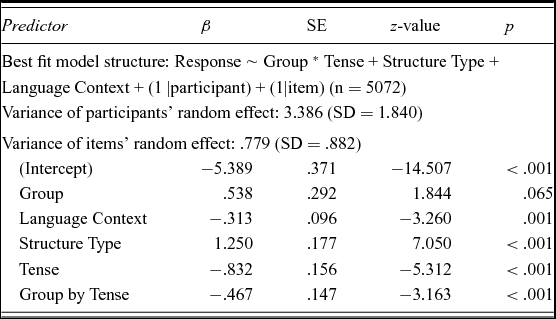
In all our analyses, the predictors were centred and sum coded, so that the reported analyses examined the effect of each predictor as a whole (similar to ANOVA analyses). We used backward χ2 model comparisons to select the best fit model with its maximal convergent random effects structure (as suggested by Barr, Levy, Scheepers & Tily, Reference Barr, Levy, Scheepers and Tily2013)Footnote 2. For that purpose, we first selected the maximal fixed effect structure and then added and selected the maximal random effect structure without convergence problems that did not show high correlation parameters between them (>.8). The results of mixed effects analyses are summarized in Tables 5 and 6, which show the influence of each predictor variable by reporting its parameter estimate (β), the standard error of the parameter estimate (SE), its z-value (which measures whether that predictor variable adds a significant contribution to the model), and its p-value.
Results
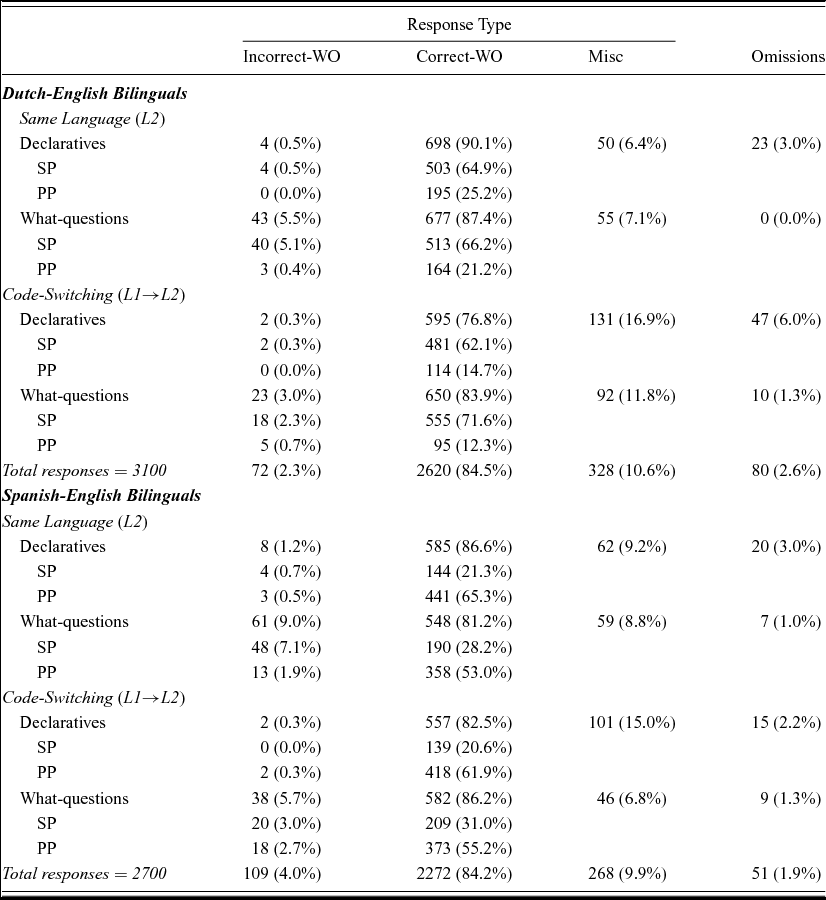
Participants who produced more errors than 2.5 SDs above the mean were removed from the analyses, leading to the exclusion of one participant per group (both produced more than 25% errors overall). As can be observed from the distribution of responses across scoring categories and experimental conditions in Table 4, a small number of word order errors occurred almost exclusively in what-questions (221 errors out of 2861 responses, 7.7% of all what-questions) and not in declaratives (17 errors out of 2801 responses, 0.6% of all declaratives).
Distribution of responses: incorrect word order (Incorrect-WO); correct word order (Correct-WO); miscellaneous responses (Misc); and omissions in Same Language (L2) and Code-Switching (L1 → L2) for each bilingual group for Declaratives and What-questions in reported speech, also indicating responses in Simple Past (SP) and Past Perfect (PP).

The maximal structure model justified by the data included Group, Structure Type, Language Context, Tense, and a Group by Tense interaction as fixed effects, with participants and items as random effects and no random slopes. The results showed main effects of Structure Type, Language Context, and Tense, revealing that participants produced more word order errors in What-question structures than in declarative ones, in same-language than in code-switched conditions, and when they produced structures with simple past than past perfect tense. The marginally significant effect of Group suggested that Spanish–English bilinguals tended to produce more word order errors than Dutch–English bilingualsFootnote 3. Finally, the Group by Tense interaction showed that the main effect of Tense was significant for Spanish–English bilinguals (β = −1.321, SE = .164, z = −8.028, p < .001), but not for Dutch–English bilinguals (β = −.247, SE = .281, z = −.881, p = .378) (see Table 5).
Logit mixed model analyses of word order errors.

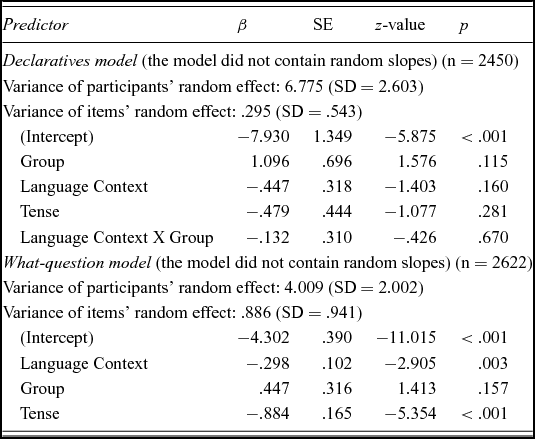
Additionally, because our main theoretical interest was to examine whether there were differences between Spanish–English and Dutch–English bilinguals in the production of What-questions, despite the best fit model not including any significant interactions with Structure Type, we explored the main effects of Language Context, Group, Tense and their interactions by running two separate analyses for Declaratives and What-questions: In the Declaratives model, the maximal structure justified by the data led to a model with Language Context, Group, Tense, and a Group by Language Context interaction as fixed effects, with no by-participant or by-item random slopes. Results yielded non-significant effects in all cases (all ps > .10). In the What-question model, the maximal structure justified by the data led to a model with Language Context, Group, Tense, and a Group by Tense interaction as fixed effects, with no by-participant or by-item random slopes. Results yielded significant Language Context and Tense effects, showing that participants produced more word order errors in same-language than in code-switching and when they produced sentences in simple past than in past perfect tense. The main effect of Group was not significant, revealing that Dutch–English and Spanish–English bilinguals produced a similar amount of word order errors with What-questions. The Group by Tense interaction showed that the main effect of Tense was significant for Spanish–English bilinguals (β = −1.545, SE = .202, z = −7.625, p < .001), but not for Dutch–English bilinguals (β = −.207, SE = .282, z = −.736, p = .462) (see Table 6).
Declarative and What-question logit mixed model analyses of word order errors.

Discussion
The present study investigated whether syntactic representations that differ across two languages block language interference in proficient, unbalanced bilinguals or whether language interference originates from cross-linguistic syntactic differences (all-or-none account), and whether it is an effect that is modulated by the degree of competing features across the speakers’ two languages (graded account). Additionally, we examined the above accounts in relation to the context of language use (same language vs. code-switching). To this end, we tested the accuracy of Dutch–English and Spanish–English bilinguals who produced reported speech utterances in their common L2 (English), after having read a direct question either in their L2 (same language production) or in their L1 (code-switched production).
In line with previous studies at the sentential level on number and gender agreement (Hatzidaki et al., Reference Hatzidaki, Branigan and Pickering2011; Lemhöfer et al., Reference Lemhöfer, Spalek and Schriefers2008), our results showed that in word order too cross-linguistic influences typically arise when there is some kind of mismatch between the involved languages, as both groups of bilinguals produced word order errors in what-question structures that differed across languages between direct and reported speech. Importantly, regarding the manipulation of the degree of cross-linguistic differences, the number of errors that were produced was similar across the two groups: the group of Spanish–English bilinguals, whose L1 word order departed most from the target L2-English (with subject-verb inversion in both direct and reported speech) did not yield a larger effect of language interference than the group of Dutch–English bilinguals whose L1 word order departed the least from that of the L2 (with subject-verb inversion instead of subject-auxiliary inversion in direct speech only). This provides support for the all-or-none account whereby cross-linguistic differences by themselves suffice to induce language interference.
To account for these findings, we assume that once new L2 syntactic structures are acquired, they trigger competition with other relevant representations from the L1 because both languages are activated in parallel (e.g., Hartsuiker et al., Reference Hartsuiker, Pickering and Veltkamp2004; Hatzidaki et al., Reference Hatzidaki, Branigan and Pickering2011). As such, different syntactic operations across the L1 and the L2 can affect reported speech production in the L2. Here, both Dutch and Spanish formulate direct questions using the same verb-subject word order (as opposed to the target-L2-English, with subject-auxiliary inversion). The results showed that the L1 word order for direct questions was activated during direct question reading, and interfered with the processing and production of reported speech utterances in the L2, regardless of whether the reported speech word order was the same (Dutch) or different (Spanish) from the target-L2-English.
Next we take a closer look at the specific types of errors that were produced out of the total number of incorrect word order responses in What-questions. We suggest that the following observations should be interpreted with caution as they are based on a small amount of errors that don't allow statistical analyses. These errors showed that both groups of bilinguals sometimes produced utterances that contained the auxiliary verb required in direct questionsFootnote 4. The pattern of this kind of structures was different in each group, which we tentatively interpret as an interaction with the corresponding reported speech structure in the L1: Dutch–English bilinguals produced (25.8%, 17 out of 66 incorrect responses) subject-auxiliary-verb (in bare form) structures (RS: *Holly asked what Eric did eat in the kitchen), whereas Spanish–English bilinguals produced (20.2%, 20 out of 99 incorrect responses) auxiliary-subject-verb (in past tense) structures (RS: *Holly asked what did Eric ate in the kitchen). Moreover, a large number of incorrect word order responses reflected an influence originating from the speakers’ L1 S-V inversion: that is, participants used the verb-subject word order of their corresponding L1-Dutch (present in direct speech; 31.8%, 21 out of 66 incorrect responses) or L1-Spanish (present in both direct and reported speech; 35.4%, 35 out of 99 incorrect responses): RS: *Holly asked what ate Eric in the kitchen. The Dutch–English bilinguals’ performance is particularly enlightening in this regard, because reported speech in Dutch has the same word order as in English. In those cases where the incorrect reported speech word order did not reflect an influence from the presence of the auxiliary verb in the structure of the English direct question, it did reflect influence from the subject-verb inversion of the L1-Dutch direct question, also demonstrated in the case of the L1-Spanish speakers who had that structure in common in their corresponding L1 (see also Escutia, Reference Escutia2002). In other words, surface overlap between Dutch and English reported speech (e.g., Boogaart, Reference Boogaart, Janssen and Wurff1996) did not suffice to prevent the occurrence of word order errors in the production of the latter.
Finally, other incorrect word order responses reflected overgeneralization of the structure of the L2-English direct question; RS: *Holly asked what did Eric eat in the kitchen.: 42.4%, 28 out of 66 incorrect responses in Dutch–English bilinguals, and 44.4%, 44 out of 99 incorrect responses in Spanish–English bilinguals, respectively (see also Pozzan & Quirk, Reference Pozzan and Quirk2013). Importantly, the control group of English native speakers never produced incorrect word order errors reflecting priming of the direct question in reported speech, suggesting that the produced word order errors were certainly due to interaction of the two languages of the speakers and not to simple within-language priming (see also Pozzan & Quirk, Reference Pozzan and Quirk2013 for similar performance of English adult native speakers).
Contrary to our expectations, the manipulation of context of bilingual language use yielded more word order errors in same language context than in code-switching and did not interact with the variable of group: both Spanish–English and Dutch–English bilinguals produced more errors when they were reading sentences and producing utterances entirely in their L2 than when sentence reading was in L1 and sentence production in L2. One explanation why the current study did not yield an increased number of errors in a context of language alternation as previously found in subject-verb agreement (Hatzidaki et al., Reference Hatzidaki, Branigan and Pickering2011) can be that agreement dependency relations might be more susceptible to code-switching than word order selection processesFootnote 5. Alternatively, this difference in participants’ performance across the two studies might be due to an important difference in the experimental procedure: in Hatzidaki et al., code-switched and same language production were induced in the same session following the presentation of a language cue; whereas in the current study the two contexts of language use were blocked and pre-determined, with one session performed entirely in the same language (L2 production) and another one entirely in code-switched production from L1 to L2. Thus, the code-switched context in the present study might have allowed the use of a strategic approach that minimized the costs of code-switching. What is more, the fact that code-switching did not interact with the interference effect suggests that both language representations are active (and compete) anyway, regardless of whether the context of language-use is bi- or monolingual. Either way, more research is certainly needed to shed light on syntactic processing of competing structures when both languages are actively used in a discourse setting. The occurrence, on the other hand, of more errors in same language than in code-switching suggests that the features of the L2 direct question had a larger impact than those of the L1 direct question in the processing of the L2 target structure.
The occurrence of language interference in our study is consistent with Hartsuiker et al.’s (Reference Hartsuiker, Pickering and Veltkamp2004) model of bilingual sentence production which assumes shared syntactic representations and cross-linguistic influences (cf. de Bot, Reference De Bot1992). In Hartsuiker et al. (as in other syntactic priming studies), the cross-lingual interaction effects are mostly facilitatory (i.e., representations in one language pre-activate representations in the other language). Here, they are inhibitory and hinder performance, which supports the automatic nature of such cross-lingual syntactic interactions. Additionally, finding the same amount of L1 interference during L2 reported speech production in bilinguals of L1s with a varying degree of cross-linguistic differences in the relevant structures provides novel information regarding the role of similarity of the representations of syntactic rules in the emerging L2 interference. For Dutch speakers who have attained high proficiency in English, we can assume that they have two language-specific rules to formulate direct questions: a rule that involves inversion between a subject and an auxiliary verb in the L2-English, and a rule that involves inversion between a subject and a main verb in the L1-Dutch. For the formulation of indirect questions in both Dutch and English, the same rule requiring the production of a canonical word order would be shared in both languages (see Bernolet et al., Reference Bernolet, Hartsuiker and Pickering2013; Hartsuiker et al., Reference Hartsuiker, Pickering and Veltkamp2004). For Spanish speakers who have attained high proficiency in English, we assume that they have to acquire different language-specific rules for the L1-Spanish and the L2-English to formulate not only direct questions, as Dutch speakers, but indirect questions as well. This is because to formulate indirect questions, Spanish requires a rule in which the order of the subject and the verb is inverted, whereas English requires a rule for the production of a canonical word order.
The implementation of information of these representations occurs at the stage of grammatical encoding (Bock & Levelt, Reference Bock, Levelt and Gernsbacher1994), and more specifically, during the selection of combinatorial nodes (Pickering & Branigan, Reference Pickering and Branigan1998). Specifically, when a speaker wishes to report the idea ‘What did Eric eat in the kitchen?’ following a preamble such as Holly asked . . ., he/she has to select the appropriate lemmas that carry grammatical class and argument information and assign syntactic relations among the constituents. Word order is specified during the process of constituent assembly that reflects the syntactic functions given earlier. During the production of indirect questions, we assume that the word order rules of both the direct question to be reported in indirect speech and those necessary to formulate the actual indirect question are activated. This is a reasonable assumption, despite the fact that the prime sentences in the current design might have boosted the activation of the structure of direct-questions, because it is difficult to think how one could report indirectly the information provided in a direct wh-question without activating it if one's thoughts are linked to linguistic representations (Levelt, Reference Levelt1989). More importantly though, our assumption rests on the use of tenses in reported speech which is guided by formal and/or semantic operations of direct speech (Boogaart, Reference Boogaart, Janssen and Wurff1996; Comrie, Reference Comrie1986). In other words, apart from correct word order, the speaker has to choose the correct tense in reported speech and this choice depends on the point of reference that is adopted when considering the relationship between the direct question and the reporting event. These operations, as our results suggest, differed across the two bilingual groups, with L1-Dutch speakers showing preference for simple past and L1-Spanish speakers for past perfect. For bilinguals, the word order rules of their two languages will be activated to some extent. Hence, we assume that the activation of any competing syntactic rules that are different from those that are necessary to formulate indirect questions in the L2-English is enough to create interference and lead to non-target like structures.
Our results are also compatible with models of bilingual use and learning, such as the Competition Model and its extended version the Unified Competition Model (e.g., Li & MacWhinney, Reference Li, MacWhinney and Chapelle2013; MacWhinney, Reference MacWhinney2005), whereby information from the two languages is represented in an interconnected way, allowing cross-linguistic influences. Although this model was initially put forward to explain language comprehension, it can accommodate the present findings if we assume the kind of alternative structure competition and L2-rule learning described in the previous paragraph for speakers with L1-Dutch and Spanish, respectively. Additionally, the role of cue validity and cue strength (MacWhinney, Reference MacWhinney, Groot and Kroll1997) is relevant here, because although some of their aspects may differ across the languages we examined, such that form-function mappings are not always consistent, yet they led to similar participant performance. Regarding the role of cue-validity, for example, the Spanish wh-word qué (‘what’) in the complementizer position triggers subject-verb inversion both in direct and in reported speech, whereas in Dutch or English, the ‘what’ word does not necessarily require a preposed verb (Cheng, Reference Cheng1991; Torrego, Reference Torrego1984; see also Zagona, Reference Zagona2003 for additional accounts). As far as cue strength is concerned, the frequency of use of reported speech in English native speakers is lower than that of direct speech (Ely & McCabe, Reference Ely and McCabe1993; Köder, Reference Köder2016), let alone in L2-English speakers. All this has consequences for the availability and reliability of word order as a cue in the reported speech production of Dutch– and Spanish–English bilinguals, and therefore, these two aspects have important implications for language interaction and language interference. What is not compatible though with the predictions of the Competition Model is our finding that additional cues (i.e., different word order in L1 vs. L2 both in direct and reported speech) do not boost the activation and competition of contrasting structures. If that were the case it would have required more word errors of What-questions in Spanish–English than in Dutch–English bilinguals and this was not the case. Thus, according to the all-or-none account, language interference is not a cumulative effect. Moreover, when a conflicting cue of different word order from the L1 wins the competition and yields an L2 word order error, this seems to occur because of the cue's different nature and not because of a summated value of difference the cue has. At a practical level, this finding could be used to inform foreign and second language instruction by engaging strategies and methods that put more emphasis on aspects of selective attention and active thinking in and using of L2 than on mere memory-based word order learning.
Conclusions
The current results speak to the case of reported speech production of what-questions which was used as a proxy to explore whether and to what extent cross-linguistic syntactic differences may lead to language interference and whether this effect can be regulated by the degree of these differences across structures. Our findings suggest that cross-linguistic syntactic differences per se suffice to induce language interference when the system is processing contrasting syntactic features even in highly proficient bilinguals, and that the degree of differences between the L1 and the L2, at least as far as reported speech is concerned, does not seem to affect or modulate the magnitude of this effect. Since this is the first psycholinguistic study to investigate whether the degree of syntactic differences matters for the emerging interference in L2 sentence production in adult speakers, certainly more research is needed to obtain a comprehensive picture of the effect and test whether the current results can generalize to other syntactic structures and languages as well.
Appendix
The English experimental stimuli used in the present study with their translations in Dutch and Spanish. Prime sentences were translated from English to Dutch or Spanish by a Dutch or Spanish native speaker, respectively, and were checked for their accuracy by another two native speakers of each language. The materials (verbs) were retrieved from The MRC Psycholinguistic Database (Coltheart, Reference Coltheart1981) and from Thordardottir and Weismer (Reference Thordardottir and Weismer2001).
What-questions
1. What did Eric eat in the kitchen?/Wat at Eric in de keuken?/¿Qué comió Eric en la cocina?
2. What did John get in the corridor?/Wat kreeg John in de gang?/¿Qué cogió John en el pasillo?
3. What did Henry have in the wallet?/Wat had Henry in de portefeuille?/¿Qué tenía Henry en la cartera?
4. What did Eddie put in the envelope?/Wat stak Eddie in de enveloppe?/¿Qué puso Eddie en el sobre?
5. What did Sam see in the street?/Wat zag Sam in de straat?/¿Qué vió Sam en la calle?
6. What did Alex pay at the cinema?/Wat betaalde Alex in de bioscoop?/¿Qué pagó Alex en el cine?
7. What did Steve make in the department?/Wat maakte Steve op de vakgroep?/¿Qué hizo Steve en el departamento?
8. What did Jerry read in the newspaper?/Wat las Jerry in de krant?/¿Qué leyó Jerry en el periódico?
9. What did Fred say on the telephone?/Wat zei Fred aan de telefoon?/¿Qué dijo Fred por teléfono?
10. What did Nick take in the toilet?/Wat nam Nick in het toilet?/¿Qué cogió Nick en el baño?
11. What did Adam write on the wall?/Wat schreef Adam op de muur?/¿Qué escribió Adam en la pared?
12. What did David hear on the radio?/Wat hoorde David op de radio?/¿Qué escuchó David en la radio?
13. What did Peter drive on the highway?/Waarmee reed Peter op de snelweg?/¿Qué condujo Peter en la autopista?
14. What did Bob move in the shower?/Wat verplaatste Bob in de douche?/¿Qué movió Bob en la ducha?
15. What did Karl find in the bag?/Wat vond Karl in de zak?/¿Qué encontró Karl en el bolso?
16. What did Alf play on the boat?/Wat speelde Alf op de boot?/¿Qué tocó Alf en el barco?
17. What did Toby wish in the dream?/Wat wenste Toby in de droom?/¿Qué deseó Toby en el sueño?
18. What did Jake open on the balcony?/Wat opende Jake op het balkon?/¿Qué abrió Jake en el balcón?
19. What did Roger want in the crowd?/Wat wilde Roger in de menigte?/¿Qué quería Roger en la multitud?
20. What did Roy lock in the attic?/Wat sloot Roy op de zolder?/¿Qué cerró Roy en el ático?
21. What did Max visit in the touristic center?/Wat bezocht Max in het vakantieverblijf?/¿Qué visitó Max en el centro turístico?
22. What did Brad stop at the airport?/Wat stopte Brad in de luchthaven?/¿Qué paró Brad en el aeropuerto?
23. What did Chris change in the painting?/Wat veranderde Chris in het schilderij?/¿Qué cambió Chris en la pintura?
24. What did Gavin study in the dark?/Wat studeerde Gavin in het donker?/¿Qué estudió Gavin en la oscuridad?
25. What did Brian plant in the field?/Wat plantte Brian in het veld?/¿Qué plantó Brian en el campo?
Declaratives
26. Fons ran a mile in the forest./Fons liep een mijl in het bos./Fons corrió una milla en el bosque.
27. Bruce lit a cigarette in the market./Bruce stak een sigaret op in de winkel./Bruce encendió un cigarro en el mercado.
28. Paul hid the letter in the drawer./Paul verstopte de brief in de lade./Paul escondió la carta en el cajón.
29. Jack fed the monkey in the zoo./Jack voedde een aap in de zoo./Jack alimentó a un mono en el zoo.
30. Kevin won a trip in the city./Kevin won een reis in de stad./Kevin ganó un viaje en la ciudad.
31. Alan sang a song in the opera./Alan zong een lied in de opera./Alan cantó una canción en la ópera.
32. Harry sold the kite in the garden./Harry verkocht de vlieger in de tuin./Harry vendió la cometa en el patio.
33. Billy stole a wallet in the bus./Billy stal een portemonnee in de bus./Billy robó una cartera en el autobús.
34. Ian drew a portrait in the gallery./Ian tekende een portret in de galerij./Ian dibujó un retrato en la galería.
35. Scott wore a hat at the meeting./Scott droeg een hoed op de vergadering./Scott vistió un sombrero en la reunión.
36. Ben fried the egg in the saucepan./Ben bakte het ei in de pan./Ben frió el huevo en la sartén.
37. Matt broke the bed in the hostel./Matt brak het bed in de jeugdherberg./Matt rompió la cama en el hostal.
38. James built a house on the mountain./James bouwde een huis op de berg./James construyó una casa en la montaña.
39. Vic drank a tea in the cafeteria./Vic dronk een kopje thee in de cafetaria./Vic bebió un té en la cafetería.
40. Todd baked a cake in the house./Todd bakte een taart in het huis./Todd cocinó una tarta en casa.
41. Carl ironed the tie in the bedroom./Carl streek de das in de slaapkamer./Carl planchó la corbata en el dormitorio.
42. Clark rented a flat in the area./Clark huurde een huis in het gebied./Clark alquiló una casa en los alrededores.
43. Larry caught the thief in the restaurant./Larry ving de dief in het restaurant./Larry atrapó al ladrón en el restaurante.
44. Andy hunted a wolf in the street./Andy joeg een wolf in de straat./Andy cazó un lobo en la calle.
45. Josh pushed the man in the queue./Josh duwde de man in de rij./Josh empujó al hombre en la cola.
46. Tom avoided the waitress in the bar./Tom vermeed de serveerster in de bar./Tom evitó a la camarera en el bar.
47. Dylan carried the ladder in the hall./Dylan droeg de ladder in de hal./Dylan cargó la escalera en la sala.
48. Ralph ignored the police in the distance./Ralph negeerde de politieman in de verte./Ralph ignoró al policía en la distancia.
49. Ray emptied the bag on the floor./Ray leegde de zak op de vloer./Ray vació la bolsa en el suelo.
50. Jeff created a group on the internet./Jeff creëerde een groep op het internet./Jeff creó un grupo en internet.