Introduction
Carcinoma of the larynx is one of the most common malignant head and neck tumours. Due to advances in surgical and chemo-radiotherapy techniques, the treatment outcomes and prognosis of patients with laryngeal carcinoma have improved dramatically, compared with those for other malignancies such as hypopharyngeal carcinoma. In patients with early stage laryngeal carcinoma, fairly satisfactory results are now obtained either by laser surgery or radiation therapy. Thus, the current focus in the treatment of such early stage cancer is how to acquire good voice quality. Even in cases of advanced laryngeal carcinoma, most patients are able to be rescued by combined total laryngectomy and radiation therapy. Therefore, our current interest in advanced laryngeal carcinoma treatment is how to preserve vocal function, and thus quality of life, without worsening patient prognosis.
In recent years, surgical protocols enabling preservation of the larynx (such as supracricoid laryngectomy with cricohyoidoepiglottopexy or cricohyoidopexy) have been indicated for early and selected advanced laryngeal cancer cases.Reference Chevalier, Laccourreye, Brasnu, Laccourreye and Piquet1–Reference Laccourreye, Laccourreye, Weinstein, Menard and Brasnu4 Laccourreye et al. Reference Laccourreye, Brasnu, Perie, Muscatello, Menard and Weinstein2 described the surgical procedure of supracricoid partial laryngectomy, and insisted that supracricoid laryngectomy reduced the indications for total laryngectomy in selected cases of advanced laryngeal carcinoma. Higher rates of local control and long-term control were obtained, compared with the conventional treatment modalities of vertical and horizontal partial laryngectomy. In a review article focussing on management of supraglottic carcinoma, Myers and Alvi stated that “[supracricoid partial laryngectomies] provided new hope for patients [who] would have otherwise lost their larynx”.Reference Myers and Alvi5
On the other hand, induction chemotherapy followed by radiotherapy has also been developed as a standard alternative to total laryngectomy. Concurrent radio-chemotherapy with cisplatin and fluorouracil is one of the most popular organ preservation strategies for advanced laryngeal cancer.Reference Forastiere, Goepfert, Maor, Pajak, Weber and Morrison6 The Department of Veterans Affairs laryngeal cancer study group was the first to demonstrate that nonsurgical therapy could achieve survival rates comparable to those of standard therapy by total laryngectomy.7 Although there was not a significant impact on overall survival, these findings, along with those of other authors, have demonstrated the important role of induction chemotherapy in advanced laryngeal cancer treatment.Reference Genden, Ferlito, Rinoldo, Silver, Fagan and Suarez8 As a result, many head and neck oncologists are now faced with the choice of a surgical approach or chemo-radiation.
In order to obtain the best oncological and functional outcome in the treatment of locally advanced laryngeal carcinoma, we applied selective, (intra-arterial), rapid infusion chemotherapy combined with radiotherapy.
Consideration of the arterial distribution in the paraglottic spaceReference Reidenbach9 and cricoid areaReference Pressman, Sermon and Monell10 would appear to vindicate our approach to larynx preservation in cases of locally advanced carcinoma.
Patients and methods
In 2006 to 2007, 72 previously untreated patients (69 men, three women; age range from 43 to 88 years; average age 69.4 years) were treated for laryngeal carcinoma at Kurume University Hospital. According to the 1997 staging system of the International Union Against Cancer, 26 of these patients were stage I, 18 were stage II, 19 were stage III and nine were stage IV. Of the 72 patients, selective (intra-arterial), rapid infusion chemotherapy combined with radiotherapy was used to treat 10 patients with advanced carcinoma. Our original protocol for radical treatment of advanced laryngeal carcinoma was total laryngectomy. Intra-arterial chemotherapy with radiation was used due to rejection of surgical treatment (by seven patients) or medical problems such as systemic disease (in three patients). Patients who had a history of radiation to the head and neck, or who had previously suffered from brain ischaemia, were excluded.
Chemotherapy was administered intra-arterially in the angiography suite via Selective, transfemoral catheterisation of the superior thyroid artery. Delivery of the dose to the feeding arteries was determined according to angiographic findings. In a patient with supraglottic carcinoma, part of the dose was delivered through the lingual artery so as to cover the base of the tongue. The patients received up to four once-weekly infusions of cisplatin (75 mg/patient), with simultaneous intravenous administration of sodium thiosulphate, a neutralising agent.
Simultaneously during the first week of treatment, patients received external beam radiation therapy. This comprised 1.8 or 2.0 Gy per fraction once daily, starting on the same day five days a week, for 7 weeks with a photon beam energy of 6 MV.
After therapy, patients were followed up every four to eight weeks.
Results
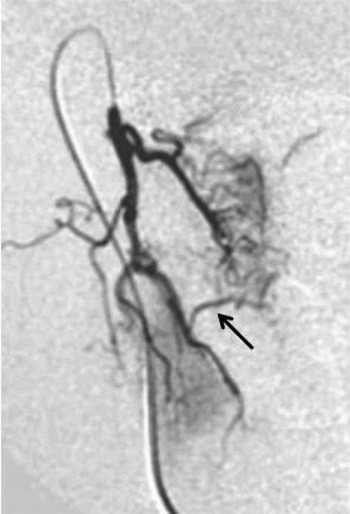
Angiographic studies of the human larynx have shown that a small feeding artery originating from a branch of the superior thyroid artery traverses the thyroid cartilage and distributes around the fascia of the intrinsic muscles (Figure 1). Therefore, we used the superior thyroid artery, not the superior laryngeal artery, for selective infusion, so that the anticancer agent would be distributed almost completely in the larynx. This infusion procedure may also prevent the development of acute laryngeal oedema, often induced by infusion of cisplatin selectively only to the superior laryngeal artery instead of superior thyroid artery.
Angiogram of the superior thyroid artery, showing a small branch artery penetrating the thyroid cartilage (arrow).

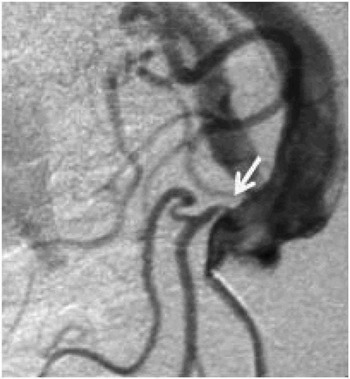
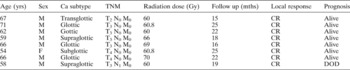
Intra-arterial infusion of the anticancer agent was successfully accomplished in eight of the 10 patients. Two patients were excluded from intra-arterial treatment because of unsuccessful catheterisation (e.g. due to arterial narrowing; see Figure 2). Therefore, one of these patients underwent total laryngectomy, and the other was treated by systemic chemotherapy with radiation. As shown in Table I, there were four glottic, three supraglottic (including one transglottic) and one subglottic laryngeal carcinoma cases. Seven of eight patients had advanced stage laryngeal carcinoma. Patients with T2 N0 M0 glottic cancer also received selective, (intra-arterial), rapid infusion chemotherapy plus radiotherapy, because in these cases the tumour extended widely to the posterior as well as the subglottic region, and the radiologist recommended this method instead of radiotherapy only. Patients' total dose of radiation ranged from 60 to 70 Gy.
Angiogram of the superior thyroid artery, showing narrowing of the artery (arrow).

Patients and treatment results

Yrs = years; Ca = carcinoma; TNM = tumour–node–metastasis stage; mths = months; M = male; F = female; CR = complete remisson; DOD = died of other disease
Following treatment, patients were followed up for a period ranging from 15 to 26 months.
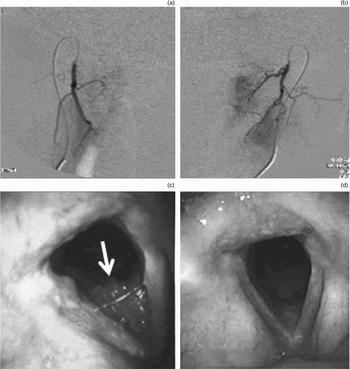
Complete response of the local disease was achieved in every patient, and there was no evidence of recurrence during the follow-up period. Even in the patient with a T4 N0 M0, subglottic-type laryngeal carcinoma, the tumour disappeared and treatment was uneventful (Figure 3).
Angiograms and laryngoscopic photographs illustrating selective, (intra-arterial), rapid infusion chemo-radiotherapy of the subglottic laryngeal carcinoma. Cisplatin infusion was performed via the right (a) and left (b) superior thyroid arteries. As a result, extensive tumour of the subglottic larynx (c) disappeared completely (d).

Discussion
When planning treatment of advanced laryngeal carcinoma, some patients strongly reject removal of the larynx. There are also patients with laryngeal carcinoma who suffer from cancer of other important organs (e.g. liver or lung), whose prognosis is therefore unfavourable and whose quality of life would be greatly enhanced by preservation of the larynx. In such cases, we have previously applied palliative chemo-radiotherapy, but the results are often miserable. Selective, intra-arterial infusion chemotherapy combined with radiation therapy has been used as a treatment option for patients with head and neck cancer.Reference Robbins, Staniolo, Kerber, Seagren, Berson and Howell11–Reference Cheung, Regan, Savin, Gibberman and Woessner15 Intra-arterial infusion chemotherapy has been found to be the most useful treatment protocol for maxillary sinus carcinoma.Reference Lee, Dimery, Van Tassel, De Pena, Blacklock and Goepfert16, Reference Samant, Robbins, Vang, Wan and Robertson17 Selective (intra-arterial), rapid infusion chemotherapy has been found to dramatically improve rates of primary response and organ preservation in case of paranasal sinus carcinoma.Reference Samant, Robbins, Vang, Wan and Robertson17
In contrast, there have been few reports of intra-arterial infusion used to achieve organ preservation in the treatment of advanced laryngeal cancer. This has been partly due to the difficulty of selecting the appropriate artery in order to reach the tumour lesion. Continuous infusion of anticancer agent through the superficial temporal artery to the thyroid artery, close to the carotid bifurcation, is quite dangerous because of the risk of overflow to the internal carotid artery. However, recent advances in transfemoral arterial infusion have enabled easy access to the feeding arteries of laryngeal tumours.
In the future, we intend to extend the use of selective, intra-arterial infusion chemo-radiotherapy to most cases of advanced stage laryngeal carcinoma, in order to enable larynx preservation.
Acknowledgement
This study was supported in part by a Grant-in-Aid for Scientific Research (#17591812) from the Ministry of Education, Culture, Sports Science and Technology, Japan.