Introduction
Adverse maternal uterine environments experienced during microbial infection can alter programming of the fetus leaving it susceptible to various adulthood diseases.Reference Harris and Seckl 1 The hypothalamic–pituitary–adrenal axis (HPAA) is especially susceptible to reprogramming by environmental influences such as maternal stress during early and late gestation, and this can alter the HPAA response to stress into adulthood.Reference Rakers, Frauendorf and Rupprecht 2 – Reference Hawkins, Steyn and McGarrigle 5 It has been suggested in the literature that over-exposure of the fetus to maternal glucocorticoids (GCs), as well as increases in maternal inflammatory mediators such as prostaglandin E2 (PGE2) and cytokines IL-1 and IL-6, contribute to alterations in the HPAA development of the offspring.Reference Reynolds 6 , Reference Karrow 7 Maternal inflammatory stress induced by a bacterial endotoxin challenge during late gestation for example, has been shown to alter HPAA responsiveness of sheep offspring leaving them hyper-cortisol responsive to stress later in life.Reference Fisher, Karrow and Quinton 8 In humans, impaired HPAA function is associated with increased susceptibility to a variety of inflammatory and autoimmune diseases such as rheumatoid arthritis, Crohn’s disease, multiple sclerosis and allergic conditions.Reference Silverman and Sternberg 9 – Reference Adcock, Ford, Bhavsar, Ahmad and Chung 13
A shift in the westernized diets from a balanced omega-3 (n-3): omega-6 (n-6) polyunsaturated fatty acid (PUFA) ratio to a diet dominated by n-6 PUFAs has occurred over the past 30 years.Reference Simopoulos 14 This shift in PUFA ratio has lead to increased incorporation of n-6 PUFAs into tissues that promotes a pro-inflammatory environment characterized by higher concentrations of pro-inflammatory eicosanoids, enzymes and cytokines such as PGE2, cyclo-oxygenase 2 (COX2), tumor necrosis factor alpha (TNF-α) and interleukin (IL)-1.Reference Simopoulos 14 – Reference Calder 16 Tissue enrichment with n-3 PUFAs on the other hand has been shown to promote an anti-inflammatory environment characterized by the production of anti-inflammatory cytokines, resolvins, lipoxins and protectins.Reference Weylandt and Kang 17 , Reference Block, Dier and Calderonartero 18 This unbalanced dietary n-3:n-6 PUFA ratio has been associated with a number of human inflammatory disorders,Reference Simopoulos 14 and for this reason n-3 PUFAs have been used to treat and prevent many inflammatory diseases.Reference Lee 19 – Reference Mickleborough, Lindley, Ionescu and Fly 26
With this in mind, the purpose of this study was to investigate whether maternal supplementation with fishmeal (FM) rich in n-3 PUFA during gestation and lactation protects the fetal HPAA from maternal inflammatory stress during late gestation. It is hypothesized that maternal supplementation with n-3 PUFAs during pregnancy and lactation will protect the fetus from endotoxin-induced reprogramming of the HPAA.
Methodology
Ewe experimental procedures
Fifty-three cross-bred Rideau-Arcott ewes were used in a randomized complete block design study. Ewes were allocated to either a diet rich in soybean meal (SM) representing n-6 PUFA (control diet), or a diet rich in FM representing n-3 PUFA beginning on day 100 of gestation (gd100; gestation period 145 days) and continuing throughout lactation; the diet composition is provided in Stryker et al., 2013.Reference Stryker, Fisher and You 27 Ewes were offered feed twice a day totaling 2.64 kg of feed/day during gestation and 3.90 kg feed/day during lactation. Nutrient requirements were based on both the weight and age of the ewes, and were calculated using the Cornell Net Carbohydrate and Protein System for sheep (Cornell University, Ithaca, NY). To ensure adequate PUFA levels were achieved in the ewe a preliminary trial was performed and dietary PUFA concentrations were shown to plateau by ~27 days after the introduction of the dietary supplement.Reference Or-Rashid, Fisher, Karrow, AlZahal and McBride 28
On gd135, half the ewes from each dietary treatment group were endotoxin challenged with a 2 ml i.v. bolus of 1.2 μg/kg body weight of Escherichia coli 055:B5 lipopolysaccharide (LPS) endotoxin (Sigma-Aldrich, Oakville, Ontario) to mimic a bacterial infection in late gestation, while the remaining control ewes received a 2 ml bolus of saline (CON). Gestation day 135 was chosen because rapid differentiation in the fetal ovine HPAA occurs around this time, and as a result leaves the fetal HPAA susceptible to re-programming in response to elevated maternal GC concentrations.Reference Matthews and Challis 29 The treatment groups are as follows SM+LPS (n=12), SM+CON (n=13), FM+LPS (n=14) or FM+CON (n=14). All block trials were conducted in accordance with the guidelines set by the University of Guelph Animal Care Committee.
Offspring experimental procedures
Eighty-nine lambs were born to the 53 ewes mentioned above; SM+LPS n=18 (male:female=10:8), SM+CON n=22 (male:female=10:12), FM+LPS n=24 (male:female=14:10), and FM+CON n=25 (male:female=16:9). The mean±S.E. birth weight for all animals was 4.4 kg±0.1, and body weight gain did not differ across treatment groups throughout the study (data not shown). All lambs were raised by their mother until weaning at 50 days of age, and had ad libitum access to feed and water. Ewes were allowed to raise a maximum of only two lambs each to allow adequate milk supply (nine were raised as singles, while 80 were raised as twins). Jugular blood samples were collected in heparin BD vacutainers from four lambs per block at day 0, 50 and 135 days of age to assess total plasma fatty acid concentrations using gas-liquid chromatography as discussed in.Reference Or-Rashid, Fisher, Karrow, AlZahal and McBride 28 The 50 days of age sampling was chosen to assess plasma PUFA concentration during the stress challenge at weaning. Plasma PUFA concentrations were also measured at 135 days of age to determine the PUFA concentrations before the endotoxin challenge. It was expected that n-3 PUFA concentrations in the plasma would be minimal at this time.
HPAA response to weaning
At 50 days of age, lambs were weaned from their mother and housed randomly in a separate room placed in pens of two or three animals. Blood samples were collected via jugular venipuncture before weaning (T0), 6 (T6) and 24 (T24) hours post weaning. These blood samples were allowed to clot for ~1 h, and then centrifuged for 15 min at 2500 rpm. Serum was isolated and aliquots were frozen and stored at −80°C until cortisol analysis could be preformed.
Adrenocorticotropic hormone (ACTH) challenge after weaning
Twenty-four hours post weaning, lambs were subjected to an ACTH challenge. All lambs were administered a 2 ml i.v. bolus of ACTH at a dosage of 0.25 µg/kg of body weight dissolved in saline (Sigma, Ontario, Canada). Blood samples were collected 0, 0.25, 0.5, 1 and 2 h post ACTH injection, and serum was isolated and stored for cortisol analysis as described above.
Endotoxin challenge
At 5.5 months of age, all lambs were administered a 2 ml bolus of bacterial endotoxin i.v. dissolved in saline (400 ng/kg of body weight). Blood samples were collected at 0, 0.25, 0.5, 1, 2, 4 and 6 h post challenge to measure cortisol, and serum was isolated and stored for cortisol analysis as described above. This time was chosen to reflect animal sexual maturity and to ensure residual n-3 PUFA concentrations were minimal.
Cortisol analysis
Total cortisol concentration was determined using a commercially available ovine-specific competitive enzyme-linked immunosorbant assay (ELISA) kit (Calbiotech, Spring Valley, CA, USA). Briefly, ELISA plates were purchased pre-coated with an anti-cortisol monoclonal antibody. Cortisol samples were prepared by diluting T0 samples 1/10, and T2, T4, T6 samples 1/50 in 1% bovine serum albumin dissolved in PBS (Sigma-Aldrich, Oakville, Canada). Once prepared, 40 μl of the kit standards, positive and negative controls, and samples were added to the plate wells with 200 μl of cortisol enzyme conjugate. The plate was incubated at room temperature for 1 h using a high-speed shaker. Plates were washed three times with 300 µl of wash buffer provided in the kit. Tetramethylbenzidine substrate was then added to the plate (100 µl/well) and incubated for 15 min at room temperature with high speed shaking. Stop solution was added at 50 µl/well to the plate to terminate the reaction, and the plate was allowed to sit for 10 min at room temperature with low speed shaking before the absorbance was measured at 450 nm using a Wallac Victor 3 plate reader (Perkin Elmer, Woodbridge, ON). Sample concentrations were determined using a standard curve generated from the ELISA kit standards. Intra- and inter- plate coefficients of variation for the ELISA plates were 2.53% and 9.15%, respectively.
Statistical methods
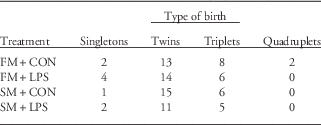
Statistical analysis of the offspring data was carried out as described for the ewes by Stryker et al.,Reference Stryker, Fisher and You 27 with seven blocks, eight ewes per block and four ewes for each supplement. Two ewes from each diet within each block received endotoxin and two received saline in a 2×2 factorial arrangement. Cortisol measurements over the 6 h on the offspring from these ewes were analyzed using the mixed model procedure from SAS (version 9.2). The model included parturition day as a covariate, type of birth (see Table 1 for complete breakdown of single v. multiple birth; FM+CON singles=2, multiples=23; FM+LPS singles=4, multiples=20; SM+CON=1, multiples=21; SM+LPS singles=2, multiples=16), gender, diet, treatment (LPS v. control) and time (hours after injection) plus all interactions among diet, treatment, gender and time as fixed effects. Blocks, mothers (within each block, diet and treatment) and lamb (within gender and mother) were included as random effects. Repeated measurements over time on each lamb were accounted for using the approach given by.Reference Wang and Goonewardene 30 Differences in lamb cortisol concentrations over time and effects of diet, treatment and gender on these were assessed using linear and quadratic orthogonal polynomial contrasts over time and interactions of these with diet, treatment and gender. Baseline measures were analyzed using mixed model procedures from SAS. Significant differences over time were reported at a P-value<0.05 and suggestions of trends toward significance over time were indicated by P-values ranging from 0.06 to 0.10. Residual plots were examined for all analyses, and showed no evidence of variance heterogeneity.
Type of birth (singletons, twins, triplets, or quadruplets) across treatment groups

FM, fishmeal; LPS, lipopolysaccharide; SM, soybean meal.
Results
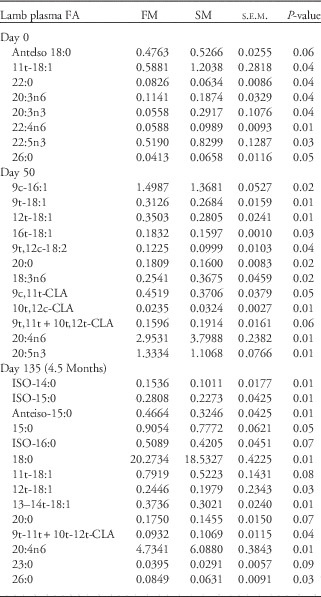
All offspring survived the study period and there were no treatment differences in birth weight or body weight gain over time (data not shown). There were significant differences in plasma concentrations for a number of fatty acids on the three sampling days (P<0.05; Table 2). At parturition, the PUFA, docosapentaenoic acid was greater in the plasma of SM offspring compared with FM offspring (P<0.05; Table 2). Eicosapentaenoic (EPA) was greater in FM v. SM offspring at 50 days of age, while arachidonic acid (AA) was greater in SM v. FM at both 50 and 135 days of age.
Plasma FA (least square means±s.e.m.) at 0, 50 and 135 days of age collected from lambs born to mothers supplemented with FM or SM

FA, fatty acid; FM, fishmeal; SM, soybean meal.
Significant differences are reported with P<0.05, while trends represent P<0.10.
Weaning+ACTH challenge
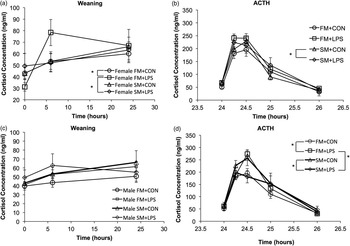
All lambs responded to both the weaning and ACTH stressors as indicated by significant linear and quadratic changes in the cortisol concentration over time (P<0.05; Fig. 1a and 1b). There were significant differences in baseline cortisol measurements; with SM+LPS offspring having the greatest cortisol response compared with SM+CON and FM+LPS offspring (P<0.05; Fig. 1a and 1b). Baseline cortisol differences were not observed among FM+LPS or FM+CON offspring. Significant differences were observed in the two-way interaction of diet by time and treatment by time contrasts as well as the three-way interaction of diet by treatment by time. Linear contrasts demonstrated that offspring born to FM+LPS dams had the greatest cortisol trend to weaning compared with offspring from FM+CON dams (P<0.05; Fig. 1). No differences in linear or quadratic trends were observed over time in the cortisol response to weaning between offspring born to SM+LPS and SM+CON dams (P>0.05; Fig. 1). A linear trend over time was also observed between offspring of FM+LPS dams and SM+LPS dams, with the FM+LPS offspring having a greater cortisol trend response (P=0.06; Fig. 1). Gender by treatment differences were observed which allowed for the exploration of contrasts among female offspring, male offspring and male and female offspring. There was a difference observed between female offspring, with females from FM+LPS dams having a greater linear cortisol trend compared with the female offspring born to FM+CON dams (P<0.05; Fig. 1a). This relationship was not observed between female offspring from SM+LPS and SM+CON dams. Differences across dietary treatments were also observed, with females from SM+LPS and FM+LPS dams demonstrating different linear trends over time (P<0.05; Fig. 1a). There were no differences in linear or quadratic trends observed between male offspring treatment groups during the weaning challenge (P>0.05; Fig. 1b).
Cortisol response of offspring during weaning and ACTH challenge. The figure represents weaning and ACTH challenge from female (a and c) and male (b and d) offspring born to dams supplemented with fishmeal (FM) or soybean meal (SM) and challenged with endotoxin (LPS), or administered saline (CON). Data are presented as least square means±s.e. Significant differences are reported at P<0.05 and indicated by *.

Gender differences were also observed following the ACTH challenge. However, unlike the weaning period, there were no differences in linear or quadratic trend contrasts observed among female offspring born to FM+LPS dams and females born to SM+LPS or FM+CON dams (P>0.05, Fig. 1c). There was, however, a significant difference in the quadratic trend detected between female offspring born to SM+LPS dams and SM+CON dams. The SM+LPS offspring, for example, had a different quadratic cortisol response compared with the SM+CON females (P<0.05; Fig. 1c). Additionally, male offspring born to FM+LPS dams had a greater cortisol trend response over time to the ACTH challenge compared with the female offspring from the same treatment group (P<0.05; Fig. 1d).
There were also significant differences over time observed between male offspring during the ACTH challenge. Quadratic trends over time demonstrated that male offspring born to FM+LPS dams for example had an exacerbated cortisol trend over time compared to male offspring born to FM+CON dams (P<0.05; Fig. 1d). In contrast, male offspring from SM+CON dams had a greater cortisol trend response over time to ACTH compared with male offspring born to SM+LPS dams (P<0.05). Lastly, quadratic trends were observed, with male offspring from FM+LPS dams having a greater cortisol response than male offspring from SM+LPS dams (P<0.05).
Endotoxin challenge
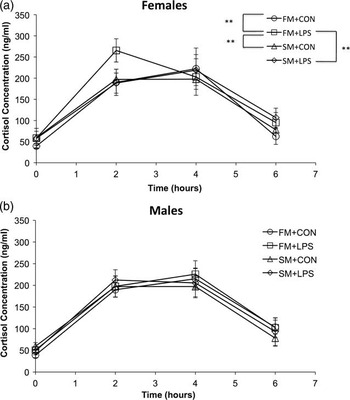
All offspring responded to the endotoxin challenge with a significant change in cortisol response represented by both linear and quadratic trends over time (P<0.05; Fig. 2a and 2b). There was a trend toward significance with greater cortisol trend over time for female offspring from FM+LPS dams compared with all other treatment groups (P<0.07; Fig. 2a).
Cortisol concentrations for female (a) and male (b) offspring following an endotoxin challenge at 5.5 months of age. Offspring were born to dams supplemented with fishmeal (FM) and challenged with endotoxin (FM+LPS) or administered saline (FM+CON), or dams supplemented with soybean meal (SM) and challenged with endotoxin (SM+LPS) or administered saline (SM+CON). Data are presented as least square means±s.e. Trends toward significance are reported at P<0.1 and indicated by **.

Discussion
The purpose of this study was to investigate whether there was maternal endotoxin-induced programming of their offspring and whether maternal supplementation with FM could help to protect offspring from endotoxin-induced programming of the HPAA. The endotoxin-induced stress model was used to stimulate an inflammatory response analogous to an acute bacterial infection that may occur during late pregnancy. It was evident based on the cortisol responses from this study that there were endotoxin-induced changes in the HPAA response of the offspring as well as alterations based on the PUFA diet that mothers were consuming. It should be noted that there were no differences reported in the ewes’ ACTH or cortisol response to endotoxin challenge across the PUFA treatment groups on gd135 of this trial reported in Stryker et al. Reference Stryker, Fisher and You 27 However, the ewes did demonstrate a difference in their fever response, with FM+LPS ewes having an attenuated fever response compared with the SM+LPS ewes.Reference Stryker, Fisher and You 27
Results from the present study demonstrated that female offspring born to mothers supplemented with FM and challenged with endotoxin during late gestation had the greatest and quickest cortisol response to weaning stress as well as the endotoxin challenge compared with all other treatment groups. This was surprising as n-3 PUFAs have been shown to reduce pro-inflammatory cytokines (such as TNF-α, IL-1 and IL-6) that can activate the HPAAReference Calder 16 , Reference Block, Dier and Calderonartero 31 and therefore, it was expected that offspring born to mothers supplemented with SM and challenged with LPS would have the greatest cortisol response. The heightened response present in these female lambs may have been programmed for an enhanced stress response potentially improving their ability to cope with other types of stressors. If this is the case, it is possible that the HPAA is acting to quickly restore homeostasis to the perceived threats as well as resolving any potential inflammation.Reference Rhen and Cidlowski 32 , Reference Barnes 33 This is supported by the fact that the female lambs responded quickly to the weaning stressor but demonstrated a similar response to the FM+CON offspring when the additional stressor of ACTH was administered.
Unfortunately there are a limited studies in the literature investigating the effect of n-3 PUFA supplementation on the HPAA, and the studies that have been performed have demonstrated contradictory results.Reference Waddell, Bollen, Wyrwoll, Mori and Mark 34 , Reference Ganga, Tort, Acerete, Montero and Izquierdo 35 For example, an in vitro study demonstrated that incubating gilthead seabream head kidney cells with docosahexaenoic acid (DHA), (EPA) or ARA PUFAs leads to an increase in the cortisol response following an ACTH challenge compared with the controls, however, EPA and DHA supplementation resulted in an earlier peak cortisol concentration compared with both the control and ARA treatment groups.Reference Ganga, Tort, Acerete, Montero and Izquierdo 35 On the other hand, additional studies have demonstrated that there is no difference in the cortisol response with supplementation of various PUFAs. One rodent study for example, showed there was no difference in corticosterone production in rat pups that were supplemented with n-3 PUFAs and born to mothers that received daily dexamethasone treatment from day 13 of gestation until parturition.Reference Waddell, Bollen, Wyrwoll, Mori and Mark 34 However, it should be noted that pups received postnatal supplementation of n-3 PUFAs, while; the present study carried out maternal supplementation during gestation and lactation. This could account for some of the observed differences in GC concentration.
Minimal differences in plasma PUFA concentration were detected between FM and SM offspring. EPA concentrations in the plasma, for example, were greater in FM offspring at 50 days of age, while AA concentrations were greater in SM offspring at 50 and 135 days of age. It was expected that there would be a greater n-3 and n-6 PUFA enrichment in plasma that would correlate with the observed cortisol response. However, since PUFA concentrations were not measured in other tissues, it is highly possible that both n-6 and n-3 PUFAs repartition differently in other tissues. In rats for example, 3–5% of AA and 3–8% of DHA is replaced daily in the brain with unesterfied PUFAs from the plasma.Reference Rapoport, Chang and Spector 36 Since PUFAs are incorporated into many different organs and tissues of the body, it is possible that high turnover rates deplete plasma PUFA concentrations. Additionally, since n-3 PUFAs are oxidized more quickly than n-6 PUFAs,Reference Song, Fujimoto and Miyazawa 37 greater concentrations of AA in plasma from SM offspring at 135 days of age may be expected.
Interestingly, female offspring born to SM+LPS mothers followed the opposite trend as the offspring born to FM+LPS mothers, demonstrating differences in their cortisol response at baseline (T0) and a more rapid cortisol response during the ACTH challenge compared with their control counterparts. This was surprising, as previous studies in our lab have demonstrated clear differences in cortisol response following both ACTH challenge and the endotoxin challenge.Reference Fisher, Karrow and Quinton 8 However, dietary and experimental design differences may account for this variation observed between these two studies. For example, ewes were fed a diet of 4% FM or SM in the present study, while the ewes in our previous study were fed a SM-corn mixture. Therefore, it is possible that there is a difference in the PUFA profile between these two sets of ewes, which could have an impact on the inflammatory response. Additionally, the diets were offered individually in the present study ensuring that each ewe had access to the same amount of feed. Our previous study offered feed to the ewes in a group setting and did not assess the difference in feed consumption. Lastly, there were also differences in how the ewes were housed. In the present trial, ewes were housed in individual pens from day 100 of gestation until 50 days lactation, while the ewes from the previous study were only housed individually for 72 h during the endotoxin challenge. Additionally, this trial was carried out in a block design over a course of 2 years while the previous study used only one block. Although there was no statistical difference between our blocks in this study this could have played a role in the seasonal variation. Other studies have also demonstrated alterations in cortisol response of offspring born to maternally stressed mothers. For example, recent studies have demonstrated that maternal stress, such as repeated stress during early or late gestation, maternal endotoxin challenge as well as repeated administration dexamethasone in the guinea pig dams, leads to a decrease in the cortisol response of the offspring.Reference Schopper, Palme, Ruf and Huber 38 – Reference McCabe, Marash, Li and Matthews 41 Additionally, guinea pig dams that were stressed during early development produced offspring with a lower basal cortisol concentration during pre-pubertal life, but higher basal cortisol levels post puberty compared with the control offspring.Reference Schopper, Palme, Ruf and Huber 42 Therefore, the timing of the stressor as well as the period of testing for the offspring needs to be considered when designing experiments.
Gender differences were also observed in this trial, with female offspring born to FM+LPS mothers having a lower cortisol response compared with their male counterparts following the ACTH challenge. This was surprising, as multiple sheep studies have shown female offspring born to mothers that were stressed during gestation have a greater cortisol response compared with the male offspring.Reference Chadio, Kotsampasi and Papadomichelakis 43 – Reference Poore, Boullin and Cleal 45 However, the enhanced cortisol response exhibited by the female offspring from FM+LPS mothers during the weaning stressor may account for the lower cortisol response during the ACTH challenge. It is postulated that the sex hormones may influence the cortisol response, as testosterone has been shown to inhibit the HPAA, while estrogen has been shown to enhance the HPAA response.Reference Handa, Burgess, Kerr and O’Keefe 46 Maternal stress during gestation has been shown to influence the concentrations of both testosterone and estrogen in their offspring. For example, a recent study by Kapoor and MatthewsReference Kapoor and Matthews 47 demonstrated that male guinea pig offspring born to prenatally stressed mothers had a decrease in testosterone levels leading to an increase in their basal ACTH concentrations; a trend that was reversed by the administration of testosterone. Studies in both rats and pigs have also demonstrated that male offspring may be more susceptible to maternal stress as they have a greater cortisol response to stress in adulthood compared with female offspring.Reference Shanks, McCormick and Meaney 48 , Reference Collier, Williams, Carroll, Welsh and Laurenz 49 However, an interesting study performed by Puder et al.Reference Puder, Freda, Goland and Wardlaw 50 found that women who were treated with estrodiol (E2) before the challenge had an attenuated ACTH and cortisol response to endotoxin. Therefore, this suggests that the female reproductive cycle could influence the stress response. Sheep are known to reach sexual maturity between 5 and 12 months of age. Therefore, the stage of reproductive cycle as well as the concentration of sex hormones could definitely impact the cortisol response of these offspring. In support of this it has been reported that female guinea pig offspring have a reduced HPAA response to stressors during the estrous phase of their cycle.Reference Kapoor and Matthews 39 Together these studies suggest that there are a number of factors such as the type stressor, age and species need to be accounted for when assessing programming of the HPAA.
Lastly, results from this study have also demonstrated cortisol concentration differences across the male treatment groups during the ACTH challenge. This was surprising as previous study using sheep demonstrated no difference in cortisol response of ram lambs born to mothers challenged with endotoxin and their control counterparts.Reference Fisher, Karrow and Quinton 8 Interestingly, the male offspring in this study also demonstrated differences in their cortisol response but only to the ACTH stressor, and not to the stress of weaning. The FM+LPS males followed a similar trend to their female counterparts having an increased cortisol response compared with FM+CON and SM+LPS males. However, there were also alterations in the cortisol response of male offspring born to SM+LPS mothers, demonstrating attenuated cortisol responses to the ACTH stressor compared with the controls and males from the FM+LPS mothers. This suggests that the male offspring are also susceptible to fetal programming but it may affect them in a different way than the female offspring.
Overall, this study has provided insight into the affects of maternal inflammatory stress on the programming of the HPAA. It is apparent that maternal supplementation with FM alters the stress response of the offspring with both male and female offspring being more susceptible to endotoxin-induced programming. It is not clear whether the enhanced cortisol response of the offspring is beneficial for responding to stressors and therefore, additional studies are required to assess the mechanisms of action.
Acknowledgments
The authors would like to thank the staff at the Ontario Ministry of Agriculture and Rural Affairs’ Ponsonby Sheep Research and General Animal Facilities, Judy Stryker, Qiumei You, Laura Cain, Graham Biggar, Dr. Chris Verschoor and Dr. Sameer Pant for their help with this study.
Financial Support
This research was funded by grants awarded to Dr. Niel Karrow from the Ontario Ministry of Agriculture and Rural Affairs, the Ontario Sheep Marketing Agency, Natural Sciences and Engineering Research Council of Canada, and Canadian Foundation for Innovation and Ontario Research Funds.
Conflicts of Interest
None.
Ethical Standards
The authors assert that all procedures contributing to this work comply with the ethical standards of the Canadian Council on Animal Care national guides on the care and use of laboratory animals and has been approved by the Animal Care Committee at the University of Guelph.