

The number of people with visual impairment (VI) in the world is estimated at 285 million, and about 90% of them live in low-income, developing countries (World Health Organization [WHO], 2016). The social, political, economic, and in recent years, the digital inclusion of people with VI remains a pressing development challenge (Bhatnagar & Schware, Reference Bhatnagar and Schware2000; Dobransky & Hargittai, Reference Dobransky and Hargittai2006). People with VI are among some of the most marginalised people in the developing world, with limited access to social, economic, educational opportunities (Hersh, Reference Hersh2014) and legal protection (Thianthai, Reference Thianthai2014). Although it is widely acknowledged that information and communication technologies’ (ICTs’) integration improves the quality of life for people with VI, the challenges and opportunities for such improvement in various socioeconomic contexts in which people with VI live are underresearched, especially in developing countries (Ashraf, Hasan, Lewis, Hasan, & Ray, Reference Ashraf, Hasan, Lewis, Hasan and Ray2017), such as Bangladesh. To address this gap in the literature, in this article, we discuss how the use of ICTs can promote human development for people with VI.
Governments in both developed and developing countries have been paying increasing attention to the digital inclusion of their citizens including people with disabilities (Watling, Reference Watling2011; Söderström & Yttherhus, 2010). The digital exclusion of people in the United Kingdom (UK) raised concerns about the accessibility of public services by people with disabilities in the context of the government plans to provide and manage services through ICTs (Watling, Reference Watling2011). Since additional software and equipment, such as text-to-hearing software, are required with computers or similar devices for their use, persons with VI may have to incur higher costs for using ICTs (Douglas, Corcoran, & Pavey, Reference Douglas, Corcoran and Pavey2007; Khan et al., Reference Khan, Choudhuri, Alam, Choudhury, Bari, Hasan and Rahaman2003) and thus cost is a barrier to digital inclusion.
It is also worth noting that the recently adopted Sustainable Development Goals (SDGs) agenda by the United Nations (UN) member states in 2015 aspires to ‘ensure equitable and inclusive quality education for all’ (Goal 4), including ‘promoting access to ICTs skills for employment, decent jobs and entrepreneurship’ (Target 4.4; UN 2016). The same aspiration is echoed in other global agendas, such as the New Urban Agenda adopted by UN-Habitat, with its mission of ‘leaving no one behind’. Some progress towards this mission is evident in the wide range of ICTs products and services designed for use by persons with disabilities, including specialised keyboards, Braille printers, conversion of local languages to Braille, screen readers, touch screens, eye tracking, talking word processors, screen magnifiers and web-based services (Rathinavelu & Saranya, Reference Rathinavelu and Saranya2015). This technological innovation has offered considerable opportunities for persons with disabilities to engage with the information society (Jagannathan, Govindraj, & Gupta, Reference Jagannathan, Govindraj and Gupta2008).
While researchers agree on the potential role of ICTs in transforming socioeconomic lives of persons with disabilities, there is some disagreement on how this role actually plays out in different contexts. On the one hand, researchers suggest that ICTs has the potential to overcome many of the disabling social and environmental barriers that persons with disabilities encounter (Kenny, Reference Kenny2008; Zahid, Ashraf, & Malik, Reference Zahid, Ashraf and Malik2013). The potential benefits of computer-based technologies to support positive occupational engagement and communication in persons with disability are being emphasised (Lancioni et al., Reference Lancioni, O’Reilly, Singh, Sigafoos, Boccasini, La Martire and … Spagnuolo2016; Michailakis, Reference Michailakis2001). On the other hand, some authors have cautioned against an overdeterministic perspective of ICTs in promoting positive socioeconomic change, arguing that ICTs may facilitate change only within conducive social, cultural and political order (Douglas, Corcoran, & Pavey, Reference Douglas, Corcoran and Pavey2007; Guo, Bricout, & Huang, Reference Guo, Bricout and Huang2005; Michailakis, Reference Michailakis2001). Macdonald and Clayton (Reference Macdonald and Clayton2013), for example, ‘found no evidence that digital and assistive technologies had any impact on reducing social exclusion for disabled people’ (p. 702). They argued that ICTs may instead produce new types of disabling barriers because of the digital divide (Macdonald & Allyson, 2013).
Against this backdrop, the research question that guided this study was ‘What is the role of ICTs and ICTs-based training in promoting the “development” for persons with VI in Bangladesh’. We utilised the economist and Nobel Laureate Professor Amartya Sen’s (Reference Sen1999) notion of ‘development as freedom’ as a lens through which we conceptualised development and assessed the effectiveness of ICTs in their lives. The assessment was conducted based on narratives of men and women with VI in Bangladesh who participated in an ICTs training program conducted by Young Power in Social Action (YPSA). YPSA was established in 2005 to provide ICTs services to persons with disabilities (YPSA, 2014). It offers accessible e-education content, Braille books, and ICTs equipment for persons with disabilities — mostly students with VI, and in general for persons with disabilities (YPSA, 2014). The findings provide several insights about the potential role of ICTs and ICTs-based training in promoting different types of freedoms for VI people.
In the following section, we review the existing literature on the role of ICTs in development. Next, we provide a brief introduction to Bangladesh and the status of people with visual impairment to set the context for our study. We then describe the conceptual framing of this article in terms of Sen’s idea of development as freedom. After this, we discuss the methodological approach and tools used to collect data for this study. Finally, we present the findings of the study and examine its implication for further research and practice.
ICTs, Development, and People With Visual Impairment
Researchers argued that ICTs can help to achieve greater autonomy, empowerment, and quality of life (Hasan, Ashraf, Ahmed, Hasan & Bhattacharjee, Reference Hasan, Ashraf, Ahmed, Hasan and Bhattacharjee2017; Hasan, Ashraf, & Rahman, Reference Hasan, Ashraf and Rahman2016; United Nations Educational, Scientific and Cultural Organization [UNESCO], 2002). Takimoto, Dandolini, Souza, and Vanzin (Reference Takimoto, Dandolini, Souza and Vanzin2012) provided insights into the factors (e.g., accessibility) required for their social and educational inclusion. Similarly, Douglas (Reference Douglas2001) concluded that ICTs played a valuable role in providing opportunities for persons with disabilities to participate in education.
Disability and participation in the labour market is an important topic of interest (Hutton, Bohle, & McNamara, Reference Hutton, Bohle and McNamara2012). Researchers suggest that the use of ICTs can provide people with VI a means to overcome functional difficulties (Benda, Havlíček, Lohr, & Havránek, Reference Benda, Havlíček, Lohr and Havránek2011; Keijer & Breding, Reference Keijer and Breding2012) and to become self-reliant (Ratliffe, Rao, Skouge, & Peter, Reference Ratliffe, Rao, Skouge and Peter2012). Fix and Pal (2009) found that participation in ICTs training courses was positively associated with employability, socioeconomic inclusion, and visibility of persons with physical impairments.
The existing literature therefore indicates that ICTs can play a critical role in the lives of people with VI. ICTs have the potential to improve their standard of living, development of skills, overcoming constraints created by disabilities, building self-reliance, and promoting social inclusion. The use of ICTs is found to symbolise competence, belonging and independence and in developing social inclusion through participation in online forums (Söderström & Ytterhus, Reference Söderström and Ytterhus2010). Therefore, the availability of ICTs can contribute to the inclusion in society of individuals who have disabilities (Cook, Reference Cook2009).
Furthermore, the use of ICTs provides opportunities for adults and children with VI to participate in education (Douglas, Reference Douglas2001). Nguyen et al. (Reference Nguyen, Fichten, King, Barile, Mimouni, Havel and … Chauvin2013) demonstrated that the skills of college students with learning difficulties were developed through access to and use of the necessary ICTs. ICTs seemed to be especially beneficial for students with motor, visual, physical disabilities as the use can improve their writing, spelling, and communication skills (Lidström & Hemmingsson, Reference Lidström and Hemmingsson2014). According to Baig (Reference Baig2013), in a classroom study where technologies were employed like iPad, as opposed to traditional classroom tools, students with disabilities were found to have achieved greater accuracy in task completion and have shown more interest and motivation. Sourbati (Reference Sourbati2012), by applying Amartya Sen’s capabilities approach to examine patterns of ICTs use by people with disabilities in the UK, argues that persons with disabilities lack the freedom to use online services and that there is a shortage of policies that support disabled people’s access to broadband, media literacy and education. Likewise, people with VI in Bangladesh experience digital divide because they lack access to adequate ICTs services (Khan et al., Reference Khan, Choudhuri, Alam, Choudhury, Bari, Hasan and Rahaman2003).
People with Visual Impairment in Bangladesh
Bangladesh is one of most densely populated, lower-middle income country located in South Asia. It is estimated that more than 1.3 million people of the country’s 150 million people are visually impaired (Khan et al., Reference Khan, Choudhuri, Alam, Choudhury, Bari, Hasan and Rahaman2003). According to the Bangladesh Bureau of Statistics (2009), the percentages of people with different types of disability are as follows: visual 31.3%, physical (including leprosy and goitre) 35.8%, hearing and speech 28%, and psychological disability 4.9%. Most people with disabilities in Bangladesh tend to be poor. In Bangladesh disability occurs for many reasons such as accidents, wrong pathological diagnosis, malnutrition of pregnant women, unavailability of trained birth attendants and nurses, polio, typhoid, crime and violence, acid burn, child marriage, marriage between close relatives and so forth (Edmonds, Reference Edmonds2005).
People with VI in Bangladesh are deprived of basic human as well as social and political needs, such as employment, educational opportunities and health care (Sultana, Reference Sultana2010). For example, many people with VI are unemployed and therefore cannot support themselves or their families (BRAC, 2013). Furthermore, people with VI are often ostracised (Nokrek, Alam, & Ahmed, Reference Nokrek, Alam and Ahmed2013). Even those with good education are often excluded from employment. Taunts and jeers are frequently used against people with VI. Persons with disabilities, particularly women, experience physical and sometimes sexual violence in Bangladesh (Hasan, Reference Hasan2007).
Under such circumstances, the present government popularised the slogan of ‘digital Bangladesh’ that aims at offering services through ICTs to every citizen of the country. Therefore, it is important to explore the possibility of ICTs in expanding freedom for people with VI.
Conceptual Framing: Sen’s ‘Development as Freedom’
The economist and Nobel Laureate Amartya Sen’s (Reference Sen1999) work, Development as Freedom, offers a suitable and appropriate model for assessing the effects of development initiatives on marginalised populations, especially for individuals with disabilities. While mainstream development is often conceived of as economic growth, an increase in per capita income, higher productivity and so on, Sen argues the goal of development is to enhance freedoms, specifically freedom(s) from hunger, poverty, illiteracy, lack of social support and lack of access to markets.
Sen (Reference Sen1999) explored the complex interrelationships between different types of freedom from a dialectic point of view, rather than being too simplistic. He argued that an exhaustive list of freedoms was not possible, since they vary from one individual to the next and from one culture to another. Sen (Reference Sen1999) gives five examples what he calls ‘instrumental freedoms’ to illustrate the linkages among these types of freedom. The five types of freedom mentioned by Sen (Reference Sen1999) are political freedom, economic opportunities, social opportunities, transparency guarantees and protective security (Sen, Reference Sen1999, p. 38). Sen (Reference Sen1999) indicated that each freedom can enhance the enjoyment of another freedom.
A further elaboration of Sen’s (Reference Sen1999) contention that the different forms of freedoms are interlinked lies in his emphasis on democracy, civil liberty, opportunities for public debate and their links to take appropriate public policies to tackle economic crises. In this respect, Sen (Reference Sen1999) cautiously rejects the Lee thesis (i.e., political freedom hampers economic growth) and the accusations that democracy is ‘luxury’ of developing countries where millions of people struggle to meet their basic economic needs. According to Sen, the central question we need to ask in a development and social justice context is ‘What is each person able to do and to be?’. This approach takes each person as an end in itself instead of looking at average levels of well being and/or economic growth.
Access to digital, online ICTs, to the services this ICTs mediate and the actions they enable are now part of an important capability (Sen, Reference Sen1999, p. 79). Lack of access can be seen to prevent individuals from fulfilling active roles in society (Haddon, Reference Haddon2000). Additionally, Sourbati (Reference Sourbati2012) applied Sen’s capability approach to study the digital exclusion of persons with disability in the European context, highlighting insensitive ICTs policy as a barrier to digital inclusion of people with disability. Toboso (Reference Toboso2011) presents an analysis of the concept of disability in Amartya Sen’s capabilities and functions approach in the context of ICTs and argued that specific functional needs of persons with disability need to be taken into account when designing devices. Similarly, Vichitvanichphong, Talaei-Khoei, Kerr & Ghapanchi (Reference Vichitvanichphong, Talaei-Khoei, Kerr and Ghapanchi2014) applied capability approach to study senior peoples’ use of assistive technology and found that the use of Xbox Kinect would improve their driving skills by enhancing functional abilities.
Sen’s approach can be used to conceptualise development as freedom. We are particularly interested in Sen’s notion of five freedoms that are critical to human development. Achieving these freedoms can pave the way to better social, economic, and digital inclusion of people with VI who are, as mentioned earlier, often marginalised both by ‘ableist’ discourses and by digital exclusion.
Methods and Materials
Research Design
A narrative interview method was applied to capture narratives from persons with VI. ‘Usually, a narrative is understood as a spoken or written text giving an account of an event/action or series of events/actions, chronologically connected’ (Czarniaswka, Reference Czarniawska2004, p. 17). Chase (Reference Chase2008) considers the narrative method a type of qualitative research characterised by ‘an amalgam of interdisciplinary analytic lenses, diverse disciplinary approaches, and both traditional and innovative methods — all revolving around an interest in biographical particulars as narrated by the one who lives them’ (p. 58). This method is useful in eliciting responses from participants through participant-driven conversation, with little interruption during the interview.
Participants
For the purpose of the study there was a total of 18 participants; 15 individuals with VI who had participated in YPSA’s ICTs program were purposefully recruited after informed consent and ethical permission were gained, and three disability activists shared their stories with us. Participants were requested to narrate experiences of participation in the ICTs training program. To develop a deeper understanding of the role of ICTs in enhancing their socioeconomic lives, some unstructured interview questions were asked. Typical open-ended questions were ‘What was your experience of your participation in the program?’, ‘Tell me about your use of ICTs in everyday life?’, ‘How did the use of ICTs benefit you?’. These unstructured questions were followed by probing questions that allowed the interviewer to generate further details about the study questions.
Data Collection
Stories, which formed the basis of the approach, were collected with the help of simple open-ended questions. It was then up to the respondents to convey what they perceived as most appropriate to the domain category in the form of stories. In addition, respondents were encouraged to report why they considered a particular change to be the most significant one. Prompts were utilised to elicit responses in relation to different topics discussed during the interviews.
YPSA field staff collected data for this research. Although 18 participants in this study would have higher levels of formal education than the general population or other people with disability in Bangladesh, the benefit of conducting the research at this centre was that some researchers are associated with YPSA and they were confident that the research would provide useful feedback to the organisation. Once refined, following this pilot testing, it is intended that the method be used at other institutions. The field research aimed at understanding the challenges faced by people with VI, their experiences and how they have benefitted from opportunities stemming from the use of ICTs, including training.
Data Analysis
Participants’ stories were audio-recorded and transcribed in full. The transcripts were then subjected to multiple readings, looking for themes and patterns within the stories. The analysis of participants’ stories was informed by Sen’s theory of ‘development as freedom’, looking at different types of freedom and the role of ICTs in enhancing such freedoms. Patterns and themes were discovered by reading the transcripts multiple times. Analyses of the stories are presented in the next section to illustrate how the use of ICTs has brought about changes in the lives of people with VI.
Results
ICTs and Freedoms: Narratives of People with Visual Impairment
As mentioned earlier, the narrative method was applied to develop a participant-centric understanding of the role of ICTs in the lives of people with VI. Our analyses of these narratives indicates that access to ICTs training and resources played a pivotal role in promoting well being of participants by enhancing their social, economic, political, and educational opportunities; and by providing protective security for them. In the following stories, pseudonyms have been used for the participants’ identities and to ensure their anonymity.
Promoting economic freedom through ICTs
Persons with VI are often deprived of economic opportunities, due to discrimination and the social stigma attached to disability, which results in them being unable to find employment or even suitable employment. In the following story, a participant who is a junior law student indicates how the concept of access to ICTs may enhance economic freedom for persons with VI in relation to their own experience.
Novel is a visually impaired junior lawyer and a university student, who lives in Dhaka, the capital of Bangladesh. He received ICTs training from the YPSA, which enabled him to communicate with clients living in remote regions of the country, far from Dhaka. Novel explains how ICTs training enabled him to have greater communication with senior professionals, and clients:
I had to complete a project at the request of one of my close relatives. One day before presenting the case to the court, I encountered a serious and complex problem that I did not know how to address. I became tense about what to do because I did not have time to go to the chamber of a senior lawyer for a consultation. As I attended the YPSA training programs, I learned the use of ICTs, including mobile, computer and the Internet. Suddenly I thought of calling one of my senior lawyers to get an immediate consultation. He asked me many questions regarding the problem, and then he gave me some suggestions and sent me a file via email. After following his instructions, I prepared the case and got a positive result.
After that, I always carry a mobile phone and laptop with me when I am at the office or outside the room for office work. I decided to share my contact number and email address to all my clients to contact me either by phone or email, anytime from anywhere within Bangladesh, or even outside the country.
Through using ICTs, I became more efficient in both dealing with clients and getting a consultation from the senior lawyers. It helped me to increase my income level. I appreciate the use of ICTs as they make the services I offer more accessible and enable me to work more efficiently.
Novel’s story indicated the personal importance and usefulness of ICTs in his work life. He indicated that the use of ICTs helped him to achieve work efficiency and to communicate easily with his clients. He added that he could not communicate with clients who lived in remote areas before he attended the ICTs training from YPSA ICTs Resource Center.
Moreover, ICTs had reduced the distance and time barrier for him. Earlier, he had to travel to a senior lawyer’s chamber to get help, and he could not easily communicate with the clients located in remote regions. Now, using ICTs, he can communicate and share information quickly through the use of his mobile phone and the Internet. The use of ICTs has also contributed to an increase in his income as he could serve more clients living at greater distances away from his workplace. In Sen’s (Reference Sen1999) view, an increase in income can promote greater freedom enhancing a person’s access to the market.
A project officer of the YPSA, who contributed to this research, envisions a knowledge-based society in which people with VI can contribute, added:
I’ve been continuously working on increasing awareness about the use of ICTs for enhancing capabilities of people with VI. Many people with VI who were trained at this resource center are doing well in their respective jobs because ICTs-based training has enabled them to become more confident to do several kinds of job with the use of computer and the Internet.
Novel’s story and the YPSA project officer’s comments indicate that ICTs may play a positive role in enhancing the economic freedom of people with VI, by removing geographic and communication barriers resulting in increasing income.
Enhancing social opportunities through ICTs
In Bangladesh, persons with VI have limited access to education and health services (Hasan et al., Reference Hasan, Ashraf and Rahman2016). The mainstream school system tends to exclude students with VI. There are, however, some special schools where students with intellectual disabilities, hearing impairment, and visual impairment can study.
The participants’ narratives suggest that ICTs training and access to ICTs devices and software can enhance better educational opportunities. Their stories indicate that digital inclusion can facilitate social inclusion by improving opportunities for economic freedom as well as better opportunities for education. More specifically, ICTs can help students with VI develop reading, writing and speaking skills.
Mahe is a male university student with VI, who often dreamed of high academic achievement at the honours and master’s levels. He had migrated to Dhaka from Chittagong after being accepted into the University of Dhaka. He said that VI was one of the barriers to achieving better results in his secondary and higher secondary school examinations. But at the honours level, he aimed to achieve a better grade. He spoke of how mastering Job Access with Speech (JAWS) software helped him to enhance his learning. (JAWS is a useful software program, designed to work with a speech synthesiser to improve the productivity level of people with VI.):
At the beginning of my studies, I encountered some problems such as difficulty in keeping track of teachers’ lectures. I got both soft- and hard-copy study materials in different courses. Since I stayed in my room alone, there’s no one to help me read my study materials loudly. After that, I attended the YPSA’s programs to learn the use of ICTs. I learned the use of JAWS software, which made my study much easier. To keep track of teachers’ lectures, I started using unlimited recording tap which is one of the most common and useful assistive technologies. Through adopting ICTs as an essential tool of learning process, I overcame the barrier and could get good results. This made my dream come true. I joined an NGO [non-government organisation] which works with people with disabilities and provides ICTs-based training to people with VI free of charge, and contributes to their social development.
Mahe’s story indicates that he was dissatisfied with his VI, as he could not achieve optimum result at the secondary and high schools. Attending the ICTs-based training at the YPSA ICTs Resource Center enabled him to achieve better results at his university. Thus, ICTs provided them with different skills, thereby enabling them to contribute to the society.
Kamal, an NGO professional, told a story of how this project was implemented in developing human capital of people with disabilities. He said that his vision is to promote social inclusion through full participation of people with VI into society using ICTs training to invest and build human capital. For the last few years, he has been working to develop human capital by primarily targeting people with VI. After attending the training at the YPSA, Kamal said, people with VI can develop various skills and perform well in the workplace. He elucidates this theme, as follows:
People with disabilities are considered a burden on our society. The public, in general, do not want to involve them in any activities, although government and nongovernment organisations are working to change the attitude towards people with disabilities. I strongly believe, if people with disabilities attend the ICTs-based training, they can become independent. They won’t be a burden for others anymore.
I’ve been providing training to people with VI since 2011. Our objective is to build a knowledge-based society where all the visually impaired people will be involved in mainstream development. Our attitude towards disabled people should be changed. The present government has set a vision where one of the objectives is to upgrade the nation from a low-income to a middle-income country by 2021. To achieve the goal, there is no alternative to a knowledge-based society where both general and disabled people will participate. I found that people with VI are very enthusiastic in using ICTs-based training, overcoming all barriers, which is a good sign for the nation. Both general and disabled people should be aware of the use of ICTs, especially in education, which can bring a long-term benefit for the people and the country.
Kamal indicates that negative social attitudes may be seen as a barrier to social inclusion of persons with VI. This ICTs trainer also thinks that the participation of persons with disabilities is critical to achieving middle-income country status, and through ICTs training people with VI can also positively contribute to achieving this target. Achieving higher income status might open up opportunities for greater social, economic, and political freedoms for all, including persons with VI in Bangladesh in the future.
Expanding political freedom through ICTs
The participation of people with disabilities in politics in Bangladesh is limited. Able-bodied, wealthy men tend to dominate politics in Bangladesh, although women’s participation in politics, in the recent times, has increased; 45 seats are reserved for women in the national parliament of Bangladesh. However, there is no representation of persons with disabilities in the Bangladeshi parliament. They are almost excluded from political parties. Some NGOs in Bangladesh are advocating for the rights of people with disabilities and their greater economic, social, and political participation.
Hamid is a leader of a disability rights movement and activist. He had received leadership and disability awareness, basic legal and ICTs training from an international NGO working in the country. He is an active user of social media. He said that he often uses social media to raise awareness about, and to advocate for, the rights of persons with disabilities in the country. Nasim is a 40-year-old man with VI. He is also a disability activist. He too uses his computer with Internet connection to communicate with other people with disability in the country. He stated that has been working for the integration of people with disability in the mainstream society through increasing their participation in politics, economy and by providing assistive devices. Nasim said:
As an activist and a leader of an organisation of persons with disability, we are working to enhance political participation. My organisation works for capacity building and for promoting human rights of persons with disabilities in the country. We are fighting for our rights. We advocate for special quota in the parliament for persons with disabilities. We also work with politicians to make them aware of the rights and issues for persons with disabilities. I use a mobile phone and JAWS to use a computer to communicate with fellow disability rights workers, leaders, and politicians. I think politicians and government officers and society at large have now become more aware of the issues and concerns of persons with disabilities. I have, for example, could persuade transport owners association and politicians to reserve three seats in public for persons with disabilities in the country.
Nasim’s narratives indicate how ICTs enabled him to work for promoting greater political freedom for persons with disability. As communication is central to working in community development and advocacy work, ICTs assists him to perform his tasks efficiently.
Sabrina is a woman with multiple disabilities including deafness and VI. Unlike other participants she is from a relatively wealthy family, her father owned a garments factory. After her father’s death, as she is an only child, she became the proprietor and managing director of her father’s garments manufacturing company. The use of ICTs has helped her to assume management and leadership roles in the company, thus promoting women’s political empowerment at the organisational level. Sabrina said:
After the death of my father, I had to take the responsibility of the garments factory which was built by my father. As I had no other siblings, I had to come forward and take up the post of managing director of this business organisation. To overcome barriers linked to my disabilities, I went to the YPSA ICTs Resource Center and sought out help. The Center helped me to use Relay Services Using Mobile Video Communication. Video calls via mobile telephones brought about a revolution in the communication opportunities for people who are deaf. Text messages (SMS) became an important means of communication for people like me. Traditional relay services have all communication in text only through a TTY or via the Internet, while a video relay service uses a videophone or a webcam and a sign language interpreter. As I couldn’t speak and hear, it was tough for me to manage my large business. However, as I start using mobile video communication I could communicate with foreign buyers and take orders from them and negotiate with them through sign language. I also communicate with staff members through SMS and email. If the team encounter any problem, they simply just send a text message or email. I take necessary steps by providing direction staff and official concerned through SMS and email.
Sabrina added that over the last few years, she had been successfully and efficiently communicating with staff and officials by using ICTs. Moreover, she had been successfully performing her tasks as a managing director since the death of her father. Thus, the story indicates that ICTs may help women with VI and deafness to assume leadership roles and promote political freedoms at micro-level such as a company.
Ensuring transparency guarantees and ICTs
Bangladesh is perceived as one of the most corrupt countries in the world. Weak social, political, and legal institutions mean that there is lack of transparency and accountability in the country among influential people such as government officers and politicians (Transparency International Bangladesh, 2016). Amidst this situation, the information act and stronger media including social media have opened up opportunities for ensuring better governance, opportunities for debate which are indispensable for strong democratic institutions (Sen, Reference Sen1999). The government has recently popularised the slogan ‘digital Bangladesh’ emphasising access to information and service provisions using ICTs. Accordingly, the government has updated its websites and is offering different types of services online. The stories collected suggest that participants used some of the services from the government by using mobile phones and the Internet. Ahmed, a disability rights activist and leader of a local disability-focused NGO said:
Persons with disabilities are mistreated in our country. They don’t have access to adequate social services. They’re often looked down upon and laughed at. We’re trying to change this situation. Political empowerment of people with disabilities is central to this task. We’re also victims of corrupt practices. There is lack of transparency and good governance in the country. Whenever support from the central government in the form of food aid or income support come for people, persons with disabilities are often excluded. They are deprived of these services. Many people with disability are not even aware of their rights to these services as citizens of the country. I’ve been working with them and government institutions to make sure that disabled people are not excluded from these service provisions. I offer training workshops making persons with disability to access information about government services that are now available online. I now have better ideas about governmental procedures because I often try to find out information from the government websites.
Thus, participants’ narratives point to the potential of ICTs training for accessing government services and collecting information about these services. Lack of knowledge about government procedures among service recipients and citizens more generally is a barrier to ensure transparency and good governance in Bangladesh. Participants in this study emphasised on the need to provide more information online that are accessible to the persons with disabilities.
The role of ICTs in protective security
People with VI lack adequate social support and safety in Bangladesh. Due to unfavourable social attitudes towards them, they are often excluded from the available social support. They tend to live on low income due to low participation in economic activities. In Bangladesh, there are limited service provisions for protection against loss of income, unemployment, personal crises or accidents. Although NGOs in Bangladesh provide financial inclusion services for poor women, as poorest of the poor, people with disabilities are largely excluded from these economic programmes.
Participants’ stories suggest that ICTs may play an important role in financial inclusion. ICTs may help people with VI to seek out information about different income sources which can make them financially solvent. After receiving ICTs training sessions, some participants suggest they could get involved in income-generating activities which enabled them to meet their expenses and thus overcame financial hardships.
A student who had visual impairment told a story of how he could solve the economic barrier. Sajid is a university student who lives in a male dormitory at the YPSA. He comes from a poor single-parent household. He has five siblings who lived in his village with his parents. His father died many years ago. His mother alone supported the family without any support from the state or NGOs. She could manage it by making and selling handicraft goods. But day by day her earnings plunged as she grew older. She could hardly support the large family. Being left with no other means of social support, she had been finding it increasingly difficult to send money to Sajid living in the city. As Sajid explains:
I was totally dependent on the money sent by my mother. Because I’m visually impaired. I could not go out and look for a part-time job. But I’m quite good at some computing tasks, such as Microsoft Word, Microsoft Excel, Microsoft PowerPoint, etc. I discussed my problems with one of my elder brothers, and he suggested me to attend the training sessions. They advised me that there are lot of online earning website like Odesk, Freelancer, etc., from which I can earn money. I do not even need to go out of my room. What I did was that I bought a 3G modem and installed it on my PC. As I earned enough, I could meet the cost of my education and family expenses. I can also search for information about scholarship opportunities abroad. ICTs helps me to connect with the global society.
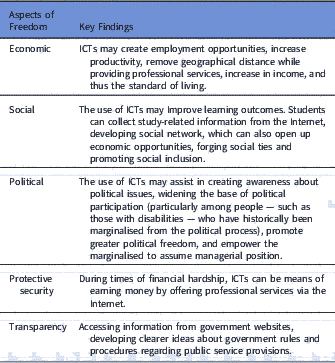
The case presented above suggests that in a situation of acute financial hardship and lack of social safety net for persons with VI, ICTs training can open up avenues for skills and capabilities to find out alternative means of income and support such as earning money online by working as a freelancer. Earning money online may also enhance and promote another type of freedom (such as educational opportunity) indicating the interrelationships between different forms of freedom, as was indicated by Sen (Reference Sen1999). Table 1 below summarises the main findings of the study:
ICTs in Promoting Different Dimensions of Freedom

Discussion and Conclusion
Participants’ stories shed light on the effects and contributions of ICTs in promoting different types of freedoms for people with VI. The results indicate that people with VI who use ICTs can have better access to jobs, become self-dependent and also contribute towards family income. So, awareness and active use of ICTs might be a way forward for addressing the unemployment problems encountered by these marginalised groups.
The findings further suggest that each type of freedom can enhance the enjoyment of a differed kind of freedom, as was argued by Sen (Reference Sen1999). In this study, for example, educational opportunities have been shown to have increased income for participants. Overall our findings do not support the claim that ICTs have no positive effect on the lives of persons with VI, although we found two participants who claimed that ICTs played no role in improving their lives (Macdonald & Allyson, 2013).
This study found that access to ICTs holds significant potential to improve employment opportunities for people with VI. Thus, the findings of this study are in line with previous research that showed that ICTs can create employment opportunities for people with disability (Fix & Pal, 2009). Moreover, the findings indicate that ICTs training may help people with VI to gain skills which support the findings of previous researchers such as Baig (Reference Baig2013) and Lidström and Hemmingsson (Reference Lidström and Hemmingsson2014) who suggest that ICTs can enhance different sets of learning skills such as reading, writing, and critical thinking.
With the help of ICTs, people with VI may become self-reliant, confident, self-dependent and showcase their talents in their respective jobs. Previous researchers also supported this claim that ICTs can enhance economic efficiency, self-confidence, access to information and economic opportunities (Domingo, Reference Domingo2012; Pascual, Ribera, Granollers, & Coiduras Reference Pascual, Ribera, Granollers and Coiduras2014). Therefore, both the government organisations and NGOs should come forward to accelerate the development of ICTs-related training and enhance the society’s capability especially for people with a disability.
This research was conducted on a small sample (only 18) from one of several resource centres, which may not be representative of all of the people with VI in the country. However, useful preliminary findings generated from this study can also be used as the foundation to conduct large-sample studies. It is also important to note that all the respondents in this study were literate or had some formal education. It would be interesting to explore how ICTs affect illiterate people with VI, by drawing a broader sample of people across the population. Furthermore, while Sen’s ‘development as freedom perspective’ provides a useful lens to examine the role of ICTs in the lives of people with VI, the issue can be looked at from other theoretical and philosophical lenses as well.
Authors’ Note
This research received no specific grant from any funding agency, commercial, or not-for-profit sectors.