1. Introduction
The notion of subject is central to human language. Though the precise definition and characterization of this notion is and has been a matter of controversy, there is general agreement that in most, if not all, human languages one argument or one syntactic position, typically characterized as the subject, has a privileged status.Footnote 2 This special status is manifested in a variety of linguistic levels and constructions. At the semantic level, the subject is associated with the highest-ranking thematic role, usually the agent. It tends to be definite, and is usually the discourse topic. In syntax, various syntactic operations treat the subject in a special way. For example, Comrie & Keenan (Reference Comrie and Edward1979) pointed out that the cross-linguistic pattern of relative clause formation can be explained in terms of a Grammatical Relations Hierarchy, where subjects are more prominent than objects: if a language relativizes objects it must relativize the subject as well. In addition, the subject functions as pivot in multi-clausal units: it is deleted under co-reference in coordinate constructions (as in Ron went to the library and [Ø] borrowed a book), and under control in subordinate clauses (Ron went to the library [Ø] to borrow a book). Similarly, the subject displays characteristic morphological behavior, in that it bears the unmarked case marker, and is the most likely argument to trigger verb agreement.Footnote 3
In this paper, we claim that sign languages provide an additional, unique piece of evidence for the centrality of the subject in language, one that is unavailable in spoken languages. This piece of evidence focuses on the lexical level – in particular, on lexicalization patterns of verbs (lexemes denoting states of affairs) in sign languages. We argue that in sign languages, patterns of lexicalization in the structure of verbs reveal regularities that are best captured by referring to the notion of subject.
The analysis relies on the iconicity or partial iconicity of many lexemes in sign languages. Since iconicity is a form–meaning relationship, the iconic structure of signs often reflects semantic patterns that are more obscure in spoken languages (Shepard-Kegl Reference Shepard-Kegl1985, Taub Reference Taub2001, Meir Reference Meir2002, Aronoff, Meir & Sandler Reference Aronoff, Irit and Wendy2005). When examining patterns of iconicity in lexical items denoting states of affairs, a regularity emerges: there is a division of labor between the body and the hands in encoding the various facets of the state of affairs. This division of labor is revealed by the way the hands move in relation to the body. The body encodes properties of one argument participating in the event, whereas other facets of the state of affairs (the event and other arguments) are encoded by the hands. The argument encoded by the body may bear a variety of thematic roles, depending on the specific lexical item; however, it is always the most prominent argument (the argument associated with the highest-ranking thematic role), and the argument which the verb is predicated of, that is, the subject. For example, the sign EAT, analyzed in detail in sections 3.2 and 4.1, is signed in all known sign languages by moving the hand towards the body (specifically, the mouth). The body represents the subject of the ‘eating’ state of affairs. The hands represent the object being eaten and aspects of the event itself. Because we find that this regularity in the iconic structure of verbs appears in various unrelated sign languages, we propose that this pattern constitutes another manifestation of the centrality of subject in human language.Footnote 4
In this paper, then, we refer to subject mainly as a lexical notion. This differs from the use of this term in various other treatments, which define the subject in terms of a syntactic position, a grammatical relation or a grammatical function.Footnote 5 Yet the idea of subject as a lexical notion is not new. Williams (Reference Williams1984: 641) distinguishes between ‘two characterizations of the notion “subject”, one lexical and one syntactic’. The lexical notion is what he termed ‘external argument’, the argument assigned under predication (in contrast with the other arguments, which are assigned under government). The syntactic notion is more closely related to a specific syntactic position, the sister node of the VP, which is in the ‘subject–predicate relation‘ with the VP. Crucial to the point we make in this paper, Williams points out that there are no thematic restrictions on external arguments, and that ‘any theta role is eligible to be an external argument’ (ibid., p. 642). Our use of the term subject is very close to Williams’ external argument, that is, the argument of the verb that the verb is predicated of, whatever its thematic role may be.Footnote 6
By identifying the lexicalization pattern of ‘body as subject’ as a basic strategy in the lexicon of sign languages, our analysis makes certain predictions concerning sign language typology and diachronic developments within sign languages. The main prediction is that any sign language will have ‘body as subject’ type of verbs, while other verb classes, especially the class of verbs inflecting for agreement, which we describe below, are optional. Therefore we expect to find a sign language with ‘body as subject’ verbs and no verbs inflecting for agreement, but not vice versa. We also predict that a sign language will have ‘body as subject’ verbs in earlier stages of its development, and will acquire other verb classes only later on. We bring evidence from two sign languages in support of these predictions (in section 6). Our analysis also provides a solution to a long-standing typological puzzle (presented in section 5), namely the primacy of object agreement marking over subject agreement marking in sign language verb agreement. In many sign languages, the object agreement marker is obligatory, while the subject agreement marker is optional. Moreover, if a verb can agree with only one argument, it agrees with the object. This is in contrast with what we typically find in spoken languages, where the subject is the argument most likely to trigger verb agreement. We argue that in sign language forms inflecting only for object agreement, the subject is not deleted, but rather is represented in the lexical form of the sign, by the body.
Our analysis highlights a shared characteristic of human language in general, namely, the centrality of the notion of subject. But it also pinpoints how this common trait is realized differently in languages of two different modalities, signed vs. spoken languages. In that, this paper joins a growing body of work showing that the study of modality-induced differences between spoken languages and sign languages is valuable because it allows us to observe the effects of modality on linguistic structure and to distinguish between truly universal properties of human language and properties which are modality-dependent (Armstrong, Stokoe & Wilcox Reference Armstrong, William and Sherman1995, Taub Reference Taub2001, Meier, Cormier & Quinto-Pozos Reference Meier, Kearsy and David2002, Meir Reference Meir2002, Aronoff, Meir & Sandler Reference Aronoff, Irit and Wendy2005, Sandler & Lillo-Martin Reference Sandler and Diane2006, inter alia).
The notion of subject is unique to language; it is not found in other representational systems. We begin (section 2) by briefly presenting other representational systems, in order to bring home the idea that subject is strictly a linguistic notion. We then turn to sign languages, examining the structure of lexical items in manual-visual languages (section 3), and present our analysis of the lexicalization pattern of ‘body as subject’ (section 4).
2. Absence of subject in non-linguistic representational systems
To a naive observer, and even to many linguists, there is nothing remarkable about sentences having subjects. It seems to be a completely natural phenomenon: a sentence typically consists of a subject noun phrase and a predicate, which tells us something about the subject. There may or may not be other noun phrases in the sentence, but only one can be the subject. In fact, however, there is nothing natural about subjects and no other human information or communication system besides natural language makes use of subjects.
In order to understand this assertion, we must first have some understanding of the notion of representation (Putnam Reference Putnam1988). A sentence, or just about any utterance, for that matter, is a representation of some state of affairs or succession of states of affairs, imagined or real (Larson & Siegal Reference Larson and Gabriel1995). In uttering a sentence, a language user intends to inform his or her interlocutor of this state of affairs. It is important to note that no representation directly reflects reality (whatever we take reality to be); instead, every representation depends in part on the system in which that representation is embedded. We can easily see that identifying a subject is not essential to representation by comparing the representation system of human language, which encodes the notion of subject, to other representational systems, which do not.
Let us begin with the human representational system for which we have the oldest evidence, painting, beginning with cave paintings, which date from as early as about 30,000 years ago (Hogan Reference Hogan2003: 8). Each cave painting depicts a scene involving people or animals in some relation to one another, with little or no background, as illustrated by the painting in figure 1, dated about 17,000 years ago. We can surmise in part from a particular painting how the participants relate to one another, but exactly what is being depicted or communicated depends, of course, on a culture that disappeared long ago. Certainly, the painting does not identify anything close to grammatical subjecthood, though this could be achieved, perhaps by means of a circle drawn around the equivalent of grammatical subject in the representation. We might note in passing that Egyptian hieroglyphics had a special notation for setting off the names of royal personages, which was to enclose them in what Champollion calls a cartouche. It was, in fact, these cartouches that provided the key to Champollion's decipherment of the Rosetta stone. But neither Egyptian hieroglyphics nor any other writing system has anything like cartouches for identifying subjects. And indeed, the scene depicted in the cave painting can be described by different sentences, with different entities functioning as subjects: The hunters are hunting animals, The animals attack the hunters, The animals are being hunted by the hunters, The painting shows the hunting of the animals by the hunters, etc. Subjects do not directly map onto any perceivable category of objects or entities.Footnote 7
A cave painting from Lascaux, France, dated 17,000 years ago

The same is true of any figurative painting. Consider the Vermeer picture presented in figure 2. In a Vermeer, there is almost always at least one person, and the people are usually doing something fairly transparent. For example, in Het straatje (The Little Street), one woman is doing needlework, another is standing over a barrel, and two people, perhaps children, are kneeling in front of the house. Certainly, in trying to describe the contents of the picture in words, we would use grammatical subjects. But there is nothing in the picture that identifies subjects, or grammatical objects either and, for that matter, no cartouches.
Vermeer's Het Straatje

Let us move to formal logic. Logical expressions are modeled on sentences. Each expression has a separate symbol for a predicate and one for each of the predicate's arguments. However, formal logic does not set off subjects from the predicate and other arguments, the way language does. Instead, it sets off the predicate from all of the arguments. For example, if we were to translate the English sentence John admires Mary into a logical equivalent, we might write the following:
(1) admire (John, Mary)
In this expression, admire is a predicate and John and Mary are its two arguments. They may be said to be ordered, which allows us to express the fact that John is the admirer and Mary the admiree, but there is nothing in the form of the expression itself that sets off the subject from the rest of the expression in the way that natural language does. Instead, the system highlights and sets off the predicate. In fact, it is a little confusing that both grammar and logic use the term predicate, since they mean quite different things by it: in logic, the predicate is always set off from all its arguments; in language, the predicate is set off only from the subject, and what we call the predicate includes the verb and all the remaining arguments.
The notion of subject is not relevant to various representational systems, then, not even to the logical representation of the elements in a proposition, but in the analysis of language structure it plays a central role. Our focus is on languages in the visual-manual modality, sign languages. Sign languages have a greater propensity for iconic representation than spoken languages, and it is this ability that facilitates the specific lexicalization pattern that we identify, ‘body as subject’. However, the iconicity of signs referred to in our analysis may lead readers to assume that signs have no internal composition of a strictly formal nature. This assumption is incorrect; signs are composed of meaningless sub-lexical formational elements comparable to phonemes (Stokoe Reference Stokoe1960). In the next section we describe this sub-lexical level. We then show how patterns of iconic structure map onto these formational elements.
3. Properties of the sign
3.1 A meaningless level of structure: phonology
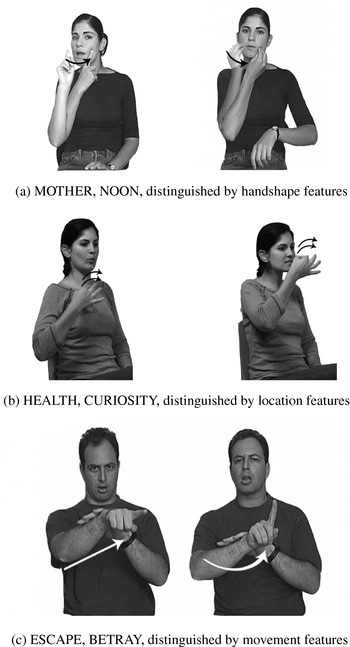
From a phonological perspective, signs are comprised of three major formational categories: Hand Configuration,Footnote 8 Location, and Movement. Using Israeli Sign Language (ISL) as an example, figure 3 exemplifies the fact that each of these categories is made up of a list of contrastive features, just as the consonant and vowel categories of spoken languages each have contrastive phonological features. In ISL, the signs MOTHER and NOON (figure 3a) are distinguished by features of the two handshapes  and
 . This is a minimal pair, because the locations and movements are the same in the two signs, which are distinguished by handshape alone. The ISL signs HEALTH and CURIOSITY (figure 3b) are minimally distinguished by features of location (chest vs. nose respectively), while ESCAPE and BETRAY are distinguished by movement alone, straight for ESCAPE, and an arc for BETRAY (figure 3c).
Phonologically distinguished minimal pairs in ISL

The important observation here is that, in the signs of the ISL lexicon, the different handshapes, locations, and movements function as meaningless building blocks, or formational elements, in the same way that phonemes like [t], [k], and [a] do in spoken language. There are constraints on the combination of these units in sign languages as in spoken languages, and their form may change in different (morpho-)phonological contexts (Sandler & Lillo-Martin Reference Sandler and Diane2006).
In short, established sign languages that have been investigated have a phonological level of structure. This characteristic gives sign language duality of patterning (Hockett Reference Hockett1960), the universal design feature of human language that makes it possible to create a vast vocabulary of meaningful forms from a relatively small number of units that form a system without reference to meaning.
3.2 Iconicity
The formational elements described in the previous section constitute the basic building blocks of lexical items (signs) in the language. In many instances, these elements are meaningless, and the form of the sign is arbitrary. However, sign languages are much better than spoken languages in conveying concepts in a more transparent, iconic way, because of the spatio-visual modality they are transmitted in (Armstrong et al. Reference Armstrong, William and Sherman1995, Taub Reference Taub2001, Meier et al. 2002 and references cited there). Iconic signs, like arbitrary signs, make use of the same building blocks – hand configuration, movement and location. Yet what makes signs iconic (or partially iconic, as we discuss below) is that these formational elements are mapped onto specific meaning components of the concept conveyed.Footnote 9
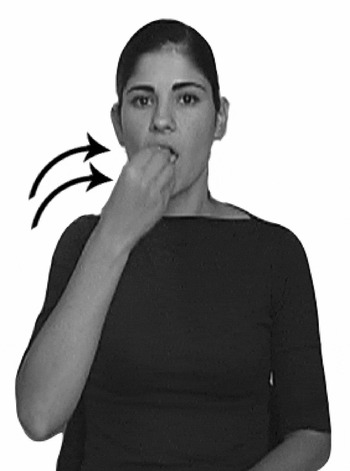
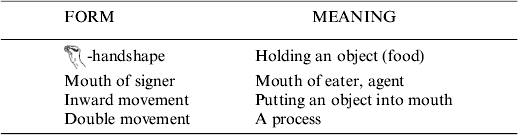
We use the term iconicity to refer to the regular mapping between formational elements of an expression and components of its meaning (Taub Reference Taub2001, Russo Reference Russo2004, Wilcox Reference Wilcox2004). This mapping can be demonstrated by showing the correspondence between formational elements and meaning components (based on Taub Reference Taub2001). Take, for example, the verb EAT in Israeli Sign Language (ISL), illustrated in figure 4. The hand assumes a particular shape ( ), moving towards the mouth from a location in front of it, and executes this movement twice. ‘Eat’ means ‘to put (food) in the mouth, chew if necessary, and swallow’ (Webster's New World Dictionary, Third College Edition). A possible Lexical Conceptual Structure representation is given in (2).
(2) X CAUSE [Y GO [INTO MOUTH-OF X]]
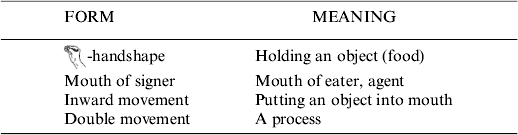
As is obvious from figure 4, the sign EAT is iconic. However, if we go beyond the global impression of iconicity, we see that an explicit mapping between form and meaning as a set of correspondences has the advantage of showing which of the various formational elements correspond to which aspects of meaning. Such a mapping is illustrated in table 1.
The iconic sign EAT (ISL)

Iconic mapping for EAT
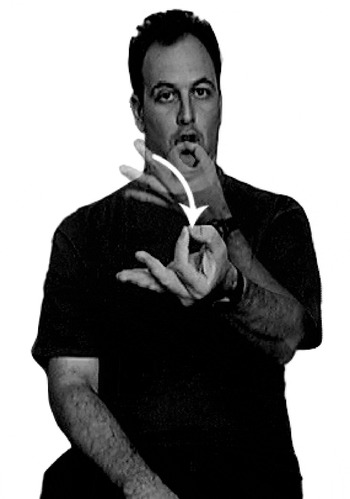
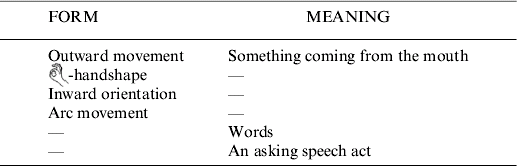
Some signs are only partially iconic. In such signs, not all of the formational components correspond to meaning components. The sign ASK (ISL) is partially iconic. The hand is oriented towards the mouth in a  handshape, and moves in an arc path movement outward from the mouth (illustrated in figure 5). Table 2 shows that the set of correspondences between formational and meaning components is incomplete.
The partially iconic sign ASK (ISL)

Iconic mapping for ASK
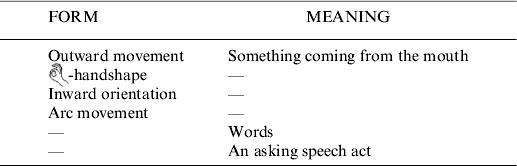
In ASK, as opposed to EAT, some meaning components have no straightforward formational representation, and some of the formational elements do not correspond to any meaning components.
Regularities can emerge from a comparison of iconic mappings in different lexical items. One interesting observation, pertinent to the point we make in this paper, becomes apparent when examining table 1 and table 2: both the hands and the body play a role in building an iconic sign. Yet there is a basic difference between the two: the hands are much more versatile than the body. The body usually corresponds to only one meaning component; in the case of EAT and ASK, it corresponds to some property of the agent argument – the fact that it has a mouth. The hands, in contrast, have more degrees of freedom. They have a specific shape, assume a specific orientation, and move in a specific manner and a specific direction. As a consequence, the hands may represent many more aspects of the sign's meaning components in iconic or partially iconic signs. As is illustrated by the analyses of EAT and ASK, the formational components manifested by the hands correspond to aspects of the action itself (e.g., the temporal properties of the event, manner) and to the arguments of the event not represented by the body (the food in EAT, and the addressee and question in ASK). In the next section, we explore in depth how this division of labor between the body and the hands reflects linguistic organization in the lexical structure of sign language verbs.
4. A lexicalization pattern in sign languages
In his description of how spoken languages encode motion events, Talmy (Reference Talmy and Timothy1985, Reference Talmy2000) points out that verbs alone do not encode all the meaning components of such events. Languages tend to be systematic about which meaning components are encoded by which types of lexical items. Thus, some languages (e.g., English, German, Russian and Chinese) encode manner of motion in verbs and direction of motion by prepositions or particles (‘satellites’, in Talmy's terms), while other languages (e.g., Hebrew, Spanish, Japanese and Turkish) encode direction of motion in the verb and the manner component is expressed by adverbials. For example, when describing an event in which a protagonist is running down the stairs, English encodes the manner of motion in the verb run and the direction of motion by the preposition down. In Hebrew, the direction of motion is expressed by the verb (yarad ‘descend’) and the manner is encoded by a prepositional phrase be-rica ‘in running’. Each language is self-consistent. The manners of motion expressed in English verbs like waddle, stroll, and scurry have to be expressed in Hebrew by using an adverbial describing the manner. On the other hand, the Hebrew verbs yarad ‘descend’, ala ‘ascend’ and yaca ‘exit’ are usually expressed in English by a verb of motion and a particle (go up, down, or out).
In sign languages, as illustrated in the previous section, specific formational elements of a sign may correspond to specific meaning components; that is, the hands and the body (the chest or the head) may each separately be used to encode different parts of an event. We now show that this correspondence between a part of an encoded event and the body or hands is not random, at least in some respects. In particular, if the body of the signer corresponds to any meaning component, it is to the subject argument of the event.
4.1 Body as subject
The signer's body is not merely a formal location for the articulation of signs, but may, in principle, be associated with a particular meaning or a particular function. We argue that in iconic or partially iconic verbs articulated on the body, the so-called ‘body-anchored verbs’, the body represents the subject argument.
To return to the example we discussed earlier, the sign EAT is almost identical in ISL and ASL, and in both languages, it is a body-anchored iconic sign (see figure 4 and table 1 above). Crucial to our point here is the correspondence between the location of the sign (the mouth) and the mouth of the eater, the agent argument in the event. In other words, the body, constituting one of the formational components of the sign, represents one particular argument in the event, the agent. It is important to note that the body does not represent first person. The sign EAT is signed on the mouth of the signer whether the subject in a particular event of eating is first, second or third person. In other words, the sign EAT has one form in all three sentences ‘I eat’, ‘you eat’ or ‘s/he eats’, and this form is signed on the signer's mouth.
Examining a wide variety of body-anchored verbs shows that in iconic signs, the body corresponds to an argument participating in the event. The following examples are from ISL, but similar lists of words can be found in ASL as well.
(3) Psych verbs (Location: chest)
HAPPY, LOVE, SUFFER, UPSET, BE-FED-UP-WITH, HURT
Chest corresponds to the symbolic location of emotions of the experiencer argument
(4) Verbs of mental activities (Location: temple and forehead)
KNOW, REMEMBER, FORGET, LEARN, WORRY, THINK, DREAM, UNDERSTAND, INFORM, GRASP (an idea)
Temple or forehead represents the site of the mental activity of the experiencer.
(5) Verbs of perception (Location: sense organs)
SEE, LOOK, HEAR, LISTEN, SMELL
Eyes, ear or nose represents the site of the activity of the experiencer
(6) Verbs of saying (Location: mouth)
TALK, SAY, ASK, ANSWER, EXPLAIN, SHOUT, WHISPER
Mouth represents the mouth of the agent argument
(7) Change-of-state verbs (Location: face, chest, eyes)
BLUSH, GET-WELL, WAKE-UP
Face, chest, eyes represent the relevant part of the body of the patient (undergoer) argument
As the above list shows, the argument represented by the body and corresponding to specific features of the body can be associated with a variety of thematic roles: agent, patient, experiencer, recipient. However, the choice of the particular argument to be represented by the signer's body is not random. In the case of a one-place predicate, the body naturally is associated with the sole argument of the predicate. In the case of transitive events, we find that the argument associated with body features is the highest-ranking argument: the agent in <agent, patient>verbs (e.g., EAT, DRINK, LOOK) or <agent, patient, recipient>verbs (such as ASK, INFORM, EXPLAIN), and the experiencer or perceiver in <experiencer, theme>verbs (e.g., SEE, HEAR, LOVE).Footnote 10 According to general principles of mapping between thematic structure and syntactic structure (e.g., Fillmore Reference Fillmore, Emmon and Robert1968, Grimshaw Reference Grimshaw1990, Jackendoff Reference Jackendoff1990, Falk Reference Falk2006 and others), the argument associated with the highest-ranking thematic role is the subject argument. The correct generalization, then, is that the body is associated with the subject argument of the verb rather than with a particular thematic role. An implication of our analysis is that the basic lexicalization pattern when representing a state of affairs in sign languages is ‘body as subject’.
In other words, the body represents, or corresponds to, some property of the subject argument (that it has feelings, is sentient, has a mouth, etc.). In spoken languages, properties of the arguments are inferred from or are part of the meaning of verbs. For example, the verb sneeze implies that the subject has a nose; the subject of lick has a tongue; the subject of faint is animate; and the subject of angry is sentient. In signed languages, such properties can actually be represented by some aspects of the form of the sign, in particular, by parts of the body. If the sign denoting an event is signed on some part of the body, then the body is interpreted as associated with properties of the subject argument.Footnote 11
4.2 Hands as event
The iconic mapping for the sign EAT shows that properties of the event itself and of other arguments are encoded by the hands.Footnote 12 The inward movement of the verb represents putting something into somebody's mouth; the specific handshape represents holding or manipulating a solid object, food in the case of ‘eat’; and the double movement denotes an action, or an atelic event. In the ISL verb ASK, the outward movement represents something being transferred from the subject to the recipient. Aspects of the movement can correspond to temporal aspects of the event (such as telicity), direction of motion often encodes spatial thematic roles of the arguments such as source and goal, and the final location of the sign is associated with the recipient argument. The handshape often represents the argument in motion (the theme) or the manipulation of the (patient) argument by the subject. The hands, then, may encode many more aspects of the event than the body. This is to be expected. The hands are much more versatile than the body: first, they can move in space; second, they can take different handshapes; third, they come in pairs. The movement component in itself is complex, as it includes both manner of movement and direction. The body, on the other hand, does not show any of these properties. It does not move in the same way that the hands can, and there is only one body. In this sense, it can encode considerably fewer aspects of the event. Interestingly, it encodes one particular aspect of the event, an argument – the subject. This argument is in a sense privileged, since it is set apart formationally from the other meaning components of the event.
This separation between one privileged argument and other aspects of the event including other arguments is reminiscent of the distinction between external and internal arguments (Williams Reference Williams1980, Reference Williams1984, Marantz Reference Marantz1984, Rappaport & Levin Reference Rappaport, Beth and Wendy1988, Grimshaw Reference Grimshaw1990 and others). The distinction is based on the observed asymmetry between the subject and other arguments of the verb. One argument, usually the one realized as the subject, is much less dependent on the event itself. For example, Marantz (Reference Marantz1984) points out that there are many instances where the object argument determines a particular interpretation of the verb (e.g., throw a baseball/a party/a fit), and very few instances where the subject has such an effect. Furthermore, there are many idioms involving the verb and its object (kick the bucket, let the cat out of the bag, take advantage of and others), and much fewer, if any, involving the verb and its subject. This asymmetry in the relationship between the verb and its arguments is formalized in various ways in different theories: the external argument occupies a position external to the VP (Williams Reference Williams1980), is not an argument of the verb (Marantz Reference Marantz1984) but rather of a separate head, Voice (Kratzer Reference Kratzer, Johan and Laurie1996).
While it is hard to find a unified definition of the term ‘external argument’ which clearly sets it apart from ‘subject’,Footnote 13 the basic asymmetry between the arguments of a predicate is valid: one argument is much more independent, and much less determined by the event, than the other. These properties – independent existence, separation from the event – are precisely the properties that distinguish the role of the body from the role of the hands in the structure of lexical items in sign language. The body is independent of the hands, and expresses only one argument; the hands express the events and the other arguments. We have argued that the body corresponds to the subject argument. Given the resemblance between properties of the body and properties of the external argument, would it be more accurate to say that the body represents the external argument? As we pointed out, the body may be associated with a variety of thematic roles, including that of patient and experiencer. Therefore, our use of the term ‘subject’ does not correspond to a thematic (or thematically determined) interpretation of external argument. However, as we pointed out above, our use of subject is very similar to Williams' definition of external argument – the argument assigned under predication.
4.3 Factors obscuring the pattern
The basic lexicalization pattern ‘body as subject’ described above is most salient in body-anchored iconic verbs. In other domains of the lexicon and grammar of any given sign language, this pattern is often obscured by other structures and processes in the language. The versatility of hands vs. the stability of the body may mean that the hands assume more and more roles in the lexicon and grammar of sign languages as the lexicon expands, resulting in forms which do not conform to ‘body as subject’. We mention three factors here.
4.3.1 Hands represent body parts outside of the signing space
Not all body parts participate in the structure of signs. Typically, the signing space is on or in front of the body, in the area between the waist and the head. Body parts that are lower than the waist, then, hardly ever function as locations for signs. Therefore, actions which are performed by the legs and feet of the subject are not articulated by these appendages; rather, the legs and feet are represented by the arms and hands. It is very common across sign languages for the index and middle fingers to represent the two legs. Verbs that denote actions such as standing, getting up, jumping, falling, walking (in ASL and ISL) have a  handshape on the dominant hand, often performing the action on the non-dominant
 hand (in the horizontal plane, palm up or down, representing a surface). Forms denoting a special way of walking, such as walking on high heels, are expressed by a
 handshape in ASL and a
 handshape in ISL, with the pinky pointing down.
When the hands represent other body parts, such as legs, the signer's body may still be involved in articulating the sign. For example, when describing somebody teetering on high heels, the body may move in tandem with the hands, depicting the motion of the subject argument. However, there is an important difference between the role of the body in such verbs and its role in verbs like EAT. In the latter, the body is an obligatory part of the phonological structure of the verb, and it is obligatorily associated with the subject argument. With forms such as walking on high heels, the body is not part of the phonological structure of the verb; the verb is articulated in neutral space, not on the body. Body motion may accompany the manual sign, but this is not obligatory. Moreover, the body may take on one of several roles: it may represent the subject argument, but it may also represent the attitude of an outside observer looking at another person walking on high heels. Once the hands take on the role of the body themselves, and do not use the body as the location for the sign, then the body is free to express a variety of nuances, and the basic pattern of ‘body as subject’ is no longer apparent.
4.3.2 Body is animate
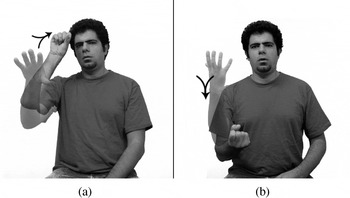
The body represents the subject argument when the subject is animate. Events involving inanimate subjects are articulated by the hands, usually in the space in front of the signer. Quite often, the dominant hand is performing the sign on the non-dominant hand. Take, for example, the verb ‘eat’. In English and other spoken languages, the same verb can be used metaphorically with inanimate subjects, as in The acid ate the metal, The house ate all my savings. In ASL and ISL, the verb EAT cannot refer to inanimate referents. The iconicity of the sign, especially the location (the mouth of the signer), constrains the possible contexts and metaphorical extensions of the sign (Meir Reference Meir2004). Similarly, the sign ABSORB (ISL), when signed on the temple (figure 6a), can only refer to a human subject absorbing information. When the sign is signed in neutral space (figure 6b) it can refer to an inanimate subject, like a sponge absorbing water.
ABSORB: (a) with a human subject; (b) with a non-human subject

In general, inanimate entities are usually represented by the hands in a specific handshape, and an event predicated of such entities is also expressed by the hands. Compare, for example, the sign ‘fall’ when referring to an animate referent and the same concept when predicating over an inanimate referent. The ASL sign FALL is a  handshape (the fingers representing the legs) twisting from a vertical to horizontal position. When referring to human or animate referents, signers may accompany this sign with a slight leaning of the torso. However, when describing a bottle of water falling, signers do not use their body together with the hands to show the direction of falling. The bottle is represented by an upright arm moving to a horizontal position. A similar distinction is found in the verb FLY (in both ASL and ISL). The flying of a bird is represented by moving the hands and arms to represent the motion of the wings (that is, the signer's body represents the body of the agent). An airplane flying is represented by a handshape, tracing in the signing space the path that the plane traverses. A signer would not extend the arms out to depict the plane in flight. Even in mimetic depiction, a type of signing that incorporates pantomimic elements in which the signer uses his/her body to express an event mimetically, the body represents an event predicated of an animate subject, not an inanimate one. For example, an ISL signer describing a girl falling down used his body to show the falling event: his torso bent to a horizontal position. When describing a water bottle falling down, or a plastic bag floating down to the ground, he used his hands to represent the event, not his torso.
However, there are functions in ASL and ISL, notably theatrical or poetic functions, under which the body can be used for inanimate objects. These are cases of personification, where objects take on animate-like qualities. One well-known deaf performer of humorous ASL narratives depicted the flight of a golf ball by using his own head, complete with expressive eyes and other facial features as if the golf ball were human. The golf ball, ‘happily sitting on a tee’ (with the tee represented by a hand in appropriate scale underneath his chin), was ‘surprised to find itself sailing through the air’ when it was hit by a golf club. Such forms are rarely found in everyday ASL conversation, unless the signer intends to make a humorous play on the language.
This observation, that the body is usually associated with animate referents, is reminiscent of the phenomenon of ‘persistence’ in grammaticalization processes, that is, that properties of the source item are still present in the grammaticalized element, and influence its behavior. For example, in several West African languages, an accusative case marker that originates from the verb ‘take’ can only attach to nouns denoting concrete, already existing objects, which ‘can be taken’ (Lord Reference Lord1993, cited in Hopper & Traugott 2003: 97); similarly, a pronominal object marker originating from the sign PERSON in ISL can only refer to [+human] referents (Meir Reference Meir2003).
We see a similar phenomenon here. Although the body is used as a formational element in the structure of signs, it is still a human body that ‘belongs’ to the signer, an animate being. As such, it is not used to stand for inanimate entities. In this sense, then, we see persistence of properties of the human body in certain aspects of the linguistic behavior of the body.
4.3.3 Verb agreement system
The third factor obscuring the ‘body as subject’ pattern is the morpho-syntactic process of verb agreement. In the verb agreement system of ASL and ISL (and many other sign languages as well, cf. Meir Reference Meir2002, Sandler & Lillo-Martin Reference Sandler and Diane2006) the body encodes first person, and the syntactic and semantic roles of the arguments are encoded by the hands. In other words, in verbs inflected for agreement, the body is no longer associated with the subject argument; rather, the subject is marked by a morphological marker, which we describe below. Therefore, when discussing verb agreement, we use the term ‘subject’ in its morpho-syntactic sense, not in a lexical sense. Since the mechanism of sign language verb agreement is very different from that of spoken languages, and since our analysis has consequences for this system, we describe it in some detail here. We exemplify the system with ASL and ISL, but the description applies to many other sign languages.
Like verb agreement in spoken languages, sign language verb agreement is a grammatical system, because it involves systematic encoding of syntactic and thematic roles. But Padden (Reference Padden1988) showed that ASL verb agreement is different from that of spoken languages in that the language has a three-way classification of verbs, according to their agreement patterns: plain, spatial and agreement verbs.
Verb agreement in sign languages takes the following form: the beginning and ending points of the agreeing verb are associated with the points in space established for the arguments of the verb. In these languages, nominals in a clause are associated with discrete locations in space, called ‘R(eferential)-loci’. For referents present in the discourse, their actual location functions as a referential locus. First person is represented by the signer's body, second person by the location of the addressee, and third person by the location of the actual third person referent. For non-present referents, this association is usually achieved by signing a NP and then pointing to, or directing the gaze towards, a specific point in space. Once an R-locus has been established for a specific NP, subsequent reference to that locus is equivalent to pronominal reference. Pointing again to that point has the function of referring back to the NP associated with that locus. And, important to our argument here, verbs are inflected for agreement with respect to these R-loci.
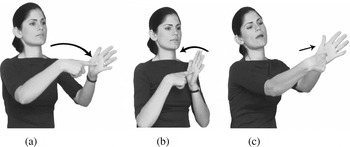
The form of agreement verbs can be described as consisting of a linear path movement from one reference point to another: the direction of the movement is determined by the R-loci of the verb's arguments. The ISL verb SHOW, for example, moves from the location associated with its subject argument towards the location associated with its object argument. Figure 7 exemplifies three forms of this verb: 1SHOW2, ‘I show you’ (the verb moves from 1st person locus to 2nd person locus), 2SHOW1 ‘You show me’ (where the path movement is from 2nd person locus to 1st person locus), and 3SHOW2 ‘S/he shows you’ (where the path movement is from the locus established for 3rd person to 2nd person locus).
A verb inflected for agreement (ISL): (a) 1SHOW2; (b) 2SHOW1; (c) 3SHOW2

The class of verbs that inflect for agreement is that of verbs of transfer – either real, concrete transfer, as in ‘give’ and ‘take’, or abstract transfer, as in ‘teach’, ‘help’ or ‘copy’ (Meir Reference Meir2002). In verbs like GIVE, SHOW, TELL, INFORM, AWARD, and SEND, where the subject argument is the source of transfer, the path movement is from the location of subject to object. For the subclass of ‘backwards’ verbs like BORROW, INVITE, COPY, and RECEIVE, in which the subject is the recipient, the path movement is opposite, from object to subject.Footnote 14
The remaining two classes of verbs behave differently with respect to verb agreement. Plain verbs have invariant beginning and end points; in particular, the direction of the path movement of these verbs is not determined by the R-loci of their arguments. Many of the verbs in (3)–(7) above are plain verbs, e.g., EAT, THINK, KNOW, UNDERSTAND, LISTEN, BLUSH, LOVE, WAKE-UP.
Spatial verbs are those with beginning and end points determined by spatial referents, that is, by their actual or designated locations in a spatial array, and not by the syntactic arguments of subject or object. The locations encoded by verbs in this class are interpreted analogically and literally, and not as representing grammatical arguments (Padden Reference Padden1988). In such signs, the movement begins at some location and ends at a different location, depicting the trajectory of motion of an entity. Spatial verbs, e.g., DRIVE-TO and MOVE-TO, incorporate fine distinctions of location and movement throughout the signing space in front of the body, but, importantly, do not contact the body itself. Ted Supalla (Reference Supalla1982) describes forms denoting motion and location events as existing in appropriate ‘scale’. If the signs contact the body, then the scale becomes relative to the signer's body, and the meaning changes, e.g., from ‘drive to a place’ to ‘a toy car driven into the side of a human body’.
Agreement verbs, then, encode two grammatical categories: grammatical person and syntactic roles. Person is encoded by the body and locations in space: a locus on or near the region of the signer's chest marks first person. Any other locus around the body marks non-first person, including second and third person (Meier Reference Meier, Susan and Patricia1990). The syntactic roles of the arguments are encoded by the movement of the hands between these loci.Footnote 15 It follows, then, that in fully inflected forms of agreement verbs, body is no longer subject; rather, it is first person. The basic, default lexicalization pattern is obscured by a morphological process, which makes use of the same formational elements but associates them with different grammatical functions.
The default pattern becomes evident in certain cases. First, if a sign language does not have a verb agreement system, then we expect ‘body as subject’ to be apparent in verbs of transfer as well. Al-Sayyid Bedouin Sign Language (ABSL), which we describe in section 6.1 below, is precisely such a language. Furthermore, even in languages with verb agreement, such as ASL and ISL, the default pattern will appear in specific cases. For example, some verbs of transfer are partly body-anchored. The ISL verb ASK (in figure 5 above) is specified for being signed on the mouth: the initial point of the sign is always the mouth, not the R-locus associated with the referent functioning as the syntactic subject. Such a verb, then, agrees only with its object (the verb moves towards the R-locus of the object). Its initial point does not encode person distinctions, but rather is associated with properties of the subject argument (having a mouth). We return to such verbs in the following section.Footnote 16
5. A sign language typological puzzle
5.1 Object-over-subject primacy
Sign language verb agreement presents interesting challenges to linguistic theory, because it is similar to, but also very different from, verb agreement systems in spoken languages. One difference is that in sign languages verb agreement is marked only on one class of verbs, verbs denoting transfer, whereas in spoken languages agreement systems usually apply to all the verbs in a particular language.Footnote 17 A second difference is that in the sign language system, agreement with the object takes precedence over agreement with the subject. This contrasts with the situation in spoken languages, where the subject is the highest-ranking argument in the Grammatical Relations (GR) Hierarchy (Greenberg Reference Greenberg1966: 37f.) and therefore the most accessible argument for verb agreement. This hierarchy implies that if a language has object agreement, it also has subject agreement, but not vice versa. We expect then to find spoken languages with subject agreement and no object agreement, but not languages with object agreement and no subject agreement (see e.g., Keenan Reference Keenan and Charles1976: 316, Lehmann Reference Lehmann, Michael and Charles1988: 64). The hierarchy also implies that within a given language, if a verb form encodes agreement with object it also encodes agreement with subject. In sign languages, this is not the case. First, no sign language is known to have subject agreement and no object agreement. But more crucially, there are several phenomena in the verb agreement system of particular sign languages that result in forms marked for object agreement but not subject agreement. Two phenomena are described here.
(i) Single-agreement verbs. In ASL and ISL, agreement verbs fall into a number of subcategories. Some verbs agree with only one argument. In such verbs, the beginning point of the verb is marked for being located at some body-part (mainly some part of the face) and therefore is not determined by the R-locus of the other argument of the verb. ASK (ISL) is such a verb: its initial location is near the mouth, and its final location is towards the R-locus of the object of the verb. Even if the subject is not first person, the verb nonetheless begins at a location near the mouth. Thus a verb form meaning ‘He asked you’ has the form ASK2 rather than 3ASK2. Examples of other single-argument agreement verbs in ISL are: ANSWER, EXPLAIN, TELL (mouth); SEE, VISIT (eye); CARE-FOR (forehead); TELEPHONE (ear). In ASL, single-argument agreement verbs include SEE, TATTLE-ON, SPY-UPON. Interestingly, in these verbs it is always the subject agreement marker (that is, the R-locus associated with the syntactic subject) that is omitted. The object agreement marker, then, seems to be obligatory, while the subject marker is not. The same phenomenon is described in other sign languages, e.g., Danish Sign Language (Engberg-Pedersen Reference Engberg-Pedersen1993: 191) and Italian Sign Language (LIS; Pizzuto Reference Pizzuto and Bernard1986: 25f.).
(ii) Subject agreement marker omission. It has been observed that the subject agreement marker in ASL can be optionally deleted (Padden Reference Padden1988, Bahan Reference Bahan1996, Liddell Reference Liddell2003). As Padden points out, the subject agreement marker of a verb may be optionally deleted, whether it is realized as the beginning point of the verb (as in ‘give’-type verbs) or as its end point (as in ‘take’-type verbs). When the subject agreement marker is deleted, Padden notes, ‘the resulting form has a reduced linear movement’ (ibid., p. 117). However, when the subject of such reduced verb forms is 2nd or 3rd person, signers tend to sign the verb from the body, not from a location near the R-locus of the subject. In other words, when the R-locus functioning as subject agreement marker is omitted, the verb often anchors to the body in its initial point, agreeing only with its object. Such verb forms resemble the single-agreement verb forms discussed in the previous section.Footnote 18
Sign languages, then, appear at first to have a reverse hierarchy with respect to verb agreement: the object is more prominent than the subject. If a verb agrees with only one argument, it is the (recipient) object argument. And if a verb form encodes agreement with subject, it encodes agreement with object as well. Several researchers have noticed this peculiar behavior, and tried to offer an explanation. Janis (Reference Janis, Karen and Judy1995: 220) points out that the agreement hierarchy of ASL parallels the hierarchies found in other languages for case markers. Meir (Reference Meir1998b, Reference Meir2002) builds on this observation, and analyzes the facing of the hands (which, according to her analysis, marks the syntactic roles of the arguments) as marking case relations. However, both Janis and Meir admit that sign languages are still unusual in that case relations are marked on the verb rather than on the arguments. Thus, no satisfactory solution has been offered so far for this typological puzzle.
We suggest that the puzzle can be resolved by taking a new look at the sign language verb classification, one that takes into consideration the role of the body in the three verb classes. Such an approach will show that the subject is the most prominent argument in sign languages as well, but that this prominence is manifested in a somewhat different way in sign languages.
5.2 The solution
Previous analyses of verb classes in sign languages have focused primarily on the movement of the hands and the direction of their movement. Agreement verbs were defined as the class of verbs whose path movement is determined by the R-loci of the subject and object arguments. In plain verbs, the hands and their direction of movement do not play a grammatical role at all. If we now shift attention to the use of the body in verbs, we find that these two classes of verbs divide up neatly in terms of the role of the body. Plain verbs can be defined as the set of verbs in which the body is subject and the category of person is not encoded. In the inflected forms of agreement verbs, the body is no longer subject, but rather encodes person.
An important difference, then, between agreement verbs and plain verbs is in the role of the body. In plain verbs, the body represents the subject, and the category of person is not encoded. In agreement verbs, the body encodes first person, and the hands take care of all the rest, that is, encoding non-first-person referents as well as their syntactic roles.
Turning back to single-agreement verbs, we can now suggest a solution to the typological puzzle they present. Single-agreement verbs can be regarded as a kind of ‘hybrid’ of plain verbs and agreement verbs. As with plain verbs, in single-agreement verbs the body represents the subject, while the hands behave as in (full) agreement verbs: they encode non-first-person features, as well as the syntactic object. These verbs, then, represent the subject by the body. What is dropped in these forms is not the subject marker, but rather the specificity with respect to person. These verbs retain their trajectory with respect to the body as subject, as they still move from near the body outward (or towards the body if a backwards verb). Our analysis suggests that reference to the subject is not optional, but rather obligatorily represented by the signer's body. In other words, the subject is not encoded by the verb agreement system, but rather by the lexical form of the verb, as in plain verbs. In a way, the subject is more deeply entrenched in plain verbs and single agreement verbs than in full-agreement verbs, because it is part of the lexical entry itself, and not added by an inflectional affix.
This line of thought suggests that the subject is a privileged argument in both signed and spoken languages. But the two modalities afford different possibilities for expressing this special status. The manual–visual modality makes use of the natural asymmetry between the body and the hands to encode the subject–predicate asymmetry in the form of lexical items denoting states of affairs. The asymmetry is encoded in the structure of lexical items in these languages. Grammatical processes such as verb agreement may cause this pattern to become opaque, but this basic tendency surfaces as a default pattern under various circumstances. The auditory modality of spoken languages cannot encode features of the subject in the lexical structure of words. The special status of the subject is expressed in the grammar, by being the most accessible target for various morphological and syntactic processes.
6. Consequences and predictions of the ‘body as subject’ theory
We argue that ‘body as subject’ is a basic default lexicalization strategy in sign languages, and that verb agreement is a more complex mechanism, which builds on this basic strategy but also obscures it, as it involves an additional grammatical category (grammatical person) and the detachment of the subject from the body. Since ‘body as subject’ is more basic, the following predictions emerge: (a) If a sign language has verb agreement, it must also have ‘body as subject’ verbs (that is, plain verbs) but not vice versa. (b) From a diachronic perspective, the appearance of ‘body as subject’ verbs precedes that of agreement verbs. That is, a sign language would move from having basically ‘body as subject’ verbs towards adding verb agreement to its verbal system only in later stages.Footnote 19
We describe here two languages conforming to these predictions: Al-Sayyid Bedouin Sign Language (ABSL), a young language with plain verbs but no agreement verbs, and ISL (Israeli Sign Language), a language that did not have verb agreement in earlier stages of its history, but developed this system in later stages.
6.1 ABSL: a sign language with no verb agreement
The Al-Sayyid Bedouin group was founded about 200 years ago in the Negev region of present-day Israel. Originally fellahin ‘peasants’ from Egypt who worked for traditional Bedouins as laborers, the Al-Sayyid now function autonomously and are regarded by outsiders as Bedouin. The group is now in its seventh generation and numbers about 3,500 members, all of whom reside together in a single community exclusive of others. Consanguineous marriage has been the norm in the group since its third generation. Such marriage patterns are common in the area and lead to very strong group-internal bonds and group-external exclusion. It is indicative that the Al-Sayyid still view themselves as a single large family, though now subdivided into subfamilies.
In the fifth generation since the founding of the community (about 70 years ago), four deaf siblings were born into the community. In the next two generations, deafness spread in many other families. The number of deaf individuals in the community today is about one hundred. The particular distribution of deafness in the community, typical of recessive congenital deafness (Lane, Pillard & French Reference Lane, Richard, Mary, Karen and Harlan2000), has had sociolinguistic consequences: deaf members of the community are integrated into its social structure and are not shunned or stigmatized, and a sign language developed in the community as a means of communication, used by both deaf members of the community and a significant portion of its hearing members (Kisch Reference Kisch2000). The sign language, Al-Sayyid Bedouin Sign Language, is passed on from one generation of signers to another in a natural social setting for language acquisition, and deaf children born into the community are exposed to native-like linguistic input. Thus, the Al-Sayyid community presents a unique situation of a language that developed de novo in a stable community.
ABSL is different in lexicon and structure from other sign languages used in the region, including Israeli Sign Language (ISL) (Sandler et al. Reference Sandler, Irit, Carol and Mark2005) and Jordanian Sign Language (LIU) (Al-Fityani Reference Al-Fityani2007), and, as expected, the languages are not mutually intelligible. In an earlier study, we showed that ABSL developed consistent SOV word order within a span of one generation, which is different from the word order of the ambient signed and spoken languages (Arabic and Hebrew) in the region (Sandler et al. Reference Sandler, Irit, Carol and Mark2005). What we did not find is inflectional morphological processes such as verb agreement. We attribute the lack of inflectional morphology in ABSL to the young age of the language. Inflectional morphology involves grammatical categories that play a role in the syntax of a language and are realized morphologically. Therefore, the emergence of inflectional morphology in a given language requires both the emergence of a grammatical category and the development of particular bound morphemes that mark the grammatical distinctions encoded by this category (Aronoff et al. Reference Aronoff, Irit and Wendy2005). Young languages, then, are less likely to have inflectional morphology (McWhorter Reference McWhorter2005: 12), ABSL being no exception (Aronoff et al. Reference Aronoff, Irit, Carol, Wendy, Geert and Jaap2004, Padden et al. in press).
As a result of the lack of verb agreement morphology in ABSL, the basic lexicalization pattern of ‘body as subject’ is more apparent. Of the three verb classes of many other sign languages – plain, agreement and spatial – ABSL has only two: plain verbs and spatial verbs. Verbs denoting transfer, which in many sign languages constitute the class of agreement verbs, behave like plain verbs in ABSL.
This observation is based on data elicited from nine signers of the second generation (age range from 28 to about 45), described in more detail in Aronoff et al. (Reference Aronoff, Irit and Wendy2005). The signers were shown a set of 45 short video clips set up to elicit a range of transitive and intransitive verbs across different semantic categories. From these we identified a subset of 11 videos as involving the following actions of transfer between two entities: GIVE, THROW, CATCH, TAKE, and FEED. We then analyzed the signers' responses to these 11 elicitation clips, resulting in a total of 110 transfer forms (which include repetitions and descriptions of single events with two clauses).
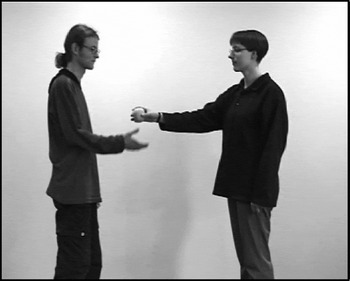
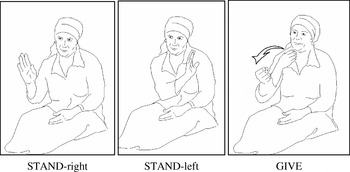
Of the 110 transfer forms produced, 98 involved movement with respect to the body: center-out movement when the subject is the source (as in GIVE, THROW and FEED), or center-in if the subject is the goal (as in the backwards verbs TAKE and CATCH). There was little or no shifting of the movement to the side; instead the movement was either center-out or center-in. The center-out/in movement appeared despite the fact that the action clips showed the actors as transferring an object from one side of the screen to the other. Signers did not mimic the direction of motion in the action clip; instead they used movement along their own central plane. Figure 8 shows pictures from an action clip in which a woman gives a ball to a man. In her response, the signer indicates that the woman is to her right on the screen, and the man to her left, but her verb form does not make use of either of these locations; instead the movement of the verb GIVE is center-out. The signer's response is shown in figure 9.
Woman gives ball to man

‘He's standing here; she's standing there. She gave (the ball) to him.’

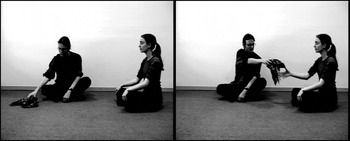
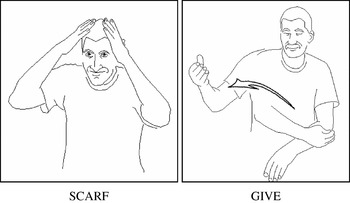
In a smaller number of responses (12 out of 110), signers used a form with path movement not from the body, but from one side to the other (as illustrated in figure 11). On closer analysis, we noticed that these involved holding or manipulating an object and moving it to another location. For example, five of these responses came from an action clip in which a man picks up a scarf lying on the floor and moves it in front of the woman who then accepts the scarf (figure 10). This action is less like one of transfer than of picking up the scarf from its initial position on the floor and moving it to the woman's location. The scarf was not initially in the possession of the man, but on the floor in front of him. We analyze these verb productions as akin to spatial verbs, since they conform to those produced by the same signers in response to action clips in which an object is moving through space with no transfer involved. For example, when describing a ball being thrown through a hoop across the room, signers often depict the trajectory of the motion of the ball by moving the hand from one side of the signing space to the other.
Man moves scarf to woman

‘There's a scarf; he handed (it) over (to her) (left to right).’

ABSL, then, does not have a verb agreement system. Crucial to our point here is the default lexical pattern of ‘body as subject’ that verbs of transfer in ABSL show. In these verbs, the body represents the subject argument, whether the subject is the source of transfer (as in GIVE, THROW and FEED) or the goal of transfer (as in TAKE and CATCH). These forms do not encode person distinctions. That is, ABSL signers did not vary the direction of the verb form when the person of the subject and object of the clause varied. Verbs that involve transfer from one entity to another behave like the default class of plain verbs.
As pointed out above, in sign languages with a verb agreement system the body is first person, and the hands encode the syntactic roles of the arguments. In such a system, the ‘body as subject’ pattern is no longer apparent, since the category of person is superimposed on it. The ABSL verb system does not encode grammatical person, thus giving supportive evidence to the basic ‘body as subject’ pattern.
6.2 Israeli Sign Language: the diachronic perspective
Israeli Sign Language is also a comparatively young sign language, which came into existence as the Israeli Deaf community evolved, beginning about 70 years ago. Unlike ABSL, ISL developed in a pidgin-like situation. The members of the first generation of the Deaf community came from different backgrounds, both in terms of their country of origin and in terms of their language. A few of that generation were born in Israel, but the majority were immigrants who came to Israel from Europe (Germany, Austria, France, Hungary, Poland) and later from North Africa and the Middle East. Some of these immigrants brought with them the sign language of their respective countries. Others had no signing, or used some kind of homesign.Footnote 20 Today, four generations of signers exist simultaneously within the Deaf community: members of the very first generation, which contributed to the earliest stages of the formation and development of the language, down to the fourth generation, which has acquired and further developed the modern language as a full linguistic system (Meir & Sandler Reference Meir and Wendy2007).
While the signing of the first-generation signers (age 65 and older) shows considerable individual variation in terms of vocabulary, word order and grammatical devices, the signing of that generation is consistent in lacking verb agreement. Older signers usually do not inflect transfer verbs at all; they use them as plain verbs, similar to our findings in ABSL. Signers in their late 40s and 50s often use agreement verbs as single-agreement verbs, originating from the body and agreeing with the (recipient) object. Younger signers (in their 30s and younger) inflect agreement verbs for both subject and object, but the object-agreement-only forms are still being used as well.
Engberg-Pedersen (Reference Engberg-Pedersen1993: 193) describes a similar tendency in Danish Sign Language: older signers tend to use agreement verbs as single-agreement verbs, agreeing only with their (indirect) object argument. Younger signers, in contrast, use verb forms in which agreement is marked with both subject and object. However, they, too, can use the ‘earlier’ pattern.
7. Conclusions
Sign languages show that the privileged status of the subject is manifested not only in its behavior at various structural levels, but also in the inherent lexical structure of signs. That is, the notion of subject is built into the structure of the words themselves, even before they combine into larger units. The division of labor between the body and the hands in such signs suggests that we conceptualize an event in terms of a predicate which is predicated over the subject. The subjecthood of one of the arguments participating in the event is a basic component of the lexical structure for expressing the event.
Our analysis shows, then, that the study of sign languages is indispensable for understanding human language, because it allows us to literally see certain properties of human language that may be obscured by the medium of speech. The special status of the subject in the structure of lexical items encoded by the body–hands asymmetry cannot be encoded in the structure of auditory signals because of their one-dimensional and arbitrary nature.
The structural parallelism between the body–hands and subject–predicate relations provides additional support for the approach of ‘embodied cognition’, that is, the idea that our concepts are shaped by our bodies. Lakoff & Johnson (Reference Lakoff and Mark1999: 22) have argued that ‘[h]uman concepts are not just reflections of an external reality, but they are crucially shaped by our bodies and brains, especially by our sensorimotor system’. This embodiment is manifested in metaphorical expressions, reasoning and the structure of philosophical ideas, inter alia. Krifka (Reference Krifka, Shinichiro, Michaela and Anne2006) has recently pointed out that there is a strong functional similarity between the differential role of the hands in bimanual coordination and topic–comment structures. He suggests that the asymmetry of bimanual coordination ‘may be a preadaptation that facilitated the development of topic/comment structure in communication’ (ibid., p. 15). In a similar vein, the body–hands functional asymmetry in the structure of lexical items and the subject–predicate asymmetry in language may be regarded as closely related and as another manifestation of our embodied cognition. When we use our body and hands to conceptualize an event, the body can represent only one argument, thus forcing us to separate one argument from all other aspects of the event. Therefore, the notion of subject as a privileged argument shows up in the very basic building blocks of a sign language. It is an essential part of how we encode an event in a word, even before we string words together into sentences.