Introduction
Low birth weight (LBW) has been strongly associated with infant mortality, especially neonatal mortality (McCormick, Reference McCormick1985). Despite their smaller proportion among LBW newborns, very low birth weight (VLBW; <1500 g) newborns have the highest risk for infant mortality although the risk has been declining over the last decade in the Americas (Kramer et al., Reference Kramer, Barros, Demissie, Shiliang and Kiely2005). Some Brazilian studies have shown high risks of infant mortality in comparison with other Latin American countries (Monteiro et al., Reference Monteiro, Benicio and Ortiz2000; Goldani et al., Reference Goldani, Barbieri, Rona, Da Silva and Bettiol2004a). Low birth weight and its component VLBW have increased in the Americas, in some European countries and Japan during the last decades (Rodrìguez et al., Reference Rodrìguez, Regidor and Gutiérrez-Fisac1995; Lekea-Karanika et al., Reference Lekea-Karanika, Tzoumaka-Bakoula and Matsaniotis1999; Branum & Schoendorf, Reference Branum and Schoendorf2002; Kramer et al., Reference Kramer, Barros, Demissie, Shiliang and Kiely2005; Takimoto et al., Reference Takimoto, Yokoyama, Yoshiike and Fukuoka2005; Thompson et al., Reference Thompson, Goodman, Chang and Stukel2005). In these studies, besides traditional risk factors, late childbearing, increased Caesarean section rates and an increase in multiple births have arisen as new determinants (Tough et al., Reference Tough, Newburn-Cook, Johnston, Svenson, Rose and Belik2002; Kramer et al., Reference Kramer, Barros, Demissie, Shiliang and Kiely2005; Nobile et al., Reference Nobile, Rafaelle, Altomare and Pavia2007). Despite its importance and its potential impact on infant mortality, as far as we know, there are no studies evaluating the trend of VLBW in Brazil.
In Brazil, studies of LBW rates and its components have shown a heterogeneous pattern of distribution according to the size of the cities and their social standards. Findings from some large surveys carried out in small- and medium-sized cities have suggested that LBW (<2500 g) rates have increased over the last 30 years (Silva et al., Reference Silva, Barbieri, Gomes and Bettiol1998; Barbieri et al., Reference Barbieri, Silva, Bettiol and Gomes2000). In terms of social background, data from these three cohort studies have shown the highest rates of LBW in the most developed areas of the country (south-eastern and southern Brazil) compared with poor areas in the north (Barros et al., Reference Barros, Victora, Barros, Santos, Albernaz and Matijasevich2005). On the other hand, another study from São Paulo, the largest city in the country, has shown that the rates of LBW have remained stable, with a slight decrease during the last 20 years (Monteiro et al., Reference Monteiro, Benicio and Ortiz2000). This phenomenon has been explained by different phases of intense epidemiologic transition in Brazil. Other important limitations of these findings are that they have been based on cohort studies or on short-term series databases, which do not permit a secular trend of LBW to be determined with more accuracy.
Therefore, the aim of this study was to assess the secular trend of VLBW in Porto Alegre, a large city in the most developed area of southern Brazil, and its potential determinants during the 1990s and 2000s.
Methods
The study was carried out in the city of Porto Alegre, southern Brazil, with 1,420,667 inhabitants in 2007 (Instituto Brasileiro de Geografia e Estatìstica, 2009), located in one of the richest regions in South America. This is a registry-based study in which all live births from 1994 to 2005 were reviewed. The data were obtained in each urban district from the SINASC (Sistema de Informações de Nascidos Vivos – Live Births Information System), a database consisting of birth certificates for all births in the city (Sistema de Coleta de Dados e Análise de Estatìsticas Vitais, 2000). This database was set up in Brazil in 1993, offering systematic information about the mother's characteristics, medical care and the anthropometric measurements of the newborns, as well as information about hospital deliveries, which correspond to 99% of all deliveries in the city. Information about home deliveries was obtained monthly by searching all registry offices in the city. Birth under-enumeration was estimated at 0.1% of all live births.
Nevertheless, the management of data collection is decentralized at the city level and therefore is quite dependent on the stage of organization in each municipality, offering databases of heterogeneous quality (Silva et al., Reference Silva, Ribeiro, Borba Júnior, Coimbra and Silva2001b). Some studies have shown the progress of the Live Birth Information System since it was first established, building up historical series with accurate figures for these vital events (Szwarcwald, Reference Szwarcwald2008). In addition, data from Porto Alegre have been surveyed continually, guaranteeing a high level of reliability (Shimakura et al., Reference Shimakura, Carvalho and Aerts2001).
During the study period, the database format was changed due to the introduction of new variables and therefore the database does not provide a continuous series of all variables included. Thus, three models of analysis were proposed: first, variables not present in all series were excluded. Second, a category for missing values was included for these variables. Third, incomplete registers were excluded. The first option provided the most complete time series for possible variables. Finally, twelve distinct databases related to 12 consecutive years of surveillance were pooled into a single format.
A total of 265,898 newborns were delivered during the study period of 12 years in the city. Newborns weighing less than 500 g and multiple pregnancies were excluded, with a total of 257,740 singleton newborns being included in the study.
The variables included in this analysis were: VLBW (<1500 g) as the dependent variable, maternal schooling in years (0–8 and 9 or over, corresponding to the compulsory level of education), maternal age in years (less than 20, 21–30, 31–35 or 36 and over), type of delivery (vaginal of Caesarean), type of hospital (public insurance, private insurance and those attending patients covered by public care and by private insurance – mixed hospitals), number of live births (none, 1–2, 3–4 and 3 or more), gestational age (less than 28 weeks, 28–36 and 37 or over), newborn gender, and rate of unemployment per year (continuous variable).
The incidence rate ratio (IRR) using Poisson regression was calculated to identify possible trends in VLBW rates related to independent variables over the period. Linearity of IRR in time series was tested for all independent variables. Poisson regression was performed in order to assess the influence of biological, demographic, health service and socioeconomics factors on VLBW (crude and adjusted). Interactions among independent variables included in the Poisson regression models were also explored.
Results
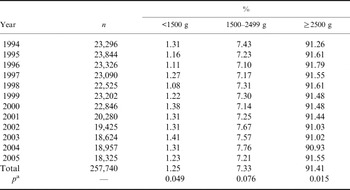
A total of 257,740 newborns were delivered over a period of 12 years in the city, with a steady reduction of the total number of live births. The results showed a small but significant increase in VLBW (p for trend=0.049) and a stable annual rate of birth weight between 1500 and 2499 g from 1994 to 2005 (Table 1).
Secular trend of VLBW from 1994 to 2005 in Porto Alegre, Brazil

a p: chi-squared for trend.
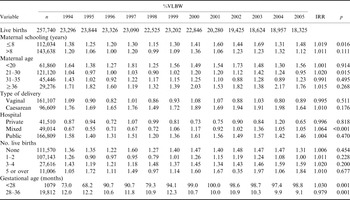
Table 2 presents the distribution of VLBW according to independent variables. The findings indicate that increases in VLBW rates were significant among less educated mothers, mixed hospitals and mothers aged 21 to 30 years. There was a decrease in the proportion of newborns weighing less than 1500 g born between 28 and 36 weeks of gestational age, from 12% in 1994 to 9.1% in 2005 (p<0.001). This finding may suggest an increase in number of newborns with adequate weight for gestational age during the period and a decline of intrauterine growth restriction (IUGR).
Incidence rate ratio (IRR) for VLBW according to covariables from 1994 to 2005 in Porto Alegre, Brazil

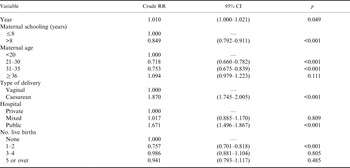
The crude relative risk of VLBW per year reinforces the results of a significant increase in probability of VLBW occurrence of 1% per year (p=0.049). The main risk factors related to VLBW were mothers with low levels of schooling, public hospitals, multiparity and nulliparity (Table 3).
Crude relative risk (RR) using Poisson regression for VLBW considering time series from 1994 to 2005 in Porto Alegre, Brazil

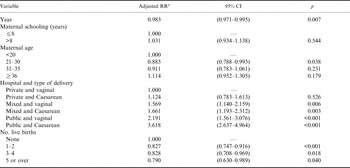
After adjustment, the risk of VLBW per year decreased, suggesting that the variables included in the model explained, at least in part, the increased risk of VLBW during the period. Nulliparity remained as a significant risk factor. Interaction between type of hospital and type of delivery indicated that the probability for VLBW was 3.6 times higher (p<0.001) among those born in public hospitals by Caesarean section than among those born in private hospitals by vaginal delivery. It is also noted that risk decreased steadily from private to public hospitals (Table 4).
Adjusted relative risk for VLBW using Poisson regression considering time series from 1994 to 2005 in Porto Alegre, Brazil

a Adjusted for gestational age.
Discussion
This study is the first to investigate the trend of VLBW in Brazil, introducing the largest continuous temporal series of birth weight databases. The findings show a small but significant increase in VLBW rates during the last 12 years.
The trend and rates of LBW differ from country to country and within each country. Ecological factors are involved such as different distribution of biological and social variables (Letamo & Majelantle, Reference Letamo and Majelantle2001; Mohsin et al., Reference Mohsin, Wong, Bauman and Bai2003), economic indicators and health care resources. In Brazil, considering register-based studies, there is a clear trend towards LBW both in the most developed area (south-east and south) and in the less developed regions of the north (Silva et al., Reference Silva, Barbieri, Gomes and Bettiol1998; Victora, Reference Victora2001; Barros et al., Reference Barros, Victora, Barros, Santos, Albernaz and Matijasevich2005; Instituto Brasileiro de Geografia e Estatìstica, 2009). The increase in LBW rates was more intense during the 1970s to 1990s and declined at the beginning of the 2000 decade (Silva et al., Reference Silva, Barbieri, Gomes and Bettiol1998; Barbieri et al., Reference Barbieri, Silva, Bettiol and Gomes2000; Victora, Reference Victora2001; Barros et al., Reference Barros, Victora, Barros, Santos, Albernaz and Matijasevich2005).
This occurrence was related to a significant reduction of perinatal mortality and infant mortality (Silva et al., Reference Silva, Bettiol, Barbieri, Pereira, Brito, Ribeiro and Aragão2005). Both the decrease in infant mortality and the increase in VLBW can be the result of a general improvement of perinatal care, with better access to and quality of neonatal care arising from anticipatory interventions leading to a decrease of stillbirths or abortions (Paul et al., Reference Paul, Leef, Locke, Bartoshesky, Walrath and Stefano2006; Moro et al., Reference Moro, Figueras-Aloy, Fernández, Doménech, Jiménez and Pérez-Rodrìguez2007).
Brazil presents one of the highest rates of IUGR compared with other Latin American countries (Kramer, Reference Kramer2003). In a study carried out in the north-east of the country, the rate of IUGR was about 18% and did not differ according to socioeconomic factors (Aragão et al., Reference Aragão, Barbieri, Silva, Bettiol and Ribeiro2005). However, no studies of IUGR trends have been conducted in Brazil. The results for Porto Alegre suggest a reduction in IUGR rates, as also observed in developed countries. Maternal smoking rates associated with social improvements as important determinants of IURG in developing countries have decreased over the last few years in Brazil, partially explaining this finding (Goldani et al., Reference Goldani, Bettiol, Barbieri and Tomkins2000).
The reduction in number of live births may be due to a decrease in fertility rates in Brazil during the past 20 years, markedly so in more developed areas as part of an intense demographic transition. Several factors are playing an important role in this scenario, particularly improvement in socioeconomic status associated with ample access to contraceptives (Potter et al., Reference Potter, Schmertmann and Cavenaghi2002). In addition, sterilization and easier access to abortion may also have influenced this trend (da Costa Leite et al., Reference da Costa Leite, Gupta and do Nascimento Rodrigues2004). Porto Alegre has become a remarkable example of this phenomenon due to special conditions such as a broad access to primary care and one of the best social standards of the country (Goldani et al., Reference Goldani, Benatti, Silva, Bettiol, Correa, Tietzmann and Barbieri2002).
It was also observed that the increase in LBW rates was restricted to the lowest birth weight category, as also observed in developed countries. A recent trend of an increased proportion of VLBW infants has been demonstrated in the better-off social groups in Japan and the United States. These findings were related to improved social conditions and better access to adequate care leading to a decrease in abortion and stillbirth rates (Ohmi et al., Reference Ohmi, Hirooka and Mochizuki2002; Branum & Shoendorf, Reference Branum and Schoendorf2002). Data from Brazil have also shown improvement in prenatal care coverage, mainly in the south of the country (Goldani et al., Reference Goldani, Barbieri, Silva and Bettiol2004b). On the other hand, the introduction of new technologies, such as assisted conception in the early 1990s, has increased the rates of multiple births, mainly triplets, with an impact on LBW rates in Porto Alegre (Homrich da Silva et al., Reference Homrich da Silva, Goldani, Silva, Agranonik, Bettiol, Barbieri and Rona2008). In the present study, multiple births were excluded from analysis.
Considering the independent variables separately, despite the significant increase in VLBW rates among less educated mothers, maternal schooling did not remain as a risk factor for VLBW after controlling. This finding supports the possibility that confounding or compensatory factors reduced the impact of education on pregnancy outcome during the study period (Silva et al., Reference Silva, Bettiol, Barbieri, Brito, Pereira, de Aragão and Ribeiro2006). The increase in maternal education (Goldani et al., Reference Goldani, Benatti, Silva, Bettiol, Correa, Tietzmann and Barbieri2002) has been followed by improvements in health indicators such as increased prenatal coverage and population longevity, for example (Secretaria Municipal de Saúde, 2008), indicating that this region has moved towards a health pattern similar to that of developed countries.
The interaction between hospital and type of delivery showed that Caesarean section was always related to a higher probability of VLBW and this risk increased from private to public hospitals. Caesarean section has been found to be associated with LBW in previous studies, mainly in private hospitals (Silva et al., Reference Silva, Lamy-Filho, Alves, Coimbra, Bettiol and Barbieri2001a). Thus, it was assumed that the risk for VLBW probably stemmed from the large number of high-risk pregnancies assisted at public and mixed hospitals rather than from the abusive use of Caesarean section, usually related to private hospitals (Barbosa et al., Reference Barbosa, Giffin, Angulo-Tuesta, Gama, Chor, D'Orsi and Reis2003).
In Brazil, as part of an intense demographic transition, the rates of adolescent mothers are decreasing, associated with an increase in rates of mothers aged more than 30 years (Goldani et al., Reference Goldani, Benatti, Silva, Bettiol, Correa, Tietzmann and Barbieri2002). However, the findings reinforced the association between adolescent mothers and mothers older than 30 years with poor pregnancy outcome (Costa & Gotlbieb, Reference Costa and Gotlieb1998), although a few studies in the literature have evaluated primiparous mothers as a factor of biological risk for VLBW (Manganaro et al., Reference Manganaro, Gemelli, Mamão, Mancuso, Rizza and Leonardi1991; Cnattingius et al., Reference Cnattingius, Forman, Berendes and Isotalo1992).
This is the first population study in South America that has evaluated the trend towards VLBW using a continuous database. The strengths of this study are the completeness of the data set for births in Porto Alegre and the reliance on well defined variables. Its weakness is the limited number of variables available on the birth certificate. Information about maternal smoking during the gestational period, usually related to LBW (Kramer, Reference Kramer2003), was unavailable on birth certificates. The rate of maternal smoking has decreased during the last 30 years in Brazil and therefore its effect on LBW may have had a limited impact in our study (Mariotoni & Barros, Reference Mariotoni and Barros2000). Moreover, it was possible to include in our study many of the factors associated with maternal smoking such as socioeconomic background and higher access to medical care (Victora et al., Reference Victora, Barros, Vaughan and Teixeira1987; Menezes et al., Reference Menezes, Barros, Victora, Alves, Rocha and Albernaz1996). Unfortunately, we were unable to assess the direct impact of obstetric interventions such as the number of prenatal care visits, the use of ultrasound and the induction of labour. An underestimate of the impact of multiple births on LWB due to the exclusion of infants weighing less than 500 g (n=76) from analysis is unlikely because the number of exclusions was too small and inclusion of those weighing less than 500 g did not change the results significantly.
In conclusion, these results show that southern Brazil is going through a demographic transition characterized by a considerable decrease in the number of live births associated with a small increase in VLBW rates, a decrease in IUGR rates and stabilization of LBW. These findings represent an improvement in health care in Porto Alegre that could be reaching the patterns of developed countries.
Acknowledgments
Special acknowledgments are extended to Denise Aerts, Juarez Cunha, Gehysa G. Alves and Rui Flores of Secretaria Municipal de Saúde of Porto Alegre.