FOCUS POINTS
• QOL is poorly studied albeit gravely impaired in patients with BDD.
• Initial evidence show that therapy and medications improve QOL in BDD.
• Using QOL as one of the primary outcome measures of BDD could add significant value to treatment.
Introduction
Body dysmorphic disorder (BDD), previously known as dysmorphophobia, is a severe somatoform disorder typified by a distressing or impairing preoccupation with an imagined or slight defect in appearance, as defined by the Diagnostic & Statistical Manual (DSM-IV).1 According to DSM-IV, BDD is characterized by three major criteria:
• Criterion A: The patient is preoccupied with a defect in appearance; the defect is either imagined, or if a slight physical anomaly is present, the individual's concern is markedly excessive.
• Criterion B: There will be significant distress or impairment in social, occupational, or other important areas of functioning caused by the preoccupation.
• Criterion C: The preoccupation is not caused by another mental disorder (e.g., dissatisfaction with body shape and size in anorexia nervosa).
BDD affects nearly 1.7% of the population,Reference Rief, Buhlmann, Wilhelm, Borkenhagen and Brähler2, Reference Faravelli, Salvatori and Galassi3 with more prevalence and earlier in life symptom development in women.Reference Ruffolo, Phillips, Menard, Fay and Weisberg4 Males typically present with more severe pathology and comorbid substance use disorders.Reference Phillips, Menard and Fay5 In a U.S. nationwide sample of individuals with and without BDD, Koran etal. found that the prevalence of BDD decreases after age 44, and those who meet BDD criteria are less likely to be married.Reference Koran, Abujaoude, Large and Serpe6 Those suffering from BDD have decreased perceived general functioning, increased suicide attempts,Reference Phillips and Dufresne7 decreased social interactions, increased depression,Reference Phillips and Dufresne7 and decreased QOL compared to the rest of the general U.S. population.Reference Phillips and Dufresne7–Reference Phillips, Menard, Fay and Pagano9 Individuals with BDD often engage in intense mirror gazing and frequent comparisons between themselves and others.Reference Veale10 Patients with BDD have high lifetime rates of psychiatric hospitalization (48%), suicidal ideation (45–82%), and suicide attempts (22–24%).Reference Phillips and Rasmussen11 Rief etal. (2006) reported that patients with BDD have higher rates of suicidal ideation and suicide attempts than the general population (19% vs. 3% and 7% vs. 1%, respectively).Reference Rief, Buhlmann, Wilhelm, Borkenhagen and Brähler2 BDD patients also had higher somatization scores compared to individuals who did not meet BDD criteria in the general population.Reference Rief, Buhlmann, Wilhelm, Borkenhagen and Brähler2 Phillips reported that 80% of BDD patients have experienced lifetime suicidal ideation, and 24% to 28% have attempted suicide.Reference Phillips12 BDD patients tend to seek cosmetic rather than psychiatric treatment. Effective interventions include psychiatric medications and cognitive behavioral therapy (CBT). The most frequently prescribed medications are selective serotonin reuptake inhibitors (SSRIs). Outcome of interventions is usually measured using the Yale-Brown Obsessive Compulsive Scale, Modified for BDD (BDD-YBOCS).
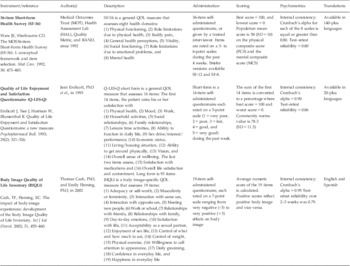
Quality of life (QOL) describes an individual's subjective perception of his or her well-being in terms of physical, psychological, and social functioning. A relatively small number of studies has been performed to examine BDD and QOL, which is not surprising considering that BDD has been historically underdiagnosed. Although QOL has been studied extensively for the past 10 years, there is scarce research incorporating QOL as an outcome measure. QOL measurement utilizes a wide variety of instruments divided into main two classes of measures: general QOL measures and disease-specific QOL measures. The commonly referenced QOL measures in BDD are detailed in Table 1.
Quality of life measures in body dysmorphic disorder

General measures, such as the 36-item Medical Outcomes Study–Short Form (SF-36) and the Quality of Life Enjoyment and Satisfaction Questionnaire (Q-LES-Q), facilitate comparing QOL impairments across disorders, whereas disease-specific measures, such as the Body Image Quality of Life Inventory (BIQLI), enable focusing on the unique aspects of QOL impairments in the illness being assessed. Although the BIQLI was specifically utilized to assess QOL in body image disorders, it might be helpful to develop a BDD-specific QOL measure, as the BIQLI contains items about weight and eating but none on preoccupation with appearance defects or body parts.
Symptomatology and morbidity of BDD have become better known in the past several years; however BDD's consequences on the QOL of patients have not been fully explored. The objective of this article is to present an initial literature review of QOL in patients with BDD. In this review, we plan to investigate (1) the impact of BDD on a patient's QOL, (2) the impact of psychiatric comorbidity on QOL in BDD, and (3) how treatment of BDD affects QOL.
Methods
Search strategy
Studies were identified through PubMed, MEDLINE, and PsycINFO computer-based literature searches from 1960 to 2011. The following keywords were used: “quality of life,” “body dysmorphic disorder,” “dysmorphophobia,” and “body image.”
Selection criteria
Studies of female and male adult and adolescent participants, age 12 and older, were chosen. Studies were required to be published in peer-reviewed journals and appeared in English, or with an available English translation. A third criterion was that the studies must include at least one QOL measure.
Data extraction and yield
Two authors reached consensus on which studies to include, using the above selection criteria. After identifying the studies, extracted data included age, gender, the results of the assessment tests employed by the authors, statistical significance of the studies cited, and the most relevant findings of these studies.
Results
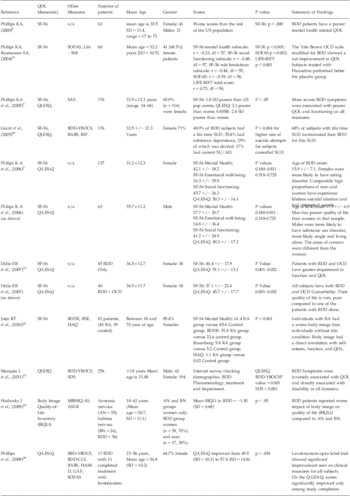
There is a paucity of studies of QOL in BDD. Most BDD research studies have used symptom severity measures mainly to study BDD and its treatments. However, using search strategy, we identified eight studies for the review. One more study comparing several measures of body image including QOL in anorexia, bulimia, and BDD, and another pilot study on the novel use of an approved medication, were added to results. The findings from the studies are highlighted in Table 2.
Studies on Quality of Life in Body Dysmorphic Disorder

Abbreviations
ASI-R: Appearance Schemas Inventory-Revised
BABS: Brown Assessment of Beliefs Scale
BDD: Body Dysmorphic Disorder.
BDDE: Body Dysmorphic Disorder Examination.
HAQ: Health Assessment Questionnaire.
IAT: Implicit Attractive Important.
MBSRQ-AS : Multidimensional Body-Self Relations Questionnaire-Appearance Scales
OCD: Obsessive Compulsive Disorder.
P: Power.
Q-LES-Q: Quality of Life, Enjoyment and Satisfaction Questionnaire.
QoL: Quality of Life.
RA: Rheumatoid arthritis.
RSE: Rosenberg Self-esteem Scale.
SD: Standard Deviation.
SDS: Sheehan Disability Scale .
SOFAS: Social and Occupational Functioning Scale.
SUD: Substance Use Disorder.
YBOCS: Yale Brown Obsessive Compulsive Scale.
Here we discuss the findings from the literature review as they relate to the research topics we posed in the Introduction to this article.
1. How does BDD affect QOL?
BDD patients frequently report low health-related QOL,Reference Phillips8 including decreased general mental health, enjoyment, social adjustment, and social functioning.Reference Didie, Tortolani and Walters13 QOL factors affected by BDD include family life, well-being, and job security. Patients with BDD have lower income, less likelihood of living with a partner, and a higher unemployment rate than the general population.Reference Rief, Buhlmann, Wilhelm, Borkenhagen and Brähler2
Studies have shown that patients with BDD have notably poor mental health status and mental health–related quality of life (mental health, role limitations due to emotional problems, and social functioning). A study comparing BDD patients to anorexia nervosa (AN) patients, bulimia nervosa (BN) patients, and normal controls, revealed that BDD has a more negative impact on QOL than AN and BN, as measured using the BIQLI.Reference Hrabosky, Cash and Veale14 Physical health–related quality of life (physical functioning, role limitations due to physical problems, and bodily pain) was also affected in patients with BDD, but this was not as significant as the effect on mental health–related quality of life.Reference Phillips8 Evidence shows that the greater the severity of BDD symptoms, the higher the association with poorer mental health–related quality of life. In a cross-sectional study using multivariate regression analysis, Marques etal. found that more severe BDD symptoms, older age, female gender, no medical insurance, and more body parts of concern to be negative predictors of QOL, i.e., more significantly associated with QOL impairment.Reference Marques, Leblanc and Robinaugh15
It is clear from the studies that BDD patients not only suffer from the impact of symptom severity and functioning impairments, but also BDD has a significant negative impact on QOL. Future investigations should examine if QOL improves as symptom intensity decreases in longitudinal studies (with or without treatment), and target the factors that contribute to QOL impairments in mild, moderate, and severe BDD over time.
2. What is the impact of psychiatric comorbidity on QOL in BDD?
There are a number of psychiatric disorders that are highly comorbid with BDD, such as depression, obsessive compulsive disorder (OCD), eating disorders, social phobia, and substance use,Reference Phillips, Pagano, Menard and Stout16, Reference Crerand, Phillips, Menard and Fay17 with one disease aggravating or fueling the other.Reference Rief, Buhlmann, Wilhelm, Borkenhagen and Brähler2, Reference Phillips, Menard and Fay5 When combined, OCD and BDD create higher impairment on QOL, which suggests that the two are additive or synergistic.Reference Nachshoni and Kotler18 Coles etal. in 2006 made a clear statement in favor of a direct relationship between social phobia and BDD with 39.3% (n = 178) of patients with lifetime comorbidity.Reference Coles, Phillip and Menard19 Eating disorders have been studied and reported as comorbid factors in BDD.Reference Ruffolo, Phillips, Menard, Fay and Weisberg4 In this study, 32.5% of the patients had a comorbid lifetime eating disorder, with 9% having AN, 6.5% with BN, and 17.5% experiencing an eating disorder not otherwise specified (NOS). The need for more intensive mental health interventions (regular psychotherapy sessions and psychotropic medications) for patients with combined BDD and eating disorder is higher than for patients with BDD and no eating disorder.Reference Ruffolo, Phillips, Menard, Fay and Weisberg4 Grant etal. found that 68% of subjects with comorbid substance use disorders (SUD) blamed BDD for their substance use.Reference Grant, Menard, Pagano, Fay and Phillips20 The reasons for the elevated rate of lifetime SUD among BDD subjects are unclear, although one possibility is the unusually high levels of distress reported by patients with BDD.Reference Grant, Menard, Pagano, Fay and Phillips20 Recognizing the relationship between BDD and SUD is important, as identifying and treating SUD may significantly improve the prognosis of BDD.Reference Fals-Steward and Schafer21, Reference Gunstad and Phillips22
A few studies were performed on the impact of comorbidity on QOL in BDD. A study on 210 OCD subjects compared the QOL and the functioning of the patients. Forty-five subjects were affected with BDD only, and 40 presented with both disorders. The study showed that patients with BDD have lower QOL than controls, and those with both OCD and BDD had even poorer QOL than either of the former groups.Reference Didie, Walters and Pinto23 Studies of comorbid BDD and major depressive disorder (MDD) showed significant associations, with improvement in major depression predicting BDD remission, and vice versa.Reference Phillips and Stout24
The results suggest that psychiatric comorbidity adds further to QOL impairments in BDD. There seems to be a tremendous need for further investigation of QOL in conditions that are commonly comorbid with BDD, such as depression, which has its own independent significant impact on QOL.
3. How does treatment of BDD affect QOL?
Despite the fact that BDD patients tend to seek cosmetic rather than psychiatric treatment, empirical support has been shown for psychopharmacological interventions and CBT for BDD,Reference Phillips and Hollander25–Reference Phillips and Menard28 but not for cosmetic or dermatological interventions.Reference Crerand, Phillips, Menard and Fay17
Psychopharmacological interventions
Body dysmorphic disorder–related distress, depressive symptoms, anxiety, anger/hostility, functioning, and suicidality often significantly improve with SSRIs.Reference Grant and Phillips27 However, studies of the impact of psychiatric medications on QOL in BDD are scarce. In a study conducted by Phillips and Rasmussen in 2004,Reference Phillips and Rasmussen11 the investigators found that patient QOL and psychological functioning improved more with fluoxetine compared to placebo after 12 weeks of treatment as measured by the SF-36, Social and Occupational Functioning Assessment Scale (SOFAS), and Longitudinal Interval Follow-up Evaluation–Range of Impaired Functioning Tool (LIFE-RIFT). Improvements were highly correlated with improvement in body dysmorphic disorder symptoms on SOFAS and LIFE-RIFT scales and were less noticed on the SF-36 scale. However, fluoxetine responders improved more significantly on the SF-36 mental component scale and on the SF-36 social functioning subscale compared to fluoxetine nonresponders. For all 60 subjects, a decrease in severity of BDD was significantly correlated with improvement on all measures of QOL.Reference Phillips and Rasmussen11 A pilot study of 17 subjects exploring the efficacy and safety of the antiepileptic medication levetiracetam revealed statistically significant improvement of BDD symptoms. QOL improvement, as measured by the Q-LES-Q, reached statistical significance only for study completers (n = 11, p < 0.034).Reference Phillips and Menard28
CBT
Although a meta-analysis of BDD randomized clinical trials conducted by Williams etal. in 2006Reference Williams, Hadjistavropoulos and Sharpe26 suggested that CBT may be the most useful treatment, the impact of CBT on QOL in BDD was not formally studied in the research studies.
Improvements in quality of life and functioning have the potential to improve patients’ treatment adherence, reduce the economic impact of BDD, and enhance long-term treatment outcomes of BDD.Reference Marques, Leblanc and Robinaugh15 The impact of treatment of BDD on QOL requires more investigation with large-sample longitudinal clinical studies testing the impact of medications, psychotherapy, and their combination on QOL.
Conclusions
Despite the fact that QOL in BDD is poorly studied, this initial review shows that QOL is gravely impaired in patients with BDD. BDD affects a broad range of domains for QOL. Awareness of psychiatric comorbidity is important in order to better assess and treat individuals with BDD as these individuals do experience much poorer functioning and QOL. Initial evidence shows positive impact of pharmacological and psychotherapeutic interventions on QOL in BDD. As BDD has been traditionally under-diagnosed, it is important to examine and understand the effects of BDD on all domains of mental and physical health. Using QOL as one of the primary measures of the negative effects of BDD could add significant value to the assessment of BDD, e.g., by providing more information and clearer understanding on the impact of the illness. This includes satisfaction with activities of daily life and overall sense of wellbeing before and after treatment. Future studies should give more attention to investigating the factors that might potentially affect the interaction between BDD symptom severity, functioning, and QOL.
Disclosures
Waguih William IsHak, MD, has received research support from NARSAD (quality of life in major depression) and Pfizer (ziprasidone monotherapy for major depression). The remaining authors have nothing to disclose.