Introduction
What drives East Asian regionalism? The rise of China and the perceived decline in the influence of the United States have sparked debates about the future of the regional order, including the yet-unresolved question of whose leadership is likely to be more stable and accepted as legitimate by other regional actors. Those who put emphasis on the US-centered hub-and-spokes system of alliances in East Asia tend to endorse the view that China's rise can be managed and its powers bound into a broadened regional institutional setting.Footnote 1 In contrast, some see China's resumption of regional leadership as an outgrowth of its ‘natural’ return to the center as the most dominant power. Given the long history of hierarchical order in Asia, it is argued East Asian states can be expected to gravitate toward a resurgent Middle Kingdom.Footnote 2
What is puzzling, however, is that persistent demands for the formation of a coherent and uniquely East Asian regional institution have come not from China, but rather Japan and South Korea, two key American allies. In the past decade or so, Japan and South Korea have respectively pushed for a pan-East Asian regionalism that includes China, but often not the United States.Footnote 3 At the same time, Japan and South Korea have rarely accepted China's leadership role in efforts toward regionalism.Footnote 4 In this article, we propose an alternative framework that conceptualises the varieties of East Asian regionalism, emphasising the multiple pivots and variegated levels of politics involved in efforts toward regional integration. We argue that Japan and South Korea have not been content to play the role of followers, as might be implied in existing accounts that highlight the role of Great Powers in forging regional stability and order. Japanese and Korean leaders have proposed their own alternative region-making initiatives at different time periods as a way to enhance their political standing domestically and regionally.
Consider the evolution of the East Asia Vision Group (EAVG), which served as an intellectual launch pad for the East Asia Summit (EAS). Proposed by South Korean President Kim Dae-jung at the 1998 ASEAN Plus Three (APT) meeting in Hanoi, Vietnam, the EAVG plan mandated a group of regional experts ‘to discuss the future of cooperation in East Asia and to submit recommendations’ to the fifth APT Summit in 2001.Footnote 5 The Final EAVG Report called for transforming the APT Summit to ‘an East Asian Summit, together with institutionalization of the East Asia cooperation process to create regular channels of communications and cooperation’. Not to be left out of this regionalisation process, the United States and China have since actively pursued becoming part of the EAVG-turned-EAS design spearheaded by South Korea. In November 2011, the United States finally joined the EAS as the 18th member at the Sixth Summit in Bali, Indonesia. The success of the EAVG in setting in motion the East Asia Summit suggests that the East Asian pursuit of regionalism cannot be fully explained by US or China-centric perspectives.
The case of the EAVG/EAS underscores another puzzle. Despite its initial momentum-building success, subsequent governments in South Korea and Japan have either shunned it or sought to replace it with alternative proposals. In general, leaders in both countries have promised to deliver new region-building initiatives rather than building on existing institutional frameworks. These persistent overtures and dialogues on regionalism have contributed to a surprising multiplicity of regional cooperation efforts in East Asia, ‘a region that is often perceived as being institutionally underdeveloped’.Footnote 6 The horizontal proliferation of regional institutions, however, does not necessarily translate into successful institution-building or regional cooperation.Footnote 7 Indeed, in East Asia, region-building initiatives, while enduring, have often been short-lived. Thus, it is important to examine not only the effects of institutions (on regional cooperation, for example) but also the factors that contribute to institutional development, such as institutional design, modes of conflict resolution, and – we argue – the multiple pivots behind the horizontal proliferation of regional institutions.Footnote 8
This study seeks to understand this growing institutional complexity in the East Asian region. Specifically, we ask the following question: why do Japanese and South Korean leaders promote different visions of regionalism? Perhaps more importantly, under what conditions do they seek to create new institutional frameworks rather than working within – or adding to – existing ones? Identifying the types and the underlying mechanisms of such multiple East Asian regionalisms is the central objective of this study. We find that competing versions of regionalism are not determined solely by structural power or the convergence of interests but are extensions of domestic debates on obtaining autonomy and status in the region and globally. We seek to provide a theoretical framework that takes into account both the content and contestation of domestic debates about regionalism.Footnote 9 In doing so, we aim to show how domestic political processes centered on enhancing political legitimacy produce different types of region-making initiatives, measured in terms of both membership as well as scope and cohesion of agenda.
A closer examination of Japanese and South Korean domestic debates on regionalism in the past two decades then reveals that these various region-making initiatives reflect politically contested views on how best to seek autonomy and status from the region's Great Powers, which has historically been a key source of political legitimacy for East Asian leaders in power. We focus on Japan and South Korea because studies of East Asian regionalism have tended to focus on Southeast Asia, leaving Japanese or South Korean initiatives relatively under-examined.Footnote 10 Furthermore, as US allies and long-time players in the postwar ‘hub-and-spokes’ system in East Asia, Japan and South Korea offer opportunities to examine the interesting interplay of institution-building contexts, both bilateral and multilateral.
In what follows, we discuss the theoretical context of this research and critically examine existing accounts of the varieties of regionalism. The next section provides an alternative account based on domestic legitimacy politics as shaped by the content and contestation of regionalisms within Japan and South Korea. We illustrate this logic by analysing Japan and South Korea's debates and policies with respect to regionalism since the early 1990s. The article concludes with a discussion of the theoretical and policy implications of such an analytical focus on multiple pivots and multilevel politics in studying East Asian regionalism.
Explaining the varieties of East Asian regionalism
Existing studies of East Asian regionalism have treated the multiple arrays of regional institutions and ideas as a reflection of a distinctive regional process shaped by both external and internal forces.Footnote 11 Due to different national priorities, it has been argued, there is a lack of converging interests among East Asian countries, and regionalism has developed differentially according to function (for example, financial, economic, or security regionalism).Footnote 12 On the economic front, the emergence of the ASEAN Plus Three (APT) and the Chiang Mai Initiative (CMI), a region-wide currency swap arrangement, has been attributed to the regional countries’ growing awareness of the need for a regional coordination mechanism in the wake of the Asian financial crisis of 1997–8 and the perceived role of the US and the IMF in exacerbating the crisis.Footnote 13 As a result, East Asian regionalism was predominantly economic in nature and influenced largely by a crisis-driven, problem-solving endeavour.Footnote 14 Unlike economic regionalism, which was shaped to a significant degree by exogenous shocks, security regionalism in East Asia, it is argued, has been more ad hoc in nature and emerged in response to ‘endogenous security problems of a much more particularistic character’.Footnote 15 Prominent examples include the Six Party Talks set up to address North Korea's nuclear pursuit in 2003 and the US-led Proliferation Security Initiative (PSI) aimed at preventing the spread of nuclear materials from North Korea to other countries.Footnote 16
Other scholars have tended to conceptualise regionalism as the result of bottom-up processes of preference formation driven primarily by domestic interest groups and other economic and societal actors.Footnote 17 Traditionally in East Asia, regionalisation, a process of ‘market-driven integration’ through trade and investment networks, has been one of the most prominent features of regional dynamics. This often came ‘without coordinated governmental involvement’, a key step toward regionalism.Footnote 18 The lack of progress in formal, institutionalised regionalism has been widely noted. According to Peter Katzenstein, a unique form of regionalism, which is largely informal, underinstitutionalised and network-based, resulted in Asia as a byproduct of a historically and domestically contextualised process. This ‘open regionalism’, he argues, is due to the dominance of the United States that has historically preferred bilateralism in the region and Asian states’ preoccupation with sovereignty and aversion to formal institutions.Footnote 19
The ‘open regionalism’ framework, based on US leadership, embedded in traditional regional security and economic structures, is being increasingly challenged by a set of new regional realities. Coupled with the perceived weakening of the US regional influence, the rise of China poses a long-term regional challenge that might potentially alter the US-led hub-and-spokes security structure. The region has also undergone a series of regional crises, such as the 1997–8 Asian financial crisis, the second North Korean nuclear crisis, and the 2008 global financial crisis, with limited US leadership in grappling with them. What emerged out of this new regional context is a rather dizzying array of regional institutional structures with multiple, overlapping institutional frameworks, each with different membership and functions.Footnote 20 These include the ASEAN Plus Three (APT), the Asia-Pacific Economic Cooperation (APEC), the ASEAN Regional Forum (ARF), and the Chiang Mai Initiative (CMI), the East Asia Summit (EAS), the Proliferation Security Initiative (PSI), and the Trans-Pacific Partnership (TPP). No longer satisfied with their earlier role as mere facilitators of regionalisation, and despite many lingering hurdles and underperformances, East Asian leaders have been eager to set the agendas and scope of regionalism. In the process, the region as a whole has been ‘moving rapidly beyond any one national model to the coexistence of several viable alternatives and the emergence of a truly hybrid form of regionalism’.Footnote 21
Such varieties of region-making initiatives suggest not only a multiplicity of national models, but also the increasing salience of the regionalism agenda in the domestic politics of East Asian countries.Footnote 22 Etel Solingen, for example, argues that the relative strength of different domestic coalitions (for example, internationalist or nationalist coalitions) shapes regional patterns of interaction.Footnote 23 From this vantage point, regionalism is likely to be promoted when integrationist coalitions prevail across the region. In the post-Cold War Southeast Asia, for instance, internationalising coalitions dominated ASEAN countries, helping their ruling allies adopt an integrationist strategy aimed at promoting foreign investment and trade.Footnote 24 Richard Stubbs also argues that the emergence and implementation of the ASEAN Free Trade Agreement (AFTA) was possible due to ‘a shift in the domestic balance of power between economic nationalists and liberal reformers’ sparked by changes in the regional and global economic contexts in the late 1980s and the early 1990s.Footnote 25
Highlighting the domestic determinants of regional policy outcomes, the coalitional account effectively shows different types of regional order (for example, open regionalism, hybrid, or limited regionalism) as outcomes. This model theoretically expects that there will be domestic political competition between nationalist (isolationist) and internationalist (integrationist) coalitions. Depending on the nature of the integrationist coalition, one can further predict different types of regionalism that emerge out of this process. For example, the dominance of the financial sector within the winning coalition would promote financial regionalism (for example, the emergence of the Chiang Mai Initiative after the Asian financial crisis), while the political sway of private business sectors can promote regionalism in the form of expanded production networks or increased investment flow. Applied to the situation concerning a rising China, the type of regionalism in Japan and South Korea would reflect the preferences of dominant coalitions in each country. Given the growing economic linkages with China, according to this logic, we would expect more comprehensive and extensive regional ties in the form of economic regionalism, which over time may spill over into the political and security aspects.
The situation in East Asia, however, does not appear to bear out this prediction particularly well. Leaders in power have not always responded to the interests of particular domestic coalition groups. They have more often than not pushed proactive regional initiatives of their own, reflecting the structural environment as well as domestic political conditions at a given time.Footnote 26 For instance, Abe Shinzo's ‘Arc of Democracy’ proposal highlighted the role of Japan, India, and Australia in a broadly conceived Asia-Pacific regionalism and was largely unrelated to economic interests. Moreover, it created anxiety for the Nippon Keidanren (or the Japan Business Federation) that was concerned about possible negative effects on Japan's economic relations with China.Footnote 27 Put differently, increasing demand on regionalism on the part of domestic coalitions may be a necessary, but hardly a sufficient, condition, as private actors often lack ‘political mechanisms to provide leadership, aggregate interests and convert them into policy’.Footnote 28 In East Asia, governments and leaders have played a key role in promoting and politically framing different ideas of exercising regional leadership and attaining external status, either regionally or globally.
Regionalism may also reflect broader political contestation about greater foreign policy autonomy and/or international prestige and not merely the interests of the dominant coalition in power. Specific regional initiatives have not gone unchallenged, irrespective of the strength of the dominant coalition. For example, in South Korea, President Roh Moo-hyun chose to narrow the scope of regionalism to Northeast Asia, despite the earlier success of President Kim's EAVG in facilitating East Asian regionalism, in order to enhance South Korea's regional status and autonomy. In laying out his vision for the new Presidential Committee on Northeast Asian Cooperation Initiative (Dongbuka Sidae Wiwonhoi), Roh stressed that South Korea had traditionally been a country in the periphery of the region, but it should now aim for the hub of regional economy and politics in Northeast Asia.Footnote 29 Although emphasising economic cooperation and prosperity in the region, the central objective was to promote South Korea's regional leadership in the political and security arena.Footnote 30
As the linkages with a rising China multiply, domestic public debates on the future of the regional order have increased (and at times intensified), compelling some Japanese and South Korean leaders to seek less comprehensive and more ambiguous types of regionalism.Footnote 31 This is because the domestic politics surrounding regionalism is not just about the choice between nationalism and globalism, but what kind of integration path would promote maximum power, prosperity, and prestige. What the integrationist neoliberal consensus often assumes is that a yearning for regional (and national) autonomy can be set aside for the greater benefits of economic linkages and prosperity.Footnote 32 This may be rational for individual actors, but not always for national governments, whose promotion of region-making proposals often involve narratives about both international status and prestige on the one hand and greater autonomy and independence on the other.
The argument: domestic legitimacy politics and region-making initiatives
The above discussion suggests that East Asian regionalism is not simply a byproduct of either government reactions to changes in the external structural conditions or a direct translation of the material preferences of powerful interest groups within each country. Regionalism in East Asia has not been purely reactive or crisis-driven.Footnote 33 As evident in the case of the ASEAN Regional Forum (ARF), East Asian leaders turned to regionalism prior to the Asian financial crisis. Japanese and South Korean leaders have proactively launched regional initiatives with the goal of enhancing political legitimacy. While strengthening alliance ties and broadening institutional links may be at times necessary for regional leaders, these strategies also come at the cost of foreign policy autonomy and thus political legitimacy. Seen in this light, Japan's push for regionalism is to ‘enhance regional influence in a nonthreatening manner and to reduce its dependence on bilateral bargaining with the U.S.’Footnote 34 This is precisely why, contrary to the expectations of the US-led balancing/binding mechanisms or the China bandwagon, Japanese and South Korean governments have rarely assumed or accepted unquestioned American or Chinese leadership roles in regionalism. In other words, there are no ‘natural’ leaders and obvious followers in East Asian regionalism; leadership remains variable and contested.
Rather, the varieties of regionalism that have been pursued in East Asia reveal long-standing domestic legitimacy politics concerning relations with recognised Great Powers in the region. Tsuneo Akaha observes that foreign policy – including that toward the Korean peninsula – has legitimated Japanese leaders through the following mechanisms: public appreciation for ‘bold diplomacy’ or the appearance of standing up to pressure from powerful regional actors (including the United States).Footnote 35 Since the early 1990s, proposals for regionalism have served as conduits for Japanese and Korean leaders to generate domestic support and enhance international status – at the regional or global levels. These visions of regionalism are not merely rhetorical devices to promote national prestige and regional cooperation, however.Footnote 36 They also reflect attempts by political leaders to pitch their own brand of regional leadership, one that is fundamentally different from their predecessors or political opponents. For example, despite the relative success of high-profile regional initiatives such as the East Asia Vision Group (EAVG) and the East Asia Study Group (EASG) set up by former South Korean President Kim Dae-jung, subsequent administrations have refused continued support.Footnote 37
Why then do ideas of regionalism and region-building initiatives legitimate leaders? We posit that regionalism proposals contain foreign policy goals and content that signal continuity or change to domestic audiences. It is important to note that regionalism is not a shared idea – either at the regional or domestic levels – in East Asia. Thus, region-building initiatives reflect competing and contested ideas in Japan and South Korea about global engagement, including and especially their relations with the United States and China. This is why attempts to put forth calls for regional leadership have not been uniformly legitimacy-generating for governments in power; different region-making initiatives have had variable costs and benefits. For example, regionalism initiatives failed to enhance the legitimacy of either Roh Moo-hyun or Hatoyama Yukio, who suffered political setbacks due to general confusion and backlash against their regional proposals. There is no national – much less regional – consensus on what type of regionalism to pursue. Multiple versions of integrationist initiatives are domestically contested, and diversions from existing policy platforms are politically consequential.
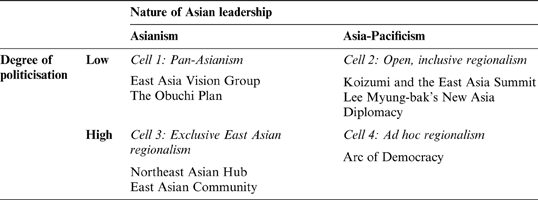
The varieties of region-making initiatives in East Asia then are the result of leaders’ attempts to generate or enhance legitimacy and the extent to which their visions are politically contested in the public arena. Specifically, such domestic legitimacy politics are shaped by the following two dimensions: (i) the content and nature of Asian leadership, related to issues of regional boundaries and membership (for example, Asian-only regionalism vs. Asia-Pacificism); and (ii) the degree of domestic (and sometimes regional) politicisation over the proposed region-making initiative (for example, low versus high levels of political contestation). In terms of the content of regional leadership, Japanese and South Korean leaders have tended to claim regionalism as a path toward greater autonomy and reduced dependence on external powers or pressures. But while some leaders have interpreted autonomy to mean diversification and multi-level, multitiered diplomacy,Footnote 38 others have emphasised greater involvement and leadership at the regional level within the US-led alliance system and adherence to global standards or appeals to universal values. In light of the rise of China, debates on autonomy and regional leadership in Japan and South Korea have led to the emergence of different proposals for region-building: one which promotes ‘Asia for Asians’ and the other drawing a more inclusive, US-oriented boundary for membership.
The tension between Asianism and Pacificism has its origin as far back as Fukuzawa Yukichi's nineteenth-century notion of whether Japan should get out of Asia and join the West.Footnote 39 However, this ‘general pattern of oscillation’ between an exclusive regionalism (that is, Asianism) and a more inclusive, open regionalism (that is, Pacificism) has recently been pronounced, as different leaders in the region have sought to respond to the changing regional order.Footnote 40 In dealing with China specifically, the Asianist camp may point to various regional initiatives by ‘pro-China’ governments and subsequent tensions in alliance relations with the United States. In contrast, the Pacificist camp would stress the role of the United States in regional security and point to the rivalry with China as a driver of regionalism. In Japan, for instance, some leaders have turned to Asianism in their efforts to bring China into a regional mechanism, while others have sought to ‘shape regionalism in a way that keeps China from dominating regional groupings’.Footnote 41 In this regard, it has been suggested that Japan's support for establishing the ASEAN Regional Forum (ARF) was partly to incorporate China into a regional framework,Footnote 42 whereas others view Japan's push for regionalism as a competition with China over regional leadership.Footnote 43 As examined below, a similar vacillation exists in South Korea between Asianism and Pacifism in dealing with China.Footnote 44
A second factor shaping the domestic politics of regionalism is the degree of political contestation. Regionalism initiatives can enhance or reduce the legitimacy of leaders depending on how much politicisation and opposition it generates. Because the question of how best to manage Great Powers in the region has been deeply contested throughout the region's history, regionalism has been a salient, and often controversial, issue. Important foreign policy decisions in Japan and South Korea, and politics surrounding the nature of alliance relations with the United States including the ‘choice’ between US-oriented bilateralism and a more region-centered multilateralism, have been at the center of party (and factional) politics in both countries.Footnote 45 Due to the strategic and political value attached to alliance relations, attempts to shift away from the postwar US alliance-centered security consensus have resulted in the mobilisation of various societal groupsFootnote 46 as well as generating heated political debate among existing political institutional forms (such as political parties, bureaucratic organs, etc.). In general, conservative leaders and parties in Japan and South Korea have been rather minimalistic in their calls for changing the political and economic regional framework, while liberal-leaning parties have shown bolder region-centric initiatives.
The most contested ideas of regionalism have emerged in Japan and South Korea during leadership transitions, involving either shifts in party positions or intra-party (factional) competition. For example, Hatoyama and the DPJ represented an era of ‘new Asianism’ in postwar Japanese politics, highlighting their ideological distance from the long-dominant LDP.Footnote 47 In the case of Roh and Abe, their proposals for regionalism were more extreme versions of the moderate positions espoused by their former and current party (or coalition) members. Roh pushed Kim Dae-jung's vision of ‘soft’ Asia-centrism to a more narrowly-defined Northeast Asia Hub, whereas Abe took Koizumi's widely accepted alliance-centric global contribution model to a China-repelling grouping of democratic nations. Such political ‘outbidding’ politicises, and sometimes polarises, specific foreign policy decisions involving intra-alliance politics as well as regionalism and have resulted in policy and institutional changes.Footnote 48
Often, the framing of new region-making proposals is critical. When leaders tend to put too much emphasis on ‘reverse course’ – that is, attempts to differentiate themselves from their predecessors’ policies – they become subject to widespread criticism of catering to Great Powers. For example, when South Korean President Roh Moo-hyun and Japanese Prime Minister Hatoyama each presented their own visions of autonomy-enhancing East Asian regionalism, they were met with accusations of trading one hegemon (US) for another (China). The political context at a given time is important as well, since heightened political competition (during election year, for example) or public foreign policy disagreements or disputes with the US or China can exacerbate existing tensions or make policy decisions more salient or contentious.
As shown in Table 1, depending on the relative strength of each category in a given time period, four different types of regionalism have resulted in the past two decades. East Asian regionalism is not necessarily US-driven or China-driven. There are significant and consequential variations in conceptions of regional boundaries and goals. These variations are a manifestation of long-standing domestic legitimacy politics – that is, different types of regionalism result from how (much) it is politically contested at the domestic level. In the following section, we examine each of the different types of regionalism in detail. While existing accounts have focused on critical junctures determined by external events, such as the Asian Financial Crisis of 1997–8 or the rise of China, as key turning points in East Asian regionalism, we show that regionalism has been a major part of the foreign policy agendas of successive Japanese and Korean governments since the early 1990s.
Types of Japan or South Korea-led East Asian regionalism initiatives

Case Studies of East Asian regionalism
Cell 1: Pan-Asianism
Although the idea for an exclusively Asian region had been debated in discussions of economic and political integration, the pursuit of a distinctive form of ‘East Asian regionalism that intentionally excludes “outsiders” and which is effectively a repudiation of the “Asia-Pacific” idea’Footnote 49 began to formally coalesce after the 1997 financial crisis. For instance, Chinese discontent with solutions prescribed by the International Monetary Fund (IMF) contributed to an increasing sense of a pan-Asian identity within the leadership and reinforced their sense of resentment against the perceived dominance of the West. The Chinese government participated in the creation and implementation of the Chiang Mai Initiative and also actively supported a series of East Asian financial cooperative arrangements.Footnote 50
For the Japanese, the Asian financial crisis revealed not only its high stakes in Southeast Asia but also its limited ability to take leadership in the region. In order to compete with China's growing influence in the region, especially over the Southeast Asian countries, and to seek alternatives to American-led institutions, the Japanese government began to proactively take larger steps to build an East Asian regional framework. In 1998, Prime Minister Obuchi promoted his plan of commencing an ‘intellectual dialogue for the creating of Asia's future’ highlighting ‘human security’ as a possible area for cooperation.Footnote 51 Japan demonstrated a more active interest in the ASEAN Plus Three (APT), successfully convening a Japan-China-South Korea tripartite breakfast meeting in November 1999.Footnote 52 Obuchi also announced the Plan for Enhancing Human Resources Development and Human Resources Exchanges in East Asia, dubbed ‘the Obuchi Plan’ by the Philippine President Joseph Estrada.Footnote 53 In a marked shift from Japan's earlier aid efforts for Southeast Asia focused on short-term emergency financial assistance, the Obuchi Plan stressed ‘support for longer-term recovery and development’.Footnote 54 The Obuchi cabinet also made careful attempts ‘to strike a balance between the United States and Asia, especially focusing on South Korea’.Footnote 55
Even though this new push was partly motivated by the desire to restore Japan's economic leadership credentials in the region, the Obuchi Plan was not a notably new regional initiative. It represented a continuation of the Hashimoto Doctrine of 1997, which had called for strengthened economic cooperation with the ASEAN countries as well as greater cultural exchanges and leader dialogues.Footnote 56 The Hashimoto Doctrine in turn was motivated by the desire to promote multilateral frameworks – both economic and political – in the region in order to carve out alternative and autonomous mechanisms. For example, the Japanese government became more interested in the ASEAN Regional Forum (ARF) as a venue for promoting multilateral security and reassuring Asian neighbours of their security concerns. As observed by Takeshi Yuzawa, ‘Japan's continuous support for the ARF reflects its long-standing thinking that strengthening Japan-US security cooperation alone is inadequate for enhancing Japan's as well as regional security’.Footnote 57
This Asia-focused direction taken by Japan was not met with much resistance from regional or domestic audiences. Japanese firms in particular were especially supportive of regional economic initiatives, including developments in technology and technical standards. Under the new permissive context in the early 2000s, China, and South Korea have cooperated on joint research and development, standards, and personnel training in order to offset American dominance in telecommunications, culminating in a 2004 plan by the Japanese Ministry of Internal Affairs and Communications ‘to build an Asian Super High-speed Information Network that would be centered in Japan and cover Asia with a fiber optic cable and super high-speed Internet satellite’.Footnote 58
In the aftermath of the Asian financial crisis, there were similar attempts by South Korean President Kim Dae-jung to pursue East Asian regionalism as a way to reduce dependence on the US, even as he actively sought American and IMF assistance. He stated that, ‘Northeast Asia has no economic community and is, therefore, vulnerable to financial crises whenever one occurs within the region. Countries in the region need to cooperate in order to survive the global competition.’Footnote 59 As a diversification strategy, he used the inaugural ASEAN Plus Three (APT) summit in 1998 to propose the creation of the East Asia Vision Group (EAVG). The EAVG received wide attention from the APT states, whereby a group of scholars were engaged in providing a blueprint for the concept of an East Asian community. In order to further the development of regional cooperation, a group of government officials, the East Asia Study Group (EASG), were assembled to discuss the EAVG's recommendations.Footnote 60 The EASG final report made 17 short-term recommendations and nine medium-to long-term recommendations, including the establishment of an East Asian Free Trade Area, further trade liberalisation for developing economies, the establishment of a regional financial cooperation mechanism, and the creation of an East Asia Summit.Footnote 61
Kim's vision of East Asian regionalism received support from other Asian countries.Footnote 62 Kim offered support to Japan's AMF proposal and agreed to discuss a free trade area (FTA) with Japan.Footnote 63 China also supported this South Korean-led regional initiative as a way to gain leverage in relations with the US and to restore relations with Japan.Footnote 64 South Koreans viewed the newly emerging regional network, including both China and Russia, as an opportunity to draw North Korea into a multilateral framework.Footnote 65 Although the APT and other proposals were not fully realised, it was the first effort by the South Korean leadership to introduce an alternative, more autonomous institutional framework.Footnote 66
Cell 2: Open regionalism
Seeking autonomy is a key foreign policy goal of most Asian governments, but some leaders have pursued autonomy largely within the confines of the US-led regional framework. Instead of highlighting regional cooperation, they prioritise adherence to global standards. Alarmed by the increasing regional influence of a rising China, Japanese leaders such as Koizumi Junichiro sought to put emphasis on a regionalism that is nested within the US-led regional system. The result was a ‘U.S. first, Asia second’ approach that was aimed at keeping the United States and other Asia Pacific countries engaged in an expansive version of regionalism, that is Asia-Pacificism.Footnote 67 A similar consideration shaped the strategic thinking of the Lee Myung-bak administration with its emphasis on alliance ties with the United States and South Korea's role in the larger regional and global contexts.
At the outset, however, the Koizumi government also focused inwardly on Asia, reaffirming Japan's role in Southeast Asia. One of his earlier foreign policy achievements was not the strengthening of the alliance, but a series of measures aimed at strengthening Japan's economic relations with the region, which included signing Japan's inaugural free-trade agreement with Singapore.Footnote 68 Similar to the Hashimoto Doctrine and the Obuchi Plan, Prime Minister Koizumi also made extensive trips to the region, resulting in plans for a ‘Japan-ASEAN Comprehensive Economic Partnership’ in 2002.Footnote 69 His May 2002 speech, entitled ‘The Future of Asia’, not only made pledges to improve the linkages between Japan and ASEAN but also to increase support for China, which led to the Initiative for Development in East Asia (IDEA).Footnote 70
What distinguished Koizumi's regional efforts from those of his predecessors, however, was the greater sensitivity shown toward a rising China. In fact, many believed that the Japan-ASEAN Comprehensive Partnership was ‘Tokyo's attempt to counter Beijing's growing influence in the region’.Footnote 71 In his proactive policy toward ASEAN, Japan's traditional image of playing ‘a mere economic role’ has been replaced by its growing interest in the ‘formation of a strategic partnership’ with the ASEAN states.Footnote 72 The linchpin of Japan's strategic vision, however, remained its alliance with the United States. Hence, Koizumi's regional vision more broadly encompassed countries in the Asia Pacific centered around the US-Japan alliance. The American-led wars in Afghanistan and Iraq gave additional boost to Japan's growing strategic role beyond the region. After the outbreak of the War in Afghanistan in 2001, the Koizumi administration swiftly adopted various domestic legislations to send Japan's Self Defense Force abroad. Earlier talks of regional leadership were increasingly overshadowed by an emphasis on Japan's global role.
Given Japan's troubled role in the region's past, Japan's growing security role raised concerns in the region, compounded by his repeated visits to the Yasukuni Shrine where a number of Japanese World War II war criminals are enshrined with the other war-dead. Within Japan, however, his proactive foreign policy faced little opposition, as the Koizumi government effectively framed Japan's global role as a meaningful contribution to the international community. Koizumi's approval ratings soared, and he was able to successfully use his regional policy to bolster political legitimacy. The end result was the emergence of a regionalism that included and emphasised the United States and its allies in the Asia Pacific. This was particularly the case in the formation of the East Asia Summit (EAS). Initially conceived as an indigenous East Asian institution, the regional body's membership expanded, including Australia, New Zealand, and India. For instance, Tanaka Hitoshi, vice minister at the Ministry of Foreign Affairs during the Koizumi years, made particular efforts to include Australia as a founding member of the EAS.Footnote 73
Similarly, conservative-leaning governments in South Korea have tended to define Asian regionalism as part of a broader foreign policy platform, one that tends to emphasise the maintenance of close alliance relations with the United States and global economic integration. Following a period of two consecutive presidencies by left-leaning, progressive governments, the general direction of the Lee Myung-bak government's ‘New Asian Diplomacy’ has been to ‘expand and revitalize the pan-Pacific cooperation under the leadership of the United States’.Footnote 74 In contrast to his predecessors, President Lee has emphasised improving ties with states outside of Northeast Asia, expanding levels of development assistance and economic cooperation with ASEAN states, countries in Central and South Asia, Australia, and New Zealand.Footnote 75
The Lee government's decision to seek a regional leadership role within the alliance mechanism and expand the boundaries and scope of regionalism was in part sparked by a ‘domestic political calculus to differentiate itself from previous progressive governments’.Footnote 76 Attacking the regional policy of his predecessor, Roh, as a key factor undermining the alliance, the Lee government sought to ‘restore the alliance by proposing the strategic alliance on common value, mutual trust, and peace-building of global reach’.Footnote 77 In financial regionalism, the Lee administration has also been ‘taking side with the United States’ and ‘shying away from radically reforming the IMF’, a stance that is a contrast from China and other newly emerging economies which have pushed for a transformation of the global financial system.Footnote 78
The emphasis on the US-led regional framework, however, is likely to ‘delimit South Korea's diversification efforts such as East Asian financial regionalism’.Footnote 79 As a result, instead of pursuing regional autonomy and leadership credentials through East Asian regionalism, the Lee government sought to improve South Korea's status in the larger international arena and to assume a global leadership role through multiple avenues. For instance, highlighting South Korea's hosting of the G-20 Summit in November 2010 and joining of the Development Assistance Committee (DAC) of the Organization for Economic Cooperation and Development (OECD), President Lee's advisor for foreign policy and national security Kim Sung Hwan maintained that the Lee government's goal was to enhance South Korean gukgyuk Footnote 80 (or national prestige) on the global scene and to make the country become a global player in peacekeeping and cultural diplomacy.Footnote 81 In policy toward North Korea as well, the Lee government stressed the global dimension, calling for building ‘a global network for a unification vision’.Footnote 82 Given this shift toward a more globally-oriented policy framework, it is not surprising that Lee has shown an interest in regional dialogues such as an ‘ASEAN+5’ that includes Australia and New Zealand and former Australian Prime Minister Kevin Rudd's notion of the ‘Asia-Pacific community’ which spans the entire Asia-Pacific region.Footnote 83
Cell 3: Exclusive regionalism
At first glance, Japanese Prime Minister Hatoyama Yukio's call for an ‘East Asia community (EAC)’ and South Korean President Roh Moo-hyun's vision of turning South Korea into ‘a hub of the Northeast Asian integration’ may appear similar to other, previous proposals for pan-Asian regionalism. Hatoyama's and Roh's attempts to seek regionalism as a legitimacy-enhancing strategy, however, faced intense political contestation in Japan and South Korea, resulting in a narrower – that is, based on East Asia or Northeast Asia – and conceptually more ambiguous form of regionalism, as manifested in Hatoyama's EAC proposal and Roh's Dongbuka Sidae Gusang (Northeast Asian Cooperation Initiative).
Determined to dissociate the Democratic Party of Japan (DPJ) from the old Liberal Democratic Party (LDP) mantra of prioritising the alliance first and foremost, the Hatoyama administration turned again to an East Asia-centric regionalism. His call for an East Asia community was the result of regional policy initiative centered on ‘anything but [the] Liberal Democratic Party’, including his ‘assertive efforts to resolve history issues, seek a more balanced diplomacy between China and the United States, and renew Asian diplomacy, while hesitating to accommodate American demands on its Okinawa military base’.Footnote 84 Hatoyama's concern about dependence on the US as a source of regionalism was exemplified by his discussion with Chinese and South Korean leaders about Japan's tendency ‘to depend too much on the United States’, which in turn led to Assistant Secretary of State for East Asian and Pacific Affairs Kurt Campbell's warning that this ‘would create a crisis in U.S.-Japan relations’.Footnote 85
Hatoyama emphasised the term yuuai (fraternity) among Japan, Korea, and China as a central pillar of an East Asian community. He traced its origins to his grandfather, Prime Minister Ichiro Hatoyama, who had in the early postwar period been also ‘unhappy about Japanese diplomacy that relied heavily on the United States and had felt the need to inculcate the good neighborly relations with Korea and China’.Footnote 86 In 1996, the DPJ leaders, including Hatoyama, had drafted a manifesto for the Party, whose foreign policy orientation was focused narrowly on Northeast Asia:
We must turn away from our excessive dependence on the U.S., and while deepening Japan-U.S. relations and bringing them to a new dimension, we must give greater weight to our relationships with the countries of the Asia Pacific. Resting firmly on the foundation of our Constitution's peace principles, and a historical consciousness based on facts, we will take our place as a member of Northeast Asia and gain the trust of others.Footnote 87
The DPJ's 2007 campaign message was more specific. While emphasising the need to forge ‘a strong and equal U.S.-Japan relationship’, it called for an immediate ending of the dispatch of Self Defense Forces to Iraq. It also stressed the goal of ‘[d]eveloping relations of mutual trust with China, South Korea, and other Asian nations.’Footnote 88 Once in power, the Hatoyama government was also insistent on its campaign pledge to renegotiate the Futenma base relocation agreement with the United States.Footnote 89
This ambitious, autonomy-seeking regional drive, however, was not without its detractors. In fact, the specific agendas of the new regional vision were hotly contested even within the party itself. While some highlighted the central role of China, Japan, and South Korea, others such as Maehara Seiji demanded that the regional mechanism ‘should be open to the United States, India, and other countries’.Footnote 90 Amidst this internal ambiguity within the ruling party, the idea of the East Asian Community gained little traction – domestically or regionally. For instance, one Chinese analyst pointed out that if Hatoyama's EAC vision was ‘designed to be an open organization with the same goal of promoting regional cooperation like the existing mechanism, the establishment of such Community is hardly meaningful’.Footnote 91 Another expert of the Chinese Academy of Social Sciences went even further by saying that the EAC plan represented Japan's efforts to build ‘a “Japan-led order in Asia” driven by a sense of rivalry with China’.Footnote 92 Hatoyama's vision was further undercut by tensions between Japan and China over the disputed Diaoyu/Senkaku Islands in October 2010.
In striking similarity to Hatoyama's regional vision, South Korean President Roh Moo-hyun also sought to strengthen South Korea's relations with China and Japan, while largely maintaining a degree of ambivalence about the role of the United States in the region.Footnote 93 Specifically, the Roh government launched a foreign policy initiative centered on Northeast Asia, dubbed ‘the Northeast Asian Cooperative Initiative for Peace and Prosperity’, a regional master plan representing a ‘long-term strategy and vision for creating peace and common prosperity in Northeast Asia by shaping a new regional order based on mutual trust and cooperation’.Footnote 94 In the security arena, Roh promoted the Six Party Talks not just as a forum for resolving the North Korean nuclear problem but, more importantly, as a stepping stone for a peace regime on the Korean peninsula and security cooperation in Northeast Asia.Footnote 95 The Roh government's narrow focus on Northeast Asia was also echoed in the economic realm as South Korea centered its plan for regional economic integration on ‘the Yellow Sea basin, encompassing northern China, the Korean peninsula, and Japan’, thereby effectively transforming Korea into ‘the geographical centre and a core transportation hub’.Footnote 96
In 2005, Roh went even further to suggest South Korea's role as a regional ‘balancer role’ (gyunhyungja-ron).Footnote 97 Initially, his autonomy-seeking regional vision was popular among the South Korean public. According to a 2005 poll, 63.6 per cent of respondents endorsed South Korea's balancer role as ‘an indication of a determined pursuit of proactive diplomacy’.Footnote 98 Over time, however, Roh's ‘balancer role’ policy initiative came to be viewed as undercutting the political-economic foundations of security cooperation with the US, alarming opinion leaders in both Washington and Seoul.Footnote 99 Lawmakers in the opposition party, the Grand National Party, were particularly angered by the strained alliance ties. South Korea's balancer role was not well received in the region either, as Japan did not accept South Korea's self-proclaimed position as the ‘hub of Northeast Asia’.Footnote 100 By the time the first East Asia Summit was about to convene, the gulf between China and Japan ‘had widened too far for South Korea to have any hope of bridging it’.Footnote 101 Amid such internal and external resistance, Roh's Uri Party suffered electoral defeat, and paved way for the rise to power of the conservative candidate Lee Myung-bak.
Cell 4: Ad hoc regionalism
While broader notions of Asia-Pacific regionalism have not been particularly controversial for leaders such as Koizumi and Lee Myung-bak, recent attempts at forging regional cooperation have been less coherent and at times criticised as being too dependent on American leadership or even subservient to American goals. Examples of regional problem-solving approaches that have been ad hoc but also complementary to, and supportive of, existing bilateral relations include the Container Security Initiative and the Proliferation Security Initiative, both intended to prevent the transfer of sensitive technologies and weapons of mass destruction into terrorists’ hands or reaching American shores, and the US-initiated Asia-Pacific Partnership on Clean Development and Climate (APPCDC).Footnote 102
The rise of ad hoc regionalism came amid the changing domestic and regional contexts. The continuing nuclear situation in North Korea pushed the Japanese right to ‘closer ties with the United States and lowered interest in “Asianism”’.Footnote 103 In its agreement with the United States on the restructuring of US forces in Japan, the first Abe government (2006–7), also sought to ‘integrat[e] the forces of the two countries, especially their intelligence and command functions, and transforming Japan's Self-Defense Forces into a junior partner of the United States in the “global war on terror”, as the “Great Britain of East Asia.”’Footnote 104 The Abe administration, however, had to address the perceived strategic dependency on the United States. In the midst of declining public support and heightening domestic political competition, Abe articulated a vision of a democratic alliance in Asia, with an emphasis on shared ‘universal values’, going beyond Koizumi's globally-oriented regionalism. Abe's regionalism envisioned increased cooperation among the four great Asian-Pacific democracies in Asia – that is, Australia, Japan, India, and the US At the same time, Abe strongly advocated the principle of separating politics and economics in Japan's relations with China, ‘implying that it is possible to sustain good bilateral economic relations while political relations remain problematic’.Footnote 105
Aso Taro, Abe's foreign minister and later prime minister in 2008–9, went even further, proposing the building of ‘“the arc of freedom and prosperity” around the outer rim of the Eurasian continent’, based firmly on the goal of strengthening the Japan-US alliance.Footnote 106 The proposal has as its basic focus ‘three focal areas of the United States, the United Nations, and Asia’. In this regional vision, he also launched talks to conclude economic partnership agreements (EPAs) with India and Australia, with ‘implications of this go far beyond the realms of economics or trade’.Footnote 107
In order to address domestic concerns about the increasing Chinese influence – both economic and political – a succession of Japanese leaders have begun to put an increasing emphasis on ‘values-oriented diplomacy’ and the use of ‘principled’ multilateralism among like-minded countries on key issues such as democracy, human rights, and the rule of law.Footnote 108
Overall, the first Abe administration's new regional approach, especially in its application to Southeast Asia, marked a sharp break from the Fukuda Doctrine under which Japan sought to bridge the communist and capitalist camps, while avoiding ‘taking an ideological or interventionist approach in Southeast Asia’.Footnote 109 In addition, this was a major shift from earlier emphasis on Asian values as well. In March 1994, for instance, Prime Minister Hosokawa Morihiro told Chinese Premier Li Peng ‘it is not sensible for Western countries to impose their own values of democracy upon other countries’.Footnote 110 While the governments of Abe and Aso have been relatively short-lived, the effects of these initiatives have been to reinforce an ad hoc approach to regionalism, including an uneasy coexistence between the APT and the Japan-led EAS.Footnote 111
Conclusion
This article provides an analytical framework that helps explain the varieties of regionalism in East Asia as shaped by domestic legitimacy politics. By examining some of the causal mechanisms behind the domestic politics of proliferating regionalisms, and outlining the conditions under which we are most likely to see intensified political contestation, we seek to contribute to the literature on East Asian regionalism and comparative institutions.Footnote 112 The findings of this research have shown that regionalism, a key manifestation of the changing regional order in East Asia, is not uniform. Japanese and Korean leaders, under different domestic political circumstances, have pursued different types of regionalism.
In promoting regionalism, both Japanese and South Korean leaders have stressed the importance of international status and regional autonomy. They have done so because they believe that such framing of their region-building initiatives will enhance their political legitimacy at home. Leaders in Japan and South Korea also share their oscillation between an exclusively Asian regionalism and an inclusive Asia-Pacific regionalism that includes the United States. The push for regionalism in both countries has been particularly strong during major shifts in leadership and intra-party dynamics as political actors jockey for power and standing.
Despite these overall similarities, Japan and South Korea differ in their pursuits of regionalism with regard to geographic scope and specific focus. Owing to South Korea's peninsular location and the domestic political salience of inter-Korean relations, South Korean leaders tend to highlight a Northeast Asian regionalism, often placing their nation at the hub of regional economy and security cooperation while seeking to lure North Korea into a multilateral regional setting. In contrast, Japanese leaders in general emphasise a model of institutional cooperation encompassing the entire East Asian region, including Southeast Asia where Japan's influence and leadership have traditionally been recognised by its domestic and regional audiences. While vacillating between Asian regionalism and Asia Pacific regionalism, Japanese leaders, unlike their South Korean counterparts, have also increasingly highlighted the rivalry with China, thereby seeking a regionalism nested within the US-centered regional framework or taken even further, one that is centered on democratic values and political freedom, as evidenced in the Arc of Democracy initiative.
These varieties of regionalism matter in East Asian international relations, as they circumscribe the possible boundaries and scope of foreign policy. The varieties of regionalism in East Asia also have larger implications on both theoretical and policy grounds. Theoretically, it is important to consider the possibility that not all political initiatives on regionalism intend or lead to enhanced regional cooperation. Political initiatives toward East Asian regionalism are the outcomes of specific political contexts that may reflect other domestic considerations. This finding is consistent with T. J. Pempel's analysis that ‘the nation-states of East Asia continue to be driven far more by their quite distinctive national agendas than by any preexisting regionwide comity’.Footnote 113 This then presents a challenge to the conventional view that regionalism is an outgrowth of an evolutionary, linear progress. The East Asian case also shows that Great-Power-centric International Relations theories, such as balancing, bandwagoning, and binding provide an incomplete account of regional dynamics in East Asia. In the face of a powerful China, realists recommend that the United States strengthen ties with its alliance partners, in particular Japan and South Korea in a counterbalancing coalition.Footnote 114 While this expectation captures the perceived importance of seeking greater political leadership in the region in Table 1 (that is, cells 2 and 4), it overlooks the region's desire to pursue autonomy beyond the alliance framework (cells 1 and 3). No matter how the United States pushes for a counterbalancing mechanism against a rising China, insomuch as the ruling governments in Tokyo and Seoul pursue an autonomy-driven Asian regionalism, such efforts at balancing will be difficult at best and may even backfire, thereby worsening alliance ties. The tensions between the United States and the Roh and the Hatoyama governments illustrate this point.
Those who forecast bandwagoning in the region highlight as evidence the emergence of Asianism that includes China.Footnote 115 Pointing to Japan's persistent bandwagoning tendency, Samuel Huntington predicted that if the United States loses its dominance in the region and beyond, Japan is likely to ‘align itself with China’.Footnote 116 Similarly, Mark Beeson suggests that ‘“East Asia” may prove a more effective mechanism for confronting contemporary challenges and, when seen in a longer historical perspective, a more authentic expression of a traditional regional order’.Footnote 117 This endorsement of indigenous regionalism, however, has little to say about Koizumi and Lee's ‘global status-enhancing’ regionalism manifested in the resurgence of Asia-Pacificism (cells 2 and 4). More importantly, given that a key motivation for seeking Asianism is to gain regional autonomy from the traditional hegemon (that is, the United States), the idea of aligning with the potential new hegemon goes against the grain of regional strategy.
Another possibility is John Ikenberry's notion of institutional binding that seeks to reconcile Asianism and Asia-Pacificism by accepting China into a wider regional order, with greater regional standing accorded to China in return for its accommodation of US strategic interests.Footnote 118 Similarly, Henry Kissinger calls for building a ‘Pacific Community’, a regional mechanism in which the United States and China join other Asia Pacific states ‘in the construction of a system perceived as joint rater than polarised between “Chinese” and “American” blocs’.Footnote 119 While this option looks plausible to regional leaders endorsing Asia-Pacificism, it is a bitter pill to swallow for other leaders eager to take the regional initiative in Asian regionalism for domestic political legitimacy. In short, both bandwagoning and binding strategies tend to downplay the proactive regional leadership that Japanese and South Korean governments have taken in the period of a rising China.
Our analysis suggests that policymakers in the United States and China need to pay greater attention to the autonomy-seeking drive behind regionalism in Japan and South Korea. Dismissing Japan and South Korea's regional leadership altogether as an unwanted challenge to their positions is particularly short sighted and likely to be counterproductive. As the North Korean nuclear standoff remains unabated, the United States and China have recently ‘deferred to South Korea for leadership in dealing with North Korea’, calling for South Korea to resume inter-Korean talks as the first step to restarting the mothballed Six Party process. Critics, however, question the US move by suggesting that the US encouragement of South Korea's leadership role stem largely from ‘Washington's lack of an effective strategy toward North Korea.’Footnote 120 A more systematic US and Chinese support for leadership roles by their smaller allies and neighbours would be conducive not only to help promote their desire for autonomy but also to improve ties with Great Powers in the region. More broadly, Japan and South Korea's internally-shaped, autonomy-centered regionalism initiatives identified in this article may bode ill for region-wide coordination and cooperation. Absent an effective management of their domestic political dynamics, the prospect of genuine collaboration between the two Asian neighbours in pushing forward regionalism remains remote.Footnote 121
In conclusion, East Asia's pursuit of various regionalisms is indicative of the new regional context in which the traditional ‘hub and spokes’ mechanism and open regionalism are insufficient. Given this new regional reality, it has been suggested that America ‘will pay increasing costs to its interests, credibility, and influence unless it acts to shape multilateral trends in Asia’.Footnote 122 Merely calling for going beyond the alliance mechanism or suggesting the more frequent use of what Richard Haas calls ‘a la carte multilateralism’, occasional turns to multilateralism to fulfill US interests on a case-by-case basis, will be limited.Footnote 123 This is particularly so when a rising China gains more leverage over a war-fatigued and deficit-bound hegemon. Interestingly, Chinese President Hu Jintao at the 2011 Boao Forum for Asia suggested that countries in the region should ‘adhere to open regionalism and respect the presence and interests of countries outside the region in Asia’.Footnote 124 How leaders in Japan and South Korea respond to China's newfound interest in open regionalism still remains to be seen. Upon returning to his premiership, Abe Shinzo has reiterated his earlier emphasis on strengthening the US-Japan alliance and expanding ties with Australia and India.Footnote 125 Despite its focus on domestic economic recovery, the return of the LDP thus seems to suggest another sharp break from the regional policies of preceding DPJ-led administrations. Considerations of domestic legitimacy and political contestation then will continue to be critical in understanding Japanese and South Korean political initiatives toward regionalism.