Introduction
Vertebrate microfossils from the Devonian of the western United States have been described only rarely (e.g., Turner and Murphy, Reference Turner and Murphy1988; Parkes, Reference Parkes1995; Burrow, Reference Burrow2003, Reference Burrow2007), despite occurrences of vertebrates being mentioned in many older stratigraphic publications (e.g., Berry and Murphy, Reference Berry and Murphy1975; Gregory et al., Reference Gregory, Morgan and Reed1977; Hose et al., Reference Hose, Armstrong, Harris and Mamet1982; Murphy and Berry, Reference Murphy and Berry1983). Late Silurian–Early Devonian strata in Nevada have been most rigorously sampled in the quest for diagnostic conodonts and invertebrates to establish relative age both locally and worldwide. The Kobeh Member of the McColley Canyon Formation in the Willow Creek section in the northern Roberts Mountains is one of the few Pragian deposits in the western United States known to yield vertebrate microremains, with rare fish scales also noted from the Monitor Range (MAM, personal observation) and the McColley Canyon Formation in the Northern Antelope Range (Hose et al., Reference Hose, Armstrong, Harris and Mamet1982), both in central Nevada. Other faunal elements are abundant in the inner shelf deposits of this region. The fish-bearing stratum low in the Sevy Dolomite of eastern Nevada, once considered Pragian (Blieck and Cloutier, Reference Blieck and Cloutier2000, fig. 8), is now dated as Emsian, as are other western U.S. fossiliferous strata in the Water Canyon and Beartooth Butte formations and the Holland Quarry Shale (Elliott and Johnson, Reference Elliott and Johnson1997).
The Kobeh Member vertebrate assemblage is dominated by acanthodian scales, with a small number of other gnathostome scales and fragments of teeth and bones. The samples have a low diversity; nearly all taxa differ from those in the older Lochkovian (Turner and Murphy, Reference Turner and Murphy1988; Parkes, Reference Parkes1995) and younger Emsian (Burrow, Reference Burrow2007) assemblages from Nevada. The best represented taxon, and the only one to be identified with certainty, is the acanthodian Nostolepis costata Goujet, Reference Goujet1976. This species is otherwise only reliably recorded from localities in the Armorica terrane and northern Gondwana during the Lochkovian–Pragian. Here we describe the material of N. costata retrieved from the Willow Creek sections and discuss the biogeographical implications of the occurrence.
Geologic setting
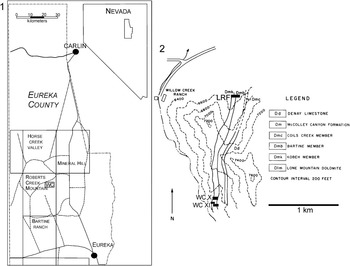
The Kobeh Member of the McColley Canyon Formation (Murphy and Gronberg, Reference Murphy and Gronberg1970) forms an eastern belt of limestone and dolomitic limestone cropping out in the ranges west of Eureka, Nevada (Fig. 1), interpreted as being deposited in a well-aerated, shallow-water marine environment. Its stratigraphy has been studied in four of these ranges: Sulphur Springs (Carlisle et al., Reference Carlisle, Murphy, Nelson and Winterer1957), Lone Mountain and Roberts Mountains (Murphy and Gronberg, Reference Murphy and Gronberg1970), northern Antelope Range (Johnson et al., Reference Johnson, Klapper and Trojan1980; Hose et al., Reference Hose, Armstrong, Harris and Mamet1982), and Hot Creek Range (McGovney, Reference McGovney1977). These rocks have yielded a fauna of conodonts (especially icriodontids), brachiopods, corals, bryozoans, pelmatozoans, trilobites, ostracodes, nautiloids, bivalves, gastropods, tentaculites, sponges, calcareous algae, fish, and burrowing organisms. The sedimentary structures mostly indicate deposition above the base of wave action. However, in parts of the interval, features including bioturbation and burrowing indicate that some of the rocks (but not those with fish remains) accumulated below normal storm-wave base (Murphy, Reference Murphy2005). Rarity of vertebrates in the Monitor Range and their absence in the Toquima Range indicate they were not present, or at least not preserved, in the outer shelf environment.
Maps showing the location of Willow Creek sections. (1) General locality map after Vodrážková et al. (Reference Vodrážková, Klapper and Murphy2011, fig. 1), inset showing Eureka county in Nevada; (2) topographic map of the Willow Creek area (WC box in [1]) after Murphy and Gronberg (Reference Murphy and Gronberg1970, fig. 6) showing location of sections WC X, WC XI, LRF.

In the Willow Creek sections (WC X, WC XI, LRF; see Murphy, Reference Murphy2005, figs. 2, 4; Fig. 1), northern Roberts Mountains, the Kobeh Member rests unconformably on the Lone Mountain Dolomite. The lower half of the Pragian is missing, but a meter of the brevicauda-mariannae Conodont Zone and the mariannae-excavata CZ (sensu Murphy, Reference Murphy1977) are present. The section shows the superposition of the kindlei μ-excavata and excavata-gronbergi zones, but conodonts are scarce and there is no overlap of the characterizing zonal taxa (Murphy, Reference Murphy2005). These sections have also yielded several important ostracode faunas (Luptowitz, Reference Luptowitz1990b).
Materials and methods
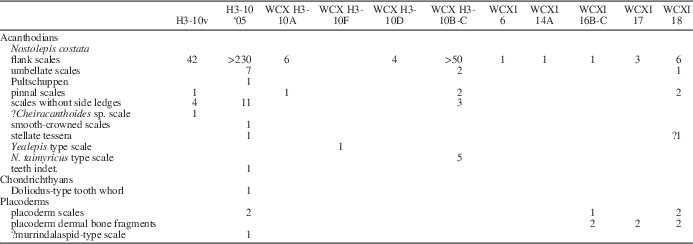
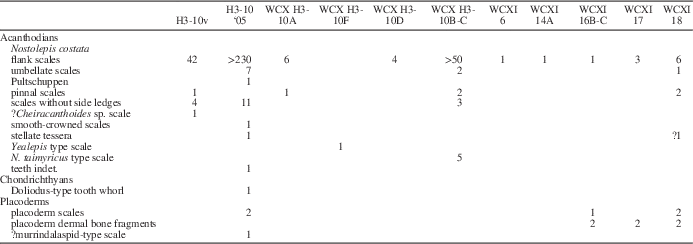
Specimens were obtained by standard formic acid treatment of limestone samples (Jeppson et al., Reference Jeppsson, Arnehus and Fredholm1999). The vertebrate assemblages (Table 1) are from the basal to middle beds (sample levels WC X H3-10A–F, WC XI 6, 14, 16B-C, 17, 18) of the Kobeh Member. ‘H3-10’ is a field mapping number used by MM for a point on the Lone Mountain–Kobeh contact when first mapping the area. Subsequently the notation was appended to the whole basal bed in the WC X and WC XI sections. This strongly laminated basal bed was sampled at several levels, all showing the same fauna (UCR 7343: see Murphy et al., Reference Murphy, Matti and Walliser1981; Murphy, Reference Murphy2005 for conodont assemblage). Vertebrate microremains in the lower H3-10 samples are oxidized (colored red); others in WC X and WC XI are black; and all are recrystallized with no histological details preserved.
Distribution of vertebrate microremains in samples from the Kobeh Member, Nevada.
Systematic paleontology
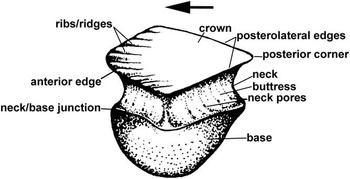
Terminology used for scale features is illustrated in Figure 2. Specimens are deposited in the University of California Riverside Campus Museum collection, Earth Sciences Department (UCR).
Illustrative drawing showing terminology for acanthodian scale features; arrow points to anterior of scale.

Class Acanthodii Owen, Reference Owen1846
Order Incertae sedis
Family indeterminate
Genus Nostolepis Pander, Reference Pander1856
Type species
Nostolepis striata Pander, Reference Pander1856, p. 68, pl. 6.7, 6.7 from the Ohesaare Beds, Saaremaa Island, Estonia, by original designation.
Nostolepis costata Goujet, Reference Goujet1976
Figures 3.1–3.32, ?3.33, 4.1–4.9, ?4.10–4.12, 5; Table 1
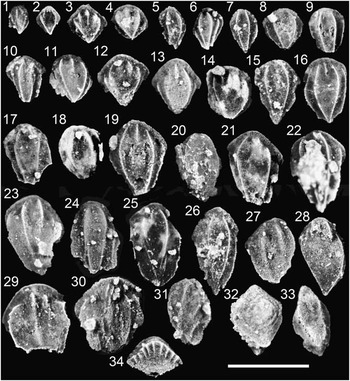
Light microscope images of a range of whitened acanthodian scales from sample H3-10v, locality H3-10 (UCR 7343), base of Willow Creek section WC XI. (1–32) Nostolepis costata: (1–31) crown views of scales UCR 7343/Ac1–Ac31; (32) base view scale UCR 7343/Ac32, all anterior to top. (33) Acanthodii indet. scale UCR 7343/Ac33 with a smooth narrow crown, possibly a worn N. costata. (34) Acanthodii indet. scale UCR 7343/Ac34 with multiple short ridges along anterior edge, posterior crown missing, possibly Cheiracanthoides sp. Scale bar=1.0 mm.

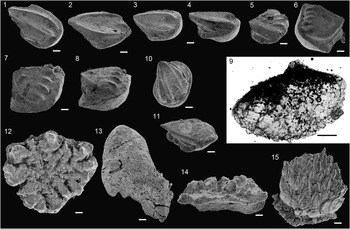
Scanning electron micrographs of vertebrate microremains from sample H3-10 ‘05, locality H3-10 (UCR 7343), base of Willow Creek section WC XI. (1–8) Nostolepis costata scales UCR 7343/Ac35–Ac42 in laterocrown views: (1–5, 7, 8) anterior to right (6) anterior to left. (9) Vertical transverse section of N. costata scale UCR 7343/Ac46, showing lack of histological detail due to complete recrystallization of the scale plus extensive hyphal borings. (10) Pinnal scale UCR 7343/Ac43 probably from N. costata. (11) Worn smooth-crowned scale UCR 7343/Ac44 with lateral ledges, possibly a ventral scale from N. costata. (12) Stellate tessera of nostolepid type UCR 7343/Ac45, probably from N. costata. (13) Smooth worn tooth UCR 7343/Gnath1 in lateral view with broken base, Gnathostomata sp. indet. (14) Acanthothoracid placoderm scale UCR 7343/Plac1. (15) ?Chondrichthyan or murrindalaspid-type placoderm scale UCR 7343/Gnath2, crown view. Scale bars=0.1 mm; (1–8, 10, 12–15) all at the same magnification.

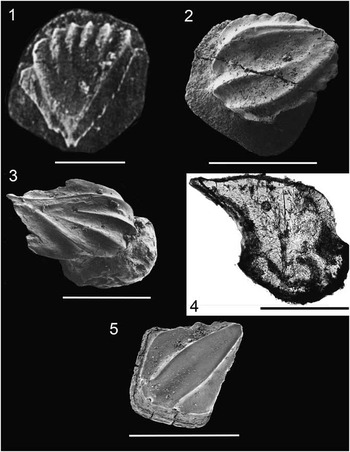
Comparative scales of Nostolepis costata from regions outside Nevada. (1) Holotype scale IGR 80024, Institute of Geology, Rennes University, from Saint Céneré Formation, Armorican Massif, France. (2–4) Scales and vertical longitudinal section of scale QM F58628–58630 from the Nogueras Formation, Los Poyales E section, d2ab, level 104, northern Spain. (5) Scale MNHN 1992-6-06 (Burrow et al., Reference Burrow, Lelièvre and Janjou2006, fig. 2.3) from the Qasr Limestone, Jawf Formation, northeastern Saudi Arabia. (1, 2, 5) Scale bars=1.0 mm; (3, 4) scale bars=0.5 mm.

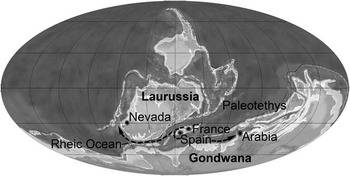
Paleobiogeographic reconstruction (after Blakey, 2003; Mollweide projection map for the Early Devonian at http://cpgeosystems.com/400 moll.jpg) showing distribution and possible dispersal routes of Nostolepis costata in the Early Devonian.

1976 Nostolepis costata Reference GoujetGoujet, p. 316, fig. 55, pl. 62.1–62.10.
Types
Holotype I.G.R. 80024 (Goujet, Reference Goujet1976, pl. 62.7; Fig. 5.1). Paratypes I.G.R. 80018–80023, 80025–80027, from the lower Saint-Céneré Formation (upper Lochkovian), Laval Synclinorium, eastern Armorican Massif, France, reposited at l’Institut de Géologie de l’Université de Rennes.
Description
Body (and fin) scales from the Kobeh Member are up to 1.2 mm wide and 1.5 mm long (Figs. 3.1–3.26; 4.1–4.8, ?4.10), with very few small scales. Scale bases have a rhombic outline, with most crowns longer than wide. Nearly all scales have a central subtriangular crown surface with lower posterolateral ledges and 0–4 short ridges running back from the anterior edge of the crown. Of the scales examined, about 75% had no median ridges; 14% had one ridge; 8% had two ridges; 2% had three ridges; and 0.5% had four or more ridges. The central crown area is usually concave side to side in scales with fewer than two median anterior ridges and flatter in scales with more anterior ridges. The crown plane is flat and slightly inclined anteroposteriorly (Fig. 4.2, 4.4); the lateral crown ledges are often quite wide (Fig. 3.8–3.10, 3.15–3.19, 3.22–3.26). Several scale forms with different shapes, present in small numbers, are also assigned to N. costata, by comparison with the similar elements described and figured by Goujet (Reference Goujet1976) and scale and tessera forms that Gross (Reference Gross1971) assigned to Nostolepis striata, the type species. These rare forms include wide umbellate-type scales, which were edged sensory lines (possibly Fig. 3.27); ‘Pultschuppen,’ which are scales with a flat base and high neck that were possibly branchial scales (Gross, Reference Gross1971) or scales on the coracoid (Goujet, Reference Goujet1976); pinnal scales (Fig. 4.10) with an upright ridged crown resembling a ridged stellate tubercle, which were positioned in the shoulder girdle region; and a few stellate tesserae (Fig. 4.12) presumed to be from the head region, possibly around the mouth. Other scales are markedly asymmetrical (Fig. 3.31), and a few large wide scales lacking distinct lateral ledges (Fig. 3.29, 3.30) are probably from near a fin base. Unfortunately, as the scale tissues have been completely recrystallized, their histological structure cannot be determined. However, the body scales can still be confidently assigned to N. costata on the basis of their morphological features.
Materials
Approximately 500 scales (Table 1, Figs. 3, 4) including figured scales UCR 7343/Ac1–Ac32, Ac35–Ac42, ?Ac33, ?Ac44, ?Ac45 and thin section UCR 7343/Ac46 from the Kobeh Member, Willow Creek, Eureka County, Nevada (Willow Creek Ranch: Latitude: 39.9502, Longitude: -116.3117).
Remarks
The ~40 type scales were diagnosed by Goujet (Reference Goujet1976) on the basis of their large size (up to 2 mm long and 1.9 mm wide), a base inserted very high in the crown, a crown that is sharply pointed posteriorly and ornamented with 3–6 strong ridges, lateral edges of the crown forming a lower horizontal ledge that overhangs the neck, and the posterior ends of the ledges being denticulated on well-preserved scales. Given the range of scale variations recognized in Nostolepis spp., it is not surprising that the much larger number of scales from the Kobeh Member show more variation and include scales with only the two strong ridges edging the central crown area, with no other ridges running back from the anterior edge. The narrow, elongate body scales resemble those of Nostolepis arctica Vieth, Reference Vieth1980, but in scales of the latter species, the crown curves strongly up and back from the anterior edge and the lateral crown edges are always narrow, whereas in the scales from the Kobeh Member (as well as the type scales of N. costata), the crown plane is flat and the lateral crown ledges are often quite wide. N. arctica could be a form taxon encompassing specialized scales, probably from the fins, having a common form in several Nostolepis spp. (Burrow et al., Reference Burrow, Lelièvre and Janjou2006, p. 541). Because the scales of N. arctica are usually found in assemblages with a high diversity of nostolepid type scales (e.g., Vieth, Reference Vieth1980; Wang, Reference Wang1993; Valiukevicius, Reference Valiukevicius1998; Vergoossen, Reference Vergoossen1999), determining whether the species is a form taxon or a ‘proper’ species is difficult, although Vergoossen (Reference Vergoossen1999, p. 35) supported the latter hypothesis because of “the morphological features of its crown and its vertical distribution.” With more than half of the large scales from the Kobeh Member having an elongate, narrow crown, this is probably the ‘standard’ body scale form for the species. Of the type material figured by Goujet (Reference Goujet1976, pl. 62.1–62.10), five of the eight body scales are also elongate, and three have only a single ridge on the central crown plane. The range of morphologies in the Nevada scales matches N. costata rather than N. arctica.
Elsewhere, Nostolepis costata scales (Fig. 5.2–5.4) are found in vertebrate assemblages from the upper Lochkovian Nogueras Formation, Los Poyales E, Spain. Several scales we consider to derive from N. costata, from the upper Lochkovian–lower Pragian of the same formation, were figured by Wang (Reference Wang1993, pl. 12, fig. 8, captioned as N. costata; pl. 12.3–12.6, captioned as N. arctica; pl. 13.2–13.5, captioned as N. striata). Burrow et al. (Reference Burrow, Lelièvre and Janjou2006, fig. 2.3, 2.4, 2.19; Fig. 4.5) also recorded the species from the Pragian Qasr Limestone, low in the Jawf Formation of Saudi Arabia. Lelièvre et al. (Reference Lelièvre, Janjou, Halawani, Janvier, Muallem, Wynns and Robelin1994) dated this member as late Pragian–early Emsian; however, a number of the vertebrate taxa are also present in the upper Lochkovian assemblages of northern Spain (Wang, Reference Wang1993), indicating the vertebrate level in the Qasr Limestone could be older than late Pragian.
Turner (Reference Turner1993) assigned isolated scales from the Early Devonian of southeastern Australia to N. costata, but these were subsequently reassigned to a new taxon, Nostolepoides platymarginata Burrow, Reference Burrow1997. De Pomeroy (Reference De Pomeroy1996, figs. 2, 3H, 3I, 3L) assigned younger scales from the Emsian to Givetian of the Broken River Group, north Queensland to Nostolepis sp. cf. N. costata, but their morphology differs markedly from that of N. costata. Scales from the Lochkovian Chortkov Regional Stage of Podolia have been assigned to Nostolepis sp. aff. N. costata (Valiukevicius, Reference Valiukevicius2000), but as this material has not been described or figured, it is not known how closely the scales resemble those of the type N. costata. Other scales from the Lochkovian of Timan-Pechora that were initially assigned by Valiukevicius (Reference Valiukevicius1998) to Nostolepis cf. costata were subsequently reassigned to Nostolepis n. sp. 2 (Valiukevicius, Reference Valiukevicius2000).
Discussion
The vertebrate-bearing strata of the Kobeh Member are in the brevicauda-mariannae Conodont Zone (Murphy, Reference Murphy2005). Vertebrate microremains other than scales of Nostolepis costata include a few acanthodian scales (Fig. 2.34) resembling those of Nostolepis taimyrica Valiukevicius, Reference Valiukevicius1994 from the Pragian–Emsian of the Taimyr region, Siberia, several indeterminate acanthodian scales, and a stellate tessera (Fig. 4.12). Placoderm scales and dermal bone fragments (Fig. 4.14) in the assemblages include one distinctive scale with nodose ridged tubercles (Fig. 4.15) resembling those of acanthothoracid placoderm Murrindalaspis (Long and Young, Reference Long and Young1988, fig. 9E) from southeastern Australia, but also resembling those scales that Vergoossen (Reference Vergoossen1999, figs. 24–26) assigned to cf. Polymerolepis. Another distinctive specimen is a diplodont tooth whorl resembling those of Doliodus problematicus Woodward, Reference Woodward1892 (Table 1).
Unless scale forms are highly distinctive, it is not possible, from a very small number of scales, to assign them to a species. The undetermined acanthodian and placoderm scales and bone fragments are comparable with forms found throughout the Lochkovian and Pragian, whereas Doliodus-type tooth whorls only become common in maritime Canada in the early Emsian (Turner, Reference Turner2004). An interesting feature of the Kobeh Member assemblage is the absence of agnathans, possibly related to the water depth and/or restriction to their dispersal by the disappearance of shallow water seaways after the Lochkovian (Elliott and Petriello, Reference Elliott and Petriello2011).
The scales of Nostolepis costata are the only vertebrate remains from the Kobeh Member assemblage that can be assigned reliably to a species. The type material from the Saint-Céneré Formation is in a very similar vertebrate assemblage to that of the Kobeh Member, comprising scales of the acanthodians Nostolepis costata and Machaeracanthus goujeti Botella, Martínez-Pérez, and Soler-Gijón, Reference Botella, Martínez-Pérez and Soler-Gijón2012, ‘radotinid’ placoderm scales and bone fragments, and rare shark scales; agnathans are absent. In northern Spain, Nostolepis costata from the upper Lochkovian–early Pragian of the Nogueras Formation occurs in species-rich assemblages that include up to 10 acanthodian taxa, several chondrichthyan taxa represented by scales and teeth, several placoderms, but also rare turiniid thelodonts (Wang, Reference Wang1993). The younger vertebrate assemblage in the Qasr Limestone, Saudi Arabia, includes the acanthodians N. costata, Machaeracanthus sp., Milesacanthus ancestralis Burrow, Lelièvre, and Janjou, Reference Burrow, Lelièvre and Janjou2006, Gomphonchus? fromensis Burrow, Reference Burrow2002, a few onychodont teeth, shark scales of Cladolepis-type and Tassiliodus lessardi Derycke and Goujet, Reference Derycke and Goujet2011, and very abundant scales of a stellate-tubercled placoderm and the acanthothoracid Arabosteus variabilis Olive et al., Reference Olive, Goujet, Lelièvre and Janjou2011. Although this assemblage is more diverse than the Armorican Massif and Nevada assemblages, agnathans are once again absent.
Of the other fauna found in the Kobeh Member, ostracodes are a mixture of provincial and more cosmopolitan genera, with closest affinity to northern Cordilleran (western Canada and Alaska) assemblages (Luptowitz, Reference Luptowitz1990a). Conodonts brevicauda and profunda are also recorded from the mid-Pragian Boola section near Tyers, Victoria, Australia. Tyers Quarry and Waratah Bay, also in Victoria, similarly show sections only through mid-Pragian strata, terminating before the late Pragian (Mawson and Talent, Reference Mawson and Talent1994; Murphy, Reference Murphy2005). Philip (Reference Philip1965, pl. 8.38, 40, 41) figured scales from the Tyers Quarry that Turner (Reference Turner1991, Reference Turner1993) assigned to Nostolepis costata, but these were later reassigned to the taxon Nostolepoides platymarginata, found elsewhere in uppermost Pragian–lower Emsian strata in southeastern Australia (Burrow, Reference Burrow2002). Reexamination of the Tyers scales confirms that they belong to N. platymarginata, although the lower limit of its range is not known in the type locality and nearby regions because of a gap in the vertebrate-bearing strata between the upper Lochkovian and upper Pragian (Sherwin, Reference Sherwin1996; Burrow, Reference Burrow2002). The main differences between Nostolepis costata and Nostolepoides platymarginata are that scales of the latter mostly have a rhombic, flat crown, and deep neck and lack Stranggewebe (parallel-oriented elongate lacunae/dentine tubules in the scale crown growth zones).
Despite the extensive and intensive investigations of Early Devonian scale-based acanthodian taxa and their distribution through the circum-Arctic region (e.g., Vieth, Reference Vieth1980; Märss, Reference Märss1997; Blom, Reference Blom1999; Valiukevicius, Reference Valiukevicius2000), Nostolepis costata has not been recorded from the Old Red Sandstone Continent (Blieck and Cloutier, Reference Blieck and Cloutier2000). The known geographical distribution of Nostolepis costata includes the Armorican Massif in France, northern Spain, Nevada, and northwestern Saudi Arabia, which were all in subtropical latitudes during the Early Devonian (e.g., Johnson et al., Reference Johnson, Elliott and Wittke2000, fig. 10). These occurrences are in progressively younger rocks, indicating possible dispersal westward from the Armorica terrane to southern Laurentia, and southeastward to northern Gondwana (Fig. 6). This hypothetical dispersal pattern is difficult to test because of the lack of other identifiable vertebrate remains of Pragian age in the western United States. Vertebrates in older assemblages from the Lochkovian Windmill Limestone in central Nevada compare most closely with contemporary taxa from Arctic Canada and western Europe (Turner and Murphy, Reference Turner and Murphy1988), with the gnathostomes also closely comparable with taxa from Spain (e.g., Wang, Reference Wang1993). There appears to have been a barrier to western dispersal of most fishes during the Pragian, perhaps associated with the worldwide lowering of sea level at this time (Johnson et al., Reference Johnson, Klapper and Sandberg1985). For example, actinolepid placoderms appear first in the fossil record in the Lochkovian, with the earliest known records from Europe. By the Pragian they are also found in Spitsbergen, the Canadian arctic, and the eastern United States but are not found in the western United States until the Emsian (Johnson et al., Reference Johnson, Elliott and Wittke2000). Vertebrate assemblages from the Emsian of the western United States include mostly endemic species and endemic genera (Blieck and Cloutier, Reference Blieck and Cloutier2000; Burrow, Reference Burrow2007); cosmopolitan genera include agnathans Poraspis (Elliott and Petriello, Reference Elliott and Petriello2011) and Canonia (Blieck and Cloutier, Reference Blieck and Cloutier2000), but these are possibly both relic taxa as their other occurrences are Lochkovian or earliest Pragian and, for Canonia at least, include the Windmill Limestone. Cosmopolitan acanthodian genera of the western U.S. Emsian include Ischnacanthus, Nodacosta, and Ptychodictyon (Burrow, Reference Burrow2007). Whereas lack of shallow seas could have restricted or prevented migration of agnathans and placoderms during the Pragian, fusiform nektonic acanthodians were more capable of crossing deepwater barriers that would have restricted migration of these other fishes.
Acknowledgments
CJB thanks the Queensland Museum for provision of basic facilities. We thank reviewers D.K. Elliott and J. Boyle for their suggested improvements. This is a contribution to IGCP 591: The Early to Middle Paleozoic Revolution, and IGCP 596: Climate change and biodiversity patterns in the Mid-Palaeozoic (Early Devonian to Late Carboniferous).