Introduction
Thousands of people throughout North Wales, North Lancashire and as far south as Derbyshire intuitively turned their heads towards Liverpool as a one-tenth of a second flash flitted across the city. . .in the ten seconds that followed, a fireball, measuring almost 1.5 miles in diameter, flashed across the inner city, reaching out across the Mersey to Birkenhead and Wirral waterfront. . .human beings vanished like they were never there. . .below the fireball where once had stood offices, factories, churches, schools, houses and the greater part of the city's dock complex appeared a crater of massive proportions. A depression 100 feet deep and three-quarters of a mile across. . .a mushroom cloud stood 15 miles high over Liverpool.Footnote 1
By January 1980, imagining the effects of a nuclear attack on urban centres was a normalized aspect of British culture.Footnote 2 This quote from the Liverpool Echo exemplifies the way in which journalistic narratives routinely reminded British citizens of the possibility of nuclear attack. While encouraging precise knowledge of potential devastation to human life, city infrastructure and the cityscape, these narratives also contributed to deeply embedded nuclear anxieties that were local and global in character: spatially specific, yet universal at the same time. By 1980, the unthinkable (‘a one-tenth of a second flash flitted across the city’) had become a familiar imaginary. Individual citizens were reminded of their own vulnerability and centrality to the nuclear predicament (‘human beings vanished like they were never there’), while the city itself was a constant, vulnerable, immovable nuclear target (‘a mushroom cloud stood 15 miles high over Liverpool’). People's lives and minds, like their cities, had become nuclearized.Footnote 3
Focusing on Liverpool in the early 1980s, this article will argue that localized historical perspectives on Cold War cities help us to understand the impact of national nuclear policy on cultures of local government and everyday life. Following an articulation of British cultural politics in the early 1980s, this article suggests that nuclear cultures that existed in Liverpool were shaped by ideas and assumptions discursively reinforced at both a national and local level. After acknowledging the national political and social context of resurgent nuclear civil defence initiatives, anti-nuclear activism, and a cultural politics broadly defined as uniquely anti-nuclear, this article will argue that new and unexpected forms of nuclear resistance can be uncovered by focusing on an individual city, precisely because of its unique place in the broader contexts of the Cold War. The recent history of all British cities is linked in some way to the complex administrative, scientific and military requirements of the British nuclear state, but detailed histories of this relationship have not been written. The choice of Liverpool as a case-study can be explained by the fact I was made aware of the papers of C.K. Wilson, the county solicitor, and partly justified by my earlier contention that every British city had a unique experience of and role in the nuclear state. Liverpool is one of many cities to be neglected in histories of the nuclear age. Looking to the future, I hope that comparative histories of cities in the British nuclear state will be written to advance our understanding of the complex meanings of the nuclear century.
Through an examination of local government archives and the papers of C.K. Wilson, a picture emerges of regional and local officials displaying apathy and frustration towards nationally defined civil defence exercises.Footnote 4 Yet, in subtle ways, they also attempted to empower themselves and their citizens. By taking control of local nuclear narratives and constructing alternative and open visions of the nuclear present and future, their actions served to democratize the nuclear state. It was normal for some local officials to resist, or re-shape, the nuclearization of their city. These localized forms of nuclear resistance echo familiar types of nuclear activism undertaken by citizens throughout the nuclear age, but their specific nature must be understood as a direct product of the unique cultural politics of the 1980s. What emerges is a historically and locally specific picture of the intersections between city-dwelling individuals and their perceptions of nuclear policy, and nuclear danger.
Furthermore, it is argued that these historical perspectives must be understood alongside analysis of ‘unofficial’ narratives that became common in the 1980s: those narratives that were not institutionally produced and shaped, and often challenged political orthodoxy. There was a rise in the frequency and cultural importance of these powerful and confident nuclear narratives in British culture more widely, and they proved more representative of a citizenry willing to take intellectual and political ownership of nuclear threats to the family, selfhood and a peaceful life. Through an exploration of the national and local press, and popular culture more widely, it will be argued that the twin motifs of the ‘city-as-target’ and the ‘centrality of the individual’ to the nuclear predicament served to provide, reinforce and confirm understandings of nuclear danger. These nuclear motifs deployed in national discourse therefore provided the discursive and epistemological foundation for local acts of resistance. In this way, the cultural politics of the era helped legitimize the emergence of increasingly informed, politicized and assertive nuclear citizens. Focusing on cities introduces us to more of these counter-narratives and citizens, but also asks us to rethink how we link these to broader political, social and cultural histories.
This article does not build on research focusing on national political and physical infrastructure of Cold War urban areas, but instead offers a new way in which we can conceptualize cities in an era where nuclear attack was imagined, by some, as a real possibility.Footnote 5 Such an approach is influenced by recent developments in Cold War and urban historical scholarship. The three main historiographical strands that relate directly to this article are, first, new approaches to and conceptualizations of the Cold War; secondly, older (neglected) approaches that foreground the importance of language in constructing the social and political meaning of nuclear politics; and, thirdly, spatial approaches to Cold War cities.
New approaches in Cold War historiography are moving us away from general interpretations of the era; some even suggest we dispense with the term ‘Cold War’ altogether.Footnote 6 It has become increasingly common to disrupt and question existing categories of analysis when it comes to the Cold War, especially for those seeking to write histories of everyday life in the Cold War era.Footnote 7 Although scholars have made significant headway in the American and European context, everyday life in the British Cold War era is a relatively underresearched aspect of the past. In a response to this, some scholars have looked to reconceptualize one corner of the British Cold War: ‘British nuclear culture’. Dan Cordle has argued that a ‘politics of vulnerability’, in part, defined British culture in the 1980s, with nuclear anxiety serving as a constant backdrop to culture and society.Footnote 8 Jeff Hughes has suggested that writing localized histories of the nuclear age is one way of capturing what ‘nuclear culture’ can mean. He argues that if we are to move ‘towards a more nuanced and critical history of responses to nuclearization. . .these responses. . .should be seen as collectively constitutive of the nuclear condition rather than as passive reflections of it’.Footnote 9
Elsewhere, I have explored the relationship between language and nuclear anxiety, deploying the term ‘nuclearity’ to describe the ‘shifting set of assumptions held by individual citizens on the dangers of nuclear technology: assumptions that were rooted firmly in context and which circulated in, and were shaped by, national discourse’.Footnote 10 Due to these assumptions, individuals implicitly understood the many things nuclear danger could mean. Because nuclearity can be seen as an active component in the formation of British identity, nuclear ‘knowledge’ can serve to disrupt conceptions of self, nationhood and family in everyday life. Richard Maguire's work has focused on the various ‘nuclear cultures’ that existed within government, arguing that a ‘diverse, and shifting, set of ideas’ defined official thinking around nuclear weapons.Footnote 11
Although it is now less fashionable to stress the importance of language in structuring knowledge in the nuclear age, ‘nuclear criticism’ was a powerful intellectual movement that emerged in the 1980s, which, in the words of Brian Taylor, proved ‘uniquely concerned with how language and images shape the public experience of nuclear weapons’.Footnote 12 These thinkers viewed ‘nuclear culture as a dialogic site of struggle between conflicting and interanimating discourses. . .each seeking authority over the meaning and consequence of nuclear weapons’.Footnote 13 Unique to the 1980s was the emergence of this sustained criticism involved in ‘historicizing the production and accommodation of nuclear hegemony, exposing its ambiguities and contradictions, restoring to public consciousness what it has repressed, providing alternative narratives of the nuclear future, and energizing democratic participation in nuclear policy-making’.Footnote 14 Taylor's own work analysing nuclear photography introduces the concept of ‘nuclear subjectivity’, which should be understood as those reminders of the physical and psychological impact the nuclear state can have on individual lives, as seen through unofficial narratives. Taylor argues that these narratives could be powerful enough to compel us to ‘revise official accounts of nuclear history’,Footnote 15 and that official accounts of nuclear history have still, on the whole, left nuclear subjectivities hidden.Footnote 16
Linking these ideas more directly to recent work on the spatial histories of cities in the nuclear age suggests that we can analyse nuclear narratives in new ways to make sense of how cities ‘enable and constrain different constellations of power and knowledge’.Footnote 17 Work by David Monteyne (in the American context) suggests ways in which the Foucauldian concept of ‘biopower’ can be applied to thinking about the logic of nuclear civil defence. Monteyne argues that ‘Cold War civil defence was a discursive formation and spatial practice particularly well suited to representing the goals and powers of the welfare state’, partly because it based its ‘power on an underlying reference to the established institutions of the disciplinary society’.Footnote 18 Designing and building Cold War infrastructure was part of an unquestioned faith in systems of government and thinking that were deemed necessary to preserve peace. Sometimes viewed as engendering conformity and obedience within government, civil defence initiatives also created pockets of resistance within official circles. In the British context, Coventry Council's refusal to partake in civil defence exercises in 1954, due to the perceived pointlessness of the initiative and the waste of money involved, is probably the most notable example.Footnote 19 While Grant has argued that up to 1968 civil defence was considered a ‘rational and understandable sham’, or a ‘necessary facade’Footnote 20 by government officials, by the 1980s it was far more common to find examples of nuclear resistance within local government. On a collective level, this is best symbolized by the fact that at least 120 councils signed up to become ‘nuclear free zones’ in the early 1980s.Footnote 21
Whether influenced by recent studies on British nuclear culture that seek to understand aspects of the past which are ‘constitutive of the nuclear condition’, or the nuclear critics and historians of the nuclear age who stress that the Cold War can be thought of as a ‘discursive formation’, it should be clear that ‘systems of power’ unify the three historiographical strands that inform this article. The 1980s is viewed as representative of an increase in cultural works that ‘disrupt the passivity of viewers and implicated them in the evaluation of nuclear representations’.Footnote 22 Thus, it was more likely that forms of nuclear representation that emerged in the 1980s would ‘destabilize the authority of official nuclear images and narratives by contrasting them with their unofficial counterparts’.Footnote 23 The next section will examine the cultural politics in Britain relating to this destabilization of the nuclear state.
British cultural politics in the 1980s: new forms of nuclear resistance
The early 1980s saw a resurgence of interest in nuclear issues in British society, due largely to international developments that led to the end of the era of ‘détente’.Footnote 24 In response to the Soviet SS-20 missiles that were being deployed in eastern Europe, NATO decided to assign a new generation of nuclear weapons to western Europe in 1979. The Soviet invasion of Afghanistan in 1979 coincided with the election of Margaret Thatcher as Conservative prime minister in the same year, and the election of Republican Ronald Reagan as American president in 1980. This led to a hardening of nuclear rhetoric and an assertive, unified nuclear policy between Britain and the USA, symbolized by the situating of Cruise Missiles on British soil from November 1983 and the Able Archer debacle in the same month. This renewed sense of Cold War tension led to an increase in public engagement with nuclear politics, and an increase in public anxiety as nuclear attacks on cities appeared more likely.Footnote 25
These international developments were accompanied by the renewal of nuclear civil defence as a government priority in Britain, which was linked to a significant rise in formal anti-nuclear activism in the 1980s. Campaign for Nuclear Disarmament (CND) membership increased, new anti-nuclear factions emerged and the Greenham Common protest camp was established as a direct, and long-lived, protest against nuclear policy.Footnote 26 A significant factor in the rise of anti-nuclear sentiment was the media storm surrounding the civil defence pamphlet Protect and Survive (Figure 1) in the late 1970s.Footnote 27 Cordle has argued that Protect and Survive, created by the government as an advisory pamphlet, came to symbolize the ‘absurdity. . .of nuclear civil defence’ and to ‘highlight the vulnerability of ordinary citizens in a decade in which the threat of nuclear war came to seem much more urgent’.Footnote 28 As an icon of nuclear madness, Protect and Survive proved to have significant cultural impact, due mainly to its stark depiction of the home-as-target, and the simplistic suggestion that household goods and materials could be mobilized to lessen the nuclear blow against a living, breathing family. This advice served to normalize and confirm nuclear dangers, while the imagery of futile civilian action represented the shadow of inescapable threat that hung over people, homes, towns and cities.
Protect and Survive (London: Central Office of Information, 1980), 10–11. Crown copyright.

Books such as the provocatively titled Protest and Survive (1980) and Over our Dead Bodies: Women against the Bomb (1983) reinforced the public hostility to government civil defence plans.Footnote 29 Other popular scientific, protest and ‘doomsday’ literature centred on the devastating consequences of nuclear war on humans and their homes, most notably London after the Bomb (1982) and The Medical Effects of Nuclear War (1983). Frequently, these texts deployed visual motifs such as concentric circles over urban centres to represent the potentially vast range of destruction.Footnote 30 The ‘city-as-target’ was a common motif, both in official and unofficial narratives. Defended to Death (1983) and War Plan, UK (1982) analysed the ‘discrepancies’ between official and unofficial messages, and mapped the extent of the secret British nuclear state, including new information on the likely targets of a nuclear attack.Footnote 31 Scepticism towards government policy gained legitimacy through these rigorous scientific and political studies, which proved popular in their attempts to uncover and deconstruct the ‘nukespeak’ that emerged from secretive institutions.
Echoing the concerns of the anti-nuclear activists, and the growing number of intellectual projects dismissing the usefulness of nuclear civil defence, the use of language in the press frequently articulated the likelihood and possibility of nuclear attack on cities.Footnote 32 Trends that echoed previous decades include the reporting of incidents linked to nuclear fear, such as the threat of suicide, and the act of suicide linked to nuclear fear.Footnote 33 Familiar journalistic motifs were deployed, such as target maps of the country alongside narratives fearful of nuclear conflict:
The world looks a more dangerous place today than it did even a year ago. Millions of people now believe that a nuclear war one day is inevitable. The dread of it clouds the future of the young and the last years of the old. That's why thousands demonstrate against a defence policy based on the use of The Bomb. Their concern and sincerity can't be doubted. But they are wrong.Footnote 34
Here we see intense ambiguity. This is a narrative that acknowledges and reinforces collective anxiety, while concluding that Britain needs the bomb. The threat of nuclear war and any resultant nuclear anxiety is to be accepted as the price to pay for world peace. Fears over communist insurgence, details on nuclear bunker provision in Britain, political criticism over civil defence policy and details of America's nuclear arsenal on British soil were all represented in a great amount of detail in the press.Footnote 35 Yet, the impossibility of government protection in the event of nuclear attack was also acknowledged. For instance, an article from The Times from early 1980 read: ‘the public are on their own pretty much. The government has no plans to evacuate them from big conurbations likely to be targets for Russian missiles.’Footnote 36 Here, the tension between the vulnerability of the collective and the individual can be seen in the journalistic narrative of the time. Often, the inescapable ‘centrality of the individual’ to the nuclear predicament was a persistently reinforced motif.
Journalism in this period contributed to a sharper popular scientific understanding of what nuclear attack on cities would mean. One extended and detailed report on the consequences of nuclear attack from 1980 shows concentric circles over north-west England, where cities are reinforced as potential targets of nuclear attack.Footnote 37 Journalistic narrative frequently deployed the traditional visual vocabulary of the nuclear age. Images such as the concentric circle had long been deployed in journalistic and academic contexts as shorthand for the destructive potential and imminent possibility of nuclear attack, confirming the reality of the city-as-target. The mushroom cloud was also a common symbol, serving similar purposes to the concentric circle.Footnote 38 These motifs served as part of a familiar visual vocabulary that reinforced assumptions of nuclear threat: confirmation of the psychospatial nuclearization of the city. All of this combined to generate a cultural politics that allowed politically radical nuclear culture to find its way into ‘mainstream’ film, fiction, music and art in 1980s Britain. Many of these focused on urban destruction following an imagined nuclear attack, or presented sustained critiques of civil defence policy and government policy on nuclear issues more widely.Footnote 39 Readers and audiences were, more frequently than ever before, asked to contemplate themselves at the centre of nuclear devastation.
Two television documentaries from the time highlight the potency of the dual motifs so common in 1980s nuclear culture. ‘Q.E.D.’: A Guide to Armageddon, broadcast on the BBC on 26 July 1982, was written and directed by Mick Jackson.Footnote 40 It was an informative, stark and unflinching production. After being told that ‘most of us live in cities’, viewers were shown a nuclear attack scenario where the bronze cross of St Paul's in London melts under the heat of nuclear attack. The documentary is a sustained and relentless string of nightmarish images relating to destruction and the inescapable forces involved in nuclear explosions. Repetitive images of the city and indications of the blast radius once again utilize that pragmatic motif of measurable destruction: the concentric circle. Zooming down onto the city streets, we are invited into the lives of a young couple who are determined to follow the advice in Protect and Survive. We follow them in their attempts to construct a fallout shelter in the wet mud of the back garden. The absurdity of civil defence is implicitly reinforced through dead-pan narration. Scenes in the documentary are at once familiar, yet occupy a psychological space where the viewer is invited to assume the possibility of the unthinkable on an individual and collective level. The overall impression is rendered more realistic by the innovative special effects, a novel departure for TV. Using ‘first-person’ cinematic techniques to highlight the urgency, tragedy and absurdity of the nuclear imaginary the viewer is invited to examine their own fears. It is the viewer – the modern citizen – that is placed at the centre of the nuclear predicament.
John Pilger's The Truth Game from 1983 was a similarly unflinching assault on government policy and displays an interest in ‘nukespeak’. Offering a detailed critique of ‘nuclear propaganda’, Pilger argues that ‘by using reassuring, even soothing, language – language which allowed the politicians and us to distance ourselves from the horror of nuclear war – this new kind of propaganda created acceptable images of war and the illusion that we could live securely with nuclear weapons’. Pilger uses Britain's ‘Chevaline’ warhead development programme to demonstrate the fact that huge amounts of money were being spent without democratic approval, pointing out that from 1965 to 1980 the British parliament did not once debate nuclear weapons. He states: ‘in a democracy, secrecy and propaganda ought not to control how we think, especially in matters of national survival. [Today, for many of us] the unthinkable has become the thinkable.’Footnote 41 Whether we examine documentaries, journalistic narrative, docudrama, film or literature, it is clear that the ‘cultural politics of the nuclear’ transformed in early 1980s Britain. Representations of nuclear threat had become increasingly accessible, extreme and politicized. The centrality of the (often city-bound) individual within the nuclear predicament became increasingly powerful as a motif, and the reality of the city-as-target was reinforced across many aspects of British culture. Detailed anti-government stances emerged in a way unprecedented in the nuclear century, thus undermining the legitimacy of civil defence initiatives, and the nuclear state. The cultural politics of the early 1980s created powerful nuclear counter-narratives which through their informative and imaginative richness contributed to a new set of assumptions around nuclear danger and imaginary nuclear war which normalized new types of nuclear resistance in Britain and, as I will now argue, allowed new types to emerge.
Cultures of nuclear resistance in 1980s Liverpool
It is possible to identify discursive and physical acts of nuclear resistance across aspects of city life which, I argue, can be partly explained with reference to broader changes in national cultural politics. A brief sketch of Liverpool in the early 1980s demonstrates that the city has its own unique cultural, political and scientific role in the nuclear age, just like every individual British town and city. After an examination of the local press, the article will end by demonstrating the way in which city officials displayed acts of nuclear resistance.
Liverpool sits on the Mersey estuary, in the north-west of England. By the late nineteenth century, the city was the largest port in Britain, its prosperity reflected in the style and scale of urban growth, and its architecture.Footnote 42 The city was heavily bombed during World War II and as a consequence faced significant housing problems in the intervening years.Footnote 43 The early 1980s was a time shaped by industrial decline which started in the late 1960s, and unemployment rates were some of the highest in the country.Footnote 44 By 1981, the population of Liverpool city was 530,000 and the population of Merseyside County was 1,541,000. Rioting occurred in the district of Toxteth in 1981, caused by a combination of economic, social and racial issues in the city.Footnote 45 In terms of its physical infrastructure and scientific tradition, Liverpool is tied to the development of the nuclear state. Over the River Mersey, in Birkenhead, ship-builders Cammell Laird built the nuclear submarine HMS Conqueror in the late 1960s.Footnote 46 The importance of the ship-building workforce during World War II was reflected in the construction of a series of tunnels around Bidston, which were briefly assigned as fallout shelters in the 1960s. By the 1980s, the city had a number of fallout shelters, including one at the Walker Art Gallery, and a bunker at nearby Southport. The physics department at Liverpool University was once the professional home of James Chadwick and Joseph Rotblat, key contributors to the wartime atomic bomb project.Footnote 47 A gaseous diffusion plant at Capenhurst entered service in 1953, and was replaced by a gas centrifuge plant in the early 1980s. The Liverpool Echo discussed the ‘new plan to produce highly-enriched uranium – the fuel used for nuclear submarines and H-bombs – at Capenhurst, Wirral’, explaining that the project ‘has run straight into a storm of controversy’, and that Frank Field (MP) accused the government of turning Wirral into an ‘economic graveyard’ and a ‘nuclear dump’. However, the MP for Chester, Peter Morrison, was happy with the benefits this could bring to the Merseyside region.Footnote 48 This nuclear controversy prompted the creation of a peace camp on the site.Footnote 49
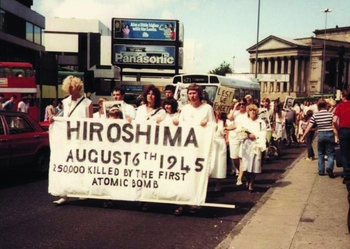
The specific political and cultural landscape within Liverpool itself created unique responses to the national nuclear debate. In the 1980s, Liverpool City Council became one of the most radical in the country, with the Trotskyist group Militant gaining increasing influence by the mid-1980s.Footnote 50 In terms of its parliamentary presence, the city's strong Labour representation can be considered in direct opposition with the Conservative government on a variety of policy issues. Perhaps for this reason, evidence from the local press and anti-nuclear archives suggests that broader anti-nuclear activism thrived in Liverpool in the early 1980s. The city became ‘nuclear free’ in June 1981. Liverpool MPs, including Eric Heffer and Allan Roberts, were part of the ‘CND 120’, which was a group of MPs who openly declared their CND membership.Footnote 51 In March and April 1981, the Liverpool Festival of Peace (Figure 2) was broadcast on local radio, sponsored by CND, Liverpool Trades Council, Liverpool University Guild of Undergraduates, among others.Footnote 52Bombs Away, the Merseyside CND magazine, in autumn 1983 lists over 50 active CND groups in Merseyside.Footnote 53 In June 1982, a Liverpool CND float took part in the lord mayor's parade, and in the same month Merseyside CND held a disco aboard the Royal Iris ferry on the Mersey. Across Liverpool in 1982, other anti-nuclear events included the Blackie community centre's ‘Participatory Vigils’, a talk entitled ‘Psychology of the Bomb’ given by Dr John Gleisner at the Everyman Theatre, organized by Nursing Campaign against Nuclear Weapons, and Health Service CND, as well as a screening of Jonathan Dimbleby's film The Bomb, at Charing Cross Methodist church, Birkenhead on 26 April. The archbishop of Liverpool spoke out against the bomb in May 1983.Footnote 54 The CND magazine Sanity carried the story of a Liverpudlian army recruit who was thrown out of the army for joining CND.Footnote 55 Many local musicians, authors and artists such as George Melly, John Peel and Coronation Street actress Mary Cunningham were vocal advocates of anti-nuclear politics.Footnote 56 In an interview in Sanity, Liverpool band The Beat were asked whether they had ever thought about writing a song on the danger of nuclear war. In response, they said, ‘I think everything we write has an ominous cloud of nuclear threat hanging over it.’Footnote 57 In May 1984, another Liverpool band, Frankie Goes to Hollywood, released the number one hit ‘Two Tribes’, which was a direct attack on the absurdity of late Cold War nuclear diplomacy. The lyrics referenced the two Cold War tribes locked in nuclear stalemate and, accompanied with a now iconic music video, parodies the machismo of nuclear leadership, and the futility of their general aims. This snap-shot of Liverpool life in the early 1980s suggests that anti-nuclear ideas had a strong foothold in the city.
Photograph of the Liverpool Festival of Peace, March/April 1981, Merseyside CND archive. Used by permission, Merseyside CND.

Turning to the local press, it is clear that there were powerful preoccupations away from the threat of nuclear war. In the Liverpool Echo social issues such as unemployment and crime figure highly in the early 1980s, as do stories about royalty, the Falklands war and the successes of the city's two football teams. Nuclear issues do appear sporadically. In the special report by journalist David Hope cited at the beginning of this article, one of the subtitles offers the scenario that ‘the port of Liverpool has been deemed a strategic target by the enemy’. After being invited to imagine nuclear attack, readers were told to follow government advice in Protect and Survive, while also being told that Britain lagged behind Europe in its civil defence preparations. A high level of detail regarding radiation and survival rates was offered, and it was made public that ‘a command post under the Walker Art Gallery could be the centre of operations’.Footnote 58 Discussions in the national press resonate in the Echo, but are localized by offering familiar and scalable examples of the possible impact on the Merseyside region. One reader of the Echo responded a couple of weeks later, asking ‘would I be considered a coward if in the four minutes, four hours or four days warning preceding a nuclear attack, I hoped not to be one of the “lucky survivors”’.Footnote 59 Another said,
time is not on our side; nations must disarm or die. We must try and be effective in informing public opinion on the crass stupidity of rearming. Fear between peoples and governments is the main cause of the race to rearm, and it is only by ordinary folk working together to increase trust and understanding in order to dispel this basic fear. Unless we show that effective non-violence is the only real alternative to modern warfare, our future and that of the whole human race is bleak indeed.Footnote 60
Here, we see nuclear subjectivities emerging, shaped by broad assumptions around nuclear danger which were echoed in the national and local press.
In 1983, the Echo offered an editorial which criticized the Easter marches organized by CND. Ambiguous public responses were published in the paper. D.W. Millner argued,
you say it is a sad reflection on the state of our civilization when the politicians and publicists have taken away Easter from our priests. . .it is the present government which is naïve and reckless and not the peace movement. . .the spread of nuclear weapons has done nothing but engender such mistrust and fear that neither side will now favourably consider any proposal made by the other.Footnote 61
A. Horton of Birkenhead believed that fear of nuclear attack was misguided, and asked that ‘you make it known to the anti-nuclear demonstrators that the danger of bombs dropping is no more than the danger of gas bombs dropping in the last war’.Footnote 62 In the following issue, one letter was given its own headline: ‘Peace dream won't come true.’ Its author argued,
after watching the antics of the CND I would ask, why don't they put their spare time to a better use? Like helping the aged and handicapped. If they got their wish they would do away with bombs and rockets. Then they would disband the Armed Forces. Later on they would scrap the Scouts and Brownies. What little work there is would be done by robots, so that everyone would be free to sing and dance in the streets, pelting each other with flowers.Footnote 63
This conservative voice displayed trust in the value of military and youth institutions which were assumed to preserve an idealized version of Britishness.
If we look to the local press, activist groups, politicians, artists and religious leaders in the city, we encounter a similar pattern to what was happening on the national level. The nature of engagement with nuclear politics, including actively imagining nuclear attack, was dependent on a range of assumptions over nuclear danger, but the space for individual expression remained. Nuclear subjectivity and degrees of nuclear resistance could emerge.
Within the national and local cultural context that has been sketched out, Merseyside County Council (MCC) reacted uniquely to the pressures of the late Cold War. It is clear that there were a variety of instances where local government initiatives went against national policy, particularly on nuclear civil defence. Overall, this had the effect of more openness when it came to sharing nuclear knowledge, contributing to the story of popular resistance to national nuclear policy. It is in this sense that a complex picture of nuclear resistance emerges in this single urban setting. In 1981, as part of the national civil defence plan, MCC was asked to undertake ‘Exercise Firm Grip’.Footnote 64 Council officials, or ‘players’, were asked to imagine a detailed nuclear attack scenario. As an example, in May 1981, ‘Exercise Narrative No. 5’ compelled players to imagine an attack on the UK involving the use of 71 warheads totalling 200 megatons.Footnote 65 In response to these ‘exercise narratives’, players were expected to develop sub-regional plans and public broadcasts: partake in a nuclear ‘role-playing’ game.
Notes from the county solicitor, C.K. Wilson, include: ‘like everyone else we had problems of commitment by players’. Commenting on an information services supplement, one official admits that ‘some of the advice given in the “Protect and Survive” publication lacks credibility particularly in a Merseyside context. In a PR sense it is, and would be, very difficult to defend.’ A letter from the chief executive of Wirral district council to the county emergency planning office dated 29 April 1981 states: ‘I think there is a widely held view that the Government's “protect and survive” policies would provide little protection for anyone in the large urban conurbations (which I think is true). There also appears to be a fairly common belief that persons in authority will retreat to invulnerable “bunkers” in the event of a nuclear attack.’Footnote 66 The perceived reluctance of council workers to conform to discredited national civil defence policy had clearly become a serious issue for district council leaders. In response, a reassuring message from MCC was sent out that the families of volunteers will be ‘looked after’ in the event of nuclear attack.Footnote 67 Clearly, strong awareness of the city-as-target, and the centrality of the individual within the nuclear predicament shaped rebellious responses from the district councils, as well as county council assurances that volunteers who agree to conform would be ‘protected’. A frustrated letter from the County Engineers Department to the chief executive of MCC complained that ‘the District Officers are not “playing the game” as I had expected, and when I or my staff have asked questions it is quite clear to me that they have done no planning whatsoever and, indeed, in some cases when we spoke to them were hardly aware of what was required from them’.Footnote 68 Communication between the two tiers of regional government appears poor, and it is easy to see why an MCC request to ‘play the game’ would have been resisted, or overlooked, by the districts.
Compellingly enough, these minor acts of resistance seem to reflect a growing willingness on the part of MCC to counteract national policy on nuclear civil defence. Official MCC sub-committee minutes show a proposal that an advertisement be placed in the Liverpool Echo in the name of MCC supporting the objectives of the proposed Day of Peace and indicating the council's support for the ‘Nuclear Free Zones Concept’.Footnote 69 Most striking of all, the MCC also committed to an intellectual project to construct its own civil defence narrative for the region. Clearly, it was deemed important to shape nuclear knowledge that would be received by Merseyside residents. In response to ‘the revised Civil Defence Regulations, which were to be debated in the House of Commons on 26th October 1983’, it was resolved that, amongst other things, the county emergency planning officer would
continue his work towards the production of a balanced booklet on the subject of civil defence against the background of the Council's policies (on the general basis of the publication issued by the Leeds City Council) for sale to the general public and for deposit in public libraries, together with a leaflet for free distribution as widely as possible drawing attention to the booklet.Footnote 70
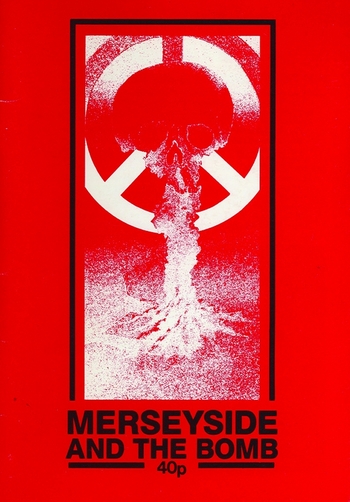
This is evidence of MCC reacting to national policy and taking inspiration from another city council's decision to produce their own civil defence booklet. The ‘balanced’ booklet which was eventually produced, entitled Merseyside and the Bomb, was funded by MCC and Nuclear Free Authority, but was ‘produced by Merseyside Campaign for Nuclear Disarmament, based on information provided by SANA, Scientists against Nuclear Arms’. The front cover of this ‘official’ pamphlet includes the CND peace symbol behind a mushroom cloud with a skull at its epicentre (Figure 3). At the end of the booklet, an A–Z of nukespeak is preceded by a list of peace movements and anti-nuclear groups.Footnote 71 Although the first publication in the list under the title ‘How can I find out more?’ is Protect and Survive, the reader is urged to ‘compare what the Home Office says in its publication with what the United States government and British scientists have published’. Merseyside residents were being urged to make their own minds up about nuclear policy. On a variety of levels, the booklet was an implicit rejection of national nuclear civil defence policy, and indicative of the wider radicalization of national nuclear attitudes. The booklet becomes explicit in this regard when, on the last page of the pamphlet, the council pledges
Merseyside CND, Merseyside and the Bomb, 1983. Used by permission, Merseyside CND.

not to be party to civil defence exercises designed to mislead the public into believing that adequate protection is available in the event of such an attack. . .to open up to public inspection wartime emergency facilities. . .to carry out no more than the minimum statutory obligations as they relate to wartime civil defence planning. . .to support, financially and otherwise, those local organizations and individuals who wish to protest about the dangers of nuclear attack. . .and to invite such organizations and individuals to work with the County Council on the implementation of the above policy.Footnote 72
It seems that MCC was influenced by the radical cultural politics that had emerged in the 1980s, and allowed a broadly anti-nuclear message to shape its ‘official’ nuclear stance. Merseyside citizens were effectively warned about being misled by central government policy. The council opened up nuclear bunkers to the public, symbolizing the openness displayed in these nuclear civil defence publications.Footnote 73 It is this openness and non-conformity that offers a glimpse of individual and collective nuclear resistance. Returning to Taylor's ideas, we can see how the city council offered ‘alternative narratives of the nuclear future’, encouraged ‘democratic participation in nuclear policy-making’, ‘disrupt[ed] the passivity of viewers, and implicated them in the evaluation of nuclear representations’.Footnote 74 In Merseyside, including Liverpool city, officials displayed apathy and frustration towards civil defence exercises but also empowered themselves and their citizens in their independent responses to nuclearization. By taking control of local nuclear narratives, thereby offering alternative and open visions of the nuclear present and future, they served both to democratize and to destabilize the nuclear state. The extent to which this process occurred in other cities should be of interest to historians of nuclear and urban Britain, and future comparative studies will increase our understanding of these complex and everyday modes of resistance during the Cold War.
Conclusion
The early 1980s generated new forms of nuclear expression due to a shift in broader national assumptions around nuclear danger. By locating events and ideas in underresearched urban environments, we can further appreciate the huge variety of cultural and political activities, lived experiences and emotions that emerged in direct or indirect response to nuclear threat. An examination of the complex ‘nuclearization’ of cities opens up the possibility for us more thoroughly to historicize the nuclear century. Focusing on just one city has suggested that individuals interacted in powerful, diverse and locally specific ways to the imagined threat of nuclear war. Conflicting opinions existed within the leadership of a single city when it came to official planning for nuclear attack. Individuals in official positions displayed degrees of nuclear resistance. It seems that nuclear resistance, activism and openness could become a normalized part of British official life in the late Cold War in ways we are yet fully to understand. Perhaps radicalized cultural politics on a national level proved more likely to take hold in Liverpool because of its relatively radical political climate.
Historicizing cities in the Cold War era influences how we define nuclear subjectivity and nuclear resistance as concepts. Can we see particular assumptions that we identify in national discourse influencing the actions and emotions of individuals, or altering the direction of leadership, communities and institutions? By what other means do people in cities create distinctive ‘nuclear knowledge’? Responses to nuclear threat were never passive. Each response would draw on a series of assumptions that can be traced not only in national nuclear narratives, but localized nuclear narratives as well. Also, to what extent did the politics of memory (especially in cities bombed during 1940–41) influence responses to nuclear civil defence initiatives, and perceived nuclear threat? In other British cities, very different stories will emerge, and understanding these will allow us to write fuller histories of the nuclear age. It could be argued that this more microscopic work needs to be done before we can confidently write ‘transnational’ histories of the Cold War. The broader implication of this article is that to understand the psychosocial pressures at the heart of the nuclear age we must be sensitive to the powerful role played by diverse nuclear narratives, the types of knowledge they created, and the individuals involved in their production, dissemination and reception. Only then can we convincingly capture histories of everyday life that reflect the full impact of the nuclear arms race, and truly understand urban spaces as complex and contested sites of power at the centre of the Cold War.