I. INTRODUCTION
Wide band gap metal oxides, like TiO2, have a wide range of uses, particularly if they can be synthesized in nanoparticle form. Titania nanoparticles have proven to be very useful across a broad range of applications and have been intensively studied. For example, TiO2 nanoparticles are excellent precursors for the formation of mesoporous semiconductor layers in dye-sensitized solar cells and recently in many solid-state polymer solar cells.Reference Arango, Carter and Brock1, Reference Gratzel2 Titania nanoparticles also find applications as catalysts,Reference Stark, Wegner, Pratsinis and Baiker3 photocatalysts,Reference Yu, Yu, Ho and Zhang4–Reference Anpo, Shima, Kodama and Kubokawa7 pigments,Reference Feldmann and Jungk8 as a possible electrode material in rechargeable lithium batteries,Reference Yu, Zhao, Guo, Ding, Bala, Liu and Wang9, Reference Huang, Kavan, Exnar and Gratzel10 and in many optical devices.Reference Will, Rao and Fitzmaurice11–Reference Frindell, Bartl, Popitsch and Stucky13 Here, we present a simple room temperature synthesis for nonagglomerated crystalline titania (TiO2) nanoparticles without the use of expensive organic surfactants or high temperature processing. The synthesis requires only three inexpensive widely available chemicals (titanium isopropoxide, isopropanol, and water) and produces very high quality nanoparticles that are well dispersed. Different ligands can be bound to the titania surface during or postsynthesis to further modify the particles’ functionality. The particles described here are well suited for use in optical devices and other applications.
Due to its high utility, a variety of different synthetic techniques have been used to fabricate TiO2 nanoparticles. A common method of synthesizing commercially available titania nanoparticles is through oxidation of titanium tetrachloride (TiCl4) in a methane–oxygen flame.Reference Morrison, Raghavan, Timpone, Artelt and Pratsinis14, Reference Yang, Zhuang and Biswas15 This approach is high yield and cost-effective yet it produces particles with a very high size dispersity. These particles also tend to agglomerate since they have high surface area and are synthesized without any ligands. Two other less common synthesis techniques used for commercial TiO2 involve ultrasonic irradiationReference Yu, Yu, Ho and Zhang4 and chemical vapor deposition,Reference Seifried, Winterer and Hahn16 which both result in particles that suffer from similar issues as oxidation of TiCl4.
Many research groups have fabricated titania nanoparticles on a smaller scale using wet chemistry techniques. A common approach is to synthesize the particles by hydrolyzing alkoxide or halide titanium precursors in a modified sol–gel prep.Reference Yu, Zhao, Guo, Ding, Bala, Liu and Wang9, Reference Aruna, Tirosh and Zaban17–Reference Wang and Ying21 These approaches have been successful but do not have a great deal size control, and the particles can suffer from agglomeration, though micellar or emulsion techniques can improve size control.Reference Lim, Hwang, Ryoo and Johnston22, Reference Spatz, Mossmer, Moller, Kocher, Neher and Wegner23 Nonhydrolytic methods generally use titanium tetrachloride as the Ti precursor coupled with a nonaqueous oxygen source.Reference Niederberger, Bartl and Stucky24–Reference Vioux26 Cassaignon et al.Reference Cassaignon, Koelsch and Jolivet27 reacted titanium tetrachloride with nitric acid at 95 °C from one day to up to a week to form titania particles in the brookite, anatase, or rutile phases. The routes utilizing titanium tetrachloride as a Ti precursor were successful in yielding titania particles with varied degrees of shape and size control but typically required high reaction temperatures, often lengthy reaction times, or expensive ligands such as trioctylphosphine oxide (TOPO).
To achieve a high degree of crystallinity titania syntheses must generally be either performed at high temperature (often in the form of a hydrothermal or solvothermal synthesis process) or followed by ultrasonic irradiation, hydrothermal treatment, or calcination.Reference Yu, Yu, Ho and Zhang4, Reference Yu, Zhao, Guo, Ding, Bala, Liu and Wang9, Reference Aruna, Tirosh and Zaban17–Reference Niederberger, Bartl and Stucky24, Reference Kandiel, Feldhoff, Robben, Dillert and Bahnemann28–Reference Ohno, Tomita, Komatsubara, Taniguchi, Katsumata, Matsushita, Kogure and Okada33 Hydrothermal and solvothermal preparations most often do not involve the use of surfactants and therefore result in nonfunctionalized and agglomerated particles. Postsynthesis treatments contribute to further particle agglomeration. To overcome these issues, some researchers use other costly surfactants such as tributylphosphine, tributylphosphine oxide, or TOPO.Reference Trentler, Denler, Bertone, Agrawal and Colvin25, Reference Tang, Redl, Zhu, Siegrist, Brus and Steigerwald34
Although these syntheses yield particles suitable for some applications, we wished to develop a straightforward synthesis that avoided the use of expensive organic surfactants and high temperature processing yet still produced nonagglomerated crystalline TiO2nanoparticles. Developing such a synthesis would allow us to scale up the synthesis easily and produce titania nanoparticles in bulk for various applications at a very low cost. In particular, if we could synthesize discrete nonagglomerated particles an order of magnitude smaller than the wave length of light, they would be very well suited for many optical applications where minimizing light scattering is important. Developing the ability to functionalize the particles’ surface so that they could be incorporated into a variety of transparent polymers suitable for optical applications was also very important.
II. EXPERIMENTAL DETAILS
A. Nanoparticle synthesis
All glassware was dried overnight in an oven at 115 °C before use, and reaction vessels were purged with nitrogen to remove moisture. Isopropyl alcohol from Fisher Scientific (Hampton, NH) was dried by stirring with magnesium sulfate for several hours followed by filtration. Titanium(IV) isopropoxide, trimethoxy-(7-octen-1-yl)silane, and triethylamine were purchased from Aldrich (St. Louis, MO) and used as received.
Isopropanol and titanium isopropoxide were added to a round bottom flask at a volumetric ratio of 100:1. In a separate flask, isopropanol and 18 MΩ water were mixed at a ratio of 400:1 (by volume). The molar ratio of water to titanium isopropoxide was 4:1. The water and isopropanol were added dropwise using a peristaltic pump to the vigorously stirred isopropanol and titanium isopropoxide solution, and the reaction continued stirring overnight. Titania nanoparticles with trimethoxy-(7-octen-1-yl)silane ligands could be synthesized by including a 2:1 volumetric ratio of trimethoxy-(7-octen-1-yl)silane and triethylamine in the flask containing the isopropanol and titanium isopropoxide. The trimethoxy-(7-octen-1-yl)silane to titanium isopropoxide molar ratio was 4:1. TiO2nanoparticles were recovered from the excess solvent through rotary evaporation or centrifugation at a force of 4000 g. A translucent white powder was recovered and redispersed in isopropanol or other common organic solvents.
Exchanging isopropanol ligands with decanol was accomplished by dispersing the particles in a 1% (v/v) solution of decyl alcohol and chloroform, then sonicating for 60 min, and followed by stirring the particles in this solution overnight. Decyl alcohol was purchased from Acros (Geel, Belgium), the chloroform was from Fisher Scientific, and both were used as received.
B. Characterization
1H nuclear magnetic resonance (NMR) spectra were taken on a Bruker DRX400 at 399.87 MHz. FTIR spectra were collected on a nitrogen-purged Bruker IFS 66/S spectrometer (Bruker BioSpin Corporation, Billerica, MA) using a sample concentration of 1.25% (w/w) pressed in a KBr pellet. Low-resolution transmission electron microscope (TEM) images were recorded on a JEOL 1200EX microscope (JEOL USA, Peabody, MA) at an acceleration voltage of 120 kV. High-resolution bright field TEM images were collected with an acceleration voltage of 200 kV on a JEOL 2010F microscope. Low-resolution TEM images of >150 particles were analyzed for size information using Digital Micrograph software available from Gatan. Ultraviolet (UV)–Vis absorption spectra were collected on a Cary 6000i UV–Vis–NIR spectrophotometer (Agilent Technologies, Santa Clara, CA).
X-ray powder diffraction (XRD) data were collected on a Rigaku Geigerflex powder diffractometer (Rigaku, Tokyo, Japan). XRD data for pair distribution function (PDF) analysis were obtained using a Siemens θ-2θ D500 diffractometer (Munich, Germany) equipped with a molybdenum sealed-tube x-ray source (λ = 0.7107 Å), a diffracted beam β-filter (Zr metal), and a scintillation detector. Fixed incident and diffracted beam slits (1° aperture) were used. The goniometer radius was 200 mm. Data were collected over an angular range of 4–110° 2θ with a step size of 0.05° 2θ and a count time of 20 s/step using Bragg-Brentano geometry (reflection mode). Four complete datasets were collected and merged to obtain the final raw data file. This file was treated for background modeling and removal within the software program Jade (Version 9, Materials Data Incorporated, Livermore, CA). Generation of the G(r) function was performed within the software package PDFgetX2.Reference Qiu, Thompson and Billinge35 Diffraction data were truncated at 90° 2θ (Q max = 12.5 Å−1) as the dataset consisted of essentially noise at larger values of Q. Modeling of G(r) was performed within the program PDFgui.Reference Farrow, Juhas, Liu, Bryndin, Božin, Bloch, Proffen and Billinge36
III. RESULTS AND DISCUSSION
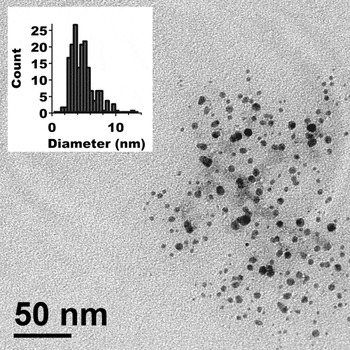
Our synthesis uses the room temperature hydrolysis of titanium(IV) isopropoxide to produce titania nanoparticles. Previous attempts to synthesize TiO2 nanoparticles from titanium isopropoxide have been unsuccessful due to the extremely rapid rate at which hydrolysis of titanium isopropoxide occurs. This resulted in a wide particle size distribution and agglomeration.Reference Turova, Turevskaya, Kessler and Yanovskaya37–Reference Stallings and Lamb40 However, our synthesis is different from previous attempts to grow titania nanoparticles in that it uses the common organic solvent isopropanol as both the solvent and the ligand, which controls particle growth and passivates the particles’ surface. By diluting both the titanium precursor and the water added to the precursor with isopropanol, the reaction rate is slowed and nanoparticle growth is controlled. This method yields particles with a size of 4.4 ± 1.8 nm, as determined by TEM. Figure 1 displays a TEM image of the titania nanoparticles including an inset with a histogram of the particle diameters.
TEM image of TiO2nanoparticles. The inset is a histogram of the distribution of particle diameters determined by analyzing over 150 particles.

The use of this simple three-component system is critical to the successful synthesis of titania nanoparticles. Unlike the more familiar primary alkoxides that are known to form clusters in solution, titanium isopropoxide exists as an isolated species in solution. This lack of steric hindrance is the reason for its rapid hydrolysis in the absence of a catalyst at room temperature. We found that adding a cosolvent consisting of a primary alcohol prevented this reaction from occurring at a reasonable rate, likely due to ligand exchange to form clusters of primary alkoxides of titanium.
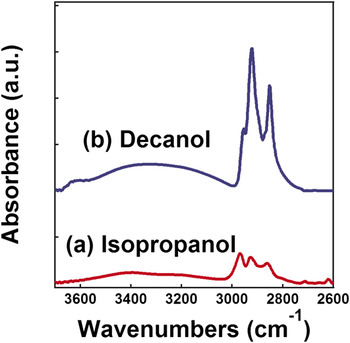
Once formed, the particles are stable in isopropanol but can be centrifuged or dried and recovered in powder form. To prevent agglomeration, it is best to store the particles dispersed in isopropanol or other organic solvents. We are also able to exchange the isopropanol ligands with those of longer chain alcohols (decanol works well and provides good particle separation) by ultrasonicating the particles in a 1% (v/v) solution of alcohol and chloroform followed by stirring the particles in this solution overnight. The particles can then be recovered by centrifuging or drying and redispersing in common organic solvents. 1H NMR (CDCl3, 400 MHz) of the as-synthesized particles confirmed isopropanol was passivating their surfaces: δ = 4.03 ppm (bs), 1.2 ppm (bs). FTIR spectroscopy also confirmed that isopropanol was on the particles’ surfaces. Upon exchanging the isopropanol ligands for decyl alcohol, an increase in the intensities of the C–H stretching peaks from 2970 to 2850 cm−1 confirms the presence of the longer chain alcohol on the particles’ surface. FTIR spectra of both titania samples are displayed in Fig. 2.
FTIR spectra of titania nanoparticles showing the presence of ligand molecules on the surface. (a) TiO2 particles with an isopropanol capping group. (b) TiO2particles after exchanging the ligands for decyl alcohol.

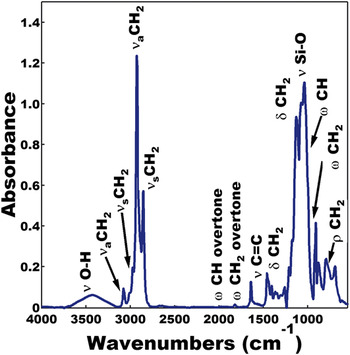
A vinyl termination can be included on the particles’ surface by adding trimethoxy-(7-octen-1-yl)silane and triethylamine. In this case, the vinyl-terminated trimethoxy-(7-octen-1-yl)silane acts as a ligand, and the triethylamine catalyzes the reaction between the trimethoxy-(7-octen-1-yl)silane and the titania surface. The vinyl-terminated ligand would enable these particles to readily mix and cross-link into a silicone matrix, facilitating the formation of a transparent, high index of refraction silicone composite. FTIR spectroscopy was used to confirm the presence of trimethoxy-(7-octen-1-yl)silane bound to the surface of the nanoparticles (see Fig. 3). A number of IR-active modes provide strong evidence of the presence of trimethoxy-(7-octen-1-yl)silane including the C = C stretching mode (ν) at 1640 cm−1 and ν Si–O at both 1072 and 1038 cm−1. The wagging (ω) modes of CH2and CH along with their respecting overtones are also indicative of the presence of the vinyl-terminated trimethoxy-(7-octen-1-yl)silane.
FTIR spectra of titania nanoparticles confirming the presence of the vinyl-terminated trimethoxy-(7-octen-1-yl)silane as a ligand. IR-active modes of trimethoxy-(7-octen-1-yl)silane are labeled. The following abbreviations are used: stretching mode (ν), antisymmetric stretching mode (νa), symmetric stretching mode (νs), wagging mode (ω), in-plane deformation or scissoring (δ), and rocking mode (ρ).

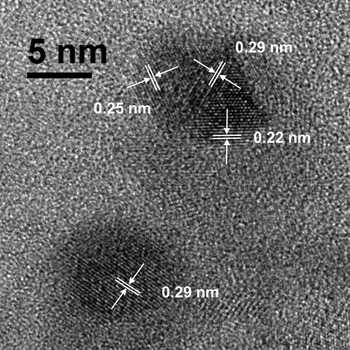
As synthesized, the particles are polycrystalline and in the brookite phase. A reasonable confirmation of the phase of the particles can be made by examining them using high-resolution transmission electron microscope (HRTEM). The HRTEM image in Fig. 4 shows not only the polycrystalline nature of the particles but also the lattice spacings along the [121], [012], and [022] axes of brookite TiO2.
HRTEM image of titania nanoparticles. The particles are polycrystalline and lattice spacings from the [121], [012], and [022] axes of brookite titania are indicated.

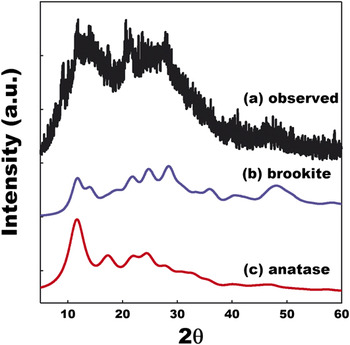
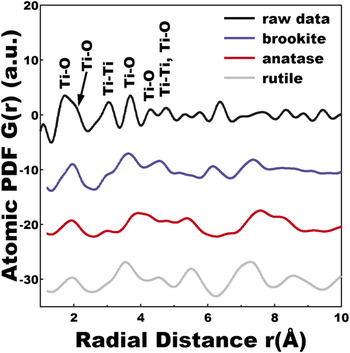
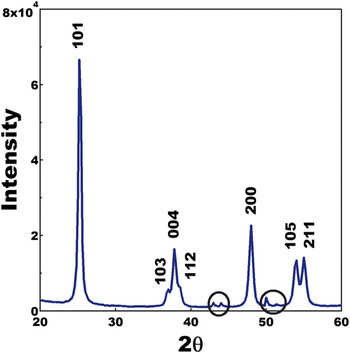
We also analyzed particles using x-ray diffraction (XRD) and observed the extremely broad peaks expected for such small crystallites. The XRD of the particles collected with a Mo source (λ = 0.7107 Å) is displayed in Fig. 5. The observed XRD pattern compares very favorably with the calculated pattern for brookite titania, assuming a crystallite size of 2 nm. The calculated pattern for 2-nm anatase titania, which is not as good of a match to the experimental data as the brookite pattern, is also displayed for comparison. This XRD data were also analyzed using the atomic PDF approach. A plot of the experimental atomic PDF as a function of radial distance is displayed in Fig. 6. The simulated atomic PDF patterns of brookite, anatase, and rutile titania with a crystallite size of 4 nm are also displayed. The brookite phase of titania provided the best match to the particles’ PDF function. The contribution to the PDF function from the first six nearest neighbors of brookite titania is labeled. Upon heating the particles to a temperature of 350 °C, their XRD data change dramatically. After calcining, the particles coarsen and undergo a phase change to the anatase form of titania. XRD data of the TiO2 particles after calcining at 350 °C, with labels for all peaks corresponding to anatase titania, are displayed in Fig. 7.
XRD of TiO2particles collected with a Mo source (λ = 0.7107 Å). The (a) observed XRD pattern compares very favorably with the (b) calculated pattern for brookite titania, assuming a crystallite size of 2 nm. (c) The calculated pattern for anatase titania, assuming a crystallite size of 2 nm, is not as good of a match to the experimental data as the brookite pattern.

A plot of the experimental atomic PDF for TiO2nanoparticles as a function of radial distance. The simulated atomic PDF patterns of brookite, anatase, and rutile titania with a crystallite size of 4 nm are also displayed. The brookite phase of titania provided the best match to the particles’ PDF function. The contribution to the PDF function from the first six nearest neighbors of brookite titania is labeled.

XRD of titania nanoparticles after calcining at 350 °C. The circled peaks are due to the heater stage on which the particles were resting. After calcining, the particles coarsen and undergo a phase change to the anatase form of titania.

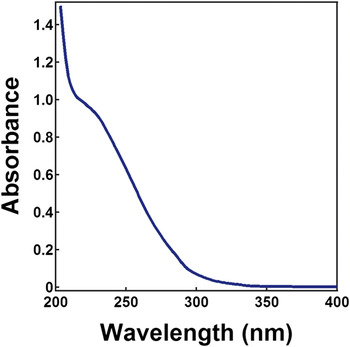
Absorption spectra of our TiO2 nanoparticles were collected using UV–Vis spectroscopy as shown in Fig. 8. By plotting the square root of the absorption coefficient of the material versus energy, the band gap of the particles can be determined by extrapolating the linear region of plot to zero. The band gap of the particles is calculated to be 3.4 eV, which is consistent with band gap values reported for nanoparticle-sized brookite titania (where some blueshifting of the band gap would be expected due to quantum confinement).Reference Koelsch, Cassaignon, Guillemoles and Jolivet41, Reference Henderson42
UV–Vis absorption spectrum of TiO2nanoparticles.

IV. CONCLUSIONS
In summary, we have developed a low-cost and scalable synthesis for crystalline brookite titania nanoparticles where neither expensive organic surfactants nor high temperature processing are required. The synthesis uses titanium(IV) isopropoxide as the titanium precursor and isopropanol as both the solvent and ligand. These particles can be converted from the brookite to the anatase phase by calcining the particles at 350 °C. The isopropanol ligands can easily be exchanged with longer chain alcohols if desired to increase particle separation. Additionally, the particles can be synthesized with a vinyl-terminated silane ligand to facilitate mixing and cross-linking with optical silicones.
ACKNOWLEDGMENTS
We thank P. Provencio for the HRTEM images, D. Overmeyer for the XRD data, and A. Boal for the NMR spectra. We also thank A.F. Emery, J.L. Crandall, and D.E. Fish for assistance in sample preparation. Funding was provided by the Division of Materials Sciences and Engineering, Office of Basic Energy Sciences, U.S. Department of Energy. Sandia National Laboratories is a multiprogram laboratory managed and operated by Sandia Corporation, a wholly owned subsidiary of Lockheed Martin Corporation, for the U.S. Department of Energy’s National Nuclear Security Administration under Contract No. DE-AC04-94AL85000.