Introduction
Several important reviews have been published on soluble carbohydrates in seeds (Dey, Reference Dey1985, Reference Dey1990; Horbowicz and Obendorf, Reference Horbowicz and Obendorf1994; Obendorf, Reference Obendorf1997; Loewus and Murthy, Reference Loewus and Murthy2000; Górecki et al., Reference Górecki, Fordoński, Halmajan, Horbowicz, Jones and Lahuta2001; Kadlec et al., Reference Kadlec, Bjergegaard, Gulewicz, Horbowicz, Jones, Kintia, Kratchanov, Lewandowicz, Soral-Smietana, Sorensen and Urban2001; Peterbauer and Richter, Reference Peterbauer and Richter2001; Raboy, Reference Raboy2009; Obendorf et al., Reference Obendorf, Horbowicz and Lahuta2012). This review is intended to supplement these with information published during the past decade. Earlier reports are included in an attempt to provide appropriate credits.
Sucrose and raffinose family oligosaccharides (RFOs)
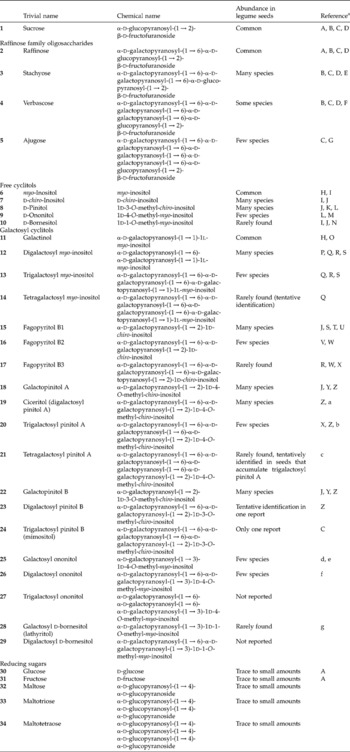
Sucrose (compound 1, Table 1; Fig. 1) is the most common soluble carbohydrate in plants and is present in all legume seeds (Hsu et al., Reference Hsu, Hadley and Hymowitz1973; Amuti and Pollard, Reference Amuti and Pollard1977a, Reference Amuti and Pollardb; Morris and Hall, Reference Morris and Hall1981; Koster and Leopold, Reference Koster and Leopold1988; Kuo et al., Reference Kuo, VanMiddlesworth and Wolf1988; Ganter et al., Reference Ganter, Correa, Reicher, Heyraud and Rinaudo1991; Horbowicz and Obendorf, Reference Horbowicz and Obendorf1994; Pattee et al., Reference Pattee, Isleib, Giesbrecht and McFeeters2000).
Trivial names, chemical names and abundance of soluble carbohydrates in legume seeds

a Reference codes: A (Morris and Hall, Reference Morris and Hall1981); B (Kuo et al., Reference Kuo, VanMiddlesworth and Wolf1988); C (Ganter et al., Reference Ganter, Correa, Reicher, Heyraud and Rinaudo1991); D (Horbowicz and Obendorf, Reference Horbowicz and Obendorf1994); E (McIntyre and Vogel, Reference McIntyre and Vogel1989); F (Meredith et al., Reference Meredith, Thomas, Snook, Himmelsbach and Van Halbeek1988); G (Kotiguda et al., Reference Kotiguda, Peterbauer and Mulimani2006); H (Brown and Serro, Reference Brown and Serro1953); I (Angyal and Odier, Reference Angyal and Odier1982); J (Schweizer and Horman, Reference Schweizer and Horman1981); K, (Angyal and Odier, Reference Angyal and Odier1983); L (Binder and Haddon, Reference Binder and Haddon1984); M (Richter et al., Reference Richter, Peterbauer and Brereton1997); N (Obendorf et al., Reference Obendorf, McInnis, Horbowicz, Keresztes and Lahuta2005); O (Noguchi et al., Reference Noguchi, Okuyama, Hidano, Wakiuchi, Tarui, Tamaki, Kishirara and Fujii2000); P (Petek et al., Reference Petek, Villarroya and Courtois1966); Q (Courtois and Percheron, Reference Courtois and Percheron1971); R (W. Gui, B.A. Lemley, I. Keresztes, A.Condo, K.J. Steadman and R.L. Obendorf, unpublished); S (Ogawa et al., Reference Ogawa, Watanabe, Ikeda and Kondo1997); T (Szczeciński et al., Reference Szczeciński, Gryff-Keller, Horbowicz and Obendorf1998); U (Obendorf et al., Reference Obendorf, Steadman, Fuller, Horbowicz and Lewis2000); V (Shiomi et al., Reference Shiomi, Takeda and Kiriyama1988); W (Steadman et al., Reference Steadman, Fuller and Obendorf2001); X (Obendorf et al., Reference Obendorf, Sensenig, Wu, Ohashi, O'Sullivan, Kosina and Schnebly2008a, Reference Obendorf, Zimmerman, Zhang, Castillo, Kosina, Bryant, Sensenig, Wu and Schnebly2009); Y (Beveridge et al., Reference Beveridge, Ford and Richards1977); Z (Szczeciński et al., Reference Szczeciński, Gryff-Keller, Horbowicz and Lahuta2000); a (Quemener and Brillouet, Reference Quemener and Brillouet1983; Bernabé et al., Reference Bernabé, Fenwick, Frias, Jiménez-Barbero, Price, Valverde and Vidal-Valverde1993); b (Nicolas et al., Reference Nicolas, Gertsch and Parisod1984); c (Lahuta et al., Reference Lahuta, Goszczyńska and Horbowicz2010a); d (Yasui, Reference Yasui1980); e (Richter et al., Reference Richter, Peterbauer and Brereton1997); f (Peterbauer et al., Reference Peterbauer, Brereton and Richter2003a); g (Obendorf et al., Reference Obendorf, McInnis, Horbowicz, Keresztes and Lahuta2005).
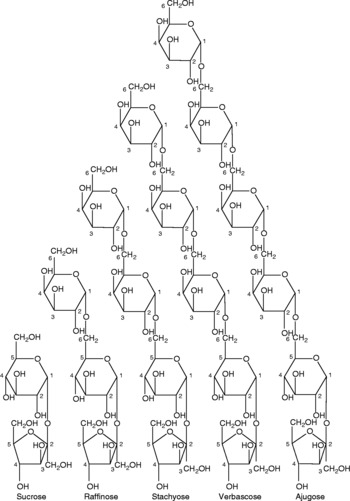
Structures of sucrose and raffinose family oligosaccharides (RFOs) present in legume seeds. Raffinose, stachyose, verbascose and ajugose, respectively, are mono-, di-, tri- and tetra-α-d-galactopyranosyl derivatives of sucrose.

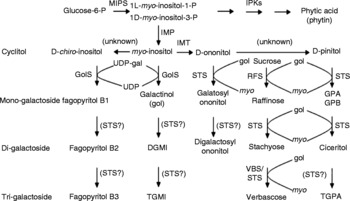
The raffinose family oligosaccharides (RFOs) are mono-, di-, tri- and tetra-galactosides of sucrose, including raffinose, stachyose, verbascose and ajugose, respectively (Fig. 1; compounds 2–5 in Table 1). Structures of RFOs have been confirmed (Morris and Hall, Reference Morris and Hall1981; Meredith et al., Reference Meredith, Thomas, Snook, Himmelsbach and Van Halbeek1988; McIntyre and Vogel, Reference McIntyre and Vogel1989; Ganter et al., Reference Ganter, Correa, Reicher, Heyraud and Rinaudo1991; Kotiguda et al., Reference Kotiguda, Peterbauer and Mulimani2006), and pathways of their synthesis have been described (Dey, Reference Dey1985, Reference Dey1990; Peterbauer and Richter, Reference Peterbauer and Richter1998, Reference Peterbauer and Richter2001) (Fig. 2). During soybean (Glycine max [L.] Merrill) seed formation, soluble carbohydrates accumulate in the order of sucrose, galactinol, raffinose and stachyose (Amuti and Pollard, Reference Amuti and Pollard1977a; Blackman et al., Reference Blackman, Obendorf and Leopold1992; Obendorf et al., Reference Obendorf, Horbowicz, Dickerman, Brenac and Smith1998b, Reference Obendorf, Zimmerman, Zhang, Castillo, Kosina, Bryant, Sensenig, Wu and Schnebly2009). Similar patterns occur in other legumes (Corbineau et al., Reference Corbineau, Picard, Fougereaux, Ladonne and Côme2000; Lahuta et al., Reference Lahuta, Górecki, Gojło and Horbowicz2005a). RFOs accumulate during seed yellowing and desiccation (Amuti and Pollard, Reference Amuti and Pollard1977a), and 70% of RFOs accumulate after physiological maturity (maximum seed dry mass) (Obendorf et al., Reference Obendorf, Zimmerman, Zhang, Castillo, Kosina, Bryant, Sensenig, Wu and Schnebly2009). When present, galactosyl cyclitols accumulate in a pattern parallel to, but not always coincidental with, RFOs during seed development and maturation (Obendorf et al., Reference Obendorf, Dickerman, Pflum, Kacalanos and Smith1998a, Reference Brown and Serrob, Reference Obendorf, Zimmerman, Zhang, Castillo, Kosina, Bryant, Sensenig, Wu and Schnebly2009; Lahuta et al., Reference Lahuta, Górecki, Gojło and Horbowicz2005a). In genotypes of pea selected for high or low RFOs, or low verbascose in mature, dry seeds, RFOs ranged from 67 to 72% of total soluble carbohydrates (Lahuta et al., Reference Lahuta, Święcicki, Dzik, Górecki and Horbowicz2010c).
Proposed pathways for synthesis of cyclitols, cyclitol galactosides and raffinose family oligosaccharides (modified from Ma et al., Reference Ma, Horbowicz and Obendorf2005). Parentheses (unknown) by an arrow indicate that an enzyme catalysing the reaction has not been identified. Some reactions may be reversible. Ciceritol, digalactopinitol A; DGMI, digalactosyl myo-inositol; gol, galactinol; GolS, galactinol synthase (EC 2.4.1.123); GPA, galactopinitol A; GPB, galactopinitol B; IMP, myo-inositol-phosphate monophosphatase (EC 3.1.3.25); IMT, myo-inositol 4-O-methyl transferase (EC 2.1.1.129); IPKs, inositol polyphosphate kinases; MIPS, myo-inositol-phosphate synthase (EC 5.5.1.4); myo, myo-inositol; RFS, raffinose synthase (EC 2.4.1.82); STS, stachyose synthase (EC 2.4.1.67); (STS?), indicates that STS or a similar enzyme is proposed by extrapolation but has not been demonstrated experimentally; TGMI, trigalactosyl myo-inositol; TGPA, trigalactopinitol A; UDP, uridine diphosphate; UDP-gal, uridine diphosphate galactoside; VBS, verbascose synthase. For chemical structures, see Figs 1, 3 and 4, and Obendorf (Reference Obendorf1997).

Like sucrose, raffinose (2) is present in all mature, dry legume seeds, but normally raffinose is not the most predominant RFO. Stachyose (3) is common in mature dry legume seeds and the most predominant RFO in many species, including soybean, cowpea (Vigna unguiculata Walp.), dry bean (Phaseolus vulgaris L., many genotypes), lima bean (Phaseolus lunatus L.), garden pea (some genotypes), lentil (Lens culinaris Medik.), lupin (Lupinus albus L.; Lupinus luteus L.), chickpea (Cicer arietinum L.), alfalfa (Medicago sativa L.) and peanut (Arachis hypogaea L.) (Amuti and Pollard, Reference Amuti and Pollard1977b; Kuo et al., Reference Kuo, VanMiddlesworth and Wolf1988; Horbowicz and Obendorf, Reference Horbowicz and Obendorf1994; Górecki et al., Reference Górecki, Brenac, Clapham, Willcott and Obendorf1996, Reference Górecki, Piotrowicz-Cieślak and Obendorf1997a, Reference Górecki, Piotrowicz-Cieślak, Lahuta and Obendorfb; Corbineau et al., Reference Corbineau, Picard, Fougereaux, Ladonne and Côme2000; Tahir et al., Reference Tahir, Vandenberg and Chibbar2011). Although detected in several species of legume seeds, verbascose (4) is the most predominant RFO in some mature, dry legume seeds including pigeon pea (Cajanus cajan [L.] Millsp.), mung bean, black gram (Vigna mungo [L.] Hepper), field bean, several species of Vicia, and some genotypes of pea (Kuo et al., Reference Kuo, VanMiddlesworth and Wolf1988; Horbowicz and Obendorf, Reference Horbowicz and Obendorf1994; Corbineau et al., Reference Corbineau, Picard, Fougereaux, Ladonne and Côme2000; Kotiguda et al., Reference Kotiguda, Peterbauer and Mulimani2006; Lahuta et al., Reference Lahuta, Login, Socha and Zalewski2000b, Reference Lahuta, Górecki, Gojło and Horbowicz2005a, Reference Lahuta, Goszczyńska and Horbowicz2010a). Ajugose (5) is not common in legume seeds, but may be present in small amounts (Kotiguda et al., Reference Kotiguda, Peterbauer and Mulimani2006). Its presence has been confirmed in mature dry seeds of black gram (Kotiguda et al., Reference Kotiguda, Peterbauer and Mulimani2006) and tentatively identified in seeds of Mimosa scabrella Benthan (Ganter et al., Reference Ganter, Correa, Reicher, Heyraud and Rinaudo1991) and in certain genotypes of peanut (Amuti and Pollard, Reference Amuti and Pollard1977a; Pattee et al., Reference Pattee, Isleib, Giesbrecht and McFeeters2000), mung bean (Vigna radiata [L.] R. Wilcz.), pea and faba bean (Vicia faba L.) (Amuti and Pollard, Reference Amuti and Pollard1977a).
RFOs as flatulence factors
RFOs have been identified as the principal flatulence-causing factors present in legumes and other seeds (Naczk et al., Reference Naczk, Amarowicz and Shahidi1997). Their consumption from mature seed products results in flatulence in humans and monogastric animals (Suarez et al., Reference Suarez, Springfield, Furne, Lohrmann, Kerr and Levitt1999; Sebastian et al., Reference Sebastian, Kerr, Pearlstein and Hitz2000). Due to the lack of α-galactosidase activity in human and animal intestine mucosa, RFOs are metabolized by the bifidobacteria and other bacteria of the colon, resulting in the production of mostly hydrogen and carbon dioxide. Various methods have been recommended for the removal of flatulence-inducing RFOs, including enzymatic treatment, soaking and/or cooking in water and in buffer solutions, germination, and solvent extraction, dehulling and irradiation (Naczk et al., Reference Naczk, Amarowicz and Shahidi1997). A reduction in RFOs in legume seeds is also possible by breeding and genetic modification. It is likely, however, that removal of RFOs has an adverse effect on seed desiccation tolerance and storability. Consequently, we have been searching for other desiccation-protecting factors such as galactosyl cyclitols that may substitute for RFOs in desiccation tolerance (Horbowicz and Obendorf, Reference Horbowicz and Obendorf1994; Lahuta et al., Reference Lahuta, Górecki and Horbowicz2005b, Reference Lahuta, Horbowicz, Gojło, Goszczyńska and Górecki2010c; Obendorf and Kosina, Reference Obendorf and Kosina2011).
Synthesis of RFOs in legume seeds
RFOs are synthesized de novo in legume seeds (Peterbauer and Richter, Reference Peterbauer and Richter2001); they are not transported to the developing seeds (Kandler and Hopf, Reference Kandler and Hopf1980; Peterbauer and Richter, Reference Peterbauer and Richter2001; Gomes et al., Reference Gomes, Obendorf and Horbowicz2005; Kosina et al., Reference Kosina, Castillo, Schnebly and Obendorf2009, Reference Kosina, Schnebly and Obendorf2010). Sucrose is the major product of photosynthesis that is transported to the seeds and is unloaded from the seed coats to the developing embryos (Thorne and Rainbird, Reference Thorne and Rainbird1983; Thorne, Reference Thorne1985; Ellis and Spanswick, Reference Ellis and Spanswick1987; Ellis et al., Reference Ellis, Turgeon and Spanswick1992; Gomes et al., Reference Gomes, Obendorf and Horbowicz2005; Kosina et al., Reference Kosina, Castillo, Schnebly and Obendorf2009, Reference Kosina, Schnebly and Obendorf2010). Its transport increases during increasing seed fresh weight growth (Amuti and Pollard, Reference Amuti and Pollard1977a; Blackman et al., Reference Blackman, Obendorf and Leopold1992; Obendorf et al., Reference Obendorf, Horbowicz, Dickerman, Brenac and Smith1998b, Reference Obendorf, Zimmerman, Zhang, Castillo, Kosina, Bryant, Sensenig, Wu and Schnebly2009). Typically, sucrose accumulates early in seed development followed by galactinol, raffinose, stachyose, verbascose and ajugose (Tanner, Reference Tanner1969; Amuti and Pollard, Reference Amuti and Pollard1977a; Górecki et al., Reference Górecki, Brenac, Clapham, Willcott and Obendorf1996, Reference Górecki, Piotrowicz-Cieślak and Obendorf1997a, Reference Górecki, Piotrowicz-Cieślak, Lahuta and Obendorfb; Obendorf et al., Reference Obendorf, Horbowicz, Dickerman, Brenac and Smith1998b; Reference Obendorf, Zimmerman, Zhang, Castillo, Kosina, Bryant, Sensenig, Wu and Schnebly2009; Peterbauer et al., Reference Peterbauer, Lahuta, Blöchl, Mucha, Jones, Hedley, Górecki and Richter2001). Because the equilibrium constant is 4 for the synthesis reaction in favour of stachyose (Tanner and Kandler, Reference Tanner and Kandler1968), measured accumulation of this may appear to precede the measured accumulation of raffinose (Górecki et al., Reference Górecki, Piotrowicz-Cieślak and Obendorf1997a). When present, stachyose, verbascose and ajugose sequentially accumulate late in seed maturation, typically during seed yellowing and drying (Amuti and Pollard, Reference Amuti and Pollard1977a; Blackman et al., Reference Blackman, Obendorf and Leopold1992; Górecki et al., Reference Górecki, Piotrowicz-Cieślak and Obendorf1997a, Reference Górecki, Piotrowicz-Cieślak, Lahuta and Obendorfb; Obendorf et al., Reference Obendorf, Horbowicz, Dickerman, Brenac and Smith1998b, Reference Obendorf, Zimmerman, Zhang, Castillo, Kosina, Bryant, Sensenig, Wu and Schnebly2009; Peterbauer et al., Reference Peterbauer, Lahuta, Blöchl, Mucha, Jones, Hedley, Górecki and Richter2001). Immature seeds can be induced to mature by slow drying (Adams and Rinne, Reference Adams and Rinne1980, Reference Adams and Rinne1981; Adams et al., Reference Adams, Fjerstad and Rinne1983; Rosenberg and Rinne, Reference Rosenberg and Rinne1986, Reference Rosenberg and Rinne1987; Blackman et al., Reference Blackman, Wettlaufer, Obendorf and Leopold1991, Reference Blackman, Obendorf and Leopold1992; Corbineau et al., Reference Corbineau, Picard, Fougereaux, Ladonne and Côme2000) and precocious maturation by slow drying has been used many times in the study of soluble carbohydrates in maturing seeds (Rosenberg and Rinne, 1987; Blackman et al., Reference Blackman, Obendorf and Leopold1992; Górecki et al., Reference Górecki, Piotrowicz-Cieślak and Obendorf1997a, Reference Górecki, Piotrowicz-Cieślak, Lahuta and Obendorfb; Obendorf et al., Reference Obendorf, Dickerman, Pflum, Kacalanos and Smith1998a, Reference Obendorf, Horbowicz, Dickerman, Brenac and Smithb; Corbineau et al., Reference Corbineau, Picard, Fougereaux, Ladonne and Côme2000). Legume seeds accumulate RFOs during slow drying and become desiccation tolerant (Rosenberg and Rinne, Reference Rosenberg and Rinne1987; Blackman et al., Reference Blackman, Obendorf and Leopold1992; Górecki et al., Reference Górecki, Piotrowicz-Cieślak and Obendorf1997a, Reference Górecki, Piotrowicz-Cieślak, Lahuta and Obendorfb; Obendorf et al., Reference Obendorf, Dickerman, Pflum, Kacalanos and Smith1998a, Reference Obendorf, Horbowicz, Dickerman, Brenac and Smithb; Corbineau et al., Reference Corbineau, Picard, Fougereaux, Ladonne and Côme2000). Field conditions of water deficit stress and high temperatures shorten the seed-filling period of faba bean, hasten seed maturation, reduce seed size and yield, and increase the concentration of verbascose in mature seeds (Lahuta et al., Reference Lahuta, Login, Socha and Zalewski2000b). Altering the temperature during legume seed maturation has little influence, or an inconsistent influence, on the composition of RFOs and galactosyl cyclitols in maturing seeds (Górecki et al., Reference Górecki, Brenac, Clapham, Willcott and Obendorf1996; Obendorf et al., Reference Obendorf, Horbowicz, Dickerman, Brenac and Smith1998b; Ren et al., Reference Ren, Bilyeu and Beuselinck2009; Bellaloui et al., Reference Bellaloui, Smith, Gillen and Ray2010). Several enzymes, namely the respective synthases or galactosyl transferases, are involved in the biosynthesis of RFOs in legume seeds.
Galactinol synthase – a key enzyme in RFO biosynthesis
Galactinol synthase (GolS, EC 2.4.1.123) transfers a galactosyl residue from UDP-galactose to myo-inositol (6) to form galactinol (11) (Fig. 2; reviewed by Castillo et al., Reference Castillo, de Lumen, Reyes and de Lumen1990; Horbowicz and Obendorf, Reference Horbowicz and Obendorf1994; Liu et al., Reference Liu, Odegard and de Lumen1995; Peterbauer and Richter, Reference Peterbauer and Richter2001) with optimum activity near pH 7 (Liu et al., Reference Liu, Odegard and de Lumen1995). Cold temperatures (Castillo et al., Reference Castillo, de Lumen, Reyes and de Lumen1990; Liu et al., Reference Liu, Krenz, Galvez and de Lumen1998), desiccation (Liu et al., Reference Liu, Krenz, Galvez and de Lumen1998) and abscisic acid (ABA) (Lahuta et al., Reference Lahuta, Górecki, Gojło and Horbowicz2004; Blöchl et al., Reference Blöchl, Grenier-de March, Sourdioux, Peterbauer and Richter2005) can increase galactinol synthase activity, thereby increasing galactinol formation and the accumulation of RFOs. Galactinol synthase activity is detected in seeds relatively early during seed fill (Peterbauer et al., Reference Peterbauer, Lahuta, Blöchl, Mucha, Jones, Hedley, Górecki and Richter2001), and has been reported as early as 5 days after pollination in cotyledons of soybean (Castillo et al., Reference Castillo, de Lumen, Reyes and de Lumen1990). Galactinol synthase can utilize d-chiro-inositol as a galactosyl acceptor to form fagopyritol B1 (Obendorf et al., Reference Obendorf, Odorcic, Ueda, Coseo and Vassallo2004; Ueda et al., Reference Ueda, Coseo, Harrell and Obendorf2005; Lahuta et al., Reference Lahuta, Horbowicz, Gojło, Goszczyńska and Górecki2005c), but cannot utilize d-pinitol (or other O-methyl cyclitols) to form galactopinitol (Obendorf et al., Reference Obendorf, Odorcic, Ueda, Coseo and Vassallo2004).
Raffinose synthase
Raffinose synthase (RFS; EC 2.4.1.82) is the key enzyme that channels sucrose into RFOs (reviewed by Peterbauer and Richter, Reference Peterbauer and Richter2001; Peterbauer et al., Reference Peterbauer, Mach, Mucha and Richter2002a) (Fig. 2). It transfers a galactose moiety from galactinol (11) to sucrose (1) forming raffinose (2) and myo-inositol (6) (Lehle et al., Reference Lehle, Tanner and Kandler1970; Castillo et al., Reference Castillo, de Lumen, Reyes and de Lumen1990; Peterbauer and Richter, Reference Peterbauer and Richter2001; Peterbauer et al., Reference Peterbauer, Mach, Mucha and Richter2002a) with an equilibrium constant of 4.1, favouring the formation of raffinose (Peterbauer et al., Reference Peterbauer, Mach, Mucha and Richter2002a). This, in turn, is a substrate for the formation of stachyose by stachyose synthase. Raffinose synthase is the most unstable of the RFO synthesis enzymes in vitro (Castillo et al., Reference Castillo, de Lumen, Reyes and de Lumen1990; Peterbauer et al., Reference Peterbauer, Puschenreiter and Richter1998, Reference Peterbauer, Mach, Mucha and Richter2002a); perhaps this instability has contributed to the historical lack of studies on raffinose synthase in seeds (Peterbauer and Richter, Reference Peterbauer and Richter2001). Surprisingly, pea raffinose synthase can utilize d-ononitol (9) and d-pinitol (8), O-methyl cyclitols not normally found in pea, as galactosyl acceptors to form galactosyl ononitol (25) and galactopinitol A (18), respectively, in reactions that are similar to that of stachyose synthase (Peterbauer et al., Reference Peterbauer, Mach, Mucha and Richter2002a). Raffinose synthase is a transglycosidase with structural and biological properties similar to seed imbibition proteins (SIPs, including neutral pH α-galactosidases) and α-galactosidases (EC 3.2.1.22) (Peterbauer et al., Reference Peterbauer, Mach, Mucha and Richter2002a). In addition to the normal utilization of galactinol as the galactosyl donor to sucrose, pea seed raffinose synthase also can utilize galactosyl ononitol (25) and p-nitrophenyl α-d-galactopyranoside, a commonly used artificial substrate for α-galactosidases, as galactosyl donors (Peterbauer et al., Reference Peterbauer, Mach, Mucha and Richter2002a). Pea raffinose synthase is strongly inhibited by a potent inhibitor of α-galactosidases, 1-deoxygalactonojirimycin (Peterbauer et al., Reference Peterbauer, Mach, Mucha and Richter2002a).
Soybean plants homozygous for the mutant stc1 gene produce seeds with high sucrose and high galactinol but a low-raffinose and low-stachyose seed phenotype (Sebastian et al., Reference Sebastian, Kerr, Pearlstein and Hitz2000; Hitz et al., Reference Hitz, Carlson, Kerr and Sebastian2002). Seeds of this phenotype have low raffinose synthase activity but normal galactinol synthase and stachyose synthase activities (Hitz et al., Reference Hitz, Carlson, Kerr and Sebastian2002); have normal field emergence comparable to the normal raffinose and stachyose phenotype (Neus et al., Reference Neus, Fehr and Schnebly2005); are tolerant to imbibitional chilling (Obendorf et al., Reference Obendorf, Zimmerman, Ortiz, Taylor and Schnebly2008b); and accumulate normal to elevated amounts of galactinol (11), fagopyritols (15–17) and galactopinitols (18–22) (Obendorf et al., Reference Obendorf, Zimmerman, Ortiz, Taylor and Schnebly2008b, Reference Obendorf, Zimmerman, Zhang, Castillo, Kosina, Bryant, Sensenig, Wu and Schnebly2009).
Dierking and Bilyeu (Reference Dierking and Bilyeu2008) have identified four candidate genes for raffinose synthase (RS1, RS2, RS3 and RS4) in soybean. However, RS1 appears to be a gene encoding an alkaline α-galactosidase (Carmi et al., Reference Carmi, Zhang, Petreikov, Gao, Eyal, Granot and Schaffer2003; Dierking and Bilyeu, Reference Dierking and Bilyeu2008). Dierking and Bilyeu (Reference Dierking and Bilyeu2009a) identified four mutations in the soybean RS2 raffinose synthase gene in independent lines. Two of these resulted in amino acid mutations and one in an altered seed oligosaccharide phenotype. The resulting seed phenotype had increased sucrose concentrations and less raffinose and stachyose. This unique RS2 allele completely associates with the seed raffinose phenotype through a segregating population and is identified as a raffinose synthase (Dierking and Bilyeu, Reference Dierking and Bilyeu2008). Interestingly, RS2 is highly expressed in all soybean tissues tested (leaf, seedling and all stages of seed development). The functions of raffinose synthase candidate genes RS3 and RS4 remain unknown but may be soybean-seed stachyose synthases (Dierking and Bilyeu, Reference Dierking and Bilyeu2008). Skoneczka et al. (Reference Skoneczka, Maroof, Shang and Buss2009) identified a 3-bp deletion mutant, identified as rsm1 (raffinose synthase mutation) for the PI200508 allele because it segregates in a recessive manner, which is responsible for the low stachyose phenotype in soybean PI200508, accounting for 88 and 94% of the phenotypic variation in seed stachyose in two different segregating populations. It has been mapped to confirm cosegregation with a low stachyose quantitative trait locus (QTL).
Stachyose synthase
Stachyose synthases (STS, EC 2.4.1.67) are often multifunctional, forming stachyose (3) as well as higher RFOs including verbascose (4) and ajugose (5). In addition, many stachyose synthases can form galactosyl cyclitols. Stachyose synthase from P. vulgaris seeds transfers a galactosyl residue from galactinol to raffinose, forming stachyose and myo-inositol (Tanner and Kandler, Reference Tanner and Kandler1968). This enzyme does not recognize stachyose to form verbascose. However, a multifunctional stachyose synthase from V. faba seeds can form stachyose (raffinose + galactinol → stachyose + myo-inositol) and also verbascose (stachyose + galactinol → verbascose + myo-inositol), but this enzyme cannot use verbascose as a substrate to form ajugose (Tanner et al., Reference Tanner, Lehle and Kandler1967).
A multifunctional stachyose synthase from pea seeds catalyses the formation of stachyose (raffinose + galactinol → stachyose + myo-inositol), verbascose (stachyose + galactinol → verbascose + myo-inositol) and ajugose (tentative identification) (verbascose + galactinol → ajugose + myo-inositol) (Peterbauer et al., Reference Peterbauer, Mucha, Mach and Richter2002b). This pea seed stachyose synthase can also use sequoyitol (5-O-methyl-myo-inositol; not found in legumes, Dittrich and Brandl, Reference Dittrich and Brandl1987) and d-ononitol (9) as galactosyl acceptors at high reaction rates, as well as d-pinitol (8) at lower reaction rates, to form their respective galactosyl cyclitols (Peterbauer et al., Reference Peterbauer, Mucha, Mach and Richter2002b). The absence of these galactosyl cyclitols from pea seeds is probably caused by the absence of synthesis of the respective free cyclitols in the pea plant rather than an absence of the biosynthetic machinery to form galactosyl cyclitols in the pea seeds (Peterbauer et al., Reference Peterbauer, Mucha, Mach and Richter2002b).
Adzuki bean (Vigna angularis Ohwi et Ohashi) seed stachyose synthase forms stachyose (3) (raffinose + galactinol → stachyose + myo-inositol) and galactosyl ononitol (25; d-ononitol + galactinol → galactosyl ononitol + myo-inositol) but also can utilize galactosyl ononitol (25) to form stachyose (3) (raffinose + galactosyl ononitol → stachyose +d-ononitol) (Peterbauer and Richter, Reference Peterbauer and Richter1998; Peterbauer et al., Reference Peterbauer, Mucha, Mayer, Popp, Glössl and Richter1999). Stachyose synthase from lentil seeds forms stachyose (3) using galactinol (11), galactosyl ononitol (25) and galactopinitol A (18) (low activity) as galactosyl donors (raffinose + galactinol → stachyose + myo-inositol; raffinose + galactosyl ononitol → stachyose + d-ononitol; raffinose + galactopinitol A → stachyose + d-pinitol) (Hoch et al., Reference Hoch, Peterbauer and Richter1999). This enzyme can also transfer a galactose unit from galactinol (11) to sequoyitol (5-O-methyl-myo-inositol), forming an unidentified product, to d-ononitol (9; 1d-4-O-methyl-myo-inositol) forming galactosyl ononitol (25), and to d-pinitol (8; 1d-3-O-methyl-chiro-inositol) forming galactopinitol A (18) and small amounts of galactopinitol B (22) (Hoch et al., Reference Hoch, Peterbauer and Richter1999). The enzyme can also form ciceritol (19) (galactopinitol A+ galactinol → ciceritol + myo-inositol). Additionally, the enzyme can utilize d-chiro-inositol (7) and scyllo-inositol to form their respective galactosyl cyclitols (Hoch et al., Reference Hoch, Peterbauer and Richter1999). To our knowledge, this is the only report of a stachyose synthase transferring a galactosyl residue from galactinol to d-chiro-inositol to form a galactosyl d-chiro-inositol (tentatively identified as fagopyritol B1) (Hoch et al., Reference Hoch, Peterbauer and Richter1999).
Verbascose synthase
Pea seeds from the line SD1 accumulate stachyose as the predominant RFO, but only traces of verbascose (Jones et al., Reference Jones, DuPont, Ambrose, Frias and Hedley1999), whereas pea seeds of the RRRbRb line accumulate a high amount of verbascose (4) in addition to stachyose (3). Verbascose synthase activity (stachyose + galactinol → verbascose + myo-inositol), with an optimum pH of 7.0, is fourfold higher in RRRbRb pea seeds compared to SD1 pea seeds (Peterbauer et al., Reference Peterbauer, Lahuta, Blöchl, Mucha, Jones, Hedley, Górecki and Richter2001). Verbascose synthase mRNA increases a few days before maximum enzyme activity. Galactinol synthase and raffinose synthase activities are only about 1.5-fold higher in RRRbRb seeds (Peterbauer et al., Reference Peterbauer, Lahuta, Blöchl, Mucha, Jones, Hedley, Górecki and Richter2001). A galactinol-independent activity (stachyose + stachyose → verbascose + raffinose) has also been detected in RRRbRb seeds (Peterbauer et al., Reference Peterbauer, Lahuta, Blöchl, Mucha, Jones, Hedley, Górecki and Richter2001). Both stachyose synthase and galactinol-independent activities are almost undetectable in SD1 seeds. Subsequent cloning of a multifunctional stachyose synthase from SD1 seeds with low verbascose accumulation, demonstrates that this enzyme has a reduced ability to synthesize verbascose, prompting the authors to suggest that the low verbascose accumulation in SD1 pea seeds is caused by mutations in the stachyose synthase gene as well as the amount of the enzyme in SD1 seeds (Peterbauer et al., Reference Peterbauer, Karner, Mucha, Mach, Jones, Hedley and Richter2003b).
Metabolism of RFOs
Legume seed soluble carbohydrates (sucrose, RFOs and galactosyl cyclitols) are present predominately (85%) in the cytosol but also are present (15%) in protein storage vacuoles (Plant and Moore, Reference Plant and Moore1982). Seed germination begins with the uptake of water and ends with the appearance of the embryo, usually the radicle, through the seed coat (Nonogaki et al., Reference Nonogaki, Bassel and Bewley2010). Most of the RFOs and galactosyl cyclitols in axis tissues are hydrolysed before germination is completed (Hsu et al., Reference Hsu, Hadley and Hymowitz1973; Koster and Leopold, Reference Koster and Leopold1988; Górecki and Obendorf, Reference Górecki and Obendorf1997; Górecki et al., Reference Górecki, Piotrowicz-Cieślak, Lahuta and Obendorf1997b; Lahuta and Goszczyńska, Reference Lahuta and Goszczyńska2009; Lahuta and Górecki, Reference Lahuta and Górecki2011), and half or more of the RFOs and galactosyl cyclitols in cotyledons are also hydrolysed during this time (Hsu et al., Reference Hsu, Hadley and Hymowitz1973; Górecki and Obendorf, Reference Górecki and Obendorf1997; Górecki et al., Reference Górecki, Piotrowicz-Cieślak, Lahuta and Obendorf1997b; Blöchl et al., Reference Blöchl, Peterbauer, Hofmann and Richter2008; Lahuta and Goszczyńska, Reference Lahuta and Goszczyńska2009; Lahuta and Górecki, Reference Lahuta and Górecki2011). Both RFOs and galactosyl cyclitols are hydrolysed by α-galactosidases (EC 3.2.1.22) (Peterbauer and Richter, Reference Peterbauer and Richter2001; Blöchl et al., Reference Blöchl, Peterbauer, Hofmann and Richter2008; Lahuta and Goszczyńska, Reference Lahuta and Goszczyńska2009). Acid and alkaline α-galactosidases are present in legume seeds (Dey et al., Reference Dey, Del Campillo and Pont Lezica1983; Blöchl et al., Reference Blöchl, Peterbauer, Hofmann and Richter2008). The α-galactosidase enzymes are ubiquitous in legume seeds and are present in two forms, having an acid or alkaline pH optimum for activity (Dey et al., Reference Dey, Del Campillo and Pont Lezica1983; Carmi et al., Reference Carmi, Zhang, Petreikov, Gao, Eyal, Granot and Schaffer2003; Zhao et al., Reference Zhao, Corum, Mullen, Meeley, Helentjaris, Martin and Downie2006; Blöchl et al., Reference Blöchl, Peterbauer, Hofmann and Richter2008). The acid α-galactosidase accumulates during seed development, is localized in protein storage vacuoles (Plant and Moore, Reference Plant and Moore1982; Herman and Shannon, Reference Herman and Shannon1985; Bassel et al., Reference Bassel, Mullen and Bewley2001; Blöchl et al., Reference Blöchl, Peterbauer, Hofmann and Richter2008), and its amino acid sequence is similar to that of prokaryotic α-galactosidases (Carmi et al., Reference Carmi, Zhang, Petreikov, Gao, Eyal, Granot and Schaffer2003; Zhao et al., Reference Zhao, Corum, Mullen, Meeley, Helentjaris, Martin and Downie2006; Blöchl et al., Reference Blöchl, Peterbauer, Hofmann and Richter2008). Acid α-galactosidases hydrolyse RFOs and glycoproteins in protein storage vacuoles; the secreted enzyme also hydrolyses cell wall components, including branched galactans and galactomannans (Plant and Moore, Reference Plant and Moore1982). Alkaline α-galactosidase is synthesized after germination, is localized in the cytosol, and its amino acid sequence is similar to that of seed imbibition proteins (SIPs), raffinose synthase and stachyose synthase (Carmi et al., Reference Carmi, Zhang, Petreikov, Gao, Eyal, Granot and Schaffer2003; Zhao et al., Reference Zhao, Corum, Mullen, Meeley, Helentjaris, Martin and Downie2006; Blöchl et al., Reference Blöchl, Peterbauer, Hofmann and Richter2008).
Active α-galactosidase has been extracted from dry, stored seeds of yellow lupin (Lupinus luteus L.) (Lahuta et al., Reference Lahuta, Górecki, Michalczyk and Piotrowicz-Cieśkak2000a). Two cDNAs were isolated from maturing and germinating seeds of pea (Blöchl et al., Reference Blöchl, Peterbauer, Hofmann and Richter2008). One cDNA encodes an acidic α-galactosidase localized in protein storage vacuoles and the second encodes an alkaline α-galactosidase, highly homologous with seed imbibition proteins (SIPs) (Blöchl et al., Reference Blöchl, Peterbauer, Hofmann and Richter2008). In pea seeds, the acidic α-galactosidase is present during seed development and facilitates mobilization of RFOs during early germination. After emergence of the radicle, an alkaline α-galactosidase hydrolyses the remaining RFOs in the cotyledons and axis during early seedling growth (Blöchl et al., Reference Blöchl, Peterbauer, Hofmann and Richter2008).
A potent inhibitor of α-galactosidases, 1-deoxygalactonojirimycin (Peterbauer and Richter, Reference Peterbauer and Richter2001; Blöchl et al., Reference Blöchl, Peterbauer and Richter2007; Dierking and Bilyeu, Reference Dierking and Bilyeu2009b; Lahuta and Goszczyńska, Reference Lahuta and Goszczyńska2009), has been proposed as a useful experimental tool to study the role of RFOs during germination (Peterbauer and Richter, Reference Peterbauer and Richter2001). This inhibits RFO and galactosyl cyclitol mobilization and delays germination of pea and winter (hairy) vetch (Vicia villosa Roth) seeds (Blöchl et al., Reference Blöchl, Peterbauer and Richter2007; Lahuta and Goszczyńska, Reference Lahuta and Goszczyńska2009), but the final percentage germination is the same as in the absence of inhibitor. Similarly, inhibiting the mobilization of RFOs in soybean by treatment with this inhibitor does not alter germination percentage (Dierking and Bilyeu, Reference Dierking and Bilyeu2009b). When RFO accumulation is prevented by incubation of soybean seeds at high relative humidity during seed maturation (Blackman et al., Reference Blackman, Obendorf and Leopold1992) or is reduced by low raffinose synthase activity in maturing soybean seeds expressing the mutant stc1 gene (Obendorf et al., Reference Obendorf, Zimmerman, Ortiz, Taylor and Schnebly2008b), they germinate under laboratory conditions. Jasmonic acid (10− 3 M) inhibits mobilization of RFOs and galactosyl cyclitols in yellow lupin seeds and delays germination, but the final percentage is reduced only slightly (Zalewski et al., Reference Zalewski, Nitkiewicz, Lahuta, Glowacka, Socha and Amarowicz2010). Collectively, these results do not rule out a role for RFOs or galactosyl cyclitols as storage reserves, but indicate that these seeds have alternative reserves in sufficient quantities to meet the needs for germination per se under laboratory conditions.
Cyclitols in legumes
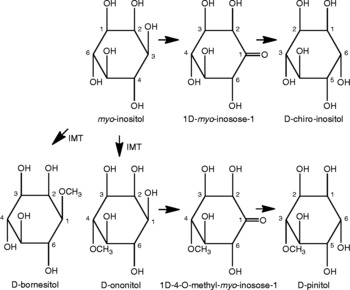
Five cyclic sugar alcohols called cyclitols, including myo-inositol, d-chiro-inositol, d-pinitol, d-ononitol and d-bornesitol, are present in legumes (Fig. 3; Table 1, compounds 6–10). Their structures have been confirmed (Brown and Serro, Reference Brown and Serro1953; Schweizer and Horman, Reference Schweizer and Horman1981; Angyal and Odier, Reference Angyal and Odier1982, Reference Angyal and Odier1983; Binder and Haddon, Reference Binder and Haddon1984; Richter et al., Reference Richter, Peterbauer and Brereton1997; Obendorf et al., Reference Obendorf, McInnis, Horbowicz, Keresztes and Lahuta2005). In Fig. 3, myo-inositol (6) carbons are numbered in the clockwise direction representing the l-configuration. Carbons on the myo-inositol ring of d-ononitol (9) and d-bornesitol (10) are numbered in the counter-clockwise direction representing the d-configuration. Note that the carbons on the d-chiro-inositol (7) ring have a different numbering system than carbons on the d-myo-inositol ring. d-myo-Inositol and l-myo-inositol are the same compound; therefore, when used alone (no attachments), the compound is called myo-inositol, which is optically inactive (does not rotate light). Substitution of an O-methyl group on the myo-inositol ring causes the compound to become optically active. d-Ononitol (1d-4-O-methyl-myo-inositol) (9) has a small dextrorotation (Binder and Haddon, Reference Binder and Haddon1984; Richter et al., Reference Richter, Peterbauer and Brereton1997), but d-bornesitol (1d-1-O-methyl-myo-inositol) (10) has levorotation (Bien and Ginsburg, Reference Bien and Ginsburg1958; Obendorf et al., Reference Obendorf, McInnis, Horbowicz, Keresztes and Lahuta2005). Both compounds are in the d-configuration. d-chiro-Inositol (7) and d-pinitol (1d-3-O-methyl-chiro-inositol) (8) are optically active (dextrorotation) (Schweizer et al., Reference Schweizer, Horman and Würsch1978; Baumgartner et al., Reference Baumgartner, Genner, Haas, Amado and Neukom1986).
Cyclitols found in legume seeds and proposed pathways for their synthesis. IMT, myo-inositol O-methyl transferases (EC 2.1.1.40 forming d-bornesitol, and EC 2.1.1.129 forming d-ononitol). Enzymes converting myo-inositol to d-chiro-inositol and d-ononitol to d-pinitol have not been identified.

myo-Inositol is synthesized from glucose-6-phosphate by action of myo-inositol-phosphate synthase (MIPS; EC 5.5.1.4) to 1l-myo-inositol-1-phosphate (also known as 1d-myo-inositol-3-phosphate; Raboy, Reference Raboy2009) and myo-inositol-phosphate monophosphatase (IMP; EC 3.1.3.25) to myo-inositol (see Fig. 2). myo-Inositol is present in all living cells (Loewus, Reference Loewus1990) and has many roles in plants, including synthesis of membranes, cell walls, O-methyl cyclitols, galactinol and RFOs, phytic acid and indoleacetic acid (IAA) conjugates (see reviews by Bohnert et al., Reference Bohnert, Nelson and Jensen1995; Loewus and Murthy, Reference Loewus and Murthy2000; and Raboy, Reference Raboy2009). myo-Inositol is a precursor of other cyclitols in legume leaves (Figs 2 and 3). It is converted to d-ononitol by myo-inositol 4-O-methyl transferase (IMT; EC 2.1.1.129) (Vernon and Bohnert, Reference Vernon and Bohnert1992; Rammesmayer et al., Reference Rammesmayer, Pichorner, Adams, Jensen and Bohnert1995; Wanek and Richter, Reference Wanek and Richter1995) and to d-pinitol, with d-ononitol as an intermediate and d-pinitol as the end product (Dittrich and Brandl, Reference Dittrich and Brandl1987). In legumes that synthesize d-pinitol, the concentration of d-ononitol is very low compared to the accumulated concentrations of d-pinitol (Horbowicz et al., Reference Horbowicz, Obendorf, McKersie and Viands1995; Kosina et al., Reference Kosina, Castillo, Schnebly and Obendorf2009), consistent with an efficient conversion of d-ononitol to d-pinitol in leaves (Dittrich and Brandl, Reference Dittrich and Brandl1987). In legumes that synthesize d-pinitol, d-ononitol is not unloaded by seed coats (Gomes et al., Reference Gomes, Obendorf and Horbowicz2005; Kosina et al., Reference Kosina, Castillo, Schnebly and Obendorf2009, Reference Kosina, Schnebly and Obendorf2010) and normally is not detected in embryos of seeds that form galactopinitols. In some species, d-ononitol is not converted to d-pinitol, resulting in d-ononitol accumulation in stems, petioles and leaf blades (Ford, Reference Ford1982, Reference Ford1984; Wanek and Richter, Reference Wanek and Richter1995, Reference Wanek and Richter1997) and galactosyl ononitol in seeds (Yasui, Reference Yasui1980; Yasui and Ohno, Reference Yasui and Ohno1982; Richter et al., Reference Richter, Peterbauer and Brereton1997; Peterbauer and Richter, Reference Peterbauer and Richter1998; Peterbauer et al., Reference Peterbauer, Puschenreiter and Richter1998). Soybean embryos do not form d-chiro-inositol, d-ononitol or d-pinitol (Odorcic and Obendorf, Reference Odorcic and Obendorf2003; Obendorf et al., Reference Obendorf, Odorcic, Ueda, Coseo and Vassallo2004; Chiera et al., Reference Chiera, Streeter and Finer2006), but transgenic soybean somatic embryos containing the inositol methyl transferase (IMT) gene from Mesembryanthmum crystallinum exhibit an increase in d-ononitol, compared to non-transgenic embryos, and an increase in d-pinitol in maturing embryos (Chiera et al., Reference Chiera, Streeter and Finer2006).
myo-Inositol feeding experiments show the conversion of myo-inositol to d-chiro-inositol in leaves and perhaps other maternal tissues (Gomes et al., Reference Gomes, Obendorf and Horbowicz2005; Ma et al., Reference Ma, Horbowicz and Obendorf2005). Cool temperatures may enhance accumulation of d-chiro-inositol (Horbowicz and Obendorf, Reference Horbowicz and Obendorf2005), but this has not been confirmed in legumes (Górecki et al., Reference Górecki, Brenac, Clapham, Willcott and Obendorf1996; Obendorf et al., Reference Obendorf, Dickerman, Pflum, Kacalanos and Smith1998a). The enzymes responsible for the conversion of d-ononitol to d-pinitol, or for the conversion of myo-inositol to d-chiro-inositol, have not been identified in higher plants, but the enzymes are proposed to be oxidoreductases with an inosose as intermediate (see Fig. 3; reviewed by Obendorf, Reference Obendorf1997; Raboy, Reference Raboy2009). d-Pinitol accumulates in leaves and stems of many (but not all) legumes, but pinitol galactosides accumulate only in seeds (Beveridge et al., Reference Beveridge, Ford and Richards1977). Water deficit (or osmotic) stress enhances IMT activity, d-ononitol and d-pinitol accumulation in leaves (Ford, Reference Ford1982, Reference Ford1984; Vernon and Bohnert, Reference Vernon and Bohnert1992; Keller and Ludlow, Reference Keller and Ludlow1993; Vernon et al., Reference Vernon, Tarczynski, Jensen and Bohnert1993; Bohnert et al., Reference Bohnert, Nelson and Jensen1995; Wanek and Richter, Reference Wanek and Richter1997; Streeter et al., Reference Streeter, Lohnes and Fioritto2001), but a role for d-pinitol in desiccation tolerance has not been confirmed during osmotic adjustment of winter (hairy) vetch seedlings (Lahuta and Górecki, Reference Lahuta and Górecki2011). myo-Inositol is converted to d-bornesitol by a specific myo-inositol 3-O-methyl transferase (EC 2.1.1.40) in vegetative tissues (Wagner et al., Reference Wagner, Hoffmann and Hoffmann-Ostenhof1969; Koller and Hoffmann-Ostenhof, Reference Koller and Hoffmann-Ostenhof1976).
myo-Inositol also is converted to phytic acid in seeds (see Fig. 2; reviewed by Raboy, Reference Raboy2009) where it is stored as phytin, the potassium and magnesium salts of phytic acid, myo-inositolhexakisphosphate, and represents a major seed storage source of phosphorus, potassium, magnesium and other ions (Raboy, Reference Raboy2009). There are multiple Mips (myo-inositol-phosphate synthase) genes in legumes; four of these genes have been identified in soybean. Mips1 is highly expressed in seeds (Hegeman et al., Reference Hegeman, Good and Grabau2001; Hitz et al., Reference Hitz, Carlson, Kerr and Sebastian2002; Chappell et al., Reference Chappell, Scaboo, Wu, Nguyen, Pantalone and Bilyeu2006; Nunes et al., Reference Nunes, Vianna, Cuneo, Amaya-Farfán, de Capdeville, Rech and Aragão2006; Chiera and Grabau, Reference Chiera and Grabau2007), especially in immature cotyledons (Chappell et al., Reference Chappell, Scaboo, Wu, Nguyen, Pantalone and Bilyeu2006). Mips2, Mips3 and Mips4 are poorly expressed in immature seeds. By contrast, Mips4 is highly expressed in leaves (Chappell et al., Reference Chappell, Scaboo, Wu, Nguyen, Pantalone and Bilyeu2006).
About 75% of the phosphorus in legume seeds is stored as the potassium and magnesium salts of phytic acid (myo-inositol hexakisphosphate) in protein storage vacuoles (Raboy, Reference Raboy2009). Phytic acid is a common component of animal feeds in the form of seeds or seed products including seed protein extracts. Upon consumption, it can chelate calcium, iron and zinc in the digestive tract, forming stable chelates that are not readily digested by humans and monogastric animals (Erdman, Reference Erdman1979), producing potential environmental hazards when present in manure (Raboy, Reference Raboy2009). Animals fed meal prepared from low-phytic acid soybean seeds excrete less phosphorus (Powers et al., Reference Powers, Fritz, Fehr and Angel2006). Raboy (Reference Raboy2009) reviewed four targets for reducing phytic acid in seeds: (1) synthesis of 1l-myo-inositol-1-phosphate and myo-inositol; (2) synthesis of phytic acid from myo-inositol or 1l-myo-inositol-1-phosphate; (3) compartmentation, transport and storage; and (4) phytase. The relationship of phytic acid modification with soluble carbohydrates in legume seeds has been studied in detail for target 1 (Obendorf et al., Reference Obendorf, Zimmerman, Ortiz, Taylor and Schnebly2008b, Reference Obendorf, Zimmerman, Zhang, Castillo, Kosina, Bryant, Sensenig, Wu and Schnebly2009) and target 2 (Frank et al., Reference Frank, Norenberg and Engel2009). Cotyledons of low phytic acid soybean seeds expressing the mips mutant (target 1) have decreased total RFOs, total α-galactosides, raffinose, stachyose, verbascose, galactinol, galactopinitol A, galactopinitol B, ciceritol, fagopyritol B1 and fagopyritol B2 (Hitz et al., Reference Hitz, Carlson, Kerr and Sebastian2002; Obendorf et al., Reference Obendorf, Zimmerman, Ortiz, Taylor and Schnebly2008b). Similarily, metabolite profiling of low phytic acid (lpa) soybean mutants (target 2) reveals decreased myo-inositol, galactinol, raffinose, stachyose, galactopinitol A, galactopinitol B and fagopyritol B1 compared to the wild type (Frank et al., Reference Frank, Norenberg and Engel2009). Reduced field emergence has been reported for modifications to targets 1 and 2 (Meis et al., Reference Meis, Fehr and Schnebly2003; Hulke et al., Reference Hulke, Fehr and Welke2004; Oltmans et al., Reference Oltmans, Fehr, Welke, Raboy and Peterson2005). Some progress has been made in selecting low phytic acid lines with improved field seedling establishment (Spear and Fehr, Reference Spear and Fehr2007).
Seeds of low phytic acid (lpa lpa) soybean lines are not significantly different from normal phytate lines in their concentrations of a partially phosphorylated inositol phosphate intermediate (inositol triphosphate), stachyose, raffinose and phytase activity during seed development (Israel et al., Reference Israel, Taliercio, Kwanyuen, Burton and Dean2011). In two of three experiments, myo-inositol concentrations were higher in seeds of the low phytic acid lines early during seed development, but the differences in myo-inositol concentrations were not significant at seed maturity. Concentrations of d-pinitol, d-chiro-inositol or galactosyl cyclitols were not reported.
Soluble carbohydrate unloading by seed coat cups
Development of the seed coat cup technique in Phaseolus bean (Patrick, Reference Patrick1983), soybean (Thorne and Rainbird, Reference Thorne and Rainbird1983; Ellis and Spanswick, Reference Ellis and Spanswick1987) and faba bean (Wolswinkel and Ammerlaan, Reference Wolswinkel and Ammerlaan1983) stimulated a flurry of research that contributed enormously to our understanding of the transport to developing seeds and unloading of maternally synthesized sucrose, the amides glutamine and asparagine, and amino acids (Rainbird et al., Reference Rainbird, Thorne and Hardy1984; Thorne, Reference Thorne1985; Ellis et al., Reference Ellis, Turgeon and Spanswick1992; Wolswinkel, Reference Wolswinkel1992; Weber et al., Reference Weber, Heim, Golombek, Borisjuk and Wobus1998; Patrick and Offler, Reference Patrick and Offler2001). More recently, the seed coat cup technique has been used to demonstrate the unloading of maternally synthesized sucrose (1) (147 μg h− 1), myo-inositol (6) (3.6 μg h− 1), d-chiro-inositol (7) (5.1 μg h− 1) and d-pinitol (8) (32 μg h− 1) from surgically prepared seed coat cups (filled with water) on whole soybean plants (Gomes et al., Reference Gomes, Obendorf and Horbowicz2005; Kosina et al., Reference Kosina, Castillo, Schnebly and Obendorf2009) and on soybean stem–leaf–pod explants (Kosina et al., Reference Kosina, Schnebly and Obendorf2010). Interestingly, free cyclitols are 60% of total soluble carbohydrates in soybean leaves in planta, but free cyclitols are only 20% of the total in seed coat cup exudates (Kosina et al., Reference Kosina, Castillo, Schnebly and Obendorf2009). d-Ononitol (9), galactinol (11), galactopinitols (18–24), fagopyritols (15–17) or RFOs (2–5) were not detected in these. However, after feeding solutions containing raffinose (2) or stachyose (3) to the cut stem of soybean stem–leaf–pod explants, small amounts of raffinose (2) and galactinol (11) were detected in the exudates (S.M. Kosina, S.R. Schnebly and R.L. Obendorf, unpublished). d-Pinitol (8), d-ononitol (9) and myo-inositol (6), free cyclitols that are present in alfalfa leaves and stems, are also in honeydew of pea aphids (Acyrthosiphon pisum) that feed on alfalfa phloem and, by deduction, provide evidence for the phloem transport of these cyclitols in alfalfa (Campbell and Binder, Reference Campbell and Binder1984; Horbowicz et al., Reference Horbowicz, Obendorf, McKersie and Viands1995).
Galactosyl cyclitols in legume seeds
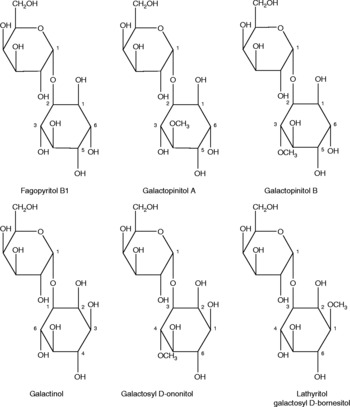
The structures of the mono-α-d-galactosyl cyclitols [fagopyritol B1 (15), galactopinitol A (18), galactopinitol B (22), galactinol (11), galactosyl ononitol (25) and lathyritol (28)] in legume seeds are illustrated in Fig. 4. The higher galactosyl oligomers (the di-, tri- and tetra-α-d-galactosides) follow the same structural additions as illustrated for the RFOs (Fig. 1), with sucrose being substituted by the respective cyclitol.
Structures of mono-galactosides of cylitols found in legume seeds including fagopyritol B1 [α-d-galactopyranosyl-(1 → 2)-1d-chiro-inositol], galactopinitol A [α-d-galactopyranosyl-(1 → 2)-1d-4-O-methyl-chiro-inositol], galactopinitol B [α-d-galactopyranosyl-(1 → 2)-1d-3-O-methyl-chiro-inositol], galactinol [α-d-galactopyranosyl-(1 → 1)-1l-myo-inositol], galactosyl ononitol [α-d-galactopyranosyl-(1 → 3)-1d-4-O-methyl-myo-inositol] and galactosyl d-bornesitol [lathyritol; α-d-galactopyranosyl-(1 → 3)-1d-1-O-methyl-myo-inositol].

Galactosides of myo-inositol
myo-Inositol (6) is converted to galactinol [11; α-d-galactopyranosyl-(1 → 1)-1l-myo-inositol; also known as α-d-galactopyranosyl-(1 → 3)-1d-myo-inositol] in seeds by galactinol synthase (GolS; EC 2.41.123) using UDP-galactose as the galactosyl donor (Fig. 2) (Peterbauer and Richter, Reference Peterbauer and Richter2001; Hitz et al., Reference Hitz, Carlson, Kerr and Sebastian2002; Karner et al., Reference Karner, Peterbauer, Raboy, Jones, Hedley and Richter2004; Obendorf et al., Reference Obendorf, Odorcic, Ueda, Coseo and Vassallo2004; Lahuta et al., Reference Lahuta, Goszczyńska and Horbowicz2010a). Galactinol is the galactosyl donor to sucrose to form raffinose (2) by raffinose synthase (RFS, EC 2.4.1.82), to raffinose to form stachyose (3) by stachyose synthase (STS, EC 2.4.1.67), and to stachyose to form verbascose (4) by verbascose synthase (VBS) (Fig. 2) (Dey, Reference Dey1985, Reference Dey1990; Peterbauer and Richter, Reference Peterbauer and Richter2001; Peterbauer et al., Reference Peterbauer, Mach, Mucha and Richter2002a, Reference Peterbauer, Mucha, Mach and Richterb). Galactinol normally accumulates to a transient peak during mid-seed development and declines during accumulation of RFOs during late development and maturation desiccation (Koster and Leopold, Reference Koster and Leopold1988; Obendorf et al., Reference Obendorf, Horbowicz, Dickerman, Brenac and Smith1998b; Lahuta et al., Reference Lahuta, Górecki, Gojło and Horbowicz2004, Reference Lahuta, Górecki, Gojło and Horbowicz2005a). Increasing the supply of myo-inositol and sucrose increases the accumulation of RFOs in pea seeds (Karner et al., Reference Karner, Peterbauer, Raboy, Jones, Hedley and Richter2004), and myo-inositol increases RFO accumulation in soybean seeds expressing the mutant mips gene (Hitz et al., Reference Hitz, Carlson, Kerr and Sebastian2002), demonstrating that the supply of substrates can affect the accumulation of RFOs. ABA applied to immature seeds increases the transitory accumulation of galactinol when applied early during seed development and increases accumulation of RFOs when applied during late development (Lahuta et al., Reference Lahuta, Górecki, Gojło and Horbowicz2004; Blöchl et al., Reference Blöchl, Grenier-de March, Sourdioux, Peterbauer and Richter2005). When applied to alfalfa somatic embryos, ABA increases galactinol synthase activity threefold while raffinose synthase and stachyose synthase activities remain almost constant (Blöchl et al., Reference Blöchl, Grenier-de March, Sourdioux, Peterbauer and Richter2005), indicating that the increase in RFOs is most likely caused by an increased supply of galactinol. Conversely, when the synthesis of RFOs in seeds is restricted, the amount of galactinol increases (Blackman et al., Reference Blackman, Obendorf and Leopold1992; Hitz et al., Reference Hitz, Carlson, Kerr and Sebastian2002; Obendorf et al., Reference Obendorf, Zimmerman, Zhang, Castillo, Kosina, Bryant, Sensenig, Wu and Schnebly2009).
Accumulation of galactinol in seeds can lead to the formation of higher galactosyl oligomers. The occurrence and structures of galactinol and digalactosyl myo-inositol (12) have been reported in common vetch (Vicia sativa L.) seeds (Petek et al., Reference Petek, Villarroya and Courtois1966). Germinating vetch seeds have an enzyme with transferase activity that can add an α-galactosyl residue to galactinol to form digalactosyl myo-inositol (12) (Petek et al., Reference Petek, Villarroya and Courtois1969). The presence of small amounts of trigalactosyl myo-inositol (13) and a tetragalactosyl myo-inositol (14) has been reported (Courtois and Percheron, Reference Courtois and Percheron1971). The structure of galactinol (11) has been confirmed (Brown and Serro, Reference Brown and Serro1953; Noguchi et al., Reference Noguchi, Okuyama, Hidano, Wakiuchi, Tarui, Tamaki, Kishirara and Fujii2000). Recently, the structures of digalactosyl myo-inositol (12) and trigalactosyl myo-inositol (13) were confirmed by nuclear magnetic resonance (NMR) analysis (W. Gui, B.A. Lemley, I. Keresztes, A. Condo, K.J. Steadman and R.L. Obendorf, unpublished). Both galactinol and digalactosyl myo-inositol are widespread in legume seeds, but usually in small amounts in mature seeds. Increased galactinol and digalactosyl myo-inositol plus small amounts of trigalactosyl myo-inositol have been identified in soybean seeds expressing the mutant stc1 gene with low raffinose synthase (RFS) activity and low raffinose and stachyose accumulation in seeds (Obendorf et al., Reference Obendorf, Sensenig, Wu, Ohashi, O'Sullivan, Kosina and Schnebly2008a, Reference Obendorf, Zimmerman, Ortiz, Taylor and Schneblyb, Reference Obendorf, Zimmerman, Zhang, Castillo, Kosina, Bryant, Sensenig, Wu and Schnebly2009). Galactinol, digalactosyl myo-inositol and trigalactosyl myo-inositol accumulate sequentially during seed development and maturation. The accumulation of trigalactosyl myo-inositol is very late in seed maturation, after maximum seed dry mass has been attained (physiological maturity) and during seed desiccation (Obendorf et al., Reference Obendorf, Zimmerman, Zhang, Castillo, Kosina, Bryant, Sensenig, Wu and Schnebly2009).
Galactosides of d-chiro-inositol
A galactoside of d-chiro-inositol, called fagopyritol B1, naturally accumulates in seeds of many legume species that form d-chiro-inositol in their leaves or other maternal tissues and transport this d-chiro-inositol to seeds. Fagopyritol B1 is synthesized in seeds by galactinol synthase (GolS, EC 2.4.1.123) using UDP-galactose as the galactosyl donor and d-chiro-inositol as the galactosyl acceptor (Fig. 2; Obendorf et al., Reference Obendorf, Odorcic, Ueda, Coseo and Vassallo2004; Ueda et al., Reference Ueda, Coseo, Harrell and Obendorf2005). The structures of fagopyritol B1 (15) (Schweizer and Horman, Reference Schweizer and Horman1981; Ogawa et al., Reference Ogawa, Watanabe, Ikeda and Kondo1997; Szczeciński et al., Reference Szczeciński, Gryff-Keller, Horbowicz and Obendorf1998; Obendorf et al., Reference Obendorf, Steadman, Fuller, Horbowicz and Lewis2000) and fagopyritol B2 (16) (Shiomi et al., Reference Shiomi, Takeda and Kiriyama1988; Steadman et al., Reference Steadman, Fuller and Obendorf2001) have been confirmed by NMR analysis. Recently, the structure of fagopyritol B3 (17) was confirmed by NMR (W. Gui, B.A. Lemley, I. Keresztes, A. Condo, K.J. Steadman and R.L. Obendorf, unpublished). Only the fagopyritol B series (compounds 15–17) are present in legume seeds and accumulate in sequential order of fagopyritol B1, fagopyritol B2 and fagopyritol B3 (Górecki et al., Reference Górecki, Piotrowicz-Cieślak, Lahuta and Obendorf1997b; Obendorf et al., Reference Obendorf, Zimmerman, Zhang, Castillo, Kosina, Bryant, Sensenig, Wu and Schnebly2009), typically in decreasing amounts with the increasing degree of polymerization. Fagopyritol A1 [α-d-galactopyranosyl-(1 → 3)-1d-chiro-inositol] (Obendorf et al., Reference Obendorf, Steadman, Fuller, Horbowicz and Lewis2000) and the higher α-d-galactosyl oligomers, fagopyritol A2 and fagopyritol A3 (Steadman et al., Reference Steadman, Fuller and Obendorf2001), have not been confirmed to be present in legume seeds. Synthesis of fagopyritol A1 appears to require a specific galactinol synthase in buckwheat (Fagopyrum esculentum Moench) seeds (Ueda et al., Reference Ueda, Coseo, Harrell and Obendorf2005) that is not present in soybean seeds (Obendorf et al., Reference Obendorf, Odorcic, Ueda, Coseo and Vassallo2004) nor presumably in seeds of other legumes. Increasing the supply of d-chiro-inositol to isolated seeds (Obendorf et al., Reference Obendorf, Odorcic, Ueda, Coseo and Vassallo2004), or to stem–leaf–pod explants (Gomes et al., Reference Gomes, Obendorf and Horbowicz2005; Obendorf et al., Reference Obendorf, Zimmerman, Ortiz, Taylor and Schnebly2008b), increases the accumulation of fagopyritol B1 in soybean seeds. Increasing the supply of d-chiro-inositol to buckwheat stem–leaf–inflorescence explants increases the concentration of both fagopyritol A1 and fagopyritol B1 in mature seeds (Ma et al., Reference Ma, Horbowicz and Obendorf2005). Interestingly, feeding d-chiro-inositol to isolated seeds or to stem–leaf–pod explants of legumes or to stem–leaf–ear explants of small grain cereals that do not normally synthesize this, results in the accumulation of fagopyritol B1 in seeds that do not normally accumulate fagopyritols (Lahuta et al., Reference Lahuta, Górecki and Horbowicz2005b, Reference Lahuta, Horbowicz, Gojło, Goszczyńska and Góreckic, Reference Lahuta, Święcicki, Dzik, Górecki and Horbowicz2010c; Lahuta and Goszczyńska, Reference Lahuta and Goszczyńska2010; Lahuta and Dzik, Reference Lahuta and Dzik2011). These results underscore the importance of the availability of specific cyclitols to legume seeds as one factor regulating the accumulation of galactosyl cylitols. Interestingly, feeding d-chiro-inositol to immature pea seeds (Lahuta and Dzik, Reference Lahuta and Dzik2011) or to pea stem–leaf–pod explants (Lahuta et al., Reference Lahuta, Święcicki, Dzik, Górecki and Horbowicz2010c) reduces the accumulation of RFOs in certain genotypes. However, feeding d-pinitol does not reduce RFO accumulation in pea seeds (Lahuta et al., Reference Lahuta, Święcicki, Dzik, Górecki and Horbowicz2010c, Lahuta and Dzik, Reference Lahuta and Dzik2011).
Galactosides of d-pinitol
Seven different galactopinitols (18–24), in two different series (galactopinitol A series, 18–21; galactopinitol B series, 22–24) have been identified in legume seeds. Many, but not all, legumes accumulate d-pinitol in leaf and stem tissues, but galactosyl pinitols accumulate only in seeds (Beveridge et al., Reference Beveridge, Ford and Richards1977). Galactopinitol A [α-d-galactopyranosyl-(1 → 2)-1d-4-O-methyl-chiro-inositol; compound 18 in Table 1; Fig. 4] is the most commonly reported galactosyl pinitol in legume seeds (Beveridge et al., Reference Beveridge, Ford and Richards1977; Schweizer et al., Reference Schweizer, Horman and Würsch1978; Schweizer and Horman, Reference Schweizer and Horman1981; Horbowicz and Obendorf, Reference Horbowicz and Obendorf1994; Szczenciński et al., Reference Szczeciński, Gryff-Keller, Horbowicz and Lahuta2000). All members of the galactopinitol A series have an O-methyl group in the 4-position of d-pinitol (see Fig. 4). The first galactosyl residue is linked to the 5-position of d-pinitol (1d-3-O-methyl-chiro-inositol) (8) (Fig. 3); after renumbering the carbons on the d-chiro-inositol ring of d-pinitol, 6 becomes 1, 5 becomes 2, and 3 becomes 4 (see structure of galactopinitol A in Fig. 4) (reviewed by Horbowicz and Obendorf, Reference Horbowicz and Obendorf1994). To form higher galactosyl oligomers, subsequent α-d-galactopyranosyl-(1 → 6) additions are made to the most distal galactosyl residue, comparable to addition of galactosyl linkages to the RFOs (Fig. 1). Ciceritol [digalactosyl pinitol A, α-d-galactopyranosyl-(1 → 6)-α-d-galactopyranosyl-(1 → 2)-1d-4-O-methyl-chiro-inositol; compound 19 in Table 1] has been identified as a prominent galactopinitol in several species (Quemener and Brillouet, Reference Quemener and Brillouet1983; Bernabé et al., Reference Bernabé, Fenwick, Frias, Jiménez-Barbero, Price, Valverde and Vidal-Valverde1993; Horbowicz and Obendorf, Reference Horbowicz and Obendorf1994; Horbowicz et al., Reference Horbowicz, Obendorf, McKersie and Viands1995; Szczeciński et al., Reference Szczeciński, Gryff-Keller, Horbowicz and Lahuta2000; Lahuta et al., Reference Lahuta, Górecki, Gojło and Horbowicz2005a). Trigalactosyl pinitol A [α-d-galactopyranosyl-(1 → 6)-α-d-galactopyranosyl-(1 → 6)-α-d-galactopyranosyl-(1 → 2)-1d-4-O-methyl-chiro-inositol; compound 20 in Table 1] is present in seeds of a few species (Nicolas et al., Reference Nicolas, Gertsch and Parisod1984; Szczeciński et al., Reference Szczeciński, Gryff-Keller, Horbowicz and Lahuta2000; Lahuta et al., Reference Lahuta, Górecki, Gojło and Horbowicz2005a), ranging from the predominant galactopinitol in seeds of certain Vicia species (Lahuta et al., Reference Lahuta, Górecki, Gojło and Horbowicz2005a, Reference Lahuta, Goszczyńska and Horbowicz2010a) to trace or small amounts in other seeds, including soybean seeds expressing the mutant stc1 gene causing low raffinose synthase (RFS) activity and low raffinose and stachyose accumulation (Obendorf et al., Reference Obendorf, Sensenig, Wu, Ohashi, O'Sullivan, Kosina and Schnebly2008a, Reference Obendorf, Zimmerman, Ortiz, Taylor and Schneblyb, Reference Obendorf, Zimmerman, Zhang, Castillo, Kosina, Bryant, Sensenig, Wu and Schnebly2009). Tetragalactosyl pinitol A [α-d-galactopyranosyl-(1 → 6)-α-d-galactopyranosyl-(1 → 6)-α-d-galactopyranosyl-(1 → 6)-α-d-galactopyranosyl-(1 → 2)-1d-4-O-methyl-chiro-inositol; compound 21 in Table 1] is rarely present, but tentatively identified in seeds that accumulate trigalactosyl pinitol A (Lahuta et al., Reference Lahuta, Goszczyńska and Horbowicz2010a). Galactopinitols accumulate in the order of galactopinitol A (18), ciceritol (digalactosyl pinitol A, 19), trigalactosyl pinitol A (20) and tetragalactosyl pinitol A (21) (Obendorf et al., Reference Obendorf, Zimmerman, Zhang, Castillo, Kosina, Bryant, Sensenig, Wu and Schnebly2009).
A multifunctional stachyose synthase (STS) from lentil seeds forms galactopinitol A (18) using d-pinitol (8) as the galactosyl acceptor and galactinol (11) as the galactosyl donor (Hoch et al., Reference Hoch, Peterbauer and Richter1999; Peterbauer and Richter, Reference Peterbauer and Richter2001). Galactopinitol A is further glycosylated by lentil stachyose synthase to form ciceritol [digalactosyl pinitol A, α-d-galactopyranosyl-(1 → 6)-α-d-galactopyranosyl-(1 → 2)-1d-4-O-methyl-chiro-inositol; 19] (Hoch et al., Reference Hoch, Peterbauer and Richter1999). Lentil stachyose synthase also forms galactopinitol B (22) at a low rate (Hoch et al., Reference Hoch, Peterbauer and Richter1999). By contrast, stachyose synthase from adzuki bean and pea seeds, and raffinose synthase from pea seeds (species that normally do not form d-pinitol), are capable of transferring a galactosyl residue from galactinol to d-pinitol, but at a low rate (Peterbauer and Richter, Reference Peterbauer and Richter1998; Peterbauer et al., Reference Peterbauer, Mach, Mucha and Richter2002a, b). Pea seeds fed free d-pinitol accumulate d-pinitol, galactopinitol A and ciceritol (Lahuta and Dzik, Reference Lahuta and Dzik2011), and after feeding d-pinitol to stem–leaf–pod explants of pea, the seeds accumulate d-pinitol but only small amounts of galactopinitol A and galactopinitol B (Lahuta et al., Reference Lahuta, Święcicki, Dzik, Górecki and Horbowicz2010c). Likewise, feeding free d-pinitol to stem–leaf–inflorescence explants of buckwheat or cereals [wheat (Triticum aestivum L.), triticale ( × Triticosecale Wittmache), barley (Hordeum vulgare L.)], species that normally do not form d-pinitol, results in accumulation of d-pinitol in seeds but only small amounts or non-detected amounts of galactopinitol A (Ma et al., Reference Ma, Horbowicz and Obendorf2005; Lahuta and Goszczyńska, Reference Lahuta and Goszczyńska2010), most likely a response to low stachyose synthase activity in the seeds.
Legume seeds that accumulate galactopinitol A also accumulate lower amounts of galactopinitol B [α-d-galactopyranosyl-(1 → 2)-1d-3-O-methyl-chiro-inositol; 22] (Horbowicz and Obendorf, Reference Horbowicz and Obendorf1994; Obendorf et al., Reference Obendorf, Horbowicz, Dickerman, Brenac and Smith1998b, Reference Obendorf, Zimmerman, Zhang, Castillo, Kosina, Bryant, Sensenig, Wu and Schnebly2009; Szczeciński et al., Reference Szczeciński, Gryff-Keller, Horbowicz and Lahuta2000), consistent with the observed lower rate of galactopinitol B synthesis, in comparison to galactopinitol A synthesis, by lentil stachyose synthase (Hoch et al., Reference Hoch, Peterbauer and Richter1999). Higher galactosyl oligomers of galactopinitol B are rare. One report tentatively identified digalactosyl pinitol B [α-d-galactopyranosyl-(1 → 6)-α-d-galactopyranosyl-(1 → 2)-1d-3-O-methyl-chiro-inositol; 23] (Szczeciński et al., Reference Szczeciński, Gryff-Keller, Horbowicz and Lahuta2000). Another identified trigalactosyl pinitol B [mimositol, α-d-galactopyranosyl-(1 → 6)-α-d-galactopyranosyl-(1 → 6)-α-d-galactopyranosyl-(1 → 2)-1d-3-O-methyl-chiro-inositol; 24] (Ganter et al., Reference Ganter, Correa, Reicher, Heyraud and Rinaudo1991). All members of the galactopinitol B series have an O-methyl group in the 3-position of d-pinitol (Fig. 4). The first galactosyl residue is linked to the 2-position of d-pinitol (1d-3-O-methyl-chiro-inositol) (8). The reasons for the general absence of higher galactosyl oligomers of galactopinitol B in legume seeds are unknown and should be investigated.
Galactosides of d-ononitol and d-bornesitol
A galactosyl ononitol from adzuki bean has been identified (Yasui, Reference Yasui1980) and its molecular structure was subsequently revised to be α-d-galactopyranosyl-(1 → 3)-1d-4-O-methyl-myo-inositol (25) (Richter et al., Reference Richter, Peterbauer and Brereton1997) (Fig. 4). A digalactosyl ononitol [α-d-galactopyranosyl-(1 → 6)-α-d-galactopyranosyl-(1 → 3)-1d-4-O-methyl-myo-inositol] (26) has also been identified (Peterbauer et al., Reference Peterbauer, Brereton and Richter2003a). A trigalactosyl ononitol or higher oligomers have not been reported. d-Ononitol and galactosyl ononitol (25) have been identified in seeds of a few species of legumes, including adzuki bean, cowpea, lablab bean (Lablab purpureus Sweet) and Cassia obtusifolia L. (Yasui and Ohno, Reference Yasui and Ohno1982). d-Ononitol is synthesized in stem, petiole and leaf blade tissues and accumulates in leaves (Wanek and Richter, Reference Wanek and Richter1995, Reference Wanek and Richter1997), from which it is, presumably, transported to the developing seeds. A multifunctional stachyose synthase (STS) converts d-ononitol (9) to galactosyl ononitol (25) in seeds, using galactinol as the galactosyl donor and d-ononitol as the galactosyl acceptor (Richter et al., Reference Richter, Peterbauer and Brereton1997; Peterbauer and Richter, Reference Peterbauer and Richter1998; Peterbauer et al., Reference Peterbauer, Puschenreiter and Richter1998, Reference Peterbauer, Mucha, Mayer, Popp, Glössl and Richter1999) (Fig. 2). Both raffinose synthase and stachyose synthase from pea seeds can use d-ononitol as the galactosyl acceptor to form galactosyl ononitol (Peterbauer et al., Reference Peterbauer, Mach, Mucha and Richter2002a, Reference Peterbauer, Mucha, Mach and Richterb). An enzyme forming digalactosyl ononitol (26) has not been identified. However, it is suggested (Peterbauer and Richter, Reference Peterbauer and Richter2001) that the enzyme is a multifunctional stachyose synthase or a similar enzyme (STS?) (Fig. 2), which uses galactinol as the galactosyl donor for the synthesis of digalactosyl cyclitols.
A galactoside of d-bornesitol, lathyritol [α-d-galactopyranosyl-(1 → 3)-1-O-methyl-1d-myo-inositol] (28), has been reported in seeds of only one species, sweet pea (Lathyrus odoratus L.), and its molecular structure has been confirmed by NMR (Obendorf et al., Reference Obendorf, McInnis, Horbowicz, Keresztes and Lahuta2005). Lathyritol accumulates late during seed maturation and desiccation. Higher galactosyl oligomers of lathyritol have not been reported, nor has the enzyme catalysing the synthesis of lathyritol been identified. By analogy with other O-methyl-cyclitols [d-ononitol (9), sequoyitol (5-O-methyl-myo-inositol), d-pinitol (8)] used as galactosyl acceptors, it seems likely that a multifunctional stachyose synthase or similar enzyme transfers a galactosyl residue from galactinol to d-bornesitol to form lathyritol (not shown in Fig. 2). However, adzuki bean stachyose synthase and lentil stachyose synthase are not active with d-bornesitol as the galactosyl acceptor using galactinol as the galactosyl donor (Peterbauer and Richter, Reference Peterbauer and Richter1998; Hoch et al., Reference Hoch, Peterbauer and Richter1999). Likewise, soybean galactinol synthase (GmGolS) and buckwheat galactinol synthase (FeGolS1, FeGolS2) are not active with d-bornesitol as the galactosyl acceptor and UDP-galactose as the galactosyl donor (Obendorf et al., Reference Obendorf, Odorcic, Ueda, Coseo and Vassallo2004; Ueda et al., Reference Ueda, Coseo, Harrell and Obendorf2005). Therefore, the nature of the enzyme catalysing the synthesis of lathyritol in seeds remains unresolved.
Competition between pathways for RFO synthesis and galactosyl cyclitol synthesis
The screening of seeds from 70 pea lines has demonstrated considerable variation in the accumulation of raffinose, stachyose and verbascose among the various genotypes (Jones et al., Reference Jones, DuPont, Ambrose, Frias and Hedley1999). Since pea plants synthesize only one cyclitol, myo-inositol, pea seeds do not accumulate galactopinitols or fagopyritols (Horbowicz and Obendorf, Reference Horbowicz and Obendorf1994). Increasing the amount of myo-inositol and sucrose, substrates for galactinol synthase and raffinose synthase, respectively, available to pea seeds increases the accumulation of RFOs in maturing seeds (Karner et al., Reference Karner, Peterbauer, Raboy, Jones, Hedley and Richter2004). RFOs and ciceritol are the major α-galactosides in lentil seeds (Quemener and Brillouet, Reference Quemener and Brillouet1983; Bernabé et al., Reference Bernabé, Fenwick, Frias, Jiménez-Barbero, Price, Valverde and Vidal-Valverde1993). A genetic analysis shows that there is a negative correlation between low concentrations of verbascose and high concentrations of ciceritol in lentil seeds, leading to the conclusion that there is a metabolic link between the synthesis of RFO and that of galactopinitol, and the proposal that increasing the synthesis of galactopinitols decreases accumulation of RFOs in these seeds (Frias et al., Reference Frias, Bakhsh, Jones, Arthur, Vidal-Valverde, Rhodes and Hedley1999). Lentil seed stachyose synthase forms galactopinitol A, galactopinitol B and ciceritol in addition to stachyose (Hoch et al., Reference Hoch, Peterbauer and Richter1999). Feeding pinitol to lentil seeds has not been reported.
Like lentil seeds, Vicia species vary greatly in seed composition of both RFOs and galactosyl pinitols (Lahuta et al., Reference Lahuta, Goszczyńska and Horbowicz2010a). All have sucrose, myo-inositol and galactinol, and accumulate varying amounts of raffinose, stachyose and verbascose, with verbascose as the dominant RFO (Lahuta et al., Reference Lahuta, Goszczyńska and Horbowicz2010a). Group 1 species (V. augustifolia, V. grandiflora, V. sativa and V. sepium) accumulate RFOs to almost 90% of total soluble carbohydrates but do not accumulate d-pinitol or galactosyl pinitols (Lahuta et al., Reference Lahuta, Goszczyńska and Horbowicz2010a). Group 2 species (V. sylvatica, V. hirsuta) also accumulate d-pinitol and galactosyl pinitols, mainly galactopinitol A (18) and ciceritol (19). Group 3 species (V. tetrasperma, V. villosa) accumulate high concentrations of galactosyl pinitols, mostly ciceritol (19) and trigalactosyl pinitol A (20) (more ciceritol than trigalactosyl pinitol A). Group 4 species (V. cracca, V. tenuifolia) accumulate trigalactosyl pinitol A (20) to concentrations much higher than those of RFOs. In seeds that accumulate high concentrations of trigalactosyl pinitol A (20) (more trigalactosyl pinitol A than ciceritol), a higher homologue is present, tentatively identified as tetragalactosyl pinitol A (21) (Lahuta et al., Reference Lahuta, Goszczyńska and Horbowicz2010a). Interestingly, seeds of V. augustifolia which accumulate only RFOs, mostly as verbascose (4) [they do not naturally form d-chiro-inositol (7) or d-pinitol (8) and do not accumulate fagopyritols or galactopinitols], are able to accumulate fagopyritol B1 (15), fagopyritol B2 (16) and fagopyritol B3 (17) (but mostly fagopyritol B2) when d-chiro-inositol (7) is fed to stem–leaf–pod explants (Lahuta et al., Reference Lahuta, Goszczyńska and Horbowicz2010a). Accumulation of fagopyritols significantly reduces accumulation of verbascose (4). When d-pinitol (8) is fed to these explants, the seeds are able to accumulate free d-pinitol (8), but only small amounts of galactopinitol A (18), galactopinitol B (22) and ciceritol (19) (Lahuta et al., Reference Lahuta, Goszczyńska and Horbowicz2010a). The high accumulation of fagopyritols could be explained by the high activity of galactinol synthase, which also serves as a fagopyritol B1 synthase, in V. augustifolia seeds (Lahuta et al., Reference Lahuta, Goszczyńska and Horbowicz2010a). In contrast, activity of the enzyme forming ciceritol (19) is much lower than activity of that forming stachyose (3), and activity of the enzyme forming trigalactosyl pinitol A (20) is much lower than that of the enzyme forming verbascose (4) in seeds of this species (Lahuta et al., Reference Lahuta, Goszczyńska and Horbowicz2010a).
Common (garden) vetch seeds accumulate RFOs and small amounts of myo-inositol (6) and galactinol (11), but do not accumulate d-chiro-inositol (7) or d-pinitol (8) or their respective galactosides (fagopyritols or galactosyl pinitols). Feeding d-chiro-inositol (7) to stem–leaf–pod explants of V. sativa increases the accumulation of fagopyritols, mostly fagopyritol B1 (15) and fagopyritol B2 (16) with traces of fagopyritol B3 (17), in maturing seeds and a concomitant decrease in RFO accumulation, especially verbascose (4) (Lahuta et al., Reference Lahuta, Goszczyńska, Horbowicz, Holdyński and Górecki2010b). Feeding d-pinitol (8) to stem–leaf–pod explants of V. sativa results in accumulation of d-pinitol (8), and small amounts of galactopinitol A (18), galactopinitol B (22), ciceritol (19) and trigalactosyl pinitol A (20) in maturing seeds with a concomitant decrease in RFO accumulation, especially verbascose (4) (Lahuta et al., Reference Lahuta, Goszczyńska, Horbowicz, Holdyński and Górecki2010b).
Fine-leaved vetch (Vicia tenuifolia Roth) seeds are unique among legumes with a very large accumulation of galactosyl pinitols, predominantly trigalactosyl pinitol A (20), which nearly replaces the accumulation of RFOs (Lahuta et al., Reference Lahuta, Goszczyńska and Horbowicz2010a). Unexpectedly, feeding myo-inositol (6) or sucrose (1) to stem–leaf–raceme explants of V. tenuifolia results in an increased accumulation of galactosyl pinitols, especially during the drying phase of seed maturation (Lahuta et al., Reference Lahuta, Goszczyńska, Horbowicz, Holdyński and Górecki2010b), but not an increase in RFOs as in pea (Karner et al., Reference Karner, Peterbauer, Raboy, Jones, Hedley and Richter2004). Feeding d-chiro-inositol (7) to stem–leaf–raceme explants of V. tenuifolia results in accumulation of fagopyritol B1 (15) and fagopyritol B2 (16) with a small amount of fagopyritol B3 (17) in maturing seeds (Lahuta et al., Reference Lahuta, Goszczyńska, Horbowicz, Holdyński and Górecki2010b). Their accumulation in V. tenuifolia seeds does not alter that of RFOs which normally are very low in amount (Lahuta et al., Reference Lahuta, Goszczyńska, Horbowicz, Holdyński and Górecki2010b). Feeding d-chiro-inositol results in accumulation of fagopyritols and a decrease in stachyose accumulation in pea seeds, but feeding d-pinitol does not reduce RFO accumulation in pea seeds (Lahuta et al., Reference Lahuta, Święcicki, Dzik, Górecki and Horbowicz2010c, Lahuta and Dzik, Reference Lahuta and Dzik2011).
The role of soluble carbohydrates in legume seeds
Sucrose, RFOs and galactosyl cyclitols are non-reducing compatible solutes, representing one of the multiple components required for the acquisition of desiccation tolerance during seed development and maturation and seed longevitity during dry storage (Obendorf, Reference Obendorf1997; Górecki et al., Reference Górecki, Fordoński, Halmajan, Horbowicz, Jones and Lahuta2001; Hoekstra et al., Reference Hoekstra, Golovina and Buitink2001; Leprince and Buitink, Reference Leprince and Buitink2010; Farrant and Moore, Reference Farrant and Moore2011). Acquisition of desiccation tolerance in maturing seeds involves several factors, including the accumulation of special proteins (Blackman et al., Reference Blackman, Wettlaufer, Obendorf and Leopold1991, Reference Blackman, Obendorf and Leopold1995; Bewley and Black, Reference Bewley and Black1994; Vertucci and Farrant, Reference Vertucci and Farrant1995; Górecki et al., Reference Górecki, Piotrowicz-Cieślak, Lahuta and Obendorf1997b; Horbowicz et al., Reference Horbowicz, Brenac and Obendorf1998; Boudet et al., Reference Boudet, Buitink, Hoekstra, Rogniaux, Larré, Satour and Leprince2006; Leprince and Buitink, Reference Leprince and Buitink2010; Hundertmark et al., Reference Hundertmark, Buitink, Leprince and Hincha2011; Popova et al., Reference Popova, Hundertmark, Seckler and Hincha2011), non-reducing sugars and/or galactosyl cyclitols (Koster and Leopold, Reference Koster and Leopold1988; Horbowicz and Obendorf, Reference Horbowicz and Obendorf1994; Górecki et al., Reference Górecki, Piotrowicz-Cieślak and Obendorf1997a; Obendorf, Reference Obendorf1997; Horbowicz et al., Reference Horbowicz, Brenac and Obendorf1998; Leprince and Buitink, Reference Leprince and Buitink2010), abscisic acid (Blackman et al., Reference Blackman, Wettlaufer, Obendorf and Leopold1991; Vertucci and Farrant, Reference Vertucci and Farrant1995), free-radical scavenging systems (Koster and Leopold, Reference Koster and Leopold1988; Lowell and Kuo, Reference Lowell and Kuo1989; Leprince et al., Reference Leprince, Hendry and McKersie1993; Finch-Savage et al., Reference Finch-Savage, Hendry and Atherton1994; Hoekstra et al., Reference Hoekstra, Golovina and Buitink2001; Leprince and Buitink, Reference Leprince and Buitink2010; Morse et al., Reference Morse, Rafudeen and Farrant2011), as well as reduced molecular mobility (Ballesteros and Walters, Reference Ballesteros and Walters2011; Farrant and Moore, Reference Farrant and Moore2011). As was mentioned earlier, legume seeds accumulate sucrose early in development, while, during maturation and desiccation, seeds accumulate RFOs and/or galactosyl cyclitols. The acquisition of desiccation tolerance and the ability to germinate upon rehydration of pea, soybean, faba bean, yellow lupin and vetch seeds is accompanied by the accumulation of substantial amounts of sucrose and RFOs during seed maturation. During the acquisition of desiccation tolerance, soybean, yellow lupin, lentil and vetch seeds additionally accumulate several different galactosyl cyclitols. Immature soybean seeds accumulate galactopinitols during slow drying (Obendorf et al., Reference Obendorf, Horbowicz, Dickerman, Brenac and Smith1998b). Lupin seeds accumulate four different series of galactosyl oligomers: the galactopinitol A series (galactopinitol A, ciceritol, trigalactopinitol A), the galactopinitol B series (galactopinitol B), the fagopyritol B series (fagopyritol B1, fagopyritol B2) and the galactinol series (galactinol, digalactosyl myo-inositol) (Górecki et al., Reference Górecki, Brenac, Clapham, Willcott and Obendorf1996, Reference Górecki, Piotrowicz-Cieślak, Lahuta and Obendorf1997b). Usually the quantities of accumulated galactosyl cyclitols are much lower than those of RFOs. However, some seeds accumulate mostly or only galactosyl cyclitols in addition to sucrose (Horbowicz et al., Reference Horbowicz, Brenac and Obendorf1998; Lahuta et al., Reference Lahuta, Górecki, Gojło and Horbowicz2005a). Castor bean (Ricinus communis L.) seeds accumulate galactinol and buckwheat seeds accumulate fagopyritols in addition to sucrose. Fagopyritol accumulation is associated with the acquisition of desiccation tolerance in maturing buckwheat seeds (Horbowicz et al., Reference Horbowicz, Brenac and Obendorf1998). The role of galactosyl cyclitols in other seeds, including castor bean, kidney bean, pigeon pea and cowpea, has not been elucidated (Górecki et al., Reference Górecki, Fordoński, Halmajan, Horbowicz, Jones and Lahuta2001). Galactosyl sucrose (RFOs) and galactosyl cyclitols in maturing seeds have been proposed to play various roles in desiccation tolerance, including non-toxic and non-reducing compatible forms of seed storage products and intracellular osmotic agents contributing to the structural stability of organelles, membranes, enzymes and proteins, other macromolecules and the glassy state. Ether derivatives of cyclitols may form liquid crystals. Cyclitols and methyl ether derivatives of cyclitols may have roles as cryoprotectants, desiccation protectants and hydroxyl radical scavengers (Smirnoff and Cumbes, Reference Smirnoff and Cumbes1989; Orthen et al., Reference Orthen, Popp and Smirnoff1994; Obendorf, Reference Obendorf1997; Orthen and Popp, Reference Orthen and Popp2000; Górecki et al., Reference Górecki, Fordoński, Halmajan, Horbowicz, Jones and Lahuta2001). According to Sun and Leopold (Reference Sun and Leopold1997), raffinose protects sucrose by preventing crystallization during withdrawal of water, and the vitrified cytoplasm is stabilized when a sufficient amount of raffinose is present. Recently, Walters et al. (Reference Walters, Ballesteros and Vertucci2010) and Ballesteros and Walters (Reference Ballesteros and Walters2011) refocused our views on molecular mobility in dry seed tissues. Of the three relaxations (α, β and γ) identified, diffusive molecular movement is delimited by the α-relaxation or transition to the glassy state. The β- and γ-relaxations, representing intramolecular movements, are detected at temperatures lower than the α-relaxation. The β-relaxation occurs at temperature and moisture conditions typically used for seed storage and may be important for intracellular stability and longevity during storage (Ballesteros and Walters, Reference Ballesteros and Walters2011).
The RFOs are ubiquitous storage products in legume seeds. They are hydrolysed during seed imbibition, sooner in the axes than in the cotyledons (Górecki and Obendorf, Reference Górecki and Obendorf1997; Górecki et al., Reference Górecki, Piotrowicz-Cieślak, Lahuta and Obendorf1997b). Loss of RFOs and galactosyl cyclitols from the axes precedes the completion of germination. In oilseeds, non-reducing sugars (sucrose, RFOs, galactosyl cyclitols) are converted to starch temporarily (Von Ohlen, Reference Von Ohlen1931), which causes a reduction in the intracellular osmotic concentration that is required for axis growth and reduction in sucrose that is required for the mobilization of oil reserves. Blocking of RFO degradation by the α-galactosidase inhibitor, 1-deoxygalactonojirimycin, delays germination by several days in pea seeds (Blöchl et al., Reference Blöchl, Peterbauer and Richter2007) and winter vetch seeds (Lahuta and Goszczyńska, Reference Lahuta and Goszczyńska2009), perhaps until other seed reserves can be mobilized. Similarly, blocking the degradation of stachyose and raffinose delays germination of soybean seeds, but only in the wild type. In contrast, this inhibitor has no effect on germination of soybean seed lines with reduced raffinose and stachyose, which means that RFOs are not an essential source, or more likely not the only source, of metabolizable energy for early germinaton events (Dierking and Bilyeu, Reference Dierking and Bilyeu2009b). Thus a decrease of raffinose and stachyose in soybean seeds by special breeding programmes may not have a negative effect on seed germinability but can increase the usefulness of seeds or seed products for consumption by humans and monogastric animals.
The degradation of α-galactosides during seed germination is associated with the loss desiccation tolerance, and, generally, after radicle protrusion seeds rapidly lose desiccation tolerance. Slow-drying treatments of legume seedlings induces the accumulation of large amounts of sucrose in hypocotyls and roots and small amounts of raffinose in the former, but this is not sufficient to protect against desiccation injuries (Górecki et al., Reference Górecki, Fordoński, Halmajan, Horbowicz, Jones and Lahuta2001). Reduction in desiccation tolerance of soybean and lupin is associated with the loss of raffinose, stachyose and galactosyl cyclitols and an increase in glucose and fructose (Koster and Leopold, Reference Koster and Leopold1988; Górecki and Obendorf, Reference Górecki and Obendorf1997; Górecki et al., Reference Górecki, Piotrowicz-Cieślak, Lahuta and Obendorf1997b). Seven days after sowing of winter vetch seeds, all α-galactosides are degraded and soluble carbohydrates such as sucrose, fructose, myo-inositol and d-pinitol are present in seedling tissues (Lahuta and Górecki, Reference Lahuta and Górecki2011). Osmotic stress of the seedlings increases activity of galactinol synthase and raffinose synthase in roots and epicotyls and the appropriate enzyme reaction products, i.e. galactinol and raffinose, respectively. This indicates that accumulation of sucrose and raffinose in these seedlings is a direct reponse of vegetative tissues to osmotic stress (Lahuta and Górecki, Reference Lahuta and Górecki2011).
Farrant and Moore (Reference Farrant and Moore2011) emphasize the similarities between desiccation tolerance in vegetative tissues and in seeds. RFOs and galactosyl cyclitols may serve as osmoprotectants when plants are exposed to environmental water deficit, cold and salinity stress (Minorsky, Reference Minorsky2003). Arabidopsis (Arabidopsis thaliana [L.] Heynh.) plants treated with drought, high salinity and cold accumulate a large amount of raffinose and galactinol, which also protect plants from oxidative damage (Nishizawa et al., Reference Nishizawa, Yabuta and Shigeoka2008). Three stress-responsive galactinol synthase (GolS) genes (AtGolS1, 2 and 3) are among seven Arabidopsis GolS genes that are up-regulated (Taji et al., Reference Taji, Ohsumi, Iuchi, Seki, Kasuga, Kobayashi, Yamaguchi-Shinozaki and Shinozaki2002; Maruyama et al., Reference Maruyama, Takeda, Kidokoro, Yamada, Sakuma, Urano, Fujita, Yoshiwara, Matsukura, Morishita, Sasaki, Suzuki, Saito, Shibata, Shinozaki and Yamaguchi-Shinozaki2009) by dehydration and repressed by rehydration (Oono et al., Reference Oono, Seki, Nanjo, Narusaka, Fujita, Satoh, Satou, Sakurai, Ishida, Akiyama, Iida, Maruyama, Satoh, Yamaguchi-Shinozaki and Shinozaki2003). Expression of GolS is associated with desiccation tolerance in developing Brassica napus seeds (Li et al., Reference Li, Zhuo, Jing, Liu and Wang2011). GolS activity increases in kidney bean seeds upon exposure of plants to cold (Liu et al., Reference Liu, Krenz, Galvez and de Lumen1998). Moreover, GolS mRNA in the vegetative tissues of Arabidopsis increases significantly upon cold exposure, and these transcripts diminish upon return of the plants to room temperature. In contrast, in rice plants the accumulation of raffinose under salnity stress is not associated with increases in GolS transcripts (Ito et al., Reference Ito, Katsura, Maruyama, Taji, Kobayashi, Seki, Shinozaki and Yamaguchi-Shinozaki2006). Most research on gene expression under stress conditions involves vegetative tissues, and there is mimimal published information on legume seeds and seedlings.
Future outlook
Recent research has been on Arabidopsis and other model systems. Specific genetic programmes and control signals are expressed during seed development, maturation, desiccation and rehydration. Of the 6937 mRNAs detected during Arabidopsis seed development, 289 are from seed-specific genes, including 48 that encode transcription factors expressed exclusively, or in elevated amounts, in seeds (Le et al., Reference Le, Cheng, Bui, Wagmaister, Henry, Pelletier, Kwong, Belmonte, Kirkbride, Horvath, Drews, Fischer, Okamuro, Harada and Goldberg2010), although some low-expression mRNAs may be undetected. Relatively few studies have been on legume seeds (Weber et al., Reference Weber, Borisjuk and Wobus2005; Buitink et al., Reference Buitink, Leger, Guisle, Vu, Wuilleme, Lamirault, Le Bars, Le Meur, Becker, Kuester and Leprince2006; Li and Dhaubhadel, Reference Li and Dhaubhadel2011) that are rich sources for diversity in both RFOs and galactosyl cyclitols. Younger scientists are encouraged to work on soluble carbohydrates in seeds, including their synthetic and degradative pathways, the relevant enzymes, gene expression, gene structural and biological properties, and regulatory features. Some galactosyl cyclitols have not yet been identified, including digalactosyl pinitol B, trigalactosyl d-ononitol and higher oligomers of galactosyl d-bornesitol. Enzymes responsible for the synthesis of d-chiro-inositol, d-pinitol and galactosyl d-bornesitol are not known. Also, except for ciceritol and digalactosyl myo-inositol, enzymes forming the galactosyl elongation of mono-galactosyl cyclitols are not known. Factors triggering expression of enzymes of the RFO pathways are unknown. Induction of galactinol and raffinose synthesis in vetch seedlings by desiccation (Lahuta and Górecki, Reference Lahuta and Górecki2011) suggests that both GolS and RFS are present in seedling tissues, but factors increasing their activity are not known. It is also of interest to study the competition between the biosynthesis pathways of RFOs and galactosyl cyclitols, and the pathways, enzymology, genetics and regulation of free cyclitols and galactosyl cyclitols. The health-related utilization of cyclitols in seeds is now one of the most important topics.
Acknowledgements
This report was conducted as part of Multistate Project W-2168 and supported in part by Cornell University Agricultural Experiment Station federal formula funds, Project No. NYC-125852, received from the National Institutes for Food and Agriculture (NIFA), US Department of Agriculture. Any opinions, findings, conclusions or recommendations expressed in this publication are those of the authors and do not necessarily reflect the view of the US Department of Agriculture. The authors thank J. Derek Bewley, Hiroyuki Nonogaki, Henk Hilhorst, Lesław Lahuta and Marcin Horbowicz for helpful comments.