Introduction
Echocardiographic evaluation of cardiac structures plays a crucial role in assessing pathologic cardiac changes in paediatric patients. In order to assess cardiac structural enlargement in children, measurements must be corrected based on body size. This is frequently done using aortic Z-score models, which describe the number of standard deviations an individual measurement is above or below a population mean, to help determine the degree of cardiac abnormality and inform the diagnosis and plan of care.Reference Lorenzoni, Elkins and Quezada1
There are multiple aortic Z-score systems that practitioners utilize in the United States to assess cardiac structures. The Boston Z-score model, derived from a population of healthy children of undefined race from a single centre, has been commonly used in the past.Reference Colan, Lai, Cohen, Geva and Mertens2 In 2017, the Pediatric Heart Network published a Z-score system created from a larger and explicitly racially diverse sample of healthy children from 19 institutions, making it more representative of the US population.Reference Lopez, Colan and Stylianou3
While measurements of paediatric cardiac structures on echocardiogram are standardized, there is evidence of discrepancies in Z-scores depending on the model used. Clinically significant differences in Z-scores were determined when evaluating aortic root diameter with various models.Reference Rutten, Aarts-Janssen and Kempers4 Statistically significant differences in diagnoses of aneurysms have also been reportedReference Lorenzoni, Elkins and Quezada1 Additionally, qualitative assessment of cardiac structural size based on Z-scores can differ between practitioners, as there is not one set of cutoff values to define mild, moderate, and severe structural abnormalities. Z-scores often guide diagnosis and treatment, so individual interpretations of a patient’s structural measurements may impact what interventions are deemed necessary for the patient. Indeed, usage of different allometric Z-score models themselves can result in variable interpretations even if standardized Z-score cutoffs are used.Reference Lorenzoni, Elkins and Quezada1,Reference Rutten, Aarts-Janssen and Kempers4,Reference Robinson, Ware and Sauer5
This study aims to survey paediatric cardiologists nationwide on their practices in analysing echocardiographic measurements through Z-score systems. In particular, the survey gathers information on clinical decision-making for patients with bicuspid aortic valve, the most common congenital valvular structure abnormalityReference Williams6 which can help direct future work on standardizing Z-score guidelines.
Methods
A 25-question survey was developed by the research team to assess paediatric cardiologists’ use of different Z-score systems and their definitions of mild/moderate/severe aortopathy associated with bicuspid aortic valve. The questions specifically focused on patients with isolated bicuspid aortic valve, without a known genetic syndrome, without a rapid change in aortic dimensions, and without aortic valve dysfunction. The survey also covered how Z-scores inform clinical practice with regard to the use of medical therapy, cutoffs for restriction of activity, referral to genetics, and referral to surgery. Lastly, respondents were evaluated on their use of the 2015 Task Force 7 Bethesda exercise guidelines. A copy of the survey is shown in Supplement A.
The survey was approved by the Oregon Health & Science University Institutional Review Board and reviewed by the expert committee from the American Academy of Pediatrics Section on Cardiology and Cardiac Surgery in order to receive approval for distribution. The survey was emailed to members of the American Academy of Pediatrics Section on Cardiology and Cardiac Surgery, which has just under 1,000 members, and PediHeartNet listservs, which has over 1,500 members, in July 2023. Survey responses were collected for 4 weeks, and the survey closed in August 2023. Participation was voluntary, without incentive, and responses were anonymized from the outset. Survey data from non-cardiologists and surgeons were excluded in the final study sample.
Survey responses were de-identified and stored in a secure OneDrive database. Respondent characteristics were summarized using counts and percentages, means, and interquartile ranges.
Results
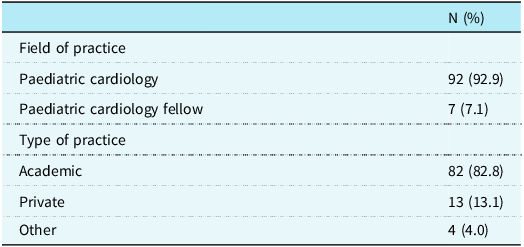
A total of 108 participants began the survey, and 100 answered some or all of the survey questions. A large amount of overlap exists between the two listservs, and active versus inactive status is unknown, so a true response rate cannot be determined. In all, 2500 non-discrete members are included on these listservs. All responses to each survey question were included in the data set, with the exception of the responses from a paediatric cardiac surgeon, which were removed per protocol. The survey did not inquire about the respondent’s practice region, so we were unable to determine regional representation. The demographics of the respondents are shown in Table 1. The majority of respondents were paediatric cardiologists (93%), with a small percentage of trainees (7%). A total of 83% of respondents came from academic institutions.
Demographics (N = 99)

The survey specifically focused on measurements of the aortic root and ascending aorta. The majority of respondents (71.7%, 71/99) reported using Z-score cutoffs to evaluate aortic root dilation. The average Z-score cutoffs used to define mild, moderate, and severe dilation were normally distributed and were 2.13 (SD = 0.32), 3.59 (SD = 0.49), and 5.11 (SD = 0.84), respectively (Figure 1a). Participants were also asked about Z-score cutoffs for ascending aorta dilation, at which point there was a decrease in survey responses resulting in 68.2% of respondents (60/88) reporting defined Z-score cutoffs. The average Z-score cutoff for mild ascending aorta dilation was 2.13 (SD = 0.33), moderate was 3.56 (SD = 0.47), and severe was 5.09 (SD = 0.87) (Figure 1b). Of note, one respondent reported using a Z-score cutoff of 1.5 to define mild aortic root and ascending aorta dilation. A large proportion of respondents primarily use the Boston system (36%, 18/50) or Boston and Pediatric Heart Network systems together (36%, 18/50) to determine Z-scores. Additionally, 8% (4/50) of respondents reported solely using the Pediatric Heart Network Z-score system (Figure 1c). There were also participants who used a combination of Boston, Pediatric Heart Network, Detroit, and/or Wessex Data systems.
Z-score use in aortopathy management. (a) Reported Z-score cutoffs to define severity of aortic root and (b) ascending aorta dilation. (c) Z-score systems used by respondents.

The second aim of the survey was to identify management patterns based on aortic root and ascending aorta Z-scores (Figure 2a). Respondents were first asked about whether there was a Z-score at which they would restrict different types of competitive sports in patients aged 15 years or older. Among the survey participants, 49.2% (32/65) would restrict dynamic competitive sports based on aortic root Z-scores, which increased to 70.8% (46/65) and 75.4% (49/65) for static and impact competitive sports, respectively. A similar trend was seen for sports restrictions based on ascending aorta Z-scores, with 44.6% (29/65) restricting dynamic competitive sports, 66.2% (43/65) restricting static competitive sports, and 70.8% (46/65) restricting impact competitive sports.
Management decisions for bicuspid aortic valve aortopathy. (a) Interventions based on Z-score cutoffs. (b) Factors considered when determining exercise restrictions in children with bicuspid aortic valve.

Among the respondents, 55.3% would add medications such as a beta-blocker, ACE inhibitor, or angiotensin receptor–blocking drug based on aortic root or ascending aorta dilation Z-scores, with the average Z-scores being 3.3–3.45 (Figure 2a). Among the survey participants who would add medications, 53–58% of providers reported angiotensin receptor–blocking drugs as their agent of choice. A smaller percentage of respondents preferred ACE inhibitors (11–19%) or beta-blockers (28–30%).
Less than half (42–45%) of the respondents had a Z-score cutoff at which they would recommend genetics referrals to patients with dilated aortic root or ascending aorta, with the average Z-score being 3.45 (SD = 1.08) and 3.56 (SD = 1.11), respectively (Figure 2a). A total of 42% of survey participants reported having a Z-score cutoff that would prompt them to send a patient for surgery, with the average being 5.34 (SD = 1.29) for aortic root dilation and 5.42 (SD = 1.23) for ascending aorta dilation (Figure 2a).
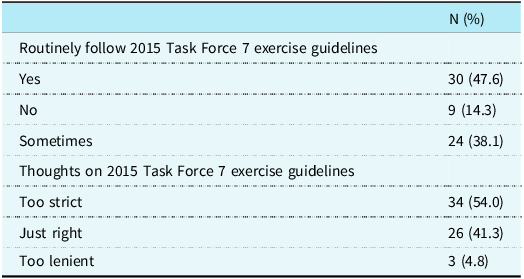
Lastly, the survey evaluated providers’ thoughts on the 2015 Task Force Bethesda exercise guidelines for bicuspid aortic valve.Reference Braverman, Harris and Kovacs7 A large proportion of respondents followed the guidelines to some capacity in their practice (85.7%). About half of respondents felt the 2015 Task Force 7 exercise guidelines were too strict (53.9%), a smaller proportion thought they were appropriately restrictive (41.3%), and a very small percentage thought they were too lenient (4.76%) (Table 2). Respondents were also asked to rank different factors based on their importance when determining exercise restrictions. Z-score and disease progression were ranked as the top two factors influencing exercise restriction decisions. Figure 2b demonstrates how respondents were fairly split regarding adherence to 2015 Task Force 7 Bethesda exercise guidelines when determining exercise restrictions, as a large proportion ranked it as a top factor and another proportion ranked it as a low factor. Other factors that respondents manually entered included absolute aortic valve measurement (four responses), other diagnoses, shared decision-making, and patient symptoms.
Survey respondents’ use of 2015 Task Force 7 Bethesda exercise guidelines

Discussion
Our study demonstrates variability among paediatric cardiologists nationwide in their use of Z-scores for describing aortic root and ascending aorta dilation in patients with isolated bicuspid aortic valve. Among our survey respondents, the Boston Z-score system was the most widely used, with many providers also using a combination of the Boston and Pediatric Heart Network systems (Figure 1c). Fewer providers reported using the Pediatric Heart Network model alone, and although this survey did not explicitly explore why one system was preferred over another, it is possible that the more recent introduction of Pediatric Heart Network Z-scores may have played a role in these results. While these two models are similar, reflected by the fairly equivalent Boston and Pediatric Heart Network Z-score curves and high correlation coefficients, there are some systemic differences.Reference Lopez, Frommelt and Colan8 Discrepancies may vary depending on the structure being measured; for example, measurements of left anterior descending coronary artery diameter can largely differ between the Boston model and Pediatric Heart Network compared to other structures.Reference Lopez, Frommelt and Colan8 These differences beg the question of whether the choice of the Z-score system leads to differences in the evaluation and management of patients.Reference Lorenzoni, Elkins and Quezada1,Reference Rutten, Aarts-Janssen and Kempers4,Reference Robinson, Ware and Sauer5
An abnormal Z-score is generally defined as greater than + 2.0 or less than − 2.0, meaning the value is more than two standard deviations from the average. Beyond that distinction, there were previously no specific cutoff values to define mild, moderate, and severe dilation.Reference De Backer, Muiño-Mosquera and Campens9 Recently, a new Z-score grading scale to determine the severity of aortic dilation was published.Reference Morris, Flyer and Yetman10 Our data underscore the importance of this information, as a large range of Z-score cutoffs were reportedly used by providers in categorizing aortic root and ascending aorta dilation (Figure 1a,b). Differences in defining the severity of the disease may impact management decisions, supported by the range of Z-score cutoffs at which survey respondents would implement treatment plans such as recommending exercise restrictions, adding medication, referring to genetics, etc. (Figure 2a). Of note, one respondent preferred to use absolute mm measurement of the aortic root/ascending aorta to inform clinical decision-making. These survey results suggest the possibility of variable management between providers and highlight the need for guidelines on Z-score usage. Although the survey focused on patients with isolated bicuspid aortic valve, these findings could be extrapolated to the paediatric heritable aortopathy population, who are at a higher risk of adverse outcomes. The recent American Heart Association guidelines delineate Z-score intervals for medical management and referral to genetics but does not provide specific recommendations related to aortic size when determining exercise limitations.Reference Morris, Flyer and Yetman10 Further investigation is still required to develop standardized recommendations for best practice in all clinical decision-making.
This study had a particular interest in surveying paediatric cardiologists on their use of the 2015 Task Force 7 Bethesda exercise guidelines when managing sports participation and exercise restriction in patients with isolated bicuspid aortic valve. The majority of respondents referred to the guidelines in some capacity when considering exercise limitations for patients. Literature suggests that strict adherence to these guidelines may lead to over-restriction from competitive sportsReference Baleilevuka-Hart, Teng, Carson, Ravekes and Holmes11, which could negatively impact patients, as sports participation has been associated with decreased risk of obesity in children with bicuspid aortic valvesReference Baleilevuka-Hart, Holmes, Khader, De Alba and Huang12 Progression of disease and Z-scores were overall ranked as the top two factors for consideration in determining exercise restrictions (Figure 2b), but there was variability among survey participants on what Z-score cutoff should be used to restrict competitive sports (Figure 2a). Implementing guidelines for Z-score use may help providers in making more consistent sports participation recommendations that are appropriately restrictive.
Limitations
These survey findings are limited to patients with isolated bicuspid aortic valves and exclude factors such as known genetic syndromes and aortic valve dysfunction. By excluding other parameters and risk factors, the data may or may not be extrapolated to Z-score system use in a broad bicuspid aortic valve population. The survey did not ask respondents to define the technical methods they use to measure the aortic root and ascending aorta, which can impact Z-score evaluation. This study is also limited by survey response rate, which may have been affected by length of survey, survey design, and timing. In an effort to keep the survey anonymous, it is not known which institution the respondents came from, so it is not possible to evaluate whether the responses are representative of national Z-score system use. Despite this, there was a wide variation in practice, which suggests that it is a representative sample from different regions and institutions.
Conclusions
Z-scores are routinely used in the assessment of aortic dilation in paediatric patients because it allows for the incorporation of children’s changing weight and height, which affects aortic size. Despite their important role in the management of patients with bicuspid aortic valve, there are no standardized guidelines for how Z-scores should be utilized. This study demonstrates the variability that exists among paediatric cardiologists when using Z-scores in patient management and suggests the need for a more consistent approach to implementing this tool in bicuspid aortic valve evaluation and treatment. Further investigation into how the use of different Z-score systems affects patient management may help with the development of guidelines in the future.
Supplementary material
The supplementary material for this article can be found at https://doi.org/10.1017/S104795112403645X.
Acknowledgements
Thank you to members of the PediHeartNet online community and the American Academy of Pediatrics Section on Cardiology and Cardiac Surgery for survey completions. Thank you to Dr John Hokanson and members of the SOCCS survey committee for the survey review and distribution. Thank you to Rebecca Rdesinzski for the assistance with statistical analysis.
Financial support
This research received no specific grant from any funding agency, commercial, or not-for-profit sectors.
Competing interests
None.