THE PROBLEM
Malaria is the major cause of illness in Cameroon, responsible for 40 percent of medical consultations. For this reason, the Head of State along with his African Union peers in April 2000 and 2006 undertook to achieve universal access to malaria control interventions, including effective treatment (10;12). Uneven distribution of health services, especially in rural areas, and high poverty rates make health care and drugs inaccessible or unaffordable (14;16). Therefore, the World Health Organization recommends building comprehensive mechanisms grounded on relevant social and community organizations, including the private sector, to improve access to care for vulnerable populations (22;23). Accordingly, the strategic plan to fight malaria in Cameroon, endorsed by the National Committee to Roll Back Malaria, recommends home-based management of malaria (HMM) to improve access and reduce delays in treatment (12).
The national treatment policy has established artemisinin-based combination therapies (ACTs; artesunate + amodiaquine [AS+AQ] and artemeter + lumefantrine [AL]) in 2006 as the first-line treatment for uncomplicated malaria (13;24). Because of the high poverty rate (40 percent of all Cameroonians and 55 percent in rural communities) (16), the Government decided beginning in January 2007 to partially subsidize antimalarials in public and not-for-profit NGO health facilities and in private pharmacies (12). The subsidies are financed by multiple funders.
However, supervisory and evaluation reports indicate that stocks of AS+AQ expire in National Supply Centre for Drugs and Essential Commodities (CENAME) and Provincial Pharmaceutical Supply Centres (CAPP) bases, and AL is frequently out of stock (9;11). In several regions Community Health Workers (CHWs) known as “agents relais communautaires,” who are trained to provide ACTs, are still not operational because of a lack of HMM kits. The agreement signed by the Minister of Health and private pharmacists’ representatives to allow them to sell subsidized ACTs is also not adequately implemented for several reasons, including:
• AS+AQ and AL (with respective quotas for ordering of 75 percent and 25 percent) are among approximately 100 licensed antimalarials in Cameroon, including monotherapies.
• Many of those are actively marketed by the pharmaceutical industry.
• The State supply chain fails to deal with private pharmacies.
• Sales of other licensed antimalarials are often more profitable.
Given the importance of the private sector in the provision of care and medicines (40 and 60 percent respectively) and the informal sector (approximately 25 percent) (Reference Mballa7;15), it is essential to engage all the stakeholders to achieve universal access to subsidized ACTs. This includes pharmaceutical importers, wholesalers, pharmacists, physicians, and other health workers.
Just as it is the case in many sub-Saharan African countries, self-medication is widespread in Cameroon (60 percent) for cases of easily recognized, uncomplicated malaria, which is perceived by a large majority of people to be a relatively mild disease (8;15;18;19). With the introduction of subsidies for ACT, there were requirements for a medical consultation and prescription to access subsidized ACTs in health facilities providing those for accountability purposes. These requirements were conflicting with the HMM strategy, as well as patients’ care-seeking behavior thus constituting a barrier to universal use of ACTs in the public sector. ACTs are sold without a prescription in private pharmacies. The lack of means to enforce regulation of licensed antimalarials makes it possible to prescribe and use monotherapies and other ineffective antimalarials. The diversity of antimalarials causes confusion among care providers and patients, thus further contributing to nonadherence to the national policy and failure to ensure use of drugs of proven efficacy.
In addition, studies revealed noncompliance due to discontinuation of AQ once symptoms of the disease disappear (Reference Goodman, Brieger and Unwin3;Reference Kouokam5;8;Reference Yomi and Koumga25). Many prescribers and users prefer AL to AS+AQ because of widely experienced side effects of AQ, which was extensively used as the previous first line treatment regimen. Recent studies in Cameroon have found a slightly higher rate of side effects with AS+AQ compared with AL as well as slightly higher effectiveness of AL (Reference Mbacham, Moyou and Basco6).
In summary, this policy brief was prepared to inform decisions by the National Malaria Control Program about how to achieve universal access to subsidized ACTs. Specific questions that it addresses are how to improve self-medication within the HMM framework so that it is safe, effective, and efficient; and how to engage the private sector in distributing subsidized ACTs.
POLICY OPTIONS
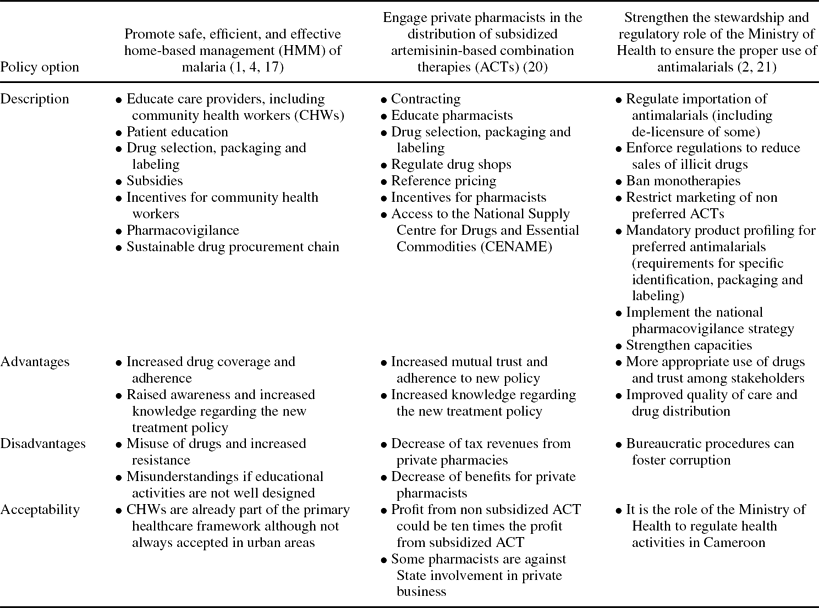
Three policy options that could help to improve HMM and engage the private sector in distributing subsidized ACTs are to:
• Promote safe, efficient, and effective home-based management of malaria (Reference Ajayi, Browne and Garshong1;Reference Hopkins, Talisuna, Whitty and Staedke4;Reference Sievers, Lewey and Musafiri17).
This option includes: (i) simplifying the communication messages to reduce confusion among prescribers and users and the risk of plasmodium resistance to ACTs by limiting plasmodium exposure to many ACTs; (ii) extending training and educational activities of CHW, mothers and teachers in primary schools; (iii) availing HMM kits (ACTs, resources and tools) to CHW and health professionals at the first level health facilities; (iv) implementing mass media campaign communication for behavioral change with simple messages accessible in English, French, and the main national languages; and (v) supporting local area health committees to lead the fight against malaria.
• Engage private pharmacists in the distribution of subsidized ACTs (Reference Waters, Hatt and Peters20).
Potentially effective interventions include the following: (i) performance-based contracting for the provision of subsidized ACTs by private professionals and pharmacists comprising for instance the access to subsidized ACTs from CENAME and CAPP with reference pricing, the implementation of the national pharmacovigilance strategy, and a specific reward systems including bonuses or fiscal exemptions; (ii) revising regulations on drug distribution to enable the creation of licensed medicines sales points under the control of private pharmacists to potentially limit the illicit drug market as is the case in Kenya or Ghana; (iii) executing specific communication and educational plans aimed at revalorizing the role of and proactively engaging the private pharmacist as public health agent.
• Strengthen the stewardship and regulatory role of the Ministry of Health to ensure the proper registration, regulation, and use of antimalarials (Reference Bosman and Mendis2;Reference Williams, Durrheim and Shretta21), while maintaining the availability and affordability of the preferred antimalarials
There is a need for clarity on the marketing of antimalarials and for simple messages relative to ACTs. Potentially effective interventions include the following: (i) revising the list of licensed and marketed antimalarials to restrict these to preferred antimalarials; (ii) clearing the market by enforcing regulatory measures such as banning nonpreferred antimalarials including monotherapies provided through humanitarian gifts and non subsidized ACTs, and by seizing and destroying nonpreferred antimalarials (thus limiting multiple pricing, competing profits margins, misappropriation of subsidized ACTs for the illicit drug market and marketing pressures over prescribers and users by the pharmaceutical industry); (iii) product profiling for preferred antimalarials (Quinine, SP, and ACTs) to be licensed so as to require specific identification, packaging and labeling (such as the NCMP seal, the price, IPT licensed only in a 3-tablet blister labeled “Free” and “For Pregnant Woman Only,” and packaging of ACTs in fixed drug combination to facilitate their proper usage by patients); (iv) enforcing regulation combating the illicit drug market; (v) pursuing resource mobilization to secure the availability of ACTs nationwide and improving management performance of CENAME and CAPP so as to ensure the best purchasing costs on the international market, to lower stock outs of ACTs, and to appropriately implement the public-private agreement signed in 2007; (vi) extending training and educational activities to CHWs, mothers and teachers in primary schools; providing HMM kits to first line health facilities and CHWs to ensure the HMM strategy is fully implement including supervision and monitoring; (vii) strengthening capacities and mobilizing resources to implement planned pharmacovigilance activities and to effectively supervise, control or inspect health facilities and CHWs when needed; (viii) establishing resources and tools for monitoring and evaluation to ensure universal and equitable access to ACTs and proper use of antimalarials; and (ix) embedding the HMM strategy within the primary healthcare framework to ensure its sustainability.
Each of these options entails changes in how antimalarials are delivered, financed, and governed. They are not mutually exclusive. The three options are described in Table 1.
Policy Options

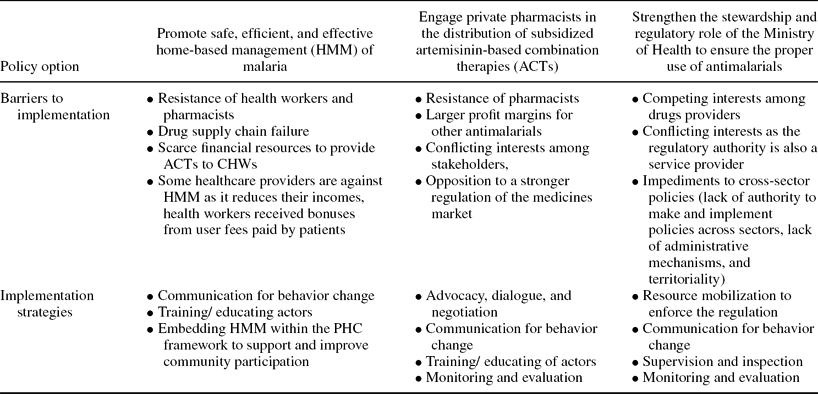
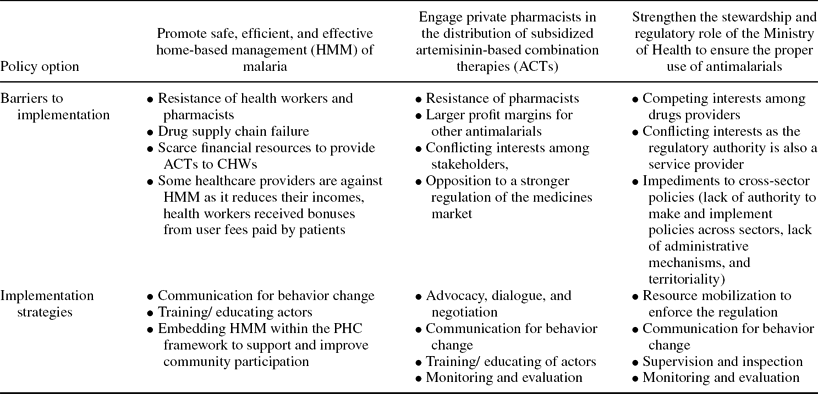
IMPLEMENTATION OF THE POLICY OPTIONS
Strategies for implementing the three policy options are described in Table 2.
Implementation of the Policy Options
DISCUSSION
A policy dialogue attended by thirty-five stakeholders informed by the policy brief was held late January 2009 in Yaoundé, 6 months after the policy brief was prepared and shared with the NMCP manager. At that time, for financial motives, the national policy had already been changed to restrict subsidies only for AS+AQ, thus reducing its price to US$ 0.20–0.40 per treatment, with other ACTs including AL still available on the market. During the dialogue, participants while agreeing on the diagnosis and magnitude of the problem as well as on the need to scale up universal access to ACT were divided between the pros and cons of the strengthening of the role of the State in the private business of pharmacists and the role assigned to CHWs, particularly in urban settings. The dialogue was instrumental in identifying some of the implementation considerations such as the conditions for the successful involvement of private pharmacies, the means to persuade some healthcare practitioners on the ability and soundness of using CHWs to treat malaria and the expectations of various actors in combating the illicit drug market.
CONTACT INFORMATION
Pierre Ongolo-Zogo, MD, MSc (pc.ongolo@cdbph.org or pc.ongolo@gmail.com or cyrilleoz@yahoo.fr), Senior Lecturer, Department of Medical Imaging, University Yaoundé 1, Faculty of Medicine and Biomedical Sciences, Melen Campus, Yaoundé, Cameroon; Head, Centre for Development of Best Practices in Health, Yaoundé Central Hospital, Avenue Henry Dunant, P.O. box 87, Yaoundé, Cameroon
Renée-Cécile Bonono, MSc (bonono2003@yahoo.fr or rcbonono@cdbph.org), Assistant Researcher, Department of Sociology and Anthropology, Catholic University of Central Africa, Nkolbisson Campus, Yaoundé, Cameroon; Research Fellow, Centre for Development of Best Practices in Health, Yaoundé Central Hospital, Avenue Henry Dunant, P.O. box 87, Yaoundé, Cameroon