Introduction
Flavonoids, as natural products in the plant kingdom, are divided into six major sub-classes including flavones, flavonols, flavanones, catechins, anthocyanidins and isoflavones, based on variation in the heterocyclic C-ring (Ross and Kasum, Reference Ross and Kasum2002). High contents of anthocyanins, proanthocyanidins and/or other types of tannins are usually found in dark-coloured flowers, seeds or fruits (Ma and Bliss, Reference Ma and Bliss1978; Todd and Vodkin, Reference Todd and Vodkin1993; Mol et al., Reference Mol, Grotewold and Koes1998). They can alter seed quality by reducing digestibility, but also have positive health effects (Eĺias et al., Reference Eĺias, De Ferńandez and Bressani1979; Salunkhe et al., Reference Salunkhe, Jadhav, Kadam and Chavan1982). Isoflavones (e.g. daidzein and genistein) and flavonols (e.g. kaempferol, myricetin and quercetin) as secondary metabolites have beneficial effects for human health due to their antioxidant, anti-oestrogenic and antiproliferative activities. This has been demonstrated by consumption of soybean products containing such flavonoids which can reduce the risk of certain forms of cancer, heart diseases and oxidation-linked diseases of old age (see reviews by Ross and Kasum, Reference Ross and Kasum2002; McCue and Shetty, Reference McCue and Shetty2004). Research on flavonoids has been conducted in soybean but relevant information about the flavonoid contents in other legumes is lacking (Messina, Reference Messina1999). Furthermore, the biosyntheses of flavonols, isoflavones and anthocyanins occur in similar pathways (Dixon and Steele, Reference Dixon and Steele1999). The colour of anthocyanins is influenced by the presence of co-pigments such as flavonols and flavones (Mol et al., Reference Mol, Grotewold and Koes1998). High contents of anthocyanins have been detected in dark-coloured seeds (Plahar et al., Reference Plahar, Annan and Nti1997). It is reasonable to suspect that seed-coat colour might have some effects on the content of flavonoids in legume seeds.
Legume seed-coat colour varies greatly within and among species, with extensive genetic variation. Mendel used seed-coat colour successfully as a morphological trait for his genetic studies. Breeders pay great attention to seed-coat colour in their breeding programmes, due to its commercial and nutritional value. Germplasm scientists use seed-coat colour as an important descriptor for germplasm collection, characterization and classification of their accessions. Expression of seed-coat colour is related to polyphenolics, which are often associated with plant resistance to pathogens or insects (Islam et al., Reference Islam, Rengifo, Redden, Basford and Beebe2003). Cowpea seed-coat colour has a very strong relationship with antioxidant activity (Nzaramba et al., Reference Nzaramba, Hale, Scheuring and Miller2005).
The results from a preliminary study of flavonoid content in guar seeds have been reported (Wang and Morris, Reference Wang and Morris2007). Since biosyntheses of flavonoids in different legume seeds are involved in similar pathways, five legume species were selected. Since seed-coat colour is a good indicator for the accumulation of proanthocyanidin, anthocyanins and tannins, accessions with different seed-coat colours (in different genetic backgrounds) were chosen for high-performance liquid chromatography (HPLC) analysis in this study. Five different flavonoids (including daidzein, genistein, myricetin, kaempferol and quercetin) were quantified. The objectives of this study were to: (1) measure amounts of five beneficial flavonoids in the seeds among and within legume species; (2) determine the interrelationships among the five flavonoids; and (3) reveal whether there are possible associations between the measured flavonoid amount and the observed seed-coat colour.
Materials and methods
Plant materials
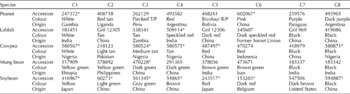
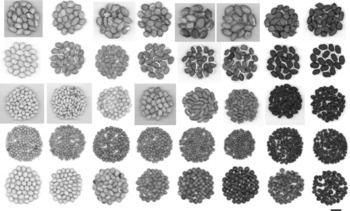
According to seed-coat colours, 40 legume accessions (eight accessions from each of five species) were selected from peanut, Arachis hypogaea L.; lablab, Lablab purpureus L.; cowpea, Vigna unguiculata L.; mung bean, Vigna radiata L.; and soybean, Glycine max L. Information about these accessions can be found in the Germplasm Resources Information Network (GRIN, http://www.ars-grin.gov/npgs). Seeds were obtained from the USDA-ARS, Plant Genetic Resources Conservation Unit (PGRCU, Griffin, Georgia, USA) and the Soybean Genetic Resources Management Unit (SGRMU, Urbana, Illinois, USA), respectively. The accession numbers (either plant introduction number or tentative number), seed-coat colour and origin or collection sites for each accession are listed in Table 1. Seeds from the repositories were directly used for HPLC analysis in 2004. Greenhouse-regenerated seeds from the same 40 accessions were used for HPLC analysis in 2005. However, seeds from Grif 12305 (lablab) could not be reproduced in the Griffin greenhouse due to photoperiod sensitivity. Prior to HPLC analysis, the seed-coat colour was scanned and recorded on an Hewlett–Packard Scanjet 7400C. The assigned colour name from GRIN is listed under each accession (Table 1). The scanned seed-coat colour and seed size of each accession were arrayed in a similar format to that of Table 1 and are shown in Fig. 1.
Accession number, assigned colour name and origin

T, tan; R, red; P, purple.
* Cultivar.
Seed-coat colours from accessions of different legume seeds. From left to right, first row from peanut are PI 247372, PI 408718, PI 262129, PI 493582, PI 468261, PI 602067, and PI 493965; second row from lablab are PI 183451, Grif 12305, PI 338341, PI 509114, Grif 12306, PI 345607, PI 639277, and PI 419086; third row from cowpea are PI 580567, PI 218123, PI 580524, PI 580575, PI 487497, PI 47024, PI 418979, and PI 580871; fourth row from mung bean are PI 517909, PI 378892, PI 470228, PI 291365, PI 378036, PI 473671, PI 183337, and PI 183342; and fifth row from soybean are PI 416967, PI 60273, PI 561345, PI 54865, PI 243517, PI 153203, PI 547506, and PI 594887, respectively. The bar for seed size represents 1 cm.

Flavonoid analysis
A standard curve for daidzein, genistein, kaempferol, myricetin and quercetin was established using standards purchased from Sigma (St. Louis, Missouri, USA). About 30 seeds (with uniform sizes, see Fig. 1) from each accession were ground into a fine powder using a coffee blender. Ground seed tissues (0.5 g) were transferred into 5 ml polypropylene tubes and mixed with 2.5 ml of 80% methanol containing 1.2 M hydrochloric acid for hydrolysis. The mixture was vortexed briefly and then incubated at 80°C for 2 h with tube inversion for mixing the seed powder with extract solution at 15-min intervals. After incubation, the samples were centrifuged at 14 000 rpm for 3 min and the supernatant was transferred into 2 ml Eppendorf tubes. The supernatant containing flavonoids was filtered through a syringe with a 0.2 μm filter prior to injection into an HPLC system. Flavonoid separation was performed on the Agilent 1100 series HPLC system using a C18 column [Zorbax Eclipse XDB-C18, 4.6 mm internal diameter (i.d.) × 150 mm, 5 μm, Palo Alto, California, USA] with a guard column (4.6 mm i.d. × 12.5 mm, 5 μm) in a mobile phase. The mobile phase consisted of A: water (pH 2.5 with formic acid); and B: acetonitrile (GFS Chemicals, Powell, Ohio, USA). A gradient elution was carried out at a flow rate of 2.0 ml/min with a column temperature of 40°C. The gradient profile was programmed at 20% B from 0 to 2 min, 20–30% B from 2 to 20 min, 100% B from 22 to 24 min, 20% B from 24 to 26 min, then holding at 20% B for 2 min. A 5-min post time was allowed for a system equilibration prior to each sequential injection. Another separate extraction from seeds of each accession was performed as a replicate. The supernatant from the same extraction sample was injected twice. The average of two injections from each extraction was used for data collection.
Data analysis
In the first year seeds were collected from different sources, and in the second year seeds were collected from the same growing environment, therefore the data obtained from these 2 years were analysed separately. The data were analysed by the general linear model procedure (SAS OnlineDoc® 9.1.3, 2004, SAS Institute Inc., Cary, North Carolina, USA). Fisher's protected LSD (F) test was used to evaluate the significance of differences. Pearson's correlation coefficient analysis was performed to determine the interrelationships of the flavonoids. The results from the first year were considered preliminary (to see trends) and only used to help in the explanation of the second year results.
Results
Flavonoid content variation among legume species
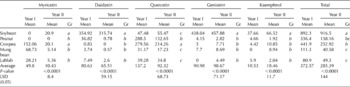
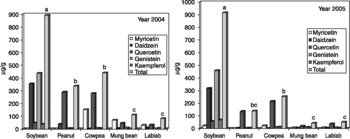
The result of five individual and total measured flavonoids quantified by HPLC from five legume species in 2 years is summarized in Table 2 and expressed in Fig. 2. Although there were some absolute value differences in flavonoid amounts, some consistency and similar trends were observed in both years. Overall, soybean contained higher amounts of daidzein, genistein and total measured flavonoids; cowpea and peanut contained a higher amount of quercetin; mung bean and lablab contained lower amounts of flavonoids (Fig. 2).
Flavonoid content (μg/g) in different species

Gr, LSD grouping.
Comparison of individual and total measured flavonoid contents among five legume species from 2 years.

There were significant differences in individual and total measured flavonoid contents among species (Table 2). Total measured flavonoid content for soybean (916.5 μg/g, LSD grouping a for 2005 and 892.3 μg/g for 2004) was significantly higher than the other legumes (LSD grouping b or c); cowpea (252.9 μg/g, b for 2005 and 441.9 μg/g for 2004) was significantly higher than mung bean (c) and lablab (c). Both daidzein and genistein contents from soybean (354.9 μg/g and 315.7 μg/g; 438.0 μg/g and 457.9 μg/g) were significantly higher than the other legumes for both years. Quercetin content in cowpea and peanut (279.6 μg/g and 214.3 μg/g; 288.5 μg/g and 132.7 μg/g) were significantly higher than soybean, mung bean and lablab for both years. Myricetin content in cowpea was significantly higher than peanut, mung bean and lablab. The environmental effect on flavonoid contents could be easily observed. For instance, the average of total measured flavonoids was 372.6 μg/g for the first year and 285.4 μg/g for the second year (Table 2). Although seeds for the experiment in the second year were collected from the same environment, the environmental effects on flavonoid contents could not be estimated from our data because seeds for the first year experiment were collected from different environments.
Flavonoid content variation among accessions within the same species
Soybean
The individual and total measured flavonoid contents from soybean during 2005 are listed in Supplementary Table 1 (available online only at http://journals.cambridge.org). There was a significant variation (ranging from 5.3 to 28.3 μg/g) among soybean accessions for myricetin content. PI 594887 (28.3 μg/g, black) and PI 60273 (28.5 μg/g, light green) were significantly higher than PI 153203 (5.3 μg/g, dark red) and PI 243517 (10.6 μg/g, red). There was about a fivefold difference among accessions for daidzein content. PI 594887 (584.0 μg/g, black) and PI 416967 (480.8 μg/g, yellow) were significantly higher than PI 54865 (118.3 μg/g, brown), PI 60273 (136.0 μg/g, light green) and PI 547506 (164.3 μg/g, dark brown). PI 54865 (137.7 μg/g, brown) and PI 153203 (143.8 μg/g, dark red) were significantly higher than the other six accessions for quercetin content. PI 594887 (833.2 μg/g, black) was significantly higher than the other seven accessions for genistein content. PI 54865 (107.6 μg/g, brown), PI 547506 (106.7 μg/g, dark brown) and PI 594887 (92.7 μg/g, black) were significantly higher than the other five accessions for kaempferol content. PI 594887 (1585.6 μg/g, black) was significantly higher than the other seven accessions and PI 416967 (1154.6 μg/g, yellow) was significantly higher than the other six accessions for total measured flavonoid content. Unfortunately, PI 594887 has a black seed-coat colour which is probably not a good choice for most consumers, but black soybean is preferred in hilly areas of India. PI 594887 may be good breeding material for enhancement of flavonoids in soybean breeding programmes. In comparison with other legumes, soybean is not a good source of quercetin but some variation exists. Both PI 54865 and PI 153203 contained relatively higher amounts of quercetin. They can be used as genetic materials for increasing quercetin content in soybean cultivars.
Peanut
The individual and total measured flavonoid contents for peanut are listed in Supplementary Table 2 (available online only at http://journals.cambridge.org). Peanut contained a negligible amount of myricetin and limited amounts of daidzein, genistein and kaempferol. There were no significant differences for these four individual flavonoids among peanut accessions. However, peanut contained a significantly higher amount of quercetin (ranging from 0 to 547.4 μg/g). PI 247372 (547.4 μg/g, white) was significantly higher than the other seven accessions; PI 493582 (154.2 μg/g, red), PI 259576 (133.2 μg/g, purple), and PI 468261 (130.5 μg/g, bicolour of red and purple) were significantly higher than PI 262129, PI 408718 and PI 602067. Quercetin contributed greatly to the total measured flavonoid content in peanut. Therefore, the LSD grouping patterns for the quercetin content and total measured flavonoid content were very similar. There would be great potential in breeding for increasing the quercetin content in peanut cultivars.
Lablab
The individual and total measured flavonoid contents for lablab are listed in Supplementary Table 3 (available online only at http://journals.cambridge.org). There were limited amounts of myricetin, genistein and kaempferol in lablab. There were no significant differences for three individual flavonoids among lablab accessions. PI 419086 (18.2 μg/g, black) contained a significantly higher amount of daidzein than the other six accessions. Grif 12306 (65.0 μg/g, dark red), PI 338341 (81.3 μg/g, tan) and PI 509114 (57.9 μg/g, speckled red) contained significantly higher amounts of quercetin than the other four accessions. Quercetin also contributed significantly to the total measured flavonoid content which led to these three accessions containing a significantly higher amount of total measured flavonoids than the other three accessions. Similar to peanut, there is potential for increasing quercetin content in lablab breeding programmes.
Cowpea
The individual and total measured flavonoid contents for cowpea are listed in Supplementary Table 4 (available online only at http://journals.cambridge.org). Cowpea contained a very negligible amount of daidzein, very limited amounts of genistein and kaempferol, and relatively high amounts of myricetin and quercetin. PI 580871 (black) contained significantly higher amounts of genistein (16.9 μg/g) than the other seven accessions and higher amounts of kaempferol (20.3 μg/g) than the other six accessions. PI 418979 (black) contained significantly higher amounts of myricetin (51.3 μg/g) and quercetin (412.5 μg/g) than the other seven accessions tested. Myricetin and quercetin contributed significantly to the total amount of measured flavonoids. Therefore, PI 418979 (black) contained a significantly higher total amount of measured flavonoids (508.9 μg/g) than the other seven accessions. Since the variation of myricetin and quercetin contents in cowpea was significant, there is great potential in increasing these two individual flavonoid contents in cowpea breeding programmes.
Mung bean
The individual and total measured flavonoid contents for mung bean are listed in Supplementary Table 5 (available online only at http://journals.cambridge.org). There were limited amounts of daidzein and kaempferol in mung bean. PI 183337 (22.0 μg/g, black) and PI 183342 (17.6 μg/g, black) contained a higher amount of myricetin than the other six accessions. PI 183337 (63.8 μg/g, black) also contained a significantly higher amount of total measured flavonoids than the other five accessions. Due to its black seed-coat colour, PI 183337 cannot be used directly by consumers but should be useful for increasing the flavonoid content in mung bean cultivars.
Interrelationship between flavonoids within species
Pearson correlation coefficients among different flavonoids in the legume seeds were calculated. The magnitude of individual flavonoid contribution to the total amount of measured flavonoids was genistein, daidzein, quercetin, kaempferol and myricetin, respectively. The amounts of daidzein and genistein were positively correlated (r = 0.92, r = 0.95, P < 0.0001) and they were also positively correlated to kaempferol (r = 0.68, r = 0.53, P < 0.0001; r = 0.84, r = 0.59, P < 0.0001) from 2 years’ data. Correlation information is very important for plant breeding. For example, if a line with a high amount of genistein is selected in a soybean breeding programme, it may be expected that this line would contain high amounts of daidzein, kaempferol and total amount of measured flavonoids but a low amount of myricetin, because of the interrelationships between flavonoids in soybean.
Seed-coat colour with flavonoid content
Extensive variations were observed in the seed-coat colour among and within the legume species (Fig. 1). A high amount of total measured flavonoids was observed in the dark-coloured soybeans (PI 594887, black, 1585.6 μg/g), cowpeas (PI 418979, black, 508.9 μg/g) and mung beans (PI 183337, black, 63.8 μg/g; PI 183342, black, 54.0 μg/g). It seems that many, but not all, dark-coloured coated seeds contain a high amount of total measured flavonoids. For example, black cowpea seed PI 580871 contained a lower amount of total measured flavonoids (192.1 μg/g). Furthermore, a light-coloured soybean seed (PI 416967, yellow, 1154.6 μg/g) and light-coloured peanut seed (PI 247372, white, 565.2 μg/g) also contained a high amount of total measured flavonoids. Seed-coat colour is a complicated trait, controlled by several genes. Due to differences in genetic background, it was not possible to draw a meaningful conclusion between seed-coat colour and flavonoid content from our results.
Discussion
Flavonoid contents measured by HPLC have been compared in different legume seeds from two separate years. All species studied are self-pollinated. To address the environmental effect on flavonoid content, further studies are needed with plants grown under different uniform environmental conditions. Legume species differ in the optimal environment required for seed production. For example, when peanut and soybean plants were grown in the greenhouse, the conditions were more favourable for soybean than for peanut seed production. High-quality seeds were obtained from soybean but not from peanut because the greenhouse conditions were more suited for peanut vegetative than reproductive growth. That may explain why the total amount of measured flavonoids for peanut was much lower in 2005 than in 2004.
Legume seed-coat colour is a good indicator of the accumulation of proanthocyanidin, anthocyanins and tannins. Legume seeds with a dark-coloured seed coat (for example, black, purple or dark red) contain a high content of tannins which leads to a higher antioxidant activity and a lower digestible activity of proteins (Plahar et al., Reference Plahar, Annan and Nti1997; Nzaramba et al., Reference Nzaramba, Hale, Scheuring and Miller2005). Seed coats contain a high concentration of tannins. During the processing of legume seeds, dark-coloured seed coats can be removed for increased protein digestibility but this may result in products with a lower antioxidant activity. Since biosyntheses of flavonoids, anthocyanins and tannins in legume seeds are involved in similar pathways, there might be some connection between seed-coat colour and flavonoid content. However, since accessions used in this experiment had different genetic backgrounds, it was difficult to draw a meaningful conclusion between seed-coat colour and flavonoid content. Seeds from near-isogenic lines (NILs) growing under the same environmental conditions should be used in future studies to ascertain the connection between seed-coat colour and flavonoid content. To determine the relationship between seed-coat colour and flavonoid content more precisely, tissues from seed-coats only, and seed tissues without seed coats, should be used for flavonoid extraction, quantified by HPLC analysis separately and then compared, with seed size taken into consideration. Seed-coat only constitutes a small proportion of the whole seed. Therefore, there might be no clear association between individual flavonoid content of the whole seed and seed-coat colour.
From the present study, great variability for flavonoid content was identified within and among legume species. Soybean is a good source of flavonoids and its products are highly recommended for human consumption due to their beneficial effects. However, variation in the amount of flavonoids exists among soybean accessions. Therefore, when soybean is recommended as a source of flavonoids for human consumption, differences in flavonoid amount among different soybean cultivars should be considered. Furthermore, there are different kinds of flavonoids. Soybean is not necessarily a good source of all flavonoids. In our report, white seed-coat peanut seems to be a good source of quercetin, black seed-coat cowpea seeds seem to be a good source of myricetin and, among other legumes investigated previously, guar seeds seem to be a good source of kaempferol (Wang and Morris, Reference Wang and Morris2007). When specific flavonoids are required, these legumes should be considered as an alternative. Great variation exists in flavonoid content among legumes, and flavonoid content should be integrated into legume breeding programmes for selection.
Legume yield may have an impact on other important traits (e.g. protein content and oil content) as well. A negative correlation between oil and protein in soybean seeds has been reported (Brim and Burton, Reference Brim and Burton1979). A negative correlation between oil and isoflavonoids and a positive correlation between protein and isoflavonoids have been reported in soybean cultivars (Charron et al., Reference Charron, Allen, Johnson, Pantalone and Sams2005). Information about the relationship between legume yield and flavonoids is lacking from the literature. Further studies are required to address the relationships among the contents of oil, protein and flavonoids in legumes, along with yield, in order to effectively incorporate the flavonoid content as a new trait for selection in legume breeding programmes.
Acknowledgements
The authors gratefully thank Dr Randall Nelson for providing soybean seeds, Dr Oliver Yu for his advice on the HPLC, Drs Noelle Barkley, Jorge Mosjidis and Paul Raymer for comments on the manuscript, and Ms Meredith Reed for her excellent technical assistance.