INTRODUCTION
Neohelice granulata (Dana, 1851), formerly known as Chasmagnathus granulatus, is a crab found in salt marshes and mangroves of the southern Atlantic coast, from Rio de Janeiro (Brazil) to Patagonia (Argentina) (Melo, Reference Melo1996). This crab is one of the most abundant Brachyura in salt marshes of the estuarine region of the Lagoa dos Patos Lagoon and it plays an important role in nutrients recycling in these environments (Gutierrez et al., Reference Gutiérrez, Jones, Groffman, Findlay, Iribarne, Ribeiro and Bruschetti2006).
The reproductive biology of N. granulata has been investigated in some populations from the Argentinean coast. For instance, reproduction pattern is likely related to latitude, as the shortest reproductive period is found in southern Argentina (Bas et al., Reference Bas, Luppi and Spivak2005). Alternatively, variations in life history traits have also been related with thermal amplitude (Bas et al., Reference Bas, Luppi and Spivak2005). Although N. granulata is distributed along an extensive shoreline, the population dynamics of this species on the Brazilian coast is barely understood.
A previous study carried out in the Lagoa dos Patos (Ruffino et al., Reference Ruffino, Telles and D'Incao1994) was based on a light sampling effort, in a region near to the mouth connecting the estuary to the sea. Ecological studies developed in the last 10 years have cast doubts whether the reproductive parameters estimated earlier are representative for populations observed elsewhere in the estuary (D'Incao, personal observation). The present investigation intended to address this issue by estimating reproductive parameters (reproductive period, size at onset of maturation and fecundity) of two populations of N. granulata inhabiting two distinct locations. Results reported provide more reliable estimates of these parameters for populations from southern Brazil. This information is important to establish robust comparisons of population parameters for a species which is found along ~3000 km of the south and south-east American coast.
MATERIALS AND METHODS
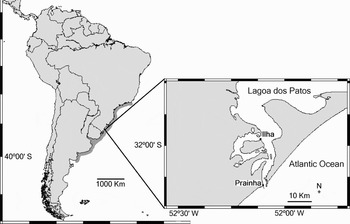
The study area comprised two salt marshes in the estuarine region of the Lagoa dos Patos. The first, ‘Prainha’, near to the mouth of the estuary (32°09′011″S 52°06′02″W) and the second, ‘Ilha’, in an inner region of the estuary (31°58′99″S 52°06′75″W) (Figure 1). These two locations were chosen based on differences in productivity and salinity regimes. For instance, the salt marsh ‘Ilha (2.05 km2) has a higher diversity and sediment with higher organic matter content than ‘Prainha’ (0.35 km2) (Costa et al., Reference Costa, Seeliger, Oliveira and Mazo1997). Regarding the salinity regime, it has been shown that the lowest salinities are observed at inner regions of the estuary (Coutinho & Seelinger, Reference Coutinho and Seeliger1984). Prainha is a salt marsh in which the reproductive biology of N. granulata was previously studied (Ruffino et al., Reference Ruffino, Telles and D'Incao1994).
Map of South America indicating the distribution range of Neohelice granulata (Dana, 1851) (grey shading). Estuarine region of the Lagoa dos Patos Lagoon is shown (inset), and sampling sites are indicated (•).

Sampling was performed monthly, from June 2003 to May 2005. Crabs were manually caught during low water periods. Sampling was carried out by three experienced researchers, who sought crabs during a fixed period of one hour. Crabs were caught by digging on the edge of their burrows with a garden trowel to stimulate the crab to leave the burrow.
Within each salt marsh, an approximate area of 625 m2 (25 × 25 m) was scanned at each sampling. The same site was sampled each month. Crabs caught were taken to the laboratory. During the first year of sampling sediment was collected for the quantification, in three replicates, of the organic matter content (Suguio, Reference Suguio1973).
In the laboratory, crabs were sexed (observing abdomen morphology) and measured. Sex of the smallest crabs was determined by the observation of the pleopods using a stereoscopic microscope. When sex determination was not possible (very small crabs), crabs were classified as juveniles. Measurements (nearest 0.01 mm) consisted of carapace width (CW), width of the third segment of the abdomen (AW, only for females), and length of the propodus of the cheliped (PL, only for males). Ovigerous females were kept frozen for further analysis.
Size at the onset of maturation was estimated by morphometric analysis, assuming a two-phase model. For females, AW was linearly regressed against CW, while for males PL was linearly regressed against CW. Estimation of the size at the onset of maturation was performed by analysis of the residuals of a one-phase linear regression (Lovett & Felder, Reference Lovett and Felder1989). Residuals plots of regressions were analysed by fitting a quadratic function. The minimum of this function (x = −b/2a) was considered as the CW in which the allometric change happens. One and two-phased models were statistically compared using an F-test (Muiño et al., Reference Muiño, Fernandez, González-Gurriarán, Freire and Vilar1999).
Reproductive period was verified by the monthly percentage of ovigerous females, in relation to the total number of females caught. To estimate the fecundity, all ovigerous females caught were sorted in 1 mm size-classes, and three females with eggs in the earliest stage of development, from each size-class, were randomly selected. For each female, the mass of eggs was removed from the abdomen and eggs were dried for 24 hours at 70ºC. After being dried, egg mass was weighed. From each dry egg mass, three aliquots were removed, each one was weighed, and the number of eggs counted. Individual fecundity was estimated by the arithmetic mean of the three aliquots extrapolated for the total weight of the egg mass. Data of individual fecundity (log-transformed) were regressed against log(CW), and the mean fecundity was estimated using the average size of the females utilized for fecundity analysis. Regression estimates for females of both salt marshes were compared by analysis of covariance. Statistical significance adopted was 0.05 and results are presented as mean±standard error.
RESULTS
During the first year of sampling, the percentage of organic matter in the sediment was significantly higher (P < 0.01) at Ilha (5.51±1.19%) than at Prainha (1.24±0.29%). No seasonal trend was observed. A finer statistical comparison was not possible, as sediment samples were taken only once a month.
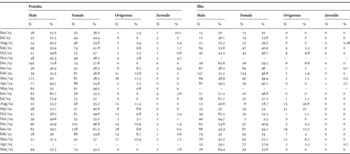
At Prainha 3215 crabs were caught (1531 males and 1684 females, including 173 ovigerous), while at Ilha 2443 crabs were caught (1271 males and 1172 females, including 125 ovigerous) (Table 1).
Neohelice granulata. Monthly number and percentages of males, females, ovigerous females and juveniles by site. Sampling was not possible in two months in Ilha and one month in Prainha (–).

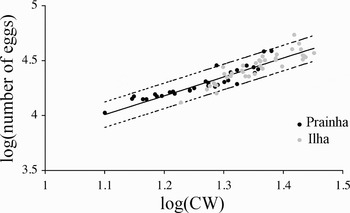
Ovigerous females were found year-round in both locations, except in July 2003 and June 2004. The maximum number (N = 31) of ovigerous females was observed in September 2004 (Ilha), while the highest percentage observed (≈70%) (August 2004, Ilha) represented a total of 13 ovigerous females. The smallest percentages were observed in April 2004 (1.5%, Ilha) and May 2004 (1.6%, Prainha). Carapace width of ovigerous females ranged from 12.6 mm to 25.5 mm at Prainha and from 12.8 mm to 28.7 mm at Ilha. The average size of ovigerous females caught at Prainha (17.9±0.2 mm) was significantly smaller (P < 0.001) than the average size estimated for Ilha (22.9±0.2 mm). Mean fecundity was 19968±1159 and 29019±1014, for females from Prainha and Ilha, respectively. Significant linear regressions were found between log(CW) and log(number of eggs), but covariance analysis demonstrated no difference between regressions estimated for both sites (slope homogeneity – F1,65 = 2.57, P = 0.11; intercept – F1,66 = 1.17, P = 0.29). Pooled regression estimated was log(number of eggs) = 2.11 + 1.72 × log(CW) (r2 = 0.85, Fcalc. = 383 > F(0.05)1,67 = 3.98, P < 0.001) (Figure 2).
Neohelice granulata. Relationship between log of number of eggs and log of carapace width. Full line represents the linear regression - log(number of eggs) = 2.11+1.72 × log(CW). 95% prediction limit is shown.

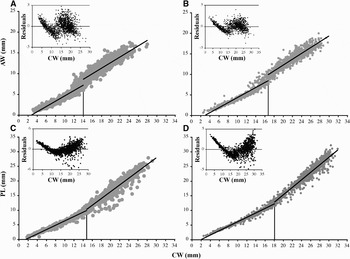
Plots of CW against AW, and CW against PL (Figure 3) suggest the existence of an allometric change in the plots. Estimated size at the onset of maturation was as follows: Prainha, 14.9 mm (males) and 14.1 mm (females); Ilha, 18.2 mm (males) and 16.8 mm (females). Statistical comparison of one and two-phased models (F-test) showed that two-phased models were consistently preferred than one-phase models (Prainha, females−Fcalc. = 162 > F2,1679 = 3.00, P < 0.001; Ilha, females−Fcalc. = 118 > F2,1167 = 3.00, P < 0.001; Prainha, males−Fcalc. = 432 > F2,1549 = 3.00, P < 0.001; Ilha, males−Fcalc. = 439 > F2,1251 = 3.00, P < 0.001). Residuals of the two-phased regressions were always randomly distributed (F test; minimal P = 0.99; graphs not shown). Two-phased regression of males and females had distinct patterns. For females, regressions tended to be parallel, particularly for data from Prainha (Ilha: 95% CI of slopes were 0.59–0.63 and 0.69–0.73; Prainha: 95% CI of slopes were 0.62–0.66 and 0.65–0.69) (Figure 3 A, B). Conversely, two-phased regressions of males intercept at the breakpoint, that is, regressions were not parallel (Ilha: 95% CI of slopes were 0.74–0.77 and 1.25–1.31; Prainha: 95% CI of slopes were 0.73–0.76 and 1.13–1.18) (Figure 3 C, D).
Neohelice granulata. Morphometric analysis for (A) females and (C) males from Prainha, and for (B) females and (D) males from Ilha. Two-phased models are shown to highlight the breakpoint estimated by residual analysis. Estimated size at maturation is indicated by the vertical line. Inset shows the residual plot of the estimated one phase model.

DISCUSSION
The reproductive process of Neohelice granulata has been studied in some populations from Brazil and Argentina. Regarding studies developed in Brazil, ovigerous females were observed year-round in a northern location (‘Lagoa do Peixe’, 31º09′S) near to Lagoa dos Patos (Barutot, Reference Barutot2007). Although ovigerous females were not observed in two months during the sampling period at Lagoa dos Patos, it is suggested that individuals of N. granulata hatch eggs year-round, although with a weaker reproductive activity in winter. Supporting evidence is provided by a study consisting of zooplanktonic sampling in the estuary during two years (Vieira, Reference Vieira2006), in which it was reported zoea and megalopae of N. granulata year-round. Temperature has been pointed to as one of the main physical factors affecting reproductive traits of crustaceans, such as the reproductive period (Hines, Reference Hines1989). However, provided ovigerous females are likely found year-round in the estuarine region of Lagoa dos Patos, this is indicative that decreases in temperature found in winter (range of average winter temperatures during the period of study, 13.5–16.4ºC) (FURG Meteorological Station) were not enough to completely stop the reproductive activity. Contradictory evidence is found in an earlier study, which was performed near to Prainha (Ruffino et al., Reference Ruffino, Telles and D'Incao1994), in which ovigerous females were reported only from October to April. The reason for this inconsistency is probably related to a much more intense sampling effort of the present investigation; the earlier study was based on 204 crabs (males and females summed) caught during three years. In the present investigation, 3272 crabs (173 ovigerous females) were caught at Prainha.
Studies developed in Argentina (Spivak et al., Reference Spivak, Anger, Bas, Luppi and Ismael1996; Ituarte et al., Reference Ituarte, Spivak and Luppi2004; Bas et al., Reference Bas, Luppi and Spivak2005) have demonstrated a shorter reproductive period of N. granulata than that observed in Brazil. For instance, populations from Samboronbón (36º18′S) have ovigerous females from September to March. In the estuary of Mar Chiquita (37º32′S), the reproductive period was reported from October to March, while near the southernmost limit of distribution of the species (San Antonio, 40º46′S) ovigerous females were observed from November to March. Altogether, these pieces of information provide further support for a latitudinal cline in duration of the reproductive period of N. granulata. Another possibility raised elsewhere (Bas et al., Reference Bas, Luppi and Spivak2005) is that the reproductive period should not be related only to latitudinal gradient, but also to the amplitude of temperatures observed among seasons, that is, the difference in extreme temperatures between winter and summer is higher at the highest latitudes. For example, in San Antonio Bay (Argentina) average July (winter) and January (summer) temperatures were 7.8 and 22.6ºC (difference = 14.8ºC), respectively, while at Lagoa dos Patos average July and January temperatures were 14.0 and 24.4ºC (difference = 10.4ºC). This higher temperature amplitude would cause a thermal stress in populations which could somewhat affect the reproductive process (Bas et al., Reference Bas, Luppi and Spivak2005).
For a population from Lagoa dos Patos, a larger average size of ovigerous females (19.1 mm; range 14.5–25.6 mm) and average size at the onset of maturation (16.5 mm) were previously estimated (Ruffino et al., Reference Ruffino, Telles and D'Incao1994). This difference is probably related with sampling effort, in which the smallest ovigerous females were overlooked. Considering maximum sizes of ovigerous females, similar figures (Ruffino et al., Reference Ruffino, Telles and D'Incao1994, 25.6 mm; this study, 25.5 mm) were found in both studies. The largest ovigerous female found (28.7 mm, Ilha) is around 15% smaller than the largest found northwards (Lagoa do Peixe, 33.6 mm; Barutot, personal observation) and southwards (Mar Chiquita, 34.2 mm; Luppi et al., Reference Luppi, Bas, Spivak and Anger1997), which does not support the existence of latitudinal gradient, i.e. the largest animals found in the coldest environments. A similar finding is observed for the size at the onset of maturation in which the largest reported sizes were found at Paraty (19.2 mm) (23º13′S) (Gregati & Negreiros-Fransozo, Reference Gregati and Negreiros-Fransozo2007) and at Samboronbón (22.7 mm) (López et al., Reference López, Stella and Rodriguez1997), which are the north and southernmost populations for which these data are available.
Size at the onset of maturation of males and females were larger at Ilha (18.2 mm and 16.8 mm for males and females respectively) than at Prainha (14.9 mm and 14.1 mm for males and females respectively). A possible explanation for the largest sizes at Ilha is related to the higher content of organic matter found in this salt marsh than at Prainha (Costa et al., Reference Costa, Seeliger, Oliveira and Mazo1997), as it has been quantified in the present investigation during the first year of sampling. It is known that N. granulata feeds mainly on sediment (Barutot, Reference Barutot2007), which is associated with bacteria, algae and meiofauna (D'Incao et al., Reference D'Incao, Silva, Ruffino and Braga1990). Therefore, feeding on sediment richer in organic matter, crabs from Ilha would be able to reach larger CW than crabs from Prainha. Nitrogen availability was reported as a limiting factor for growth and reproduction of crabs (Kyomo, Reference Kyomo2000) and food availability has been related with changes in size at maturation in crustaceans (Diaz & Conde, Reference Diaz and Conde1989; Pollock, Reference Pollock1995).
The pattern of relative growth of the females demonstrates not only a change in the level of allometry but also a clear increase in the dimensions of the variable (abdomen width). This is not surprising, as morphologically immature and mature females are easily recognized by the observation of the abdomen shape, and it is consistent with the existence of a puberty moult. The transition between the immature and mature phase differs between males and females. For females, although a breakpoint has been demonstrated in the analysis of the residuals, the transition between immature and mature phase likely occurs over a size-range of approximately 3 mm (from 12 and 15 mm, for Prainha and Ilha, respectively), as regressions did not intercept at the breakpoint (Figure 3 A, B). It means that the puberty moult of females may take place over a small range of CW around the estimated breakpoint.
No significant differences were found between regressions relating CW and fecundity. Variations in fecundity can be considered adaptive, resulting from distinct life conditions experienced by populations. In the present investigation, increases in fecundity do not seem to be a direct effect of the environment, but an indirect response to larger sizes of ovigerous females found at Ilha.
Briefly, this investigation demonstrated year-round reproduction in N. granulata at Lagoa dos Patos, suggesting a latitudinal gradient for the duration of the reproductive period. Different reproductive traits, such as average size of ovigerous females and size at the onset of maturation, were found in the populations studied. These differences are likely related to distinct food availabilities at both sites.
ACKNOWLEDGEMENTS
This study was supported by a PhD studentship to R.A.B., a researcher scholarship to F.D. and a post-doctoral scholarship to D.B.F. from the Brazilian Government (CNPq).