Introduction
Soil seed banks are composed of viable diaspores buried in the soil or present in the litter layer (Fenner & Thompson Reference Fenner and Thompson2005). Seed banks can be partly composed of transient seeds, which persist in the soil for 1 y or less, and partly of persistent seeds, which persist over longer periods (Thompson et al. Reference Thompson, Bakker and Bekker1997). The importance of the extant soil seed bank in determining the composition of standing vegetation depends on the relative importance of the local vs. external seed rain, coupled with the contribution of the germination of seeds from the persistent vs. transient components of seed banks (Simpson et al. Reference Simpson, Leck, Parker, Leck, Parker and Simpson1989). Because seed persistence differs among pioneer and non-pioneer species (Dalling & Brown Reference Dalling and Brown2009), and the importance of the seed rain can vary among successional stages (Castillo & Ríos Reference Castillo and Rios2008), the seed bank can have a potential role in determining the composition of standing vegetation during secondary ecological succession (Thompson Reference Thompson and Fenner2000).
Most studies of the roles of seed banks in secondary succession in tropical environments have been conducted in tropical rain forests (TRF). While the establishment of late-successional species in those environments does not appear to depend on persistent seeds (Daïnou et al. Reference Daïnou, Bauduin, Bourland, Gillet, Fétéké and Doucet2011, Dalling & Brown Reference Dalling and Brown2009), pioneer species remain in the seed bank throughout succession (Baskin & Baskin Reference Baskin and Baskin2014), whereas the main source of regeneration of late-successional species is seed input through dispersal. TRF therefore tend to show high dissimilarity between the soil seed bank and the actual stage of vegetational succession.
The generalizations elaborated above for TRF may not be applicable to tropical dry forests (TDF) (Derroire et al. Reference Derroire, Balvanera, Castellanos-Castro, Decocq, Kennard, Lebrija-Trejos and Tigabu2016, Lohbeck et al. Reference Lohbeck, Poorter, Lebrija-Trejos, Martínez-Ramos, Meave, Paz and Bongers2013) because of differences in seasonality and wide variation in the amounts of rainfall (Maass & Burgos Reference Maass, Burgos, Dirzo, Young, Mooney and Ceballos2011). In TDF, one alternative for dealing with this unpredictability would be to adopt a bet-hedging strategy (Cohen Reference Cohen1966) with the production of persistent seeds in cases of germination failure due to droughts or irregular precipitation events (Pake & Venable Reference Pake and Venable1996). As the species of different successional stages are subjected to the same climatic variability, one might expect that both pioneer species and species of more advanced successional stages would form persistent banks. This has long been established for annual species (Childs et al. Reference Childs, Metcalf and Rees2010, Cohen Reference Cohen1966, Thompson et al. Reference Thompson, Bakker and Bekker1997), but can also be true for perennial shrubs and trees (Silveira et al. Reference Silveira, Martins and Araújo2017, Witkowski & Garner Reference Witkowski and Garner2000).
Therefore, as TDF occur in more severe and variable climates than TRF, it would be expected that: (1) permanent seed banks would be as (or more) important as seed input by dispersal to the establishment of successional species – implying (2) an expected high similarity between the seed bank and the standing vegetation of more advanced stages of succession (and not just the early stages). To test the above hypotheses, we investigated soil seed bank and standing vegetation composition and the relative contributions of recently dispersed versus persistent seeds to the composition of seed banks in three chronosequences located in the Brazilian tropical semi-arid region.
Methods
Study area
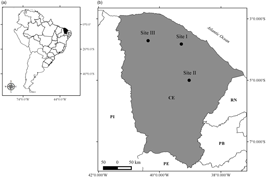
Fieldwork was conducted in the semi-arid region of north-eastern Brazil. On a broad scale, the vegetation in this region has been considered as part of the larger seasonally dry tropical forest (Banda et al. Reference Banda, Delgado-Salinas, Dexter, Linares-Palomino, Oliveira-Filho and Prado2016, Miles et al. Reference Miles, Newton, Defries, Ravilious, May, Blyth, Kapos and Gordon2006). On a local scale, the vegetation cover of the region consists of phytophysiognomies ranging from shrublands to taller woodlands and forests (Andrade-Lima Reference Andrade-Lima1981). All of those physiognomies are characterized by species of deciduous trees (most of them thorny) and annual plants that can represent up to half of the local species richness (Costa et al. Reference Costa, Souza, Silva, Camacho and Dantas2007). We collected data in three sites: Site I – Fazenda Experimental do Vale do Curu (3°47′34″S, 39°16′10″W); Site II – Fazenda Não Me Deixes (4°58′03″S, 39°00′56″W); and Site III – Empresa Brasileira de Pesquisa Agropecuária – EMBRAPA (3°44′52″S, 40°21′35″W), all located in Ceará State, Brazil (Figure 1). According to the Köppen–Geiger classification system (Köppen Reference Köppen1948), the regional climate is type BSh – semi-arid, dry, with rains starting in January/February and a dry season starting in June/July. Rainfall is highly seasonal and irregular, varying between 300 and 800 mm y−1 and usually concentrated in the first 4 mo of the year (especially February and March), followed by a long dry season (May–December) (Based on data from the Ceará State Meteorology and Water Resources Foundation – FUNCEME). The year of the study was the sixth in the longest drought with the lowest rainfall in the last 50 y (Marengo et al. Reference Marengo, Torres and Alves2016).
Geographic locations of the study sites: Ceará State in South America (a); sites in Ceará State (b). Sites I, II and III correspond to study sites located in the municipalities of Pentecoste, Quixadá and Sobral, respectively, all located in the state of Ceará, Brazil. Neighbouring states: PI – Piauí; RN – Rio Grande do Norte; PE – Pernambuco; PB – Paraíba.

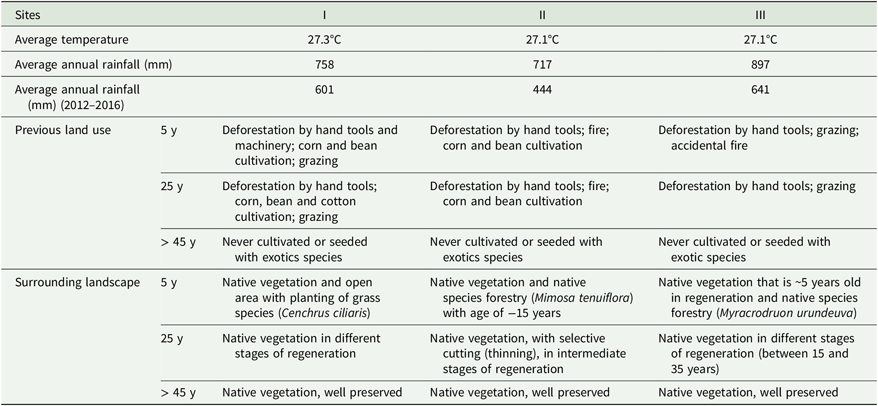
We chose three areas in each site having different regeneration ages after their most recent use. The histories of land use were obtained from local residents and from LANDSAT satellite images (from the 1970s until the present time, when available) from INPE (http://www.dgi.inpe.br/CDSR/) and USGS (http://earthexplorer.usgs.gov/). The images were processed using ArcMap software and allowed the confirmation of the dates the sites were abandoned (see Table 1 for details of previous use and the surrounding landscape for each site). Chronosequences were classified into three successional categories: early (5 y after abandonment), intermediate (25 y after abandonment) and old-growth forest (over than 45 y after abandonment).
Climate, land-use history and immediate landscape (the neighbourhood within a 3.0 km distance from the sampling areas) descriptions of the three study sites in the semi-arid region of north-eastern Brazil. Sites I, II and III correspond to study sites located in the municipalities of Pentecoste, Quixadá and Sobral, respectively, all located in the state of Ceará, Brazil

Data collection
To sample the standing vegetation and the corresponding seed bank of each successional age (5 y, 25 y and 45 y), we defined areas of 0.25 ha, inside of which ten 10 × 10-m plots were randomly established – totalling 30 plots for each site. Floristic surveys of the upper stratum (woody component) were performed in each site from June 2015 to January 2016 to determine their floristic composition, marking all individuals with girth at ground level >3 cm (Rodal et al. Reference Rodal, Sampaio and Figueiredo2013). The understorey species (herbs, sub-shrubs and herbaceous climbers) in those same plots were surveyed for presence/absence during the rainy season (February to May 2016). Reproductive and vegetative samples of all inventoried plants were collected and subsequently prepared as voucher specimens for identification to the family level.
Species-level identifications were made by comparisons with herbarium specimens held at the Prisco Bezerra (EAC) herbarium, and by consulting the specialized literature and specialists.
To determine the floristic composition of the soil seed banks (hereafter referred as SSB), soil samples were collected in the same sites as the vegetation surveys at the end of the dry season (November–December 2015) when most seeds have already been dispersed in Brazilian semi-arid ecosystems (Griz & Machado Reference Griz and Machado2001) – the most appropriate time for seed bank analyses (Brito & Araújo Reference Brito and Araújo2009, Costa & Araújo Reference Costa and Araújo2003). We collected, separately, two SSB components: the BS component (the soil with buried seeds; 0–5 cm depth) and the LT (litter) component (consisting of non-decomposed plant material lying above the BS) using a circular sampling ring (25 cm diameter and 10 cm depth) (Mamede & Araújo Reference Mamede and Araújo2008). A total of 180 soil samples (three sites × three successional ages × 10 plots × two components) were collected. The samples were held individually in labelled black plastic bags and stored (up to 2 mo) in the laboratory at room temperature until seedling emergence tests were performed.
The BS and LT samples were first sifted through 0.5-cm and 0.2-mm mesh sieves in the laboratory to facilitate seed germination by scarifying seeds showing physical dormancy (Caballero et al. Reference Caballero, Olano, Loidi and Escudero2008) and to remove the coarse soil fraction (rocks and large plant fragments). After removing the coarse fraction, the remaining material was returned to the soil samples. The BS and LT samples were then distributed individually in thin layers (~0.5 cm) onto plastic trays (45 × 30 × 7 cm) on greenhouse benches and subsequently mixed with sterile vermiculite (to maintain moisture and promote seedling development) (Ferreira et al. Reference Ferreira, Souto, Lucena, Sales and Souto2014, Mamede & Araújo Reference Mamede and Araújo2008). The thickness of each soil sample in the trays after adding vermiculite was ≤5 cm; those substrates were irrigated daily (Dalling et al. Reference Dalling, Swaine and Garwood1994).
The emerging seedlings were counted, labelled and morphotyped. Specimens of each morphotype were cultivated until taxonomic identification was possible (Mamede & Araújo Reference Mamede and Araújo2008). Starting at the second month of the experiment, the soil samples were carefully mixed every 2 wk to facilitate the emergence of new seedlings (Luo & Wang Reference Luo and Wang2006). After completing 7 mo without observing any new germination, the germination trays were irrigated with a solution of gibberellic acid (GA3) (1000 ppm), following Olano et al. (Reference Olano, Caballero and Escudero2012), to stimulate the germination of any seeds demonstrating physiological dormancy. As such, emergence was monitored for two more months, following the methodology of Heerdt et al. (Reference Heerdt, Verweij, Bekker and Bakker1996), for a total period of 10 mo (February–November 2016).
Data analysis
The Jaccard similarity index (J) was used to evaluate similarities between the species composition of the different components (BS, LT and VEG – standing vegetation), establishing a presence/absence matrix considering all of the species recorded in the surveys (three successional ages in each of the sites). We considered that J >0.5 in each component vs successional age comparison indicated moderate to high levels of similarity. Principal coordinate analysis (PCoA) was performed to interpret the floristic similarities among the three components (BS, LT and VEG). We constructed 95% confidence intervals around the obtained ordination sample groups for each component (BS, LT and VEG). PERMANOVA was used to test whether there were differences in species compositions among them. The Jaccard similarities and UPGMA (Unweighted Pair Group Method with Arithmetic Mean) linkage method were used to analyse how the floristic similarity among the BS, LT and VEG differed at different successional ages, producing dendrograms in which similar samples were grouped according to the variables chosen (Moita & Moita Reference Moita and Moita1998).
To understand the relative importance of seed persistence and seed dispersal in the formation of the soil seed banks at different successional ages, we assumed that Jaccard similarity between the BS component of one successional age and the previous one (referred hereafter as Jp) reflects the importance of seed persistence, while the Jaccard similarity between the BS and LT components of the same successional age (referred hereafter as Jd) reflects the importance of seed dispersal. The seeds in the LT component are representative of recent dispersal inputs because dispersed seeds must first pass through that layer before becoming completely buried in the BS component (Espinar et al. Reference Espinar, Thompson and Garcia2005, Simpson et al. Reference Simpson, Leck, Parker, Leck, Parker and Simpson1989). We evaluated the importance of the two processes (seed dispersal and seed persistence) by computing the difference between Jp and Jd for the 25-y and 45-y successional ages at each site. Permutation tests were performed to examine the null hypothesis that differences between Jp and Jd did not deviate from expected under random species assembling of each component (Manly Reference Manly2007). We pooled all of the species of the components involved in each comparison and used that species pool as a source for random assembling. To perform those tests, we randomly selected sets of species of each component/successional stage while keeping the richness constant. After each selection we re-computed the similarity index and also the difference between Jp and Jd. We repeated this procedure 999 times to construct frequency distributions of the similarity difference values obtained under the null hypothesis and used it to compute the probability of obtaining each of the observed differences. The null hypothesis was rejected when P <0.05 and, in those cases, considered the process with larger Js (Jp or Jd) as the most important contribution to SSB composition.
All data analyses were performed using the R statistical environment and functions available from the Vegan and Picante packages.
Results
Seedlings of 55 different morphospecies were encountered in the SSB (BS +LT components) in the three sites, with 54 being identified to species level (belonging to 19 families); only one taxon was not identified to the genus level (Appendix 1). The families with the highest species richness were Fabaceae (nine), Poaceae (seven) and Euphorbiaceae (five). We found few seeds of woody species at any time in the chronosequence. Except for those of Cordia glazioviana, Cordia oncocalyx, Combretum leprosum and Poincianella bracteosa; all of the other species were representatives of understorey vegetation. Of those understorey plants, 71% were annual species. Notably, woody component seeds were only found in the litter, not in the soil.
Of a total of 166 species identified in the standing vegetation, only 50 (30.1%) were also present in the seed bank (BS and LT) in the three study sites (Appendix 1). Besides being dissimilar, the VEG components also differed from SSB in terms of the proportions of annual species in their composition. While more than two-thirds of the SSB species were annuals, this life form comprised less than 20% of the species in VEG (5 y: mean = 19.4 ± 2.9; 25 y: mean = 13.9 ± 3.3; 45 y: mean = 10.2 ± 4.8 units).
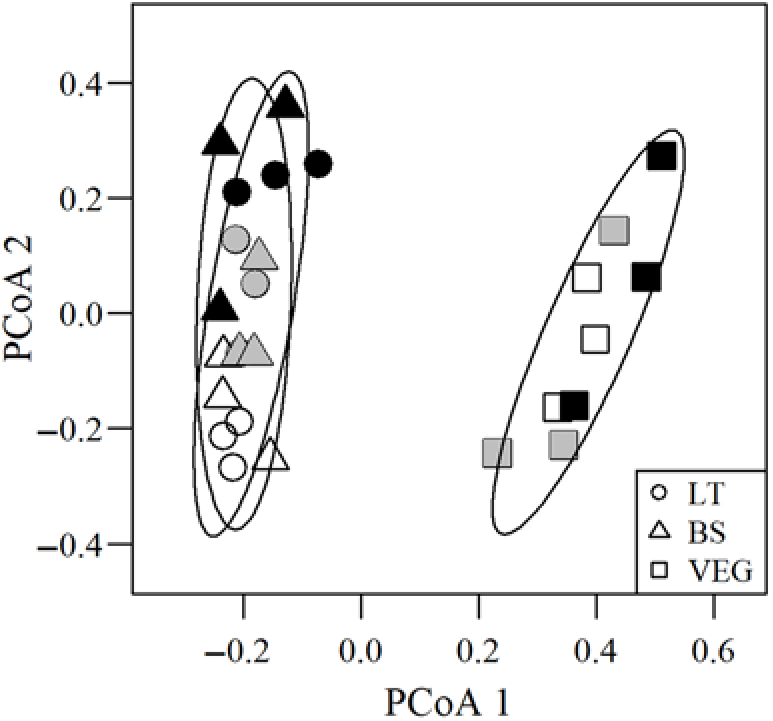
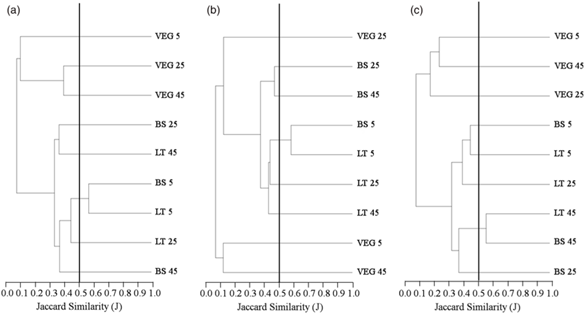
When analysing the species similarities of the components (LT, BS, VEG) of the three sites when pooled together, we observed significant differences in their species composition (PERMANOVA, F = 3.57; P = 0.001). The confidence intervals demonstrated that the BS and the LT fraction had similar composition, while the standing vegetation showed a very different composition (Figure 2). That difference in species composition could be confirmed by observing the similarity values within each site (I, II and III). The standing vegetation was very dissimilar to the soil seed banks and litter, even in the advanced successional stages of the chronosequence (Figure 3). That result held true even when all of the study sites were considered together (Figure 3). The similarity between BS and LT tended to be high early in the chronosequence, with the highest Jaccard index values (J > 0.58) being found between those components in two of the three sites analysed (I and II, Figure 3a, b). As the chronosequence continued, however, there was a tendency for reduced similarity between those two components.
Principal coordinate analysis (PcoA) ordination diagram based on the species compositions (presence/absence) of the litter (LT), buried seeds (BS), and vegetation (VEG) components at sites I (black symbols), II (grey symbols) and III (white symbols) in the semi-arid region in north-eastern Brazil. Ellipses represent 95% confidence envelopes around the LT, BS and VEG sample groups. Sites I, II and III correspond to study sites located in the municipalities of Pentecoste, Quixadá and Sobral, respectively, all located in the state of Ceará, Brazil.

Similarity dendrograms produced by cluster analysis of the three successional ages (5 y, 25 y and 45 y), with three components (BS: buried seeds; LT: litter; VEG: vegetation), using the Jaccard similarity index and UPGMA group linkage. Site I (a); Site II (b); Site III (c). Sites I, II and III correspond to study sites located in the municipalities of Pentecoste, Quixadá and Sobral, respectively, all located in the state of Ceará, Brazil.

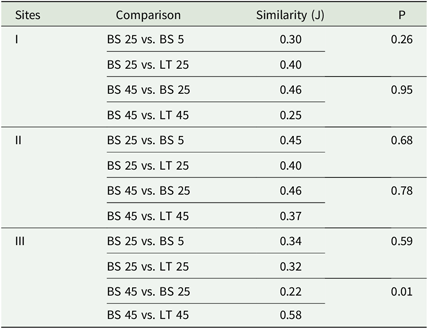
Seed persistence and seed dispersal had balanced contributions to the composition of SSB, as the difference between Jp and Jd did not differ from the null hypothesis in four out of six tested cases (two successional ages × three sites) (Table 2). Only two cases appeared as exceptions where the null hypothesis was rejected and Jd was significantly greater than Jp – in the 25-y and 45-y successional ages of sites I and III respectively (Table 2), indicating that there were larger contributions of seed dispersal to the compositions of SSB in those specific locations.
Comparisons of the Jaccard index of similarity (J) of the buried seed component (BS) and previous BS and current litter layer (LT) for successional ages 25 y and 45 y in each study site in the semi-arid region in north-eastern Brazil. P-values were obtained from permutation tests performed to examine the null hypothesis that differences between the Js of each age/site do not deviate from expected under random species assembling of each component (BS actual, BS previous, LT actual); P <0.05 indicates that the difference between the Js of any age/site is greater than expected under the null hypothesis of random species assemblages of each component. Sites I, II and III correspond to study sites located in the municipalities of Pentecoste, Quixadá and Sobral, respectively, all located in the state of Ceará, Brazil

Discussion
Our results did not support the prediction of high similarity between SSB and standing vegetation in TDFs, suggesting that the seed bank does not have an important role in determining the standing vegetation composition of the different seral stages of secondary succession. The fact that this result held true in three different sites indicates it as a general feature of the regeneration ecology of those ecosystems. One implication of those findings is that secondary succession in TDF must be largely dependent on the seed-input through dispersal. Our results are puzzling in that respect, however, because a consistent pattern of dissimilarity between the LT and VEG was observed. The seeds in the litter component are representative of recent dispersal inputs because any diaspores must first pass through that layer before becoming completely buried in the soil layer underneath (Espinar et al. Reference Espinar, Thompson and Garcia2005, Simpson et al. Reference Simpson, Leck, Parker, Leck, Parker and Simpson1989), and therefore should be similar in species composition to the standing vegetation if local seed dispersal is an important driver of its composition.
Our results showed that the dissimilarity between the standing vegetation and LT is largely a result of the absence of woody species. Two possibilities could explain that finding. The first is that the low rainfall observed in the years preceding our study (Table 1) resulted in reduced seed production and poor contribution of the local seed rain to the seed bank. It has been demonstrated that low precipitation in the previous year is related to reductions in the richness and density of the seed banks in the same kind of ecosystem as investigated here (Silva et al. Reference Silva, Santos, Santos, Albuquerque, Ferraz and Araújo2013). Accordingly, the persistence of seeds from previous years would make an important contribution to SSB composition because the similarity between the BS and the current LT was as high as between the current and previous BS. Woody species, however, were nearly absent in both components. As such, we tentatively propose that interannual variation in rainfall drives fluctuations in perennial species in the composition of SSB by affecting seed production. This is consistent with earlier studies that pointed out that those life forms rely on the survival of established individuals (and not on the formation of SSB) to cope with environmental unpredictability (Caballero et al. Reference Caballero, Olano, Loidi and Escudero2008, Childs et al. Reference Childs, Metcalf and Rees2010). It is important to note, however, that there are exceptions among perennial species. Previous studies have found that tree species in tropical semi-arid savannas and woodlands form persistent seed banks (Silveira et al. Reference Silveira, Martins and Araújo2017, Witkowski & Garner Reference Witkowski and Garner2000). In the case of Silveira et al. (Reference Silveira, Martins and Araújo2017), the same species they studied was present in our SSB, indicating that although the presence of woody species in SSB can be erratic and coupled with rainfall variation, a few species can persist by means of the SSB. Further studies comparing seed production by woody species, their presence in SSB, and rainfall variation in TDF will be required to provide more evidence for the rainfall-driven fluctuation hypothesis for the absence of woody species in SSB.
A second explanation could be that sampling the SSB at the end of the dry season underestimated the woody species component because those seeds had either germinated before the sampling period or had not yet been dispersed. Previous studies demonstrated two patterns of fruit production in woody Brazilian semi-arid species: (1) fruiting concentrated in the rainy season (which is observed for more than 60% of the woody species present in local communities) and (2) fruit production during the dry season (which is displayed by just a few anemochoric species) (Griz & Machado Reference Griz and Machado2001, Lima & Rodal Reference Lima and Rodal2010). While the species that were dispersed in the dry period could potentially be under-represented in our sampling, that bias should be small because anemochoric species represent only a small part of the richness and abundance of woody species in the Brazilian semi-arid (Lima & Rodal Reference Lima and Rodal2010). On the other hand, species that produce fruits during the rainy season could potentially produce seeds that rapidly germinate during the rainy season and would therefore be absent in SSB samples collected in the following dry season (the time of our collections). That would only be feasible, however, if seed production was concentrated in the beginning of the rainy season, because quiescent seeds dispersed later would experience increased risk of establishment failure due to desiccation as soon as the rainy season ends. Previous studies in Brazilian semi-arid communities diverge in that respect: while in some cases fruiting is concentrated in the early rainy season (Lima & Rodal Reference Lima and Rodal2010), in others it peaks later (Griz & Machado Reference Griz and Machado2001). The specific periods of seed production, dispersal and germination should therefore be assessed to establish whether dry-season sampling biases SSB composition. These sorts of data, and knowledge of the amount of seed production of woody species in different years (with different rainfall totals), would allow a distinction between low seed production and biased sampling as explanations for the observed near absence of woody species in the SSB. As those data are not available, both explanations remain plausible – although both hypotheses have in common the fact that seeds from standing vegetation should be part of the transient component of the SSB.
According to the above, standing vegetation and seed bank composition are largely decoupled, at least during periods when the local perennial vegetation, which generally produces transient seeds, does not provide seeds to the SSB. Our results indicate that this allochthonous SSB component is a result of the nearly balanced contribution of extrinsic and local processes. The extrinsic processes consist of recent allochthonous inputs of seeds into LT by dispersal (as seen by the similarity between extant LT and BS composition). It is worth noting that the observed decay of similarity between LT and BS components as successional age increased in all three sites (Figure 3) is consistent with the existence of an increasing barrier to allochthonous seed input related to the development of a taller and more complex vegetation as succession proceeds. Local processes are mainly interpreted as the contributions of persistent seeds to the composition of the extant SSB, as seen by the similarity between previous and current BS components at different chronosequence ages. The importance of those processes is consistent with the fact that the studied SSB was dominated by annual herb species (Gomes et al. unpubl. data). Annual species tend to have smaller seeds (Moles et al. Reference Moles, Ackerly, Webb, Tweddle, Dickie and Westoby2005) with higher dispersal capacities and wider distributions (Guo et al. Reference Guo, Brown, Valone and Kachman2000). Those traits would be responsible for consistent seed inputs from non-local seed sources, independent of the successional age. Additionally, the life history of annual species (and small seed sizes) is associated with higher seed persistence in the soil as a bet-hedging strategy against erratic environmental variability (Childs et al. Reference Childs, Metcalf and Rees2010, Cohen Reference Cohen1966). The similar importance of persistence and dispersal to BS composition (Jp and Jd did not differ) found in the three sites shows the importance of both processes in the formation of SSB in TDF.
The exceptions to this balanced similarity were sites I (25 y) and III (45 y) where the extant BS component was more similar to the extant LT than to the previous BS – indicating a more important contribution of the seed rain to the composition of SSB. Those divergent results could be related to unique differences in previous uses and the surrounding landscapes of those sites. Different from site II, where seed dispersal was as important as seed persistence in terms of their similarities with the BS component in both the 25-y and 45-y time periods, sites I and III experienced previous grazing use. In site I, the previous uses at successional ages of 5 y and 25 y consisted of grazing and, specifically, grass species (Cenchrus ciliaris) planted for pasture surrounding the 5 y area (Table 1). In site III, previous uses of the 5-y and 25-y areas also included grazing. Although the characteristics of the immediate surrounding landscape of the areas of sites I (25 y) and III (45 y) do not provide any apparent explanation for the higher importance of seed rain (Table 1), the fact that those two sites experienced previous or current grazing use at broad scales suggests that they have more sources of seeds from annual species. Grazing is known to select for annual species, mainly ruderal ones (Díaz et al. Reference Díaz, Lavorel, McIntyre, Falczuk, Casanoves, Milchunas, Skarpe, Rusch, Sternberg, Noy-Meir, Landsberg, Zhang, Clarck and Campbell2007) with high dispersal abilities (Guo et al. Reference Guo, Brown, Valone and Kachman2000). The dominance of annuals (ruderals in most cases) has been considered an important cause of dissimilarities between the SSB of heavily grazed areas and remnants of native vegetation in semi-arid ecosystems (Tessema et al. Reference Tessema, Ejigu and Nigatu2017).
In summary, our findings were contrary to our initial predictions and, together with previous studies, confirm the general dissimilarity between SSB and standing vegetation in forest ecosystems undergoing secondary succession. Although our results do not allow us to distinguish between different hypotheses for the absence of standing vegetation species (mainly woody ones) in the SSB, our findings and alternative explanations are consistent with the idea of the standing vegetation being part of a transient component of the SSB. Our results also indicate that SSBs in TDFs are largely the result of the influence of allochthonous annual species that are characterized by both high dispersal capacities and high persistence in SSB – thus contributing to decoupling the SSB and vegetation species compositions, irrespective of the successional stage. In face of those findings, two important conservation implications for TDF arise: (1) considering that SSB have low importance in the establishment of standing vegetation during secondary succession, ecological restoration efforts must take into account the fact the SSB will not be a force for natural regeneration; and (2) as the establishment and regeneration of vegetation species is largely dependent on the seed rain, the invasion of disturbed sites by late-successional species is dependent on the presence of nearby patches of mature vegetation.
Author ORCIDs
Fernanda Melo Gomes https://orcid.org/0000-0002-4213-6577, Rafael Carvalho da Costa https://orcid.org/0000-0002-0942-3128, Maria Iracema Bezerra Loiola https://orcid.org/0000-0003-3389-5560
Acknowledgements
We thank the Coordination for the Improvement of Higher Education Personnel (CAPES) for the doctoral scholarship granted to the first author; Brazilian Agricultural Research – EMBRAPA, and those responsible for Não Me Deixes Farm and the Experimental Farm Curu Valley for their logistical support.
Appendix 1
Species sampled in three components (L: litter; B: buried seeds; V: standing vegetation), at three successional ages (5 y, 25 y and 45 y) in three study sites (I, II and III) in the Brazilian semi-arid region. Sites I, II and III correspond to study sites located in the municipalities of Pentecoste, Quixadá and Sobral, respectively, all located in the state of Ceará, Brazil.