1. Introduction
This article is a first step in answering the question of whether phenomenal consciousness should be seen as a problem for the brain sciences. I accept that if there is such a phenomenon, then it does indeed pose a significant problem and we should not fault a growing group of scientists (those involved in what I will refer to as the new science of consciousness) for taking it seriously. But, should we accept the reality of phenomenal consciousness? I hold that this is a nontrivial question that is often trivialized by blunt assertions that phenomenal consciousness is phenomenologically obvious—that it is manifest in introspection or that everyone knows it from their own experience. In this article I argue that this claim is false: I argue that phenomenal consciousness is not phenomenologically obvious.
To illustrate, consider the opening line in philosopher Daniel Stoljar's (Reference Stoljar2006, v) recent, well-received volume on the problem of consciousness:
Apart from its phenomenological obviousness, the two central facts about conscious experience are these: It is philosophically puzzling, and we are scientifically ignorant with respect to it.
Stoljar asserts as fact that conscious experience (what I referred to above as phenomenal consciousness) is phenomenologically obvious and that we are scientifically ignorant of it. One reasonable conclusion to draw from these supposed facts is that further scientific work into the phenomenon is warranted. A number of prominent scientists—the new scientists—have drawn exactly that conclusion from philosophical claims like Stoljar's. They typically take the reality of phenomenal consciousness for grantedFootnote 1 and seek to offer a scientific explanation of this holdout against the progress of modern science.
In contrast, I assert that we remain scientifically ignorant of phenomenal consciousness because there is no such phenomenon. To make this assertion plausible, however, I need to argue that phenomenal consciousness is not phenomenologically obvious (after all, if Stoljar is correct, then my denial of the phenomenon would seem to be rather misguided). I do this by first arguing that if phenomenal consciousness is in fact phenomenologically obvious, then it should be obvious to people without training in philosophy or the new science (since they too have the phenomenology); I then present evidence that this is not the case.
Here is how I will proceed. In Section 2, I briefly introduce the new science of consciousness. In Section 3, I outline my argument against the claim that phenomenal consciousness is phenomenologically obvious. In Section 4, I review recent work on the folk psychology of consciousness, finding that the current evidence suggests that ordinary people do not share the philosophical concept of phenomenal consciousness. I support this finding further, in Section 5, by noting that there are reasons to think that most people hold a naïve view of colors that contrasts with the qualia view underlying the new science understanding of phenomenal consciousness.
2. The New Science of Consciousness
Over the course of the past quarter century there has been a growing scientific interest in the philosophical problem of consciousness. The resulting new science of consciousnessFootnote 2 is ultimately focused on solving what David Chalmers (Reference Chalmers1996) has termed the “hard problem”—the problem of explaining phenomenal consciousness. This phenomenon is understood in terms of there being “something it is like” to be in certain mental states (see Nagel Reference Nagel1974), with the something typically being indicated by noting the qualities we are aware of in having an experience. Paradigmatic examples are redness (such as that seen in looking at a ripe tomato) and painfulness (such as that felt in stubbing one's toe). The central question for the new science is to explain how such qualities arise from neural activity in the brain.
Space constraints prevent me from giving a detailed discussion of the new science here. It is important, however, to illustrate that the above characterization directly reflects how prominent new scientists describe the discipline. Consider the preface to psychologist Jeffrey Gray's volume, Consciousness: Creeping Up on the Hard Problem (Reference Gray2004, vii):
Consciousness has become a very fashionable topic. It wasn’t always so. A paper I wrote in 1971 about what is now called the ‘Hard Problem’ … received a grand total of two reprint requests. Indeed, at that time, with behaviourism still dominant in psychology and positivism in philosophy, the topic of consciousness was virtually taboo. My 1971 paper questioned the then popular view (‘mind-brain identity theory’). … To me, alas, this solution was simply a philosophical cop-out from what, in the long run, was bound to become the scientific version of the Hard Problem: how do states of consciousness fit into neuroscience (since they seem to be created by the brain) and into psychology (since they seem to be related to behaviour)?
The long run may now be over. The problem of consciousness has entered science with a bang, celebrated in a spate of recent books by eminent authors (not to mention new scientific associations, new journals and hundreds upon hundreds of articles).
Gray's statement is characteristic of discussions of the new science in noting that scientists had turned their backs on the problem of consciousness and asserting that a solution would come from scientists reclaiming the project from philosophers.
Gray's statement is also characteristic in focusing on the hard problem. As Francis Crick and Christof Koch put it (Reference Crick and Koch2003, 119), “The most difficult aspect of consciousness is the so-called ‘hard problem’ of qualia—the redness of red, the painfulness of pain, and so on.” Such qualities mark certain mental states as being phenomenally conscious, and the problem that ultimately drives the new science is to explain how these distinctive qualities could arise from the biological activity of brains; this is held to be a truly hard problem, presenting a troubling puzzle for the brain sciences. Koch expresses the problem nicely in his recent volume:
How do the salty taste and crunchy texture of potato chips, the unmistakable smell of dogs after they have been in the rain, or the feeling of hanging on tiny fingerholds on a cliff a couple of meters above the last secure foothold, emerge from networks of neurons? These sensory qualities, the building blocks of conscious experience, have traditionally been called qualia. The puzzle is, how can a physical system have qualia? (Reference Koch2004, 1–2)
This statement is representative of the new science understanding of phenomenal consciousness. The focus is on the qualities that we are aware of in having experiences such as eating a chip or smelling a dog; the qualities are taken to be qualities of mental states, and the goal is to explain how they could possibly be produced by the physical brain.
The result is a concept that unites a diverse range of qualities under a single header. Specific tastes, textures, smells, and so on are taken to have something in common: they are all qualia, and they mark the corresponding mental states as being phenomenally conscious. This understanding is also common in the philosophical literature. Noncontroversially phenomenal consciousness is taken to cover a diversity of mental states, including perceptual experiences (seeing red, hearing a C-sharp), bodily sensations (feeling pain, nausea), and felt emotions (happiness, depression; see, e.g., Levin Reference Levin and Craig1998; Tye Reference Tye2003). For each of these mental states there is thought to be something it is like to be in it, and this is typically taken to contrast with states such as beliefs and desires that lack such qualities.
3. Phenomenal Consciousness and Phenomenological Obviousness
It is in this context of a science aimed at explaining qualia that I am considering the claim that phenomenal consciousness is phenomenologically obvious. Specifically, I am concerned with this claim insofar as it is given as justification for the existence of phenomenal consciousness as it is understood in the new science. Further, for reasons of space, I cannot here deal with other types of argument that could be given for the reality of this phenomenon (but see Sytsma Reference Sytsma2010). As such, the claim that phenomenal consciousness is phenomenologically obvious should be understood in a way that directly justifies belief in this problematic phenomenon without undue reliance on unstated and potentially controversial theoretical assumptions (as these would lead us to a rather different type of argument and take us beyond the scope of the present article). The claim does this if we take it at face value: Many hold that phenomenal consciousness is evident just in having experiences such as tasting a potato chip or smelling a wet dog. In effect, the claim is that phenomenal consciousness is observed in such experiences and therefore cannot be reasonably doubted. This has a great deal of force exactly because it appeals to what is evident in common experiences and not to theoretical assumptions learned through training in philosophy or the new science.Footnote 3
Note, however, that it is not enough that the salty taste of a potato chip or the stinky smell of a wet dog be obvious. The issue is whether phenomenal consciousness is phenomenologically obvious and the concept of phenomenal consciousness in the new science involves the classification of mental states based on their having (or lacking) qualia. The key point is that these qualities are taken to be qualities of phenomenally conscious mental states. As such, for phenomenal consciousness to be phenomenologically obvious is for it to be obvious from the phenomenology that qualities such as the salty taste and the stinky smell noted by Koch are qualities of mental states.
Understood in this way, is it true that phenomenal consciousness is phenomenologically obvious? Certainly many philosophers and new scientists hold that it is. Note, however, that they also have training in philosophy or the new science and that it could be the case that they are calling on theoretical assumptions in this assessment. A better test is to consider the views of people who have the phenomenology but lack the theoretical training. Do ordinary people also have the (perhaps implicit) concept of phenomenal consciousness? If it is true that phenomenal consciousness is phenomenologically obvious, then we should expect that they do; we should expect that the concept of phenomenal consciousness is part of what Dan Dennett has called the folk theory of consciousness (Reference Dennett2005, 26). Fortunately, assessing this claim about the folk has been the focus of recent work in experimental philosophy and psychology.
4. Folk Psychology and Phenomenal Consciousness
Cognitive science has made great progress over the past several decades in expanding our knowledge of how people come to understand psychological phenomena. This understanding is thought to be underpinned by a general cognitive framework—folk psychology or folk theory of mind (Nichols and Stich Reference Nichols and Stich2003; Malle Reference Malle2004; Goldman Reference Goldman2006). This framework is typically called on in explaining our ability to predict behavior, including our ability to conceptualize and reason about mental states such as beliefs and desires. As such, the research on folk psychology has not cast much light on the folk understanding of mental states such as seeing red and feeling pain. This has begun to change over the last few years, however, with a wave of fascinating work on the topic being done by experimental psychologists and philosophers (Gray, Gray, and Wegner Reference Gray, Gray and Wegner2007; Knobe and Prinz Reference Knobe and Prinz2008; Huebner Reference Huebner2009; Sytsma and Machery Reference Sytsma and Machery2009, Reference Sytsma and Macheryn.d.; Arico Reference Arico2010; Arico et al. Reference Arico, Fiala, Goldbert and Nicholsn.d.).
Of particular interest is Joshua Knobe and Jesse Prinz's (Reference Knobe and Prinz2008) pioneering work presenting empirical evidence that the folk understanding of these states corresponds with the philosophical concept of phenomenal consciousness. Most notably, in their second study they asked subjects to evaluate how natural it is to ascribe a range of mental states to a group agent (Acme Corporation). Knobe and Prinz found that the folk seem to be unwilling to ascribe those states that philosophers take to be phenomenally conscious (such as feeling depressed) to the corporation, while being disposed to ascribe nonphenomenal mental states to it. They interpret these results as indicating that the folk have the (perhaps implicit) concept of phenomenal consciousness, distinguishing between phenomenally conscious mental states and mental states that are not phenomenally conscious.
If Knobe and Prinz are correct, then this would be strong evidence that phenomenal consciousness is in fact phenomenologically obvious, with nonphilosophers spontaneously drawing the same distinctions between these mental states that philosophers do. These conclusions have been brought into question, however (Sytsma and Machery Reference Sytsma and Machery2009; Arico Reference Arico2010). In particular, Edouard Machery and I have challenged the conclusion that the folk possess the concept of phenomenal consciousness. We argue that there is a confound inherent in Knobe and Prinz's approach: Corporations differ in some significant behavioral and functional ways from individuals. A group agent such as Acme Corporation is distributed; it does not have an individual body, although it comprises such bodies. As such, Acme cannot smile in happiness or grimace in disgust. It is thus difficult to determine whether people focus on the supposed phenomenality of joy or pain (and not on the functional and behavioral differences between distributed corporations and humans) when they deny that Acme can experience great joy or feel excruciating pain. Because of this, we found that Knobe and Prinz's study of the ascription of mental states to corporations does not establish that the folk share the concept of phenomenal consciousness.
In fact, in a subsequent study Machery and I (Sytsma and Machery Reference Sytsma and Macheryn.d.) produced evidence that the folk do not share this concept. In that paper we reasoned that if the folk share the concept of phenomenal consciousness discussed above, then they should treat paradigmatic examples of phenomenally conscious mental states similarly. Specifically, both the folk and philosophers should deny that an entity that lacks phenomenal consciousness can either see red or feel pain (e.g., tending to deny both to a simple robot).
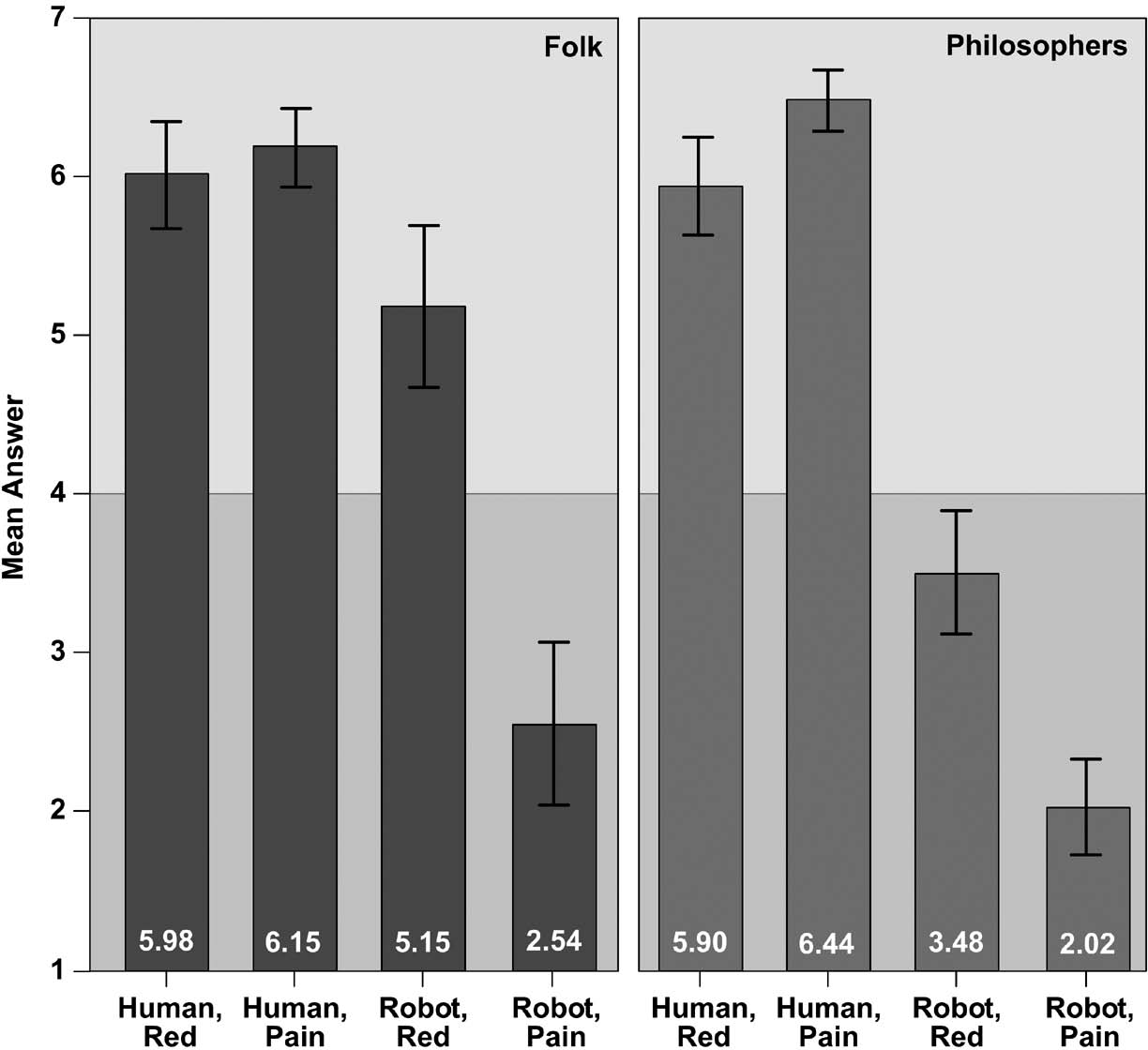
Our first study tested this hypothesis. The study was conducted online with participants (both nonphilosophers and philosophers) being given either a description of a relatively simple, nonhumanoid robot or a normal human performing behaviorally analogous tasks expected to elicit ascriptions of either a perceptual experience or a bodily sensation in humans. In each scenario the agent (robot or human) manipulated a red box. In half of the scenarios, the manipulation was successful, and participants were asked whether the agent “saw red” on a 7-point scale anchored at 1 with “clearly no,” at 4 with “not sure,” and at 7 with “clearly yes.” In the other half, the agent was electrically shocked, and participants were asked whether the agent “felt pain” on the same scale.
With respect to the philosophers surveyed, the results of this study were consistent with the hypothesis (see Figure 1). Philosophers treated feeling pain and seeing red analogously. They were unwilling to ascribe either the perceptual experience of seeing red or the bodily sensation of feeling pain to the robot. By contrast, philosophers were willing to ascribe both states to a normal human male. Contrary to the hypothesis that ordinary people and philosophers understand these states in the same way, however, the folk treated the perceptual state of seeing red quite differently from the bodily sensation of feeling pain. Nonphilosophers were willing to attribute seeing red to the robot but were not willing to attribute feeling pain to it. As such, our results offer preliminary evidence that the folk do not share the philosophical concept of phenomenal consciousness; they do not treat these states as philosophers do, seemingly failing to recognize that they have something obvious in common (that they are both phenomenally conscious mental states).Footnote 4
Results, Sytsma and Machery (Reference Sytsma and Macheryn.d.) study 1 (error bars: 95% confidence interval).

5. Phenomenal Red and the Naïve View
The most common objection to my work with Machery discussed in the previous section has centered on the claim that “seeing red” is ambiguous between what we might term an informational reading and a phenomenal reading. The critics of our conclusion tend to hold that on the informational reading a creature sees red if its behavior is responsive to the distinction between those things that we see as being red and those that we do not. In this sense, the simple robot appearing in our probes sees red, as is witnessed by its successfully performing the relevant discrimination task. On the phenomenal reading, however, a creature sees red only if it has the appropriate phenomenal experience of redness. Our critics maintain that the robot does not see red in this sense (because it is not phenomenally conscious). The critics then utilize the distinction between informational and phenomenal seeing to suggest that the folk recognize both readings, but that (for some reason) they focused on the informational reading in responding to our survey questions.
Machery and I offered a number of responses to this ambiguity objection in our original paper, primarily focusing on the distribution of the folk's answers (the answers were not bimodal as would be expected if the folk recognize both an informational and a phenomenal reading) and the folk's explanations of their negative answers (unlike the explanations given by philosophers, the folks did not indicate a phenomenal reading). Rather than rehash these responses further, however, I want to explore the relationship between the concept of phenomenal consciousness at issue and the view of color that is presumed in the ambiguity objection. I argue that the ambiguity found in the phrase “see red” reflects a theoretical view of color that the folk plausibly lack: The ambiguity primarily attaches to the term “red” (not “see”) and supposes a distinction between physical red (red as light reflectance, e.g.) and phenomenal red (red as phenomenally experienced by us).
There is a contrasting naïve view of color that does not make this distinction. On this view it is held that colors are real, mind-independent properties of things in the world; as such, the red we experience is taken to be the red of the physical object. The term “naïve” is not used pejoratively; rather, it is used to indicate that there is reason to think that this is the pretheoretical view of colors. As Michael Tye (Reference Tye2000, 147) expresses the point, “The obvious view of color, at least as far as common sense goes, is that the color we see objects and surfaces to have are observer-independent properties of those objects and surfaces.” If this is correct, then the view that the colors we experience are not qualities of objects, but are instead qualities of our mental states, is rather counterintuitive and stands in need of a motivating argument.
In fact, this view seems to be counterintuitive, in part, because the phenomenology places the colors in the world. As Natika Newton (Reference Newton2000, 63) puts it, “visual sensations do not feel like sensations; instead sensations like colour appear to the naïve subject to be properties of external objects.” As such, that the color is a “sensation”—that it is a quality of a mental state or a quale—cannot be read off of the phenomenology. But, as discussed in Section 3, the claim that phenomenal consciousness is phenomenologically obvious is best read as asserting exactly the opposite: We are concerned with the claim that qualia are evident in the phenomenology of experiences such as seeing red.
That the phenomenology of visual experiences in fact seems to locate colors in the world is rather clear if one considers the responses of those among us who are least “tainted” by the prevalent theoretical and scientific views about color (children). As Paul Skokowski (Reference Skokowski2007, 67) notes, “Ask a child where the yellow is when she looks at a daffodil. She will reply ‘on the daffodil.’” The time I have spent discussing colors with children is enough to convince me that our initial understanding of colors, our most purely pretheoretical understanding, treats them as mind-independent properties of worldly objects. Further, I suspect that the pretheoretical view of colors that is found in children remains quite widespread in the general population.Footnote 5 While most Americans today likely come to understand that color is connected to how surfaces differentially reflect light and perhaps learn that modern science explains colors in this way, this can be accepted without adopting the view that the colors we experience are actually in the mind. That is a nontrivial extension and one that, in the absence of evidence to the contrary, we should not expect that the folk generally make. If this is correct, then it is hardly surprising that the folk would treat “seeing red” differently than many philosophers and new scientists.Footnote 6
6. Conclusion
The last two decades have seen a surge in interest in the topic of phenomenal consciousness among serious brain scientists. Many hold that phenomenal consciousness poses a distinctively hard problem for the brain sciences, and this has motivated the development of a new science of consciousness. This, in turn, motivates philosophical scrutiny of the assumptions underlying this new science. Importantly, we can ask what reason we have to believe that the central explanandum for the new science really exists. In this article I have focused on just one common argument for the existence of phenomenal consciousness: It is often suggested that phenomenal consciousness must exist because it is phenomenologically obvious.
I began by articulating the new science understanding of phenomenal consciousness and unpacking the claim that it is phenomenologically obvious. I argued that if phenomenal consciousness is phenomenologically obvious, then the concept of it should be shared by ordinary people (people without training in philosophy or the new science); it should be part of the folk theory of consciousness. I then discussed evidence suggesting that this bit of philosophical common sense is mistaken: Ordinary people do not seem to share the concept of phenomenal consciousness. Further, I argued that this in part reflects that the folk (but not philosophers or new scientists) generally hold a naïve view of colors. Colors, whether perceived or not, are held to be qualities of objects beyond the perceiving subject's brain. Taken together, this suggests that phenomenal consciousness is not phenomenologically obvious. My hope is that this goes some way toward clearing the ground for a renewed debate concerning the reality of this supposed phenomenon and the prospects for the science aimed at explaining it.