Introduction
The nose is a vitally important structure to the appearance of the face. Physiologically, it serves in respiration and olfaction. Thus, the goal of nasal reconstruction is to re-establish the nasal appearance to as close to the pre-morbid condition, while maintaining a patent airway.
In full-thickness defects, a three-layer reconstruction of the skin, structural support and inner lining is required.Reference Menick1 The inner lining in particular provides a challenge, as the key to reconstruction is a well-vascularised flap that prevents retraction and protects osseous or cartilaginous grafts.Reference Cannady, Cook and Wax2,Reference Aneeshkumar, Chueng, Hart, Trites and Taylor3 Various local flaps have been described for inner lining, including the inferior turbinate flap, septal mucoperichondrial flap and composite septal pivotal flap.Reference Cannady, Cook and Wax2–Reference Ramji, Kim, Pozdnyakov and McRae4
Depending on the extent of tumour resection, the requisite adjacent tissues may not be available for these flaps. In this situation, more distant tissue is required for lining. Modifications to the paramedian forehead flap and various free flaps have been described.Reference Cannady, Cook and Wax2–Reference Sertel and Pasche5 Despite its use in cranial vault reconstruction, little attention has been given to the pericranial flap as nasal lining.Reference Phillips6,Reference Balagopal, George, Ajith, Ahamed and Sebastian7
The anteriorly based pericranial flap is a thin, pliable flap with multiple vascular pedicles capable of covering up to one-third of the central face. It is commonly used for reconstruction in anterior skull base surgery with good success.Reference Yoshioka and Rhoton8 Thus, the thinness and pliability of the pericranial flap makes it ideal for use as nasal lining.Reference Phillips6
Anatomy
The layers of the scalp consist of skin, subcutaneous tissue, epicranial aponeurosis, loose areolar tissue and pericranium. The arterial supply is derived from the supratrochlear artery, supraorbital artery, superficial temporal artery, posterior auricular artery and occipital artery, which freely anastomose throughout the scalp.Reference Phillips6,Reference Potparić, Fukuta, Colen, Jackson and Carraway9
The pericranial flap consists of the pericranium and loose areolar tissue and, anteriorly based, the blood supply is derived from the supratrochlear and supraorbital vessels. It can be harvested based on one or both sides, depending on the clinical situation.Reference Gonzalex-Ulloa, Castilla, Stevens, Alvarex Fuertes, Leonelli and Ubaldo10 The anteriorly based pericranial flap has been demonstrated to have reliable axial blood supply of 70 mm above the superior orbital rim; however, distal to this, the ‘random-pattern’ blood supply is difficult to ascertain and vascularisation may be compromised.Reference Phillips6,Reference Gonzalex-Ulloa, Castilla, Stevens, Alvarex Fuertes, Leonelli and Ubaldo10
Materials and methods
This quality improvement project was approved by the Capital District Health Authority Research Ethics Board, Halifax, Canada.
Patients
A range analysis search of the Practimax database (Deloitte & Touche, Nova Scotia, Canada, 2008) was performed, using the procedure code for second-stage nasal reconstruction, for surgery carried out from 1 January 2007 through to 1 December 2019, for the senior author. This captured all patients receiving a second-stage procedure for paramedian forehead flap reconstruction from 2007, when the code was first used.
A retrospective chart review was then performed to identify patients who had undergone paramedian forehead flap reconstruction combined with a pericranial flap for lining. Patients who had received other procedures for nasal lining or those who had undergone alternative procedures were excluded.
The included patients’ charts were then reviewed for diagnosis, operative resection technique, reconstructive procedure, outcome and complications.
Surgical technique
The paramedian forehead flap is elevated in the standard fashion based on a unilateral supratrochlear pedicle, with careful dissection above the loose areolar plane in order to maintain thickness of the pericranial flap. Wide lateral and superior dissection is then performed in order to maximise the available pericranium for the flap.
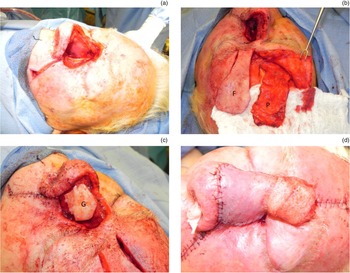
The subsequent pericranial flap is based off the supratrochlear pedicle on the opposite side of the forehead (Figure 1). The flap width is planned depending on the size of the defect; the farthest lateral aspect can be out to the temporal line and the medial aspect is taken at the midline, if possible avoiding the paramedian forehead flap defect in order to prevent exposure of bare bone. Superiorly, it may be taken up to the sagittal suture.
Intra-operative images, showing: (a) the defect following nasal cancer resection; (b) paramedian forehead flap (F) elevated based on unilateral supratrochlear pedicle, and pericranial flap (P) based off the supratrochlear pedicle on the contralateral side of the forehead; (c) cartilaginous graft (G), with pericranium rotated 180° to provide lining for structural grafts; and (d) completed closure, with the paramedian forehead flap rotated inferiorly to provide the external envelope and coverage of structural grafts.

Next, the pericranial flap is rotated 180 degrees in order to provide lining for any structural grafts, and is then secured with chromic gut sutures. The paramedian forehead flap is then rotated down to provide the external envelope, and is secured to the surrounding tissue and to the pericranial flap in order to provide complete coverage of any structural grafts.
Results
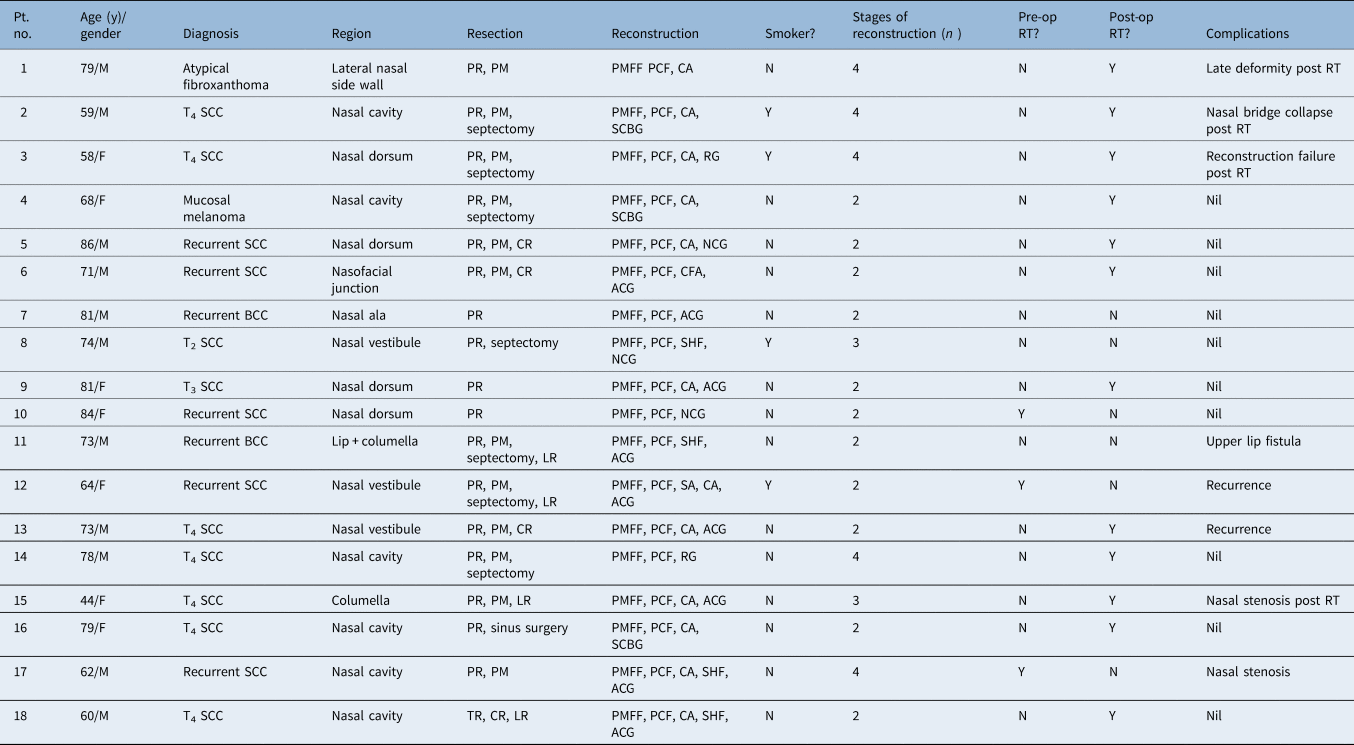
A total of 66 patients were identified in the initial search as undergoing a second-stage procedure. Eighteen patients (11 male and 7 female) were identified as having undergone nasal reconstruction with a paramedian forehead flap with a pericranial flap for inner lining. The mean age of the patients was 71 years (range, 44–86 years). Of the 18 patients, 14 had squamous cell carcinoma (SCC) of the nose or nasal cavity, 2 had nasal basal cell carcinomas (BCCs), 1 had mucosal melanoma and 1 had a malignant fibroxanthoma. Two-thirds of patients (12 of 18) received post-operative radiotherapy (RT) and three patients had received pre-operative RT. The average follow-up time was 20 months (range, 0–100 months). Patient data are presented in Table 1.
Patient data

Pt. no. = patient number; y = years; pre-op = pre-operative; RT = radiotherapy; post-op = post-operative; M = male; PR = partial rhinectomy; PM = partial maxillectomy; PMFF = paramedian forehead flap; PCF = pericranial flap; CA = cheek advancements; N = no; Y = yes; T = tumour stage; SCC = squamous cell carcinoma; SCBG = split calvarial bone graft; F = female; RG = rib graft; CR = cheek resection; NCG = nasal cartilage graft; CFA = cervicofacial advancement; ACG = auricular cartilage graft; BCC = basal cell carcinoma; SHF = septal hinge flap; LR = lip resection; SA = septal advancement; TR = total rhinectomy
The face is commonly divided into aesthetic subunits,Reference Burget and Menick11 with the nose being further described as having nine aesthetic subunits:Reference Faris, Heiser, Quatela, Jackson, Tessler and Jowett12 dorsum, tip, columella, nasal sidewalls, alae and soft tissue triangles. The resections performed were primarily of the nose; however, in 15 of 18 cases, the resections included part of other facial aesthetic subunits and/or nasal supports (Table 1). In all cases, between three and six of the nasal aesthetic subunits were completely excised, with some additional subunits being partially excised. The median number of nasal subunits excised was five.
In this study, there were no immediate post-operative complications. Overall, the complication rate was 33 per cent. Of the six patients with complications, five received either pre- or post-operative RT. The sole major complication was a delayed complete loss of the reconstruction in a patient who continued to smoke and who was treated with adjuvant RT. This was in the context of a total rhinectomy with pericranium used exclusively for lining. She developed hardware exposure in the columellar component of the reconstruction, requiring removal of the rib graft and a secondary reconstruction.
Two patients suffered nasal deformity occurring after completion of adjuvant RT. These defects were thought to be related to radiation-induced fibrosis and required additional stages of reconstruction. One of these patients had significant nasal bridge collapse; however, this occurred several months after the completion of treatment and was surgically addressed. The other patient developed severe alar retraction, nasal deviation and septocolumellar subluxation. In both of these patients, the paramedian and pericranial flaps remained intact. Two patients developed nasal stenosis. This occurred following RT in one patient; the other patient did not receive post-operative RT, but had received RT prior to their salvage surgery.
One patient, who underwent a significant upper lip resection because of the extent of the tumour, developed an orocutaneous fistula in the upper lip. This patient did not receive RT and the complication was felt to be unrelated to the pericranial flap.
Discussion
Moderate to large nasal defects caused by radical tumour ablation negatively affect patient health, physically and psychosocially.Reference Cannady, Cook and Wax2,Reference Aneeshkumar, Chueng, Hart, Trites and Taylor3 Surgical reconstruction requires a multi-layered approach, addressing functional and aesthetic needs for physical and psychosocial recovery. The inner lining of the reconstruction of these defects has always proved a challenge, given the complexity of the defect and variability of the resection as dictated by the primary tumour. Reconstructions must also be resistant to damage from adjuvant RT. This study aimed to investigate the utility of the pericranial flap for inner lining during nasal reconstruction with a paramedian forehead flap, focusing on the technical points, clinical outcomes, and advantages and disadvantages of its use in this setting.
The principle of aesthetic nasal reconstruction concerns replacing missing tissue with similar tissue; that is, an external skin envelope, cartilaginous or bony support, and mucosal lining.Reference Cannady, Cook and Wax2,Reference Aneeshkumar, Chueng, Hart, Trites and Taylor3 The skin is commonly reconstructed with the paramedian forehead flap, and the structural support is reconstructed using free cartilage or bone grafts from various sites. The inner lining proves the greatest challenge. The most important factor in applying the inner lining is that the tissue must be well vascularised in order to protect the underlying free bone or cartilage grafts, as their viability depends on the neovascularisation provided by the outer and inner linings.
The ideal inner lining, therefore, is mucosa. Many of the inner lining flaps described use intranasal mucosa, including: the inferior turbinate mucoperiostium, septal mucoperichondrial hinge and septal composite pivot flap.Reference Ramji, Kim, Pozdnyakov and McRae4,Reference Weber and Wang13 The major advantages of these flaps are the direct replacement of like with like tissue, good vascularisation, and, in some cases, a composite of both lining and structural components, eliminating the need for free grafts. The disadvantages are that these flaps may not be available because of the extent of resection or there may be insufficient tissue to replace the volume resected.
Other options include the paramedian forehead flap, which can be fashioned to form both the skin envelope and the inner lining.Reference Cannady, Cook and Wax2,Reference Weber and Wang13 This has the advantage that it is already being utilised as part of the reconstruction and therefore does not require an additional donor site; however, it is limited by the size of the resection in terms of how much tissue can be harvested and subsequent donor site morbidity. A further option is the galeo-frontalis myofascial flap, but this has the disadvantage of causing an immobile forehead.Reference Gonzalex-Ulloa, Castilla, Stevens, Alvarex Fuertes, Leonelli and Ubaldo10
Vascularised free tissue transfer has been described with various flaps used for lining.Reference Sertel and Pasche5 The most commonly described is the radial forearm flap, which has the advantage of a long vascular pedicle, pliability and good vascularisation. There are associated disadvantages too, including a time-consuming surgical harvest, flap thickness, pedicle placement, donor site morbidity and the need for microvascular expertise.
In cases where the residual intranasal mucosa is insufficient to support structural grafts, the pericranial flap provides a regional, low-morbidity, rapidly harvested alternative to free tissue transfer or other methods of lining reconstruction. The flap is thin, pliable and well vascularised.Reference Phillips6,Reference Potparić, Fukuta, Colen, Jackson and Carraway9,Reference Miles, Davis, Crandall and Ellis14 The pericranial flap has been shown to have reliable blood supply for up to an axial length of 70 mm. The median distance measured for nasal reconstruction including the tip and nostrils is 70 ± 5 mm; therefore, the blood supply is adequate for nasal reconstruction including the tip and columellar subunits.Reference Phillips6 Vascularisation and early mucosal re-epithelialisation has also been demonstrated.Reference Phillips6 Despite these advantages, few cases of its use in full-thickness nasal defects have been reported.Reference Phillips6,Reference Harrison, Sieffert, Kadakia, Kadakia, Johnson and Ducic15,Reference Potter, Ducic and Ellis16
The disadvantages of the flap are few. The flap width is limited by the temporal line and lack of a midline anastomosis, except in the glabellar area, which can limit its size given our tendency to avoid the risk of exposing bone on the side of the forehead flap harvest.Reference Phillips6 The flap length is limited by the reliability of the supratrochlear artery, which has a median length of 70 mm ± 13.9 mm; vascularisation becomes random above this point, increasing the risk of distal necrosis.Reference Phillips6 Our experience with raising the pericranial flap is that the flap itself does shrink somewhat once elevated, which can limit the length. Despite these anatomical findings, we have had good success when reconstructing larger defects of the tip, alar subunits and columella with pericranial flaps of more than 70 mm in vertical height. A final commonly held belief is that the flap may result in excessive contracture, but our experience does not align with this.
The majority of patients in this review had tumour (T) stage T3 or T4 nasal malignancy or recurrent tumours, requiring large resections of multiple nasal subunits and significant mucosal resections (Table 1). This led to limited options for lining reconstruction.
Fifteen of the patients were aged 60 years or more; on average, these patients had more than three major cardiovascular, respiratory, gastrointestinal, metabolic or endocrine, or central nervous system co-morbidities, as assessed during pre-operative anaesthesia assessment. For these reasons, inner lining with vascularised free tissue transfer is not always preferred, and as such pericranium is the ideal flap for inner lining.
• Nasal reconstruction aims to re-establish the nasal appearance to as close to the pre-morbid condition, while maintaining a patent airway
• The pericranial flap is a reliable inner lining for nasal reconstruction patients when combined with a paramedian forehead flap
• The pericranial flap is easily accessible, readily elevated and useful when other inner lining options are lacking
• The anteriorly based pericranial flap with multiple vascular pedicles provides a well-vascularised, pliable inner lining for nasal reconstruction, able to protect osseous and cartilaginous grafts
• In this retrospective cohort study, there were no immediate post-operative complications and two-thirds of patients had no complications
• The pericranial flap offers a safe, reliable alternative for nasal lining in complex nasal defects, but caution is advocated in smokers and those requiring post-operative radiotherapy
The results show good success, with two-thirds of patients suffering no complications, and, of these patients, the majority required only two stages of reconstruction. Of those who suffered complications, only one had a major reconstructive failure, which occurred after RT following a near total rhinectomy. We postulate that this, combined with heavy smoking, likely contributed to the poor vascularisation of the pericranial flap at the distal tip, which resulted in exposed columellar hardware. The remaining complications were not related to reconstructive failure, and all but one of these occurred following pre- or post-operative RT, which may suggest a link with radiation-induced fibrosis. However, 8 of the 12 patients who did not suffer complications also received RT without incident and had excellent post-operative results.
Conclusion
This study demonstrated that the pericranial flap offers a reliable inner lining option for patients undergoing nasal reconstruction when combined with a paramedian forehead flap. The flap has the advantage of being easily accessible and readily elevated, and is especially useful when other inner lining options are lacking. We feel the pericranial flap offers a safe and reliable alternative for nasal lining in complex nasal defects. We do advise caution regarding its use for near total reconstructions in patients who smoke and who may require post-operative RT.
Data availability statement
The data for this project were accessed through the Practimax database (Deloitte & Touche, Nova Scotia, Canada, 2008).
Competing interests
None declared