

I. INTRODUCTION
For powder X-ray diffraction analysis, the ideal particle diameter is commonly taken to be less than 10 µm and is preferably close to 1 µm, but the range 1–5 µm generally provides satisfactory data for many purposes, including the determination of quantitative phase proportions (Bish and Reynolds, Reference Bish, Reynolds, Bish and Post1989; Smith, Reference Smith1992; Buhrke et al., Reference Buhrke, Jenkins and Smith1998; Raudsepp and Pani, Reference Raudsepp and Pani2003; Madsen and Scarlett, Reference Madsen, Scarlett, Dinnebier and Billinge2008). A variety of mechanical mills or grinders are available to comminute materials to this size range (Buhrke et al., Reference Buhrke, Jenkins and Smith1998; Rasenack and Müller Reference Rasenack and Müller2004). However, this report concentrates on the McCrone Micronizing Mill (McCrone Group, Illinois), a type of vibratory rod mill that is widely used by the powder X-ray diffraction community for the preparation of fine powders of inorganic materials (Buhrke et al., Reference Buhrke, Jenkins and Smith1998; Omotoso et al., Reference Omotoso, McCarty, Hillier and Kleeberg2006; Kleeberg et al., Reference Kleeberg, Monecke and Hillier2008).
The manufacturer's instructions recommend that the volume of solid material to be milled in a McCrone Micronizing Mill be between 2 and 4 cm3 and not exceed 5 cm3, with optimum grinding efficiencies reportedly obtained from 2 cm3 of solid material. Taking the example of monodisperse quartz sand (quartz density 2.65 g cm−3), and given that the volume fraction of random packing (of spheres) is between 0.6 and 0.64 (Weitz, Reference Weitz2004), the volume range 2–4 cm3 yields a mass range of 3.2–6.8 g. Although this mass range is often obtainable for many geological samples, there are numerous applications for which a much smaller sample mass would be preferable, particularly in the case of hazardous, rare, or expensive material. The desire to mechanically mill sample masses in the range of 0.1– 1.0 g provides the impetus for this work to miniaturize the grinding capabilities of a McCrone Micronizing Mill.
II. INITIAL MICRONIZING CONDITIONS
The McCrone Micronizing Mill is a vibratory rod mill that has a fixed rate of oscillation (O'Connor and Chang, Reference O'Connor and Chang1986). The principal experimental variables involved in such mechanical milling are liquid volume (assuming wet grinding), sample mass, and grinding time; these parameters were varied systematically to determine an initial experimental procedure from which to proceed to miniaturization.
A. Ethanol volume
In this work, ethanol (95%) was used as the grinding liquid (for its ease of evaporation), and varying its volume between 5 and 20 ml with a set 4.0-g mass (of mixed quartz and baryte) and a fixed grinding time of 15 min had little effect on the resultant grain size or degree of contamination from the grinding elements. The capabilities of the McCrone Micronizing Mill were therefore tested by varying sample mass and grinding time with the use of sintered corundum (rather than agate) grinding elements. Corundum was chosen because of its greater hardness, up to 21 GPa (Krell, Reference Krell1995) and lower replacement cost.
B. Sample mass
For the tests based on varying sample mass, the materials used were mixtures of equal amounts of quartz and baryte; these minerals have hardness of 12 GPa (Whitney et al., Reference Whitney, Broz and Cook2007) and 1.5 GPa (Brandon and Wood, Reference Brandon and Wood1993), respectively. Quartz and baryte were chosen for the contrast in their hardness and different linear absorption coefficients for CoKα radiation. Milling of quartz and baryte mixtures with corundum-grinding elements and 10 ml of ethanol for 15 min revealed that the absolute quantity of corundum contamination was effectively constant at 0.18(3) g in the sample mass range of 1.0–6.0 g (the value in parentheses is the standard deviation of the last decimal place). This rate of corundum contamination – 12(2) mg min−1 – is consistent with that previously demonstrated for corundum-grinding elements in the same type of mill (Van Grieken et al., Reference Van Grieken, Van De Velde and Robberecht1980). Phase proportions (Madsen and Scarlett, Reference Madsen, Scarlett, Dinnebier and Billinge2008) were determined in relative weight percent by Rietveld refinement of powder X-ray diffraction data collected with a Rigaku Ultima IV diffractometer. The following settings were used: Bragg-Brentano geometry, Co X-ray tube operated at 40 kV and 40 mA, diffracted-beam graphite monochromator, scintillation detector, divergent slit ⅓°, height slit 10 mm, scatter slit ⅓°, receiving slit 0.3 mm, acquisition range 5–80° 2θ in step-scan mode, step-size of 0.04°, count time 4 s per step, fixed slits, and top-pack aluminum mounts with 0.5 Hz rotation. The Whole Pattern Fitting module of JADE 9 software (Materials Data Incorporated, California) was used for the Rietveld refinements.
C. Milling time
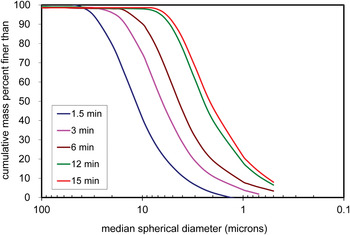
The effects of milling time were tested using quartz sand (sieved to between −40 and +45 U.S. mesh size equal to 420–350 µm in diameter) from Lane Mountain (Washington). Quartz was chosen as a limiting case as it is a common, hard, rock-forming mineral of high chemical purity. A sample mass of 4.0 g was chosen to limit relative contamination by corundum to less than 5 wt% (even for grinding times as long as 15 min), and to yield sample volumes between 2.3 and 2.5 cm3. Wet milling of separate samples was undertaken for periods of 1.5, 3, 6, 12, and 15 min, each with 10 ml of ethanol and corundum-grinding elements. Particle size distributions of the resultant powders were determined by an X-ray gravitational-sedimentation method with a Sedigraph 5100 instrument (Jillavenkatesa et al., Reference Jillavenkatesa, Dapkunas and Lum2001). This instrument was calibrated with a garnet reference material (part 004-16810, lot W20-65428-23) supplied by the instrument manufacturer, Micromeritics (Georgia). The reference value of the mass median equivalent spherical diameter of this garnet powder is 2.4(2) µm; duplicate runs of this material with the Sedigraph 5100 yielded values of 2.36 and 2.42 µm. An aqueous solution of 0.05% sodium hexametaphosphate was used for the particle suspension, with run masses for the milled quartz samples of 2–3 g and liquid volumes of 40–50 ml. Figure 1 shows the particle size distributions determined for the five different milling periods, and Table I summarizes these data for selected points and ranges in the cumulative mass distributions.
Particle size distributions of five samples of Lane Mountain quartz sand, milled for different periods in corundum (grinding time increases from left to right).

Summary of cumulative mass particle size distribution data for 4.0-g quartz samples milled with corundum-grinding elements.

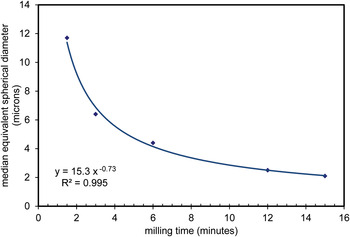
The power–law relationship between the mass median equivalent spherical diameter (variable y) of Lane Mountain quartz ground with corundum rods and milling time (variable x) is

and is shown in Figure 2. These results are comparable to those previously reported for similar conditions (O'Connor and Chang, Reference O'Connor and Chang1986), and indicate that milling 4.0 g of quartz sand with 10 ml of ethanol for 10 min will yield a powder with less than 5 wt% corundum contamination, and a median particle size of about 2.8 µm in diameter.
Median particle size as a function of milling time for 4.0-g quartz samples ground with corundum rods in a McCrone Micronizing Mill. Data are shown as points, along with a best-fit power-law function.

III. Miniaturization
Mechanical milling can provide a narrow range of fine particle sizes in an efficient and reproducible fashion in comparison with the tedium of grinding materials by hand. However, for small samples (<1 g), hand grinding has been preferred, even in recent times (Oerter et al., Reference Oerter, Brimhall, Redmond and Walker2007), as most mechanical mills are optimized for larger samples. The goal of this work is to provide a method for mechanical milling of 0.1–1.0 g samples with a McCrone Micronizing Mill.
A. McCrone Mill
The commercial McCrone Micronizing Mill uses a ~125 ml polypropylene jar with a gasketless-threaded polyethylene or hardened polyvinyl chloride lid (disposable Teflon tape may be used on the threads to minimize leakage during prolonged grinding). A set of 48 cylindrical-grinding elements is arranged (with the use of a plastic loading device) into six layers of eight elements in a jar; the mass of the assembly varies from about 273 to 341 g depending on whether agate- or corundum-grinding elements are used. Although it is possible to obtain zirconia rods from other sources (Eberl, Reference Eberl2003), the McCrone Group only supplies agate- or corundum-chamfered cylindrical-grinding elements, whose initial dimensions are 12.7 mm in diameter and 13.0 mm in height.
B. Polypropylene vessel
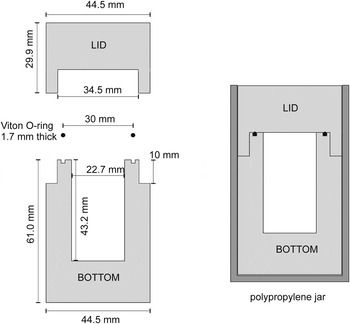
For miniaturization of the milling process, rather than producing an entirely new jar, it proved convenient to design a cylindrical-grinding vessel that could be inserted in the conventional jar supplied by the McCrone Group. This jar has an internal diameter of 45.0 mm and internal height of 81.4 mm. A solid polypropylene rod was obtained from Johnson Industrial Plastics (Edmonton), and machined in the Department of Chemistry, University of Alberta. The vessel consists of a base and knurled lid that can be threaded together and sealed by compression of a 30-mm diameter Viton O-ring, and which fits inside the conventional jar (Figure 3). The volume of the cavity in this polypropylene vessel is about one-seventh of the conventional jar supplied by the McCrone Group.
Cross-section of the cylindrical grinding vessel designed for miniaturized milling.

C. Tungsten carbide
For the new grinding elements to be used in the vessel, cobalt-cemented tungsten carbide (Upadhyaya, Reference Upadhyaya1998) grade K6UF was obtained from Ultra Carbide (Michigan), as this grade of material is recommended by this manufacturer for milling applications that require superior resistance to abrasion. Fine-grained cobalt-cemented tungsten carbide was used as a standard reference material for micro-indentation hardness testing of ceramics (Quinn et al., Reference Quinn, Gettings and Ives2004). The nominal composition of K6UF is 6% Co and 94% WC (including subsidiary Cr3C2 and VC). Elemental analysis performed by the semi-absolute method of instrumental neutron activation (Bergerioux et al., Reference Bergerioux, Kennedy and Zikovsky1979) revealed the composition of this material: 84.5% W, 5.7(3)% Co, 3.6% Cr and 0.118(1)% V, equivalent to 90.0% WC with 5.7% Co, 4.1% Cr3C2 and 0.146% VC.
D. Machining
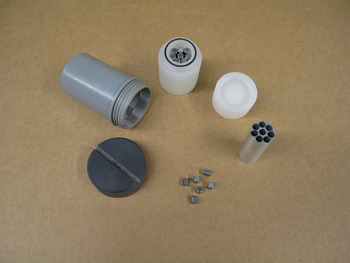
The tungsten carbide shafts supplied by Ultra Carbide were machined by Extramet Products (Pennsylvania) into cylindrical rods with dimensions of 6.35-mm diameter and 6.90-mm height to h8 ISO mechanical tolerance with chamfered edges. The hardness of this polycrystalline tungsten carbide, 18.6 GPa (according to Ultra Carbide), is similar to that of dense sintered corundum, 21 GPa (Krell, Reference Krell1995), whereas its effective density is four times greater than that reported for the corundum rods originally supplied with the McCrone Micronizing Mill: 14.8 g cm−3 (Ultra Carbide) vs. 3.7 g cm−3 (McCrone Group). Combined with the thick polypropylene vessel, the mass of the tungsten carbide-based grinding media and jar is 323 g, intermediate between the masses of the agate- and corundum-loaded assemblies. To facilitate the packing of the tungsten carbide rods into the white polypropylene vessel, an aluminum-loading device (outer diameter 22.6 mm, individual hole diameter 6.4 mm, Figure 4) was fabricated.
Miniaturized-grinding vessel for a McCrone Micronizing Mill. Clockwise from top center: white polypropylene vessel base loaded with tungsten carbide rods and O-ring, vessel lid, aluminum loading device, loose tungsten carbide rods, hardened polyvinyl chloride lid, and gray polypropylene jar.

IV. Results
To test the efficacy of the miniaturized tungsten carbide milling assembly, 500 mg aliquots of quartz sand (sieved to between −40 and +45 U.S. mesh size, equal to 420–350 µm diameter) from Lane Mountain (Washington) were milled for 2.75 or 5.67 min together with 2.0–2.5 ml of ethanol. A stopwatch is required for short and precise milling periods as the timer on the McCrone Micronizing Mill is not calibrated in seconds. As the total mass of the tungsten carbide assembly is similar to that of the corundum- or agate-based assemblies, the oscillation energies experienced by the different assemblies are comparable. However, the greater density of tungsten carbide leads to more rapid milling.
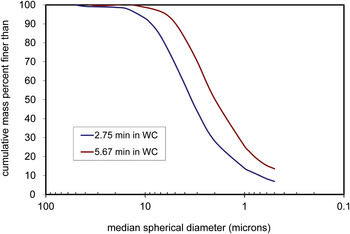
Particle size distributions were determined as described above using the Sedigraph 5100 instrument (which requires a sample mass of several grams) by pooling four 500-mg powder aliquots (each ground for the same period). Figure 5 shows the particle size distributions determined for the two different milling periods, and Table II summarizes these data for selected points and ranges in the cumulative mass distributions. If the power–law relationship between median grain size (variable y from Equation 1) and grinding time (variable x from Equation 1) determined for the 4.0-g quartz samples ground in corundum (Table I and Figure 2) is scaled to match the data for the 500-mg quartz samples ground in tungsten carbide (Table II), the resultant expression is

Particle size distributions of two pooled samples of Lane Mountain quartz sand, milled for different periods in tungsten carbide (grinding time increases from left to right).

Summary of cumulative mass particle size distribution data for 500-mg quartz samples milled with tungsten carbide grinding elements.

The proportions of contamination of tungsten carbide derived from the milling rods were determined by absolute instrumental neutron activation analysis (Heft and Koszykowski, Reference Heft and Koszykowski1982) to be 0.41(1) and 0.78(1) wt% for quartz milled for 2.75 and 5.67 min, respectively; these results yield an average rate of contamination of 0.72(4) mg of tungsten carbide per minute of milling.
V. DISCUSSION
The goal of mechanical milling is the reproducible size-reduction of a material. One of the major deleterious effects of grinding is the contamination of the sample by the grinding medium (Hickson and Juras, Reference Hickson and Juras1986; Buhrke et al., Reference Buhrke, Jenkins and Smith1998). In the case of a McCrone Micronizing Mill, Van Grieken et al. (Reference Van Grieken, Van De Velde and Robberecht1980) established that the rate of sample contamination is relatively constant. The results presented here for corundum media (in the conventional jar supplied by the McCrone Group) are consistent with this conclusion and yield a rate of contamination by corundum of 12(2) mg min−1. In conjunction with the relationship between particle size and grinding time [Eq. (1)], it may be concluded that milling in corundum media of 4.0 g of medium-grained quartz sand with 10 ml of ethanol for 10 min will yield a powder with 3.0(5) wt% corundum contamination, and a median particle size of about 2.8 µm in diameter. This amount of contamination, although low, is not insignificant, and may be measured using the Rietveld method (Madsen and Scarlett, Reference Madsen, Scarlett, Dinnebier and Billinge2008).
In contrast, the rate of contamination by tungsten carbide yielded by the miniaturized milling assembly is 0.72(4) mg min−1. This rate of contamination is about 6(1)% of that given by the conventional corundum grinding assembly. In conjunction with the relationship between particle size and grinding time [Eq. (2)], it may be concluded that milling in miniaturized tungsten carbide media of 500 mg of medium-grained quartz sand with ~2 ml of ethanol for 3.5 min will yield a powder with 0.50(3) wt% tungsten carbide contamination, and a median particle size of about 2.8 µm in diameter. This amount of contamination is likely below the detection limits of the routine Rietveld methods (Madsen and Scarlett, Reference Madsen, Scarlett, Dinnebier and Billinge2008).
For comparison, to achieve the same median grain size a medium-grained 500-mg quartz sample milled in the miniaturized tungsten carbide assembly requires about one-third the grinding time required by a 4.0-g quartz sample milled in the conventional corundum assembly. Although the miniaturized-grinding assembly permits milling of much smaller samples (as its volume is one-seventh that of the conventional jar) in a shorter period with considerably less contamination, it still must be ensured that the ground specimen is representative of the bulk material (Buhrke et al., Reference Buhrke, Jenkins and Smith1998). In addition, despite the relatively low amount of contamination yielded by the miniaturized milling assembly, a sample ground in tungsten carbide is not ideal for routine elemental analysis by neutron activation. The activated tungsten emits a significant number of gamma rays across a wide range of energies resulting in more complex spectra, spectral interferences, and increased detection limits for many elements because of the elevated Compton background.
DISCLAIMER
The identification of brand names, suppliers, and manufacturers in this report is made to provide complete details of the experimental procedure and does not imply recommendation or endorsement or that these products are necessarily the best available for the purpose.
Acknowledgements
We thank the Department of Earth and Atmospheric Sciences for access to, and support of, the X-ray diffraction facilities and Sedigraph instrument. We gratefully acknowledge the donation of the Rigaku Ultima IV diffractometer and accompanying equipment to the University of Alberta by ConocoPhillips Canada. We thank the machine shop of the Department of Chemistry at the University of Alberta for their efforts.